CEREBROSPINAL FLUID
(CSF)
CONTENTS
• INTRODUCTION
• FORMATION
• COMPOSITION
• CIRCULATION
• FUNCTIONS
• APPLIED PHYSIOLOGY
INTRODUCTION
What is Cerebrospinal fluid?
Cerebrospinal fluid is a clear, colourless transparent tissue fluid that is
formed mainly in the ventricular plexus, distributed within the
ventricular system, basal cisterns and subarachnoid space.
FORMATION
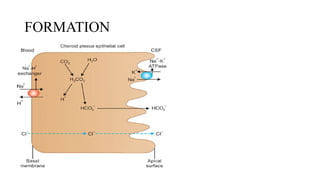
About two thirds of CSF is secreted from the choroid plexus in the four
ventricles, mainly the two lateral ventricles.
One third of CSF is secreted by ependymal surfaces of all the ventricles
and by the arachnoid membranes.
In an adult, the intracranial volume is about 1700ml, of which the brain
measures 1200-1400ml and CSF acounts for 70-160ml.
CSF is formed at the rate of 500ml/day, However CSF is completely
replaced 3-4 times daily.
MECHANISM OF FORMATION
CSF is formed by a combination of passive diffusion, active transport
and facilitated diffusion
FORMATION
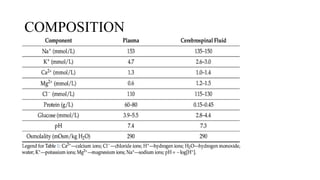
COMPOSITION
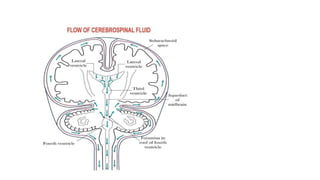
CIRCULATION
FUNCTIONS
• Protection– CSF acts as a hydraulic shock absorber preventing any
mechanical injury to the brain by coming in contact with the cranium.
• Buoyancy- The brain weighs approximately 1500g, CSF provides
buoyancy to support the weight of the brain.
• Homeostasis- Regulates the distribution of metabolites surrounding
the brain, provides a constant and controlled environment for the
brain cells.
FUNCTIONS
• Transport and clearance- Provides transport and exchange of
nutrients, waste products from the brain cells are excreted into the
CSF, which then drains into the bloodstream.
• Diagnosis of diseases- CSF can be used to diagnose diseases such as
meningitis.
APPLIED PHYSIOLOGY
• Lumbar Puncture- Sampling of CSF by lumbar puncture is an
important diagnostic tool in neurology.
• Hydrocephalus- Increase in the volume of CSF resulting in
enlargement of cerebral ventricles
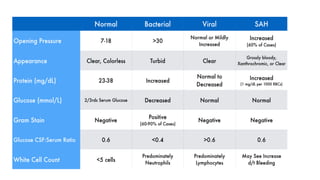
• Examination of CSF (Meningitis)
CEREBROSPINAL FLUID FLOW. POWERPOINT(ppt

CEREBROSPINAL FLUID FLOW. POWERPOINT(ppt

  • 1.
  • 2.
    CONTENTS • INTRODUCTION • FORMATION •COMPOSITION • CIRCULATION • FUNCTIONS • APPLIED PHYSIOLOGY
  • 3.
    INTRODUCTION What is Cerebrospinalfluid? Cerebrospinal fluid is a clear, colourless transparent tissue fluid that is formed mainly in the ventricular plexus, distributed within the ventricular system, basal cisterns and subarachnoid space.
  • 4.
    FORMATION About two thirdsof CSF is secreted from the choroid plexus in the four ventricles, mainly the two lateral ventricles. One third of CSF is secreted by ependymal surfaces of all the ventricles and by the arachnoid membranes. In an adult, the intracranial volume is about 1700ml, of which the brain measures 1200-1400ml and CSF acounts for 70-160ml. CSF is formed at the rate of 500ml/day, However CSF is completely replaced 3-4 times daily.
  • 5.
    MECHANISM OF FORMATION CSFis formed by a combination of passive diffusion, active transport and facilitated diffusion
  • 6.
  • 7.
  • 8.
  • 10.
    FUNCTIONS • Protection– CSFacts as a hydraulic shock absorber preventing any mechanical injury to the brain by coming in contact with the cranium. • Buoyancy- The brain weighs approximately 1500g, CSF provides buoyancy to support the weight of the brain. • Homeostasis- Regulates the distribution of metabolites surrounding the brain, provides a constant and controlled environment for the brain cells.
  • 11.
    FUNCTIONS • Transport andclearance- Provides transport and exchange of nutrients, waste products from the brain cells are excreted into the CSF, which then drains into the bloodstream. • Diagnosis of diseases- CSF can be used to diagnose diseases such as meningitis.
  • 12.
    APPLIED PHYSIOLOGY • LumbarPuncture- Sampling of CSF by lumbar puncture is an important diagnostic tool in neurology. • Hydrocephalus- Increase in the volume of CSF resulting in enlargement of cerebral ventricles • Examination of CSF (Meningitis)