Ubaidur Rahaman
Internist and Critical Care Specialist
HYPONATREMIA
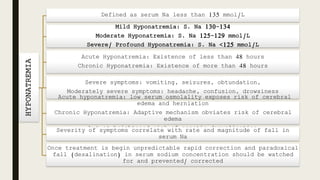
Defined as serum Na less than 135 mmol/L
Acute Hyponatremia: Existence of less than 48 hours
Chronic Hyponatremia: Existence of more than 48 hours
Severe symptoms: vomiting, seizures, obtundation,
Moderately severe symptoms: headache, confusion, drowsiness
Acute hyponatremia: low serum osmolality exposes risk of cerebral
edema and herniation
Chronic Hyponatremia: Adaptive mechanism obviates risk of cerebral
edema
but at heightened risk of osmotic demyelinationSeverity of symptoms correlate with rate and magnitude of fall in
serum Na
Once treatment is begin unpredictable rapid correction and paradoxical
fall (desalination) in serum sodium concentration should be watched
for and prevented/ corrected
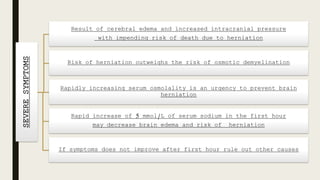
SEVERESYMPTOMS Result of cerebral edema and increased intracranial pressure
with impending risk of death due to herniation
Risk of herniation outweighs the risk of osmotic demyelination
Rapidly increasing serum osmolality is an urgency to prevent brain
herniation
Rapid increase of 5 mmol/L of serum sodium in the first hour
may decrease brain edema and risk of herniation
If symptoms does not improve after first hour rule out other causes
HYPONATREMIA
SEVERE SYMPTOMS
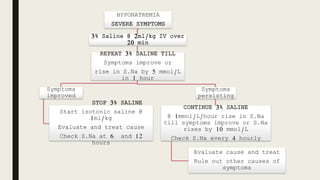
3% Saline @ 2ml/kg IV over
20 min
REPEAT 3% SALINE TILL
Symptoms improve or
rise in S.Na by 5 mmol/L
in 1 hour
Symptoms
improved
STOP 3% SALINE
Start isotonic saline @
1ml/kg
Evaluate and treat cause
Check S.Na at 6 and 12
hours
Symptoms
persisting
CONTINUE 3% SALINE
@ 1mmol/L/hour rise in S.Na
till symptoms improve or S.Na
rises by 10 mmol/L
Check S.Na every 4 hourly
Evaluate cause and treat
Rule out other causes of
symptoms
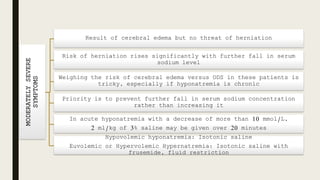
MODERATELYSEVERE
SYMPTOMS Result of cerebral edema but no threat of herniation
Risk of herniation rises significantly with further fall in serum
sodium level
Weighing the risk of cerebral edema versus ODS in these patients is
tricky, especially if hyponatremia is chronic
Priority is to prevent further fall in serum sodium concentration
rather than increasing it
In acute hyponatremia with a decrease of more than 10 mmol/L,
2 ml/kg of 3% saline may be given over 20 minutes
Hypovolemic hyponatremia: Isotonic saline
Euvolemic or Hypervolemic Hypernatremia: Isotonic saline with
frusemide, fluid restriction
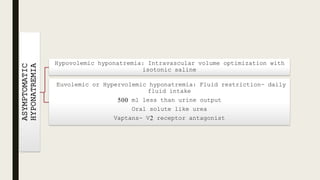
ASYMPTOMATIC
HYPONATREMIA
Hypovolemic hyponatremia: Intravascular volume optimization with
isotonic saline
Euvolemic or Hypervolemic hyponatremia: Fluid restriction- daily
fluid intake
500 ml less than urine output
Oral solute like urea
Vaptans- V2 receptor antagonist
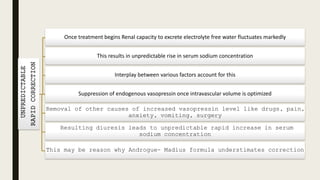
UNPREDICTABLE
RAPIDCORRECTION
Once treatment begins Renal capacity to excrete electrolyte free water fluctuates markedly
This results in unpredictable rise in serum sodium concentration
Interplay between various factors account for this
Suppression of endogenous vasopressin once intravascular volume is optimized
Removal of other causes of increased vasopressin level like drugs, pain,
anxiety, vomiting, surgery
Resulting diuresis leads to unpredictable rapid increase in serum
sodium concentration
This may be reason why Androgue- Madius formula understimates correction
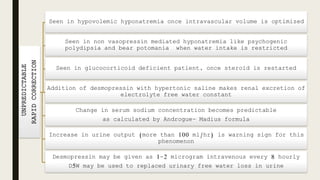
UNPREDICTABLE
RAPIDCORRECTION
Seen in hypovolemic hyponatremia once intravascular volume is optimized
Seen in non vasopressin mediated hyponatremia like psychogenic
polydipsia and bear potomania when water intake is restricted
Seen in glucocorticoid deficient patient, once steroid is restarted
Addition of desmopressin with hypertonic saline makes renal excretion of
electrolyte free water constant
Change in serum sodium concentration becomes predictable
as calculated by Androgue- Madius formula
Increase in urine output (more than 100 ml/hr) is warning sign for this
phenomenon
Desmopressin may be given as 1-2 microgram intravenous every 8 hourly
D5W may be used to replaced urinary free water loss in urine
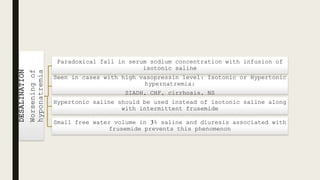
DESALINATION
Worseningof
hyponatremia
Paradoxical fall in serum sodium concentration with infusion of
isotonic saline
Seen in cases with high vasopressin level: Isotonic or Hypertonic
hypernatremia:
SIADH, CHF, cirrhosis, NS
Hypertonic saline should be used instead of isotonic saline along
with intermittent frusemide
Small free water volume in 3% saline and diuresis associated with
frusemide prevents this phenomenon
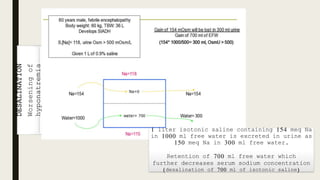
1 liter isotonic saline containing 154 meq Na
in 1000 ml free water is excreted in urine as
150 meq Na in 300 ml free water,
Retention of 700 ml free water which
further decreases serum sodium concentration
(desalination of 700 ml of isotonic saline)
DESALINATION
Worseningof
hyponatremia
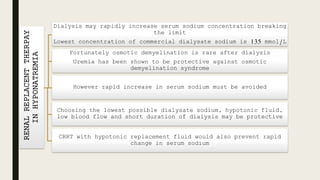
RENALREPLACENTTHERPAY
INHYPONATREMIA
Dialysis may rapidly increase serum sodium concentration breaking
the limit
Lowest concentration of commercial dialysate sodium is 135 mmol/L
Fortunately osmotic demyelination is rare after dialysis
Uremia has been shown to be protective against osmotic
demyelination syndrome
However rapid increase in serum sodium must be avoided
Choosing the lowest possible dialysate sodium, hypotonic fluid,
low blood flow and short duration of dialysis may be protective
CRRT with hypotonic replacement fluid would also prevent rapid
change in serum sodium
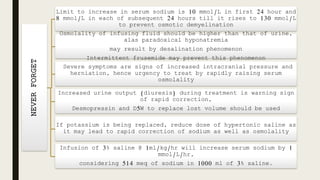
NEVERFORGET
Limit to increase in serum sodium is 10 mmol/L in first 24 hour and
8 mmol/L in each of subsequent 24 hours till it rises to 130 mmol/L
to prevent osmotic demyelination
Osmolality of infusing fluid should be higher than that of urine,
alas paradoxical hyponatremia
may result by desalination phenomenon
Intermittent frusemide may prevent this phenomenon
Severe symptoms are signs of increased intracranial pressure and
herniation, hence urgency to treat by rapidly raising serum
osmolality
Increased urine output (diuresis) during treatment is warning sign
of rapid correction,
Desmopressin and D5W to replace lost volume should be used
If potassium is being replaced, reduce dose of hypertonic saline as
it may lead to rapid correction of sodium as well as osmolality
Infusion of 3% saline @ 1ml/kg/hr will increase serum sodium by 1
mmol/L/hr,
considering 514 meq of sodium in 1000 ml of 3% saline.
REFERENCES
Clinical practice guidelines on diagnosis and treatment of
hyponatremia. European Journal of Endocrinology, 2014
Treatment of hyponatremia. Seminars in Nephrology 2009
Management of hyponatremia in the ICU. Chest 2013
Hyponatremia. NEJM 2000

Hyponatremia management pearls 1

  • 1.
    Ubaidur Rahaman Internist andCritical Care Specialist
  • 2.
    HYPONATREMIA Defined as serumNa less than 135 mmol/L Acute Hyponatremia: Existence of less than 48 hours Chronic Hyponatremia: Existence of more than 48 hours Severe symptoms: vomiting, seizures, obtundation, Moderately severe symptoms: headache, confusion, drowsiness Acute hyponatremia: low serum osmolality exposes risk of cerebral edema and herniation Chronic Hyponatremia: Adaptive mechanism obviates risk of cerebral edema but at heightened risk of osmotic demyelinationSeverity of symptoms correlate with rate and magnitude of fall in serum Na Once treatment is begin unpredictable rapid correction and paradoxical fall (desalination) in serum sodium concentration should be watched for and prevented/ corrected
  • 3.
    SEVERESYMPTOMS Result ofcerebral edema and increased intracranial pressure with impending risk of death due to herniation Risk of herniation outweighs the risk of osmotic demyelination Rapidly increasing serum osmolality is an urgency to prevent brain herniation Rapid increase of 5 mmol/L of serum sodium in the first hour may decrease brain edema and risk of herniation If symptoms does not improve after first hour rule out other causes
  • 4.
    HYPONATREMIA SEVERE SYMPTOMS 3% Saline@ 2ml/kg IV over 20 min REPEAT 3% SALINE TILL Symptoms improve or rise in S.Na by 5 mmol/L in 1 hour Symptoms improved STOP 3% SALINE Start isotonic saline @ 1ml/kg Evaluate and treat cause Check S.Na at 6 and 12 hours Symptoms persisting CONTINUE 3% SALINE @ 1mmol/L/hour rise in S.Na till symptoms improve or S.Na rises by 10 mmol/L Check S.Na every 4 hourly Evaluate cause and treat Rule out other causes of symptoms
  • 5.
    MODERATELYSEVERE SYMPTOMS Result ofcerebral edema but no threat of herniation Risk of herniation rises significantly with further fall in serum sodium level Weighing the risk of cerebral edema versus ODS in these patients is tricky, especially if hyponatremia is chronic Priority is to prevent further fall in serum sodium concentration rather than increasing it In acute hyponatremia with a decrease of more than 10 mmol/L, 2 ml/kg of 3% saline may be given over 20 minutes Hypovolemic hyponatremia: Isotonic saline Euvolemic or Hypervolemic Hypernatremia: Isotonic saline with frusemide, fluid restriction
  • 6.
    ASYMPTOMATIC HYPONATREMIA Hypovolemic hyponatremia: Intravascularvolume optimization with isotonic saline Euvolemic or Hypervolemic hyponatremia: Fluid restriction- daily fluid intake 500 ml less than urine output Oral solute like urea Vaptans- V2 receptor antagonist
  • 7.
    UNPREDICTABLE RAPIDCORRECTION Once treatment beginsRenal capacity to excrete electrolyte free water fluctuates markedly This results in unpredictable rise in serum sodium concentration Interplay between various factors account for this Suppression of endogenous vasopressin once intravascular volume is optimized Removal of other causes of increased vasopressin level like drugs, pain, anxiety, vomiting, surgery Resulting diuresis leads to unpredictable rapid increase in serum sodium concentration This may be reason why Androgue- Madius formula understimates correction
  • 8.
    UNPREDICTABLE RAPIDCORRECTION Seen in hypovolemichyponatremia once intravascular volume is optimized Seen in non vasopressin mediated hyponatremia like psychogenic polydipsia and bear potomania when water intake is restricted Seen in glucocorticoid deficient patient, once steroid is restarted Addition of desmopressin with hypertonic saline makes renal excretion of electrolyte free water constant Change in serum sodium concentration becomes predictable as calculated by Androgue- Madius formula Increase in urine output (more than 100 ml/hr) is warning sign for this phenomenon Desmopressin may be given as 1-2 microgram intravenous every 8 hourly D5W may be used to replaced urinary free water loss in urine
  • 9.
    DESALINATION Worseningof hyponatremia Paradoxical fall inserum sodium concentration with infusion of isotonic saline Seen in cases with high vasopressin level: Isotonic or Hypertonic hypernatremia: SIADH, CHF, cirrhosis, NS Hypertonic saline should be used instead of isotonic saline along with intermittent frusemide Small free water volume in 3% saline and diuresis associated with frusemide prevents this phenomenon
  • 10.
    1 liter isotonicsaline containing 154 meq Na in 1000 ml free water is excreted in urine as 150 meq Na in 300 ml free water, Retention of 700 ml free water which further decreases serum sodium concentration (desalination of 700 ml of isotonic saline) DESALINATION Worseningof hyponatremia
  • 11.
    RENALREPLACENTTHERPAY INHYPONATREMIA Dialysis may rapidlyincrease serum sodium concentration breaking the limit Lowest concentration of commercial dialysate sodium is 135 mmol/L Fortunately osmotic demyelination is rare after dialysis Uremia has been shown to be protective against osmotic demyelination syndrome However rapid increase in serum sodium must be avoided Choosing the lowest possible dialysate sodium, hypotonic fluid, low blood flow and short duration of dialysis may be protective CRRT with hypotonic replacement fluid would also prevent rapid change in serum sodium
  • 12.
    NEVERFORGET Limit to increasein serum sodium is 10 mmol/L in first 24 hour and 8 mmol/L in each of subsequent 24 hours till it rises to 130 mmol/L to prevent osmotic demyelination Osmolality of infusing fluid should be higher than that of urine, alas paradoxical hyponatremia may result by desalination phenomenon Intermittent frusemide may prevent this phenomenon Severe symptoms are signs of increased intracranial pressure and herniation, hence urgency to treat by rapidly raising serum osmolality Increased urine output (diuresis) during treatment is warning sign of rapid correction, Desmopressin and D5W to replace lost volume should be used If potassium is being replaced, reduce dose of hypertonic saline as it may lead to rapid correction of sodium as well as osmolality Infusion of 3% saline @ 1ml/kg/hr will increase serum sodium by 1 mmol/L/hr, considering 514 meq of sodium in 1000 ml of 3% saline.
  • 13.
    REFERENCES Clinical practice guidelineson diagnosis and treatment of hyponatremia. European Journal of Endocrinology, 2014 Treatment of hyponatremia. Seminars in Nephrology 2009 Management of hyponatremia in the ICU. Chest 2013 Hyponatremia. NEJM 2000