Bronchiectasis
By: Karunesh Kumar
Bronchiectasis
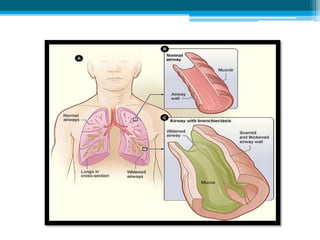
• A condition characterized by chronic
permanent dilation & destruction of bronchi
due to destructive changes in the elastic and
muscular layers of bronchial walls.
• May be diffuse or localized resulting in
impairment of the drainage of bronchial
secretions.
Aetiology
Congenital
• Cystic Fibrosis (Most common cause)
• Primary hypogammaglobinemia leading to recurrent
infection
• Ciliary dysfunction syndrome
Acquired (In children)
• Secondary to pneumonia which occurs often as
complication of whooping cough and measles
Bronchiectasis can also be congenital, as in:
• Williams-Campbell syndrome, in which there is an
absence of annular bronchial cartilage.
• Marnier-Kuhn syndrome (congenital
tracheobronchomegaly), in which there is a
connective tissue disorder.
Other disease entities associated with bronchiectasis
are:
• Right middle lobe syndrome (chronic extrinsic
compression of right middle lobe bronchus by hilar
lymph nodes)
• Yellow nail syndrome (pleural effusion,
lymphedema, discoloured nails).
Pathogenesis
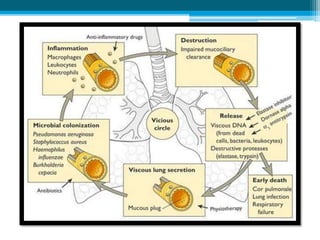
• The common thread in the pathogenesis of
bronchiectasis consists of difficulty clearing
secretions & recurrent infections with a “vicious
circle” of infection and inflammation resulting in
airway injury and remodelling.
3 mechanisms:
1. Obstruction- can occur because of tumour, foreign
body, impacted mucus due to poor muco-ciliary
clearance, external compression, bronchial webs, and
atresia.
2. Infections d/t Bordetella pertusis, measles, rubella,
adenovirus, and mycobacterium tuberculosis induce
chronic inflammation.
3. Chronic inflammation contributes to the mechanism
by which obstruction leads to bronchiectasis.
• Inflammatory mediators such as neutrophil elastase,
interleukin-6, interleukin-8, and Tumor necrosis factor-
α (TNF-α) have been found to be elevated in the
airways of patients with bronchiectasis
Pathological forms of Bronchiectasis
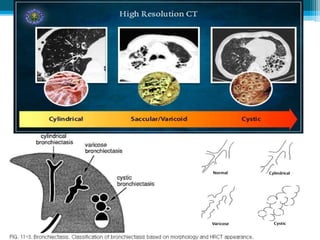
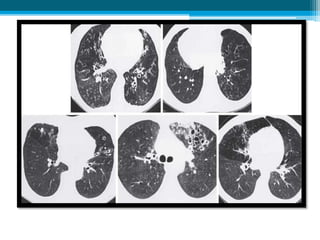
• Cylindrical bronchiectasis- bronchial outlines are
regular, but there’s diffuse dilatation of the bronchial
unit. Bronchial lumen ends abruptly because of mucous
plugging.
• Tramline appearance on CT scan.
• Varicose bronchiectasis- degree of dilatation is greater,
local constrictions cause irregularity of outline
resembling that of varicose veins.
• Beaded contour on CT scan.
Cont..
• Saccular (Cystic) bronchiectasis- bronchial dilatation
progresses and results in ballooning of bronchi that
end in fluid or mucous filled sacs.
• Most severe form of Bronchiectasis.
• Prebronchiectasis- chronic or recurrent
endobronchial infection with non specific HRCT
changes – may be reversible.
Clinical Features
• Cough: Chronic productive cough usually worse in the
morning & often brought on by change in posture.
Cough occurs due to accumulation of pus in dilated
bronchi.
• Sputum: copious & purulent
• Fever
• Hemoptysis
• Anorexia and poor weight gain may occur as time
passes.
• Crackles localized to the affected area
• Wheezing as well as digital clubbing may also occur
Diagnosis
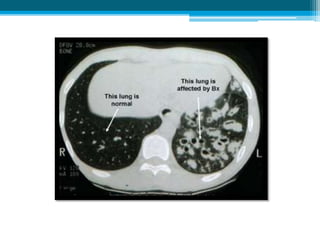
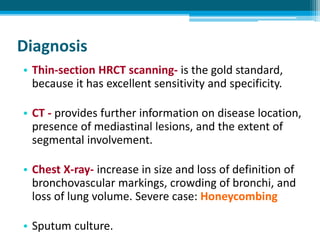
• Thin-section HRCT scanning- is the gold standard,
because it has excellent sensitivity and specificity.
• CT - provides further information on disease location,
presence of mediastinal lesions, and the extent of
segmental involvement.
• Chest X-ray- increase in size and loss of definition of
bronchovascular markings, crowding of bronchi, and
loss of lung volume. Severe case: Honeycombing
• Sputum culture.
Treatment
• Aims at decreasing airway obstruction and controlling infection.
• Postural drainage and control Infection.
• 2 to 4 wk of parenteral antibiotics is often necessary to manage acute
exacerbations adequately.
• Amoxicillin/ Clavulanic acid (22.5mg/kg/dose twice daily) has been
successful at treating the exacerbations.
• Long-term prophylactic oral (macrolide) or nebulized antibiotics (e.g.,
tobramycin, colistin, aztreonam) may be beneficial.
• Airway hydration (inhaled hypertonic saline or mannitol) also improves
quality of life in adults with bronchiectasis.
• Any underlying disorder (immunodeficiency, aspiration) that may be
contributing must be addressed.
Prognosis
• Children with bronchiectasis often suffer from
recurrent pulmonary illnesses.
Reference
• Kliegman, R., Stanton, B., St. Geme, J., Schor, N. and
Behrman, R. (n.d.). Nelson textbook of pediatrics.
20th ed.
• Short textbook of Medical Diagnosis and
Management by Mohammad Inam Danish

Bronchiectasis

  • 1.
  • 2.
    Bronchiectasis • A conditioncharacterized by chronic permanent dilation & destruction of bronchi due to destructive changes in the elastic and muscular layers of bronchial walls. • May be diffuse or localized resulting in impairment of the drainage of bronchial secretions.
  • 6.
    Aetiology Congenital • Cystic Fibrosis(Most common cause) • Primary hypogammaglobinemia leading to recurrent infection • Ciliary dysfunction syndrome Acquired (In children) • Secondary to pneumonia which occurs often as complication of whooping cough and measles
  • 7.
    Bronchiectasis can alsobe congenital, as in: • Williams-Campbell syndrome, in which there is an absence of annular bronchial cartilage. • Marnier-Kuhn syndrome (congenital tracheobronchomegaly), in which there is a connective tissue disorder.
  • 8.
    Other disease entitiesassociated with bronchiectasis are: • Right middle lobe syndrome (chronic extrinsic compression of right middle lobe bronchus by hilar lymph nodes) • Yellow nail syndrome (pleural effusion, lymphedema, discoloured nails).
  • 9.
    Pathogenesis • The commonthread in the pathogenesis of bronchiectasis consists of difficulty clearing secretions & recurrent infections with a “vicious circle” of infection and inflammation resulting in airway injury and remodelling.
  • 11.
    3 mechanisms: 1. Obstruction-can occur because of tumour, foreign body, impacted mucus due to poor muco-ciliary clearance, external compression, bronchial webs, and atresia. 2. Infections d/t Bordetella pertusis, measles, rubella, adenovirus, and mycobacterium tuberculosis induce chronic inflammation.
  • 12.
    3. Chronic inflammationcontributes to the mechanism by which obstruction leads to bronchiectasis. • Inflammatory mediators such as neutrophil elastase, interleukin-6, interleukin-8, and Tumor necrosis factor- α (TNF-α) have been found to be elevated in the airways of patients with bronchiectasis
  • 13.
    Pathological forms ofBronchiectasis • Cylindrical bronchiectasis- bronchial outlines are regular, but there’s diffuse dilatation of the bronchial unit. Bronchial lumen ends abruptly because of mucous plugging. • Tramline appearance on CT scan. • Varicose bronchiectasis- degree of dilatation is greater, local constrictions cause irregularity of outline resembling that of varicose veins. • Beaded contour on CT scan.
  • 14.
    Cont.. • Saccular (Cystic)bronchiectasis- bronchial dilatation progresses and results in ballooning of bronchi that end in fluid or mucous filled sacs. • Most severe form of Bronchiectasis. • Prebronchiectasis- chronic or recurrent endobronchial infection with non specific HRCT changes – may be reversible.
  • 16.
    Clinical Features • Cough:Chronic productive cough usually worse in the morning & often brought on by change in posture. Cough occurs due to accumulation of pus in dilated bronchi. • Sputum: copious & purulent • Fever • Hemoptysis • Anorexia and poor weight gain may occur as time passes. • Crackles localized to the affected area • Wheezing as well as digital clubbing may also occur
  • 17.
    Diagnosis • Thin-section HRCTscanning- is the gold standard, because it has excellent sensitivity and specificity. • CT - provides further information on disease location, presence of mediastinal lesions, and the extent of segmental involvement. • Chest X-ray- increase in size and loss of definition of bronchovascular markings, crowding of bronchi, and loss of lung volume. Severe case: Honeycombing • Sputum culture.
  • 19.
    Treatment • Aims atdecreasing airway obstruction and controlling infection. • Postural drainage and control Infection. • 2 to 4 wk of parenteral antibiotics is often necessary to manage acute exacerbations adequately. • Amoxicillin/ Clavulanic acid (22.5mg/kg/dose twice daily) has been successful at treating the exacerbations. • Long-term prophylactic oral (macrolide) or nebulized antibiotics (e.g., tobramycin, colistin, aztreonam) may be beneficial. • Airway hydration (inhaled hypertonic saline or mannitol) also improves quality of life in adults with bronchiectasis. • Any underlying disorder (immunodeficiency, aspiration) that may be contributing must be addressed.
  • 20.
    Prognosis • Children withbronchiectasis often suffer from recurrent pulmonary illnesses.
  • 21.
    Reference • Kliegman, R.,Stanton, B., St. Geme, J., Schor, N. and Behrman, R. (n.d.). Nelson textbook of pediatrics. 20th ed. • Short textbook of Medical Diagnosis and Management by Mohammad Inam Danish

Editor's Notes

  • #3 a disease characterized by irreversible abnormal dilatation and anatomic distortion of the bronchial tree
  • #17 The most common complaints in patients with bronchiectasis are cough and production of copious purulent sputum. Younger children may swallow the sputum. Hemoptysis is seen with some frequency. Fever can occur with infectious exacerbations. Anorexia and poor weight gain may occur as time passes. Physical examination typically reveals crackles localized to the affected area, but wheezing as well as digital clubbing may also occur. In severe cases, dyspnea and hypoxemia can occur. Pulmonary function studies may demonstrate an obstructive, restrictive, or mixed pattern. Typically, impaired diffusion capacity is a late finding
  • #19 High-resolution CT scans of lungs with bronchiectasis. A, Dilated and thickened airways (arrow). B, Airways do not taper (arrows) toward the periphery in a patient with Kartagener syndrome. C, Varicose changes (dilated and beaded airways [arrows]). D, Clustered cysts or saccules (arrow) as well as a peripheral infiltrate. E, Middle lobe bronchiectasis (arrows) in a patient with Mycobacterium avium complex infection. (From Barker AF: Bronchiectasis, N Engl J Med 346:1383, 2002.)