MAPLESON BREATHING SYSTEMS MODERATOR : DR  RANJAN  R K PRESENTER :  DR  NIKHIL M P
History   In 1954 Mapleson described and analyzed Five different anaesthetic breathing systems & referred  as Mapleson A – E. Bain circuit  in 1972 by Bain & Spoeral
In 1975 Willis et al described F system & added to above. In 1976 – Lack circuit .
CLASSIFICATION
MAPLESON A Classic & Lack’s modification MAPLESON B MAPLESON C MAPLESON D Classic form & Bain’s modification MAPLESON E MAPLESON F
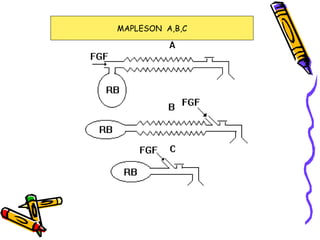
BASED ON THE RESERVOIR BAG POSITION Afferent reservoir system eg:Mapleson A,B,C & Lack’s Afferent limb:delivers FGF from machine to patient end
Efferent reservoir system eg:Mapleson D,E,F & Bain’s Efferent limb:carries expired gas from patient & vents it to the atmosphere through expiratory valve
Breathing systems Bidirectional flow  & without carbondioxide absorption & Semiclosed system MAPLESON SYSTEMS
Mapleson’s assumptions Gases move enblock fresh gas,dead space gas,alveolar gas 2.  Reservoir bag continues to fill,without offering any resistance till it is full
3.  Expiratory valve opens as soon as reservoir bag is full & the pressure inside the system goes above atmospheric pressure 4. Valve remain opens throughout the expiratory phase and closes at the start of next inspiration MAPLESON’S ASSUMPTIONS CONTD.
Afferent reservoir systems
MAPLESON A SYSTEM
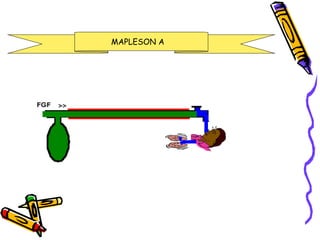
Magill system FGF enters the system near machine end A corrugated tubing connects the reservoir bag to APL valve of the system MAPLESON A
MAPLESON A
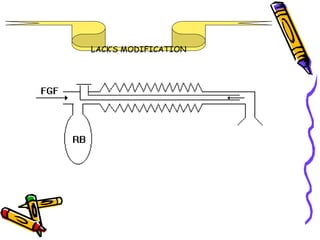
Lack’s modification Expiratory limb –from patient end to APL valve at the machine end of the system 2 forms dual tube  (parallel) tube-within-a-tube(coaxial )
LACK’S MODIFICATION
Functional analysis
Spontaneous breathing
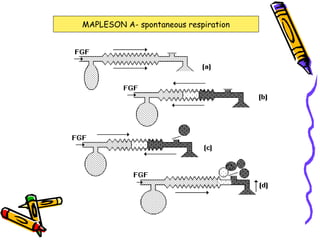
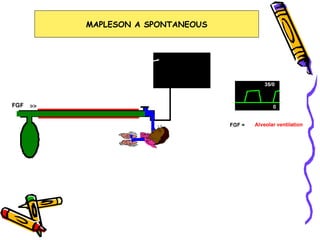
MAPLESON A- spontaneous respiration
a.   During inspiration,FG from the machine and reservoir bag  flows to the patient,RB collapses b. During expiration,FG continues to flow.expired gas (dead space gas & alveolar gas) pushes the FG into RB and collects inside the corrugated tube MAPLESON A – SPONT.  CONTD.
c.  Expiratory valve opens and alveolar gas is vented into atmosphere d.  During Expiratory pause,alveolar gas that had come in contact with the corrugated tube is also vented depending on FGF. MAPLESON A – SPONT.  CONTD.
System is filled with only FG & dead space gas at the start of next inspiration when  FGF =Minute ventilation  Alveolar gas+dead space gas+some of FG also escapes if  FGF>minute ventilation  Some alveolar gas +dead space gas will remain if  FGF < minute ventilation MAPLESON A – SPONT.  CONTD.
MAPLESON A SPONTANEOUS
Controlled ventilation
MAPLESON A- controlled ventilation
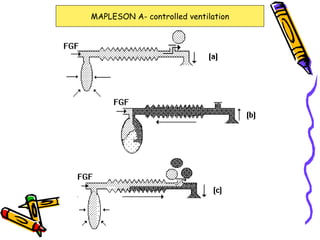
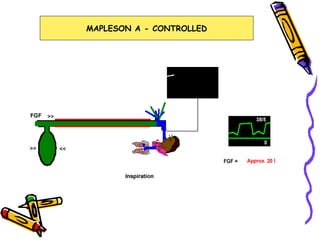
a .  During inspiration,patient gets ventilated with FG & part of  FG is vented through the valve.  b. During expiration,FG  flows into RB & expired gases flows back into corrugated tubing till system is full MAPLESON A- controlled ventilation contd.
c.  During next inspiration alveolar gas is pushed back into alveoli followed by FG  part of expired gas & part of FG  escape through the valve when sufficient pressure is developed rebreathing inefficient for controlled ventilation MAPLESON A- controlled ventilation contd.
MAPLESON A - CONTROLLED
TESTS FOR MAPLESON A SYSTEMS
Tested for leaks by occluding the patient end of the system,closing the APL valve & pressurizing the system APL valve opens TESTS FOR MAPLESON A  CONTD.
To attach a tracheal tube to the inner tubing at the patient end of the system To occlude both limbs at the patient connection with APL valve open TESTS FOR COAXIAL LACKS SYSTEM
FGF Requirement Spontaneous : equal to minute  ventilation  Controlled  :very high & difficult to  predict.
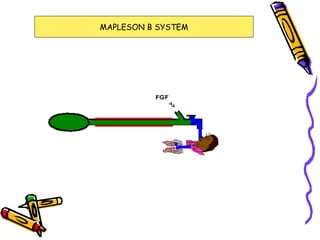
MAPLESON B SYSTEM
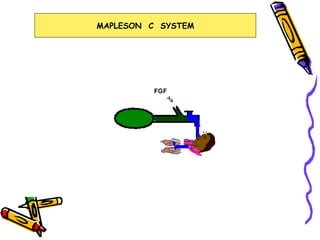
MAPLESON  C  SYSTEM
MAPLESON  A,B,C
Efferent reservoir system
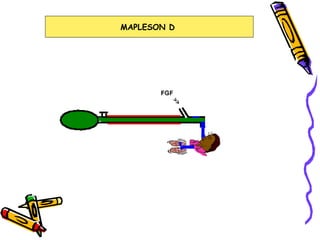
They have a 6mm d. tube as afferent limb and carries FGF from machine  end to patient end . Reservoir bag is attached to efferent limb which is a wide bore corrugated tube EFFERENT RESERVOIR SYSTEM CONTD .
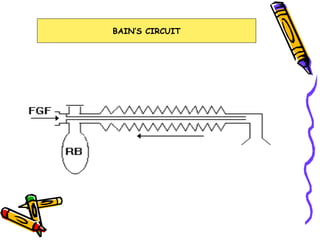
APL valve is placed near the reservoir bag In Bain’s modification afferent & efferent limbs are coaxially placed Inner tube – 6mm Outer tube – 22 mm Length- 180 cms EFFERENT RESERVOIR SYSTEM CONTD .
Mapleson D system
MAPLESON D
BAIN’S CIRCUIT
Functional analysis
Spontaneous respiration
MAPLESON D - Spontaneous respiration
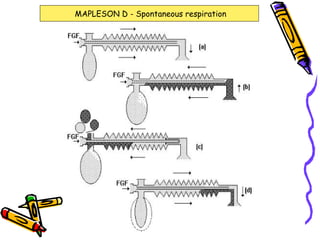
a.During inspiration,FG from the  machine,RB & corrugated tube flow to the patient b.During expiration,FGF to the system at the patient end & expired gas gets continuously mixed with FG as it flows back into corrugated tube & reservoir bag MAPLESON D CONTD .
c.Once the system is full, the excess gas is vented to the atmosphere through the APL valve during expiratory pause FG continues to flow & fill the proximal portion of corrugated tube while mixed gas is vented through the valve MAPLESON D CONTD .
d . During next inspiration,patient breaths FG & mixed gas. MAPLESON D CONTD.

Controlled ventilation
MAPLESON D-controlled ventilation
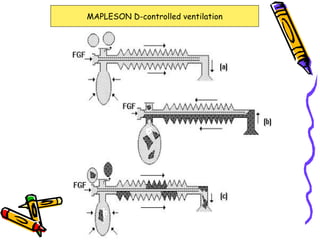
a.During inspiration the patient gets ventilated with FGF from the machine,corrugated tube & RB. b.During expiration the expired gas gets mixed with the fresh gas that is flowing into the system at patient end During expiratory pause the FG continues to enter the system and pushes the mixed gas towards RB. MAPLESON D CONTROLLED CONTD .
c. When next ventilation is initiated patient gets ventilated with the gas in the corrugated tube. As the pressure in the system increases APL valve opens and contents of RB are released into the atmosphere. MAPLESON D CONTROLLED CONTD .
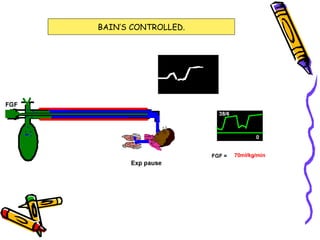
BAIN’S CONTROLLED.
FGF Requirement Spontaneous : 1.5 to 3 times minute  ventilation ( 100 to 300 ml/kg/min) Controlled  :  1 to 2 times minute  ventilation
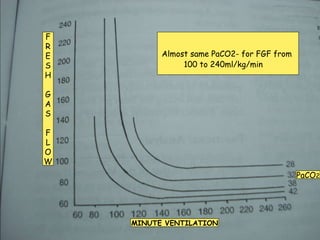
MINUTE VENTILATION F R E S H G A S F L O W PaCO 2 Almost same PaCO2- for FGF from  100 to 240ml/kg/min
Tests for Mapleson D
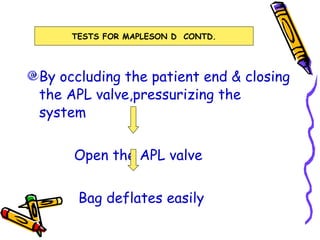
By occluding the patient end & closing the APL valve,pressurizing the system Open the APL valve Bag deflates easily TESTS FOR MAPLESON D  CONTD.
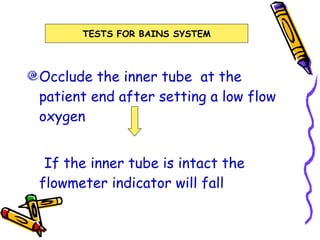
Occlude the inner tube  at the patient end after setting a low flow oxygen If the inner tube is intact the flowmeter indicator will fall TESTS FOR BAINS SYSTEM
Pethick test Activate oxygen flush & observe the bag  Venturi effect caused by high flow oxygen at the patient end will create a negative pressure at the outer tube Bag deflates TESTS FOR BAINS SYSTEM
Advantages   Can be usedin controlled/spontaneous respiration Adults & Pediatrics  Portable,Light weight Scavenging of exhaled gases
Hazards  Accidental disconnection of inner tube from machine end. ‘ Double back’ itself & cause obstruction to FGF.
THANK YOU

Mapleson breathing systems

  • 1.
    MAPLESON BREATHING SYSTEMSMODERATOR : DR RANJAN R K PRESENTER : DR NIKHIL M P
  • 2.
    History In 1954 Mapleson described and analyzed Five different anaesthetic breathing systems & referred as Mapleson A – E. Bain circuit in 1972 by Bain & Spoeral
  • 3.
    In 1975 Williset al described F system & added to above. In 1976 – Lack circuit .
  • 4.
  • 5.
    MAPLESON A Classic& Lack’s modification MAPLESON B MAPLESON C MAPLESON D Classic form & Bain’s modification MAPLESON E MAPLESON F
  • 6.
    BASED ON THERESERVOIR BAG POSITION Afferent reservoir system eg:Mapleson A,B,C & Lack’s Afferent limb:delivers FGF from machine to patient end
  • 7.
    Efferent reservoir systemeg:Mapleson D,E,F & Bain’s Efferent limb:carries expired gas from patient & vents it to the atmosphere through expiratory valve
  • 8.
    Breathing systems Bidirectionalflow & without carbondioxide absorption & Semiclosed system MAPLESON SYSTEMS
  • 9.
    Mapleson’s assumptions Gasesmove enblock fresh gas,dead space gas,alveolar gas 2. Reservoir bag continues to fill,without offering any resistance till it is full
  • 10.
    3. Expiratoryvalve opens as soon as reservoir bag is full & the pressure inside the system goes above atmospheric pressure 4. Valve remain opens throughout the expiratory phase and closes at the start of next inspiration MAPLESON’S ASSUMPTIONS CONTD.
  • 11.
  • 12.
  • 13.
    Magill system FGFenters the system near machine end A corrugated tubing connects the reservoir bag to APL valve of the system MAPLESON A
  • 14.
  • 15.
    Lack’s modification Expiratorylimb –from patient end to APL valve at the machine end of the system 2 forms dual tube (parallel) tube-within-a-tube(coaxial )
  • 16.
  • 17.
  • 18.
  • 19.
  • 20.
    a. During inspiration,FG from the machine and reservoir bag flows to the patient,RB collapses b. During expiration,FG continues to flow.expired gas (dead space gas & alveolar gas) pushes the FG into RB and collects inside the corrugated tube MAPLESON A – SPONT. CONTD.
  • 21.
    c. Expiratoryvalve opens and alveolar gas is vented into atmosphere d. During Expiratory pause,alveolar gas that had come in contact with the corrugated tube is also vented depending on FGF. MAPLESON A – SPONT. CONTD.
  • 22.
    System is filledwith only FG & dead space gas at the start of next inspiration when FGF =Minute ventilation Alveolar gas+dead space gas+some of FG also escapes if FGF>minute ventilation Some alveolar gas +dead space gas will remain if FGF < minute ventilation MAPLESON A – SPONT. CONTD.
  • 23.
  • 24.
  • 25.
  • 26.
    a . During inspiration,patient gets ventilated with FG & part of FG is vented through the valve. b. During expiration,FG flows into RB & expired gases flows back into corrugated tubing till system is full MAPLESON A- controlled ventilation contd.
  • 27.
    c. Duringnext inspiration alveolar gas is pushed back into alveoli followed by FG part of expired gas & part of FG escape through the valve when sufficient pressure is developed rebreathing inefficient for controlled ventilation MAPLESON A- controlled ventilation contd.
  • 28.
    MAPLESON A -CONTROLLED
  • 29.
  • 30.
    Tested for leaksby occluding the patient end of the system,closing the APL valve & pressurizing the system APL valve opens TESTS FOR MAPLESON A CONTD.
  • 31.
    To attach atracheal tube to the inner tubing at the patient end of the system To occlude both limbs at the patient connection with APL valve open TESTS FOR COAXIAL LACKS SYSTEM
  • 32.
    FGF Requirement Spontaneous: equal to minute ventilation Controlled :very high & difficult to predict.
  • 33.
  • 34.
    MAPLESON C SYSTEM
  • 35.
  • 36.
  • 37.
    They have a6mm d. tube as afferent limb and carries FGF from machine end to patient end . Reservoir bag is attached to efferent limb which is a wide bore corrugated tube EFFERENT RESERVOIR SYSTEM CONTD .
  • 38.
    APL valve isplaced near the reservoir bag In Bain’s modification afferent & efferent limbs are coaxially placed Inner tube – 6mm Outer tube – 22 mm Length- 180 cms EFFERENT RESERVOIR SYSTEM CONTD .
  • 39.
  • 40.
  • 41.
  • 42.
  • 43.
  • 44.
    MAPLESON D -Spontaneous respiration
  • 45.
    a.During inspiration,FG fromthe machine,RB & corrugated tube flow to the patient b.During expiration,FGF to the system at the patient end & expired gas gets continuously mixed with FG as it flows back into corrugated tube & reservoir bag MAPLESON D CONTD .
  • 46.
    c.Once the systemis full, the excess gas is vented to the atmosphere through the APL valve during expiratory pause FG continues to flow & fill the proximal portion of corrugated tube while mixed gas is vented through the valve MAPLESON D CONTD .
  • 47.
    d . Duringnext inspiration,patient breaths FG & mixed gas. MAPLESON D CONTD.
  • 48.
  • 49.
  • 50.
    a.During inspiration thepatient gets ventilated with FGF from the machine,corrugated tube & RB. b.During expiration the expired gas gets mixed with the fresh gas that is flowing into the system at patient end During expiratory pause the FG continues to enter the system and pushes the mixed gas towards RB. MAPLESON D CONTROLLED CONTD .
  • 51.
    c. When nextventilation is initiated patient gets ventilated with the gas in the corrugated tube. As the pressure in the system increases APL valve opens and contents of RB are released into the atmosphere. MAPLESON D CONTROLLED CONTD .
  • 52.
  • 53.
    FGF Requirement Spontaneous: 1.5 to 3 times minute ventilation ( 100 to 300 ml/kg/min) Controlled : 1 to 2 times minute ventilation
  • 54.
    MINUTE VENTILATION FR E S H G A S F L O W PaCO 2 Almost same PaCO2- for FGF from 100 to 240ml/kg/min
  • 55.
  • 56.
    By occluding thepatient end & closing the APL valve,pressurizing the system Open the APL valve Bag deflates easily TESTS FOR MAPLESON D CONTD.
  • 57.
    Occlude the innertube at the patient end after setting a low flow oxygen If the inner tube is intact the flowmeter indicator will fall TESTS FOR BAINS SYSTEM
  • 58.
    Pethick test Activateoxygen flush & observe the bag Venturi effect caused by high flow oxygen at the patient end will create a negative pressure at the outer tube Bag deflates TESTS FOR BAINS SYSTEM
  • 59.
    Advantages Can be usedin controlled/spontaneous respiration Adults & Pediatrics Portable,Light weight Scavenging of exhaled gases
  • 60.
    Hazards Accidentaldisconnection of inner tube from machine end. ‘ Double back’ itself & cause obstruction to FGF.
  • 61.