COPD Session 2
Gamal Rabie Agmy, MD, FCCP
Professor of chest Diseases, Assiut university
Diagnosis & Differential Diagnosis 2
Goal of this learning modules
• To Provide a framework to make informed
decisions regarding the diagnosis and
differential diagnosis of Chronic obstructive
pulmonary disease
Learning objectives
After completing this module you should know:
• Know the clinical features of COPD
• Know the basic investigations needed
• Know when should you prompt further
investigations
• Differentiate COPD from other similar conditions
Key Indicators for Considering a Diagnosis of COPD
Dyspnea:
•Progressive (worsens over time)
•Characteristically worse with exercise
•Persistent (present every day)
Chronic Cough:
•May be intermittent and maybe unproductive
Chronic sputum production:
• Any pattern of chronic sputum production mayindicate COPD
History of exposure to risk factors:
•Tobacco smoke.
•Occupational dusts and chemicals
•Smoke from home cooking and heating fuels
Family history of COPD
Consider COPD: indicators are present in an individual over age 40.
Spirometryis required to establisha diagnosisof COPD
The COPD patient  Generally over 40
years
 A smoker or ex-
smoker
 Presentation with:
– cough
– excessive sputum
production
– shortness of breath
 Dyspnea is the
reason most
patients seek
medical attention.
1. BTS, 1997; 3. GOLD, 2003
Dyspnea: its importance in COPD
• One of the most common and distressing symptoms for
patients with COPD, and the reason most patients seek
medical attention.
• Disabling, limits activity , and reduces quality of life.
• An important outcome variable for clinical and research
evaluations.
• Related to, but independent of lung function.
*Mahler D, Harver A. Am Rev Respir Dis (1992)
“ The Downward Spiral ”
Airflow
limitation
Inactivity
Isolation
Dyspnea
Muscle
Impairment
Hyper Inflation
Severe
Dyspnea
Deconditioning
Weight Loss
Depression
Poor Quality
of Life
Mortality
Hypoxia
The causes of dyspnea are complex
• Hyperinflation at rest or with exertion
(Dynamic).
• Increased ventilation demand.
• Weak respiratory muscles.
All will lead to limitation of activity in COPD .
Causes of Chronic Cough with a Normal Chest X-ray
Intrathoracic
• Chronic obstructive pulmonary disease
• Bronchial asthma
• Central bronchial carcinoma
• Endobronchial tuberculosis
• Bronchiectasis
• Left heart failure
• Interstitial lung disease
• Cystic fibrosis
Extrathoracic
• Postnasal drip
• Gastroesophageal reflux
• Drug therapy (e.g., ACE inhibitors)
Medical History
• Patient’s exposure to risk factors
• Past medical history (asthma, allergy, sinusitis or nasal polyps;
respiratory infections in childhood; other respiratory diseases)
• Family history of COPD or other chronic respiratory disease
• Pattern of symptom development: COPD typically develops in adult
life and most patients are conscious of increased breathlessness,
more frequent “winter colds,” and some social restriction for a
number of years before seeking medical help.
• History of exacerbations or previous hospitalizations
• Presence of comorbidities
• Impact of disease on patient’s life
• Social and family support
• Possibilities for reducing risk factors
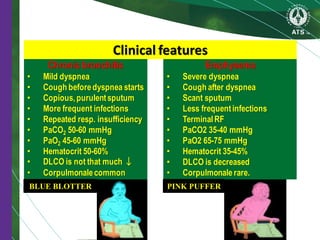
Clinical features
Chronic bronchitis
• Mild dyspnea
• Cough beforedyspnea starts
• Copious,purulentsputum
• More frequent infections
• Repeated resp. insufficiency
• PaCO2 50-60 mmHg
• PaO2 45-60 mmHg
• Hematocrit 50-60%
• DLCO is not that much ↓
• Corpulmonalecommon
Emphysema
• Severe dyspnea
• Cough after dyspnea
• Scant sputum
• Less frequentinfections
• TerminalRF
• PaCO2 35-40 mmHg
• PaO2 65-75 mmHg
• Hematocrit 35-45%
• DLCO is decreased
• Corpulmonalerare.
BLUE BLOTTER PINK PUFFER
Diagnosis of COPD
Why Do We Need Spirometry?
• Spirometry is useful for:
– Screen individuals at risk for pulmonary disease
– Confirmation of COPD diagnosis
– Assessing severity of pulmonary dysfunction
– Guiding selection of treatment
– Assessing the effects of therapeutic interventions
Spirometry
 A post-bronchodilator FEV1/FVC < 0.70 confirms
the presence of airflow limitation.
 Where possible, values should be compared to
age-related normal values to avoid overdiagnosis of
COPD in the elderly.
 Spirometry should be performed
after the administration of an
adequate dose of a short-acting
inhaled bronchodilator (e.g. 400
µg Salbutamol) to minimize
variability.
Acceptability & Repeatability
Acceptability
At least three (3) acceptable maneuvers:
• Good start to the test.
• No hesitation or coughing for the 1st second.
• FVC lasts at least 6 seconds with a plateau
of at least 1 second.
• No valsalva maneuver or obstruction of the
mouthpiece.
• FIVC shows apparent maximal effort.
Repeatability
Repeatability criteria act as guideline to
determine need for additional efforts.
– Largest and 2nd largest FVC must be within 150
mL.
– Largest and 2nd largest FEV 1 must be 150 mL.
– PEF values may be variable (within 15%).
If three acceptable reproducible maneuvers
are not recorded, up to 8 attempts may be
recorded.
Spirometry Value
• Spirometry is typically reported in both
absolute values and as a predicted
percentage of normal.
• Normal values vary and are dependent on:
– Gender,
– Race,
– Age,
– Weight and
– Height.
Reporting Standards
• Largest FVC obtained from all acceptable
efforts should be reported.
• Largest FEV1 obtained from all acceptable
trials should be reported.
• May or may not come from largest FVC
effort.
• All other flows, should come from the effort
with the largest sum of FEV 1 & FVC.
• PEF should be the largest value obtained
from at least 3 acceptable maneuvers.
Results Reporting Example
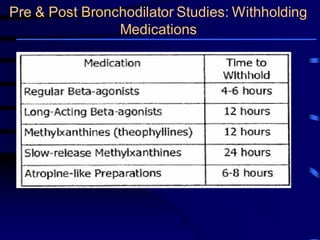
Pre & Post Bronchodilator Studies: Withholding
Medications
Reversibility
Reversibility of airways obstruction can be
assessed with the use of bronchodilators.
• > 12% increase in the FEV1 and 200
ml improvement in FEV1
OR
• > 12% increase in the FVC and 200
ml improvement in FVC.
1-First Step, Check quality of the
test
1- Start:
*Good start: Extrapolated volume (EV) <
5% of FVC or 0.15 L
*Poor start: Extrapolated volume (EV)
≥5% of FVC or ≥ 0.15 L
2- Termination:
*No early termination :Tex ≥ 6 s
*Early termination : Tex < 6 s
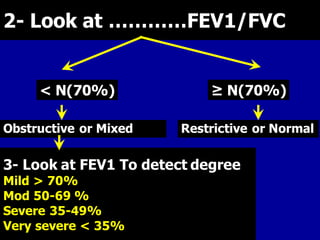
2- Look at …………FEV1/FVC
< N(70%)
Obstructive or Mixed
≥ N(70%)
Restrictive or Normal
3- Look at FEV1 To detect degree
Mild > 70%
Mod 50-69 %
Severe 35-49%
Very severe < 35%
4- Postbronchodilator FEV1/FVC
> 70%
asthma
< 70%
COPD
5- Reversibility test of FEV1
> 12%, 200 ml
Reversible (asthma)
< 12% ,200 ml
Ireversible (COPD)
6- Look at TLC
≥ 80-120% Pure
obstruction
< 80% Mixed
2- Look at …………FEV1/FVC
< N(70%)
Obstructive or Mixed
≥ N(70%)
Restrictive or Normal
3- Look at FVC
≥ N(80%) < N(80%)
Normal or SAWD
4-Look at FEF25/75
> 50% Normal < 50% SAWD
Restrictive
Changes in Lung Volumes in
Various Disease States
RuppelGL. ManualofPulmonary Function Testing, 8th ed., Mosby 2003
Patterns of Abnormality
Restriction low FEV1 & FVC, high FEV1%FVC
Recorded Predicted SR %Pred
FEV 1 1.49 2.52 -2.0 59
FVC 1.97 3.32 -2.2 59
FEV 1 %FVC 76 74 0.3 103
PEF 8.42 7.19 1.0 117
Obstructive low FEV1 relative to FVC, low PEF, low FEV1%FVC
Recorded Predicted SR %Pred
FEV 1 0.56 3.25 -5.3 17
FVC 1.65 4.04 -3.9 41
FEV 1 %FVC 34 78 -6.1 44
PEF 2.5 8.28 -4.8 30
high PEF early ILD
low PEF late ILD
Patterns of Abnormality
Upper AirwayObstruction low PEF relative to FEV1
Recorded Predicted SR %Pred
FEV 1 2.17 2.27 -0.3 96
FVC 2.68 2.70 0.0 99
FEV 1 %FVC 81 76 0.7 106
PEF 2.95 5.99 -3.4 49
FEV 1 /PEF 12.3
Discordant PEF and FEV1
High PEF versus FEV1 = early interstitial lung disease (ILD)
Low PEF versus FEV1 = upper airway obstruction
Concordant PEF and FEV1
Both low in airflow obstruction, myopathy, late ILD
Common FVL Shapes
Volume
Flow
Normal Young or quitter Poor effort
Hesitation Knee Coughing
Upper Airway Obstruction
0 1 2 3 4 5 6
-6
-4
-2
0
2
4
6 Age 40 yrs
FVC 3.52 L 0.84 SR
FEV1
3.0 L 0.74 SR
PEF 4.57 L/s -2.18 SR
FEV/PEF = 10.9
Inspiratory
Expiratory
FlowinL/s
Volume in Litres
FEV1 in mls
PEF in L/min
> 8
Diffusing Capacity
 Diffusing capacity of lungs for CO
 Measures ability of lungs to transport inhaled gas
from alveoli to pulmonary capillaries
 Depends on:
- alveolar—capillary membrane
- hemoglobin concentration
- cardiac output
Diffusing Capacity
 Decreased DLCO
(<80% predicted)
 Obstructive lung disease
 Parenchymal disease
 Pulmonary vascular
disease
 Anemia
 Increased DLCO
(>120-140% predicted)
 Asthma (or normal)
 Pulmonary hemorrhage
 Polycythemia
 Left to right shunt
DLCO — Indications
 Differentiate asthma from emphysema
 Evaluation and severity of restrictive lung
disease
 Early stages of pulmonary hypertension
Spirometry
• Definition for Reversibility:
– FEV1 and/or FVC >12% and >200 mL ATS/ERS,2005
– FEV1 >12% and >200 mL GOLD,2010
Additional Optional Investigations
• Imaging
• Arterial blood gas measurement
• Alpha-1 antitrypsin deficiencyscreening
• Lung volumes & diffusing capacity
• Sleep study
• Exercise testing
• Composite scores
Chest X-ray
Chest X-ray
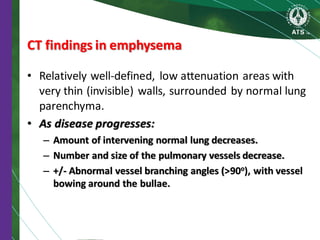
CT findings in emphysema
• Relatively well-defined, low attenuation areas with
very thin (invisible) walls, surrounded by normal lung
parenchyma.
• As disease progresses:
– Amount of intervening normal lung decreases.
– Number and size of the pulmonary vessels decrease.
– +/- Abnormal vessel branching angles (>90o), with vessel
bowing around the bullae.
CT scan
CT scan
CT densitovolumetryshows the attenuationmask. Green areas are those
with attenuationbelow the selected threshold (here, -950 HU to evaluate
emphysema), and pink areas are those with attenuationsabove the
threshold. Area outside the patient is highlightedin green because of air
Quantitative CT:
• Spirometically triggered images at 10% and
90% vital capacity (VC) have been reported
to be able to distinguish patients with chronic
bronchitis from those with emphysema.
– Patients with emphysema had significantly lower
mean lung attenuation at 90% VC than normal
subjects or patients with chronic bronchitis.
– Attenuation was the same for normal subjects and
those with chronic bronchitis.
Where is the pathology ???????
in the areas with increased density
meaning there is ground glass
in the areas with decreased density
meaning there is air trapping
Pathology in black areas
Airtrapping: Airway Disease
Bronchiolitis obliterans (constrictive bronchiolitis)
idiopathic, connective tissue diseases, drug reaction,
after transplantation, after infection
Hypersensitivity pneumonitis
granulomatous inflammation of bronchiolar wall
Sarcoidosis
granulomatous inflammation of bronchiolar wall
COPD/Asthma / Bronchiectasis / Airway diseases
Airway Disease
what you see……
In inspiration
sharply demarcated areas of seemingly increased
density (normal) and decreased density
demarcation by interlobular septa
In expiration
‘black’ areas remain in volume and density
‘white’ areas decrease in volume and increase in density
INCREASE IN CONTRAST DIFFERENCES
AIRTRAPPING
Bronchiolitis
obliterans
Centrilobular (proximal or
centriacinar) emphysema
Found most commonly in the upper lobes
Manifests as multiple small areas of low attenuation without a
perceptible wall, producing a punched-out appearance.
Often the centrilobular artery is visible within the
centre of these lucencies.
55
Centrilobular emphysema due to smoking. The periphery of
the lung is spared (blue arrows). Centrilobular artery (yellow
arrows) is seen in the center of the hypodense area.
Panlobular emphysema
Affects the whole secondary lobule
Lower lobe predominance
In alpha-1-antitrypsin deficiency, but
also seen in smokers with advanced
emphysema
PANLOBULAR EMPHYSEMA
Affects the entire secondary pulmonary
lobule and is more pronounced in the lower
zones
Complete destruction of the entire pulmonary
lobule.
Results in an overall decrease in lung
attenuation and a reduction in size of
pulmonary vessels
58
PANLOBULAR EMPHYSEMA
59
Panlobular emphysema
Paraseptal (distal acinar)
emphysema
Affects the peripheral parts of
the secondary pulmonary lobule
Produces subpleural lucencies.
61
Paraseptal emphysema
Alpha-1 antitrypsin deficiencyscreening
• Caucasian descent who develop
COPD at a young age (< 45 years)
lower lobe emphysema or who have
a strong family history of the disease
• A serum concentration of alpha-1
antitrypsin below 15-20% of the
normal value is highly suggestive of
homozygous alpha-1 antitrypsin
deficiency.
• 11 mmol/L (80 mg/mL) represents
the threshold level below which
emphysema is common
• Only 2% of COPD is alpha 1- AT
deficiency
ALPHA1 ANTITRYPSIN ↓EMPHYSEMA
Specific circumstances of Alpha 1- AT↓include.
• Emphysema in a young individual(< 35)
• Without obvious risk factors (smoking etc)
• Necrotizing panniculitis, Systemic vasculitis
• Anti-neutrophil cytoplasmic antibody (ANCA)
• Cirrhosis of liver, Hepatocellular carcinoma
• Bronchiectasis of undetermined etiology
• Otherwise unexplained liver disease, or a
• Family history of any one of these conditions
• Especially siblings of PI*ZZ individuals.
• Only 2% of COPD is alpha 1- AT ↓
Arterial blood gas (ABG) measurement
Indicated:
• Stable patients with FEV1 < 35%
predicted
• Clinical signs suggestive of respiratory
failure or right heart failure.
Considerations:.
• The inspired oxygen concentration (FiO2) –
should be noted
• Especially when using an O2-driven
nebulizer. ??
• Changes in ABG take time to occur→ 30
minutes should pass before rechecking the
gas tensions
• Adequate pressure must be applied at the
arterial puncture site for at least one minute
Lung volumes & diffusingcapacity:
Hyperinflation & air trapping
• Impairs respiratory muscle
function and gas exchange
• Increases the work of breathing
Hyperinflation →Reduces IC (esp.
during exercise) →↑ dyspnea &
limitation of exercise capacity
Lung volumes
• IC appears to correlate more
strongly to dyspnea than FEV1.
Lung volumes & diffusing capacity:
Effect of exercise on Hyperinflation
Hyperinflation & air trapping
• Explains why airway medications are effective in
COPD
Proc Am Thorac Soc Vol 2. pp 267–271, 2005
Lung volumes & diffusingcapacity:
• Measurement of diffusing
capacity (DLco) → provides
information on functional
impact of emphysema in
COPD & it is helpful in
breathlessness out of
proportion with the
degree of airflow
limitation.
Sleep study
• Symptoms related to sleep disturbances are
common in moderate to severe COPD,
particularly in elderly patients.
• COPD+ obstructive sleep apnea (OSA)
(overlap syndrome) occurs in 1% of adults
and overlap patients have worse nocturnal
hypoxemia and hypercapnia than COPD
and OSA patients alone.
May be indicated when:
• Hypoxemia or right heart failure develops
in the presence of relatively mild airflow
limitation or when the patient has
symptoms suggesting the presence of sleep
apnea.
Exercise testing
• To measure exercise capacity,
e.g., treadmill and cycle
ergometry in the laboratory – or
six-minute and shuttle walking
tests.
• Powerful indicator of health
status impairment and predictor
of prognosis.
• Assess disability & effectiveness
of pulmonary rehabilitation
• Primarily used in conjunction
with pulmonary rehabilitation
programs.
Composite scores
The cutoff values for the assignment of points are shown for each variable. The
total possible values range from 0 to 10, with higher scoresindicating a greater
risk of death.
Approximate 4 Year Survival Interpretation
0-2 Points: 80%
3-4 Points: 67 %
5-6 Points: 57%
7-10 Points: 18%
DifferentialDiagnosis of COPD
 Asthma
 Congestive heart failure
 Bronchiectasis
 Tuberculosis
 Obliterative bonchiolitis
 Diffuse Panbronchiolitis
DifferentialDiagnosis of COPD
Asthma – Similarities with COPD
• Major epidemiologic causes of chronic obstructive
airway disease
• Involve underlying airway inflammation
• Can cause similar chronic respiratory symptoms and
fixed airflow limitation
• Can co-exist with the other making diagnosis more
difficult
DifferentialDiagnosis of COPD
Asthma – Differences from COPD
• Underlying immune mechanism of chronic
inflammation different
– Eosinophilic and CD4-driven in asthma & neutrophilic
and CD8-driven in COPD
• Age of onset
– Earlier in life with asthma
– Usually > age 40 in COPD
• Symptoms in asthma vary; COPD slowly progressive
• Smoking associatedwith COPD
• Asthma with reversible airflow limitation; irreversible
airflow limitation in COPD
DifferentialDiagnosis of COPD
• Asthma-COPD Overlap Syndrome (ACOS) is
characterized by persistent airflow limitation with
several features usually associated with asthma and
several features usually associated with COPD. ACOS
is therefore identified in the features that it shares
with both asthma and COPD.
Asthma COPD
A
C
O
S
DifferentialDiagnosis of COPD
Clinical Feature COPD Asthma
Age Older than 35 years Any age
Cough Persistent, productive
Intermittent, usually
nonproductive
Smoking Typical Variable
Dyspnea Progressive,persistent Variable
Nocturnal symptoms
Breathlessness,late in
disease
Coughing,wheezing
Family history Less common More common
Atopy Less common More common
Significantdiurnal or day
to day variability
Less common More common
Spirometry
Irreversible airway
limitation
Reversible airway
limitation
DifferentialDiagnosis of COPD
Congestive Heart Failure (CHF)
Characteristics Midlife to late-lifeonset;associated with riskfactors such
as hypertensionand coronary artery disease
Clinical
presentation
Fatigue,exertional and paroxysmal nocturnal dyspnea,
and peripheraledema,crackles on auscultation
Pulmonary
function test
Pulmonary functiontests indicate
volume restriction,notairflowlimitation.
Chest
radiography
Increased heartsize,pulmonaryvascular congestion,
pleural effusions
Others testing Echocardiography,BNP measurement,
electrocardiography;cardiaccatheterizationin selected
patients
DifferentialDiagnosis of COPD
Bronchiectasis
Characteristics Usually midlifeonset;progressivewith exacerbations
Clinical
presentation
Productivecough with large volumes of thick,
purulentsputum; ±related to posture, ±bad odor
dyspnea;and wheezing associatedwith bacterial
infections,crackles,and clubbing on exam
Pulmonary function
test
Obstructiveairflowlimitation,both fixed and
reversible
Chest radiography
Focal pneumonia,atelectasis;dilated bronchial tree,
thickened airways (ring shadow)
Other testing
Bacterial,& microbacterial sputumculture,high
resolutionchestCT.
DifferentialDiagnosis of COPD
Tuberculosis
Characteristics
Onsetat any age; associated with historyof exposure,
High local prevalenceof tuberculosis may suggest
diagnosis
Clinical presentation Productivecough,hemoptysis,fever,and weightloss
Pulmonary function
test
Not used for diagnosis
Chest radiography
Infiltrate,nodular lesions,hilar adenopathy,cavitary
lesionsor granulomas
Other testing SputumAFB culture,sputumcultures
DifferentialDiagnosis of COPD
Obliterative bonchiolitis
Characteristics
Onsetat any age but often younger;may be
associated with history of flu-like illness,collagen
vascular disease,or toxic fume exposure,non-
smokers
Clinical
presentation
Often subacute presentationwith dyspnea,cough,
and fever
Pulmonary
function test
Decreased vital capacity, decreasedDLCO, usually no
obstructive component
Chest radiography Multifocal,bilateral alveolar infiltrates
Other testing
High-resolutionCT shows hypodense areas on
expiration,lung biopsy
DifferentialDiagnosis of COPD
Diffuse Panbronchiolitis
Characteristics
Predominatelyseen in patients with Asian descent
Mostpatients are male and nonsmokers.
Almostall have chronicsinusitis.
Radiography
Chest X-ray and HRCT showdiffuse
small centrilobular nodular opacities
and hyperinflation
83
Chlamydia Trachomatis
DECREASED
LUNG
ATTENUATION
ABPA: glove-fingershadow dueto mucoid impaction in central
bronchiectasisin a patientwith asthma.
Signet-Ring Sign
A signet-ring sign represents an axial cut of a dilated bronchus
(ring) with its accompanying small artery (signet).
Tram Tracks
Thank you

COPD Session 2

  • 2.
    COPD Session 2 GamalRabie Agmy, MD, FCCP Professor of chest Diseases, Assiut university
  • 3.
  • 4.
    Goal of thislearning modules • To Provide a framework to make informed decisions regarding the diagnosis and differential diagnosis of Chronic obstructive pulmonary disease
  • 5.
    Learning objectives After completingthis module you should know: • Know the clinical features of COPD • Know the basic investigations needed • Know when should you prompt further investigations • Differentiate COPD from other similar conditions
  • 6.
    Key Indicators forConsidering a Diagnosis of COPD Dyspnea: •Progressive (worsens over time) •Characteristically worse with exercise •Persistent (present every day) Chronic Cough: •May be intermittent and maybe unproductive Chronic sputum production: • Any pattern of chronic sputum production mayindicate COPD History of exposure to risk factors: •Tobacco smoke. •Occupational dusts and chemicals •Smoke from home cooking and heating fuels Family history of COPD Consider COPD: indicators are present in an individual over age 40. Spirometryis required to establisha diagnosisof COPD
  • 7.
    The COPD patient Generally over 40 years  A smoker or ex- smoker  Presentation with: – cough – excessive sputum production – shortness of breath  Dyspnea is the reason most patients seek medical attention. 1. BTS, 1997; 3. GOLD, 2003
  • 8.
    Dyspnea: its importancein COPD • One of the most common and distressing symptoms for patients with COPD, and the reason most patients seek medical attention. • Disabling, limits activity , and reduces quality of life. • An important outcome variable for clinical and research evaluations. • Related to, but independent of lung function. *Mahler D, Harver A. Am Rev Respir Dis (1992)
  • 9.
    “ The DownwardSpiral ” Airflow limitation Inactivity Isolation Dyspnea Muscle Impairment Hyper Inflation Severe Dyspnea Deconditioning Weight Loss Depression Poor Quality of Life Mortality Hypoxia
  • 10.
    The causes ofdyspnea are complex • Hyperinflation at rest or with exertion (Dynamic). • Increased ventilation demand. • Weak respiratory muscles. All will lead to limitation of activity in COPD .
  • 11.
    Causes of ChronicCough with a Normal Chest X-ray Intrathoracic • Chronic obstructive pulmonary disease • Bronchial asthma • Central bronchial carcinoma • Endobronchial tuberculosis • Bronchiectasis • Left heart failure • Interstitial lung disease • Cystic fibrosis Extrathoracic • Postnasal drip • Gastroesophageal reflux • Drug therapy (e.g., ACE inhibitors)
  • 12.
    Medical History • Patient’sexposure to risk factors • Past medical history (asthma, allergy, sinusitis or nasal polyps; respiratory infections in childhood; other respiratory diseases) • Family history of COPD or other chronic respiratory disease • Pattern of symptom development: COPD typically develops in adult life and most patients are conscious of increased breathlessness, more frequent “winter colds,” and some social restriction for a number of years before seeking medical help. • History of exacerbations or previous hospitalizations • Presence of comorbidities • Impact of disease on patient’s life • Social and family support • Possibilities for reducing risk factors
  • 13.
    Clinical features Chronic bronchitis •Mild dyspnea • Cough beforedyspnea starts • Copious,purulentsputum • More frequent infections • Repeated resp. insufficiency • PaCO2 50-60 mmHg • PaO2 45-60 mmHg • Hematocrit 50-60% • DLCO is not that much ↓ • Corpulmonalecommon Emphysema • Severe dyspnea • Cough after dyspnea • Scant sputum • Less frequentinfections • TerminalRF • PaCO2 35-40 mmHg • PaO2 65-75 mmHg • Hematocrit 35-45% • DLCO is decreased • Corpulmonalerare. BLUE BLOTTER PINK PUFFER
  • 14.
  • 15.
    Why Do WeNeed Spirometry? • Spirometry is useful for: – Screen individuals at risk for pulmonary disease – Confirmation of COPD diagnosis – Assessing severity of pulmonary dysfunction – Guiding selection of treatment – Assessing the effects of therapeutic interventions
  • 16.
    Spirometry  A post-bronchodilatorFEV1/FVC < 0.70 confirms the presence of airflow limitation.  Where possible, values should be compared to age-related normal values to avoid overdiagnosis of COPD in the elderly.  Spirometry should be performed after the administration of an adequate dose of a short-acting inhaled bronchodilator (e.g. 400 µg Salbutamol) to minimize variability.
  • 17.
  • 18.
    Acceptability At least three(3) acceptable maneuvers: • Good start to the test. • No hesitation or coughing for the 1st second. • FVC lasts at least 6 seconds with a plateau of at least 1 second. • No valsalva maneuver or obstruction of the mouthpiece. • FIVC shows apparent maximal effort.
  • 19.
    Repeatability Repeatability criteria actas guideline to determine need for additional efforts. – Largest and 2nd largest FVC must be within 150 mL. – Largest and 2nd largest FEV 1 must be 150 mL. – PEF values may be variable (within 15%). If three acceptable reproducible maneuvers are not recorded, up to 8 attempts may be recorded.
  • 20.
    Spirometry Value • Spirometryis typically reported in both absolute values and as a predicted percentage of normal. • Normal values vary and are dependent on: – Gender, – Race, – Age, – Weight and – Height.
  • 21.
    Reporting Standards • LargestFVC obtained from all acceptable efforts should be reported. • Largest FEV1 obtained from all acceptable trials should be reported. • May or may not come from largest FVC effort. • All other flows, should come from the effort with the largest sum of FEV 1 & FVC. • PEF should be the largest value obtained from at least 3 acceptable maneuvers.
  • 22.
  • 23.
    Pre & PostBronchodilator Studies: Withholding Medications
  • 24.
    Reversibility Reversibility of airwaysobstruction can be assessed with the use of bronchodilators. • > 12% increase in the FEV1 and 200 ml improvement in FEV1 OR • > 12% increase in the FVC and 200 ml improvement in FVC.
  • 26.
    1-First Step, Checkquality of the test 1- Start: *Good start: Extrapolated volume (EV) < 5% of FVC or 0.15 L *Poor start: Extrapolated volume (EV) ≥5% of FVC or ≥ 0.15 L 2- Termination: *No early termination :Tex ≥ 6 s *Early termination : Tex < 6 s
  • 27.
    2- Look at…………FEV1/FVC < N(70%) Obstructive or Mixed ≥ N(70%) Restrictive or Normal 3- Look at FEV1 To detect degree Mild > 70% Mod 50-69 % Severe 35-49% Very severe < 35%
  • 28.
    4- Postbronchodilator FEV1/FVC >70% asthma < 70% COPD
  • 29.
    5- Reversibility testof FEV1 > 12%, 200 ml Reversible (asthma) < 12% ,200 ml Ireversible (COPD) 6- Look at TLC ≥ 80-120% Pure obstruction < 80% Mixed
  • 30.
    2- Look at…………FEV1/FVC < N(70%) Obstructive or Mixed ≥ N(70%) Restrictive or Normal 3- Look at FVC ≥ N(80%) < N(80%) Normal or SAWD 4-Look at FEF25/75 > 50% Normal < 50% SAWD Restrictive
  • 31.
    Changes in LungVolumes in Various Disease States RuppelGL. ManualofPulmonary Function Testing, 8th ed., Mosby 2003
  • 32.
    Patterns of Abnormality Restrictionlow FEV1 & FVC, high FEV1%FVC Recorded Predicted SR %Pred FEV 1 1.49 2.52 -2.0 59 FVC 1.97 3.32 -2.2 59 FEV 1 %FVC 76 74 0.3 103 PEF 8.42 7.19 1.0 117 Obstructive low FEV1 relative to FVC, low PEF, low FEV1%FVC Recorded Predicted SR %Pred FEV 1 0.56 3.25 -5.3 17 FVC 1.65 4.04 -3.9 41 FEV 1 %FVC 34 78 -6.1 44 PEF 2.5 8.28 -4.8 30 high PEF early ILD low PEF late ILD
  • 33.
    Patterns of Abnormality UpperAirwayObstruction low PEF relative to FEV1 Recorded Predicted SR %Pred FEV 1 2.17 2.27 -0.3 96 FVC 2.68 2.70 0.0 99 FEV 1 %FVC 81 76 0.7 106 PEF 2.95 5.99 -3.4 49 FEV 1 /PEF 12.3 Discordant PEF and FEV1 High PEF versus FEV1 = early interstitial lung disease (ILD) Low PEF versus FEV1 = upper airway obstruction Concordant PEF and FEV1 Both low in airflow obstruction, myopathy, late ILD
  • 34.
    Common FVL Shapes Volume Flow NormalYoung or quitter Poor effort Hesitation Knee Coughing
  • 35.
    Upper Airway Obstruction 01 2 3 4 5 6 -6 -4 -2 0 2 4 6 Age 40 yrs FVC 3.52 L 0.84 SR FEV1 3.0 L 0.74 SR PEF 4.57 L/s -2.18 SR FEV/PEF = 10.9 Inspiratory Expiratory FlowinL/s Volume in Litres FEV1 in mls PEF in L/min > 8
  • 36.
    Diffusing Capacity  Diffusingcapacity of lungs for CO  Measures ability of lungs to transport inhaled gas from alveoli to pulmonary capillaries  Depends on: - alveolar—capillary membrane - hemoglobin concentration - cardiac output
  • 37.
    Diffusing Capacity  DecreasedDLCO (<80% predicted)  Obstructive lung disease  Parenchymal disease  Pulmonary vascular disease  Anemia  Increased DLCO (>120-140% predicted)  Asthma (or normal)  Pulmonary hemorrhage  Polycythemia  Left to right shunt
  • 38.
    DLCO — Indications Differentiate asthma from emphysema  Evaluation and severity of restrictive lung disease  Early stages of pulmonary hypertension
  • 39.
    Spirometry • Definition forReversibility: – FEV1 and/or FVC >12% and >200 mL ATS/ERS,2005 – FEV1 >12% and >200 mL GOLD,2010
  • 42.
    Additional Optional Investigations •Imaging • Arterial blood gas measurement • Alpha-1 antitrypsin deficiencyscreening • Lung volumes & diffusing capacity • Sleep study • Exercise testing • Composite scores
  • 43.
  • 44.
  • 45.
    CT findings inemphysema • Relatively well-defined, low attenuation areas with very thin (invisible) walls, surrounded by normal lung parenchyma. • As disease progresses: – Amount of intervening normal lung decreases. – Number and size of the pulmonary vessels decrease. – +/- Abnormal vessel branching angles (>90o), with vessel bowing around the bullae.
  • 46.
  • 47.
    CT scan CT densitovolumetryshowsthe attenuationmask. Green areas are those with attenuationbelow the selected threshold (here, -950 HU to evaluate emphysema), and pink areas are those with attenuationsabove the threshold. Area outside the patient is highlightedin green because of air
  • 48.
    Quantitative CT: • Spirometicallytriggered images at 10% and 90% vital capacity (VC) have been reported to be able to distinguish patients with chronic bronchitis from those with emphysema. – Patients with emphysema had significantly lower mean lung attenuation at 90% VC than normal subjects or patients with chronic bronchitis. – Attenuation was the same for normal subjects and those with chronic bronchitis.
  • 51.
    Where is thepathology ??????? in the areas with increased density meaning there is ground glass in the areas with decreased density meaning there is air trapping
  • 52.
    Pathology in blackareas Airtrapping: Airway Disease Bronchiolitis obliterans (constrictive bronchiolitis) idiopathic, connective tissue diseases, drug reaction, after transplantation, after infection Hypersensitivity pneumonitis granulomatous inflammation of bronchiolar wall Sarcoidosis granulomatous inflammation of bronchiolar wall COPD/Asthma / Bronchiectasis / Airway diseases
  • 53.
    Airway Disease what yousee…… In inspiration sharply demarcated areas of seemingly increased density (normal) and decreased density demarcation by interlobular septa In expiration ‘black’ areas remain in volume and density ‘white’ areas decrease in volume and increase in density INCREASE IN CONTRAST DIFFERENCES AIRTRAPPING
  • 54.
  • 55.
    Centrilobular (proximal or centriacinar)emphysema Found most commonly in the upper lobes Manifests as multiple small areas of low attenuation without a perceptible wall, producing a punched-out appearance. Often the centrilobular artery is visible within the centre of these lucencies. 55
  • 56.
    Centrilobular emphysema dueto smoking. The periphery of the lung is spared (blue arrows). Centrilobular artery (yellow arrows) is seen in the center of the hypodense area.
  • 57.
    Panlobular emphysema Affects thewhole secondary lobule Lower lobe predominance In alpha-1-antitrypsin deficiency, but also seen in smokers with advanced emphysema
  • 58.
    PANLOBULAR EMPHYSEMA Affects theentire secondary pulmonary lobule and is more pronounced in the lower zones Complete destruction of the entire pulmonary lobule. Results in an overall decrease in lung attenuation and a reduction in size of pulmonary vessels 58
  • 59.
  • 60.
  • 61.
    Paraseptal (distal acinar) emphysema Affectsthe peripheral parts of the secondary pulmonary lobule Produces subpleural lucencies. 61
  • 62.
  • 63.
    Alpha-1 antitrypsin deficiencyscreening •Caucasian descent who develop COPD at a young age (< 45 years) lower lobe emphysema or who have a strong family history of the disease • A serum concentration of alpha-1 antitrypsin below 15-20% of the normal value is highly suggestive of homozygous alpha-1 antitrypsin deficiency. • 11 mmol/L (80 mg/mL) represents the threshold level below which emphysema is common • Only 2% of COPD is alpha 1- AT deficiency
  • 64.
    ALPHA1 ANTITRYPSIN ↓EMPHYSEMA Specificcircumstances of Alpha 1- AT↓include. • Emphysema in a young individual(< 35) • Without obvious risk factors (smoking etc) • Necrotizing panniculitis, Systemic vasculitis • Anti-neutrophil cytoplasmic antibody (ANCA) • Cirrhosis of liver, Hepatocellular carcinoma • Bronchiectasis of undetermined etiology • Otherwise unexplained liver disease, or a • Family history of any one of these conditions • Especially siblings of PI*ZZ individuals. • Only 2% of COPD is alpha 1- AT ↓
  • 65.
    Arterial blood gas(ABG) measurement Indicated: • Stable patients with FEV1 < 35% predicted • Clinical signs suggestive of respiratory failure or right heart failure. Considerations:. • The inspired oxygen concentration (FiO2) – should be noted • Especially when using an O2-driven nebulizer. ?? • Changes in ABG take time to occur→ 30 minutes should pass before rechecking the gas tensions • Adequate pressure must be applied at the arterial puncture site for at least one minute
  • 66.
    Lung volumes &diffusingcapacity: Hyperinflation & air trapping • Impairs respiratory muscle function and gas exchange • Increases the work of breathing Hyperinflation →Reduces IC (esp. during exercise) →↑ dyspnea & limitation of exercise capacity Lung volumes • IC appears to correlate more strongly to dyspnea than FEV1.
  • 67.
    Lung volumes &diffusing capacity: Effect of exercise on Hyperinflation
  • 68.
    Hyperinflation & airtrapping • Explains why airway medications are effective in COPD Proc Am Thorac Soc Vol 2. pp 267–271, 2005 Lung volumes & diffusingcapacity:
  • 69.
    Lung volumes &diffusingcapacity: • Measurement of diffusing capacity (DLco) → provides information on functional impact of emphysema in COPD & it is helpful in breathlessness out of proportion with the degree of airflow limitation.
  • 70.
    Sleep study • Symptomsrelated to sleep disturbances are common in moderate to severe COPD, particularly in elderly patients. • COPD+ obstructive sleep apnea (OSA) (overlap syndrome) occurs in 1% of adults and overlap patients have worse nocturnal hypoxemia and hypercapnia than COPD and OSA patients alone. May be indicated when: • Hypoxemia or right heart failure develops in the presence of relatively mild airflow limitation or when the patient has symptoms suggesting the presence of sleep apnea.
  • 71.
    Exercise testing • Tomeasure exercise capacity, e.g., treadmill and cycle ergometry in the laboratory – or six-minute and shuttle walking tests. • Powerful indicator of health status impairment and predictor of prognosis. • Assess disability & effectiveness of pulmonary rehabilitation • Primarily used in conjunction with pulmonary rehabilitation programs.
  • 72.
    Composite scores The cutoffvalues for the assignment of points are shown for each variable. The total possible values range from 0 to 10, with higher scoresindicating a greater risk of death. Approximate 4 Year Survival Interpretation 0-2 Points: 80% 3-4 Points: 67 % 5-6 Points: 57% 7-10 Points: 18%
  • 73.
    DifferentialDiagnosis of COPD Asthma  Congestive heart failure  Bronchiectasis  Tuberculosis  Obliterative bonchiolitis  Diffuse Panbronchiolitis
  • 74.
    DifferentialDiagnosis of COPD Asthma– Similarities with COPD • Major epidemiologic causes of chronic obstructive airway disease • Involve underlying airway inflammation • Can cause similar chronic respiratory symptoms and fixed airflow limitation • Can co-exist with the other making diagnosis more difficult
  • 75.
    DifferentialDiagnosis of COPD Asthma– Differences from COPD • Underlying immune mechanism of chronic inflammation different – Eosinophilic and CD4-driven in asthma & neutrophilic and CD8-driven in COPD • Age of onset – Earlier in life with asthma – Usually > age 40 in COPD • Symptoms in asthma vary; COPD slowly progressive • Smoking associatedwith COPD • Asthma with reversible airflow limitation; irreversible airflow limitation in COPD
  • 76.
    DifferentialDiagnosis of COPD •Asthma-COPD Overlap Syndrome (ACOS) is characterized by persistent airflow limitation with several features usually associated with asthma and several features usually associated with COPD. ACOS is therefore identified in the features that it shares with both asthma and COPD. Asthma COPD A C O S
  • 77.
    DifferentialDiagnosis of COPD ClinicalFeature COPD Asthma Age Older than 35 years Any age Cough Persistent, productive Intermittent, usually nonproductive Smoking Typical Variable Dyspnea Progressive,persistent Variable Nocturnal symptoms Breathlessness,late in disease Coughing,wheezing Family history Less common More common Atopy Less common More common Significantdiurnal or day to day variability Less common More common Spirometry Irreversible airway limitation Reversible airway limitation
  • 78.
    DifferentialDiagnosis of COPD CongestiveHeart Failure (CHF) Characteristics Midlife to late-lifeonset;associated with riskfactors such as hypertensionand coronary artery disease Clinical presentation Fatigue,exertional and paroxysmal nocturnal dyspnea, and peripheraledema,crackles on auscultation Pulmonary function test Pulmonary functiontests indicate volume restriction,notairflowlimitation. Chest radiography Increased heartsize,pulmonaryvascular congestion, pleural effusions Others testing Echocardiography,BNP measurement, electrocardiography;cardiaccatheterizationin selected patients
  • 79.
    DifferentialDiagnosis of COPD Bronchiectasis CharacteristicsUsually midlifeonset;progressivewith exacerbations Clinical presentation Productivecough with large volumes of thick, purulentsputum; ±related to posture, ±bad odor dyspnea;and wheezing associatedwith bacterial infections,crackles,and clubbing on exam Pulmonary function test Obstructiveairflowlimitation,both fixed and reversible Chest radiography Focal pneumonia,atelectasis;dilated bronchial tree, thickened airways (ring shadow) Other testing Bacterial,& microbacterial sputumculture,high resolutionchestCT.
  • 80.
    DifferentialDiagnosis of COPD Tuberculosis Characteristics Onsetatany age; associated with historyof exposure, High local prevalenceof tuberculosis may suggest diagnosis Clinical presentation Productivecough,hemoptysis,fever,and weightloss Pulmonary function test Not used for diagnosis Chest radiography Infiltrate,nodular lesions,hilar adenopathy,cavitary lesionsor granulomas Other testing SputumAFB culture,sputumcultures
  • 81.
    DifferentialDiagnosis of COPD Obliterativebonchiolitis Characteristics Onsetat any age but often younger;may be associated with history of flu-like illness,collagen vascular disease,or toxic fume exposure,non- smokers Clinical presentation Often subacute presentationwith dyspnea,cough, and fever Pulmonary function test Decreased vital capacity, decreasedDLCO, usually no obstructive component Chest radiography Multifocal,bilateral alveolar infiltrates Other testing High-resolutionCT shows hypodense areas on expiration,lung biopsy
  • 82.
    DifferentialDiagnosis of COPD DiffusePanbronchiolitis Characteristics Predominatelyseen in patients with Asian descent Mostpatients are male and nonsmokers. Almostall have chronicsinusitis. Radiography Chest X-ray and HRCT showdiffuse small centrilobular nodular opacities and hyperinflation
  • 83.
  • 84.
  • 85.
    ABPA: glove-fingershadow duetomucoid impaction in central bronchiectasisin a patientwith asthma.
  • 86.
    Signet-Ring Sign A signet-ringsign represents an axial cut of a dilated bronchus (ring) with its accompanying small artery (signet).
  • 88.
  • 89.