Mechanical Ventilation of Patients with COPD and Asthma Richard K. Albert, M.D. Chief of Medicine Denver Health Professor of Medicine University of Colorado Adjunct Professor of Engineering and Computer Science University of Denver 8 th  Pulmonary Medicine Update February 7, 2008 Denver Health
Colorado Aspen Trees Denver Health
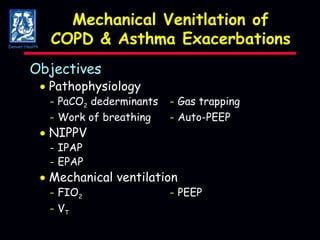
Mechanical Venitlation of COPD & Asthma Exacerbations Objectives    Pathophysiology - PaCO 2  dederminants - Gas trapping - Work of breathing - Auto-PEEP    NIPPV - IPAP - EPAP    Mechanical ventilation - FIO 2 - PEEP - V T Denver Health
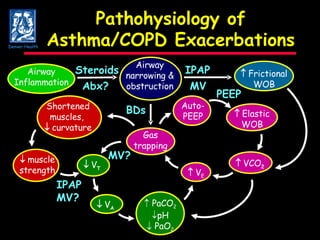
Pathohysiology of Asthma/COPD Exacerbations PEEP IPAP MV? Steroids Abx? MV? BDs Airway Inflammation Airway narrowing & obstruction Shortened muscles,   curvature  Frictional WOB  muscle strength  V T PaCO 2 pH PaO 2 Gas trapping Auto- PEEP  VCO 2  V E  Elastic WOB  V A IPAP MV Denver Health
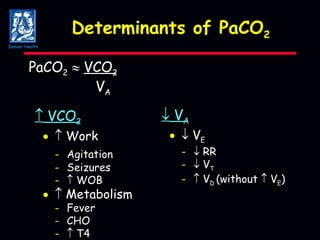
Determinants of PaCO 2 PaCO 2      VCO 2 V A    VCO 2     Work - Agitation - Seizures -   WOB     Metabolism - Fever - CHO -   T4    V A     V E -   RR -   V T -   V D  (without    V E ) Denver Health
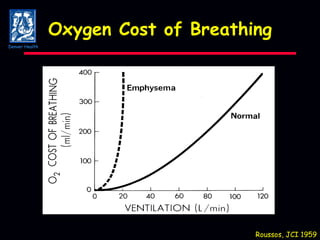
Oxygen Cost of Breathing Roussos, JCI 1959 Denver Health
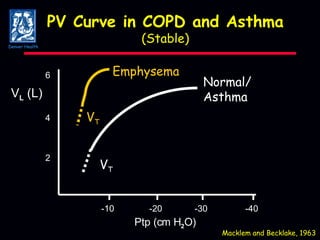
PV Curve in COPD and Asthma (Stable) Macklem and Becklake, 1963 -10 -20 -30 -40 2 4 6 Ptp (cm H 2 O) V L  (L) V T V T Normal/ Asthma Emphysema Denver Health
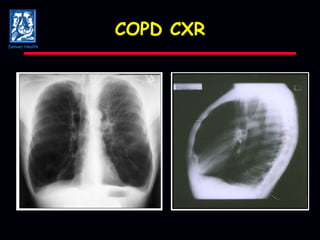
COPD CXR Denver Health
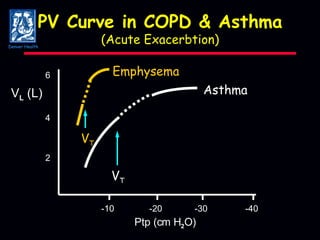
PV Curve in COPD & Asthma (Acute Exacerbtion) -10 -20 -30 -40 2 4 6 Ptp (cm H 2 O) V L  (L) V T V T Asthma Emphysema Denver Health
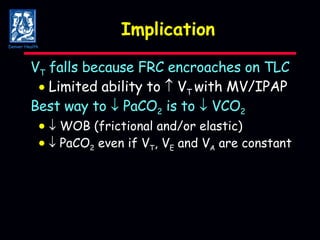
Implication V T  falls because FRC encroaches on TLC  Limited ability to    V T  with MV/IPAP Best way to    PaCO 2  is to    VCO 2     WOB (frictional and/or elastic)       PaCO 2  even if V T , V E  and V A  are constant Denver Health
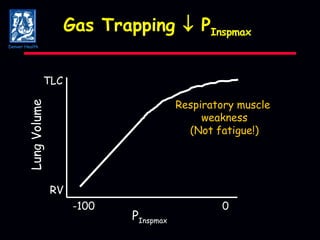
Gas Trapping    P Inspmax Lung Volume TLC RV P Inspmax -100 0 Respiratory muscle  weakness (Not fatigue!) Denver Health
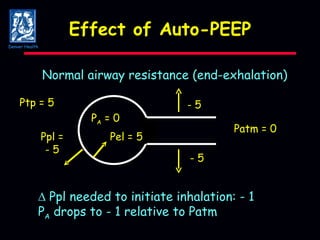
Effect of Auto-PEEP Patm = 0 P A  = 0 Ppl = - 5 Normal airway resistance (end-exhalation) Pel = 5    Ppl needed to initiate inhalation: - 1 P A  drops to - 1 relative to Patm - 5 - 5 Ptp = 5 Denver Health
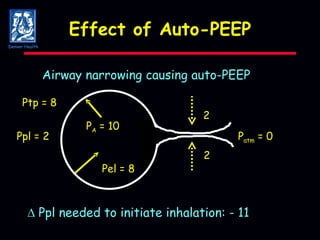
Effect of Auto-PEEP P A  = 10 Airway narrowing causing auto-PEEP P atm  = 0 Ppl = 2 Pel = 8    Ppl needed to initiate inhalation: - 11 2 2 Ptp = 8 Denver Health
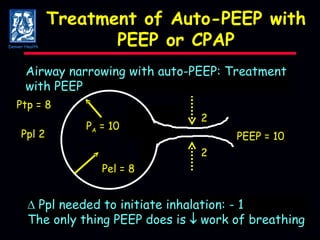
Treatment of Auto-PEEP with PEEP or CPAP Airway narrowing with auto-PEEP: Treatment with PEEP P A  = 10 PEEP = 10 Ppl 2 Pel = 8    Ppl needed to initiate inhalation: - 1 The only thing PEEP does is    work of breathing 2 2 Ptp = 8 Denver Health
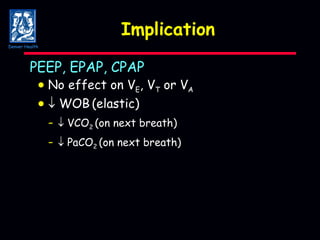
Implication PEEP, EPAP, CPAP  No effect on V E , V T  or V A     WOB   (elastic) -   VCO 2  (on next breath) -   PaCO 2  (on next breath) Denver Health
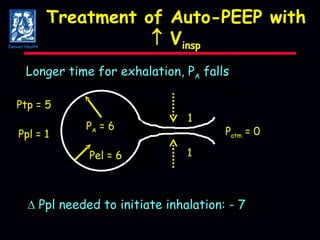
Treatment of Auto-PEEP with    V insp Longer time for exhalation, P A  falls P A  = 6 Ppl = 1 Pel = 6    Ppl needed to initiate inhalation: - 7 1 1 Ptp = 5 P atm  = 0 Denver Health
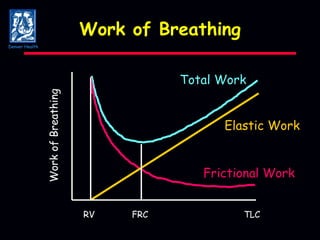
Work of Breathing Work of Breathing RV FRC TLC Total Work Elastic Work Frictional Work Denver Health
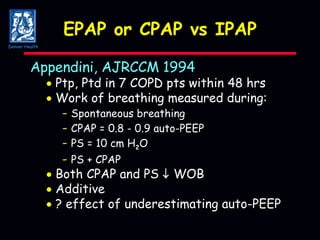
EPAP or CPAP vs IPAP Appendini, AJRCCM 1994    Ptp, Ptd in 7 COPD pts within 48 hrs    Work of breathing measured during: -   Spontaneous breathing -   CPAP = 0.8 - 0.9 auto-PEEP -   PS = 10 cm H 2 O -   PS + CPAP    Both CPAP and PS     WOB ¯    Additive    ? effect of underestimating auto-PEEP Denver Health
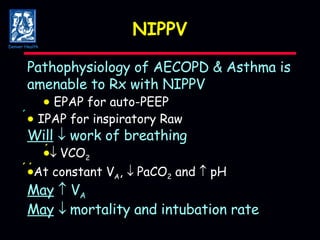
NIPPV Pathophysiology of AECOPD & Asthma is amenable to Rx with NIPPV    EPAP for auto-PEEP     IPAP for inspiratory Raw Will     work of breathing   VCO 2  At constant V A ,   PaCO 2  and    pH May     V A May    mortality and intubation rate Denver Health
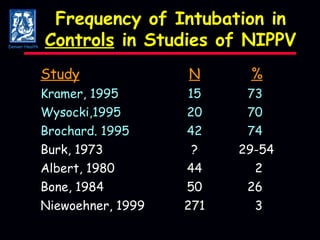
Frequency of Intubation in  Controls  in Studies of NIPPV Study N % Kramer, 1995 15 73 Wysocki,1995 20 70 Brochard. 1995 42 74 Burk, 1973 ? 29-54 Albert, 1980 44 2 Bone, 1984 50 26 Niewoehner, 1999 271 3 Denver Health
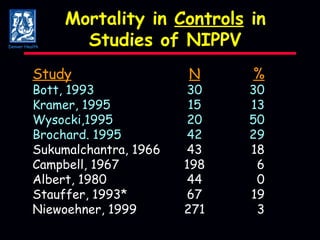
Mortality in  Controls  in Studies of NIPPV Study N % Bott, 1993 30 30 Kramer, 1995 15 13 Wysocki,1995 20 50 Brochard. 1995 42 29 Sukumalchantra, 1966 43 18 Campbell, 1967 198 6 Albert, 1980 44 0 Stauffer, 1993* 67 19 Niewoehner, 1999 271 3 Denver Health
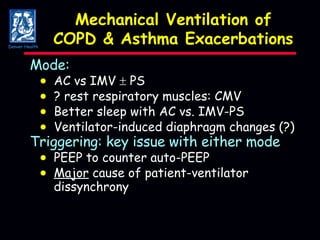
Mechanical Ventilation of COPD & Asthma Exacerbations Mode:   AC vs IMV    PS  ? rest respiratory muscles: CMV  Better sleep with AC vs. IMV-PS  Ventilator-induced diaphragm changes (?) Triggering: key issue with either mode    PEEP to counter auto-PEEP  Major  cause of patient-ventilator dissynchrony Denver Health
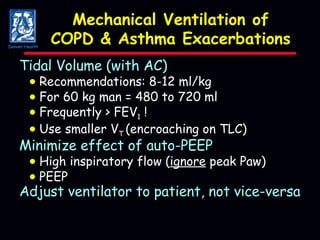
Mechanical Ventilation of COPD & Asthma Exacerbations Tidal Volume (with AC)    Recommendations: 8-12 ml/kg    For 60 kg man = 480 to 720 ml    Frequently > FEV 1  !    Use smaller V T  (encroaching on TLC) Minimize effect of auto-PEEP    High inspiratory flow ( ignore  peak Paw)    PEEP Adjust ventilator to patient, not vice-versa Denver Health
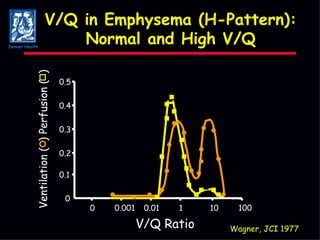
V/Q in Emphysema (H-Pattern): Normal and High V/Q Wagner, JCI 1977 0 0.001 0.01 1 10 100 0 0.1 0.2 0.3 0.4 0.5 V/Q Ratio Ventilation (  ) Perfusion (  ) Denver Health
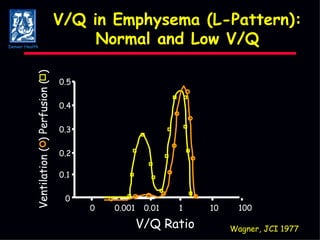
V/Q in Emphysema (L-Pattern): Normal and Low V/Q 0 0.001 0.01 1 10 100 0 0.1 0.2 0.3 0.4 0.5 V/Q Ratio Wagner, JCI 1977 Ventilation (  ) Perfusion (  ) Denver Health
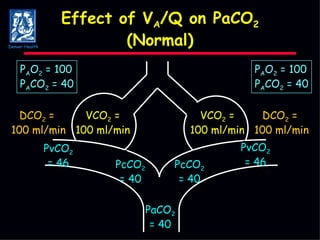
Effect of V A /Q on PaCO 2 (Normal) VCO 2  = 100 ml/min PcCO 2 = 40 PaCO 2 = 40 PcCO 2 = 40 PvCO 2 = 46 PvCO 2 = 46 DCO 2  =  100 ml/min DCO 2  =  100 ml/min P A O 2  = 100 P A CO 2  = 40 P A O 2  = 100 P A CO 2  = 40 VCO 2  = 100 ml/min Denver Health
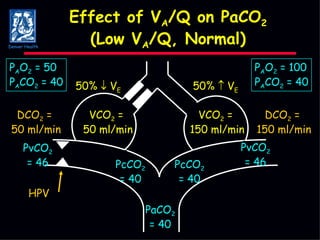
Effect of V A /Q on PaCO 2 (Low V A /Q, Normal) PcCO 2 = 40 PaCO 2 = 40 PcCO 2 = 40 PvCO 2 = 46 DCO 2  =  50 ml/min DCO 2  =  150 ml/min HPV 50%    V E VCO 2  =  50 ml/min 50%    V E VCO 2  =  150 ml/min PvCO 2 = 46 P A O 2  = 50 P A CO 2  = 40 P A O 2  = 100 P A CO 2  = 40 Denver Health
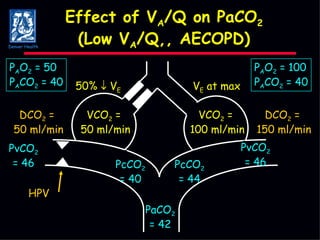
Effect of V A /Q on PaCO 2 (Low V A /Q,, AECOPD) PcCO 2 = 44 PaCO 2 = 42 PcCO 2 = 40 PvCO 2 = 46 PvCO 2 = 46 DCO 2  =  50 ml/min HPV V E  at max 50%    V E VCO 2  =  50 ml/min VCO 2  =  100 ml/min DCO 2  =  150 ml/min P A O 2  = 50 P A CO 2  = 40 P A O 2  = 100 P A CO 2  = 40 Denver Health
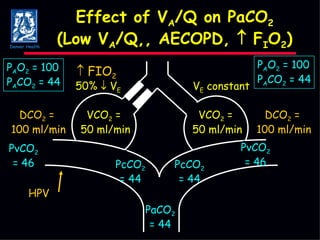
Effect of V A /Q on PaCO 2 (Low V A /Q,, AECOPD,    F I O 2 ) PcCO 2 = 44 PaCO 2 = 44 PcCO 2 = 44 PvCO 2 = 46 PvCO 2 = 46 DCO 2  =  100 ml/min HPV V E  constant 50%    V E VCO 2  =  50 ml/min VCO 2  =  50 ml/min DCO 2  =  100 ml/min    FIO 2 P A O 2  = 100 P A CO 2  = 44 P A O 2  = 100 P A CO 2  = 44 Denver Health
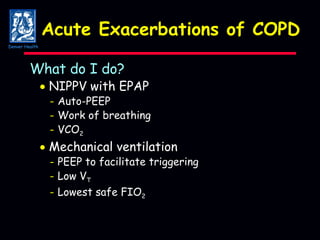
Acute Exacerbations of COPD What do I do?    NIPPV with EPAP - Auto-PEEP - Work of breathing - VCO 2    Mechanical ventilation  - PEEP to facilitate triggering - Low V T - Lowest safe   FIO 2 Denver Health
Acute Exacerbations of COPD Summary    Pathophysiology - VCO 2 - Gas trapping - Work of breathing - Auto-PEEP    NIPPV - IPAP - EPAP    Mechanical ventilation - FIO 2 - PEEP - V T Denver Health
8 th  Pulmonary Medicine Update  February 6, 2008 Denver Health

Mechanical Ventilation of Patients with COPD and Asthma

  • 1.
    Mechanical Ventilation ofPatients with COPD and Asthma Richard K. Albert, M.D. Chief of Medicine Denver Health Professor of Medicine University of Colorado Adjunct Professor of Engineering and Computer Science University of Denver 8 th Pulmonary Medicine Update February 7, 2008 Denver Health
  • 2.
    Colorado Aspen TreesDenver Health
  • 3.
    Colorado Aspen TreesDenver Health
  • 4.
    Mechanical Venitlation ofCOPD & Asthma Exacerbations Objectives  Pathophysiology - PaCO 2 dederminants - Gas trapping - Work of breathing - Auto-PEEP  NIPPV - IPAP - EPAP  Mechanical ventilation - FIO 2 - PEEP - V T Denver Health
  • 5.
    Pathohysiology of Asthma/COPDExacerbations PEEP IPAP MV? Steroids Abx? MV? BDs Airway Inflammation Airway narrowing & obstruction Shortened muscles,  curvature  Frictional WOB  muscle strength  V T PaCO 2 pH PaO 2 Gas trapping Auto- PEEP  VCO 2  V E  Elastic WOB  V A IPAP MV Denver Health
  • 6.
    Determinants of PaCO2 PaCO 2  VCO 2 V A  VCO 2   Work - Agitation - Seizures -  WOB   Metabolism - Fever - CHO -  T4  V A   V E -  RR -  V T -  V D (without  V E ) Denver Health
  • 7.
    Oxygen Cost ofBreathing Roussos, JCI 1959 Denver Health
  • 8.
    PV Curve inCOPD and Asthma (Stable) Macklem and Becklake, 1963 -10 -20 -30 -40 2 4 6 Ptp (cm H 2 O) V L (L) V T V T Normal/ Asthma Emphysema Denver Health
  • 9.
  • 10.
    PV Curve inCOPD & Asthma (Acute Exacerbtion) -10 -20 -30 -40 2 4 6 Ptp (cm H 2 O) V L (L) V T V T Asthma Emphysema Denver Health
  • 11.
    Implication V T falls because FRC encroaches on TLC  Limited ability to  V T with MV/IPAP Best way to  PaCO 2 is to  VCO 2   WOB (frictional and/or elastic)   PaCO 2 even if V T , V E and V A are constant Denver Health
  • 12.
    Gas Trapping  P Inspmax Lung Volume TLC RV P Inspmax -100 0 Respiratory muscle weakness (Not fatigue!) Denver Health
  • 13.
    Effect of Auto-PEEPPatm = 0 P A = 0 Ppl = - 5 Normal airway resistance (end-exhalation) Pel = 5  Ppl needed to initiate inhalation: - 1 P A drops to - 1 relative to Patm - 5 - 5 Ptp = 5 Denver Health
  • 14.
    Effect of Auto-PEEPP A = 10 Airway narrowing causing auto-PEEP P atm = 0 Ppl = 2 Pel = 8  Ppl needed to initiate inhalation: - 11 2 2 Ptp = 8 Denver Health
  • 15.
    Treatment of Auto-PEEPwith PEEP or CPAP Airway narrowing with auto-PEEP: Treatment with PEEP P A = 10 PEEP = 10 Ppl 2 Pel = 8  Ppl needed to initiate inhalation: - 1 The only thing PEEP does is  work of breathing 2 2 Ptp = 8 Denver Health
  • 16.
    Implication PEEP, EPAP,CPAP  No effect on V E , V T or V A   WOB (elastic) -  VCO 2 (on next breath) -  PaCO 2 (on next breath) Denver Health
  • 17.
    Treatment of Auto-PEEPwith  V insp Longer time for exhalation, P A falls P A = 6 Ppl = 1 Pel = 6  Ppl needed to initiate inhalation: - 7 1 1 Ptp = 5 P atm = 0 Denver Health
  • 18.
    Work of BreathingWork of Breathing RV FRC TLC Total Work Elastic Work Frictional Work Denver Health
  • 19.
    EPAP or CPAPvs IPAP Appendini, AJRCCM 1994  Ptp, Ptd in 7 COPD pts within 48 hrs  Work of breathing measured during: - Spontaneous breathing - CPAP = 0.8 - 0.9 auto-PEEP - PS = 10 cm H 2 O - PS + CPAP  Both CPAP and PS  WOB ¯  Additive  ? effect of underestimating auto-PEEP Denver Health
  • 20.
    NIPPV Pathophysiology ofAECOPD & Asthma is amenable to Rx with NIPPV  EPAP for auto-PEEP   IPAP for inspiratory Raw Will  work of breathing   VCO 2  At constant V A ,  PaCO 2 and  pH May  V A May  mortality and intubation rate Denver Health
  • 21.
    Frequency of Intubationin Controls in Studies of NIPPV Study N % Kramer, 1995 15 73 Wysocki,1995 20 70 Brochard. 1995 42 74 Burk, 1973 ? 29-54 Albert, 1980 44 2 Bone, 1984 50 26 Niewoehner, 1999 271 3 Denver Health
  • 22.
    Mortality in Controls in Studies of NIPPV Study N % Bott, 1993 30 30 Kramer, 1995 15 13 Wysocki,1995 20 50 Brochard. 1995 42 29 Sukumalchantra, 1966 43 18 Campbell, 1967 198 6 Albert, 1980 44 0 Stauffer, 1993* 67 19 Niewoehner, 1999 271 3 Denver Health
  • 23.
    Mechanical Ventilation ofCOPD & Asthma Exacerbations Mode:  AC vs IMV  PS  ? rest respiratory muscles: CMV  Better sleep with AC vs. IMV-PS  Ventilator-induced diaphragm changes (?) Triggering: key issue with either mode  PEEP to counter auto-PEEP  Major cause of patient-ventilator dissynchrony Denver Health
  • 24.
    Mechanical Ventilation ofCOPD & Asthma Exacerbations Tidal Volume (with AC)  Recommendations: 8-12 ml/kg  For 60 kg man = 480 to 720 ml  Frequently > FEV 1 !  Use smaller V T (encroaching on TLC) Minimize effect of auto-PEEP  High inspiratory flow ( ignore peak Paw)  PEEP Adjust ventilator to patient, not vice-versa Denver Health
  • 25.
    V/Q in Emphysema(H-Pattern): Normal and High V/Q Wagner, JCI 1977 0 0.001 0.01 1 10 100 0 0.1 0.2 0.3 0.4 0.5 V/Q Ratio Ventilation ( ) Perfusion ( ) Denver Health
  • 26.
    V/Q in Emphysema(L-Pattern): Normal and Low V/Q 0 0.001 0.01 1 10 100 0 0.1 0.2 0.3 0.4 0.5 V/Q Ratio Wagner, JCI 1977 Ventilation ( ) Perfusion ( ) Denver Health
  • 27.
    Effect of VA /Q on PaCO 2 (Normal) VCO 2 = 100 ml/min PcCO 2 = 40 PaCO 2 = 40 PcCO 2 = 40 PvCO 2 = 46 PvCO 2 = 46 DCO 2 = 100 ml/min DCO 2 = 100 ml/min P A O 2 = 100 P A CO 2 = 40 P A O 2 = 100 P A CO 2 = 40 VCO 2 = 100 ml/min Denver Health
  • 28.
    Effect of VA /Q on PaCO 2 (Low V A /Q, Normal) PcCO 2 = 40 PaCO 2 = 40 PcCO 2 = 40 PvCO 2 = 46 DCO 2 = 50 ml/min DCO 2 = 150 ml/min HPV 50%  V E VCO 2 = 50 ml/min 50%  V E VCO 2 = 150 ml/min PvCO 2 = 46 P A O 2 = 50 P A CO 2 = 40 P A O 2 = 100 P A CO 2 = 40 Denver Health
  • 29.
    Effect of VA /Q on PaCO 2 (Low V A /Q,, AECOPD) PcCO 2 = 44 PaCO 2 = 42 PcCO 2 = 40 PvCO 2 = 46 PvCO 2 = 46 DCO 2 = 50 ml/min HPV V E at max 50%  V E VCO 2 = 50 ml/min VCO 2 = 100 ml/min DCO 2 = 150 ml/min P A O 2 = 50 P A CO 2 = 40 P A O 2 = 100 P A CO 2 = 40 Denver Health
  • 30.
    Effect of VA /Q on PaCO 2 (Low V A /Q,, AECOPD,  F I O 2 ) PcCO 2 = 44 PaCO 2 = 44 PcCO 2 = 44 PvCO 2 = 46 PvCO 2 = 46 DCO 2 = 100 ml/min HPV V E constant 50%  V E VCO 2 = 50 ml/min VCO 2 = 50 ml/min DCO 2 = 100 ml/min  FIO 2 P A O 2 = 100 P A CO 2 = 44 P A O 2 = 100 P A CO 2 = 44 Denver Health
  • 31.
    Acute Exacerbations ofCOPD What do I do?  NIPPV with EPAP - Auto-PEEP - Work of breathing - VCO 2  Mechanical ventilation - PEEP to facilitate triggering - Low V T - Lowest safe FIO 2 Denver Health
  • 32.
    Acute Exacerbations ofCOPD Summary  Pathophysiology - VCO 2 - Gas trapping - Work of breathing - Auto-PEEP  NIPPV - IPAP - EPAP  Mechanical ventilation - FIO 2 - PEEP - V T Denver Health
  • 33.
    8 th Pulmonary Medicine Update February 6, 2008 Denver Health