Ventilation‐perfusion in health & 
Ventilation‐perfusion in health &
disease
Arjun Srinivasan
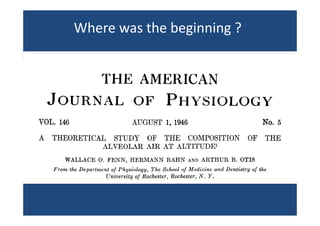
Where was the beginning ?
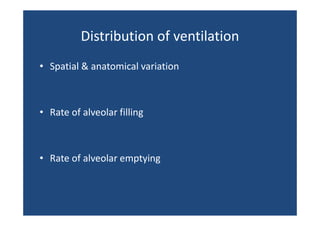
Distribution of ventilation
Distribution of ventilation
• Spatial & anatomical variation

• Rate of alveolar filling
Rate of alveolar filling

• Rate of alveolar emptying
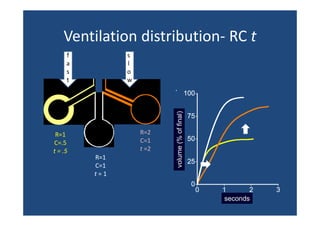
Ventilation distribution‐ RC t
Ventilation distribution RC t
f
a
s
t

s
l
o
w

R=1
C=.5
t = .5

R=2
C=1
C 1
t =2
R=1
C=1
C 1
t = 1

volume (% of final)
%
)

100
75
50
25
0

0

1
2
sekundy
seconds

3
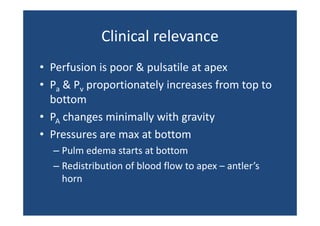
Clinical relevance 
Clinical relevance
• Perfusion is poor & pulsatile at apex
• Pa & Pv proportionately increases from top to
& P proportionately increases from top to 
bottom
• PA changes minimally with gravity
h
i i ll i h
i
• Pressures are max at bottom 
– Pulm edema starts at bottom
– Redistribution of blood flow to apex antler’s
Redistribution of blood flow to apex – antler’s 
horn
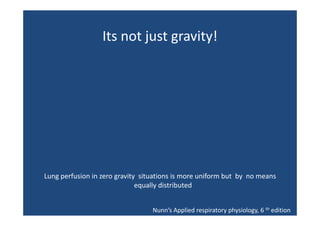
Its not just gravity!
Its not just gravity!

Lung perfusion in zero gravity  situations is more uniform but  by  no means
equally distributed
Nunn’s Applied respiratory physiology, 6 th edition
Understanding V/Q relationships
Understanding V/Q relationships
• C id l
Consider lung as single unit
i l
it
– Relationships  between PA O2, PA CO2, alveolar 
l
h
b
l l
ventilation & pulmonary blood flow
– Alveolar gas equation 

• Consider lung as multiple units of varying V/Q
– Clinical consequences in health & disease
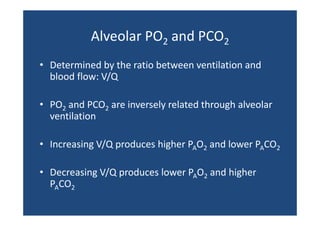
Alveolar PO and PCO
Alveolar PO2 and PCO2
• D
Determined by the ratio between ventilation and 
i db h
i b
il i
d
blood flow: V/Q
• PO2 and PCO2 are inversely related through alveolar 
ventilation
il i
• Increasing V/Q produces higher PAO2 and lower PACO2
• Decreasing V/Q produces lower PAO2 and higher 
PACO2
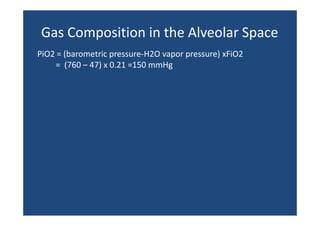
Gas Composition in the Alveolar Space
Gas Composition in the Alveolar Space
PiO2 = (barometric pressure‐H2O vapor pressure) xFiO2
=  (760 – 47) x 0.21 =150 mmHg
(
)
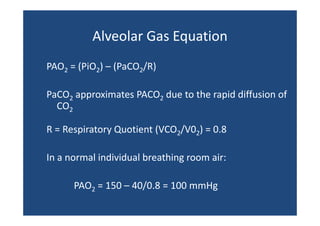
Alveolar Gas Equation
Alveolar Gas Equation
PAO2 = (PiO2) – (PaCO2/R)
PaCO2 approximates PACO2 due to the rapid diffusion of 
CO2
R = Respiratory Quotient (VCO2/V02) = 0.8
In a normal individual breathing room air:
PAO2 = 150 – 40/0.8 = 100 mmHg
/
g
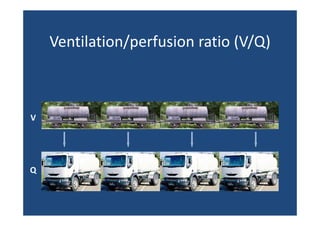
Ventilation/perfusion ratio (V/Q)
il i / f i
i ( / )

V

Q
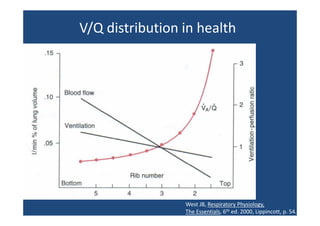
V/Q distribution in health 

West JB, Respiratory Physiology, 
The Essentials, 6th ed. 2000, Lippincott, p. 54.
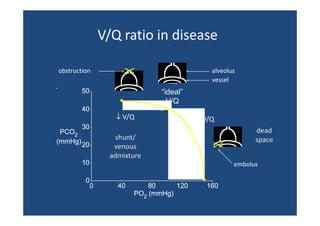
V/Q ratio in disease
V/Q ratio in disease
obstruction

alveolus
vessel

50
40

“ideal”
V/Q
↓ V/Q

↑ V/Q

30

PCO2
(mmHg) 20
(
)

dead
space

shunt/
venous
admixture

10
0

0

embolus

40

80
120
PO2 (mmHg)

160
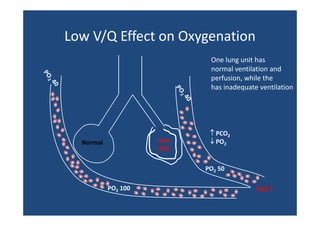
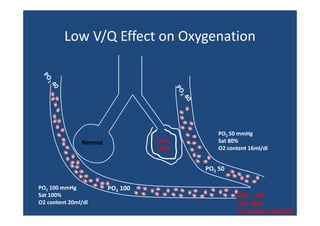
Low V/Q Effect on Oxygenation
Low V/Q Effect on Oxygenation
One lung unit has
One lung unit has
normal ventilation and
perfusion, while the 
has inadequate ventilation
has inadequate ventilation

Low
L
V/Q

Normal

↑ PCO2
↓ PO2

PO2 50
PO2 100

PO2 ?
PO2 ?
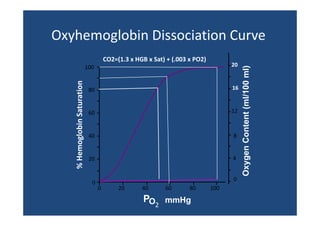
CO2=(1.3 x HGB x Sat) + (.003 x PO2)
(
) (
)

%
% Hemog
globin Saturatio
on

100

20

80

16

60

12

40

8

20

4

0

0
0

20

40

60

80

PO mmHg
2

100

Oxy
ygen Content (ml/10 ml)
C
t
00

Oxyhemoglobin Dissociation Curve
Dissociation Curve
Low V/Q Effect on Oxygenation
Low V/Q Effect on Oxygenation

Low
L
V/Q

Normal

PO2 50 mmHg
Sat 80%
O2 content 16ml/dl

PO2 50
PO2 100 mmHg
g
Sat 100%
O2 content 20ml/dl

PO2 100

PO2 = 60
Sat  90%
O2 content 18ml/dl
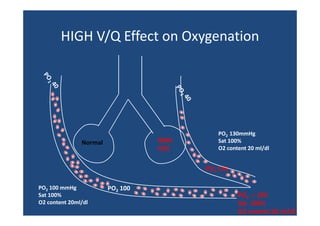
HIGH V/Q Effect on Oxygenation
HIGH V/Q Effect on Oxygenation

HIGH
V/Q

Normal

PO2  130mmHg
Sat 100%
O2 content 20 ml/dl

PO2 130
PO2 100 mmHg
g
Sat 100%
O2 content 20ml/dl

PO2 100

PO2 = 100
Sat  100%
O2 content 20 ml/dl
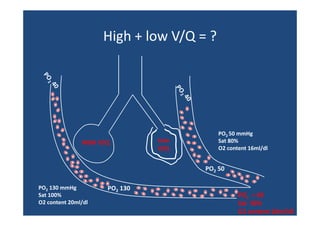
High + low V/Q = ?
High + low V/Q = ?

HIGH V/Q

Low
L
V/Q

PO2 50 mmHg
Sat 80%
O2 content 16ml/dl

PO2 50
PO2 130 mmHg
g
Sat 100%
O2 content 20ml/dl

PO2 130

PO2 = 60
Sat  90%
O2 content 18ml/dl
Local ↑ V/Q above ~1 has minimal 
effect on [O2]
160

23

PaO2
(mmHg)

O2
content
21 ( /
(ml/100 ml)
)
22

120

20
80

19
18

40

17
16

0
0.001

0.01

0.1

1

10

V/Q
Thus ↑ V/Q in one part of lung can’t compensate for ↓ elsewhere

15
100
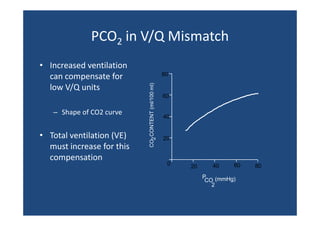
PCO2 in V/Q Mismatch
in V/Q Mismatch

– Shape of CO2 curve
Shape of CO2 curve

• Total ventilation (VE) 
( )
must increase for this 
compensation

80
CO2 CONTENT (ml/100 ml)
T
m

• Increased ventilation 
can compensate for 
low V/Q units
low V/Q units

60

40

20

0

20

40

60

P
CO (mmHg)
2

80
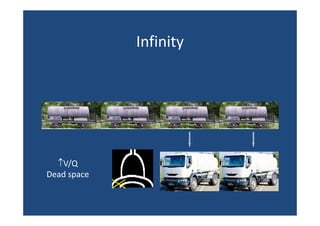
Infinity 
fi i

↑V/Q
Dead space
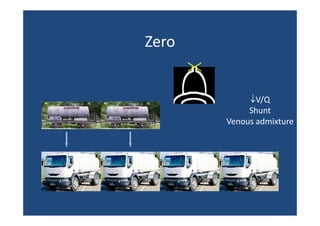
Zero

↓V/Q
Shunt
Venous admixture
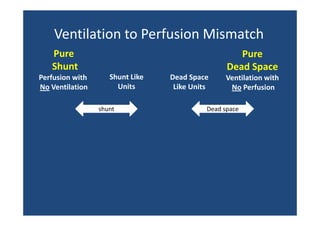
Ventilation to Perfusion Mismatch  
Ventilation to Perfusion Mismatch
Pure
Shunt
Perfusion with 
No Ventilation

Pure
Dead Space
Shunt Like
Units
shunt

Dead Space 
Like Units
Like Units

Ventilation with
No Perfusion

Dead space
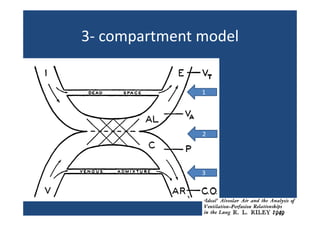
3‐ compartment model  
3 compartment model

1

2

3
Dead space
Dead space
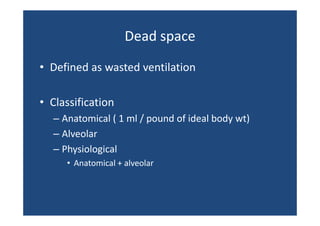
• Defined as wasted ventilation
• Classification
– Anatomical ( 1 ml / pound of ideal body wt)
– Alveolar
– Physiological 
• Anatomical + alveolar
Anatomical + alveolar 
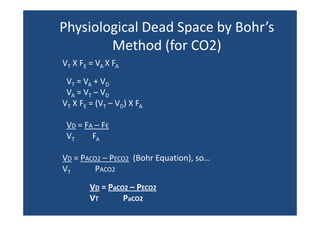
Physiological Dead Space by Bohr’s 
Method (for CO2)
VT X FE = VA X FA
X F V X F
VT = VA + VD
VA = VT – VD
VT X FE = (VT – VD) X FA
VD = FA – FE
VT
FA
T 
VD = PACO2 – PECO2 (Bohr Equation), so…
VT
PACO2
VD = PaCO2 – PECO2
PaCO
CO
VT
PaCO2
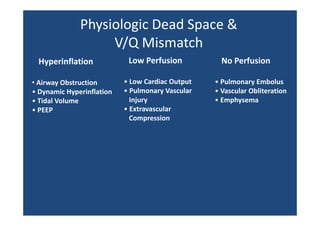
Physiologic Dead Space &
V/Q Mismatch
Hyperinflation
• Airway Obstruction
• Dynamic Hyperinflation 
• Tidal Volume
• PEEP

Low Perfusion
Low Perfusion
• Low Cardiac Output
• Pulmonary Vascular
Injury
• Extravascular
Compression

No Perfusion
No Perfusion
• Pulmonary Embolus
• Vascular Obliteration
• Emphysema
Shunt equation 
Shunt equation
Qt x CaO2 = [(Qt – Qs) x Cc’O2] + [Qs x CvO2] 

Qs Cc ' O2 − CaO 2
=
Qt Cc ' O2 − CvO 2
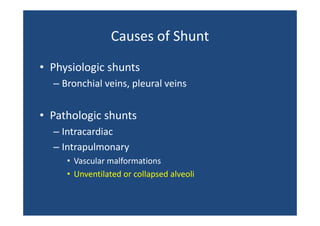
Causes of Shunt
Causes of Shunt
• Physiologic shunts
– Bronchial veins, pleural veins
,p

• P th l i h t
Pathologic shunts
– Intracardiac
– Intrapulmonary
• Vascular malformations
• Unventilated or collapsed alveoli 
Normal shunt fraction 
Normal shunt fraction
• ~ 5 %
• Due to
– Physiological shunt
– Gravity related V/Q mismatch
y

• Contributes to A a D O2
Contributes to A‐a D O
– 10 – 15 mm hg 
A a
A a DO2
• PAO2 ( l l
PAO2 (alveolar gas equation)‐ arterial PaO2
ti ) t i l P O2
• I t t ll ffi i t l
In a totally efficient lung unit with matched V/Q, 
it ith t h d V/Q
alveolar and capillary PO2 would be equal
• Admixture of venous blood or V/Q scatter from low 
V/Q lung units will  increase A a
V/Q lung units will increase A a DO2
• Increases ~ 3 mm hg every decade after 30 yrs of age
Increases  3 mm hg every decade after 30 yrs of age
Shunt    VS. V/Q scatter
Shunt VS V/Q scatter
• C l l d h
Calculated shunt fraction or A a DO2
f
i
O
– Does not differentiate

• Response of pa O2 to increasing Fi O2
• V/Q scatter 
– Pa O2 increase with small increase in FiO2(.21‐.35)

• Pure shunt
– Not much response 
p
MIGET
•
•
•

50 parallel gas exchange units 
characterized by VA‐Q ratio.
Fit predicted PE & Pa to 
experimental data.
Output:  Ventilation and 
perfusion distributions.
Compensation of V/Q inequality ?
Compensation of V/Q inequality ?
• ↑V/Q → local hypocapnia → ↑pH → local 
bronchoconstriction (↓V/Q )
• ↓V/Q → ↑CO2 → ↑ ventilation
↓V/Q →
– improves CO2 > O2 (dissociation curves)
• ↓V/Q → hypoxic pulmonary vasoconstriction
Points to remember
Points to remember
• Ventilation and Perfusion must be matched at the alveolar capillary
Ventilation and Perfusion must be matched at the alveolar capillary 
level
• Most important cause of hypoxemia in most respiratory diseases
Most important cause of hypoxemia in most respiratory diseases
• V/Q ratios close to 1.0 result in alveolar PO2 close to 100 mmHg 
and PCO2 close to 40 mmHg
and PCO2 close to 40 mmHg
• V/Q greater than 1.0 increase PO2 and Decrease PCO2.  V/Q less 
than 1.0 decrease PO2 and Increase PCO2
than 1 0 decrease PO2 and Increase PCO2
• Shunt and Dead Space are Extremes of V/Q mismatching.
• A‐a Gradient of 10‐15 Results from gravitational effects on V/Q and 
Physiologic Shunt

Pneumology - Ventilation perfusion-ratio-and-clinical-importance