Moderator  : Dr Padmanabha Presenter  :  Dr Nikhil  mp
 
Diaphragm  Dome shaped muscle . Inserted to lower rib. Phrenic nerve- C 3, 4, 5.. Abdominal contents are pushed forward and downward & vertical  dimension of chest cavity is increased. Transverse diameter increased.
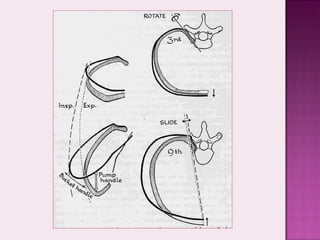
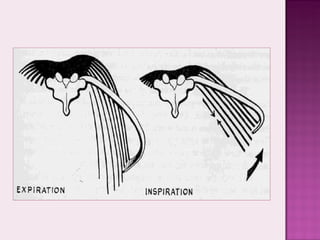
Paradoxical movement. External intercostals Ribs are pulled upward & forward causing increase in lateral & AP of thorax.  “ Bucket handle movement” “ Pump handle movement”. Accessory muscles scalene & sternocliedomastoid.
 
 
Passive during quiet breathing. Active - exercise and hyperventilation. Muscles of abdominal wall. When muscles contract intraabdominal pressure rise & diaphragm is pushed upwards.
Movements of lung is passive. Impedence of the respiratory system. Elastic resistance. Non elastic resistance.
Lung  & chest wall. Surface forces at alveolar gas liquid interface.
Lungs and chest have elastic properties. Chest has tendency to expand. Lungs have tendency to collapse . Recoil properties of chest due to components that resist deformation. In case of lung - elastin fibres & surface tension forces acting at air fluid interface.
Elastic recoil of the lungs is measured in terms of compliance. Compliance is defined as change in lung volume per unit change in transmural pressure gradient. 150 to 200ml/cm H 2 O. Static . Dynamic. Stiff lungs have low compliance.
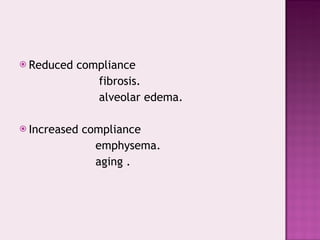
Reduced compliance fibrosis. alveolar edema. Increased compliance emphysema. aging .
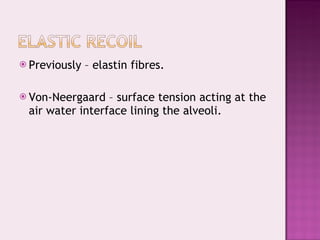
Previously – elastin fibres. Von-Neergaard – surface tension acting at the air water interface lining the alveoli.
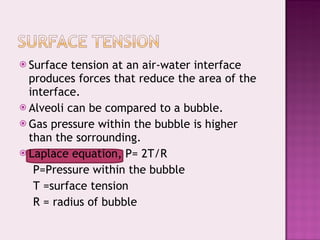
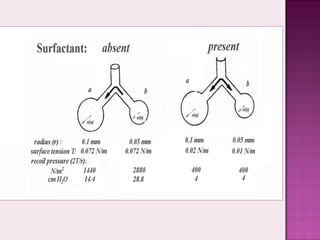
Surface tension at an air-water interface produces forces that reduce the area of the interface. Alveoli can be compared to a bubble. Gas pressure within the bubble is higher  than the sorrounding. Laplace equation, P= 2T/R P=Pressure within the bubble T =surface tension R = radius of bubble
 
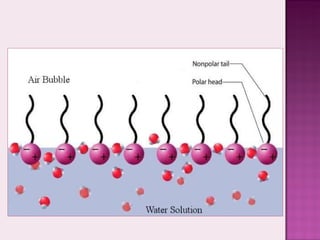
Low surface tension of alveolar lining fluid and its dependance on alveolar radius – surfactant. Alveolar epithelial cells- type II. 90% lipids & rest protiens and carbohydrate. Dipalmitoyl phosphatidyl choline.
To maintain the stability of alveoli. Immunology of  the lung.
 
Most Frictional resistance to air flow. Thoracic tissue deformation.
Gas flows from area of high pressure to area of low pressure The rate at which it does is a function of the pressure difference and the resistance to gas flow
2 types Laminar flow Turbulent flow
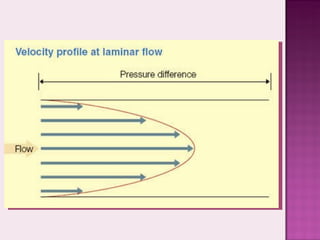
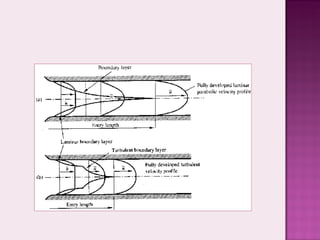
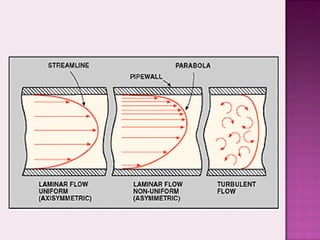
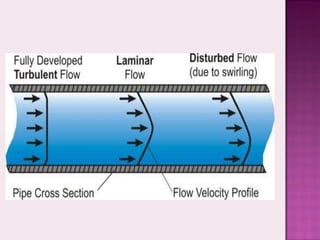
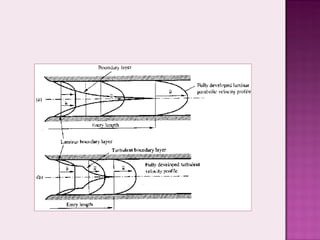
Gas flows   along a straight unbranched tube as a series of concentric cylinders that slide over one another,with peripheral cylinder stationary and central fastest,advancing cone forming a parabola
 
 
FG will reach end of the tube  while volume entering the tube is less than the volume of the tube Significant alveolar ventilation  tidal volume < volume of the airways
Friction   between tube wall and fluid is negligible. Significant alveolar ventilation when the tidal volume < the volume of airways.
Inefficient for purging the contents of the tube. Gas sampled from periphery may not be  representative of the gas in the centre. Requires a critical length of tubing  before typical flow pattern .
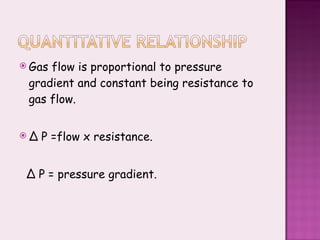
Gas flow is proportional to pressure gradient and constant being resistance to gas flow. ∆  P =flow x resistance. ∆  P = pressure gradient.
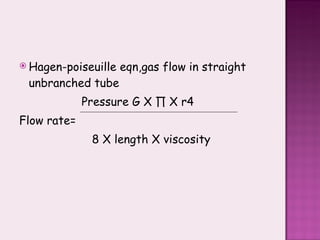
Hagen-poiseuille eqn,gas flow in straight unbranched tube Pressure G X ∏ X r4 Flow rate=  8 X length X viscosity
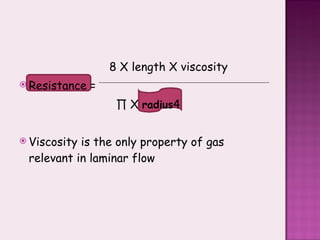
8 X length X viscosity Resistance =  ∏  X  radius 4 Viscosity is the only property of gas relevant in laminar flow
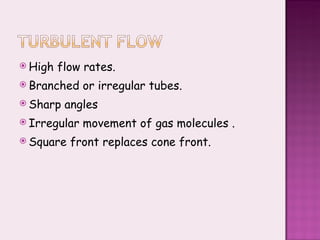
High flow rates. Branched or irregular tubes. Sharp angles Irregular movement of gas molecules . Square front replaces cone front.
 
 
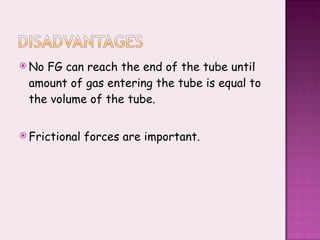
No FG can reach the end of the tube until amount of gas entering the tube is equal to the volume of the tube. Frictional forces are important.
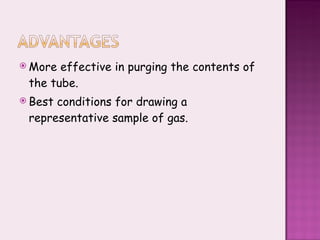
More effective in purging the contents of the tube. Best conditions for drawing a representative sample of gas.
Driving pressure is proportional To the square of the gas flow. Density of gas. Inversely proportional to the fifth power  of radius. Independent of viscosity.
The nature of gas flow . Linear velocity of gas X tube diameter X gas  density gas viscosity < 2000  -  laminar. > 4000  -  turbulent. Both  between 2000 -  4000. Low resistance . Establishment of laminar flow faster.
 
Frictional resistance  In healthy people,Larger airways responsible Smaller airways : small contribution
Velocity of gas flow & airway diameter decreases in successive airway generations. Entrance length greater. Frequent divisions.
Gas mixtures having low Reynolds number beneficial in large airway disease. Physical characteristics of airway lining will influence frictional resistance.
Primarily due to viscoelastic resistance. Lung & chestwall tissues.
Airway diameter Physical compression Contraction of smooth muscles
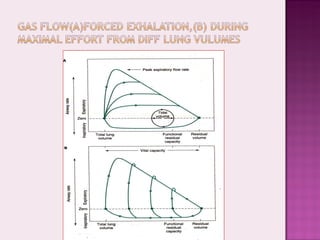
Effect of lung volume on resistance to breathing Airway resistance is an inverse function of lung volume At low lung volume ,flow related airway collapse occurs Expiratory airway collapse  Valve effect Gas trapping CPAP & PEEP
Closing capacity Lung volume at which airways in the dependant part of the lung begins to close. Closing volume  = closing capacity – RV.
< FRC in young adults. Equal to FRC at 44 yrs in supine position & 66yrs in upright position. When FRC  <  closing capacity  SHUNT.
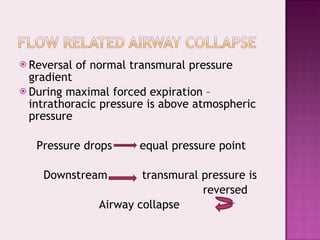
Reversal of normal transmural pressure gradient During maximal forced expiration –intrathoracic pressure is above atmospheric pressure Pressure drops  equal pressure point Downstream  transmural pressure is reversed Airway collapse
 
 
When expiration is passive  Work of breathing is done by inspiratory muscles. Half  dissipated as heat & half stored as PE. PE is available for expiration.
Actual work by respiratory muscles is small. 02 consumption – 3ml/min. Efficiency is 10%. When maximum ventilation is approached efficiency falls to lowest level.
Work done to overcome elastic resistance increases as tidal volume increases. Work done to overcome airflow resistance increases as RR increases.
Nunn’s respiratory physiology,6 th  edition. Respiratory physiology ,JOHN B .WEST,8 th  edition. Millers anaesthesia,6 th  edn. Clinical anaesthesiology,G.Edward morgan,4 th  edn.
 

Breathing mechanics

  • 1.
    Moderator :Dr Padmanabha Presenter : Dr Nikhil mp
  • 2.
  • 3.
    Diaphragm Domeshaped muscle . Inserted to lower rib. Phrenic nerve- C 3, 4, 5.. Abdominal contents are pushed forward and downward & vertical dimension of chest cavity is increased. Transverse diameter increased.
  • 4.
    Paradoxical movement. Externalintercostals Ribs are pulled upward & forward causing increase in lateral & AP of thorax. “ Bucket handle movement” “ Pump handle movement”. Accessory muscles scalene & sternocliedomastoid.
  • 5.
  • 6.
  • 7.
    Passive during quietbreathing. Active - exercise and hyperventilation. Muscles of abdominal wall. When muscles contract intraabdominal pressure rise & diaphragm is pushed upwards.
  • 8.
    Movements of lungis passive. Impedence of the respiratory system. Elastic resistance. Non elastic resistance.
  • 9.
    Lung &chest wall. Surface forces at alveolar gas liquid interface.
  • 10.
    Lungs and chesthave elastic properties. Chest has tendency to expand. Lungs have tendency to collapse . Recoil properties of chest due to components that resist deformation. In case of lung - elastin fibres & surface tension forces acting at air fluid interface.
  • 11.
    Elastic recoil ofthe lungs is measured in terms of compliance. Compliance is defined as change in lung volume per unit change in transmural pressure gradient. 150 to 200ml/cm H 2 O. Static . Dynamic. Stiff lungs have low compliance.
  • 12.
    Reduced compliance fibrosis.alveolar edema. Increased compliance emphysema. aging .
  • 13.
    Previously – elastinfibres. Von-Neergaard – surface tension acting at the air water interface lining the alveoli.
  • 14.
    Surface tension atan air-water interface produces forces that reduce the area of the interface. Alveoli can be compared to a bubble. Gas pressure within the bubble is higher than the sorrounding. Laplace equation, P= 2T/R P=Pressure within the bubble T =surface tension R = radius of bubble
  • 15.
  • 16.
    Low surface tensionof alveolar lining fluid and its dependance on alveolar radius – surfactant. Alveolar epithelial cells- type II. 90% lipids & rest protiens and carbohydrate. Dipalmitoyl phosphatidyl choline.
  • 17.
    To maintain thestability of alveoli. Immunology of the lung.
  • 18.
  • 19.
    Most Frictional resistanceto air flow. Thoracic tissue deformation.
  • 20.
    Gas flows fromarea of high pressure to area of low pressure The rate at which it does is a function of the pressure difference and the resistance to gas flow
  • 21.
    2 types Laminarflow Turbulent flow
  • 22.
    Gas flows along a straight unbranched tube as a series of concentric cylinders that slide over one another,with peripheral cylinder stationary and central fastest,advancing cone forming a parabola
  • 23.
  • 24.
  • 25.
    FG will reachend of the tube while volume entering the tube is less than the volume of the tube Significant alveolar ventilation tidal volume < volume of the airways
  • 26.
    Friction between tube wall and fluid is negligible. Significant alveolar ventilation when the tidal volume < the volume of airways.
  • 27.
    Inefficient for purgingthe contents of the tube. Gas sampled from periphery may not be representative of the gas in the centre. Requires a critical length of tubing before typical flow pattern .
  • 28.
    Gas flow isproportional to pressure gradient and constant being resistance to gas flow. ∆ P =flow x resistance. ∆ P = pressure gradient.
  • 29.
    Hagen-poiseuille eqn,gas flowin straight unbranched tube Pressure G X ∏ X r4 Flow rate= 8 X length X viscosity
  • 30.
    8 X lengthX viscosity Resistance = ∏ X radius 4 Viscosity is the only property of gas relevant in laminar flow
  • 31.
    High flow rates.Branched or irregular tubes. Sharp angles Irregular movement of gas molecules . Square front replaces cone front.
  • 32.
  • 33.
  • 34.
    No FG canreach the end of the tube until amount of gas entering the tube is equal to the volume of the tube. Frictional forces are important.
  • 35.
    More effective inpurging the contents of the tube. Best conditions for drawing a representative sample of gas.
  • 36.
    Driving pressure isproportional To the square of the gas flow. Density of gas. Inversely proportional to the fifth power of radius. Independent of viscosity.
  • 37.
    The nature ofgas flow . Linear velocity of gas X tube diameter X gas density gas viscosity < 2000 - laminar. > 4000 - turbulent. Both between 2000 - 4000. Low resistance . Establishment of laminar flow faster.
  • 38.
  • 39.
    Frictional resistance In healthy people,Larger airways responsible Smaller airways : small contribution
  • 40.
    Velocity of gasflow & airway diameter decreases in successive airway generations. Entrance length greater. Frequent divisions.
  • 41.
    Gas mixtures havinglow Reynolds number beneficial in large airway disease. Physical characteristics of airway lining will influence frictional resistance.
  • 42.
    Primarily due toviscoelastic resistance. Lung & chestwall tissues.
  • 43.
    Airway diameter Physicalcompression Contraction of smooth muscles
  • 44.
    Effect of lungvolume on resistance to breathing Airway resistance is an inverse function of lung volume At low lung volume ,flow related airway collapse occurs Expiratory airway collapse Valve effect Gas trapping CPAP & PEEP
  • 45.
    Closing capacity Lungvolume at which airways in the dependant part of the lung begins to close. Closing volume = closing capacity – RV.
  • 46.
    < FRC inyoung adults. Equal to FRC at 44 yrs in supine position & 66yrs in upright position. When FRC < closing capacity SHUNT.
  • 47.
    Reversal of normaltransmural pressure gradient During maximal forced expiration –intrathoracic pressure is above atmospheric pressure Pressure drops equal pressure point Downstream transmural pressure is reversed Airway collapse
  • 48.
  • 49.
  • 50.
    When expiration ispassive Work of breathing is done by inspiratory muscles. Half dissipated as heat & half stored as PE. PE is available for expiration.
  • 51.
    Actual work byrespiratory muscles is small. 02 consumption – 3ml/min. Efficiency is 10%. When maximum ventilation is approached efficiency falls to lowest level.
  • 52.
    Work done toovercome elastic resistance increases as tidal volume increases. Work done to overcome airflow resistance increases as RR increases.
  • 53.
    Nunn’s respiratory physiology,6th edition. Respiratory physiology ,JOHN B .WEST,8 th edition. Millers anaesthesia,6 th edn. Clinical anaesthesiology,G.Edward morgan,4 th edn.
  • 54.