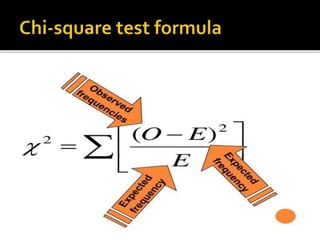
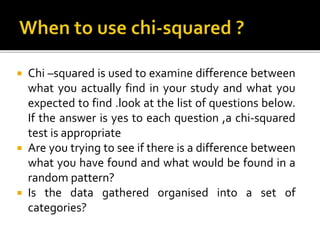
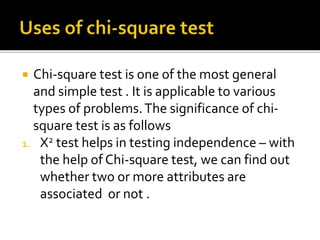
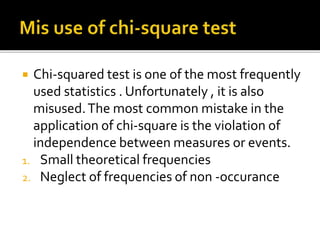
This document discusses the chi-square test, a statistical hypothesis test where the test statistic follows a chi-squared distribution if the null hypothesis is true. It was developed by Karl Pearson in 1900. The chi-square test can be used to examine differences between observed and expected results in a random pattern. It is applicable to testing independence between attributes and goodness of fit to theoretical distributions. Common mistakes in applying the chi-square test include small theoretical frequencies, neglecting non-occurrences, and incorrect determination of degrees of freedom. The chi-square test is used to test significance of sample variance, independence in contingency tables, comparisons of frequency distributions, and goodness of fit.