SHREE SA’D VIDYA MANDAL
INSTITUTE OF TECHNOLOGY
DEPARTMENT OF CIVIL
ENGINEERING
Subject:-Numerical and Statistical
Methods
Topic:-Poisson Distribution
Presented by:-
Name
 Arvindsai Nair
 Dhaval Chavda
 Shubham Yadav
Enrollment no.
130454106002
130454106001
130450106056
Poisson Distribution
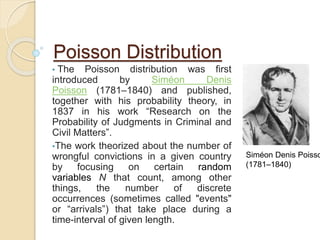
• The Poisson distribution was first
introduced by Siméon Denis
Poisson (1781–1840) and published,
together with his probability theory, in
1837 in his work “Research on the
Probability of Judgments in Criminal and
Civil Matters”.
•The work theorized about the number of
wrongful convictions in a given country
by focusing on certain random
variables N that count, among other
things, the number of discrete
occurrences (sometimes called "events"
or “arrivals”) that take place during a
time-interval of given length.
Siméon Denis Poisso
(1781–1840)
Poisson Distribution
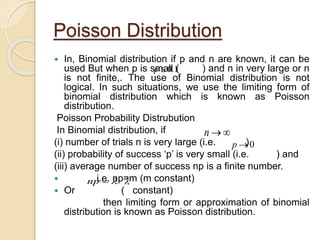
 In, Binomial distribution if p and n are known, it can be
used But when p is small ( ) and n in very large or n
is not finite,. The use of Binomial distribution is not
logical. In such situations, we use the limiting form of
binomial distribution which is known as Poisson
distribution.
Poisson Probability Distrubution
In Binomial distribution, if
(i) number of trials n is very large (i.e. )
(ii) probability of success ‘p’ is very small (i.e. ) and
(iii) average number of success np is a finite number.
 i.e. np=m (m constant)
 Or ( constant)
then limiting form or approximation of binomial
distribution is known as Poisson distribution.
np
n
0p

1.0p
Poisson Distribution
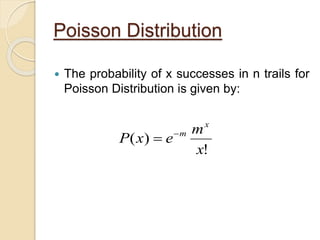
 The probability of x successes in n trails for
Poisson Distribution is given by:
!
)(
x
m
exP
x
m

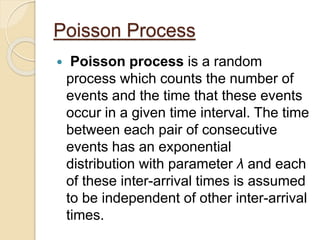
Poisson Process
 Poisson process is a random
process which counts the number of
events and the time that these events
occur in a given time interval. The time
between each pair of consecutive
events has an exponential
distribution with parameter λ and each
of these inter-arrival times is assumed
to be independent of other inter-arrival
times.
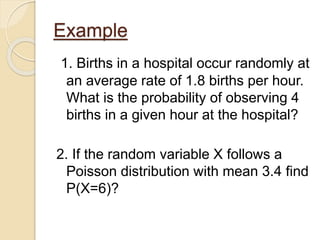
Example
1. Births in a hospital occur randomly at
an average rate of 1.8 births per hour.
What is the probability of observing 4
births in a given hour at the hospital?
2. If the random variable X follows a
Poisson distribution with mean 3.4 find
P(X=6)?
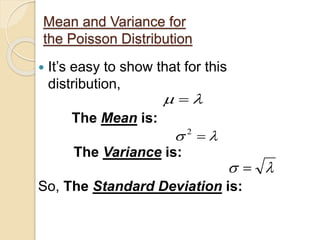
Mean and Variance for
the Poisson Distribution
 It’s easy to show that for this
distribution,
The Mean is:
The Variance is:
So, The Standard Deviation is:
 
 2
 
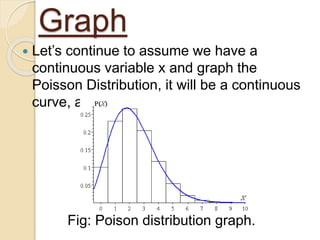
Graph
 Let’s continue to assume we have a
continuous variable x and graph the
Poisson Distribution, it will be a continuous
curve, as follows:
Fig: Poison distribution graph.
Properties of Poisson distribution
1. Poisson distribution is a distribution of discrete
random variable.
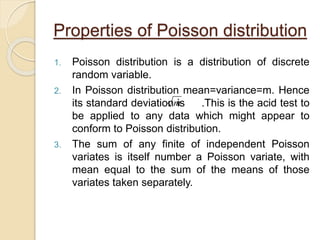
2. In Poisson distribution mean=variance=m. Hence
its standard deviation is .This is the acid test to
be applied to any data which might appear to
conform to Poisson distribution.
3. The sum of any finite of independent Poisson
variates is itself number a Poisson variate, with
mean equal to the sum of the means of those
variates taken separately.
m
Applications of Poisson distribution
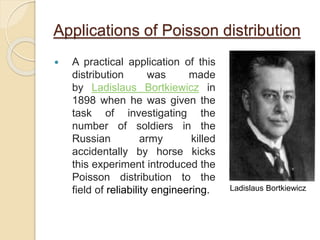
 A practical application of this
distribution was made
by Ladislaus Bortkiewicz in
1898 when he was given the
task of investigating the
number of soldiers in the
Russian army killed
accidentally by horse kicks
this experiment introduced the
Poisson distribution to the
field of reliability engineering. Ladislaus Bortkiewicz
Applications of Poisson distribution
Following are some practical applications of Poisson
distribution
1. The count of - particles emitted per unit of time is
useful in analysis of any radio-active substance.
2. Number of telephone calls received at a given switch
board per small unit of time.
3. Number of deaths per day or week due to a rare
disease in a big hospital
4. In industrial production to find the proportion of defects
per unit length, per unit area etc.
5. The count of bacteria per c.c. in blood
6. Distribution of number of mis-prints per page of a book

Poisson distribution

Poisson distribution

  • 1.
    SHREE SA’D VIDYAMANDAL INSTITUTE OF TECHNOLOGY DEPARTMENT OF CIVIL ENGINEERING
  • 2.
  • 3.
    Presented by:- Name  ArvindsaiNair  Dhaval Chavda  Shubham Yadav Enrollment no. 130454106002 130454106001 130450106056
  • 4.
    Poisson Distribution • ThePoisson distribution was first introduced by Siméon Denis Poisson (1781–1840) and published, together with his probability theory, in 1837 in his work “Research on the Probability of Judgments in Criminal and Civil Matters”. •The work theorized about the number of wrongful convictions in a given country by focusing on certain random variables N that count, among other things, the number of discrete occurrences (sometimes called "events" or “arrivals”) that take place during a time-interval of given length. Siméon Denis Poisso (1781–1840)
  • 5.
    Poisson Distribution  In,Binomial distribution if p and n are known, it can be used But when p is small ( ) and n in very large or n is not finite,. The use of Binomial distribution is not logical. In such situations, we use the limiting form of binomial distribution which is known as Poisson distribution. Poisson Probability Distrubution In Binomial distribution, if (i) number of trials n is very large (i.e. ) (ii) probability of success ‘p’ is very small (i.e. ) and (iii) average number of success np is a finite number.  i.e. np=m (m constant)  Or ( constant) then limiting form or approximation of binomial distribution is known as Poisson distribution. np n 0p  1.0p
  • 6.
    Poisson Distribution  Theprobability of x successes in n trails for Poisson Distribution is given by: ! )( x m exP x m 
  • 7.
    Poisson Process  Poissonprocess is a random process which counts the number of events and the time that these events occur in a given time interval. The time between each pair of consecutive events has an exponential distribution with parameter λ and each of these inter-arrival times is assumed to be independent of other inter-arrival times.
  • 8.
    Example 1. Births ina hospital occur randomly at an average rate of 1.8 births per hour. What is the probability of observing 4 births in a given hour at the hospital? 2. If the random variable X follows a Poisson distribution with mean 3.4 find P(X=6)?
  • 9.
    Mean and Variancefor the Poisson Distribution  It’s easy to show that for this distribution, The Mean is: The Variance is: So, The Standard Deviation is:    2  
  • 10.
    Graph  Let’s continueto assume we have a continuous variable x and graph the Poisson Distribution, it will be a continuous curve, as follows: Fig: Poison distribution graph.
  • 11.
    Properties of Poissondistribution 1. Poisson distribution is a distribution of discrete random variable. 2. In Poisson distribution mean=variance=m. Hence its standard deviation is .This is the acid test to be applied to any data which might appear to conform to Poisson distribution. 3. The sum of any finite of independent Poisson variates is itself number a Poisson variate, with mean equal to the sum of the means of those variates taken separately. m
  • 12.
    Applications of Poissondistribution  A practical application of this distribution was made by Ladislaus Bortkiewicz in 1898 when he was given the task of investigating the number of soldiers in the Russian army killed accidentally by horse kicks this experiment introduced the Poisson distribution to the field of reliability engineering. Ladislaus Bortkiewicz
  • 13.
    Applications of Poissondistribution Following are some practical applications of Poisson distribution 1. The count of - particles emitted per unit of time is useful in analysis of any radio-active substance. 2. Number of telephone calls received at a given switch board per small unit of time. 3. Number of deaths per day or week due to a rare disease in a big hospital 4. In industrial production to find the proportion of defects per unit length, per unit area etc. 5. The count of bacteria per c.c. in blood 6. Distribution of number of mis-prints per page of a book 