Student t-test
    Unit 8 strand
Student‟s t-test
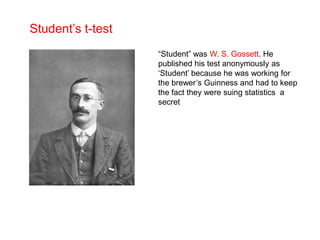
                   “Student” was W. S. Gossett. He
                   published his test anonymously as
                   „Student‟ because he was working for
                   the brewer‟s Guinness and had to keep
                   the fact they were suing statistics a
                   secret
Student‟s t-test

                   The test is used to compare samples
                   from two different batches.

                   It is usually used with small (<30) samples
                   that are normally distributed.
There are two types of t-test:

 Matched pairs and independent pairs


     If there is some link between the data then use the
     matched pairs test (eg a „before‟ and „after‟)


     If there is no link between the data then use the
     independent pairs test
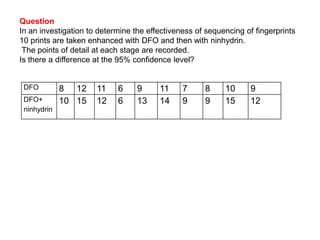
Question
In an investigation to determine the effectiveness of sequencing of fingerprints
10 prints are taken enhanced with DFO and then with ninhydrin.
 The points of detail at each stage are recorded.
Is there a difference at the 95% confidence level?


 DFO         8 12     11    6     9     11     7     8     10      9
 DFO+        10 15    12    6     13    14     9     9     15      12
 ninhydrin
t-test for matched pairs

 1. Set up the null and alternative hypothesis:
t-test for matched pairs

 1. Set up the null and alternative hypothesis:

 H0 there is no difference in the number of minutae when using ninhydrin

 HA there are more minutae observed after the enhancement of ninhydrin.
t-test for matched pairs

 1. Set up the null and alternative hypothesis:

 H0 there is no difference in the number of minutae when using ninhydrin

 HA there are more minutae observed after the enhancement of ninhydrin.


 This is a one-tail test.

 We are testing at the 95% or 5% (0.05) level
t-test for matched pairs

 1. Set up the null and alternative hypothesis
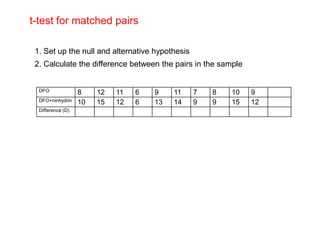
 2. Calculate the difference between the pairs in the sample
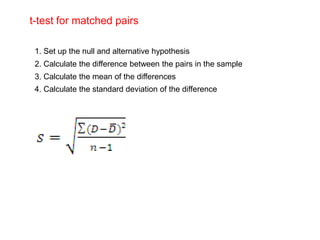
t-test for matched pairs

 1. Set up the null and alternative hypothesis
 2. Calculate the difference between the pairs in the sample

  DFO              8    12   11   6   9    11    7   8   10    9
  DFO+ninhydrin    10   15   12   6   13   14    9   9   15    12
  Difference (D)
t-test for matched pairs

 1. Set up the null and alternative hypothesis
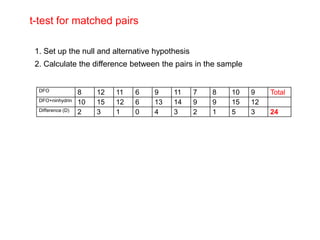
 2. Calculate the difference between the pairs in the sample

  DFO              8    12   11   6   9    11    7   8   10    9    Total
  DFO+ninhydrin    10   15   12   6   13   14    9   9   15    12
  Difference (D)   2    3    1    0   4    3     2   1   5     3    24
t-test for matched pairs

 1. Set up the null and alternative hypothesis
 2. Calculate the difference between the pairs in the sample
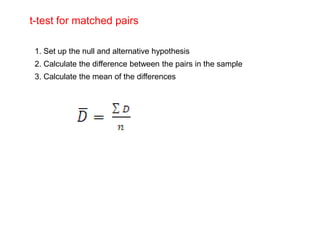
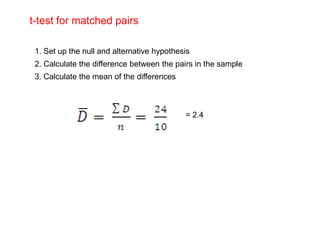
 3. Calculate the mean of the differences
t-test for matched pairs

 1. Set up the null and alternative hypothesis
 2. Calculate the difference between the pairs in the sample
 3. Calculate the mean of the differences


                                            = 2.4
t-test for matched pairs

 1. Set up the null and alternative hypothesis
 2. Calculate the difference between the pairs in the sample
 3. Calculate the mean of the differences


                                            = 2.4
t-test for matched pairs

 1. Set up the null and alternative hypothesis
 2. Calculate the difference between the pairs in the sample
 3. Calculate the mean of the differences
 4. Calculate the standard deviation of the difference
t-test for matched pairs

 1. Set up the null and alternative hypothesis
 2. Calculate the difference between the pairs in the sample
 3. Calculate the mean of the differences
 4. Calculate the standard deviation of the difference
t-test for matched pairs

 1. Set up the null and alternative hypothesis
 2. Calculate the difference between the pairs in the sample
 3. Calculate the mean of the differences
 4. Calculate the standard deviation of the difference


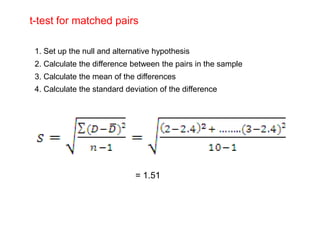
                              = 1.51
t-test for matched pairs

 1. Set up the null and alternative hypothesis
 2. Calculate the difference between the pairs in the sample
 3. Calculate the mean of the differences
 4. Calculate the standard deviation of the difference
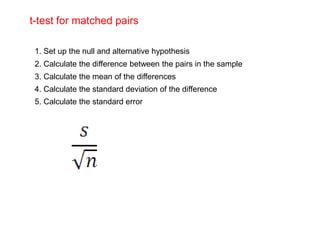
 5. Calculate the standard error
t-test for matched pairs

 1. Set up the null and alternative hypothesis
 2. Calculate the difference between the pairs in the sample
 3. Calculate the mean of the differences
 4. Calculate the standard deviation of the difference
 5. Calculate the standard error
t-test for matched pairs

 1. Set up the null and alternative hypothesis
 2. Calculate the difference between the pairs in the sample
 3. Calculate the mean of the differences
 4. Calculate the standard deviation of the difference
 5. Calculate the standard error


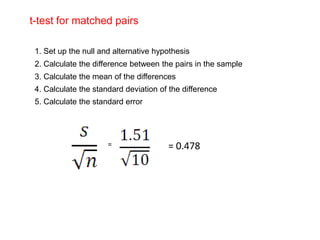
                      =                = 0.478
t-test for matched pairs

 1. Set up the null and alternative hypothesis
 2. Calculate the difference between the pairs in the sample
 3. Calculate the mean of the differences
 4. Calculate the standard deviation of the difference
 5. Calculate the standard error
 6. Calculate the value of t
t-test for matched pairs

 1. Set up the null and alternative hypothesis
 2. Calculate the difference between the pairs in the sample
 3. Calculate the mean of the differences
 4. Calculate the standard deviation of the difference
 5. Calculate the standard error
 6. Calculate the value of t
t-test for matched pairs

 1. Set up the null and alternative hypothesis
 2. Calculate the difference between the pairs in the sample
 3. Calculate the mean of the differences
 4. Calculate the standard deviation of the difference
 5. Calculate the standard error
 6. Calculate the value of t


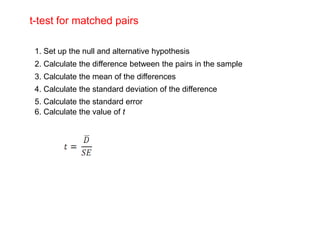
                    =          = 5.0
t-test for matched pairs

 1. Set up the null and alternative hypothesis
 2. Calculate the difference between the pairs in the sample
 3. Calculate the mean of the differences
 4. Calculate the standard deviation of the difference
 5. Calculate the standard error
 6. Calculate the value of t
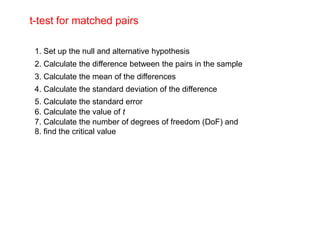
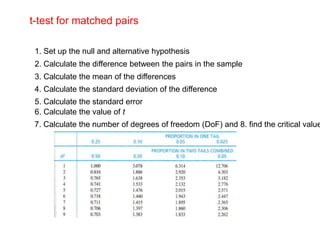
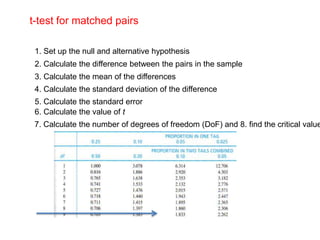
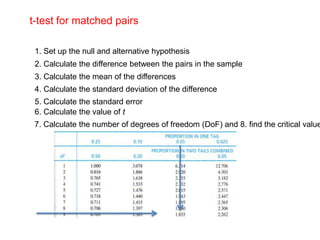
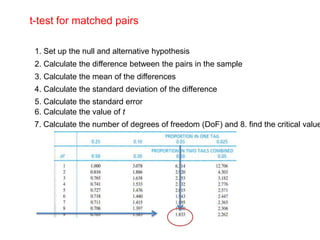
 7. Calculate the number of degrees of freedom (DoF) and find the critical value
t-test for matched pairs

 1. Set up the null and alternative hypothesis
 2. Calculate the difference between the pairs in the sample
 3. Calculate the mean of the differences
 4. Calculate the standard deviation of the difference
 5. Calculate the standard error
 6. Calculate the value of t
 7. Calculate the number of degrees of freedom (DoF) and find the critical value

   DoF = No of pairs of data – 1
t-test for matched pairs

 1. Set up the null and alternative hypothesis
 2. Calculate the difference between the pairs in the sample
 3. Calculate the mean of the differences
 4. Calculate the standard deviation of the difference
 5. Calculate the standard error
 6. Calculate the value of t
 7. Calculate the number of degrees of freedom (DoF) and find the critical value

   DoF = No of pairs of data – 1
        =n–1
         10-1 = 9
t-test for matched pairs

 1. Set up the null and alternative hypothesis
 2. Calculate the difference between the pairs in the sample
 3. Calculate the mean of the differences
 4. Calculate the standard deviation of the difference
 5. Calculate the standard error
 6. Calculate the value of t
 7. Calculate the number of degrees of freedom (DoF) and
 8. find the critical value
t-test for matched pairs

 1. Set up the null and alternative hypothesis
 2. Calculate the difference between the pairs in the sample
 3. Calculate the mean of the differences
 4. Calculate the standard deviation of the difference
 5. Calculate the standard error
 6. Calculate the value of t
 7. Calculate the number of degrees of freedom (DoF) and 8. find the critical value
t-test for matched pairs

 1. Set up the null and alternative hypothesis
 2. Calculate the difference between the pairs in the sample
 3. Calculate the mean of the differences
 4. Calculate the standard deviation of the difference
 5. Calculate the standard error
 6. Calculate the value of t
 7. Calculate the number of degrees of freedom (DoF) and 8. find the critical value
t-test for matched pairs

 1. Set up the null and alternative hypothesis
 2. Calculate the difference between the pairs in the sample
 3. Calculate the mean of the differences
 4. Calculate the standard deviation of the difference
 5. Calculate the standard error
 6. Calculate the value of t
 7. Calculate the number of degrees of freedom (DoF) and 8. find the critical value
t-test for matched pairs

 1. Set up the null and alternative hypothesis
 2. Calculate the difference between the pairs in the sample
 3. Calculate the mean of the differences
 4. Calculate the standard deviation of the difference
 5. Calculate the standard error
 6. Calculate the value of t
 7. Calculate the number of degrees of freedom (DoF) and 8. find the critical value
t-test for matched pairs

 1. Set up the null and alternative hypothesis
 2. Calculate the difference between the pairs in the sample
 3. Calculate the mean of the differences
 4. Calculate the standard deviation of the difference
 5. Calculate the standard error
 6. Calculate the value of t
 7. Calculate the number of degrees of freedom (DoF) and 8. find the critical value
 9. Determine if there is a difference or not
t-test for matched pairs

 1. Set up the null and alternative hypothesis
 2. Calculate the difference between the pairs in the sample
 3. Calculate the mean of the differences
 4. Calculate the standard deviation of the difference
 5. Calculate the standard error
 6. Calculate the value of t
 7. Calculate the number of degrees of freedom (DoF) and 8. find the critical value
 9. Determine if there is a difference or not
t-test for matched pairs

 1. Set up the null and alternative hypothesis
 2. Calculate the difference between the pairs in the sample
 3. Calculate the mean of the differences
 4. Calculate the standard deviation of the difference
 5. Calculate the standard error
 6. Calculate the value of t
 7. Calculate the number of degrees of freedom (DoF) and 8. find the critical value
 9. Determine if there is a difference or not

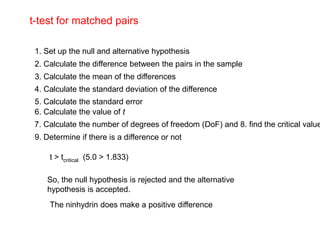
     t > tcritical (5.0 > 1.833)
t-test for matched pairs

 1. Set up the null and alternative hypothesis
 2. Calculate the difference between the pairs in the sample
 3. Calculate the mean of the differences
 4. Calculate the standard deviation of the difference
 5. Calculate the standard error
 6. Calculate the value of t
 7. Calculate the number of degrees of freedom (DoF) and 8. find the critical value
 9. Determine if there is a difference or not

     t > tcritical (5.0 > 1.833)

    So, the null hypothesis is rejected and the alternative
    hypothesis is accepted.
     The ninhydrin does make a positive difference
t-test independent samples
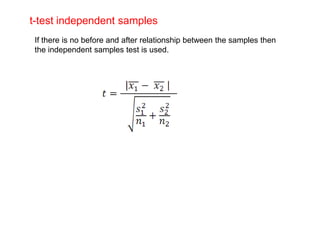
 If there is no before and after relationship between the samples then
 the independent samples test is used.
t-test independent samples
 If there is no before and after relationship between the samples then
 the independent samples test is used.
t-test independent samples
Example
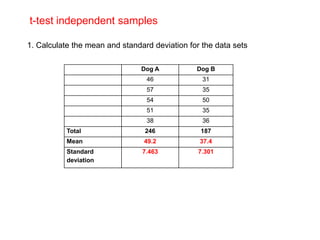
Some brown dog hairs were found on the clothing of a victim at a crime scene
involving a dog.
The five of the hairs were measured: 46, 57, 54, 51, 38 Îźm.
A suspect is the owner of a dog with similar brown hairs. A sample of the hairs
has been taken and their widths measured: 31, 35, 50, 35, 36 Îźm.
Is it possible that the hairs found on the victim were left by the suspect‟s dog?
Test at the %5 level.
[From D. Lucy Introduction to Statistics for Forensic Scientists Chichester: Wiley, 2005 p. 44.]
t-test independent samples

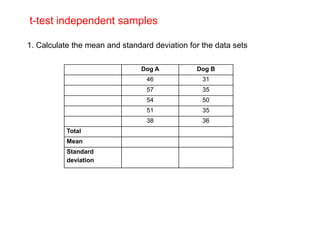
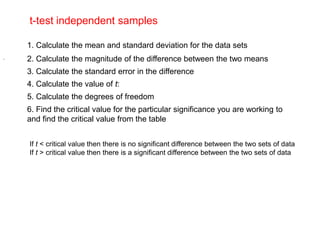
1. Calculate the mean and standard deviation for the data sets
t-test independent samples

1. Calculate the mean and standard deviation for the data sets

                                Dog A          Dog B
                                 46              31
                                 57              35
                                 54              50
                                 51              35
                                 38              36
           Total
           Mean
           Standard
           deviation
t-test independent samples

1. Calculate the mean and standard deviation for the data sets

                                Dog A          Dog B
                                 46              31
                                 57              35
                                 54              50
                                 51              35
                                 38              36
           Total                 246            187
           Mean                 49.2            37.4
           Standard             7.463           7.301
           deviation
t-test independent samples

    1. Calculate the mean and standard deviation for the data sets
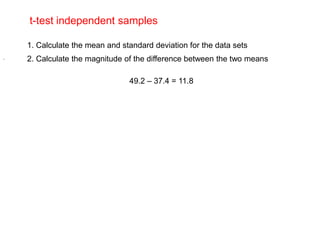
.   2. Calculate the magnitude of the difference between the two means

                                49.2 – 37.4 = 11.8
t-test independent samples

    1. Calculate the mean and standard deviation for the data sets
.   2. Calculate the magnitude of the difference between the two means
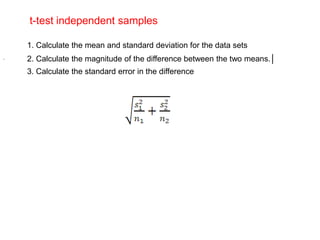
    3. Calculate the standard error in the difference
t-test independent samples

    1. Calculate the mean and standard deviation for the data sets
.   2. Calculate the magnitude of the difference between the two means.│
    3. Calculate the standard error in the difference
t-test independent samples

    1. Calculate the mean and standard deviation for the data sets
.   2. Calculate the magnitude of the difference between the two means
    3. Calculate the standard error in the difference


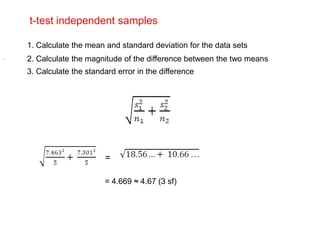
                          =

                          = 4.669 ≈ 4.67 (3 sf)
t-test independent samples

    1. Calculate the mean and standard deviation for the data sets
.   2. Calculate the magnitude of the difference between the two means
    3. Calculate the standard error in the difference
    4. Calculate the value of t
t-test independent samples

    1. Calculate the mean and standard deviation for the data sets
.   2. Calculate the magnitude of the difference between the two means
    3. Calculate the standard error in the difference
    4. Calculate the value of t:


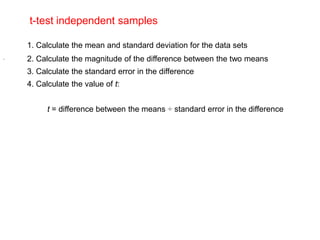
          t = difference between the means á standard error in the difference
t-test independent samples

    1. Calculate the mean and standard deviation for the data sets
.   2. Calculate the magnitude of the difference between the two means
    3. Calculate the standard error in the difference
    4. Calculate the value of t:


          t = difference between the means á standard error in the difference

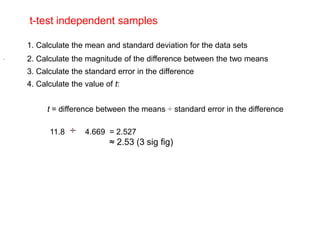
          11.8       4.669 = 2.527
                            ≈ 2.53 (3 sig fig)
t-test independent samples

    1. Calculate the mean and standard deviation for the data sets
.   2. Calculate the magnitude of the difference between the two means
    3. Calculate the standard error in the difference
    4. Calculate the value of t:
    5. Calculate the degrees of freedom
t-test independent samples

    1. Calculate the mean and standard deviation for the data sets
.   2. Calculate the magnitude of the difference between the two means
    3. Calculate the standard error in the difference
    4. Calculate the value of t:
    5. Calculate the degrees of freedom = n1 + n2 - 2
t-test independent samples

    1. Calculate the mean and standard deviation for the data sets
.   2. Calculate the magnitude of the difference between the two means
    3. Calculate the standard error in the difference
    4. Calculate the value of t:
    5. Calculate the degrees of freedom = n1 + n2 - 2

                                             5+5 -2=8
t-test independent samples

    1. Calculate the mean and standard deviation for the data sets
.   2. Calculate the magnitude of the difference between the two means
    3. Calculate the standard error in the difference
    4. Calculate the value of t:
    5. Calculate the degrees of freedom
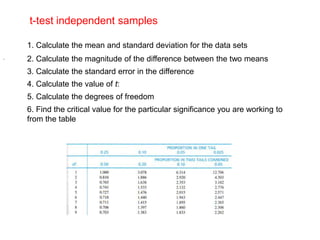
    6. Find the critical value for the particular significance you are working to
    from the table
t-test independent samples

    1. Calculate the mean and standard deviation for the data sets
.   2. Calculate the magnitude of the difference between the two means
    3. Calculate the standard error in the difference
    4. Calculate the value of t:
    5. Calculate the degrees of freedom
    6. Find the critical value for the particular significance you are working to
    from the table
t-test independent samples

    1. Calculate the mean and standard deviation for the data sets
.   2. Calculate the magnitude of the difference between the two means
    3. Calculate the standard error in the difference
    4. Calculate the value of t:
    5. Calculate the degrees of freedom
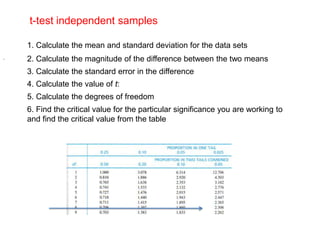
    6. Find the critical value for the particular significance you are working to
    and find the critical value from the table
t-test independent samples

    1. Calculate the mean and standard deviation for the data sets
.   2. Calculate the magnitude of the difference between the two means
    3. Calculate the standard error in the difference
    4. Calculate the value of t:
    5. Calculate the degrees of freedom
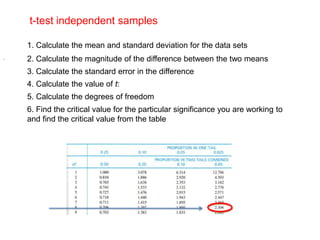
    6. Find the critical value for the particular significance you are working to
    and find the critical value from the table
t-test independent samples

    1. Calculate the mean and standard deviation for the data sets
.   2. Calculate the magnitude of the difference between the two means
    3. Calculate the standard error in the difference
    4. Calculate the value of t:
    5. Calculate the degrees of freedom
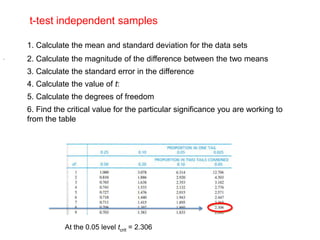
    6. Find the critical value for the particular significance you are working to
    from the table


               At the 0.05 level tcrit = 2.306
t-test independent samples

    1. Calculate the mean and standard deviation for the data sets
.   2. Calculate the magnitude of the difference between the two means
    3. Calculate the standard error in the difference
    4. Calculate the value of t:
    5. Calculate the degrees of freedom
    6. Find the critical value for the particular significance you are working to
    and find the critical value from the table


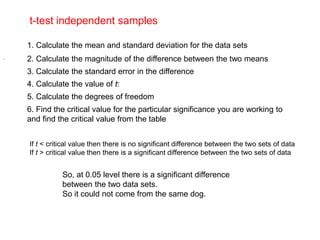
    If t < critical value then there is no significant difference between the two sets of data
    If t > critical value then there is a significant difference between the two sets of data
t-test independent samples

    1. Calculate the mean and standard deviation for the data sets
.   2. Calculate the magnitude of the difference between the two means
    3. Calculate the standard error in the difference
    4. Calculate the value of t:
    5. Calculate the degrees of freedom
    6. Find the critical value for the particular significance you are working to
    and find the critical value from the table


    If t < critical value then there is no significant difference between the two sets of data
    If t > critical value then there is a significant difference between the two sets of data


               So, at 0.05 level there is a significant difference
               between the two data sets.
               So it could not come from the same dog.
t-test independent samples

    1. Calculate the mean and standard deviation for the data sets
.   2. Calculate the magnitude of the difference between the two means
    3. Calculate the standard error in the difference
    4. Calculate the value of t:
    5. Calculate the degrees of freedom
    6. Find the critical value for the particular significance you are working to
    and find the critical value from the table
t-test independent samples

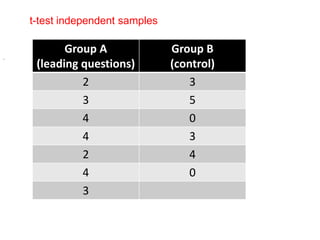
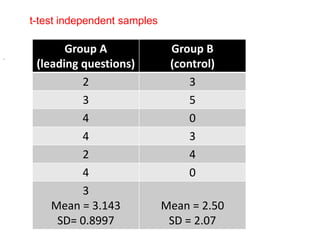
           Group A               Group B
.
     (leading questions)         (control)
              2                      3
              3                      5
              4                      0
              4                      3
              2                      4
              4                      0
              3
t-test independent samples

           Group A                Group B
.
     (leading questions)          (control)
              2                       3
              3                       5
              4                       0
              4                       3
              2                       4
              4                       0
              3
        Mean = 3.143             Mean = 2.50
         SD= 0.8997               SD = 2.07
t-test independent samples

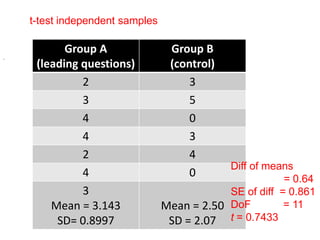
           Group A                Group B
.
     (leading questions)          (control)
              2                       3
              3                       5
              4                       0
              4                       3
              2                       4
                                             Diff of means
              4                       0                  = 0.64
              3                              SE of diff = 0.861
        Mean = 3.143             Mean = 2.50 DoF         = 11
         SD= 0.8997               SD = 2.07 t = 0.7433
t-test independent samples


.


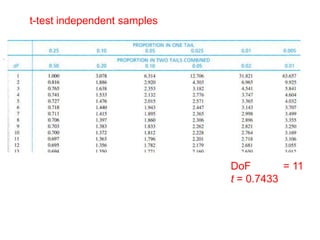
                                 DoF        = 11
                                 t = 0.7433
t-test independent samples


.


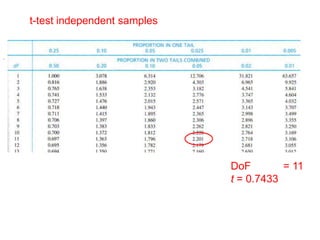
                                 DoF        = 11
                                 t = 0.7433
t-test independent samples


.


                                                                DoF        = 11
                                                                t = 0.7433
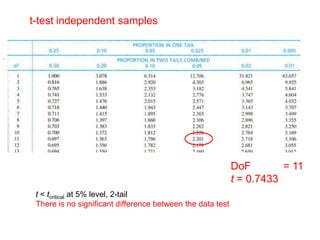
     t < tcritical at 5% level, 2-tail
     There is no significant difference between the data test

Student t-test

  • 1.
    Student t-test Unit 8 strand
  • 2.
    Student‟s t-test “Student” was W. S. Gossett. He published his test anonymously as „Student‟ because he was working for the brewer‟s Guinness and had to keep the fact they were suing statistics a secret
  • 3.
    Student‟s t-test The test is used to compare samples from two different batches. It is usually used with small (<30) samples that are normally distributed.
  • 4.
    There are twotypes of t-test: Matched pairs and independent pairs If there is some link between the data then use the matched pairs test (eg a „before‟ and „after‟) If there is no link between the data then use the independent pairs test
  • 5.
    Question In an investigationto determine the effectiveness of sequencing of fingerprints 10 prints are taken enhanced with DFO and then with ninhydrin. The points of detail at each stage are recorded. Is there a difference at the 95% confidence level? DFO 8 12 11 6 9 11 7 8 10 9 DFO+ 10 15 12 6 13 14 9 9 15 12 ninhydrin
  • 6.
    t-test for matchedpairs 1. Set up the null and alternative hypothesis:
  • 7.
    t-test for matchedpairs 1. Set up the null and alternative hypothesis: H0 there is no difference in the number of minutae when using ninhydrin HA there are more minutae observed after the enhancement of ninhydrin.
  • 8.
    t-test for matchedpairs 1. Set up the null and alternative hypothesis: H0 there is no difference in the number of minutae when using ninhydrin HA there are more minutae observed after the enhancement of ninhydrin. This is a one-tail test. We are testing at the 95% or 5% (0.05) level
  • 9.
    t-test for matchedpairs 1. Set up the null and alternative hypothesis 2. Calculate the difference between the pairs in the sample
  • 10.
    t-test for matchedpairs 1. Set up the null and alternative hypothesis 2. Calculate the difference between the pairs in the sample DFO 8 12 11 6 9 11 7 8 10 9 DFO+ninhydrin 10 15 12 6 13 14 9 9 15 12 Difference (D)
  • 11.
    t-test for matchedpairs 1. Set up the null and alternative hypothesis 2. Calculate the difference between the pairs in the sample DFO 8 12 11 6 9 11 7 8 10 9 Total DFO+ninhydrin 10 15 12 6 13 14 9 9 15 12 Difference (D) 2 3 1 0 4 3 2 1 5 3 24
  • 12.
    t-test for matchedpairs 1. Set up the null and alternative hypothesis 2. Calculate the difference between the pairs in the sample 3. Calculate the mean of the differences
  • 13.
    t-test for matchedpairs 1. Set up the null and alternative hypothesis 2. Calculate the difference between the pairs in the sample 3. Calculate the mean of the differences = 2.4
  • 14.
    t-test for matchedpairs 1. Set up the null and alternative hypothesis 2. Calculate the difference between the pairs in the sample 3. Calculate the mean of the differences = 2.4
  • 15.
    t-test for matchedpairs 1. Set up the null and alternative hypothesis 2. Calculate the difference between the pairs in the sample 3. Calculate the mean of the differences 4. Calculate the standard deviation of the difference
  • 16.
    t-test for matchedpairs 1. Set up the null and alternative hypothesis 2. Calculate the difference between the pairs in the sample 3. Calculate the mean of the differences 4. Calculate the standard deviation of the difference
  • 17.
    t-test for matchedpairs 1. Set up the null and alternative hypothesis 2. Calculate the difference between the pairs in the sample 3. Calculate the mean of the differences 4. Calculate the standard deviation of the difference = 1.51
  • 18.
    t-test for matchedpairs 1. Set up the null and alternative hypothesis 2. Calculate the difference between the pairs in the sample 3. Calculate the mean of the differences 4. Calculate the standard deviation of the difference 5. Calculate the standard error
  • 19.
    t-test for matchedpairs 1. Set up the null and alternative hypothesis 2. Calculate the difference between the pairs in the sample 3. Calculate the mean of the differences 4. Calculate the standard deviation of the difference 5. Calculate the standard error
  • 20.
    t-test for matchedpairs 1. Set up the null and alternative hypothesis 2. Calculate the difference between the pairs in the sample 3. Calculate the mean of the differences 4. Calculate the standard deviation of the difference 5. Calculate the standard error = = 0.478
  • 21.
    t-test for matchedpairs 1. Set up the null and alternative hypothesis 2. Calculate the difference between the pairs in the sample 3. Calculate the mean of the differences 4. Calculate the standard deviation of the difference 5. Calculate the standard error 6. Calculate the value of t
  • 22.
    t-test for matchedpairs 1. Set up the null and alternative hypothesis 2. Calculate the difference between the pairs in the sample 3. Calculate the mean of the differences 4. Calculate the standard deviation of the difference 5. Calculate the standard error 6. Calculate the value of t
  • 23.
    t-test for matchedpairs 1. Set up the null and alternative hypothesis 2. Calculate the difference between the pairs in the sample 3. Calculate the mean of the differences 4. Calculate the standard deviation of the difference 5. Calculate the standard error 6. Calculate the value of t = = 5.0
  • 24.
    t-test for matchedpairs 1. Set up the null and alternative hypothesis 2. Calculate the difference between the pairs in the sample 3. Calculate the mean of the differences 4. Calculate the standard deviation of the difference 5. Calculate the standard error 6. Calculate the value of t 7. Calculate the number of degrees of freedom (DoF) and find the critical value
  • 25.
    t-test for matchedpairs 1. Set up the null and alternative hypothesis 2. Calculate the difference between the pairs in the sample 3. Calculate the mean of the differences 4. Calculate the standard deviation of the difference 5. Calculate the standard error 6. Calculate the value of t 7. Calculate the number of degrees of freedom (DoF) and find the critical value DoF = No of pairs of data – 1
  • 26.
    t-test for matchedpairs 1. Set up the null and alternative hypothesis 2. Calculate the difference between the pairs in the sample 3. Calculate the mean of the differences 4. Calculate the standard deviation of the difference 5. Calculate the standard error 6. Calculate the value of t 7. Calculate the number of degrees of freedom (DoF) and find the critical value DoF = No of pairs of data – 1 =n–1 10-1 = 9
  • 27.
    t-test for matchedpairs 1. Set up the null and alternative hypothesis 2. Calculate the difference between the pairs in the sample 3. Calculate the mean of the differences 4. Calculate the standard deviation of the difference 5. Calculate the standard error 6. Calculate the value of t 7. Calculate the number of degrees of freedom (DoF) and 8. find the critical value
  • 28.
    t-test for matchedpairs 1. Set up the null and alternative hypothesis 2. Calculate the difference between the pairs in the sample 3. Calculate the mean of the differences 4. Calculate the standard deviation of the difference 5. Calculate the standard error 6. Calculate the value of t 7. Calculate the number of degrees of freedom (DoF) and 8. find the critical value
  • 29.
    t-test for matchedpairs 1. Set up the null and alternative hypothesis 2. Calculate the difference between the pairs in the sample 3. Calculate the mean of the differences 4. Calculate the standard deviation of the difference 5. Calculate the standard error 6. Calculate the value of t 7. Calculate the number of degrees of freedom (DoF) and 8. find the critical value
  • 30.
    t-test for matchedpairs 1. Set up the null and alternative hypothesis 2. Calculate the difference between the pairs in the sample 3. Calculate the mean of the differences 4. Calculate the standard deviation of the difference 5. Calculate the standard error 6. Calculate the value of t 7. Calculate the number of degrees of freedom (DoF) and 8. find the critical value
  • 31.
    t-test for matchedpairs 1. Set up the null and alternative hypothesis 2. Calculate the difference between the pairs in the sample 3. Calculate the mean of the differences 4. Calculate the standard deviation of the difference 5. Calculate the standard error 6. Calculate the value of t 7. Calculate the number of degrees of freedom (DoF) and 8. find the critical value
  • 32.
    t-test for matchedpairs 1. Set up the null and alternative hypothesis 2. Calculate the difference between the pairs in the sample 3. Calculate the mean of the differences 4. Calculate the standard deviation of the difference 5. Calculate the standard error 6. Calculate the value of t 7. Calculate the number of degrees of freedom (DoF) and 8. find the critical value 9. Determine if there is a difference or not
  • 33.
    t-test for matchedpairs 1. Set up the null and alternative hypothesis 2. Calculate the difference between the pairs in the sample 3. Calculate the mean of the differences 4. Calculate the standard deviation of the difference 5. Calculate the standard error 6. Calculate the value of t 7. Calculate the number of degrees of freedom (DoF) and 8. find the critical value 9. Determine if there is a difference or not
  • 34.
    t-test for matchedpairs 1. Set up the null and alternative hypothesis 2. Calculate the difference between the pairs in the sample 3. Calculate the mean of the differences 4. Calculate the standard deviation of the difference 5. Calculate the standard error 6. Calculate the value of t 7. Calculate the number of degrees of freedom (DoF) and 8. find the critical value 9. Determine if there is a difference or not t > tcritical (5.0 > 1.833)
  • 35.
    t-test for matchedpairs 1. Set up the null and alternative hypothesis 2. Calculate the difference between the pairs in the sample 3. Calculate the mean of the differences 4. Calculate the standard deviation of the difference 5. Calculate the standard error 6. Calculate the value of t 7. Calculate the number of degrees of freedom (DoF) and 8. find the critical value 9. Determine if there is a difference or not t > tcritical (5.0 > 1.833) So, the null hypothesis is rejected and the alternative hypothesis is accepted. The ninhydrin does make a positive difference
  • 36.
    t-test independent samples If there is no before and after relationship between the samples then the independent samples test is used.
  • 37.
    t-test independent samples If there is no before and after relationship between the samples then the independent samples test is used.
  • 38.
    t-test independent samples Example Somebrown dog hairs were found on the clothing of a victim at a crime scene involving a dog. The five of the hairs were measured: 46, 57, 54, 51, 38 μm. A suspect is the owner of a dog with similar brown hairs. A sample of the hairs has been taken and their widths measured: 31, 35, 50, 35, 36 μm. Is it possible that the hairs found on the victim were left by the suspect‟s dog? Test at the %5 level. [From D. Lucy Introduction to Statistics for Forensic Scientists Chichester: Wiley, 2005 p. 44.]
  • 39.
    t-test independent samples 1.Calculate the mean and standard deviation for the data sets
  • 40.
    t-test independent samples 1.Calculate the mean and standard deviation for the data sets Dog A Dog B 46 31 57 35 54 50 51 35 38 36 Total Mean Standard deviation
  • 41.
    t-test independent samples 1.Calculate the mean and standard deviation for the data sets Dog A Dog B 46 31 57 35 54 50 51 35 38 36 Total 246 187 Mean 49.2 37.4 Standard 7.463 7.301 deviation
  • 42.
    t-test independent samples 1. Calculate the mean and standard deviation for the data sets . 2. Calculate the magnitude of the difference between the two means 49.2 – 37.4 = 11.8
  • 43.
    t-test independent samples 1. Calculate the mean and standard deviation for the data sets . 2. Calculate the magnitude of the difference between the two means 3. Calculate the standard error in the difference
  • 44.
    t-test independent samples 1. Calculate the mean and standard deviation for the data sets . 2. Calculate the magnitude of the difference between the two means.│ 3. Calculate the standard error in the difference
  • 45.
    t-test independent samples 1. Calculate the mean and standard deviation for the data sets . 2. Calculate the magnitude of the difference between the two means 3. Calculate the standard error in the difference = = 4.669 ≈ 4.67 (3 sf)
  • 46.
    t-test independent samples 1. Calculate the mean and standard deviation for the data sets . 2. Calculate the magnitude of the difference between the two means 3. Calculate the standard error in the difference 4. Calculate the value of t
  • 47.
    t-test independent samples 1. Calculate the mean and standard deviation for the data sets . 2. Calculate the magnitude of the difference between the two means 3. Calculate the standard error in the difference 4. Calculate the value of t: t = difference between the means á standard error in the difference
  • 48.
    t-test independent samples 1. Calculate the mean and standard deviation for the data sets . 2. Calculate the magnitude of the difference between the two means 3. Calculate the standard error in the difference 4. Calculate the value of t: t = difference between the means ÷ standard error in the difference 11.8 4.669 = 2.527 ≈ 2.53 (3 sig fig)
  • 49.
    t-test independent samples 1. Calculate the mean and standard deviation for the data sets . 2. Calculate the magnitude of the difference between the two means 3. Calculate the standard error in the difference 4. Calculate the value of t: 5. Calculate the degrees of freedom
  • 50.
    t-test independent samples 1. Calculate the mean and standard deviation for the data sets . 2. Calculate the magnitude of the difference between the two means 3. Calculate the standard error in the difference 4. Calculate the value of t: 5. Calculate the degrees of freedom = n1 + n2 - 2
  • 51.
    t-test independent samples 1. Calculate the mean and standard deviation for the data sets . 2. Calculate the magnitude of the difference between the two means 3. Calculate the standard error in the difference 4. Calculate the value of t: 5. Calculate the degrees of freedom = n1 + n2 - 2 5+5 -2=8
  • 52.
    t-test independent samples 1. Calculate the mean and standard deviation for the data sets . 2. Calculate the magnitude of the difference between the two means 3. Calculate the standard error in the difference 4. Calculate the value of t: 5. Calculate the degrees of freedom 6. Find the critical value for the particular significance you are working to from the table
  • 53.
    t-test independent samples 1. Calculate the mean and standard deviation for the data sets . 2. Calculate the magnitude of the difference between the two means 3. Calculate the standard error in the difference 4. Calculate the value of t: 5. Calculate the degrees of freedom 6. Find the critical value for the particular significance you are working to from the table
  • 54.
    t-test independent samples 1. Calculate the mean and standard deviation for the data sets . 2. Calculate the magnitude of the difference between the two means 3. Calculate the standard error in the difference 4. Calculate the value of t: 5. Calculate the degrees of freedom 6. Find the critical value for the particular significance you are working to and find the critical value from the table
  • 55.
    t-test independent samples 1. Calculate the mean and standard deviation for the data sets . 2. Calculate the magnitude of the difference between the two means 3. Calculate the standard error in the difference 4. Calculate the value of t: 5. Calculate the degrees of freedom 6. Find the critical value for the particular significance you are working to and find the critical value from the table
  • 56.
    t-test independent samples 1. Calculate the mean and standard deviation for the data sets . 2. Calculate the magnitude of the difference between the two means 3. Calculate the standard error in the difference 4. Calculate the value of t: 5. Calculate the degrees of freedom 6. Find the critical value for the particular significance you are working to from the table At the 0.05 level tcrit = 2.306
  • 57.
    t-test independent samples 1. Calculate the mean and standard deviation for the data sets . 2. Calculate the magnitude of the difference between the two means 3. Calculate the standard error in the difference 4. Calculate the value of t: 5. Calculate the degrees of freedom 6. Find the critical value for the particular significance you are working to and find the critical value from the table If t < critical value then there is no significant difference between the two sets of data If t > critical value then there is a significant difference between the two sets of data
  • 58.
    t-test independent samples 1. Calculate the mean and standard deviation for the data sets . 2. Calculate the magnitude of the difference between the two means 3. Calculate the standard error in the difference 4. Calculate the value of t: 5. Calculate the degrees of freedom 6. Find the critical value for the particular significance you are working to and find the critical value from the table If t < critical value then there is no significant difference between the two sets of data If t > critical value then there is a significant difference between the two sets of data So, at 0.05 level there is a significant difference between the two data sets. So it could not come from the same dog.
  • 59.
    t-test independent samples 1. Calculate the mean and standard deviation for the data sets . 2. Calculate the magnitude of the difference between the two means 3. Calculate the standard error in the difference 4. Calculate the value of t: 5. Calculate the degrees of freedom 6. Find the critical value for the particular significance you are working to and find the critical value from the table
  • 60.
    t-test independent samples Group A Group B . (leading questions) (control) 2 3 3 5 4 0 4 3 2 4 4 0 3
  • 61.
    t-test independent samples Group A Group B . (leading questions) (control) 2 3 3 5 4 0 4 3 2 4 4 0 3 Mean = 3.143 Mean = 2.50 SD= 0.8997 SD = 2.07
  • 62.
    t-test independent samples Group A Group B . (leading questions) (control) 2 3 3 5 4 0 4 3 2 4 Diff of means 4 0 = 0.64 3 SE of diff = 0.861 Mean = 3.143 Mean = 2.50 DoF = 11 SD= 0.8997 SD = 2.07 t = 0.7433
  • 63.
    t-test independent samples . DoF = 11 t = 0.7433
  • 64.
    t-test independent samples . DoF = 11 t = 0.7433
  • 65.
    t-test independent samples . DoF = 11 t = 0.7433 t < tcritical at 5% level, 2-tail There is no significant difference between the data test