PRESENTED BY-
Rahul kapoliya
MBA 1 St Sem Sec -C
INTRODUCTION
Cash flow is a statement which picturise the position of the
changes in cash between one period to another period.
means cash flow statement describes the causes of change
in cash in one period to another period.
Cash flows
‘Cash flow’ implies movement of cash in and cash out due
to some non-cash items. Receipt of cash from non-cash
item is termed as cash inflow while cash payment in
respect of such items as cash outflow.
For example, purchase of machinery by paying cash is cash
outflow, while sale proceeds received from sale of
machinery is cash inflow.
Purpose Of Cash Flow Statement
The purpose of the cash flow statement or statement of cash flows is to
provide information about a company's gross receipts and gross
payments for a specified period of time.
The gross receipts and gross payments will be reported in the cash flow
statement according to one of the following classifications: operating
activities, investing activities, and financing activities. The net change
from these three classifications should equal the change in a
company's cash and cash equivalents during the reporting period.
ADVANTAGE OF CASH
FLOW STATEMENT
1. Ascertaining Liquidity and Profitability
Positions:
Cash Flow Statement helps the management to ascertain the
liquidity and profitability position of a firm. Liquidity means
one’s ability to pay the obligation as soon as it becomes due.
Since Cash Flow Statement presents the cash position of a firm
at the time of making payment it directly helps to ascertain the
liquidity position, the same is also applicable in case of
profitability.
2. Ascertaining Optimum Cash Balance:
Cash Flow Statement also helps to ascertain the optimum
cash balance of a firm. If optimum cash balance can be
determined, it is possible for a firm to ascertain the idle
and/or excess and/or shortage of cash position. After
ascertaining the cash position, the management can invest
the surplus cash, if any, or borrow funds from outside sources
accordingly to meet the cash deficit.
3. Cash Management:
Proper management of cash is possible if Cash Flow Statement is
properly prepared. The management can prepare an estimate about
the various inflows of cash and outflows of cash so that it becomes
very helpful for them to make plans for the future.
4. Movement of Cash:
A Cash Flow Statement presents the management the flows in and flows
out of cash for various purposes on the basis of which future estimated
can be prepared.
5. Performance Appraisal:
By comparing the actual Cash Flow Statement with the projected Cash Flow
Statements, the management can evaluate or appraise the performances
regarding cash. If any unfavorable variance is found, the reason for such
variation is located and rectified accordingly.
disadvantage of cash flow statement
1.Cash flow statement shows only cash inflow and cash outflow.
But, the cash balance disclosed by the statement cannot reveals
the true liquid position of the business
2.Net Cash Flow disclosed by Cash Flow Statement does not
necessarily mean net income of the business because net income
is determined by taking into account both cash and non-cash
items.
3. It does not give complete picture of the financial position of the
business concern.
4. The preparation of cash flow statement is only postmortem
analysis. There is no projection of cash in future in this method.
5. It is not a substitute of Income Statement.
6. The accuracy of cash flow statement is based on the balance
sheet. If balance sheet is wrong, the cash flow statement is also
wrong
Classification of cash flow statement
A cash flow statement typically breaks out a company’s cash
sources and uses for the period in to three categories
1. Cash flow from operating activities
2. Cash flow from investing activities
3. Cash flow from financial activities
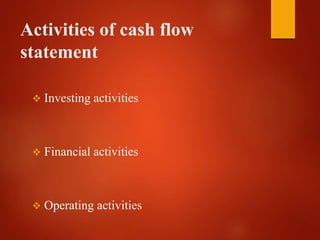
Activities of cash flow
statement
 Investing activities
 Financial activities
 Operating activities
INVESTING ACTIVITIES
The knowledge of cash flow from investment is essential
because by these cash flows that limit time is known by which
the creation for future the income and cash flows the expenses
are incurred.
Examples:--
1.Cash received on sale of fixed assets.
2.The amount received for loans and advances given to their
party.
3. Collection of loans.
Investing activities
Cash inflows
 Sales of property, plant equipment,
long term investments
 Receipt from interest and dividends
 Proceeds from issue of preference
or equity shares
cash outflows
 Purchase of property, plant
equipment and non- current
investments
Financial activities
Cash flows from financing activities is a line item in the statement of
cash flow. This statement is one of the document comprising a
company’s financial statement. The line item contains the sum total
of the changes that a company experienced during a designated
reporting period that were caused by transactions with owners or
lenders to if the company is not-for-profit then you would also
include in this line item all contributions from donors where the
funds are to be used only for long term purpose.
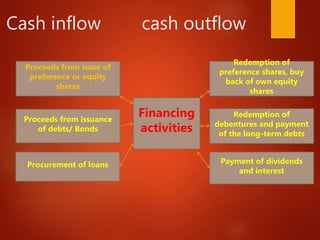
Cash inflow cash outflow
Redemption of
preference shares, buy
back of own equity
shares
Proceeds from issue of
preference or equity
shares
Proceeds from issuance
of debts/ Bonds
Redemption of
debentures and payment
of the long-term debts
Procurement of loans
Financing
activities
Payment of dividends
and interest
OPERATING ACTIVITIES
This is the amount of cash that is generated by doing
what you do. This is how much cash is generated by
making, selling or providing services or product to your
customers. These are the activities or accounts that you
will find on your income statement. Add all the cash you
received from your customers, and subtract all your
expenses for the month.
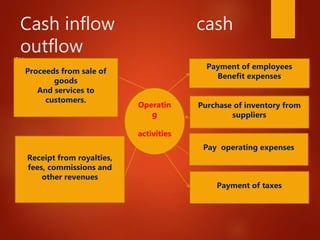
Cash inflow cash
outflow
nv
Proceeds from sale of
goods
And services to
customers.
Receipt from royalties,
fees, commissions and
other revenues
Payment of employees
Benefit expenses
Purchase of inventory from
suppliers
Pay operating expenses
Payment of taxes
Operatin
g
activities
Cash flow from operating activities
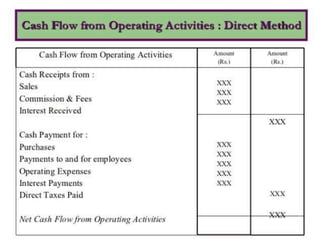
(direct method)
As the name suggest, under direct method , major heads of cash
inflows and outflows are considered.
The following items are not be
considered
1.Non cash items such as depreciation, discount on share,
etc. be written off.
2. Items which are classified as investing or financing
activities such as interest receive, dividend paid, etc.
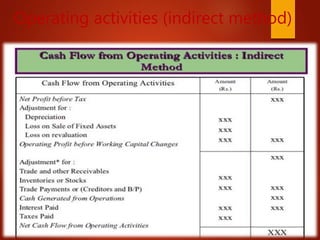
Operating activities (indirect method)
Cash flow statement

Cash flow statement

  • 1.
  • 2.
    INTRODUCTION Cash flow isa statement which picturise the position of the changes in cash between one period to another period. means cash flow statement describes the causes of change in cash in one period to another period.
  • 3.
    Cash flows ‘Cash flow’implies movement of cash in and cash out due to some non-cash items. Receipt of cash from non-cash item is termed as cash inflow while cash payment in respect of such items as cash outflow. For example, purchase of machinery by paying cash is cash outflow, while sale proceeds received from sale of machinery is cash inflow.
  • 4.
    Purpose Of CashFlow Statement The purpose of the cash flow statement or statement of cash flows is to provide information about a company's gross receipts and gross payments for a specified period of time. The gross receipts and gross payments will be reported in the cash flow statement according to one of the following classifications: operating activities, investing activities, and financing activities. The net change from these three classifications should equal the change in a company's cash and cash equivalents during the reporting period.
  • 5.
    ADVANTAGE OF CASH FLOWSTATEMENT 1. Ascertaining Liquidity and Profitability Positions: Cash Flow Statement helps the management to ascertain the liquidity and profitability position of a firm. Liquidity means one’s ability to pay the obligation as soon as it becomes due. Since Cash Flow Statement presents the cash position of a firm at the time of making payment it directly helps to ascertain the liquidity position, the same is also applicable in case of profitability.
  • 6.
    2. Ascertaining OptimumCash Balance: Cash Flow Statement also helps to ascertain the optimum cash balance of a firm. If optimum cash balance can be determined, it is possible for a firm to ascertain the idle and/or excess and/or shortage of cash position. After ascertaining the cash position, the management can invest the surplus cash, if any, or borrow funds from outside sources accordingly to meet the cash deficit.
  • 7.
    3. Cash Management: Propermanagement of cash is possible if Cash Flow Statement is properly prepared. The management can prepare an estimate about the various inflows of cash and outflows of cash so that it becomes very helpful for them to make plans for the future.
  • 8.
    4. Movement ofCash: A Cash Flow Statement presents the management the flows in and flows out of cash for various purposes on the basis of which future estimated can be prepared. 5. Performance Appraisal: By comparing the actual Cash Flow Statement with the projected Cash Flow Statements, the management can evaluate or appraise the performances regarding cash. If any unfavorable variance is found, the reason for such variation is located and rectified accordingly.
  • 9.
    disadvantage of cashflow statement 1.Cash flow statement shows only cash inflow and cash outflow. But, the cash balance disclosed by the statement cannot reveals the true liquid position of the business 2.Net Cash Flow disclosed by Cash Flow Statement does not necessarily mean net income of the business because net income is determined by taking into account both cash and non-cash items.
  • 10.
    3. It doesnot give complete picture of the financial position of the business concern. 4. The preparation of cash flow statement is only postmortem analysis. There is no projection of cash in future in this method. 5. It is not a substitute of Income Statement. 6. The accuracy of cash flow statement is based on the balance sheet. If balance sheet is wrong, the cash flow statement is also wrong
  • 11.
    Classification of cashflow statement A cash flow statement typically breaks out a company’s cash sources and uses for the period in to three categories 1. Cash flow from operating activities 2. Cash flow from investing activities 3. Cash flow from financial activities
  • 12.
    Activities of cashflow statement  Investing activities  Financial activities  Operating activities
  • 13.
    INVESTING ACTIVITIES The knowledgeof cash flow from investment is essential because by these cash flows that limit time is known by which the creation for future the income and cash flows the expenses are incurred. Examples:-- 1.Cash received on sale of fixed assets. 2.The amount received for loans and advances given to their party. 3. Collection of loans.
  • 14.
    Investing activities Cash inflows Sales of property, plant equipment, long term investments  Receipt from interest and dividends  Proceeds from issue of preference or equity shares cash outflows  Purchase of property, plant equipment and non- current investments
  • 15.
    Financial activities Cash flowsfrom financing activities is a line item in the statement of cash flow. This statement is one of the document comprising a company’s financial statement. The line item contains the sum total of the changes that a company experienced during a designated reporting period that were caused by transactions with owners or lenders to if the company is not-for-profit then you would also include in this line item all contributions from donors where the funds are to be used only for long term purpose.
  • 16.
    Cash inflow cashoutflow Redemption of preference shares, buy back of own equity shares Proceeds from issue of preference or equity shares Proceeds from issuance of debts/ Bonds Redemption of debentures and payment of the long-term debts Procurement of loans Financing activities Payment of dividends and interest
  • 17.
    OPERATING ACTIVITIES This isthe amount of cash that is generated by doing what you do. This is how much cash is generated by making, selling or providing services or product to your customers. These are the activities or accounts that you will find on your income statement. Add all the cash you received from your customers, and subtract all your expenses for the month.
  • 18.
    Cash inflow cash outflow nv Proceedsfrom sale of goods And services to customers. Receipt from royalties, fees, commissions and other revenues Payment of employees Benefit expenses Purchase of inventory from suppliers Pay operating expenses Payment of taxes Operatin g activities
  • 19.
    Cash flow fromoperating activities (direct method) As the name suggest, under direct method , major heads of cash inflows and outflows are considered. The following items are not be considered 1.Non cash items such as depreciation, discount on share, etc. be written off. 2. Items which are classified as investing or financing activities such as interest receive, dividend paid, etc.
  • 21.