PRESENTED TO:
Prof. R.K Paliwal
PRESENTED BY:
RAHUL KAPOLIYA
MBA 1ST SEM. Sec-C)
Introduction to Database
DBMS and RDBMS
 A Database is a collection of related
data organised in a way that data can
be easily accessed, managed and
updated. Any piece of information can
be a data, for example name of your
school. Database is actually a place
where related piece of information is
stored and various operations can be
performed on it.
 DBMS is the abbreviated form of DataBase
Management System.
 Database management system is a computer software
component introduced during 1960’s
A DBMS is a software that allows creation, definition
and manipulation of database. Dbms is actually a tool
used to perform any kind of operation on data in
database. Dbms also provides protection and security
to database. It maintains data consistency in case of
multiple users. Here are some examples of popular
dbms, MySql, Oracle, Sybase, Microsoft Access and
IBM DB2 etc
 The database system can be divided into four
components.
 Users : Users may be of various type such as DB
administrator, System developer and End users.
 Database application : Database application may be
Personal, Departmental, Enterprise and Internal
 DBMS : Software that allow users to define, create and
manages database access, Ex: MySql, Oracle etc.
 Database : Collection of logical data.
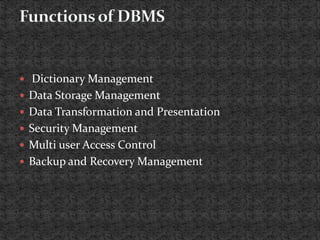
 Dictionary Management
 Data Storage Management
 Data Transformation and Presentation
 Security Management
 Multi user Access Control
 Backup and Recovery Management
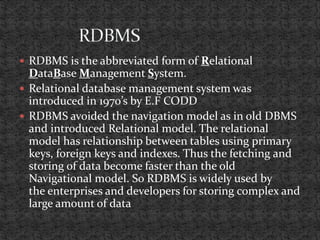
 RDBMS is the abbreviated form of Relational
DataBase Management System.
 Relational database management system was
introduced in 1970’s by E.F CODD
 RDBMS avoided the navigation model as in old DBMS
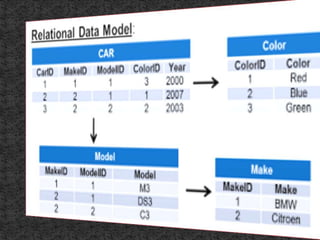
and introduced Relational model. The relational
model has relationship between tables using primary
keys, foreign keys and indexes. Thus the fetching and
storing of data become faster than the old
Navigational model. So RDBMS is widely used by
the enterprises and developers for storing complex and
large amount of data
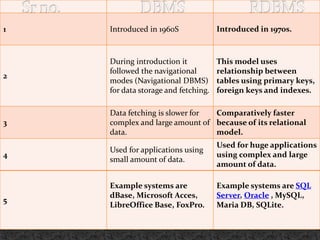
1 Introduced in 1960S Introduced in 1970s.
2
During introduction it
followed the navigational
modes (Navigational DBMS)
for data storage and fetching.
This model uses
relationship between
tables using primary keys,
foreign keys and indexes.
3
Data fetching is slower for
complex and large amount of
data.
Comparatively faster
because of its relational
model.
4
Used for applications using
small amount of data.
Used for huge applications
using complex and large
amount of data.
5
Example systems are
dBase, Microsoft Acces,
LibreOffice Base, FoxPro.
Example systems are SQL
Server, Oracle , MySQL,
Maria DB, SQLite.
Q.1 Key that consist of two or more
attributes that uniquely identify an
entity occurance is called
a) Composite key
b) Primary key
c) Null
d) Super key
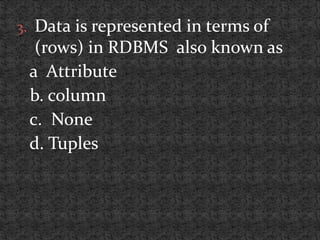
3. Data is represented in terms of
(rows) in RDBMS also known as
a Attribute
b. column
c. None
d. Tuples
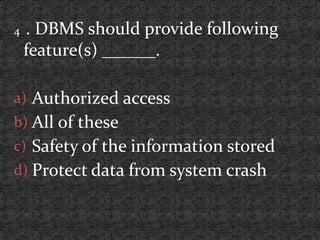
4 . DBMS should provide following
feature(s) ______.
a) Authorized access
b) All of these
c) Safety of the information stored
d) Protect data from system crash
5.Before use of DBMS information was
stored using __________.
a) .Cloud Storage
b) Data System
c) File Management System
d) .None of these
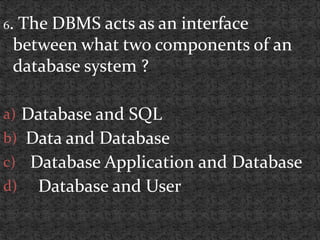
6. The DBMS acts as an interface
between what two components of an
database system ?
a) Database and SQL
b) Data and Database
c) Database Application and Database
d) Database and User
Dbms and rdbms ppt

Dbms and rdbms ppt

  • 1.
    PRESENTED TO: Prof. R.KPaliwal PRESENTED BY: RAHUL KAPOLIYA MBA 1ST SEM. Sec-C) Introduction to Database DBMS and RDBMS
  • 2.
     A Databaseis a collection of related data organised in a way that data can be easily accessed, managed and updated. Any piece of information can be a data, for example name of your school. Database is actually a place where related piece of information is stored and various operations can be performed on it.
  • 3.
     DBMS isthe abbreviated form of DataBase Management System.  Database management system is a computer software component introduced during 1960’s A DBMS is a software that allows creation, definition and manipulation of database. Dbms is actually a tool used to perform any kind of operation on data in database. Dbms also provides protection and security to database. It maintains data consistency in case of multiple users. Here are some examples of popular dbms, MySql, Oracle, Sybase, Microsoft Access and IBM DB2 etc
  • 4.
     The databasesystem can be divided into four components.  Users : Users may be of various type such as DB administrator, System developer and End users.  Database application : Database application may be Personal, Departmental, Enterprise and Internal  DBMS : Software that allow users to define, create and manages database access, Ex: MySql, Oracle etc.  Database : Collection of logical data.
  • 5.
     Dictionary Management Data Storage Management  Data Transformation and Presentation  Security Management  Multi user Access Control  Backup and Recovery Management
  • 6.
     RDBMS isthe abbreviated form of Relational DataBase Management System.  Relational database management system was introduced in 1970’s by E.F CODD  RDBMS avoided the navigation model as in old DBMS and introduced Relational model. The relational model has relationship between tables using primary keys, foreign keys and indexes. Thus the fetching and storing of data become faster than the old Navigational model. So RDBMS is widely used by the enterprises and developers for storing complex and large amount of data
  • 8.
    1 Introduced in1960S Introduced in 1970s. 2 During introduction it followed the navigational modes (Navigational DBMS) for data storage and fetching. This model uses relationship between tables using primary keys, foreign keys and indexes. 3 Data fetching is slower for complex and large amount of data. Comparatively faster because of its relational model. 4 Used for applications using small amount of data. Used for huge applications using complex and large amount of data. 5 Example systems are dBase, Microsoft Acces, LibreOffice Base, FoxPro. Example systems are SQL Server, Oracle , MySQL, Maria DB, SQLite.
  • 10.
    Q.1 Key thatconsist of two or more attributes that uniquely identify an entity occurance is called a) Composite key b) Primary key c) Null d) Super key
  • 11.
    3. Data isrepresented in terms of (rows) in RDBMS also known as a Attribute b. column c. None d. Tuples
  • 12.
    4 . DBMSshould provide following feature(s) ______. a) Authorized access b) All of these c) Safety of the information stored d) Protect data from system crash
  • 13.
    5.Before use ofDBMS information was stored using __________. a) .Cloud Storage b) Data System c) File Management System d) .None of these
  • 14.
    6. The DBMSacts as an interface between what two components of an database system ? a) Database and SQL b) Data and Database c) Database Application and Database d) Database and User