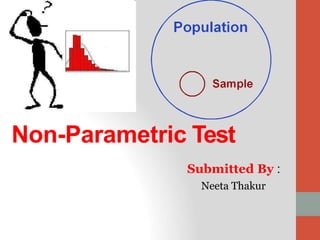
Non-Parametric Test
Submitted By :
Neeta Thakur
Introduction
Researcher in the field of health sciences many times may
not be aware about the nature of the distribution or other
required population parametres . In addition sample may be
too small to test the hypothesis and generalize the findings
for the population from which the sample is drawn.
furthermore, many times in the observations presented in
numerical figures, the scale of measurements may not be
really numerical, such as grading bedsores or ranks given to
the analgesic’s drugs effectiveness in cancer patient
management. In these situation, parametric test may not be
suitable, and a researcher may need different types of tests to
draw inferences , those test are known as non parametric
tests.
Nonparametric
tests
• Non parametric test are applied under the
circumstances where the population is not
normally distributed based on fewer assumptions
or no assumptions.
• There are some situations when it is clear that the
outcome does not follow a normal distribution.
• .
Where we can use Non
parametric test
1. Where the sample is selected using either
probability or even may be non probability
sampling technique.
2. where the population distribution is not
known or even may not normally distributed
3. Where the measurement of data is generally
in nominal or ordinal scale
4. Where the population of the study is not
clearly defind or complete information about
population is not known.
Non-parametric
Methods
• Chi Square Test
• The sign test
• Wilcoxon Signed-Rank
Test
• Mann-Whitney U- Test
• Median test
• Kruskal-Wallis Test
Sample for Chi –Square Test
Preferably random sample.
Sample size should be more than 30
Lowest expected frequency not less than 5
Chi Square Test
• Simplest & Most Widely used non-parametric test in
statistical work
• Calculated using the formula - ꭓ2
•
= ∑
𝑶−𝑬
𝟐
𝑬
O- observed frequencies
E- expected frequencies
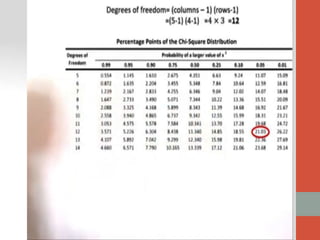
• Calculated value of ꭓ2 is compared with table value of ꭓ2 for given
degrees of freedom.
Ranking Data
• To rank data we must order a set of scores from smallest
to largest. The smallest score is given rank 1, the second
smallest score is given 2 and so on. It is purely the sample
size that affects the ranks and not the actual numerical
values of the scores.
• Imagine you have collected a sample of ten students' exam
scores (out of fifty) and wish to rank them.
• You collect the following
scores: 25,49,12,40,35,43,28,30,45,1825,49,12,40,35,43,2
8,30,45,18.
• If we sort them into ascending order, we
get: 12,18,25,28,30,35,40,45,4912,18,25,28,30,35,40,45,4
9
•
These are now in ranked order
and we can put them into a table:
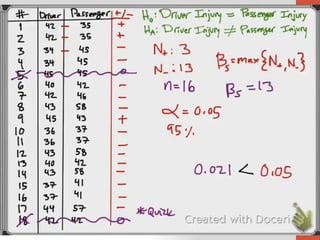
Sign test
It is used as an alternate test to T-test where
median is compared rather than mean.
Uses of Signed test
1. Used to test null hypothesis about
population median with single sample or
paired data
2. Population parametres are not known or not
normally distributed.
3. The data available are on ordinal scale
rather than interval or rational scale
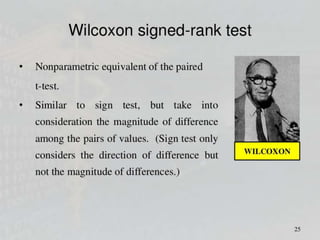
If a small size sample (n<30) is drawn
from a grossly non- normally distributed
population and t-test and Z test cannot be
applied, then a best alternative non-
parametric test is Wilcoxon- signed Rank
test. Because sign test may be used
when data consist of single sample or
have a paired data .
FOLLOWING ASSUMPTIONS ARE
CONSIDERED IN WILCOXON SIGNED
RANK TEST :
1 The sample is random
2 The variable is continuous
The population is symmetrically
distributed about its mean
The measurement scale is at least
interval.
Methods of Wilcoxon sign test
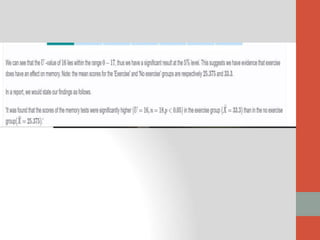
•First, delete any case where the scores are the same in both
groups (so zero differences), they can be ignored in the sign test.
•Subtract the second group's scores away from the first group's.
Remember to include the sign of the difference (++ or −−).
•Now count the number of differences which have a positive sign
and then count the number of differences with a negative sign.
•Take the smaller number.
•Look up the significance of the smaller number in a significance
table. look at the row containing the sum of the positive and
negative signs (the total number of differences ignoring zero
differences.) The value must be in the range specified in the table
for it to be statistically significant.
•Report the findings and form conclusion.
The Mann-Whitney U-test is the most
common non-parametric test for
unrelated samples of scores. We would
use it when the two groups are
independent of each other, for example i
testing of two different groups of people
in a conformity study. It can used when
the two groups are different sizes and a.
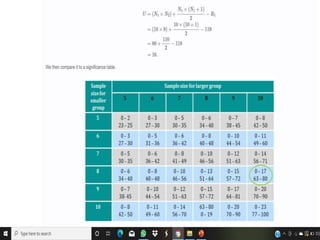
•Method of Mann Whitney U test
•First, we state our null and alternative hypotheses.
•Next, we rank all of the scores (from both groups) from
the smallest to largest. Equal scores are allocated the
average of the ranks they would have if there was tiny
differences between them. For example, say there are two
scores of 13. If there was just one score of 13 it would
have the rank 7 in this particular example. However, since
there are two scores of 13, we instead assign the
rank 7+8/2=7.5 to both scores.
•Next we sum the ranks for each group. Then sum of the
ranks for the larger group R1 and for the smaller sized
group,R2. If both groups are equally sized then we can
label them whichever way round we like.
Median test
It is used to test the null hypothesis that two independent
sample have drawn from population with equal median
Follwing assumption are considered
1. The sample are selected independently and at random
from population with equal mediun
2. The level of measurement must be at least ordinal
3. The sample don’t have to be equal in size
4. The population are of the same form and differ only in
location
Kruskal WallisTest
• Like the one-way analysis of variance, the Kruskal-
Wallis test is used to determine whether c ≥3 samples
come from the same or different populations.
• The Kruskal-Wallis test is based on the assumption that
the c groups are independent and that individual items
are selected randomly. The hypotheses tested by the
Kruskal-Wallis test follow.
H0 :The c populations are identical.
Ha: At least one of the c populations is different.
Advantages of
Nonparametric Tests
• Used with all scales
• Easier to compute
— Developed originally before
wide computer use
• Make fewer assumptions
• Need not involve
population parameters
• Results may be as
exact as parametric
procedures
.
Disadvantages of
Nonparametric Tests
• May waste information
— If data permit using
parametric procedures
— Example: converting data
from ratio to ordinal scale
• Difficult to compute by hand
for large samples
• Tables not widely available
.
Parametric Non-parametric
Assumed distribution normal any
Typical data Ratio or interval Nominal or ordinal
Usual central measures mean Median
Benefits Can draw
many
conclusions
Simplicity less
affected by outliers
Independent
measures, 2 groups
Independent
measures, >2 groups
Repeated
measures, 2
conditions
Tests
Independent
measure t test
One way
independent
measures ANOVA
Matched pair t-test
Mann- whitney test
Kruskal wallis test
Wilcoxon test
parametric statistic
• Jarkko Isotalo, Basics of Statistics
(Available online
at:
http://www.mv.helsinki.fi/home/jmisotal/BoS.pdf)
• Ken Black, 6th edition, Business Statistics For Contemporary
Decision Making
• Lisa Sullivan, Non parametric statistics, Boston University School of
Public Health (available online at:
http://sphweb.bumc.bu.edu/otlt/MPHModules/BS/BS704_Nonpara
metri c/BS704_Nonparametric_print.html)
• Arora, P.N and Malhan P.K; Biostatistics, 2009 Edition
• http://blog.minitab.com/blog/adventures-in-statistics/choosing-
between-a-nonparametric-test-and-a-parametric-test
Non parametric test

Non parametric test

  • 1.
  • 2.
    Introduction Researcher in thefield of health sciences many times may not be aware about the nature of the distribution or other required population parametres . In addition sample may be too small to test the hypothesis and generalize the findings for the population from which the sample is drawn. furthermore, many times in the observations presented in numerical figures, the scale of measurements may not be really numerical, such as grading bedsores or ranks given to the analgesic’s drugs effectiveness in cancer patient management. In these situation, parametric test may not be suitable, and a researcher may need different types of tests to draw inferences , those test are known as non parametric tests.
  • 3.
    Nonparametric tests • Non parametrictest are applied under the circumstances where the population is not normally distributed based on fewer assumptions or no assumptions. • There are some situations when it is clear that the outcome does not follow a normal distribution. • .
  • 4.
    Where we canuse Non parametric test 1. Where the sample is selected using either probability or even may be non probability sampling technique. 2. where the population distribution is not known or even may not normally distributed 3. Where the measurement of data is generally in nominal or ordinal scale 4. Where the population of the study is not clearly defind or complete information about population is not known.
  • 5.
    Non-parametric Methods • Chi SquareTest • The sign test • Wilcoxon Signed-Rank Test • Mann-Whitney U- Test • Median test • Kruskal-Wallis Test
  • 9.
    Sample for Chi–Square Test Preferably random sample. Sample size should be more than 30 Lowest expected frequency not less than 5
  • 10.
    Chi Square Test •Simplest & Most Widely used non-parametric test in statistical work • Calculated using the formula - ꭓ2 • = ∑ 𝑶−𝑬 𝟐 𝑬 O- observed frequencies E- expected frequencies • Calculated value of ꭓ2 is compared with table value of ꭓ2 for given degrees of freedom.
  • 16.
    Ranking Data • Torank data we must order a set of scores from smallest to largest. The smallest score is given rank 1, the second smallest score is given 2 and so on. It is purely the sample size that affects the ranks and not the actual numerical values of the scores. • Imagine you have collected a sample of ten students' exam scores (out of fifty) and wish to rank them. • You collect the following scores: 25,49,12,40,35,43,28,30,45,1825,49,12,40,35,43,2 8,30,45,18. • If we sort them into ascending order, we get: 12,18,25,28,30,35,40,45,4912,18,25,28,30,35,40,45,4 9 •
  • 17.
    These are nowin ranked order and we can put them into a table:
  • 18.
    Sign test It isused as an alternate test to T-test where median is compared rather than mean. Uses of Signed test 1. Used to test null hypothesis about population median with single sample or paired data 2. Population parametres are not known or not normally distributed. 3. The data available are on ordinal scale rather than interval or rational scale
  • 23.
    If a smallsize sample (n<30) is drawn from a grossly non- normally distributed population and t-test and Z test cannot be applied, then a best alternative non- parametric test is Wilcoxon- signed Rank test. Because sign test may be used when data consist of single sample or have a paired data .
  • 24.
    FOLLOWING ASSUMPTIONS ARE CONSIDEREDIN WILCOXON SIGNED RANK TEST : 1 The sample is random 2 The variable is continuous The population is symmetrically distributed about its mean The measurement scale is at least interval.
  • 25.
    Methods of Wilcoxonsign test •First, delete any case where the scores are the same in both groups (so zero differences), they can be ignored in the sign test. •Subtract the second group's scores away from the first group's. Remember to include the sign of the difference (++ or −−). •Now count the number of differences which have a positive sign and then count the number of differences with a negative sign. •Take the smaller number. •Look up the significance of the smaller number in a significance table. look at the row containing the sum of the positive and negative signs (the total number of differences ignoring zero differences.) The value must be in the range specified in the table for it to be statistically significant. •Report the findings and form conclusion.
  • 29.
    The Mann-Whitney U-testis the most common non-parametric test for unrelated samples of scores. We would use it when the two groups are independent of each other, for example i testing of two different groups of people in a conformity study. It can used when the two groups are different sizes and a.
  • 31.
    •Method of MannWhitney U test •First, we state our null and alternative hypotheses. •Next, we rank all of the scores (from both groups) from the smallest to largest. Equal scores are allocated the average of the ranks they would have if there was tiny differences between them. For example, say there are two scores of 13. If there was just one score of 13 it would have the rank 7 in this particular example. However, since there are two scores of 13, we instead assign the rank 7+8/2=7.5 to both scores. •Next we sum the ranks for each group. Then sum of the ranks for the larger group R1 and for the smaller sized group,R2. If both groups are equally sized then we can label them whichever way round we like.
  • 39.
    Median test It isused to test the null hypothesis that two independent sample have drawn from population with equal median Follwing assumption are considered 1. The sample are selected independently and at random from population with equal mediun 2. The level of measurement must be at least ordinal 3. The sample don’t have to be equal in size 4. The population are of the same form and differ only in location
  • 40.
    Kruskal WallisTest • Likethe one-way analysis of variance, the Kruskal- Wallis test is used to determine whether c ≥3 samples come from the same or different populations. • The Kruskal-Wallis test is based on the assumption that the c groups are independent and that individual items are selected randomly. The hypotheses tested by the Kruskal-Wallis test follow. H0 :The c populations are identical. Ha: At least one of the c populations is different.
  • 41.
    Advantages of Nonparametric Tests •Used with all scales • Easier to compute — Developed originally before wide computer use • Make fewer assumptions • Need not involve population parameters • Results may be as exact as parametric procedures .
  • 42.
    Disadvantages of Nonparametric Tests •May waste information — If data permit using parametric procedures — Example: converting data from ratio to ordinal scale • Difficult to compute by hand for large samples • Tables not widely available .
  • 43.
    Parametric Non-parametric Assumed distributionnormal any Typical data Ratio or interval Nominal or ordinal Usual central measures mean Median Benefits Can draw many conclusions Simplicity less affected by outliers Independent measures, 2 groups Independent measures, >2 groups Repeated measures, 2 conditions Tests Independent measure t test One way independent measures ANOVA Matched pair t-test Mann- whitney test Kruskal wallis test Wilcoxon test parametric statistic
  • 44.
    • Jarkko Isotalo,Basics of Statistics (Available online at: http://www.mv.helsinki.fi/home/jmisotal/BoS.pdf) • Ken Black, 6th edition, Business Statistics For Contemporary Decision Making • Lisa Sullivan, Non parametric statistics, Boston University School of Public Health (available online at: http://sphweb.bumc.bu.edu/otlt/MPHModules/BS/BS704_Nonpara metri c/BS704_Nonparametric_print.html) • Arora, P.N and Malhan P.K; Biostatistics, 2009 Edition • http://blog.minitab.com/blog/adventures-in-statistics/choosing- between-a-nonparametric-test-and-a-parametric-test