E-COMMERCE
Presented to: Presented by:
Prof. Ram kumar Paliwal Rahul kapoliya
Definition of E-Commerce
 E-Commerce or Electronic commerce is a
process of buying, selling, transferring, or
exchanging products, services, and/or
information via electronic networks and
computers
E-Commerce Categories
 Two major categories
 Other categories
3
Two Major Categories
 Business-to-consumer (B2C) :
Online transactions are made between
businesses and individual consumers. E.g.
Amazon.com, eBay.com.
 Business-to-business (B2B):
Businesses make online transactions with other
businesses.
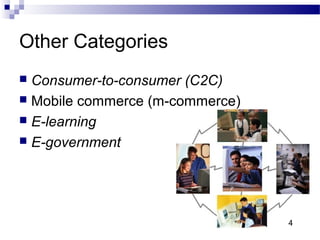
Other Categories
 Consumer-to-consumer (C2C)
 Mobile commerce (m-commerce)
 E-learning
 E-government
4
Benefits of E-Commerce
 Benefits to organizations
 Benefits to consumers
5
Benefits to organizations
 Global reach
 Cost reduction
 Supply chain improvements
 Extended hours: 24/7/365
 Customization
 Improved customer relations
Benefits to consumers
 More products and services
 Cheaper products and services
 Instant delivery
 Information availability
 Participation in auctions
Business applications
 Email
 Instant messaging
 Online shopping and order tracking
 Online banking
 Shopping cart software
 Teleconferencing
 Electronic tickets
Online Shopping
 Online shopping is the process of buying
goods and services from merchants who
sell on the Internet
 Online consumers are evenly split
between men and women and tend to be
better educated, younger, and more
affluent than the general population
Online Shopping (cont)..
 Advantages:
24-hour access
Ability to comparison
shop
The in-home privacy
Variety
6
Online Shopping (cont)..
 Favourite websites for shopping include
those featuring:
Event tickets
Online periodicals subscription
Flowers and gifts
Consumer electronics
Travel
Online Shopping (cont)..
How do you buy something
7
Interesting Facts and Statistics
 Every 1.2 seconds, a Canadian makes a
purchase with their PayPal account
 Almost 20 per cent of Canadians make three or
more online purchases per month (comScore
2009).
8
Summary and Conclusion
 The Internet has lead to the birth and evolution
E-commerce. E-commerce has now become a
key component of many organizations in the
daily running of their business.
 As the Internet and in turn E-commerce has
developed, and continues to evolve and grow, it
is vital that any organization, in any particular
industry, must base its strategic planning around
such a rapidly growing medium.
E commerce

E commerce

  • 1.
    E-COMMERCE Presented to: Presentedby: Prof. Ram kumar Paliwal Rahul kapoliya
  • 2.
    Definition of E-Commerce E-Commerce or Electronic commerce is a process of buying, selling, transferring, or exchanging products, services, and/or information via electronic networks and computers
  • 3.
    E-Commerce Categories  Twomajor categories  Other categories 3
  • 4.
    Two Major Categories Business-to-consumer (B2C) : Online transactions are made between businesses and individual consumers. E.g. Amazon.com, eBay.com.  Business-to-business (B2B): Businesses make online transactions with other businesses.
  • 5.
    Other Categories  Consumer-to-consumer(C2C)  Mobile commerce (m-commerce)  E-learning  E-government 4
  • 6.
    Benefits of E-Commerce Benefits to organizations  Benefits to consumers 5
  • 7.
    Benefits to organizations Global reach  Cost reduction  Supply chain improvements  Extended hours: 24/7/365  Customization  Improved customer relations
  • 8.
    Benefits to consumers More products and services  Cheaper products and services  Instant delivery  Information availability  Participation in auctions
  • 9.
    Business applications  Email Instant messaging  Online shopping and order tracking  Online banking  Shopping cart software  Teleconferencing  Electronic tickets
  • 10.
    Online Shopping  Onlineshopping is the process of buying goods and services from merchants who sell on the Internet  Online consumers are evenly split between men and women and tend to be better educated, younger, and more affluent than the general population
  • 11.
    Online Shopping (cont).. Advantages: 24-hour access Ability to comparison shop The in-home privacy Variety 6
  • 12.
    Online Shopping (cont).. Favourite websites for shopping include those featuring: Event tickets Online periodicals subscription Flowers and gifts Consumer electronics Travel
  • 13.
    Online Shopping (cont).. Howdo you buy something 7
  • 14.
    Interesting Facts andStatistics  Every 1.2 seconds, a Canadian makes a purchase with their PayPal account  Almost 20 per cent of Canadians make three or more online purchases per month (comScore 2009). 8
  • 15.
    Summary and Conclusion The Internet has lead to the birth and evolution E-commerce. E-commerce has now become a key component of many organizations in the daily running of their business.  As the Internet and in turn E-commerce has developed, and continues to evolve and grow, it is vital that any organization, in any particular industry, must base its strategic planning around such a rapidly growing medium.