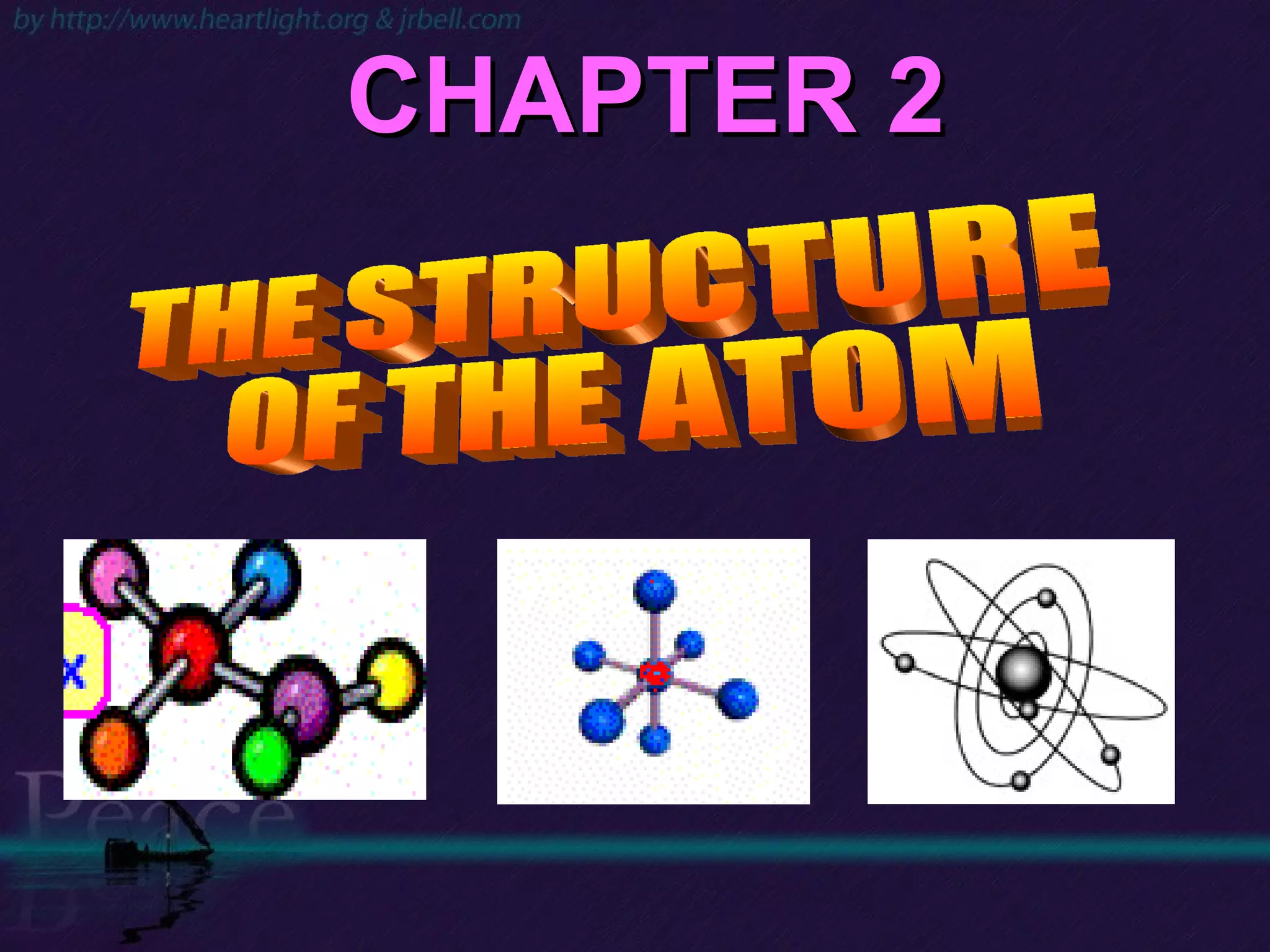
CHAPTER 2 THE STRUCTURE OF THE ATOM
2.1  MATTER Most of the things that we could see in this world are  MATTER
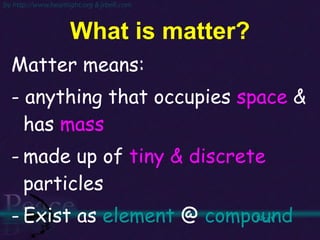
What is matter? Matter means:  - anything that occupies  space  & has  mass made up of  tiny & discrete  particles Exist as  element   @   compound Next
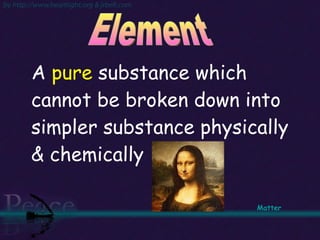
A  pure  substance which cannot be broken down into simpler substance physically & chemically Element Matter
Usually made up of  two or more  elements  which are chemically  bonded together Compound  Matter
Matter are made up of  tiny & discrete   particles Size of particles are very  minute  ~~ 1x 10 -7 cm  3. Consist of  atoms ,  molecules   ions Particles Theory  Next
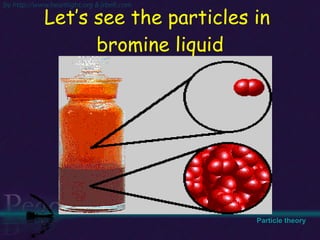
Let’s see the particles in  bromine liquid Particle theory
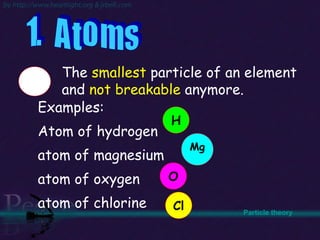
The  smallest  particle of an element and  not breakable  anymore.  1.  A t o m s Examples: Atom of hydrogen  atom of magnesium  atom of oxygen  atom of chlorine H Mg Cl O Particle theory
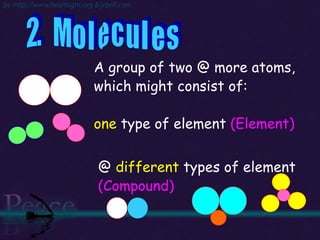
A group of two @ more atoms,  which might consist of: one  type  of element  (Element) @  different  types of element (Compound) 2.  M o l e c u l e s
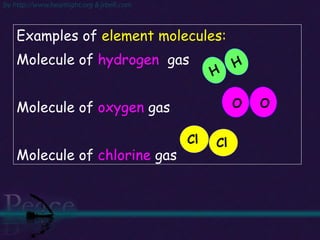
Examples of  element molecules: Molecule of  hydrogen   gas Molecule of  oxygen  gas Molecule of  chlorine  gas O O Cl Cl H H
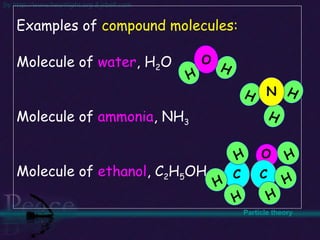
Examples of  compound molecules: Molecule of  water , H 2 O Molecule of  ammonia , NH 3 Molecule of  ethanol , C 2 H 5 OH Particle theory H H O H H H N O C C H H H H H H
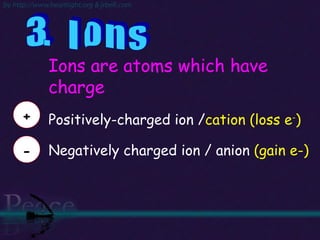
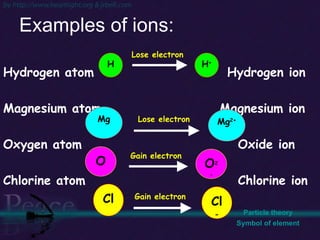
Ions are atoms which have charge Positively-charged ion / cation   (loss e - ) Negatively charged ion / anion  (gain e-) 3.  I o n s + -
Examples of ions: Hydrogen atom Hydrogen ion Magnesium atom  Magnesium ion Oxygen atom     Ox ide  ion Chlorine atom    Chlorine ion Particle theory Symbol of element H + H Lose electron Mg 2+ Lose electron Mg O 2- Gain electron O Cl - Gain electron Cl
 
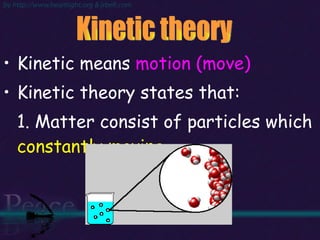
Kinetic means  motion (move) Kinetic theory states that: 1. Matter consist of particles which  constantly moving Kinetic theory
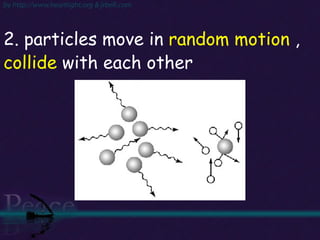
2. particles move in  random motion  ,  collide  with each other
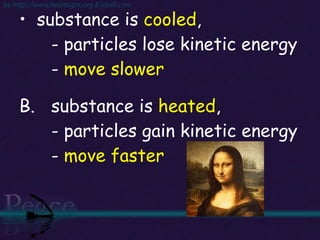
substance is  cooled ,    - particles lose kinetic energy   -  move slower B. substance is  heated ,  - particles gain kinetic energy -  move faster
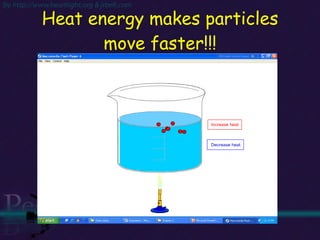
Heat energy makes particles move faster!!!
Experiment which supports the kinetic theory: Investigating the  diffusion  of particles in a  solid, liquid and gas
What is diffusion ? How diffusion supports  the  kinetic theory  ?
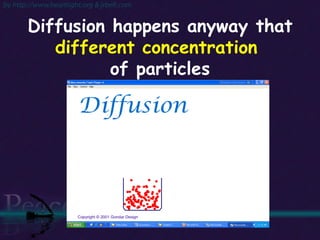
Diffusion happens anyway that  different concentration   of particles
Is the  rate of diffusion  different in solid, liquid,  and gas state? Let’s get an experiment  to check it out!!!
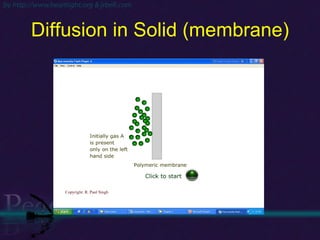
Diffusion in Solid (membrane)
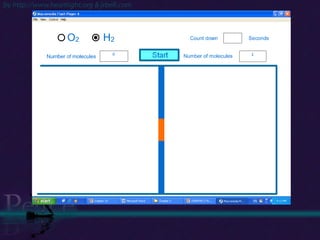
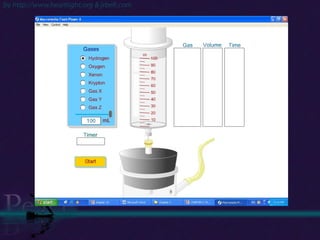
Diffusion in Liquid (  )
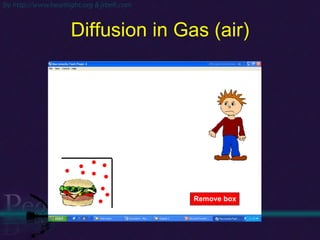
Diffusion in Gas (air)
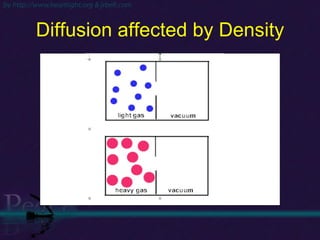
Diffusion affected by Density
 
 
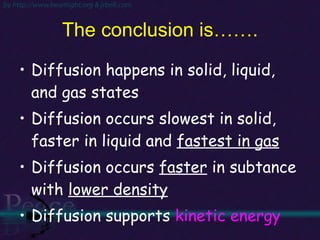
The conclusion is……. Diffusion happens in solid, liquid, and gas states Diffusion occurs slowest in solid, faster in liquid and  fastest in gas Diffusion occurs  faster  in subtance with  lower density Diffusion supports  kinetic energy
 
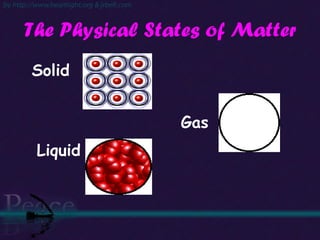
The Physical States of Matter Solid Liquid Gas
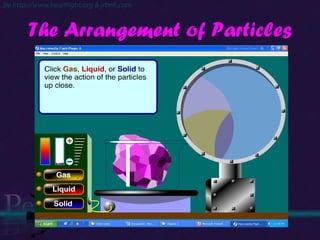
The Arrangement of Particles
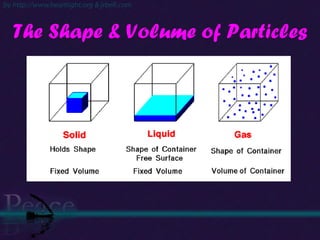
The Shape & Volume of Particles
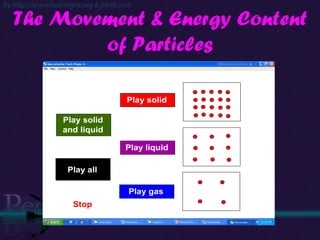
The Movement & Energy Content of Particles
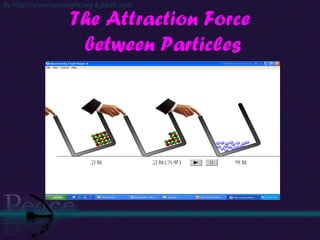
The Attraction Force  between Particles
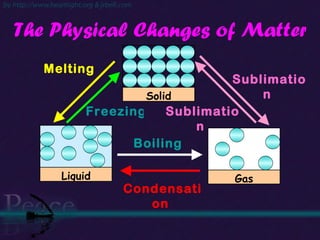
The Physical Changes of Matter Freezing   Melting Sublimation  Boiling   Condensation   Sublimation  Gas Liquid Solid
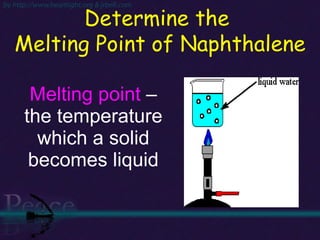
Melting point  – the temperature which a solid becomes liquid Determine the  Melting Point of Naphthalene
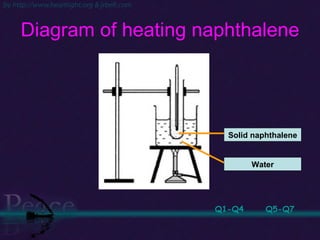
Diagram of heating naphthalene Q1-Q4 Q5-Q7 Solid naphthalene Water
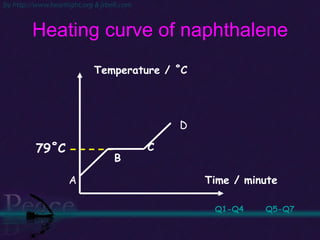
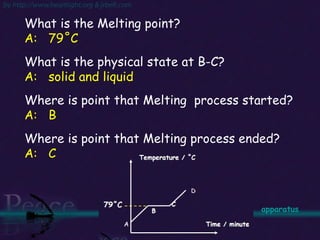
Heating curve of naphthalene Q1-Q4 Q5-Q7 A C B D Temperature / ˚C Time / minute 79˚C
 
What is the Melting point? A:  79˚C What is the physical state at B-C? A:  solid and liquid Where is point that Melting  process started? A:  B Where is point that Melting process ended? A:  C graph apparatus
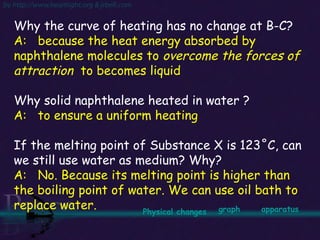
Why the curve of heating has no change at B-C? A:  because the heat energy absorbed by naphthalene molecules to  overcome the forces of attraction   to becomes liquid Why solid naphthalene heated in water ? A:  to ensure a uniform heating If the melting point of Substance X is 123˚C, can we still use water as medium? Why? A:  No. Because its melting point is higher than the boiling point of water. We can use oil bath to replace water. graph apparatus Physical changes
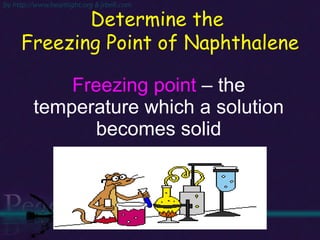
Freezing point  – the temperature which a solution becomes solid Determine the  Freezing Point of Naphthalene
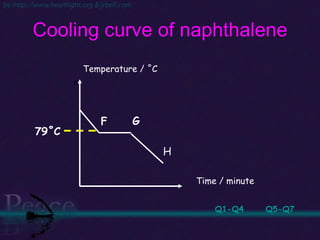
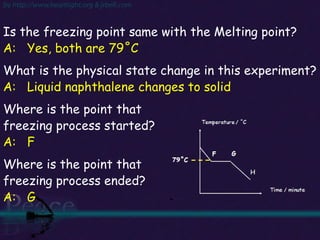
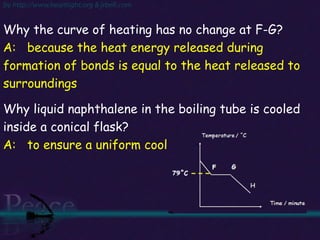
Cooling curve of naphthalene Q1-Q4 Q5-Q7 79˚C E F Temperature / ˚C G H Time / minute
Is the freezing point same with the Melting point? A:  Yes, both are 79˚C What is the physical state change in this experiment? A:  Liquid naphthalene changes to solid Where is the point that  freezing process started? A:  F Where is the point that  freezing process ended? A:  G
Why the curve of heating has no change at F-G? A:  because the heat energy released during formation of bonds is equal to the heat released to surroundings Why liquid naphthalene in the boiling tube is cooled inside a conical flask? A:  to ensure a uniform cooling
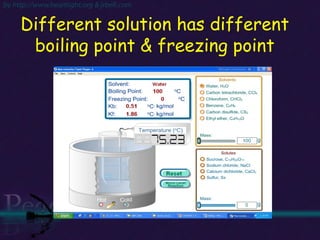
Different solution has different boiling point & freezing point
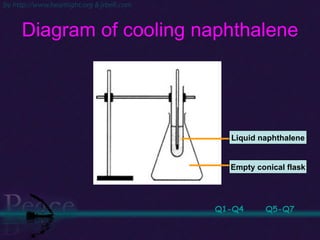
Diagram of cooling naphthalene Q1-Q4 Q5-Q7 Liquid naphthalene Empty conical flask
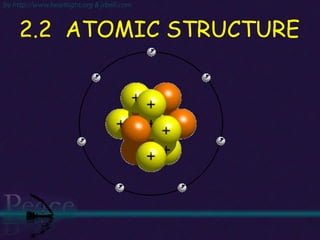
2.2  ATOMIC STRUCTURE
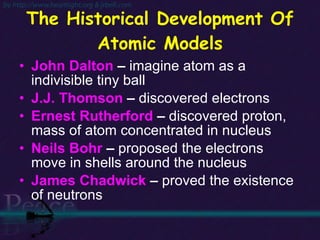
The Historical Development Of Atomic Models John Dalton  –  imagine atom as a indivisible tiny ball J.J. Thomson  –  discovered electrons Ernest Rutherford  –  discovered proton, mass of atom concentrated in nucleus Neils Bohr  –  proposed the electrons move in shells around the nucleus James Chadwick  –  proved the existence of neutrons
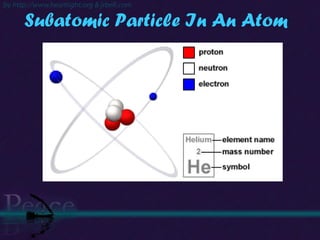
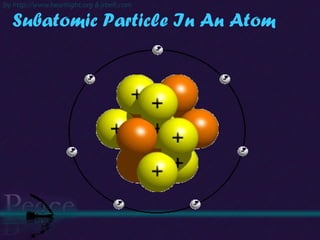
Subatomic Particle In An Atom
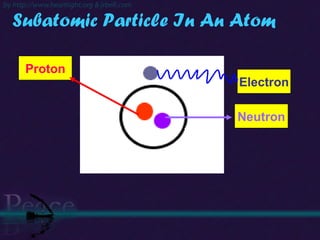
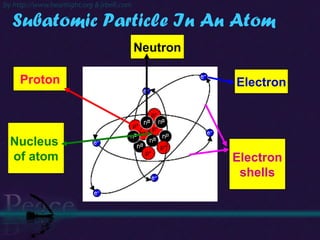
Subatomic Particle In An Atom Proton Neutron Electron
Subatomic Particle In An Atom Proton Electron Neutron Nucleus  of atom Electron shells
Subatomic Particle In An Atom
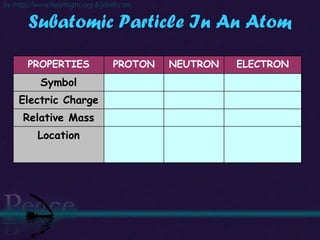
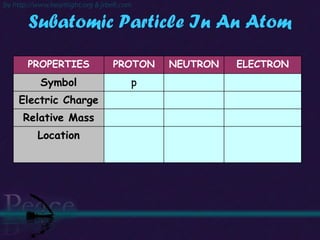
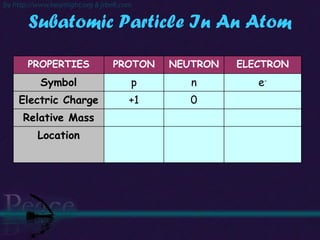
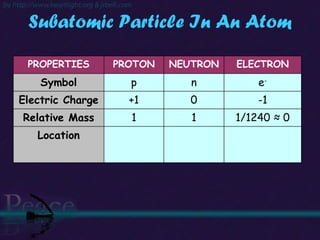
Subatomic Particle In An Atom PROPERTIES PROTON NEUTRON ELECTRON Symbol Electric Charge Relative Mass Location
Subatomic Particle In An Atom PROPERTIES PROTON NEUTRON ELECTRON Symbol p Electric Charge Relative Mass Location
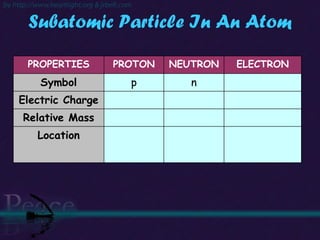
Subatomic Particle In An Atom PROPERTIES PROTON NEUTRON ELECTRON Symbol p n Electric Charge Relative Mass Location
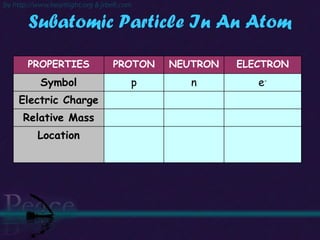
Subatomic Particle In An Atom PROPERTIES PROTON NEUTRON ELECTRON Symbol p n e - Electric Charge Relative Mass Location
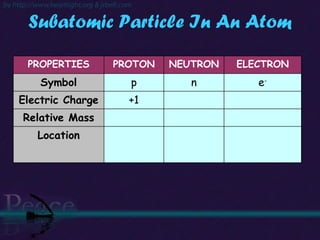
Subatomic Particle In An Atom PROPERTIES PROTON NEUTRON ELECTRON Symbol p n e - Electric Charge +1 Relative Mass Location
Subatomic Particle In An Atom PROPERTIES PROTON NEUTRON ELECTRON Symbol p n e - Electric Charge +1 0 Relative Mass Location
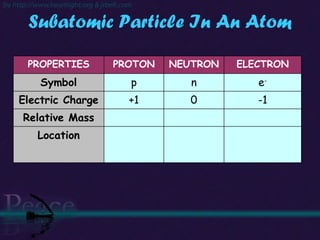
Subatomic Particle In An Atom PROPERTIES PROTON NEUTRON ELECTRON Symbol p n e - Electric Charge +1 0 -1 Relative Mass Location
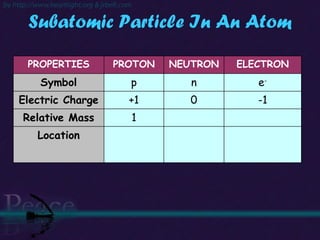
Subatomic Particle In An Atom PROPERTIES PROTON NEUTRON ELECTRON Symbol p n e - Electric Charge +1 0 -1 Relative Mass 1 Location
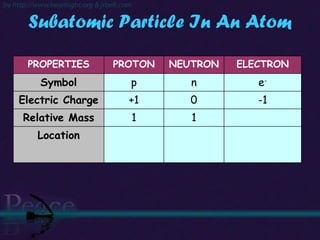
Subatomic Particle In An Atom PROPERTIES PROTON NEUTRON ELECTRON Symbol p n e - Electric Charge +1 0 -1 Relative Mass 1 1 Location
Subatomic Particle In An Atom PROPERTIES PROTON NEUTRON ELECTRON Symbol p n e - Electric Charge +1 0 -1 Relative Mass 1 1 1/1240 ≈ 0 Location
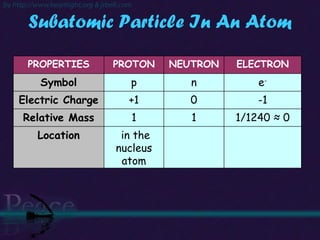
Subatomic Particle In An Atom PROPERTIES PROTON NEUTRON ELECTRON Symbol p n e - Electric Charge +1 0 -1 Relative Mass 1 1 1/1240 ≈ 0 Location in the nucleus atom
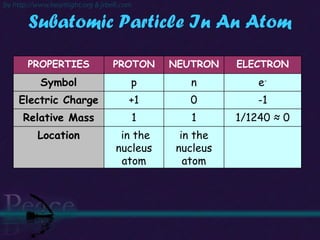
Subatomic Particle In An Atom PROPERTIES PROTON NEUTRON ELECTRON Symbol p n e - Electric Charge +1 0 -1 Relative Mass 1 1 1/1240 ≈ 0 Location in the nucleus atom in the nucleus atom
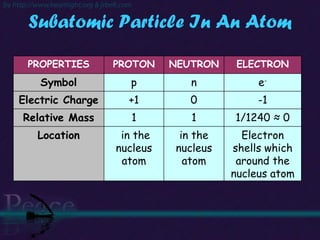
Subatomic Particle In An Atom PROPERTIES PROTON NEUTRON ELECTRON Symbol p n e - Electric Charge +1 0 -1 Relative Mass 1 1 1/1240 ≈ 0 Location in the nucleus atom in the nucleus atom Electron shells which around the nucleus atom
Still awake ??
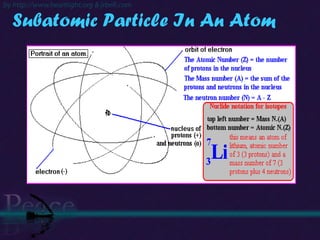
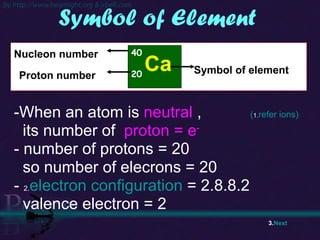
Symbol of Element When an atom is  neutral  ,  ( 1. refer ions) its number of  proton = e - number of protons = 20 so number of elecrons = 20 -  2. electron configuration  = 2.8.8.2 valence electron = 2 Nucleon number Proton number Symbol of element 3. Next   40 20 Ca
Electron Configuration Also known as  electron arrangement How electrons fill into the shells?
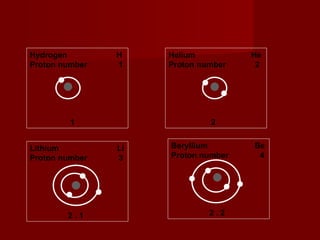
Helium  He Proton number  2 2 Hydrogen  H Proton number  1 1 Lithium  Li Proton number  3  2 . 1 Beryllium  Be Proton number  4  2 . 2
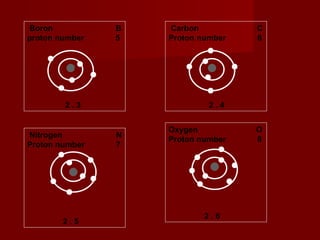
Boron  B proton number  5  2 . 3 Carbon  C Proton number  6 2 . 4 Nitrogen  N Proton number  7  2 . 5 Oxygen  O Proton number  8  2 . 6
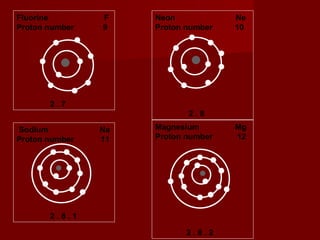
Fluorine  F Proton number  9 2 . 7 Neon  Ne Proton number  10  2 . 8 Sodium  Na Proton number  11 2 . 8 . 1 Magnesium  Mg Proton number  12  2 . 8 . 2
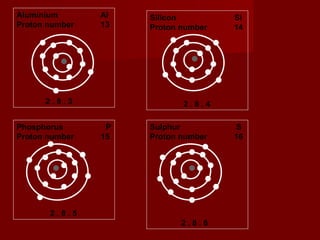
Aluminium  Al Proton number  13  2 . 8 . 3 Silicon  Si Proton number  14 2 . 8 . 4 Phosphorus  P Proton number  15 2 . 8 . 5 Sulphur  S Proton number  16  2 . 8 . 6
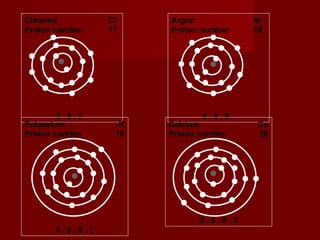
Chlorine  Cl Proton number  17  2 . 8 . 7 Argon  Ar Proton number  18  2 . 8 . 8 Potassium  K Proton number  19  2 . 8 . 8 . 1 Calcium  Ca Proton number  20  2 . 8 . 8 . 2
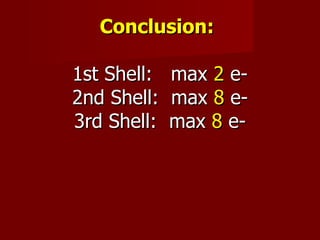
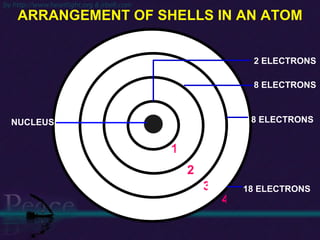
Conclusion:   1st Shell:  max  2  e- 2nd Shell:  max  8  e- 3rd Shell:  max  8  e-
ARRANGEMENT OF SHELLS IN AN ATOM NUCLEUS 2 ELECTRONS 8 ELECTRONS 8   ELECTRONS 18 ELECTRONS 1 2 3 4
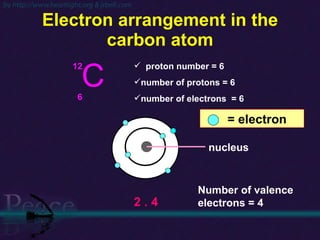
Electron arrangement in the carbon atom C 12 6 proton number = 6 number of protons = 6 number of electrons  = 6 2 . 4 = electron nucleus Number of valence electrons = 4
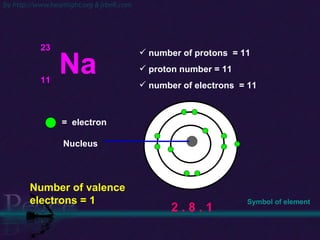
23 11 Na 2 . 8 . 1 number of protons  = 11 proton number = 11 number of electrons  = 11 =  electron Nucleus Number of valence electrons = 1 Symbol of element
 
Try to draw out the electron arrangement in shells
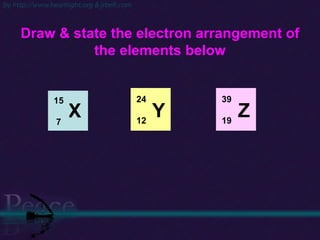
X Draw & state the electron arrangement of the elements below 15 7 Y 24 12 Z 39 19
Let us learn some chemical words !!
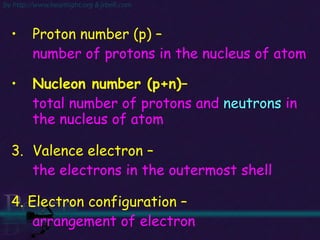
Proton number (p) –  number of protons in the nucleus of atom Nucleon number (p+n)– total number of protons and  neutrons  in the nucleus of atom 3. Valence electron – the electrons in the outer most  shell 4. Electron configuration – arrangement of electron
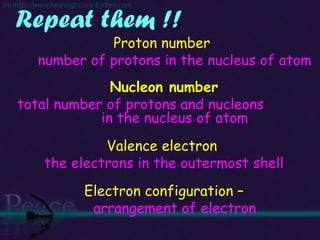
Repeat them !! Proton number  number of protons in the nucleus of atom Nucleon number total number of protons and nucleons  in the nucleus of atom Valence electron  the electrons in the outermost shell Electron configuration – arrangement of electron
Try this out!!!
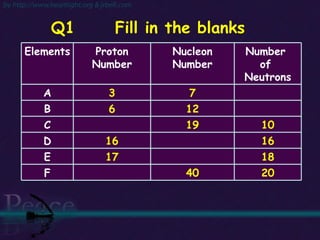
Q1  Fill in the blanks Elements Proton Number Nucleon Number Number  of  Neutrons A 3 7 B 6 12 C 19 10 D 16 16 E 17 18 F 40 20
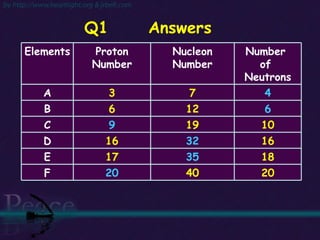
Q1  Answers Elements Proton Number Nucleon Number Number  of  Neutrons A 3 7 4 B 6 12 6 C 9 19 10 D 16 32 16 E 17 35 18 F 20 40 20
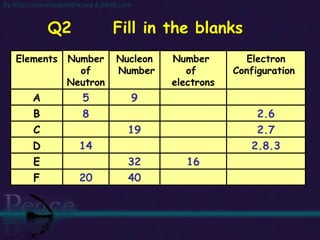
Q2  Fill in the blanks Elements Number of Neutron  Nucleon Number Number  of  electrons Electron Configuration  A 5 9 B 8 2.6 C 19 2.7 D 14 2.8.3 E 32 16 F 20 40
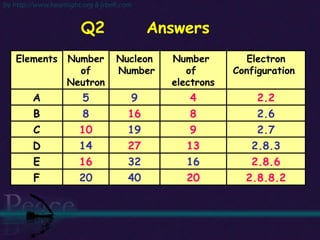
Q2  Answers Elements Number of Neutron Nucleon Number Number  of  electrons Electron Configuration  A 5 9 4 2.2 B 8 16 8 2.6 C 10 19 9 2.7 D 14 27 13 2.8.3 E 16 32 16 2.8.6 F 20 40 20 2.8.8.2
2.3  ISOTOPES
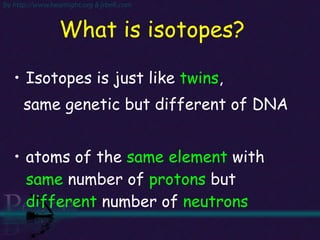
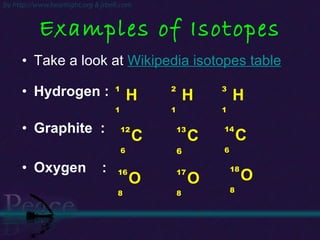
Isotopes is just like  twins ,  same genetic but different of DNA atoms of the  same element  with  same  number of  protons  but  different  number of  neutrons What is isotopes?
Examples of Isotopes Take a look at  Wikipedia isotopes table Hydrogen : Graphite  : Oxygen  :  1 1   H 3 1   H 2 1   H 12 6 C 14 6 C 13 6 C 16 8 O 18 8 O 17 8 O
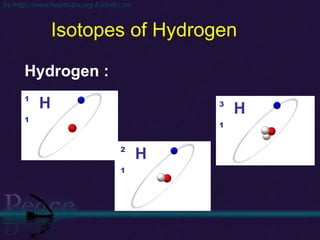
Isotopes of Hydrogen Hydrogen : 1 1   H 2 1   H 3 1   H
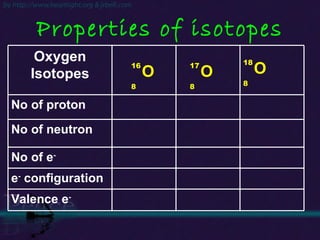
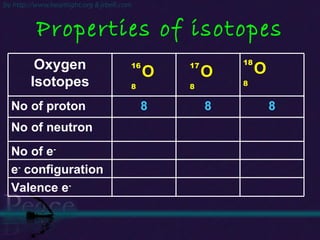
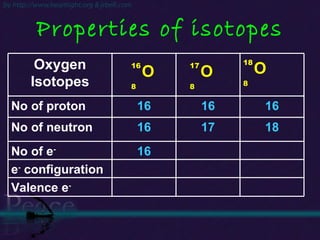
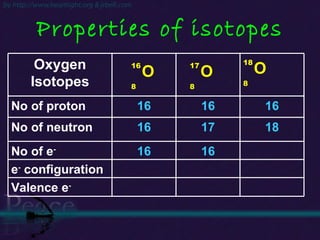
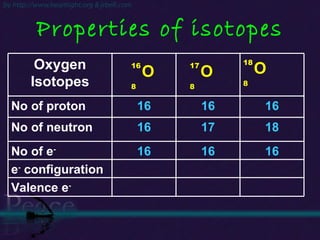
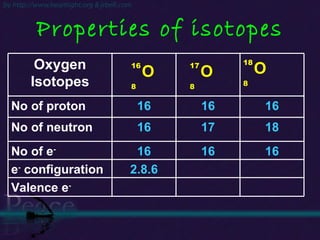
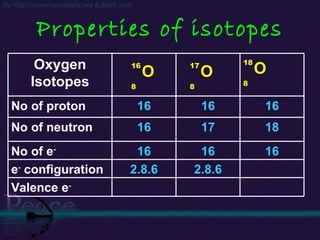
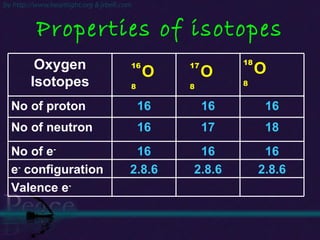
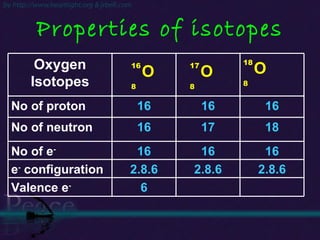
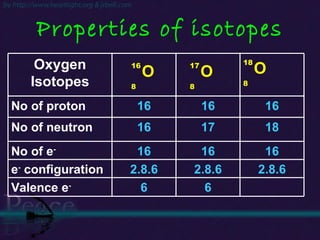
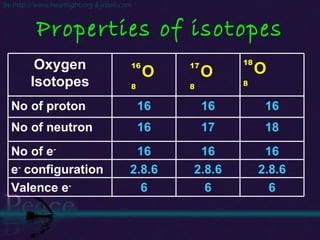
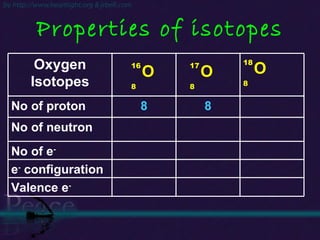
Properties of isotopes Oxygen Isotopes No of proton No of neutron No of e - e -  configuration Valence e - 16 8 O 18 8 O 17 8 O
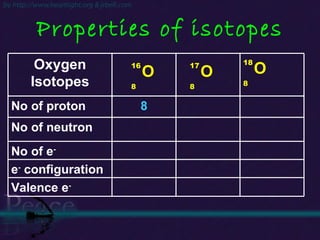
Properties of isotopes Oxygen Isotopes No of proton 8 No of neutron No of e - e -  configuration Valence e - 16 8 O 18 8 O 17 8 O
Properties of isotopes Oxygen Isotopes No of proton 8 8 No of neutron No of e - e -  configuration Valence e - 16 8 O 18 8 O 17 8 O
Properties of isotopes Oxygen Isotopes No of proton 8 8 8 No of neutron No of e - e -  configuration Valence e - 16 8 O 18 8 O 17 8 O
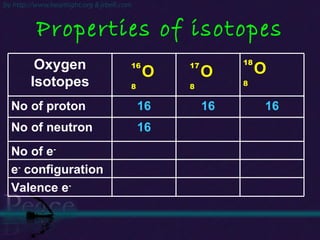
Properties of isotopes Oxygen Isotopes No of proton 16 16 16 No of neutron 16 No of e - e -  configuration Valence e - 16 8 O 18 8 O 17 8 O
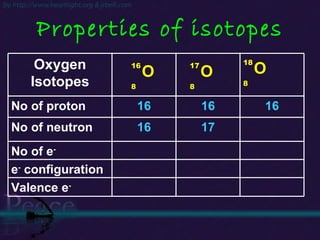
Properties of isotopes Oxygen Isotopes No of proton 16 16 16 No of neutron 16 17 No of e - e -  configuration Valence e - 16 8 O 18 8 O 17 8 O
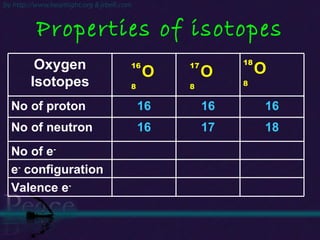
Properties of isotopes Oxygen Isotopes No of proton 16 16 16 No of neutron 16 17 18 No of e - e -  configuration Valence e - 16 8 O 18 8 O 17 8 O
Properties of isotopes Oxygen Isotopes No of proton 16 16 16 No of neutron 16 17 18 No of e - 16 e -  configuration Valence e - 16 8 O 18 8 O 17 8 O
Properties of isotopes Oxygen Isotopes No of proton 16 16 16 No of neutron 16 17 18 No of e - 16 16 e -  configuration Valence e - 16 8 O 18 8 O 17 8 O
Properties of isotopes Oxygen Isotopes No of proton 16 16 16 No of neutron 16 17 18 No of e - 16 16 16 e -  configuration Valence e - 16 8 O 18 8 O 17 8 O
Properties of isotopes Oxygen Isotopes No of proton 16 16 16 No of neutron 16 17 18 No of e - 16 16 16 e -  configuration 2.8.6 Valence e - 16 8 O 18 8 O 17 8 O
Properties of isotopes Oxygen Isotopes No of proton 16 16 16 No of neutron 16 17 18 No of e - 16 16 16 e -  configuration 2.8.6 2.8.6 Valence e - 16 8 O 18 8 O 17 8 O
Properties of isotopes Oxygen Isotopes No of proton 16 16 16 No of neutron 16 17 18 No of e - 16 16 16 e -  configuration 2.8.6 2.8.6 2.8.6 Valence e - 16 8 O 18 8 O 17 8 O
Properties of isotopes Oxygen Isotopes No of proton 16 16 16 No of neutron 16 17 18 No of e - 16 16 16 e -  configuration 2.8.6 2.8.6 2.8.6 Valence e - 6 16 8 O 18 8 O 17 8 O
Properties of isotopes Oxygen Isotopes No of proton 16 16 16 No of neutron 16 17 18 No of e - 16 16 16 e -  configuration 2.8.6 2.8.6 2.8.6 Valence e - 6 6 16 8 O 18 8 O 17 8 O
Properties of isotopes Oxygen Isotopes No of proton 16 16 16 No of neutron 16 17 18 No of e - 16 16 16 e -  configuration 2.8.6 2.8.6 2.8.6 Valence e - 6 6 6 16 8 O 18 8 O 17 8 O
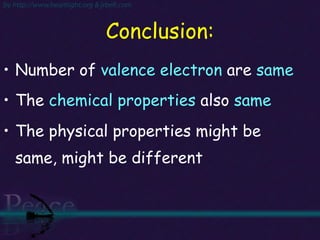
Conclusion: Number of  valence electron  are  same The  chemical properties  also  same   The physical properties might be same, might be different
Try this out!!!
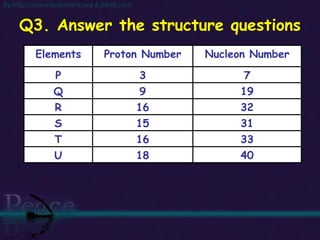
Q3. Answer the structure questions Elements Proton Number Nucleon Number P 3 7 Q 9 19 R 16 32 S 15 31 T 16 33 U 18 40
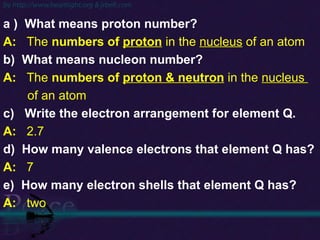
a )  What means proton number? A:  The  numbers of  proton  in the  nucleus  of an atom b)  What means nucleon number? A:  The  numbers of  proton & neutron  in the  nucleus  of an atom c)  Write the electron arrangement for element Q. A:  2.7 d)  How many valence electrons that element Q has? A:  7 e)  How many electron shells that element Q has? A:  two
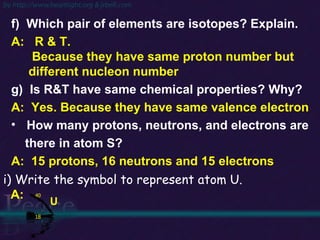
40 18  U f)  Which pair of elements are isotopes? Explain. A:  R & T.  Because they have same proton number but  different nucleon number g)  Is R&T have same chemical properties? Why? A:  Yes. Because they have same valence electron How many protons, neutrons, and electrons are  there in atom S? A:  15 protons, 16 neutrons and 15 electrons i) Write the symbol to represent atom U. A:   40 18   U


Chapter 2 the structure of the atom

  • 1.
    CHAPTER 2 THESTRUCTURE OF THE ATOM
  • 2.
    2.1 MATTERMost of the things that we could see in this world are MATTER
  • 3.
    What is matter?Matter means: - anything that occupies space & has mass made up of tiny & discrete particles Exist as element @ compound Next
  • 4.
    A pure substance which cannot be broken down into simpler substance physically & chemically Element Matter
  • 5.
    Usually made upof two or more elements which are chemically bonded together Compound Matter
  • 6.
    Matter are madeup of tiny & discrete particles Size of particles are very minute ~~ 1x 10 -7 cm 3. Consist of atoms , molecules ions Particles Theory Next
  • 7.
    Let’s see theparticles in bromine liquid Particle theory
  • 8.
    The smallest particle of an element and not breakable anymore. 1. A t o m s Examples: Atom of hydrogen atom of magnesium atom of oxygen atom of chlorine H Mg Cl O Particle theory
  • 9.
    A group oftwo @ more atoms, which might consist of: one type of element (Element) @ different types of element (Compound) 2. M o l e c u l e s
  • 10.
    Examples of element molecules: Molecule of hydrogen gas Molecule of oxygen gas Molecule of chlorine gas O O Cl Cl H H
  • 11.
    Examples of compound molecules: Molecule of water , H 2 O Molecule of ammonia , NH 3 Molecule of ethanol , C 2 H 5 OH Particle theory H H O H H H N O C C H H H H H H
  • 12.
    Ions are atomswhich have charge Positively-charged ion / cation (loss e - ) Negatively charged ion / anion (gain e-) 3. I o n s + -
  • 13.
    Examples of ions:Hydrogen atom Hydrogen ion Magnesium atom Magnesium ion Oxygen atom Ox ide ion Chlorine atom Chlorine ion Particle theory Symbol of element H + H Lose electron Mg 2+ Lose electron Mg O 2- Gain electron O Cl - Gain electron Cl
  • 14.
  • 15.
    Kinetic means motion (move) Kinetic theory states that: 1. Matter consist of particles which constantly moving Kinetic theory
  • 16.
    2. particles movein random motion , collide with each other
  • 17.
    substance is cooled , - particles lose kinetic energy - move slower B. substance is heated , - particles gain kinetic energy - move faster
  • 18.
    Heat energy makesparticles move faster!!!
  • 19.
    Experiment which supportsthe kinetic theory: Investigating the diffusion of particles in a solid, liquid and gas
  • 20.
    What is diffusion? How diffusion supports the kinetic theory ?
  • 21.
    Diffusion happens anywaythat different concentration of particles
  • 22.
    Is the rate of diffusion different in solid, liquid, and gas state? Let’s get an experiment to check it out!!!
  • 23.
  • 24.
  • 25.
  • 26.
  • 27.
  • 28.
  • 29.
    The conclusion is…….Diffusion happens in solid, liquid, and gas states Diffusion occurs slowest in solid, faster in liquid and fastest in gas Diffusion occurs faster in subtance with lower density Diffusion supports kinetic energy
  • 30.
  • 31.
    The Physical Statesof Matter Solid Liquid Gas
  • 32.
  • 33.
    The Shape &Volume of Particles
  • 34.
    The Movement &Energy Content of Particles
  • 35.
    The Attraction Force between Particles
  • 36.
    The Physical Changesof Matter Freezing Melting Sublimation Boiling Condensation Sublimation Gas Liquid Solid
  • 37.
    Melting point – the temperature which a solid becomes liquid Determine the Melting Point of Naphthalene
  • 38.
    Diagram of heatingnaphthalene Q1-Q4 Q5-Q7 Solid naphthalene Water
  • 39.
    Heating curve ofnaphthalene Q1-Q4 Q5-Q7 A C B D Temperature / ˚C Time / minute 79˚C
  • 40.
  • 41.
    What is theMelting point? A: 79˚C What is the physical state at B-C? A: solid and liquid Where is point that Melting process started? A: B Where is point that Melting process ended? A: C graph apparatus
  • 42.
    Why the curveof heating has no change at B-C? A: because the heat energy absorbed by naphthalene molecules to overcome the forces of attraction to becomes liquid Why solid naphthalene heated in water ? A: to ensure a uniform heating If the melting point of Substance X is 123˚C, can we still use water as medium? Why? A: No. Because its melting point is higher than the boiling point of water. We can use oil bath to replace water. graph apparatus Physical changes
  • 43.
    Freezing point – the temperature which a solution becomes solid Determine the Freezing Point of Naphthalene
  • 44.
    Cooling curve ofnaphthalene Q1-Q4 Q5-Q7 79˚C E F Temperature / ˚C G H Time / minute
  • 45.
    Is the freezingpoint same with the Melting point? A: Yes, both are 79˚C What is the physical state change in this experiment? A: Liquid naphthalene changes to solid Where is the point that freezing process started? A: F Where is the point that freezing process ended? A: G
  • 46.
    Why the curveof heating has no change at F-G? A: because the heat energy released during formation of bonds is equal to the heat released to surroundings Why liquid naphthalene in the boiling tube is cooled inside a conical flask? A: to ensure a uniform cooling
  • 47.
    Different solution hasdifferent boiling point & freezing point
  • 48.
    Diagram of coolingnaphthalene Q1-Q4 Q5-Q7 Liquid naphthalene Empty conical flask
  • 49.
    2.2 ATOMICSTRUCTURE
  • 50.
    The Historical DevelopmentOf Atomic Models John Dalton – imagine atom as a indivisible tiny ball J.J. Thomson – discovered electrons Ernest Rutherford – discovered proton, mass of atom concentrated in nucleus Neils Bohr – proposed the electrons move in shells around the nucleus James Chadwick – proved the existence of neutrons
  • 51.
  • 52.
    Subatomic Particle InAn Atom Proton Neutron Electron
  • 53.
    Subatomic Particle InAn Atom Proton Electron Neutron Nucleus of atom Electron shells
  • 54.
  • 55.
  • 56.
    Subatomic Particle InAn Atom PROPERTIES PROTON NEUTRON ELECTRON Symbol Electric Charge Relative Mass Location
  • 57.
    Subatomic Particle InAn Atom PROPERTIES PROTON NEUTRON ELECTRON Symbol p Electric Charge Relative Mass Location
  • 58.
    Subatomic Particle InAn Atom PROPERTIES PROTON NEUTRON ELECTRON Symbol p n Electric Charge Relative Mass Location
  • 59.
    Subatomic Particle InAn Atom PROPERTIES PROTON NEUTRON ELECTRON Symbol p n e - Electric Charge Relative Mass Location
  • 60.
    Subatomic Particle InAn Atom PROPERTIES PROTON NEUTRON ELECTRON Symbol p n e - Electric Charge +1 Relative Mass Location
  • 61.
    Subatomic Particle InAn Atom PROPERTIES PROTON NEUTRON ELECTRON Symbol p n e - Electric Charge +1 0 Relative Mass Location
  • 62.
    Subatomic Particle InAn Atom PROPERTIES PROTON NEUTRON ELECTRON Symbol p n e - Electric Charge +1 0 -1 Relative Mass Location
  • 63.
    Subatomic Particle InAn Atom PROPERTIES PROTON NEUTRON ELECTRON Symbol p n e - Electric Charge +1 0 -1 Relative Mass 1 Location
  • 64.
    Subatomic Particle InAn Atom PROPERTIES PROTON NEUTRON ELECTRON Symbol p n e - Electric Charge +1 0 -1 Relative Mass 1 1 Location
  • 65.
    Subatomic Particle InAn Atom PROPERTIES PROTON NEUTRON ELECTRON Symbol p n e - Electric Charge +1 0 -1 Relative Mass 1 1 1/1240 ≈ 0 Location
  • 66.
    Subatomic Particle InAn Atom PROPERTIES PROTON NEUTRON ELECTRON Symbol p n e - Electric Charge +1 0 -1 Relative Mass 1 1 1/1240 ≈ 0 Location in the nucleus atom
  • 67.
    Subatomic Particle InAn Atom PROPERTIES PROTON NEUTRON ELECTRON Symbol p n e - Electric Charge +1 0 -1 Relative Mass 1 1 1/1240 ≈ 0 Location in the nucleus atom in the nucleus atom
  • 68.
    Subatomic Particle InAn Atom PROPERTIES PROTON NEUTRON ELECTRON Symbol p n e - Electric Charge +1 0 -1 Relative Mass 1 1 1/1240 ≈ 0 Location in the nucleus atom in the nucleus atom Electron shells which around the nucleus atom
  • 69.
  • 70.
    Symbol of ElementWhen an atom is neutral , ( 1. refer ions) its number of proton = e - number of protons = 20 so number of elecrons = 20 - 2. electron configuration = 2.8.8.2 valence electron = 2 Nucleon number Proton number Symbol of element 3. Next 40 20 Ca
  • 71.
    Electron Configuration Alsoknown as electron arrangement How electrons fill into the shells?
  • 72.
    Helium HeProton number 2 2 Hydrogen H Proton number 1 1 Lithium Li Proton number 3 2 . 1 Beryllium Be Proton number 4 2 . 2
  • 73.
    Boron Bproton number 5 2 . 3 Carbon C Proton number 6 2 . 4 Nitrogen N Proton number 7 2 . 5 Oxygen O Proton number 8 2 . 6
  • 74.
    Fluorine FProton number 9 2 . 7 Neon Ne Proton number 10 2 . 8 Sodium Na Proton number 11 2 . 8 . 1 Magnesium Mg Proton number 12 2 . 8 . 2
  • 75.
    Aluminium AlProton number 13 2 . 8 . 3 Silicon Si Proton number 14 2 . 8 . 4 Phosphorus P Proton number 15 2 . 8 . 5 Sulphur S Proton number 16 2 . 8 . 6
  • 76.
    Chlorine ClProton number 17 2 . 8 . 7 Argon Ar Proton number 18 2 . 8 . 8 Potassium K Proton number 19 2 . 8 . 8 . 1 Calcium Ca Proton number 20 2 . 8 . 8 . 2
  • 77.
    Conclusion: 1st Shell: max 2 e- 2nd Shell: max 8 e- 3rd Shell: max 8 e-
  • 78.
    ARRANGEMENT OF SHELLSIN AN ATOM NUCLEUS 2 ELECTRONS 8 ELECTRONS 8 ELECTRONS 18 ELECTRONS 1 2 3 4
  • 79.
    Electron arrangement inthe carbon atom C 12 6 proton number = 6 number of protons = 6 number of electrons = 6 2 . 4 = electron nucleus Number of valence electrons = 4
  • 80.
    23 11 Na2 . 8 . 1 number of protons = 11 proton number = 11 number of electrons = 11 = electron Nucleus Number of valence electrons = 1 Symbol of element
  • 81.
  • 82.
    Try to drawout the electron arrangement in shells
  • 83.
    X Draw &state the electron arrangement of the elements below 15 7 Y 24 12 Z 39 19
  • 84.
    Let us learnsome chemical words !!
  • 85.
    Proton number (p)– number of protons in the nucleus of atom Nucleon number (p+n)– total number of protons and neutrons in the nucleus of atom 3. Valence electron – the electrons in the outer most shell 4. Electron configuration – arrangement of electron
  • 86.
    Repeat them !!Proton number number of protons in the nucleus of atom Nucleon number total number of protons and nucleons in the nucleus of atom Valence electron the electrons in the outermost shell Electron configuration – arrangement of electron
  • 87.
  • 88.
    Q1 Fillin the blanks Elements Proton Number Nucleon Number Number of Neutrons A 3 7 B 6 12 C 19 10 D 16 16 E 17 18 F 40 20
  • 89.
    Q1 AnswersElements Proton Number Nucleon Number Number of Neutrons A 3 7 4 B 6 12 6 C 9 19 10 D 16 32 16 E 17 35 18 F 20 40 20
  • 90.
    Q2 Fillin the blanks Elements Number of Neutron Nucleon Number Number of electrons Electron Configuration A 5 9 B 8 2.6 C 19 2.7 D 14 2.8.3 E 32 16 F 20 40
  • 91.
    Q2 AnswersElements Number of Neutron Nucleon Number Number of electrons Electron Configuration A 5 9 4 2.2 B 8 16 8 2.6 C 10 19 9 2.7 D 14 27 13 2.8.3 E 16 32 16 2.8.6 F 20 40 20 2.8.8.2
  • 92.
  • 93.
    Isotopes is justlike twins , same genetic but different of DNA atoms of the same element with same number of protons but different number of neutrons What is isotopes?
  • 94.
    Examples of IsotopesTake a look at Wikipedia isotopes table Hydrogen : Graphite : Oxygen : 1 1 H 3 1 H 2 1 H 12 6 C 14 6 C 13 6 C 16 8 O 18 8 O 17 8 O
  • 95.
    Isotopes of HydrogenHydrogen : 1 1 H 2 1 H 3 1 H
  • 96.
    Properties of isotopesOxygen Isotopes No of proton No of neutron No of e - e - configuration Valence e - 16 8 O 18 8 O 17 8 O
  • 97.
    Properties of isotopesOxygen Isotopes No of proton 8 No of neutron No of e - e - configuration Valence e - 16 8 O 18 8 O 17 8 O
  • 98.
    Properties of isotopesOxygen Isotopes No of proton 8 8 No of neutron No of e - e - configuration Valence e - 16 8 O 18 8 O 17 8 O
  • 99.
    Properties of isotopesOxygen Isotopes No of proton 8 8 8 No of neutron No of e - e - configuration Valence e - 16 8 O 18 8 O 17 8 O
  • 100.
    Properties of isotopesOxygen Isotopes No of proton 16 16 16 No of neutron 16 No of e - e - configuration Valence e - 16 8 O 18 8 O 17 8 O
  • 101.
    Properties of isotopesOxygen Isotopes No of proton 16 16 16 No of neutron 16 17 No of e - e - configuration Valence e - 16 8 O 18 8 O 17 8 O
  • 102.
    Properties of isotopesOxygen Isotopes No of proton 16 16 16 No of neutron 16 17 18 No of e - e - configuration Valence e - 16 8 O 18 8 O 17 8 O
  • 103.
    Properties of isotopesOxygen Isotopes No of proton 16 16 16 No of neutron 16 17 18 No of e - 16 e - configuration Valence e - 16 8 O 18 8 O 17 8 O
  • 104.
    Properties of isotopesOxygen Isotopes No of proton 16 16 16 No of neutron 16 17 18 No of e - 16 16 e - configuration Valence e - 16 8 O 18 8 O 17 8 O
  • 105.
    Properties of isotopesOxygen Isotopes No of proton 16 16 16 No of neutron 16 17 18 No of e - 16 16 16 e - configuration Valence e - 16 8 O 18 8 O 17 8 O
  • 106.
    Properties of isotopesOxygen Isotopes No of proton 16 16 16 No of neutron 16 17 18 No of e - 16 16 16 e - configuration 2.8.6 Valence e - 16 8 O 18 8 O 17 8 O
  • 107.
    Properties of isotopesOxygen Isotopes No of proton 16 16 16 No of neutron 16 17 18 No of e - 16 16 16 e - configuration 2.8.6 2.8.6 Valence e - 16 8 O 18 8 O 17 8 O
  • 108.
    Properties of isotopesOxygen Isotopes No of proton 16 16 16 No of neutron 16 17 18 No of e - 16 16 16 e - configuration 2.8.6 2.8.6 2.8.6 Valence e - 16 8 O 18 8 O 17 8 O
  • 109.
    Properties of isotopesOxygen Isotopes No of proton 16 16 16 No of neutron 16 17 18 No of e - 16 16 16 e - configuration 2.8.6 2.8.6 2.8.6 Valence e - 6 16 8 O 18 8 O 17 8 O
  • 110.
    Properties of isotopesOxygen Isotopes No of proton 16 16 16 No of neutron 16 17 18 No of e - 16 16 16 e - configuration 2.8.6 2.8.6 2.8.6 Valence e - 6 6 16 8 O 18 8 O 17 8 O
  • 111.
    Properties of isotopesOxygen Isotopes No of proton 16 16 16 No of neutron 16 17 18 No of e - 16 16 16 e - configuration 2.8.6 2.8.6 2.8.6 Valence e - 6 6 6 16 8 O 18 8 O 17 8 O
  • 112.
    Conclusion: Number of valence electron are same The chemical properties also same The physical properties might be same, might be different
  • 113.
  • 114.
    Q3. Answer thestructure questions Elements Proton Number Nucleon Number P 3 7 Q 9 19 R 16 32 S 15 31 T 16 33 U 18 40
  • 115.
    a ) What means proton number? A: The numbers of proton in the nucleus of an atom b) What means nucleon number? A: The numbers of proton & neutron in the nucleus of an atom c) Write the electron arrangement for element Q. A: 2.7 d) How many valence electrons that element Q has? A: 7 e) How many electron shells that element Q has? A: two
  • 116.
    40 18 U f) Which pair of elements are isotopes? Explain. A: R & T. Because they have same proton number but different nucleon number g) Is R&T have same chemical properties? Why? A: Yes. Because they have same valence electron How many protons, neutrons, and electrons are there in atom S? A: 15 protons, 16 neutrons and 15 electrons i) Write the symbol to represent atom U. A: 40 18 U
  • 117.
  • 118.
  • 119.