Atomic Theory Atomic Structure Chapter 2 Atoms
Discovering the Elements Elements are the building blocks of all matter
Elements Intro
Atomic Theory “If I have seen further, it is by standing on the shoulders of giants.”  Isaac Newton What does this mean to you?
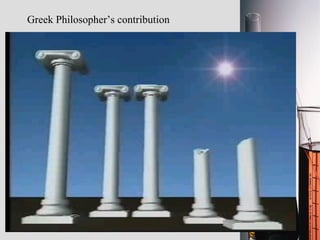
Greek Philosopher’s contribution
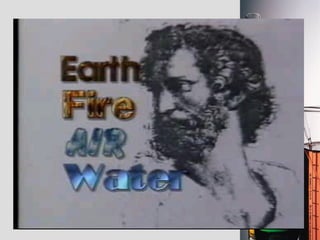
Greek Philosophers Aristotle 4 Elements of matter Democritus matter is made of atoms (cannot be further divided) Earth Fire Air Water
 
Modern Theory Alchemist believed that all matter was made of a limited number of elements. Elements are basic substances that cannot be broken down into simpler forms by ordinary means. 92 exist in nature -  20 synthetic -
 
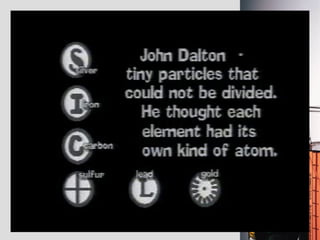
Atoms were tiny particles that could not be divided Each element had its own kind of atom John Dalton proposed that an atom is a sphere of matter that is the same throughout. Marble Model John Dalton
 
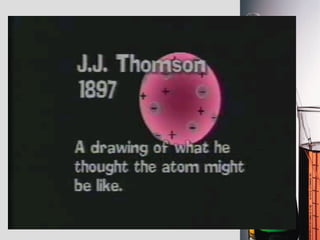
Came up with the idea of the electron – negatively charged particle J.J. Thomson discovered that all atoms contain electrons, which are tiny, negatively charged particles. Thomson proposed that an atom is a sphere of positive charge. The electrons are mixed uniformly in the sphere. Clay with embedded spheres JJ Thomson
 
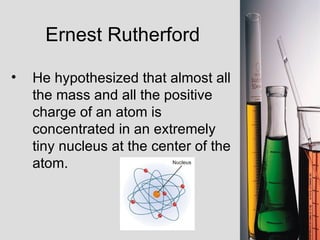
Ernest Rutherford He hypothesized that almost all the mass and all the positive charge of an atom is concentrated in an extremely tiny nucleus at the center of the atom.
 
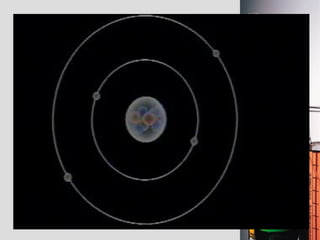
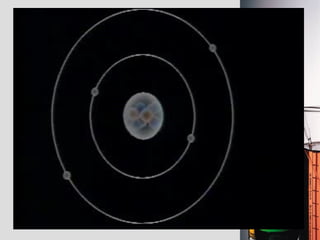
Thought electrons traveled in fixed paths around the nucleus called energy levels. Niels Bohr
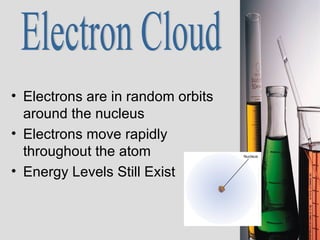
Electrons are in random orbits around the nucleus Electrons move rapidly throughout the atom Energy Levels Still Exist Electron Cloud
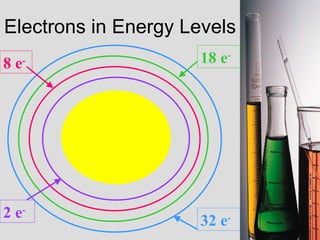
Electrons in Energy Levels 2 e - 8 e - 18 e - 32 e -
 
Atomic Structure Arrangement and number of sub-atomic particles Protons Neutrons Electrons
 
Center or core of an atom Contains 99.9% of the weight of an atom Contains protons and neutrons  Occupies 1 / 100,000 of the space of an atom Nucleus
Protons Positively Charged Sub-atomic particles Found in the nucleus All protons are a like Weight of 1 proton =  1 atomic mass unit
 
Neutrally charged (no charge) sub-atomic particle Atomic weight of 1 atomic mass unit Found in nucleus Neutron
The Number of Protons in the nucleus. What makes atoms different?
 
Atomic number is the number of Protons in an atom All atoms of a particular element have the SAME number of protons  (All Carbon atoms have 6 protons) In a neutral atom, the atomic number = the number of electrons Atomic Number
What is a neutral atom? Neutral atoms have no overall charge # of Protons = # of Electrons
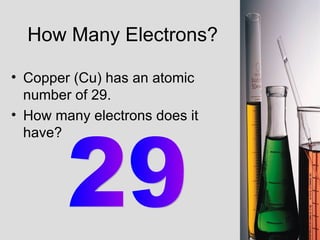
How Many Electrons? Copper (Cu) has an atomic number of 29. How many electrons does it have? 29
 
Also called atomic weight or  Mass Number Sum weight of protons and neutrons in an atom Atomic Mass
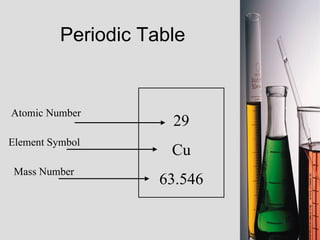
Periodic Table Atomic Number Element Symbol Mass Number 29 Cu 63.546
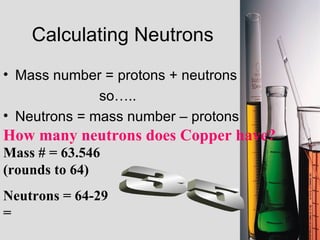
Calculating Neutrons Mass number = protons + neutrons so….. Neutrons = mass number – protons How many neutrons does Copper have? 35 Mass # = 63.546 (rounds to 64) Neutrons = 64-29 =
 
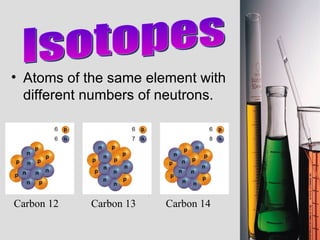
Atoms of the same element with different numbers of neutrons. Isotopes Carbon 12 Carbon 13 Carbon 14
 
Negatively charged sub-atomic particle Weight = 0.0006 atomic mass unit Move rapidly Form an electron cloud (area where electrons are likely to be) Electron
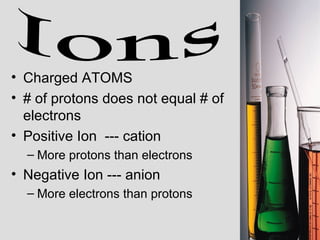
Charged ATOMS # of protons does not equal # of electrons Positive Ion  --- cation  More protons than electrons Negative Ion --- anion More electrons than protons Ions
Number of elements Oddly enough, the  exact  number of naturally-occurring elements is uncertain. Uranium (atomic number=92) is the element with the highest atomic number found  in significant quantities on earth or elsewhere . The elements astatine (atomic number=85) and francium (atomic number=87), along with all the other known elements (up to atomic number 109) were discovered when first made artificially; if they occur naturally, then they exist only in exceedingly small amounts.
Bibliography Discovering the Elements. United Learning (1996). Retrieved October 12, 2006, from unitedstreaming: http://www.unitedstreaming.com/  Physical Science Series: Atomic Structure and the Periodic Table. United Learning (1998). Retrieved October 12, 2006, from unitedstreaming: http://www.unitedstreaming.com/
Atomic Structure

  • 1.
    Atomic Theory AtomicStructure Chapter 2 Atoms
  • 2.
    Discovering the ElementsElements are the building blocks of all matter
  • 3.
  • 4.
    Atomic Theory “IfI have seen further, it is by standing on the shoulders of giants.” Isaac Newton What does this mean to you?
  • 5.
  • 6.
    Greek Philosophers Aristotle4 Elements of matter Democritus matter is made of atoms (cannot be further divided) Earth Fire Air Water
  • 7.
  • 8.
    Modern Theory Alchemistbelieved that all matter was made of a limited number of elements. Elements are basic substances that cannot be broken down into simpler forms by ordinary means. 92 exist in nature - 20 synthetic -
  • 9.
  • 10.
    Atoms were tinyparticles that could not be divided Each element had its own kind of atom John Dalton proposed that an atom is a sphere of matter that is the same throughout. Marble Model John Dalton
  • 11.
  • 12.
    Came up withthe idea of the electron – negatively charged particle J.J. Thomson discovered that all atoms contain electrons, which are tiny, negatively charged particles. Thomson proposed that an atom is a sphere of positive charge. The electrons are mixed uniformly in the sphere. Clay with embedded spheres JJ Thomson
  • 13.
  • 14.
    Ernest Rutherford Hehypothesized that almost all the mass and all the positive charge of an atom is concentrated in an extremely tiny nucleus at the center of the atom.
  • 15.
  • 16.
    Thought electrons traveledin fixed paths around the nucleus called energy levels. Niels Bohr
  • 17.
    Electrons are inrandom orbits around the nucleus Electrons move rapidly throughout the atom Energy Levels Still Exist Electron Cloud
  • 18.
    Electrons in EnergyLevels 2 e - 8 e - 18 e - 32 e -
  • 19.
  • 20.
    Atomic Structure Arrangementand number of sub-atomic particles Protons Neutrons Electrons
  • 21.
  • 22.
    Center or coreof an atom Contains 99.9% of the weight of an atom Contains protons and neutrons Occupies 1 / 100,000 of the space of an atom Nucleus
  • 23.
    Protons Positively ChargedSub-atomic particles Found in the nucleus All protons are a like Weight of 1 proton = 1 atomic mass unit
  • 24.
  • 25.
    Neutrally charged (nocharge) sub-atomic particle Atomic weight of 1 atomic mass unit Found in nucleus Neutron
  • 26.
    The Number ofProtons in the nucleus. What makes atoms different?
  • 27.
  • 28.
    Atomic number isthe number of Protons in an atom All atoms of a particular element have the SAME number of protons (All Carbon atoms have 6 protons) In a neutral atom, the atomic number = the number of electrons Atomic Number
  • 29.
    What is aneutral atom? Neutral atoms have no overall charge # of Protons = # of Electrons
  • 30.
    How Many Electrons?Copper (Cu) has an atomic number of 29. How many electrons does it have? 29
  • 31.
  • 32.
    Also called atomicweight or Mass Number Sum weight of protons and neutrons in an atom Atomic Mass
  • 33.
    Periodic Table AtomicNumber Element Symbol Mass Number 29 Cu 63.546
  • 34.
    Calculating Neutrons Massnumber = protons + neutrons so….. Neutrons = mass number – protons How many neutrons does Copper have? 35 Mass # = 63.546 (rounds to 64) Neutrons = 64-29 =
  • 35.
  • 36.
    Atoms of thesame element with different numbers of neutrons. Isotopes Carbon 12 Carbon 13 Carbon 14
  • 37.
  • 38.
    Negatively charged sub-atomicparticle Weight = 0.0006 atomic mass unit Move rapidly Form an electron cloud (area where electrons are likely to be) Electron
  • 39.
    Charged ATOMS #of protons does not equal # of electrons Positive Ion --- cation More protons than electrons Negative Ion --- anion More electrons than protons Ions
  • 40.
    Number of elementsOddly enough, the exact number of naturally-occurring elements is uncertain. Uranium (atomic number=92) is the element with the highest atomic number found in significant quantities on earth or elsewhere . The elements astatine (atomic number=85) and francium (atomic number=87), along with all the other known elements (up to atomic number 109) were discovered when first made artificially; if they occur naturally, then they exist only in exceedingly small amounts.
  • 41.
    Bibliography Discovering theElements. United Learning (1996). Retrieved October 12, 2006, from unitedstreaming: http://www.unitedstreaming.com/ Physical Science Series: Atomic Structure and the Periodic Table. United Learning (1998). Retrieved October 12, 2006, from unitedstreaming: http://www.unitedstreaming.com/