Atomic StructureUnit 7 – Physical Science
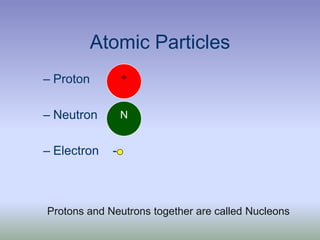
Atomic ParticlesProtonNeutronElectron    -+NProtons and Neutrons together are called Nucleons
Atomic Number is the number of ProtonsAtomic Mass is Protons and Neutrons together
ProtonPositively charged particleResides in the nucleusWeighs 1 Atomic Mass Unit (AMU)Repel other protonsThe number of protons determines the element number.+
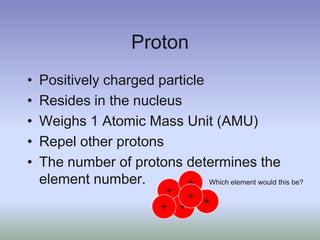
ProtonPositively charged particleResides in the nucleusWeighs 1 Atomic Mass Unit (AMU)Repel other protonsThe number of protons determines the element number.+Which element would this be?+++++
ProtonPositively charged particleResides in the nucleusWeighs 1 Atomic Mass Unit (AMU)Repel other protonsThe number of protons determines the element number.+Which element would this be?Carbon+++++
Too Many ProtonsProtons repel each other due to the electromagnetic forceIf an element has too many protons, it will be unstable and will break apart.++
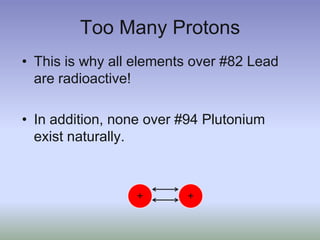
Too Many ProtonsThis is why all elements over #82 Lead are radioactive!In addition, none over #94 Plutonium exist naturally.++
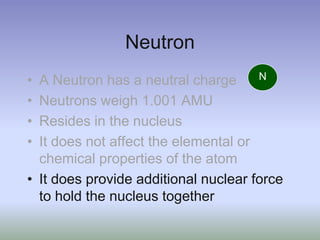
NeutronNA Neutron has a neutral chargeNeutrons weigh 1.001 AMUResides in the nucleusIt does not affect the elemental or chemical properties of the atom
NeutronA Neutron has a neutral chargeNeutrons weigh 1.001 AMUResides in the nucleusIt does not affect the elemental or chemical properties of the atomIt does provide additional nuclear force to hold the nucleus togetherN
IsotopesIsotopes result from different numbers of neutrons in an elementIsotopes are chemically the sameThey only differ in their mass and their nuclear stabilityN+NN+NN++N++++NNNNN+N+++NNCarbon-12 C12Carbon-14 C14
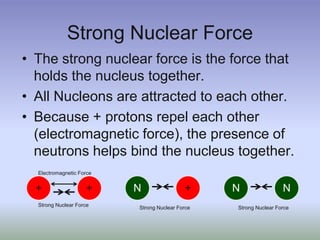
Strong Nuclear ForceThe strong nuclear force is the force that holds the nucleus together.All Nucleons are attracted to each other.Because + protons repel each other (electromagnetic force), the presence of neutrons helps bind the nucleus together.Electromagnetic Force+NNN++Strong Nuclear ForceStrong Nuclear ForceStrong Nuclear Force
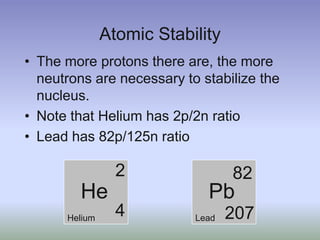
Atomic StabilityThe more protons there are, the more neutrons are necessary to stabilize the nucleus.Note that Helium has 2p/2n ratioLead has 82p/125n ratio282PbHe4207HeliumLead
Atomic MassAtomic mass is the average of all isotopes on Earth together.To figure out the number of neutrons, just go AtomicMass-Atomic # = NeutronsHe 4-2=2 neutrons	Pb 207-82 = 125 neutrons282PbHe4207HeliumLead
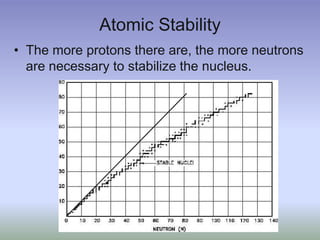
Atomic StabilityThe more protons there are, the more neutrons are necessary to stabilize the nucleus.
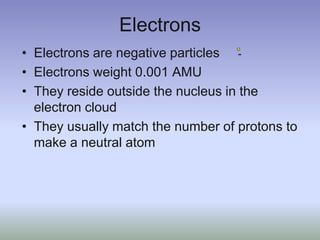
ElectronsElectrons are negative particlesElectrons weight 0.001 AMUThey reside outside the nucleus in the electron cloudThey usually match the number of protons to make a neutral atom-
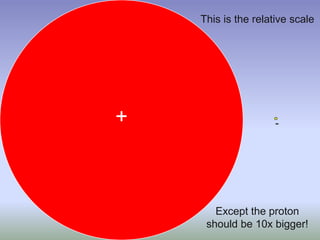
This is the relative scale+-Except the proton should be 10x bigger!
This is HydrogenHydrogen+-1H1
What is a Neutron Anyways?OK, so you’ve heard that Neutrons are neutral and weigh 1.001 AMUDo you notice any pattern here?
What is a Neutron Anyways?Think of a Neutron as a Proton and Electron stuck together.
What is a Neutron Anyways?Think of a Neutron as a Proton and Electron stuck together.N
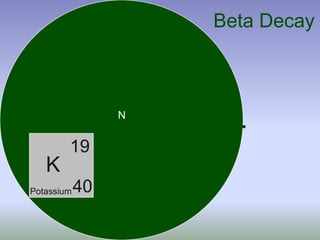
Beta Decay?When an isotope has too many neutrons, a neutron will emit a β-particle    (which is basically an electron)This causes the neutron to change from neutral to positive (i.e. a proton).This actually changes the element it is!
Beta DecayN19K40Potassium
Beta DecayPotassuim-40 with 19 protons becomes Calcium-40 with 20 protons!+β-1920KCa4040PotassiumCalcium
What about Electrons?Electrons reside outside the nucleus in the electron cloud
Models of ElectronsRutherford Model
Models of ElectronsBohr ModelEnergy Levels
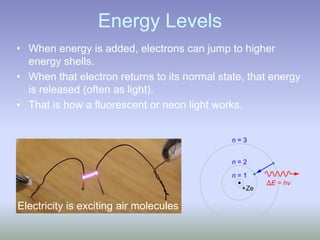
Energy LevelsWhen energy is added, electrons can jump to higher energy shells.When that electron returns to its normal state, that energy is released (often as light). That is how a fluorescent or neon light works.Electricity is exciting air molecules
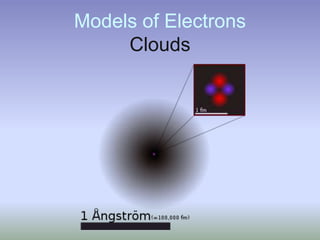
Models of ElectronsClouds
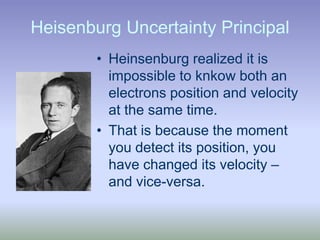
Heisenburg Uncertainty PrincipalHeinsenburg realized it is impossible to knkow both an electrons position and velocity at the same time.That is because the moment you detect its position, you have changed its velocity – and vice-versa.
Why the uncertainty?
Why the uncertainty?You know where it was, but nowyou have changed its direction and speed.
Quantum MechanicsProbability densitiesThe electrons do not appear to move in patterns, but simply seem to flash on and off in different locations.It is described as being almost like a instantaneous transporter
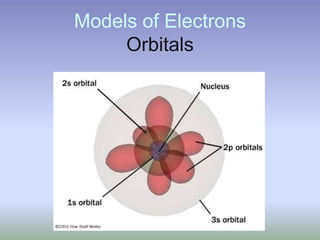
Models of ElectronsOrbitals

Unit 8 Periodic Table of Elements

  • 1.
    Atomic StructureUnit 7– Physical Science
  • 2.
    Atomic ParticlesProtonNeutronElectron -+NProtons and Neutrons together are called Nucleons
  • 3.
    Atomic Number isthe number of ProtonsAtomic Mass is Protons and Neutrons together
  • 4.
    ProtonPositively charged particleResidesin the nucleusWeighs 1 Atomic Mass Unit (AMU)Repel other protonsThe number of protons determines the element number.+
  • 5.
    ProtonPositively charged particleResidesin the nucleusWeighs 1 Atomic Mass Unit (AMU)Repel other protonsThe number of protons determines the element number.+Which element would this be?+++++
  • 6.
    ProtonPositively charged particleResidesin the nucleusWeighs 1 Atomic Mass Unit (AMU)Repel other protonsThe number of protons determines the element number.+Which element would this be?Carbon+++++
  • 7.
    Too Many ProtonsProtonsrepel each other due to the electromagnetic forceIf an element has too many protons, it will be unstable and will break apart.++
  • 8.
    Too Many ProtonsThisis why all elements over #82 Lead are radioactive!In addition, none over #94 Plutonium exist naturally.++
  • 9.
    NeutronNA Neutron hasa neutral chargeNeutrons weigh 1.001 AMUResides in the nucleusIt does not affect the elemental or chemical properties of the atom
  • 10.
    NeutronA Neutron hasa neutral chargeNeutrons weigh 1.001 AMUResides in the nucleusIt does not affect the elemental or chemical properties of the atomIt does provide additional nuclear force to hold the nucleus togetherN
  • 11.
    IsotopesIsotopes result fromdifferent numbers of neutrons in an elementIsotopes are chemically the sameThey only differ in their mass and their nuclear stabilityN+NN+NN++N++++NNNNN+N+++NNCarbon-12 C12Carbon-14 C14
  • 12.
    Strong Nuclear ForceThestrong nuclear force is the force that holds the nucleus together.All Nucleons are attracted to each other.Because + protons repel each other (electromagnetic force), the presence of neutrons helps bind the nucleus together.Electromagnetic Force+NNN++Strong Nuclear ForceStrong Nuclear ForceStrong Nuclear Force
  • 13.
    Atomic StabilityThe moreprotons there are, the more neutrons are necessary to stabilize the nucleus.Note that Helium has 2p/2n ratioLead has 82p/125n ratio282PbHe4207HeliumLead
  • 14.
    Atomic MassAtomic massis the average of all isotopes on Earth together.To figure out the number of neutrons, just go AtomicMass-Atomic # = NeutronsHe 4-2=2 neutrons Pb 207-82 = 125 neutrons282PbHe4207HeliumLead
  • 15.
    Atomic StabilityThe moreprotons there are, the more neutrons are necessary to stabilize the nucleus.
  • 16.
    ElectronsElectrons are negativeparticlesElectrons weight 0.001 AMUThey reside outside the nucleus in the electron cloudThey usually match the number of protons to make a neutral atom-
  • 17.
    This is therelative scale+-Except the proton should be 10x bigger!
  • 18.
  • 19.
    What is aNeutron Anyways?OK, so you’ve heard that Neutrons are neutral and weigh 1.001 AMUDo you notice any pattern here?
  • 20.
    What is aNeutron Anyways?Think of a Neutron as a Proton and Electron stuck together.
  • 21.
    What is aNeutron Anyways?Think of a Neutron as a Proton and Electron stuck together.N
  • 22.
    Beta Decay?When anisotope has too many neutrons, a neutron will emit a β-particle (which is basically an electron)This causes the neutron to change from neutral to positive (i.e. a proton).This actually changes the element it is!
  • 23.
  • 24.
    Beta DecayPotassuim-40 with19 protons becomes Calcium-40 with 20 protons!+β-1920KCa4040PotassiumCalcium
  • 25.
    What about Electrons?Electronsreside outside the nucleus in the electron cloud
  • 26.
  • 27.
    Models of ElectronsBohrModelEnergy Levels
  • 28.
    Energy LevelsWhen energyis added, electrons can jump to higher energy shells.When that electron returns to its normal state, that energy is released (often as light). That is how a fluorescent or neon light works.Electricity is exciting air molecules
  • 29.
  • 30.
    Heisenburg Uncertainty PrincipalHeinsenburgrealized it is impossible to knkow both an electrons position and velocity at the same time.That is because the moment you detect its position, you have changed its velocity – and vice-versa.
  • 31.
  • 32.
    Why the uncertainty?Youknow where it was, but nowyou have changed its direction and speed.
  • 33.
    Quantum MechanicsProbability densitiesTheelectrons do not appear to move in patterns, but simply seem to flash on and off in different locations.It is described as being almost like a instantaneous transporter
  • 34.