Ch. 3 - Atomic Structure
II. Masses of Atoms
♦ Mass Number
♦ Isotopes
♦ Relative Atomic Mass
♦ Average Atomic Mass
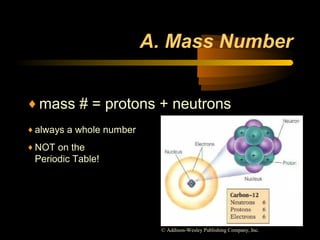
A. Mass Number
♦mass # = protons + neutrons
♦always a whole number
♦NOT on the
Periodic Table!
© Addison-Wesley Publishing Company, Inc.
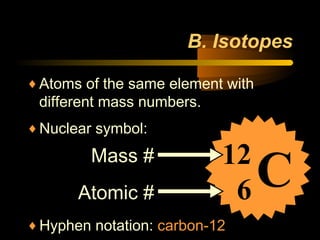
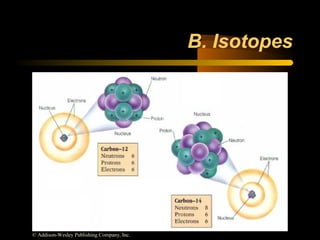
B. Isotopes
♦Atoms of the same element with
different mass numbers.
C12
6
Mass #
Atomic #
♦Nuclear symbol:
♦Hyphen notation: carbon-12
B. Isotopes
© Addison-Wesley Publishing Company, Inc.
B. Isotopes
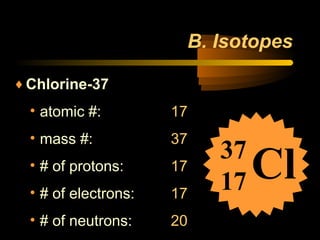
♦Chlorine-37
• atomic #:
• mass #:
• # of protons:
• # of electrons:
• # of neutrons:
17
37
17
17
20
Cl37
17
IONS
♦Sometimes an atom can lose or gain
electrons. If this happens it becomes
charged.
♦If it loses (an) electron(s), it becomes
positive.
♦If it gains (an) electron(s), it becomes
negative.
IONS
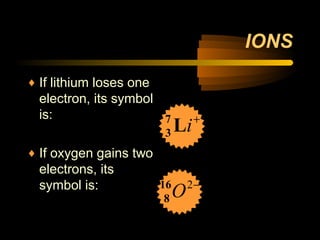
♦ If lithium loses one
electron, its symbol
is:
♦ If oxygen gains two
electrons, its
symbol is:
+
iL7
3
−2
O16
8
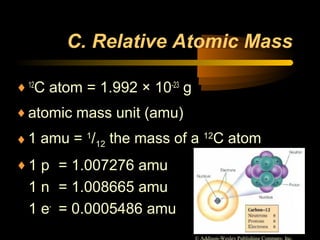
C. Relative Atomic Mass
♦12
C atom = 1.992 × 10⁻²³
g
♦1 p = 1.007276 amu
1 n = 1.008665 amu
1 e-
= 0.0005486 amu
♦atomic mass unit (amu)
♦1 amu = 1
/12 the mass of a 12
C atom
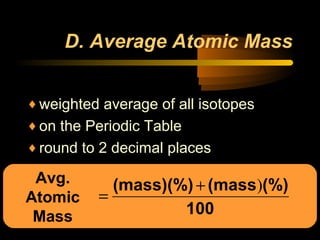
D. Average Atomic Mass
♦weighted average of all isotopes
♦on the Periodic Table
♦round to 2 decimal places
100
(%)(mass(mass)(%) )+
=
Avg.
Atomic
Mass
Avg.
Atomic
Mass
D. Average Atomic Mass
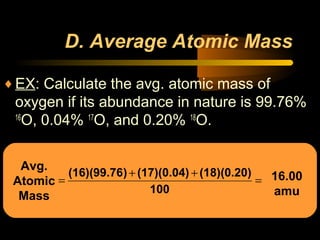
♦EX: Calculate the avg. atomic mass of
oxygen if its abundance in nature is 99.76%
16
O, 0.04% 17
O, and 0.20% 18
O.
=
++
=
100
(18)(0.20)(17)(0.04))(16)(99.76 16.00
amu
Avg.
Atomic
Mass
D. Average Atomic Mass
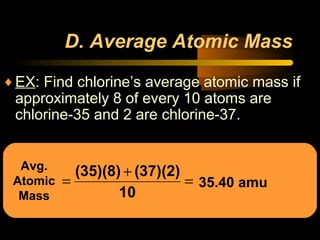
♦EX: Find chlorine’s average atomic mass if
approximately 8 of every 10 atoms are
chlorine-35 and 2 are chlorine-37.
=
+
=
10
(37)(2)(35)(8)
35.40 amu

Atomic Mass Presentation

  • 1.
    Ch. 3 -Atomic Structure II. Masses of Atoms ♦ Mass Number ♦ Isotopes ♦ Relative Atomic Mass ♦ Average Atomic Mass
  • 2.
    A. Mass Number ♦mass# = protons + neutrons ♦always a whole number ♦NOT on the Periodic Table! © Addison-Wesley Publishing Company, Inc.
  • 3.
    B. Isotopes ♦Atoms ofthe same element with different mass numbers. C12 6 Mass # Atomic # ♦Nuclear symbol: ♦Hyphen notation: carbon-12
  • 4.
    B. Isotopes © Addison-WesleyPublishing Company, Inc.
  • 5.
    B. Isotopes ♦Chlorine-37 • atomic#: • mass #: • # of protons: • # of electrons: • # of neutrons: 17 37 17 17 20 Cl37 17
  • 6.
    IONS ♦Sometimes an atomcan lose or gain electrons. If this happens it becomes charged. ♦If it loses (an) electron(s), it becomes positive. ♦If it gains (an) electron(s), it becomes negative.
  • 7.
    IONS ♦ If lithiumloses one electron, its symbol is: ♦ If oxygen gains two electrons, its symbol is: + iL7 3 −2 O16 8
  • 8.
    C. Relative AtomicMass ♦12 C atom = 1.992 × 10⁻²³ g ♦1 p = 1.007276 amu 1 n = 1.008665 amu 1 e- = 0.0005486 amu ♦atomic mass unit (amu) ♦1 amu = 1 /12 the mass of a 12 C atom
  • 9.
    D. Average AtomicMass ♦weighted average of all isotopes ♦on the Periodic Table ♦round to 2 decimal places 100 (%)(mass(mass)(%) )+ = Avg. Atomic Mass
  • 10.
    Avg. Atomic Mass D. Average AtomicMass ♦EX: Calculate the avg. atomic mass of oxygen if its abundance in nature is 99.76% 16 O, 0.04% 17 O, and 0.20% 18 O. = ++ = 100 (18)(0.20)(17)(0.04))(16)(99.76 16.00 amu
  • 11.
    Avg. Atomic Mass D. Average AtomicMass ♦EX: Find chlorine’s average atomic mass if approximately 8 of every 10 atoms are chlorine-35 and 2 are chlorine-37. = + = 10 (37)(2)(35)(8) 35.40 amu