STRUCTURE OF ATOM
     CHAPTER 5
Introduction
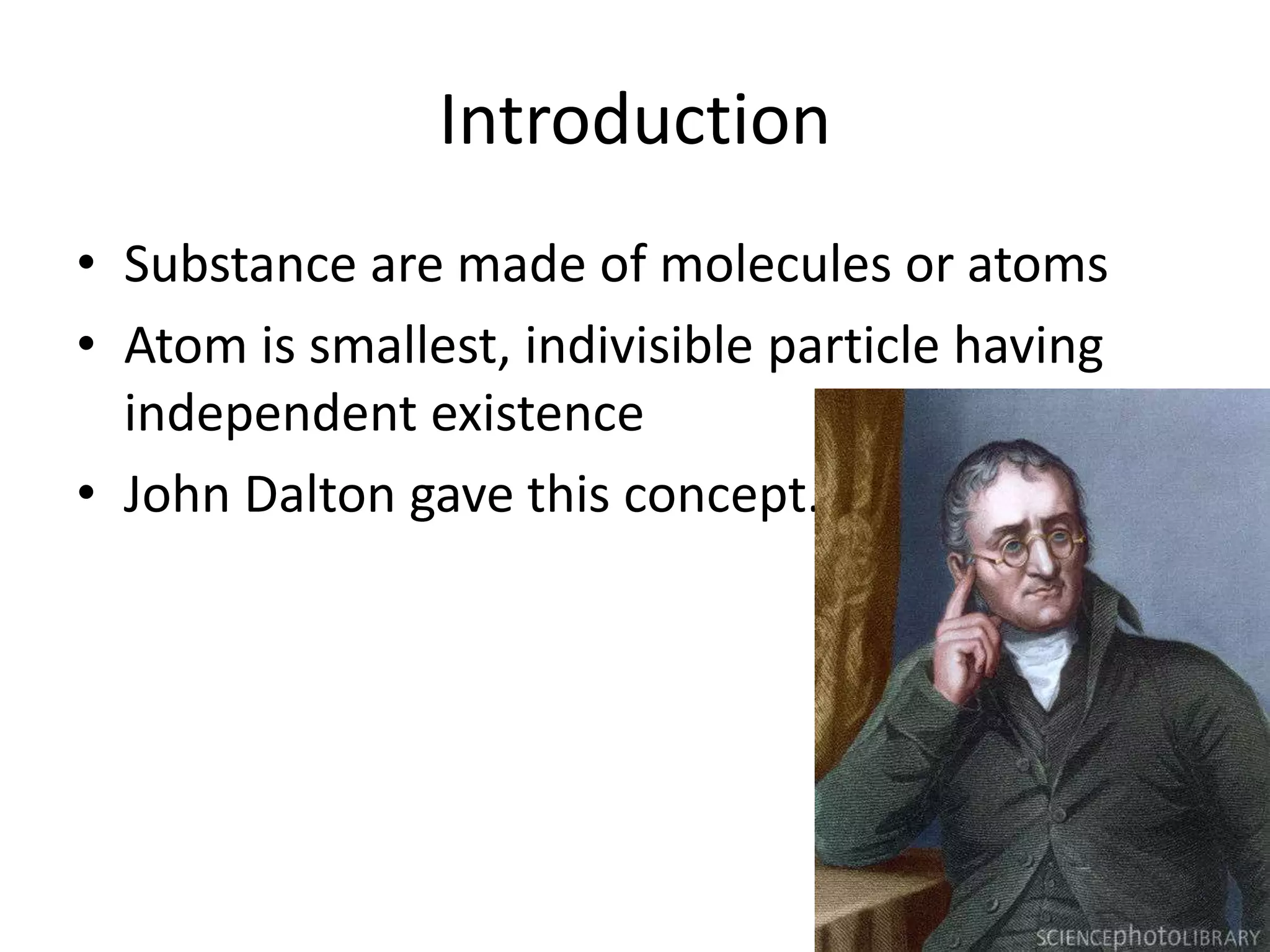
• Substance are made of molecules or atoms
• Atom is smallest, indivisible particle having
  independent existence
• John Dalton gave this concept.
What we will see this chapter?
• How concept of atom changed over time?
• How the different components of atom were
  found?
• Various experiments that evolved Atomic
  theory
• Isotopes
• Radioactivity
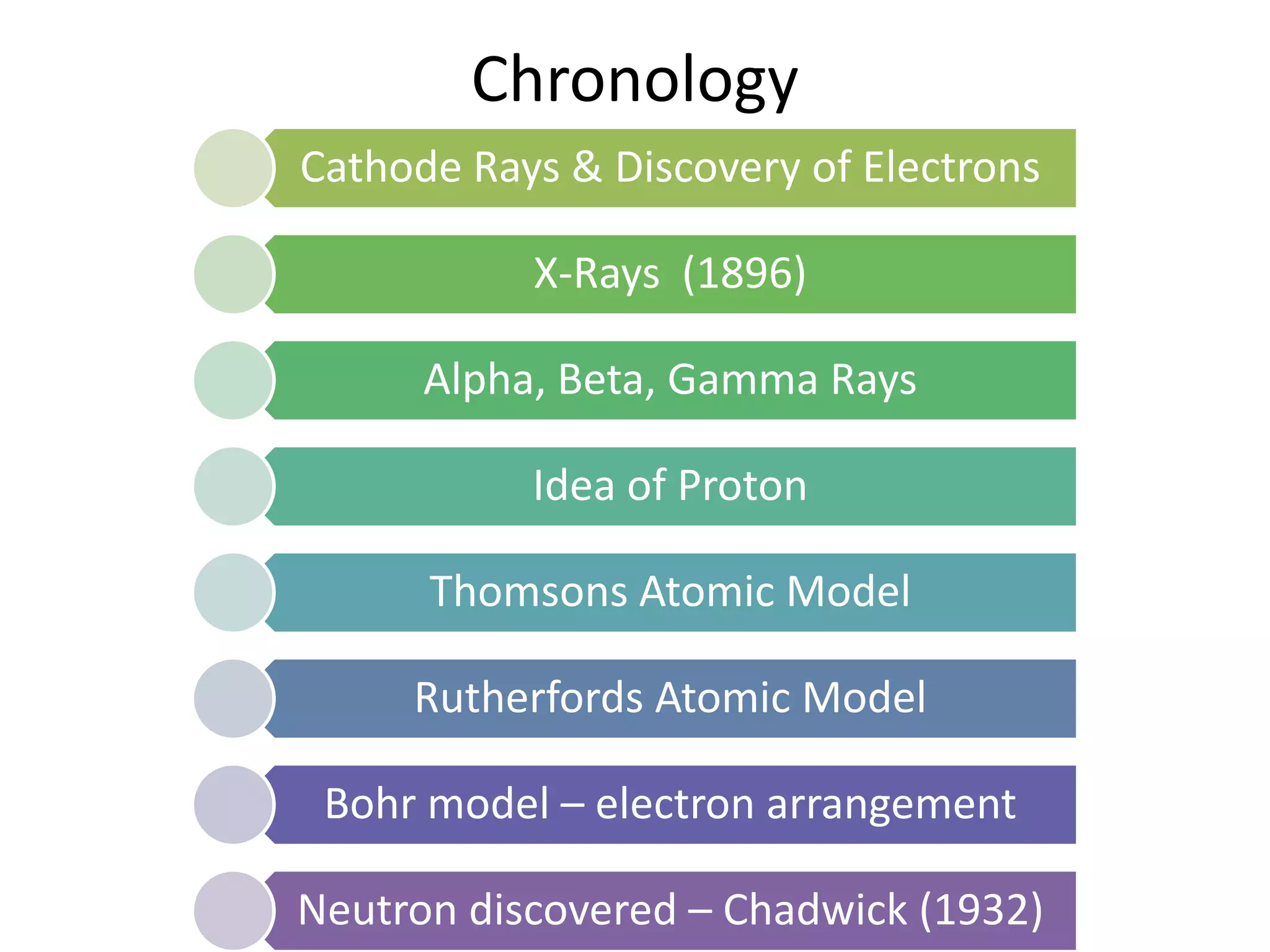
Chronology
Cathode Rays & Discovery of Electrons

           X-Rays (1896)

      Alpha, Beta, Gamma Rays

           Idea of Proton

      Thomsons Atomic Model

     Rutherfords Atomic Model

 Bohr model – electron arrangement

Neutron discovered – Chadwick (1932)
DISCOVERY OF ELECTRONS
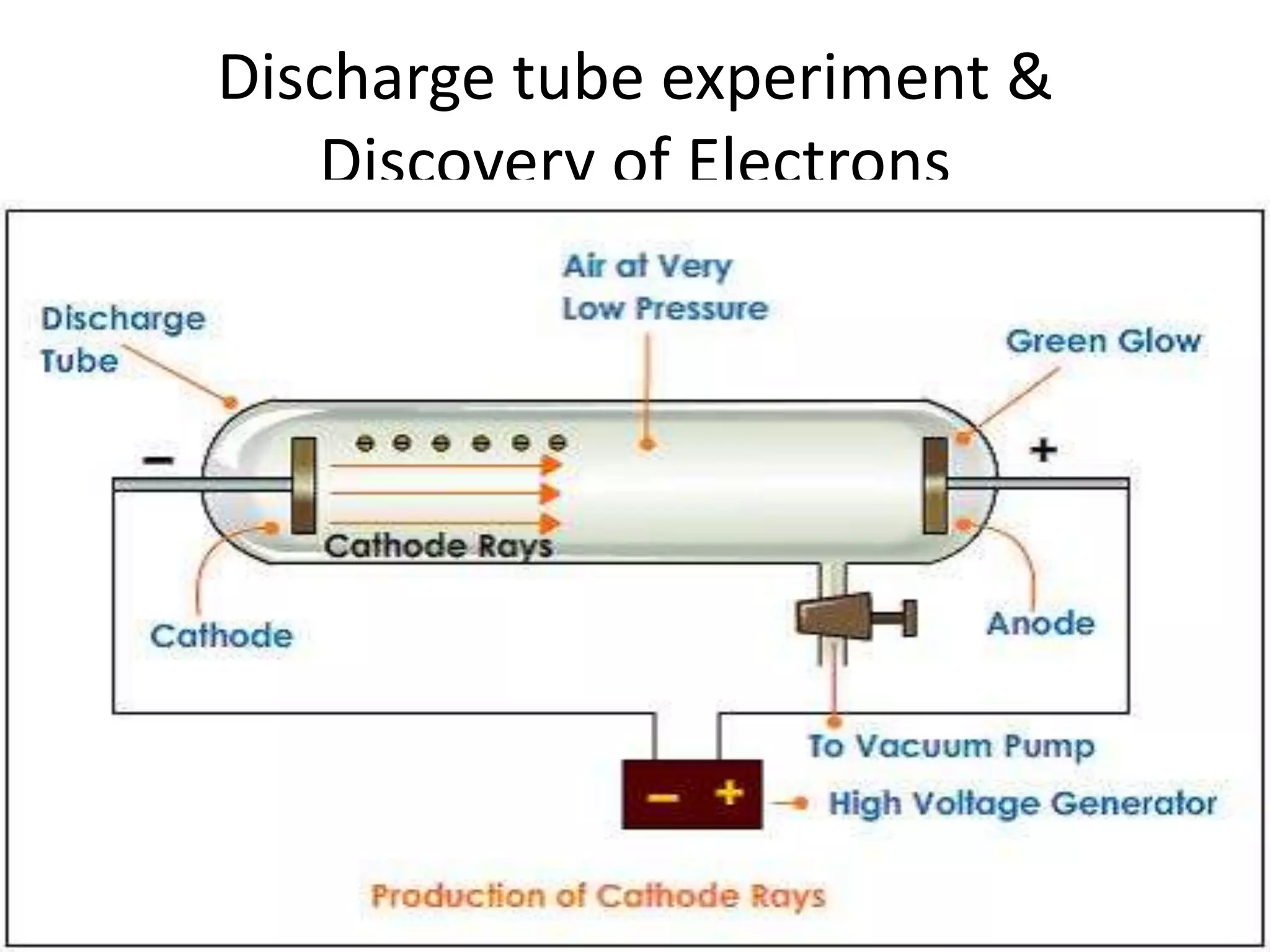
Discharge tube experiment &
    Discovery of Electrons
• The line diagram of electric discharge tube is
  given
• Vacuum is created in this tube
• Two metal plates in tube are Cathode (-ve)
  and Anode (+ve) terminals
• On joining with battery, Cathode rays are
  produced from cathode
• They have negative charge
• They move towards the Anode
• These are actually the flow of Electrons
• J J Thomson and Crookes proved that Cathode
  rays were in fact flow of Electrons
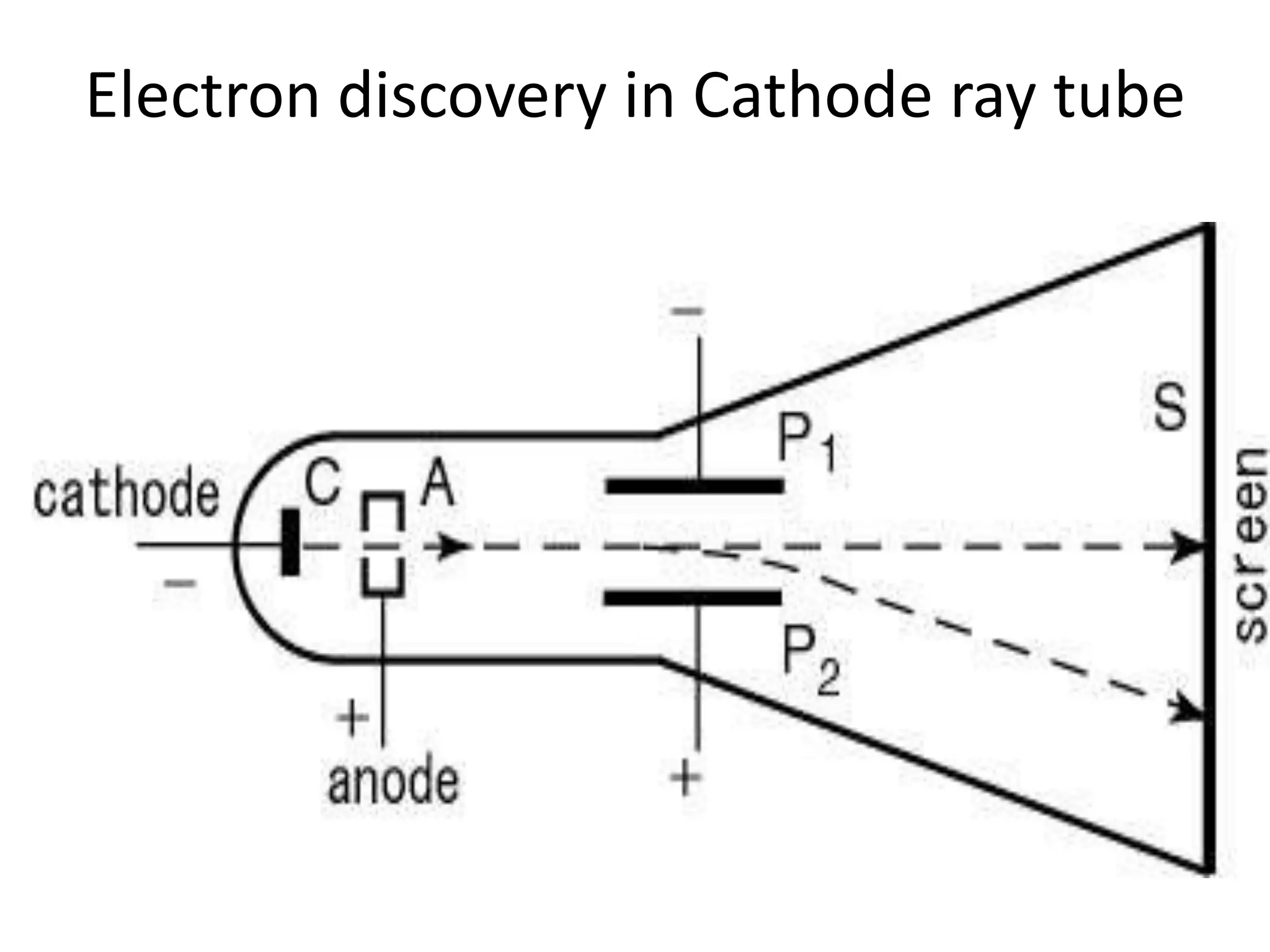
Electron discovery in Cathode ray tube
X – RAY AND RADIOACTIVITY
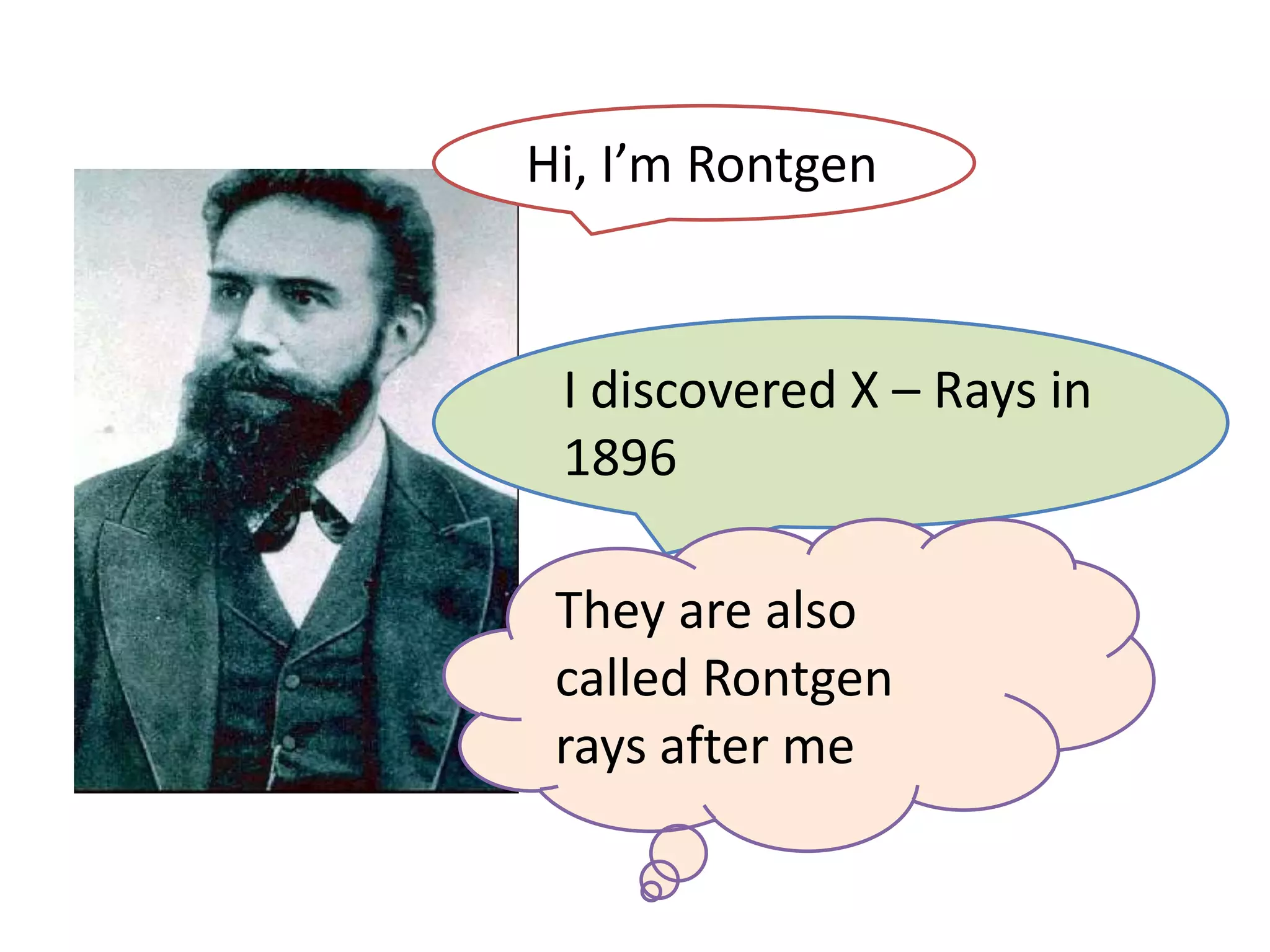
Hi, I’m Rontgen


 I discovered X – Rays in
 1896

 They are also
 called Rontgen
 rays after me
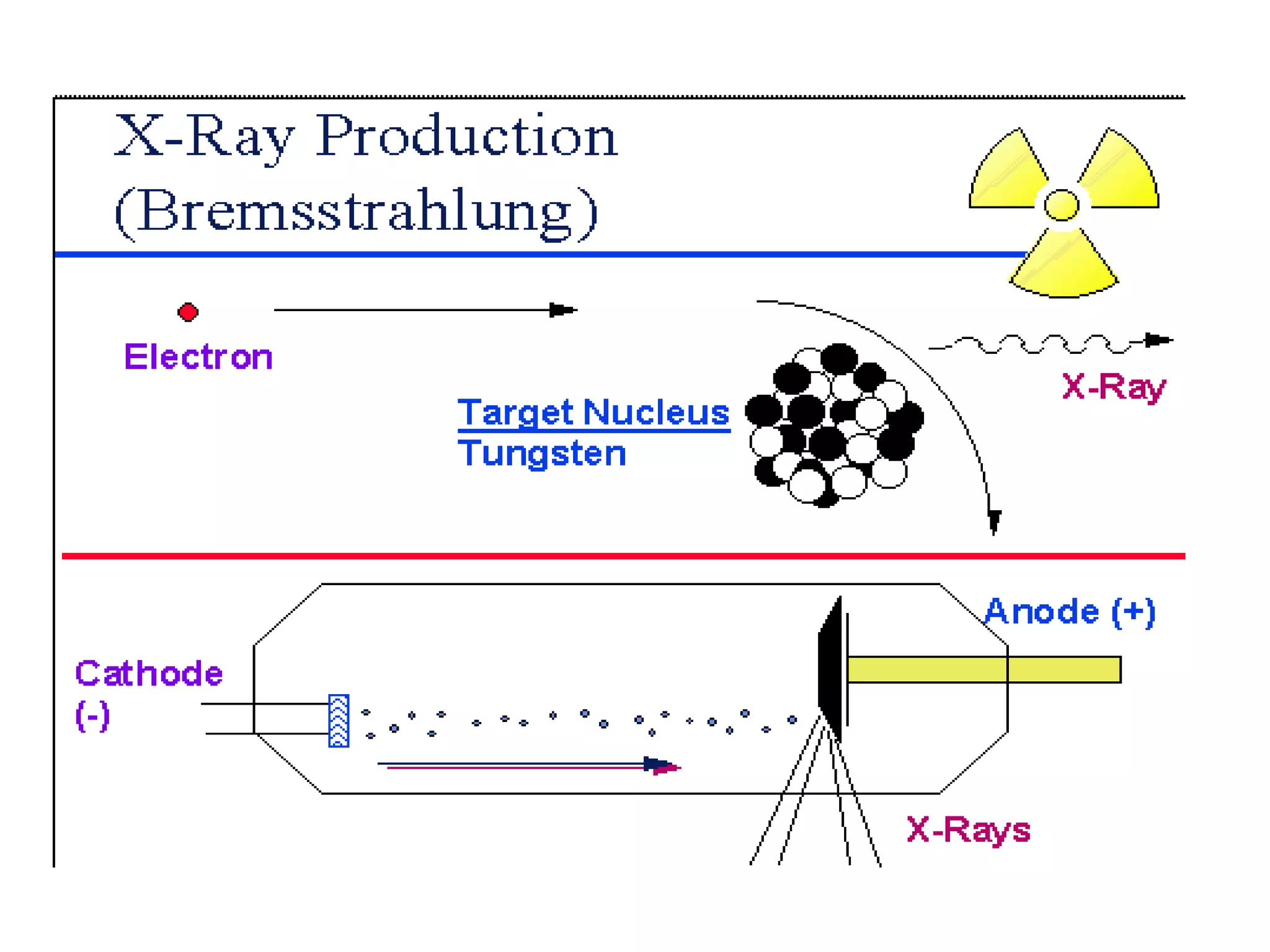
• In cathode ray tube, cathode rays were
  travelling in straight line
• They were made to strike the walls of tube
• New type of rays formed
• They travelled in straight line and were not
  deviated in strong Electromagnetic field
• Could pass through opaque substances like
  black paper
• They affected photographic plates
• He named them X -rays
• Cathode rays is beam of electrons
• X – rays are electromagnetic waves having
  very short wavelength

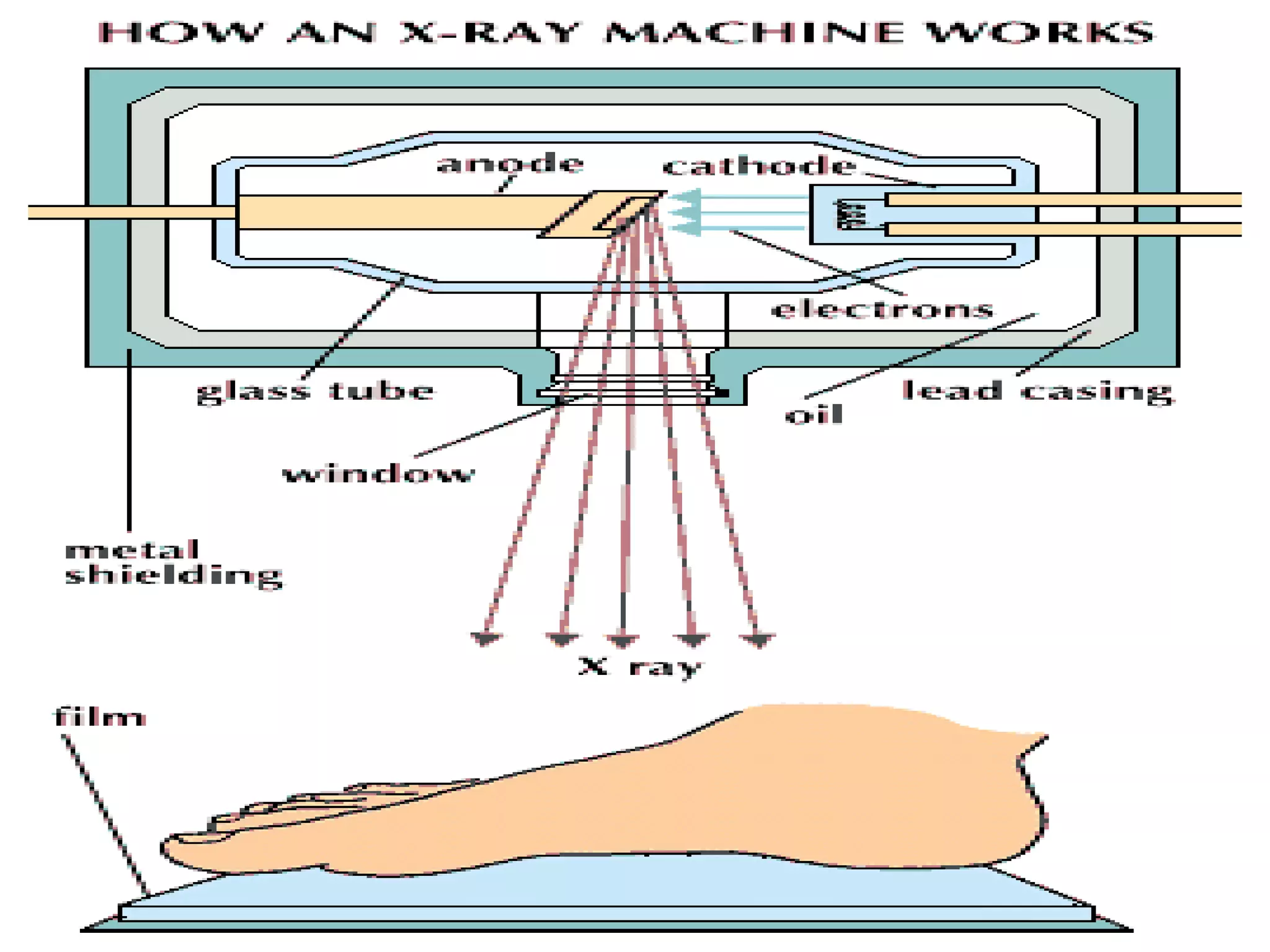
• If electrons having very high velocity are
  stopped by putting some type of resistance
  (anti- cathode) the X –rays are produced
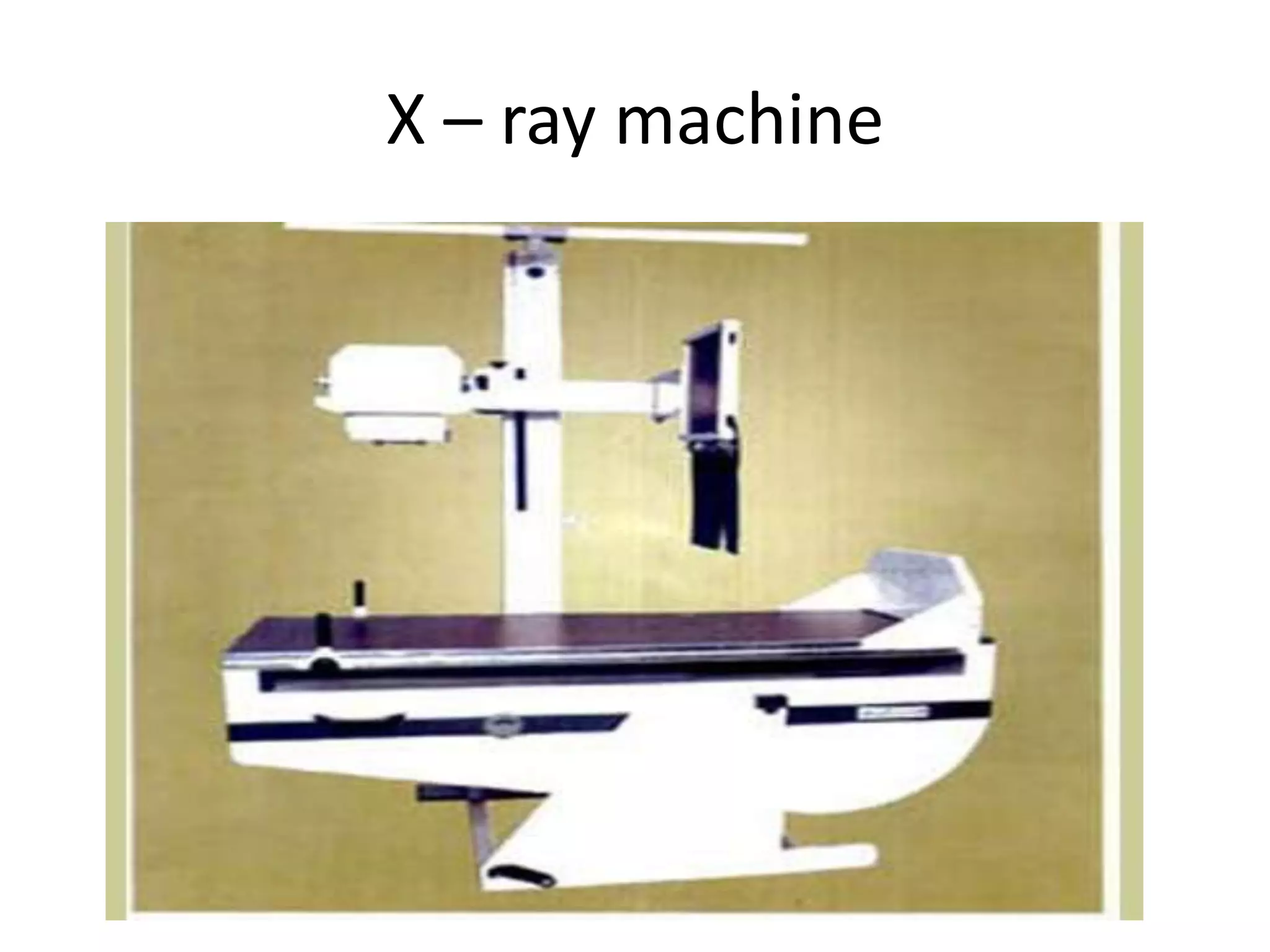
X – ray machine
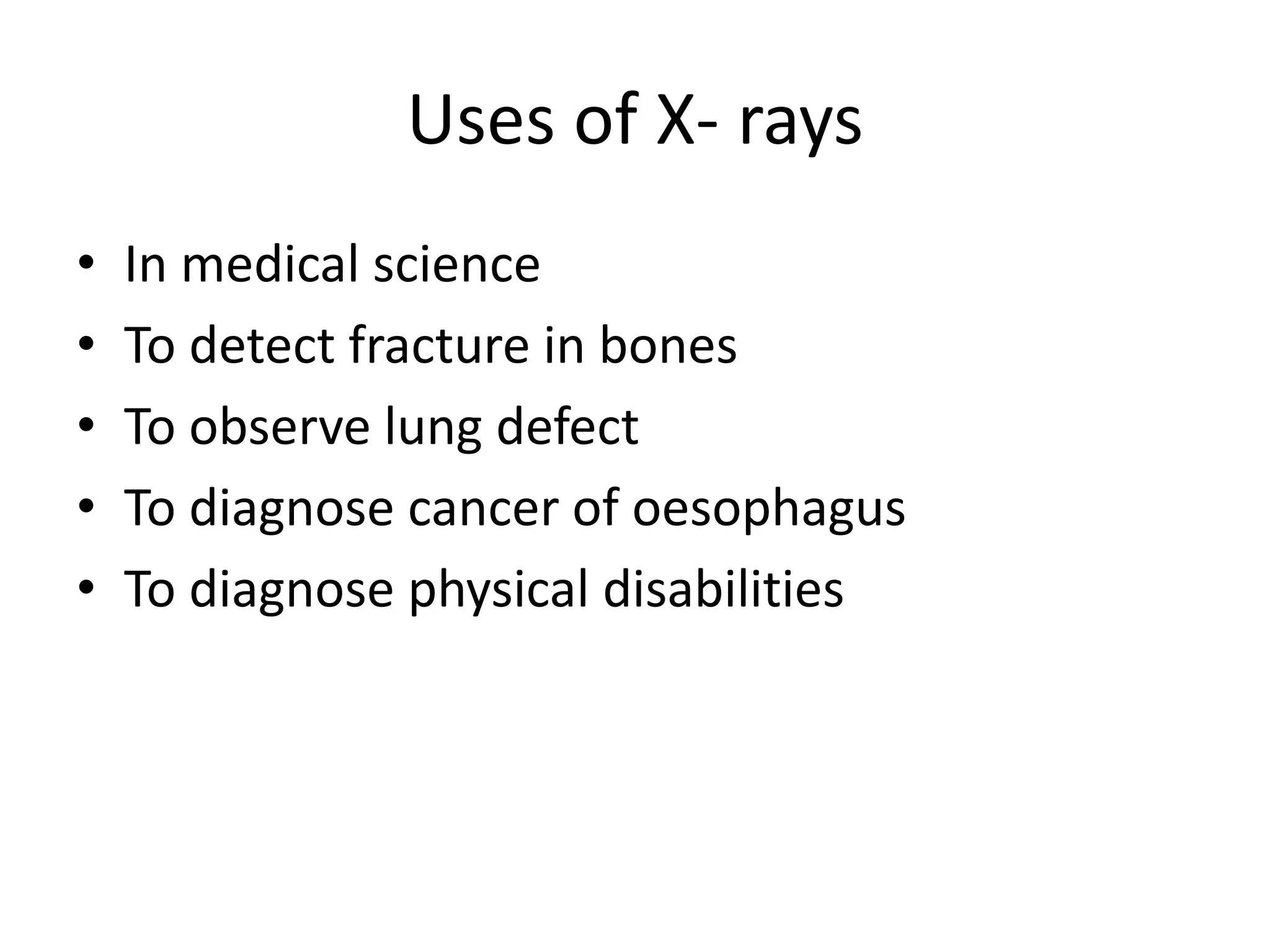
Uses of X- rays
•   In medical science
•   To detect fracture in bones
•   To observe lung defect
•   To diagnose cancer of oesophagus
•   To diagnose physical disabilities
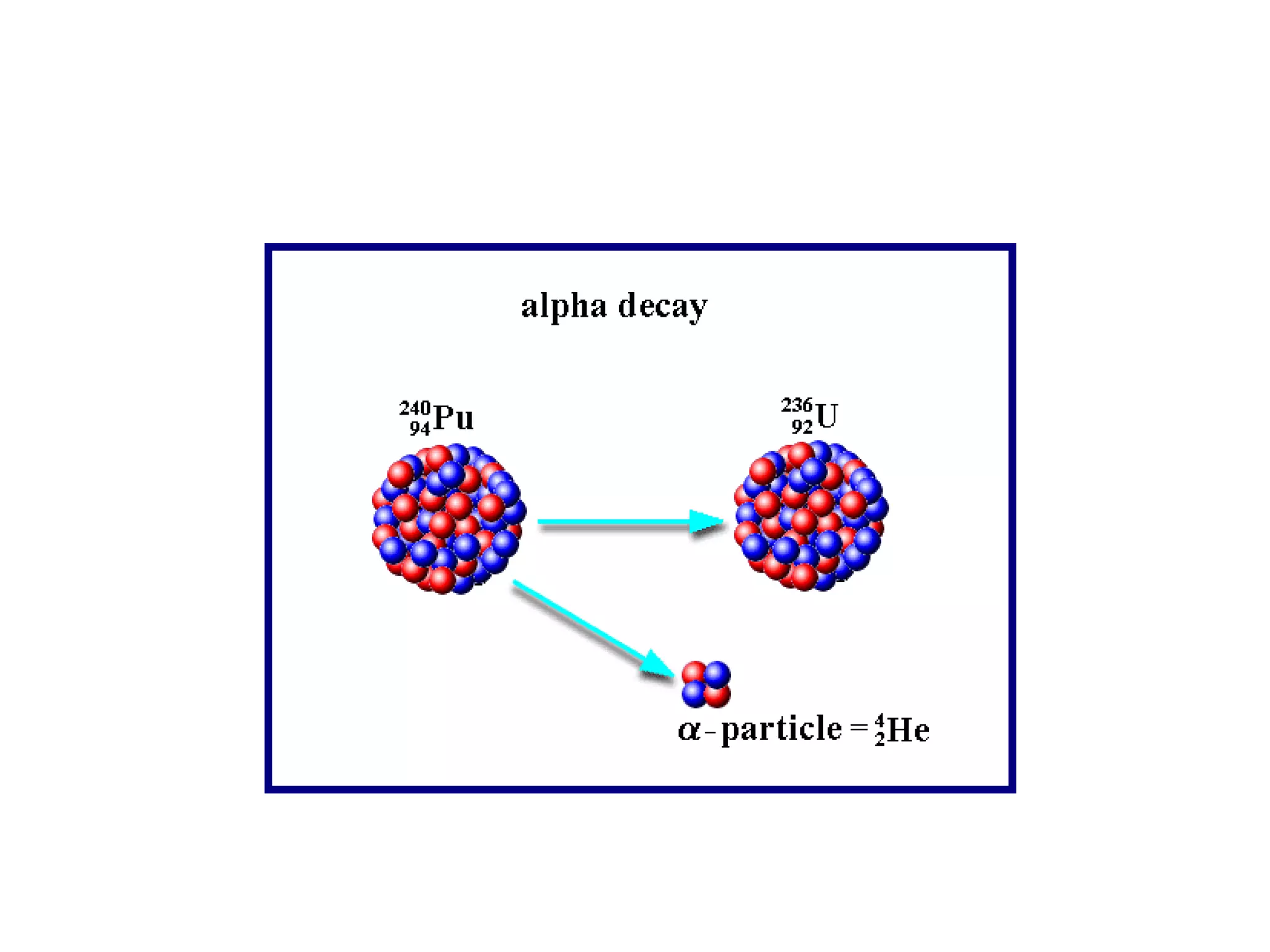
ALPHA, BETA & GAMMA RAYS
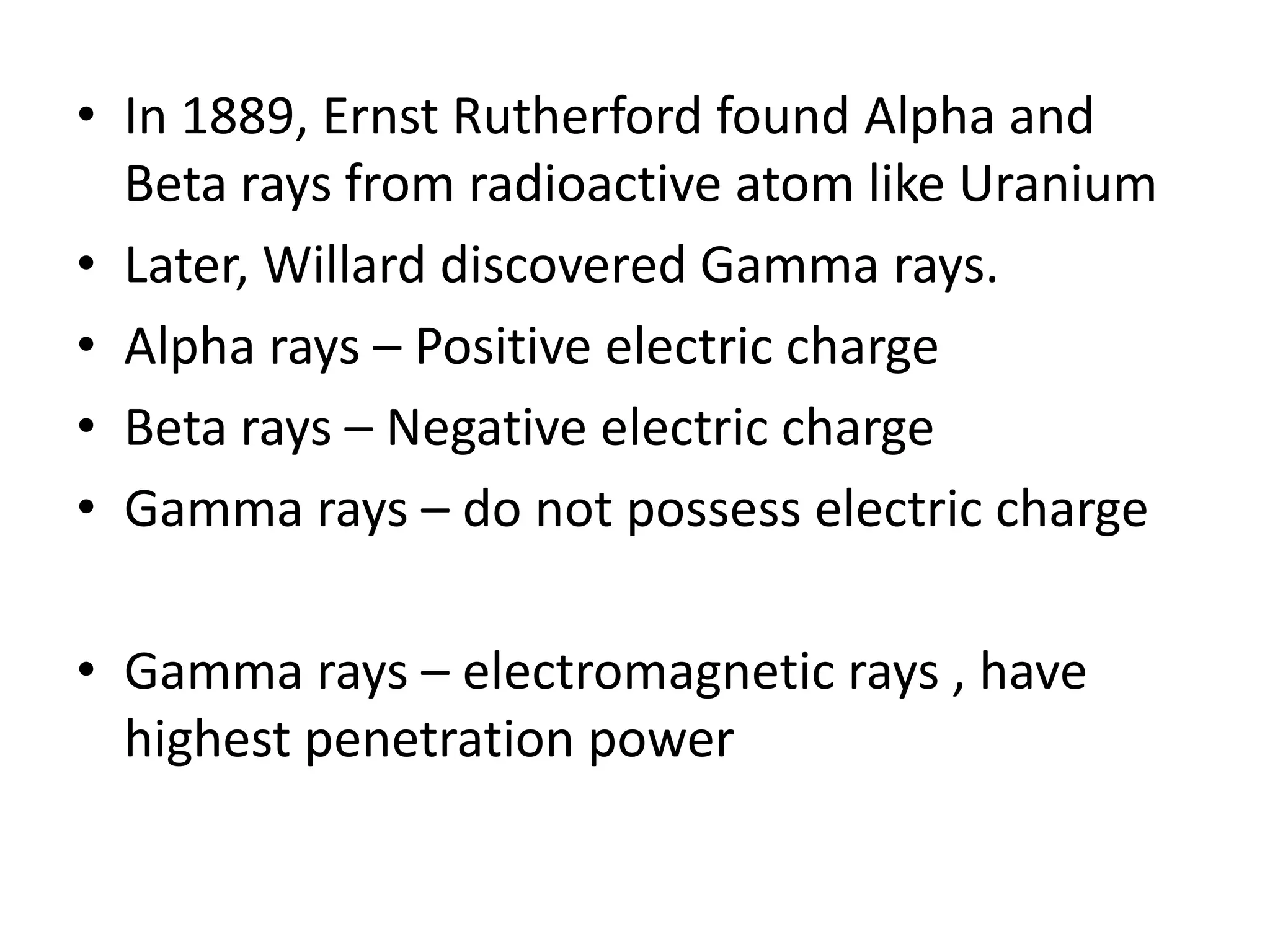
• In 1889, Ernst Rutherford found Alpha and
  Beta rays from radioactive atom like Uranium
• Later, Willard discovered Gamma rays.
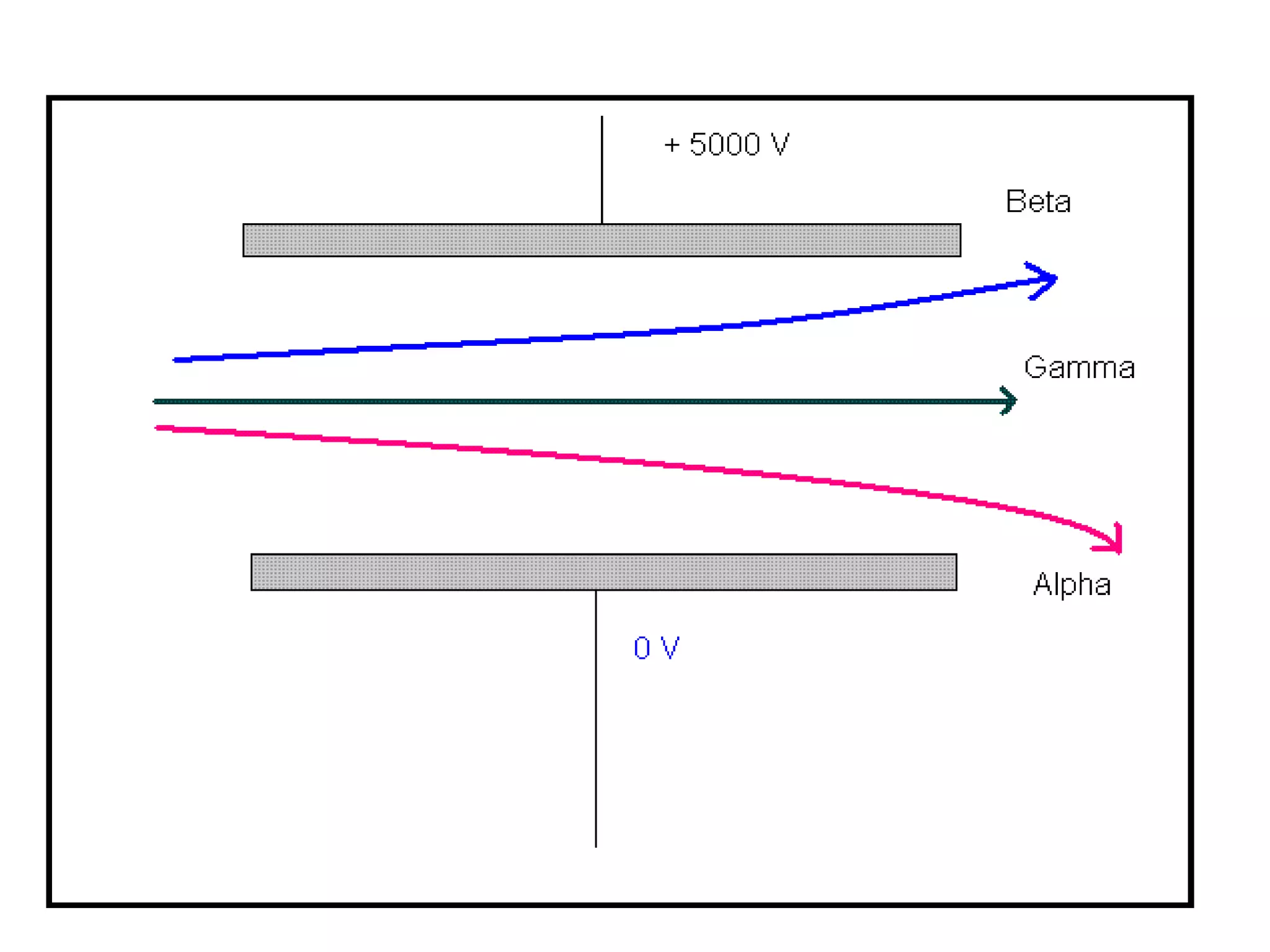
• Alpha rays – Positive electric charge
• Beta rays – Negative electric charge
• Gamma rays – do not possess electric charge

• Gamma rays – electromagnetic rays , have
  highest penetration power
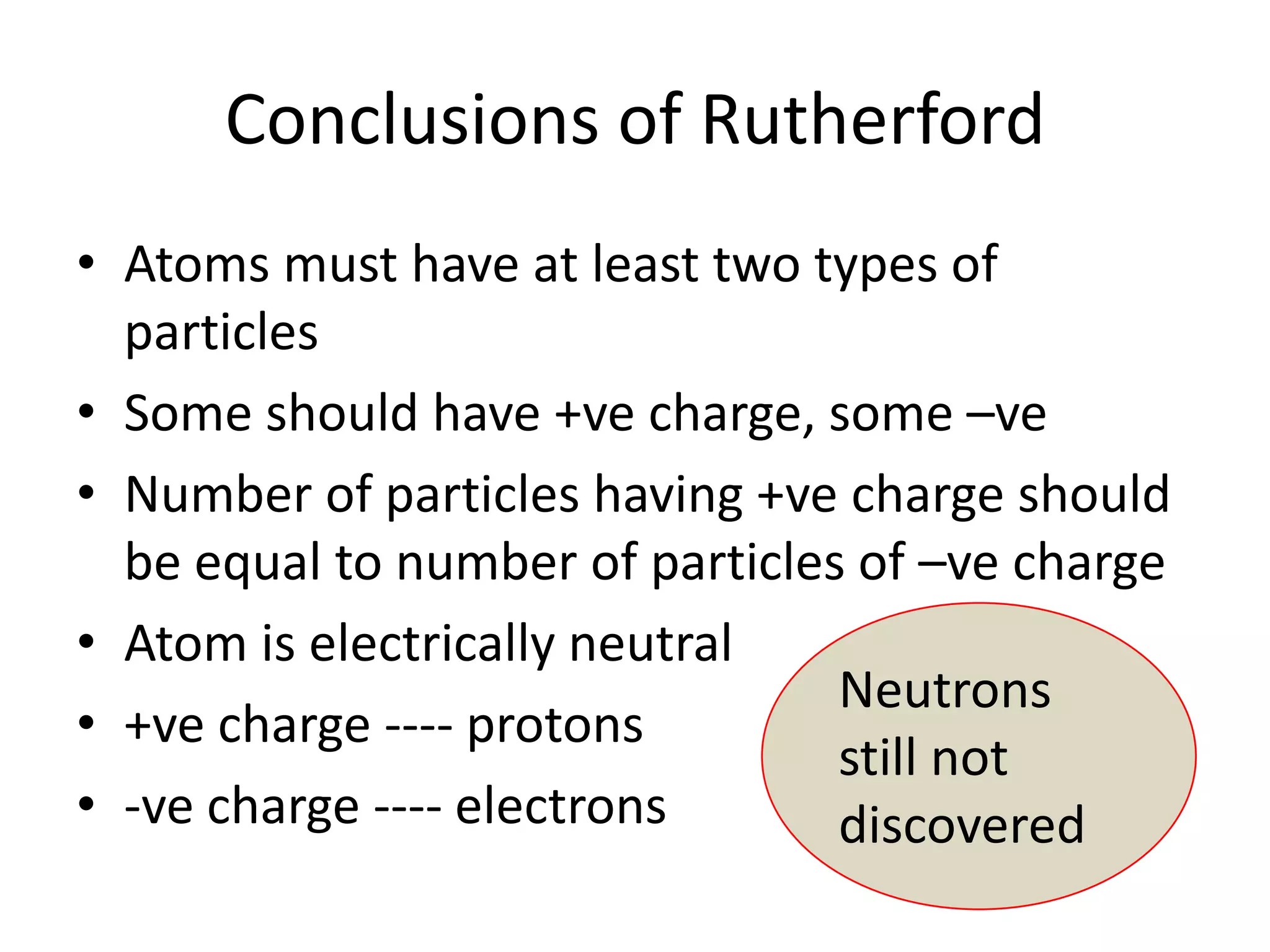
Conclusions of Rutherford
• Atoms must have at least two types of
  particles
• Some should have +ve charge, some –ve
• Number of particles having +ve charge should
  be equal to number of particles of –ve charge
• Atom is electrically neutral
                                 Neutrons
• +ve charge ---- protons
                                 still not
• -ve charge ---- electrons      discovered
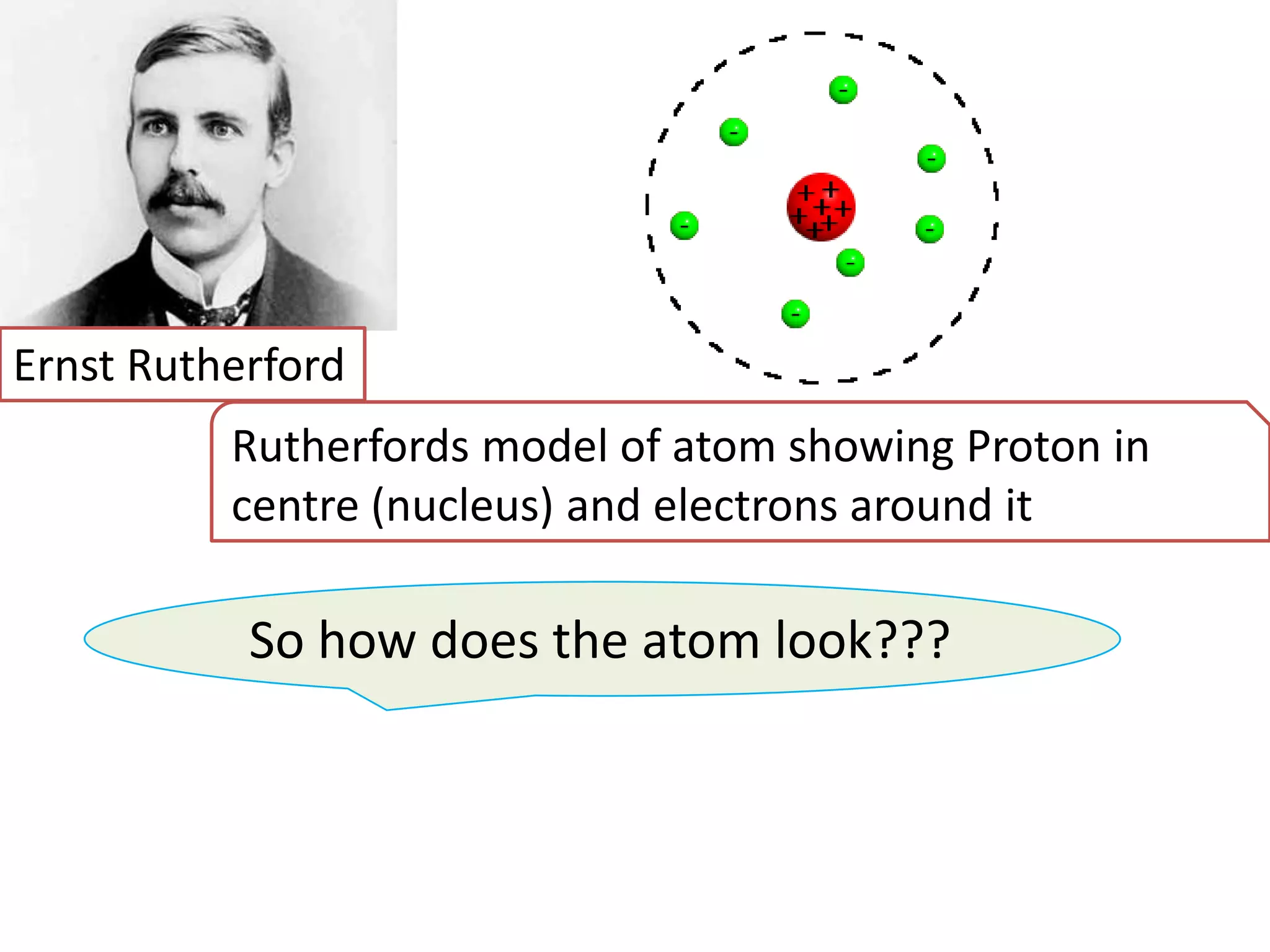
Ernst Rutherford
          Rutherfords model of atom showing Proton in
          centre (nucleus) and electrons around it

           So how does the atom look???
This question was attempted by three people

1) J. Thomson

2) Rutherford

3) Neil Bohr
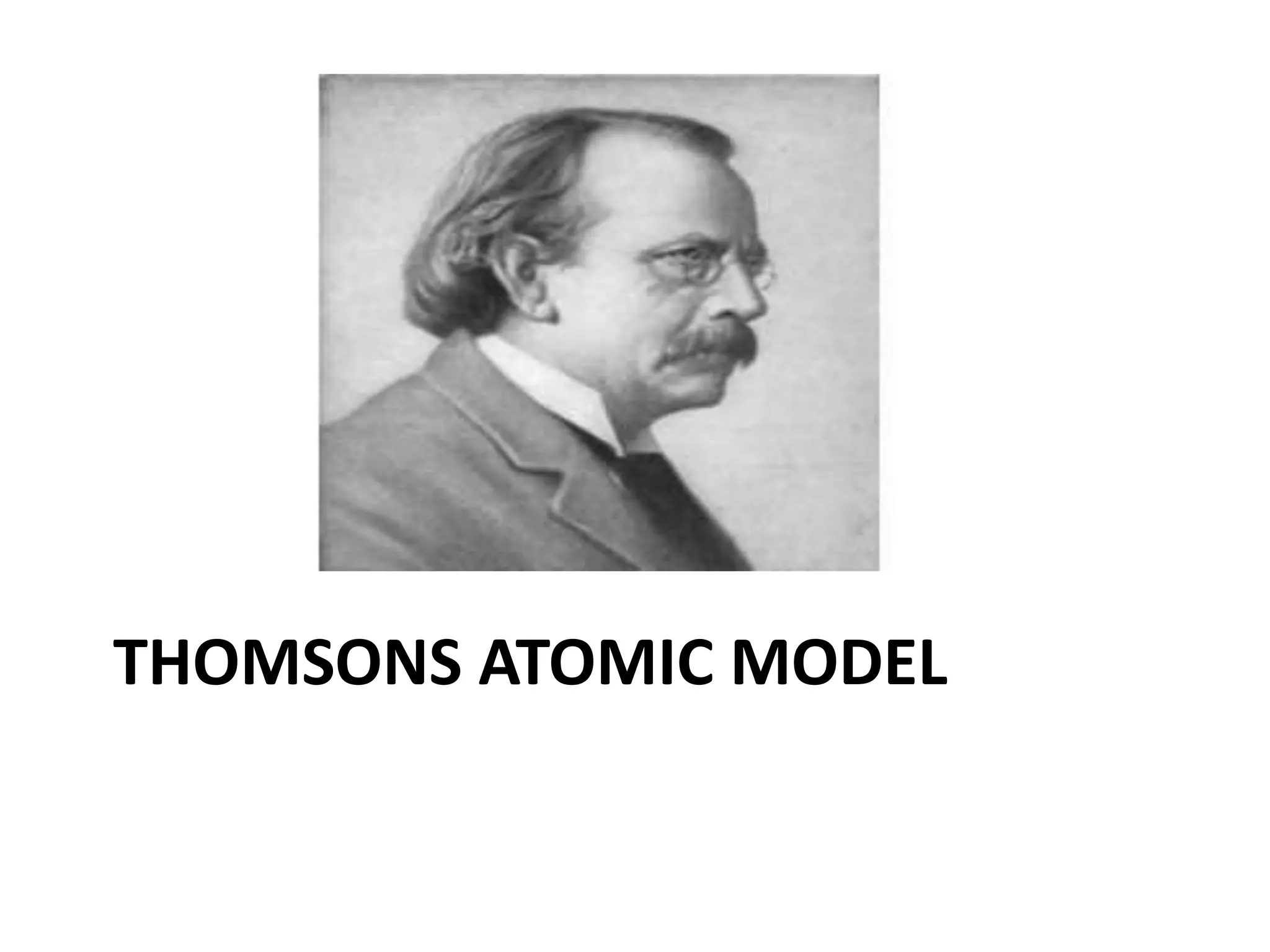
THOMSONS ATOMIC MODEL
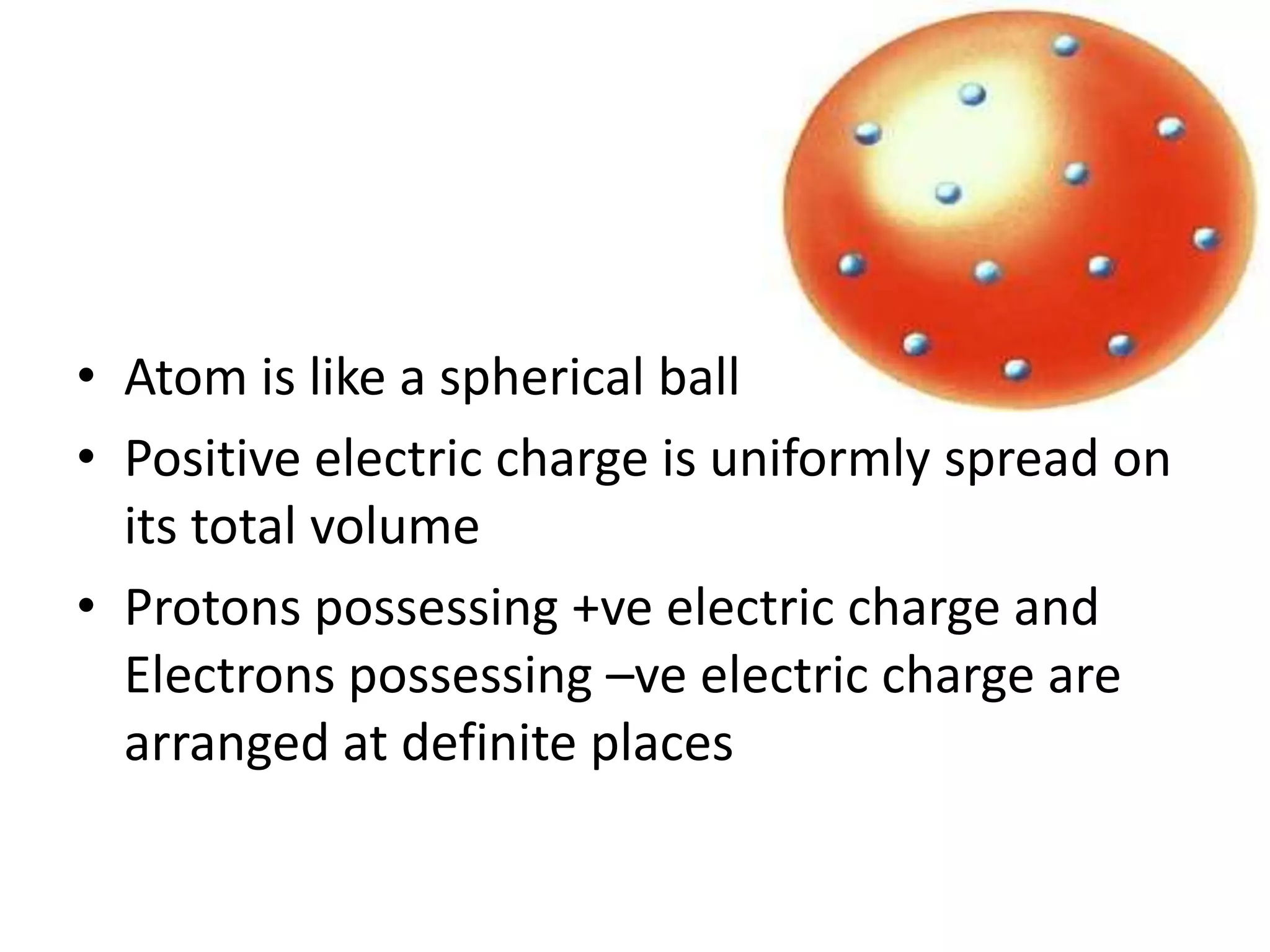
• Atom is like a spherical ball
• Positive electric charge is uniformly spread on
  its total volume
• Protons possessing +ve electric charge and
  Electrons possessing –ve electric charge are
  arranged at definite places
Limitations of Thomsons Model
• The positive and negative particles being
  together would attract each other and
  become chargeless
• It could not explain the chemical properties of
  different elements
RUTHERFORDS GOLD FOIL
EXPERIMENT
• The proton is 1836 times heavier than
  electron
• How are they arranged?
• This is what Rutherford tried to answer.

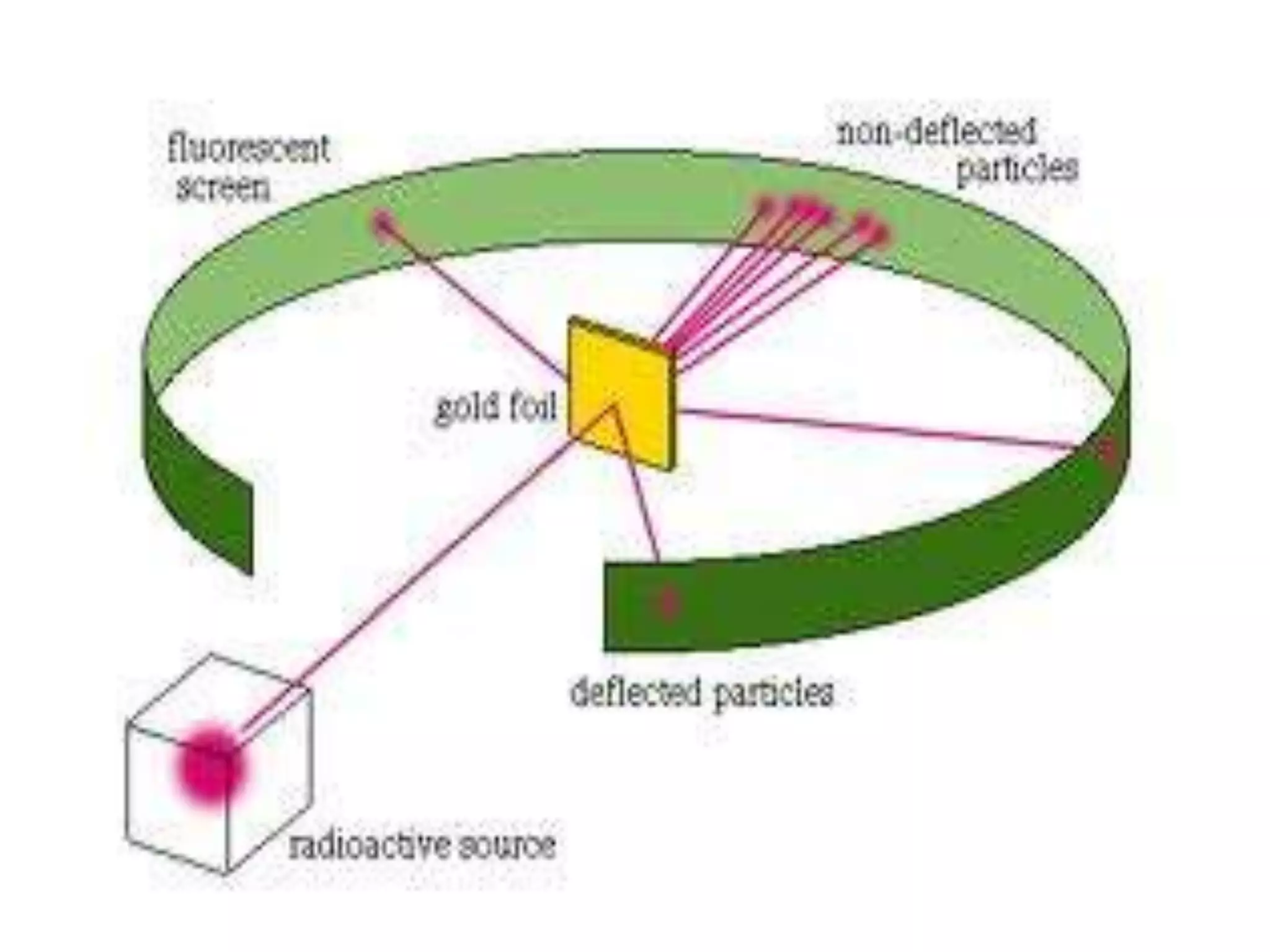
• He made Alpha rays obtained from radioactive
  Polonium (Po) fall on one side of a very thin
  (0.004mm thick) gold foil
• If the atom is like a sphere (Thomson model)
  then all Alpha rays should return back after
  striking foil.
• But,
• Rutherford observed that most rays passed
  straight through and only very few got
  deviated or got thrown back
• Proportion of Alpha rays returning and those
  passing through was 1 : 1200

        Mr. Thomson you are wrong!!!
Rutherford’s conclusions
• Centre of atom must be very small, heavy and
  positively charged
• He named it Nucleus
• Around nucleus, electrons with negligible
  weight and possessing negative charge must
  be arranged
• The atom must be very hollow
• Atomic nucleus was 105 times smaller than
  total area of atom
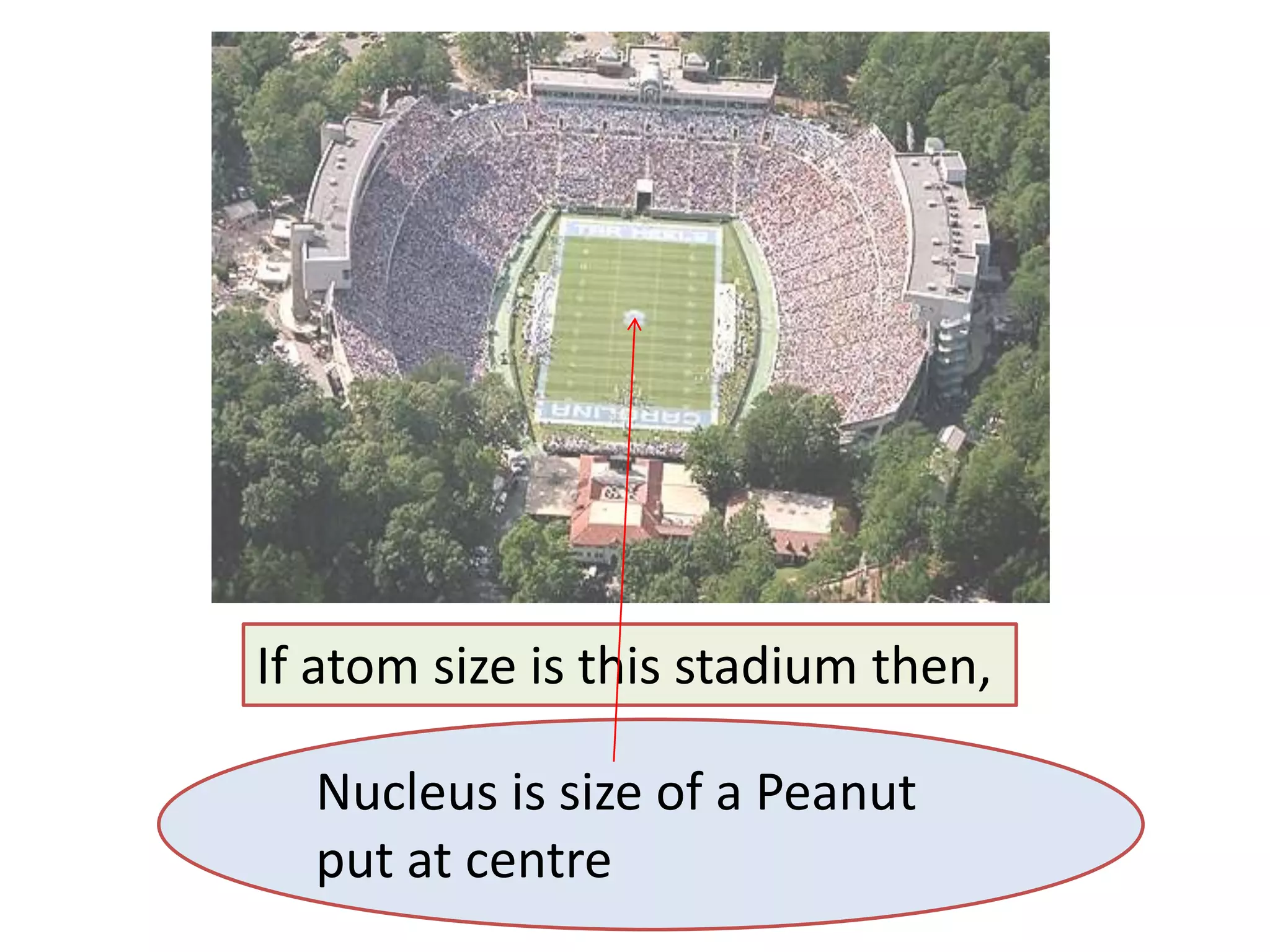
If atom size is this stadium then,

  Nucleus is size of a Peanut
  put at centre
To summarize…..
• Atom is hollow
• Centre – heavy, very small, positively charged
  nucleus
• Electrons – negligible mass, negatively
  charged are arranged around nucleus


     How are electrons arranged, Mr.
     Bohr???
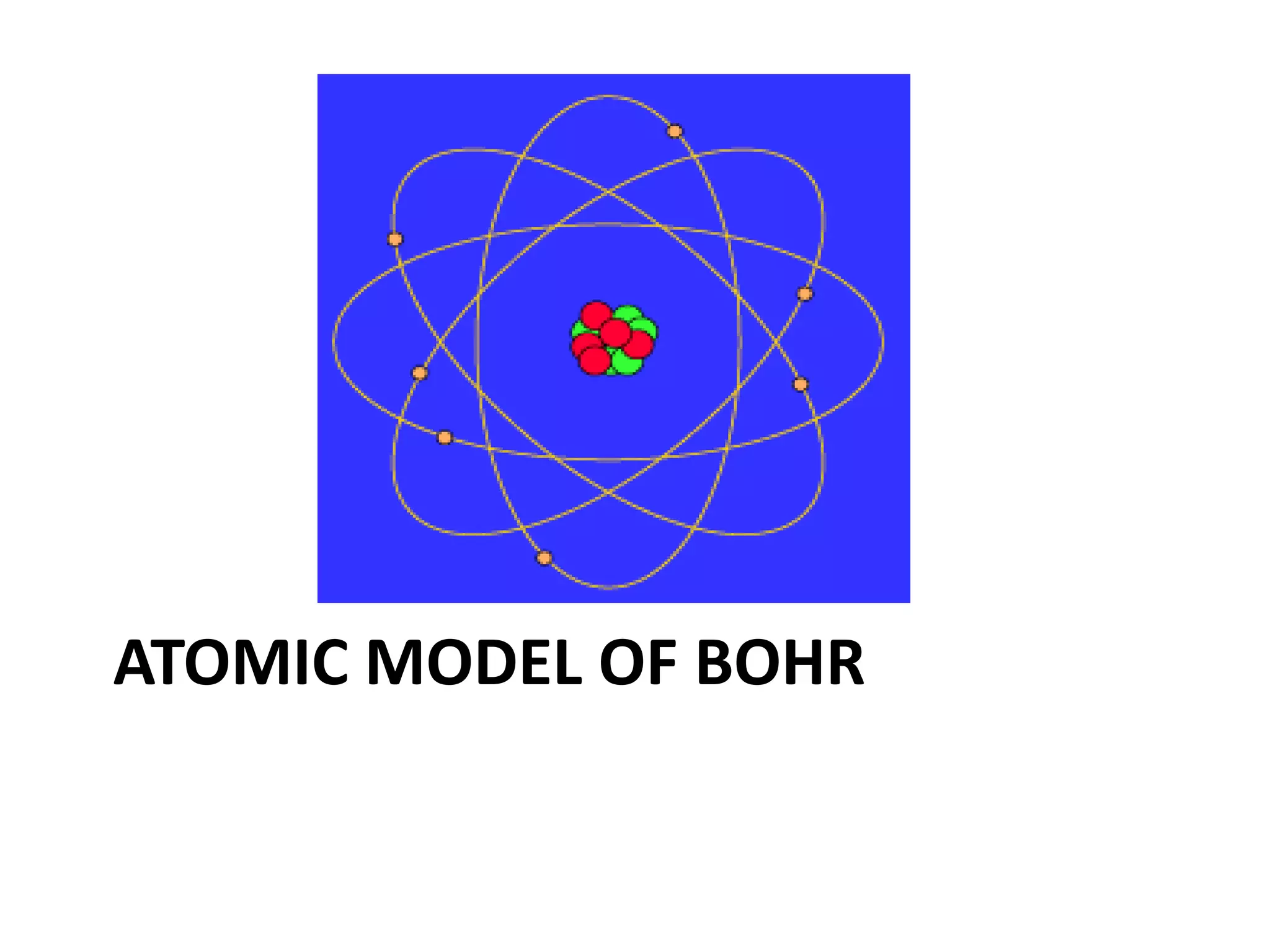
ATOMIC MODEL OF BOHR
• Proposed model in 1912
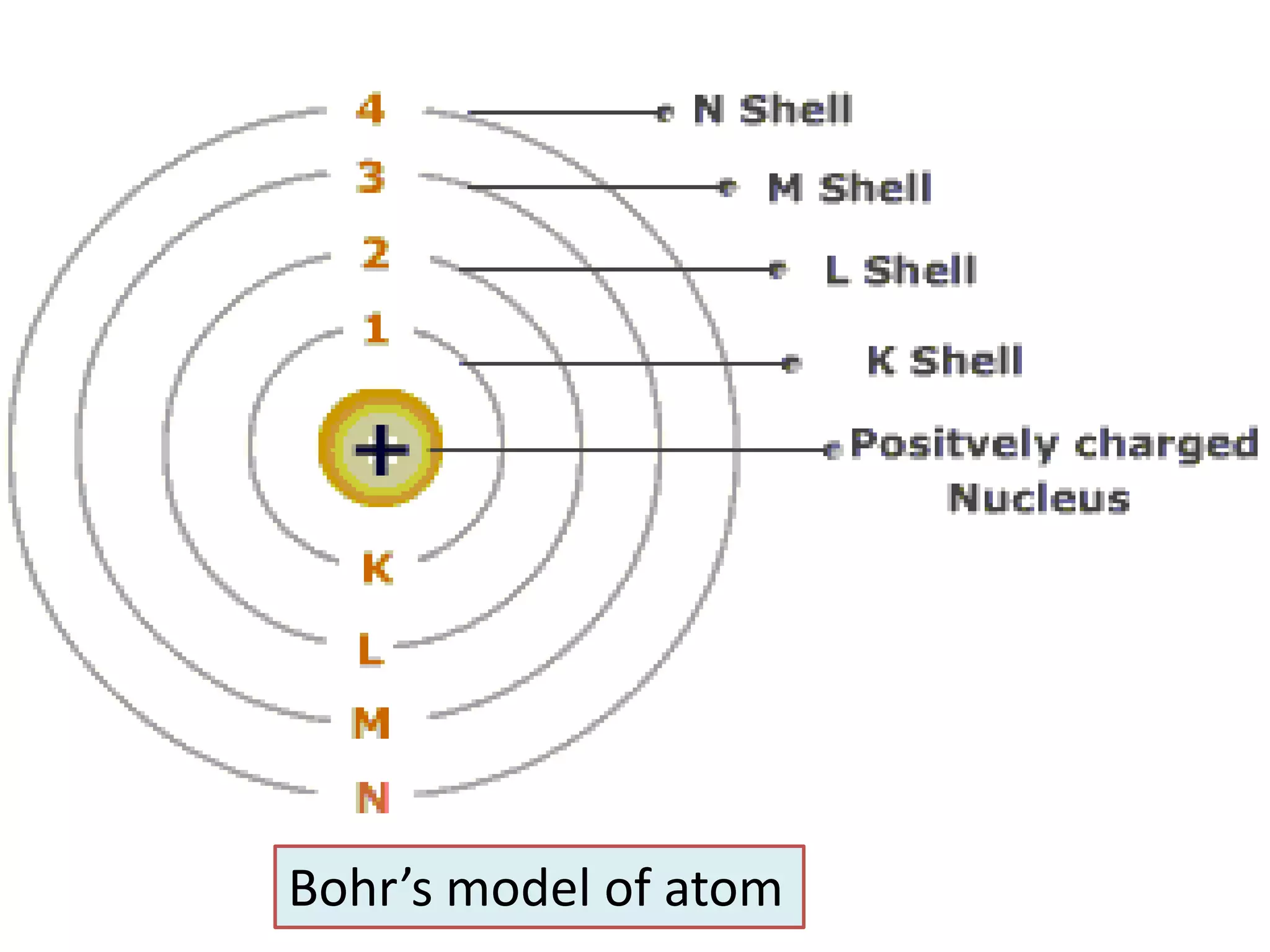
• Electrons moving around nucleus in atomic
  levels at fixed distance from nucleus
• This level is called Energy level or Orbit
• Electrons continuously move in these orbits
• They do not lose energy, so orbits are
  stationary orbits
• Energy of orbit nearest nucleus is least
• As u go away from nucleus, energy of orbit
  increases
Arrangement of electrons around
                nucleus
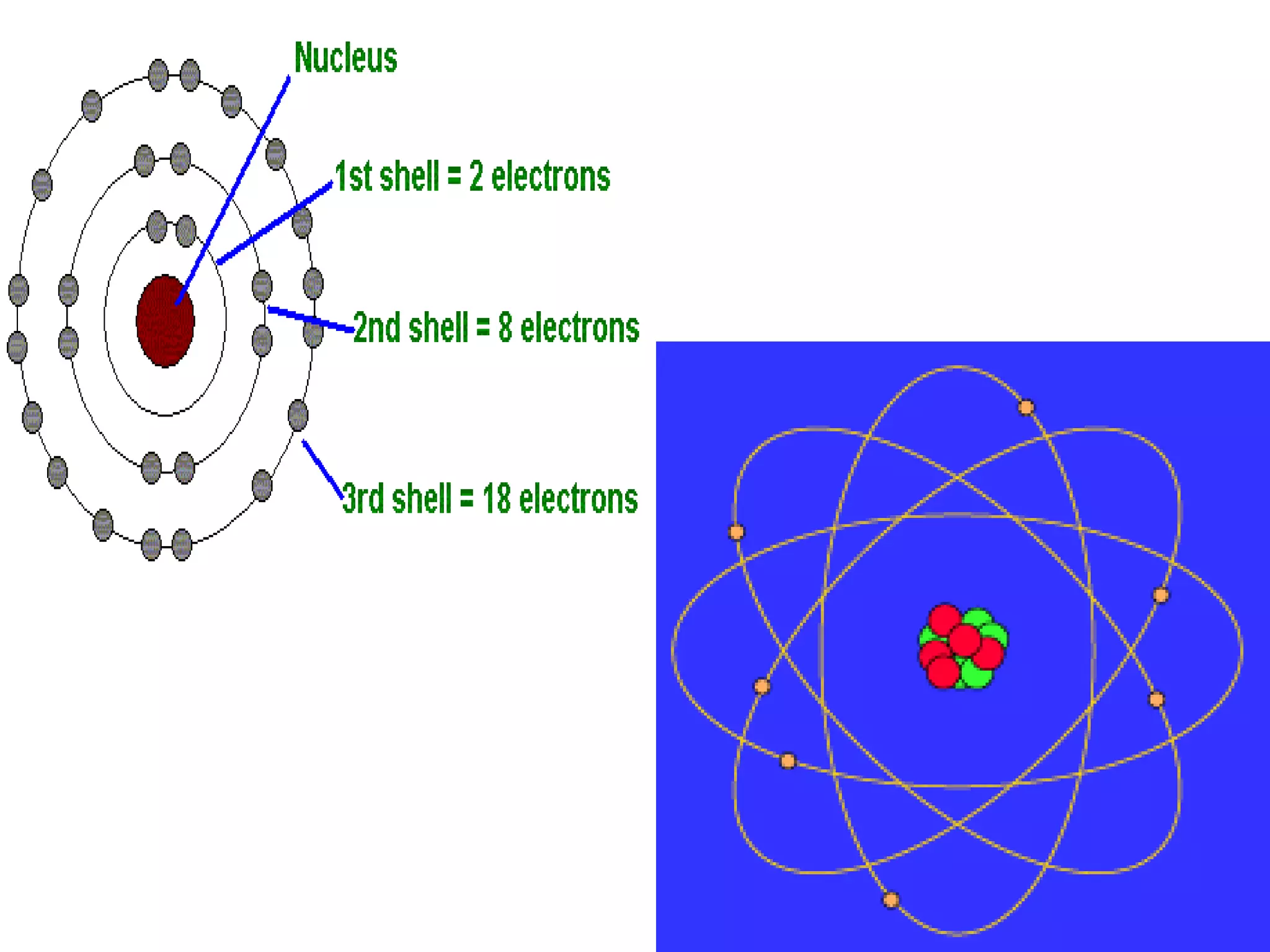
•   i) 1st orbit (K orbit) – 2 electrons
•   ii) 2nd orbit (L orbit) – 8 electrons
•   iii) 3rd orbit (M orbit) – 18 electrons
•   iv) 4th orbit (N orbit) – 32 electrons

• 2nd, 3rd and 4th orbit have sub-orbits called
  Orbitals
• First electrons fill 1st orbit then go stepwise to 2nd,
  3rd and 4th orbits
Bohr’s model of atom
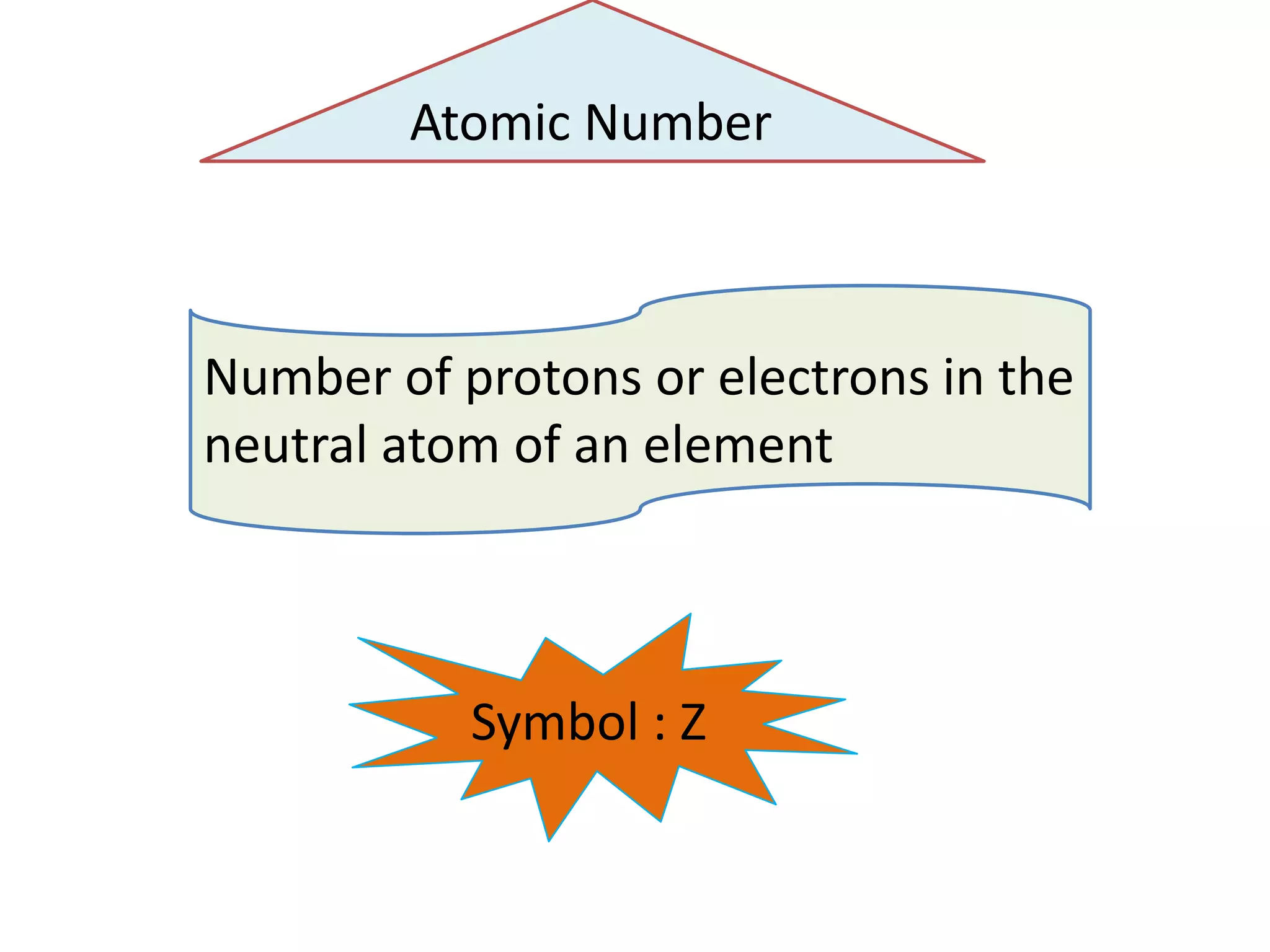
Atomic Number


Number of protons or electrons in the
neutral atom of an element


           Symbol : Z
VALENCE ELECTRONS & VALENCY
• Electrons arranged in different orbits having
  increasing energy around the nucleus
• Electrons in outermost orbit are responsible
  for emission spectra and chemical properties
• They are called Valence electrons

• Valency = number of electrons in valence orbit
DISCOVERY OF NEUTRONS
• Rutherford had suggested in 1920 that the
  element Helium (He) after Hydrogen (H) has 2
  protons, so its mass should be double than
  Hydrogen
• But it was later found that He mass was 4
  times mass of Hydrogen
• Why was this so?
• There must be something else in the atom (i.e.
  in nucleus) apart from proton and electron
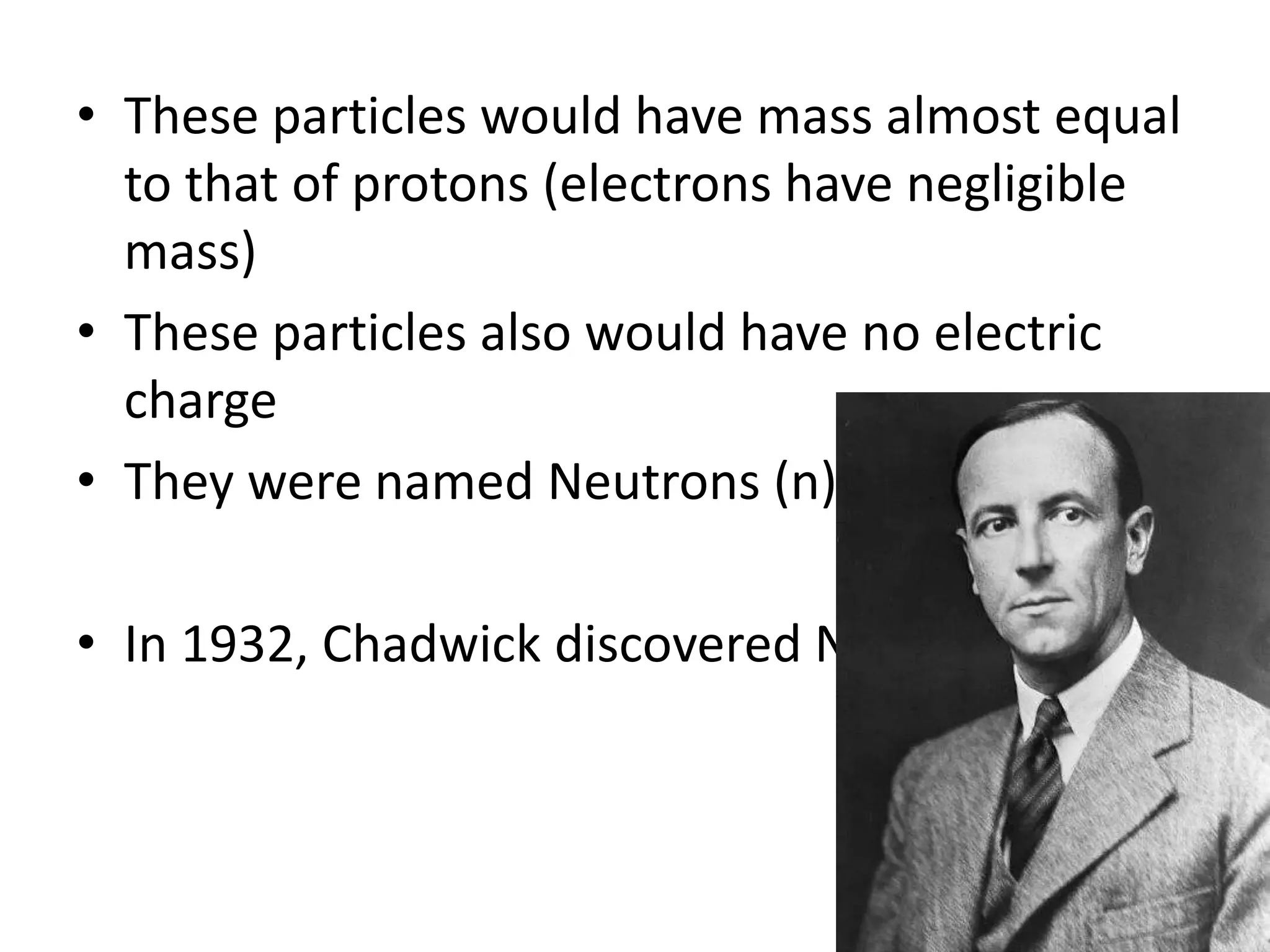
• These particles would have mass almost equal
  to that of protons (electrons have negligible
  mass)
• These particles also would have no electric
  charge
• They were named Neutrons (n)

• In 1932, Chadwick discovered Neutrons
Properties of neutrons
•   Do not possess any electric charge
•   It is neutral
•   Mass almost equal to mass of proton
•   1838 times more mass than electron
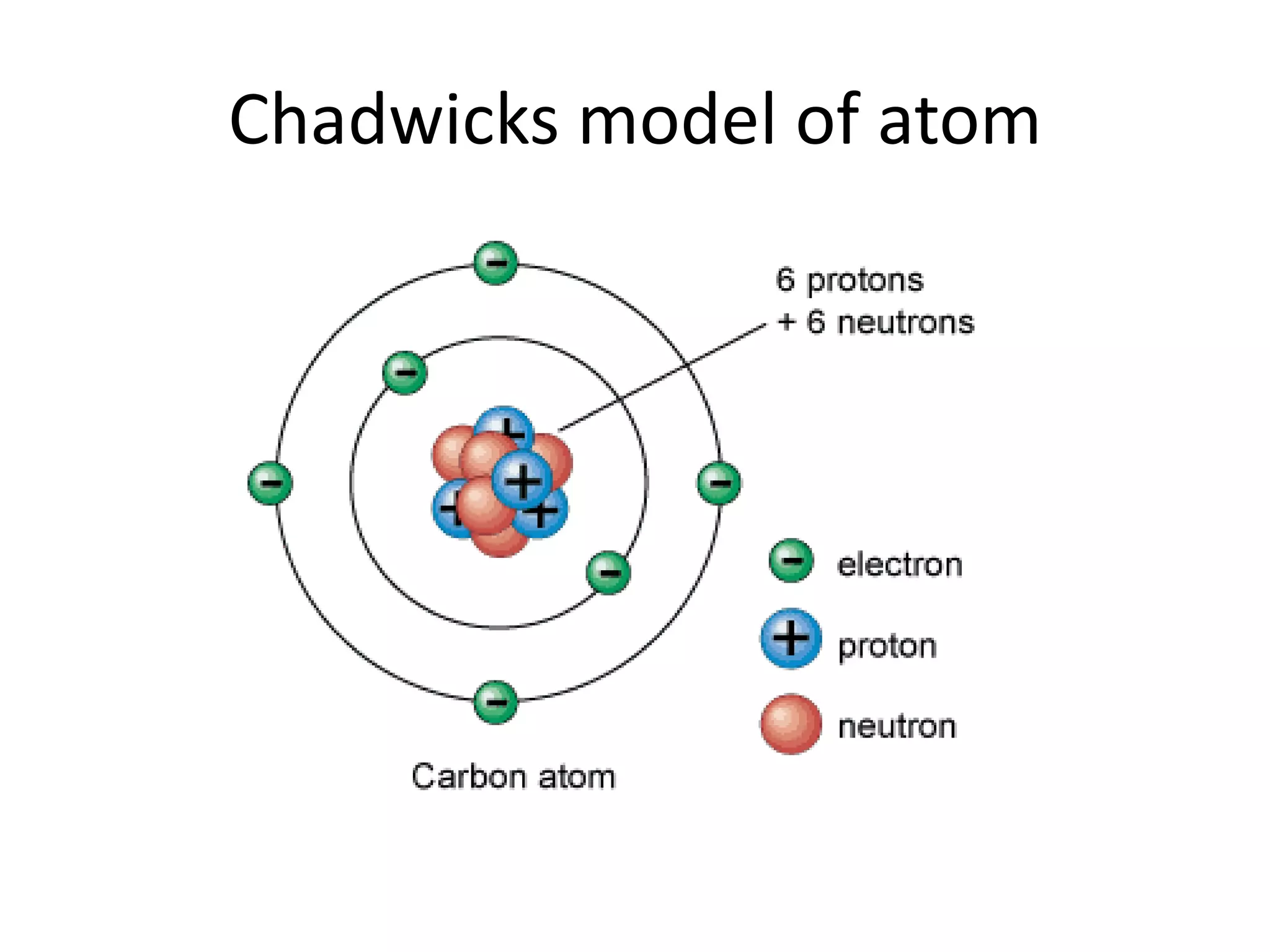
Chadwicks model of atom
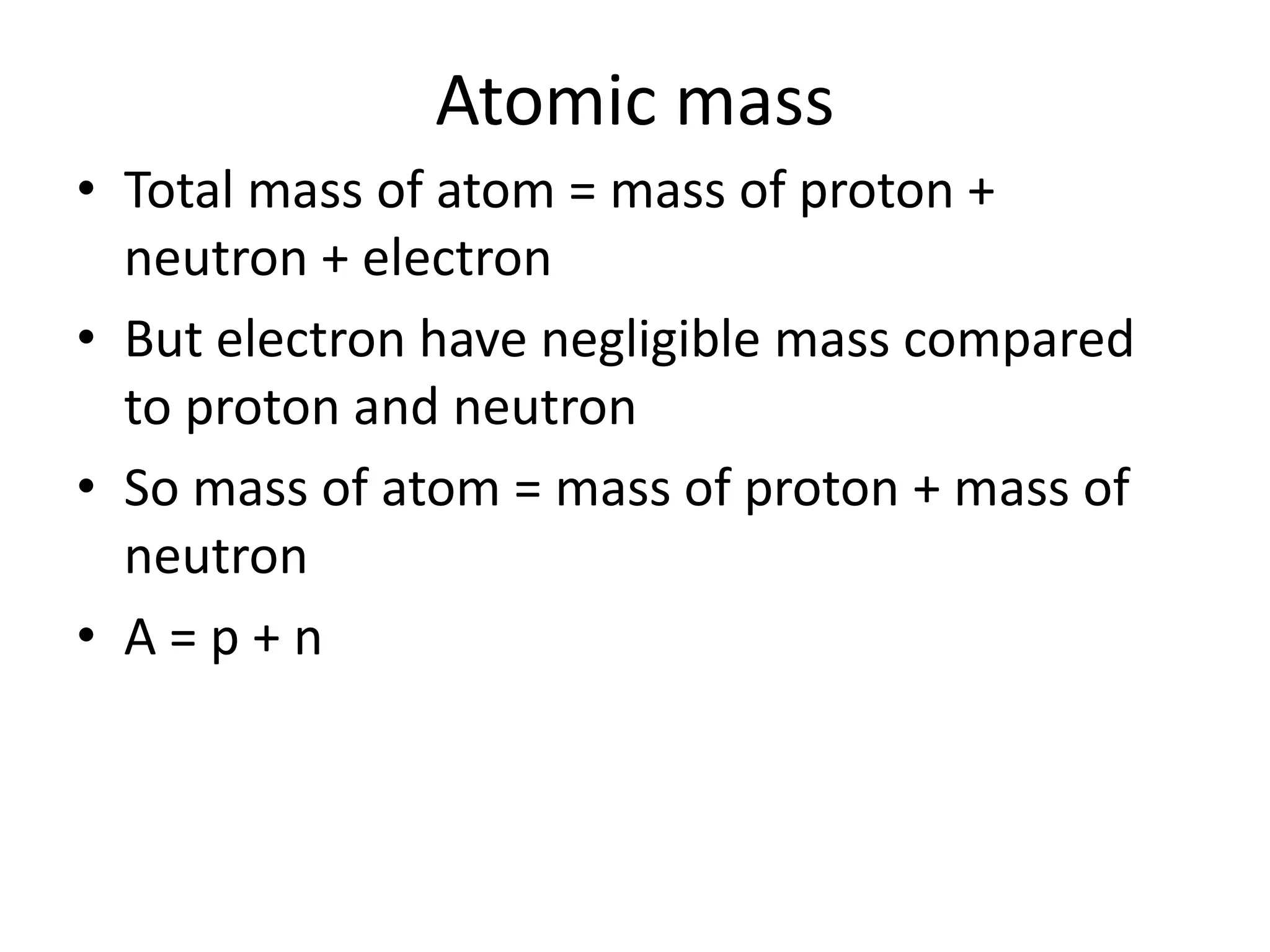
Atomic mass
• Total mass of atom = mass of proton +
  neutron + electron
• But electron have negligible mass compared
  to proton and neutron
• So mass of atom = mass of proton + mass of
  neutron
• A=p+n
ISOTOPES & RADIOACTIVITY
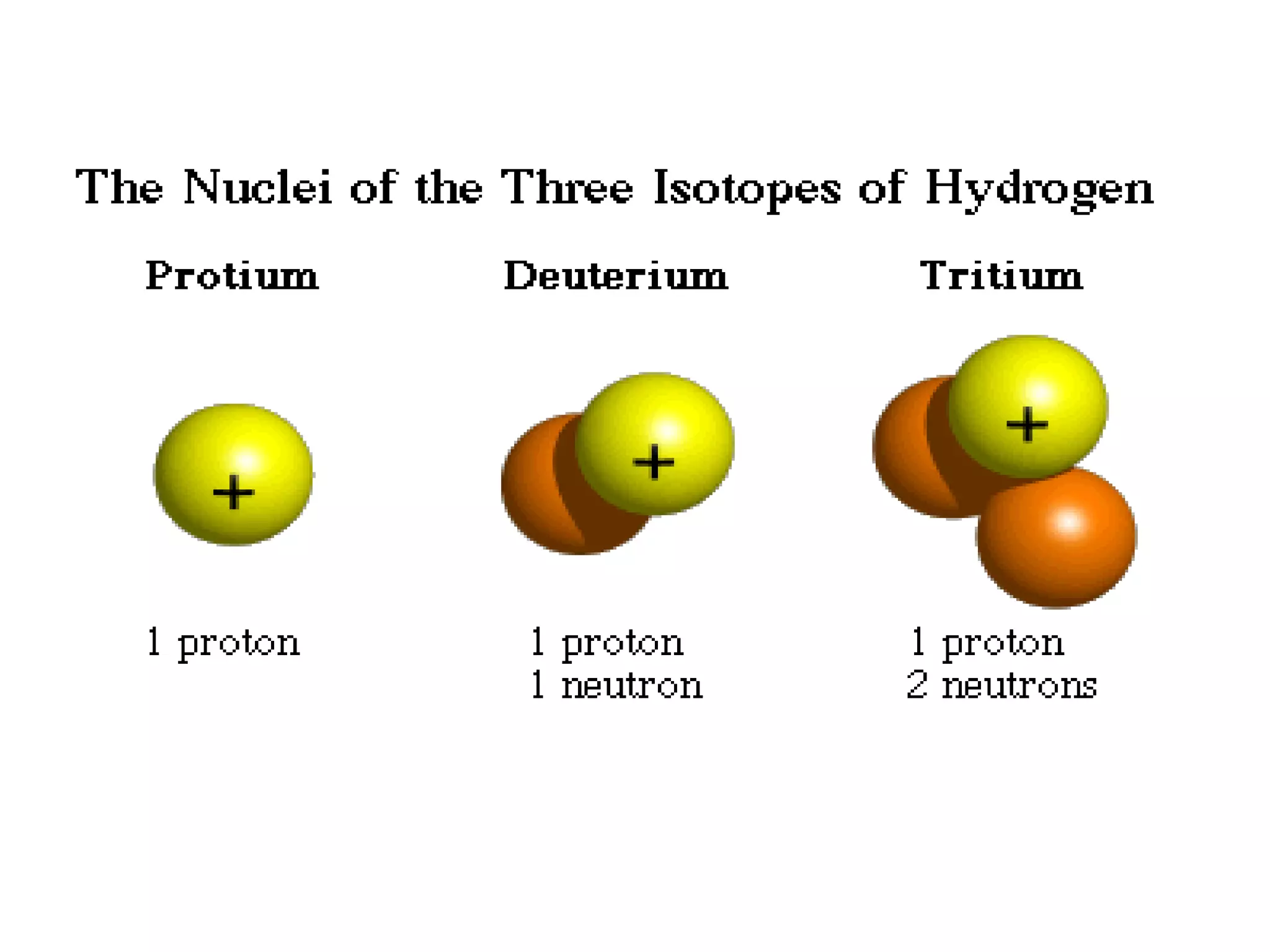
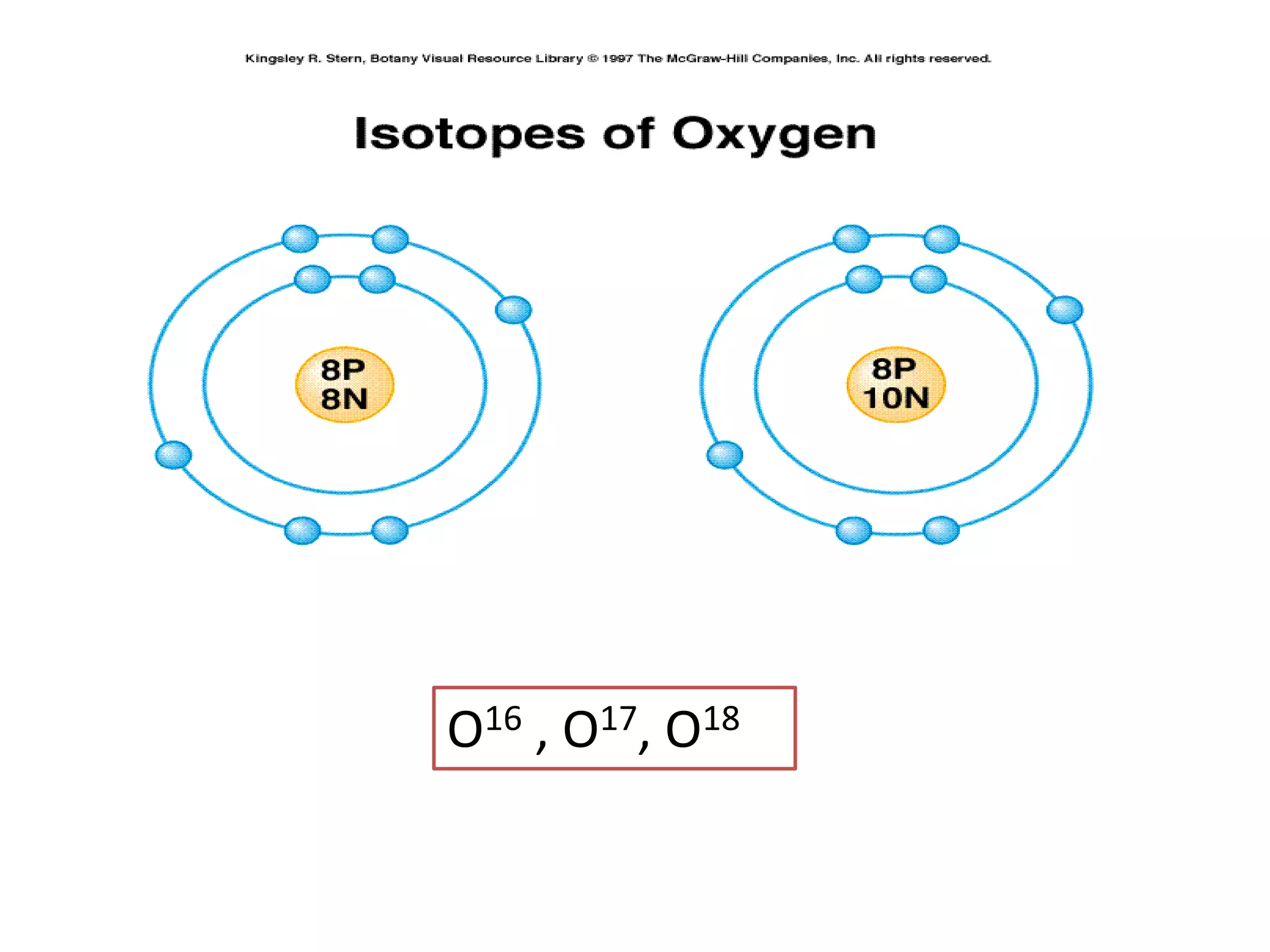
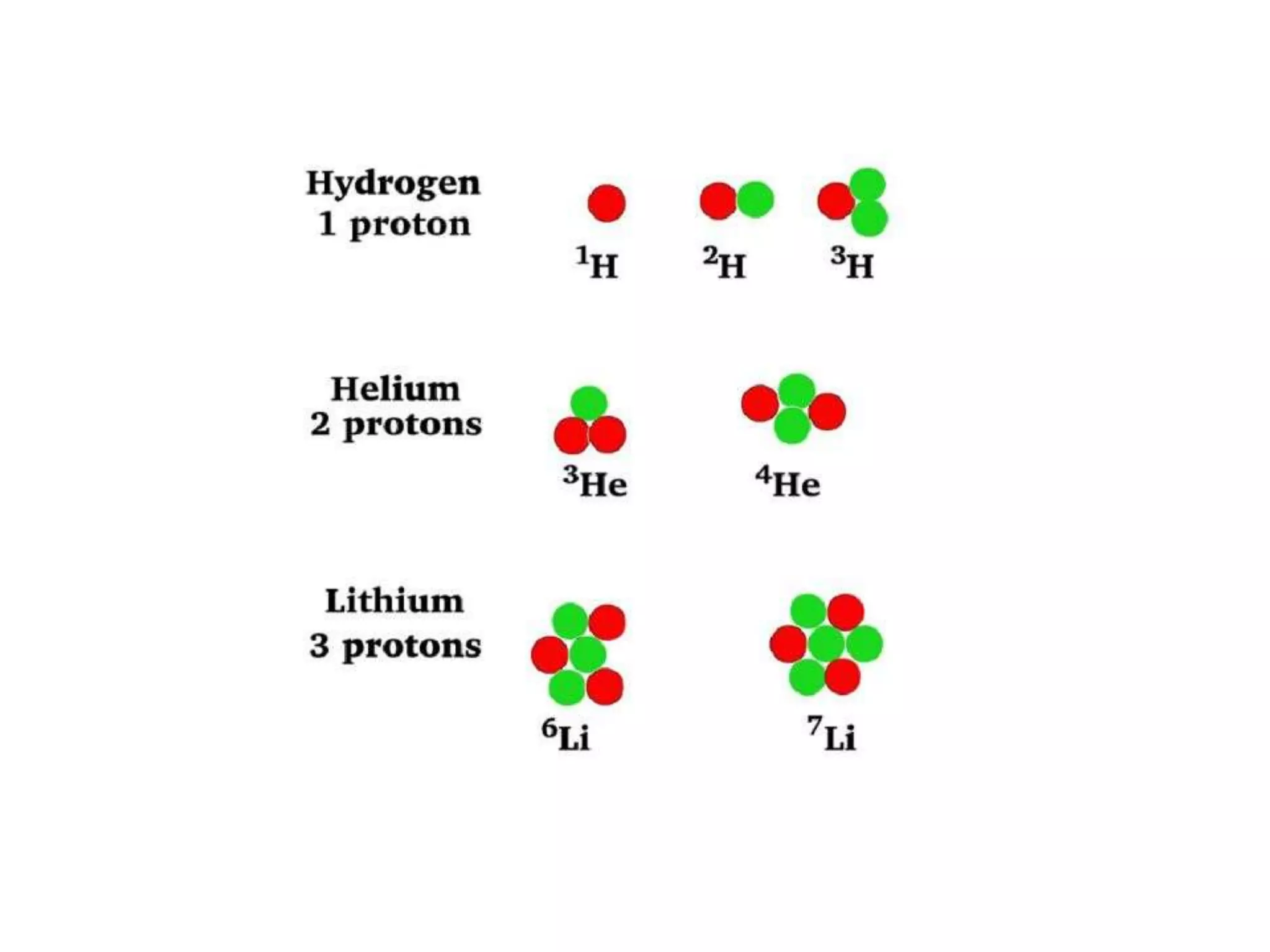
• Some elements have more than one mass
• They are called Isotopes
• Now, A = p + n
• If the number of protons remain same (atomic
  number) but number of neutrons vary than
  the element will have different masses
• Atomic masses different – but chemical
  properties similar (same element)
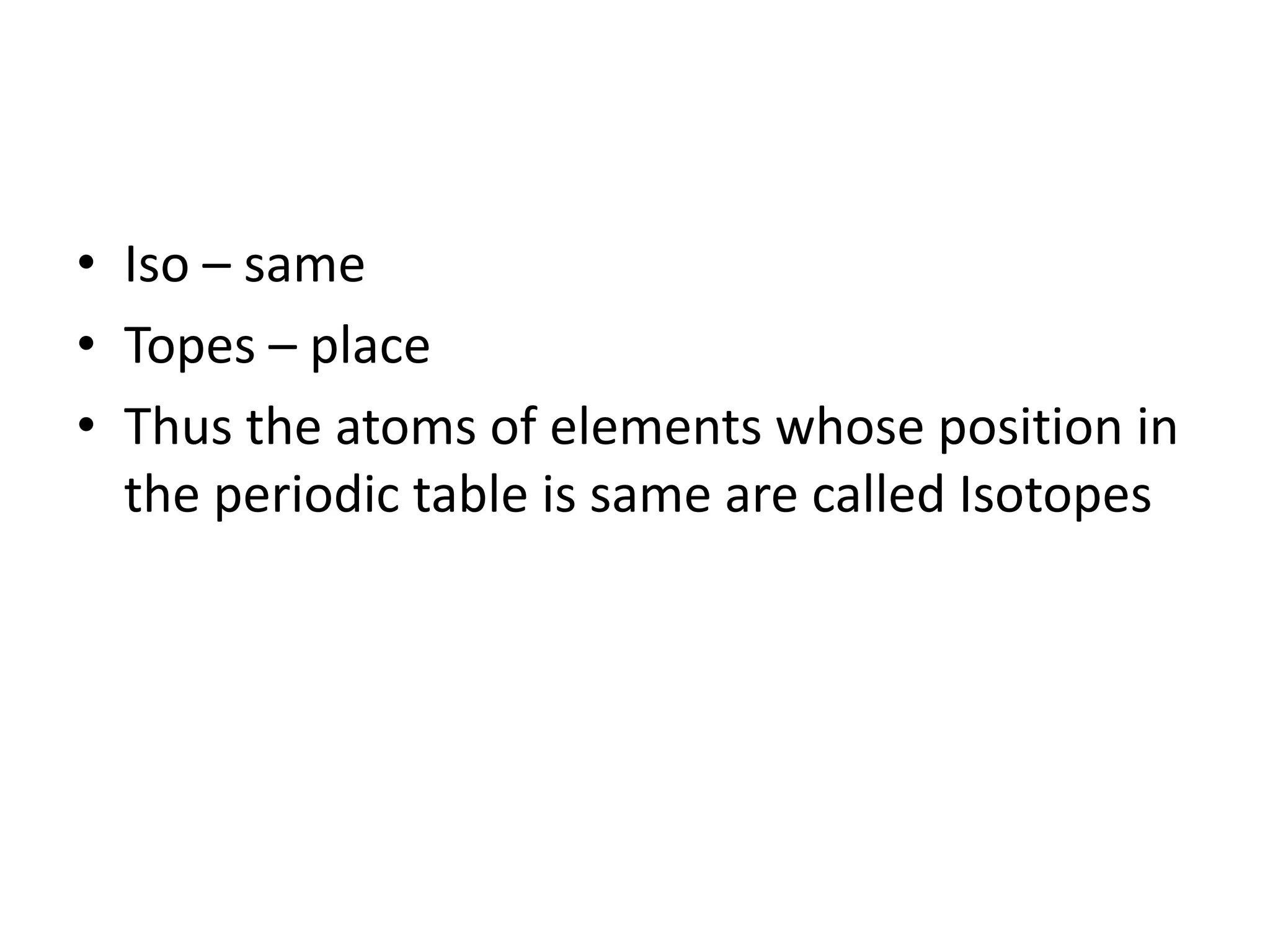
• Iso – same
• Topes – place
• Thus the atoms of elements whose position in
  the periodic table is same are called Isotopes
O16 , O17, O18
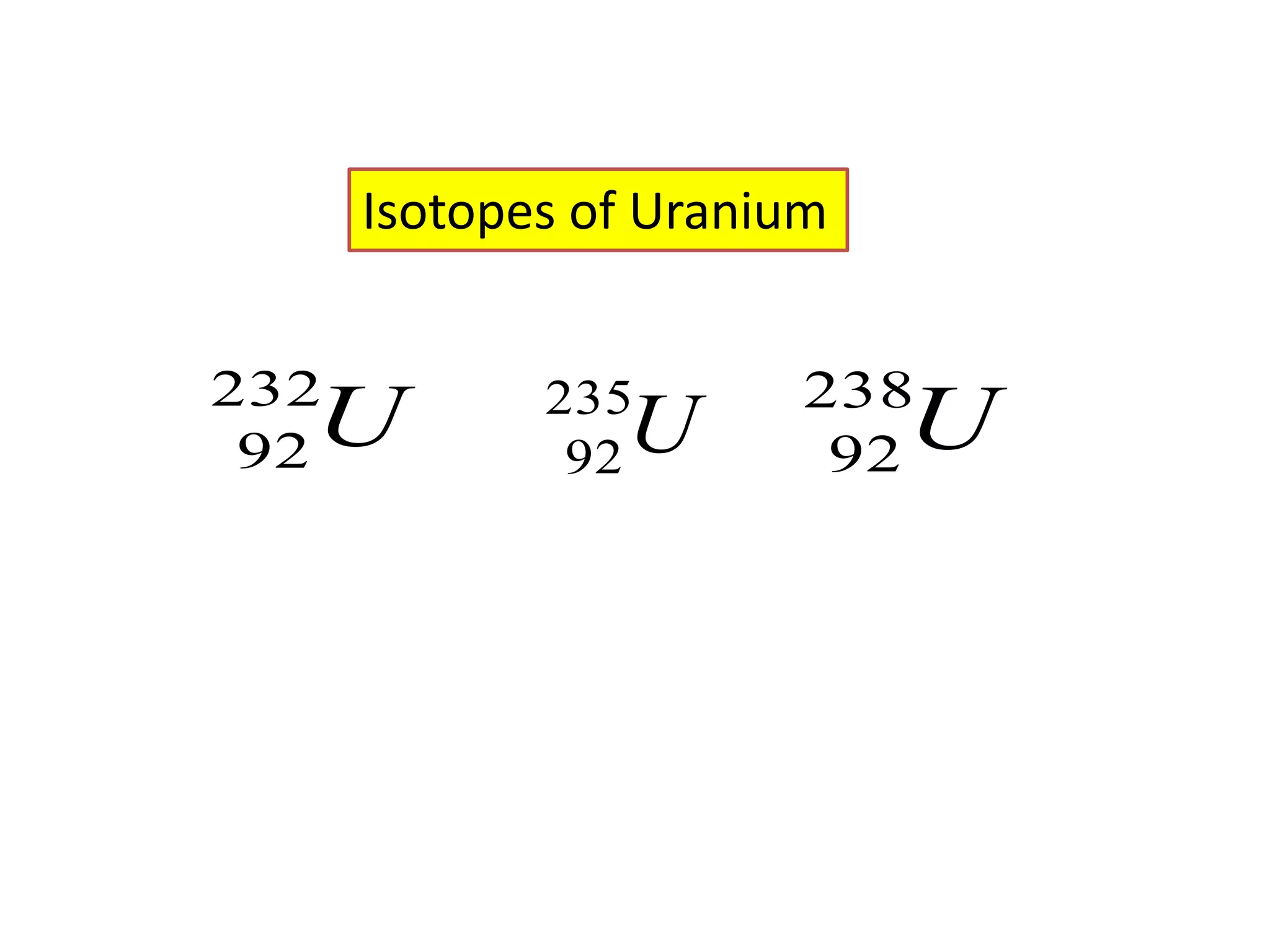
Isotopes of Uranium


232          235       238
  U
 92           92U       92  U
Radioactivity
• The isotopes of elements having high atomic
  masses possess the property of radioactivity
• Not all high mass elements are radioactive
• Eg. Lead is not radioactive
• As atomic number increases, number of
  protons also increase
• If no. of neutrons also increase the atom
  becomes unstable
• This unstable atom will emit alpha, beta and
  gamma rays
• It is radioactive
• Normally,
• If the ratio of neutrons to protons exceeds 1.6,
  the property of radioactivity is acquired
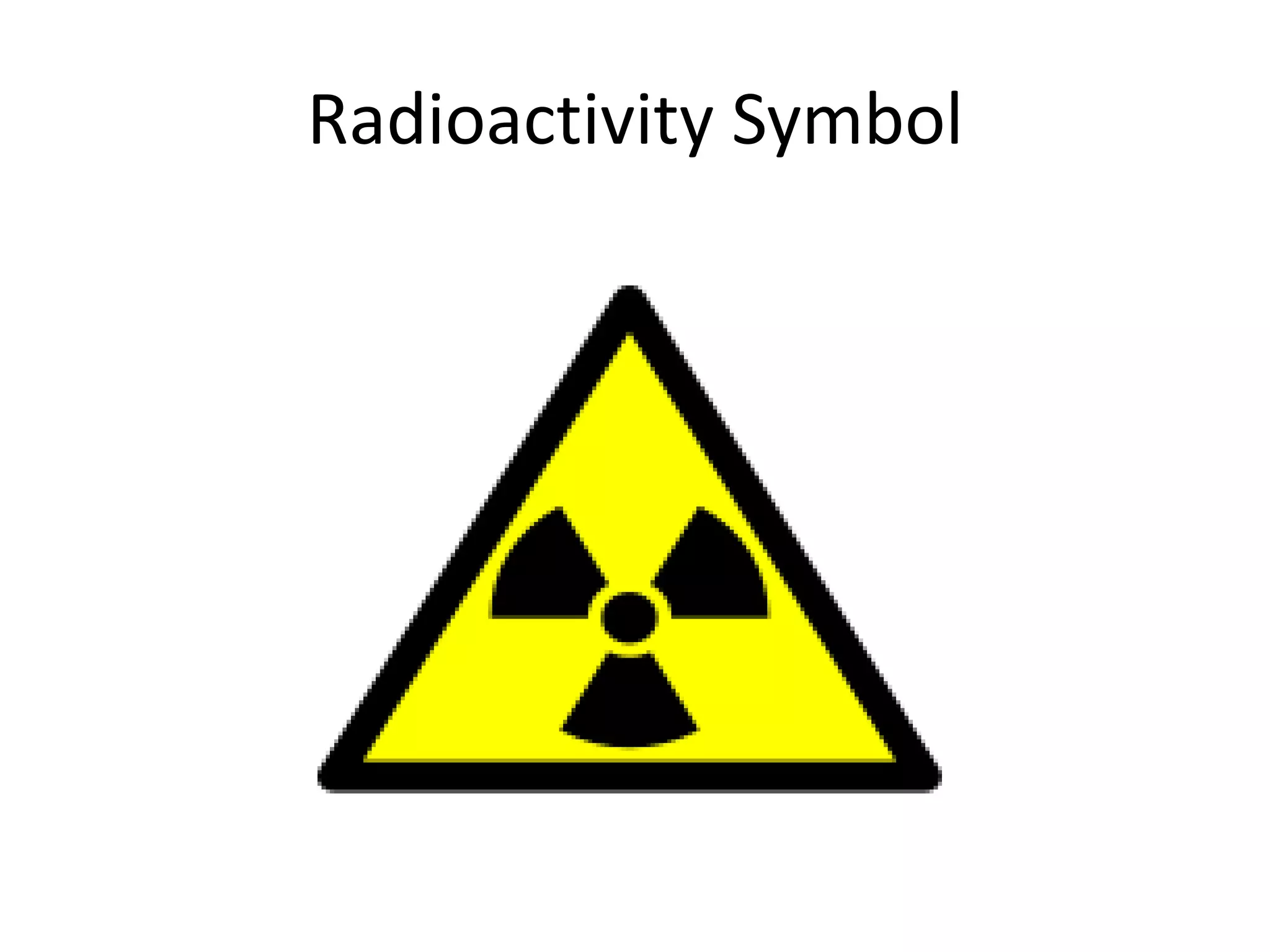
Radioactivity Symbol
Use of radioactive isotopes
•   Determining age of old trees
•   Age of fossils
•   Radiometric dating
•   Medical treatments
•   Industries
•   Treatment of diseases like cancer, etc.

structure of atom

  • 1.
  • 2.
    Introduction • Substance aremade of molecules or atoms • Atom is smallest, indivisible particle having independent existence • John Dalton gave this concept.
  • 3.
    What we willsee this chapter? • How concept of atom changed over time? • How the different components of atom were found? • Various experiments that evolved Atomic theory • Isotopes • Radioactivity
  • 4.
    Chronology Cathode Rays &Discovery of Electrons X-Rays (1896) Alpha, Beta, Gamma Rays Idea of Proton Thomsons Atomic Model Rutherfords Atomic Model Bohr model – electron arrangement Neutron discovered – Chadwick (1932)
  • 5.
  • 6.
    Discharge tube experiment& Discovery of Electrons
  • 7.
    • The linediagram of electric discharge tube is given • Vacuum is created in this tube • Two metal plates in tube are Cathode (-ve) and Anode (+ve) terminals • On joining with battery, Cathode rays are produced from cathode • They have negative charge • They move towards the Anode • These are actually the flow of Electrons • J J Thomson and Crookes proved that Cathode rays were in fact flow of Electrons
  • 8.
    Electron discovery inCathode ray tube
  • 9.
    X – RAYAND RADIOACTIVITY
  • 10.
    Hi, I’m Rontgen I discovered X – Rays in 1896 They are also called Rontgen rays after me
  • 11.
    • In cathoderay tube, cathode rays were travelling in straight line • They were made to strike the walls of tube • New type of rays formed • They travelled in straight line and were not deviated in strong Electromagnetic field • Could pass through opaque substances like black paper • They affected photographic plates • He named them X -rays
  • 12.
    • Cathode raysis beam of electrons • X – rays are electromagnetic waves having very short wavelength • If electrons having very high velocity are stopped by putting some type of resistance (anti- cathode) the X –rays are produced
  • 14.
    X – raymachine
  • 16.
    Uses of X-rays • In medical science • To detect fracture in bones • To observe lung defect • To diagnose cancer of oesophagus • To diagnose physical disabilities
  • 17.
    ALPHA, BETA &GAMMA RAYS
  • 18.
    • In 1889,Ernst Rutherford found Alpha and Beta rays from radioactive atom like Uranium • Later, Willard discovered Gamma rays. • Alpha rays – Positive electric charge • Beta rays – Negative electric charge • Gamma rays – do not possess electric charge • Gamma rays – electromagnetic rays , have highest penetration power
  • 20.
    Conclusions of Rutherford •Atoms must have at least two types of particles • Some should have +ve charge, some –ve • Number of particles having +ve charge should be equal to number of particles of –ve charge • Atom is electrically neutral Neutrons • +ve charge ---- protons still not • -ve charge ---- electrons discovered
  • 21.
    Ernst Rutherford Rutherfords model of atom showing Proton in centre (nucleus) and electrons around it So how does the atom look???
  • 22.
    This question wasattempted by three people 1) J. Thomson 2) Rutherford 3) Neil Bohr
  • 23.
  • 24.
    • Atom islike a spherical ball • Positive electric charge is uniformly spread on its total volume • Protons possessing +ve electric charge and Electrons possessing –ve electric charge are arranged at definite places
  • 25.
    Limitations of ThomsonsModel • The positive and negative particles being together would attract each other and become chargeless • It could not explain the chemical properties of different elements
  • 26.
  • 27.
    • The protonis 1836 times heavier than electron • How are they arranged? • This is what Rutherford tried to answer. • He made Alpha rays obtained from radioactive Polonium (Po) fall on one side of a very thin (0.004mm thick) gold foil
  • 29.
    • If theatom is like a sphere (Thomson model) then all Alpha rays should return back after striking foil. • But, • Rutherford observed that most rays passed straight through and only very few got deviated or got thrown back • Proportion of Alpha rays returning and those passing through was 1 : 1200 Mr. Thomson you are wrong!!!
  • 30.
    Rutherford’s conclusions • Centreof atom must be very small, heavy and positively charged • He named it Nucleus • Around nucleus, electrons with negligible weight and possessing negative charge must be arranged • The atom must be very hollow • Atomic nucleus was 105 times smaller than total area of atom
  • 31.
    If atom sizeis this stadium then, Nucleus is size of a Peanut put at centre
  • 32.
    To summarize….. • Atomis hollow • Centre – heavy, very small, positively charged nucleus • Electrons – negligible mass, negatively charged are arranged around nucleus How are electrons arranged, Mr. Bohr???
  • 33.
  • 34.
    • Proposed modelin 1912 • Electrons moving around nucleus in atomic levels at fixed distance from nucleus • This level is called Energy level or Orbit • Electrons continuously move in these orbits • They do not lose energy, so orbits are stationary orbits • Energy of orbit nearest nucleus is least • As u go away from nucleus, energy of orbit increases
  • 35.
    Arrangement of electronsaround nucleus • i) 1st orbit (K orbit) – 2 electrons • ii) 2nd orbit (L orbit) – 8 electrons • iii) 3rd orbit (M orbit) – 18 electrons • iv) 4th orbit (N orbit) – 32 electrons • 2nd, 3rd and 4th orbit have sub-orbits called Orbitals • First electrons fill 1st orbit then go stepwise to 2nd, 3rd and 4th orbits
  • 36.
  • 38.
    Atomic Number Number ofprotons or electrons in the neutral atom of an element Symbol : Z
  • 39.
  • 40.
    • Electrons arrangedin different orbits having increasing energy around the nucleus • Electrons in outermost orbit are responsible for emission spectra and chemical properties • They are called Valence electrons • Valency = number of electrons in valence orbit
  • 41.
  • 42.
    • Rutherford hadsuggested in 1920 that the element Helium (He) after Hydrogen (H) has 2 protons, so its mass should be double than Hydrogen • But it was later found that He mass was 4 times mass of Hydrogen • Why was this so? • There must be something else in the atom (i.e. in nucleus) apart from proton and electron
  • 43.
    • These particleswould have mass almost equal to that of protons (electrons have negligible mass) • These particles also would have no electric charge • They were named Neutrons (n) • In 1932, Chadwick discovered Neutrons
  • 44.
    Properties of neutrons • Do not possess any electric charge • It is neutral • Mass almost equal to mass of proton • 1838 times more mass than electron
  • 45.
  • 46.
    Atomic mass • Totalmass of atom = mass of proton + neutron + electron • But electron have negligible mass compared to proton and neutron • So mass of atom = mass of proton + mass of neutron • A=p+n
  • 47.
  • 49.
    • Some elementshave more than one mass • They are called Isotopes • Now, A = p + n • If the number of protons remain same (atomic number) but number of neutrons vary than the element will have different masses • Atomic masses different – but chemical properties similar (same element)
  • 50.
    • Iso –same • Topes – place • Thus the atoms of elements whose position in the periodic table is same are called Isotopes
  • 52.
  • 54.
    Isotopes of Uranium 232 235 238 U 92 92U 92 U
  • 55.
    Radioactivity • The isotopesof elements having high atomic masses possess the property of radioactivity • Not all high mass elements are radioactive • Eg. Lead is not radioactive • As atomic number increases, number of protons also increase • If no. of neutrons also increase the atom becomes unstable
  • 56.
    • This unstableatom will emit alpha, beta and gamma rays • It is radioactive • Normally, • If the ratio of neutrons to protons exceeds 1.6, the property of radioactivity is acquired
  • 58.
  • 59.
    Use of radioactiveisotopes • Determining age of old trees • Age of fossils • Radiometric dating • Medical treatments • Industries • Treatment of diseases like cancer, etc.