CHAPTER  2 The Structure of the Atom
What is a matter?
Matter is defined as anything that has  mass  and takes up  space .
Can you define the word ‘mass’?
Mass The mass of an object is the  amount of matter  the object contains.
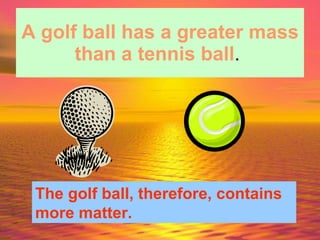
A golf ball has a greater mass than a tennis ball .  The golf ball, therefore, contains more matter.
What is matter made up of ?
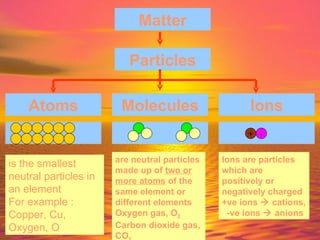
Matter Particles Ions Molecules Atoms is the smallest neutral particles in an element For example : Copper, Cu, Oxygen, O are neutral particles made up of  two or more atoms  of the same element or different elements Oxygen gas, O 2 Carbon dioxide gas, CO 2 Ions are particles which are positively or negatively charged +ve ions    cations,  -ve ions    anions + -
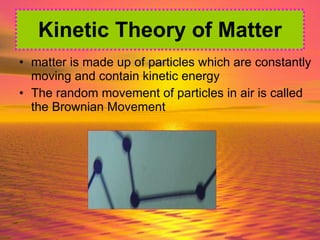
matter is made up of particles which are constantly moving and contain kinetic energy The random movement of particles in air is called the Brownian Movement Kinetic Theory of Matter
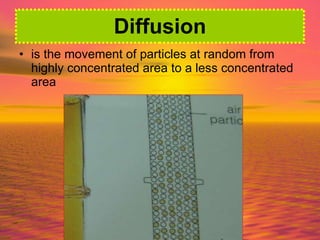
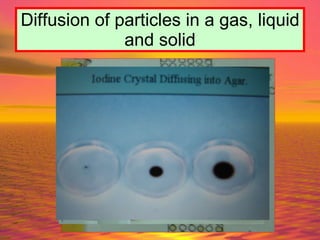
Diffusion is the movement of particles at random from highly concentrated area to a less concentrated area
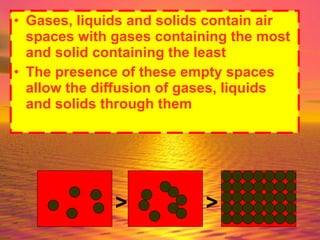
Gases, liquids and solids contain air spaces with gases containing the most and solid containing the least The presence of these empty spaces allow the diffusion of gases, liquids and solids through them > >
Do you know why we can smell a durian kept in the corner of a room ? Its smell diffuses rapidly through air which has more empty spaces than liquids and solids
Diffusion of particles in a gas, liquid and solid
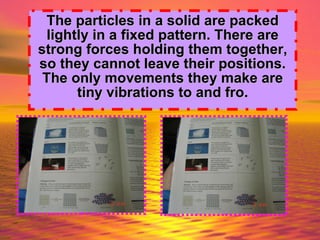
The particles in a   solid are packed lightly in a fixed pattern. There are strong forces holding them together, so they cannot leave their positions. The only movements they make are tiny vibrations to and fro.
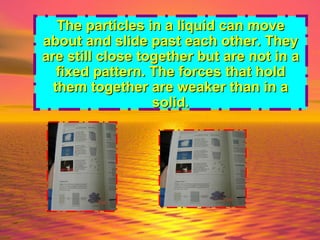
The particles in a liquid can move about and slide past each other. They are still close together but are not in a fixed pattern. The forces that hold them together are weaker than in a solid.
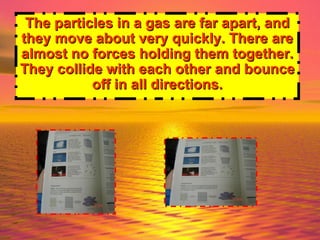
The particles in a gas are far apart, and they move about very quickly. There are almost no forces holding them together. They collide with each other and bounce off in all directions.
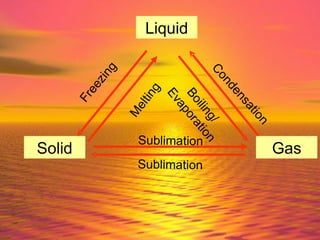
Solid Liquid Gas Melting Freezing Boiling/ Evaporation Condensation Sublimation Sublimation
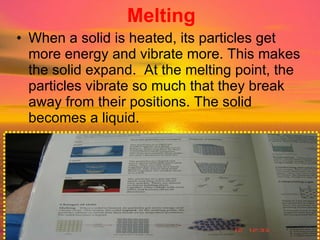
Melting When a solid is heated, its particles get more energy and vibrate more. This makes the solid expand.  At the melting point, the particles vibrate so much that they break away from their positions. The solid becomes a liquid.
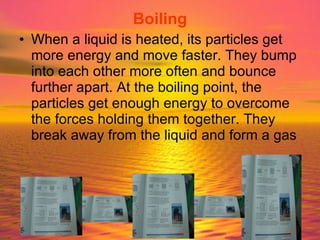
Boiling When a liquid is heated, its particles get more energy and move faster. They bump into each other more often and bounce further apart. At the boiling point, the particles get enough energy to overcome the forces holding them together. They break away from the liquid and form a gas
Evaporation Some particles in a liquid have more energy than others. Even when a liquid is well below boiling point, some particles have enough energy to escape and form a gas. It is why puddles of rain dry up in the sunshine.
Condensation When a gas is cooked, the particles lose energy. They move more and more slowly. When they bump into each other, they do not have enough energy to bounce away again. They stay close together and a liquid forms. When the liquid is cooled, the particles slow down even more. Eventually they stop moving, except for tiny vibrations, and a solid forms.
Sublimation Is a process during which a solid gains enough energy to overcome the forces of attraction between its particles to become a gas, without going through the liquid state, and vice versa
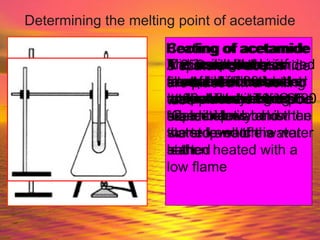
Determining the melting point of acetamide Heating of acetamide 3 spatula of acetamide are placed in a boiling tube A 250 ml beaker is filled with water and then placed on a tripod stand The boiling tube is clamped in the beaker and make sure the acetamide is below the water level of the water bath The water bath is heated until reach a temperature about 65  0 C, a stop watch is started and the water is then heated with a low flame The temperature of acetamide is recorded at 30 s intervals until 90  0 C.  Make sure the acetamide is stirred continuously during the experiment The result are recorded in a table Cooling of acetamide The boiling tube id removed from the hot water bath using test tube holder It id immediately transferred into a conical flask to be cooled slowly and then the stop watch is started  The temperature is recorded at 30 s intervals until 70  0 C Make sure the acetamide is stirred continuously during the experiment The result are recorded in a table

Chapter 2 part 1(08)

  • 1.
    CHAPTER 2The Structure of the Atom
  • 2.
    What is amatter?
  • 3.
    Matter is definedas anything that has mass and takes up space .
  • 4.
    Can you definethe word ‘mass’?
  • 5.
    Mass The massof an object is the amount of matter the object contains.
  • 6.
    A golf ballhas a greater mass than a tennis ball . The golf ball, therefore, contains more matter.
  • 7.
    What is mattermade up of ?
  • 8.
    Matter Particles IonsMolecules Atoms is the smallest neutral particles in an element For example : Copper, Cu, Oxygen, O are neutral particles made up of two or more atoms of the same element or different elements Oxygen gas, O 2 Carbon dioxide gas, CO 2 Ions are particles which are positively or negatively charged +ve ions  cations, -ve ions  anions + -
  • 9.
    matter is madeup of particles which are constantly moving and contain kinetic energy The random movement of particles in air is called the Brownian Movement Kinetic Theory of Matter
  • 10.
    Diffusion is themovement of particles at random from highly concentrated area to a less concentrated area
  • 11.
    Gases, liquids andsolids contain air spaces with gases containing the most and solid containing the least The presence of these empty spaces allow the diffusion of gases, liquids and solids through them > >
  • 12.
    Do you knowwhy we can smell a durian kept in the corner of a room ? Its smell diffuses rapidly through air which has more empty spaces than liquids and solids
  • 13.
    Diffusion of particlesin a gas, liquid and solid
  • 14.
    The particles ina solid are packed lightly in a fixed pattern. There are strong forces holding them together, so they cannot leave their positions. The only movements they make are tiny vibrations to and fro.
  • 15.
    The particles ina liquid can move about and slide past each other. They are still close together but are not in a fixed pattern. The forces that hold them together are weaker than in a solid.
  • 16.
    The particles ina gas are far apart, and they move about very quickly. There are almost no forces holding them together. They collide with each other and bounce off in all directions.
  • 17.
    Solid Liquid GasMelting Freezing Boiling/ Evaporation Condensation Sublimation Sublimation
  • 18.
    Melting When asolid is heated, its particles get more energy and vibrate more. This makes the solid expand. At the melting point, the particles vibrate so much that they break away from their positions. The solid becomes a liquid.
  • 19.
    Boiling When aliquid is heated, its particles get more energy and move faster. They bump into each other more often and bounce further apart. At the boiling point, the particles get enough energy to overcome the forces holding them together. They break away from the liquid and form a gas
  • 20.
    Evaporation Some particlesin a liquid have more energy than others. Even when a liquid is well below boiling point, some particles have enough energy to escape and form a gas. It is why puddles of rain dry up in the sunshine.
  • 21.
    Condensation When agas is cooked, the particles lose energy. They move more and more slowly. When they bump into each other, they do not have enough energy to bounce away again. They stay close together and a liquid forms. When the liquid is cooled, the particles slow down even more. Eventually they stop moving, except for tiny vibrations, and a solid forms.
  • 22.
    Sublimation Is aprocess during which a solid gains enough energy to overcome the forces of attraction between its particles to become a gas, without going through the liquid state, and vice versa
  • 23.
    Determining the meltingpoint of acetamide Heating of acetamide 3 spatula of acetamide are placed in a boiling tube A 250 ml beaker is filled with water and then placed on a tripod stand The boiling tube is clamped in the beaker and make sure the acetamide is below the water level of the water bath The water bath is heated until reach a temperature about 65 0 C, a stop watch is started and the water is then heated with a low flame The temperature of acetamide is recorded at 30 s intervals until 90 0 C. Make sure the acetamide is stirred continuously during the experiment The result are recorded in a table Cooling of acetamide The boiling tube id removed from the hot water bath using test tube holder It id immediately transferred into a conical flask to be cooled slowly and then the stop watch is started The temperature is recorded at 30 s intervals until 70 0 C Make sure the acetamide is stirred continuously during the experiment The result are recorded in a table