CHAPTER  1 RATE OF REACTION
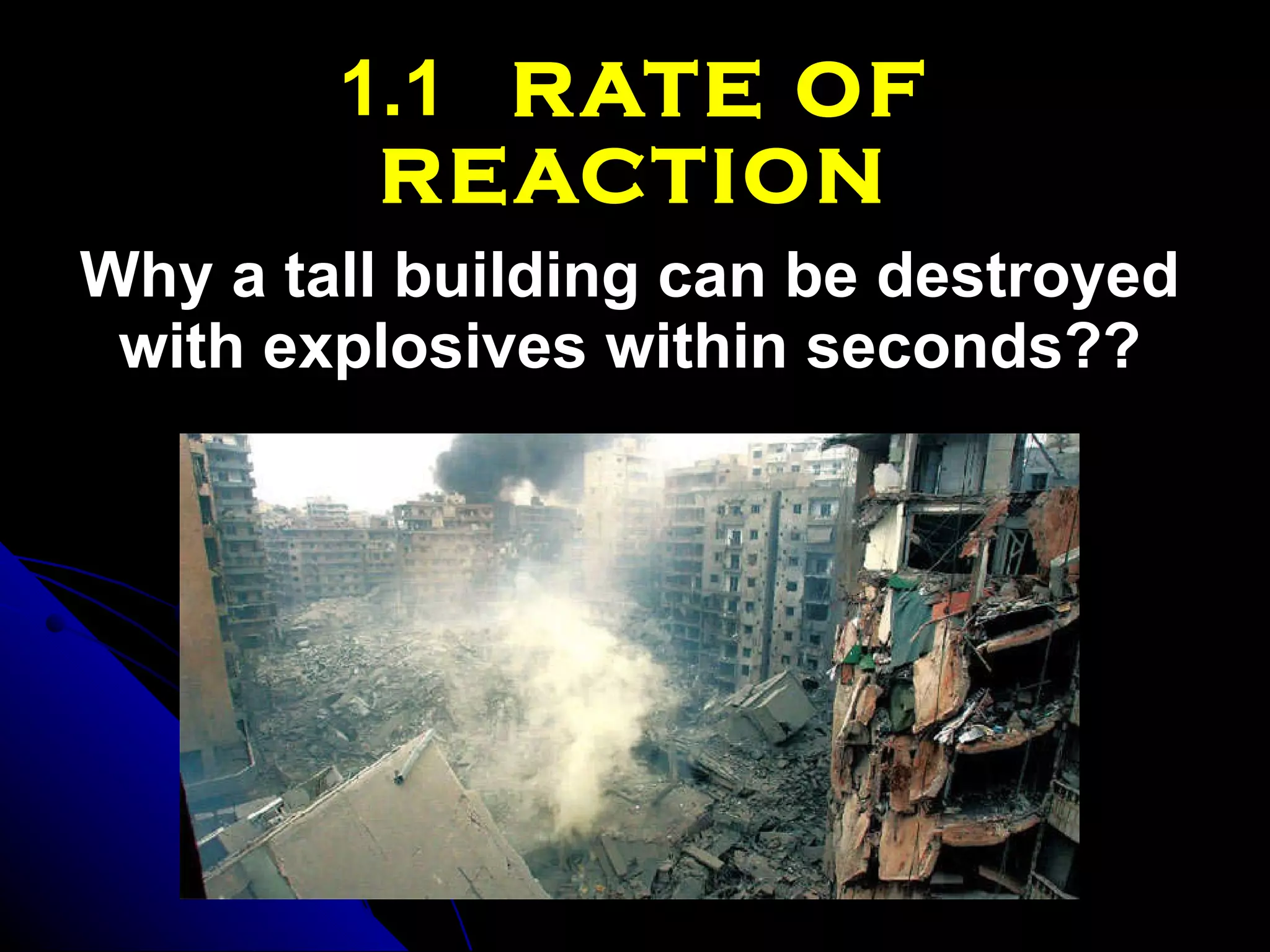
1.1  RATE OF REACTION Why a tall building can be destroyed with explosives within seconds??
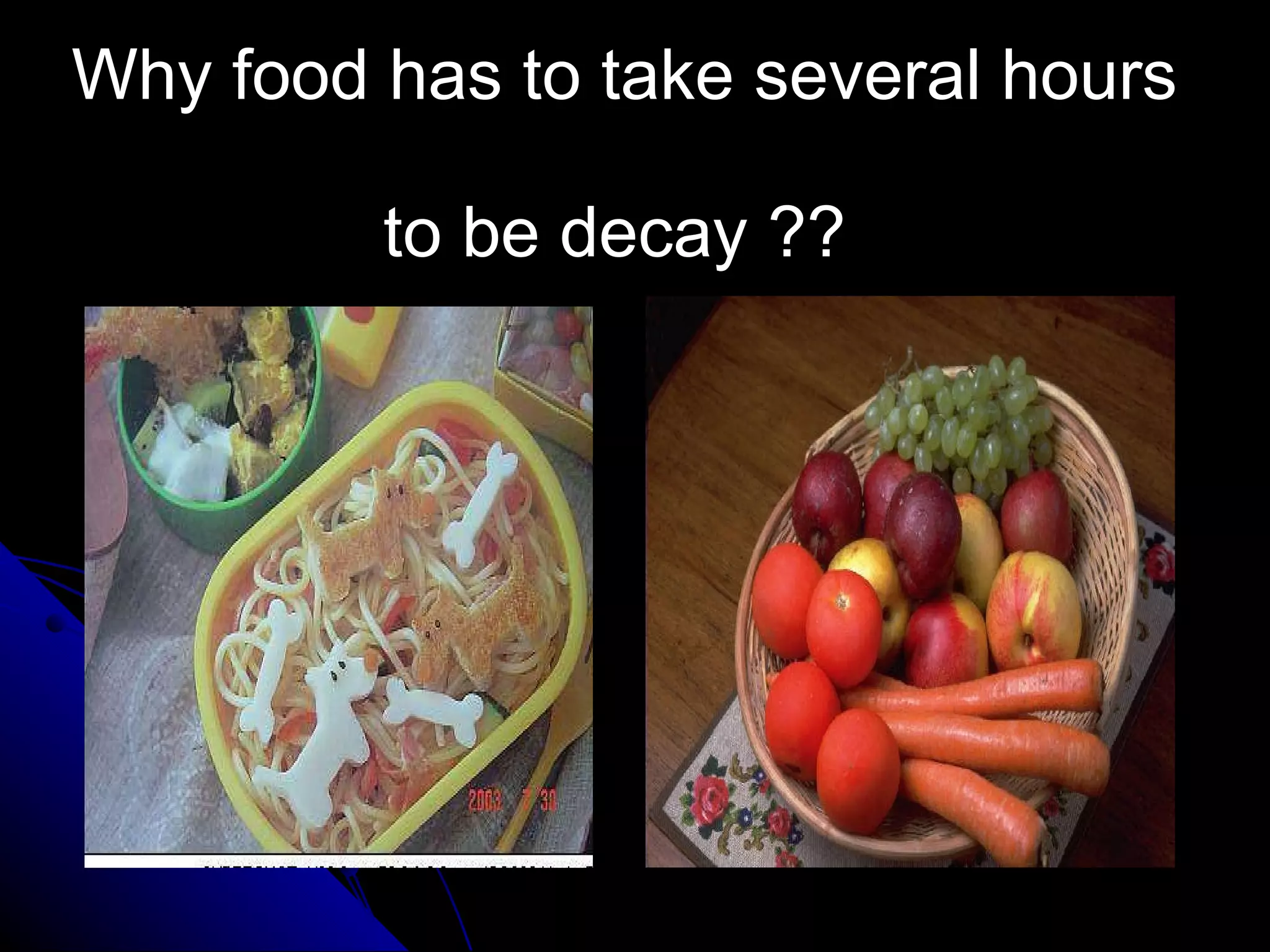
Why food has to take several hours  to be decay ??
Why do coal mines face a high risk of explosion ??
All these are because : difference of  rate of reaction
 
What is the rate of reaction ? The  speed  at which reactants are converted into products in a chemical reaction For examples:
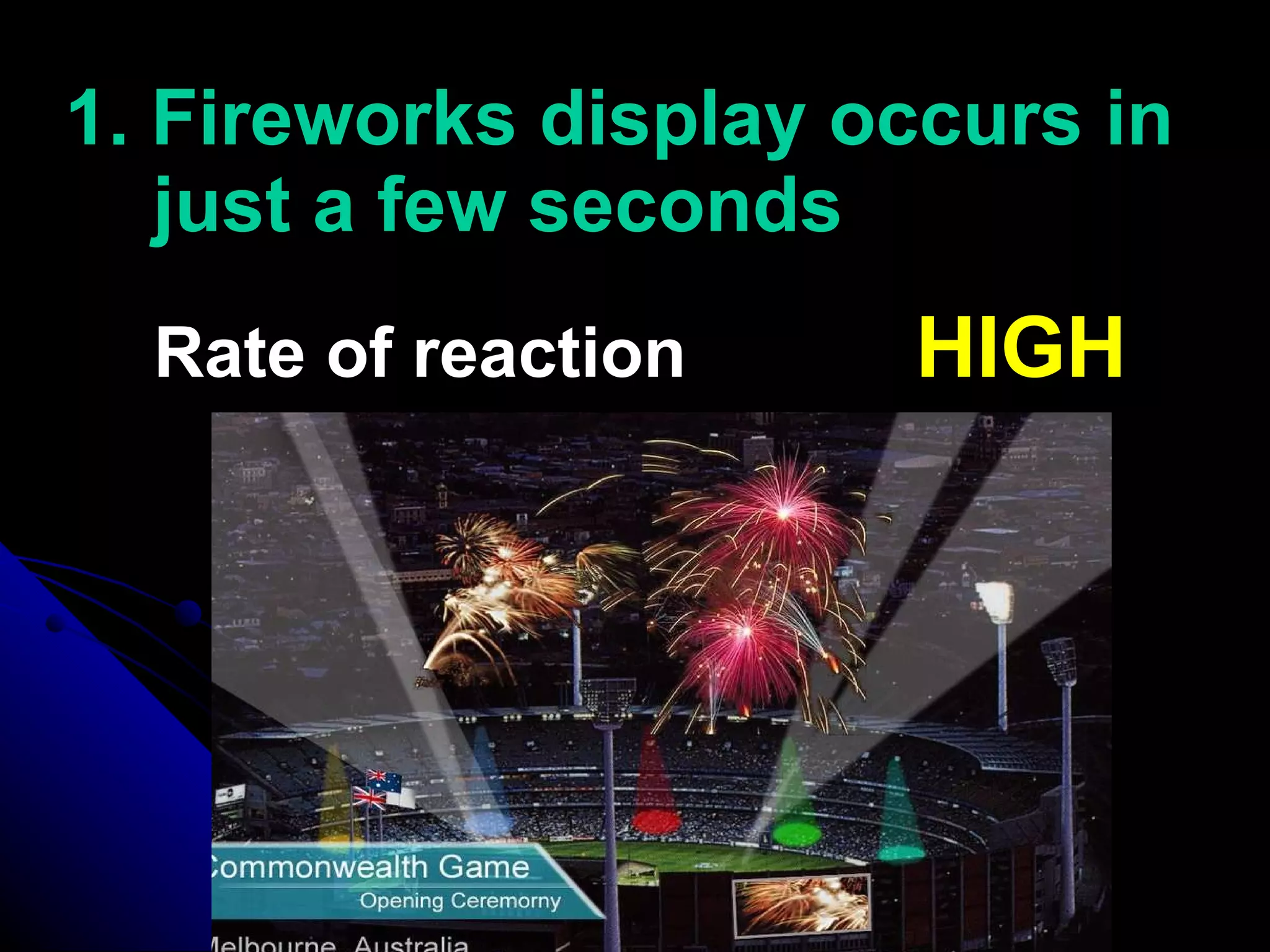
1. Fireworks display occurs in just a few seconds Rate of reaction   HIGH
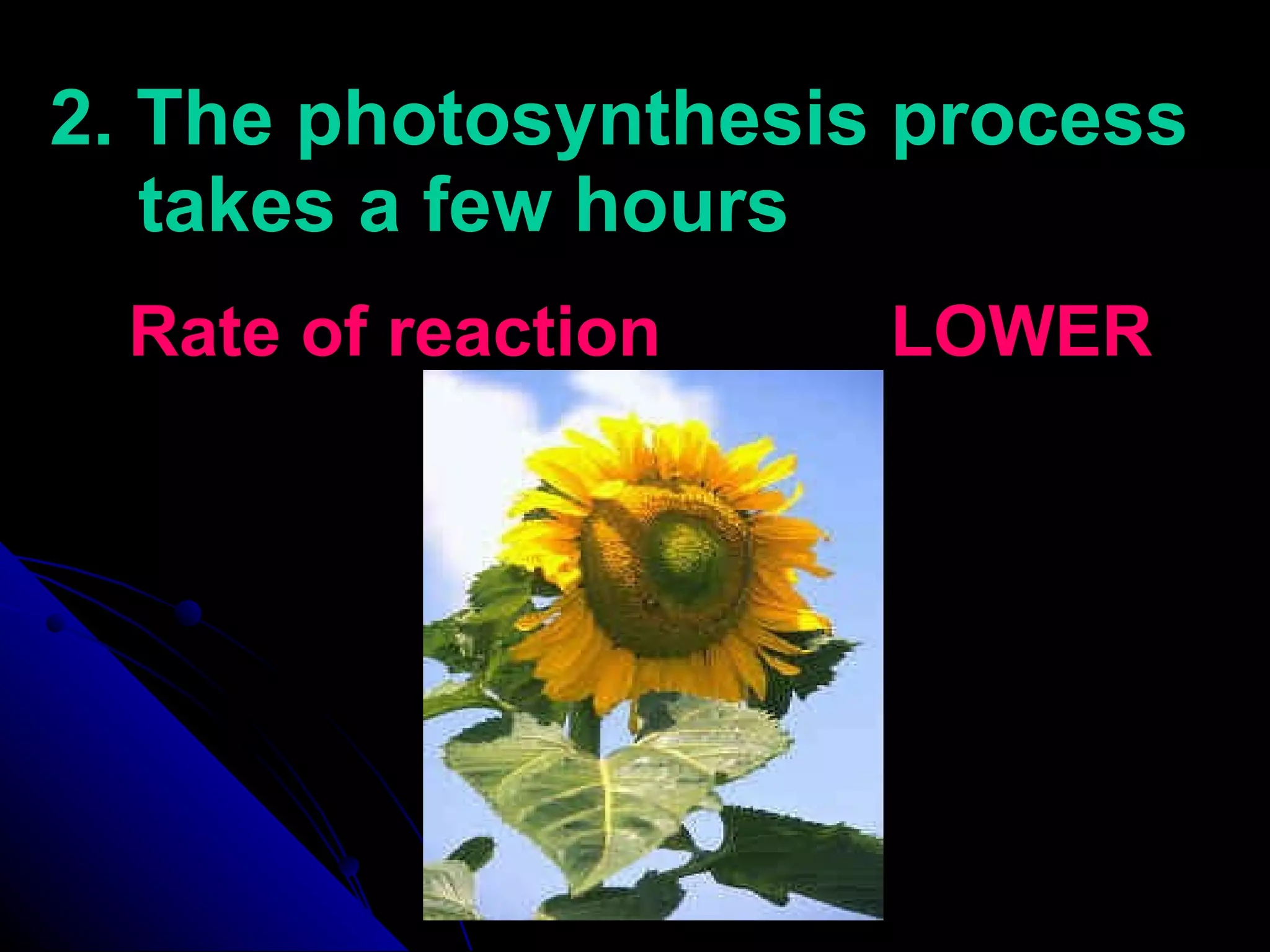
2. The photosynthesis process takes a few hours Rate of reaction  LOWER
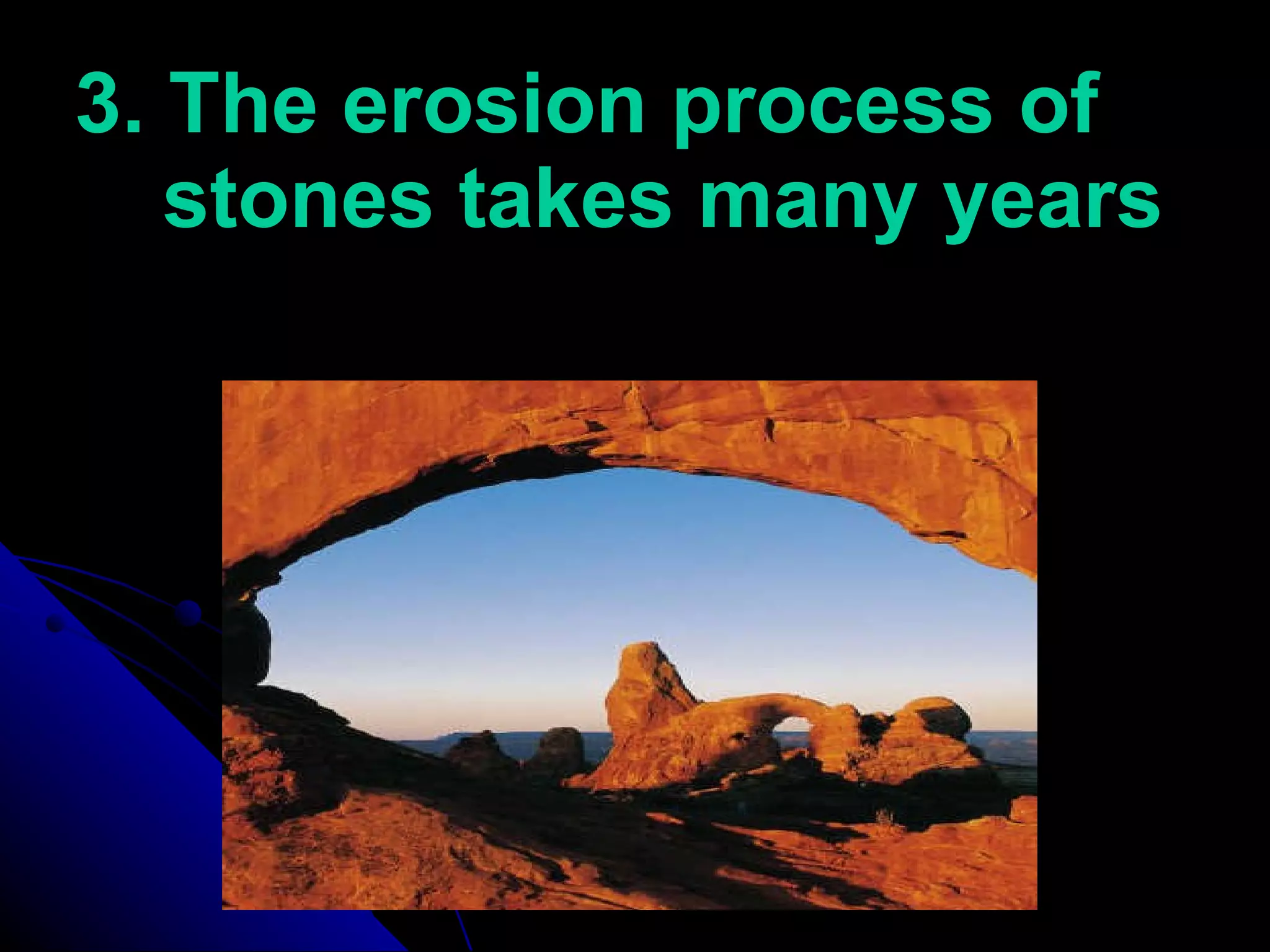
3. The erosion process of stones takes many years Rate of reaction  VERY LOW
Some reactions are fast &  some reactions are very slow So do the chemical reactions  in laboratory
How we determine & calculate the  rate of chemical reactions  in laboratory ??
It just  same  with the way we calculate the speed   of driving How we calculate the  speed of driving ??
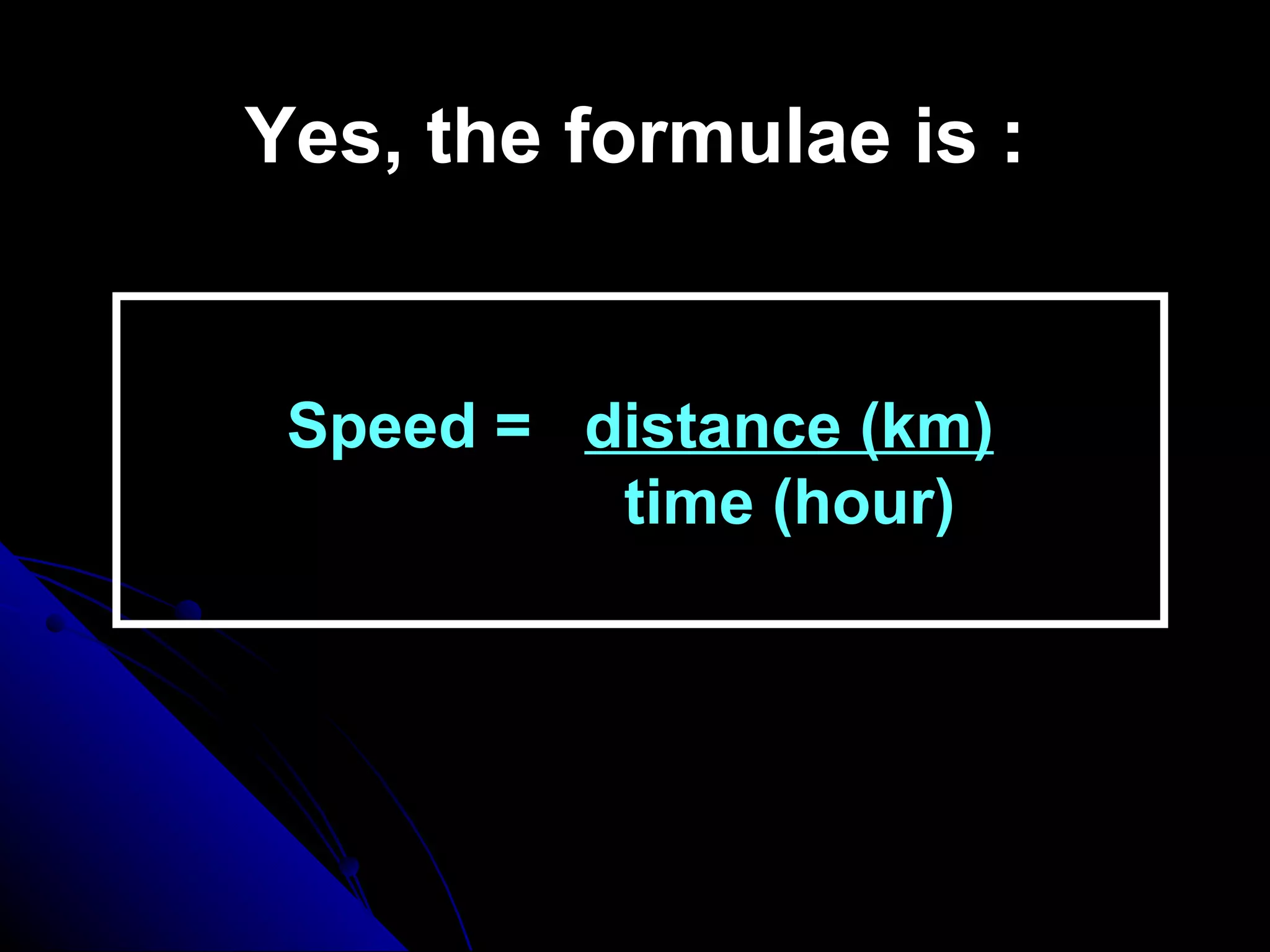
Yes, the formulae is : Speed =  distance (km)   time (hour)
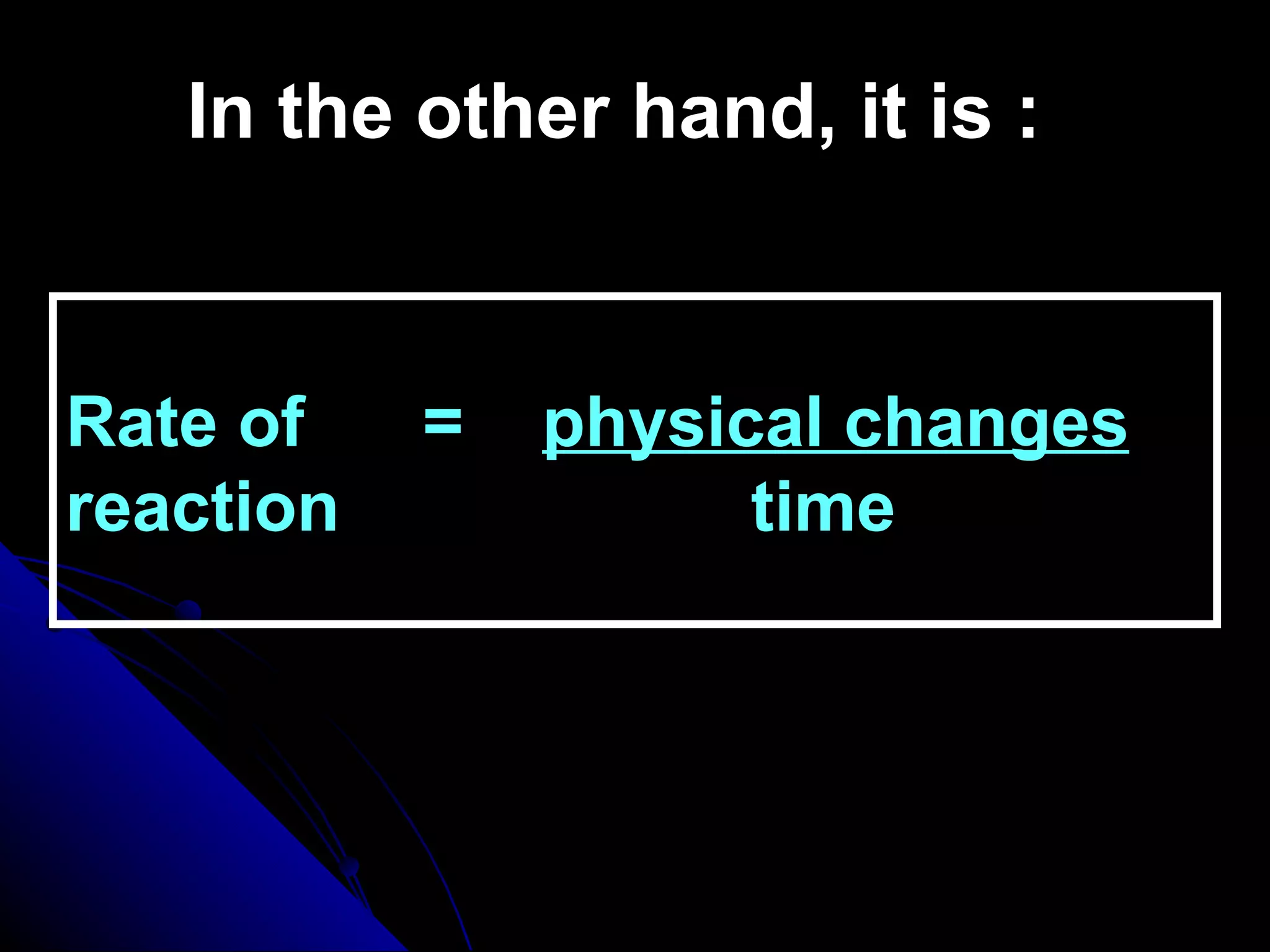
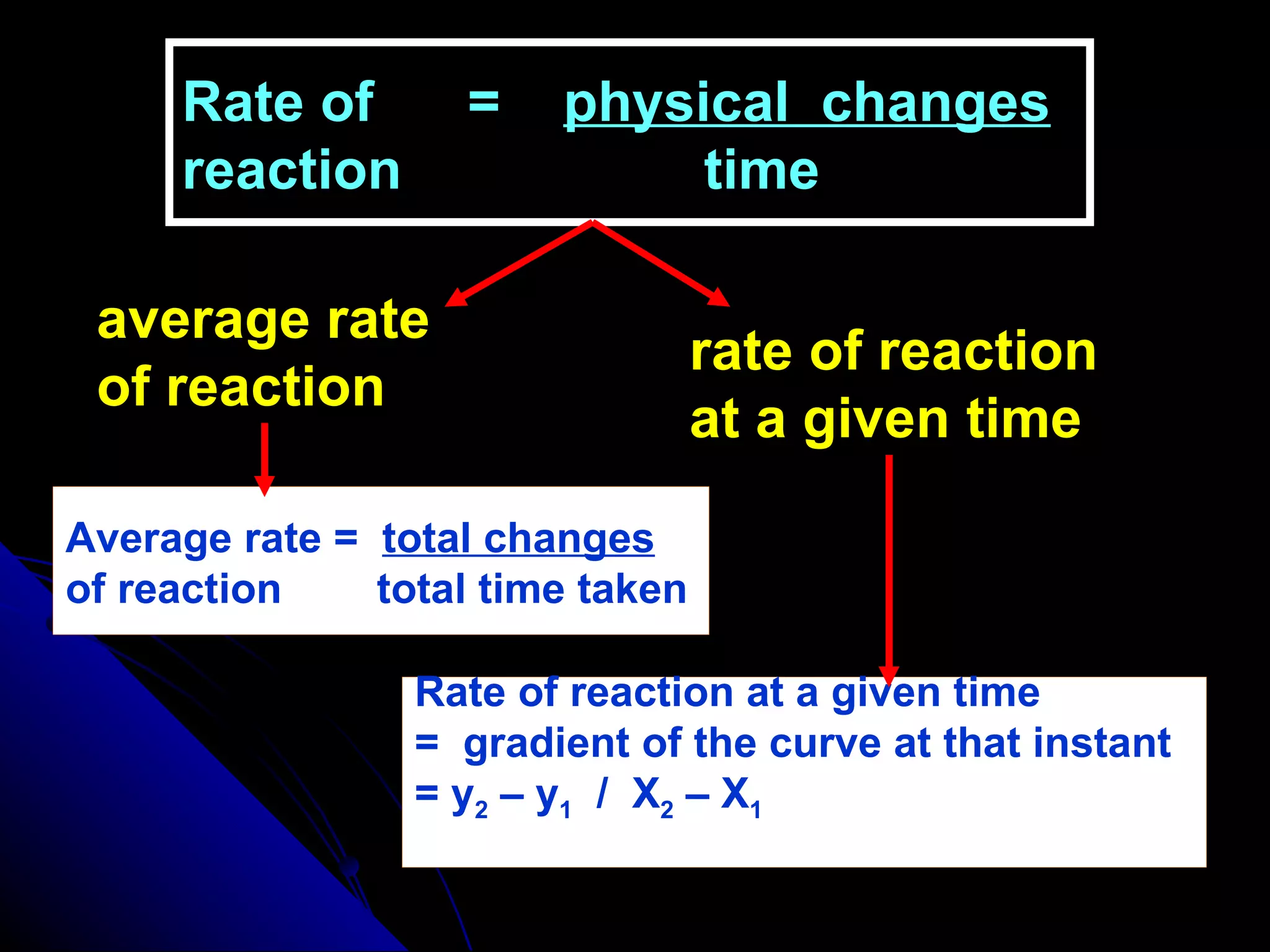
In the other hand,   it is : Rate of  =  physical changes reaction    time
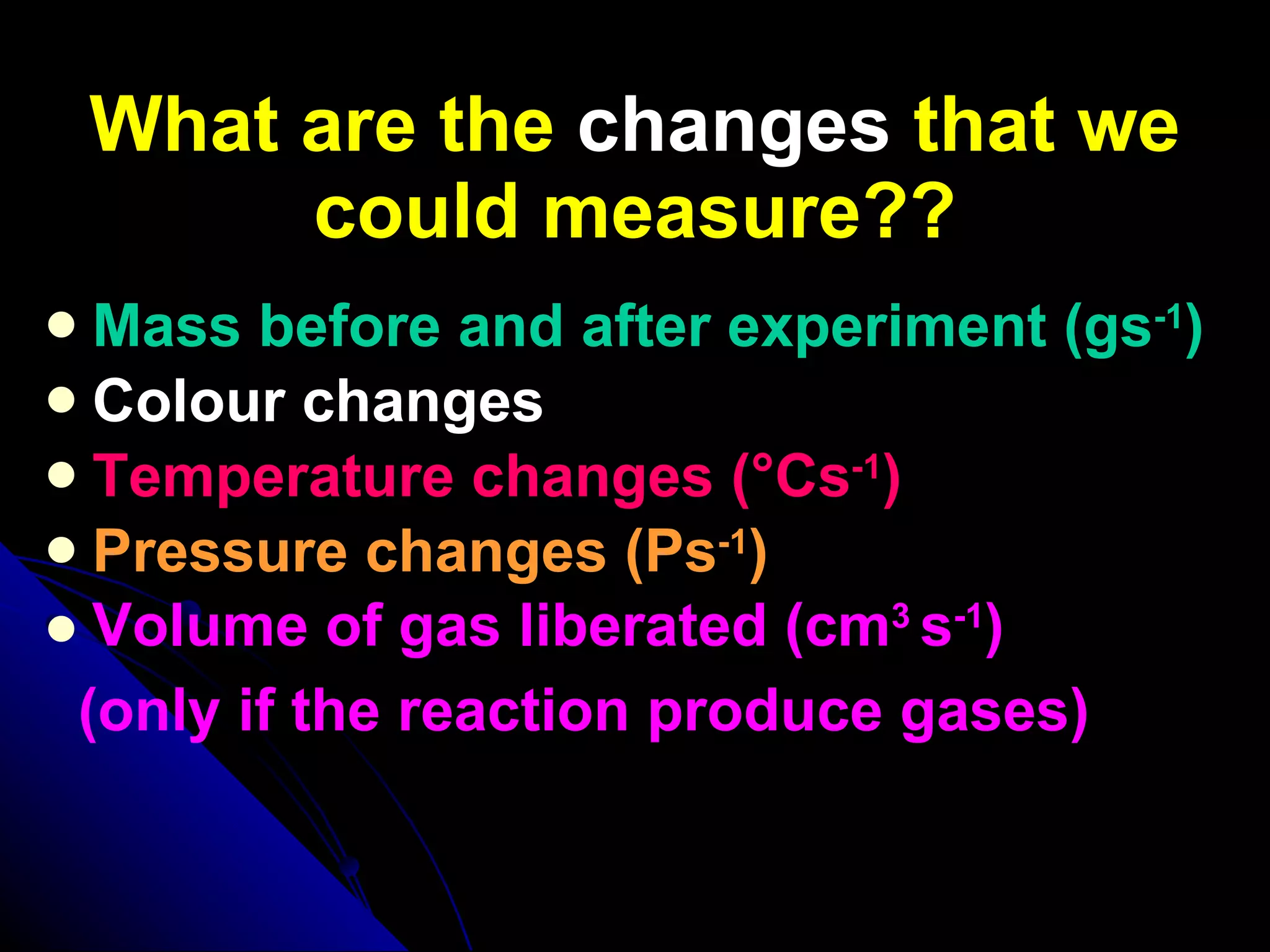
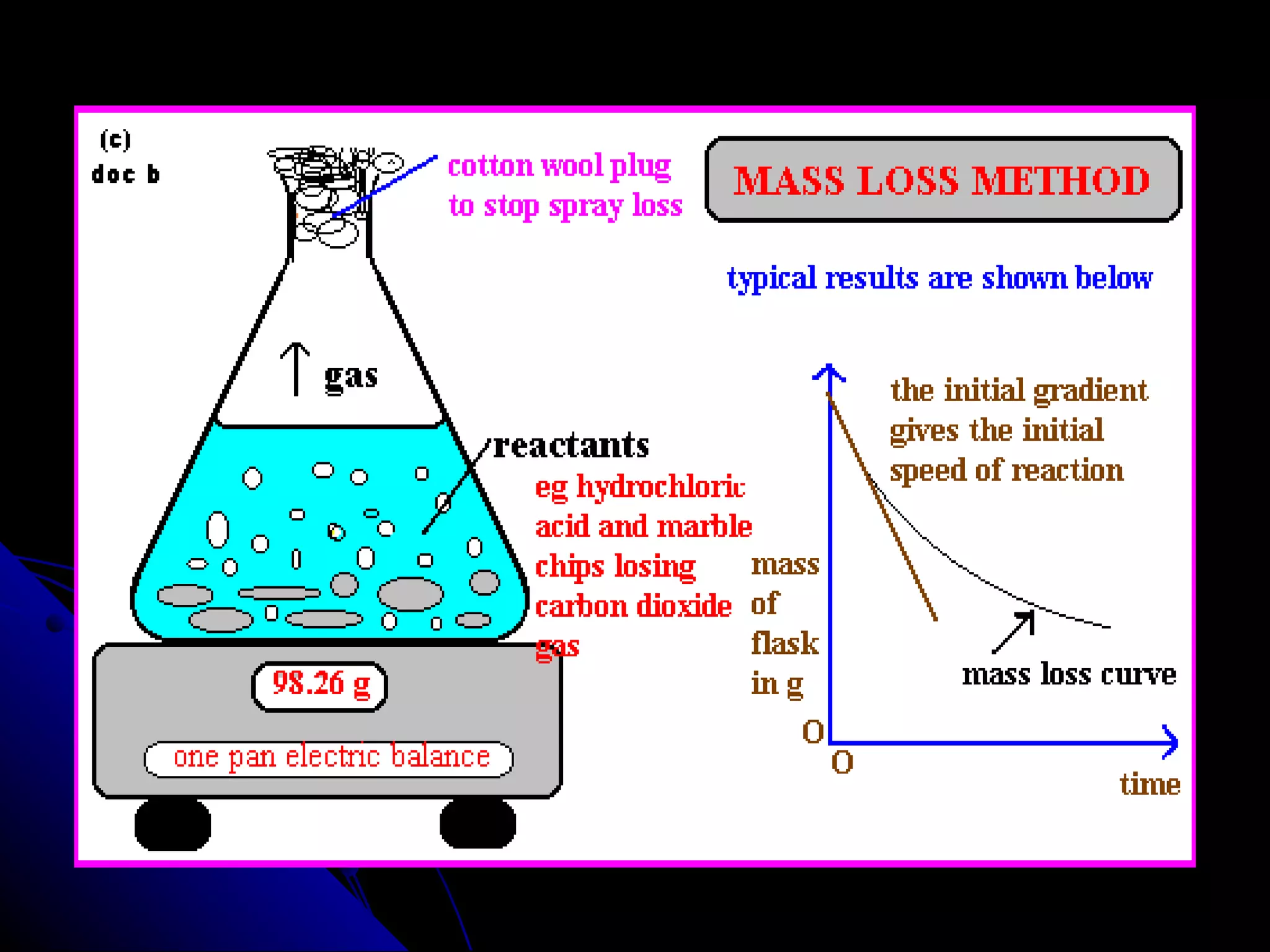
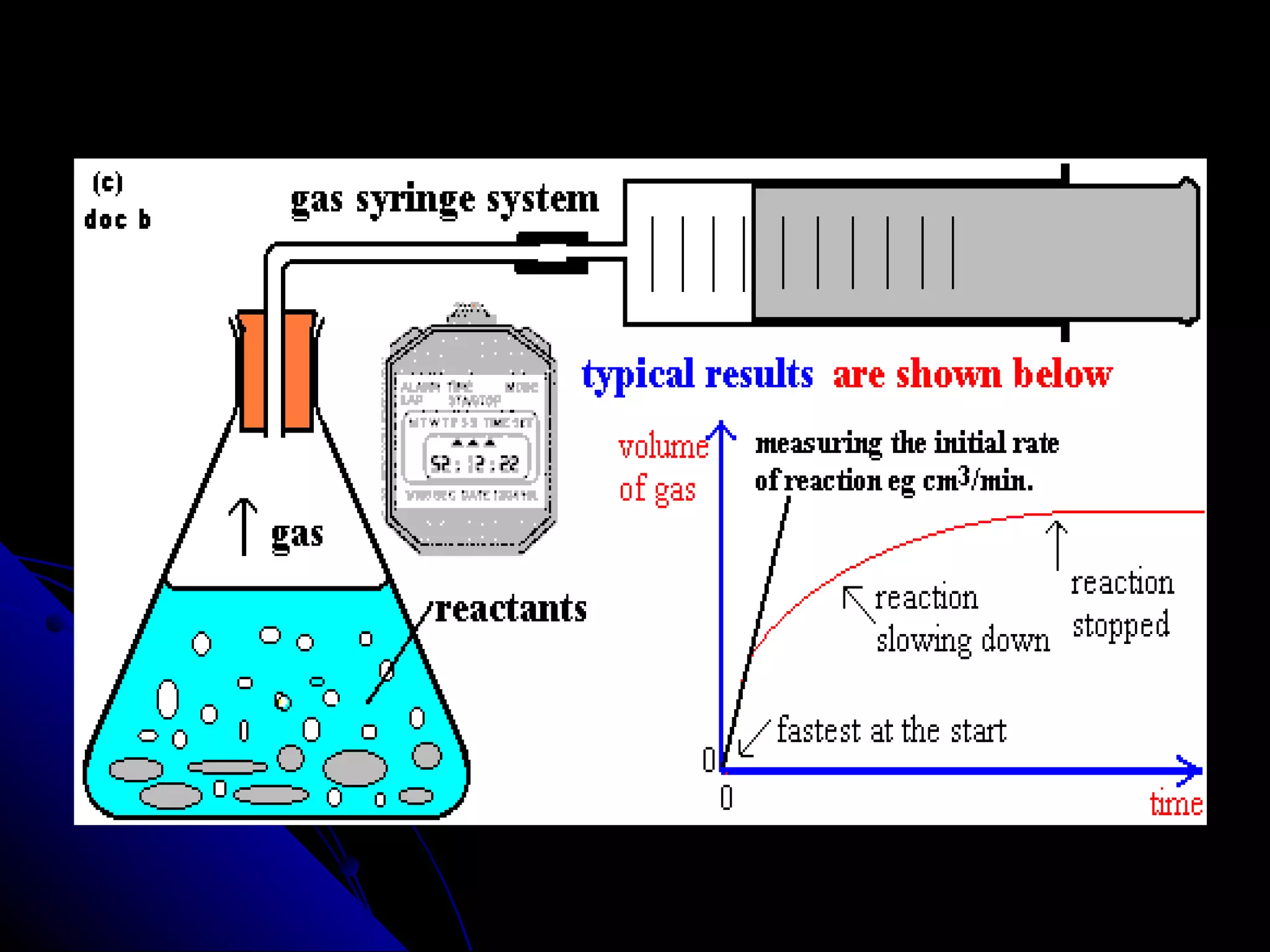
What are the  changes  that we could measure?? Mass before and after experiment (gs -1 ) Colour changes Temperature changes (°Cs -1 ) Pressure changes (Ps -1 ) Volume of gas liberated (cm 3   s -1 ) (only if the reaction produce gases)
 
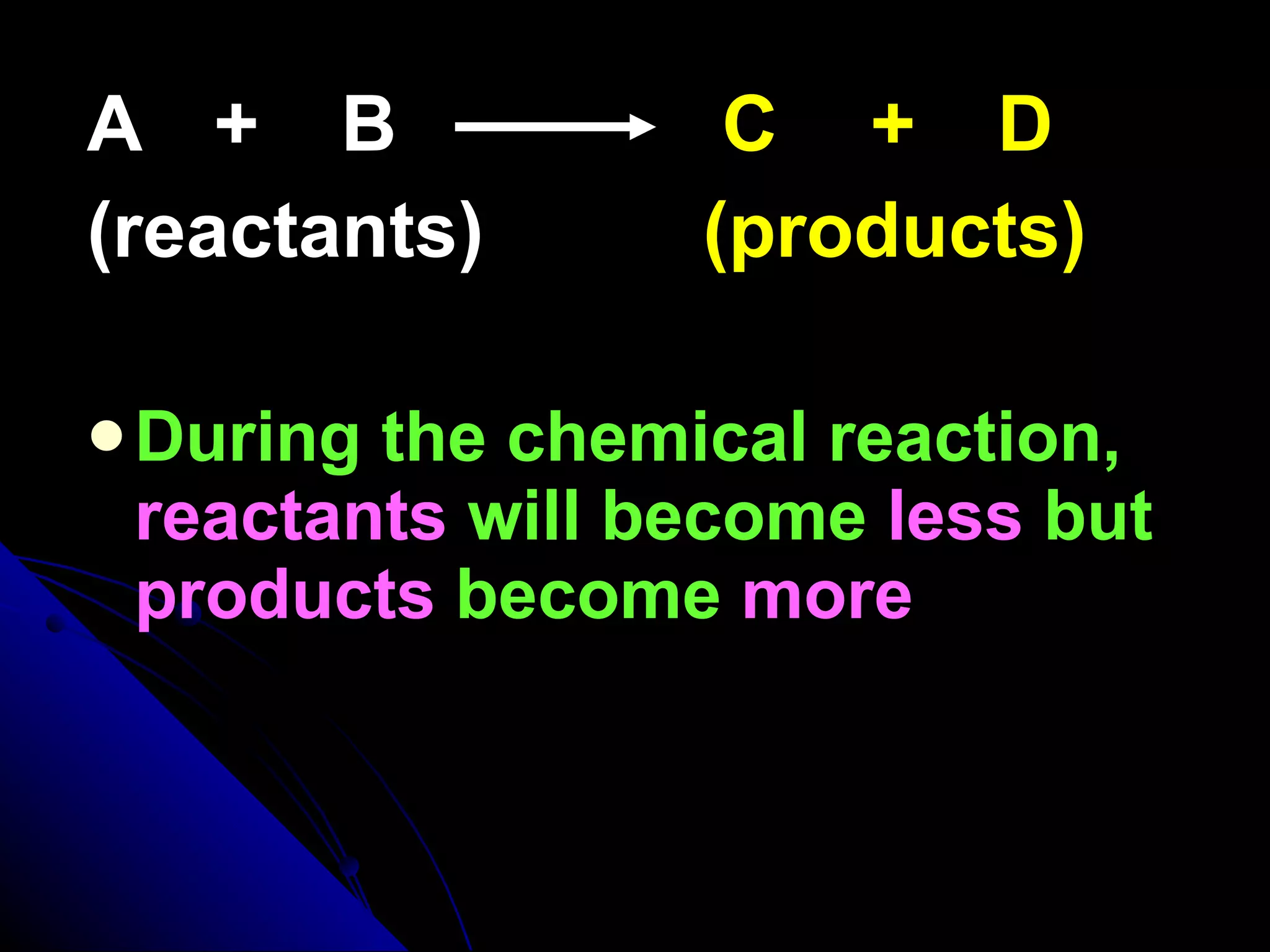
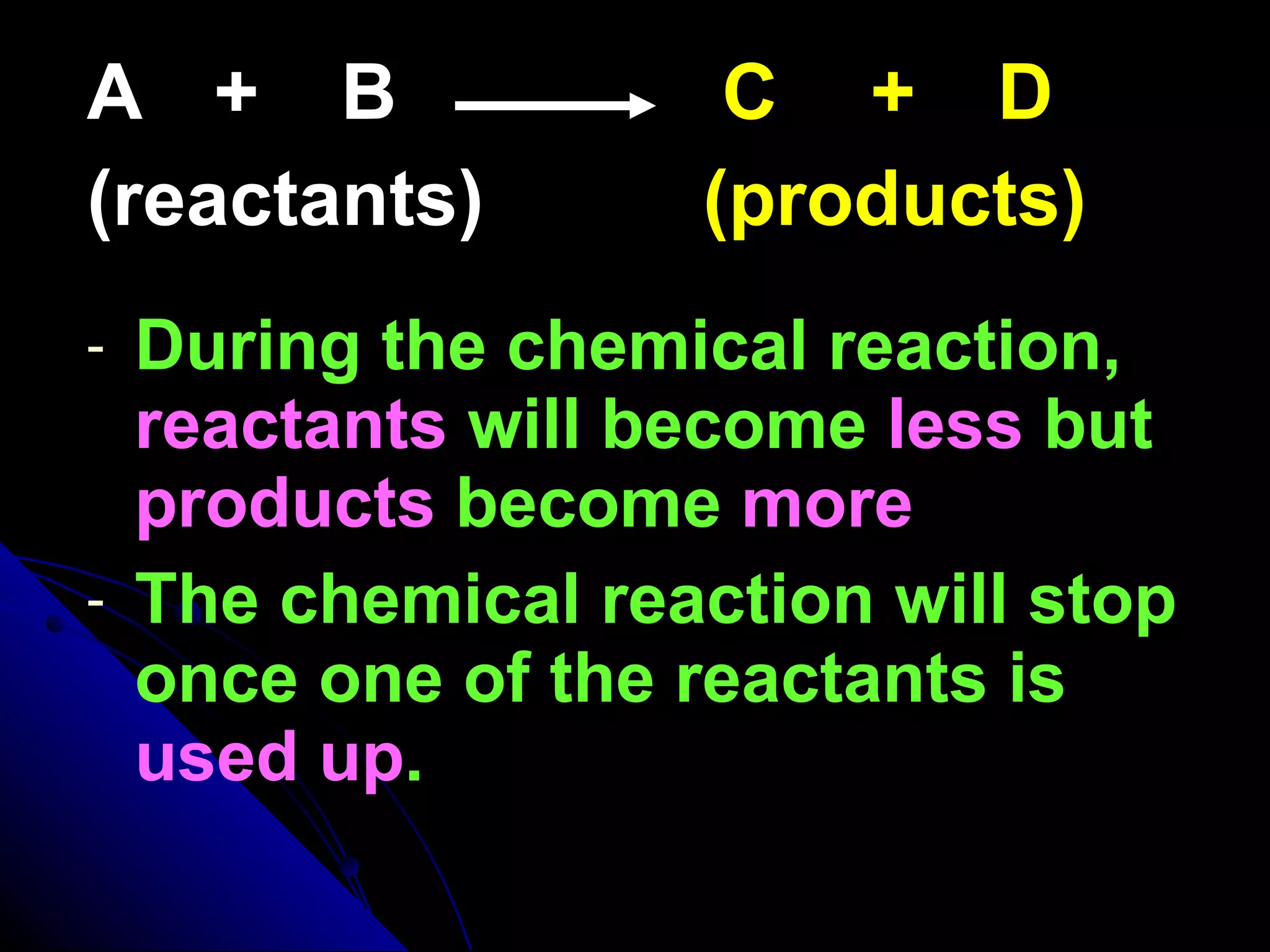
A  +  B  C   +   D (reactants)   (products) During the chemical reaction,  reactants  will become  less  but  products  become  more
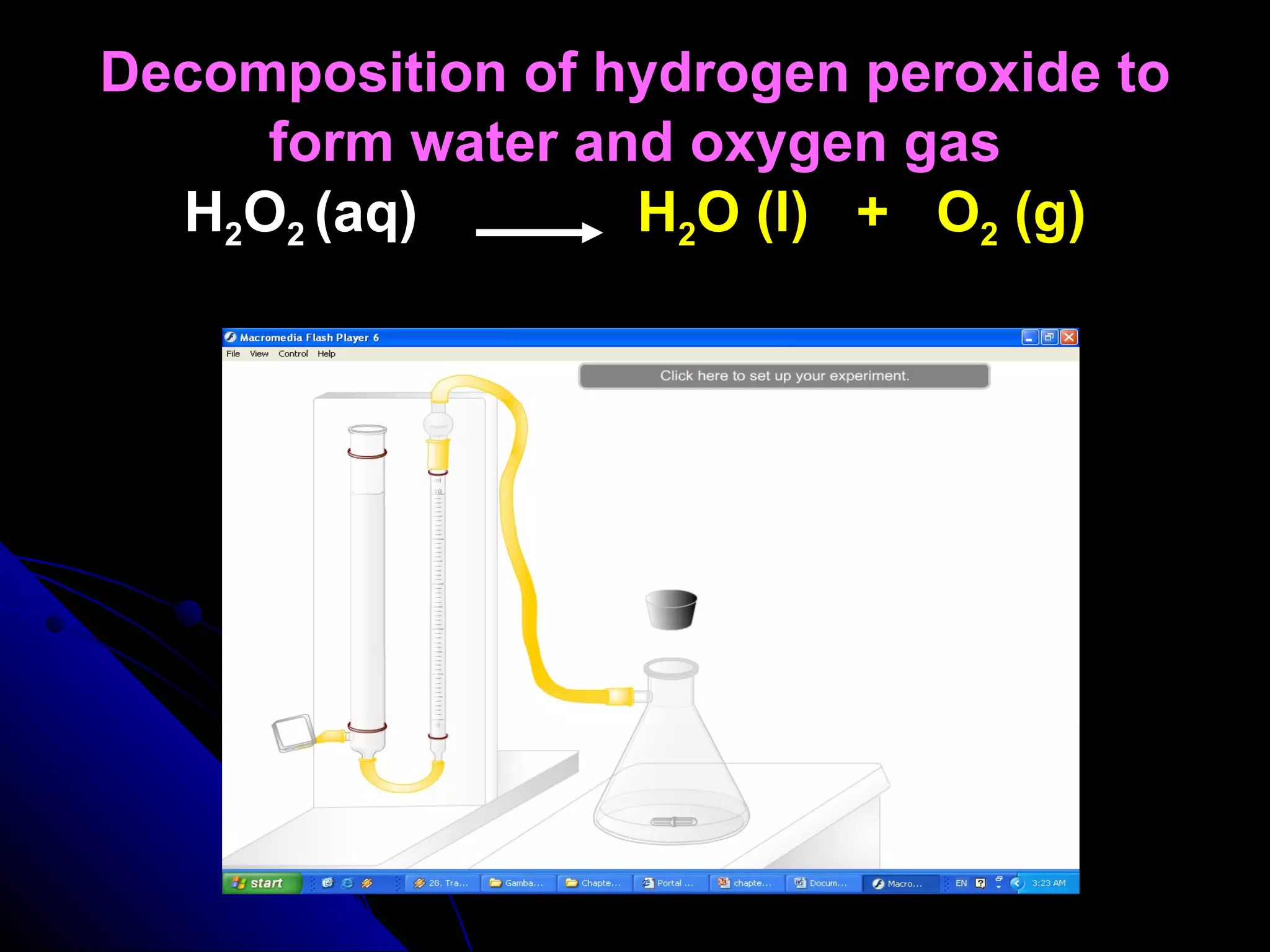
Decomposition of hydrogen peroxide to form water and oxygen gas H 2 O 2  (aq)  H 2 O (l)  +  O 2  (g)
Take 5
For any chemical reaction,  we can measure its  average rate of reaction  &  rate of reaction at a given time
What’s that  ??
Rate of  =  physical  changes reaction    time average rate  of reaction rate of reaction  at a given time Average rate =  total changes of reaction  total time taken Rate of reaction at a given time  =  gradient of the curve at that instant = y 2  – y 1   /  X 2  – X 1
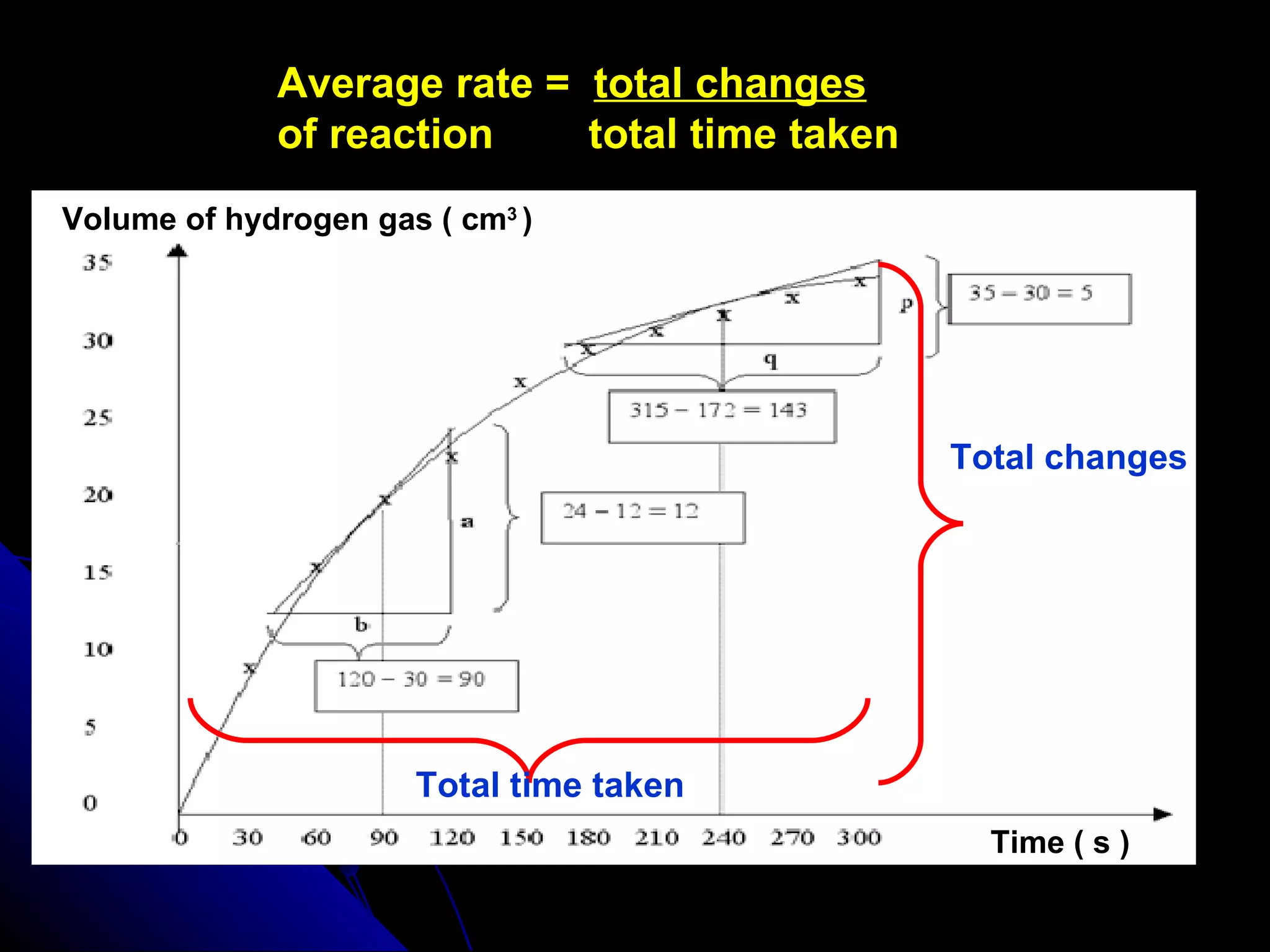
Total changes Total time taken Average rate =  total changes of reaction  total time taken Volume of hydrogen gas ( cm 3  ) Time ( s )
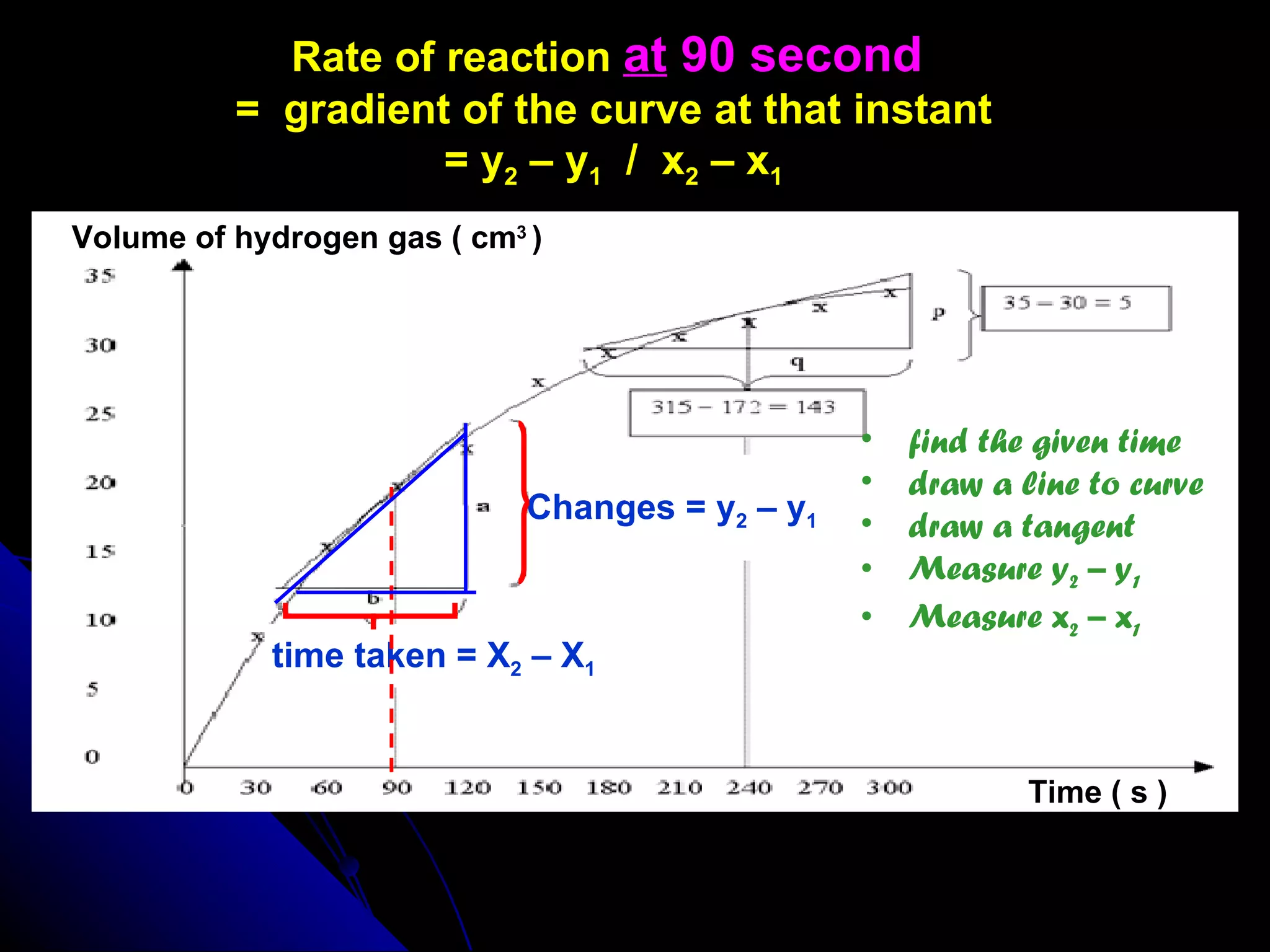
Changes = y 2  – y 1 time taken = X 2  – X 1 Rate of reaction  at   90 second  =  gradient of the curve at that instant = y 2  – y 1   /  x 2  – x 1 find the given time draw a line to curve draw a tangent Measure y 2  – y 1 Measure x 2  – x 1 Volume of hydrogen gas ( cm 3  ) Time ( s )
 
Let’s see an example:
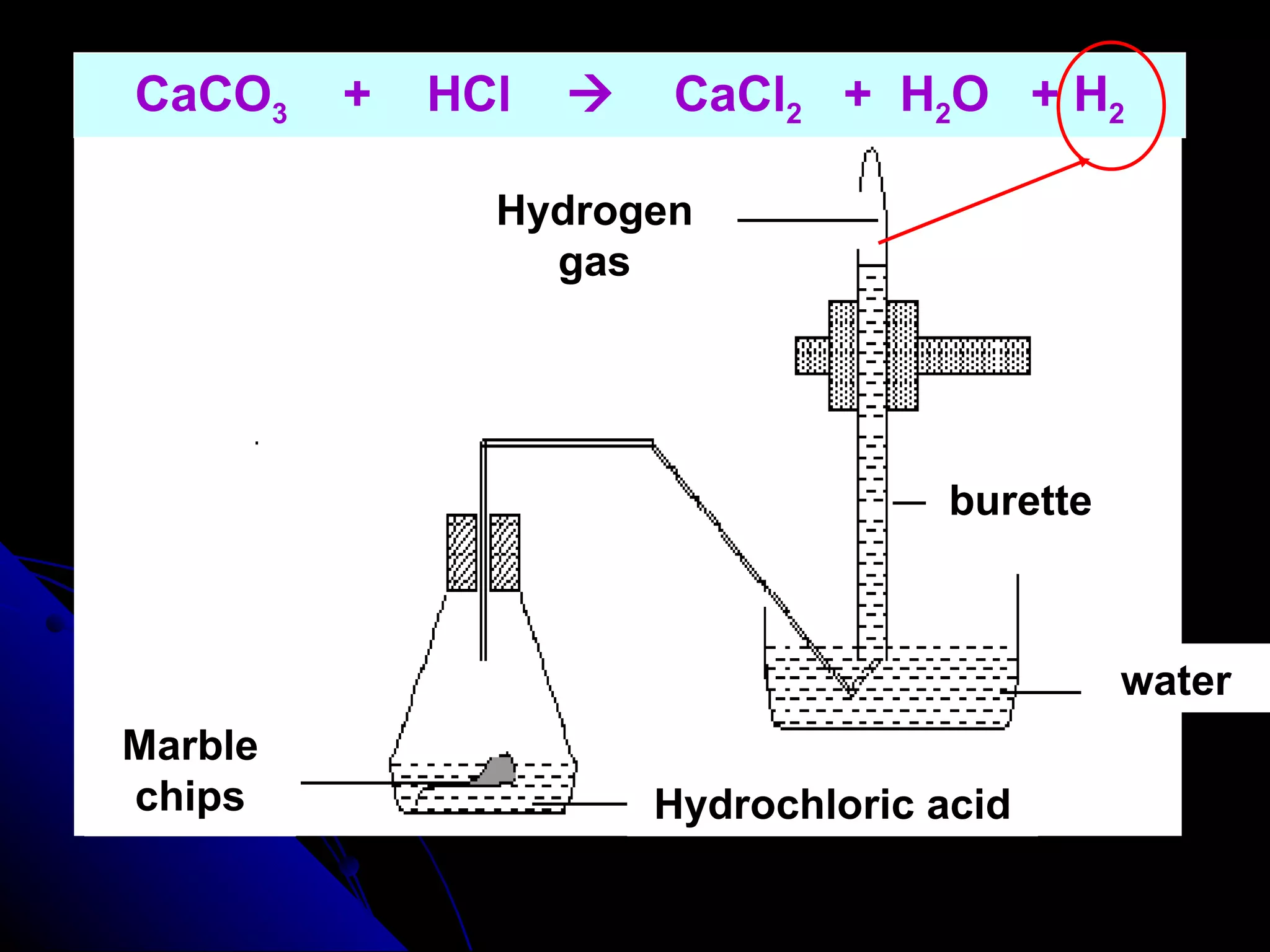
CaCO 3   +  HCl     CaCl 2   +  H 2 O  + H 2 burette water Hydrochloric acid Marble chips Hydrogen gas
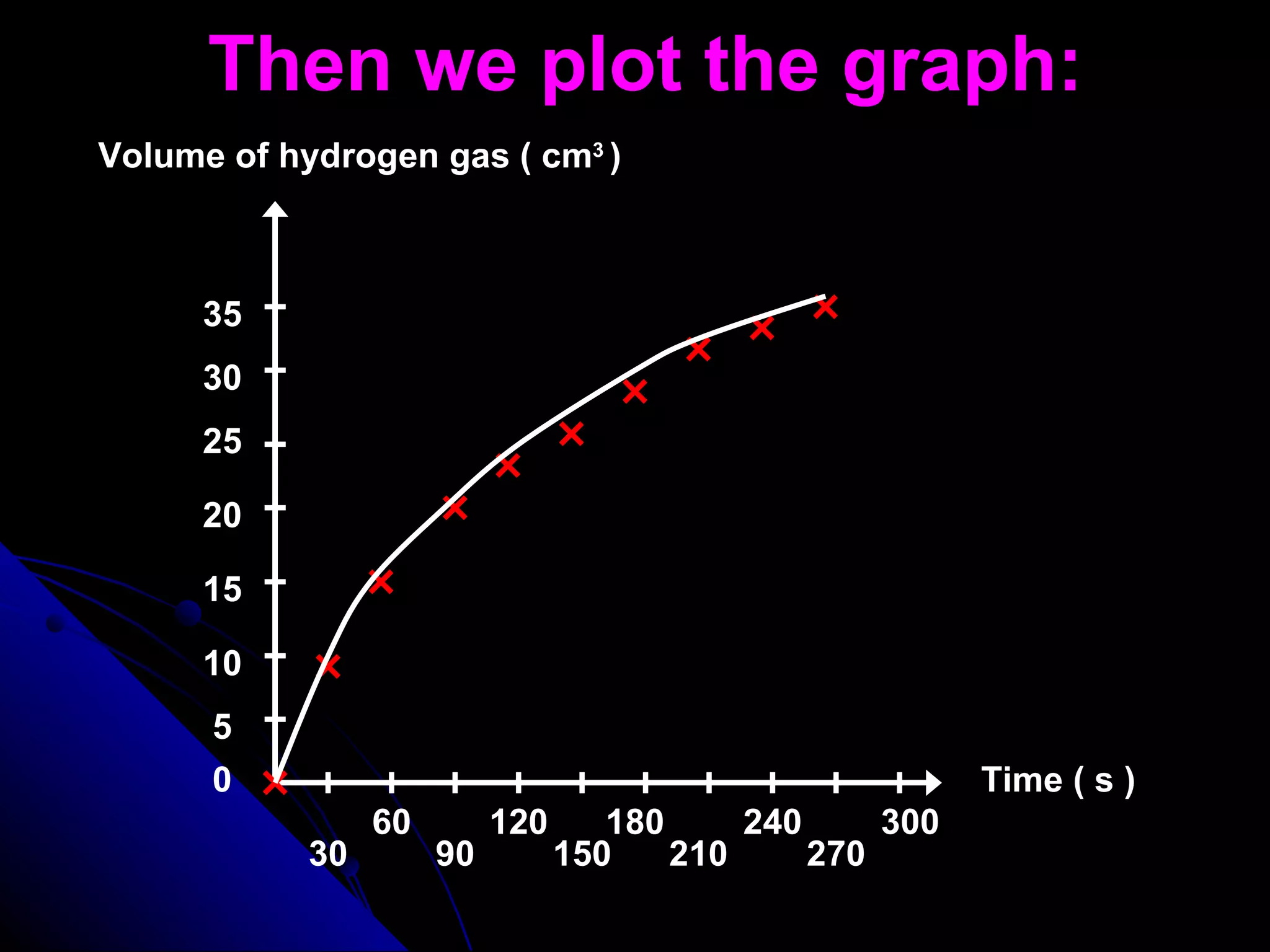
Volume of hydrogen gas was recorded every 30 seconds
. . . . . . . . . . . . . . . .   after 10 minutes . . .
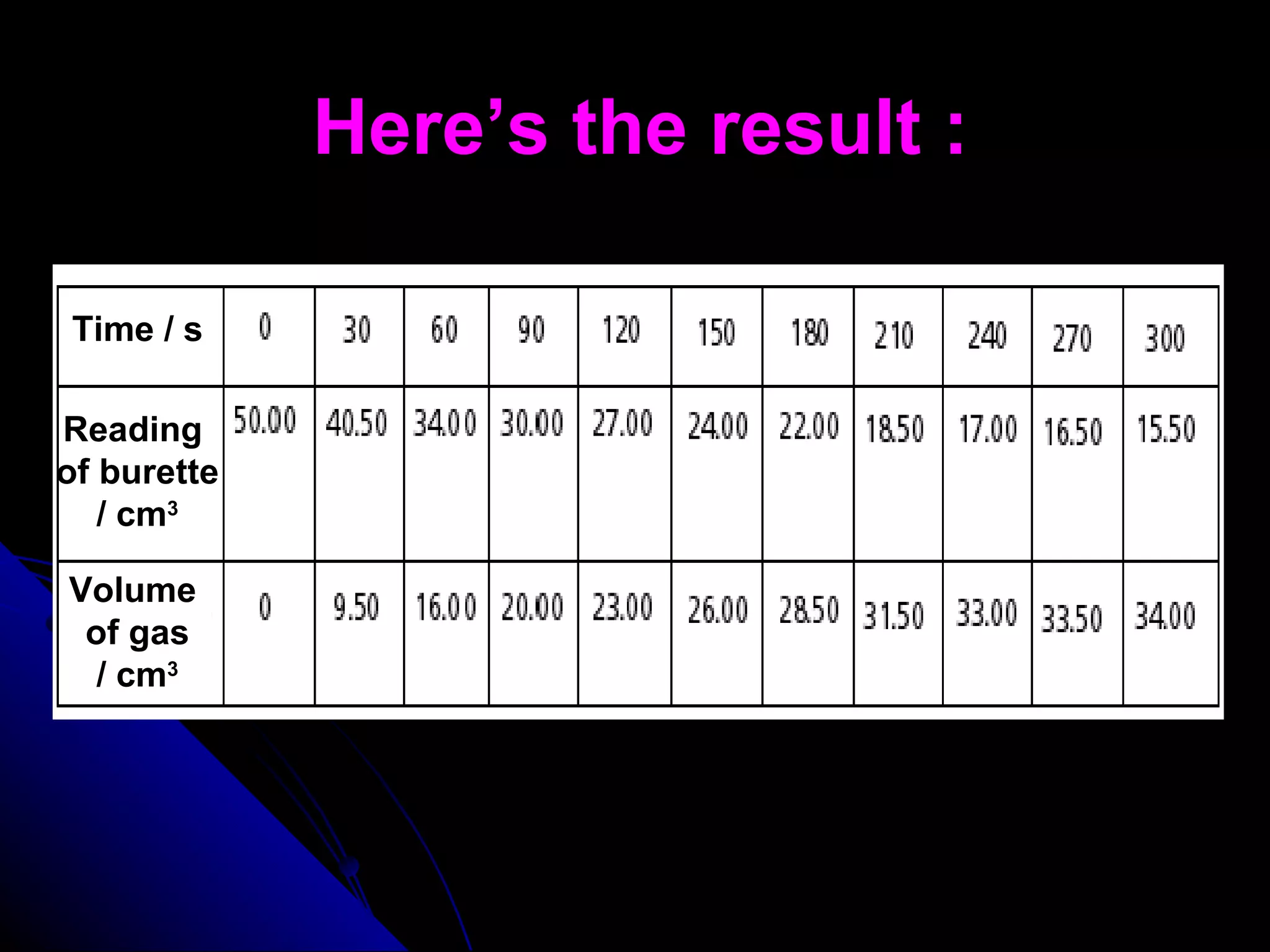
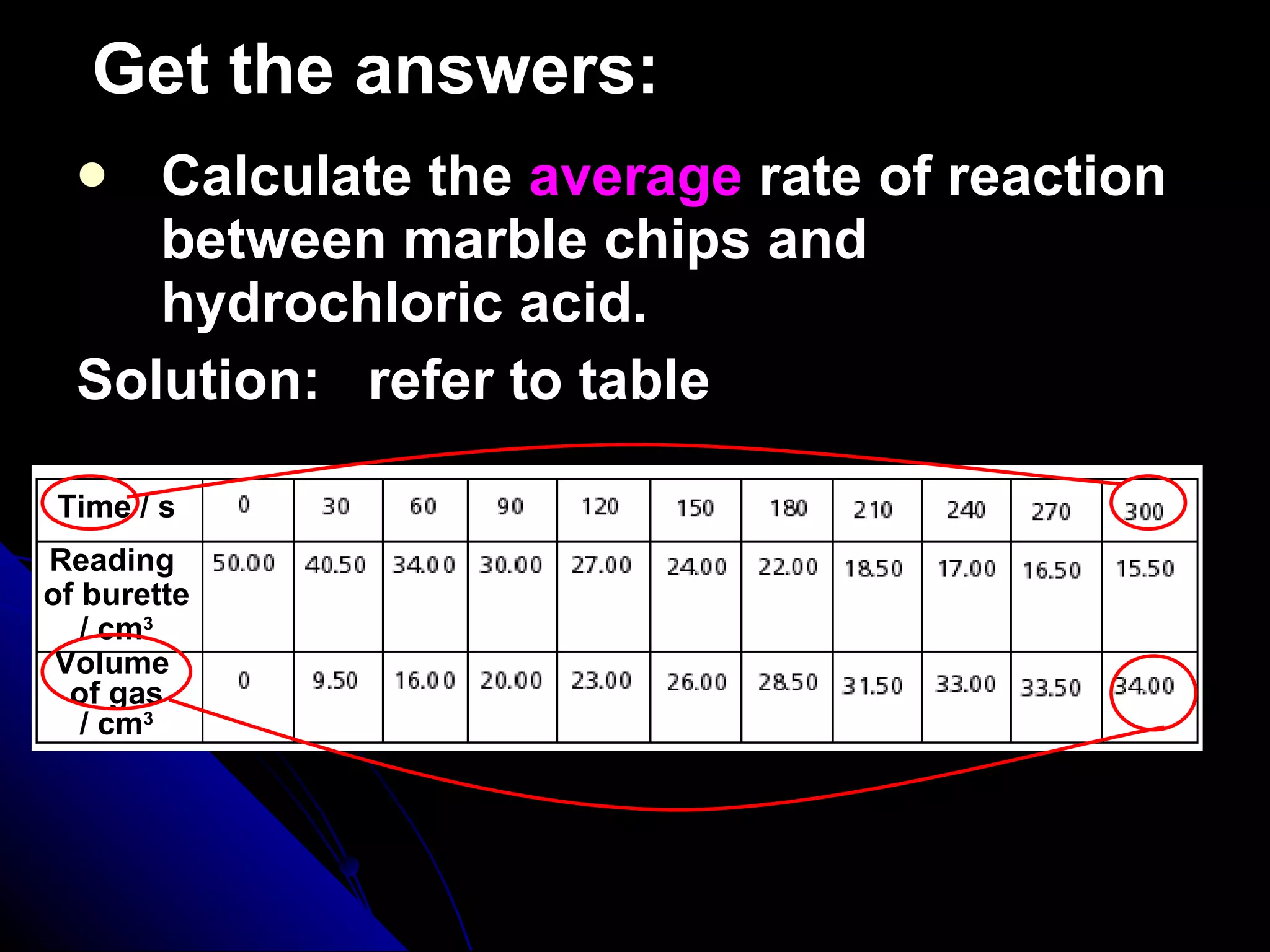
Here’s the result : Time / s Reading  of burette / cm 3 Volume  of gas / cm 3
Then we plot the graph:   Volume of hydrogen gas ( cm 3  ) Time ( s ) 5 10 0 35 30 25 20 15 60 30 90 180 210 240 270 300 150 120
Get the answers: Calculate the  average  rate of reaction between marble chips and hydrochloric acid.   Solution:  refer to table Time / s Reading  of burette / cm 3 Volume  of gas / cm 3
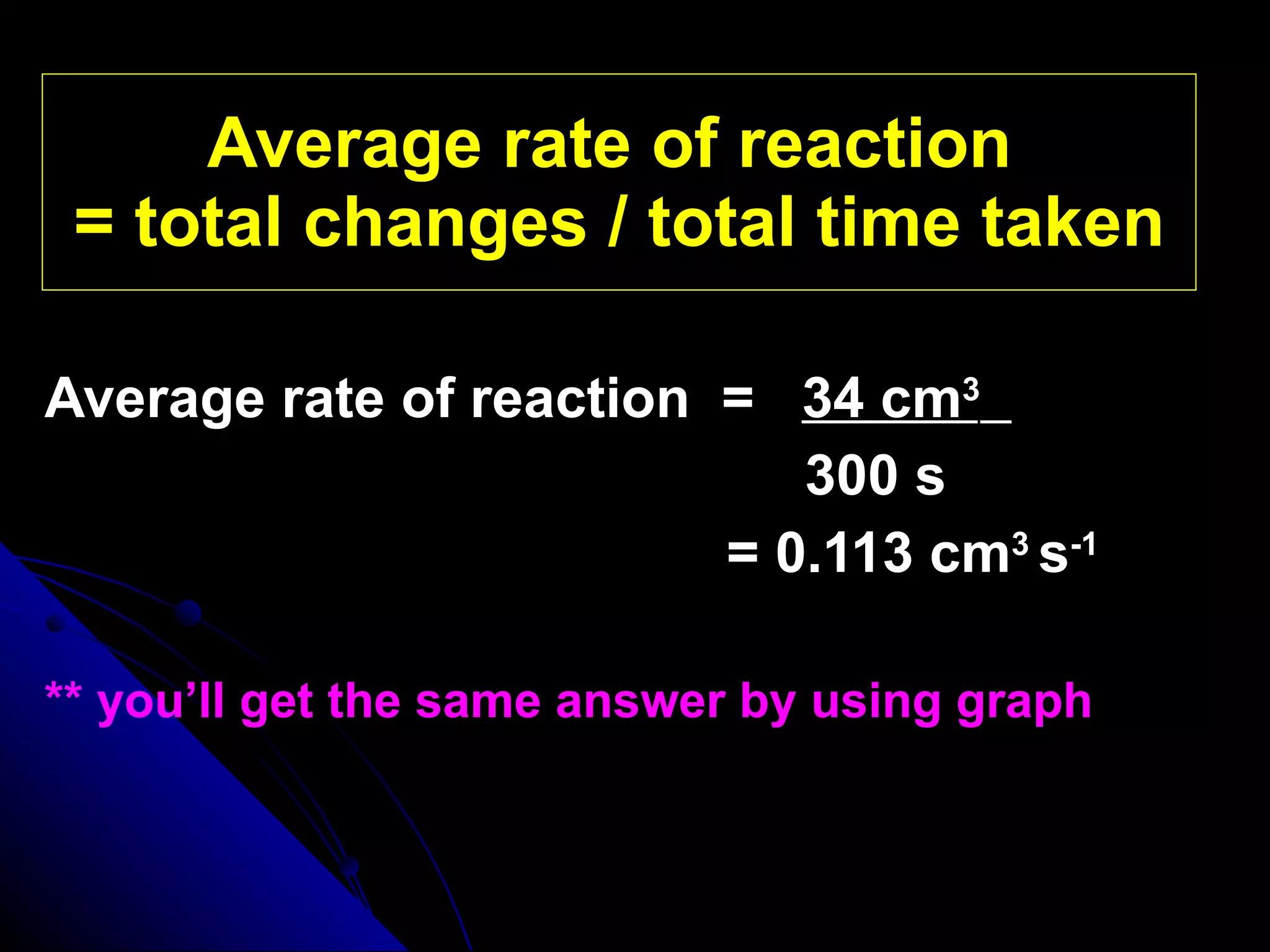
Average rate of reaction  = total changes / total time taken Average rate of reaction  =  34 cm 3     300 s   = 0.113 cm 3   s -1 ** you’ll get the same answer by using graph
 
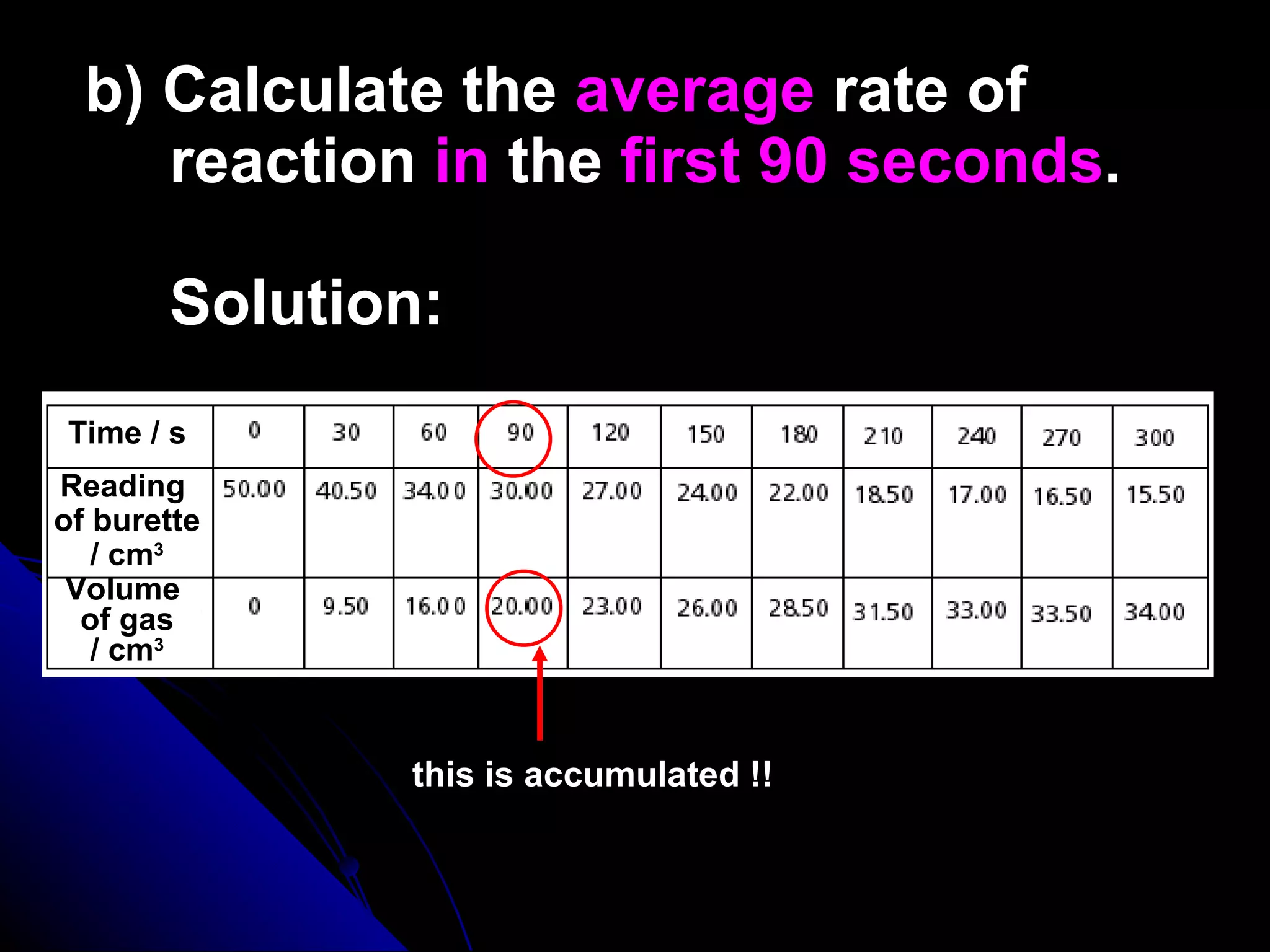
b) Calculate the  average  rate of reaction  in  the  first 90 seconds . Solution:  this is accumulated !! Time / s Reading  of burette / cm 3 Volume  of gas / cm 3
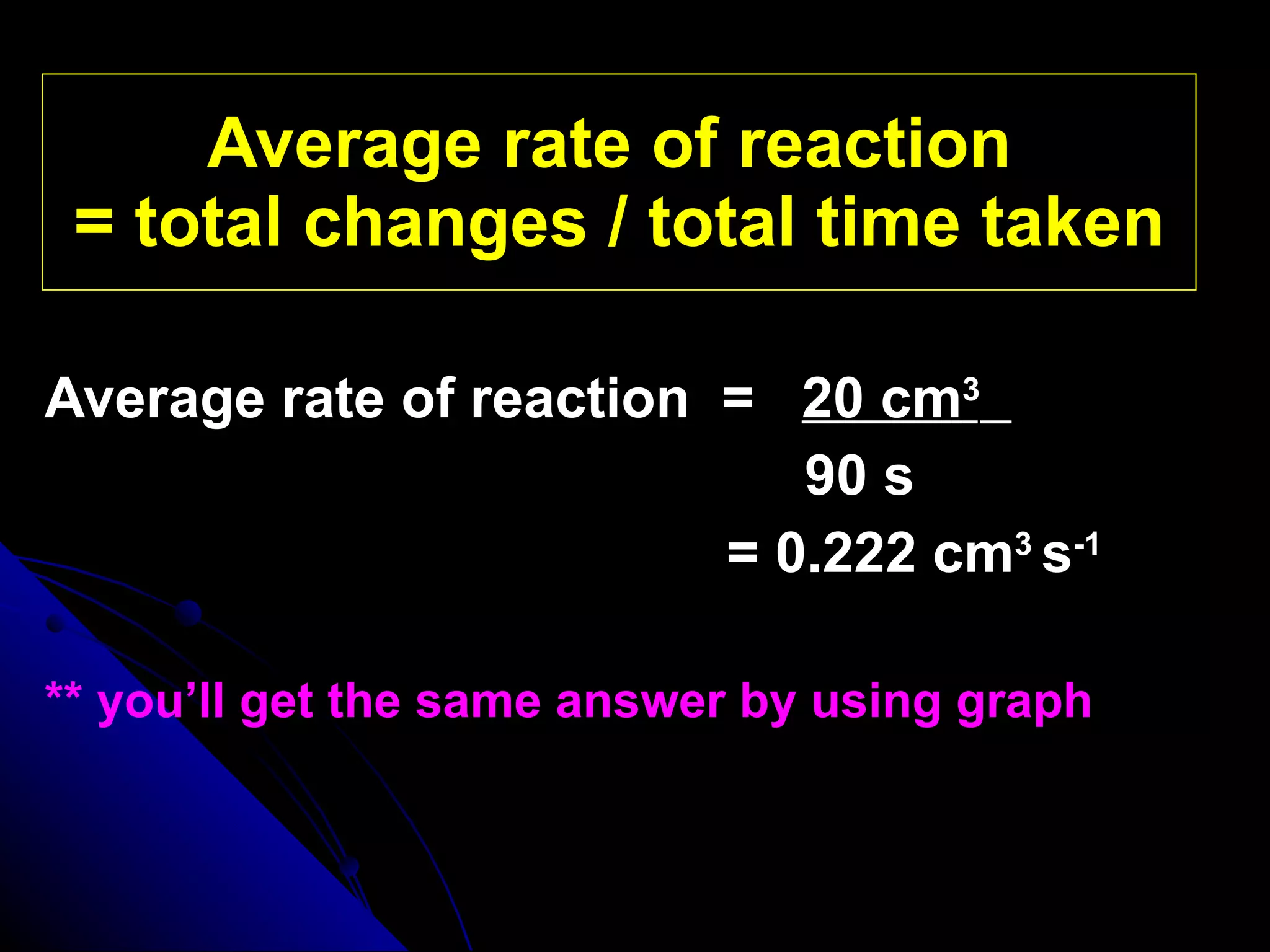
Average rate of reaction  = total changes / total time taken Average rate of reaction  =  20 cm 3     90 s   = 0.222 cm 3   s -1 ** you’ll get the same answer by using graph
 
c) Calculate the rate of reaction at  a) 60 second b) 210 second
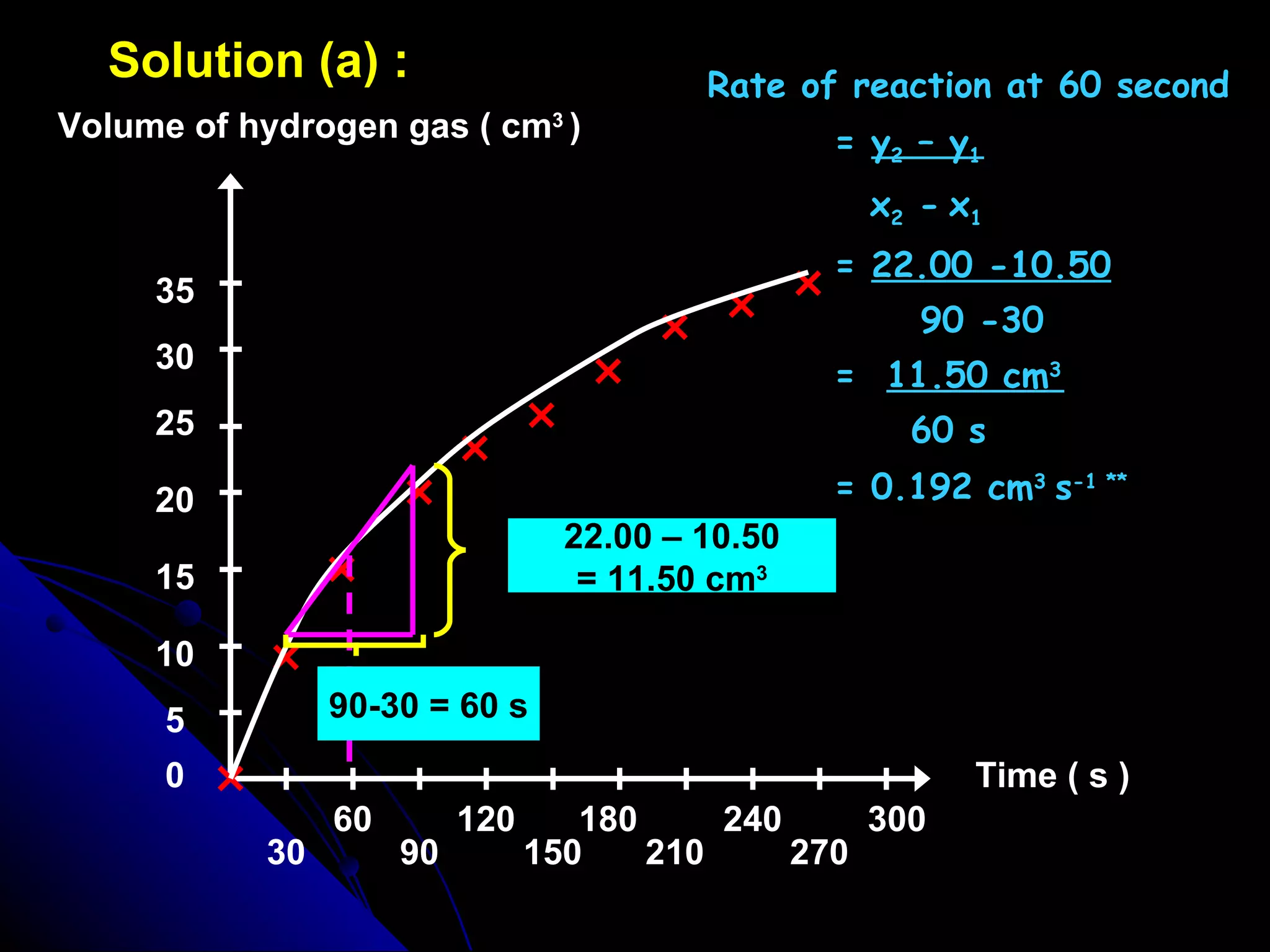
Solution (a) : 22.00 – 10.50 = 11.50 cm 3 90-30 = 60 s Rate of reaction at 60 second =  y 2  – y 1   x 2  -   x 1 =  22.00 -10.50 90 -30 =  11.50 cm 3   60 s = 0.192 cm 3   s -1 ** 5 10 35 30 25 20 15 Time ( s ) 90 Volume of hydrogen gas ( cm 3  ) 0 60 30 180 210 240 270 300 150 120
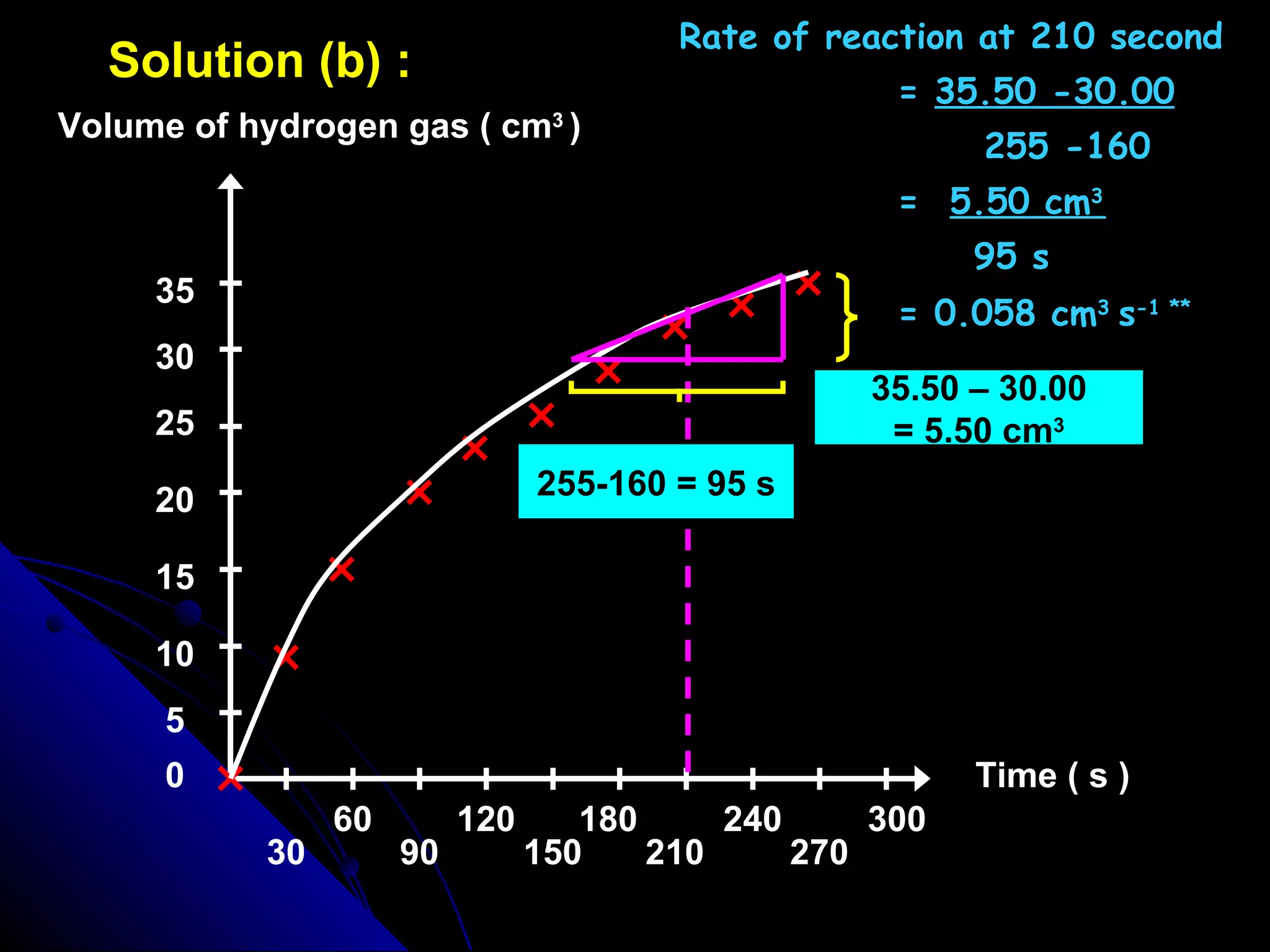
Solution (b) : 35.50 – 30.00 = 5.50 cm 3 255-160 = 95 s Rate of reaction at 210 second   =  35.50 -30.00 255 -160   =  5.50 cm 3   95 s   = 0.058 cm 3   s -1 ** 5 10 35 30 25 20 15 Time ( s ) 90 Volume of hydrogen gas ( cm 3  ) 0 60 30 180 210 240 270 300 150 120
 
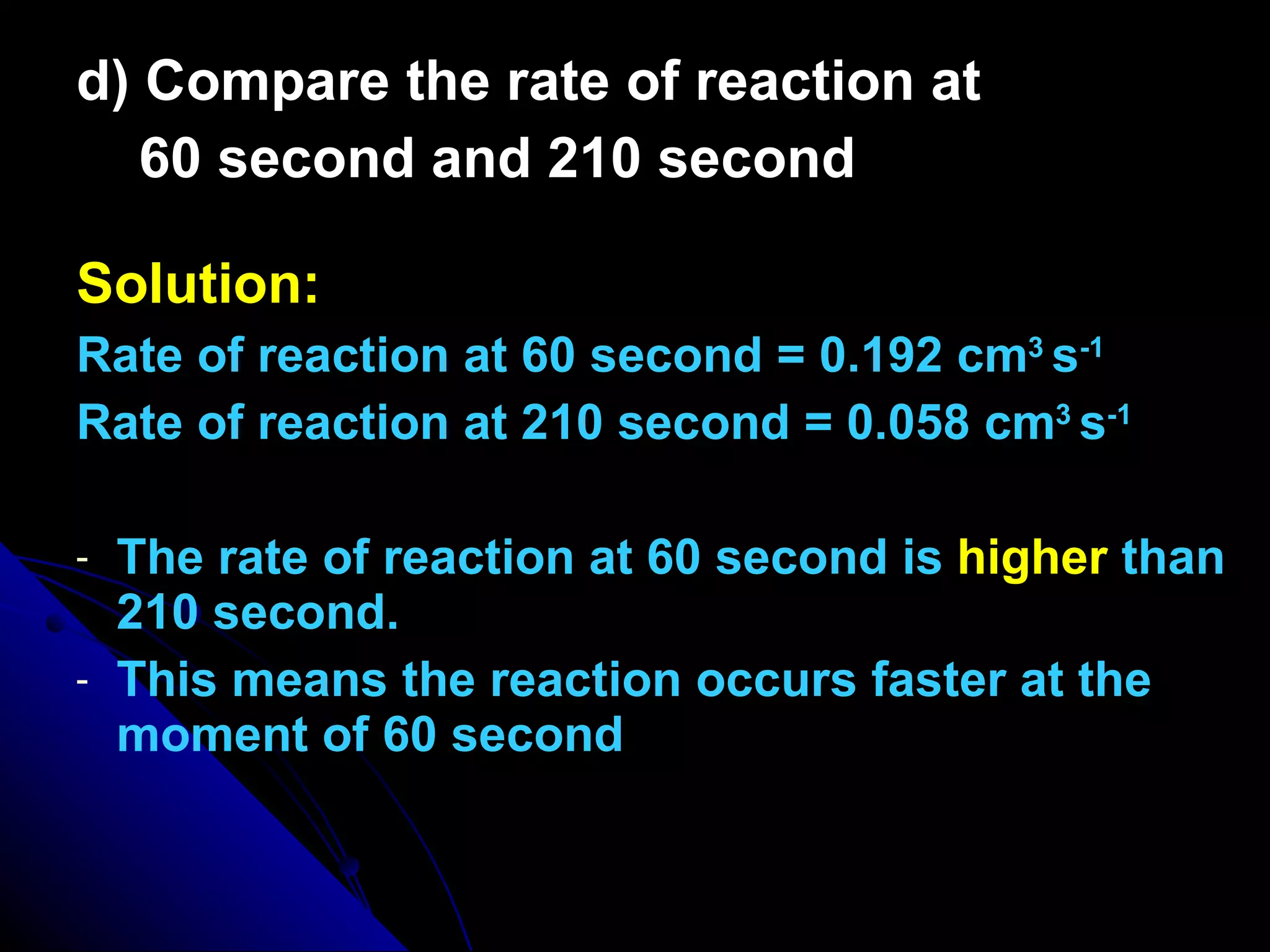
d) Compare the rate of reaction at  60 second and 210 second   Solution: Rate of reaction at 60 second = 0.192 cm 3  s -1 Rate of reaction at 210 second = 0.058 cm 3  s -1 The rate of reaction at 60 second is  higher  than 210 second. This means the reaction occurs faster at the moment of 60 second
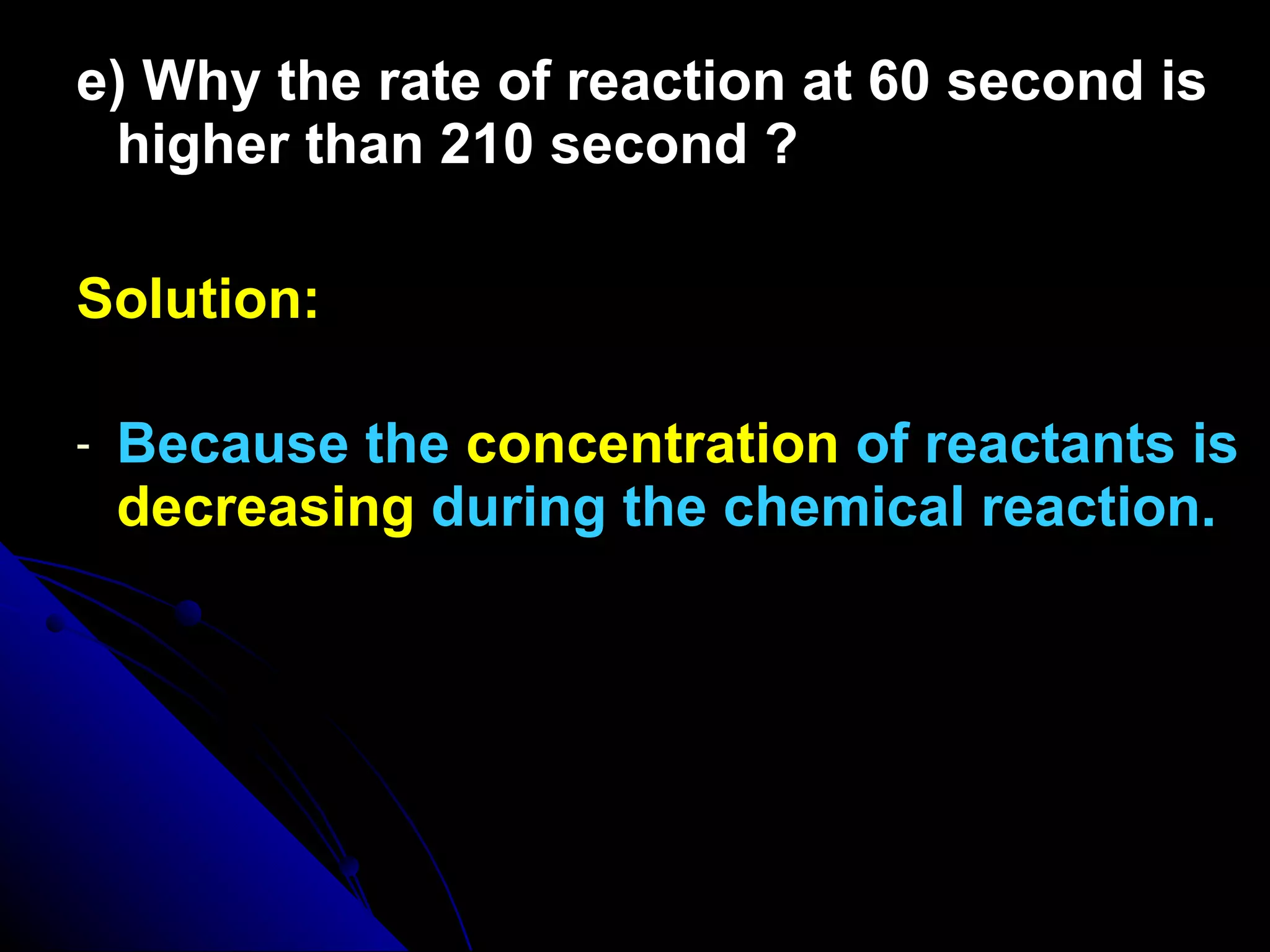
e) Why the rate of reaction at 60 second is higher than 210 second ? Solution: Because the  concentration  of reactants is  decreasing  during the chemical reaction.
f) There are no more hydrogen gas liberated after 300 second, why? Solution: Because the chemical reaction is  stopped All the marble chips had been reacted
 
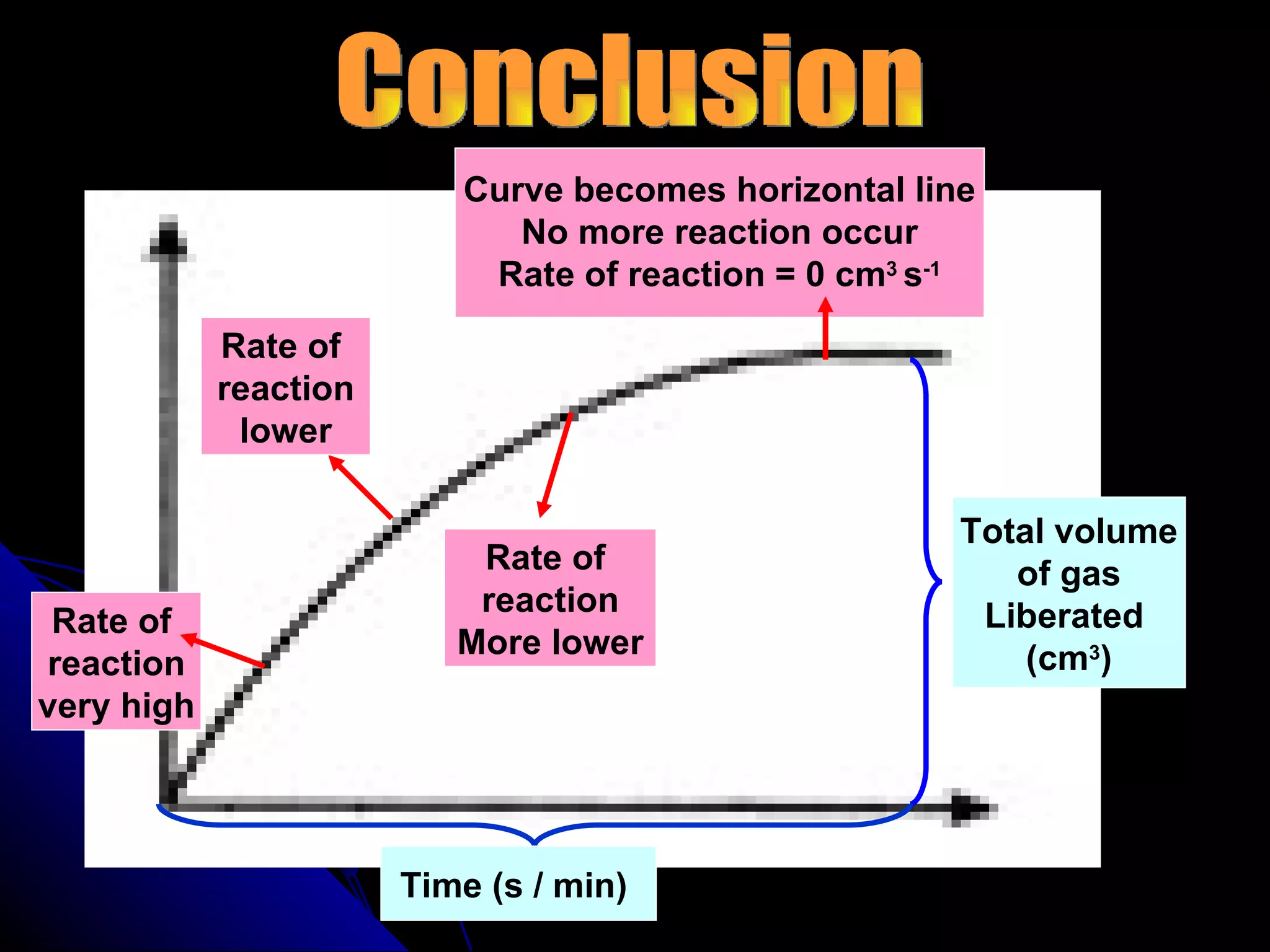
Conclusion  Rate of  reaction very high Rate of  reaction lower Curve becomes horizontal line No more reaction occur Rate of reaction = 0 cm 3   s -1 Rate of  reaction More lower Total volume of gas Liberated  (cm 3 ) Time (s / min)
Learning Task 1.2 page 8 WORKSHOP HOUR
 
1.2 Factors affecting the  rate of reaction
Some reactions are fast &  some reactions are very slow So do the chemical reactions  in laboratory
What are the factors affect the  rate of reaction ??
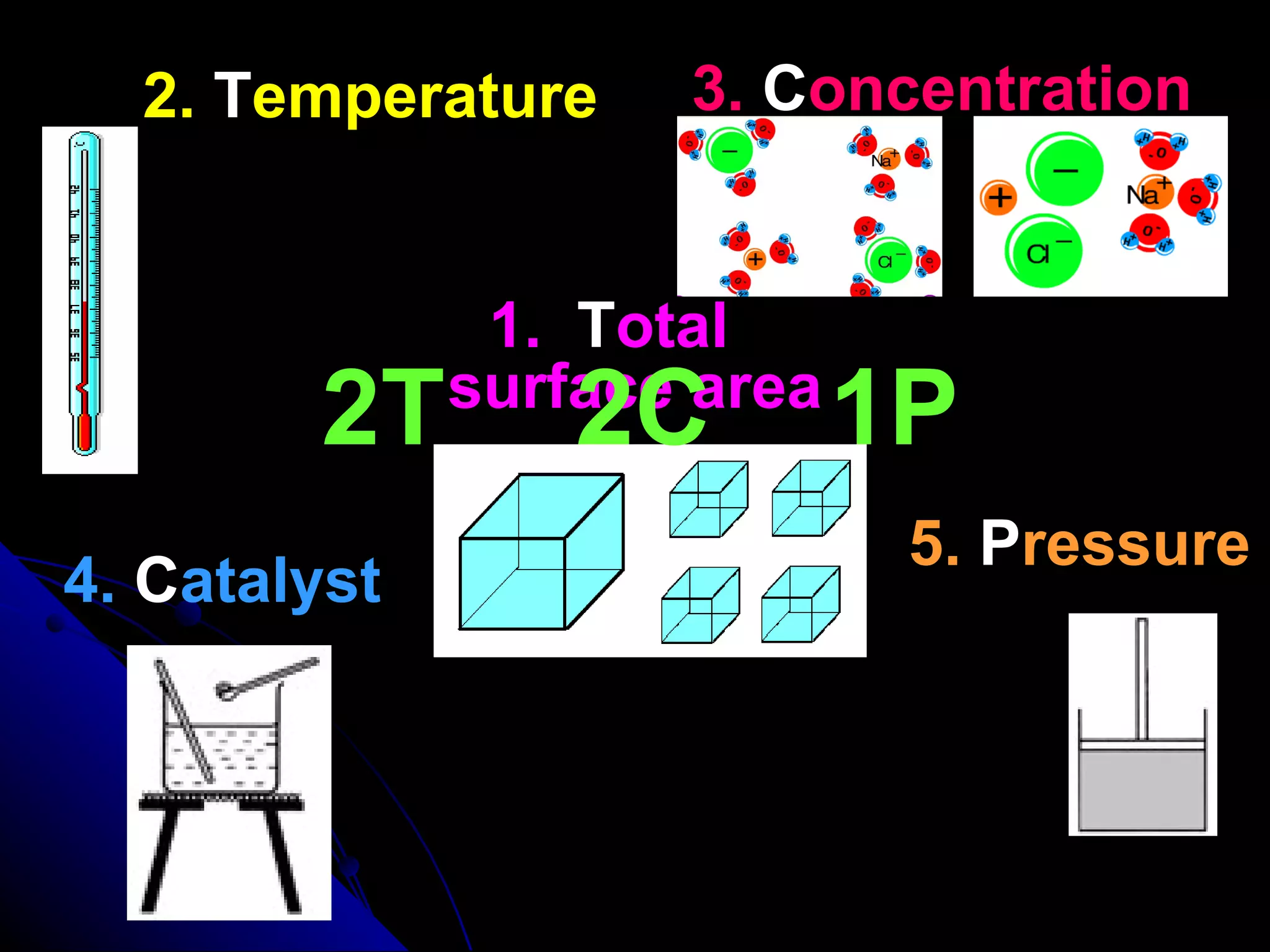
2.  T emperature 1.  T otal   surface area 4.  C atalyst 5.  P ressure 3.  C oncentration 2T 2C 1P
How does the factors of Total surface area,   Temperature,  Concentration,   Catalyst &  Pressure   affect the reaction rate?? 2T 2C 1P
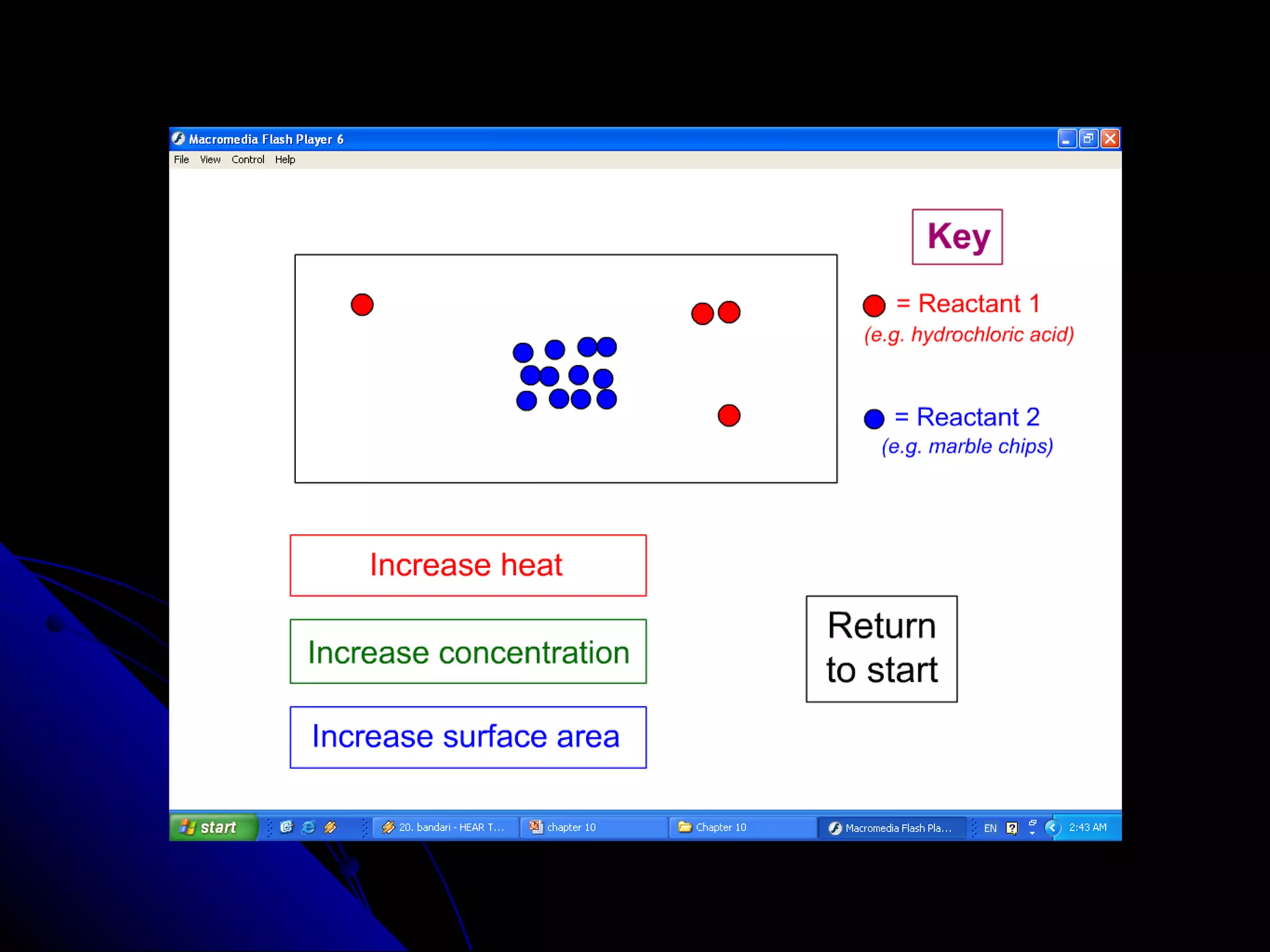
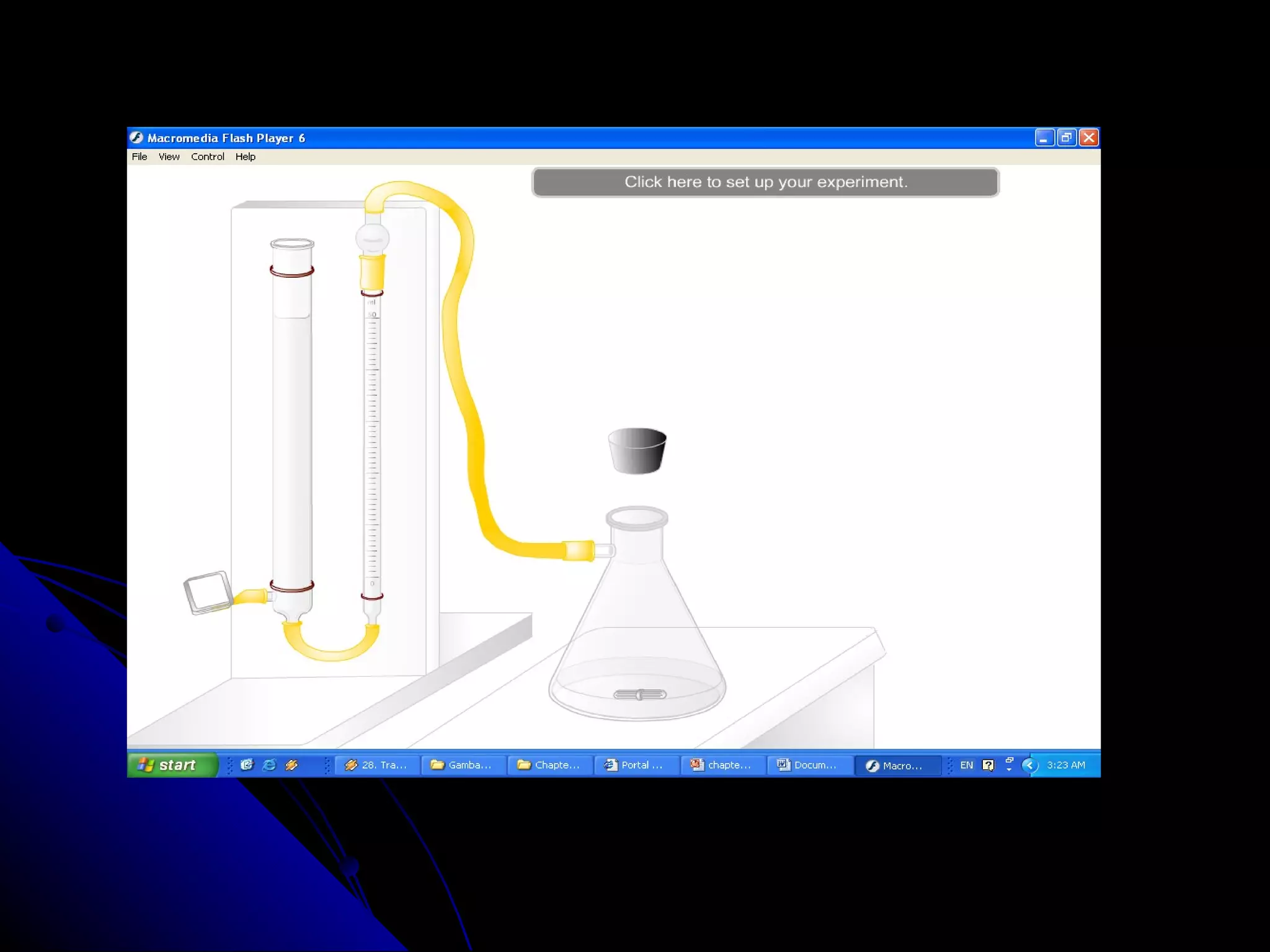
Let’s do the experiment  to investigate that: 1.Surface area smaller , rate of reaction 2.Concentration higher, rate of reaction 3.Temperature higher, rate of reaction 4.Catalyst added, rate of reaction
 
 
Surface area smaller , rate of reaction Concentration higher, rate of reaction Temperature higher, rate of reaction Catalyst added, rate of reaction Pressure higher, rate of reaction Conclusion
 
Problem solving
A  +  B  C   +   D (reactants)   (products) During the chemical reaction,  reactants  will become  less  but  products  become  more The chemical reaction will stop once one of the reactants is  used up .
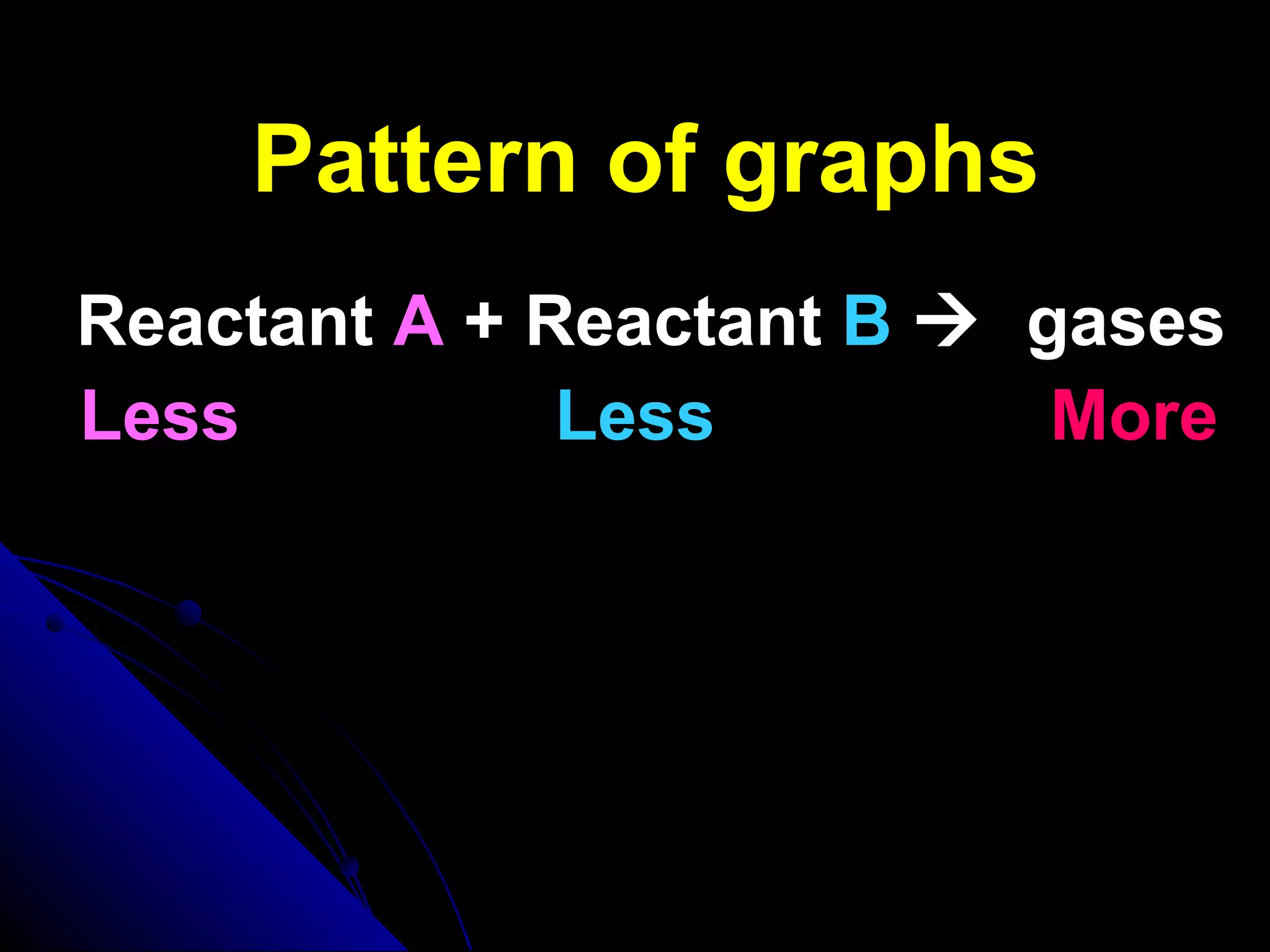
Pattern of graphs Reactant  A  + Reactant  B      gases  Less   Less   More
 
 
More examples of interpreting  graphical results
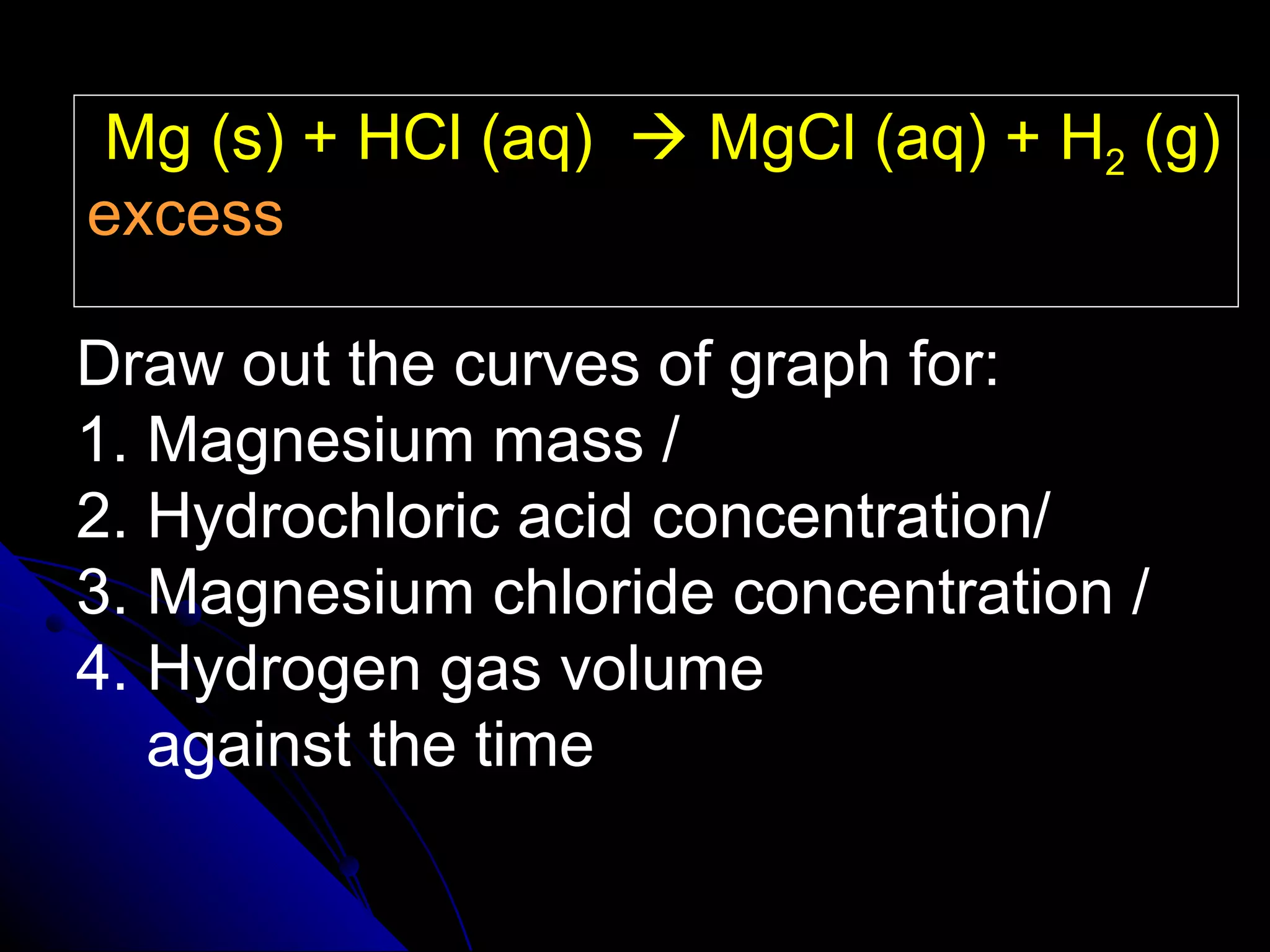
Mg (s) + HCl (aq)    MgCl (aq) + H 2  (g) excess Draw out the curves of graph for: 1. Magnesium mass /  2. Hydrochloric acid concentration/  3. Magnesium chloride concentration / 4. Hydrogen gas volume against the time
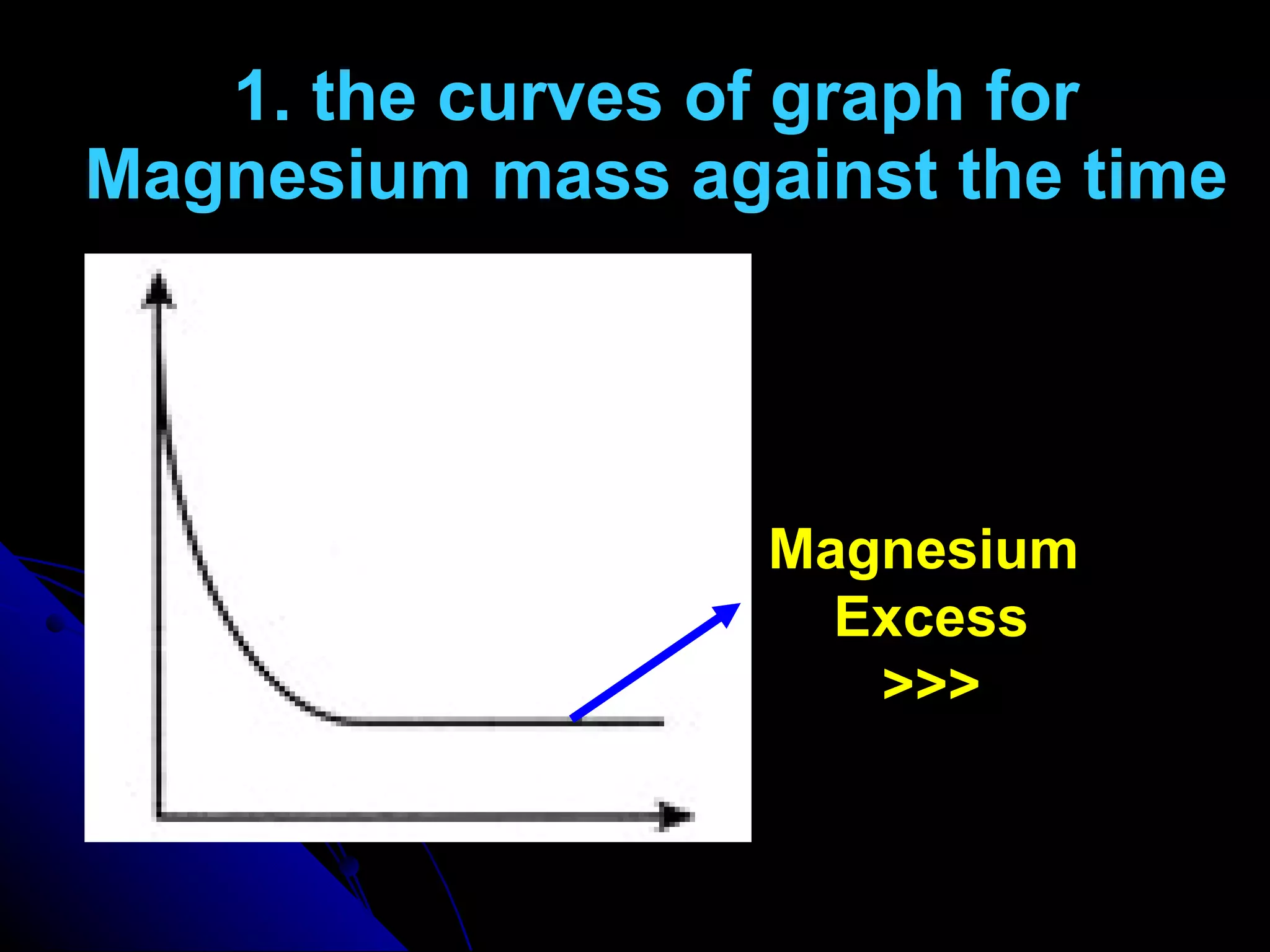
1. the curves of graph for Magnesium mass against the time Magnesium  Excess >>>
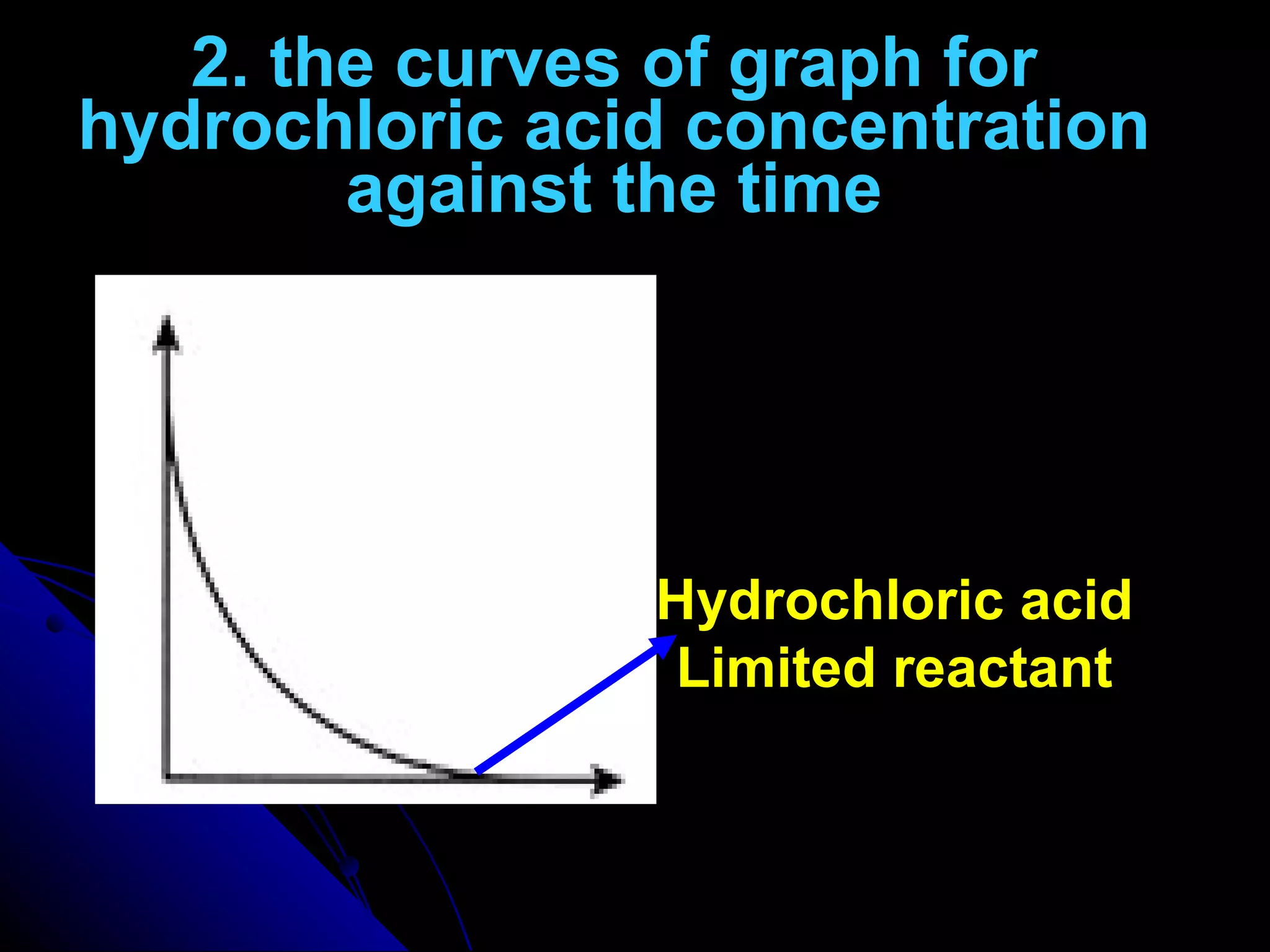
2. the curves of graph for hydrochloric acid concentration against the time Hydrochloric acid Limited reactant
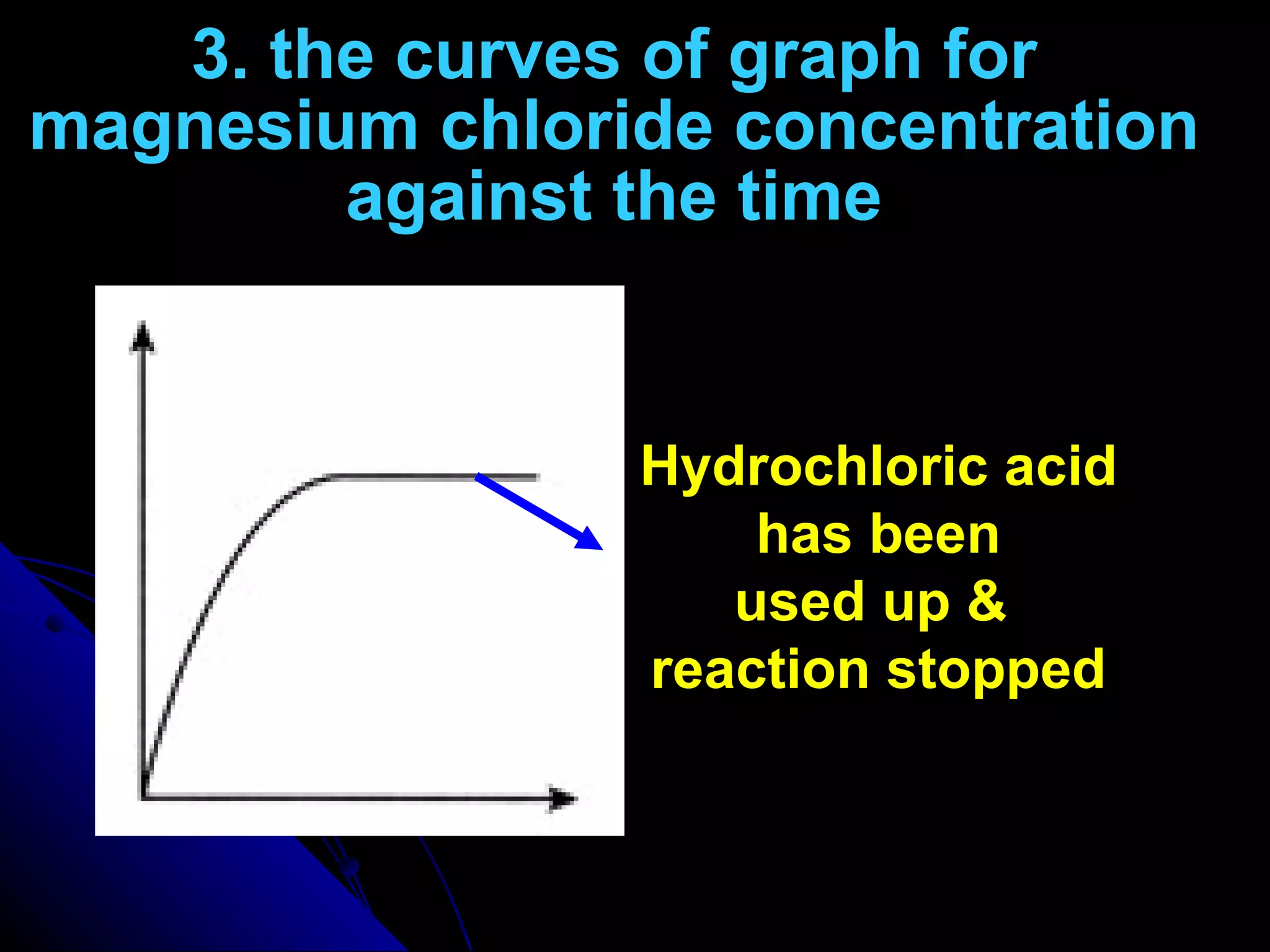
3. the curves of graph for magnesium chloride concentration against the time Hydrochloric acid has been  used up &  reaction stopped
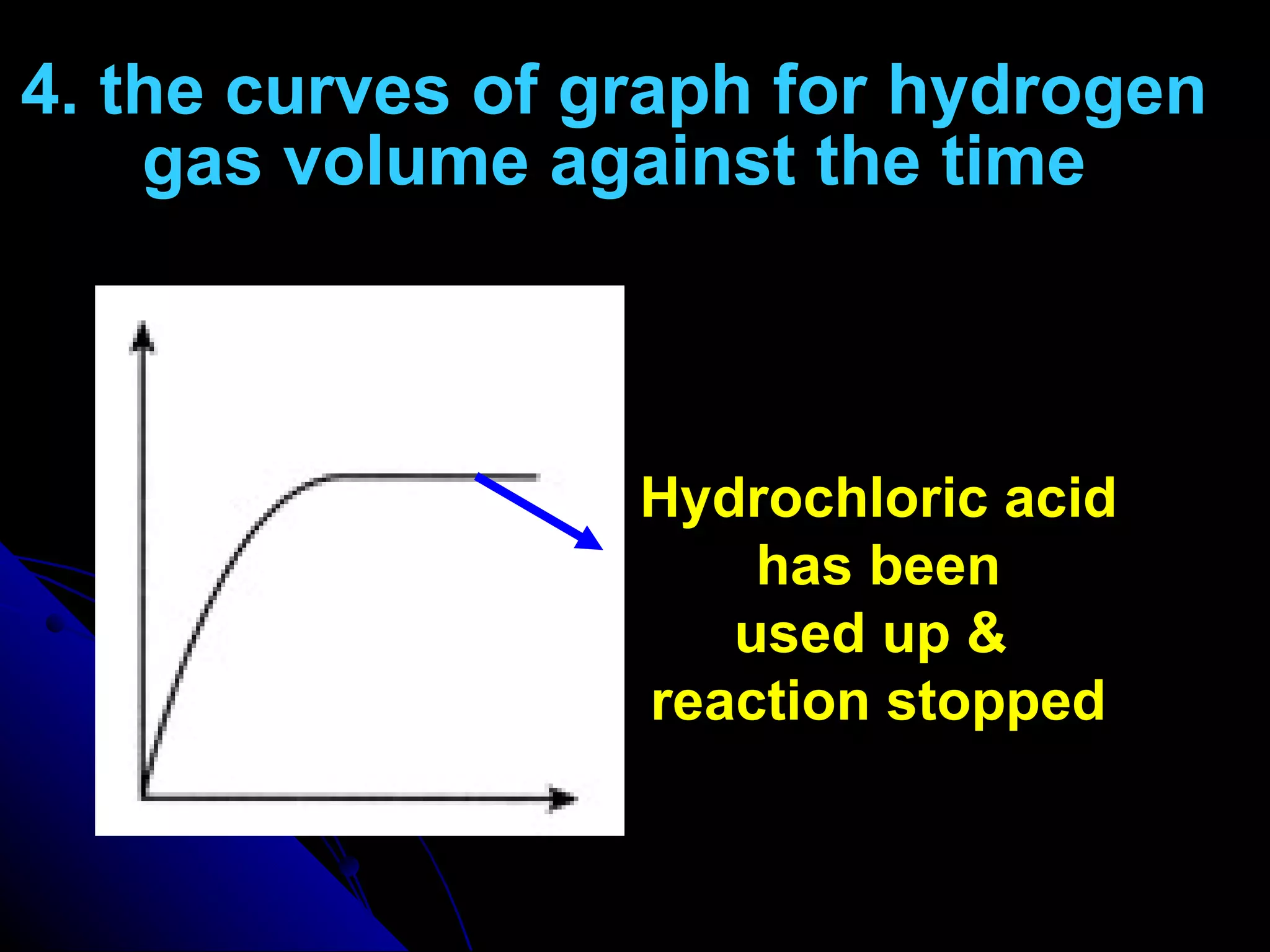
4. the curves of graph for hydrogen gas volume against the time Hydrochloric acid has been  used up &  reaction stopped
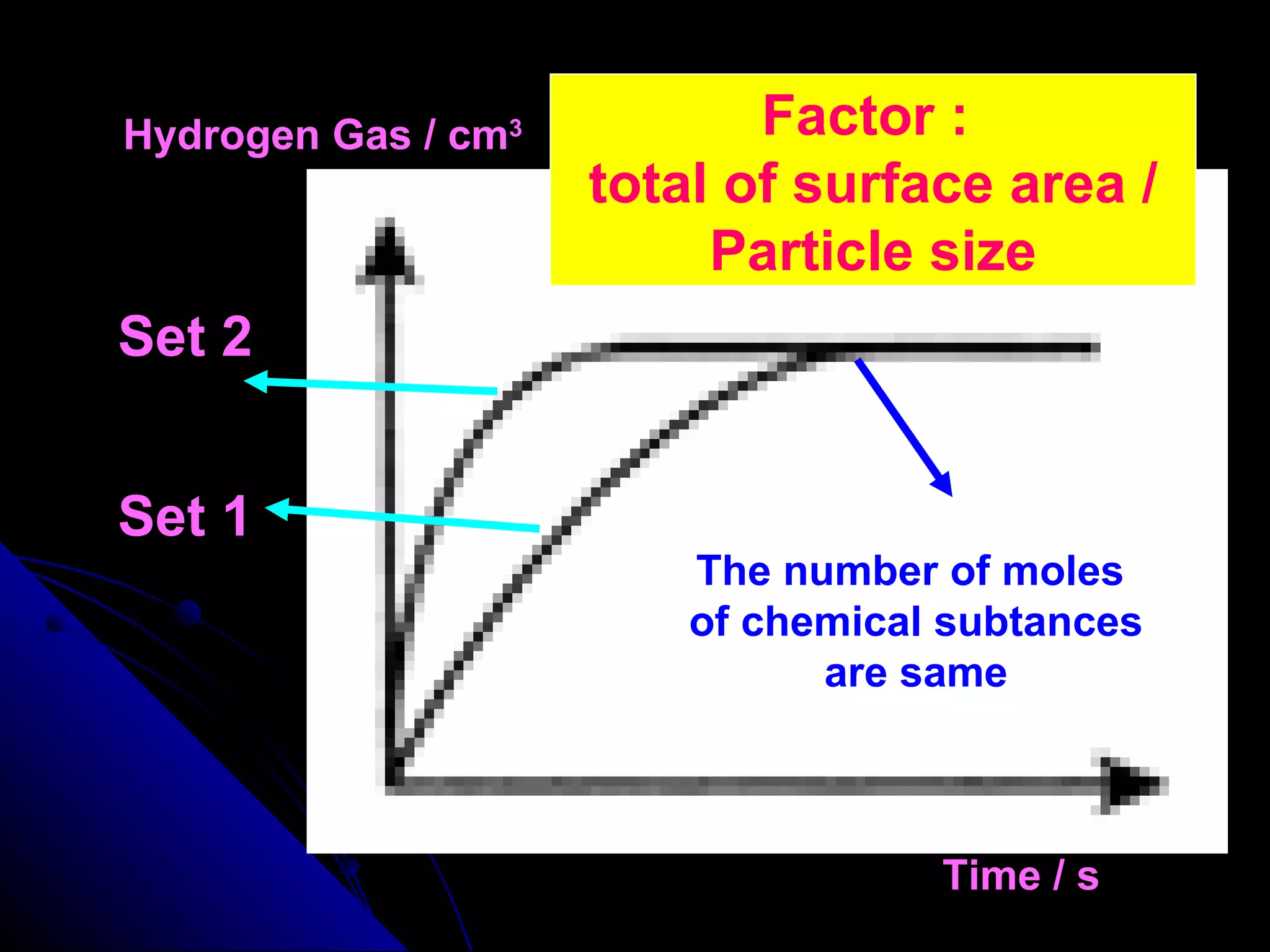
Q1. Compare these: Set 1 : 1g of zinc  plate  (excess) reacts with sulphuric acid 0.1 mol dm -3  to form zinc sulphate and hydrogen gas  Set 2 : 1g of zinc  powder  (excess) reacts with sulphuric acid 0.1 mol dm -3  to form zinc sulphate and hydrogen gas Find the difference !!
Hydrogen Gas / cm 3 Time / s Set 2 Set 1 The number of moles of chemical subtances are same Factor :  total of surface area / Particle size
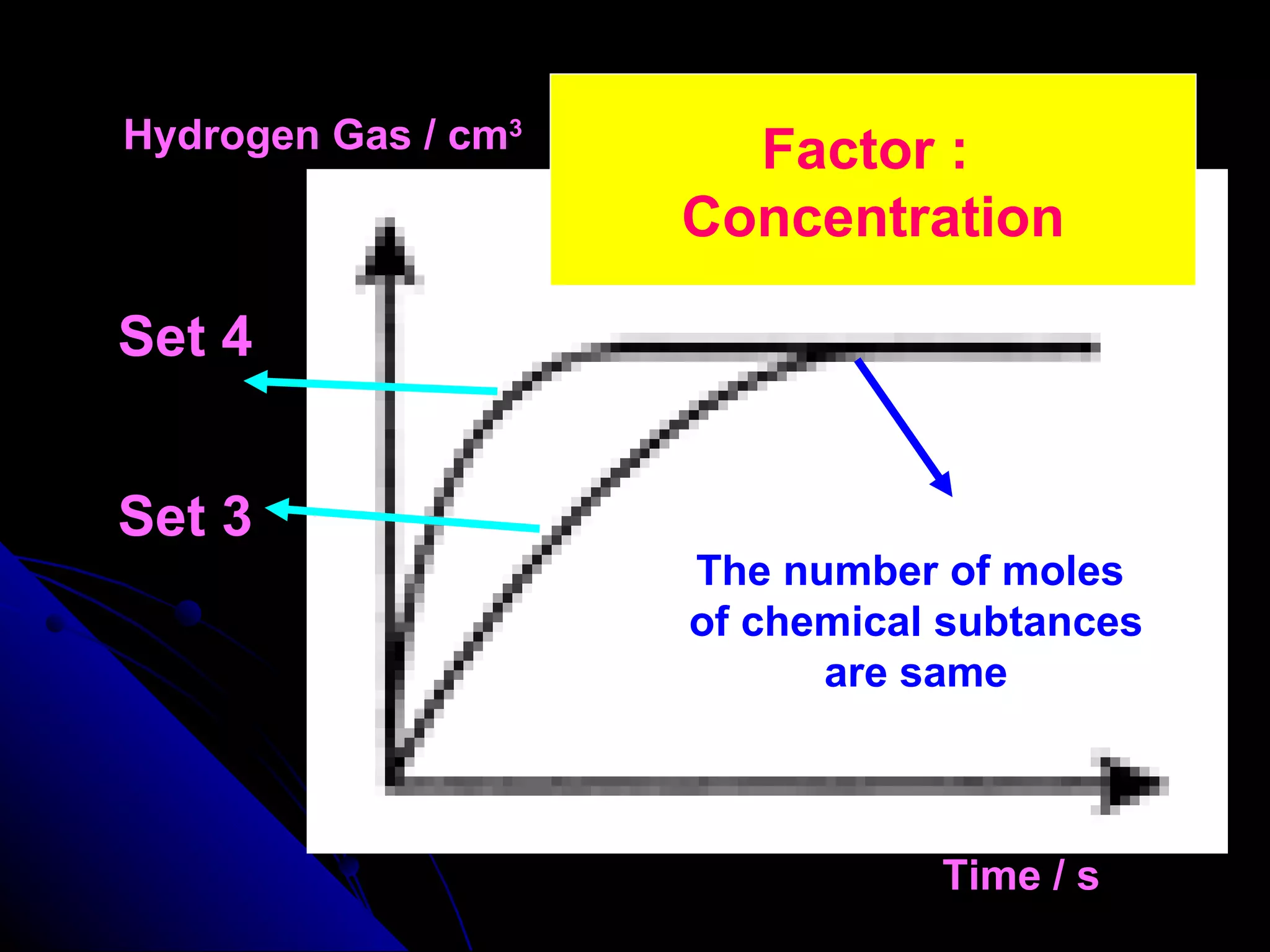
Q2. Compare these: Set 3 : 1 g of zinc powder (excess) reacts with 500cm 3  sulphuric acid 0.1 mol dm -3  to form zinc sulphate and hydrogen gas  Set 4 : 1 g of zinc powder (excess) reacts with 250cm 3  sulphuric acid 0.2 mol dm -3  to form zinc sulphate and hydrogen gas Find the difference !!
Hydrogen Gas / cm 3 Time / s Set 4 Set 3 The number of moles of chemical subtances are same Factor :  Concentration
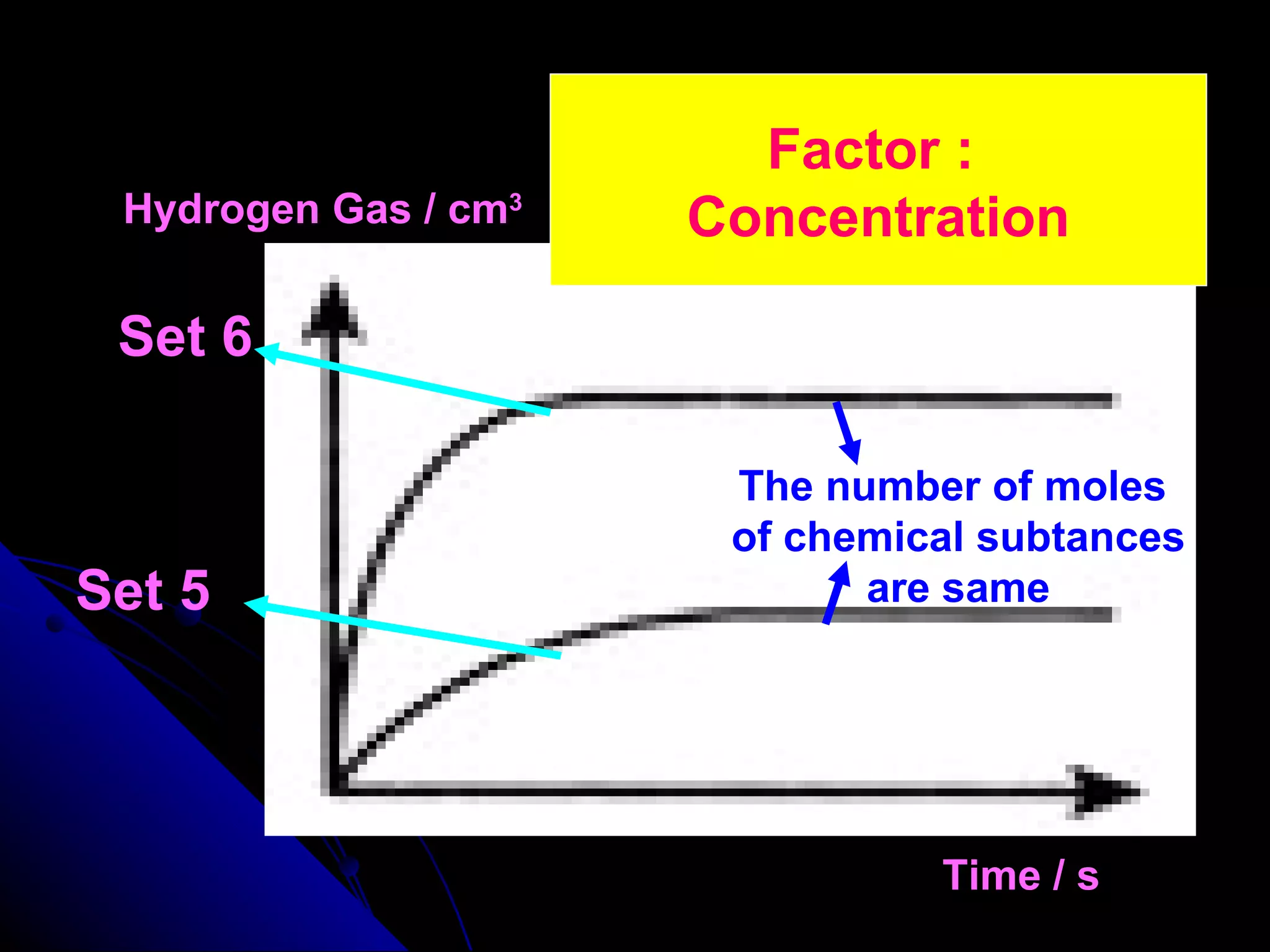
Q3. Compare these: Set 5 : 1 g of zinc powder (excess) reacts with 250cm 3  sulphuric acid 0.1 mol dm -3  to form zinc sulphate and hydrogen gas  Set 6 : 1 g of zinc powder (excess) reacts with 250cm 3  sulphuric acid 0.2 mol dm -3  to form zinc sulphate and hydrogen gas Find the difference !!
Hydrogen Gas / cm 3 Time / s Set 6 Set 5 The number of moles of chemical subtances are same Factor :  Concentration
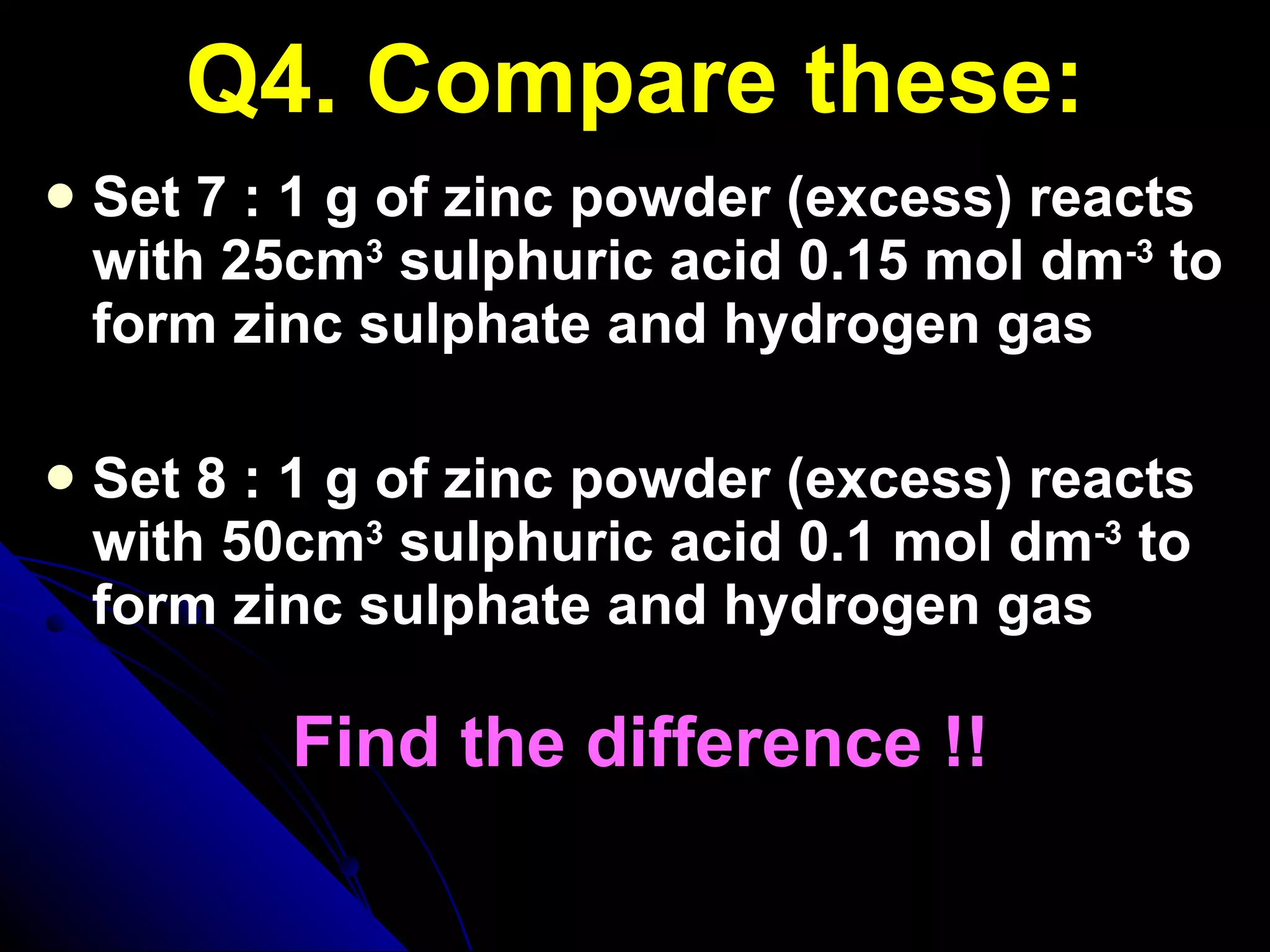
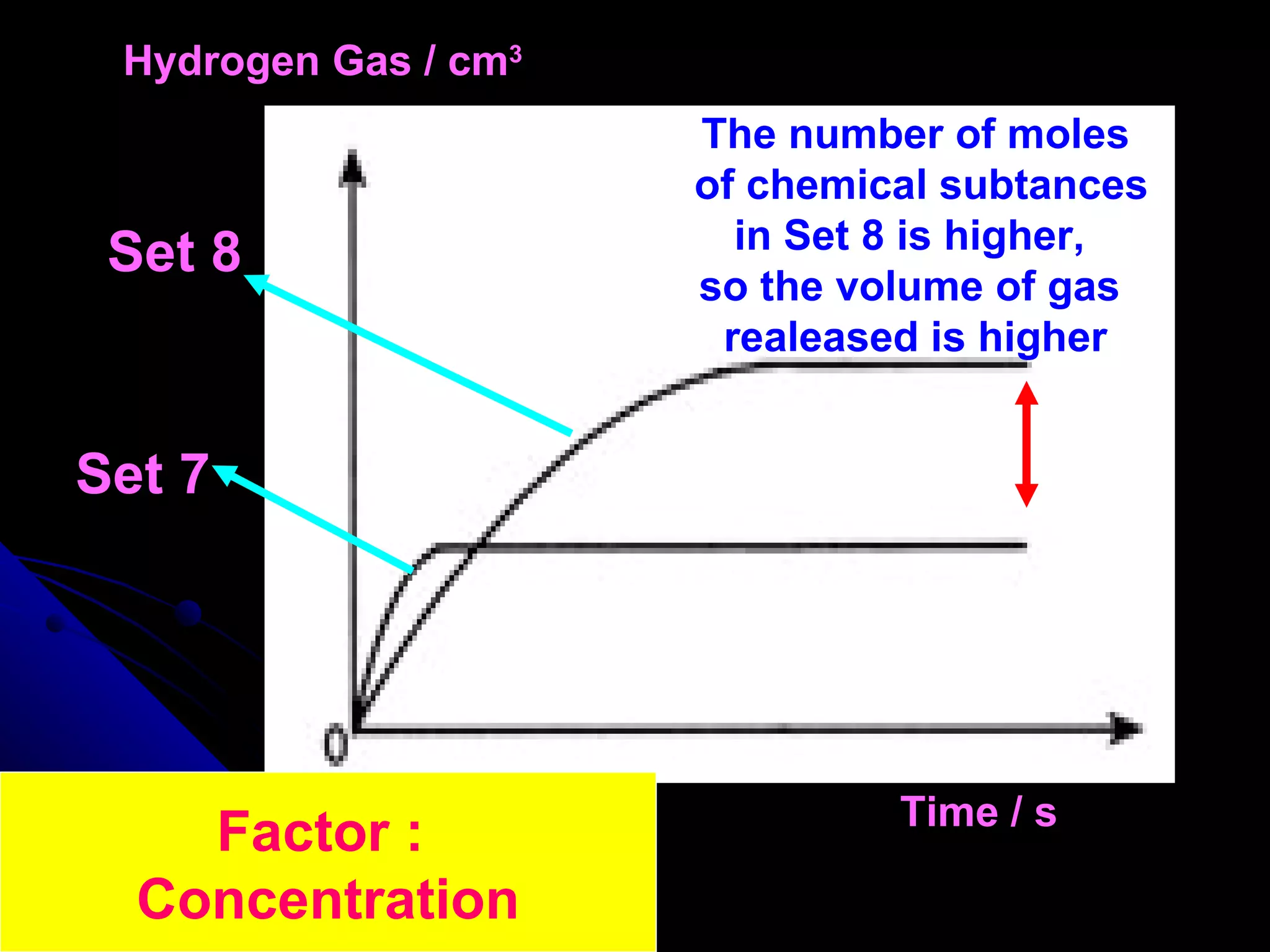
Q4. Compare these: Set 7 : 1 g of zinc powder (excess) reacts with 25cm 3  sulphuric acid 0.15 mol dm -3  to form zinc sulphate and hydrogen gas  Set 8 : 1 g of zinc powder (excess) reacts with 50cm 3  sulphuric acid 0.1 mol dm -3  to form zinc sulphate and hydrogen gas Find the difference !!
Hydrogen Gas / cm 3 Time / s Set 8 Set 7 The number of moles of chemical subtances in Set 8 is higher,  so the volume of gas  realeased is higher Factor :  Concentration
1.3  Collision Theory
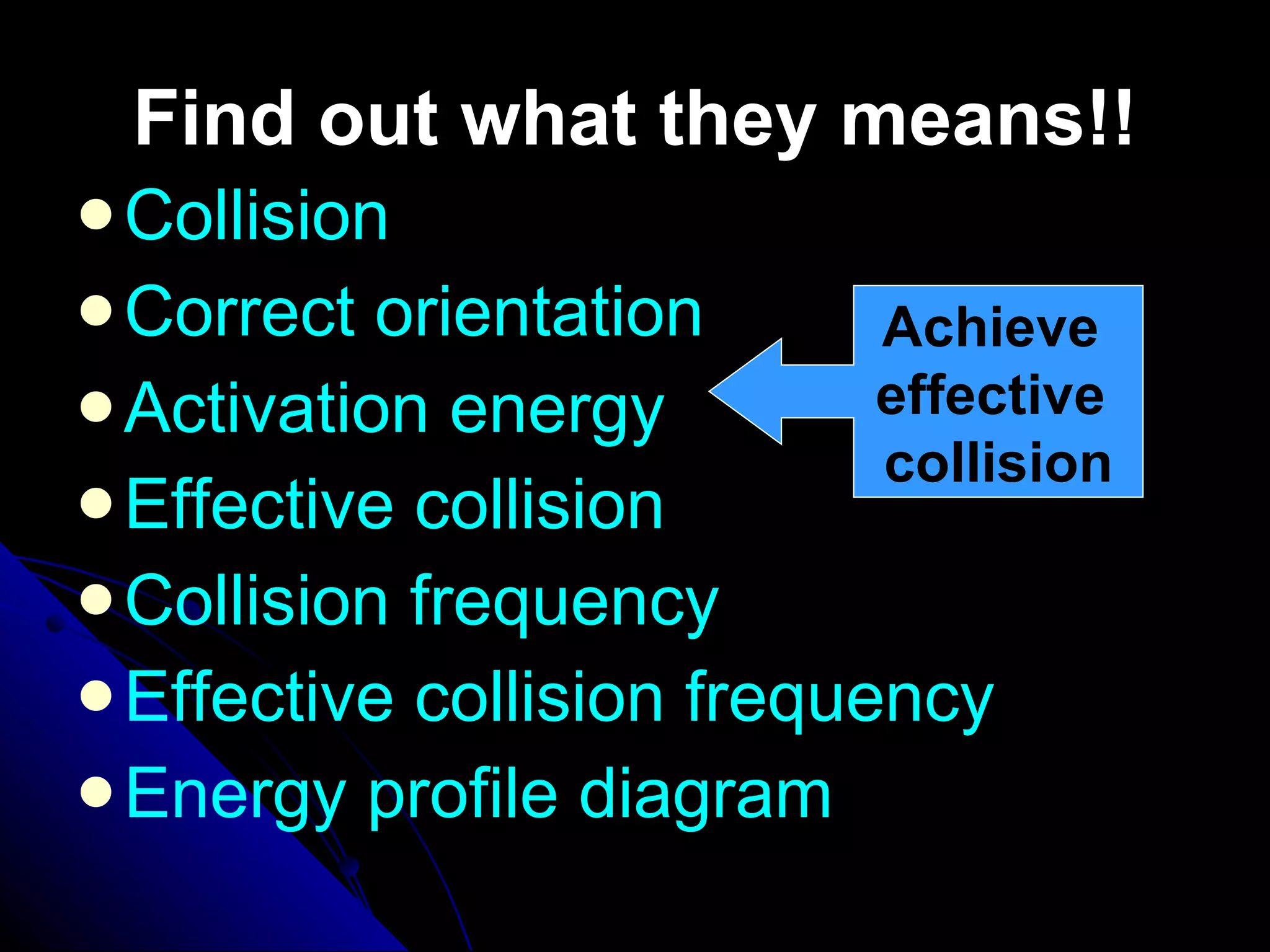
Find out what they means!! Collision Correct orientation  Activation energy Effective collision Collision frequency Effective collision frequency Energy profile diagram Achieve  effective  collision
Base on kinetic theory, particles moves constantly and  collide  each other all the time However, majority of collisions do not lead to a reaction,why ?
Only those in which the colliding species have: Achieve minimum amount of energy, called the  ACTIVATION ENERGY,  E a And with  CORRECT ORIENTATION EFFECTIVE COLLISIONS
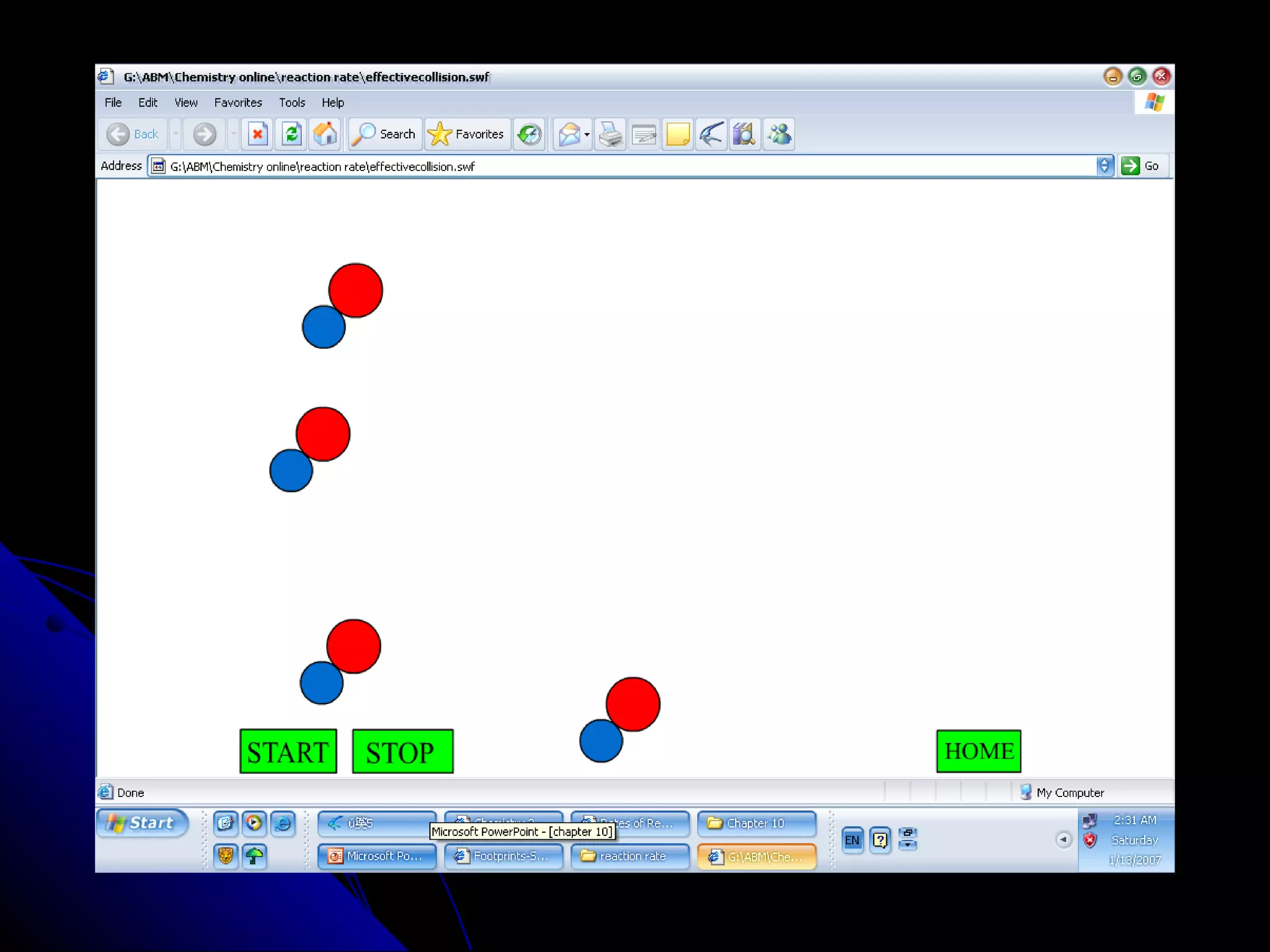
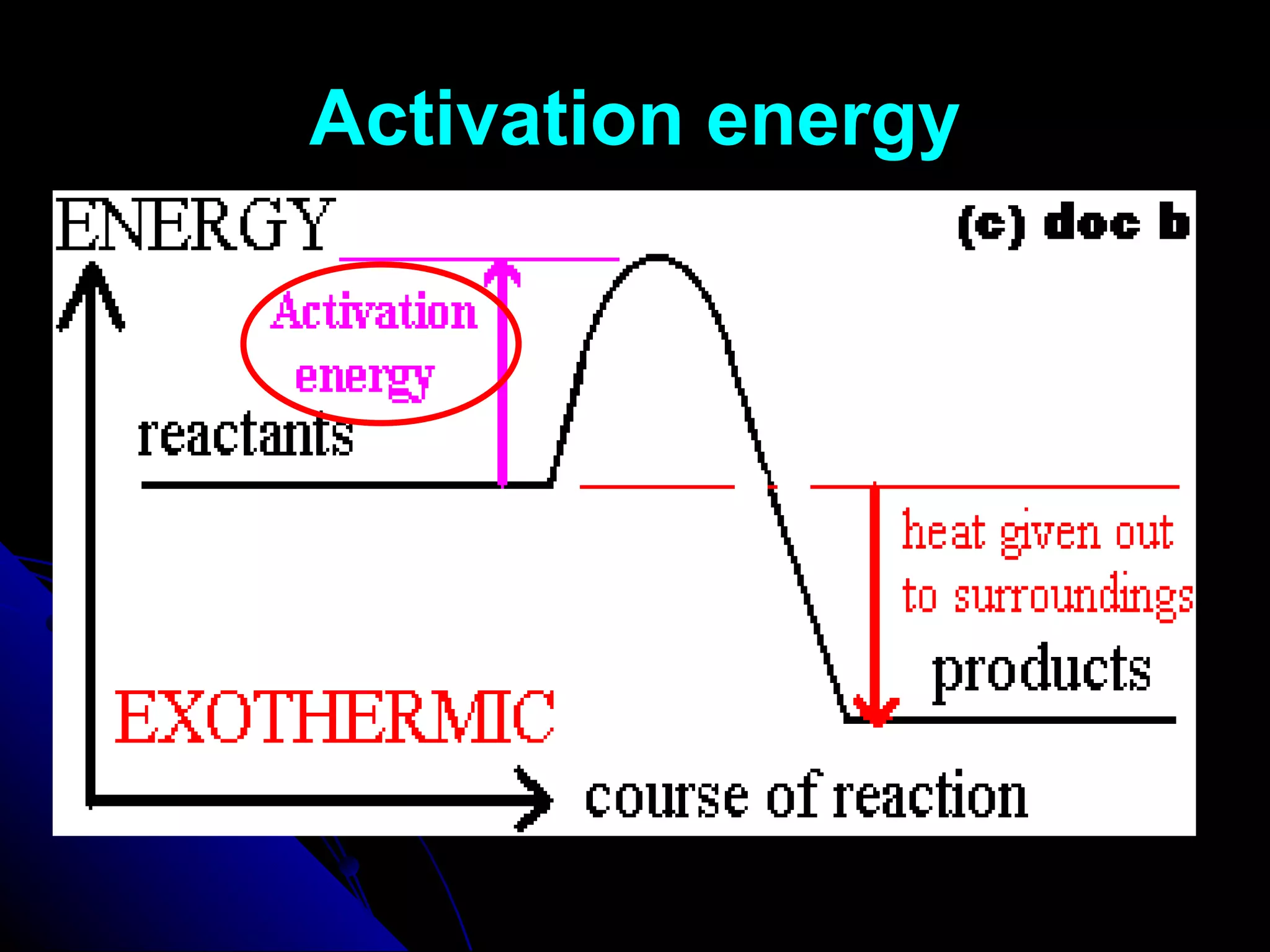
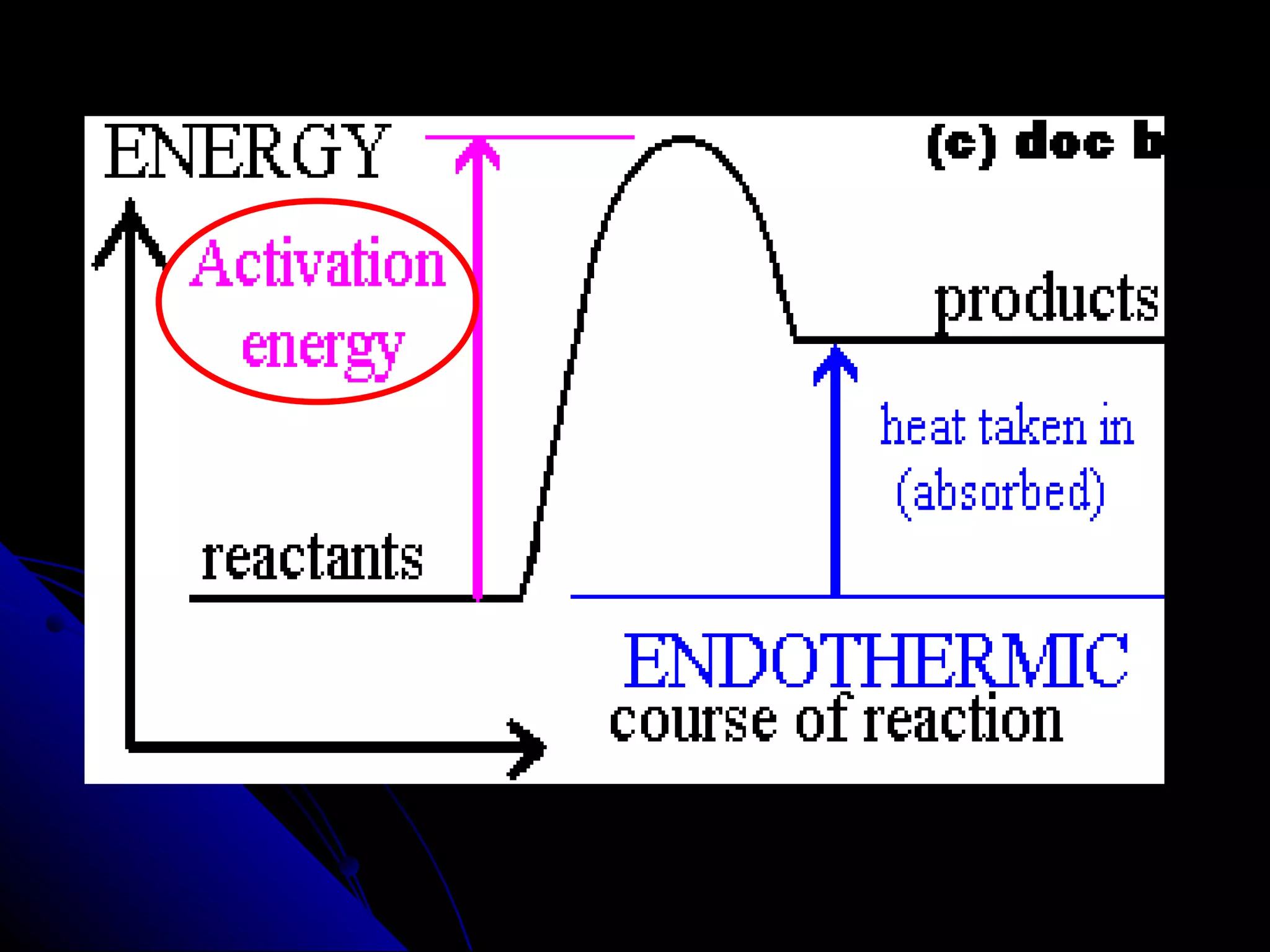
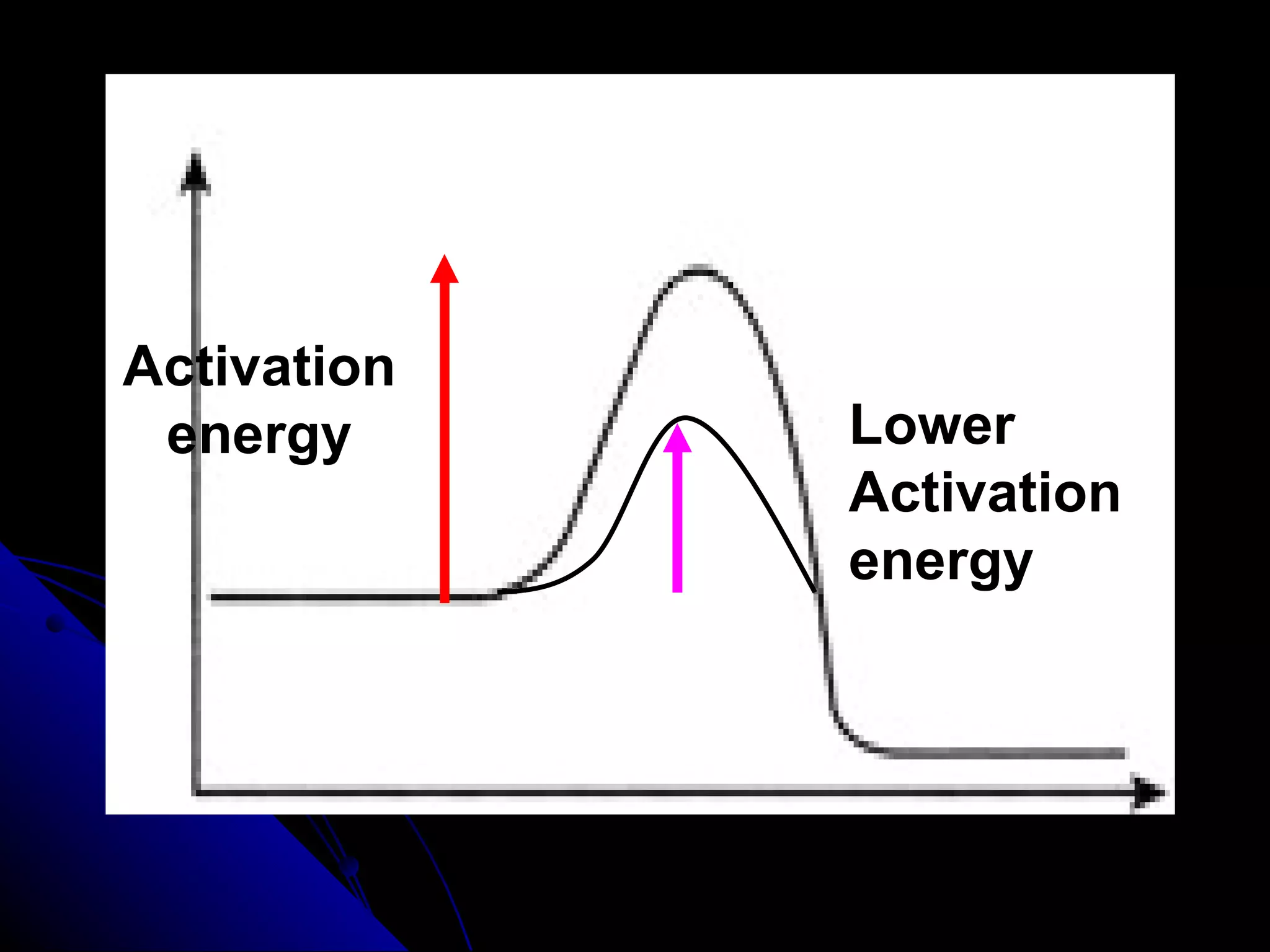
For a reaction to take place, the particles of the substances that are reacting  have to collide . If they collide, with  enough energy  then they will react.  The minimum amount of energy that particles need to react is called the  ACTIVATION ENERGY
 
Activation energy
 
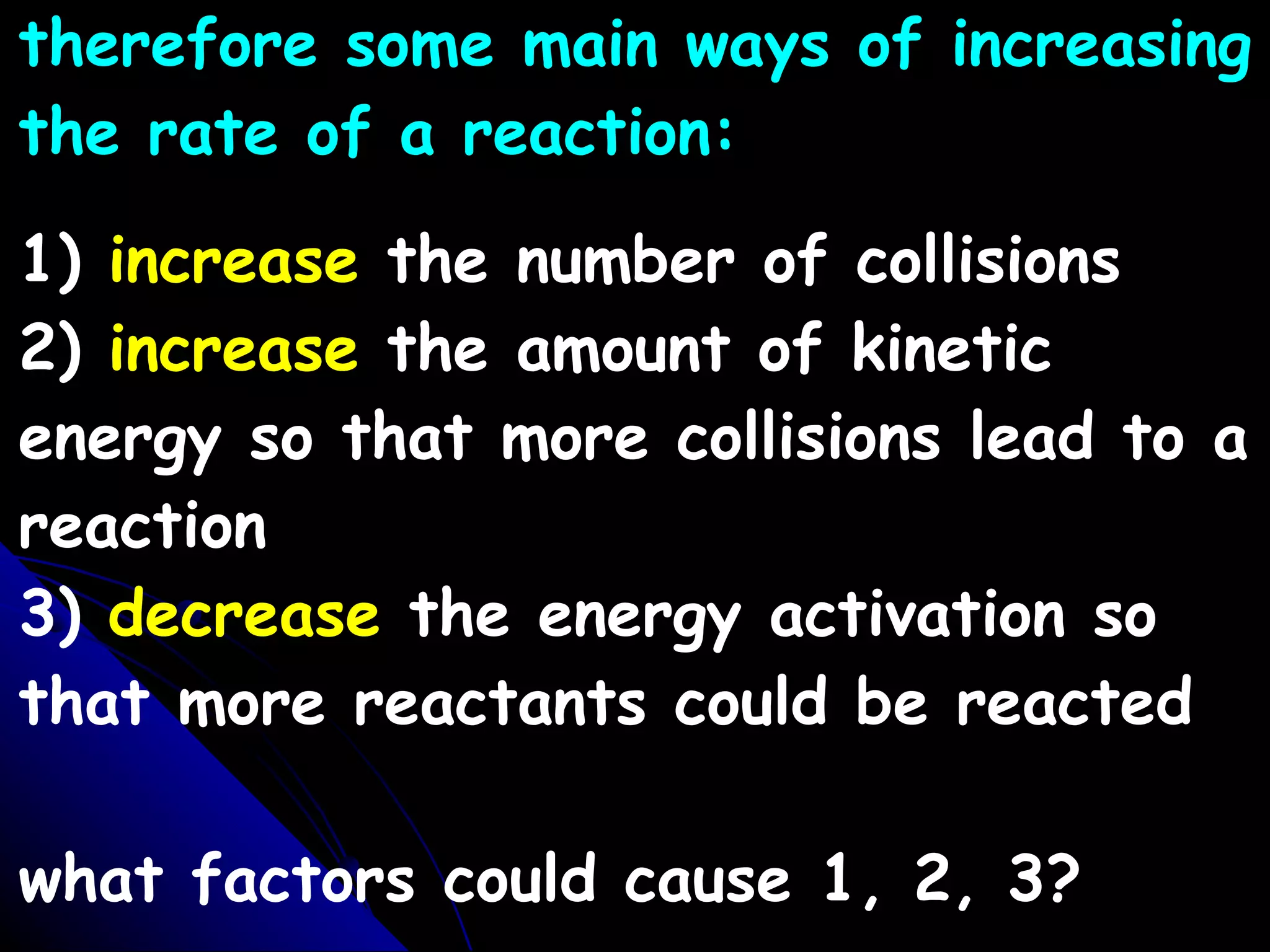
therefore some main ways of increasing the rate of a reaction: 1)  increase  the number of collisions 2)  increase  the amount of kinetic energy so that more collisions lead to a reaction 3)  decrease  the energy activation so that more reactants could be reacted what factors could cause 1, 2, 3?
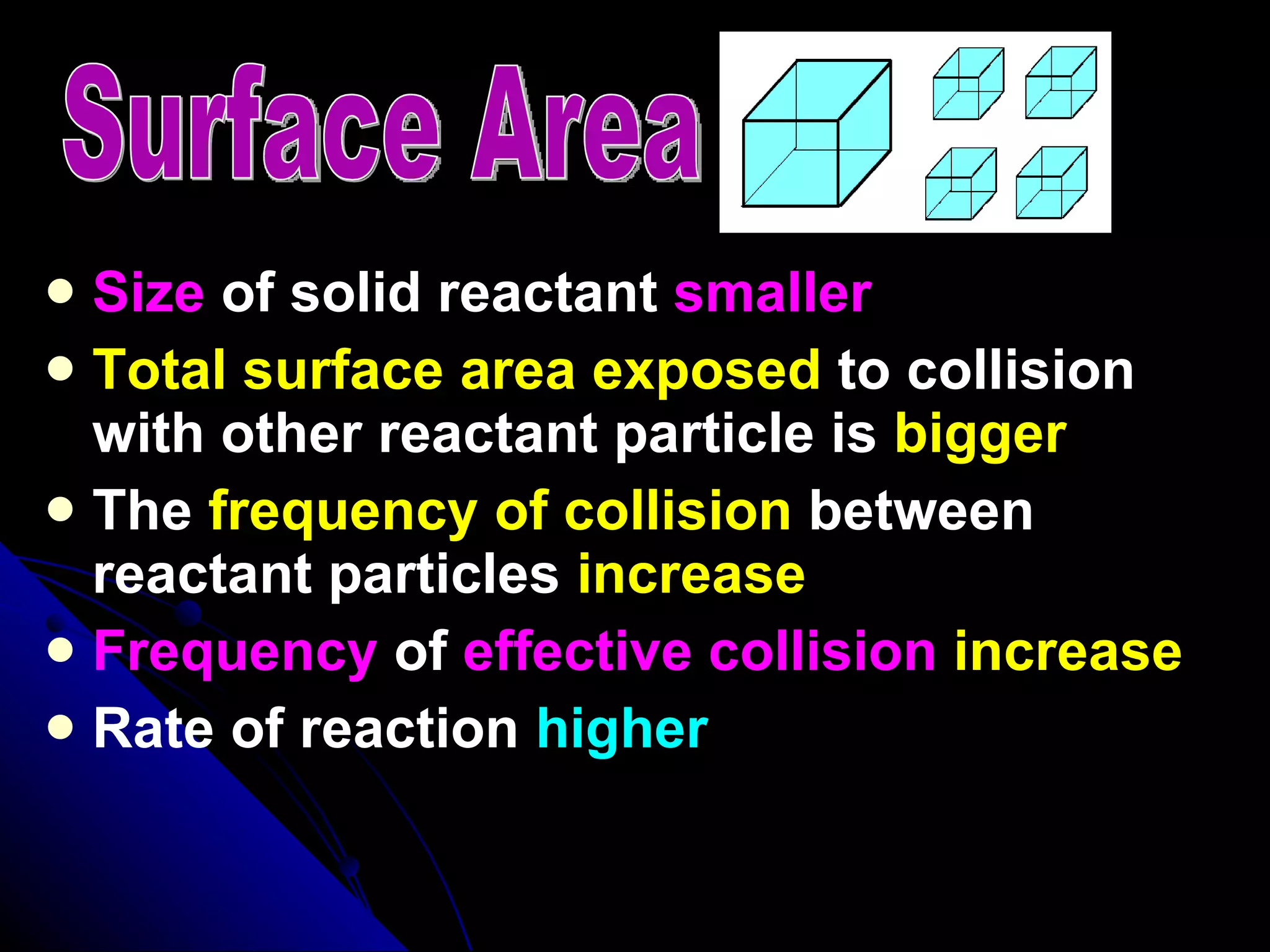
Size  of solid reactant  smaller Total surface area   exposed  to collision with other reactant particle is  bigger The  frequency of collision  between reactant particles  increase Frequency  of  effective collision   increase Rate of reaction  higher Surface Area
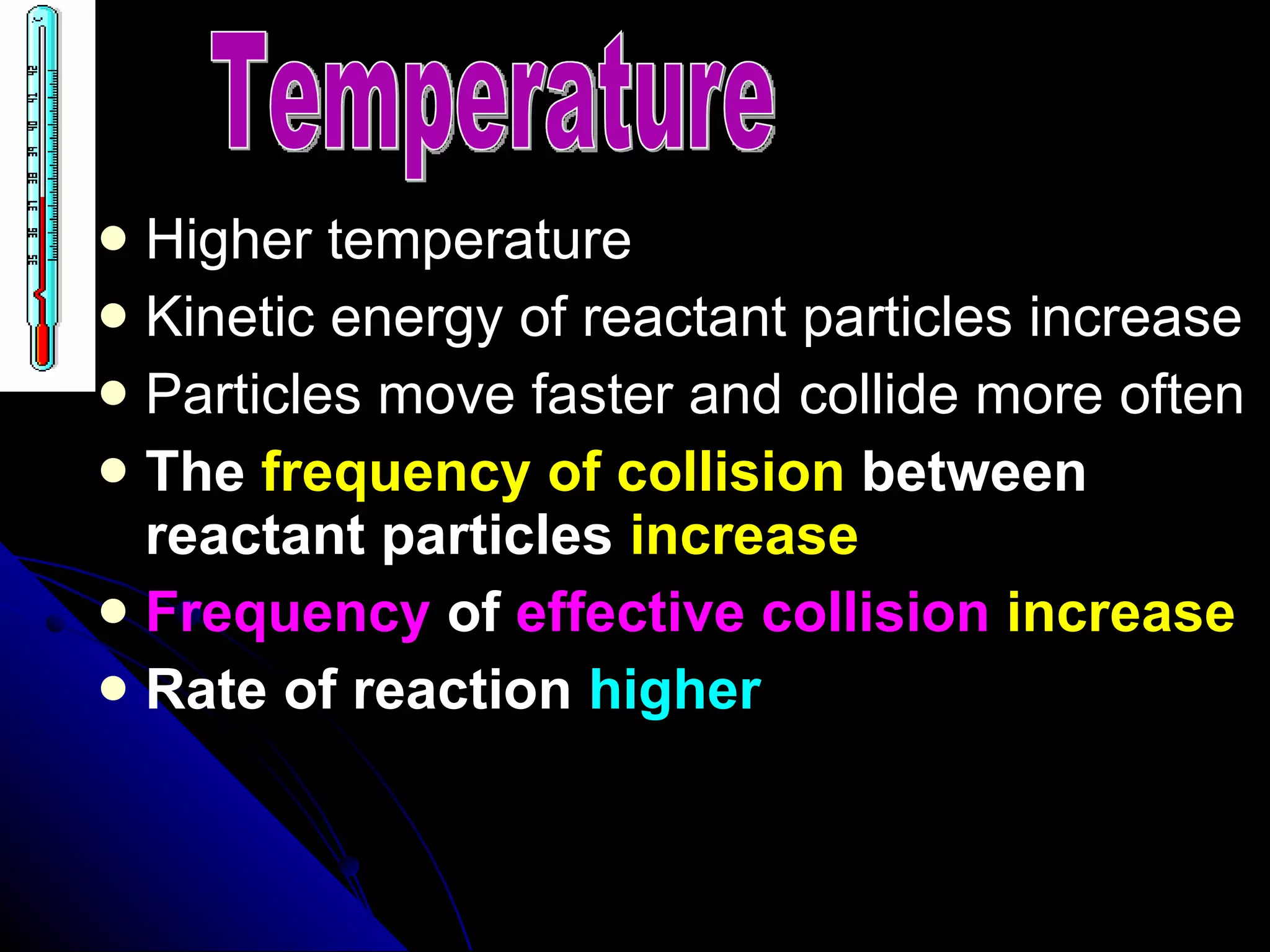
Higher temperature Kinetic energy of reactant particles increase Particles move faster and collide more often The  frequency of collision  between reactant particles  increase Frequency  of  effective collision   increase Rate of reaction  higher Temperature
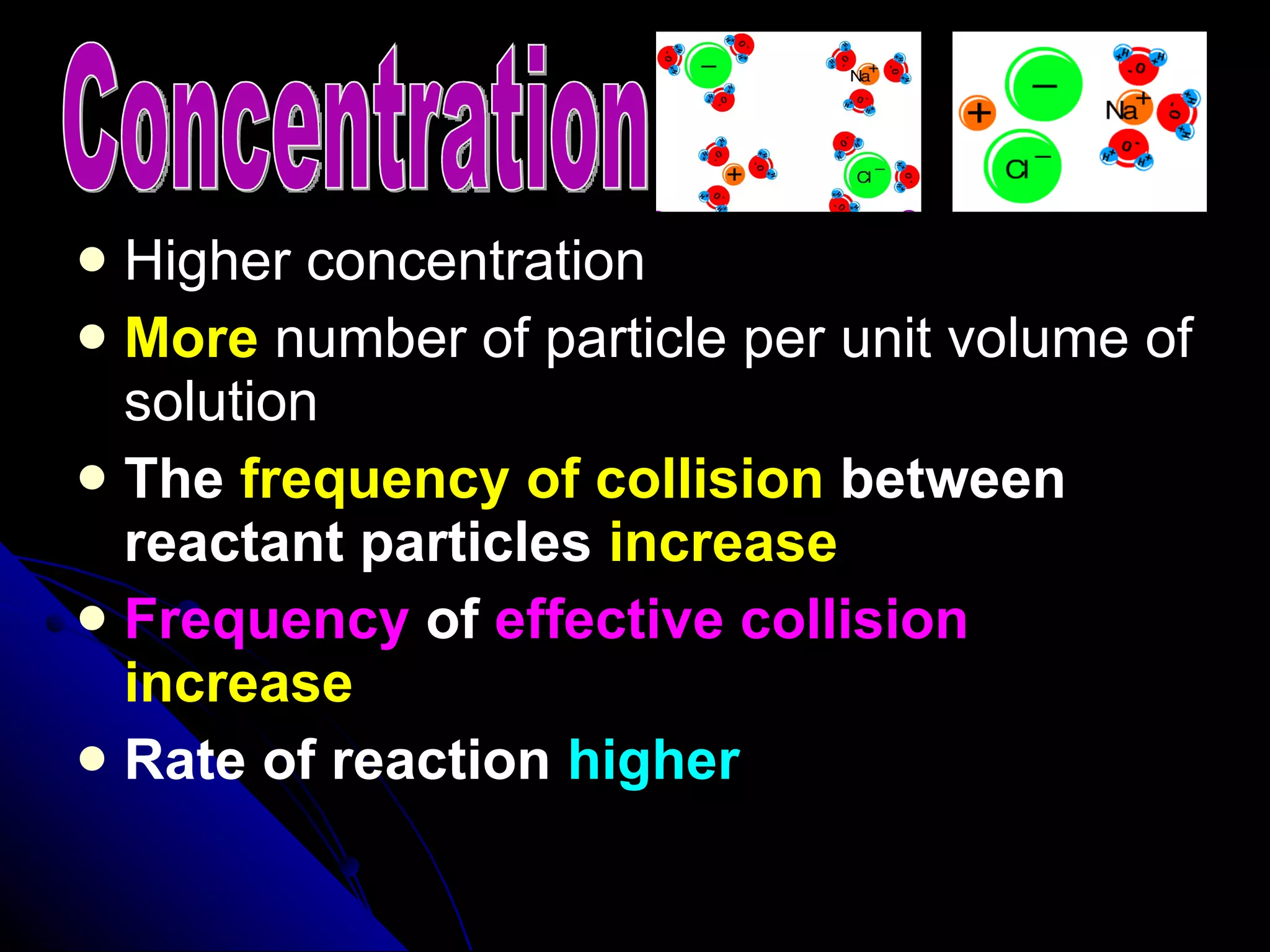
Higher concentration More  number of particle per unit volume of solution The  frequency of collision  between reactant particles  increase Frequency  of  effective collision   increase Rate of reaction  higher Concentration
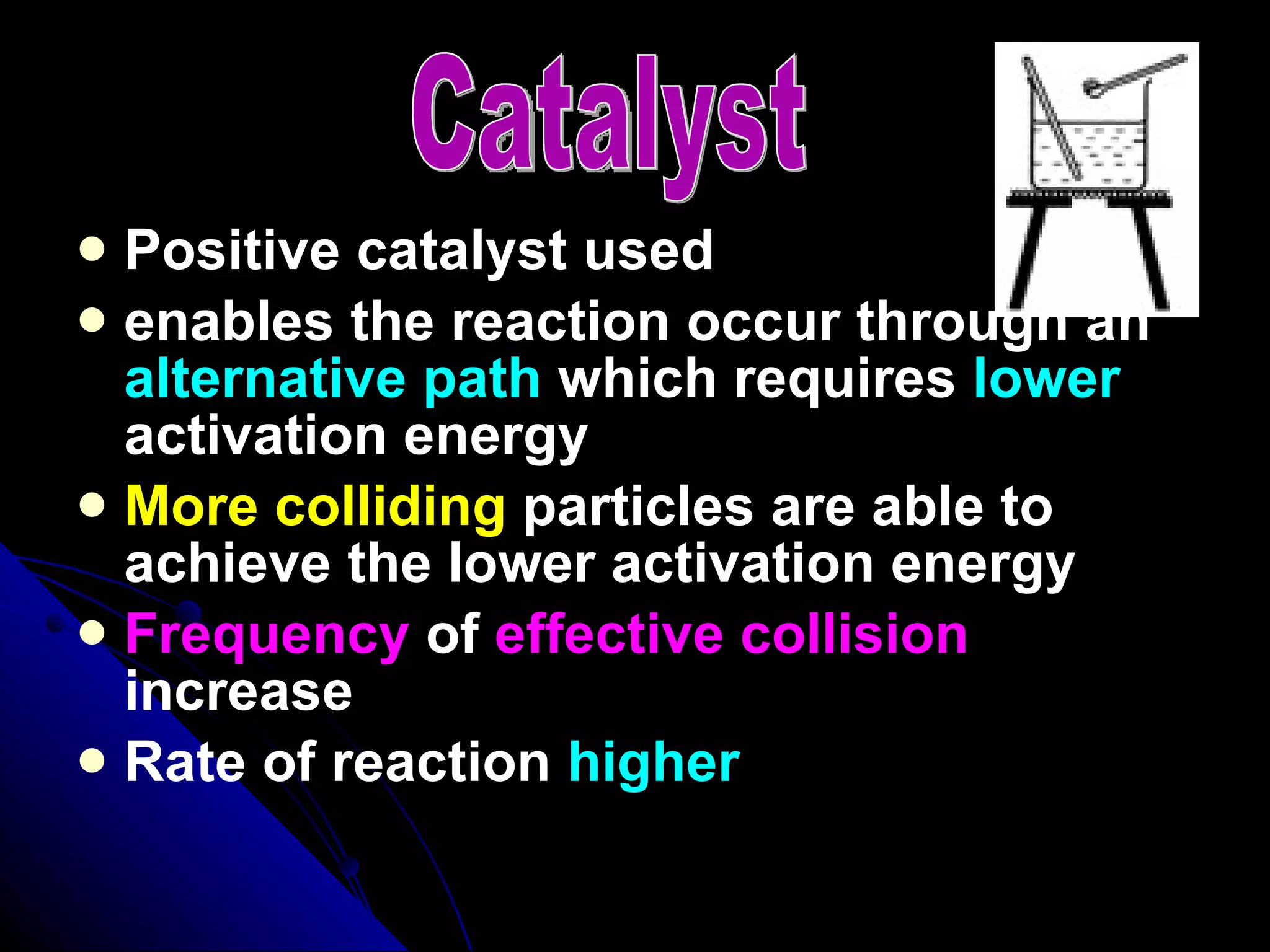
Positive catalyst used enables the reaction occur through an  alternative path  which requires  lower  activation energy More colliding  particles are able to achieve the lower activation energy Frequency  of  effective collision  increase Rate of reaction  higher Catalyst
Activation energy Lower Activation energy
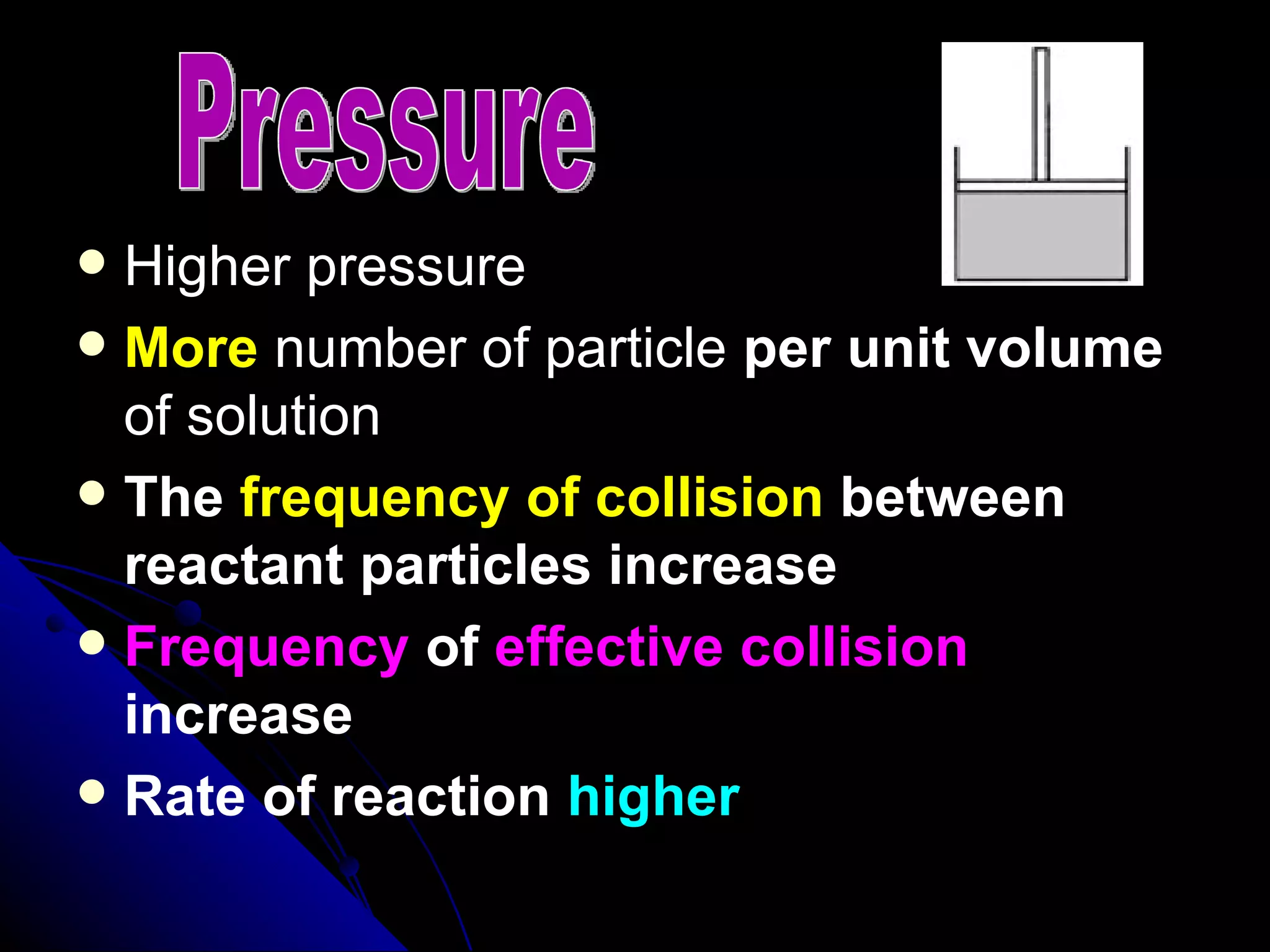
Pressure Higher pressure More  number of particle  per unit volume  of solution The  frequency of collision  between reactant particles increase Frequency  of  effective collision  increase Rate of reaction  higher
Conclusion

Chapter 1

  • 1.
    CHAPTER 1RATE OF REACTION
  • 2.
    1.1 RATEOF REACTION Why a tall building can be destroyed with explosives within seconds??
  • 3.
    Why food hasto take several hours to be decay ??
  • 4.
    Why do coalmines face a high risk of explosion ??
  • 5.
    All these arebecause : difference of rate of reaction
  • 6.
  • 7.
    What is therate of reaction ? The speed at which reactants are converted into products in a chemical reaction For examples:
  • 8.
    1. Fireworks displayoccurs in just a few seconds Rate of reaction HIGH
  • 9.
    2. The photosynthesisprocess takes a few hours Rate of reaction LOWER
  • 10.
    3. The erosionprocess of stones takes many years Rate of reaction VERY LOW
  • 11.
    Some reactions arefast & some reactions are very slow So do the chemical reactions in laboratory
  • 12.
    How we determine& calculate the rate of chemical reactions in laboratory ??
  • 13.
    It just same with the way we calculate the speed of driving How we calculate the speed of driving ??
  • 14.
    Yes, the formulaeis : Speed = distance (km) time (hour)
  • 15.
    In the otherhand, it is : Rate of = physical changes reaction time
  • 16.
    What are the changes that we could measure?? Mass before and after experiment (gs -1 ) Colour changes Temperature changes (°Cs -1 ) Pressure changes (Ps -1 ) Volume of gas liberated (cm 3 s -1 ) (only if the reaction produce gases)
  • 17.
  • 18.
    A + B C + D (reactants) (products) During the chemical reaction, reactants will become less but products become more
  • 19.
    Decomposition of hydrogenperoxide to form water and oxygen gas H 2 O 2 (aq) H 2 O (l) + O 2 (g)
  • 20.
  • 21.
    For any chemicalreaction, we can measure its average rate of reaction & rate of reaction at a given time
  • 22.
  • 23.
    Rate of = physical changes reaction time average rate of reaction rate of reaction at a given time Average rate = total changes of reaction total time taken Rate of reaction at a given time = gradient of the curve at that instant = y 2 – y 1 / X 2 – X 1
  • 24.
    Total changes Totaltime taken Average rate = total changes of reaction total time taken Volume of hydrogen gas ( cm 3 ) Time ( s )
  • 25.
    Changes = y2 – y 1 time taken = X 2 – X 1 Rate of reaction at 90 second = gradient of the curve at that instant = y 2 – y 1 / x 2 – x 1 find the given time draw a line to curve draw a tangent Measure y 2 – y 1 Measure x 2 – x 1 Volume of hydrogen gas ( cm 3 ) Time ( s )
  • 26.
  • 27.
  • 28.
    CaCO 3 + HCl  CaCl 2 + H 2 O + H 2 burette water Hydrochloric acid Marble chips Hydrogen gas
  • 29.
    Volume of hydrogengas was recorded every 30 seconds
  • 30.
    . . .. . . . . . . . . . . . . after 10 minutes . . .
  • 31.
    Here’s the result: Time / s Reading of burette / cm 3 Volume of gas / cm 3
  • 32.
    Then we plotthe graph: Volume of hydrogen gas ( cm 3 ) Time ( s ) 5 10 0 35 30 25 20 15 60 30 90 180 210 240 270 300 150 120
  • 33.
    Get the answers:Calculate the average rate of reaction between marble chips and hydrochloric acid. Solution: refer to table Time / s Reading of burette / cm 3 Volume of gas / cm 3
  • 34.
    Average rate ofreaction = total changes / total time taken Average rate of reaction = 34 cm 3 300 s = 0.113 cm 3 s -1 ** you’ll get the same answer by using graph
  • 35.
  • 36.
    b) Calculate the average rate of reaction in the first 90 seconds . Solution: this is accumulated !! Time / s Reading of burette / cm 3 Volume of gas / cm 3
  • 37.
    Average rate ofreaction = total changes / total time taken Average rate of reaction = 20 cm 3 90 s = 0.222 cm 3 s -1 ** you’ll get the same answer by using graph
  • 38.
  • 39.
    c) Calculate therate of reaction at a) 60 second b) 210 second
  • 40.
    Solution (a) :22.00 – 10.50 = 11.50 cm 3 90-30 = 60 s Rate of reaction at 60 second = y 2 – y 1 x 2 - x 1 = 22.00 -10.50 90 -30 = 11.50 cm 3 60 s = 0.192 cm 3 s -1 ** 5 10 35 30 25 20 15 Time ( s ) 90 Volume of hydrogen gas ( cm 3 ) 0 60 30 180 210 240 270 300 150 120
  • 41.
    Solution (b) :35.50 – 30.00 = 5.50 cm 3 255-160 = 95 s Rate of reaction at 210 second = 35.50 -30.00 255 -160 = 5.50 cm 3 95 s = 0.058 cm 3 s -1 ** 5 10 35 30 25 20 15 Time ( s ) 90 Volume of hydrogen gas ( cm 3 ) 0 60 30 180 210 240 270 300 150 120
  • 42.
  • 43.
    d) Compare therate of reaction at 60 second and 210 second Solution: Rate of reaction at 60 second = 0.192 cm 3 s -1 Rate of reaction at 210 second = 0.058 cm 3 s -1 The rate of reaction at 60 second is higher than 210 second. This means the reaction occurs faster at the moment of 60 second
  • 44.
    e) Why therate of reaction at 60 second is higher than 210 second ? Solution: Because the concentration of reactants is decreasing during the chemical reaction.
  • 45.
    f) There areno more hydrogen gas liberated after 300 second, why? Solution: Because the chemical reaction is stopped All the marble chips had been reacted
  • 46.
  • 47.
    Conclusion Rateof reaction very high Rate of reaction lower Curve becomes horizontal line No more reaction occur Rate of reaction = 0 cm 3 s -1 Rate of reaction More lower Total volume of gas Liberated (cm 3 ) Time (s / min)
  • 48.
    Learning Task 1.2page 8 WORKSHOP HOUR
  • 49.
  • 50.
    1.2 Factors affectingthe rate of reaction
  • 51.
    Some reactions arefast & some reactions are very slow So do the chemical reactions in laboratory
  • 52.
    What are thefactors affect the rate of reaction ??
  • 53.
    2. Temperature 1. T otal surface area 4. C atalyst 5. P ressure 3. C oncentration 2T 2C 1P
  • 54.
    How does thefactors of Total surface area, Temperature, Concentration, Catalyst & Pressure affect the reaction rate?? 2T 2C 1P
  • 55.
    Let’s do theexperiment to investigate that: 1.Surface area smaller , rate of reaction 2.Concentration higher, rate of reaction 3.Temperature higher, rate of reaction 4.Catalyst added, rate of reaction
  • 56.
  • 57.
  • 58.
    Surface area smaller, rate of reaction Concentration higher, rate of reaction Temperature higher, rate of reaction Catalyst added, rate of reaction Pressure higher, rate of reaction Conclusion
  • 59.
  • 60.
  • 61.
    A + B C + D (reactants) (products) During the chemical reaction, reactants will become less but products become more The chemical reaction will stop once one of the reactants is used up .
  • 62.
    Pattern of graphsReactant A + Reactant B  gases Less Less More
  • 63.
  • 64.
  • 65.
    More examples ofinterpreting graphical results
  • 66.
    Mg (s) +HCl (aq)  MgCl (aq) + H 2 (g) excess Draw out the curves of graph for: 1. Magnesium mass / 2. Hydrochloric acid concentration/ 3. Magnesium chloride concentration / 4. Hydrogen gas volume against the time
  • 67.
    1. the curvesof graph for Magnesium mass against the time Magnesium Excess >>>
  • 68.
    2. the curvesof graph for hydrochloric acid concentration against the time Hydrochloric acid Limited reactant
  • 69.
    3. the curvesof graph for magnesium chloride concentration against the time Hydrochloric acid has been used up & reaction stopped
  • 70.
    4. the curvesof graph for hydrogen gas volume against the time Hydrochloric acid has been used up & reaction stopped
  • 71.
    Q1. Compare these:Set 1 : 1g of zinc plate (excess) reacts with sulphuric acid 0.1 mol dm -3 to form zinc sulphate and hydrogen gas Set 2 : 1g of zinc powder (excess) reacts with sulphuric acid 0.1 mol dm -3 to form zinc sulphate and hydrogen gas Find the difference !!
  • 72.
    Hydrogen Gas /cm 3 Time / s Set 2 Set 1 The number of moles of chemical subtances are same Factor : total of surface area / Particle size
  • 73.
    Q2. Compare these:Set 3 : 1 g of zinc powder (excess) reacts with 500cm 3 sulphuric acid 0.1 mol dm -3 to form zinc sulphate and hydrogen gas Set 4 : 1 g of zinc powder (excess) reacts with 250cm 3 sulphuric acid 0.2 mol dm -3 to form zinc sulphate and hydrogen gas Find the difference !!
  • 74.
    Hydrogen Gas /cm 3 Time / s Set 4 Set 3 The number of moles of chemical subtances are same Factor : Concentration
  • 75.
    Q3. Compare these:Set 5 : 1 g of zinc powder (excess) reacts with 250cm 3 sulphuric acid 0.1 mol dm -3 to form zinc sulphate and hydrogen gas Set 6 : 1 g of zinc powder (excess) reacts with 250cm 3 sulphuric acid 0.2 mol dm -3 to form zinc sulphate and hydrogen gas Find the difference !!
  • 76.
    Hydrogen Gas /cm 3 Time / s Set 6 Set 5 The number of moles of chemical subtances are same Factor : Concentration
  • 77.
    Q4. Compare these:Set 7 : 1 g of zinc powder (excess) reacts with 25cm 3 sulphuric acid 0.15 mol dm -3 to form zinc sulphate and hydrogen gas Set 8 : 1 g of zinc powder (excess) reacts with 50cm 3 sulphuric acid 0.1 mol dm -3 to form zinc sulphate and hydrogen gas Find the difference !!
  • 78.
    Hydrogen Gas /cm 3 Time / s Set 8 Set 7 The number of moles of chemical subtances in Set 8 is higher, so the volume of gas realeased is higher Factor : Concentration
  • 79.
  • 80.
    Find out whatthey means!! Collision Correct orientation Activation energy Effective collision Collision frequency Effective collision frequency Energy profile diagram Achieve effective collision
  • 81.
    Base on kinetictheory, particles moves constantly and collide each other all the time However, majority of collisions do not lead to a reaction,why ?
  • 82.
    Only those inwhich the colliding species have: Achieve minimum amount of energy, called the ACTIVATION ENERGY, E a And with CORRECT ORIENTATION EFFECTIVE COLLISIONS
  • 83.
    For a reactionto take place, the particles of the substances that are reacting have to collide . If they collide, with enough energy then they will react. The minimum amount of energy that particles need to react is called the ACTIVATION ENERGY
  • 84.
  • 85.
  • 86.
  • 87.
    therefore some mainways of increasing the rate of a reaction: 1) increase the number of collisions 2) increase the amount of kinetic energy so that more collisions lead to a reaction 3) decrease the energy activation so that more reactants could be reacted what factors could cause 1, 2, 3?
  • 88.
    Size ofsolid reactant smaller Total surface area exposed to collision with other reactant particle is bigger The frequency of collision between reactant particles increase Frequency of effective collision increase Rate of reaction higher Surface Area
  • 89.
    Higher temperature Kineticenergy of reactant particles increase Particles move faster and collide more often The frequency of collision between reactant particles increase Frequency of effective collision increase Rate of reaction higher Temperature
  • 90.
    Higher concentration More number of particle per unit volume of solution The frequency of collision between reactant particles increase Frequency of effective collision increase Rate of reaction higher Concentration
  • 91.
    Positive catalyst usedenables the reaction occur through an alternative path which requires lower activation energy More colliding particles are able to achieve the lower activation energy Frequency of effective collision increase Rate of reaction higher Catalyst
  • 92.
    Activation energy LowerActivation energy
  • 93.
    Pressure Higher pressureMore number of particle per unit volume of solution The frequency of collision between reactant particles increase Frequency of effective collision increase Rate of reaction higher
  • 94.