Acids Bases and Salts Brainpop~Acids  and Bases
Acid: A substance that releases H+ ions in an aqueous solution “ aqueous” means: water
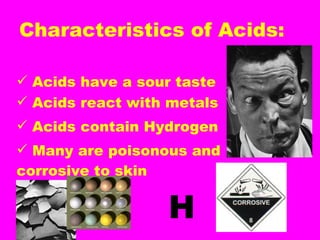
Characteristics of Acids: Acids have a sour taste Acids react with metals Acids contain Hydrogen Many are poisonous and  corrosive to skin H
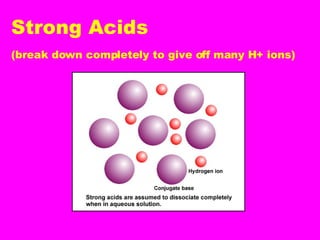
Strong Acids (break down completely to give off many H+ ions)
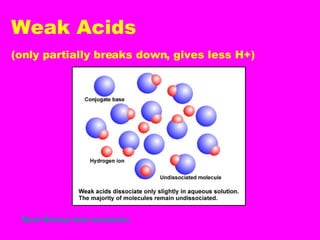
Weak Acids (only partially breaks down, gives less H+) Mark Bishop Acid animation
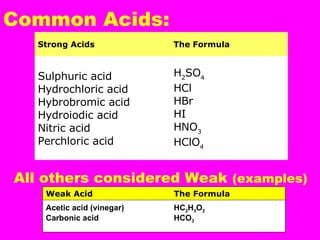
Common Acids: All others considered Weak  (examples) Acetic acid (vinegar) HC 2 H 3 O 2 Carbonic acid HCO 3 Weak Acid The Formula H 2 SO 4 HCl HBr HI HNO 3 HClO 4 Sulphuric acid Hydrochloric acid Hybrobromic acid Hydroiodic acid Nitric acid Perchloric acid The Formula Strong Acids
Base: A substance that releases OH- ions in an aqueous solution
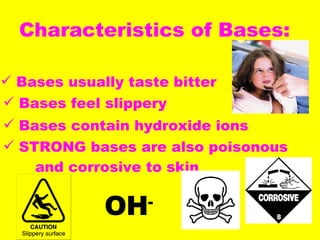
Characteristics of Bases: Bases usually taste bitter Bases feel slippery Bases contain hydroxide ions STRONG bases are also poisonous  and corrosive to skin OH -
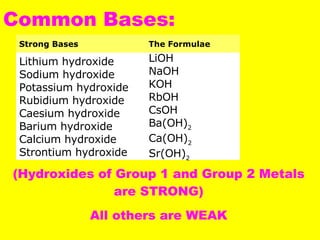
Common Bases: (Hydroxides of Group 1 and Group 2 Metals are STRONG) All others are WEAK LiOH NaOH KOH RbOH CsOH Ba(OH) 2 Ca(OH) 2 Sr(OH) 2 Lithium hydroxide Sodium hydroxide Potassium hydroxide Rubidium hydroxide Caesium hydroxide Barium hydroxide Calcium hydroxide Strontium hydroxide The Formulae Strong Bases
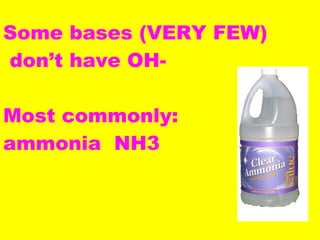
Some bases (VERY FEW) don’t have OH- Most commonly:  ammonia  NH3
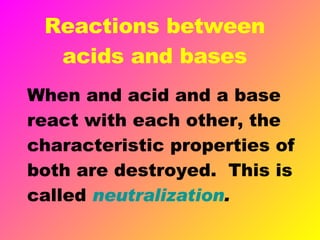
Reactions   between acids and bases When and acid and a base react with each other, the characteristic properties of both are destroyed.  This is called  neutralization .
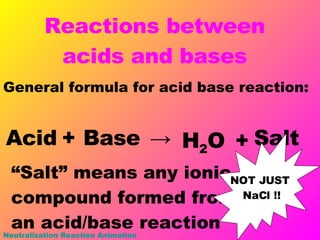
Reactions between acids and bases General formula for acid base reaction: Acid + Base -> H 2 O + Salt “ Salt” means any ionic compound formed from an acid/base reaction NOT JUST  NaCl !! Neutralization Reaction Animation
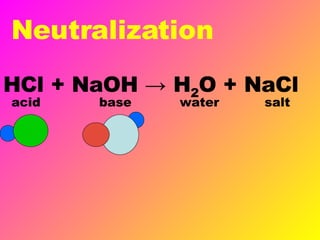
Neutralization HCl + NaOH -> H 2 O + NaCl acid base   water   salt
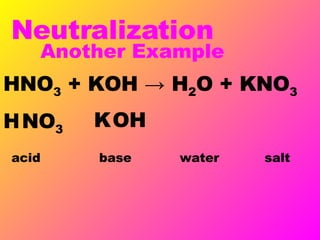
Neutralization Another Example HNO 3  + KOH -> H 2 O + KNO 3 H OH K NO 3 acid base   water   salt
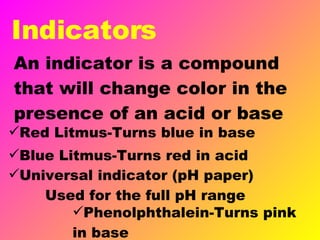
Indicators An indicator is a compound that will change color in the presence of an acid or base Universal indicator (pH paper)  Used for the full pH range Red Litmus-Turns blue in base Blue Litmus-Turns red in acid Phenolphthalein-Turns pink in base
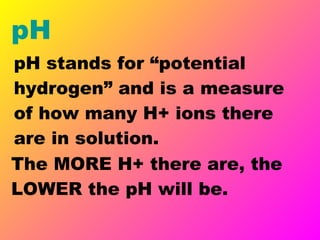
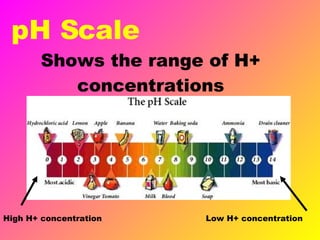
pH pH stands for “potential hydrogen” and is a measure of how many H+ ions there are in solution. The MORE H+ there are, the LOWER the pH will be.
pH Scale Shows the range of H+ concentrations High H+ concentration Low H+ concentration

Acids Bases and Salts

  • 1.
    Acids Bases andSalts Brainpop~Acids and Bases
  • 2.
    Acid: A substancethat releases H+ ions in an aqueous solution “ aqueous” means: water
  • 3.
    Characteristics of Acids:Acids have a sour taste Acids react with metals Acids contain Hydrogen Many are poisonous and corrosive to skin H
  • 4.
    Strong Acids (breakdown completely to give off many H+ ions)
  • 5.
    Weak Acids (onlypartially breaks down, gives less H+) Mark Bishop Acid animation
  • 6.
    Common Acids: Allothers considered Weak (examples) Acetic acid (vinegar) HC 2 H 3 O 2 Carbonic acid HCO 3 Weak Acid The Formula H 2 SO 4 HCl HBr HI HNO 3 HClO 4 Sulphuric acid Hydrochloric acid Hybrobromic acid Hydroiodic acid Nitric acid Perchloric acid The Formula Strong Acids
  • 7.
    Base: A substancethat releases OH- ions in an aqueous solution
  • 8.
    Characteristics of Bases:Bases usually taste bitter Bases feel slippery Bases contain hydroxide ions STRONG bases are also poisonous and corrosive to skin OH -
  • 9.
    Common Bases: (Hydroxidesof Group 1 and Group 2 Metals are STRONG) All others are WEAK LiOH NaOH KOH RbOH CsOH Ba(OH) 2 Ca(OH) 2 Sr(OH) 2 Lithium hydroxide Sodium hydroxide Potassium hydroxide Rubidium hydroxide Caesium hydroxide Barium hydroxide Calcium hydroxide Strontium hydroxide The Formulae Strong Bases
  • 10.
    Some bases (VERYFEW) don’t have OH- Most commonly: ammonia NH3
  • 11.
    Reactions between acids and bases When and acid and a base react with each other, the characteristic properties of both are destroyed. This is called neutralization .
  • 12.
    Reactions between acidsand bases General formula for acid base reaction: Acid + Base -> H 2 O + Salt “ Salt” means any ionic compound formed from an acid/base reaction NOT JUST NaCl !! Neutralization Reaction Animation
  • 13.
    Neutralization HCl +NaOH -> H 2 O + NaCl acid base water salt
  • 14.
    Neutralization Another ExampleHNO 3 + KOH -> H 2 O + KNO 3 H OH K NO 3 acid base water salt
  • 15.
    Indicators An indicatoris a compound that will change color in the presence of an acid or base Universal indicator (pH paper) Used for the full pH range Red Litmus-Turns blue in base Blue Litmus-Turns red in acid Phenolphthalein-Turns pink in base
  • 16.
    pH pH standsfor “potential hydrogen” and is a measure of how many H+ ions there are in solution. The MORE H+ there are, the LOWER the pH will be.
  • 17.
    pH Scale Showsthe range of H+ concentrations High H+ concentration Low H+ concentration