CELLULAR MANUFACTURING
           &
   GROUP TECHNOLOGY

          GROUP NO: 6
                            Ruchi Gattani
                          Shoaib Qureshi
                         Ketan Changani
                        Hitendrasinh Zala
                        Vishal Bhatnagar


                                            1
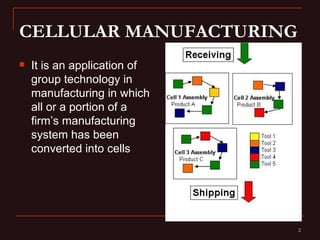
CELLULAR MANUFACTURING
   It is an application of
    group technology in
    manufacturing in which
    all or a portion of a
    firm’s manufacturing
    system has been
    converted into cells


                              2
CELL FORMATION APPROACHES

 Machine - Component Group Analysis is
 based on production flow analysis


                                         3
                                         3
Production flow analysis involves four stages:

  Stage 1: Machine classification.

  Machines are classified on the basis of
  operations that can be performed on them. A
  machine type number is assigned to
  machines capable of performing similar
  operations.


                                                 4
                                                 4
Stage 2:Checking parts list and production
     route information.

 For each part, information on the operations
 to be undertaken and the machines required
 to perform each of these operations is
 checked thoroughly.


                                                5
                                                5
Stage 3: Factory flow analysis.

 This involves a micro-level examination of
 flow of components through machines. This,
 in turn, allows the problem to be decomposed
 into a number of machine-component groups.


                                            6
                                            6
Stage 4:   Machine-component group
           analysis.

 An intuitive manual method is suggested to
 manipulate the matrix to form cells. However,
 as the problem size becomes large, the
 manual approach does not work. Therefore,
 there is a need to develop analytical
 approaches to handle large problems
 systematically.


                                                 7
                                                 7
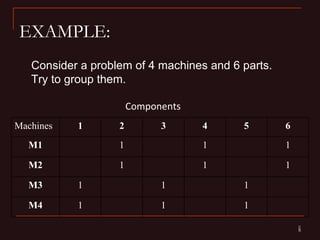
EXAMPLE:
   Consider a problem of 4 machines and 6 parts.
   Try to group them.

                       Components
Machines   1       2         3      4     5        6
  M1               1                1              1

  M2               1                1              1

  M3       1                 1            1

  M4       1                 1            1

                                                       8
                                                       8
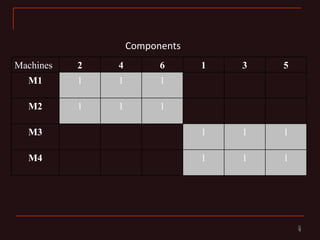
Components
Machines   2   4         6      1   3   5
  M1       1   1         1

  M2       1   1         1

  M3                            1   1   1

  M4                            1   1   1


                                            9
                                            9
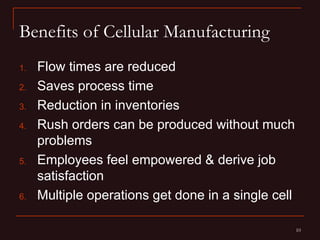
Benefits of Cellular Manufacturing
1.   Flow times are reduced
2.   Saves process time
3.   Reduction in inventories
4.   Rush orders can be produced without much
     problems
5.   Employees feel empowered & derive job
     satisfaction
6.   Multiple operations get done in a single cell

                                                     10
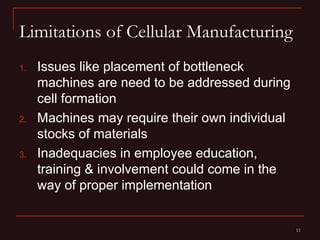
Limitations of Cellular Manufacturing
1.   Issues like placement of bottleneck
     machines are need to be addressed during
     cell formation
2.   Machines may require their own individual
     stocks of materials
3.   Inadequacies in employee education,
     training & involvement could come in the
     way of proper implementation


                                                 11
GROUP TECHNOLOGY
Group technology (GT) is a philosophy that
works in three different ways:
    1. By performing similar activities together
    2. By standardizing similar tasks
    3. By efficiently storing and retrieving
information about recurring problems


                                               12
Group Technology
   Group technology emphasizes on part families
    based on similarities in design attributes and
    manufacturing, therefore GT contributes to the
    integration of CAD (Computer Aided Design)
    and CAM (Computer Aided Manufacturing)
   The group of similar parts is known as part
    family and the group of machineries used to
    process an individual part family is known as
    machine cell


                                                 13
BENEFITS OF GROUP TECHNOLOGY


Group technology is a management strategy to
help eliminate waste caused by duplication of
effort.


                                                14
                                                14
BENEFITS OF GROUP TECHNOLOGY

It affects all areas of a company, including:

   engineering
   equipment specification
   facilities planning
   process planning
   production control
   quality control
   tool design
   purchasing
   service


                                                15
                                                15
BENEFITS OF GROUP TECHNOLOGY
 Some of the well-known tangible and intangible benefits of
 implementing GT :

  1. Engineering design

  • Reduction in new parts design
  • Reduction in the number of drawings through
    standardization
  • Reduction of drafting effort in new shop drawings
  • Reduction of number of similar parts, easy retrieval of
    similar functional parts, and identification of substitute
    parts


                                                                 16
                                                                 16
BENEFITS OF GROUP TECHNOLOGY


2. Layout planning

   Reduction in production floor space required
   Reduced material-handling effort


                                                   17
                                                   17
BENEFITS OF GROUP TECHNOLOGY


3. Specification of equipment, tools, jigs, and
  fixtures

   Standardization of equipment
   Implementation of cellular manufacturing
    systems
   Significant reduction in up-front costs
    incurred in the release of new parts for
    manufacture

                                                  18
                                                  18
BENEFITS OF GROUP TECHNOLOGY


4. Manufacturing: process planning

   Reduction in setup time and production time
   Alternative routing leading to improved part
    routing
   Reduction in number of machining operations
    and numerical control (NC) programming
    time


                                               19
                                               19
BENEFITS OF GROUP TECHNOLOGY

5. Manufacturing: production control

   Reduced work-in-process inventory
   Easy identification of bottlenecks
   Improved material flow and reduced warehousing
    costs
   Faster response to schedule changes
   Improved usage of jigs, fixtures, pallets, tools,
    material handling, and manufacturing equipment


                                                        20
                                                        20
BENEFITS OF GROUP TECHNOLOGY

6. Manufacturing: quality control

   Reduction in number of defects leading to reduced
    inspection effort
   Reduced scrap generation
   Better output quality
   Increased accountability of operators and
    supervisors responsible for quality production,
    making it easier to implement total quality control
    concepts.


                                                          21
                                                          21
BENEFITS OF GROUP TECHNOLOGY
7. Purchasing

   Coding of purchased part leading to
    standardized rules for purchasing
   Economies in purchasing possible because
    of accurate knowledge of raw material
    requirements
   Reduced number of part and raw materials
   Simplified vendor evaluation procedures
    leading to just-in-time purchasing

                                               22
                                               22
BENEFITS OF GROUP TECHNOLOGY


8. Customer service

   Accurate and faster cost estimates
   Efficient spare parts management, leading to
    better customer service


                                               23
                                               23
Thank You


            24

Cellular manufacturing group technology

  • 1.
    CELLULAR MANUFACTURING & GROUP TECHNOLOGY GROUP NO: 6 Ruchi Gattani Shoaib Qureshi Ketan Changani Hitendrasinh Zala Vishal Bhatnagar 1
  • 2.
    CELLULAR MANUFACTURING  It is an application of group technology in manufacturing in which all or a portion of a firm’s manufacturing system has been converted into cells 2
  • 3.
    CELL FORMATION APPROACHES Machine - Component Group Analysis is based on production flow analysis 3 3
  • 4.
    Production flow analysisinvolves four stages: Stage 1: Machine classification. Machines are classified on the basis of operations that can be performed on them. A machine type number is assigned to machines capable of performing similar operations. 4 4
  • 5.
    Stage 2:Checking partslist and production route information. For each part, information on the operations to be undertaken and the machines required to perform each of these operations is checked thoroughly. 5 5
  • 6.
    Stage 3: Factoryflow analysis. This involves a micro-level examination of flow of components through machines. This, in turn, allows the problem to be decomposed into a number of machine-component groups. 6 6
  • 7.
    Stage 4: Machine-component group analysis. An intuitive manual method is suggested to manipulate the matrix to form cells. However, as the problem size becomes large, the manual approach does not work. Therefore, there is a need to develop analytical approaches to handle large problems systematically. 7 7
  • 8.
    EXAMPLE: Consider a problem of 4 machines and 6 parts. Try to group them. Components Machines 1 2 3 4 5 6 M1 1 1 1 M2 1 1 1 M3 1 1 1 M4 1 1 1 8 8
  • 9.
    Components Machines 2 4 6 1 3 5 M1 1 1 1 M2 1 1 1 M3 1 1 1 M4 1 1 1 9 9
  • 10.
    Benefits of CellularManufacturing 1. Flow times are reduced 2. Saves process time 3. Reduction in inventories 4. Rush orders can be produced without much problems 5. Employees feel empowered & derive job satisfaction 6. Multiple operations get done in a single cell 10
  • 11.
    Limitations of CellularManufacturing 1. Issues like placement of bottleneck machines are need to be addressed during cell formation 2. Machines may require their own individual stocks of materials 3. Inadequacies in employee education, training & involvement could come in the way of proper implementation 11
  • 12.
    GROUP TECHNOLOGY Group technology(GT) is a philosophy that works in three different ways: 1. By performing similar activities together 2. By standardizing similar tasks 3. By efficiently storing and retrieving information about recurring problems 12
  • 13.
    Group Technology  Group technology emphasizes on part families based on similarities in design attributes and manufacturing, therefore GT contributes to the integration of CAD (Computer Aided Design) and CAM (Computer Aided Manufacturing)  The group of similar parts is known as part family and the group of machineries used to process an individual part family is known as machine cell 13
  • 14.
    BENEFITS OF GROUPTECHNOLOGY Group technology is a management strategy to help eliminate waste caused by duplication of effort. 14 14
  • 15.
    BENEFITS OF GROUPTECHNOLOGY It affects all areas of a company, including:  engineering  equipment specification  facilities planning  process planning  production control  quality control  tool design  purchasing  service 15 15
  • 16.
    BENEFITS OF GROUPTECHNOLOGY Some of the well-known tangible and intangible benefits of implementing GT : 1. Engineering design • Reduction in new parts design • Reduction in the number of drawings through standardization • Reduction of drafting effort in new shop drawings • Reduction of number of similar parts, easy retrieval of similar functional parts, and identification of substitute parts 16 16
  • 17.
    BENEFITS OF GROUPTECHNOLOGY 2. Layout planning  Reduction in production floor space required  Reduced material-handling effort 17 17
  • 18.
    BENEFITS OF GROUPTECHNOLOGY 3. Specification of equipment, tools, jigs, and fixtures  Standardization of equipment  Implementation of cellular manufacturing systems  Significant reduction in up-front costs incurred in the release of new parts for manufacture 18 18
  • 19.
    BENEFITS OF GROUPTECHNOLOGY 4. Manufacturing: process planning  Reduction in setup time and production time  Alternative routing leading to improved part routing  Reduction in number of machining operations and numerical control (NC) programming time 19 19
  • 20.
    BENEFITS OF GROUPTECHNOLOGY 5. Manufacturing: production control  Reduced work-in-process inventory  Easy identification of bottlenecks  Improved material flow and reduced warehousing costs  Faster response to schedule changes  Improved usage of jigs, fixtures, pallets, tools, material handling, and manufacturing equipment 20 20
  • 21.
    BENEFITS OF GROUPTECHNOLOGY 6. Manufacturing: quality control  Reduction in number of defects leading to reduced inspection effort  Reduced scrap generation  Better output quality  Increased accountability of operators and supervisors responsible for quality production, making it easier to implement total quality control concepts. 21 21
  • 22.
    BENEFITS OF GROUPTECHNOLOGY 7. Purchasing  Coding of purchased part leading to standardized rules for purchasing  Economies in purchasing possible because of accurate knowledge of raw material requirements  Reduced number of part and raw materials  Simplified vendor evaluation procedures leading to just-in-time purchasing 22 22
  • 23.
    BENEFITS OF GROUPTECHNOLOGY 8. Customer service  Accurate and faster cost estimates  Efficient spare parts management, leading to better customer service 23 23
  • 24.