UNIT IV
GROUP TECHNOLOGY
GROUP TECHNOLOGY
Group Technology or GT is a manufacturing philosophy in
Which the parts having similarities (Geometry,
Manufacturing process function) are grouped together and
to achieve higher level of integration between the
design and manufacturing functions of a firm.
• The group of similar parts is known as part family
and the group of machineries used to process an
individual part family is known as machine cell.
Group Technology
• Group technology emphasizes on part families based on
similarities
therefore
in design attributes and manufacturing,
GT contributes to the integration of CAD
(Computer Aided Design) and CAM (Computer
Aided Manufacturing).
Implementing Group Technology(GT)
• There are two major tasks that a company must
undertake when it implements Group Technology
1.Identifying the part families. If the plant makes 10,000
different parts, reviewing all of the part drawings and
grouping the parts into families is a substantial task that
consumes a significant amount of time.
2.Rearranging production machines into cells. It is time
consuming and costly to plan and accomplish this
rearrangement, and the machines are not producing
during the changeover.
Group Technology
• There are four general methods for solving part families
grouping. All the four are time consuming and involve the
analysis of much of data by properly trained personnel.
• The four methods are:
1.Visual inspection.
2.Composite part method.
3.Production flow analysis.
4.Parts classification and coding.
1.Visual Inspection Method
• The visual inspection method is the least sophisticated
and least expensive method.
• It involves the classification of parts into families by
looking at either the physical parts or their
photographs and arranging them into groups
having similar features.
2.Composite part Method
1. In this method a hypothetical composite part is formed on
the basis of the features of all the components forming the
group in question.
2. Figure show number of components manufacturing on a lathe.
3. The various operations include setting the length , facing ,
turning , grooving , drilling , boring , reaming , counter – boring,
chamfering , parting off , etc
4. Each job need all the operations.
5. An imaginary component is composed which involves all the
operations needed for the group.
6. The tool setting is done for such a components on a multi-tool
set up say turret, which can easily handle up to 11 tools.
7. Depends upon particular components to be worked on
instructions are prepared to indicate the tool and sequence of
operation they have to used.
8. Whenever a new component is to be made, its group is
determined and then its sequence of operations and tooling is
prepared.
3.Production Flow Analysis
1. This method makes use of the information contained on route
sheets rather than on part drawings.
2. Work – parts with identical or similar routings are classified into
part families.
The procedure of production flow analysis is as follows:
I. Data collection: The data such as part number and operation
sequence is collected from manufacturing data contained in the
route sheets.
II. Sorting: The parts are separated and arranged into groups
according to similar or identical routings.
III. Preparation of chart :
a) The chart is a tabulation of the process or machine code
numbers for all the parts of a part family.
b) In this tabulation , the entries are cross marked (X).
c) The cross mark (X) indicates I th part requiring j th machine.
d) If X ij= 0 , there is no processing of the ith part on the jth
machine.
Process flow analysis
Production Flow Analysis (PFA)
• Production flow analysis (PFA) is a method for identifying part
families and associated machine groupings that uses the
information contained on process plans rather than on part
drawings.
• Work parts with identical or similar process plans are classified
into part families. These families can then be used to form
logical machine cells in a group technology layout.
• The procedure in production flow analysis must begin by
defining the scope of the study, which means deciding on the
population of parts to be analyzed.
4. Parts classification andCoding
• In parts classification and coding, similarities among
parts are identified, and these similarities are
related in a coding system.
• This classification and coding may be carried on the entire
list of parts of a family.
• Two categories of part similarities can be distinguished:
1.Design attributes,which concerned with part
characteristics such as geometry, size and material.
2.Manufacturing attributes, which consider the
sequence of processing steps required to make a part.
Parts classification andCoding
• Reasons for using a classification and coding system:
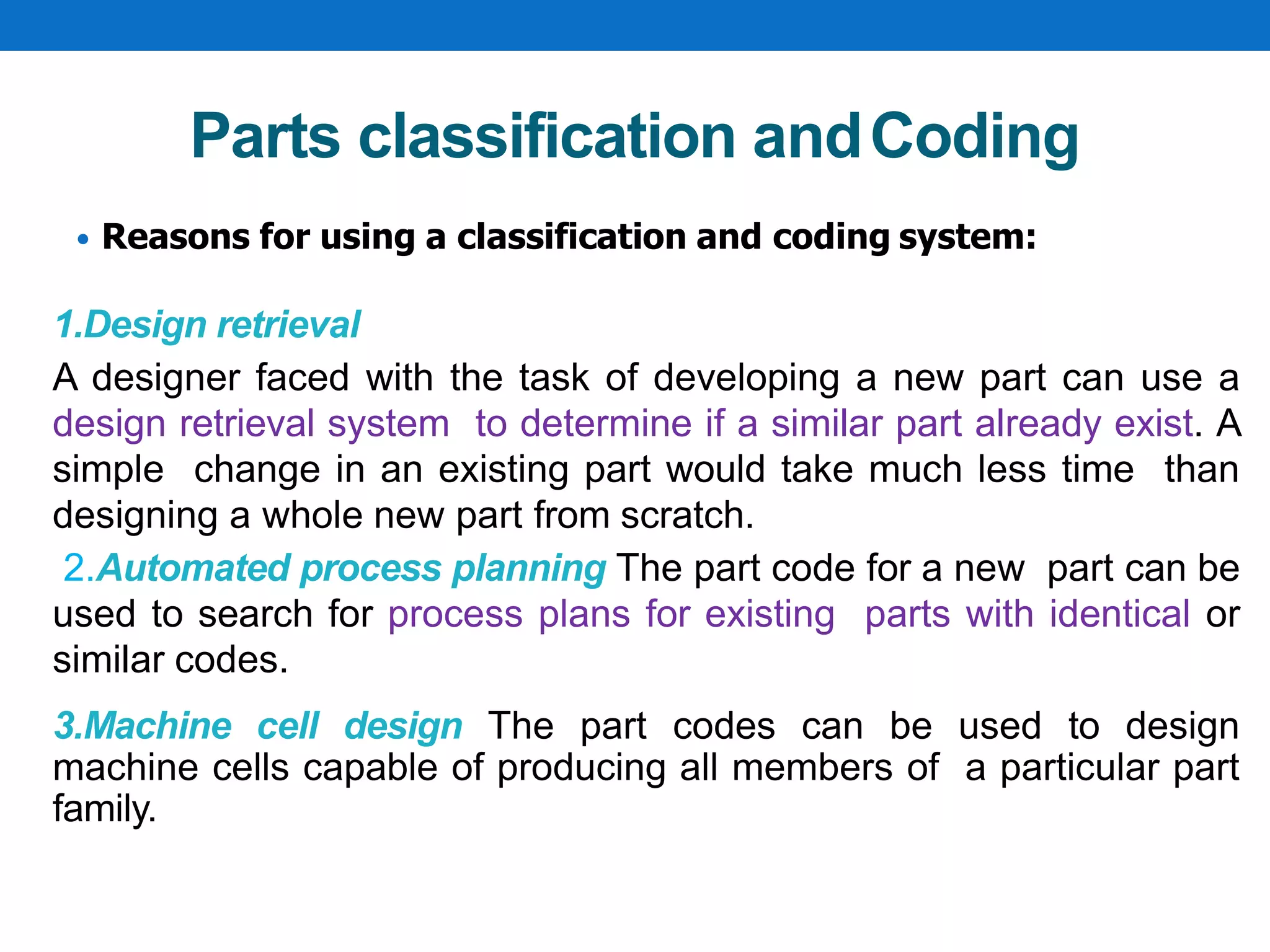
1.Design retrieval
A designer faced with the task of developing a new part can use a
design retrieval system to determine if a similar part already exist. A
simple change in an existing part would take much less time than
designing a whole new part from scratch.
2.Automated process planning The part code for a new part can be
used to search for process plans for existing parts with identical or
similar codes.
3.Machine cell design The part codes can be used to design
machine cells capable of producing all members of a particular part
family.
Types classification and coding
1.Classification of parts refers to grouping of parts on the basis
of the essential features of parts
2.Coding is the process of assigning symbols to the parts.
this symbols may represent design attributes or manufacturing
attributes or both.
A) Parts Classification Schemes:
B) Coding Schemes:
Coding systems use Number digits.
There are 3 basic codes structures used in GT applications.
1.Hierarchical structure.
2.Chain – type structure.
3.Hybrid structure.
1.Hierarchical structure:
1. In the hierarchical structure, the interpretation of each succeeding symbol depends
on the value of the preceding symbols.
2.The hierarchical structure is also called mono code.
3.This provides a relatively compact structure , which convey a lot of information
about the part in a limited number of digits.
4.The first digits (0 to 9) divides the parts into major groups such as machined parts ,
cast parts, forged parts , sheet metal parts etc
5.The second digits may sub-divide the machine parts into rotational and
non rotational parts.
6.The Third and subsequent digits may partition the machine into sub groups.
7.Therefore , the digits in a hierarchical code cannot be interpreted independently; the
interpretation depends on the information contained in the preceding symbol
• Hierarchical structure also known as a mono code, in which the interpretation
of eachsuccessivesymboldependson the value of the precedingsymbols.
 In this type of code, the meaning of eachcharacter isdependent on the
meaning of the previouscharacter.
 This type of code is particularly preferred in design departments for part
retrieval because this type of system is very effective for capturing shape,
material, and sizeinformation.
2.Chain – type structure:
1.This is also called poly code.
2. In this structure , the interpretation of each symbol in the sequence is
fixed and does not depend on the value preceding digits.
3. The problem associated with poly code is that is tends to be
relatively long
4. The use of a poly code allows for convenient identification of a
specific part attribute.
3.Hybrid Structure:
1.The hybrid structure is an attempt to achieve the best features
of mono codes and poly codes.
2.Hybrid codes seem to best serve the needs of both design and
production.
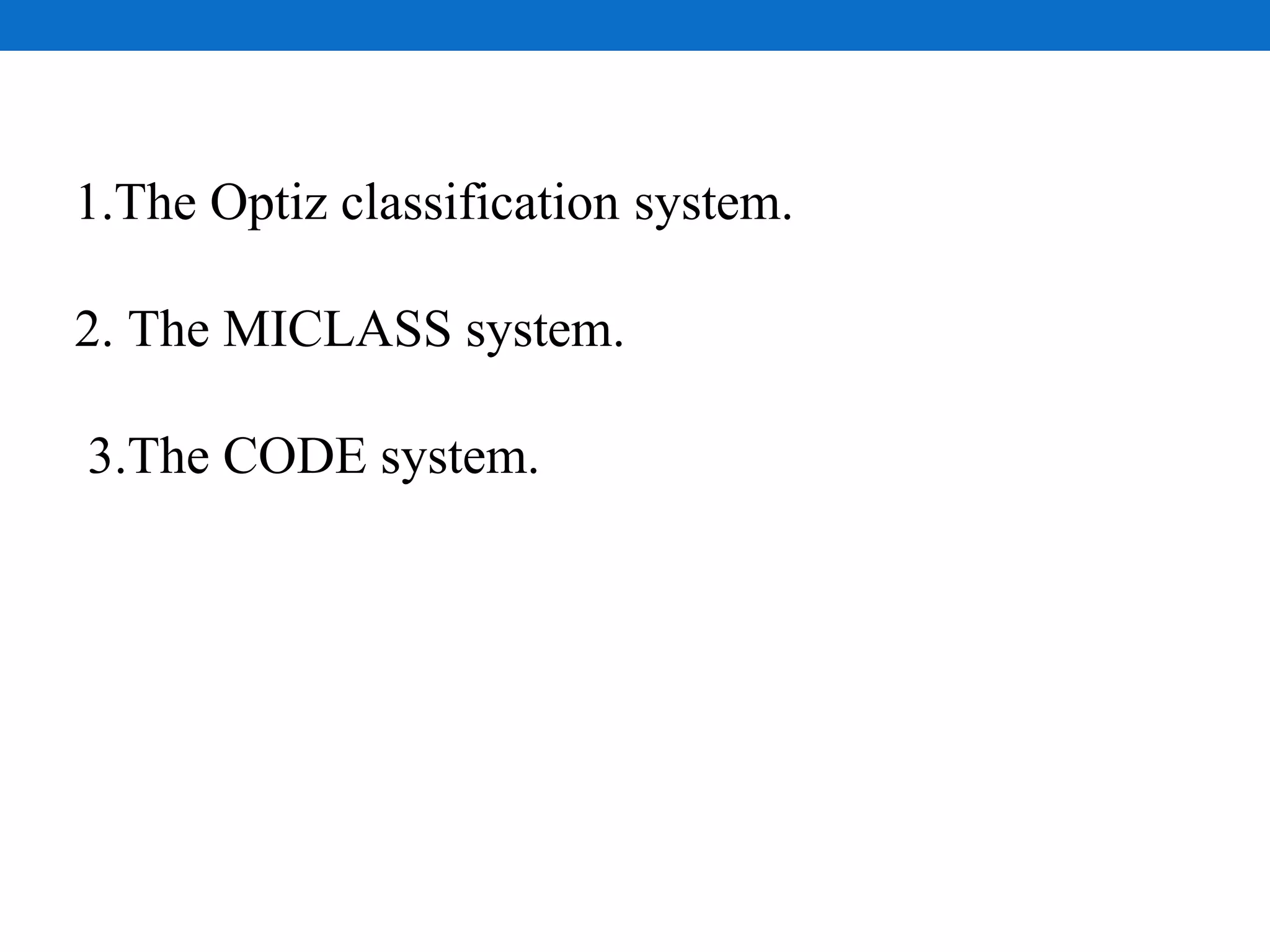
Important classification and coding systems
1.The Optiz classification system.
2. The MICLASS system.
3.The CODE system.
1. OPTIZ PARTS CLASSIFICATION AND CODING
SYSTEM
1. This is the most common and widely used coding system .
2. This system was developed by H.Optiz of the University of Aachen
in Germany
3. It is generally a 9 digit code with 5 forming the primary code while
the last 4 are secondary code.
4. It represents one of the pioneering efforts in GT and is probably the
best known, if not the most frequently used, of the parts
classification and coding systems.
5. It is intended for machine parts.
6. The Optiz coding scheme uses the following digit sequences.
12345 6789 ABCD
1. The basic code consists of nine digits, which can be extended by
adding four more digits.
2. The first nine are intended to convey both design and manufacturing
data.
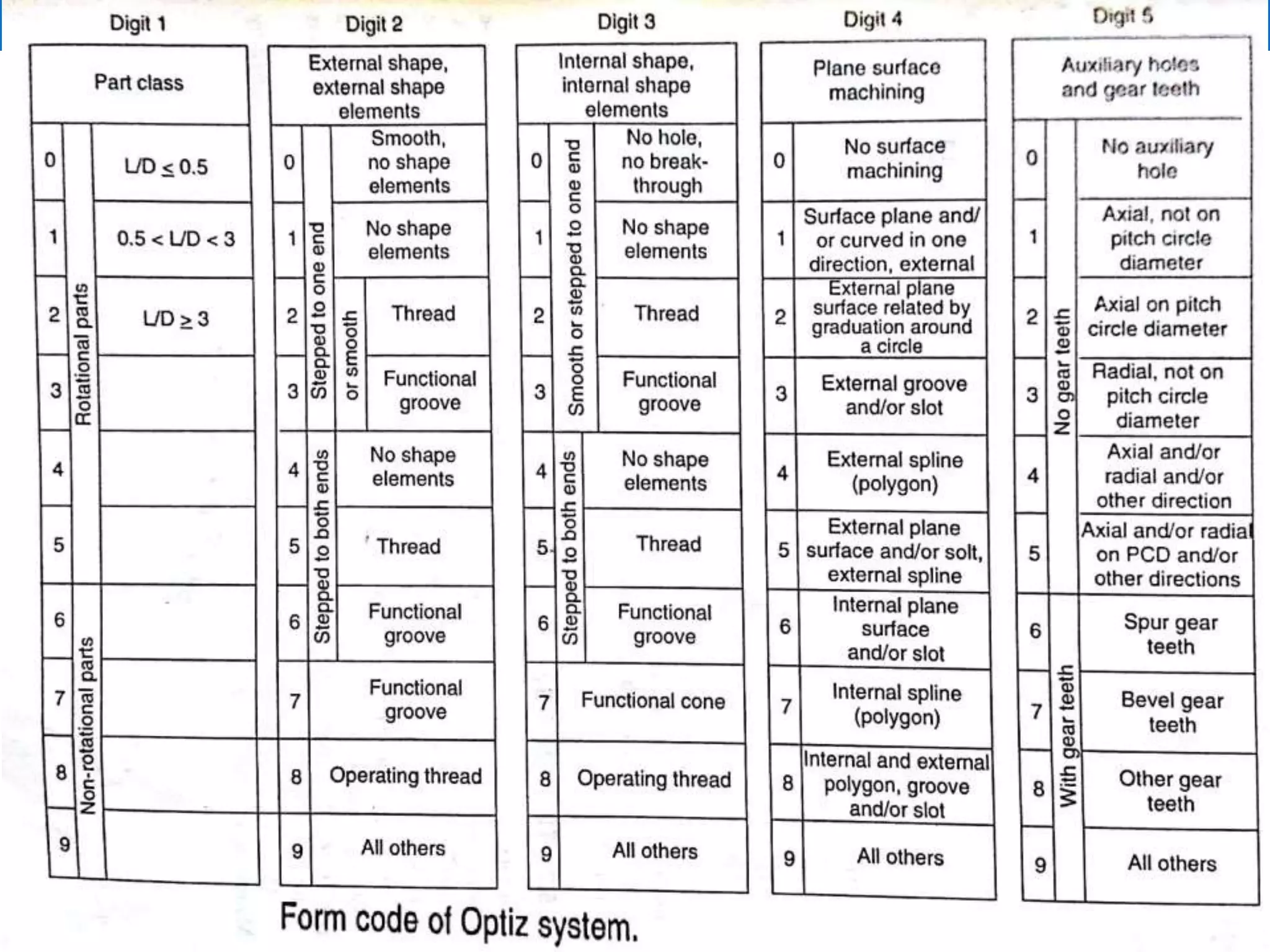
3. The interpretation of the first nine digits is defined in figure.
4. The first five digits, 12345 are called the form code. This describes
the primary design attributes of the part. Such as external shape
(For example, rotational vs rectangular) and machined features (for
example, holes, threads, gear teeth, and so forth)
5. The next four digits ,6789, constitute the supplementary code ,
which indicates some of the attributes that would be useful in
manufacturing. (for example, dimensions, work material, starting
shape, and accuracy.)
6. The Extra four digits ,ABCD, are referred to as secondary code and
are intended to identify the production operation type and
sequence.
7. The secondary code can be designed by the user firm to serve its own
particular needs.
TheOpitz coding systemconsists of three groups of digits:
1. Let us examine the from code consisting of
the first five digits, defined generally in figure
2. The first digit identifies whether the part is
rotational or non rotational. It also describes
the general shape and proportions of the
part.
3. We limit our survey here to rotational parts
possessing no unusual features, those with
first digit values of 0,1, or 2. For this class
of work parts, the coding of the first five
digits is defined in figure.
EXAMPLE1
Given the rotational part design in figure . determine the form code in the Optiz
parts classification and codingsystem.
With reference to figure ,the five digitcode is developed asfollows:
Length-to-diameter ratio, L/D =1.5
External shape:stepped on both ends with screw thread onend
Internal shape:part contains athrough-hole
Planesurface machining: none
Auxiliary holes, gear teeth, etc.:none
digit 1 =1
digit 2 =5
digit 3 =1
digit 4 =0
digit 5 =0
Hencethe form code for the given part is 15100
EXAMPLE2
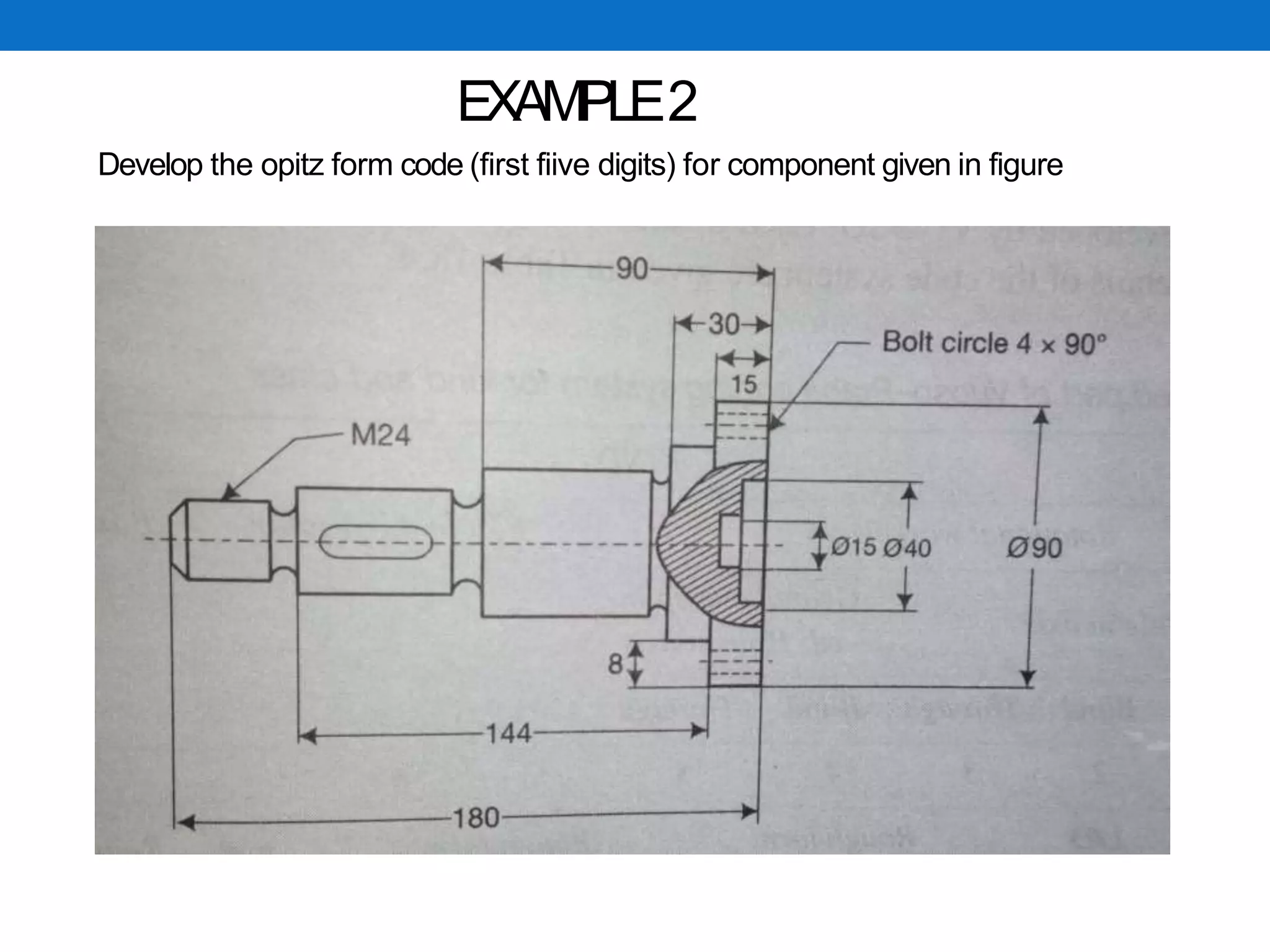
Develop the opitz form code (first fiive digits) for component given in figure
Solution
1 2 1 3 2
Part class: External shape: Internal shape: Surface Auxiliary holes:
Rotational part, Stepped to one Stepped to one machining: Axial on pitch
L/D =2 end ,thread end, no shape External groove circle diameter
element
2.MICLASS coding system :
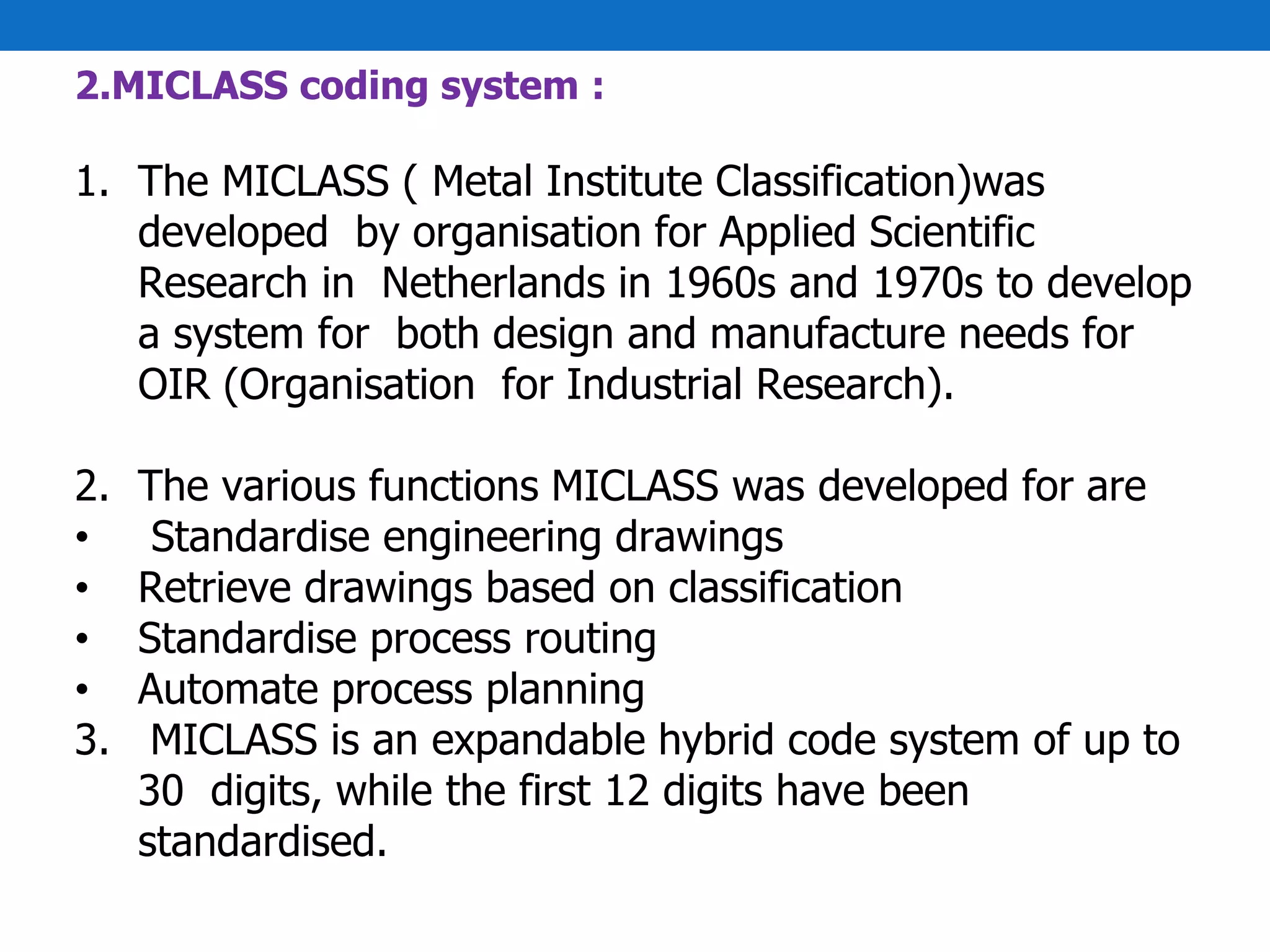
1. The MICLASS ( Metal Institute Classification)was
developed by organisation for Applied Scientific
Research in Netherlands in 1960s and 1970s to develop
a system for both design and manufacture needs for
OIR (Organisation for Industrial Research).
2. The various functions MICLASS was developed for are
• Standardise engineering drawings
• Retrieve drawings based on classification
• Standardise process routing
• Automate process planning
3. MICLASS is an expandable hybrid code system of up to
30 digits, while the first 12 digits have been
standardised.
•The system can be enlarged to thirty digits to cover
any classification attribute desired by theuser
•Computer software is provided by organisation for
industrial Research (OIR) for deriving the part code
,after the user goes through series of questions and
answers them interactively.
•The built in logic is in the form of decision tree.
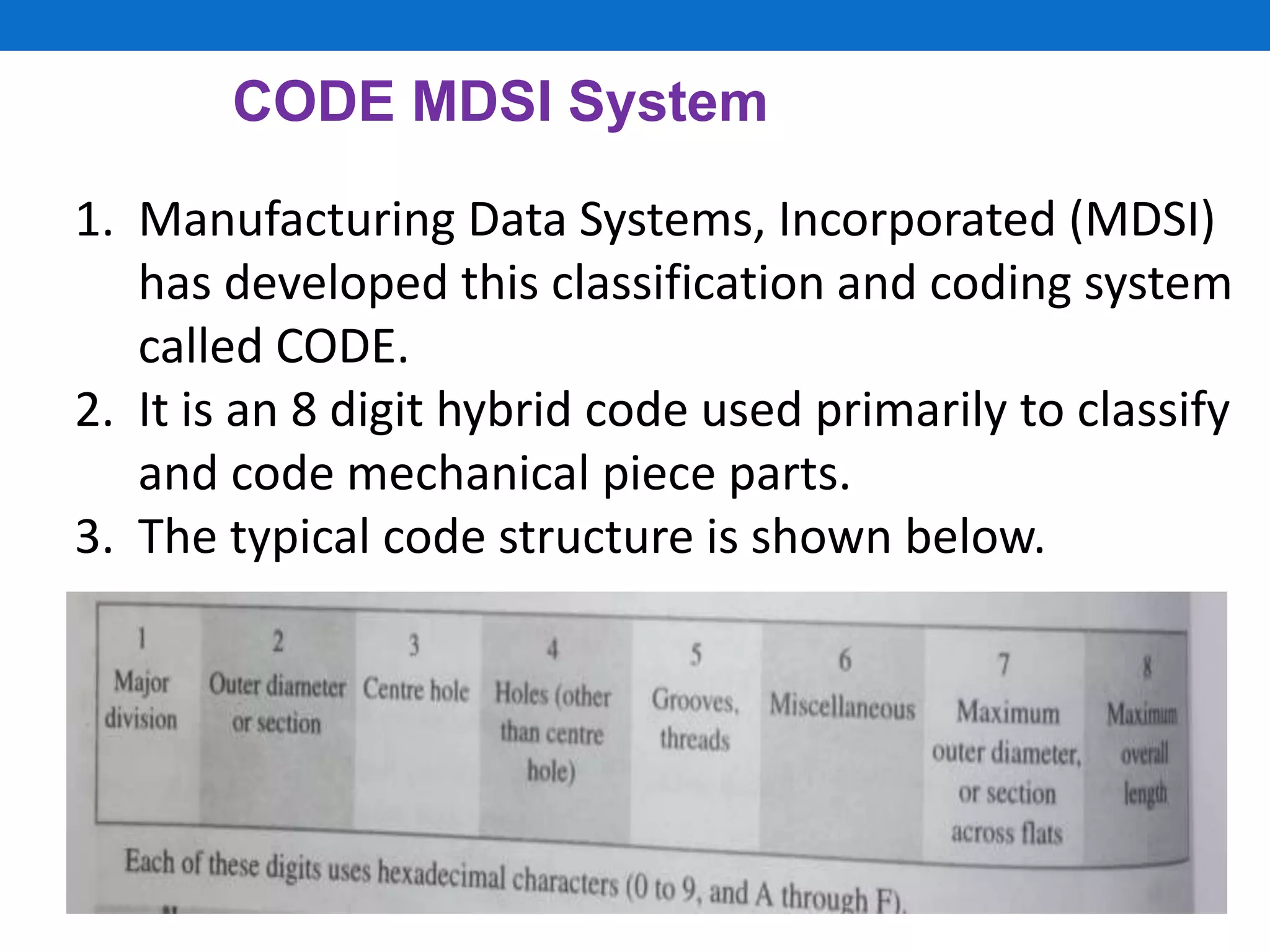
CODE MDSI System
1. Manufacturing Data Systems, Incorporated (MDSI)
has developed this classification and coding system
called CODE.
2. It is an 8 digit hybrid code used primarily to classify
and code mechanical piece parts.
3. The typical code structure is shown below.
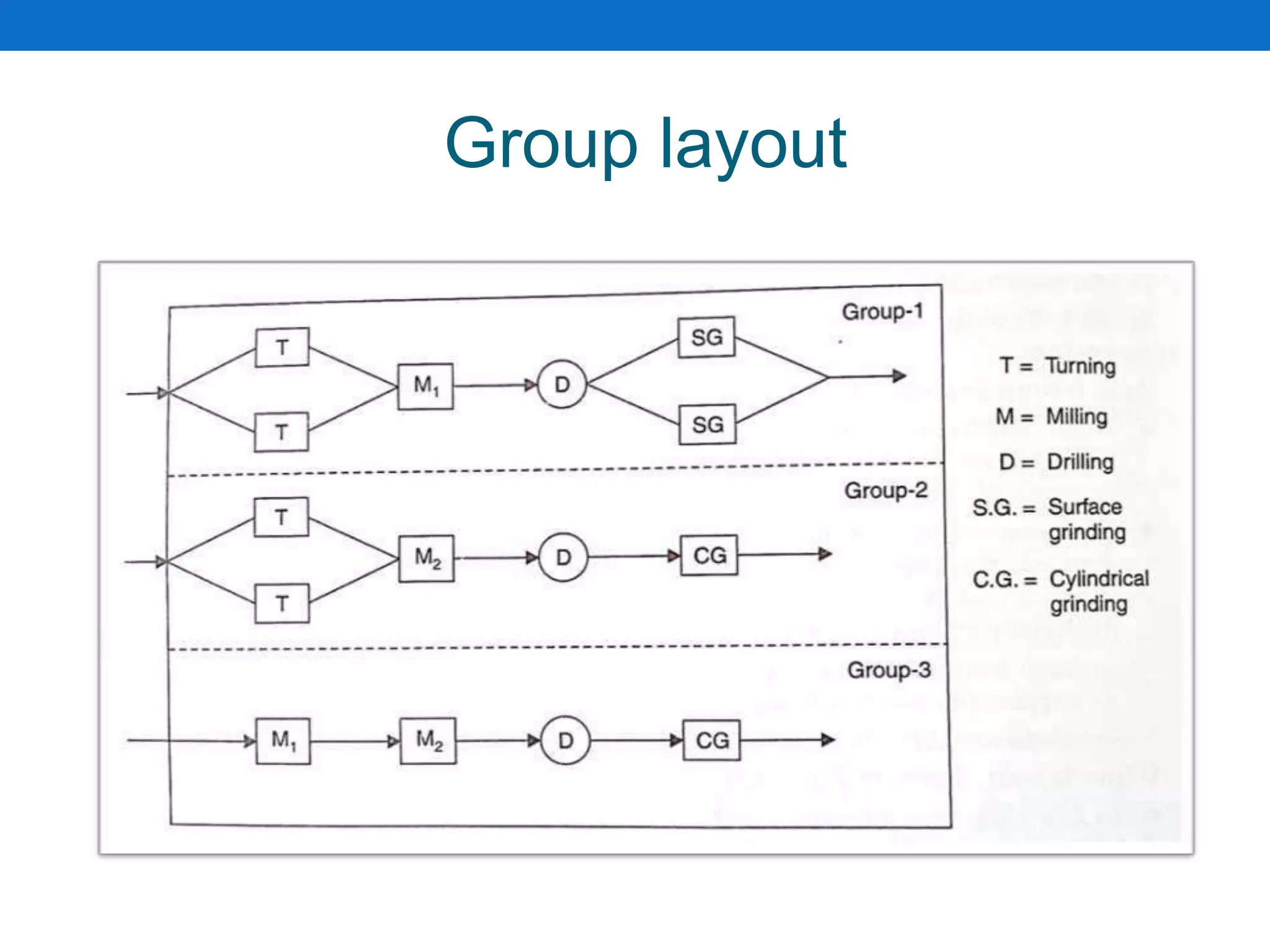
Group layout
• Group technology is a management strategy to help
eliminate waste caused by duplication of effort.
• The manufacturing efficiencies are generally increased
by employing GT because the required operations may
be confined to only a small cell and thus avoiding the
need for transportation of in-process parts.
• GT promotes standardization of tooling ,fixtures, and
setups.
• Material handling is reduced because parts are moved
within a machine cell rather than within the entire factory.
BENEFITS OF GROUP TECHNOLOGY
• It reduces the number and variety of parts.
• Process planning for the remaining parts is easier and
more consistent.
• Computer Aided Process Planning (CAPP) is an important
tool for this. It uses the coded similarities to plan
consistently, standardize and accurately estimate cost. It
then assigns the part to a GT manufacturing cell.
• Group Technology cells reduce throughput time and
Work-In-Process. They simplify schedules, reduce
transportation and ease supervision.
BENEFITS OF GROUP TECHNOLOGY
It affects all areas of a company including:
• engineering
• equipment specification
• facilities planning
• process planning
• production control
• quality control
• tool design
• purchasing
• service
BENEFITS OF GROUP TECHNOLOGY
Some of the well-known tangible and intangible benefits
of implementing GT :
1. Engineering design
• Reduction in new parts design
• Reduction in the number of drawings through
standardization
• Reduction of drafting effort in new shop drawings
• Reduction of number of similar parts, easy retrieval of
similar functional parts, and identification of substitute
parts
BENEFITS OF GROUPTECHNOLOGY
2. Layout planning
• Reduction in production floor space required
• Reduced material-handling effort
BENEFITS OF GROUPTECHNOLOGY
3. Specification of equipment, tools, jigs, and fixtures
• Standardization of equipment
• Implementation of cellular manufacturing systems
• Significant reduction in up-front costs incurred in the
release of new parts for manufacture
BENEFITS OF GROUP TECHNOLOGY
4. Manufacturing: process planning
• Reduction in setup time and production time
• Alternative routing leading to improved part routing
• Reduction in number of machining operations and
numerical control (NC) programming time
BENEFITS OF GROUP TECHNOLOGY
5. Manufacturing: production control
• Reduced work-in-process inventory
• Easy identification of bottlenecks
• Improved material flow and reduced warehousing costs
• Faster response to schedule changes
• Improved usage ofjigs and fixtures, pallets, tools, material
handling, and manufacturing equipment
BENEFITS OF GROUP TECHNOLOGY
6. Manufacturing: quality control
• Reduced scrap generation
• Better output quality
• Increased accountability of operators and supervisors
responsible for quality production, making it easier to
implement total quality control concepts.
BENEFITS OF GROUPTECHNOLOGY
7. Purchasing
• Coding of purchased part leading to standardized rules for
purchasing
• Economies in purchasing possible because of accurate
knowledge of raw material requirements
• Reduced number of part and raw materials
• Simplified vendor evaluation procedures leading to just-in-
time purchasing
BENEFITS OF GROUPTECHNOLOGY
8. Customer service
leading to better
• Accurate and faster cost estimates
• Efficient spare parts management,
customer service
Limitations of GT
• Problem of identifying part families among the many
components produced by a plant.
• It is a time consuming and expensive process.
• The expense of parts classification and coding.
• Rearranging the machines in the plant into the
appropriate machine cells.
Group technology

Group technology

  • 1.
  • 3.
    GROUP TECHNOLOGY Group Technologyor GT is a manufacturing philosophy in Which the parts having similarities (Geometry, Manufacturing process function) are grouped together and to achieve higher level of integration between the design and manufacturing functions of a firm. • The group of similar parts is known as part family and the group of machineries used to process an individual part family is known as machine cell.
  • 4.
    Group Technology • Grouptechnology emphasizes on part families based on similarities therefore in design attributes and manufacturing, GT contributes to the integration of CAD (Computer Aided Design) and CAM (Computer Aided Manufacturing).
  • 5.
    Implementing Group Technology(GT) •There are two major tasks that a company must undertake when it implements Group Technology 1.Identifying the part families. If the plant makes 10,000 different parts, reviewing all of the part drawings and grouping the parts into families is a substantial task that consumes a significant amount of time. 2.Rearranging production machines into cells. It is time consuming and costly to plan and accomplish this rearrangement, and the machines are not producing during the changeover.
  • 6.
    Group Technology • Thereare four general methods for solving part families grouping. All the four are time consuming and involve the analysis of much of data by properly trained personnel. • The four methods are: 1.Visual inspection. 2.Composite part method. 3.Production flow analysis. 4.Parts classification and coding.
  • 7.
    1.Visual Inspection Method •The visual inspection method is the least sophisticated and least expensive method. • It involves the classification of parts into families by looking at either the physical parts or their photographs and arranging them into groups having similar features.
  • 9.
    2.Composite part Method 1.In this method a hypothetical composite part is formed on the basis of the features of all the components forming the group in question. 2. Figure show number of components manufacturing on a lathe. 3. The various operations include setting the length , facing , turning , grooving , drilling , boring , reaming , counter – boring, chamfering , parting off , etc 4. Each job need all the operations. 5. An imaginary component is composed which involves all the operations needed for the group. 6. The tool setting is done for such a components on a multi-tool set up say turret, which can easily handle up to 11 tools. 7. Depends upon particular components to be worked on instructions are prepared to indicate the tool and sequence of operation they have to used. 8. Whenever a new component is to be made, its group is determined and then its sequence of operations and tooling is prepared.
  • 11.
    3.Production Flow Analysis 1.This method makes use of the information contained on route sheets rather than on part drawings. 2. Work – parts with identical or similar routings are classified into part families. The procedure of production flow analysis is as follows: I. Data collection: The data such as part number and operation sequence is collected from manufacturing data contained in the route sheets. II. Sorting: The parts are separated and arranged into groups according to similar or identical routings. III. Preparation of chart : a) The chart is a tabulation of the process or machine code numbers for all the parts of a part family. b) In this tabulation , the entries are cross marked (X). c) The cross mark (X) indicates I th part requiring j th machine. d) If X ij= 0 , there is no processing of the ith part on the jth machine.
  • 12.
  • 13.
    Production Flow Analysis(PFA) • Production flow analysis (PFA) is a method for identifying part families and associated machine groupings that uses the information contained on process plans rather than on part drawings. • Work parts with identical or similar process plans are classified into part families. These families can then be used to form logical machine cells in a group technology layout. • The procedure in production flow analysis must begin by defining the scope of the study, which means deciding on the population of parts to be analyzed.
  • 14.
    4. Parts classificationandCoding • In parts classification and coding, similarities among parts are identified, and these similarities are related in a coding system. • This classification and coding may be carried on the entire list of parts of a family. • Two categories of part similarities can be distinguished: 1.Design attributes,which concerned with part characteristics such as geometry, size and material. 2.Manufacturing attributes, which consider the sequence of processing steps required to make a part.
  • 15.
    Parts classification andCoding •Reasons for using a classification and coding system: 1.Design retrieval A designer faced with the task of developing a new part can use a design retrieval system to determine if a similar part already exist. A simple change in an existing part would take much less time than designing a whole new part from scratch. 2.Automated process planning The part code for a new part can be used to search for process plans for existing parts with identical or similar codes. 3.Machine cell design The part codes can be used to design machine cells capable of producing all members of a particular part family.
  • 16.
    Types classification andcoding 1.Classification of parts refers to grouping of parts on the basis of the essential features of parts 2.Coding is the process of assigning symbols to the parts. this symbols may represent design attributes or manufacturing attributes or both. A) Parts Classification Schemes:
  • 20.
    B) Coding Schemes: Codingsystems use Number digits. There are 3 basic codes structures used in GT applications. 1.Hierarchical structure. 2.Chain – type structure. 3.Hybrid structure.
  • 21.
    1.Hierarchical structure: 1. Inthe hierarchical structure, the interpretation of each succeeding symbol depends on the value of the preceding symbols. 2.The hierarchical structure is also called mono code. 3.This provides a relatively compact structure , which convey a lot of information about the part in a limited number of digits. 4.The first digits (0 to 9) divides the parts into major groups such as machined parts , cast parts, forged parts , sheet metal parts etc 5.The second digits may sub-divide the machine parts into rotational and non rotational parts. 6.The Third and subsequent digits may partition the machine into sub groups. 7.Therefore , the digits in a hierarchical code cannot be interpreted independently; the interpretation depends on the information contained in the preceding symbol
  • 22.
    • Hierarchical structurealso known as a mono code, in which the interpretation of eachsuccessivesymboldependson the value of the precedingsymbols.  In this type of code, the meaning of eachcharacter isdependent on the meaning of the previouscharacter.  This type of code is particularly preferred in design departments for part retrieval because this type of system is very effective for capturing shape, material, and sizeinformation.
  • 23.
    2.Chain – typestructure: 1.This is also called poly code. 2. In this structure , the interpretation of each symbol in the sequence is fixed and does not depend on the value preceding digits. 3. The problem associated with poly code is that is tends to be relatively long 4. The use of a poly code allows for convenient identification of a specific part attribute.
  • 24.
    3.Hybrid Structure: 1.The hybridstructure is an attempt to achieve the best features of mono codes and poly codes. 2.Hybrid codes seem to best serve the needs of both design and production.
  • 25.
  • 26.
    1.The Optiz classificationsystem. 2. The MICLASS system. 3.The CODE system.
  • 27.
    1. OPTIZ PARTSCLASSIFICATION AND CODING SYSTEM 1. This is the most common and widely used coding system . 2. This system was developed by H.Optiz of the University of Aachen in Germany 3. It is generally a 9 digit code with 5 forming the primary code while the last 4 are secondary code. 4. It represents one of the pioneering efforts in GT and is probably the best known, if not the most frequently used, of the parts classification and coding systems. 5. It is intended for machine parts. 6. The Optiz coding scheme uses the following digit sequences. 12345 6789 ABCD
  • 28.
    1. The basiccode consists of nine digits, which can be extended by adding four more digits. 2. The first nine are intended to convey both design and manufacturing data. 3. The interpretation of the first nine digits is defined in figure. 4. The first five digits, 12345 are called the form code. This describes the primary design attributes of the part. Such as external shape (For example, rotational vs rectangular) and machined features (for example, holes, threads, gear teeth, and so forth) 5. The next four digits ,6789, constitute the supplementary code , which indicates some of the attributes that would be useful in manufacturing. (for example, dimensions, work material, starting shape, and accuracy.) 6. The Extra four digits ,ABCD, are referred to as secondary code and are intended to identify the production operation type and sequence. 7. The secondary code can be designed by the user firm to serve its own particular needs.
  • 29.
    TheOpitz coding systemconsistsof three groups of digits:
  • 32.
    1. Let usexamine the from code consisting of the first five digits, defined generally in figure 2. The first digit identifies whether the part is rotational or non rotational. It also describes the general shape and proportions of the part. 3. We limit our survey here to rotational parts possessing no unusual features, those with first digit values of 0,1, or 2. For this class of work parts, the coding of the first five digits is defined in figure.
  • 33.
  • 34.
    Given the rotationalpart design in figure . determine the form code in the Optiz parts classification and codingsystem. With reference to figure ,the five digitcode is developed asfollows: Length-to-diameter ratio, L/D =1.5 External shape:stepped on both ends with screw thread onend Internal shape:part contains athrough-hole Planesurface machining: none Auxiliary holes, gear teeth, etc.:none digit 1 =1 digit 2 =5 digit 3 =1 digit 4 =0 digit 5 =0 Hencethe form code for the given part is 15100
  • 35.
    EXAMPLE2 Develop the opitzform code (first fiive digits) for component given in figure
  • 36.
    Solution 1 2 13 2 Part class: External shape: Internal shape: Surface Auxiliary holes: Rotational part, Stepped to one Stepped to one machining: Axial on pitch L/D =2 end ,thread end, no shape External groove circle diameter element
  • 37.
    2.MICLASS coding system: 1. The MICLASS ( Metal Institute Classification)was developed by organisation for Applied Scientific Research in Netherlands in 1960s and 1970s to develop a system for both design and manufacture needs for OIR (Organisation for Industrial Research). 2. The various functions MICLASS was developed for are • Standardise engineering drawings • Retrieve drawings based on classification • Standardise process routing • Automate process planning 3. MICLASS is an expandable hybrid code system of up to 30 digits, while the first 12 digits have been standardised.
  • 38.
    •The system canbe enlarged to thirty digits to cover any classification attribute desired by theuser •Computer software is provided by organisation for industrial Research (OIR) for deriving the part code ,after the user goes through series of questions and answers them interactively. •The built in logic is in the form of decision tree.
  • 39.
    CODE MDSI System 1.Manufacturing Data Systems, Incorporated (MDSI) has developed this classification and coding system called CODE. 2. It is an 8 digit hybrid code used primarily to classify and code mechanical piece parts. 3. The typical code structure is shown below.
  • 41.
  • 42.
    • Group technologyis a management strategy to help eliminate waste caused by duplication of effort. • The manufacturing efficiencies are generally increased by employing GT because the required operations may be confined to only a small cell and thus avoiding the need for transportation of in-process parts. • GT promotes standardization of tooling ,fixtures, and setups. • Material handling is reduced because parts are moved within a machine cell rather than within the entire factory. BENEFITS OF GROUP TECHNOLOGY
  • 43.
    • It reducesthe number and variety of parts. • Process planning for the remaining parts is easier and more consistent. • Computer Aided Process Planning (CAPP) is an important tool for this. It uses the coded similarities to plan consistently, standardize and accurately estimate cost. It then assigns the part to a GT manufacturing cell. • Group Technology cells reduce throughput time and Work-In-Process. They simplify schedules, reduce transportation and ease supervision. BENEFITS OF GROUP TECHNOLOGY
  • 44.
    BENEFITS OF GROUPTECHNOLOGY It affects all areas of a company including: • engineering • equipment specification • facilities planning • process planning • production control • quality control • tool design • purchasing • service
  • 45.
    BENEFITS OF GROUPTECHNOLOGY Some of the well-known tangible and intangible benefits of implementing GT : 1. Engineering design • Reduction in new parts design • Reduction in the number of drawings through standardization • Reduction of drafting effort in new shop drawings • Reduction of number of similar parts, easy retrieval of similar functional parts, and identification of substitute parts
  • 46.
    BENEFITS OF GROUPTECHNOLOGY 2.Layout planning • Reduction in production floor space required • Reduced material-handling effort
  • 47.
    BENEFITS OF GROUPTECHNOLOGY 3.Specification of equipment, tools, jigs, and fixtures • Standardization of equipment • Implementation of cellular manufacturing systems • Significant reduction in up-front costs incurred in the release of new parts for manufacture
  • 48.
    BENEFITS OF GROUPTECHNOLOGY 4. Manufacturing: process planning • Reduction in setup time and production time • Alternative routing leading to improved part routing • Reduction in number of machining operations and numerical control (NC) programming time
  • 49.
    BENEFITS OF GROUPTECHNOLOGY 5. Manufacturing: production control • Reduced work-in-process inventory • Easy identification of bottlenecks • Improved material flow and reduced warehousing costs • Faster response to schedule changes • Improved usage ofjigs and fixtures, pallets, tools, material handling, and manufacturing equipment
  • 50.
    BENEFITS OF GROUPTECHNOLOGY 6. Manufacturing: quality control • Reduced scrap generation • Better output quality • Increased accountability of operators and supervisors responsible for quality production, making it easier to implement total quality control concepts.
  • 51.
    BENEFITS OF GROUPTECHNOLOGY 7.Purchasing • Coding of purchased part leading to standardized rules for purchasing • Economies in purchasing possible because of accurate knowledge of raw material requirements • Reduced number of part and raw materials • Simplified vendor evaluation procedures leading to just-in- time purchasing
  • 52.
    BENEFITS OF GROUPTECHNOLOGY 8.Customer service leading to better • Accurate and faster cost estimates • Efficient spare parts management, customer service
  • 53.
    Limitations of GT •Problem of identifying part families among the many components produced by a plant. • It is a time consuming and expensive process. • The expense of parts classification and coding. • Rearranging the machines in the plant into the appropriate machine cells.