

GROUP
• Aamir Ali 13ME60(GL)
• Sajjad Mughari 13ME54(AGL)
• Awase Sommro 13ME82
• Zohaib Malik 13ME35
• Ali Raza 13ME96
In the respect of:
Sir, Umair Ahmed Rajput
What is Group Technology
(GT)?
• Group Technology also known as GT, is a manufacturing technology
where similar parts are collectively identified and grouped to use the
benefit of their relationship in design and as well as in production.
The similar parts are grouped to form part families. Each and every
family has similar design and manufacturing qualities.
• Example: A plant manufacturing 10,000 various parts could be
capable to arrange into 30 to 40 part families.
• As each member in a family have nearly processing activities,
collection of machines needed for processing of all part family
members leads to the most efficient method of manufacturing. This
group or collection of machines is called as GT Cells and this method
of manufacturing is called as Cellular Manufacturing.
• Group Technology is the realization
that many problems are similar, and
that by grouping similar problems,
a single solution can be found to a
set of problems thus saving time
and effort. (Solaja 73)
• First book formalize the concept:
Mitrofanov,S.P. 1958, "The Scientific
Principles of Group Technology"
WHY GROUP TECHNOLOGY?
• AVERAGE LOT SIZE DECREASING
• PART VARIETY INCREASING
• INCREASED VARIETY OF MATERIALS
WITH DIVERSE PROPERTIES
• REQUIREMENTS FOR CLOSER
TOLERANCES
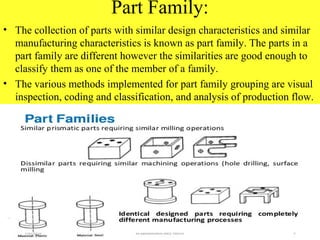
Part Family:
• The collection of parts with similar design characteristics and similar
manufacturing characteristics is known as part family. The parts in a
part family are different however the similarities are good enough to
classify them as one of the member of a family.
• The various methods implemented for part family grouping are visual
inspection, coding and classification, and analysis of production flow.
Part Classification and Coding
System:
• It concerns with identification of similarities with parts and
it relates those similarities in the form of code. The
similarities could be design characteristics alone or
manufacturing characteristics alone or both characteristics.
The part classification and coding system can be fallen
into three categories:
• System related to design characteristics,
• System related to manufacturing characteristics, and
• System related to both design and manufacturing
characteristics.
Coding Structure:
• The coding system is comprised of series of symbols which is used to
identify the design and manufacturing characteristics of the parts. The
symbols can be in the form of all alphabetic or all numeric or the both.
This arrangement of symbols is called as Coding Structure. It can be
divided into three types:
• 1 Chain type Structure,
• 2 Hierarchial Structure, and
• 3 Hybrid Structure.
• Advantages of Group Technology:
• Maximizes the output
• Less lead time
• Less setting time
• Reduced scrap
• Reduced material handling
When to Use GT and
Cellular(made of small parts) Manufacturing
1. The plant currently uses traditional batch production and a
process type layout
– This results in much material handling effort, high in-
process inventory, and long manufacturing lead times
1. The parts can be grouped into part families
– A necessary condition to apply group technology
– Each machine cell is designed to produce a given part
family, or a limited collection of part families, so it must be
possible to group parts made in the plant into families
Problems in Implementing GT
1. Identifying the part families
– Reviewing all of the parts made in the plant and
grouping them into part families is a substantial
task
1. Rearranging production machines into GT cells
– It is time-consuming and costly to physically
rearrange the machines into cells, and the
machines are not producing during the
changeover
Parts Classification and Coding
Identification of similarities among parts and
relating the similarities by means of a
numerical coding system
• Most time consuming of the three methods
• Must be customized for a given company or
industry
• Reasons for using a coding scheme:
– Design retrieval
– Automated process planning
Features of Parts Classification
and Coding Systems
• Most classification and coding systems are
based on one of the following:
– Part design attributes
– Part manufacturing attributes
– Both design and manufacturing attributes
Part Design Attributes
• Major dimensions
• Basic external shape
• Basic internal shape
• Length/diameter ratio
• Material type
• Part function
• Tolerances
• Surface finish
Part Manufacturing Attributes
• Major process
• Operation sequence
• Batch size
• Annual production
• Machine tools
• Cutting tools
• Material type
©2008 Pearson Education, Inc., Upper Saddle River, NJ. All rights reserved. This
material is protected under all copyright laws as they currently exist.
Manufacturing Applications
of Group Technology• Different ways of forming machine cells:
– Informal scheduling and routing of similar parts
through selected machines to minimize setups
– Virtual machine cells – dedication of certain
machines in the factory to produce part
families, but no physical relocation of machines
– Formal machine cells – machines are physically
relocated to form the cells
• Automated process planning
• Modular fixtures
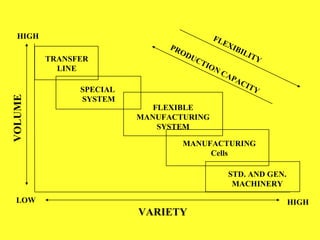
FLEXIBILITY
PRODUCTION CAPACITY
TRANSFER
LINE
SPECIAL
SYSTEM
FLEXIBLE
MANUFACTURING
SYSTEM
MANUFACTURING
Cells
STD. AND GEN.
MACHINERY
VOLUME
HIGH
VARIETY
LOW HIGH
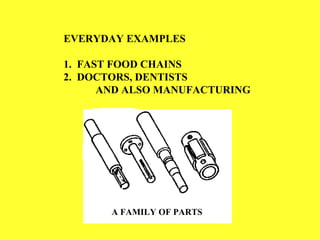
EVERYDAY EXAMPLES
1. FAST FOOD CHAINS
2. DOCTORS, DENTISTS
AND ALSO MANUFACTURING
A FAMILY OF PARTS
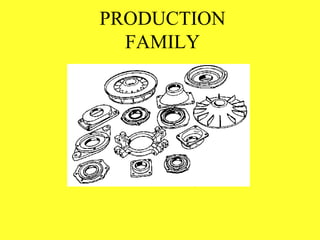
PRODUCTION
FAMILY
• LACK OF COMMON DATABASE FOR
MFG., DESIGN...
• DON’T “REDESIGN THE WHEEL”
• AUTOMATED PROCESS PLANNING
• DATABASE TO DRIVE THE
AUTOMATED FACTORY
BENEFITS OF GROUP TECHNOLOGY
REDUCTIONS IN
Cont’d
• THROUGHPUT TIME
• SET-UP TIME
• OVERDUE ORDERS
• PRODUCTION FLOOR SPACE
• RAW MATERIAL STOCKS
• IN-PROCESS INVENTORY
• CAPITAL EXPENDITURES
• TOOLING COSTS
• ENGINEERING TIME AND COSTS
• NEW PARTS DESIGN
• NEW SHOP DRAWINGS
• TOTAL NUMBER OF DRAWINGS
OTHER BENEFITS OF GROUP TECHNOLOGY
EASIER TO JUSTIFY AUTOMATION
STANDARDIZATION IN DESIGN
DATA RETRIEVAL
EASIER, MORE STANDARDIZED PROCESS PLANS
INCREASES IN QUALITY

Group Technology

  • 2.
    GROUP • Aamir Ali13ME60(GL) • Sajjad Mughari 13ME54(AGL) • Awase Sommro 13ME82 • Zohaib Malik 13ME35 • Ali Raza 13ME96 In the respect of: Sir, Umair Ahmed Rajput
  • 3.
    What is GroupTechnology (GT)? • Group Technology also known as GT, is a manufacturing technology where similar parts are collectively identified and grouped to use the benefit of their relationship in design and as well as in production. The similar parts are grouped to form part families. Each and every family has similar design and manufacturing qualities. • Example: A plant manufacturing 10,000 various parts could be capable to arrange into 30 to 40 part families. • As each member in a family have nearly processing activities, collection of machines needed for processing of all part family members leads to the most efficient method of manufacturing. This group or collection of machines is called as GT Cells and this method of manufacturing is called as Cellular Manufacturing.
  • 4.
    • Group Technologyis the realization that many problems are similar, and that by grouping similar problems, a single solution can be found to a set of problems thus saving time and effort. (Solaja 73) • First book formalize the concept: Mitrofanov,S.P. 1958, "The Scientific Principles of Group Technology"
  • 5.
    WHY GROUP TECHNOLOGY? •AVERAGE LOT SIZE DECREASING • PART VARIETY INCREASING • INCREASED VARIETY OF MATERIALS WITH DIVERSE PROPERTIES • REQUIREMENTS FOR CLOSER TOLERANCES
  • 6.
    Part Family: • Thecollection of parts with similar design characteristics and similar manufacturing characteristics is known as part family. The parts in a part family are different however the similarities are good enough to classify them as one of the member of a family. • The various methods implemented for part family grouping are visual inspection, coding and classification, and analysis of production flow.
  • 7.
    Part Classification andCoding System: • It concerns with identification of similarities with parts and it relates those similarities in the form of code. The similarities could be design characteristics alone or manufacturing characteristics alone or both characteristics. The part classification and coding system can be fallen into three categories: • System related to design characteristics, • System related to manufacturing characteristics, and • System related to both design and manufacturing characteristics.
  • 8.
    Coding Structure: • Thecoding system is comprised of series of symbols which is used to identify the design and manufacturing characteristics of the parts. The symbols can be in the form of all alphabetic or all numeric or the both. This arrangement of symbols is called as Coding Structure. It can be divided into three types: • 1 Chain type Structure, • 2 Hierarchial Structure, and • 3 Hybrid Structure. • Advantages of Group Technology: • Maximizes the output • Less lead time • Less setting time • Reduced scrap • Reduced material handling
  • 9.
    When to UseGT and Cellular(made of small parts) Manufacturing 1. The plant currently uses traditional batch production and a process type layout – This results in much material handling effort, high in- process inventory, and long manufacturing lead times 1. The parts can be grouped into part families – A necessary condition to apply group technology – Each machine cell is designed to produce a given part family, or a limited collection of part families, so it must be possible to group parts made in the plant into families
  • 10.
    Problems in ImplementingGT 1. Identifying the part families – Reviewing all of the parts made in the plant and grouping them into part families is a substantial task 1. Rearranging production machines into GT cells – It is time-consuming and costly to physically rearrange the machines into cells, and the machines are not producing during the changeover
  • 11.
    Parts Classification andCoding Identification of similarities among parts and relating the similarities by means of a numerical coding system • Most time consuming of the three methods • Must be customized for a given company or industry • Reasons for using a coding scheme: – Design retrieval – Automated process planning
  • 12.
    Features of PartsClassification and Coding Systems • Most classification and coding systems are based on one of the following: – Part design attributes – Part manufacturing attributes – Both design and manufacturing attributes
  • 13.
    Part Design Attributes •Major dimensions • Basic external shape • Basic internal shape • Length/diameter ratio • Material type • Part function • Tolerances • Surface finish
  • 14.
    Part Manufacturing Attributes •Major process • Operation sequence • Batch size • Annual production • Machine tools • Cutting tools • Material type
  • 15.
    ©2008 Pearson Education,Inc., Upper Saddle River, NJ. All rights reserved. This material is protected under all copyright laws as they currently exist. Manufacturing Applications of Group Technology• Different ways of forming machine cells: – Informal scheduling and routing of similar parts through selected machines to minimize setups – Virtual machine cells – dedication of certain machines in the factory to produce part families, but no physical relocation of machines – Formal machine cells – machines are physically relocated to form the cells • Automated process planning • Modular fixtures
  • 16.
  • 17.
    EVERYDAY EXAMPLES 1. FASTFOOD CHAINS 2. DOCTORS, DENTISTS AND ALSO MANUFACTURING A FAMILY OF PARTS
  • 18.
  • 19.
    • LACK OFCOMMON DATABASE FOR MFG., DESIGN... • DON’T “REDESIGN THE WHEEL” • AUTOMATED PROCESS PLANNING • DATABASE TO DRIVE THE AUTOMATED FACTORY
  • 20.
    BENEFITS OF GROUPTECHNOLOGY REDUCTIONS IN Cont’d • THROUGHPUT TIME • SET-UP TIME • OVERDUE ORDERS • PRODUCTION FLOOR SPACE • RAW MATERIAL STOCKS • IN-PROCESS INVENTORY • CAPITAL EXPENDITURES • TOOLING COSTS • ENGINEERING TIME AND COSTS • NEW PARTS DESIGN • NEW SHOP DRAWINGS • TOTAL NUMBER OF DRAWINGS
  • 21.
    OTHER BENEFITS OFGROUP TECHNOLOGY EASIER TO JUSTIFY AUTOMATION STANDARDIZATION IN DESIGN DATA RETRIEVAL EASIER, MORE STANDARDIZED PROCESS PLANS INCREASES IN QUALITY