GROUP TECHNOLOGY
Group
Group Technology
• It is technology in which similar parts are
identified and grouped together to take advantage
of their similarities in Design & achieve the
effectiveness. (Production)
• Parts in the medium production quantity range are
usually made in batches.
• GT exploits the part similarities by utilizing
similar processes and tooling to produce them
• GT can be implemented by manual or automated
techniques
• When automated, the term flexible manufacturing
system is often applied.
Design Group:
Group Production Lines
G.T.>>
• Similarities? among parts permit them to be
classified into part families
• In each part family, processing steps are
similar
• The improvement is typically achieved by
organizing the production facilities into
manufacturing cells that specialize in
production of certain part families
Part Family
Part Families
• Part families are a central feature of group
technology
• A group of parts that possess similarities in
geometric shape and size, or in the processing
steps used in their manufacture.
• There are always differences among parts in a
family But the similarities are close enough
that the parts can be grouped into the same
family.
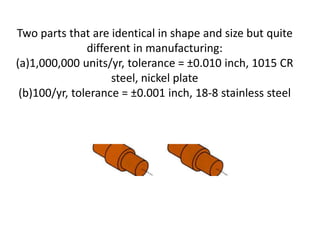
Two parts that are identical in shape and size but quite
different in manufacturing:
(a)1,000,000 units/yr, tolerance = ±0.010 inch, 1015 CR
steel, nickel plate
(b)100/yr, tolerance = ±0.001 inch, 18-8 stainless steel
Part Families:
• Ten parts that are
different in size and
shape, but quite similar
in terms of
manufacturing
• All parts are machined
from cylindrical stock by
turning; some parts
require drilling and/or
milling
Cellular Engineering
Typical Layout Of Cell
Advantages in Cellular Engg.
• Reduction in transportation.
• Set up time is low.
• Less in process inventory.
• Shorter lead time
• Effective utilization of machines.
Ways to Identify Part Families:
• Visual inspection - using
best judgment to group
parts into appropriate
families, based on the
parts or photos of the
parts
• Production flow analysis -
using information
contained on route sheets
to classify parts
• Parts classification and
coding - identifying
similarities and differences
among parts and relating
them by means of a
coding scheme
1. Parts Classification and Coding
Most classification and coding systems are one
of the following:
1) Systems based on part design attributes
2) Systems based on part manufacturing
attributes
3) Systems based on both design and
manufacturing attributes
Parts Classification and Coding
Part Design Attributes
• Major dimensions
• Basic external shape
• Basic internal shape
• Length/diameter ratio
• Aspect Ratio (L/W)
• Material type
• Part function
• Tolerances
• Surface finish
Part Manufacturing Attributes
• Major process
• Operation sequence
• Batch size
• Annual production
• Machine tools
• Cutting tools
• Material type
Three structures used in classification
and coding schemes
• Hierarchical structure, known as a mono-code, in
which the interpretation of each successive
symbol depends on the value of the preceding
symbols. For e.g. 15 & 25
• Chain-type structure, known as a polycode, in
which the interpretation of each symbol in the
sequence is always the same; it does not depend
on the value of preceding symbols
• Mixed-mode structure, which is a hybrid of the
two previous codes
Some of the important systems
• Opitz classification system –the University of Aachen
in Germany, nonproprietary, Chaintype.
• Brisch System –(Brisch-Birn Inc.)
• CODE (Manufacturing Data System, Inc.)
• CUTPLAN (Metcut Associates)
• DCLASS (Brigham Young University)
• MultiClass (OIR: Organization for Industrial Research),
hierarchical or decision-tree coding structure
• Part Analog System (Lovelace, Lawrence & Co., Inc.)
Optiz System
• This Part classification & coding was developed
by H.Opitz.
• 12345 6789 ABCD.
• Digit 1 to 5 = Form Codes
• Digit 6 to 9 = Supplementary Codes
• A,B,C,D = Secondary Codes intended to identify
the Sequence & production operations.
• Secondary Codes can be designed by user as per
need
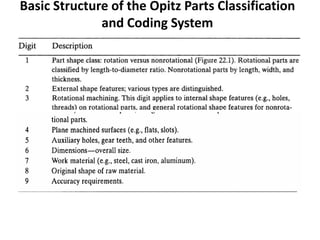
Basic Structure of the Opitz Parts Classification
and Coding System
Basic structure of the Opitz system of parts classification and
coding
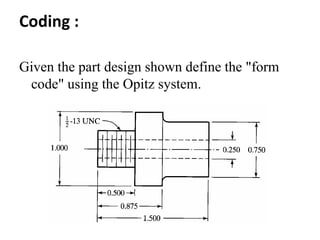
Coding :
Given the part design shown define the "form
code" using the Opitz system.
Steps
• Step 1: The total length of the part is 1.75, overall
diameter 1.25,
L/D = 1.4 (code 1)
• Step 2: External shape - a rotational part that is stepped
on both with one thread
(code 5)
Step 3: Internal shape - a through hole
(code 1)
Step 4: By examining the drawing of the part
(code 0)
Step 5: No auxiliary holes and gear teeth
(code 0)
MultiClass(MClass) –developed by the Organization for Industrial
Research (OIR)
• It is ranging from 12 to 30 digits.
• First 12 are UNIVERSAL CODE
Applied to any part.
Next 18 digits are Supplementary code
It can be used to particular industry i.e. Lot size,
piece time, cost data, sequence.
First 18 digits of the Multiclass Classification and
Coding System
Production Flow Analysis
• It is a process in which part families are
identified & associated machine group,
That uses the information contained on
production route sheets rater than part
drawing.
Similar routings are classified into part families.
These can be used to form machine cells in GT
layout.
The procedure of Production flow analysis (PFA)
consists of the following steps:
• Data Collection
• Sortation of process routings
• PFA Chart
• Cluster Analysis
1. Data Collection
• The minimum data needed in the analysis are
the part number and operation sequence,
which is obtained from process plans.
• Each operation is related with particular
machine.
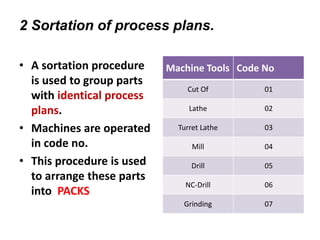
2 Sortation of process plans.
• A sortation procedure
is used to group parts
with identical process
plans.
• Machines are operated
in code no.
• This procedure is used
to arrange these parts
into PACKS
Machine Tools Code No
Cut Of 01
Lathe 02
Turret Lathe 03
Mill 04
Drill 05
NC-Drill 06
Grinding 07
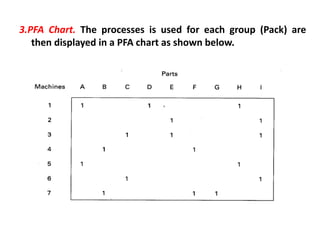
3.PFA Chart. The processes is used for each group (Pack) are
then displayed in a PFA chart as shown below.
4. Clustering Analysis. From the pattern of data in the PFA chart,
related groupings are identified and rearranged into a new
pattern that brings together groups with similar machine
sequences.
Benefits
• Product Engineering:
Reduce Part Proliferation (Reproducing)
Help design Standardization
Provide Mfg. Feedback
• Manufacturing Engineering
Process & tool selection, m/c purchase, MH
• Production Engineering
Reduce lead time, reduce delays, reduce set
times, improve product quality
<<<<……>>>>>
• Production & planning control:
Group scheduling, stock accounting, improve
product design.
• Other:
Increase productivity, improved accuracy in
estimation of cost, reduce cost purchasing,
Improved plant efficiency

Group technology

  • 1.
  • 2.
  • 3.
    Group Technology • Itis technology in which similar parts are identified and grouped together to take advantage of their similarities in Design & achieve the effectiveness. (Production) • Parts in the medium production quantity range are usually made in batches. • GT exploits the part similarities by utilizing similar processes and tooling to produce them • GT can be implemented by manual or automated techniques • When automated, the term flexible manufacturing system is often applied.
  • 4.
  • 5.
  • 6.
    G.T.>> • Similarities? amongparts permit them to be classified into part families • In each part family, processing steps are similar • The improvement is typically achieved by organizing the production facilities into manufacturing cells that specialize in production of certain part families
  • 7.
  • 8.
    Part Families • Partfamilies are a central feature of group technology • A group of parts that possess similarities in geometric shape and size, or in the processing steps used in their manufacture. • There are always differences among parts in a family But the similarities are close enough that the parts can be grouped into the same family.
  • 9.
    Two parts thatare identical in shape and size but quite different in manufacturing: (a)1,000,000 units/yr, tolerance = ±0.010 inch, 1015 CR steel, nickel plate (b)100/yr, tolerance = ±0.001 inch, 18-8 stainless steel
  • 10.
    Part Families: • Tenparts that are different in size and shape, but quite similar in terms of manufacturing • All parts are machined from cylindrical stock by turning; some parts require drilling and/or milling
  • 11.
  • 12.
  • 13.
    Advantages in CellularEngg. • Reduction in transportation. • Set up time is low. • Less in process inventory. • Shorter lead time • Effective utilization of machines.
  • 14.
    Ways to IdentifyPart Families: • Visual inspection - using best judgment to group parts into appropriate families, based on the parts or photos of the parts • Production flow analysis - using information contained on route sheets to classify parts • Parts classification and coding - identifying similarities and differences among parts and relating them by means of a coding scheme
  • 15.
    1. Parts Classificationand Coding Most classification and coding systems are one of the following: 1) Systems based on part design attributes 2) Systems based on part manufacturing attributes 3) Systems based on both design and manufacturing attributes
  • 16.
    Parts Classification andCoding Part Design Attributes • Major dimensions • Basic external shape • Basic internal shape • Length/diameter ratio • Aspect Ratio (L/W) • Material type • Part function • Tolerances • Surface finish Part Manufacturing Attributes • Major process • Operation sequence • Batch size • Annual production • Machine tools • Cutting tools • Material type
  • 17.
    Three structures usedin classification and coding schemes • Hierarchical structure, known as a mono-code, in which the interpretation of each successive symbol depends on the value of the preceding symbols. For e.g. 15 & 25 • Chain-type structure, known as a polycode, in which the interpretation of each symbol in the sequence is always the same; it does not depend on the value of preceding symbols • Mixed-mode structure, which is a hybrid of the two previous codes
  • 18.
    Some of theimportant systems • Opitz classification system –the University of Aachen in Germany, nonproprietary, Chaintype. • Brisch System –(Brisch-Birn Inc.) • CODE (Manufacturing Data System, Inc.) • CUTPLAN (Metcut Associates) • DCLASS (Brigham Young University) • MultiClass (OIR: Organization for Industrial Research), hierarchical or decision-tree coding structure • Part Analog System (Lovelace, Lawrence & Co., Inc.)
  • 19.
    Optiz System • ThisPart classification & coding was developed by H.Opitz. • 12345 6789 ABCD. • Digit 1 to 5 = Form Codes • Digit 6 to 9 = Supplementary Codes • A,B,C,D = Secondary Codes intended to identify the Sequence & production operations. • Secondary Codes can be designed by user as per need
  • 20.
    Basic Structure ofthe Opitz Parts Classification and Coding System
  • 21.
    Basic structure ofthe Opitz system of parts classification and coding
  • 22.
    Coding : Given thepart design shown define the "form code" using the Opitz system.
  • 23.
    Steps • Step 1:The total length of the part is 1.75, overall diameter 1.25, L/D = 1.4 (code 1) • Step 2: External shape - a rotational part that is stepped on both with one thread (code 5) Step 3: Internal shape - a through hole (code 1) Step 4: By examining the drawing of the part (code 0) Step 5: No auxiliary holes and gear teeth (code 0)
  • 24.
    MultiClass(MClass) –developed bythe Organization for Industrial Research (OIR) • It is ranging from 12 to 30 digits. • First 12 are UNIVERSAL CODE Applied to any part. Next 18 digits are Supplementary code It can be used to particular industry i.e. Lot size, piece time, cost data, sequence.
  • 25.
    First 18 digitsof the Multiclass Classification and Coding System
  • 26.
    Production Flow Analysis •It is a process in which part families are identified & associated machine group, That uses the information contained on production route sheets rater than part drawing. Similar routings are classified into part families. These can be used to form machine cells in GT layout.
  • 27.
    The procedure ofProduction flow analysis (PFA) consists of the following steps: • Data Collection • Sortation of process routings • PFA Chart • Cluster Analysis
  • 28.
    1. Data Collection •The minimum data needed in the analysis are the part number and operation sequence, which is obtained from process plans. • Each operation is related with particular machine.
  • 29.
    2 Sortation ofprocess plans. • A sortation procedure is used to group parts with identical process plans. • Machines are operated in code no. • This procedure is used to arrange these parts into PACKS Machine Tools Code No Cut Of 01 Lathe 02 Turret Lathe 03 Mill 04 Drill 05 NC-Drill 06 Grinding 07
  • 30.
    3.PFA Chart. Theprocesses is used for each group (Pack) are then displayed in a PFA chart as shown below.
  • 31.
    4. Clustering Analysis.From the pattern of data in the PFA chart, related groupings are identified and rearranged into a new pattern that brings together groups with similar machine sequences.
  • 32.
    Benefits • Product Engineering: ReducePart Proliferation (Reproducing) Help design Standardization Provide Mfg. Feedback • Manufacturing Engineering Process & tool selection, m/c purchase, MH • Production Engineering Reduce lead time, reduce delays, reduce set times, improve product quality
  • 33.
    <<<<……>>>>> • Production &planning control: Group scheduling, stock accounting, improve product design. • Other: Increase productivity, improved accuracy in estimation of cost, reduce cost purchasing, Improved plant efficiency