Tool geometry
By
Prem Kumar Soni
What is Single Point Cutting Tool?
As its name indicates, a tool that has a single
point for cutting purpose is called single point
cutting tool. It is generally used in the lathe
machine, shaper machine etc. It is used to
remove the materials from the workpiece.
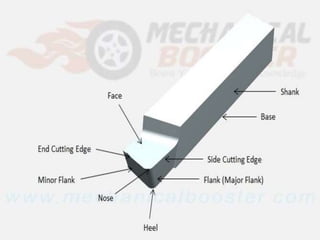
1. Shank: It is that part of single point cutting
tool which goes into the tool holder. Or in
simple language shank is used to hold the tool.
2. Flank: It is the surface below and adjacent
of the cutting edges. There are two flank
surfaces, first one is major flank and second
one is minor flank. The major flank lies below
and adjacent to the side cutting edge and the
minor flank surface lies below and adjacent to
the end cutting edge.
3. Base: The portion of the shank that lies
opposite to the top face of the shank is called
base.
4. Face: It is the top portion of the tool along
which chips slides. It is designed in such a way
that the chips slides on it in upward direction
5. Cutting edge: The edge on the tool which
removes materials from the work piece is
called cutting edges. It lies on the face of the
tool. The single point cutting tool has two
edges and these are
(i) Side cutting edge: The top edge of the
major flank is called side cutting edge.
(ii) End cutting edge: The top edge of the
minor flank is called end cutting edge
6. Nose or cutting point: The intersection point
of major cutting edge and minor cutting edge
is called nose.
7. Nose radius: It is the radius of the nose.
Nose radius increases the life of the tool and
provides better surface finish.
8. Heel: It is a curved portion and intersection
of the base and flank of the tool.
Angles
The various angles of the single point cutting
tool have great importance. Each angle has its
own function and speciality
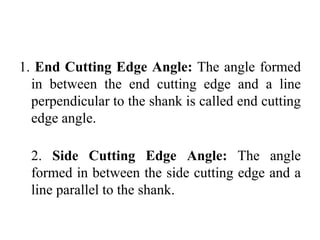
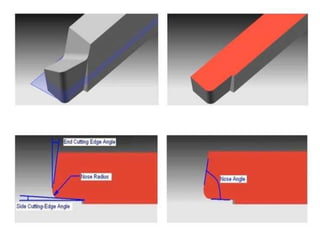
1. End Cutting Edge Angle: The angle formed
in between the end cutting edge and a line
perpendicular to the shank is called end cutting
edge angle.
2. Side Cutting Edge Angle: The angle
formed in between the side cutting edge and a
line parallel to the shank.
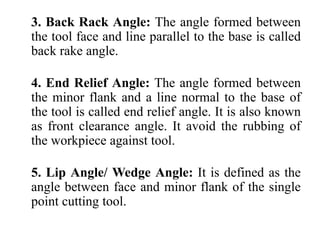
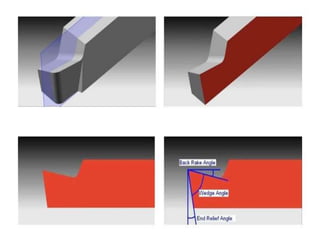
3. Back Rack Angle: The angle formed between
the tool face and line parallel to the base is called
back rake angle.
4. End Relief Angle: The angle formed between
the minor flank and a line normal to the base of
the tool is called end relief angle. It is also known
as front clearance angle. It avoid the rubbing of
the workpiece against tool.
5. Lip Angle/ Wedge Angle: It is defined as the
angle between face and minor flank of the single
point cutting tool.
6. Side Rake Angle: the angle formed between
the tool face and a line perpendicular to the
shank is called side rake angle.
7. Side Relief Angle: the angle formed
between the major flank surface and plane
normal to the base of the tool is called side
relief angle. This angle avoids the rubbing
between workpiece and flank when the tool is
fed longitudinally.
Nomenclature
There is three coordinate systems which are most
popular in tool nomenclature. And these are
1. Machine Reference System (MRS)
2. Orthogonal Tool Reference System (ORS)
or Orthogonal Rake System
3. Normal Reference System (NRS)
Signature
The shape of a tool is specified in a special
sequence and this special sequence is called tool
signature. The tool signature is given below
(i) Back rake angle
(ii) Side rake angle
(iii) Clearance or End Relief angle
(iv) Side Relief angle
(v) End cutting edge angle
(vi) Side cutting edge angle
(vii) Nose radius
• A typical tool signature of single point cutting
tool is 0-7-6-8-15-16-0.8.
• Here this tool signature indicates that the tool
has 0, 7, 6, 8, 15, 16 degree back rake, side
rake, end relief, side relief, end cutting edge,
side cutting edge angle and 0.8 mm nose
radius.
Thank You

Tool geometry

  • 1.
  • 2.
    What is SinglePoint Cutting Tool? As its name indicates, a tool that has a single point for cutting purpose is called single point cutting tool. It is generally used in the lathe machine, shaper machine etc. It is used to remove the materials from the workpiece.
  • 4.
    1. Shank: Itis that part of single point cutting tool which goes into the tool holder. Or in simple language shank is used to hold the tool. 2. Flank: It is the surface below and adjacent of the cutting edges. There are two flank surfaces, first one is major flank and second one is minor flank. The major flank lies below and adjacent to the side cutting edge and the minor flank surface lies below and adjacent to the end cutting edge.
  • 5.
    3. Base: Theportion of the shank that lies opposite to the top face of the shank is called base. 4. Face: It is the top portion of the tool along which chips slides. It is designed in such a way that the chips slides on it in upward direction
  • 6.
    5. Cutting edge:The edge on the tool which removes materials from the work piece is called cutting edges. It lies on the face of the tool. The single point cutting tool has two edges and these are (i) Side cutting edge: The top edge of the major flank is called side cutting edge. (ii) End cutting edge: The top edge of the minor flank is called end cutting edge 6. Nose or cutting point: The intersection point of major cutting edge and minor cutting edge is called nose.
  • 7.
    7. Nose radius:It is the radius of the nose. Nose radius increases the life of the tool and provides better surface finish. 8. Heel: It is a curved portion and intersection of the base and flank of the tool.
  • 8.
    Angles The various anglesof the single point cutting tool have great importance. Each angle has its own function and speciality
  • 9.
    1. End CuttingEdge Angle: The angle formed in between the end cutting edge and a line perpendicular to the shank is called end cutting edge angle. 2. Side Cutting Edge Angle: The angle formed in between the side cutting edge and a line parallel to the shank.
  • 11.
    3. Back RackAngle: The angle formed between the tool face and line parallel to the base is called back rake angle. 4. End Relief Angle: The angle formed between the minor flank and a line normal to the base of the tool is called end relief angle. It is also known as front clearance angle. It avoid the rubbing of the workpiece against tool. 5. Lip Angle/ Wedge Angle: It is defined as the angle between face and minor flank of the single point cutting tool.
  • 13.
    6. Side RakeAngle: the angle formed between the tool face and a line perpendicular to the shank is called side rake angle. 7. Side Relief Angle: the angle formed between the major flank surface and plane normal to the base of the tool is called side relief angle. This angle avoids the rubbing between workpiece and flank when the tool is fed longitudinally.
  • 15.
    Nomenclature There is threecoordinate systems which are most popular in tool nomenclature. And these are 1. Machine Reference System (MRS) 2. Orthogonal Tool Reference System (ORS) or Orthogonal Rake System 3. Normal Reference System (NRS)
  • 16.
    Signature The shape ofa tool is specified in a special sequence and this special sequence is called tool signature. The tool signature is given below (i) Back rake angle (ii) Side rake angle (iii) Clearance or End Relief angle (iv) Side Relief angle (v) End cutting edge angle (vi) Side cutting edge angle (vii) Nose radius
  • 17.
    • A typicaltool signature of single point cutting tool is 0-7-6-8-15-16-0.8. • Here this tool signature indicates that the tool has 0, 7, 6, 8, 15, 16 degree back rake, side rake, end relief, side relief, end cutting edge, side cutting edge angle and 0.8 mm nose radius.
  • 18.