Group Technology
(Cell Manufacturing)
Aayush
Jain
B15063
Abhimanyu
Singh
B15064
Abhishek
Tahlan
B15065
Aishwary
Kumar Gupta
B15066
Akshar
Anil Shah
B15067
Akshay
Ratan
B15068
Aman
Preet
B15069
Amol
Bisht
B15070
Ajit
Reddy
O15002
Cell Manufacturing - Cellular manufacturing is a manufacturing process that
produces families of parts within a single line or cell of machines
Manufacturing Cell - A cell is a cluster of machines grouped together to produce a
part family
Part Family - A collection of parts that possess similarities in geometry, shape, size
or in processing steps used in their manufacture
Cell manufacturing Introduction
“Similar things should be
done similarly”
TACIT JUDGMENT OR VISUAL INSPECTION
CLASSIFICATION AND CODING
PRODUCTION FLOW ANALYSIS
Techniques to Form
Part Families
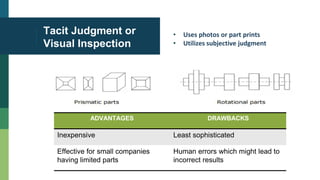
Tacit Judgment or
Visual Inspection
• Uses photos or part prints
• Utilizes subjective judgment
ADVANTAGES DRAWBACKS
Inexpensive Least sophisticated
Effective for small companies
having limited parts
Human errors which might lead to
incorrect results
Classification and
Coding
What is coding ?
The process of assigning
symbols to paths. Here symbols
represent design
attributes and manufacturing
features of parts .
Mono-code or hierarchical
structure
Poly-code, or chain-type
structure
Mixed-mode structure
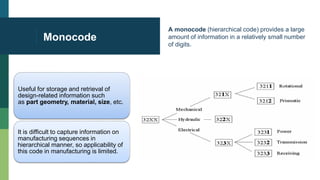
Monocode
A monocode (hierarchical code) provides a large
amount of information in a relatively small number
of digits.
Useful for storage and retrieval of
design-related information such
as part geometry, material, size, etc.
It is difficult to capture information on
manufacturing sequences in
hierarchical manner, so applicability of
this code in manufacturing is limited.
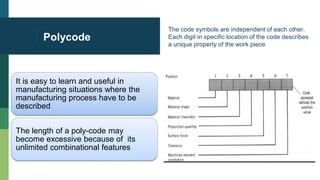
The code symbols are independent of each other.
Each digit in specific location of the code describes
a unique property of the work piece
Polycode
It is easy to learn and useful in
manufacturing situations where the
manufacturing process have to be
described
The length of a poly-code may
become excessive because of its
unlimited combinational features
Mixed Mode (OPTIZ)
Mixed coding system,
developed by OPTIZ, and is
widely used in the industry
Considers both design and
manufacturing information
Can be applied to machined,
non machined and
purchased parts
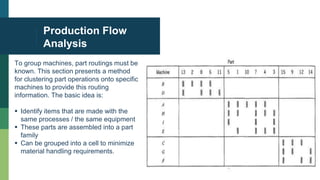
Production Flow
Analysis
To group machines, part routings must be
known. This section presents a method
for clustering part operations onto specific
machines to provide this routing
information. The basic idea is:
 Identify items that are made with the
same processes / the same equipment
 These parts are assembled into a part
family
 Can be grouped into a cell to minimize
material handling requirements.
Let’s play a Game!
▪ You are the production head of Industries
▪ The Industry has 4 machines and 4 components
▪ Component 1 requires machines 1 and 3
▪ Component 2 requires machines 1, 2 and 4
▪ Component 3 requires machines 1 & 3
▪ Component 4 requires machine 4
▪ You have to layout an optimum plan to arrange your machines
▪ You have one minute for this!
Rank Order
Clustering
▪ The arrangement is much harder to get in real-life situations!
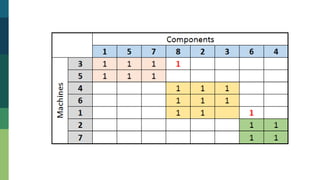
▪ This technique was presented to form machine-components group
▪ Based on sorting rows and column of machine part incidence matrix
▪ Specific components need same or similar machines
▪ Grouping of similar machines into cells is done by Rank Order Clustering
Let’s look at an example
Limitations of Rank
Order Clustering
▪ Cumbersome Calculations for large matrices
▪ Manual identification of groups from final structure
▪ Effect of inter-cell moves
▪ Some parts processed in more than one cell-Bottleneck
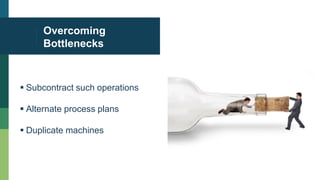
Overcoming
Bottlenecks
 Subcontract such operations
 Alternate process plans
 Duplicate machines
Segment-wise
Advantages
• Reduced WIP
• Reduced material handling due to proximity of cells
• Reduced queuing time
Inventory
• Standardization of machine setup
• Reduced travel time due to proximity of cells
• Throughput time reduced significantly
• Process flow and scheduling is simplified
Efficiency
• Quality of output improves
• Worker satisfaction is increased
• Improved feedback loop
• Better focus on quality as operation is more focused
Quality
Limitations and
Challenges
 Possible loss in routing flexibility impacting viability of cell use
 Balancing the cell and challenges of redistribution in case of diminishing
demand from one cell
 Likely deterioration of benefits of cell manufacturing over time due to changes in
production environment
 Cost-benefit analysis of switching from process layout to a cellular layout
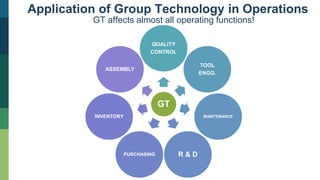
GT
QUALITY
CONTROL
TOOL
ENGG.
MAINTENANCE
R & DPURCHASING
INVENTORY
ASSEMBLY
Application of Group Technology in Operations
GT affects almost all operating functions!
THANKS!
Any Questions?

Group Technology (Cell Manufacturing)

  • 1.
    Group Technology (Cell Manufacturing) Aayush Jain B15063 Abhimanyu Singh B15064 Abhishek Tahlan B15065 Aishwary KumarGupta B15066 Akshar Anil Shah B15067 Akshay Ratan B15068 Aman Preet B15069 Amol Bisht B15070 Ajit Reddy O15002
  • 2.
    Cell Manufacturing -Cellular manufacturing is a manufacturing process that produces families of parts within a single line or cell of machines Manufacturing Cell - A cell is a cluster of machines grouped together to produce a part family Part Family - A collection of parts that possess similarities in geometry, shape, size or in processing steps used in their manufacture Cell manufacturing Introduction
  • 3.
    “Similar things shouldbe done similarly”
  • 4.
    TACIT JUDGMENT ORVISUAL INSPECTION CLASSIFICATION AND CODING PRODUCTION FLOW ANALYSIS Techniques to Form Part Families
  • 5.
    Tacit Judgment or VisualInspection • Uses photos or part prints • Utilizes subjective judgment ADVANTAGES DRAWBACKS Inexpensive Least sophisticated Effective for small companies having limited parts Human errors which might lead to incorrect results
  • 6.
    Classification and Coding What iscoding ? The process of assigning symbols to paths. Here symbols represent design attributes and manufacturing features of parts . Mono-code or hierarchical structure Poly-code, or chain-type structure Mixed-mode structure
  • 7.
    Monocode A monocode (hierarchicalcode) provides a large amount of information in a relatively small number of digits. Useful for storage and retrieval of design-related information such as part geometry, material, size, etc. It is difficult to capture information on manufacturing sequences in hierarchical manner, so applicability of this code in manufacturing is limited.
  • 8.
    The code symbolsare independent of each other. Each digit in specific location of the code describes a unique property of the work piece Polycode It is easy to learn and useful in manufacturing situations where the manufacturing process have to be described The length of a poly-code may become excessive because of its unlimited combinational features
  • 9.
    Mixed Mode (OPTIZ) Mixedcoding system, developed by OPTIZ, and is widely used in the industry Considers both design and manufacturing information Can be applied to machined, non machined and purchased parts
  • 10.
    Production Flow Analysis To groupmachines, part routings must be known. This section presents a method for clustering part operations onto specific machines to provide this routing information. The basic idea is:  Identify items that are made with the same processes / the same equipment  These parts are assembled into a part family  Can be grouped into a cell to minimize material handling requirements.
  • 11.
    Let’s play aGame! ▪ You are the production head of Industries ▪ The Industry has 4 machines and 4 components ▪ Component 1 requires machines 1 and 3 ▪ Component 2 requires machines 1, 2 and 4 ▪ Component 3 requires machines 1 & 3 ▪ Component 4 requires machine 4 ▪ You have to layout an optimum plan to arrange your machines ▪ You have one minute for this!
  • 12.
    Rank Order Clustering ▪ Thearrangement is much harder to get in real-life situations! ▪ This technique was presented to form machine-components group ▪ Based on sorting rows and column of machine part incidence matrix ▪ Specific components need same or similar machines ▪ Grouping of similar machines into cells is done by Rank Order Clustering
  • 13.
    Let’s look atan example
  • 17.
    Limitations of Rank OrderClustering ▪ Cumbersome Calculations for large matrices ▪ Manual identification of groups from final structure ▪ Effect of inter-cell moves ▪ Some parts processed in more than one cell-Bottleneck
  • 18.
    Overcoming Bottlenecks  Subcontract suchoperations  Alternate process plans  Duplicate machines
  • 19.
    Segment-wise Advantages • Reduced WIP •Reduced material handling due to proximity of cells • Reduced queuing time Inventory • Standardization of machine setup • Reduced travel time due to proximity of cells • Throughput time reduced significantly • Process flow and scheduling is simplified Efficiency • Quality of output improves • Worker satisfaction is increased • Improved feedback loop • Better focus on quality as operation is more focused Quality
  • 20.
    Limitations and Challenges  Possibleloss in routing flexibility impacting viability of cell use  Balancing the cell and challenges of redistribution in case of diminishing demand from one cell  Likely deterioration of benefits of cell manufacturing over time due to changes in production environment  Cost-benefit analysis of switching from process layout to a cellular layout
  • 21.
    GT QUALITY CONTROL TOOL ENGG. MAINTENANCE R & DPURCHASING INVENTORY ASSEMBLY Applicationof Group Technology in Operations GT affects almost all operating functions!
  • 22.