GROUP TECHNOLOGY
GROUP TECHNOLOGY (GT)
 GT is a manufacturing philosophy in which similar parts are
identified & grouped together to make advantage of their similarities
in design and production.
 Similar parts bare arranged into part families, where each part family
possesses similar design and/or manufacturing characteristics.
 Grouping the production equipment into machine cells, where each
cell specializes in the production of a part family, is called cellular
manufacturing
Part Families
• Part family - Group of similar parts
• Part family is a Collection of parts that are similar either because of
geometric shape and size or because similar processing steps are
required in their manufacture.
• Machine cell - Group of machineries used to process an individual part
family
Part Families
Similar prismatic parts requiring similar milling operations
Dissimilar parts requiring similar machining operations (hole drilling, surface milling)
Identical designed parts requiring completely different manufacturing processes
METHODS FOR PART FAMILY
There are three general methods for solving part families grouping.
All the three are time consuming and involve the analysis of much of
data by properly trained personnel. The three methods are:
 Visual inspection.
 Parts classification and coding.
 Production flow analysis.
Visual Inspection Method
• The visual inspection method is the least sophisticated and least expensive method.
• It involves the classification of parts into families by looking at either the physical parts or their
photographs and arranging them into groups having similar features.
Functional (or) process layout
Group (or) Combination Layout
Parts Classification and Coding Method
• In parts classification and coding, similarities among parts are identified, and these
similarities are related in a coding system.
• Two categories of part similarities can be distinguished:
1. Design attributes, which concerned with part characteristics such as geometry,
size and material. (Basic external and internal shape Rotational or rectangular
shape, L/D ratio, Aspect ratio, Dimensions and Tolerances)
2. Manufacturing attributes, which consider the sequence of processing steps
required to make a part.(Major processes, Minor operations, Operation sequence,
Dimension, Surface finish, Machine tool Production cycle time)
• There are three basic code structures used in group technology
– Monocode or hierarchical code
– Polycode or attribute
– Hybrid or mixed code
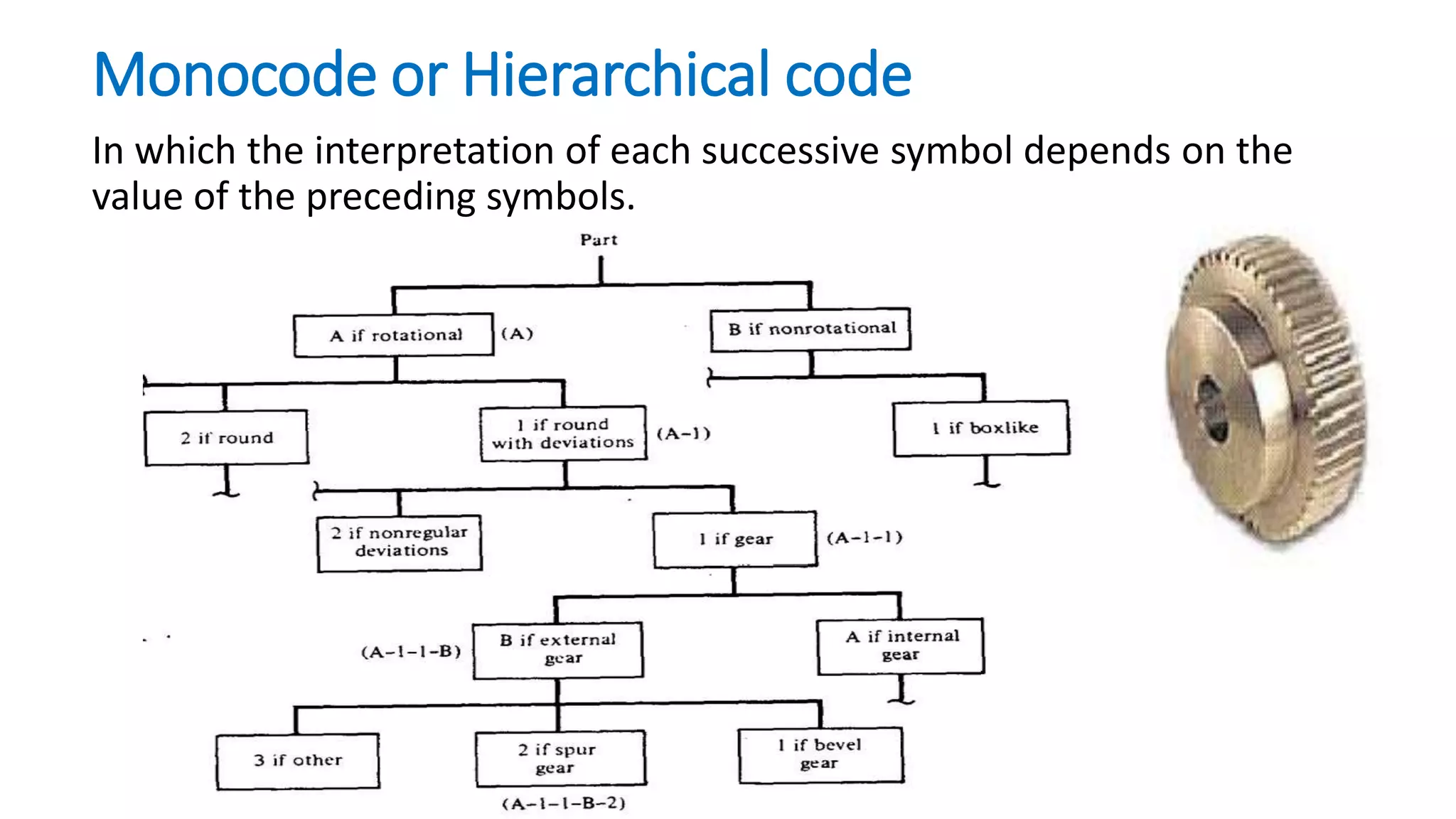
Monocode or Hierarchical code
In which the interpretation of each successive symbol depends on the
value of the preceding symbols.
Polycode or Attribute Code
• In which the interpretation of each symbol in the sequence is always the
same, it does not depend on the value of the preceding symbols.
Hybrid or Decision Code
• Construction to combine the best features of monocodes and
polycodes
• Best examples of a hybrid code is the opitz code and classification
system
OpitzClassificationSystem (H.opitz university of Aachen in Germany)
Form Code 1 2 3 4 5 for design attributes
Supplementary Code 6 7 8 9 for manufacturing attributes
Secondary Code A B C D for production operation type & sequence
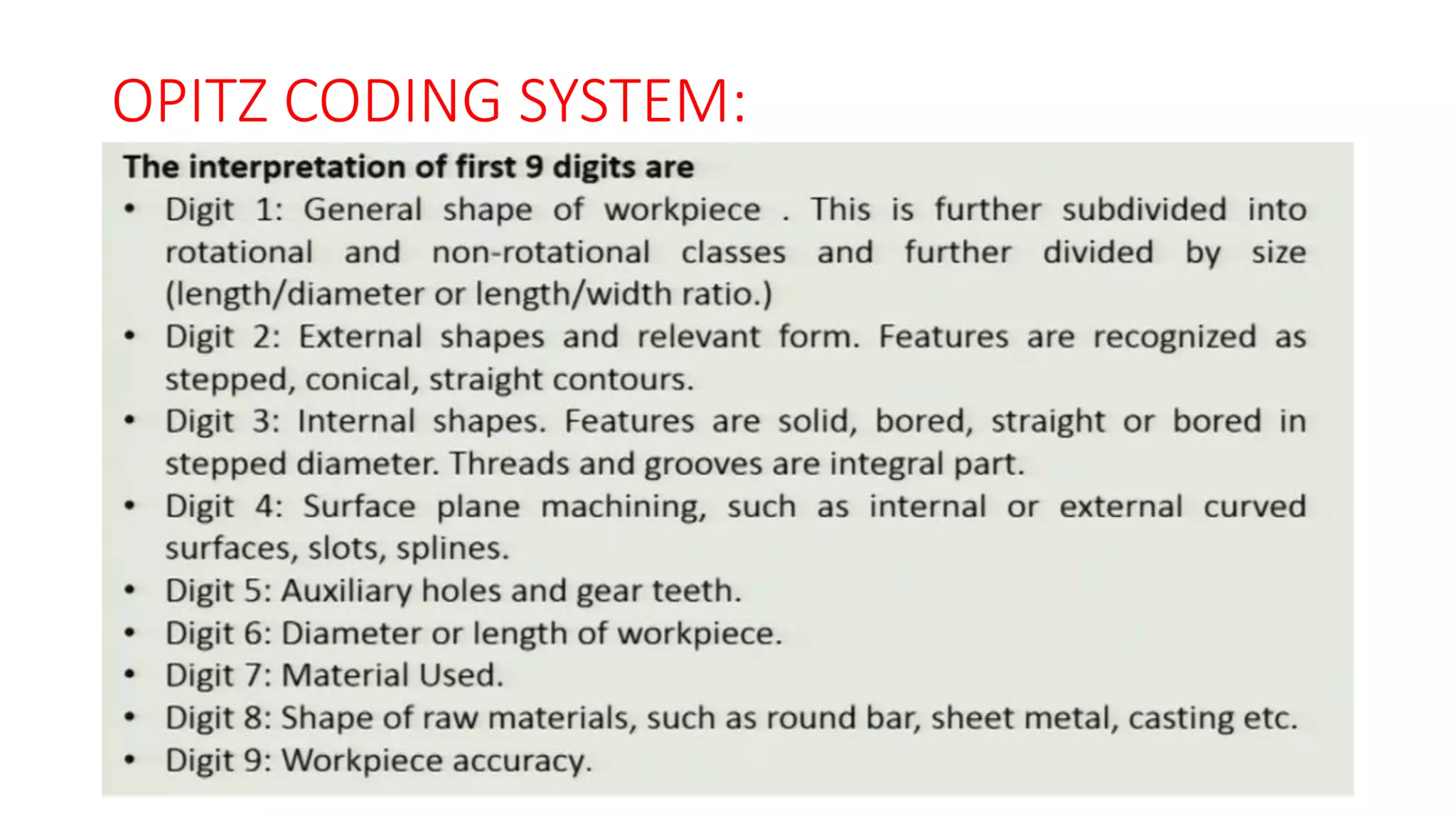
OPITZ CODING SYSTEM:
Example: Opitz part coding System
• Given the rotational part design below, determine the form code in the Opitz parts
classification and coding system.
Solution
• Length-to-diameter ratio: L/D = 1.5 Digit 1 = 1
• External shape: both ends stepped with screw thread on one end Digit 2 = 5
• Internal shape: part contains a through hole Digit 3 = 1
• Plane surface machining: none Digit 4 = 0
• Auxiliary holes, gear teeth, etc.: none Digit 5 = 0
The form code in the Opitz system is 15100
Problem 2:
•Length-to-diameter ratio: L/D = 1.4 Digit 1 = 1
•External shape: stepped on one end Digit 2 = 1
•Internal shape: part contains a through hole Digit 3 = 1
•Plane surface machining: none Digit 4 = 0
•Auxiliary holes, gear teeth, etc.: radial hole Digit 5 = 3
The form code in the Opitz system is 11103
MICLASS System
• It stands for Metal Institute Classification system and developed by Netherlands
Organization for Applied Scientific research. It is referred as Multiclass system.
• MICLASS classification range from 1 to 30 digits. Universal code the first 12 digits
code and next 18 digits are Supplementary code
Production Flow Analysis (PFA)
• Production flow analysis (PFA) is a method for identifying part families and
associated machine groupings that uses the information contained on process plans
rather than on part drawings.
• Steps involved in PFA
 Data collection
 Sortation of process routings
 Preparation of a PFA chart and
 Cluster analysis
BENEFITS OF GT IN MANUFACTURING
Cellular Manufacturing
Application of group technology in which dissimilar machines or processes
are aggregated into cells, each of which is dedicated to the production of a
part family or limited group of families
Typical objectives of cellular manufacturing:
 To shorten manufacturing lead times
 To reduce WIP
 To improve quality
 To simplify production scheduling
 To reduce setup times
Q2. Briefly explain about the Opitz coding system used in group technology. write
any seven advantages of group technology.
Assignment-2
Q1. Code the following part using Opitz coding system for the first five digits .
Describe your reasons for selecting each digit in the code.

Group Technology

  • 1.
  • 2.
    GROUP TECHNOLOGY (GT) GT is a manufacturing philosophy in which similar parts are identified & grouped together to make advantage of their similarities in design and production.  Similar parts bare arranged into part families, where each part family possesses similar design and/or manufacturing characteristics.  Grouping the production equipment into machine cells, where each cell specializes in the production of a part family, is called cellular manufacturing
  • 3.
    Part Families • Partfamily - Group of similar parts • Part family is a Collection of parts that are similar either because of geometric shape and size or because similar processing steps are required in their manufacture. • Machine cell - Group of machineries used to process an individual part family
  • 4.
    Part Families Similar prismaticparts requiring similar milling operations Dissimilar parts requiring similar machining operations (hole drilling, surface milling) Identical designed parts requiring completely different manufacturing processes
  • 5.
    METHODS FOR PARTFAMILY There are three general methods for solving part families grouping. All the three are time consuming and involve the analysis of much of data by properly trained personnel. The three methods are:  Visual inspection.  Parts classification and coding.  Production flow analysis.
  • 6.
    Visual Inspection Method •The visual inspection method is the least sophisticated and least expensive method. • It involves the classification of parts into families by looking at either the physical parts or their photographs and arranging them into groups having similar features.
  • 7.
  • 8.
  • 10.
    Parts Classification andCoding Method • In parts classification and coding, similarities among parts are identified, and these similarities are related in a coding system. • Two categories of part similarities can be distinguished: 1. Design attributes, which concerned with part characteristics such as geometry, size and material. (Basic external and internal shape Rotational or rectangular shape, L/D ratio, Aspect ratio, Dimensions and Tolerances) 2. Manufacturing attributes, which consider the sequence of processing steps required to make a part.(Major processes, Minor operations, Operation sequence, Dimension, Surface finish, Machine tool Production cycle time) • There are three basic code structures used in group technology – Monocode or hierarchical code – Polycode or attribute – Hybrid or mixed code
  • 11.
    Monocode or Hierarchicalcode In which the interpretation of each successive symbol depends on the value of the preceding symbols.
  • 12.
    Polycode or AttributeCode • In which the interpretation of each symbol in the sequence is always the same, it does not depend on the value of the preceding symbols.
  • 13.
    Hybrid or DecisionCode • Construction to combine the best features of monocodes and polycodes • Best examples of a hybrid code is the opitz code and classification system
  • 14.
    OpitzClassificationSystem (H.opitz universityof Aachen in Germany) Form Code 1 2 3 4 5 for design attributes Supplementary Code 6 7 8 9 for manufacturing attributes Secondary Code A B C D for production operation type & sequence
  • 16.
  • 17.
    Example: Opitz partcoding System • Given the rotational part design below, determine the form code in the Opitz parts classification and coding system. Solution • Length-to-diameter ratio: L/D = 1.5 Digit 1 = 1 • External shape: both ends stepped with screw thread on one end Digit 2 = 5 • Internal shape: part contains a through hole Digit 3 = 1 • Plane surface machining: none Digit 4 = 0 • Auxiliary holes, gear teeth, etc.: none Digit 5 = 0 The form code in the Opitz system is 15100
  • 18.
    Problem 2: •Length-to-diameter ratio:L/D = 1.4 Digit 1 = 1 •External shape: stepped on one end Digit 2 = 1 •Internal shape: part contains a through hole Digit 3 = 1 •Plane surface machining: none Digit 4 = 0 •Auxiliary holes, gear teeth, etc.: radial hole Digit 5 = 3 The form code in the Opitz system is 11103
  • 19.
    MICLASS System • Itstands for Metal Institute Classification system and developed by Netherlands Organization for Applied Scientific research. It is referred as Multiclass system. • MICLASS classification range from 1 to 30 digits. Universal code the first 12 digits code and next 18 digits are Supplementary code
  • 20.
    Production Flow Analysis(PFA) • Production flow analysis (PFA) is a method for identifying part families and associated machine groupings that uses the information contained on process plans rather than on part drawings. • Steps involved in PFA  Data collection  Sortation of process routings  Preparation of a PFA chart and  Cluster analysis
  • 21.
    BENEFITS OF GTIN MANUFACTURING
  • 22.
    BENEFITS OF GTIN MANUFACTURING
  • 23.
    Cellular Manufacturing Application ofgroup technology in which dissimilar machines or processes are aggregated into cells, each of which is dedicated to the production of a part family or limited group of families Typical objectives of cellular manufacturing:  To shorten manufacturing lead times  To reduce WIP  To improve quality  To simplify production scheduling  To reduce setup times
  • 24.
    Q2. Briefly explainabout the Opitz coding system used in group technology. write any seven advantages of group technology. Assignment-2 Q1. Code the following part using Opitz coding system for the first five digits . Describe your reasons for selecting each digit in the code.