Department of Mechanical Engineering
“FLEXIBLE MANUFACTURING SYSTEM”
By
Anand Khare
(5M1-23)
Guided by
BHUSHAN C. BISSA
 Introduction to FMS
 History of FMS
 Why FMS ?
 Basic components of FMS
 FMS equipment
 Types of FMS
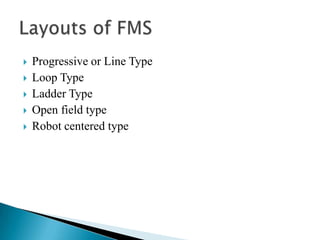
 Layouts of FMS
 Flexibility in FMS
 Applications of FMS
 Advantages
 Disadvantage
 Challenges with FMS
 Conclusion
 References
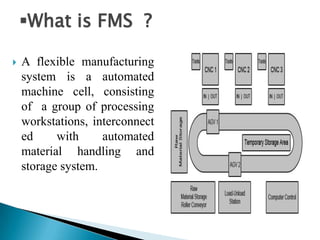
 A flexible manufacturing
system is a automated
machine cell, consisting
of a group of processing
workstations, interconnect
ed with automated
material handling and
storage system.
What is FMS ?
 The first FMS was patented in 1965 by Theo
Williamson who made numerically controlled
equipment. Examples of numerically controlled
equipment are like a CNC lathes or mills which is
called varying types of FMS.
 External changes such as change in product design
and production system.
 Optimizing the manufacturing cycle time
 Reduced production costs
 Overcoming internal changes like breakdowns etc.
 Workstations
 Automated Material Handling and Storage systems
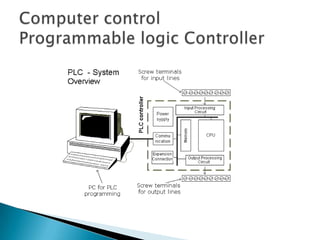
 Computer Control System
 Substations
1. Load/Unload Stations
2. Machining Stations
3. Other processing stations
4. Assembly
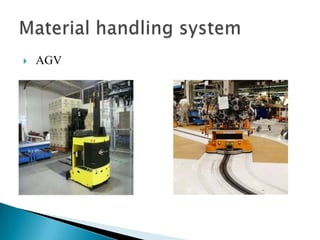
 AGV
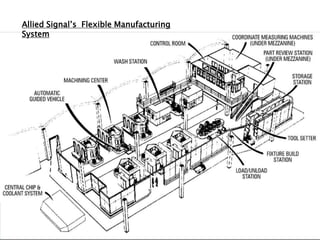
Allied Signal’s Flexible Manufacturing
System
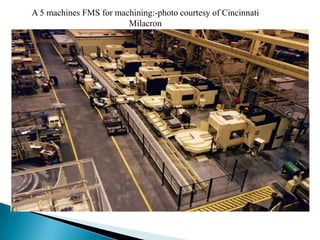
A 5 machines FMS for machining:-photo courtesy of Cincinnati
Milacron
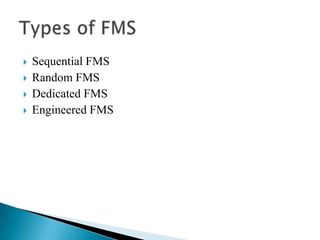
 Sequential FMS
 Random FMS
 Dedicated FMS
 Engineered FMS
 Progressive or Line Type
 Loop Type
 Ladder Type
 Open field type
 Robot centered type
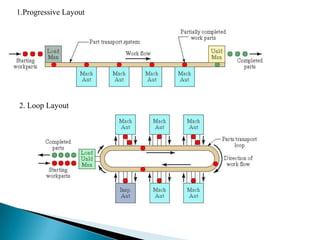
1.Progressive Layout
2. Loop Layout
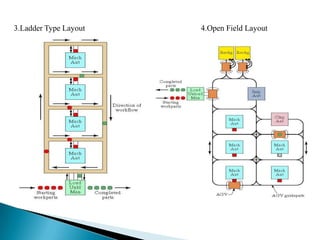
3.Ladder Type Layout 4.Open Field Layout
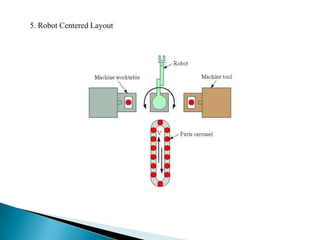
5. Robot Centered Layout
 Flexibility in manufacturing means the ability to deal
with slightly or greatly mixed parts, to allow variation
in parts assembly and variations in process sequence,
change the production volume and change the design of
certain product being manufactured.
• To be flexible, a manufacturing system must posses the
following capabilities:
 Identification of the different production units to perform the
correct operation.
 Quick changeover of operating instructions.
 Quick changeover of physical setups of fixtures, tools and
other working units.
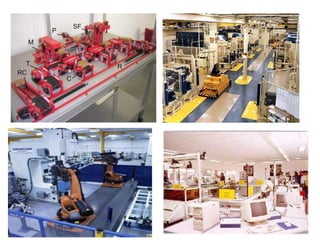
 Metal-cutting machining
 Metal forming
 Assembly
 Joining-welding (arc , spot), glueing
 Surface treatment
 Inspection
 Testing
FMS at Vought Aircraft
 To reduce set up and queue times
 Improve efficiency
 Reduce time for product completion
 Utilize human workers better
 Improve product routing
 Produce a variety of Items under one roof
 Improve product quality
 Serve a variety of vendors simultaneously
 Produce more product more quickly
 Expensive.
 Substantial pre-planning activity.
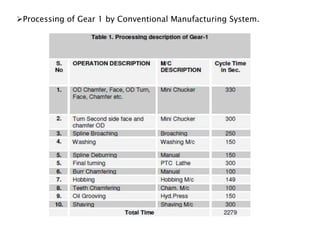
Processing of Gear 1 by Conventional Manufacturing System.
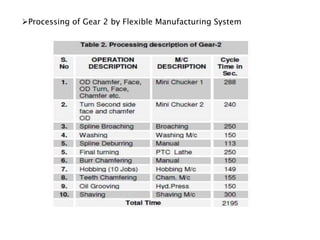
Processing of Gear 2 by Flexible Manufacturing System
The processing of Gear by FMS saves approximately 100 seconds per gear
including pre & post processing adjustments. This means if number of gears to
be produced increases this will save lot of time and increase productivity of
the manufacturer. This will help in earning more profit. Hence FMS is more
beneficial than conventional manufacturing system.
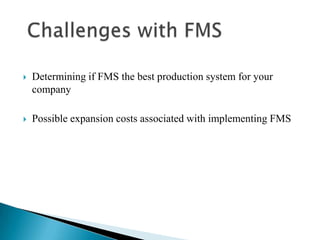
 Determining if FMS the best production system for your
company
 Possible expansion costs associated with implementing FMS
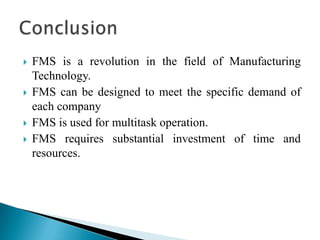
 FMS is a revolution in the field of Manufacturing
Technology.
 FMS can be designed to meet the specific demand of
each company
 FMS is used for multitask operation.
 FMS requires substantial investment of time and
resources.
 Technical Papers:
 Guixiu Qiao, Robert Lu, CharlesMclean: “Flexible manufacturing system
for mass customization manufacturing”, International Journal of Flexible
Manufacturing Systems, Volume 14, pp173-187. .
 Jim Browne, Didier Dubois, Keith Rathmill, Suresh P. Sethi, Kathryn E.
Stecke :“Classification of FMS”, International Journal of Flexible
Manufacturing Systems,Volume 13, Issue 4,Paper No. 367, pp 114-117,
(1984).
 Antonio Grieco, Quirico Semeraro, Tullio Tolio: “A Review of Different
Approaches to the FMS Loading Problem”, International Journal of
Flexible Manufacturing Systems,Volume 13, Issue 4, pp 361-384, October
2001.
 Books Referred:
 M.P. Groover: “Automation Production System and Computer Integration
Manufacturing”, Prentice-Hall of India Private Limited,2008,Pg.No.:538-
560.
 R.K. Jain: “Production technology”, Khanna Publications, 2009,
Pg.No.:962-974.
 Case study:
 Ajay Singholi, Deepti Chhabra, Sampada Bagai: “Performance Evaluation
and Design of Flexible Manufacturing System”, Global Journal of
Enterprise Information System, Volume 2, Issue 1, pp 24-34, 2010.
THANK YOU

FLEXIBLE MANUFACTURING SYSTEM

  • 1.
    Department of MechanicalEngineering “FLEXIBLE MANUFACTURING SYSTEM” By Anand Khare (5M1-23) Guided by BHUSHAN C. BISSA
  • 2.
     Introduction toFMS  History of FMS  Why FMS ?  Basic components of FMS  FMS equipment  Types of FMS  Layouts of FMS  Flexibility in FMS  Applications of FMS  Advantages  Disadvantage  Challenges with FMS  Conclusion  References
  • 3.
     A flexiblemanufacturing system is a automated machine cell, consisting of a group of processing workstations, interconnect ed with automated material handling and storage system. What is FMS ?
  • 4.
     The firstFMS was patented in 1965 by Theo Williamson who made numerically controlled equipment. Examples of numerically controlled equipment are like a CNC lathes or mills which is called varying types of FMS.
  • 5.
     External changessuch as change in product design and production system.  Optimizing the manufacturing cycle time  Reduced production costs  Overcoming internal changes like breakdowns etc.
  • 6.
     Workstations  AutomatedMaterial Handling and Storage systems  Computer Control System
  • 7.
     Substations 1. Load/UnloadStations 2. Machining Stations 3. Other processing stations 4. Assembly
  • 8.
  • 10.
    Allied Signal’s FlexibleManufacturing System
  • 11.
    A 5 machinesFMS for machining:-photo courtesy of Cincinnati Milacron
  • 12.
     Sequential FMS Random FMS  Dedicated FMS  Engineered FMS
  • 13.
     Progressive orLine Type  Loop Type  Ladder Type  Open field type  Robot centered type
  • 14.
  • 15.
    3.Ladder Type Layout4.Open Field Layout
  • 16.
  • 17.
     Flexibility inmanufacturing means the ability to deal with slightly or greatly mixed parts, to allow variation in parts assembly and variations in process sequence, change the production volume and change the design of certain product being manufactured.
  • 18.
    • To beflexible, a manufacturing system must posses the following capabilities:  Identification of the different production units to perform the correct operation.  Quick changeover of operating instructions.  Quick changeover of physical setups of fixtures, tools and other working units.
  • 19.
     Metal-cutting machining Metal forming  Assembly  Joining-welding (arc , spot), glueing  Surface treatment  Inspection  Testing
  • 20.
    FMS at VoughtAircraft
  • 22.
     To reduceset up and queue times  Improve efficiency  Reduce time for product completion  Utilize human workers better  Improve product routing  Produce a variety of Items under one roof  Improve product quality  Serve a variety of vendors simultaneously  Produce more product more quickly
  • 23.
     Expensive.  Substantialpre-planning activity.
  • 24.
    Processing of Gear1 by Conventional Manufacturing System.
  • 25.
    Processing of Gear2 by Flexible Manufacturing System
  • 26.
    The processing ofGear by FMS saves approximately 100 seconds per gear including pre & post processing adjustments. This means if number of gears to be produced increases this will save lot of time and increase productivity of the manufacturer. This will help in earning more profit. Hence FMS is more beneficial than conventional manufacturing system.
  • 28.
     Determining ifFMS the best production system for your company  Possible expansion costs associated with implementing FMS
  • 29.
     FMS isa revolution in the field of Manufacturing Technology.  FMS can be designed to meet the specific demand of each company  FMS is used for multitask operation.  FMS requires substantial investment of time and resources.
  • 30.
     Technical Papers: Guixiu Qiao, Robert Lu, CharlesMclean: “Flexible manufacturing system for mass customization manufacturing”, International Journal of Flexible Manufacturing Systems, Volume 14, pp173-187. .  Jim Browne, Didier Dubois, Keith Rathmill, Suresh P. Sethi, Kathryn E. Stecke :“Classification of FMS”, International Journal of Flexible Manufacturing Systems,Volume 13, Issue 4,Paper No. 367, pp 114-117, (1984).  Antonio Grieco, Quirico Semeraro, Tullio Tolio: “A Review of Different Approaches to the FMS Loading Problem”, International Journal of Flexible Manufacturing Systems,Volume 13, Issue 4, pp 361-384, October 2001.
  • 31.
     Books Referred: M.P. Groover: “Automation Production System and Computer Integration Manufacturing”, Prentice-Hall of India Private Limited,2008,Pg.No.:538- 560.  R.K. Jain: “Production technology”, Khanna Publications, 2009, Pg.No.:962-974.  Case study:  Ajay Singholi, Deepti Chhabra, Sampada Bagai: “Performance Evaluation and Design of Flexible Manufacturing System”, Global Journal of Enterprise Information System, Volume 2, Issue 1, pp 24-34, 2010.
  • 32.