Cellular layout
Cellular lay out
A facility layout where machines are arranged in a work
center in the general order that they are required to produce
families of parts or one product family. Also called product-
process layout.
Cell layout
1) In a cell layout, the transformed resources
entering the operation move into a cell in
which all the transforming resources it requires
in located.
2) After being processed in the cell, the
transformed resource may move to a different
cell in the operation or it may be a finished
product or service.
3) Each cell may be arranged in either a process
or product layout.
4) The cell type layout attempts to bring order to
the complex flow seen in a process layout.
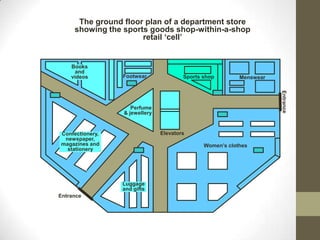
The ground floor plan of a department store
showing the sports goods shop-within-a-shop
retail ‘cell’
Sports shop Menswear
Women’s clothes
Luggage
and gifts
Confectionery,
newspaper,
magazines and
stationery
Books
and
videos Footwear
Perfume
& jewellery
Elevators
Entrance
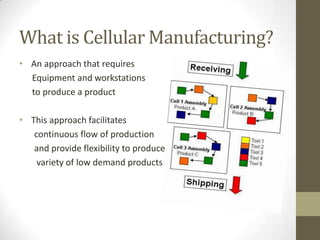
What is Cellular Manufacturing?
• An approach that requires
Equipment and workstations
to produce a product
• This approach facilitates
continuous flow of production
and provide flexibility to produce
variety of low demand products
Improving Layouts Using Work
Cells
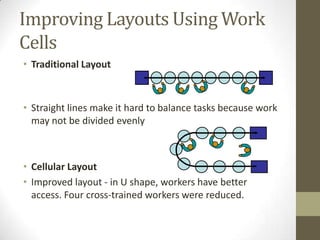
• Traditional Layout
• Straight lines make it hard to balance tasks because work
may not be divided evenly
• Cellular Layout
• Improved layout - in U shape, workers have better
access. Four cross-trained workers were reduced.
Types of Operations
One Piece Flow
• Handling items one at a time eliminates wastes inherent in
batch production and enables a balanced flow of work.
Multi-Process Handling
• Multi-Process Handling increases flexibility in the process and
avoids the inefficiencies inherent in traditional manufacturing
arrangements
Multi-functional Workforce
• A multi-functional workforce is critical to enable flexible operations
where the range of tasks performed by a given worker can be varied
to match demand
Challenges While Implementation
• The biggest challenge when implementing
cellular manufacturing in a company is dividing
the entire manufacturing system into cells.
• The issues may be conceptually divided in the
"hard" issues of equipment, such as material
flow and layout, and the "soft" issues of
management, such as upskilling and corporate
culture.
Several Operators in Series
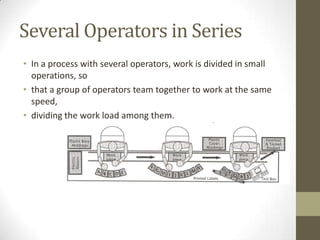
• In a process with several operators, work is divided in small
operations, so
• that a group of operators team together to work at the same
speed,
• dividing the work load among them.
Combined Cellular
Manufacturing
The combined cellular manufacturing equipment layout
further increases flexibility to adapt to demand
changes and maintain productivity through
leveraging resources of neighboring cells
Advantages of Work Cell(Cellular)
 Reduced work-in-process inventory
 Less floor space required
 Reduced raw material and finished goods inventory
 Reduced direct labor
 Heightened sense of employee participation
 Increased use of equipment and machinery
 Reduced investment in machinery and equipment

Cellular layout/Manufacturing

  • 1.
  • 2.
    Cellular lay out Afacility layout where machines are arranged in a work center in the general order that they are required to produce families of parts or one product family. Also called product- process layout.
  • 3.
    Cell layout 1) Ina cell layout, the transformed resources entering the operation move into a cell in which all the transforming resources it requires in located. 2) After being processed in the cell, the transformed resource may move to a different cell in the operation or it may be a finished product or service. 3) Each cell may be arranged in either a process or product layout. 4) The cell type layout attempts to bring order to the complex flow seen in a process layout.
  • 4.
    The ground floorplan of a department store showing the sports goods shop-within-a-shop retail ‘cell’ Sports shop Menswear Women’s clothes Luggage and gifts Confectionery, newspaper, magazines and stationery Books and videos Footwear Perfume & jewellery Elevators Entrance
  • 5.
    What is CellularManufacturing? • An approach that requires Equipment and workstations to produce a product • This approach facilitates continuous flow of production and provide flexibility to produce variety of low demand products
  • 6.
    Improving Layouts UsingWork Cells • Traditional Layout • Straight lines make it hard to balance tasks because work may not be divided evenly • Cellular Layout • Improved layout - in U shape, workers have better access. Four cross-trained workers were reduced.
  • 7.
    Types of Operations OnePiece Flow • Handling items one at a time eliminates wastes inherent in batch production and enables a balanced flow of work. Multi-Process Handling • Multi-Process Handling increases flexibility in the process and avoids the inefficiencies inherent in traditional manufacturing arrangements Multi-functional Workforce • A multi-functional workforce is critical to enable flexible operations where the range of tasks performed by a given worker can be varied to match demand
  • 8.
    Challenges While Implementation •The biggest challenge when implementing cellular manufacturing in a company is dividing the entire manufacturing system into cells. • The issues may be conceptually divided in the "hard" issues of equipment, such as material flow and layout, and the "soft" issues of management, such as upskilling and corporate culture.
  • 9.
    Several Operators inSeries • In a process with several operators, work is divided in small operations, so • that a group of operators team together to work at the same speed, • dividing the work load among them.
  • 10.
    Combined Cellular Manufacturing The combinedcellular manufacturing equipment layout further increases flexibility to adapt to demand changes and maintain productivity through leveraging resources of neighboring cells
  • 11.
    Advantages of WorkCell(Cellular)  Reduced work-in-process inventory  Less floor space required  Reduced raw material and finished goods inventory  Reduced direct labor  Heightened sense of employee participation  Increased use of equipment and machinery  Reduced investment in machinery and equipment