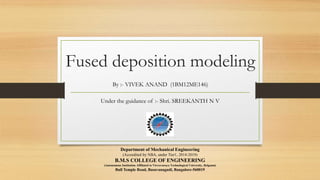
Fused deposition modeling
Under the guidance of :- Shri. SREEKANTH N V
By :- VIVEK ANAND (1BM12ME146)
Department of Mechanical Engineering
(Accredited by NBA, under Tier1, 2014-2019)
B.M.S COLLEGE OF ENGINEERING
(Autonomous Institution Affiliated to Visvesvaraya Technological University, Belgaum)
Bull Temple Road, Basavanagudi, Bangalore-560019
Rapid prototyping/Additive manufacturing
• Layered manufacturing
• Part is produced by producing multiple “slices”
• From 3D model [STL file] to physical object
Additive manufacturing
Fused deposition modeling
Selective laser sintering
Stereo lithography
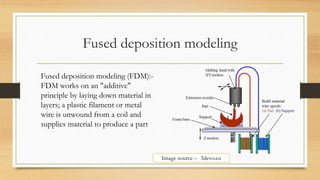
Fused deposition modeling
Image source :- 3devo.eu
Fused deposition modeling (FDM):-
FDM works on an "additive"
principle by laying down material in
layers; a plastic filament or metal
wire is unwound from a coil and
supplies material to produce a part
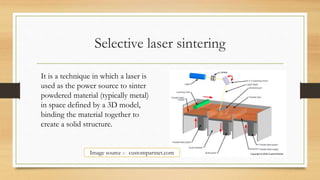
Selective laser sintering
It is a technique in which a laser is
used as the power source to sinter
powdered material (typically metal)
in space defined by a 3D model,
binding the material together to
create a solid structure.
Image source :- custompartnet.com
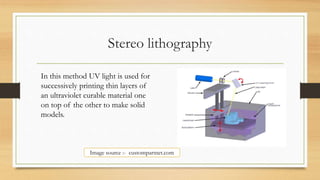
Stereo lithography
In this method UV light is used for
successively printing thin layers of
an ultraviolet curable material one
on top of the other to make solid
models.
Image source :- custompartnet.com
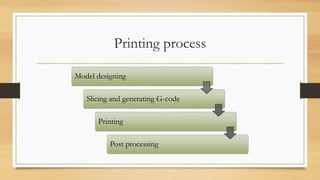
Printing process
Model designing
Slicing and generating G-code
Printing
Post processing
Model designing
• A model can be made in any of the designing software like Solid works,
Catia, Pro-e, Sketch up, AutoCAD, 3DS max… etc.
• The designed model needs to be saved with .STL extension
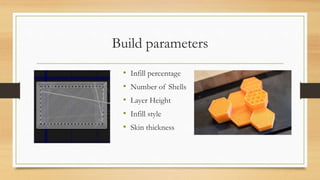
Build parameters
• Infill percentage
• Number of Shells
• Layer Height
• Infill style
• Skin thickness
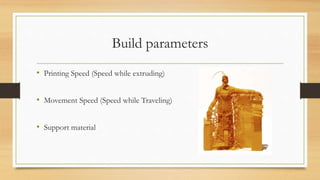
Build parameters
• Printing Speed (Speed while extruding)
• Movement Speed (Speed while Traveling)
• Support material
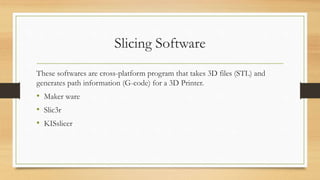
Slicing Software
These softwares are cross-platform program that takes 3D files (STL) and
generates path information (G-code) for a 3D Printer.
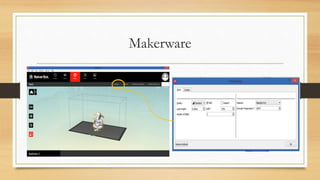
• Maker ware
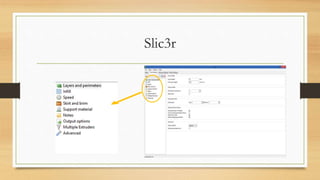
• Slic3r
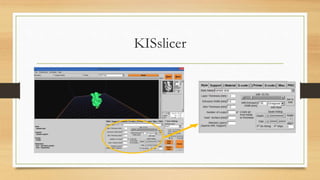
• KISslicer
KISslicer
Slic3r
Makerware
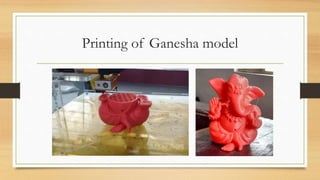
Printing of Ganesha model
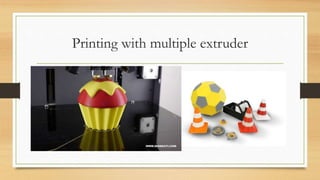
Printing with multiple extruder
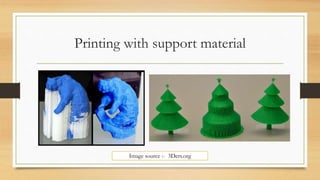
Printing with support material
Image source :- 3Ders.org
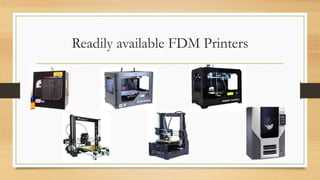
Readily available FDM Printers
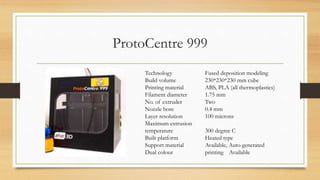
ProtoCentre 999
Technology Fused deposition modeling
Build volume 230*230*230 mm cube
Printing material ABS, PLA (all thermoplastics)
Filament diameter 1.75 mm
No. of extruder Two
Nozzle bore 0.4 mm
Layer resolution 100 microns
Maximum extrusion
temperature 300 degree C
Built platform Heated type
Support material Available, Auto generated
Dual colour printing Available
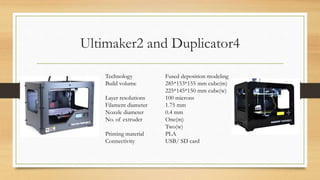
Ultimaker2 and Duplicator4
Technology Fused deposition modeling
Build volume 285*153*155 mm cube(m)
225*145*150 mm cube(w)
Layer resolutions 100 microns
Filament diameter 1.75 mm
Nozzle diameter 0.4 mm
No. of extruder One(m)
Two(w)
Printing material PLA
Connectivity USB/ SD card
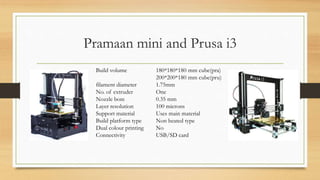
Pramaan mini and Prusa i3
Build volume 180*180*180 mm cube(pra)
200*200*180 mm cube(pru)
filament diameter 1.75mm
No. of extruder One
Nozzle bore 0.35 mm
Layer resolution 100 microns
Support material Uses main material
Build platform type Non heated type
Dual colour printing No
Connectivity USB/SD card
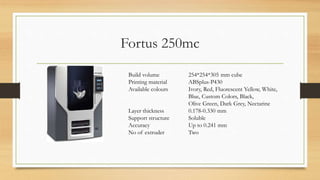
Fortus 250mc
Build volume 254*254*305 mm cube
Printing material ABSplus-P430
Available colours Ivory, Red, Fluorescent Yellow, White,
Blue, Custom Colors, Black,
Olive Green, Dark Grey, Nectarine
Layer thickness 0.178-0.330 mm
Support structure Soluble
Accuracy Up to 0.241 mm
No of extruder Two
Materials used for FDM printing
Acrylonitrile butadiene styrene
• Most widely used material in FDM. It has superior hardness, gloss toughness
and electrical insulation properties. They are stable and highly resistant to
wrapping, moisture absorption and shrinkages.
Poly lactic acid
• It is a biodegradable thermoplastic, this makes of PLA the most
environmentally friendly solution in the domain of 3D printing.PLA is
tough, but a little brittle, once it has cooled down
Defects in FDM Printing
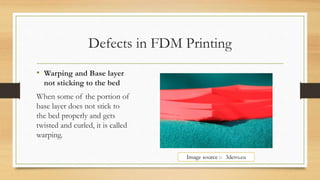
• Warping and Base layer
not sticking to the bed
When some of the portion of
base layer does not stick to
the bed properly and gets
twisted and curled, it is called
warping.
Image source :- 3devo.eu
Defects in FDM Printing
Cause of warping and base layer not sticking to the bed
• Improper bed platform levelling
• Non heated bed
• Slow print speed
Defects in FDM Printing
Remedies to prevent it
• Printing with Raft on
• Proper bed preparation
• Using sticking agent
• Using heated bed
• Replacing Kapton tape after certain duration
Applications
• Aerospace engineering
• Digital Dentistry
• Eye care
• Prosthetic hand
• Automobile industry
• Household goods and crafts
Applications
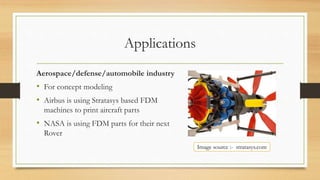
Aerospace/defense/automobile industry
• For concept modeling
• Airbus is using Stratasys based FDM
machines to print aircraft parts
• NASA is using FDM parts for their next
Rover
Image source :- stratasys.com
Applications
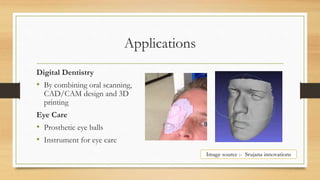
Digital Dentistry
• By combining oral scanning,
CAD/CAM design and 3D
printing
Eye Care
• Prosthetic eye balls
• Instrument for eye care
Image source :- Srujana innovations
Applications
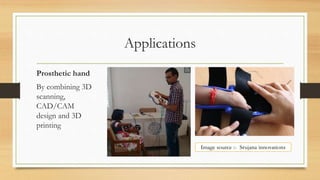
Prosthetic hand
By combining 3D
scanning,
CAD/CAM
design and 3D
printing
Image source :- Srujana innovations
Applications
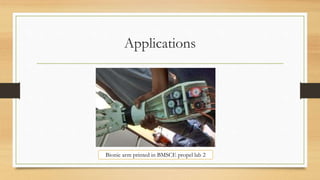
Bionic arm printed in BMSCE propel lab 2
Challenges
• Quality of print
• Affordability
• To replace different functional parts in industries with 3D printed parts
• Reduction of defects during printing
• Repeatability
FUSED DEPOSITION MODELING

FUSED DEPOSITION MODELING

  • 1.
    Fused deposition modeling Underthe guidance of :- Shri. SREEKANTH N V By :- VIVEK ANAND (1BM12ME146) Department of Mechanical Engineering (Accredited by NBA, under Tier1, 2014-2019) B.M.S COLLEGE OF ENGINEERING (Autonomous Institution Affiliated to Visvesvaraya Technological University, Belgaum) Bull Temple Road, Basavanagudi, Bangalore-560019
  • 2.
    Rapid prototyping/Additive manufacturing •Layered manufacturing • Part is produced by producing multiple “slices” • From 3D model [STL file] to physical object Additive manufacturing Fused deposition modeling Selective laser sintering Stereo lithography
  • 3.
    Fused deposition modeling Imagesource :- 3devo.eu Fused deposition modeling (FDM):- FDM works on an "additive" principle by laying down material in layers; a plastic filament or metal wire is unwound from a coil and supplies material to produce a part
  • 4.
    Selective laser sintering Itis a technique in which a laser is used as the power source to sinter powdered material (typically metal) in space defined by a 3D model, binding the material together to create a solid structure. Image source :- custompartnet.com
  • 5.
    Stereo lithography In thismethod UV light is used for successively printing thin layers of an ultraviolet curable material one on top of the other to make solid models. Image source :- custompartnet.com
  • 6.
    Printing process Model designing Slicingand generating G-code Printing Post processing
  • 7.
    Model designing • Amodel can be made in any of the designing software like Solid works, Catia, Pro-e, Sketch up, AutoCAD, 3DS max… etc. • The designed model needs to be saved with .STL extension
  • 8.
    Build parameters • Infillpercentage • Number of Shells • Layer Height • Infill style • Skin thickness
  • 9.
    Build parameters • PrintingSpeed (Speed while extruding) • Movement Speed (Speed while Traveling) • Support material
  • 10.
    Slicing Software These softwaresare cross-platform program that takes 3D files (STL) and generates path information (G-code) for a 3D Printer. • Maker ware • Slic3r • KISslicer
  • 11.
  • 12.
  • 13.
  • 14.
  • 15.
  • 16.
    Printing with supportmaterial Image source :- 3Ders.org
  • 17.
  • 18.
    ProtoCentre 999 Technology Fuseddeposition modeling Build volume 230*230*230 mm cube Printing material ABS, PLA (all thermoplastics) Filament diameter 1.75 mm No. of extruder Two Nozzle bore 0.4 mm Layer resolution 100 microns Maximum extrusion temperature 300 degree C Built platform Heated type Support material Available, Auto generated Dual colour printing Available
  • 19.
    Ultimaker2 and Duplicator4 TechnologyFused deposition modeling Build volume 285*153*155 mm cube(m) 225*145*150 mm cube(w) Layer resolutions 100 microns Filament diameter 1.75 mm Nozzle diameter 0.4 mm No. of extruder One(m) Two(w) Printing material PLA Connectivity USB/ SD card
  • 20.
    Pramaan mini andPrusa i3 Build volume 180*180*180 mm cube(pra) 200*200*180 mm cube(pru) filament diameter 1.75mm No. of extruder One Nozzle bore 0.35 mm Layer resolution 100 microns Support material Uses main material Build platform type Non heated type Dual colour printing No Connectivity USB/SD card
  • 21.
    Fortus 250mc Build volume254*254*305 mm cube Printing material ABSplus-P430 Available colours Ivory, Red, Fluorescent Yellow, White, Blue, Custom Colors, Black, Olive Green, Dark Grey, Nectarine Layer thickness 0.178-0.330 mm Support structure Soluble Accuracy Up to 0.241 mm No of extruder Two
  • 22.
    Materials used forFDM printing Acrylonitrile butadiene styrene • Most widely used material in FDM. It has superior hardness, gloss toughness and electrical insulation properties. They are stable and highly resistant to wrapping, moisture absorption and shrinkages. Poly lactic acid • It is a biodegradable thermoplastic, this makes of PLA the most environmentally friendly solution in the domain of 3D printing.PLA is tough, but a little brittle, once it has cooled down
  • 23.
    Defects in FDMPrinting • Warping and Base layer not sticking to the bed When some of the portion of base layer does not stick to the bed properly and gets twisted and curled, it is called warping. Image source :- 3devo.eu
  • 24.
    Defects in FDMPrinting Cause of warping and base layer not sticking to the bed • Improper bed platform levelling • Non heated bed • Slow print speed
  • 25.
    Defects in FDMPrinting Remedies to prevent it • Printing with Raft on • Proper bed preparation • Using sticking agent • Using heated bed • Replacing Kapton tape after certain duration
  • 26.
    Applications • Aerospace engineering •Digital Dentistry • Eye care • Prosthetic hand • Automobile industry • Household goods and crafts
  • 27.
    Applications Aerospace/defense/automobile industry • Forconcept modeling • Airbus is using Stratasys based FDM machines to print aircraft parts • NASA is using FDM parts for their next Rover Image source :- stratasys.com
  • 28.
    Applications Digital Dentistry • Bycombining oral scanning, CAD/CAM design and 3D printing Eye Care • Prosthetic eye balls • Instrument for eye care Image source :- Srujana innovations
  • 29.
    Applications Prosthetic hand By combining3D scanning, CAD/CAM design and 3D printing Image source :- Srujana innovations
  • 30.
    Applications Bionic arm printedin BMSCE propel lab 2
  • 31.
    Challenges • Quality ofprint • Affordability • To replace different functional parts in industries with 3D printed parts • Reduction of defects during printing • Repeatability