COMPUTER AIDED PROCESS 
PLANNING (CAPP) 
TKM 4502 COMPUTER INTEGRATED 
MANUFACTURING 
Present by : 
Victor Abraham 
Darnesh 
Navin 
Phuan Kian Teong
INTRODUCTION OF COMPUTER AIDED 
PROCESS PLANNING (CAPP) 
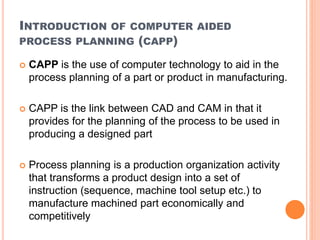
 CAPP is the use of computer technology to aid in the 
process planning of a part or product in manufacturing. 
 CAPP is the link between CAD and CAM in that it 
provides for the planning of the process to be used in 
producing a designed part 
 Process planning is a production organization activity 
that transforms a product design into a set of 
instruction (sequence, machine tool setup etc.) to 
manufacture machined part economically and 
competitively
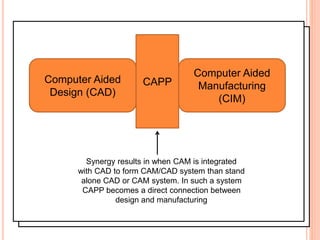
Computer Aided 
Design (CAD) 
CAPP 
Computer Aided 
Manufacturing 
(CIM) 
Synergy results in when CAM is integrated 
with CAD to form CAM/CAD system than stand 
alone CAD or CAM system. In such a system 
CAPP becomes a direct connection between 
design and manufacturing
COMPUTER AIDED PROCESS PLANNING 
(CAPP) ROLES IN MANUFACTURING 
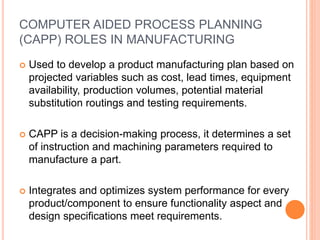
 Used to develop a product manufacturing plan based on 
projected variables such as cost, lead times, equipment 
availability, production volumes, potential material 
substitution routings and testing requirements. 
 CAPP is a decision-making process, it determines a set 
of instruction and machining parameters required to 
manufacture a part. 
 Integrates and optimizes system performance for every 
product/component to ensure functionality aspect and 
design specifications meet requirements.
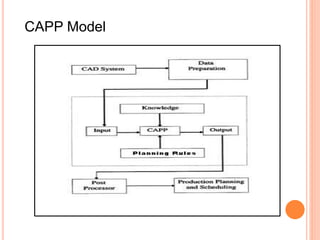
CAPP Model
Two method in Process Planning:- 
a) The manual experience based planning method 
 The manual experience based process planning is most 
widely used 
 It is mainly based on a manufacturing engineer's experience 
and knowledge of production facilities, equipment, their 
capabilities, processes and tooling.
b) Computer Aided Process Planning 
 Purpose of process planning is to translate the design 
requirements into manufacturing 
process details 
 A system was developed in which design information is 
processed by the process planning system to generate 
manufacturing process details.
CAPP PROGRAMMING SOFTWARE 
 LISP 
Is a functional programming language and offer 
flexibility in writing rules so that can use logical 
programming language . 
 PROLOG 
Programming in PROLOG involves writing logical 
formula which indicate logic relation in problem.
Contribution CAPP in implementation 
of CIM 
 The improved quality can be achieved through 
better design and better quality control in the 
manufacturing control. 
 Improved production scheduling, improved cost 
estimating procedures and fewer calculation errors. 
 The system will be more efficient and organized in 
engineering, production, marketing, and support 
functions of a manufacturing.
THANK YOU 
FOR 
YOUR ATTENTION!

COMPUTER AIDED PROCESS PLANNING (CAPP)

  • 1.
    COMPUTER AIDED PROCESS PLANNING (CAPP) TKM 4502 COMPUTER INTEGRATED MANUFACTURING Present by : Victor Abraham Darnesh Navin Phuan Kian Teong
  • 2.
    INTRODUCTION OF COMPUTERAIDED PROCESS PLANNING (CAPP)  CAPP is the use of computer technology to aid in the process planning of a part or product in manufacturing.  CAPP is the link between CAD and CAM in that it provides for the planning of the process to be used in producing a designed part  Process planning is a production organization activity that transforms a product design into a set of instruction (sequence, machine tool setup etc.) to manufacture machined part economically and competitively
  • 3.
    Computer Aided Design(CAD) CAPP Computer Aided Manufacturing (CIM) Synergy results in when CAM is integrated with CAD to form CAM/CAD system than stand alone CAD or CAM system. In such a system CAPP becomes a direct connection between design and manufacturing
  • 4.
    COMPUTER AIDED PROCESSPLANNING (CAPP) ROLES IN MANUFACTURING  Used to develop a product manufacturing plan based on projected variables such as cost, lead times, equipment availability, production volumes, potential material substitution routings and testing requirements.  CAPP is a decision-making process, it determines a set of instruction and machining parameters required to manufacture a part.  Integrates and optimizes system performance for every product/component to ensure functionality aspect and design specifications meet requirements.
  • 5.
  • 6.
    Two method inProcess Planning:- a) The manual experience based planning method  The manual experience based process planning is most widely used  It is mainly based on a manufacturing engineer's experience and knowledge of production facilities, equipment, their capabilities, processes and tooling.
  • 7.
    b) Computer AidedProcess Planning  Purpose of process planning is to translate the design requirements into manufacturing process details  A system was developed in which design information is processed by the process planning system to generate manufacturing process details.
  • 8.
    CAPP PROGRAMMING SOFTWARE  LISP Is a functional programming language and offer flexibility in writing rules so that can use logical programming language .  PROLOG Programming in PROLOG involves writing logical formula which indicate logic relation in problem.
  • 9.
    Contribution CAPP inimplementation of CIM  The improved quality can be achieved through better design and better quality control in the manufacturing control.  Improved production scheduling, improved cost estimating procedures and fewer calculation errors.  The system will be more efficient and organized in engineering, production, marketing, and support functions of a manufacturing.
  • 10.
    THANK YOU FOR YOUR ATTENTION!