GROUP TECHNOLOGY
What is Group Technology ?
 Group technology(GT) is a manufacturing philosophy to increase
production efficiency by grouping a variety of parts having
similarities of shape, dimension, and/or process route.
 Thus in GT, similar parts are identified and grouped together to
take advantages of their similarities in design and production.
 GT may be defined as a manufacturing philosophy that justifies
batch production by capitalizing on design and/or manufacturing
similarities among component parts.
 For example, a plant producing many parts(say, 5000 different
parts) may be grouped into several distinct (say, 20 to 25 part
families).Each family possesses similar design and
manufacturing characteristics.
 This grouping philosophy results in increased manufacturing
efficiencies.
 Efficiencies are due to reduced setup times, lower in-
process inventories, better scheduling, streamlined material
flow, improved quality, improved tool control, and the use of
standardized process plans.
 In many plants where GT has been implemented, the
production equipment is arranged into ‘machine groups’
(also known as ‘cells’) to facilitate work flow and parts
handling.
GENERAL ACHIEVEMENTS OF GROUP TECHNOLOGY
HISTORY OF GROUP TECHNOLOGY
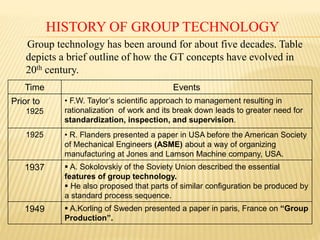
Group technology has been around for about five decades. Table
depicts a brief outline of how the GT concepts have evolved in
20th century.
Time Events
Prior to
1925
• F.W. Taylor’s scientific approach to management resulting in
rationalization of work and its break down leads to greater need for
standardization, inspection, and supervision.
1925 • R. Flanders presented a paper in USA before the American Society
of Mechanical Engineers (ASME) about a way of organizing
manufacturing at Jones and Lamson Machine company, USA.
1937  A. Sokolovskiy of the Soviety Union described the essential
features of group technology.
 He also proposed that parts of similar configuration be produced by
a standard process sequence.
1949  A.Korling of Sweden presented a paper in paris, France on “Group
Production”.
• In his paper, he described how work is decentralized into
independent groups, each of which contains the machines and tooling
to produce “a special category of parts”
1959 • S.P. Mitrofanvo, a Russian, published a book entitled “Scientific
Principles of Group Technology”.
• His book was very popular and was responsible for spreading the
concept of GT in Soviet Union.
• In fact, his book is considered responsible for over 800 plants in
Soviet Union using GT by 1965.
1960 • West Germany and Great Britain started serious studies into group
technology techniques : other European countries then followed.
• H. Opitz, a German researcher, studied workparts manufactured by
the German machine tool industry.
• Opitz developed the popular ‘parts classification and coding
system’ for machined parts (now, it is named by his name ‘ Opitz
parts classification and coding system.
1963 • Concept of GT is well recognized and widely applied in many
industries in the Soviet Union.
1969 • The first application of GT in USA was at New Jersey.
1973 • Japanese government had begun sponsoring group technology
application.
1990+ • Concept of cellular manufacturing system (CMS) have evolved.

Group technology

  • 1.
  • 2.
    What is GroupTechnology ?  Group technology(GT) is a manufacturing philosophy to increase production efficiency by grouping a variety of parts having similarities of shape, dimension, and/or process route.  Thus in GT, similar parts are identified and grouped together to take advantages of their similarities in design and production.  GT may be defined as a manufacturing philosophy that justifies batch production by capitalizing on design and/or manufacturing similarities among component parts.  For example, a plant producing many parts(say, 5000 different parts) may be grouped into several distinct (say, 20 to 25 part families).Each family possesses similar design and manufacturing characteristics.
  • 3.
     This groupingphilosophy results in increased manufacturing efficiencies.  Efficiencies are due to reduced setup times, lower in- process inventories, better scheduling, streamlined material flow, improved quality, improved tool control, and the use of standardized process plans.  In many plants where GT has been implemented, the production equipment is arranged into ‘machine groups’ (also known as ‘cells’) to facilitate work flow and parts handling.
  • 5.
    GENERAL ACHIEVEMENTS OFGROUP TECHNOLOGY
  • 6.
    HISTORY OF GROUPTECHNOLOGY Group technology has been around for about five decades. Table depicts a brief outline of how the GT concepts have evolved in 20th century. Time Events Prior to 1925 • F.W. Taylor’s scientific approach to management resulting in rationalization of work and its break down leads to greater need for standardization, inspection, and supervision. 1925 • R. Flanders presented a paper in USA before the American Society of Mechanical Engineers (ASME) about a way of organizing manufacturing at Jones and Lamson Machine company, USA. 1937  A. Sokolovskiy of the Soviety Union described the essential features of group technology.  He also proposed that parts of similar configuration be produced by a standard process sequence. 1949  A.Korling of Sweden presented a paper in paris, France on “Group Production”.
  • 7.
    • In hispaper, he described how work is decentralized into independent groups, each of which contains the machines and tooling to produce “a special category of parts” 1959 • S.P. Mitrofanvo, a Russian, published a book entitled “Scientific Principles of Group Technology”. • His book was very popular and was responsible for spreading the concept of GT in Soviet Union. • In fact, his book is considered responsible for over 800 plants in Soviet Union using GT by 1965. 1960 • West Germany and Great Britain started serious studies into group technology techniques : other European countries then followed. • H. Opitz, a German researcher, studied workparts manufactured by the German machine tool industry. • Opitz developed the popular ‘parts classification and coding system’ for machined parts (now, it is named by his name ‘ Opitz parts classification and coding system. 1963 • Concept of GT is well recognized and widely applied in many industries in the Soviet Union.
  • 8.
    1969 • Thefirst application of GT in USA was at New Jersey. 1973 • Japanese government had begun sponsoring group technology application. 1990+ • Concept of cellular manufacturing system (CMS) have evolved.