Computer Integrated Manufacturing (CIM) encompasses the entire product development and manufacturing process through dedicated software. CIM uses a common database and communication technologies to integrate design, manufacturing, and business functions. This reduces human involvement and errors. CIM aims to vastly improve manufacturing performance through an integrated, methodological approach. It connects previously separate automation "islands" into a distributed processing system to maximize efficiency. However, full CIM implementation faces challenges regarding integration of different machine components and protocols, ensuring data integrity for safe machine control, and providing competent human oversight of computer process control.
Computer Integrated Manufacturing.
UNIT– I
Introduction to CIM
Prepared By :
Mr. Satish S. Markad
Assistant Professor.
DEPARTMENT OF MECHANICAL ENGINEERING
GURU NANAK INSTITUTE OF TECHNOLOGY
NAGPUR, MAHARASHTRA
2.
CIMS
Computer IntegratedManufacturing (CIM) encompasses
the entire range of product development and
manufacturing activities with all the functions being carried
out with the help of dedicated software packages. The data
required for various functions are passed from one
application software to another in a seamless manner. For
example, the product data is created during design. This
data has to be transferred from the modeling software to
manufacturing software without any loss of data.
Introduction of CIM
3.
Introduction of CIM
CIM
CIMuses a common database wherever feasible and
communication technologies to integrate design,
manufacturing and associated business functions that
combine the automated segments of a factory or a
manufacturing facility. CIM reduces the human component
of manufacturing and thereby relieves the process of its
slow, expensive and error-prone component. CIM stands for
a holistic and methodological approach to the activities of
the manufacturing enterprise in order to achieve vast
improvement in its performance.
4.
Computer Integrated Manufacturing
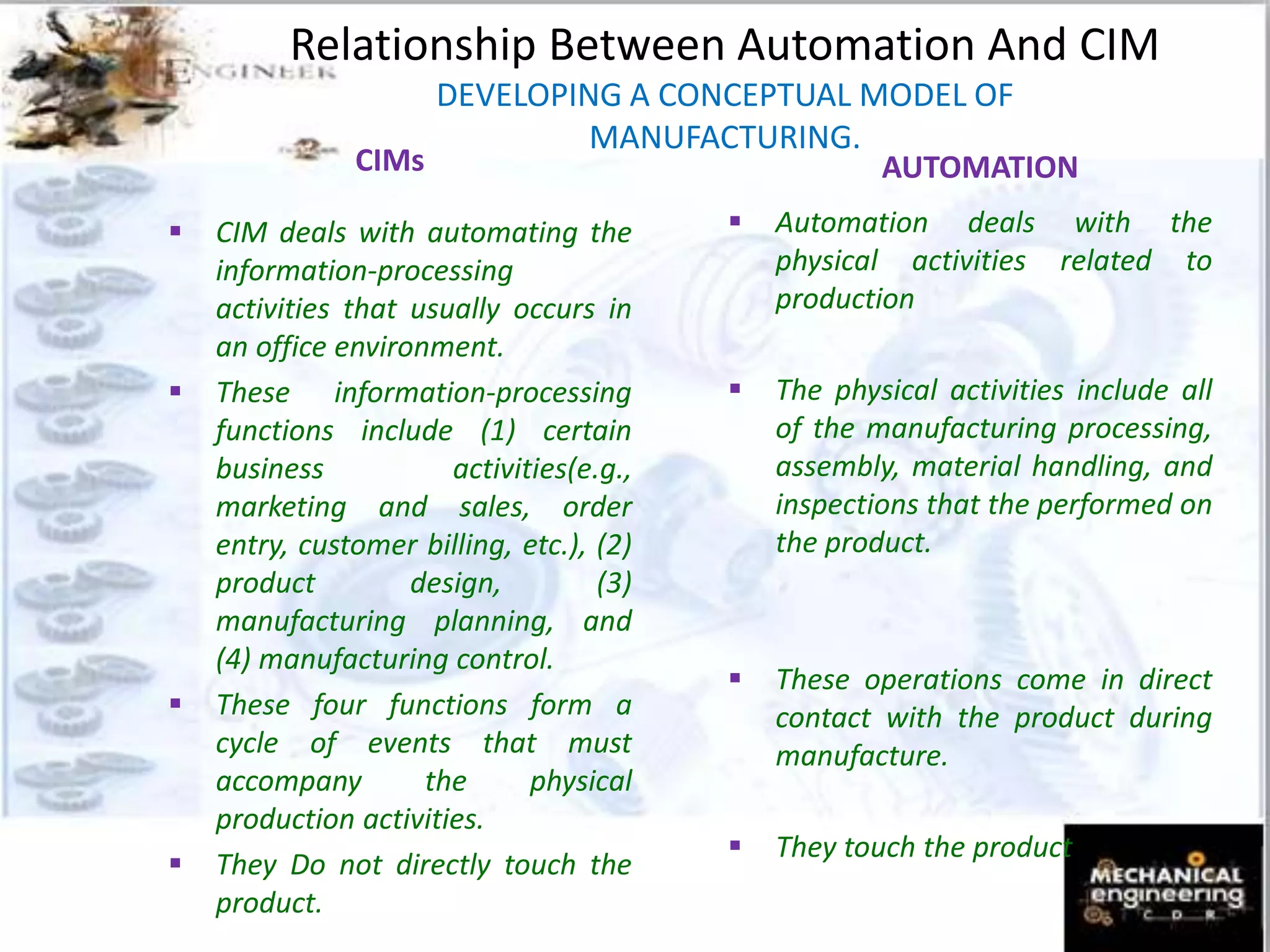
1. What is CIM?
2. Evolution of CIM
3. Definition of CIM
4.Components of CIM Wheel
5.Elements of CIM System
6.Objective of CIM
7.Benefits of CIM
8. CIM Hardware and Software
9. Relationship between automation and CIM by developing
a conceptual model of manufacturing.
10. What is Automation?
11. Types of Automation
12. Comparison Between Fixed And Flexible Automation
System
13. Reasons for Automating
14. Advantages And Disadvantages Of Automation Control In
Industry
5.
Definition of CIM
CIM Computer integrated manufacture is concerned with
providing computer assistance, control and high level
integrated automation at all levels of manufacturing and
other industry, by linking islands of automation into
distributed processing system.
OR
CIM The computer and automated systems association of
the society of Manufacturing Engineers (CASA/SEM) defines
CIM is the integration of total manufacturing enterprise by
using integrated systems and data communication coupled
with new managerial philosophies that improve
organizational and personnel efficiency.
6.
Concept of CIM
CIM is defined differently by different users, and can be
implemented in varying an increasing degree of complexity.
For many companies, improving shop-floor communications
is the primary goal. Others extend the degree of integration
to encompass communication between engineering and
manufacturing functions. The ultimate benefit of CIM is the
improvement of communication and control of information
flow to all aspects of an enterprise.
7.
Evolution Of CIM
Computer Integrated Manufacturing (CIM) is considered a
natural evolution of the technology of CAD/CAM which by
itself evolved by the integration of CAD and CAM.
Massachusetts Institute of Technology (MIT, USA) is credited
with pioneering the development in both CAD and CAM.
The first major innovation in machine control is the
Numerical Control (NC), demonstrated at MIT in 1952.
Early Numerical Control Systems were all basically hardwired
systems, since these were built with discrete systems or with
later first generation integrated chips.
8.
Evolution Of CIM
Early NC machines used paper tape as an input medium.
Every NC machine was fitted with a tape reader to read
paper tape and transfer the program to the memory of
the machine tool block by block.
Mainframe computers were used to control a group of NC
machines by mid 60's. This arrangement was then called
Direct Numerical Control (DNC) as the computer bypassed
the tape reader to transfer the program data to the machine
controller.
9.
Evolution Of CIM
By late 60's mini computers were being commonly used to
control NC machines. At this stage NC became truly soft
wired with the facilities of mass program storage, offline
editing and software logic control and processing. This
development is called Computer Numerical Control (CNC).
Manufacturing engineers also started using computers for
such tasks like inventory control, demand forecasting,
production planning and control etc. CNC technology was
adapted in the development of coordinate measuring
machine's (CMMs) which automated inspection.
10.
Evolution Of CIM
Robots were introduced to automate several tasks like
machine loading, materials handling, welding, painting
and assembly. All these developments led to the evolution
of flexible manufacturing cells and flexible manufacturing
systems in late 70's.
Since 70's, numerical controllers are being designed
around microprocessors, resulting in compact CNC
systems.
A further development to this technology is the distributed
numerical control (also called DNC) in which processing of NC
program is carried out in different computers operating at
different hierarchical levels –typically from mainframe host
computers to plant computers to the machine controller.
11.
Evolution Of CIM
Today the CNC systems are built around powerful 32 bit
and 64 bit microprocessors. PC based systems are also
becoming increasingly popular.
the manufacturing scenario during 80's we will find that
the manufacturing is characterized by a few islands of
automation. In the case of design, the task is well
automated. In the case of manufacture, CNC machines,
DNC systems, FMC, FMS etc provide tightly controlled
automation systems. Similarly computer control has been
implemented in several areas like manufacturing resource
planning, accounting, sales, marketing and purchase
12.
Evolution Of CIM
Yetthe full potential of computerization could not be
obtained unless all the segments of manufacturing are
integrated, permitting the transfer of data across various
functional modules. This realization led to the concept of
computer integrated manufacturing. Thus the
implementation of CIM required the development of whole
lot of computer technologies related to hardware and
software.
13.
Definition of CIM
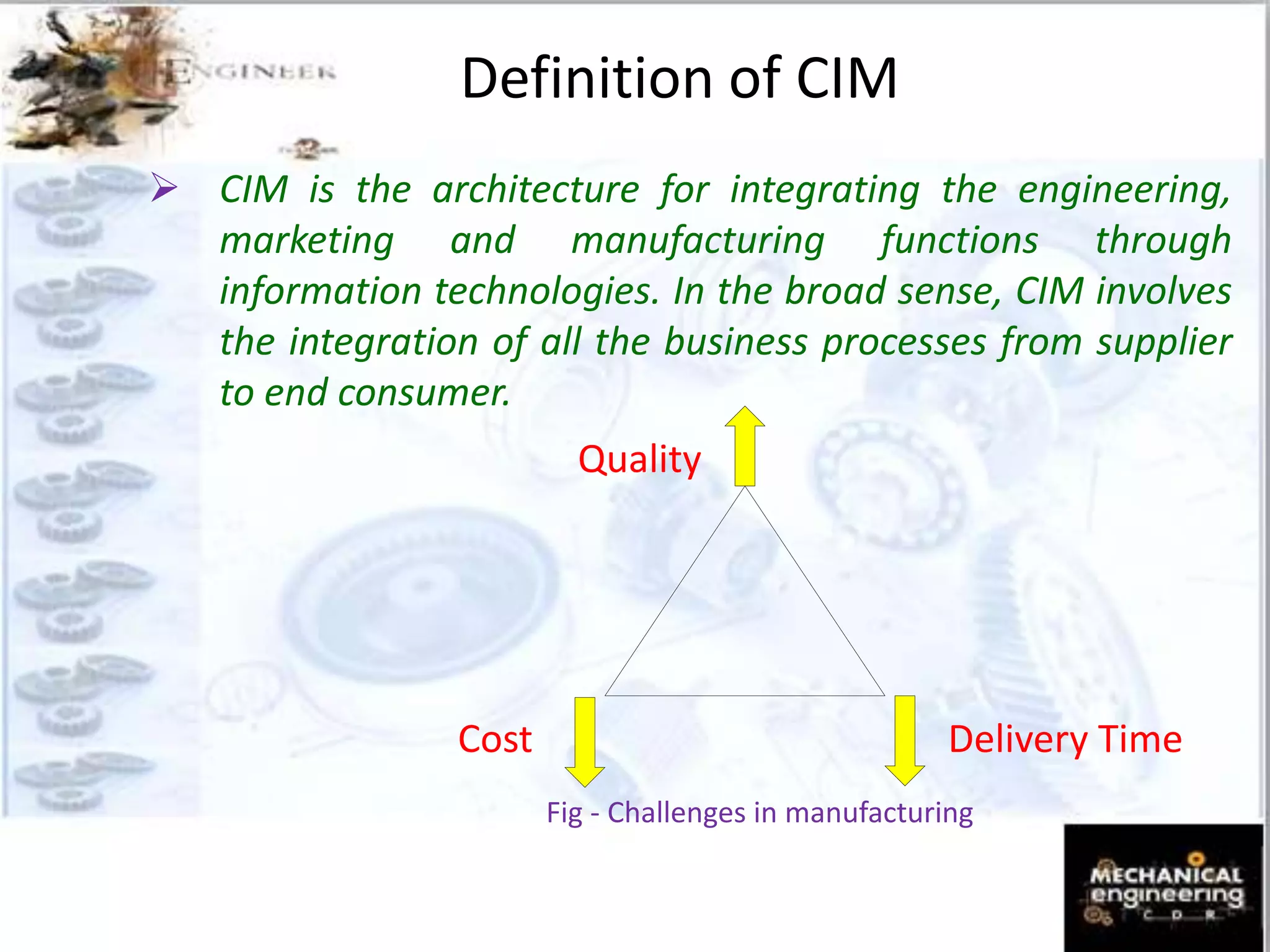
CIM is the architecture for integrating the engineering,
marketing and manufacturing functions through
information technologies. In the broad sense, CIM involves
the integration of all the business processes from supplier
to end consumer.
Quality
Cost Delivery Time
Fig - Challenges in manufacturing
14.
Scope of CIM
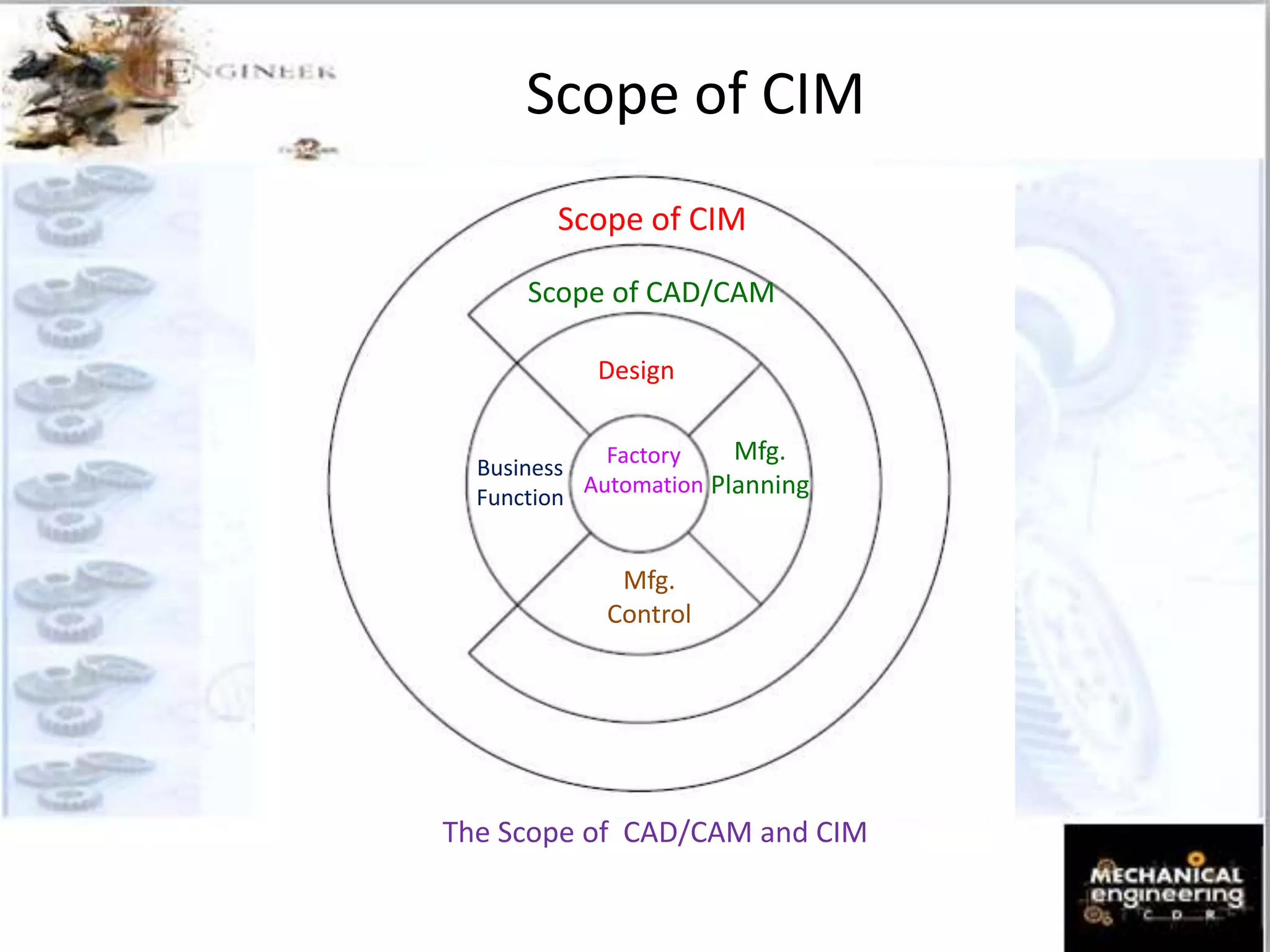
Scopeof CIM
Scope of CAD/CAM
Mfg.
Control
Design
Mfg.
Planning
Business
Function
The Scope of CAD/CAM and CIM
Factory
Automation
15.
CIM Wheel
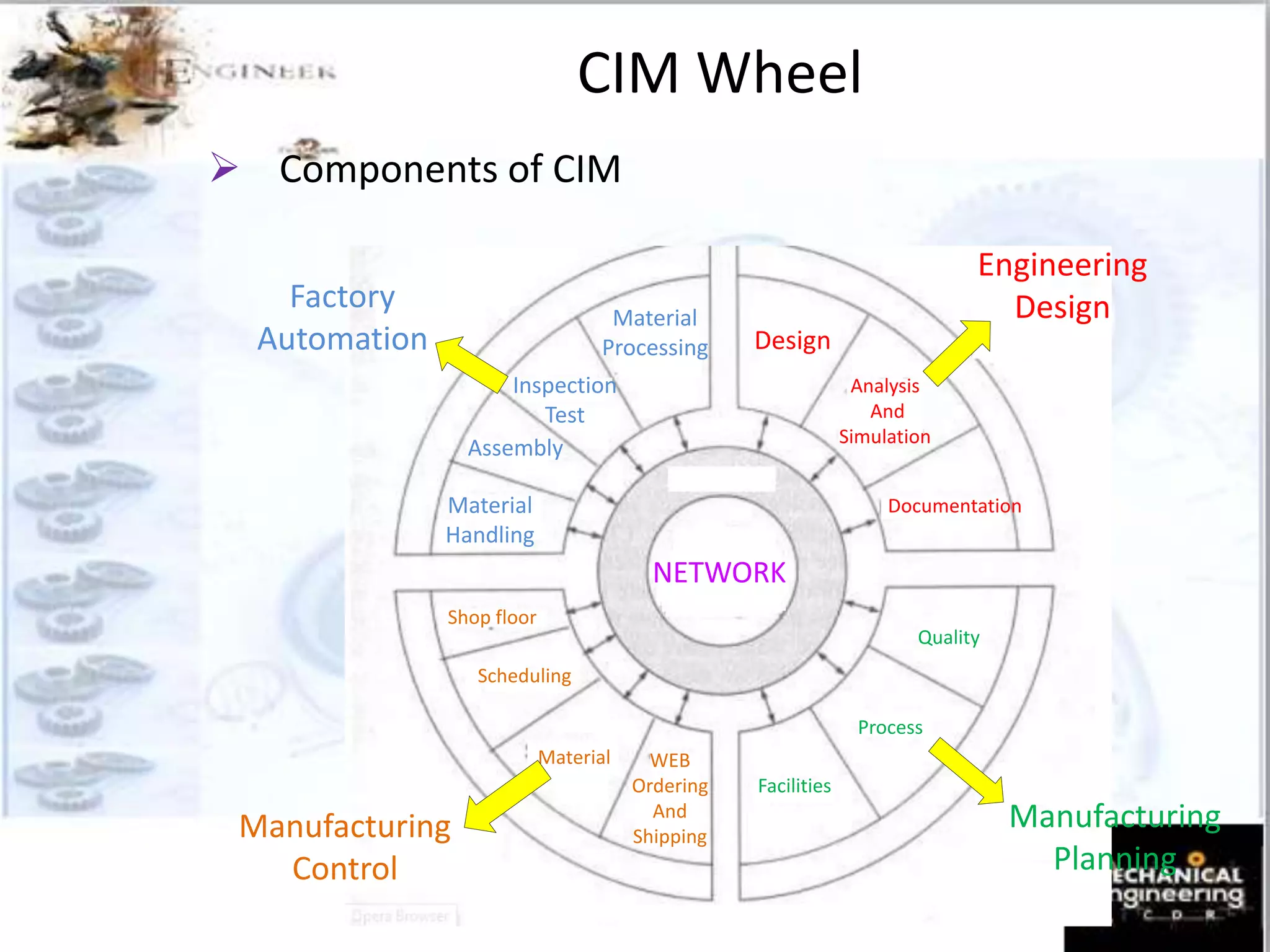
Componentsof CIM
Factory
Automation
Engineering
Design
Manufacturing
Planning
Manufacturing
Control
NETWORK
Material
Handling
Assembly
Inspection
Test
Material
Processing Design
Analysis
And
Simulation
Documentation
Shop floor
Quality
Process
Facilities
Scheduling
Material WEB
Ordering
And
Shipping
16.
The Elements OfCIM
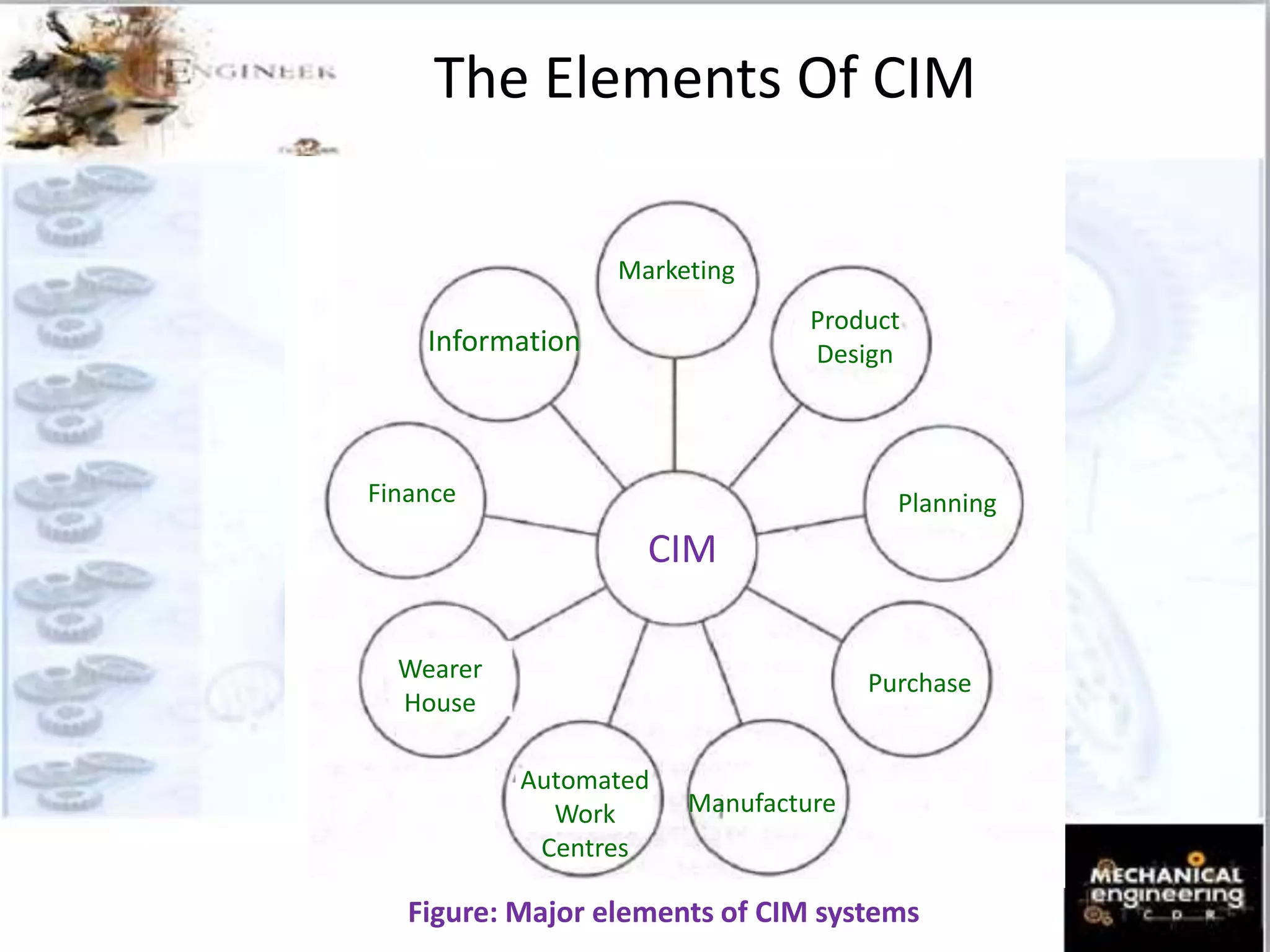
Marketing
Product
Design
Planning
Finance
Information
Wearer
House
Automated
Work
Centres
Purchase
CIM
Manufacture
Figure: Major elements of CIM systems
17.
Product DesignThe design department of the company
establishes the initial database for production of a
proposed product. In a CIM system this is accomplished
through activities such as geometric modeling and
computer aided design while considering the product
requirements and concepts generated by the creativity
of the design engineer. Configuration management is an
important activity in many designs. Complex designs are
usually carried out by several teams working
simultaneously, located often in different parts of the
world.
The Elements Of CIM
18.
The Elements OfCIM
Marketing: The need for a product is identified by the
marketing division. The specifications of the product, the
projection of manufacturing quantities and the strategy
for marketing the product are also decided by the
marketing department.
19.
Planning: Theplanning department takes the database
established by the design department and enriches it
with production data and information to produce a plan
for the production of the product. Planning involves
several subsystems dealing with materials, facility,
process, tools, manpower, capacity, scheduling,
outsourcing, assembly, inspection, logistics etc. In a CIM
system, this planning process should be constrained by
the production costs and by the production equipment
and process capability, in order to generate an optimized
plan.
The Elements Of CIM
20.
Purchase
The purchasedepartments is responsible for
placing the purchase orders and follow up, ensure
quality in the production process of the vendor, receive
the items, arrange for inspection and supply the items
to the stores or arrange timely delivery depending on
the production schedule for eventual supply to
manufacture and assembly
The Elements Of CIM
21.
Automation Hardware:Factory automation equipment
further enriches the database with equipment and process
data, resident either in the operator or the equipment to
carry out the production process. In CIM system this
consists of computer controlled process machinery such as
CNC machine tools, flexible manufacturing systems (FMS),
Computer controlled robots, material handling systems,
computer controlled assembly systems, flexibly automated
inspection systems and so on.
The Elements Of CIM
22.
Manufacturing Engineering:Manufacturing Engineering
is the activity of carrying out the production of the
product, involving further enrichment of the database with
performance data and information about the production
equipment and processes. In CIM, this requires activities
like CNC programming, simulation and computer aided
scheduling of the production activity. This should include
online dynamic scheduling and control based on the real
time performance of the equipment and processes to
assure continuous production activity. Often, the need to
meet fluctuating market demand requires the
manufacturing system flexible and agile.
The Elements Of CIM
23.
Warehousing: Warehousingis the function involving
storage and retrieval of raw materials, components,
finished goods as well as shipment of items. In today's
complex outsourcing scenario and the need for just-in-time
supply of components and subsystems, logistics and supply
chain management assume great importance.
The Elements Of CIM
24.
Finance: Financedeals with the resources pertaining to
money. Planning of investment, working capital, and cash
flow control, realization of receipts, accounting and
allocation of funds are the major tasks of the finance
departments.
Information Management: Information Management is
perhaps one of the crucial tasks in CIM. This involves
master production scheduling, database management,
communication, manufacturing systems integration and
management information systems.
The Elements Of CIM
25.
Product Design:
Thedesign department of the company establishes
the initial database for production of a proposed
product. In a CIM system this is accomplished through
activities such as geometric modeling and computer
aided design while considering the product
requirements and concepts generated by the creativity
of the design engineer.
The Elements of CIM
26.
Objectives of CIM
Manufacturingengineers are required to achieve the
following
• Reduction in inventory
• Lower the cost of the product
• Reduce waste
• Improve quality
Increase flexibility in manufacturing to achieve
immediate and rapid response to
• Product changes
• Production changes
• Process change
• Equipment change
• Change of personnel
27.
Benefits of CIM
CIMplays a vital role in the economy of the manufacturing
system or enterprise. The benefits of CIM are indicated as
follows:
Products quality improvement.
Shorter time in launching new product in the market.
Flow time minimized.
Inventory level reduced.
Competitiveness increases.
Improved scheduling performance.
Shorter vendor lead time.
28.
Benefits of CIM
CIMplays a vital role in the economy of the manufacturing
system or enterprise. The benefits of CIM are indicated as
follows
Improved customer service.
Increase in flexibility and responsiveness.
Total cost minimized.
Long term profitability increases.
Customers lead time minimized.
Manufacturing productivity increases.
Work in process inventory decreases.
29.
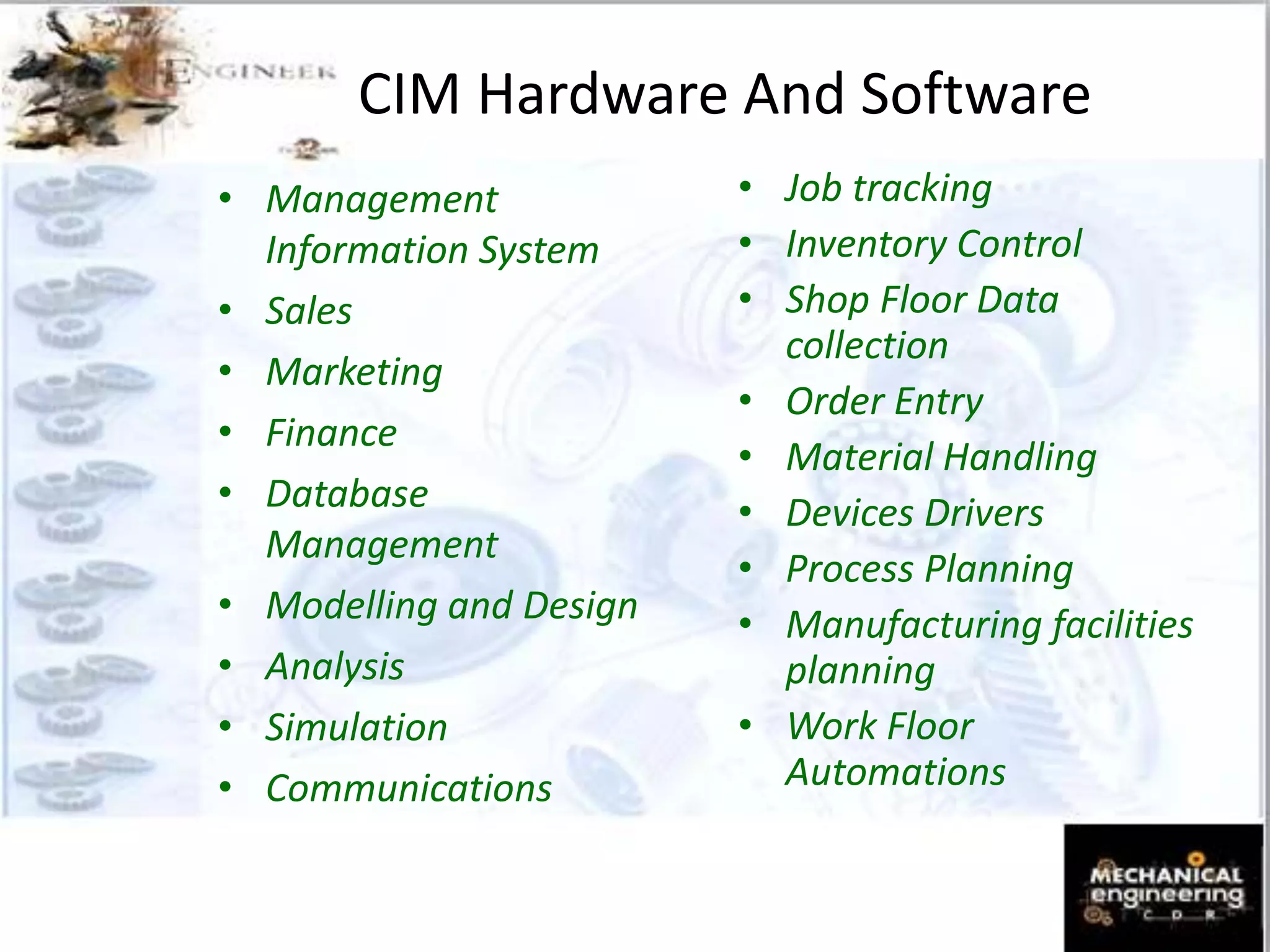
CIM Hardware AndSoftware
• Management
Information System
• Sales
• Marketing
• Finance
• Database
Management
• Modelling and Design
• Analysis
• Simulation
• Communications
• Job tracking
• Inventory Control
• Shop Floor Data
collection
• Order Entry
• Material Handling
• Devices Drivers
• Process Planning
• Manufacturing facilities
planning
• Work Floor
Automations
30.
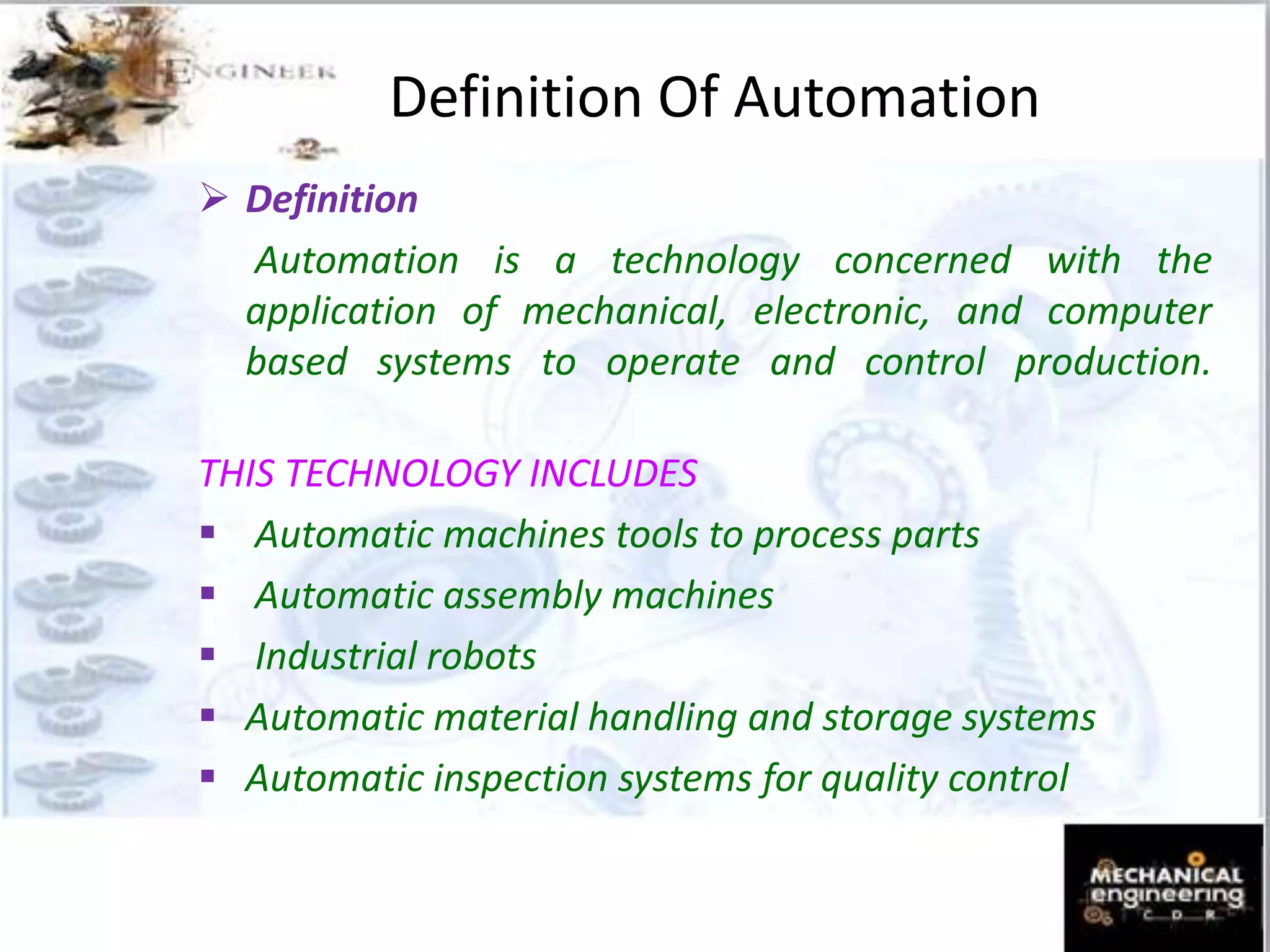
Definition Of Automation
Definition
Automation is a technology concerned with the
application of mechanical, electronic, and computer
based systems to operate and control production.
THIS TECHNOLOGY INCLUDES
Automatic machines tools to process parts
Automatic assembly machines
Industrial robots
Automatic material handling and storage systems
Automatic inspection systems for quality control
31.
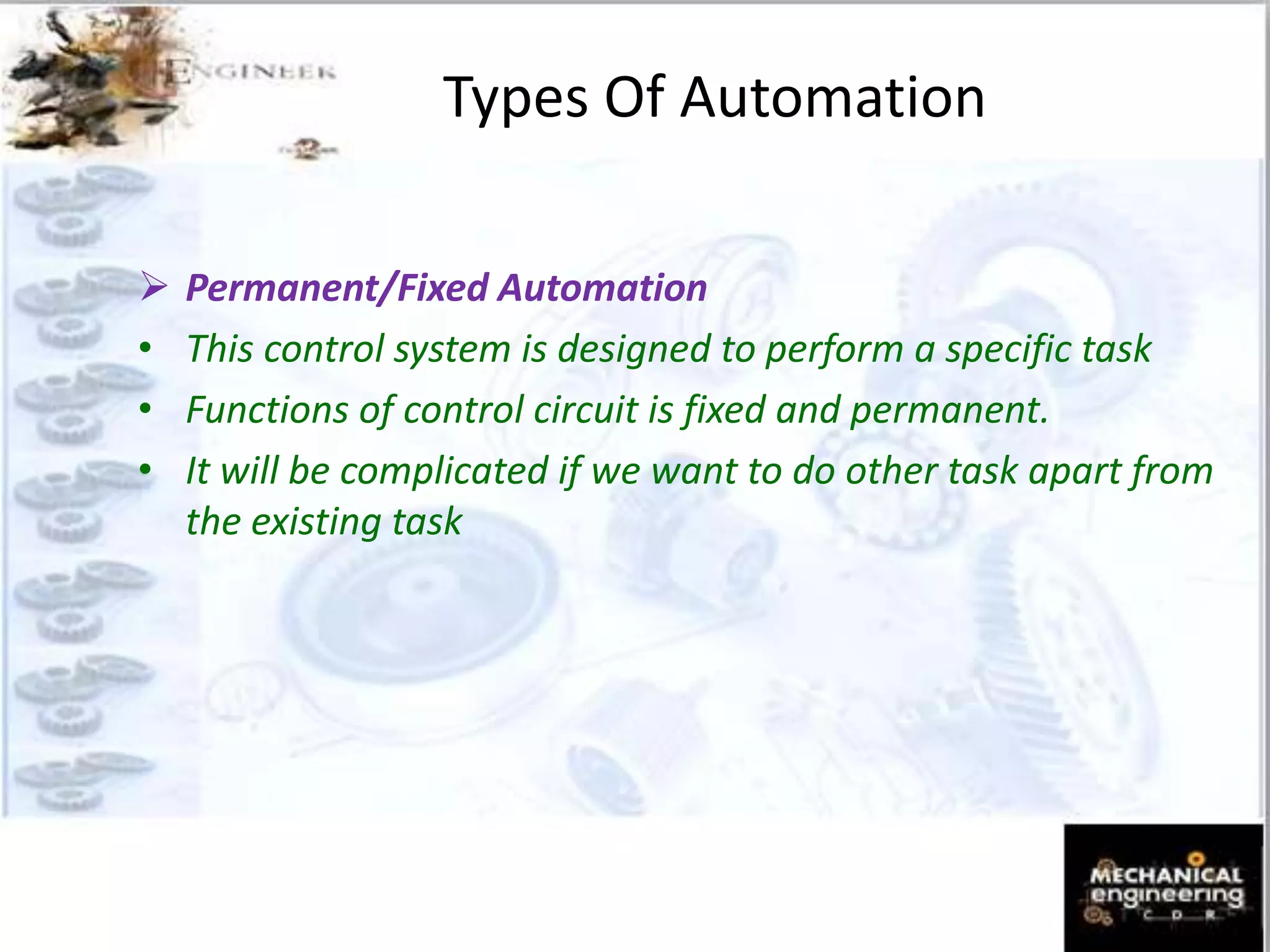
Types Of Automation
Permanent/Fixed Automation
• This control system is designed to perform a specific task
• Functions of control circuit is fixed and permanent.
• It will be complicated if we want to do other task apart from
the existing task
32.
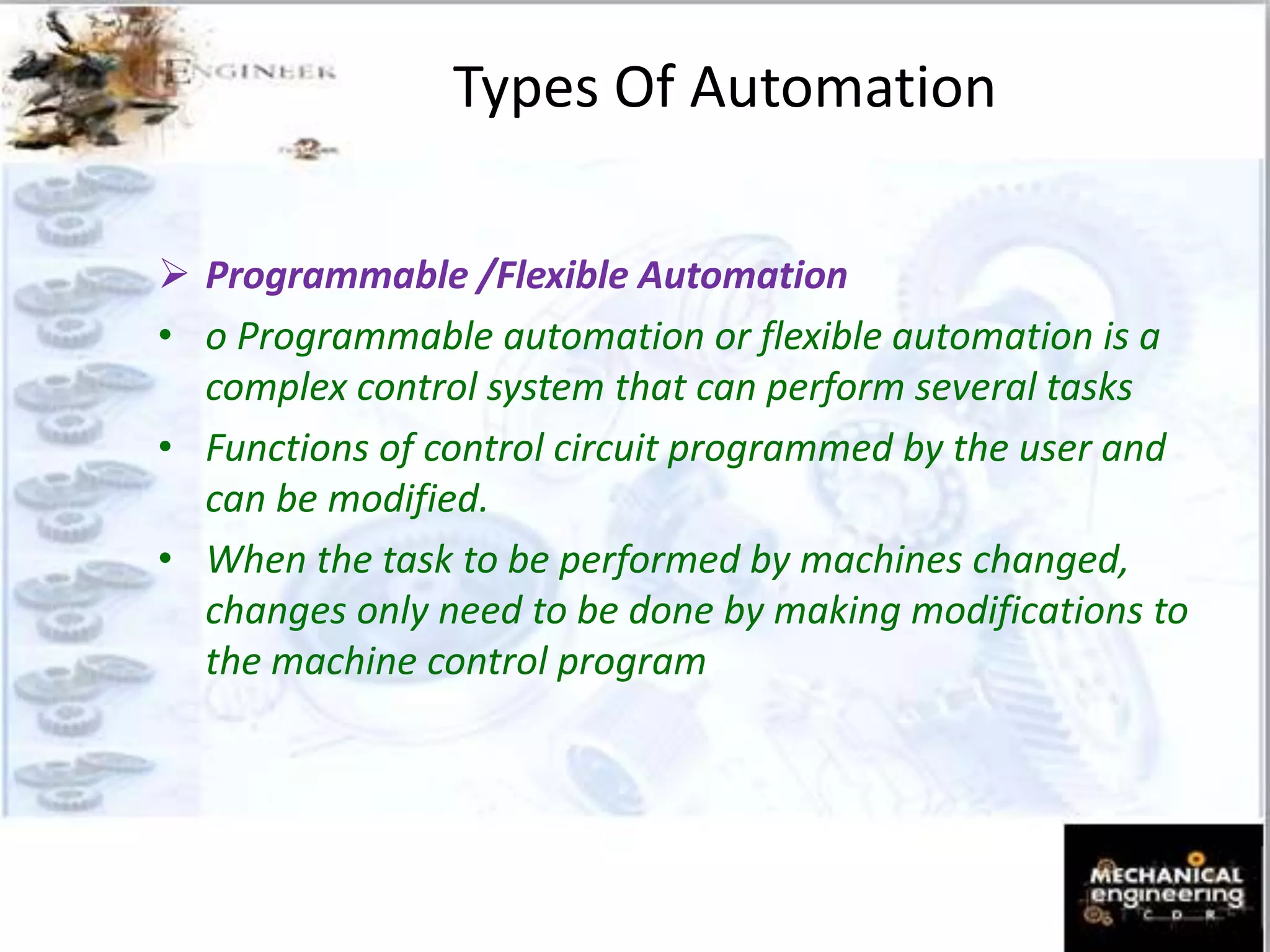
Types Of Automation
Programmable /Flexible Automation
• o Programmable automation or flexible automation is a
complex control system that can perform several tasks
• Functions of control circuit programmed by the user and
can be modified.
• When the task to be performed by machines changed,
changes only need to be done by making modifications to
the machine control program
33.
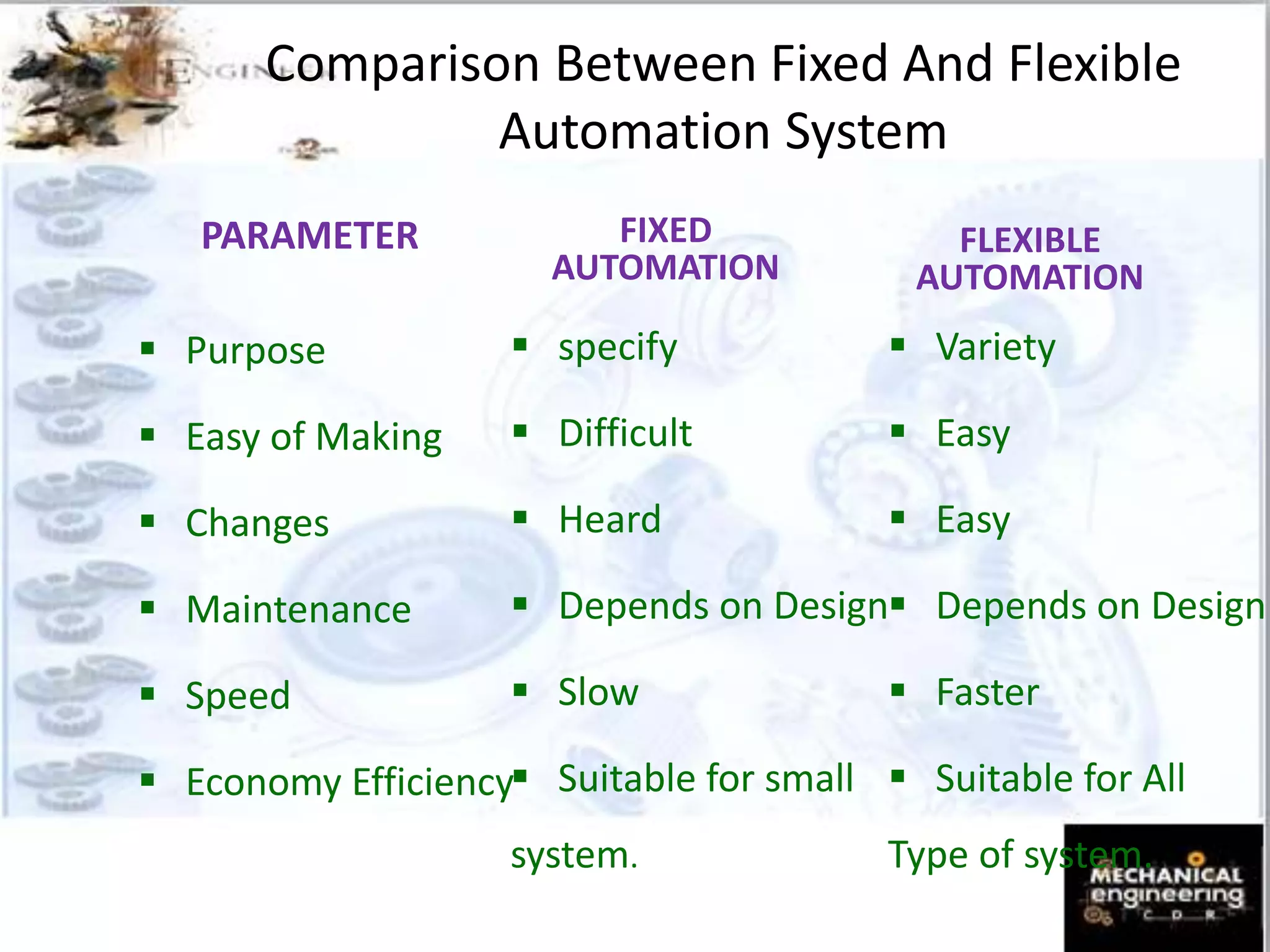
Comparison Between FixedAnd Flexible
Automation System
PARAMETER
specify
Difficult
Heard
Depends on Design
Slow
Suitable for small
system.
FIXED
AUTOMATION
Variety
Easy
Easy
Depends on Design
Faster
Suitable for All
Type of system.
Purpose
Easy of Making
Changes
Maintenance
Speed
Economy Efficiency
FLEXIBLE
AUTOMATION
34.
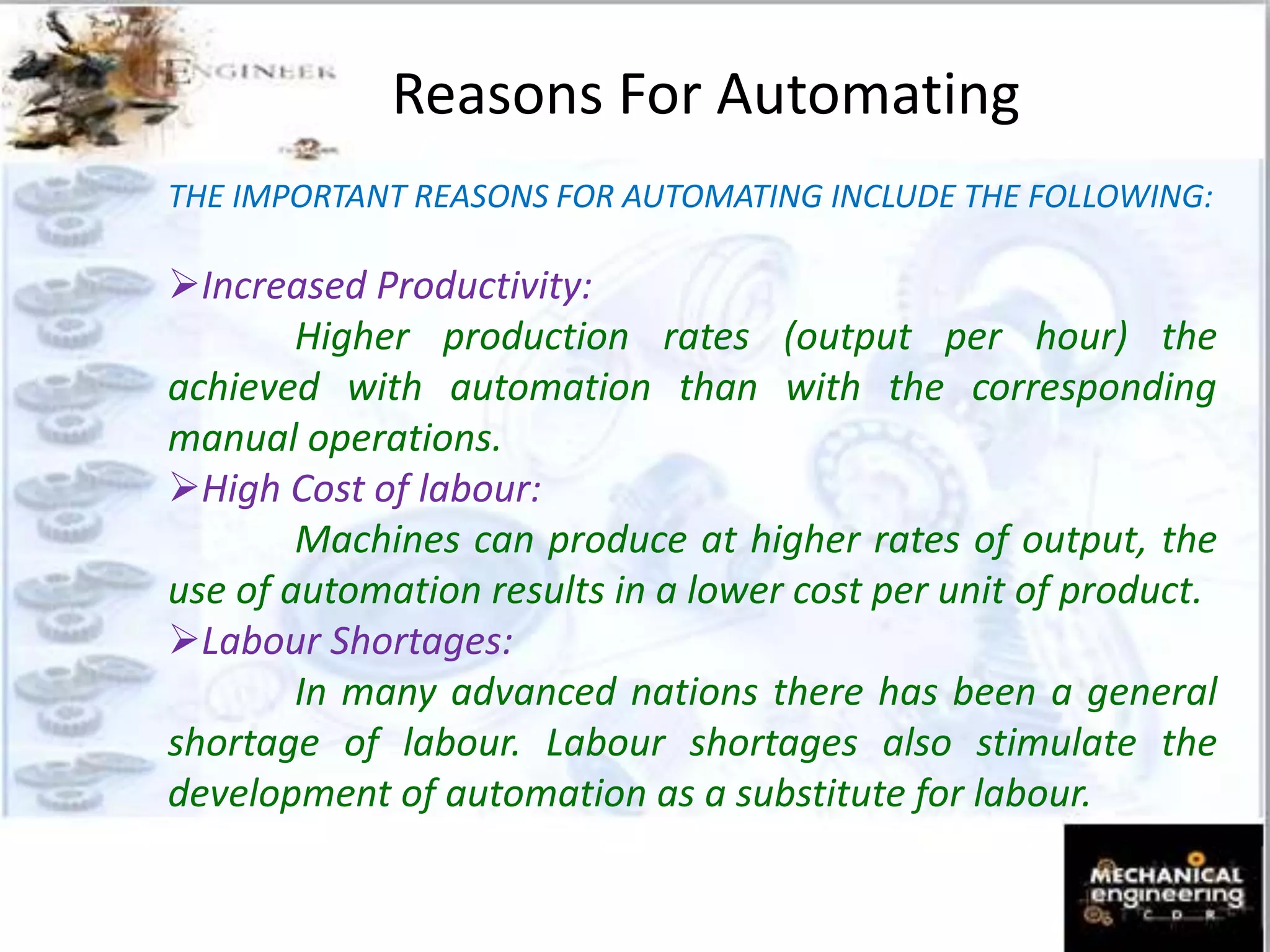
Reasons For Automating
THEIMPORTANT REASONS FOR AUTOMATING INCLUDE THE FOLLOWING:
Increased Productivity:
Higher production rates (output per hour) the
achieved with automation than with the corresponding
manual operations.
High Cost of labour:
Machines can produce at higher rates of output, the
use of automation results in a lower cost per unit of product.
Labour Shortages:
In many advanced nations there has been a general
shortage of labour. Labour shortages also stimulate the
development of automation as a substitute for labour.
35.
Reasons For Automating
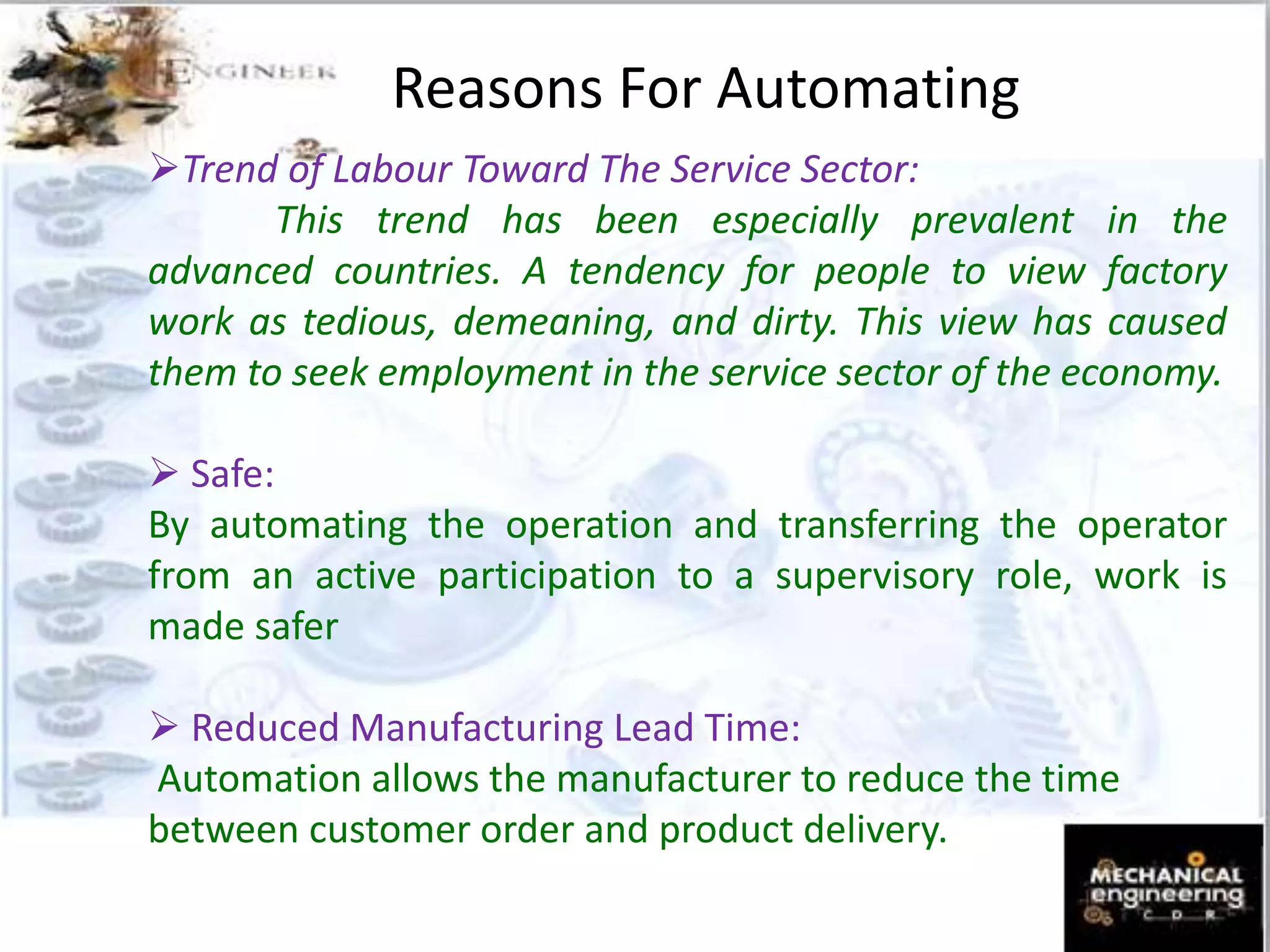
Trendof Labour Toward The Service Sector:
This trend has been especially prevalent in the
advanced countries. A tendency for people to view factory
work as tedious, demeaning, and dirty. This view has caused
them to seek employment in the service sector of the economy.
Safe:
By automating the operation and transferring the operator
from an active participation to a supervisory role, work is
made safer
Reduced Manufacturing Lead Time:
Automation allows the manufacturer to reduce the time
between customer order and product delivery.
36.
Reasons For Automating
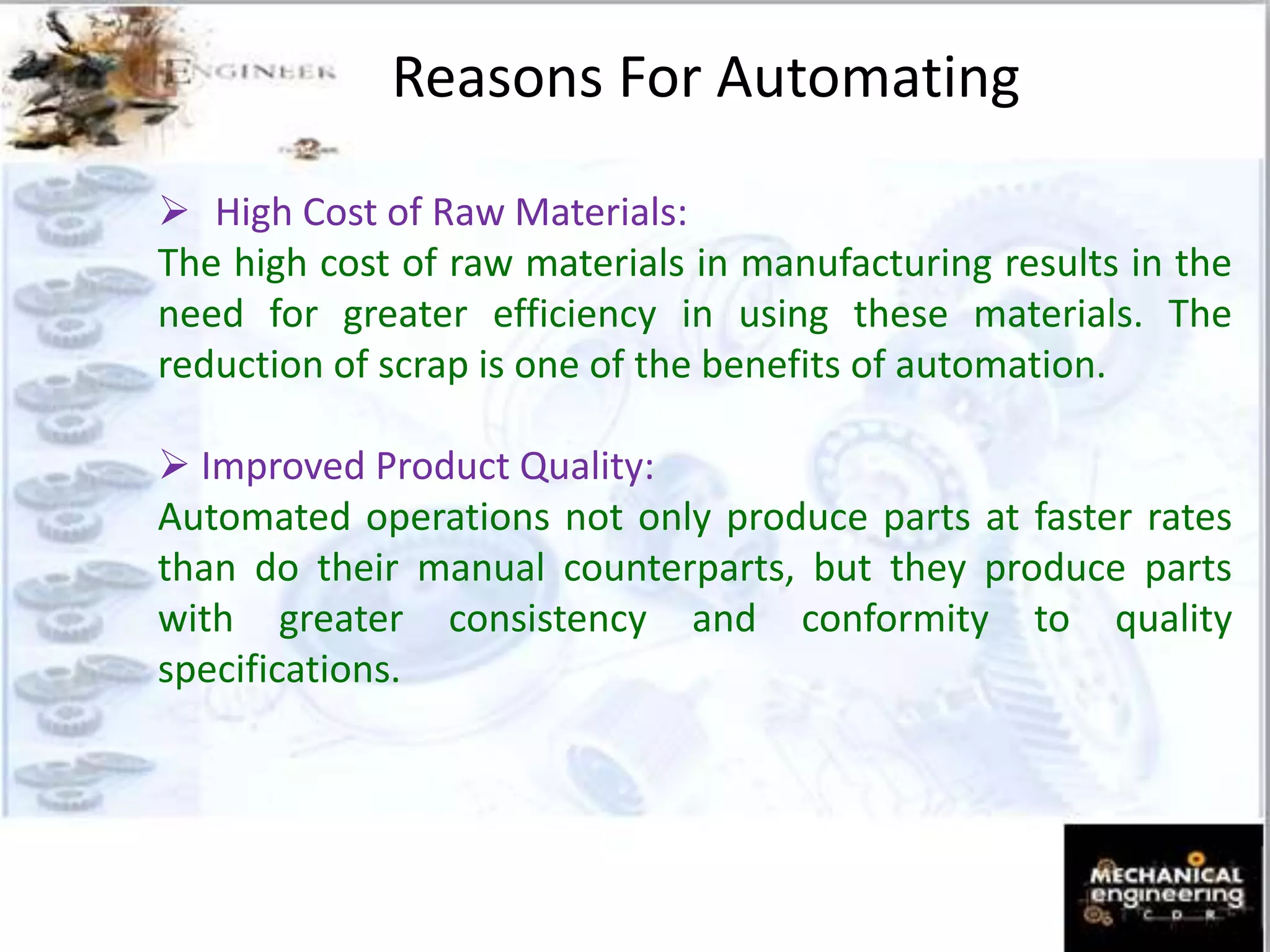
High Cost of Raw Materials:
The high cost of raw materials in manufacturing results in the
need for greater efficiency in using these materials. The
reduction of scrap is one of the benefits of automation.
Improved Product Quality:
Automated operations not only produce parts at faster rates
than do their manual counterparts, but they produce parts
with greater consistency and conformity to quality
specifications.
37.
Relationship Between AutomationAnd CIM
DEVELOPING A CONCEPTUAL MODEL OF
MANUFACTURING.
CIMs
CIM deals with automating the
information-processing
activities that usually occurs in
an office environment.
These information-processing
functions include (1) certain
business activities(e.g.,
marketing and sales, order
entry, customer billing, etc.), (2)
product design, (3)
manufacturing planning, and
(4) manufacturing control.
These four functions form a
cycle of events that must
accompany the physical
production activities.
They Do not directly touch the
product.
AUTOMATION
Automation deals with the
physical activities related to
production
The physical activities include all
of the manufacturing processing,
assembly, material handling, and
inspections that the performed on
the product.
These operations come in direct
contact with the product during
manufacture.
They touch the product
38.
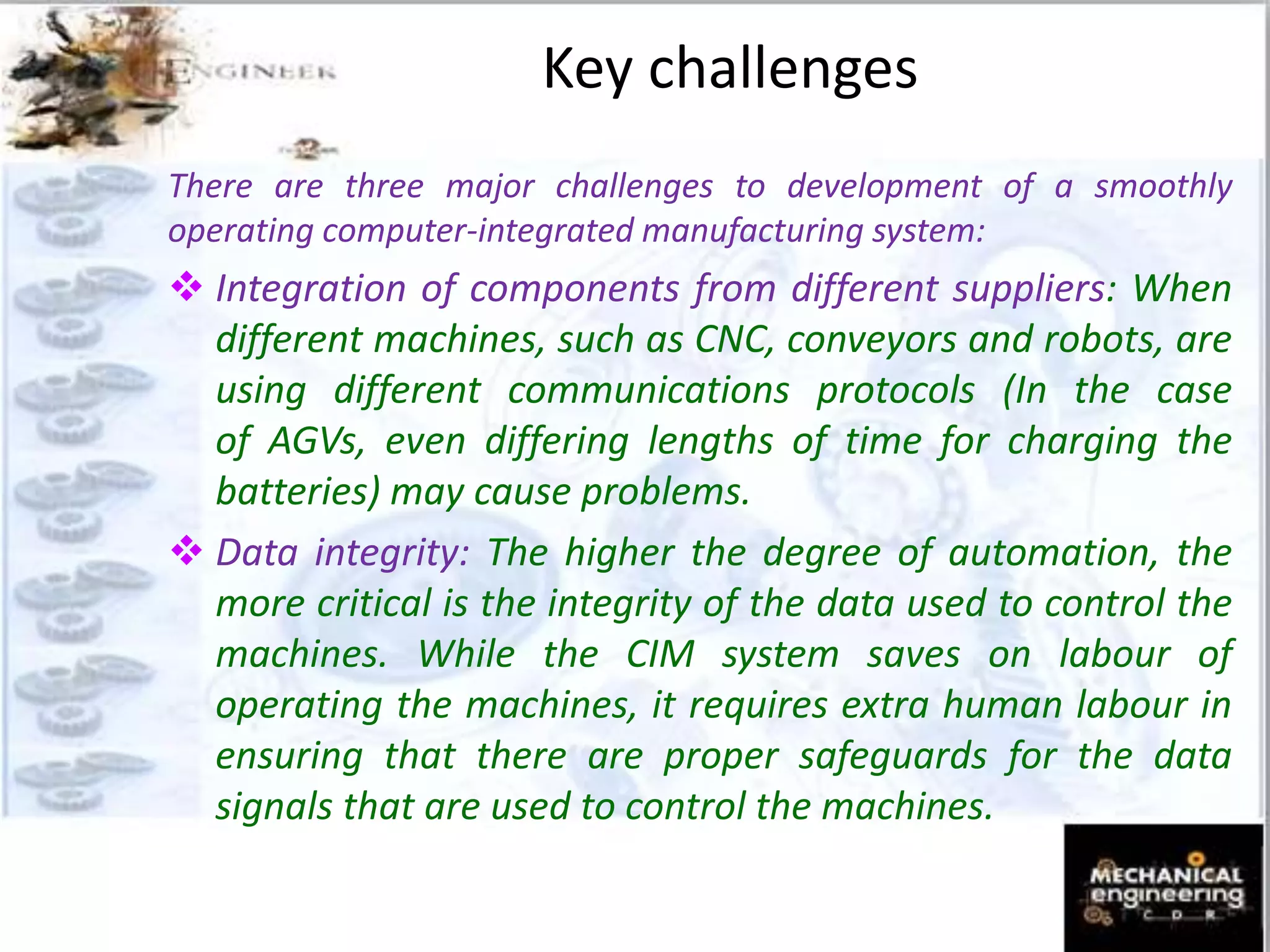
Key challenges
There arethree major challenges to development of a smoothly
operating computer-integrated manufacturing system:
Integration of components from different suppliers: When
different machines, such as CNC, conveyors and robots, are
using different communications protocols (In the case
of AGVs, even differing lengths of time for charging the
batteries) may cause problems.
Data integrity: The higher the degree of automation, the
more critical is the integrity of the data used to control the
machines. While the CIM system saves on labour of
operating the machines, it requires extra human labour in
ensuring that there are proper safeguards for the data
signals that are used to control the machines.
39.
Process control:Computers may be used to assist the
human operators of the manufacturing facility, but there
must always be a competent engineer on hand to handle
circumstances which could not be foreseen by the
designers of the control software.
Key challenges