Blood is a body fluid in humans and other
animals that delivers necessary substances
such as nutrients and oxygen to the cells and
transports metabolic waste products away
from those same cells
• Is specialized fluid of connective tissue
• Contains cells suspended in a fluid matrix
Functions of Blood
1. Transport of dissolved substances
2. Regulation of pH and ions
3. Restriction of fluid losses at injury sites
4. Defense against toxins and pathogens
5. Stabilization of body temperature
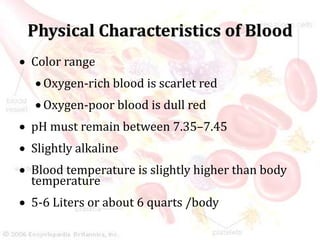
Physical Characteristics of Blood
 Color range
 Oxygen-rich blood is scarlet red
 Oxygen-poor blood is dull red
 pH must remain between 7.35–7.45
 Slightly alkaline
 Blood temperature is slightly higher than body
temperature
 5-6 Liters or about 6 quarts /body
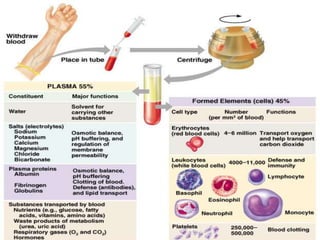
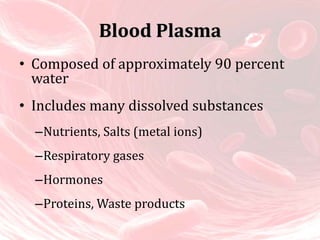
Blood Plasma
• Composed of approximately 90 percent
water
• Includes many dissolved substances
–Nutrients, Salts (metal ions)
–Respiratory gases
–Hormones
–Proteins, Waste products
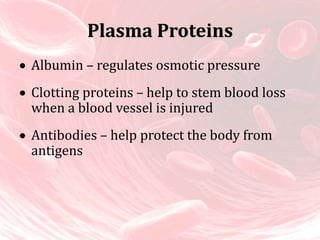
Plasma Proteins
 Albumin – regulates osmotic pressure
 Clotting proteins – help to stem blood loss
when a blood vessel is injured
 Antibodies – help protect the body from
antigens
Formed Elements
 Erythrocytes = red blood cells
 Leukocytes = white blood cells
 Platelets = cell fragments
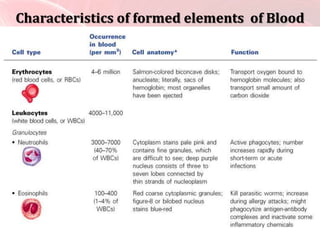
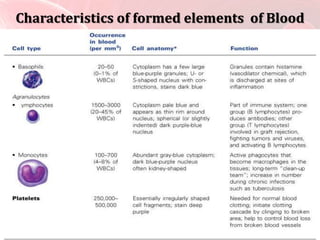
Characteristics of formed elements of Blood
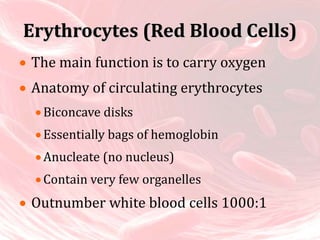
Erythrocytes (Red Blood Cells)
 The main function is to carry oxygen
 Anatomy of circulating erythrocytes
Biconcave disks
Essentially bags of hemoglobin
Anucleate (no nucleus)
Contain very few organelles
 Outnumber white blood cells 1000:1
Hemoglobin
 Iron-containing protein
 Binds strongly, but reversibly, to oxygen
 Each hemoglobin molecule has four oxygen
binding sites
 Each erythrocyte has 250 million
hemoglobin molecules
Leukocytes (White Blood Cells)
 Crucial in the body’s defense against disease
 These are complete cells, with a nucleus and
organelles
 Able to move into and out of blood vessels
(diapedesis)
 Can respond to chemicals released by
damaged tissues.
Leukocyte Levels in the Blood
 Normal levels =4,000 to 11,000 cells/ml
 Abnormal leukocyte levels
Leukocytosis
Above 11,000 leukocytes/ml
Generally indicates an infection
Leukopenia
Abnormally low leukocyte level
Commonly caused by certain drugs
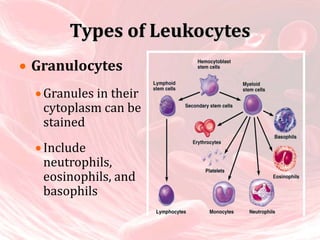
Types of Leukocytes
 Granulocytes
Granules in their
cytoplasm can be
stained
Include
neutrophils,
eosinophils, and
basophils
Granulocytes
 Neutrophils
 Multilobed nucleus with fine granules
 Act as phagocytes at active sites of infection
 Eosinophils
 Large brick-red cytoplasmic granules
 Found in repsonse to allergies and parasitic worms
 Basophils
 Have histamine-containing granules
 Initiate inflammation
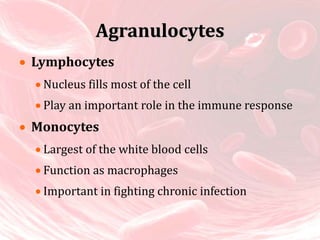
Agranulocytes
 Lymphocytes
 Nucleus fills most of the cell
 Play an important role in the immune response
 Monocytes
 Largest of the white blood cells
 Function as macrophages
 Important in fighting chronic infection
Platelets
 Derived from ruptured multinucleate cells
(megakaryocytes)
 Needed for the clotting process
 Normal platelet count = 300,000/mm3
Hematopoiesis – Blood Cell
Formation
 Occurs in red bone marrow
 All blood cells are derived from a common
stem cell (hemocytoblast)
Fate of Erythrocytes
 Unable to divide, grow, or synthesize
proteins
 Wear out in 100 to 120 days
 When worn out, are eliminated by
phagocytes in the spleen or liver
 Lost cells are replaced by division of stem
cells
Hemostasis
 Stoppage of blood flow
 Result of a break in a blood vessel
 Hemostasis involves three phases
Platelet plug formation
Vascular spasms
Coagulation
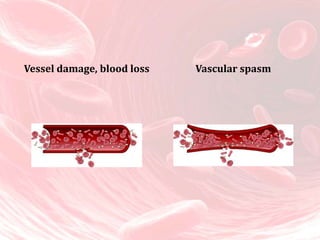
Vessel damage, blood loss Vascular spasm
Platelet Plug Formation
 Collagen fibers are exposed by a break in a
blood vessel
 Platelets become “sticky” and cling to fibers
 Anchored platelets release chemicals to
attract more platelets
 Platelets pile up to form a platelet plug
Platelet plug forms Coagulation
Vascular Spasms
 Anchored platelets release serotonin
 Serotonin causes blood vessel muscles to
spasm
 Spasms narrow the blood vessel, decreasing
blood loss
Coagulation
 Injured tissues release thromboplastin
 PF3 (a phospholipid) interacts with thromboplastin,
blood protein clotting factors, and calcium ions to trigger
a clotting cascade
 Prothrombin activator converts prothrombin to thrombin
(an enzyme)
 Thrombin joins fibrinogen proteins into hair-like fibrin
 Fibrin forms a meshwork
(the basis for a clot)
Blood Clotting
 Blood usually clots within 3 to 6 minutes
 The clot remains as endothelium
regenerates
 The clot is broken down after tissue repair
Undesirable Clotting
 Thrombus
 A clot in an unbroken blood vessel
 Can be deadly in areas like the heart
 Embolus
 A thrombus that breaks away and floats freely in
the bloodstream
 Can later clog vessels in critical areas such as the
brain
Bleeding Disorders
 Thrombocytopenia (caused by viruses, medications or
post-bone CA trtment)
 Platelet deficiency
 Even normal movements can cause bleeding from small
blood vessels that require platelets for clotting
 Hemophilia
 Hereditary bleeding disorder
 Normal clotting factors are missing
Blood Groups and Transfusions
 Large losses of blood have serious consequences
 Loss of 15 to 30 percent causes weakness
 Loss of over 30 percent causes shock, which can be
fatal
 Transfusions are the only way to replace blood quickly
 Transfused blood must be of the same blood group
Human Blood Groups
 Blood contains genetically determined proteins
 A foreign protein (antigen) may be attacked by the immune
system
 Blood is “typed” by using antibodies that will cause blood
with certain proteins to clump (agglutination)
 There are over 30 common red blood cell antigens
 The most vigorous transfusion reactions are caused by
ABO and Rh blood group antigens
ABO Blood Groups
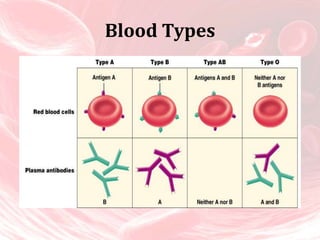
 Based on the presence or absence of two
antigens
Type A
Type B
 The lack of these antigens is called
type O
Blood Types
ABO Blood Groups
 The presence of both A and B is called type
AB
 The presence of either A or B is called types
A and B, respectively
Rh Blood Groups
 Named because of the presence or absence
of one of eight Rh antigens (agglutinogen D)
 Most Americans are Rh+
 Problems can occur in mixing Rh+ blood into
a body with Rh– blood
Rh Dangers During Pregnancy
• Danger is only when the mother is Rh– and the father is Rh+, and
the child inherits the Rh+ factor
 The mismatch of an Rh– mother carrying an Rh+ baby can
cause problems for the unborn child
 The first pregnancy usually proceeds without problems
 The immune system is sensitized after the first pregnancy
 In a second pregnancy, the mother’s immune system produces
antibodies to attack the Rh+ blood (hemolytic disease of the
newborn)
Rh Sensitivity
Blood Typing
 Blood samples are mixed with anti-A and anti-
B serum
 Coagulation or no coagulation leads to
determining blood type
 Typing for ABO and Rh factors is done in the
same manner
 Cross matching – testing for agglutination of
donor RBCs by the recipient’s serum, and vice
versa
Blood

Blood

  • 2.
    Blood is abody fluid in humans and other animals that delivers necessary substances such as nutrients and oxygen to the cells and transports metabolic waste products away from those same cells
  • 3.
    • Is specializedfluid of connective tissue • Contains cells suspended in a fluid matrix
  • 4.
    Functions of Blood 1.Transport of dissolved substances 2. Regulation of pH and ions 3. Restriction of fluid losses at injury sites 4. Defense against toxins and pathogens 5. Stabilization of body temperature
  • 5.
    Physical Characteristics ofBlood  Color range  Oxygen-rich blood is scarlet red  Oxygen-poor blood is dull red  pH must remain between 7.35–7.45  Slightly alkaline  Blood temperature is slightly higher than body temperature  5-6 Liters or about 6 quarts /body
  • 7.
    Blood Plasma • Composedof approximately 90 percent water • Includes many dissolved substances –Nutrients, Salts (metal ions) –Respiratory gases –Hormones –Proteins, Waste products
  • 8.
    Plasma Proteins  Albumin– regulates osmotic pressure  Clotting proteins – help to stem blood loss when a blood vessel is injured  Antibodies – help protect the body from antigens
  • 9.
    Formed Elements  Erythrocytes= red blood cells  Leukocytes = white blood cells  Platelets = cell fragments
  • 10.
    Characteristics of formedelements of Blood
  • 11.
    Characteristics of formedelements of Blood
  • 12.
    Erythrocytes (Red BloodCells)  The main function is to carry oxygen  Anatomy of circulating erythrocytes Biconcave disks Essentially bags of hemoglobin Anucleate (no nucleus) Contain very few organelles  Outnumber white blood cells 1000:1
  • 13.
    Hemoglobin  Iron-containing protein Binds strongly, but reversibly, to oxygen  Each hemoglobin molecule has four oxygen binding sites  Each erythrocyte has 250 million hemoglobin molecules
  • 14.
    Leukocytes (White BloodCells)  Crucial in the body’s defense against disease  These are complete cells, with a nucleus and organelles  Able to move into and out of blood vessels (diapedesis)  Can respond to chemicals released by damaged tissues.
  • 15.
    Leukocyte Levels inthe Blood  Normal levels =4,000 to 11,000 cells/ml  Abnormal leukocyte levels Leukocytosis Above 11,000 leukocytes/ml Generally indicates an infection Leukopenia Abnormally low leukocyte level Commonly caused by certain drugs
  • 16.
    Types of Leukocytes Granulocytes Granules in their cytoplasm can be stained Include neutrophils, eosinophils, and basophils
  • 17.
    Granulocytes  Neutrophils  Multilobednucleus with fine granules  Act as phagocytes at active sites of infection  Eosinophils  Large brick-red cytoplasmic granules  Found in repsonse to allergies and parasitic worms  Basophils  Have histamine-containing granules  Initiate inflammation
  • 18.
    Agranulocytes  Lymphocytes  Nucleusfills most of the cell  Play an important role in the immune response  Monocytes  Largest of the white blood cells  Function as macrophages  Important in fighting chronic infection
  • 19.
    Platelets  Derived fromruptured multinucleate cells (megakaryocytes)  Needed for the clotting process  Normal platelet count = 300,000/mm3
  • 20.
    Hematopoiesis – BloodCell Formation  Occurs in red bone marrow  All blood cells are derived from a common stem cell (hemocytoblast)
  • 21.
    Fate of Erythrocytes Unable to divide, grow, or synthesize proteins  Wear out in 100 to 120 days  When worn out, are eliminated by phagocytes in the spleen or liver  Lost cells are replaced by division of stem cells
  • 22.
    Hemostasis  Stoppage ofblood flow  Result of a break in a blood vessel  Hemostasis involves three phases Platelet plug formation Vascular spasms Coagulation
  • 23.
    Vessel damage, bloodloss Vascular spasm
  • 24.
    Platelet Plug Formation Collagen fibers are exposed by a break in a blood vessel  Platelets become “sticky” and cling to fibers  Anchored platelets release chemicals to attract more platelets  Platelets pile up to form a platelet plug
  • 25.
  • 26.
    Vascular Spasms  Anchoredplatelets release serotonin  Serotonin causes blood vessel muscles to spasm  Spasms narrow the blood vessel, decreasing blood loss
  • 27.
    Coagulation  Injured tissuesrelease thromboplastin  PF3 (a phospholipid) interacts with thromboplastin, blood protein clotting factors, and calcium ions to trigger a clotting cascade  Prothrombin activator converts prothrombin to thrombin (an enzyme)  Thrombin joins fibrinogen proteins into hair-like fibrin  Fibrin forms a meshwork (the basis for a clot)
  • 28.
    Blood Clotting  Bloodusually clots within 3 to 6 minutes  The clot remains as endothelium regenerates  The clot is broken down after tissue repair
  • 29.
    Undesirable Clotting  Thrombus A clot in an unbroken blood vessel  Can be deadly in areas like the heart  Embolus  A thrombus that breaks away and floats freely in the bloodstream  Can later clog vessels in critical areas such as the brain
  • 30.
    Bleeding Disorders  Thrombocytopenia(caused by viruses, medications or post-bone CA trtment)  Platelet deficiency  Even normal movements can cause bleeding from small blood vessels that require platelets for clotting  Hemophilia  Hereditary bleeding disorder  Normal clotting factors are missing
  • 31.
    Blood Groups andTransfusions  Large losses of blood have serious consequences  Loss of 15 to 30 percent causes weakness  Loss of over 30 percent causes shock, which can be fatal  Transfusions are the only way to replace blood quickly  Transfused blood must be of the same blood group
  • 32.
    Human Blood Groups Blood contains genetically determined proteins  A foreign protein (antigen) may be attacked by the immune system  Blood is “typed” by using antibodies that will cause blood with certain proteins to clump (agglutination)  There are over 30 common red blood cell antigens  The most vigorous transfusion reactions are caused by ABO and Rh blood group antigens
  • 33.
    ABO Blood Groups Based on the presence or absence of two antigens Type A Type B  The lack of these antigens is called type O
  • 34.
  • 35.
    ABO Blood Groups The presence of both A and B is called type AB  The presence of either A or B is called types A and B, respectively
  • 36.
    Rh Blood Groups Named because of the presence or absence of one of eight Rh antigens (agglutinogen D)  Most Americans are Rh+  Problems can occur in mixing Rh+ blood into a body with Rh– blood
  • 37.
    Rh Dangers DuringPregnancy • Danger is only when the mother is Rh– and the father is Rh+, and the child inherits the Rh+ factor  The mismatch of an Rh– mother carrying an Rh+ baby can cause problems for the unborn child  The first pregnancy usually proceeds without problems  The immune system is sensitized after the first pregnancy  In a second pregnancy, the mother’s immune system produces antibodies to attack the Rh+ blood (hemolytic disease of the newborn)
  • 38.
  • 39.
    Blood Typing  Bloodsamples are mixed with anti-A and anti- B serum  Coagulation or no coagulation leads to determining blood type  Typing for ABO and Rh factors is done in the same manner  Cross matching – testing for agglutination of donor RBCs by the recipient’s serum, and vice versa