Vocabulary
• Arteries aretubes that carry blood away from the
heart
• Veins are tubes that return blood to the heart
• Capillaries connect arteries and veins. They are tiny
tubes that exchange food, oxygen and wastes
between blood and body cells.
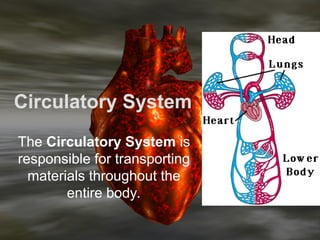
• Pulmonary circulation is the movement of blood
between the heart and lungs
• Coronary circulation is the movement of blood from
within the heart chambers to the heart tissues
themselves
• Systemic circulation is the movement of blood
between the heart and the rest of the body
• Interstitial fluid - is an isotonic solution which bathes
and surrounds the cells of multicellular animals.
3.
Functions of theCirculatory System
• The circulatory system functions in the
– delivery of oxygen,
– Delivery of nutrient molecules
– Delivery of hormones
– removal of carbon dioxide, ammonia and other
metabolic wastes
• 3 parts of the Circulatory system
– pulmonary circulation - the lungs (pulmonary),
– coronary circulation - the heart (coronary),
– systemic circulation - the rest of the body
(systemic)
4.
Parts of theCirculatory System
The circulatory System is divided into
three major parts:
• The Heart
• The Blood
• The Blood Vessels
5.
The Heart
• TheHeart is an amazing organ. It's job
is to pump your blood and keep the
blood moving throughout your body.
• Your heart beats about 100,000 times in
one day and about 35 million times in a
year. During an average lifetime, the
human heart will beat more than 2.5
billion times
6.
Healthy Heart
• Itis your job to keep your heart healthy and
there are three main things you need to
remember in order to keep your heart healthy.
– Exercise on a regular basis. Get outside and play.
Keep that body moving (walk, jog, run, bike, skate,
jump, swim).
– Eat Healthy. Stay away from high fat foods and
have your cholesterol checked regularly
– Don't Smoke! Don't Smoke! Don't Smoke! Don't
Smoke! Don't Smoke!
8.
Make up ofthe Heart
• Heart is made up of 4 chambers
– Right and Left Atrium
– Right and Left Ventricle
• Ventricles are larger then the atria
• Blood is brought back to the heart by veins
and carried away from the heart by Arteries
• The heart is made up of special muscle cells
that can carry an electrical impulse called
cardiac muscle
9.
Cardiac Cycle
• Thecardiac cycle consists of two parts:
– systole - contraction of the heart muscle
– diastole - relaxation of the heart muscle
• Atriums contract while ventricles relax.
• Ventricles contract while Atriums relax
• Heart valves limit flow to a single direction.
• One heartbeat, or cardiac cycle, includes
atrial contraction and relaxation, ventricular
contraction and relaxation, and a short pause.
10.
Flow of Bloodthough the Heart
• Right Atrium – deoxygenated blood
• Right Ventricle – deoxygenated blood
• Pulmonary artery – deoxygenated blood
• LUNGS – Deoxygenated Oxygenated
• Pulmonary vein – oxygenated blood
• Left Atrium – oxygenated blood
• Left Ventricle – oxygenated blood
• Aorta – oxygenated blood to body
12.
Control of thebeat
• The SA node (sinoatrial node) initiates
heartbeat causes the artia to contract. The
AV node (atrioventricular node) causes
ventricles to contract. The AV node is
sometimes called the pacemaker since it
keeps heartbeat regular.
lub-DUB, lub-DUB, lub-DUB. Sound familiar?
If you listen to your heart beat, you'll hear two
sounds. These "lub" and "DUB" sounds are
made by the heart valves as they open and
close.
13.
The Blood
• Theblood is an amazing substance that is
constantly flowing through our bodies.
• Your blood is pumped by your heart.
• Your blood carries nutrients, water, oxygen
and waste products to and from your body
cells.
• Your body has about 5.6 liters (6 quarts) of
blood. This 5.6 liters of blood circulates
through the body three times every minute.
14.
Make up ofBlood
• Blood Consists of 60% Plasma and 40%
cells and platelets
• Plasma – Liquid portion of blood
• Cells and Platelets:
– Red Blood Cell (RBCs) or Erythrocytes
– White Blood Cells (WBCs) or Leukocytes
– Platelets – creates clots
Plasma
• Plasma is90% water and 10% dissolved
materials
– including proteins, glucose, ions,
hormones, and gases.
• It acts as a buffer, maintaining pH near
7.4. Plasma contains nutrients, wastes,
salts, proteins, etc.
17.
Red Blood Cells
•Red Blood Cells are responsible for carrying
oxygen and carbon dioxide.
• Red Blood Cells pick up oxygen in the lungs
and transport it to all the body cells.
• After delivering the oxygen to the cells it
gathers up the carbon dioxide and transports
carbon dioxide back to the lungs where it is
removed from the body when we exhale.
• There are about 5,000,000 Red Blood Cells in
ONE drop of blood.
18.
Life Span ofan RBC
• Life-span of an erythrocyte is only 120
days, after which they are destroyed in
liver and spleen.
19.
White Blood Cells(leukocytes )
• are larger than erythrocytes,
• have a nucleus, and lack hemoglobin.
• They function in the cellular immune
response.
• White blood cells (leukocytes) are less
than 1% of the blood's volume.
20.
Type of WBCs
•There are five types of leukocytes:
– Neutrophils enter the tissue fluid by squeezing through
capillary walls and phagocytozing foreign substances.
– Macrophages release white blood cell growth factors,
causing a population increase for white blood cells.
– Lymphocytes fight infection.
– T-cells attack cells containing viruses.
– B-cells produce antibodies. Antigen-antibody complexes are
phagocytized by a macrophage. White blood cells can
squeeze through pores in the capillaries and fight infectious
diseases in interstitial areas
21.
Platelets
• Platelets areblood cells that help stop bleeding.
– When we cut ourselves we have broken a blood vessel and
the blood leaks out.
– In order to plug up the holes where the blood is leaking from
the platelets start to stick to the opening of the damaged
blood vessels.
– As the platelets stick to the opening of the damaged vessel
they attract more platelets, fibers and other blood cells to
help form a plug to seal the broken blood vessel.
– When the platelet plug is completely formed the wound stops
bleeding.
– Platelets survive for 10 days before being removed by the
liver and spleen.
– Hemophilia – inability to clot – bleeders disease
23.
Where are theblood cells made?
• In your bone marrow.
• The Red Blood Cells are made in the
red marrow and White Blood Cells and
Platelets are made in the yellow marrow.
• Bone marrow is a soft tissue inside of
our bones that produces blood cells.
24.
The Blood Vessels
•In class we talked about three types of
blood vessels:
• Arteries – carry blood AWAY from heart
• Capillaries – Place were gas exchange
takes place
• Veins – Carry blood BACK to the heart
25.
Arteries
• Arteries areblood vessels that carry
oxygen rich blood AWAY from the heart.
Remember, A A Arteries Away,
• The aorta, the largest artery in the body,
is almost the diameter of a garden
hose..
• Arterial walls are able to expand and
contract with the heart as it pushes
blood through the body
26.
Arteries
• Arterial wallsare able to
expand and contract.
• Arteries have three
layers of thick walls.
• Smooth muscle fibers
contract, another layer
of connective tissue is
quite elastic, allowing
the arteries to carry
blood under high
pressure.
27.
Artery Continued
• Theaorta is the main artery leaving the heart.
• The pulmonary artery is the only artery that
carries oxygen-poor blood. The pulmonary
artery carries deoxygenated blood to the
lungs.
• Arterioles are small arteries that connect
larger arteries with capillaries.
– Small arterioles branch into collections of
capillaries known as capillary beds.
28.
Capillaries
• Capillaries aretiny
blood vessels. Only
1 RBC fits though at
a time
• Capillaries are only
1 cell thick
• Capillaries connect
arteries to veins.
29.
Capillaries 2
• Foodsubstances (nutrients), oxygen and
wastes pass in and out of your blood through
the capillary walls.
• Capillaries, on the other hand, are so small
that it takes ten of them to equal the thickness
of a human hair
• Capillaries are thin-walled blood vessels in
which gas exchange occurs. In the capillary,
the wall is only one cell layer thick. Capillaries
are concentrated into capillary beds.
• Nutrients, wastes, and hormones are
exchanged across the thin walls of capillaries.
31.
Veins
• Veins carryblood back toward your heart.
• Veins carry blood from capillaries to the heart.
With the exception of the pulmonary veins,
blood in veins is oxygen-poor. The pulmonary
veins carry oxygenated blood from lungs back
to the heart.
• Venules are smaller veins that gather blood
from capillary beds into veins.
• The veins have valves that prevent back-flow
of blood.
AMAZING FACTS
• Onedrop of blood contains a half a drop of
plasma, 5 MILLION Red Blood Cells, 10
Thousand White Blood Cells and 250
Thousand Platelets.
• You have thousands of miles of blood vessels
in your body. Anywhere between 75,000 -
100,000 miles. The earths diameter is 25,000
miles. So your blood vessels around the
equator 3 to 4 times!
• Keep your heart healthy...it's going to have to
beat about 3 BILLION times during your
lifetime!