Prepared By:
Faiz Abdullah
TRANSPORT SYSTEM IN
HUMANS
1) Cell
2) Tissues
3) Organs
4) Systems
5) Organism
BLOOD CIRCULATORY
SYSTEM
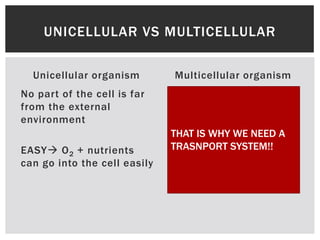
Unicellular organism
No part of the cell is far
from the external
environment
EASY O2 + nutrients
can go into the cell easily
Multicellular organism
Many cells are far from
the outside environment!
HARD diffusion alone
is not enough to bring
materials into these cells
UNICELLULAR VS MULTICELLULAR
THAT IS WHY WE NEED A
TRASNPORT SYSTEM!!
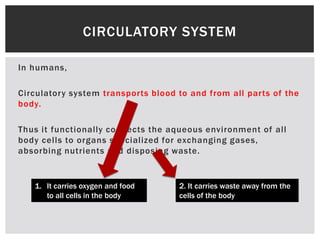
In humans,
Circulatory system transports blood to and from all parts of the
body.
Thus it functionally connects the aqueous environment of all
body cells to organs specialized for exchanging gases,
absorbing nutrients and disposing waste.
CIRCULATORY SYSTEM
1. It carries oxygen and food
to all cells in the body
2. It carries waste away from the
cells of the body
HUMAN CIRCULATORY
SYSTEM
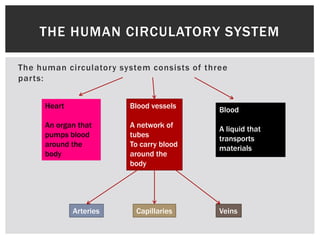
The human circulatory system consists of three
parts:
THE HUMAN CIRCULATORY SYSTEM
Heart
An organ that
pumps blood
around the
body
Blood vessels
A network of
tubes
To carry blood
around the
body
Blood
A liquid that
transports
materials
Arteries Capillaries Veins
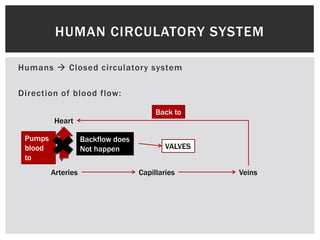
Humans  Closed circulatory system
Direction of blood flow:
HUMAN CIRCULATORY SYSTEM
Heart
Arteries Capillaries Veins
Pumps
blood
to
Back to
Backflow does
Not happen VALVES
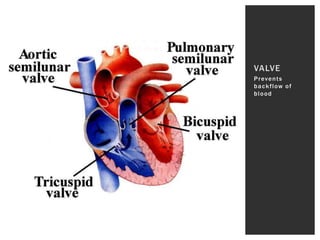
Prevents
backflow of
blood
VALVE
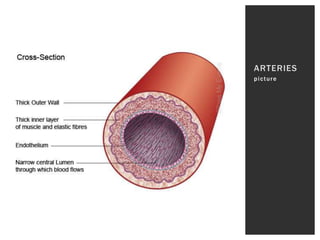
picture
ARTERIES
 Arteries receive blood directly from heart
 Narrow lumen
 Flow of blood  fast + at high pressure
Thus, The walls of the arteries are THICK, MUSCULAR and
ELASTIC to withstand the pressure.
- Elastic enables arteries to stretch and recoil, which pushes
blood in spurts and gives rise to pulse
- Blood moves along the arteries by contraction and relaxation
of muscles in the walls.
 Arteries branch into smaller vessels  arterioles
(smallest), which connects to the smallest blood
vessel, capillaries
ARTERIES
 Veins carry blood towards the heart
 Blood pressure is lower than in arteries
 Blood flows more slowly and smoothly Thin layer of wall and
elastic tissue
 Have internal valves
 Waste products are brought back to the heart when capillaries
join to form  VENULES
VEINS
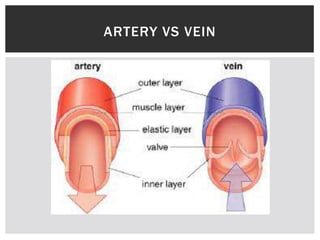
ARTERY VS VEIN
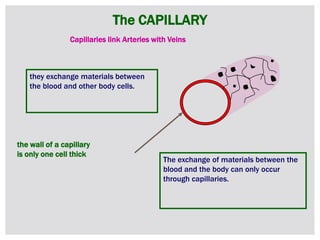
The CAPILLARY
Capillaries link Arteries with Veins
the wall of a capillary
is only one cell thick
they exchange materials between
the blood and other body cells.
The exchange of materials between the
blood and the body can only occur
through capillaries.
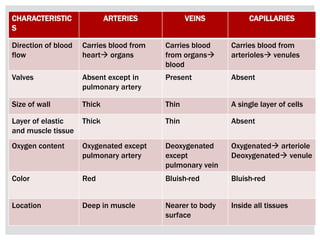
CHARACTERISTIC
S
ARTERIES VEINS CAPILLARIES
Direction of blood
flow
Carries blood from
heart organs
Carries blood
from organs
blood
Carries blood from
arterioles venules
Valves Absent except in
pulmonary artery
Present Absent
Size of wall Thick Thin A single layer of cells
Layer of elastic
and muscle tissue
Thick Thin Absent
Oxygen content Oxygenated except
pulmonary artery
Deoxygenated
except
pulmonary vein
Oxygenated arteriole
Deoxygenated venule
Color Red Bluish-red Bluish-red
Location Deep in muscle Nearer to body
surface
Inside all tissues
BREATHING TAKING IN
AND OUT OF AIR
What is
happening
inside the
lungs?
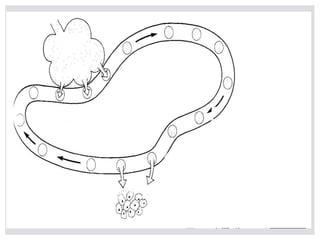
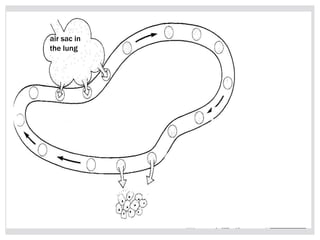
air sac in
the lung
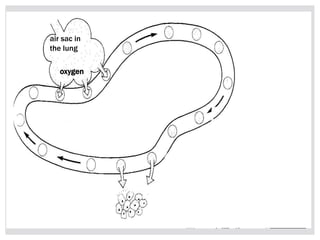
air sac in
the lung
oxygen
air sac in
the lung
oxygen
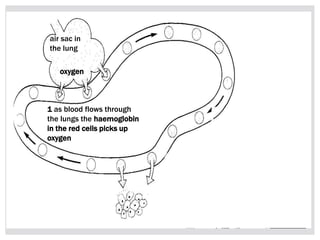
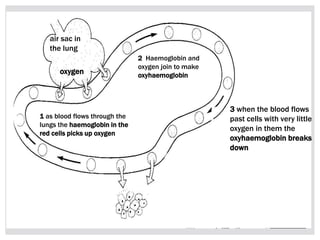
1 as blood flows through
the lungs the haemoglobin
in the red cells picks up
oxygen
air sac in
the lung
oxygen
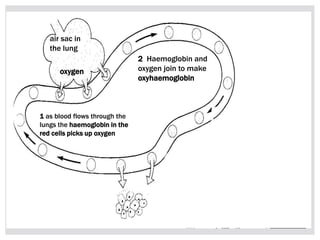
1 as blood flows through the
lungs the haemoglobin in the
red cells picks up oxygen
2 Haemoglobin and
oxygen join to make
oxyhaemoglobin
air sac in
the lung
oxygen
1 as blood flows through the
lungs the haemoglobin in the
red cells picks up oxygen
2 Haemoglobin and
oxygen join to make
oxyhaemoglobin
3 when the blood flows
past cells with very little
oxygen in them the
oxyhaemoglobin breaks
down
air sac in
the lung
oxygen
1 as blood flows through the
lungs the haemoglobin in the
red cells picks up oxygen
2 Haemoglobin and
oxygen join to make
oxyhaemoglobin
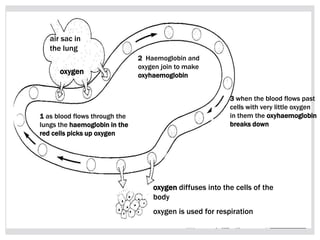
3 when the blood flows past
cells with very little oxygen
in them the oxyhaemoglobin
breaks down
oxygen diffuses into the cells of the
body
oxygen is used for respiration
air sac in
the lung
oxygen
1 as blood flows through the
lungs the haemoglobin in the
red cells picks up oxygen
2 Haemoglobin and
oxygen join to make
oxyhaemoglobin
3 when the blood flows past
cells with very little oxygen
in them the oxyhaemoglobin
breaks down
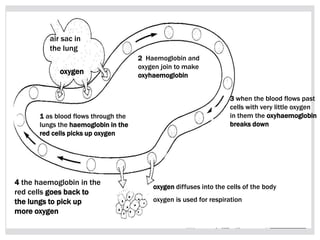
oxygen diffuses into the cells of the body
oxygen is used for respiration
4 the haemoglobin in the
red cells goes back to
the lungs to pick up
more oxygen
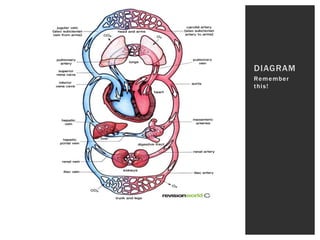
DOUBLE CIRCULATION
Remember
this!
DIAGRAM
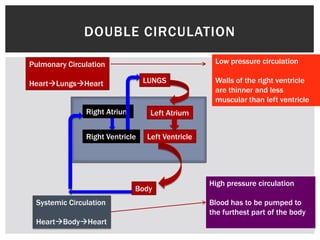
DOUBLE CIRCULATION
LUNGS
Left Atrium
Left Ventricle
Body
Right Ventricle
Right Atrium
Pulmonary Circulation
HeartLungsHeart
Systemic Circulation
HeartBodyHeart
Low pressure circulation
Walls of the right ventricle
are thinner and less
muscular than left ventricle
High pressure circulation
Blood has to be pumped to
the furthest part of the body
Blood passes the heart twiceWHY DOUBLE CIRCULATION?
THE HUMAN HEART Source of
life <3
THE HUMAN HEART
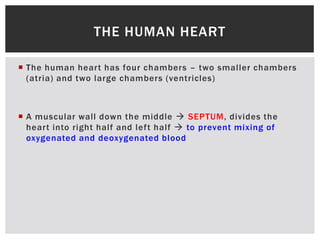
 The human heart has four chambers – two smaller chambers
(atria) and two large chambers (ventricles)
 A muscular wall down the middle  SEPTUM, divides the
heart into right half and left half  to prevent mixing of
oxygenated and deoxygenated blood
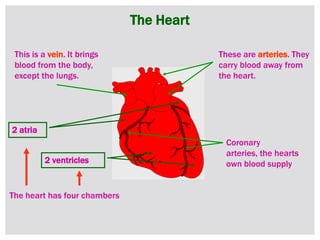
The Heart
These are arteries. They
carry blood away from
the heart.
This is a vein. It brings
blood from the body,
except the lungs.
Coronary
arteries, the hearts
own blood supply
The heart has four chambers
2 atria
2 ventricles
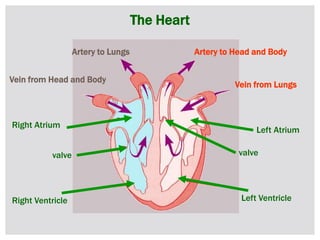
The Heart
Left Ventricle
Left Atrium
Right Atrium
Right Ventricle
valve
Vein from Lungs
Artery to Head and BodyArtery to Lungs
Vein from Head and Body
valve
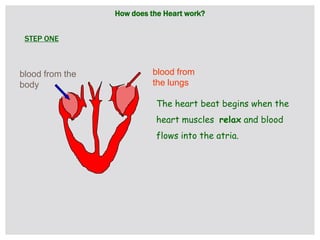
How does the Heart work?
blood from the
body
blood from
the lungs
The heart beat begins when the
heart muscles relax and blood
flows into the atria.
STEP ONE
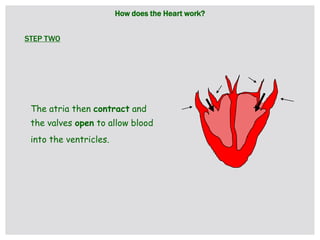
The atria then contract and
the valves open to allow blood
into the ventricles.
How does the Heart work?
STEP TWO
How does the Heart work?
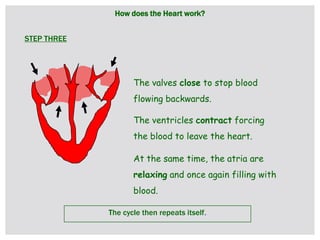
The valves close to stop blood
flowing backwards.
The ventricles contract forcing
the blood to leave the heart.
At the same time, the atria are
relaxing and once again filling with
blood.
The cycle then repeats itself.
STEP THREE
SUMMARY
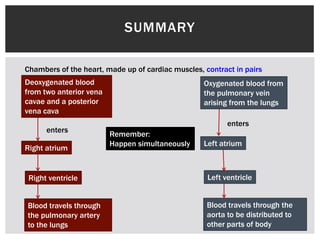
Chambers of the heart, made up of cardiac muscles, contract in pairs
Deoxygenated blood
from two anterior vena
cavae and a posterior
vena cava
Right atrium
Right ventricle
Blood travels through
the pulmonary artery
to the lungs
enters
Oxygenated blood from
the pulmonary vein
arising from the lungs
Left atrium
Left ventricle
Blood travels through the
aorta to be distributed to
other parts of body
enters
Remember:
Happen simultaneously
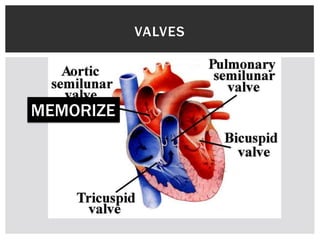
VALVES
MEMORIZE
LUP-DUP
LUP-DUP
LUP-DUP
LUP-DUP
LUP-DUP
LUP-DUP
LUP-DUP
LUP-DUP
LUP-DUP
LUP-DUP
LUP-DUP
LUP-DUP
LUP-DUP
LUP-DUP
LUP-DUP
LUP-DUP
HEARTBEAT
HEARTBEAT
HEARTBEAT
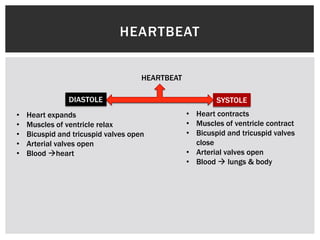
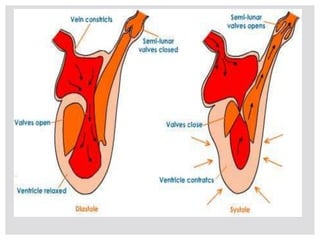
DIASTOLE SYSTOLE
• Heart expands
• Muscles of ventricle relax
• Bicuspid and tricuspid valves open
• Arterial valves open
• Blood heart
• Heart contracts
• Muscles of ventricle contract
• Bicuspid and tricuspid valves
close
• Arterial valves open
• Blood  lungs & body
Each time a heart beats, it sets up a wave of pressure called a
pulse wave along the main arteries
PULSE
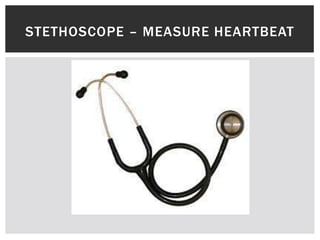
STETHOSCOPE – MEASURE HEARTBEAT
CARDIOVASCULAR
DISEASES
Diseases
of the
heart and
the blood
vessels
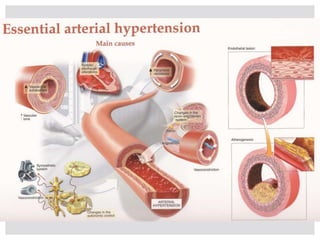
Hypertension (High blood pressure)
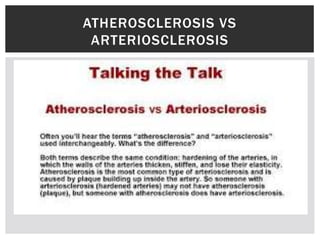
Arteriosclerosis (hardening of arteries)
Artherosclerosis (narrowing of arteries)
EXAMPLES
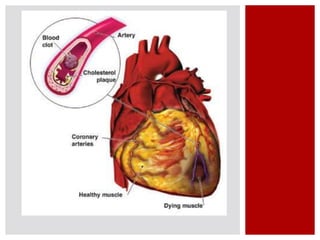
 Occurs when coronary arteries become clogged less blood
flows through and parts of heart muscles do not get sufficient
blood
 Fatty deposits on the walls of the arteries make them narrow

 Atherosclerosis progresses gradually
 Coronary artery becomes more and more clogged and may
eventually get blocked 
CORONARY HEART DISEASE
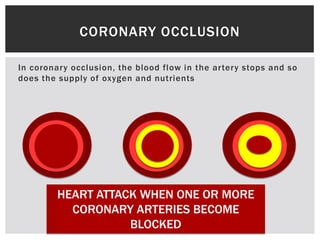
In coronary occlusion, the blood flow in the artery stops and so
does the supply of oxygen and nutrients
CORONARY OCCLUSION
HEART ATTACK WHEN ONE OR MORE
CORONARY ARTERIES BECOME
BLOCKED
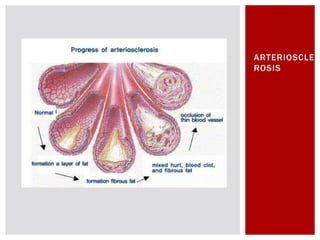
ARTERIOSCLE
ROSIS
ATHEROSCLEROSIS VS
ARTERIOSCLEROSIS
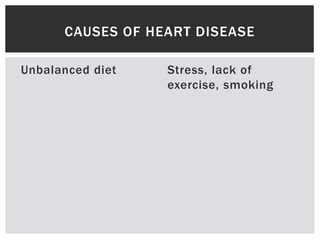
Unbalanced diet Stress, lack of
exercise, smoking
CAUSES OF HEART DISEASE
Reduce consumption of items rich in fats and cholesterol
Eat more heart-healthy food
Stay within ideal weight range by eating right diet
Exercise regularly
Don’t smoke
Reduce stress
PREVENTION
componentsBLOOD
WHAT IS BLOOD MADE UP OF?
Red blood cells
White blood cells
Platelets
Plasma
Breakdown products of digestion, such as
glucose, fatty acids and amino acids
Dissolved mineral salts
Carbon dioxide
Urea
hormones
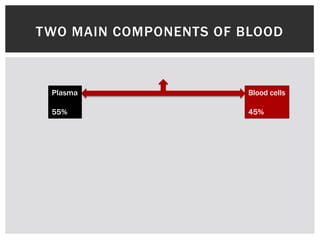
TWO MAIN COMPONENTS OF BLOOD
Plasma
55%
Blood cells
45%
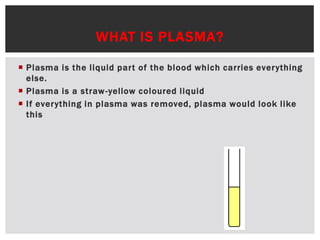
WHAT IS PLASMA?
 Plasma is the liquid part of the blood which carries everything
else.
 Plasma is a straw-yellow coloured liquid
 If everything in plasma was removed, plasma would look like
this
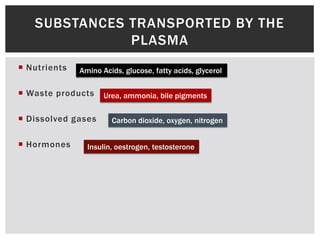
 Nutrients
 Waste products
 Dissolved gases
 Hormones
SUBSTANCES TRANSPORTED BY THE
PLASMA
Amino Acids, glucose, fatty acids, glycerol
Urea, ammonia, bile pigments
Carbon dioxide, oxygen, nitrogen
Insulin, oestrogen, testosterone
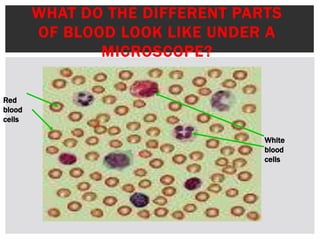
WHAT DO THE DIFFERENT PARTS
OF BLOOD LOOK LIKE UNDER A
MICROSCOPE?
Red
blood
cells
White
blood
cells
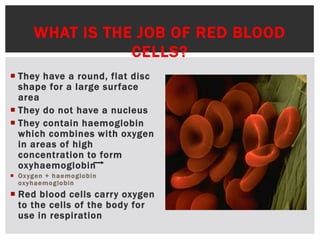
WHAT IS THE JOB OF RED BLOOD
CELLS?
 They have a round, flat disc
shape for a large surface
area
 They do not have a nucleus
 They contain haemoglobin
which combines with oxygen
in areas of high
concentration to form
oxyhaemoglobin
 Oxygen + haemoglobin
oxyhaemoglobin
 Red blood cells carry oxygen
to the cells of the body for
use in respiration
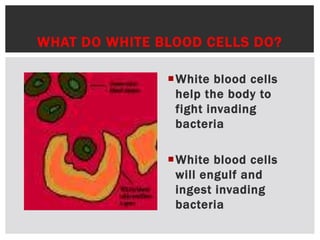
WHAT DO WHITE BLOOD CELLS DO?
White blood cells
help the body to
fight invading
bacteria
White blood cells
will engulf and
ingest invading
bacteria
OTHER IMPORTANT JOBS OF THE
WHITE BLOOD CELLS:
They produce
antibodies which
can recognise and
fight bacteria
They produce
antitoxins which
neutralise the
toxins (poisons)
that bacteria
produce, which
make us feel ill
WHAT DO PLATELETS DO?
 Platelets are fragments of cells
 The job of platelets is to help blood clot and form a scab
 The platelets are involved in the formation of fibrin, which is
needed for clotting blood
 This is useful for stopping bleeding, and for preventing germs
from entering the body through the cut
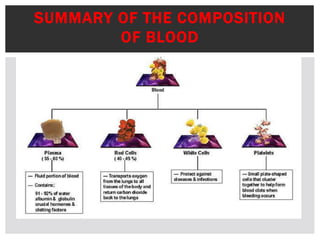
SUMMARY OF THE COMPOSITION
OF BLOOD

Transport system in humans

  • 1.
  • 2.
    1) Cell 2) Tissues 3)Organs 4) Systems 5) Organism BLOOD CIRCULATORY SYSTEM
  • 3.
    Unicellular organism No partof the cell is far from the external environment EASY O2 + nutrients can go into the cell easily Multicellular organism Many cells are far from the outside environment! HARD diffusion alone is not enough to bring materials into these cells UNICELLULAR VS MULTICELLULAR THAT IS WHY WE NEED A TRASNPORT SYSTEM!!
  • 4.
    In humans, Circulatory systemtransports blood to and from all parts of the body. Thus it functionally connects the aqueous environment of all body cells to organs specialized for exchanging gases, absorbing nutrients and disposing waste. CIRCULATORY SYSTEM 1. It carries oxygen and food to all cells in the body 2. It carries waste away from the cells of the body
  • 5.
  • 6.
    The human circulatorysystem consists of three parts: THE HUMAN CIRCULATORY SYSTEM Heart An organ that pumps blood around the body Blood vessels A network of tubes To carry blood around the body Blood A liquid that transports materials Arteries Capillaries Veins
  • 7.
    Humans  Closedcirculatory system Direction of blood flow: HUMAN CIRCULATORY SYSTEM Heart Arteries Capillaries Veins Pumps blood to Back to Backflow does Not happen VALVES
  • 8.
  • 9.
  • 10.
     Arteries receiveblood directly from heart  Narrow lumen  Flow of blood  fast + at high pressure Thus, The walls of the arteries are THICK, MUSCULAR and ELASTIC to withstand the pressure. - Elastic enables arteries to stretch and recoil, which pushes blood in spurts and gives rise to pulse - Blood moves along the arteries by contraction and relaxation of muscles in the walls.  Arteries branch into smaller vessels  arterioles (smallest), which connects to the smallest blood vessel, capillaries ARTERIES
  • 11.
     Veins carryblood towards the heart  Blood pressure is lower than in arteries  Blood flows more slowly and smoothly Thin layer of wall and elastic tissue  Have internal valves  Waste products are brought back to the heart when capillaries join to form  VENULES VEINS
  • 12.
  • 13.
    The CAPILLARY Capillaries linkArteries with Veins the wall of a capillary is only one cell thick they exchange materials between the blood and other body cells. The exchange of materials between the blood and the body can only occur through capillaries.
  • 14.
    CHARACTERISTIC S ARTERIES VEINS CAPILLARIES Directionof blood flow Carries blood from heart organs Carries blood from organs blood Carries blood from arterioles venules Valves Absent except in pulmonary artery Present Absent Size of wall Thick Thin A single layer of cells Layer of elastic and muscle tissue Thick Thin Absent Oxygen content Oxygenated except pulmonary artery Deoxygenated except pulmonary vein Oxygenated arteriole Deoxygenated venule Color Red Bluish-red Bluish-red Location Deep in muscle Nearer to body surface Inside all tissues
  • 15.
    BREATHING TAKING IN ANDOUT OF AIR What is happening inside the lungs?
  • 17.
  • 18.
    air sac in thelung oxygen
  • 19.
    air sac in thelung oxygen 1 as blood flows through the lungs the haemoglobin in the red cells picks up oxygen
  • 20.
    air sac in thelung oxygen 1 as blood flows through the lungs the haemoglobin in the red cells picks up oxygen 2 Haemoglobin and oxygen join to make oxyhaemoglobin
  • 21.
    air sac in thelung oxygen 1 as blood flows through the lungs the haemoglobin in the red cells picks up oxygen 2 Haemoglobin and oxygen join to make oxyhaemoglobin 3 when the blood flows past cells with very little oxygen in them the oxyhaemoglobin breaks down
  • 22.
    air sac in thelung oxygen 1 as blood flows through the lungs the haemoglobin in the red cells picks up oxygen 2 Haemoglobin and oxygen join to make oxyhaemoglobin 3 when the blood flows past cells with very little oxygen in them the oxyhaemoglobin breaks down oxygen diffuses into the cells of the body oxygen is used for respiration
  • 23.
    air sac in thelung oxygen 1 as blood flows through the lungs the haemoglobin in the red cells picks up oxygen 2 Haemoglobin and oxygen join to make oxyhaemoglobin 3 when the blood flows past cells with very little oxygen in them the oxyhaemoglobin breaks down oxygen diffuses into the cells of the body oxygen is used for respiration 4 the haemoglobin in the red cells goes back to the lungs to pick up more oxygen
  • 24.
  • 25.
  • 26.
    DOUBLE CIRCULATION LUNGS Left Atrium LeftVentricle Body Right Ventricle Right Atrium Pulmonary Circulation HeartLungsHeart Systemic Circulation HeartBodyHeart Low pressure circulation Walls of the right ventricle are thinner and less muscular than left ventricle High pressure circulation Blood has to be pumped to the furthest part of the body
  • 27.
    Blood passes theheart twiceWHY DOUBLE CIRCULATION?
  • 28.
    THE HUMAN HEARTSource of life <3
  • 29.
    THE HUMAN HEART The human heart has four chambers – two smaller chambers (atria) and two large chambers (ventricles)  A muscular wall down the middle  SEPTUM, divides the heart into right half and left half  to prevent mixing of oxygenated and deoxygenated blood
  • 30.
    The Heart These arearteries. They carry blood away from the heart. This is a vein. It brings blood from the body, except the lungs. Coronary arteries, the hearts own blood supply The heart has four chambers 2 atria 2 ventricles
  • 31.
    The Heart Left Ventricle LeftAtrium Right Atrium Right Ventricle valve Vein from Lungs Artery to Head and BodyArtery to Lungs Vein from Head and Body valve
  • 32.
    How does theHeart work? blood from the body blood from the lungs The heart beat begins when the heart muscles relax and blood flows into the atria. STEP ONE
  • 33.
    The atria thencontract and the valves open to allow blood into the ventricles. How does the Heart work? STEP TWO
  • 34.
    How does theHeart work? The valves close to stop blood flowing backwards. The ventricles contract forcing the blood to leave the heart. At the same time, the atria are relaxing and once again filling with blood. The cycle then repeats itself. STEP THREE
  • 35.
    SUMMARY Chambers of theheart, made up of cardiac muscles, contract in pairs Deoxygenated blood from two anterior vena cavae and a posterior vena cava Right atrium Right ventricle Blood travels through the pulmonary artery to the lungs enters Oxygenated blood from the pulmonary vein arising from the lungs Left atrium Left ventricle Blood travels through the aorta to be distributed to other parts of body enters Remember: Happen simultaneously
  • 36.
  • 37.
  • 38.
    HEARTBEAT HEARTBEAT DIASTOLE SYSTOLE • Heartexpands • Muscles of ventricle relax • Bicuspid and tricuspid valves open • Arterial valves open • Blood heart • Heart contracts • Muscles of ventricle contract • Bicuspid and tricuspid valves close • Arterial valves open • Blood  lungs & body
  • 40.
    Each time aheart beats, it sets up a wave of pressure called a pulse wave along the main arteries PULSE
  • 41.
  • 42.
  • 43.
    Hypertension (High bloodpressure) Arteriosclerosis (hardening of arteries) Artherosclerosis (narrowing of arteries) EXAMPLES
  • 44.
     Occurs whencoronary arteries become clogged less blood flows through and parts of heart muscles do not get sufficient blood  Fatty deposits on the walls of the arteries make them narrow   Atherosclerosis progresses gradually  Coronary artery becomes more and more clogged and may eventually get blocked  CORONARY HEART DISEASE
  • 46.
    In coronary occlusion,the blood flow in the artery stops and so does the supply of oxygen and nutrients CORONARY OCCLUSION HEART ATTACK WHEN ONE OR MORE CORONARY ARTERIES BECOME BLOCKED
  • 47.
  • 48.
  • 50.
    Unbalanced diet Stress,lack of exercise, smoking CAUSES OF HEART DISEASE
  • 51.
    Reduce consumption ofitems rich in fats and cholesterol Eat more heart-healthy food Stay within ideal weight range by eating right diet Exercise regularly Don’t smoke Reduce stress PREVENTION
  • 52.
  • 53.
    WHAT IS BLOODMADE UP OF? Red blood cells White blood cells Platelets Plasma Breakdown products of digestion, such as glucose, fatty acids and amino acids Dissolved mineral salts Carbon dioxide Urea hormones
  • 54.
    TWO MAIN COMPONENTSOF BLOOD Plasma 55% Blood cells 45%
  • 55.
    WHAT IS PLASMA? Plasma is the liquid part of the blood which carries everything else.  Plasma is a straw-yellow coloured liquid  If everything in plasma was removed, plasma would look like this
  • 56.
     Nutrients  Wasteproducts  Dissolved gases  Hormones SUBSTANCES TRANSPORTED BY THE PLASMA Amino Acids, glucose, fatty acids, glycerol Urea, ammonia, bile pigments Carbon dioxide, oxygen, nitrogen Insulin, oestrogen, testosterone
  • 57.
    WHAT DO THEDIFFERENT PARTS OF BLOOD LOOK LIKE UNDER A MICROSCOPE? Red blood cells White blood cells
  • 58.
    WHAT IS THEJOB OF RED BLOOD CELLS?  They have a round, flat disc shape for a large surface area  They do not have a nucleus  They contain haemoglobin which combines with oxygen in areas of high concentration to form oxyhaemoglobin  Oxygen + haemoglobin oxyhaemoglobin  Red blood cells carry oxygen to the cells of the body for use in respiration
  • 59.
    WHAT DO WHITEBLOOD CELLS DO? White blood cells help the body to fight invading bacteria White blood cells will engulf and ingest invading bacteria
  • 60.
    OTHER IMPORTANT JOBSOF THE WHITE BLOOD CELLS: They produce antibodies which can recognise and fight bacteria They produce antitoxins which neutralise the toxins (poisons) that bacteria produce, which make us feel ill
  • 61.
    WHAT DO PLATELETSDO?  Platelets are fragments of cells  The job of platelets is to help blood clot and form a scab  The platelets are involved in the formation of fibrin, which is needed for clotting blood  This is useful for stopping bleeding, and for preventing germs from entering the body through the cut
  • 62.
    SUMMARY OF THECOMPOSITION OF BLOOD