The document discusses various construction materials, including stone, bricks, lime, cement, metal, timber, sand, aggregates, and paints. It outlines the requirements, types, and uses of each material, emphasizing their properties and applications in construction projects. Key points include the durability and proper characteristics needed for each material to ensure structural integrity and functionality.
Uses of Stone
•Theyare used in hydraulic structures like dams and
bridges.
•The stones are used for foundations,columns,walls,
lintels,floor,sills,etc.
•The stones are used for facing work of structures to give
massive appearance.
•They are used in retaining wall masonry to retain soil.
•They are used as road metal in road construction.
•They are used as ballast for permanent way in railways.
9.
Brick
Requirements of Bricks
•The colour of the brick should be red or copper and uniform.
• It should be well burnt in kilns.
• The surface should be even and free from cracks.
• The edges should be sharp.
10.
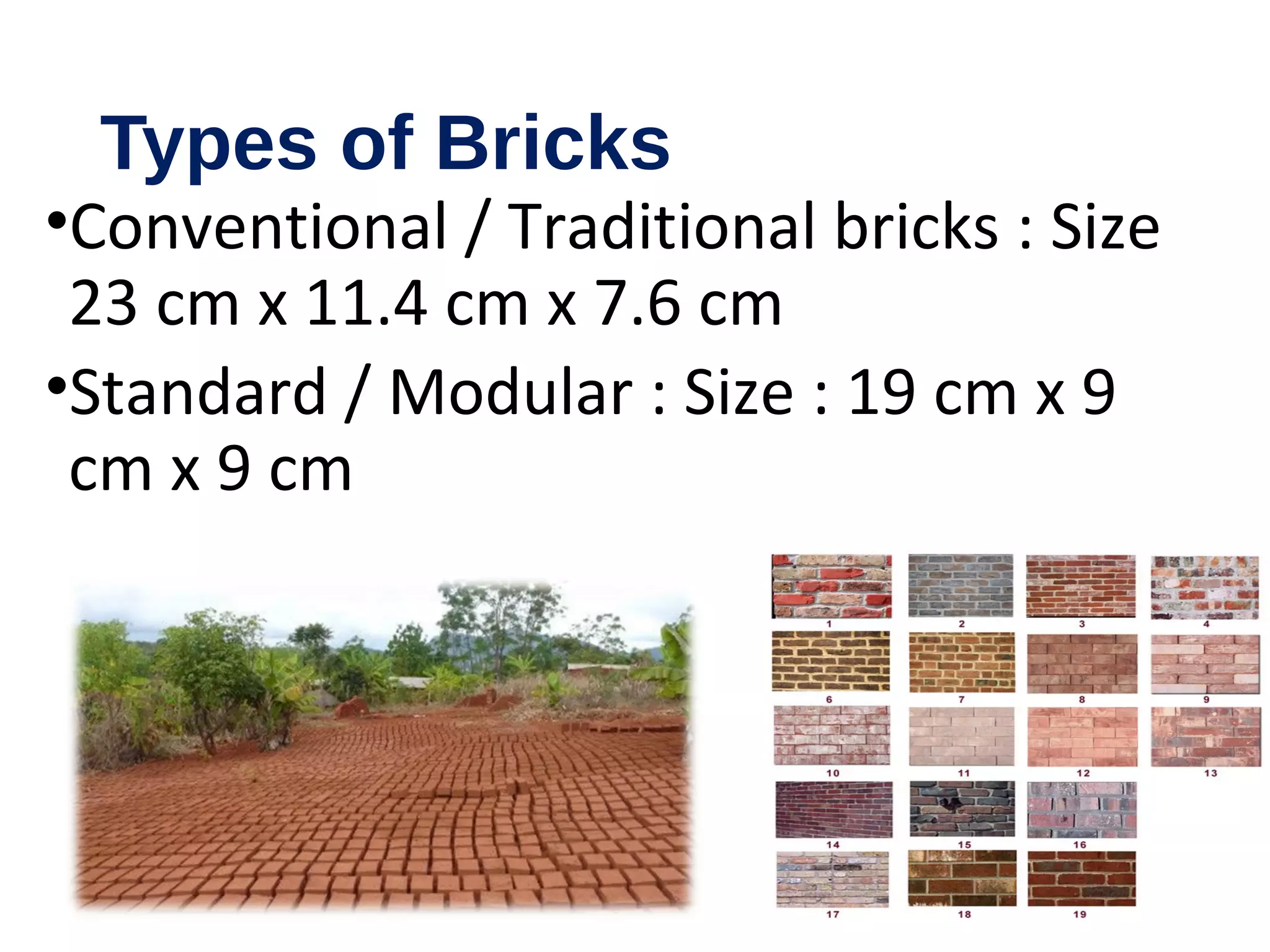
Types of Bricks
•Conventional/ Traditional bricks : Size
23 cm x 11.4 cm x 7.6 cm
•Standard / Modular : Size : 19 cm x 9
cm x 9 cm
11.
Uses of brick
•Bricks are used in wall masonry construction of building.
• The first class bricks being stronger are used in foundation of
wall etc.
• The second class bricks are used in those walls which are
generally made for to make the smooth surface.
• The third class bricks are used for temporary building.These
bricks are not used in damp situations or at places subjected
to heavy rains.
• The four class bricks are used as road meta and as ballst
which is used in foundations,floor,roofs,etc.
12.
Lime
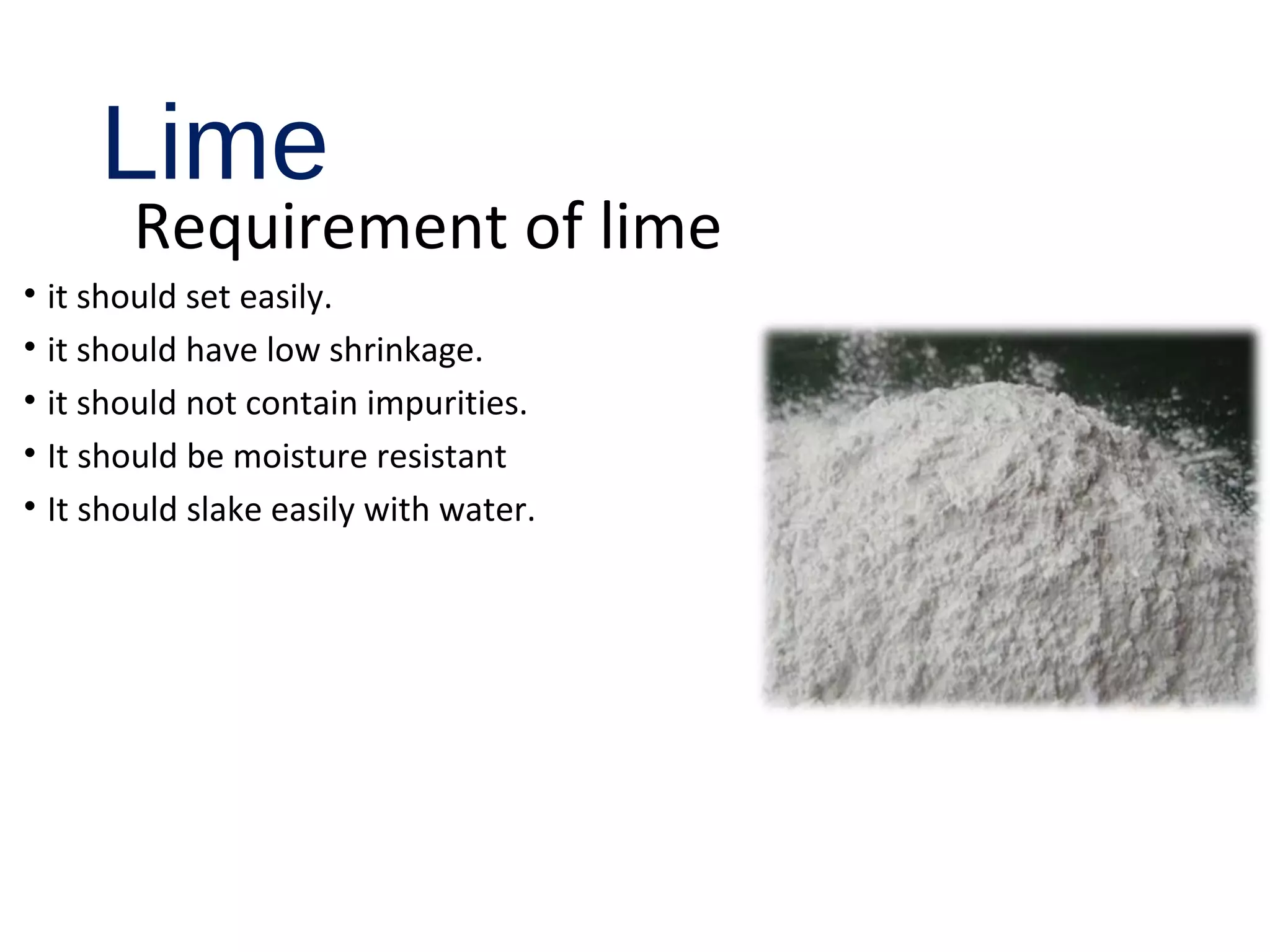
Requirement of lime
•it should set easily.
• it should have low shrinkage.
• it should not contain impurities.
• It should be moisture resistant
• It should slake easily with water.
13.
Uses of lime
•Limeis uses in the treatment of water and waste
water.
•It is used in the manufacture of
glass,refractory,sand lime bricks and paints.
•It is used as lime morter for mansonry work of
buildings.
•It is used for plastering and white washing of
buildings.
•It is used as lime concreat to make water proof
stuctures.
14.
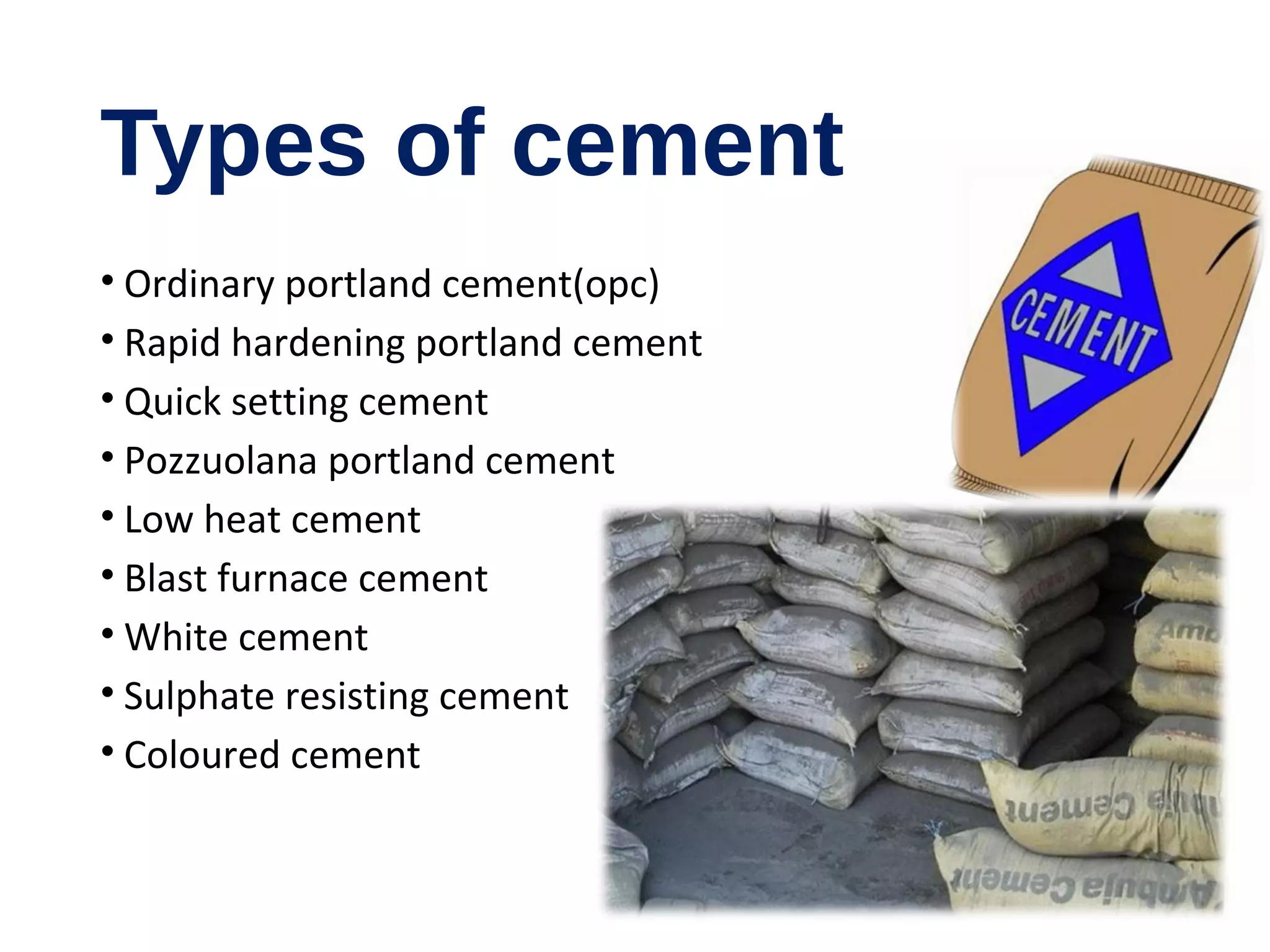
Cement
Cement is productobtained by burning a well
proportioned mixture of calcareous materials or
argillaceous materials and crushing the same into
grey color fine powder.
A very small amount of sulphur is added in
cement to make sound cement.
It should found cool when touch by hand.
it should be in fine powder form while checking
with first finger and thumb.
Uses of cement
•Itis used in making joints for drains ,pipes.
•It is used to prepare RCC structures of building by
using reinforcement with cement concrete.
• it is used in construction of buildings, bridges,
tanks, domes, flyovers, dockyard etc.
•It is used to prepare cement mortar for building
construction works like masonry, plaster, painting,
flooring etc.
•It is used to prepare cement concrete for various
construction works.
17.
Metal
Requirements of metal
•Theyshould provide sufficient strength to bear the
loads coming on them
•They should provide resistance to corrosion and
weather actions
•They should provided resistance to heat and fire.
•They should have good adhesion with cement
concrete.
18.
Types of metal
•Ferrousmetals
1) pig iron
2) cast iron
3)wrought iron
4)steel
•Non ferrous metals
1) Aluminium
2) copper
3) Magnesium
4) Nickel
19.
Timber
Requirements of timber
•It should be dense.
• It should have uniform texture.
• It should have dark uniform colour.
• It should be workable, good machinability.
• The medullary rays should be compact.
Uses of Timber
•It is used for making door and window chaukhats.
• It is used for making piles.
• It is used for making sleepers.
• It is used for making door and window chaukhats.
• It is used for temporary bridge,scaffolding,etc.
• It is used for making furniture.
22.
Sand
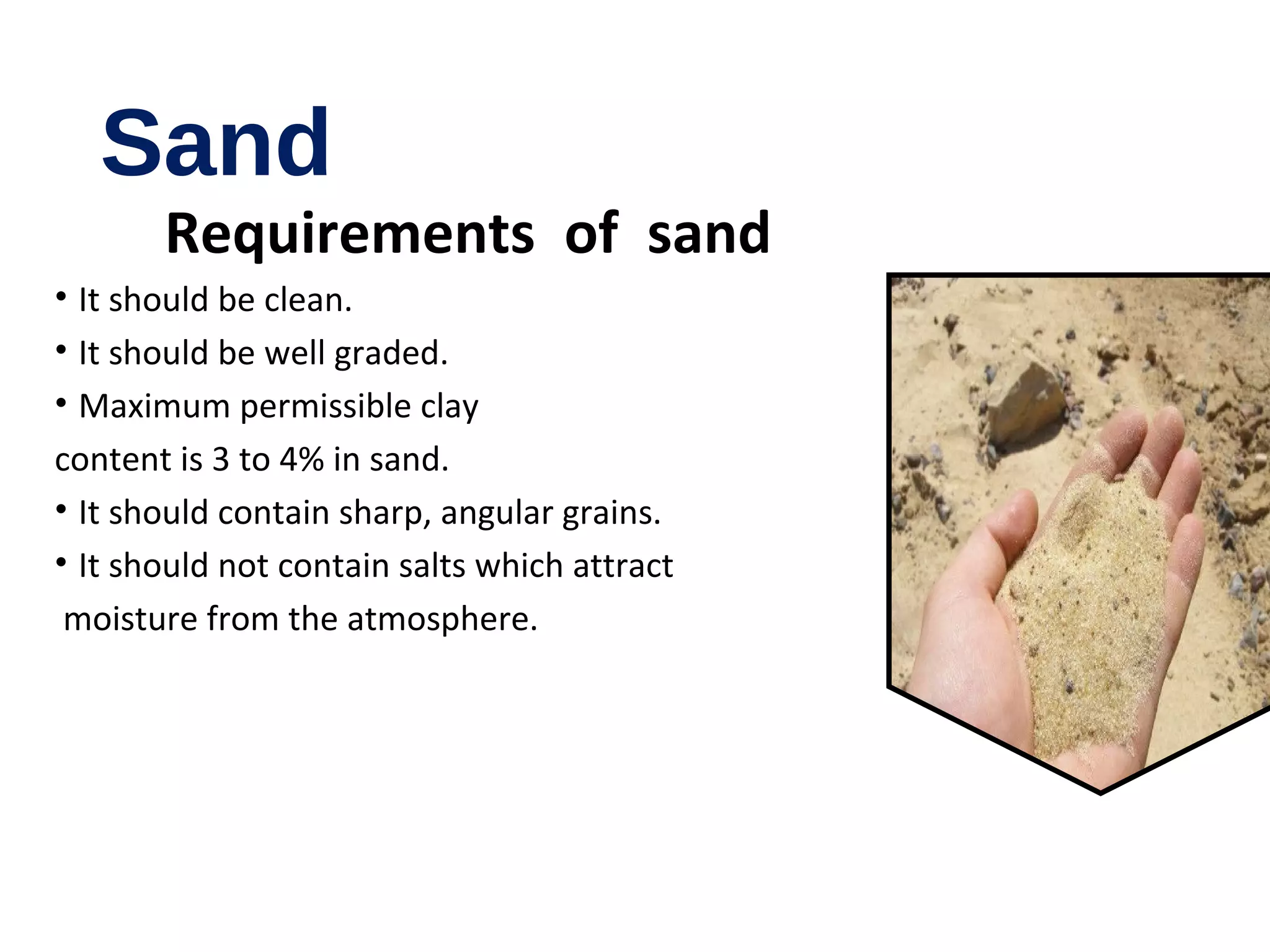
Requirements of sand
•It should be clean.
• It should be well graded.
• Maximum permissible clay
content is 3 to 4% in sand.
• It should contain sharp, angular grains.
• It should not contain salts which attract
moisture from the atmosphere.
23.
Types of sand
•Natural
naturalsand is obtained from pits, river beds and sea beds.
•Artificial
artificial sand is formed by decomposition of sandstone due to various
weathering effects.
24.
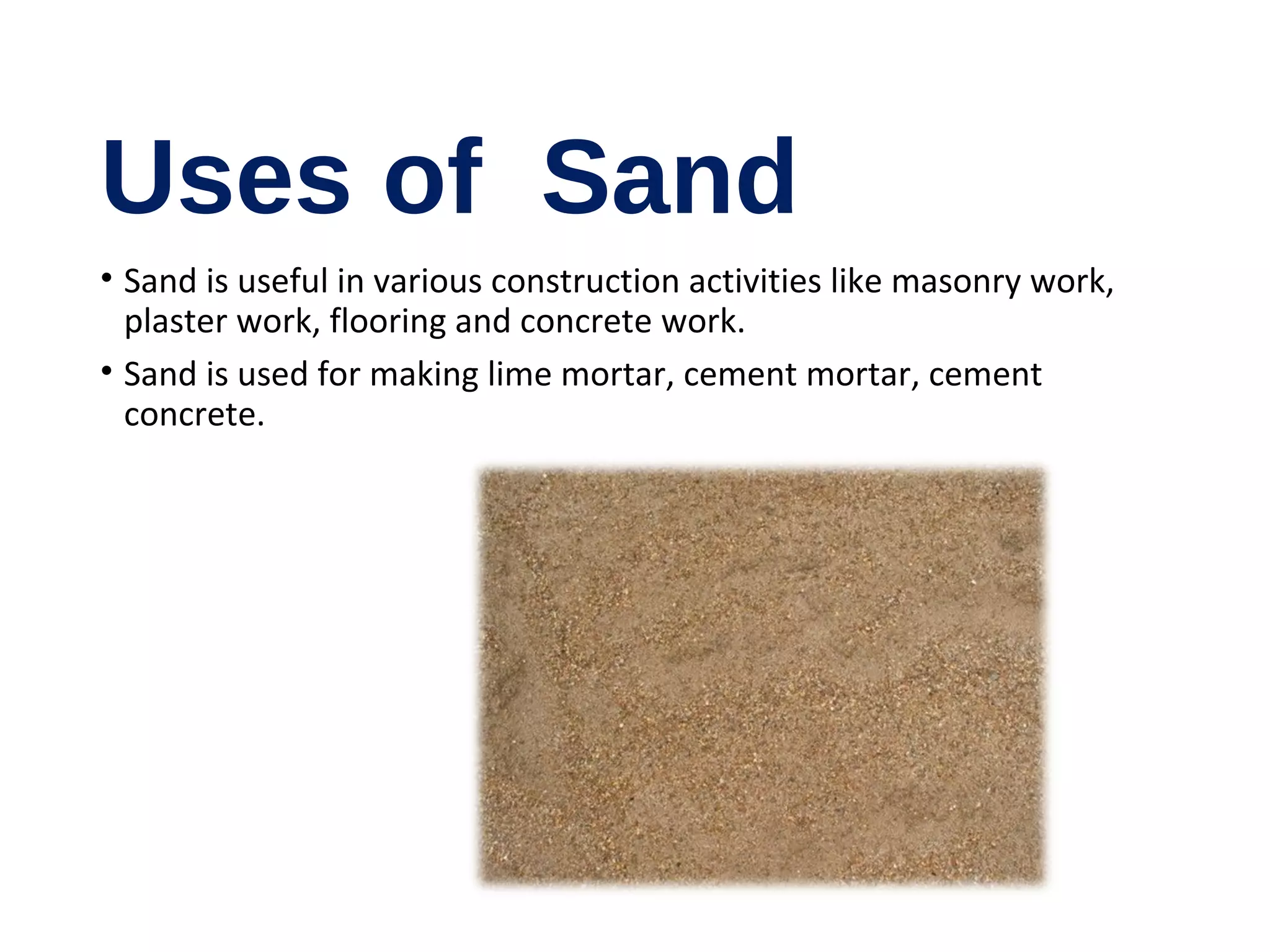
Uses of Sand
•Sand is useful in various construction activities like masonry work,
plaster work, flooring and concrete work.
• Sand is used for making lime mortar, cement mortar, cement
concrete.
25.
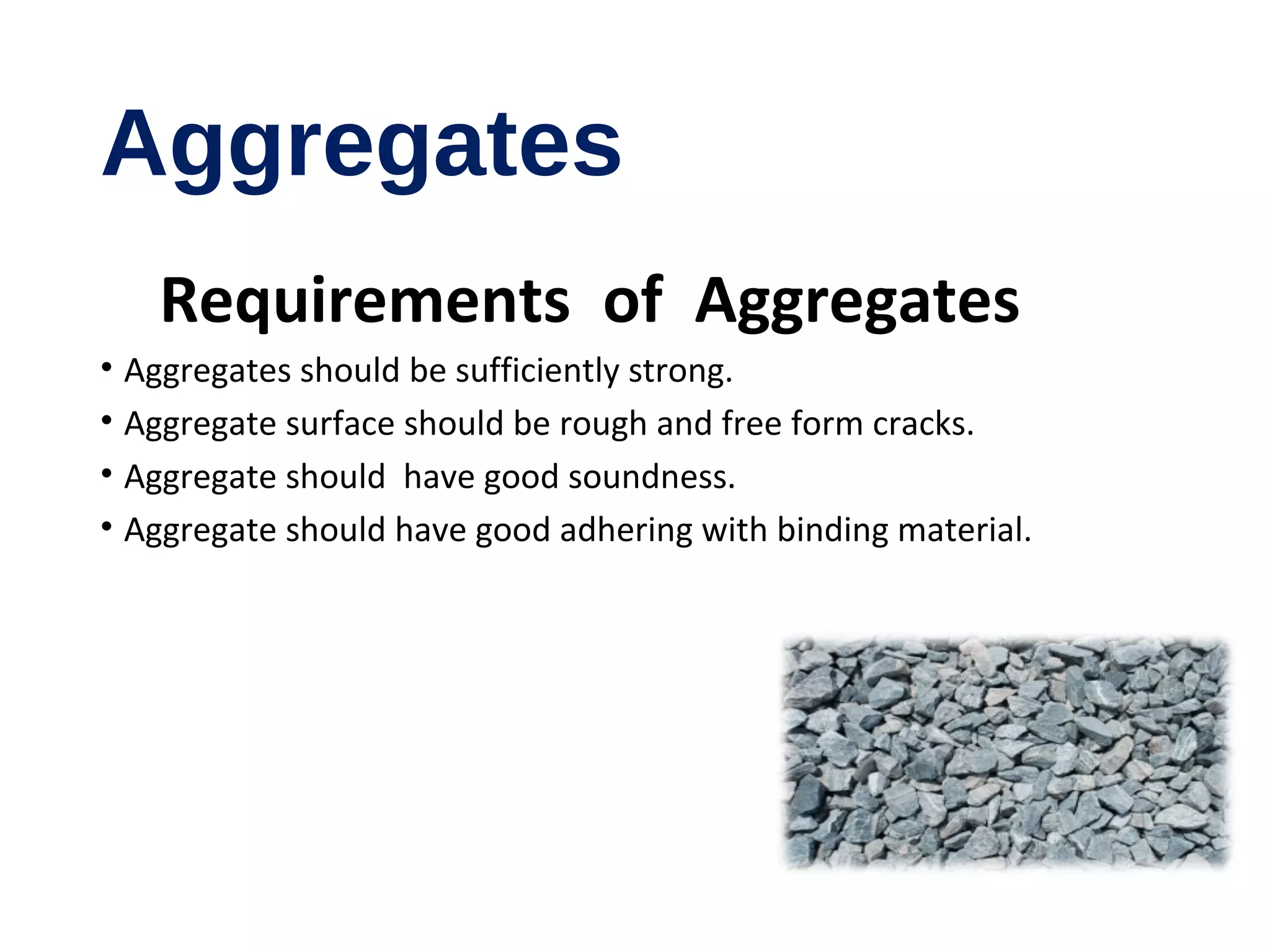
Aggregates
Requirements of Aggregates
•Aggregates should be sufficiently strong.
• Aggregate surface should be rough and free form cracks.
• Aggregate should have good soundness.
• Aggregate should have good adhering with binding material.
26.
Types of Aggregates
•Fineaggregates
size of aggregate is 4.75 mm or less is termed as fine aggregates.
•Coarse aggregates
size of aggregates 80mm to 4.75 mm is known as course.
27.
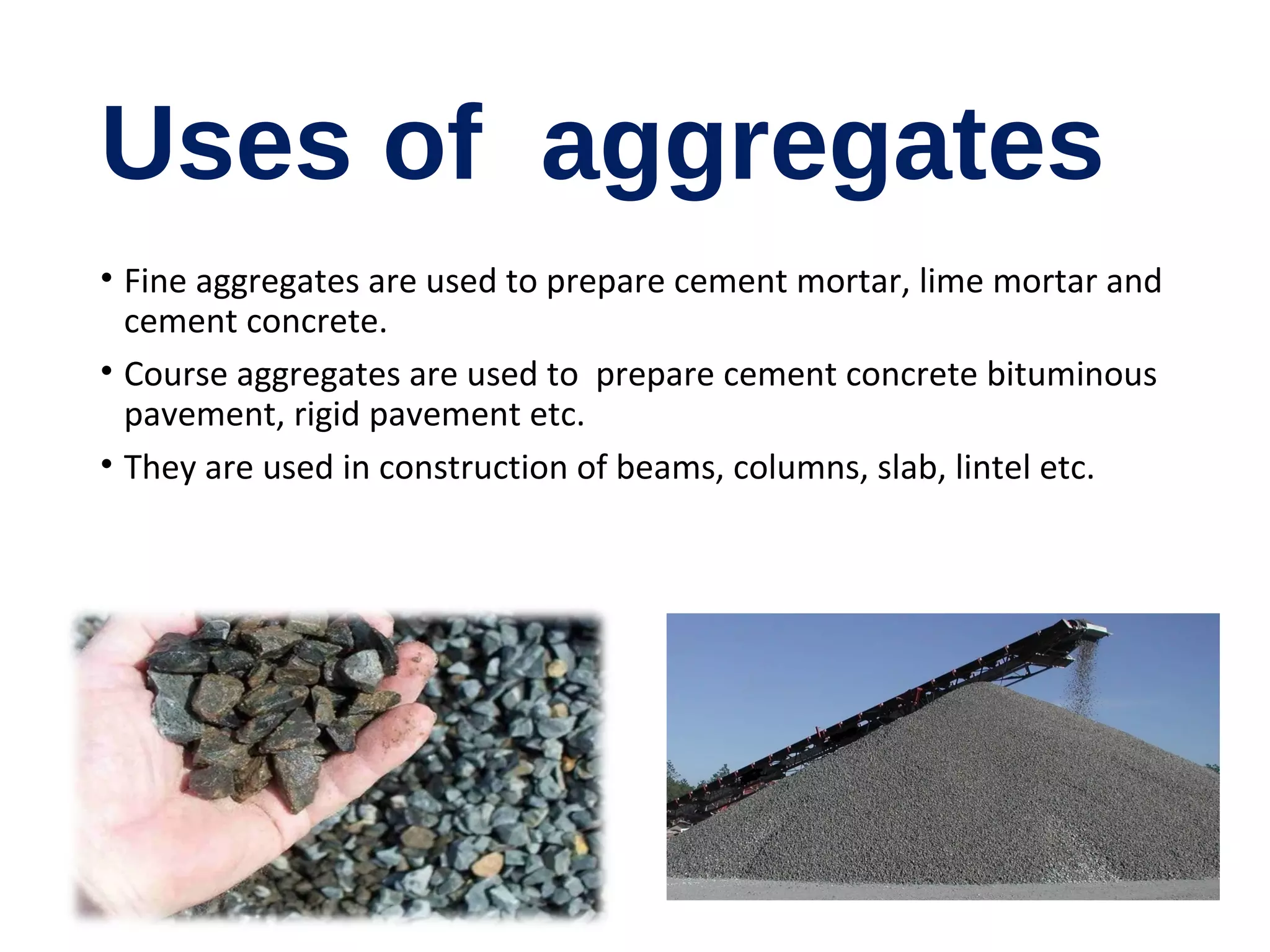
Uses of aggregates
•Fine aggregates are used to prepare cement mortar, lime mortar and
cement concrete.
• Course aggregates are used to prepare cement concrete bituminous
pavement, rigid pavement etc.
• They are used in construction of beams, columns, slab, lintel etc.
28.
PAINT & VARNISHES
•The paints are coating of fluid materils and they are applied over the
surface of timber and metal.
• The varnishes are transprent or nearly solution of resineous
materials & they re applies over the painted surfaces.
29.
REQUIREMENT OF PAINT&
VARNISHES
• The paints applied on a surface should dry within 24 hours.
• The paint should neither crack nor shrink after drying.
• The paint should have an attractive appearance.
• The colour of varnish should not develop cracks on drying.
• The varnish should adopt or accommodate to the expansion &
contration of wood due to temperature varations.