
MATERIAL OF
CONSTRUCTION
-Sufiyan Khan
Diploma in Civil Engineering
M.S.B.T.E., Mumbai
INTRODUCTION
BRICK
CEMENT
TIMBER
SAND
MORTAR
Brick
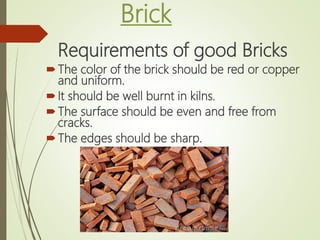
Requirements of good Bricks
The color of the brick should be red or copper
and uniform.
It should be well burnt in kilns.
The surface should be even and free from
cracks.
The edges should be sharp.
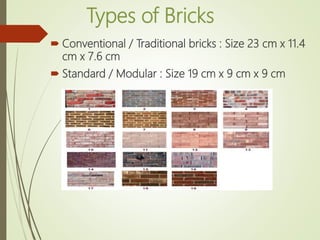
Types of Bricks
 Conventional / Traditional bricks : Size 23 cm x 11.4
cm x 7.6 cm
 Standard / Modular : Size 19 cm x 9 cm x 9 cm
Cement
while checking with first finger and thumb.
Cement should Cement should not possess of
alumina which may reduce strength.
not contain alumina in excess as it weakens the
cement.
A very small amount of sulpher is added in
cement to make sound cement.
It should found cool when touch by hand.
 it should be in fine powder form
Requirement Of Cement
Types of cement
 Ordinary portland cement(opc)
 Pozzuolana portland cement
 White cement
 Colored cement
Uses of cement
 It is used in making joints for drains ,pipes.
 It is used to prepare RCC structures of building
by using reinforcement with cement concrete.
 It is used in construction of buildings, bridges,
tanks, domes, flyovers, dockyard etc.
Timber
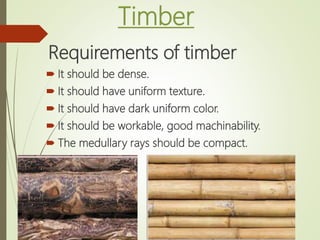
Requirements of timber
 It should be dense.
 It should have uniform texture.
 It should have dark uniform color.
 It should be workable, good machinability.
 The medullary rays should be compact.
Types
 Natural timber
babul, oak, pine, mango, saal, teak, neem, palms,
cheer.
 Industrial timber
veneers, plywoods, fiberboards, impreg timber,
compreg timber.
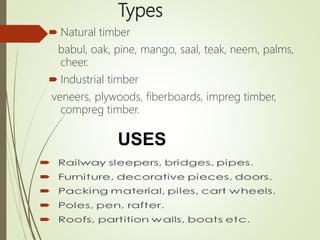
USES
Sand
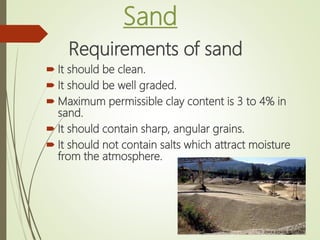
Requirements of sand
 It should be clean.
 It should be well graded.
 Maximum permissible clay content is 3 to 4% in
sand.
 It should contain sharp, angular grains.
 It should not contain salts which attract moisture
from the atmosphere.
Types of sand
 Natural
natural sand is obtained from pits, river beds and
sea beds.
 Artificial
artificial sand is formed by decomposition of
sandstone due to various weathering effects.
Sand is useful in various construction activities like
masonry work, plaster work, flooring and concrete
work.
Sand is used in cement mortar, plan cement
concrete , reinforced cement concrete and
prestressed concrete as key ingradient in building
construction
USES
Mortar
cracks. requirements of mortar
 It should have good adhesion with bricks, stones.
 It should resist penetration of rain water.
 It should be cheap, durable, and workable.
 It should be set quickly.
 The joints formed by mortar should not develop
Types
 As per type of binding material.
like cement, lime, gauged, gypsum, surkhi.
 As per nature of application.
 As per density of the mortar.
 Special mortar.
Uses
 To bind the bricks or stones firmly in wall construction
work.
 They are used in plaster work as finishing material to
provide weather resistance joints of masonry work are
covered by plaster work. White wash and color are
applied on plastered surface easily.
Thank you

Material of construction

  • 1.
    MATERIAL OF CONSTRUCTION -Sufiyan Khan Diplomain Civil Engineering M.S.B.T.E., Mumbai
  • 2.
  • 3.
    Brick Requirements of goodBricks The color of the brick should be red or copper and uniform. It should be well burnt in kilns. The surface should be even and free from cracks. The edges should be sharp.
  • 4.
    Types of Bricks Conventional / Traditional bricks : Size 23 cm x 11.4 cm x 7.6 cm  Standard / Modular : Size 19 cm x 9 cm x 9 cm
  • 5.
    Cement while checking withfirst finger and thumb. Cement should Cement should not possess of alumina which may reduce strength. not contain alumina in excess as it weakens the cement. A very small amount of sulpher is added in cement to make sound cement. It should found cool when touch by hand.  it should be in fine powder form Requirement Of Cement
  • 6.
    Types of cement Ordinary portland cement(opc)  Pozzuolana portland cement  White cement  Colored cement Uses of cement  It is used in making joints for drains ,pipes.  It is used to prepare RCC structures of building by using reinforcement with cement concrete.  It is used in construction of buildings, bridges, tanks, domes, flyovers, dockyard etc.
  • 7.
    Timber Requirements of timber It should be dense.  It should have uniform texture.  It should have dark uniform color.  It should be workable, good machinability.  The medullary rays should be compact.
  • 8.
    Types  Natural timber babul,oak, pine, mango, saal, teak, neem, palms, cheer.  Industrial timber veneers, plywoods, fiberboards, impreg timber, compreg timber. USES
  • 9.
    Sand Requirements of sand It should be clean.  It should be well graded.  Maximum permissible clay content is 3 to 4% in sand.  It should contain sharp, angular grains.  It should not contain salts which attract moisture from the atmosphere.
  • 10.
    Types of sand Natural natural sand is obtained from pits, river beds and sea beds.  Artificial artificial sand is formed by decomposition of sandstone due to various weathering effects. Sand is useful in various construction activities like masonry work, plaster work, flooring and concrete work. Sand is used in cement mortar, plan cement concrete , reinforced cement concrete and prestressed concrete as key ingradient in building construction USES
  • 11.
    Mortar cracks. requirements ofmortar  It should have good adhesion with bricks, stones.  It should resist penetration of rain water.  It should be cheap, durable, and workable.  It should be set quickly.  The joints formed by mortar should not develop
  • 12.
    Types  As pertype of binding material. like cement, lime, gauged, gypsum, surkhi.  As per nature of application.  As per density of the mortar.  Special mortar. Uses  To bind the bricks or stones firmly in wall construction work.  They are used in plaster work as finishing material to provide weather resistance joints of masonry work are covered by plaster work. White wash and color are applied on plastered surface easily.
  • 13.