Role of Water in ā€œMan Made Rockā€ By G Narendra GoudAsst.Manager QA/QC1
Contents Role of Water in Cement Concrete2Cement Concrete- the ā€œMan Made Rockā€Requirements of water used in concreteHydrationWater/Cement Ratio and StrengthWorkability of ConcreteAdmixturesDurability of ConcreteSprayed concrete
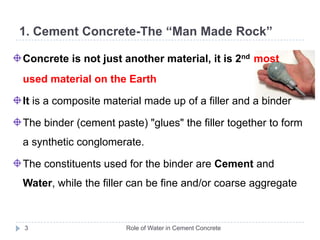
1. Cement Concrete-The ā€œMan Made Rockā€Role of Water in Cement Concrete3Concrete is not just another material, it is 2ndmost used material on the Earth It is a composite material made up of a filler and a binderThe binder(cement paste) "glues" the filler together to form a synthetic conglomerate.The constituents used for the binder are Cement and Water, while the filler can be fine and/or coarse aggregate
Binder = Cement + WaterRole of Water in Cement Concrete4	Cement consists of Mainly  Lime 75 to 77%Silica and Alumina 12 to 15%Iron Oxide 0.5 to 6%Water consists of Hydrogen and Oxygen (i.e. H2O)
2. Requirements of water used in concreteRole of Water in Cement Concrete5Water used for mixing and curing shall be clean and free from injurious amounts of Oils, Acids, Alkalis, Salts, Sugar, Organic materialsPotable water is generally considered satisfactory for mixing concreteMixing and curing with sea water shall not be permitted.The pH value shall not be less than 6
Role of Water in Cement Concrete62. Requirements of water used in concreteThe permissible limits for solids in water	Solids	Permissible Limits (Max)	Organic 				200 mg/lit	Inorganic				3000 mg/lit	Sulphates (SO4) 			500 mg/lit	Chlorides (Cl)			500 mg/lit 	Suspended matter			2000 mg/litWhat if water does not meet the above requirements????
3. HydrationRole of Water in Cement Concrete7 Concrete achieves its strength through a chemical process called Hydration.  Hydration is a complex process but in simple terms, is the reaction between water and the cement in the mix.
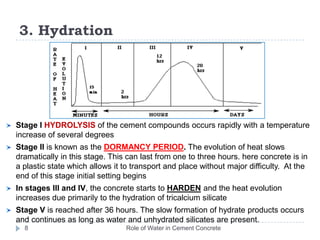
3. HydrationRole of Water in Cement Concrete8Stage IHYDROLYSIS of the cement compounds occurs rapidly with a temperature increase of several degreesStage II is known as the DORMANCY PERIOD. The evolution of heat slows dramatically in this stage. This can last from one to three hours. here concrete is in a plastic state which allows it to transport and place without major difficulty.  At the end of this stage initial setting beginsIn stages III and IV, the concrete starts to HARDEN and the heat evolution increases due primarily to the hydration of tricalcium silicateStage V is reached after 36 hours. The slow formation of hydrate products occurs and continues as long as water and unhydrated silicates are present.
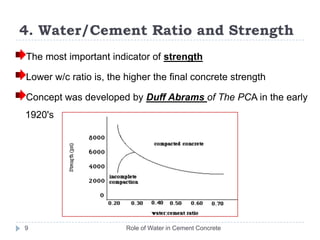
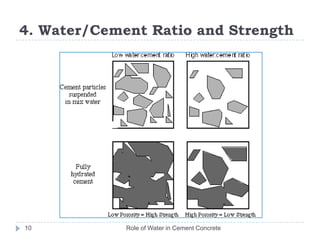
4. Water/Cement Ratio and StrengthRole of Water in Cement Concrete9The most important indicator of strengthLower w/c ratio is, the higher the final concrete strengthConcept was developed by Duff Abramsof The PCA in the early 1920's
Role of Water in Cement Concrete104. Water/Cement Ratio and Strength
Role of Water in Cement Concrete114. Water/Cement Ratio and StrengthA minimum w/c ratio of about 0.25 by weight is necessary to ensure that the water comes into contact with all cement particles (for complete hydration)Typical values are 0.25 to 0.6
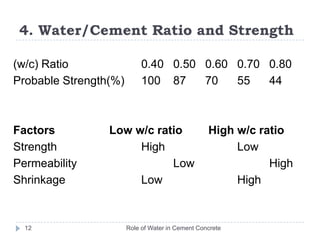
Role of Water in Cement Concrete124. Water/Cement Ratio and Strength(w/c) Ratio			0.40  	0.50  	0.60  	0.70 	0.80Probable Strength(%) 	100	87 	70 	55 	44Factors	 	Low w/c ratio	 High w/c ratioStrength 			High 			LowPermeability 			Low			HighShrinkage 			Low 			High
Adding extra water to concrete!!!Role of Water in Cement Concrete13Adding more water creates a diluted paste that is weaker and more susceptible to cracking and shrinkageShrinkage leads to micro-cracks (zones of weakness)Once the fresh concrete is placed, excess water is squeezed out of paste by weight of aggregate and cementThe excess water bleeds out onto the surface. The micro channels and passages that were created inside the concrete to allow that water to flow become weak zones
Adding extra water to concrete!!!Role of Water in Cement Concrete14This affects the compressive, tensile and flexural strengths, the porosity and the shrinkageLoss of Inherent good qualities like Cohesiveness and HomogeneityHarmful to Strength and DurabilitySowing the seed of Cancer in concreteIt is an AbuseIt is a Criminal actUn-engineering------------------(M.S.Shetty, Eminent Author)
Role of Water in Cement Concrete15* Increased strength.* Lower permeability.* Increased resistance to weathering.* Better bond between concrete and reinforcement.* Reduced drying shrinkage and cracking.* Less volume change from wetting and drying.Advantages of low water/cement ratio
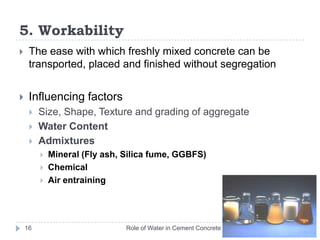
5. WorkabilityRole of Water in Cement Concrete16The ease with which freshly mixed concrete can be transported, placed and finished without segregationInfluencing factorsSize, Shape, Texture and grading of aggregateWater ContentAdmixturesMineral (Fly ash, Silica fume, GGBFS)ChemicalAir entraining
Admixture types Role of Water in Cement Concrete17Chemical and Air-entraining admixtures are Covered by IS:9301-1999	a) Accelerating admixtures	b) Retarding Admixtures	c) Water-reducing admixtures (plasticizers)	d) Air-entraining admixtures and	e) Super-plasticizing admixtures
Water-reducing admixturesRole of Water in Cement Concrete18An admixture which either increases workability of freshly mixed mortar or concrete without increasing water content or maintains workability with a reduced amount of waterRole of water reducers is to deflocculate the cement particles agglomerated together and release the water tied up in these agglomerations Can be categorized according to their active ingredientssalts and modifications of hydroxylized carboxylic acids (HC type)salts and modifications of lignosulfonic acids and Polymeric materials (PS type)Reduces water demand 7-10%Example:PolyHeed 997Ā -BASF, FLOCRETE N-Don chemicals
Air-entraining admixturesRole of Water in Cement Concrete19Which causes air to be incorporated in the form of minute bubbles in the concrete or mortar during mixing, usually to increase workability and resistance to freezing and thawing and disruptive action of de-icing saltsĀ Reduces bleeding and segregation of fresh concreteĀ Can be categorized into four groups: salts of wood resinssynthetic detergentssalts of petroleum acids,fatty and resinous acids and their saltsMB-AE 90-BASF,  AiralonĀ® 3000-Grace
Super-plasticizing admixturesRole of Water in Cement Concrete20Which imparts very high workability or allows a large decrease in water content for a given workabilityĀ Reduce water content by 12 to 30 percentĀ The effect of superplasticizers lasts only 30 to 60 minutes and is followed by a rapid loss in workabilityĀ Superplasticizers are usually added to concrete at the jobsiteExample : Glenium-BASF, 	Supaflo-Don Chemicals
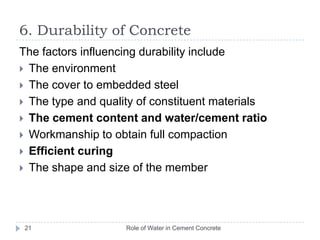
6. Durability of Concrete Role of Water in Cement Concrete21The factors influencing durability includeThe environmentThe cover to embedded steelThe type and quality of constituent materialsThe cement content and water/cement ratioWorkmanship to obtain full compactionEfficient curingThe shape and size of the member
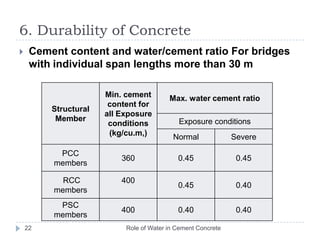
6. Durability of ConcreteRole of Water in Cement Concrete22Cement content and water/cement ratio For bridges with individual span lengths more than 30 m
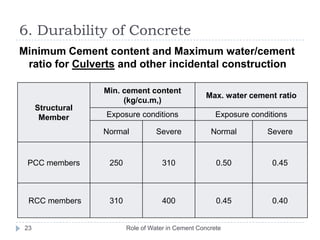
6. Durability of ConcreteRole of Water in Cement Concrete23Minimum Cement content and Maximum water/cement ratio for Culverts and other incidental construction
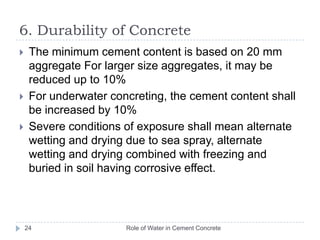
Role of Water in Cement Concrete24The minimum cement content is based on 20 mm aggregate For larger size aggregates, it may be reduced up to 10%For underwater concreting, the cement content shall be increased by 10%Severe conditions of exposure shall mean alternate wetting and drying due to sea spray, alternate wetting and drying combined with freezing and buried in soil having corrosive effect.6. Durability of Concrete
Role of Water in Cement Concrete25Curing methods 1. Water curing     2. Steam curing   3. Curing compoundsWater curingSea water shall not be used for curingSeawater shall not come into contact with concrete members unless it has attained adequate strengthExposed surface of concrete shall be kept continuously in a damp or wet condition by ponding or by covering with a layer of sacks, canvas, Hessian or similar materials and shall be kept constantly wet for a period of not less than 14 days from the date of placing of concrete.6. Durability of Concrete- Curing
Role of Water in Cement Concrete26Curing compoundsAll concrete cured by this method shall receive two applications of the curing compoundThe first coat shall be applied immediately after acceptance of concrete finishThe second application shall be made after the first application has setCuring compounds shall not be used on any surface which requires further finishing to be appliedNo curing compound shall be permitted in locations where concrete surfaces are required to be bonded together6. Durability of Concrete- Curing
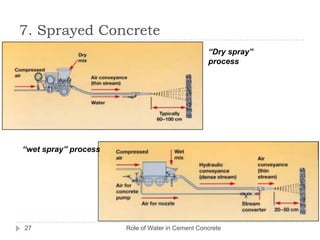
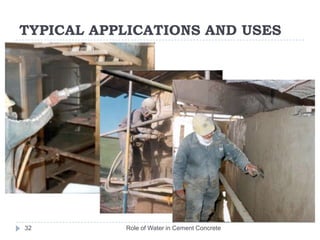
7. Sprayed ConcreteRole of Water in Cement Concrete27ā€œDry sprayā€ processā€œwet sprayā€ process
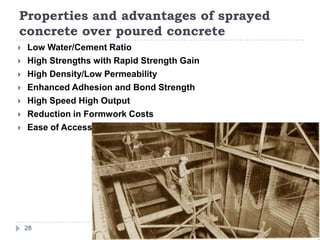
Properties and advantages of sprayed concrete over poured concreteRole of Water in Cement Concrete28Low Water/Cement RatioHigh Strengths with Rapid Strength GainHigh Density/Low PermeabilityEnhanced Adhesion and Bond StrengthHigh Speed High OutputReduction in Formwork CostsEase of Access
TYPICAL APPLICATIONS AND USESNew ConstructionUnderground ConstructionRole of Water in Cement Concrete29	Shell roofs and domes	Retaining walls	Piled wall facings	Silo structures	Barrel vaulting	Diaphragm walls	Caissons	Blast proof structures	Bank vaultsTunnel liningsStorage reservoirs
TYPICAL APPLICATIONS AND USESWater Retaining StructuresProtective CoatingsRole of Water in Cement Concrete30Fire protection to structural steelworkRefractory liningsPipeline encasementRock and soil stabilisationSea and river wallsReservoirs and damsAqueductsSwimming pools Water towersCanal liningsIrrigation and drainage channels
TYPICAL APPLICATIONS AND USESStrengthening and RepairFree Formed StructuresRole of Water in Cement Concrete31Concrete damaged by reinforcement corrosionFire damaged structuresCooling towersBridgesJetties and wharvesBrick arches and tunnelsTunnel liningsoverlaysSwimming poolsLandscapingClimbing wallsTheme parksSculptureWater sports slalom coursesBobsleigh runsZoological structures
TYPICAL APPLICATIONS AND USESRole of Water in Cement Concrete32
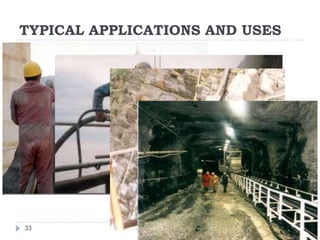
Role of Water in Cement Concrete33TYPICAL APPLICATIONS AND USES
ReferencesRole of Water in Cement Concrete34MORTHIS:456 PLAIN AND REINFORCED CONCRETE-CODE OF PRACTICEIS:9103- CONCRETE ADMIXTURES — SPECIFICATIONwww.sca.org.uk

Water in concrete

  • 1.
    Role of Waterin ā€œMan Made Rockā€ By G Narendra GoudAsst.Manager QA/QC1
  • 2.
    Contents Role ofWater in Cement Concrete2Cement Concrete- the ā€œMan Made Rockā€Requirements of water used in concreteHydrationWater/Cement Ratio and StrengthWorkability of ConcreteAdmixturesDurability of ConcreteSprayed concrete
  • 3.
    1. Cement Concrete-Theā€œMan Made Rockā€Role of Water in Cement Concrete3Concrete is not just another material, it is 2ndmost used material on the Earth It is a composite material made up of a filler and a binderThe binder(cement paste) "glues" the filler together to form a synthetic conglomerate.The constituents used for the binder are Cement and Water, while the filler can be fine and/or coarse aggregate
  • 4.
    Binder = Cement+ WaterRole of Water in Cement Concrete4 Cement consists of Mainly Lime 75 to 77%Silica and Alumina 12 to 15%Iron Oxide 0.5 to 6%Water consists of Hydrogen and Oxygen (i.e. H2O)
  • 5.
    2. Requirements ofwater used in concreteRole of Water in Cement Concrete5Water used for mixing and curing shall be clean and free from injurious amounts of Oils, Acids, Alkalis, Salts, Sugar, Organic materialsPotable water is generally considered satisfactory for mixing concreteMixing and curing with sea water shall not be permitted.The pH value shall not be less than 6
  • 6.
    Role of Waterin Cement Concrete62. Requirements of water used in concreteThe permissible limits for solids in water Solids Permissible Limits (Max) Organic 200 mg/lit Inorganic 3000 mg/lit Sulphates (SO4) 500 mg/lit Chlorides (Cl) 500 mg/lit Suspended matter 2000 mg/litWhat if water does not meet the above requirements????
  • 7.
    3. HydrationRole ofWater in Cement Concrete7 Concrete achieves its strength through a chemical process called Hydration. Hydration is a complex process but in simple terms, is the reaction between water and the cement in the mix.
  • 8.
    3. HydrationRole ofWater in Cement Concrete8Stage IHYDROLYSIS of the cement compounds occurs rapidly with a temperature increase of several degreesStage II is known as the DORMANCY PERIOD. The evolution of heat slows dramatically in this stage. This can last from one to three hours. here concrete is in a plastic state which allows it to transport and place without major difficulty. At the end of this stage initial setting beginsIn stages III and IV, the concrete starts to HARDEN and the heat evolution increases due primarily to the hydration of tricalcium silicateStage V is reached after 36 hours. The slow formation of hydrate products occurs and continues as long as water and unhydrated silicates are present.
  • 9.
    4. Water/Cement Ratioand StrengthRole of Water in Cement Concrete9The most important indicator of strengthLower w/c ratio is, the higher the final concrete strengthConcept was developed by Duff Abramsof The PCA in the early 1920's
  • 10.
    Role of Waterin Cement Concrete104. Water/Cement Ratio and Strength
  • 11.
    Role of Waterin Cement Concrete114. Water/Cement Ratio and StrengthA minimum w/c ratio of about 0.25 by weight is necessary to ensure that the water comes into contact with all cement particles (for complete hydration)Typical values are 0.25 to 0.6
  • 12.
    Role of Waterin Cement Concrete124. Water/Cement Ratio and Strength(w/c) Ratio 0.40 0.50 0.60 0.70 0.80Probable Strength(%) 100 87 70 55 44Factors Low w/c ratio High w/c ratioStrength High LowPermeability Low HighShrinkage Low High
  • 13.
    Adding extra waterto concrete!!!Role of Water in Cement Concrete13Adding more water creates a diluted paste that is weaker and more susceptible to cracking and shrinkageShrinkage leads to micro-cracks (zones of weakness)Once the fresh concrete is placed, excess water is squeezed out of paste by weight of aggregate and cementThe excess water bleeds out onto the surface. The micro channels and passages that were created inside the concrete to allow that water to flow become weak zones
  • 14.
    Adding extra waterto concrete!!!Role of Water in Cement Concrete14This affects the compressive, tensile and flexural strengths, the porosity and the shrinkageLoss of Inherent good qualities like Cohesiveness and HomogeneityHarmful to Strength and DurabilitySowing the seed of Cancer in concreteIt is an AbuseIt is a Criminal actUn-engineering------------------(M.S.Shetty, Eminent Author)
  • 15.
    Role of Waterin Cement Concrete15* Increased strength.* Lower permeability.* Increased resistance to weathering.* Better bond between concrete and reinforcement.* Reduced drying shrinkage and cracking.* Less volume change from wetting and drying.Advantages of low water/cement ratio
  • 16.
    5. WorkabilityRole ofWater in Cement Concrete16The ease with which freshly mixed concrete can be transported, placed and finished without segregationInfluencing factorsSize, Shape, Texture and grading of aggregateWater ContentAdmixturesMineral (Fly ash, Silica fume, GGBFS)ChemicalAir entraining
  • 17.
    Admixture types Roleof Water in Cement Concrete17Chemical and Air-entraining admixtures are Covered by IS:9301-1999 a) Accelerating admixtures b) Retarding Admixtures c) Water-reducing admixtures (plasticizers) d) Air-entraining admixtures and e) Super-plasticizing admixtures
  • 18.
    Water-reducing admixturesRole ofWater in Cement Concrete18An admixture which either increases workability of freshly mixed mortar or concrete without increasing water content or maintains workability with a reduced amount of waterRole of water reducers is to deflocculate the cement particles agglomerated together and release the water tied up in these agglomerations Can be categorized according to their active ingredientssalts and modifications of hydroxylized carboxylic acids (HC type)salts and modifications of lignosulfonic acids and Polymeric materials (PS type)Reduces water demand 7-10%Example:PolyHeed 997Ā -BASF, FLOCRETE N-Don chemicals
  • 19.
    Air-entraining admixturesRole ofWater in Cement Concrete19Which causes air to be incorporated in the form of minute bubbles in the concrete or mortar during mixing, usually to increase workability and resistance to freezing and thawing and disruptive action of de-icing saltsĀ Reduces bleeding and segregation of fresh concreteĀ Can be categorized into four groups: salts of wood resinssynthetic detergentssalts of petroleum acids,fatty and resinous acids and their saltsMB-AE 90-BASF, AiralonĀ® 3000-Grace
  • 20.
    Super-plasticizing admixturesRole ofWater in Cement Concrete20Which imparts very high workability or allows a large decrease in water content for a given workabilityĀ Reduce water content by 12 to 30 percentĀ The effect of superplasticizers lasts only 30 to 60 minutes and is followed by a rapid loss in workabilityĀ Superplasticizers are usually added to concrete at the jobsiteExample : Glenium-BASF, Supaflo-Don Chemicals
  • 21.
    6. Durability ofConcrete Role of Water in Cement Concrete21The factors influencing durability includeThe environmentThe cover to embedded steelThe type and quality of constituent materialsThe cement content and water/cement ratioWorkmanship to obtain full compactionEfficient curingThe shape and size of the member
  • 22.
    6. Durability ofConcreteRole of Water in Cement Concrete22Cement content and water/cement ratio For bridges with individual span lengths more than 30 m
  • 23.
    6. Durability ofConcreteRole of Water in Cement Concrete23Minimum Cement content and Maximum water/cement ratio for Culverts and other incidental construction
  • 24.
    Role of Waterin Cement Concrete24The minimum cement content is based on 20 mm aggregate For larger size aggregates, it may be reduced up to 10%For underwater concreting, the cement content shall be increased by 10%Severe conditions of exposure shall mean alternate wetting and drying due to sea spray, alternate wetting and drying combined with freezing and buried in soil having corrosive effect.6. Durability of Concrete
  • 25.
    Role of Waterin Cement Concrete25Curing methods 1. Water curing 2. Steam curing 3. Curing compoundsWater curingSea water shall not be used for curingSeawater shall not come into contact with concrete members unless it has attained adequate strengthExposed surface of concrete shall be kept continuously in a damp or wet condition by ponding or by covering with a layer of sacks, canvas, Hessian or similar materials and shall be kept constantly wet for a period of not less than 14 days from the date of placing of concrete.6. Durability of Concrete- Curing
  • 26.
    Role of Waterin Cement Concrete26Curing compoundsAll concrete cured by this method shall receive two applications of the curing compoundThe first coat shall be applied immediately after acceptance of concrete finishThe second application shall be made after the first application has setCuring compounds shall not be used on any surface which requires further finishing to be appliedNo curing compound shall be permitted in locations where concrete surfaces are required to be bonded together6. Durability of Concrete- Curing
  • 27.
    7. Sprayed ConcreteRoleof Water in Cement Concrete27ā€œDry sprayā€ processā€œwet sprayā€ process
  • 28.
    Properties and advantagesof sprayed concrete over poured concreteRole of Water in Cement Concrete28Low Water/Cement RatioHigh Strengths with Rapid Strength GainHigh Density/Low PermeabilityEnhanced Adhesion and Bond StrengthHigh Speed High OutputReduction in Formwork CostsEase of Access
  • 29.
    TYPICAL APPLICATIONS ANDUSESNew ConstructionUnderground ConstructionRole of Water in Cement Concrete29 Shell roofs and domes Retaining walls Piled wall facings Silo structures Barrel vaulting Diaphragm walls Caissons Blast proof structures Bank vaultsTunnel liningsStorage reservoirs
  • 30.
    TYPICAL APPLICATIONS ANDUSESWater Retaining StructuresProtective CoatingsRole of Water in Cement Concrete30Fire protection to structural steelworkRefractory liningsPipeline encasementRock and soil stabilisationSea and river wallsReservoirs and damsAqueductsSwimming pools Water towersCanal liningsIrrigation and drainage channels
  • 31.
    TYPICAL APPLICATIONS ANDUSESStrengthening and RepairFree Formed StructuresRole of Water in Cement Concrete31Concrete damaged by reinforcement corrosionFire damaged structuresCooling towersBridgesJetties and wharvesBrick arches and tunnelsTunnel liningsoverlaysSwimming poolsLandscapingClimbing wallsTheme parksSculptureWater sports slalom coursesBobsleigh runsZoological structures
  • 32.
    TYPICAL APPLICATIONS ANDUSESRole of Water in Cement Concrete32
  • 33.
    Role of Waterin Cement Concrete33TYPICAL APPLICATIONS AND USES
  • 34.
    ReferencesRole of Waterin Cement Concrete34MORTHIS:456 PLAIN AND REINFORCED CONCRETE-CODE OF PRACTICEIS:9103- CONCRETE ADMIXTURES — SPECIFICATIONwww.sca.org.uk