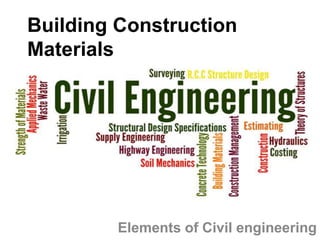
Building Construction 
Materials 
Elements of Civil engineering
Building Construction Materials 
• Stone 
• Brick 
• Lime 
• Cement 
• Metal 
• Timber 
• Sand 
• Aggregates 
• Mortar
Stone 
Requirements of 
Stone.. 
• Structure 
• Appearance - Colour 
Texture 
• Weight 
• Fineness of Grains 
• Durability 
• Strength 
• Hardness 
• Facility of Working 
and Dressing
Stone 
Types of stones are… 
• Igneous Rocks, Sedimentary Rocks, 
Metamorphic Rocks. 
• Stratified, Unstratified, Foliated. 
• Siliceous, Argillaceous, Calcarious.
Stone 
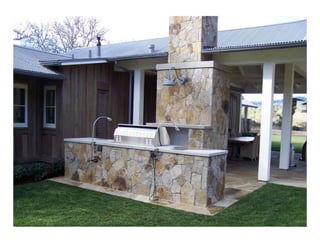
• They are used in hydraulic structures like 
dams and bridges. 
• They are used in retaining wall masonry to 
retain soil. 
• They are used as road metal in road 
construction. 
• They are used as ballast for permanent 
way in railways. 
• They are used to make concrete in the 
form of coarse aggregate.
Brick 
Requirements of Bricks… 
• The color of the brick should be red or 
copper and uniform. 
• It should be well burnt in kilns. 
• The surface should be even and free from 
cracks. 
• The edges should be sharp.
Brick 
Standard Sizes of bricks… 
• Conventional / Traditional bricks : Size 23 
cm x 11.4 cm x 7.6 cm 
• Standard / Modular : Size : 19 cm x 9 cm x 
9 cm
Brick 
• Bricks are used in wall masonry construction 
of building 
• Used in brick lintel construction 
• Bats of brick are used in concrete in 
foundation work. 
• They are durable. 
• They are low cost material. 
• They possess good strength. 
• They are easily available. 
• Brick are light in compared to stones.
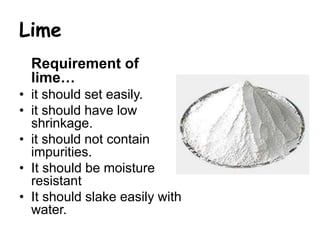
Lime 
Requirement of 
lime… 
• it should set easily. 
• it should have low 
shrinkage. 
• it should not contain 
impurities. 
• It should be moisture 
resistant 
• It should slake easily with 
water.
Lime 
• It has good workability. 
• It stiffens quickly. 
• It has low shrinkage. 
• It has good resistant to moisture. 
• Lime possesses good plasticity.
Cement 
Requirements of 
cement… 
• Cement should Cement should 
not possess of alumina which 
may reduce strength. 
• not contain alumina in excess 
as it weakens the cement. 
• A very small amount of Sulphar 
is added in cement to make 
sound cement. 
• It should found cool when 
touch by hand. 
• it should be in fine powder 
form while checking with first 
finger and thumb.
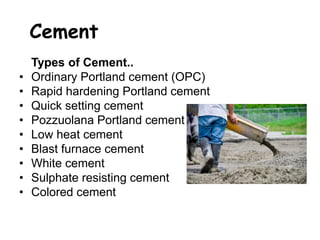
Cement 
Types of Cement.. 
• Ordinary Portland cement (OPC) 
• Rapid hardening Portland cement 
• Quick setting cement 
• Pozzuolana Portland cement 
• Low heat cement 
• Blast furnace cement 
• White cement 
• Sulphate resisting cement 
• Colored cement
Cement 
• It is used in making joints for drains ,pipes. 
• It is used to prepare RCC structures of 
building by using reinforcement with cement 
concrete. 
• it is used in construction of buildings, 
bridges, tanks, domes, flyovers, dockyard 
etc. 
• It is used to prepare cement mortar for 
building construction works like masonry, 
plaster, painting, flooring etc. 
• It is used to prepare cement concrete for 
various construction works.
Metal 
Requirements of metal… 
• They should provide sufficient strength to 
bear the loads coming on them 
• They should provide resistance to corrosion 
and weather actions 
• They should provided resistance to heat and 
fire. 
• They should have good adhesion with 
cement concrete.
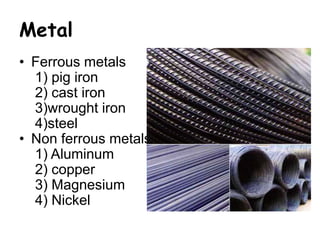
Metal 
• Ferrous metals 
1) pig iron 
2) cast iron 
3)wrought iron 
4)steel 
• Non ferrous metals 
1) Aluminum 
2) copper 
3) Magnesium 
4) Nickel
Timber 
Requirements of timber… 
• It should be dense. 
• It should have uniform texture. 
• It should have dark uniform color. 
• It should be workable, good machinability. 
• The medullary rays should be compact.
Timber 
Types of Timber… 
• Natural timber 
babul, oak, pine, mango, sal, teak, 
neem, palms, chir. 
• Industrial timber 
veneers, plywoods, fiberboards, impreg 
timber, compreg timber.
Timber 
Uses… 
• Railway sleepers, bridges, pipes. 
• Furniture, decorative pieces, doors. 
• Packing material, piles, cart wheels. 
• Poles, pen, rafter. 
• Roofs, partition walls, boats etc.
Sand 
• It should be clean. 
• It should be well graded. 
• Maximum permissible clay content is 3 to 4% in sand. 
• It should contain sharp, angular grains. 
• It should not contain salts which attract moisture from the 
atmosphere. 
• Sand is useful in various construction activities like 
masonry work, plaster work, flooring and concrete work. 
• Sand is used in cement mortar, plan cement concrete , 
reinforced cement concrete and prestressed concrete as 
key ingredient in building construction
Sand 
• It is naturally available material 
• It is durable 
• It mix with binding material easily 
• It has shiny luster 
• It is of whitish brown colour.
Sand 
Types of sands… 
• Natural 
natural sand is obtained from pits, river 
beds and sea beds. 
• Artificial 
artificial sand is formed by 
decomposition of sandstone due to 
various weathering effects.
Aggregate 
Requirements of Aggregates… 
• Aggregates should be sufficiently strong. 
• Aggregate surface should be rough and free form 
cracks. 
• Aggregate should have good soundness. 
• Aggregate should have good adhering with binding 
material. 
• Fine aggregates are used to prepare cement mortar, 
lime mortar and cement concrete. 
• Course aggregates are used to prepare cement 
concrete bituminous pavement, rigid pavement etc. 
• They are used in construction of beams, columns, slab, 
lintel etc.
Aggregate 
• Fine aggregates 
size of aggregate is 4.75 mm or less 
is termed as fine aggregates. 
• Coarse aggregates 
size of aggregates 80mm to 4.75 mm 
is known as course.
Aggregate 
• They are insoluble in water. 
• They are of moderate weight. 
• They are strong and durable. 
• They have resistance to scratches. 
• They have resistance to corrosion and 
decay.
Mortar 
Requirements of mortar 
• It should have good 
adhesion with bricks, 
stones. 
• It should resist penetration 
of rain water. 
• It should be cheap, 
durable, and workable. 
• It should be set quickly. 
• The joints formed by 
mortar should not develop 
cracks.
Mortar 
 To bind the bricks or stones firmly in wall 
construction work. 
 They are used in plaster work as finishing material 
to provide weather resistance joints of masonry 
work are covered by plaster work. White wash and 
color are applied on plastered surface easily. 
Properties of mortar 
 Mobility. 
 Place ability. 
 Water retention
Concrete 
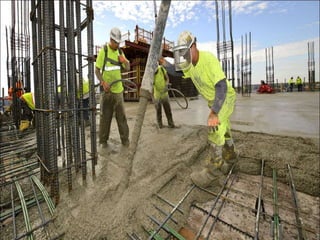
 Concrete is a mixture of cement/lime, sand, 
crushed rock, water. 
 Preparation of concrete 
<1>Ingredient of concrete 
<2>Methods of mixing of concrete 
*TYPES OF CONCRETE 
<1>Plain cement concrete 
<2>Reinforced cement concrete 
<3> Precast concrete 
<4> prestressed concrete
Concrete 
Requirements of concrete… 
• Workability 
• Strength 
• Durability 
• Dimensional stability 
Uses… 
• Foundation to slabe in building 
• Coating materil for water proofing
Artificial Or Industrial 
Materials 
• Cement 
• Bricks 
• Steel 
• Tiles 
• Ceramic 
• Paints and Varnishes 
• Glass 
• Plastic 
• Stone 
• Lime
Prepared By, FW Students…. 
• Akash Ambaliya (Roll no.-2) 
• Jay Chhatraliya (Roll no.-28) 
• Brijesh Daraniya (Roll no.-31) 
• Parag Hinsu (Roll no.-56)
Thank You…

Building construction materials

  • 1.
    Building Construction Materials Elements of Civil engineering
  • 2.
    Building Construction Materials • Stone • Brick • Lime • Cement • Metal • Timber • Sand • Aggregates • Mortar
  • 3.
    Stone Requirements of Stone.. • Structure • Appearance - Colour Texture • Weight • Fineness of Grains • Durability • Strength • Hardness • Facility of Working and Dressing
  • 4.
    Stone Types ofstones are… • Igneous Rocks, Sedimentary Rocks, Metamorphic Rocks. • Stratified, Unstratified, Foliated. • Siliceous, Argillaceous, Calcarious.
  • 6.
    Stone • Theyare used in hydraulic structures like dams and bridges. • They are used in retaining wall masonry to retain soil. • They are used as road metal in road construction. • They are used as ballast for permanent way in railways. • They are used to make concrete in the form of coarse aggregate.
  • 7.
    Brick Requirements ofBricks… • The color of the brick should be red or copper and uniform. • It should be well burnt in kilns. • The surface should be even and free from cracks. • The edges should be sharp.
  • 8.
    Brick Standard Sizesof bricks… • Conventional / Traditional bricks : Size 23 cm x 11.4 cm x 7.6 cm • Standard / Modular : Size : 19 cm x 9 cm x 9 cm
  • 9.
    Brick • Bricksare used in wall masonry construction of building • Used in brick lintel construction • Bats of brick are used in concrete in foundation work. • They are durable. • They are low cost material. • They possess good strength. • They are easily available. • Brick are light in compared to stones.
  • 10.
    Lime Requirement of lime… • it should set easily. • it should have low shrinkage. • it should not contain impurities. • It should be moisture resistant • It should slake easily with water.
  • 11.
    Lime • Ithas good workability. • It stiffens quickly. • It has low shrinkage. • It has good resistant to moisture. • Lime possesses good plasticity.
  • 12.
    Cement Requirements of cement… • Cement should Cement should not possess of alumina which may reduce strength. • not contain alumina in excess as it weakens the cement. • A very small amount of Sulphar is added in cement to make sound cement. • It should found cool when touch by hand. • it should be in fine powder form while checking with first finger and thumb.
  • 13.
    Cement Types ofCement.. • Ordinary Portland cement (OPC) • Rapid hardening Portland cement • Quick setting cement • Pozzuolana Portland cement • Low heat cement • Blast furnace cement • White cement • Sulphate resisting cement • Colored cement
  • 14.
    Cement • Itis used in making joints for drains ,pipes. • It is used to prepare RCC structures of building by using reinforcement with cement concrete. • it is used in construction of buildings, bridges, tanks, domes, flyovers, dockyard etc. • It is used to prepare cement mortar for building construction works like masonry, plaster, painting, flooring etc. • It is used to prepare cement concrete for various construction works.
  • 15.
    Metal Requirements ofmetal… • They should provide sufficient strength to bear the loads coming on them • They should provide resistance to corrosion and weather actions • They should provided resistance to heat and fire. • They should have good adhesion with cement concrete.
  • 16.
    Metal • Ferrousmetals 1) pig iron 2) cast iron 3)wrought iron 4)steel • Non ferrous metals 1) Aluminum 2) copper 3) Magnesium 4) Nickel
  • 17.
    Timber Requirements oftimber… • It should be dense. • It should have uniform texture. • It should have dark uniform color. • It should be workable, good machinability. • The medullary rays should be compact.
  • 18.
    Timber Types ofTimber… • Natural timber babul, oak, pine, mango, sal, teak, neem, palms, chir. • Industrial timber veneers, plywoods, fiberboards, impreg timber, compreg timber.
  • 20.
    Timber Uses… •Railway sleepers, bridges, pipes. • Furniture, decorative pieces, doors. • Packing material, piles, cart wheels. • Poles, pen, rafter. • Roofs, partition walls, boats etc.
  • 21.
    Sand • Itshould be clean. • It should be well graded. • Maximum permissible clay content is 3 to 4% in sand. • It should contain sharp, angular grains. • It should not contain salts which attract moisture from the atmosphere. • Sand is useful in various construction activities like masonry work, plaster work, flooring and concrete work. • Sand is used in cement mortar, plan cement concrete , reinforced cement concrete and prestressed concrete as key ingredient in building construction
  • 22.
    Sand • Itis naturally available material • It is durable • It mix with binding material easily • It has shiny luster • It is of whitish brown colour.
  • 23.
    Sand Types ofsands… • Natural natural sand is obtained from pits, river beds and sea beds. • Artificial artificial sand is formed by decomposition of sandstone due to various weathering effects.
  • 24.
    Aggregate Requirements ofAggregates… • Aggregates should be sufficiently strong. • Aggregate surface should be rough and free form cracks. • Aggregate should have good soundness. • Aggregate should have good adhering with binding material. • Fine aggregates are used to prepare cement mortar, lime mortar and cement concrete. • Course aggregates are used to prepare cement concrete bituminous pavement, rigid pavement etc. • They are used in construction of beams, columns, slab, lintel etc.
  • 25.
    Aggregate • Fineaggregates size of aggregate is 4.75 mm or less is termed as fine aggregates. • Coarse aggregates size of aggregates 80mm to 4.75 mm is known as course.
  • 27.
    Aggregate • Theyare insoluble in water. • They are of moderate weight. • They are strong and durable. • They have resistance to scratches. • They have resistance to corrosion and decay.
  • 28.
    Mortar Requirements ofmortar • It should have good adhesion with bricks, stones. • It should resist penetration of rain water. • It should be cheap, durable, and workable. • It should be set quickly. • The joints formed by mortar should not develop cracks.
  • 29.
    Mortar  Tobind the bricks or stones firmly in wall construction work.  They are used in plaster work as finishing material to provide weather resistance joints of masonry work are covered by plaster work. White wash and color are applied on plastered surface easily. Properties of mortar  Mobility.  Place ability.  Water retention
  • 30.
    Concrete  Concreteis a mixture of cement/lime, sand, crushed rock, water.  Preparation of concrete <1>Ingredient of concrete <2>Methods of mixing of concrete *TYPES OF CONCRETE <1>Plain cement concrete <2>Reinforced cement concrete <3> Precast concrete <4> prestressed concrete
  • 32.
    Concrete Requirements ofconcrete… • Workability • Strength • Durability • Dimensional stability Uses… • Foundation to slabe in building • Coating materil for water proofing
  • 33.
    Artificial Or Industrial Materials • Cement • Bricks • Steel • Tiles • Ceramic • Paints and Varnishes • Glass • Plastic • Stone • Lime
  • 34.
    Prepared By, FWStudents…. • Akash Ambaliya (Roll no.-2) • Jay Chhatraliya (Roll no.-28) • Brijesh Daraniya (Roll no.-31) • Parag Hinsu (Roll no.-56)
  • 35.