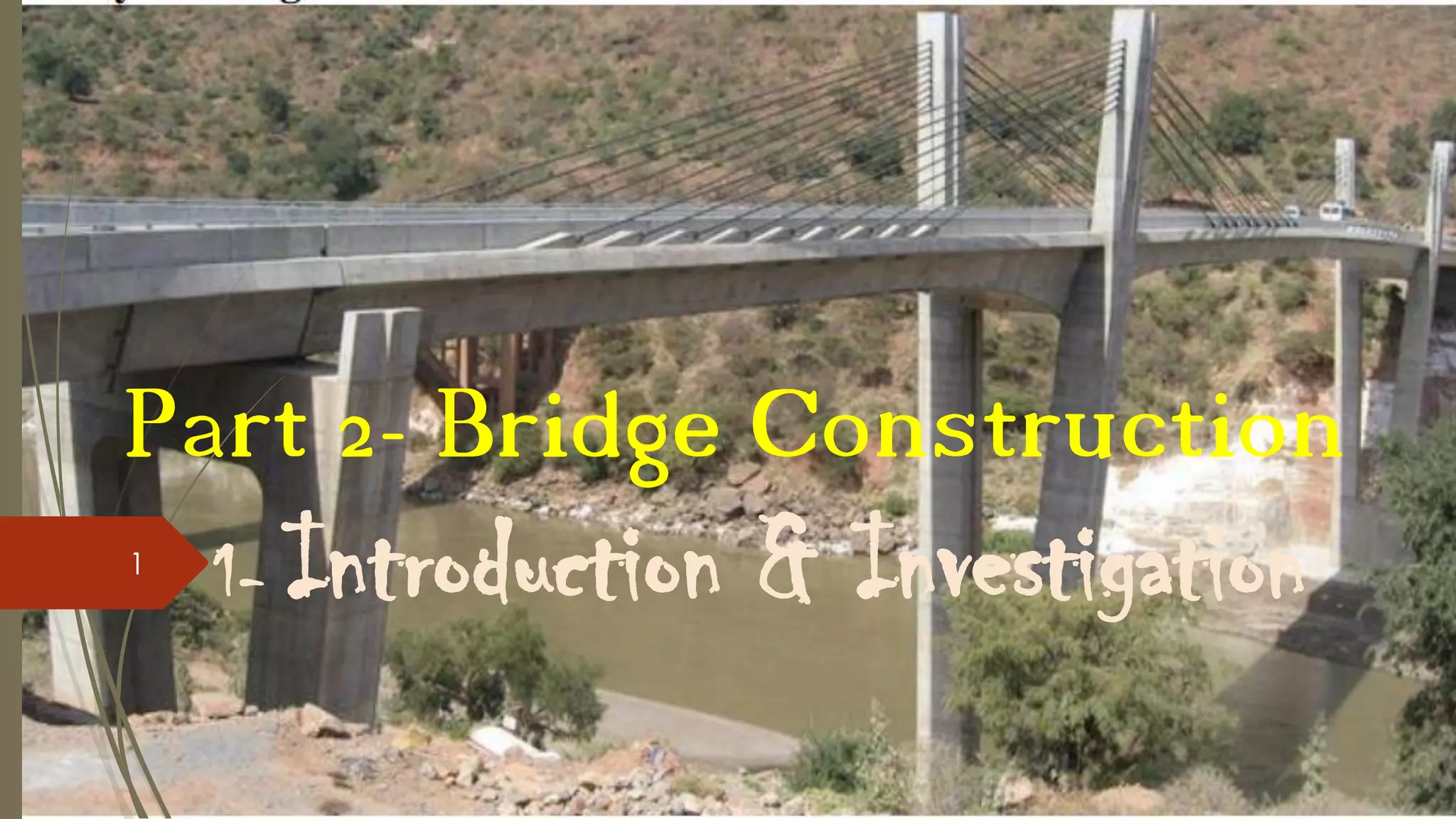
Part 2- Bridge Construction
1

1-

Introduction & Investigation
2

1.1. Introduction
Bridge is a structure providing passage (highway, railway,
pedestrian, canal, Pipeline) over obstacle (river, valley, road, railway)
“Build bridges and you will have a friend”
Bridge engineering is one of the fascinating fields in civil engineering
calling for expertise in many areas: structural analysis and design,
geotechnique, traffic projection, surveying, runoff calculation and
methods of construction.
A bridge engineer has to have an appreciation of economics and
aesthetics besides ability in analysis and design.
3

1.2. Investigation for Bridge
1.2.1. Preliminary Survey for site selection
Preliminary data for site selection is collected from
site visit for different alternative bridge sites.
The proposed road alignment

The local terrain and site conditions
The required design life of the bridge
The likely traffic volumes
The resources available for the project
4

1.2. Investigation for Bridge
1.2.2. Site Selection
Ideal site for bridge crossings
On straight reach of the river or nodal point for meandering rivers
Where the flow is steady and uniform

Beyond the disturbing influence of large tributaries
Has well defined & stable high banks above flood level
Has reasonable straight approach & permits square crossings

Has good foundation conditions
Has short span
Doesn’t requirement extensive river training work
Doesn’t requirement extensive underwater construction
5

1.2. Investigation for Bridge
1.2.2. Site Selection
 Initial Considerations during site selection
Appropriate vertical and horizontal alignment
Soil strength to ensure stability of the structure
Should not have adverse impact on adjoining land or building

 Location of bridge in relation to approach road alignment.
a) Total Span < 60m:- The alignment of approach govern

b) 60m < Total Span < 300m:- Both alignment & good bridge site selection
c)

Total Span > 300m:- Good bridge site governs
6

1.2. Investigation for Bridge
1.2.3. Site Investigation
 Factors that most often need to be confirmed by field inspection are
 High-water marks or profiles and related frequencies.
 Selection of roughness coefficients,

 Evaluation of apparent flow direction and diversions,
 Flow concentration (main stream),
 Observation of land use and related flood hazards, and

 Geomorphic relationships and soil conditions
7

1.2. Investigation for Bridge
1.2.3. Site Investigation
Elements of Site investigation

I- Catchment area and runoff data
 Catchment size
 Catchment grade
 Catchment cover
 Presence of artificial or natural storage

 Change in nature of catchment (deforestation & afforestation)
 Maximum recorded intensity & frequency of rain fall
8

1.2. Investigation for Bridge
1.2.3. Site Investigation
Elements of Site investigation

II- Drawings
A. Index map: general topographic map (1:50000)
B. Contour Map:
C. Site Plan: show detail of selected site 100-200m u/s and d/s of selected site
D. Cross section & longitudinal section of the river

E. Catchment area map:
9

1.2. Investigation for Bridge
1.2.3. Site Investigation
Elements of Site investigation

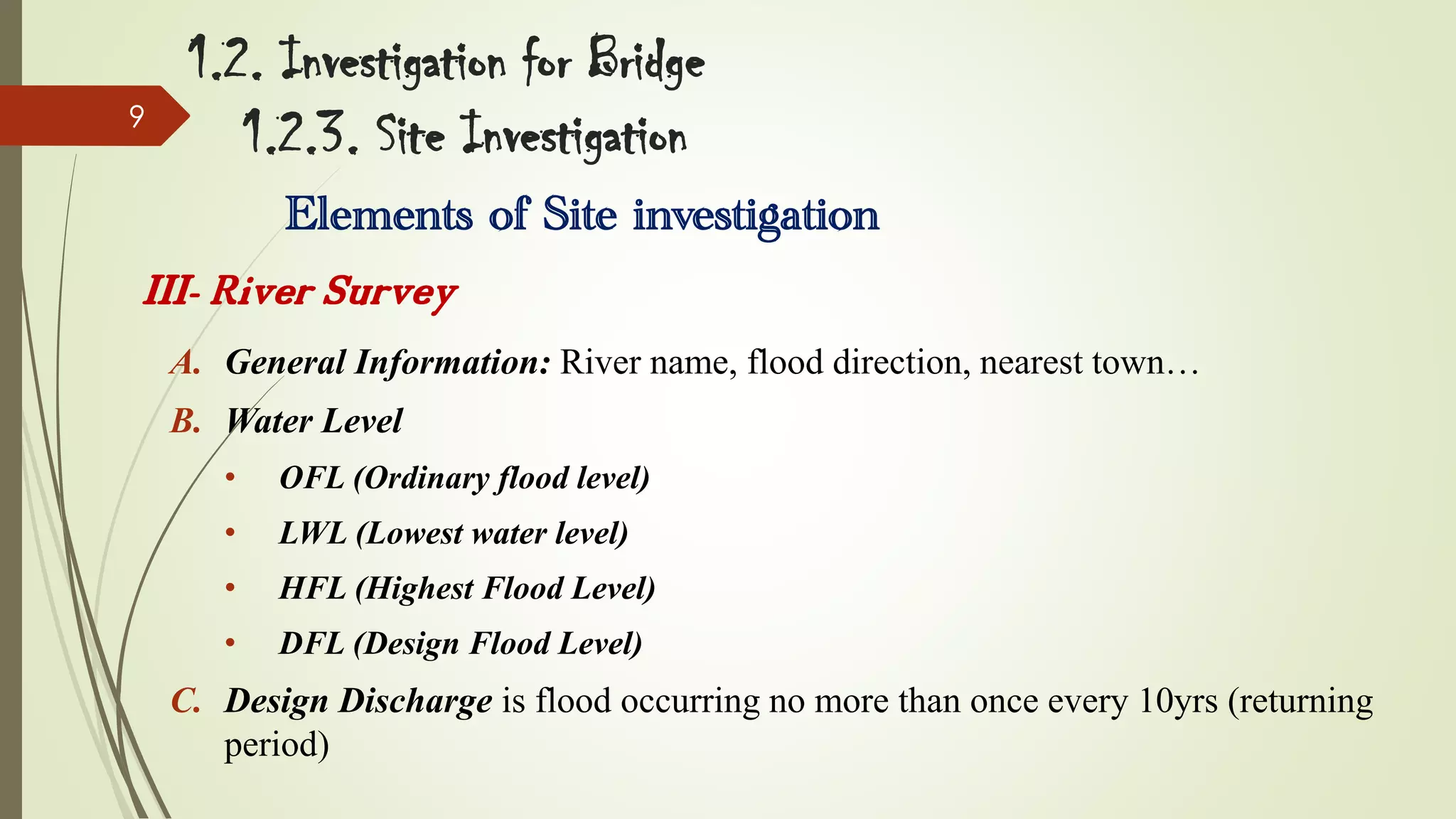
III- River Survey
A. General Information: River name, flood direction, nearest town…
B. Water Level
•

OFL (Ordinary flood level)

•

LWL (Lowest water level)

•

HFL (Highest Flood Level)

•

DFL (Design Flood Level)

C. Design Discharge is flood occurring no more than once every 10yrs (returning
period)
10

1.2. Investigation for Bridge
1.2.3. Site Investigation
Elements of Site investigation
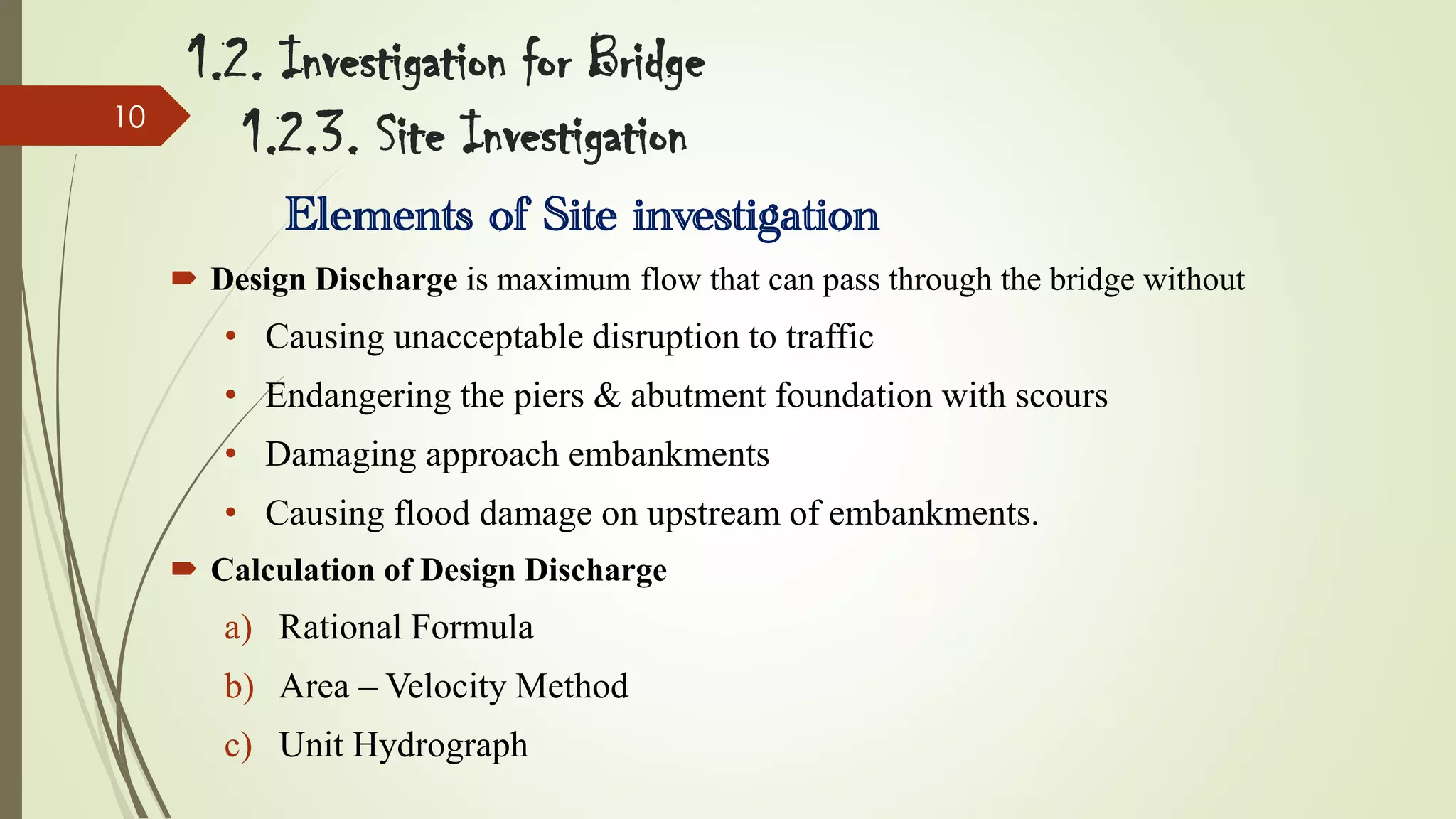
 Design Discharge is maximum flow that can pass through the bridge without

• Causing unacceptable disruption to traffic
• Endangering the piers & abutment foundation with scours

• Damaging approach embankments
• Causing flood damage on upstream of embankments.
 Calculation of Design Discharge

a) Rational Formula
b) Area – Velocity Method

c) Unit Hydrograph
11

1.2. Investigation for Bridge
1.2.3. Site Investigation
Elements of Site investigation

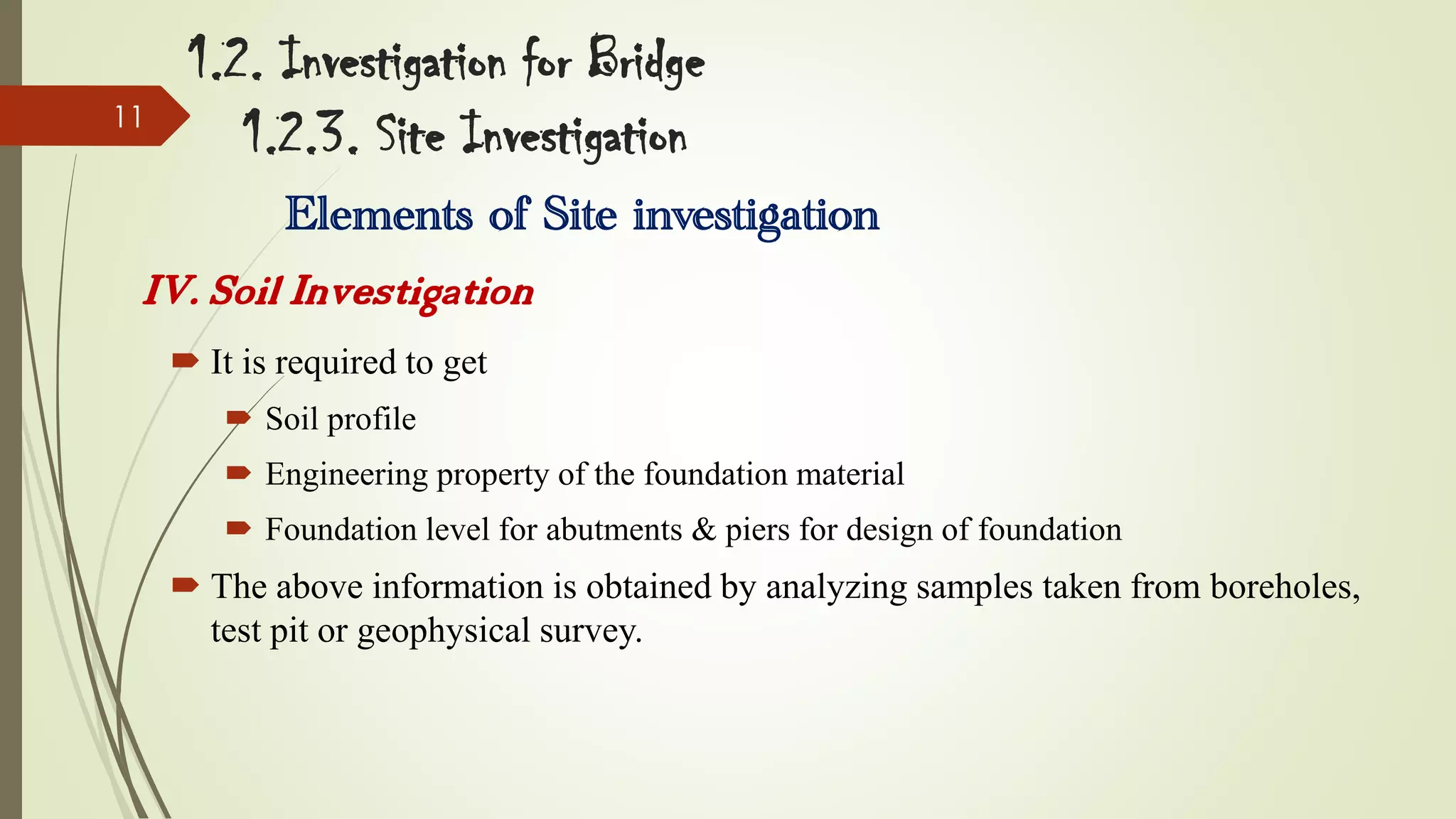
IV. Soil Investigation
 It is required to get
 Soil profile
 Engineering property of the foundation material
 Foundation level for abutments & piers for design of foundation

 The above information is obtained by analyzing samples taken from boreholes,
test pit or geophysical survey.
12

1.2. Investigation for Bridge
1.2.4. Span Determination

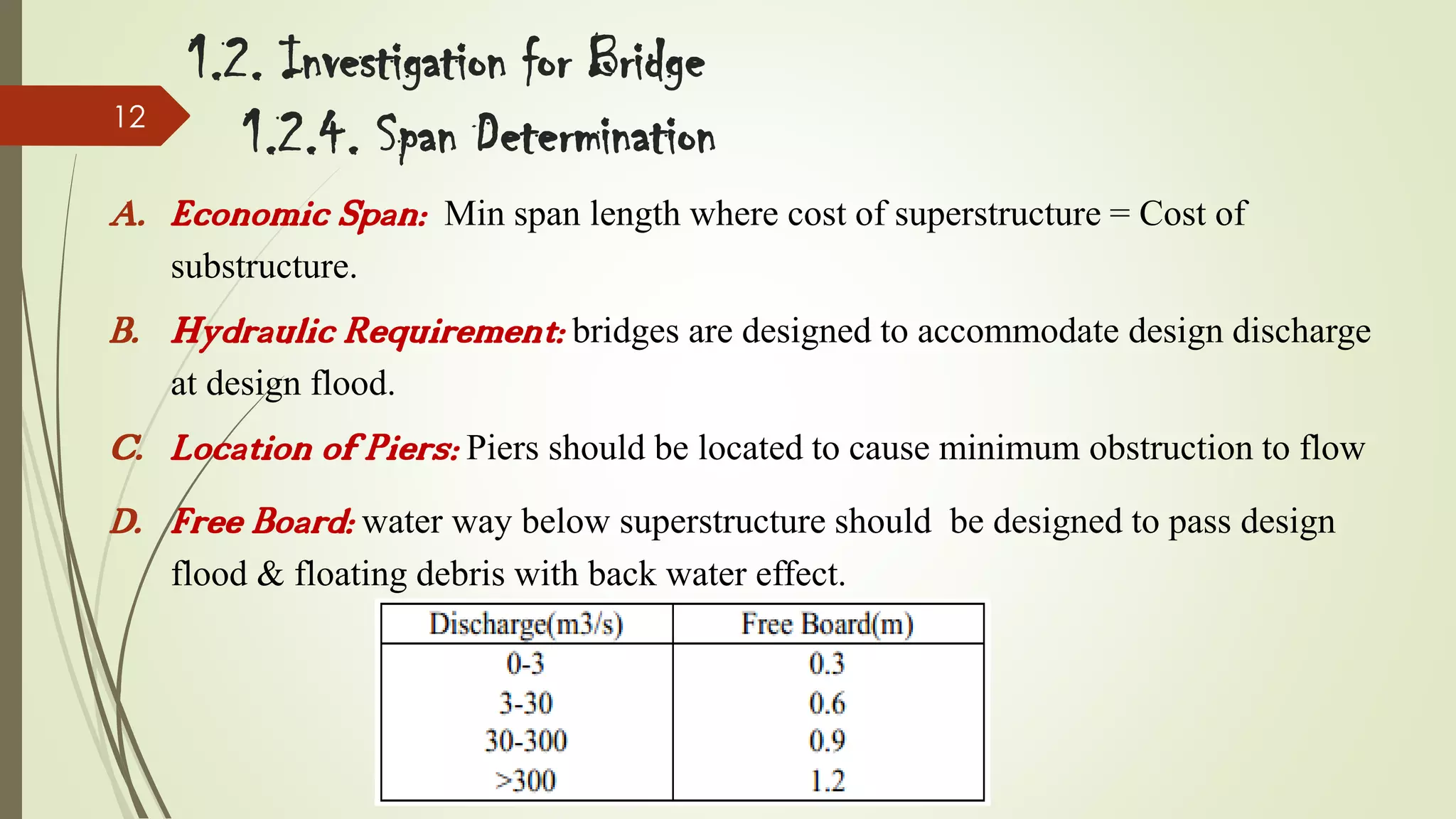
A. Economic Span:

Min span length where cost of superstructure = Cost of

substructure.

B. Hydraulic Requirement: bridges are designed to accommodate design discharge
at design flood.

C. Location of Piers: Piers should be located to cause minimum obstruction to flow
D. Free Board: water way below superstructure should be designed to pass design
flood & floating debris with back water effect.
13

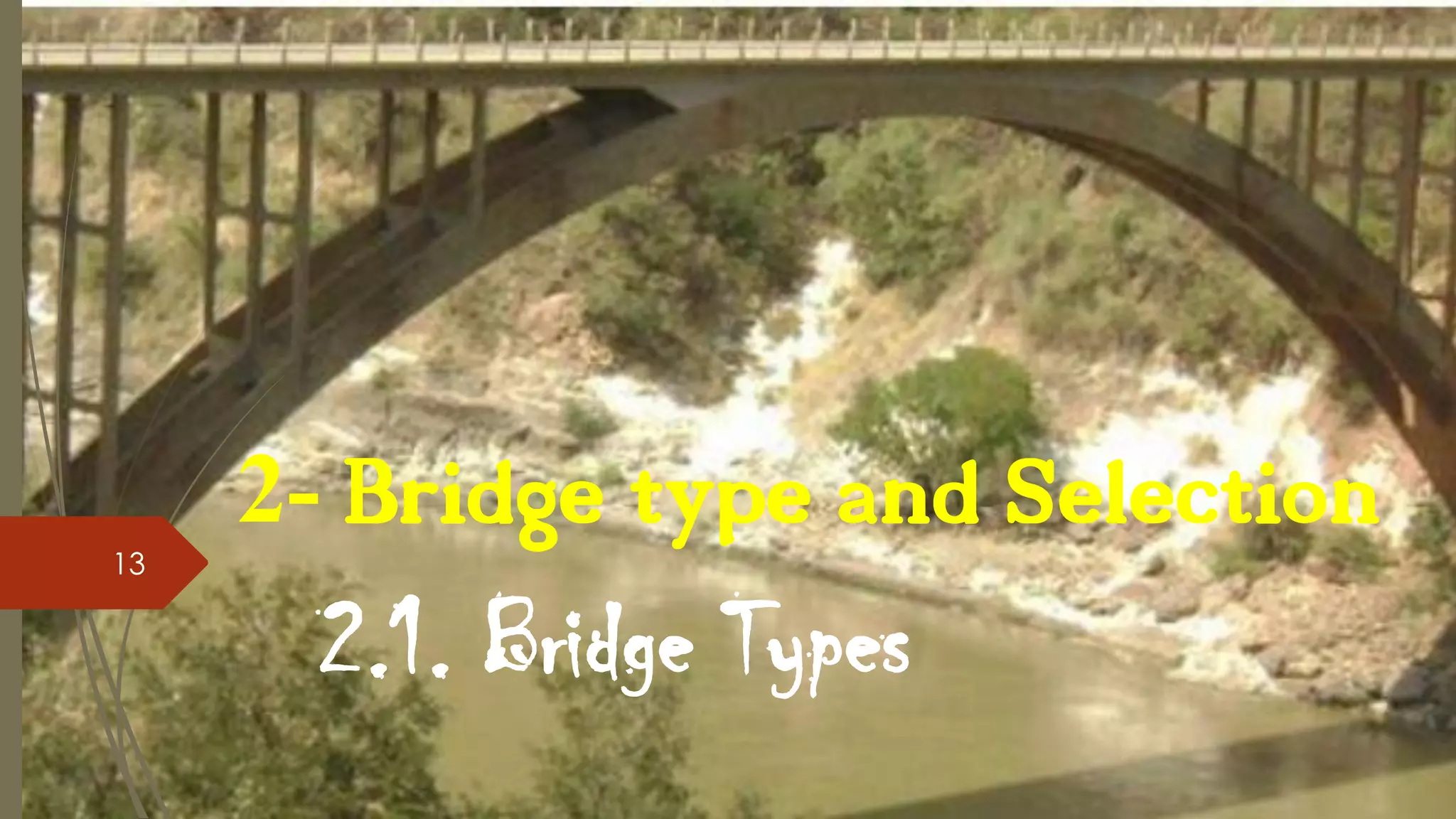
2- Bridge type and Selection

2.1. Bridge Types
14

2.1. Types of Bridge
Classification is mainly based on Superstructure

a) Material
b) Span Length
c) Span Arrangement
d) Functionality
e) Structural form
f) Span Length
g) Movement
15

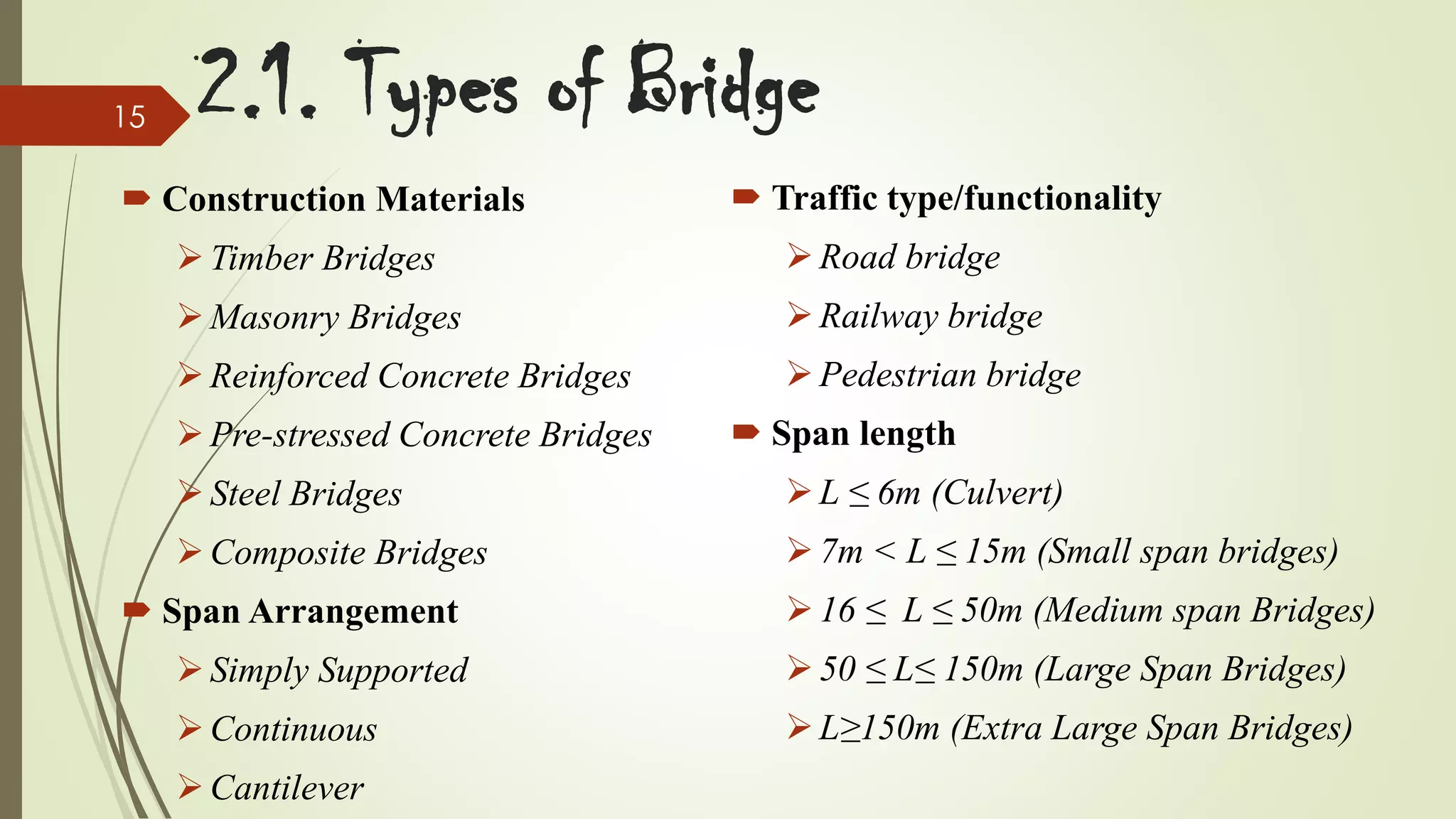
2.1. Types of Bridge

 Construction Materials

 Traffic type/functionality
 Timber Bridges

 Road bridge

 Masonry Bridges

 Railway bridge

 Reinforced Concrete Bridges

 Pedestrian bridge

 Pre-stressed Concrete Bridges

 Span length

 Steel Bridges

 L ≤ 6m (Culvert)

 Composite Bridges

 7m < L ≤ 15m (Small span bridges)

 Span Arrangement

 16 ≤ L ≤ 50m (Medium span Bridges)

 Simply Supported

 50 ≤ L≤ 150m (Large Span Bridges)

 Continuous

 L≥150m (Extra Large Span Bridges)

 Cantilever
16

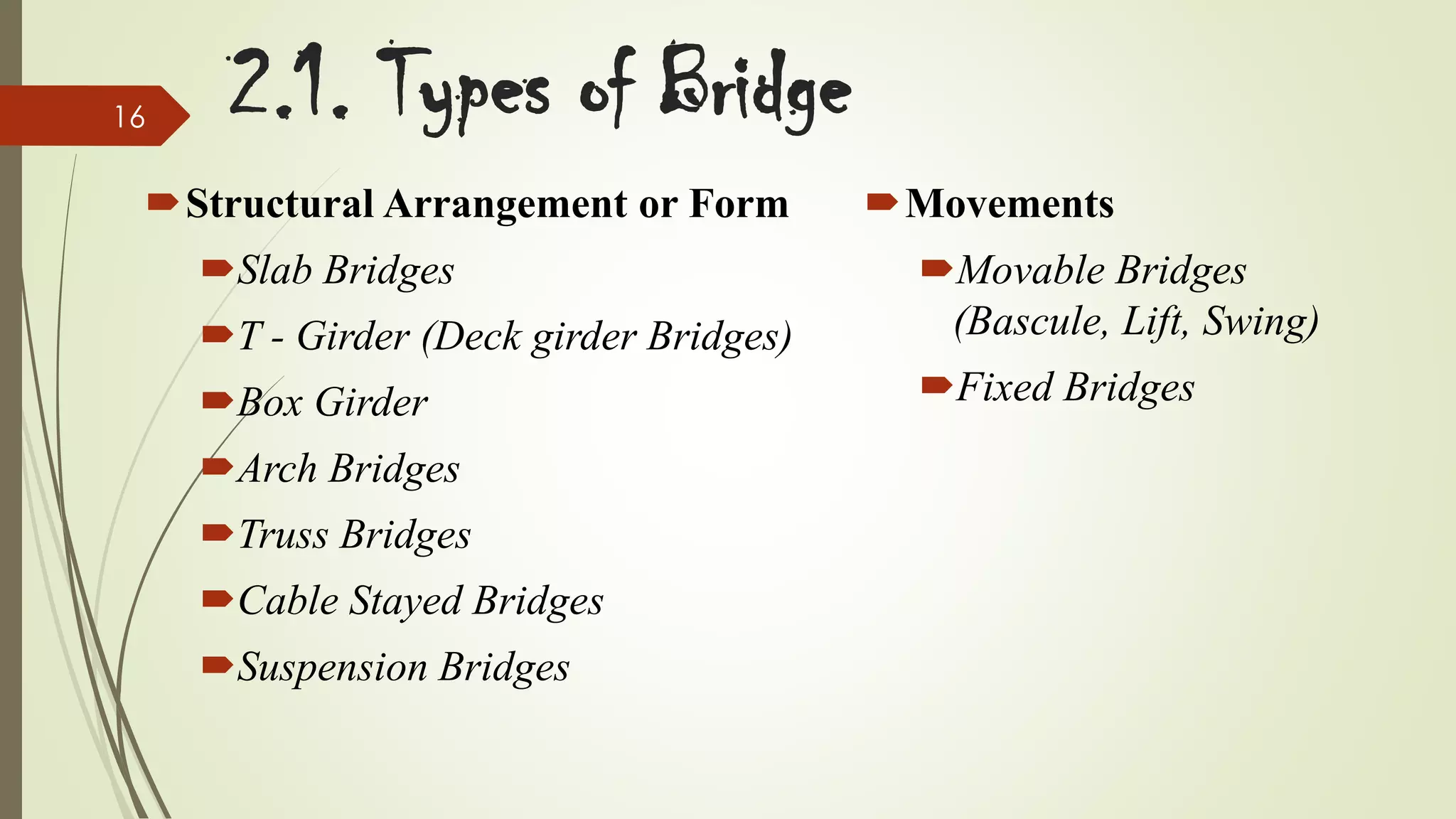
2.1. Types of Bridge

Structural Arrangement or Form
Slab Bridges

Movements

T - Girder (Deck girder Bridges)

Movable Bridges
(Bascule, Lift, Swing)

Box Girder

Fixed Bridges

Arch Bridges

Truss Bridges
Cable Stayed Bridges

Suspension Bridges
17

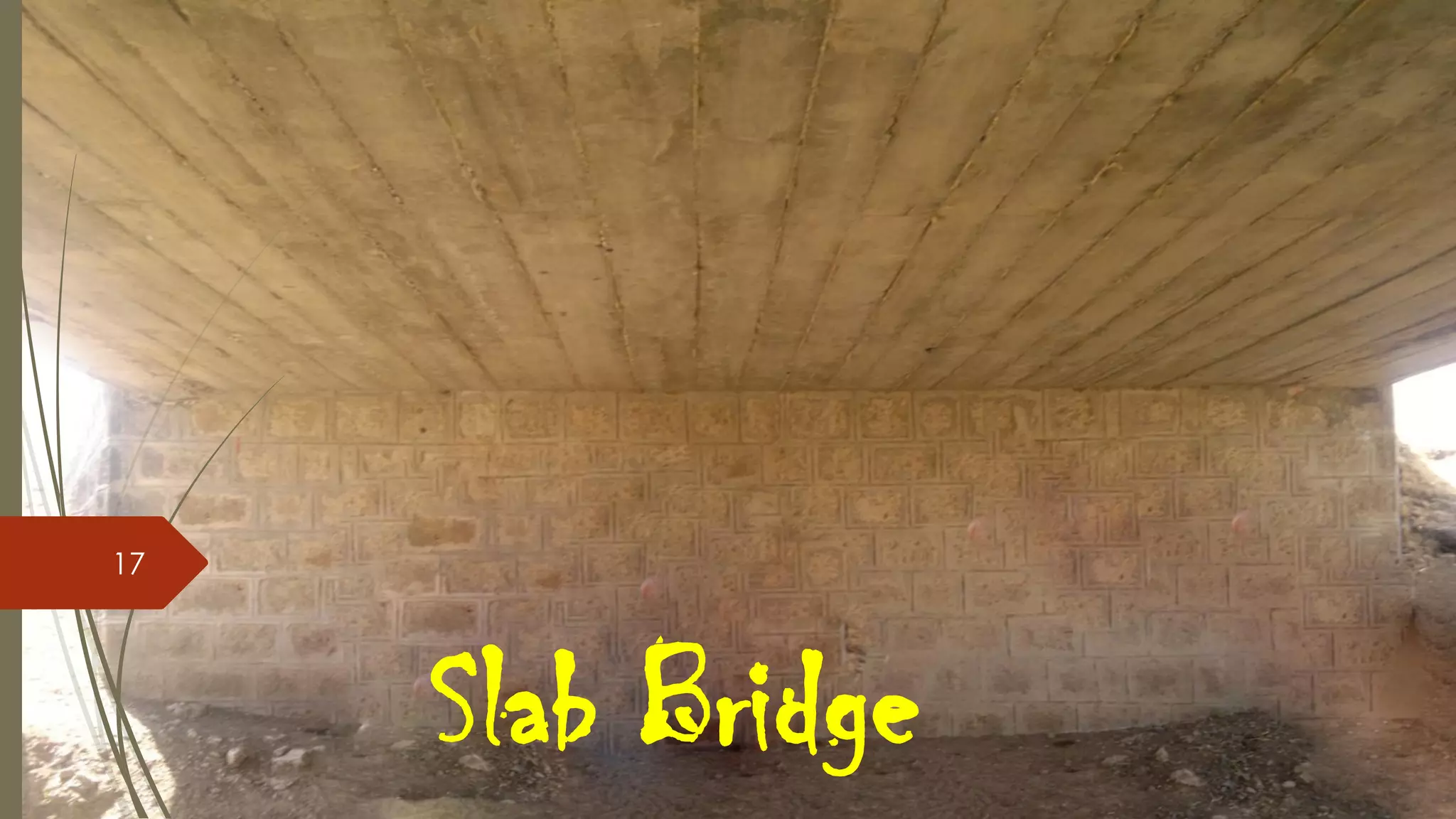
Slab Bridge
18

2.1. Types of Bridge

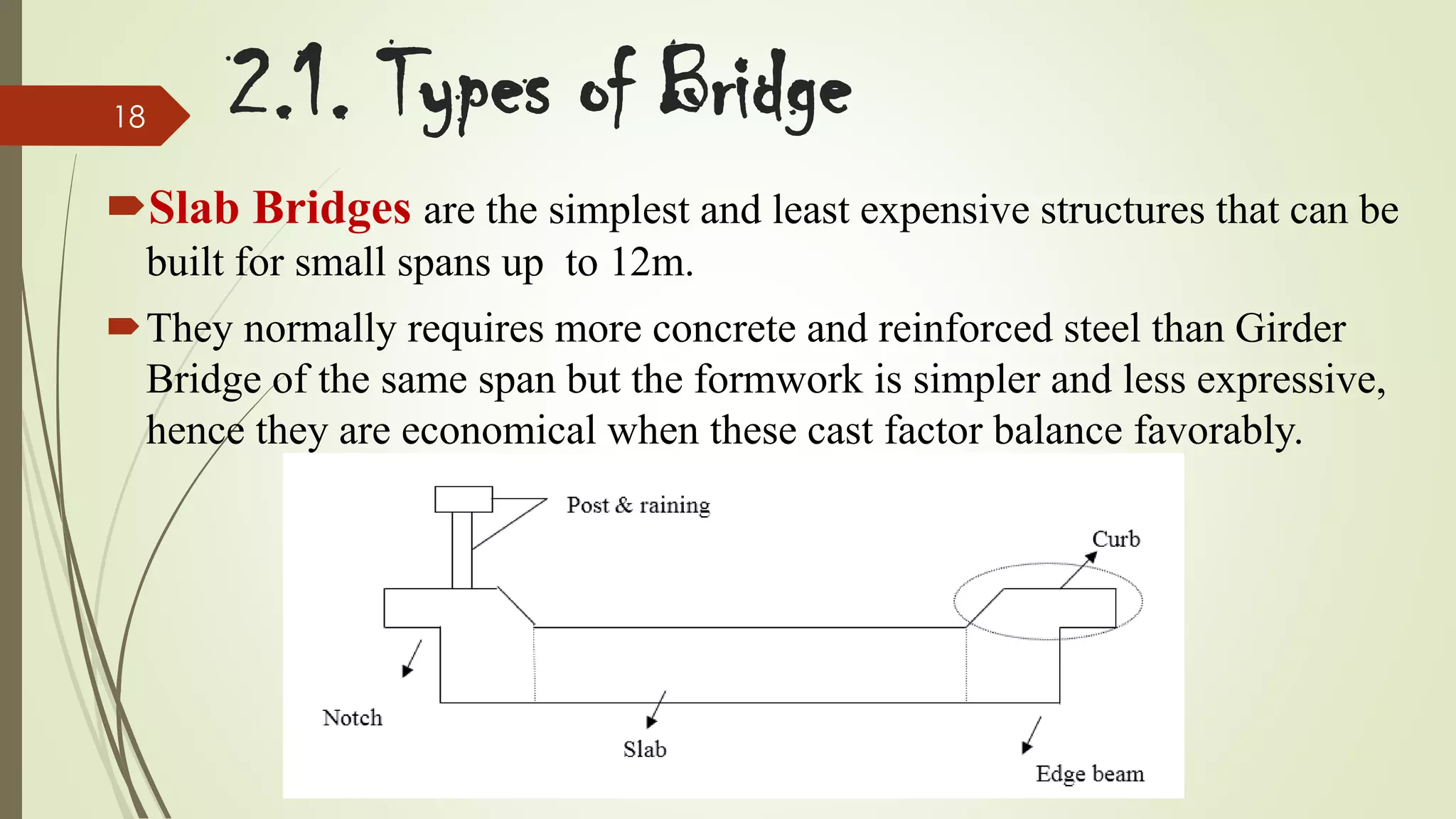
Slab Bridges are the simplest and least expensive structures that can be
built for small spans up to 12m.
They normally requires more concrete and reinforced steel than Girder
Bridge of the same span but the formwork is simpler and less expressive,
hence they are economical when these cast factor balance favorably.
19

2.1. Types of Bridge
These bridges can be built on ground supported false work or
constructed of precast elements.
The load carrying mechanism is by plate action, i.e., by bending and
twisting due to continuity in all directions.
Application of a load on the portion make the slab deflect into a dish
shape locally, causing a two-dimensional system of bending and
twisting moments.
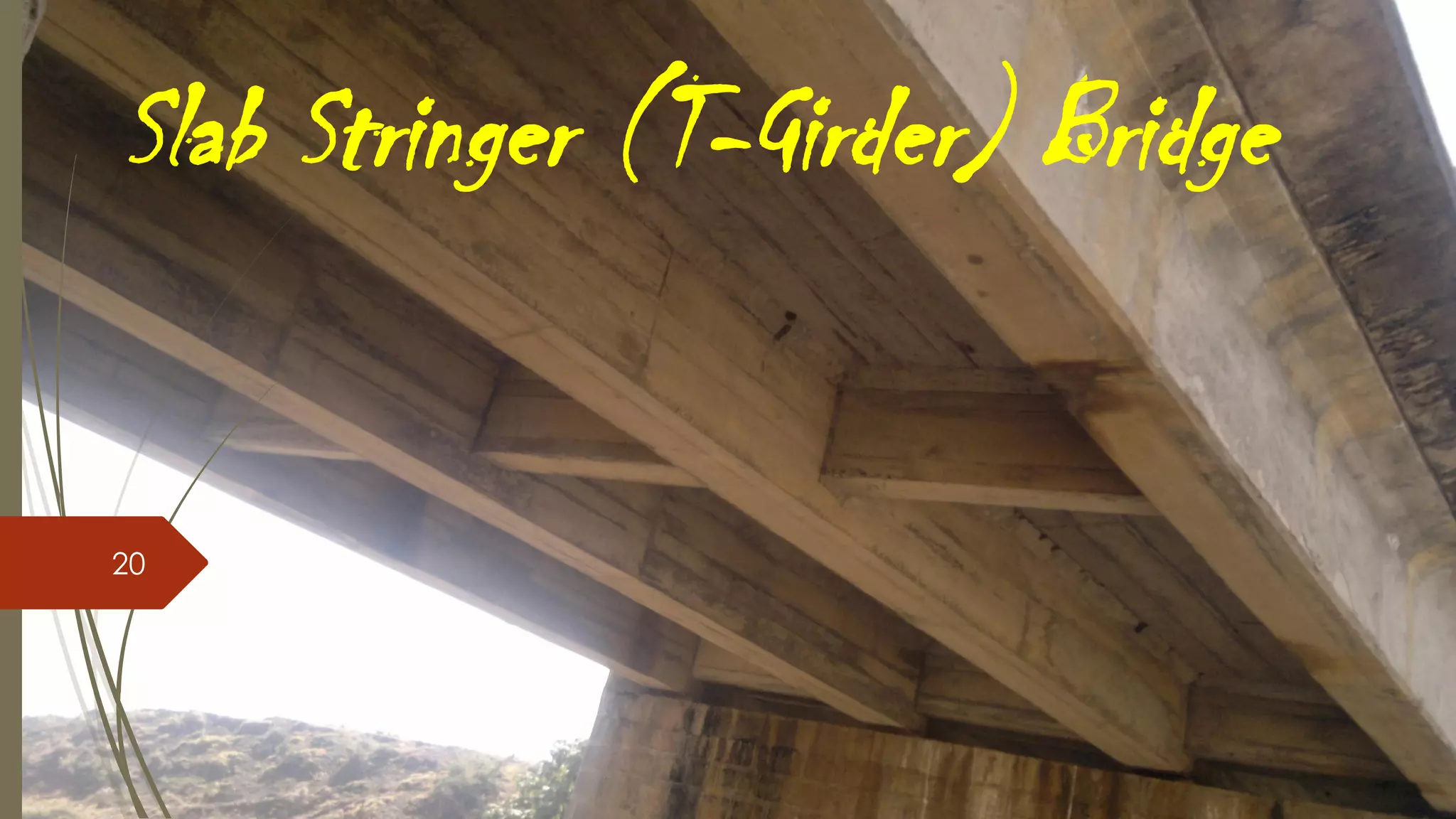
Slab Stringer (T-Girder) Bridge

20
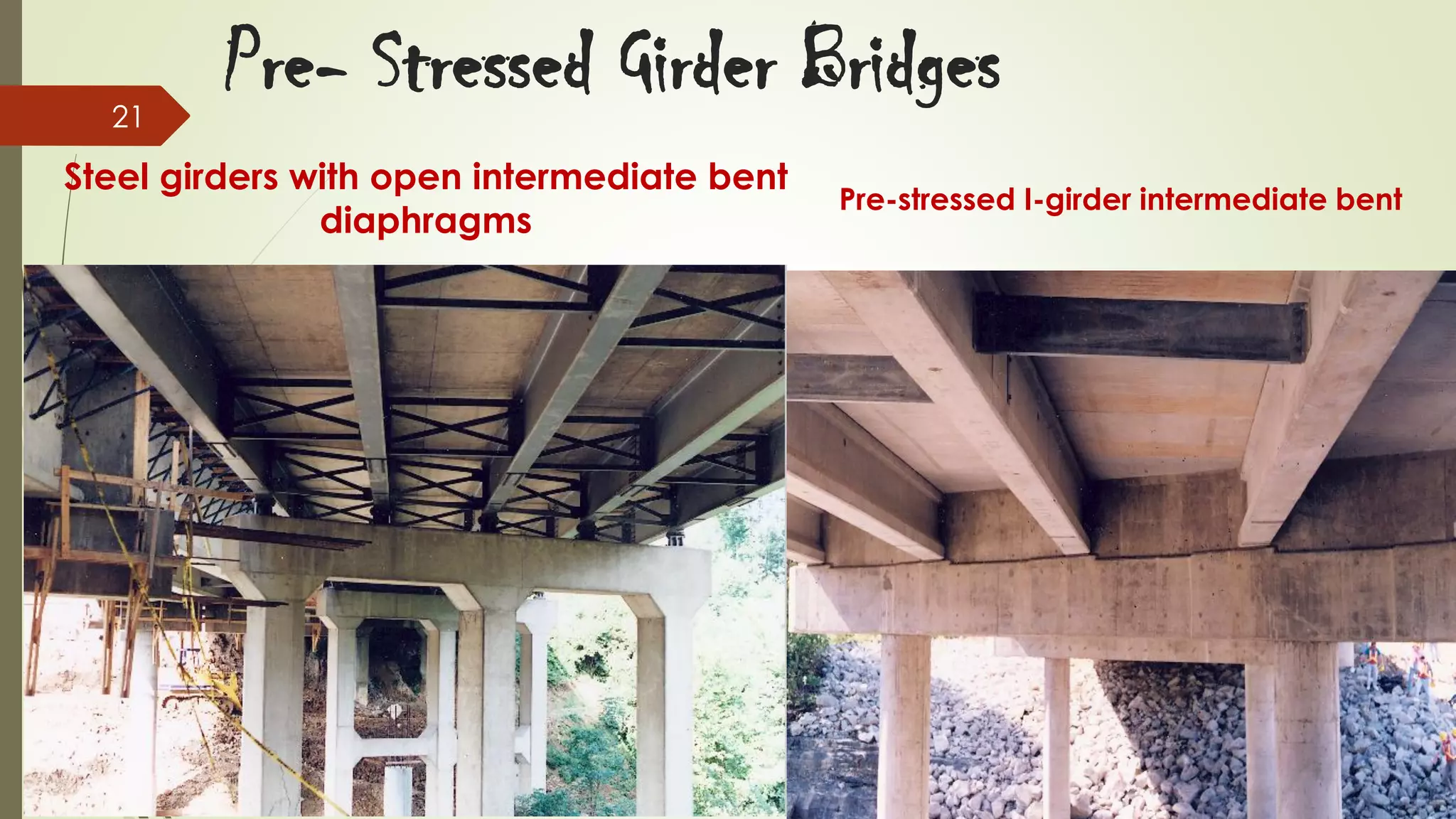
21

Pre- Stressed Girder Bridges

Steel girders with open intermediate bent
diaphragms

Pre-stressed I-girder intermediate bent
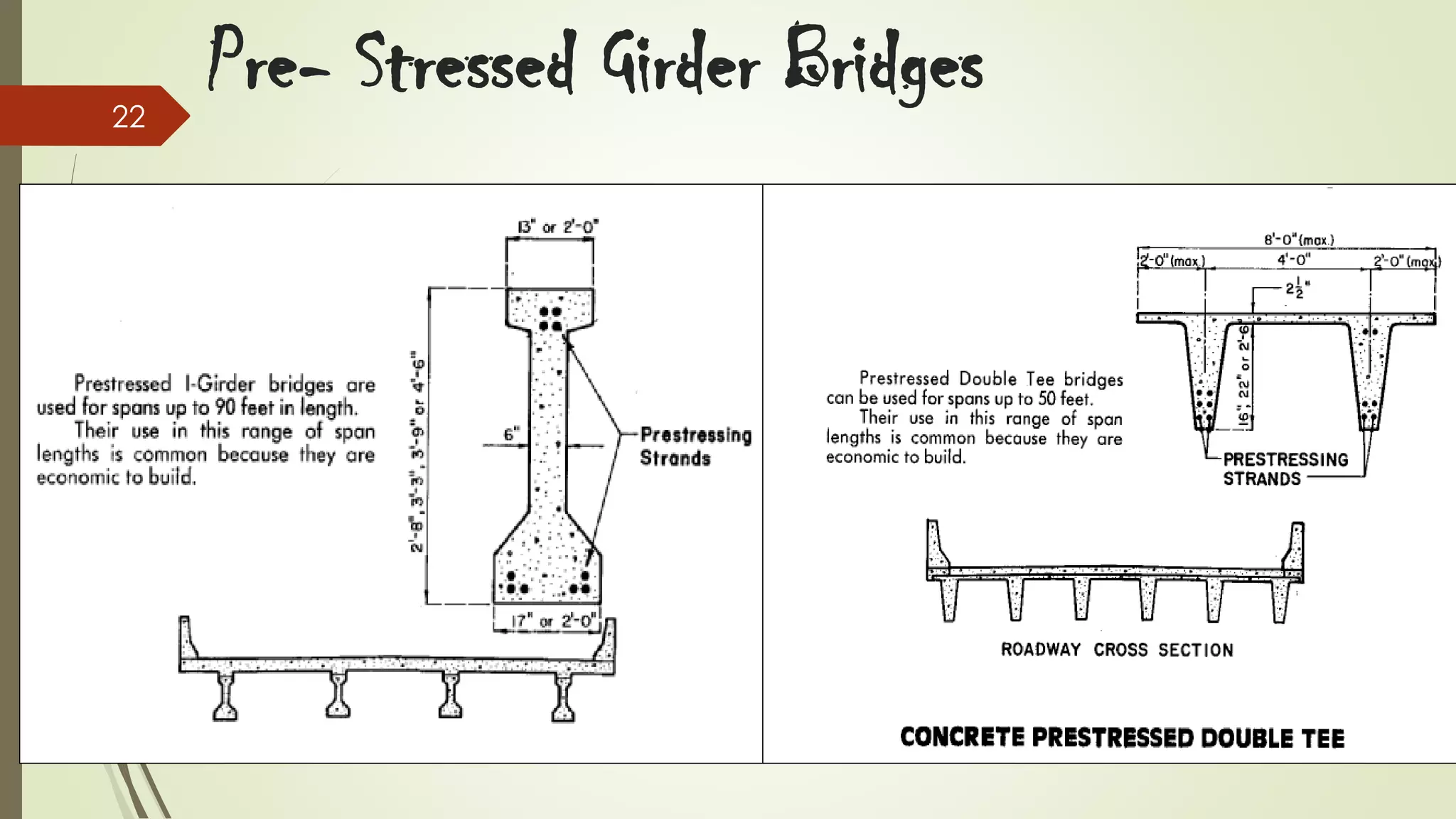
22

Pre- Stressed Girder Bridges
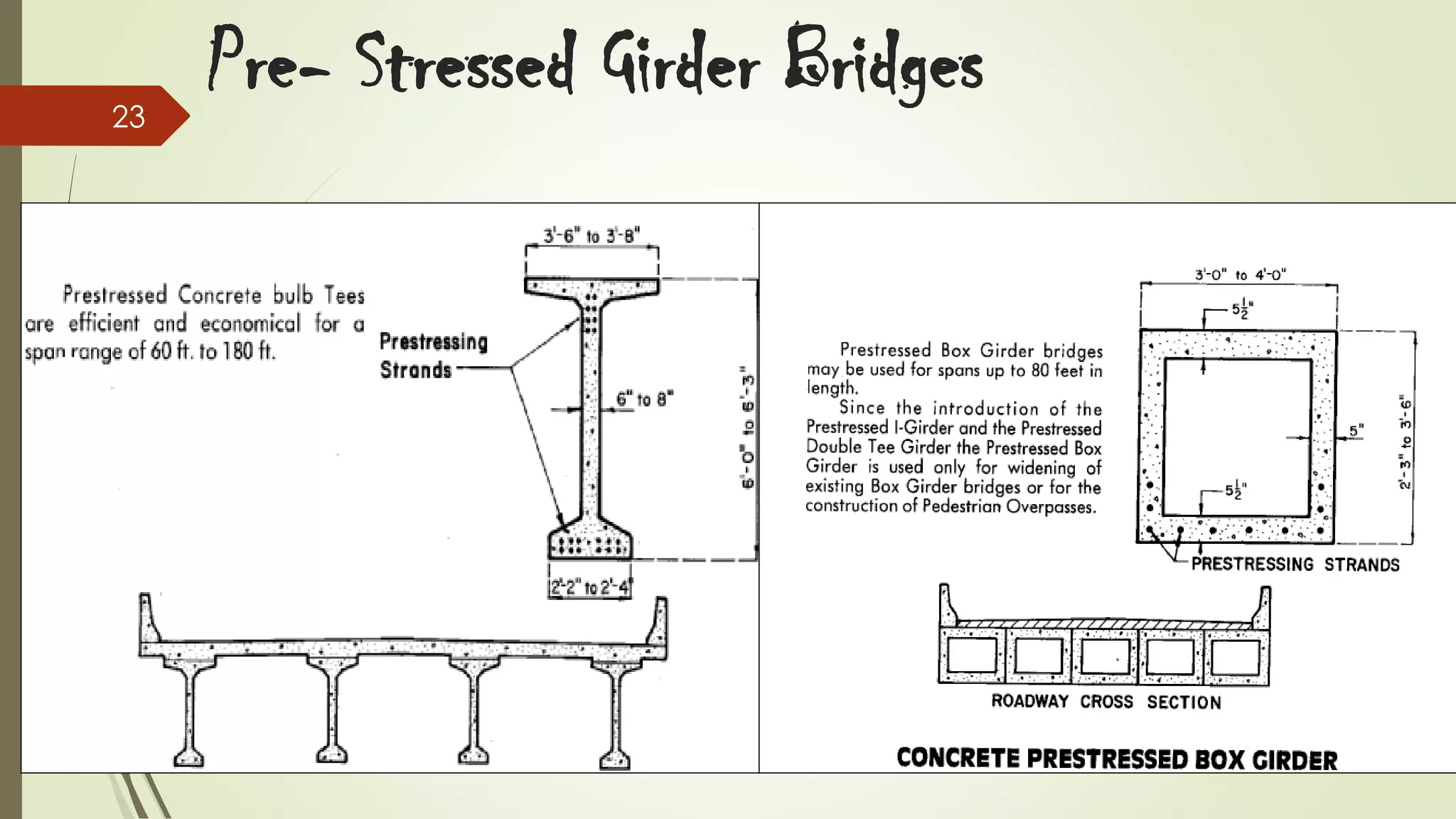
23

Pre- Stressed Girder Bridges
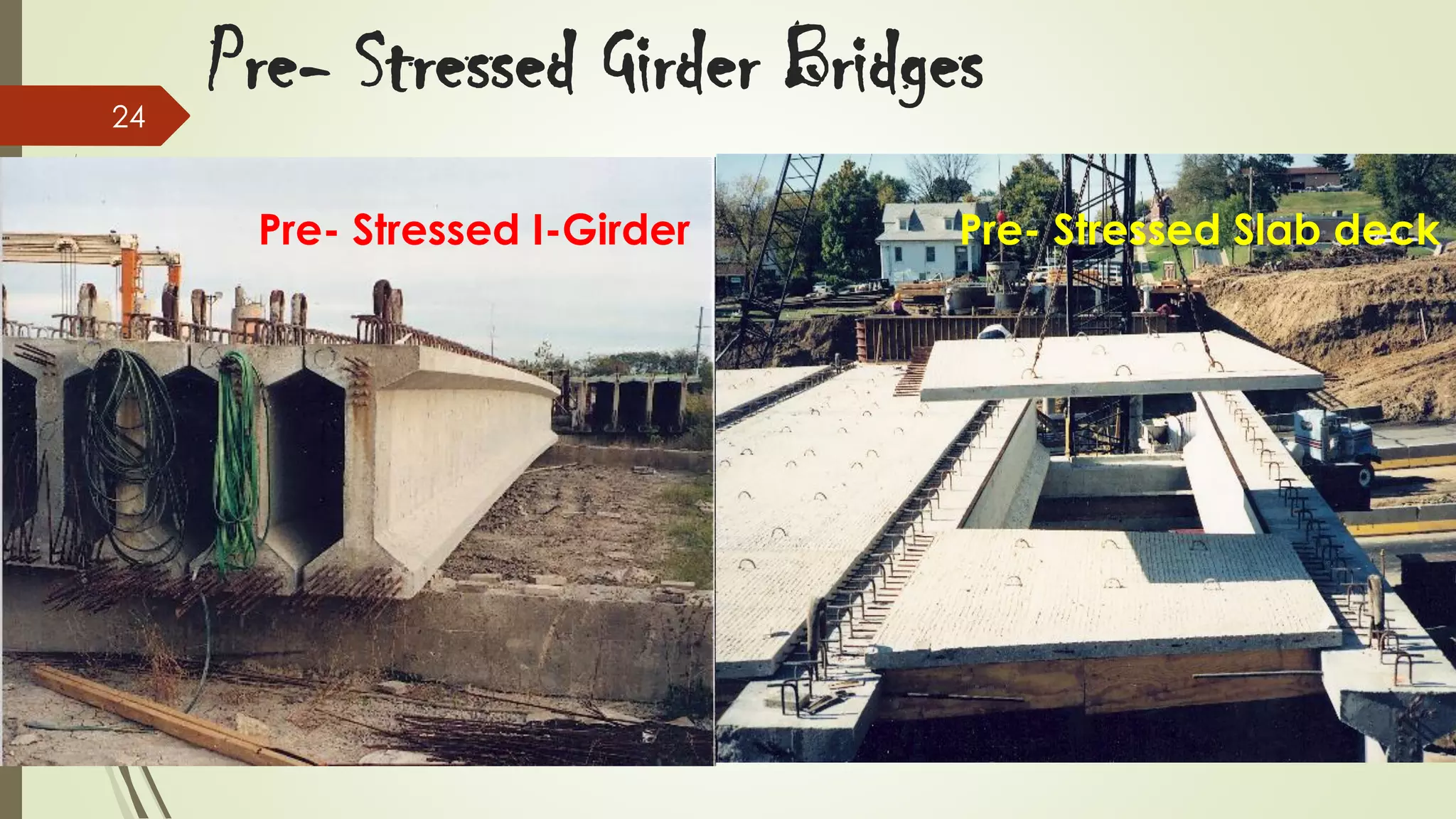
24

Pre- Stressed Girder Bridges
Pre- Stressed I-Girder

Pre- Stressed Slab deck
25

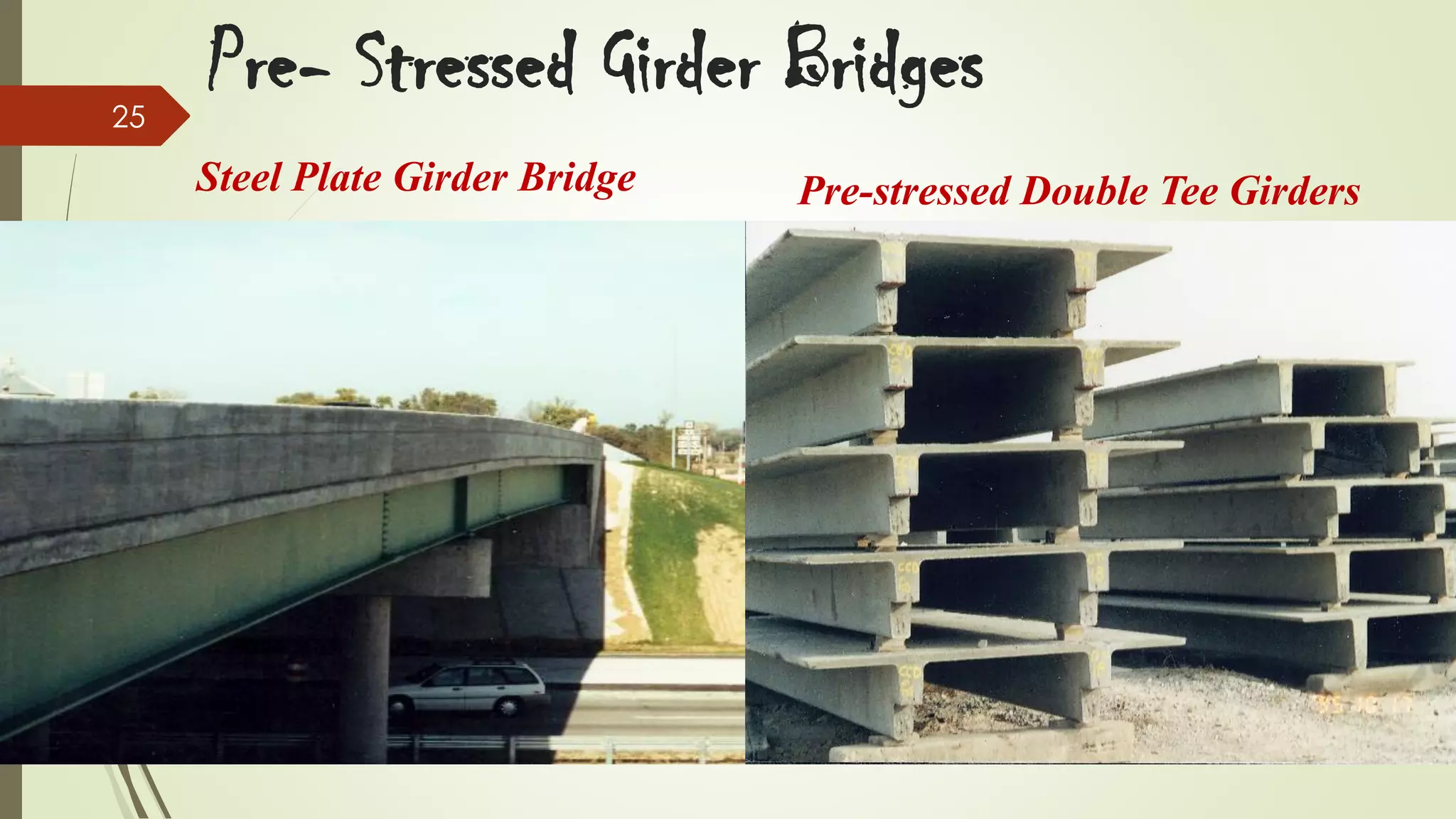
Pre- Stressed Girder Bridges
Steel Plate Girder Bridge

Pre-stressed Double Tee Girders
26

2.1. Types of Bridge
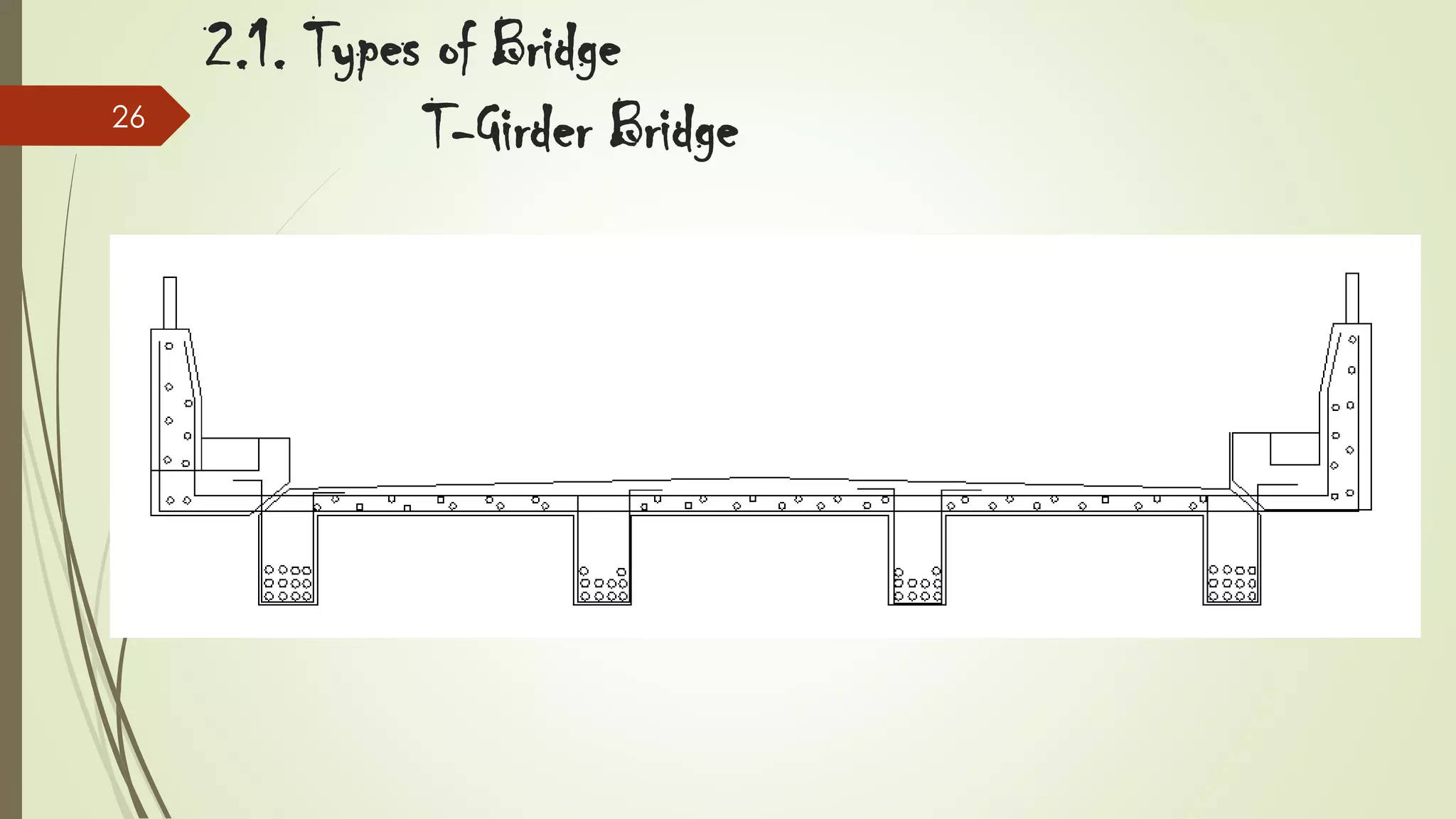
T-Girder Bridge
27

2.1. Types of Bridge
T-Girder Bridges

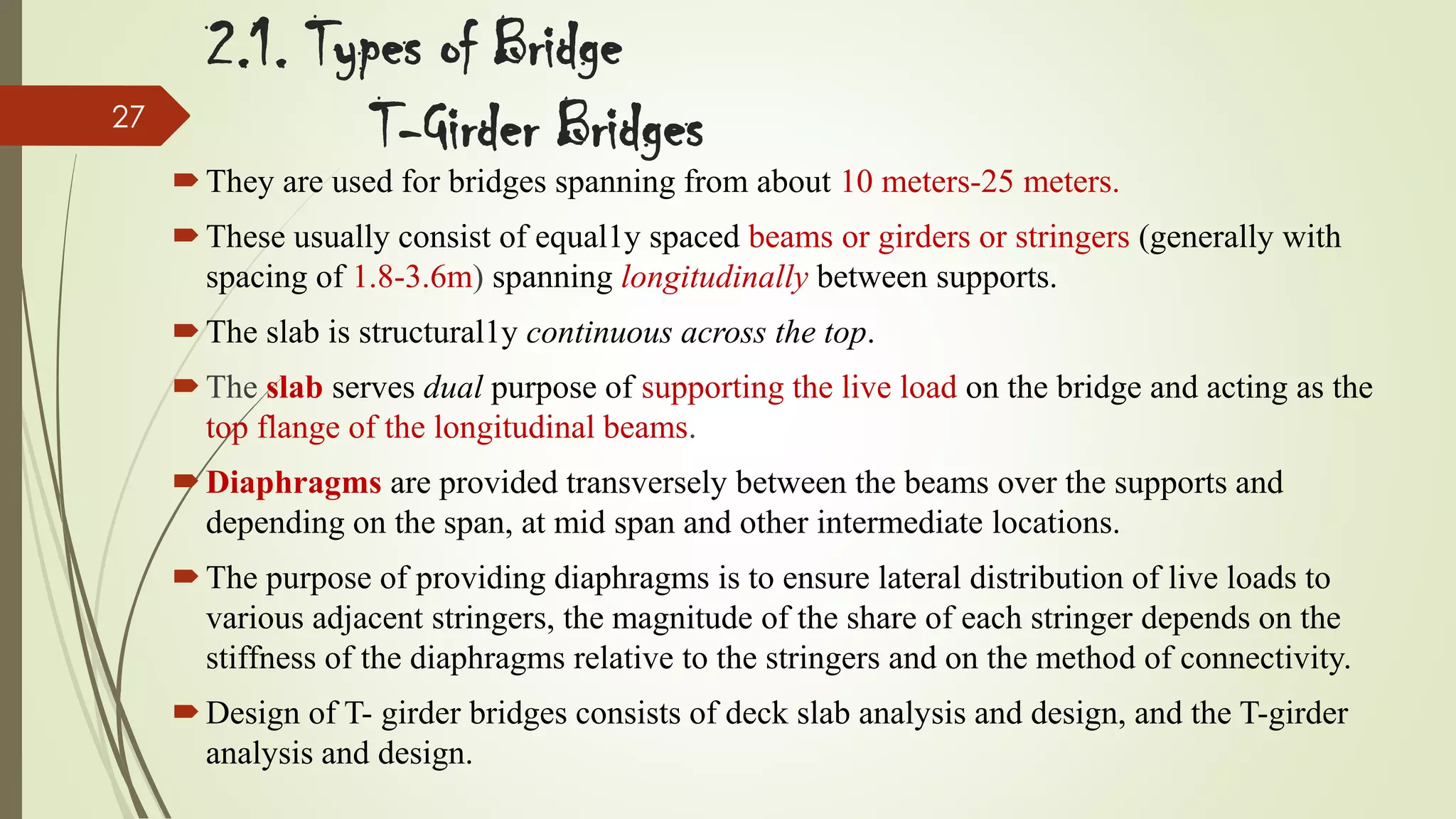
 They are used for bridges spanning from about 10 meters-25 meters.
 These usually consist of equal1y spaced beams or girders or stringers (generally with
spacing of 1.8-3.6m) spanning longitudinally between supports.
 The slab is structural1y continuous across the top.
 The slab serves dual purpose of supporting the live load on the bridge and acting as the
top flange of the longitudinal beams.
 Diaphragms are provided transversely between the beams over the supports and
depending on the span, at mid span and other intermediate locations.
 The purpose of providing diaphragms is to ensure lateral distribution of live loads to
various adjacent stringers, the magnitude of the share of each stringer depends on the
stiffness of the diaphragms relative to the stringers and on the method of connectivity.
 Design of T- girder bridges consists of deck slab analysis and design, and the T-girder
analysis and design.
28

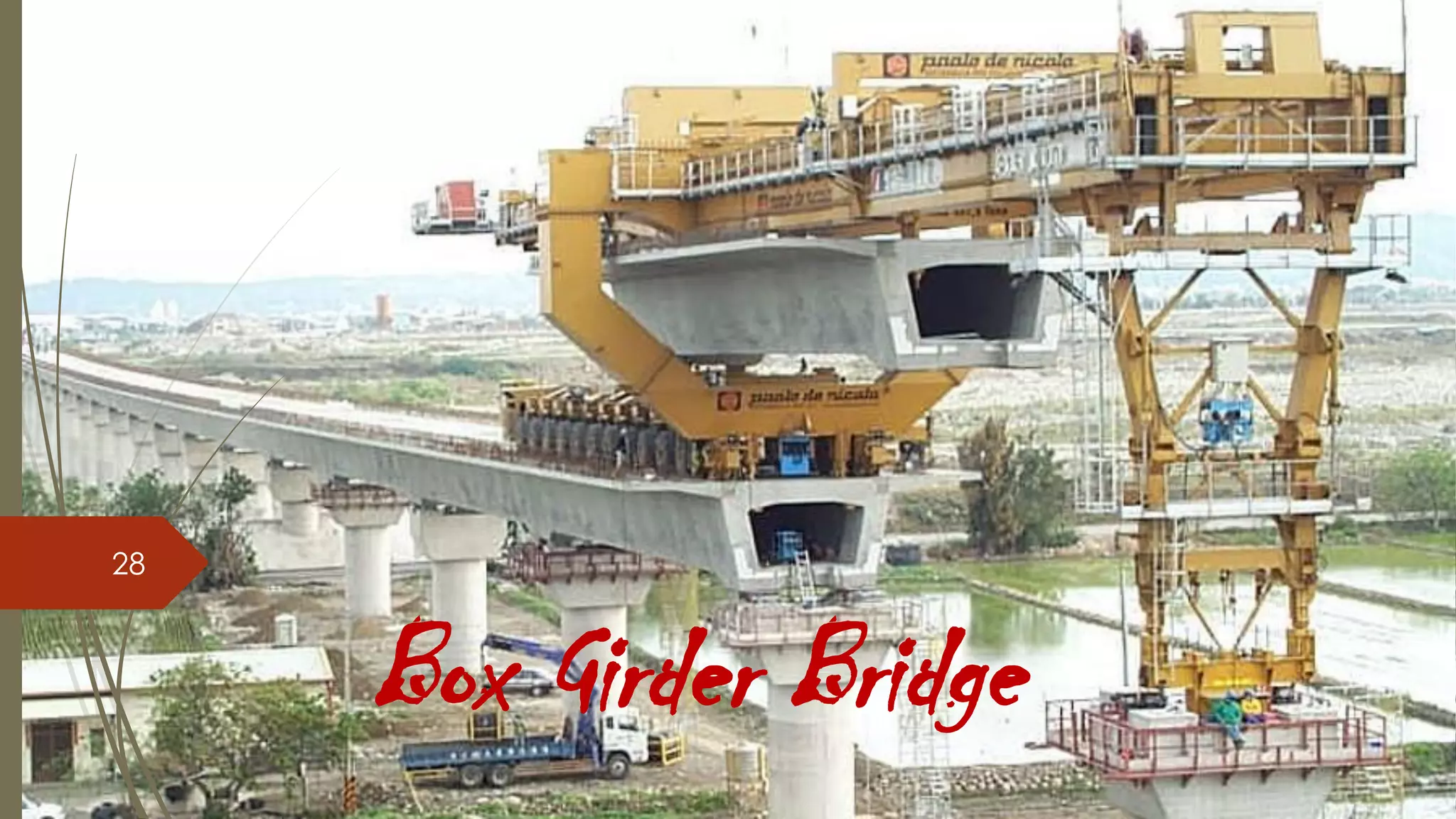
Box Girder Bridge
29

2.1. Types of Bridge
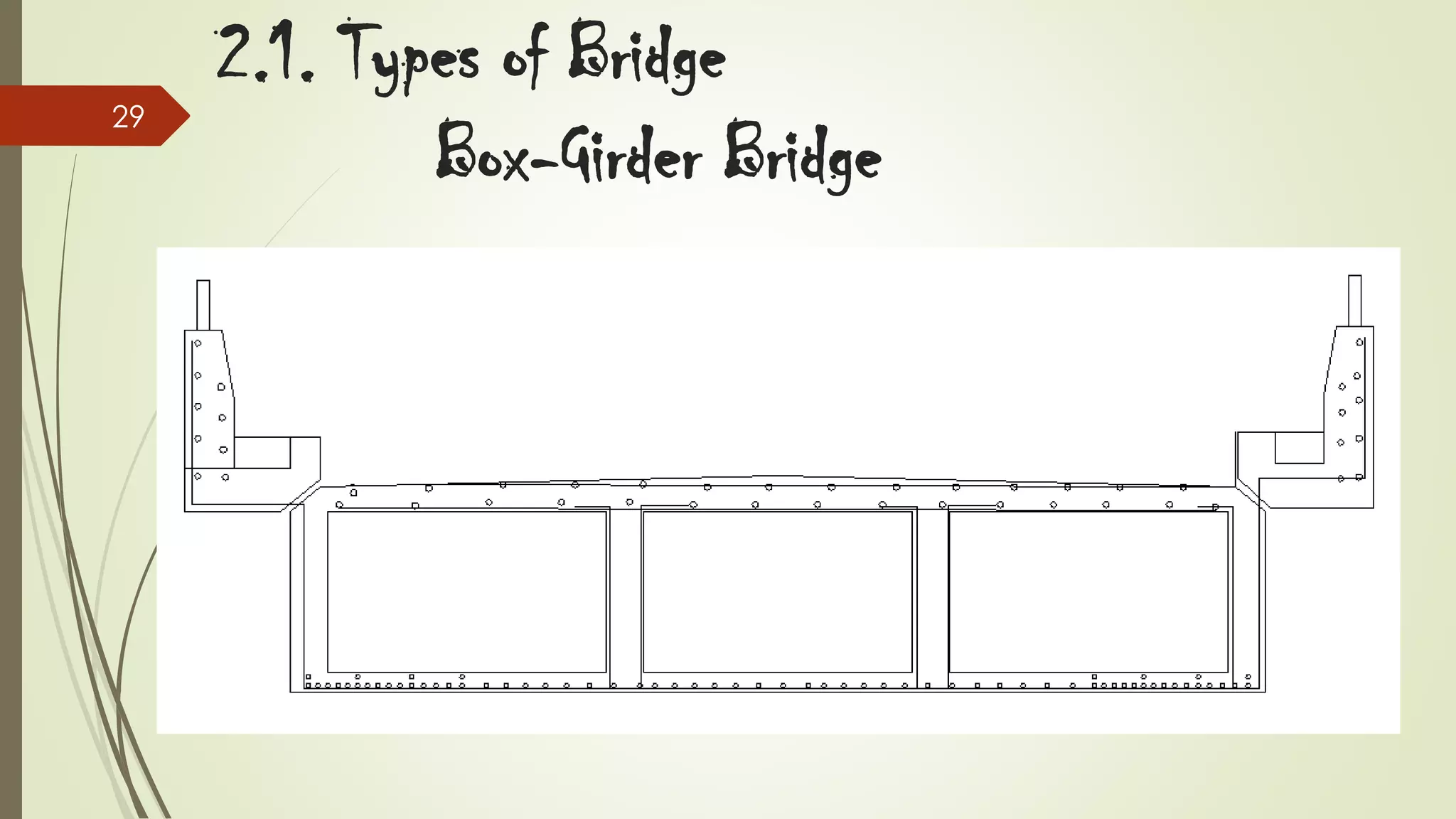
Box-Girder Bridge
30

2.1. Types of Bridge
Box-Girder Bridges
Concrete box girder bridges are economical for spans of above 25 to 45m.
They can be reinforced concrete or pre-stressed concrete. Longer span than 45m
will have to be pre-stressed.
They are similar to T-beams in configuration except the webs of T-beams are all
interconnected by a common flange resulting in a cellular superstructure.
The top slab, webs and bottom slab are built monolithically to act as a unit, which
means that full shear transfer must be provided between all parts of the section.
The interior webs resist shear and often only a small portion of girder moments.
Consequently they are usually thinner than the webs of T-beams.
In the case of continuous T-beams, the webs must resist the negative girder
moments as well as all the shear, and contain all the reinforcement for positive
moments.
31

2.1. Types of Bridge
Box-Girder Bridges
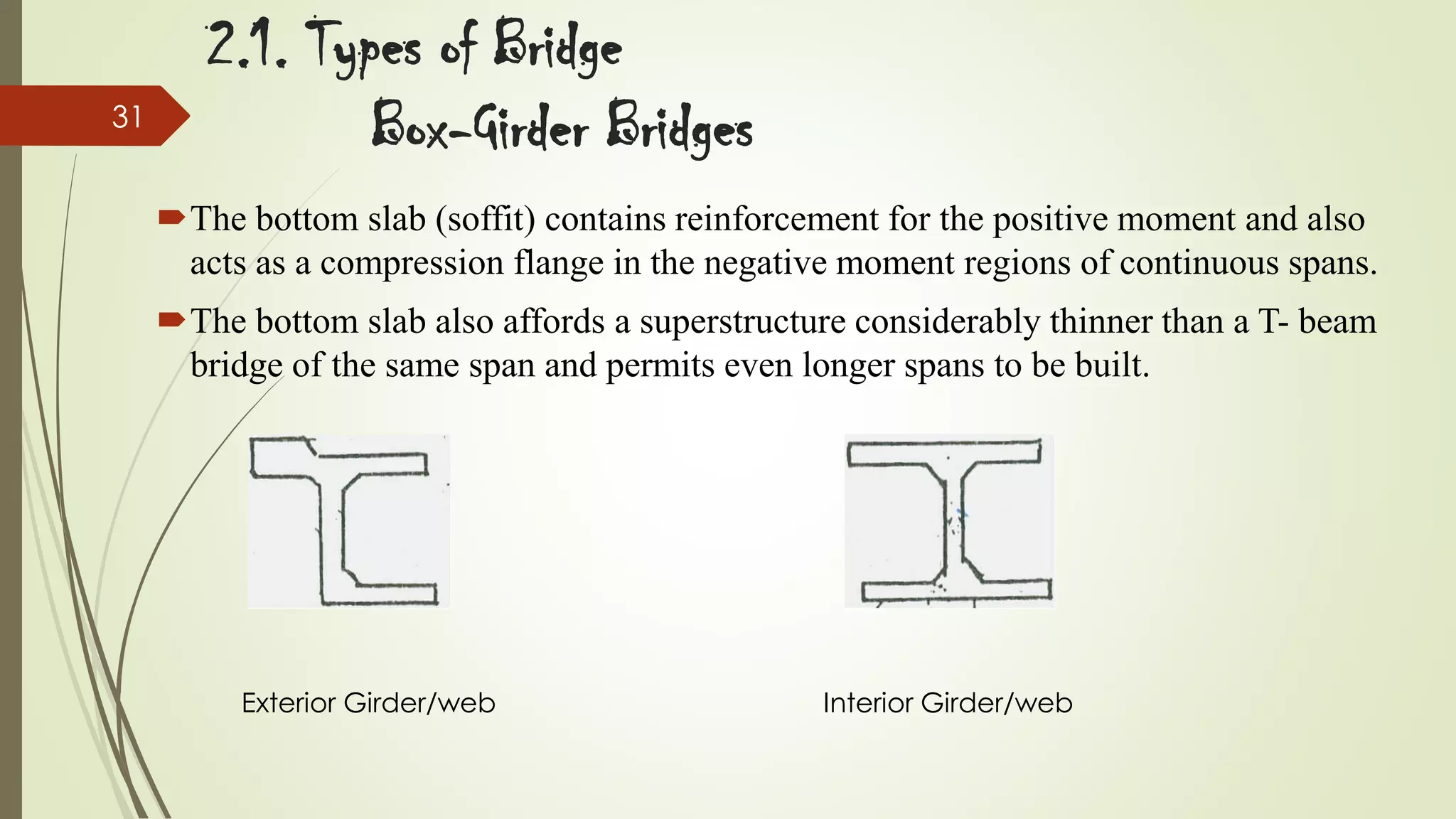
The bottom slab (soffit) contains reinforcement for the positive moment and also
acts as a compression flange in the negative moment regions of continuous spans.
The bottom slab also affords a superstructure considerably thinner than a T- beam
bridge of the same span and permits even longer spans to be built.

Exterior Girder/web

Interior Girder/web
32

2.1. Types of Bridge
Box-Girder Bridges

Concrete box girder bridges have several advantages over other types;
1. The relatively shallow depth of box girders is all advantage where headroom is
limited like in urban overpasses.
2. Monolithic construction of the superstructure and substructure offers structural as
well as aesthetic advantage. The pier caps for continuous box girders can be
placed with in the box, facilitating rigid connection to the pier.
3. They provide space for utilities such as water and gas lines, power, telephone and
cable ducts, storm drains and sewers, which can be placed in the hollow cellular
section.
4. Reinforced concrete box girders have high torsional resistance due to their
closed shape and are particularly suitable for structures with significant
curvature. This construction also lends itself to aesthetic treatment.
33

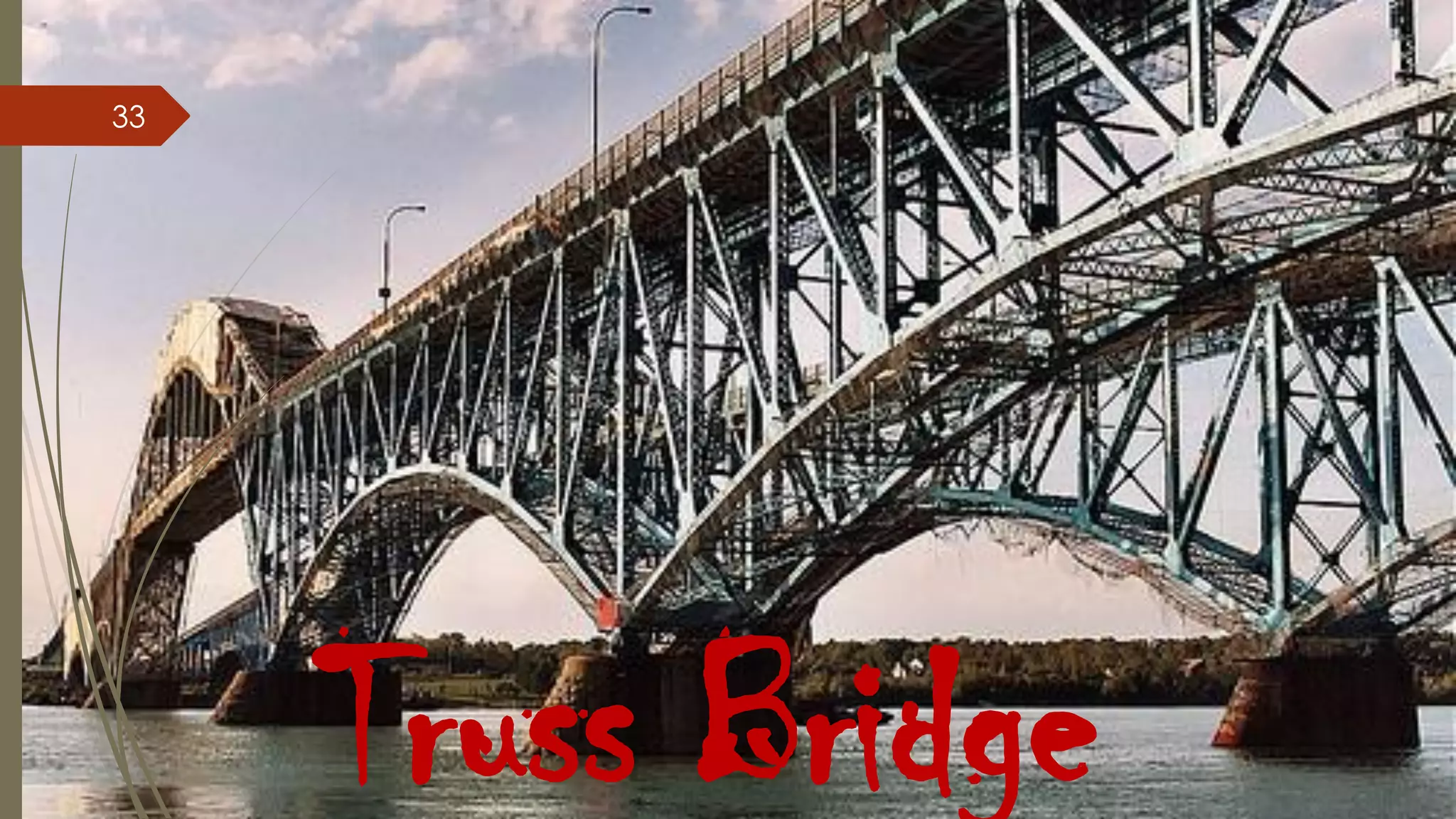
Truss Bridge
34

2.1. Types of Bridge
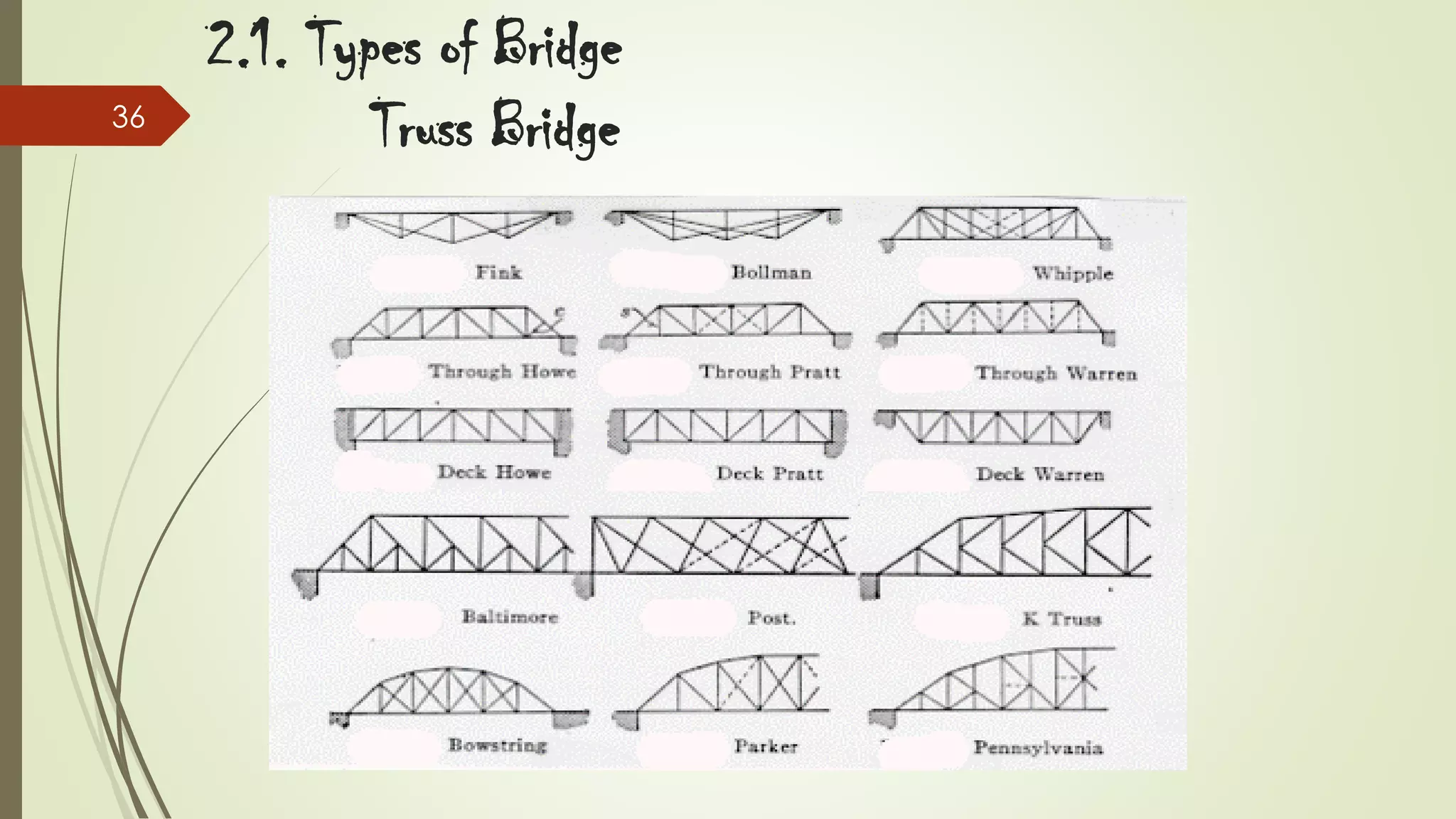
Truss Bridge
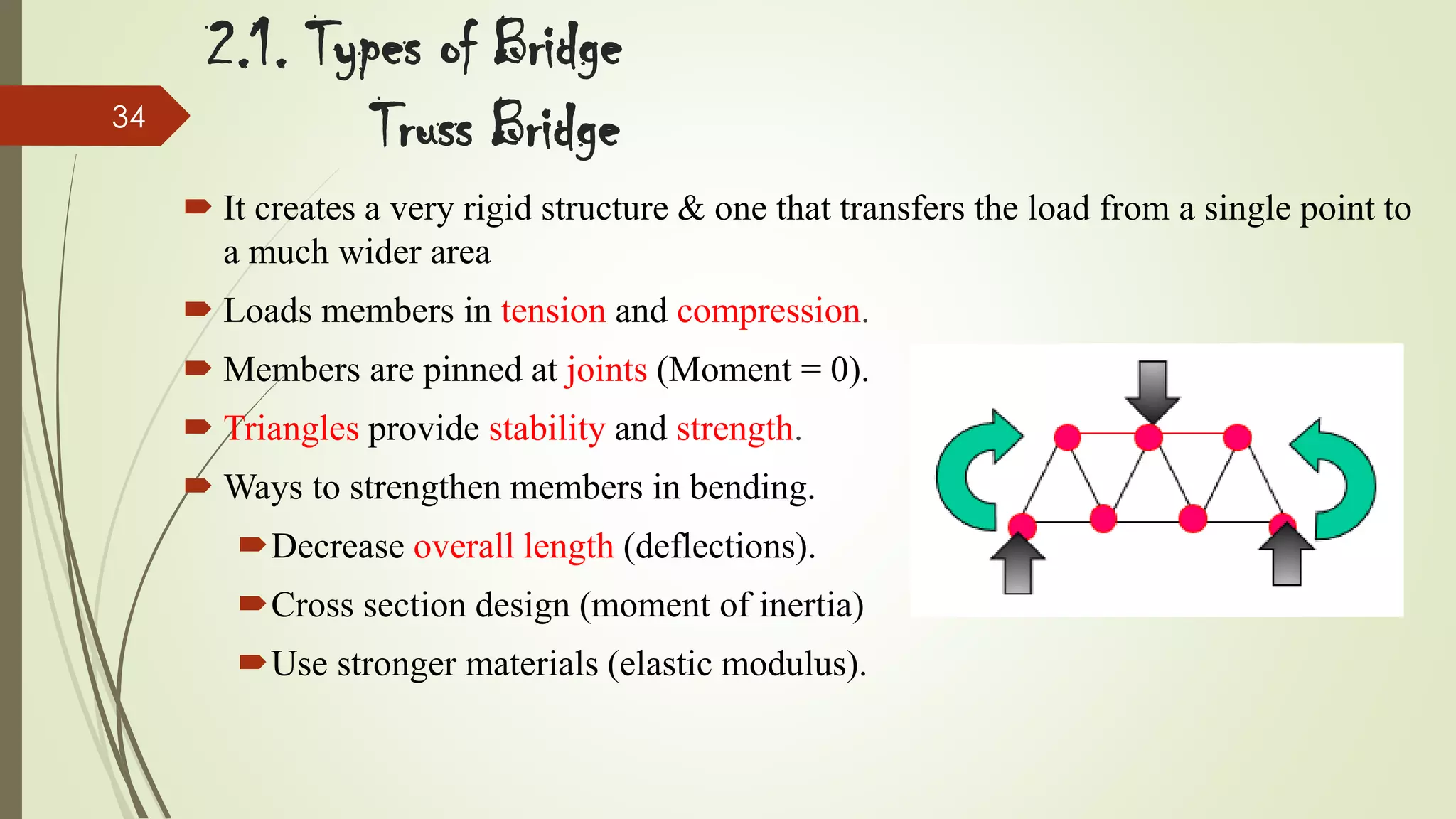
 It creates a very rigid structure & one that transfers the load from a single point to
a much wider area
 Loads members in tension and compression.

 Members are pinned at joints (Moment = 0).
 Triangles provide stability and strength.
 Ways to strengthen members in bending.
Decrease overall length (deflections).
Cross section design (moment of inertia)

Use stronger materials (elastic modulus).
35

2.1. Types of Bridge
Truss Bridge
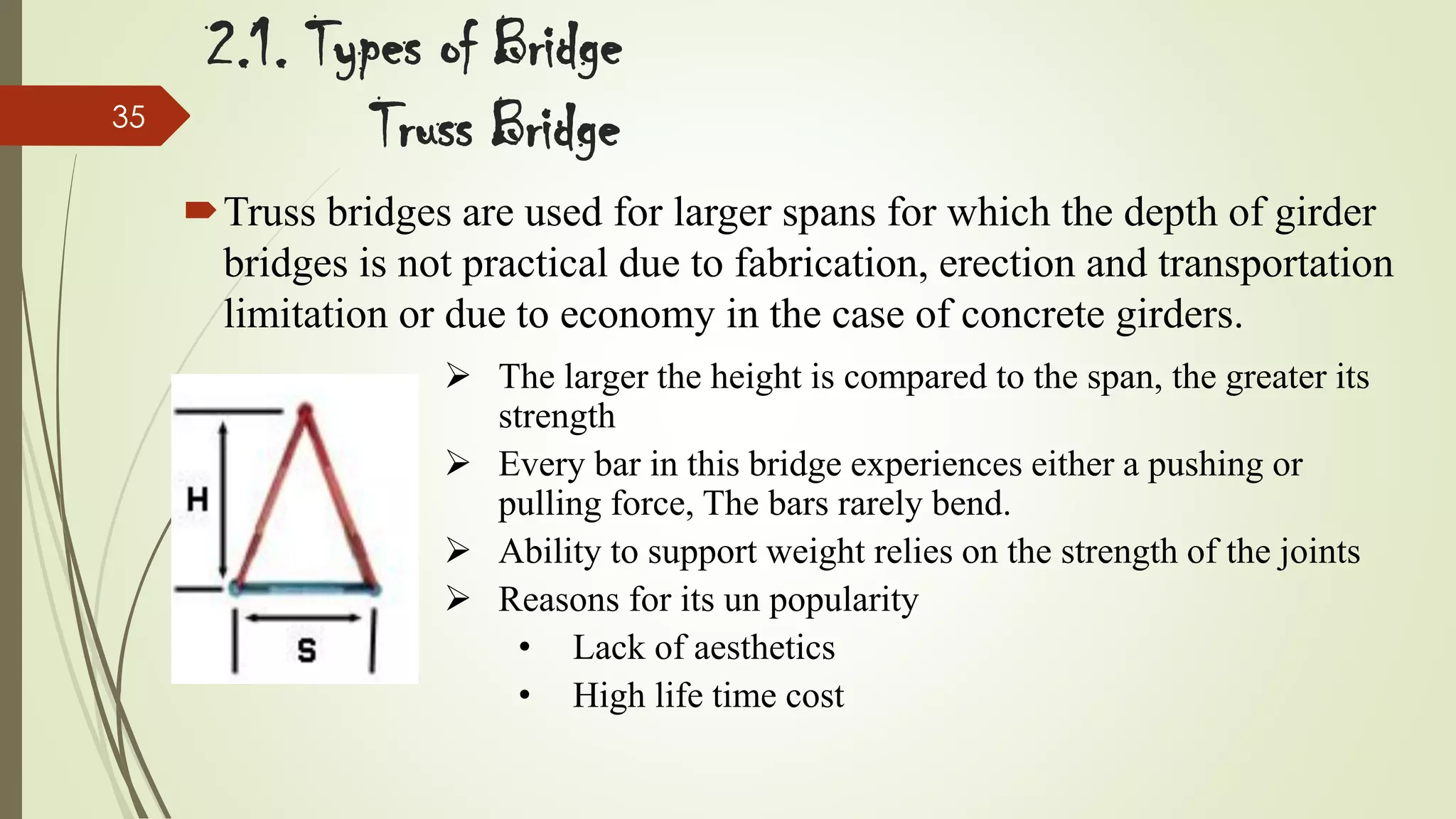
Truss bridges are used for larger spans for which the depth of girder
bridges is not practical due to fabrication, erection and transportation
limitation or due to economy in the case of concrete girders.
 The larger the height is compared to the span, the greater its
strength
 Every bar in this bridge experiences either a pushing or
pulling force, The bars rarely bend.
 Ability to support weight relies on the strength of the joints
 Reasons for its un popularity
• Lack of aesthetics
• High life time cost
36

2.1. Types of Bridge
Truss Bridge
Sydney, Australia

37

Arch Bridge
38

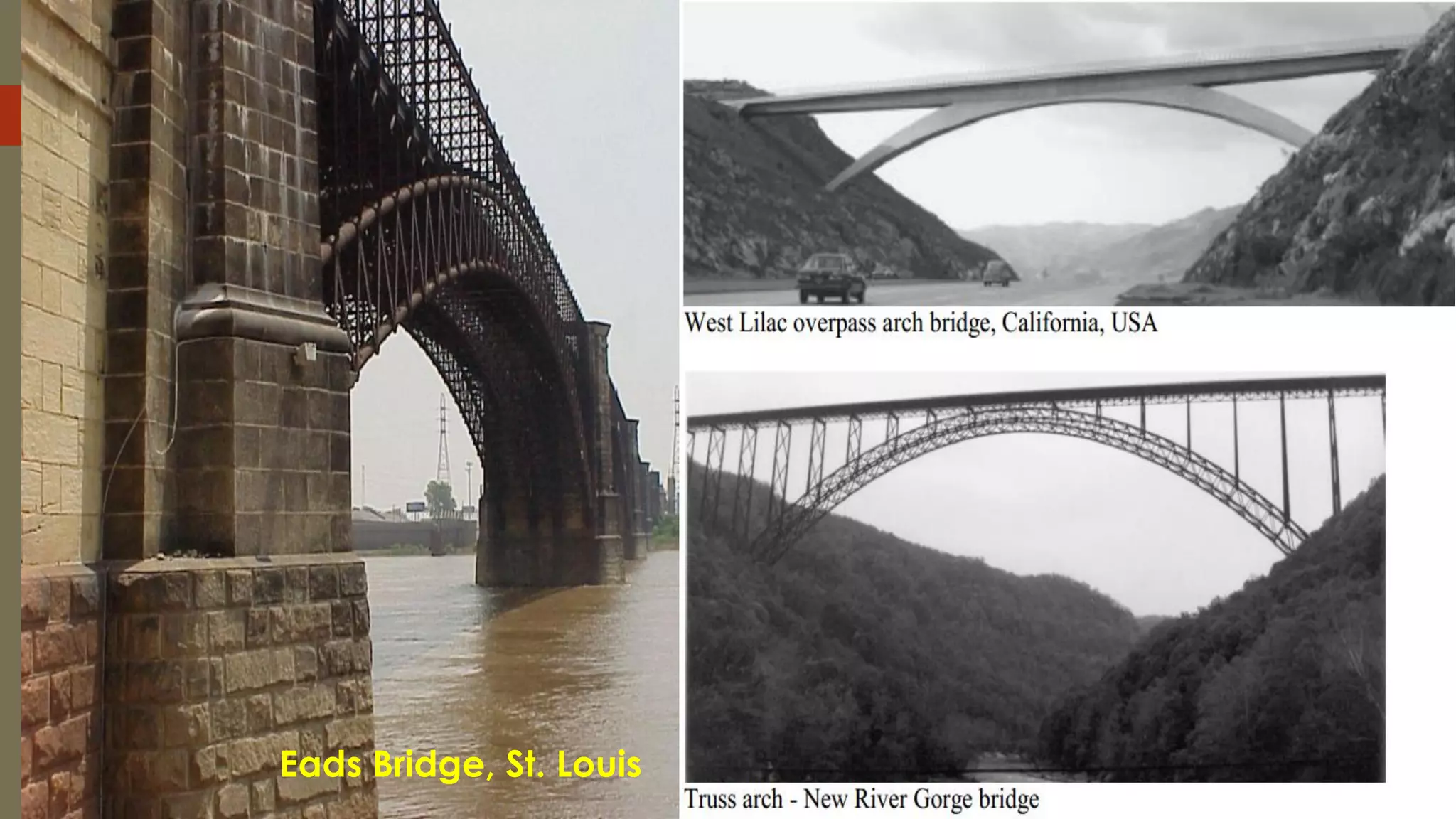
Eads Bridge, St. Louis
39

2.1. Types of Bridge
Arch Bridge
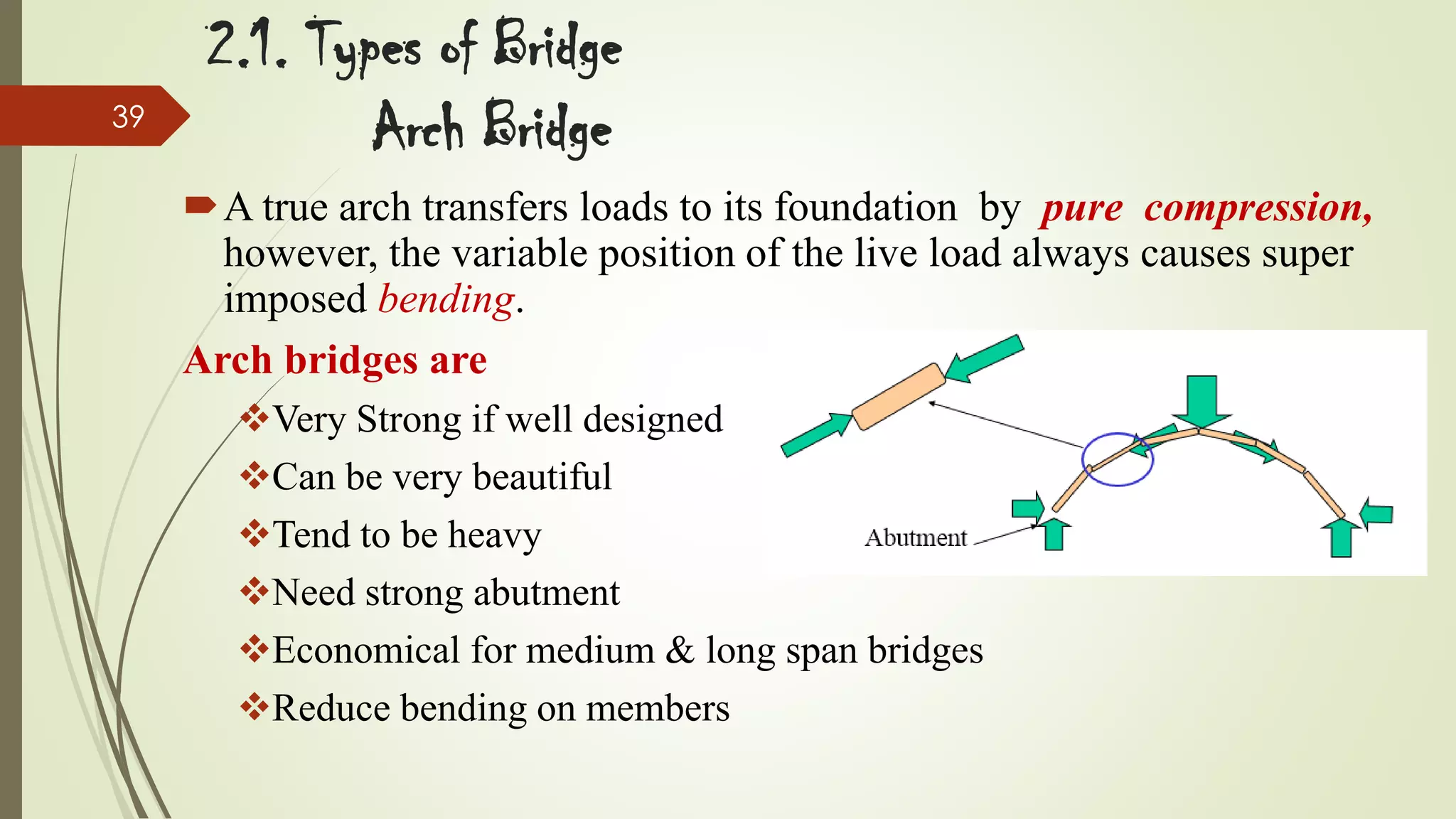
A true arch transfers loads to its foundation by pure compression,
however, the variable position of the live load always causes super
imposed bending.
Arch bridges are
Very Strong if well designed
Can be very beautiful
Tend to be heavy
Need strong abutment
Economical for medium & long span bridges
Reduce bending on members
40

2.1. Types of Bridge
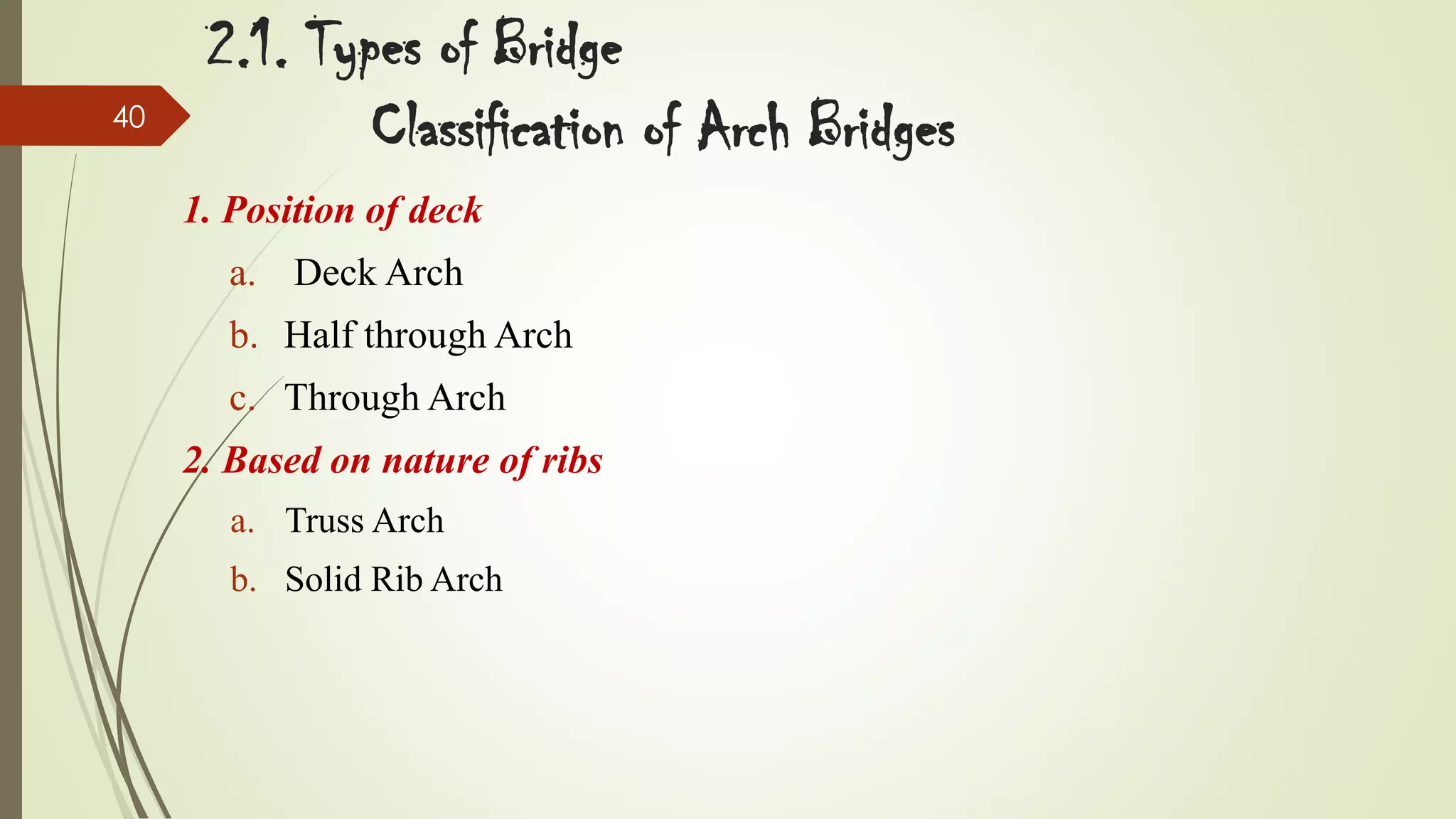
Classification of Arch Bridges
1. Position of deck
a. Deck Arch
b. Half through Arch
c. Through Arch
2. Based on nature of ribs
a. Truss Arch
b. Solid Rib Arch
Quebec Bridge

41

Cantilever Bridge
42

2.1. Types of Bridge
Cantilever Bridge
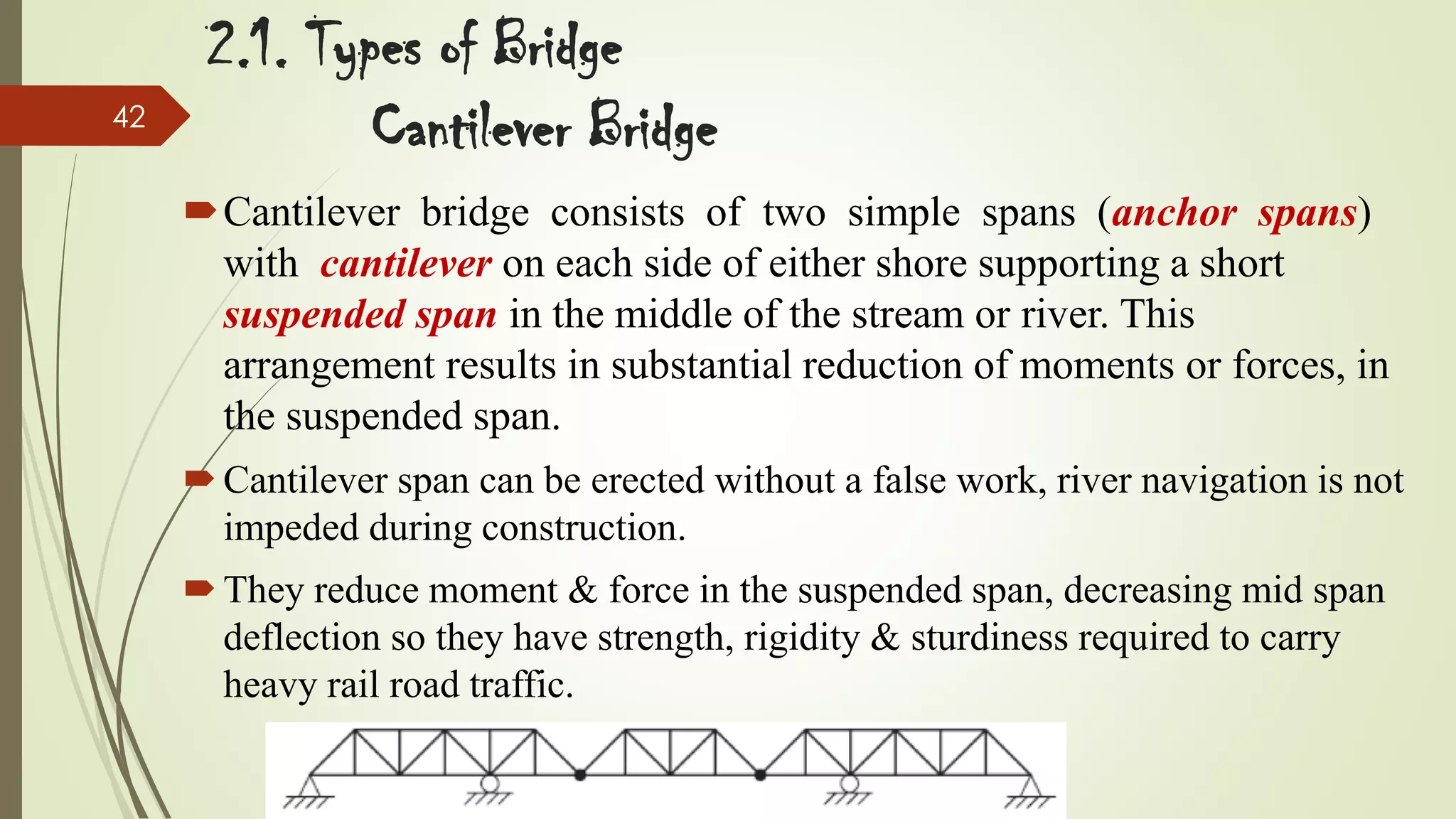
Cantilever bridge consists of two simple spans (anchor spans)
with cantilever on each side of either shore supporting a short
suspended span in the middle of the stream or river. This
arrangement results in substantial reduction of moments or forces, in
the suspended span.
 Cantilever span can be erected without a false work, river navigation is not
impeded during construction.
 They reduce moment & force in the suspended span, decreasing mid span
deflection so they have strength, rigidity & sturdiness required to carry
heavy rail road traffic.
43

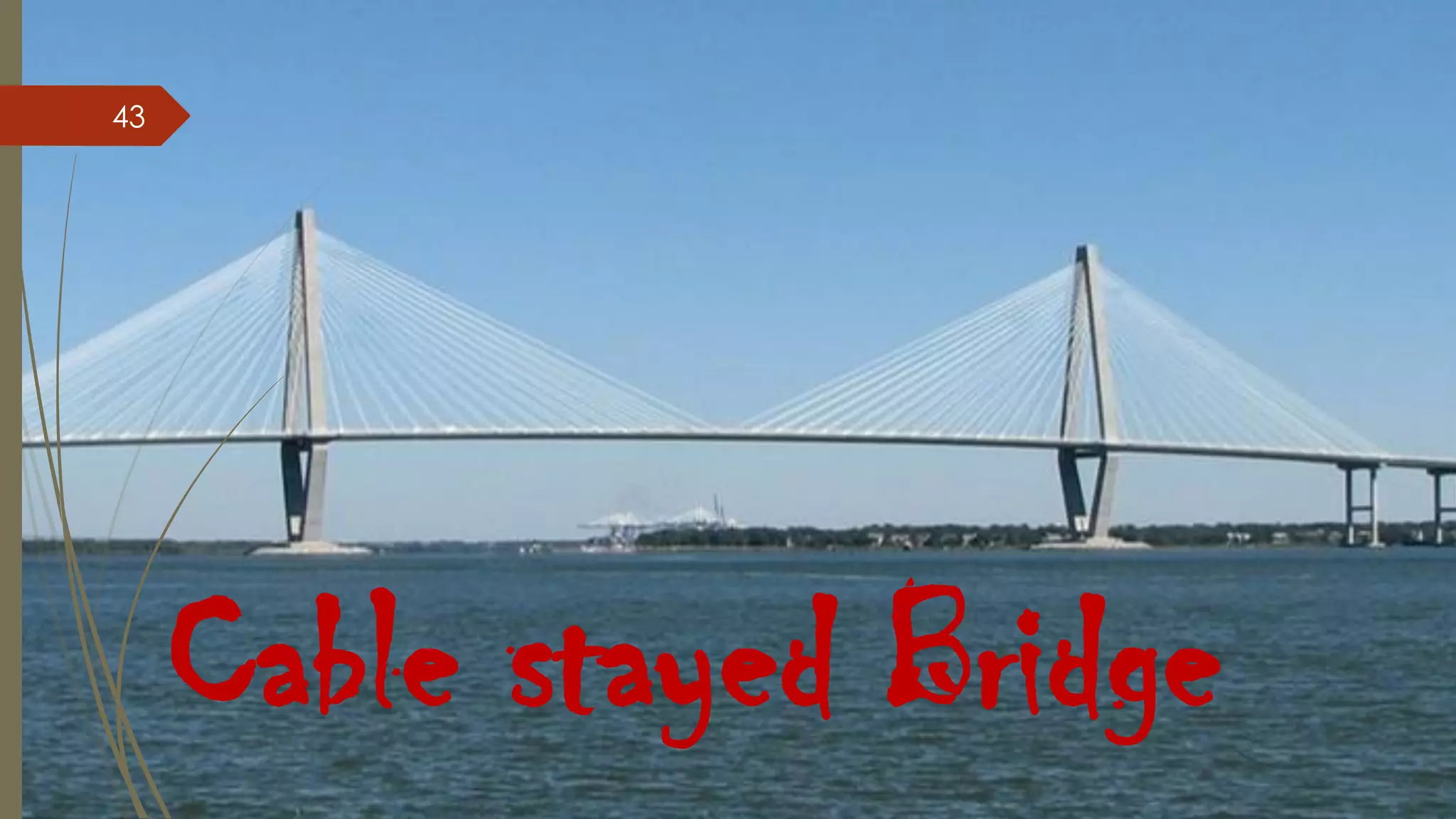
Cable stayed Bridge
44

2.1. Types of Bridge
Cable Stayed Bridge
Cable-stayed bridges are unique in that the superstructure is supported
(or hung) at several intermediate points by inclined cables, or stays,
radiating from and continuous over the towers, instead of being supported
from underneath by conventional piers or bents.
 The girder can be steel or pre-stressed concrete
 Aesthetically pleasing
 Easier and faster to build
 Economically competitive for medium and large spans

 Need strong towers
45
46

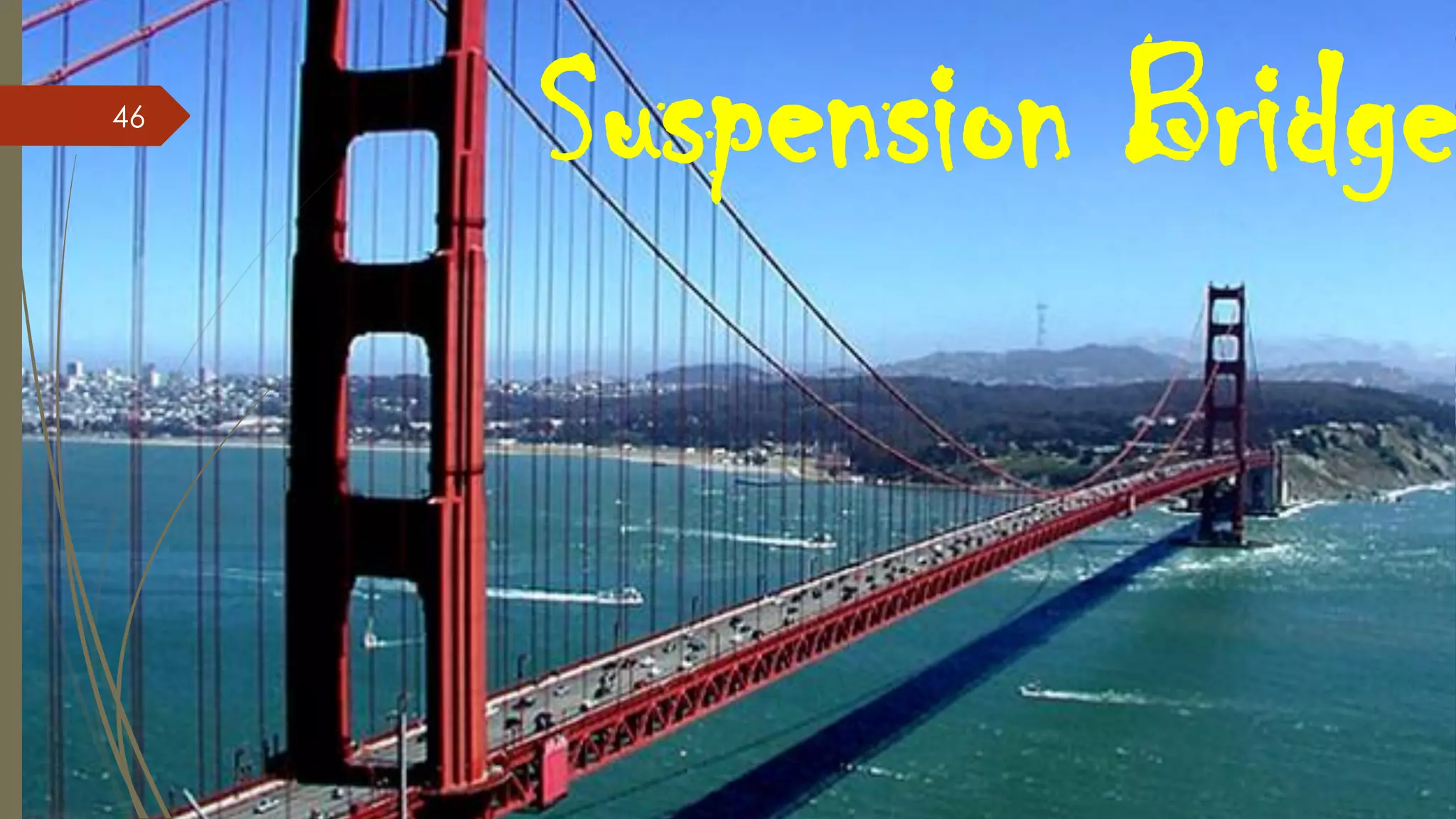
Suspension Bridge
2.1. Types of Bridge
47

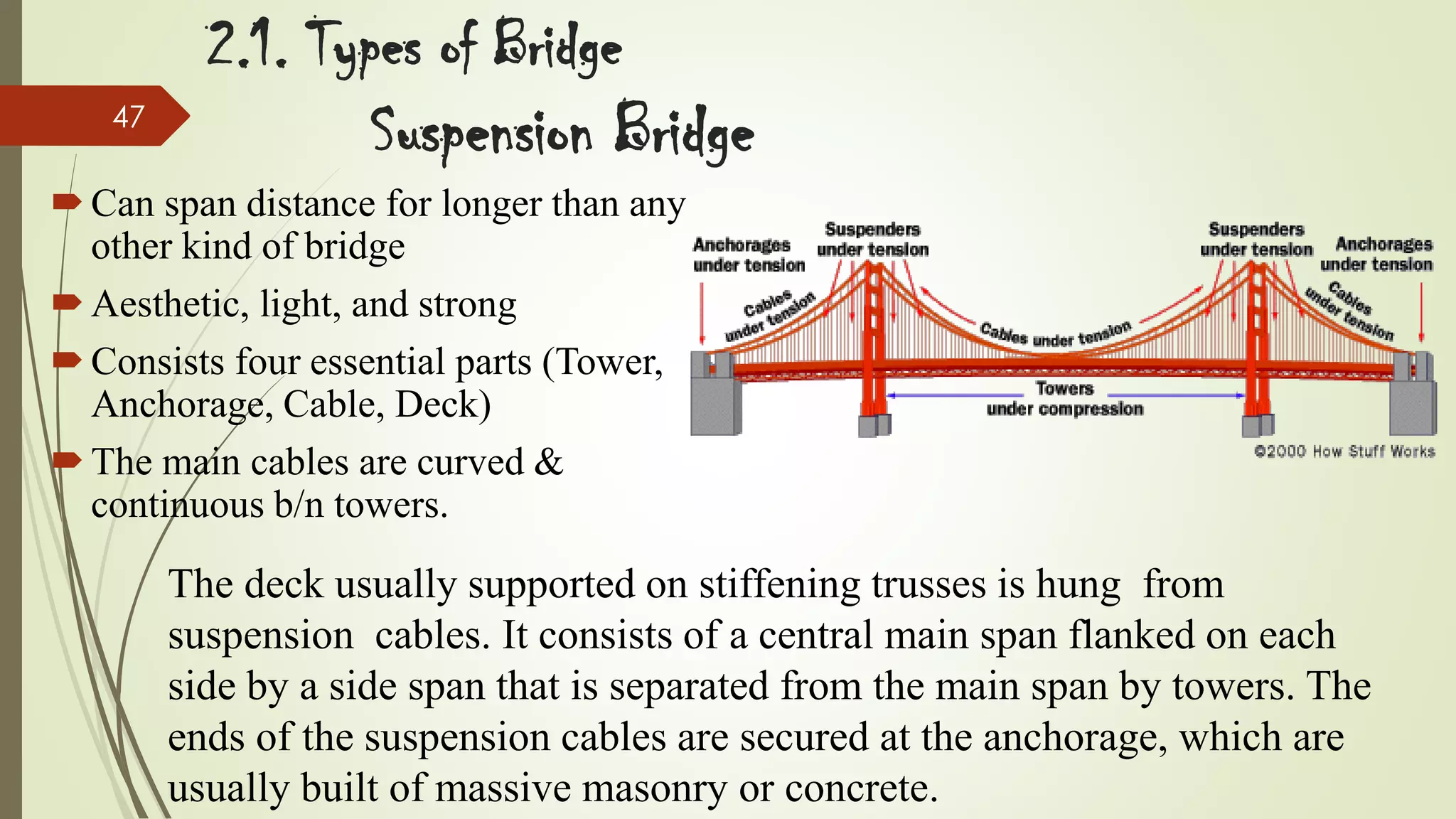
Suspension Bridge

 Can span distance for longer than any
other kind of bridge
 Aesthetic, light, and strong
 Consists four essential parts (Tower,
Anchorage, Cable, Deck)
 The main cables are curved &
continuous b/n towers.

The deck usually supported on stiffening trusses is hung from
suspension cables. It consists of a central main span flanked on each
side by a side span that is separated from the main span by towers. The
ends of the suspension cables are secured at the anchorage, which are
usually built of massive masonry or concrete.
48

2.1. Types of Bridge
Suspension Bridge

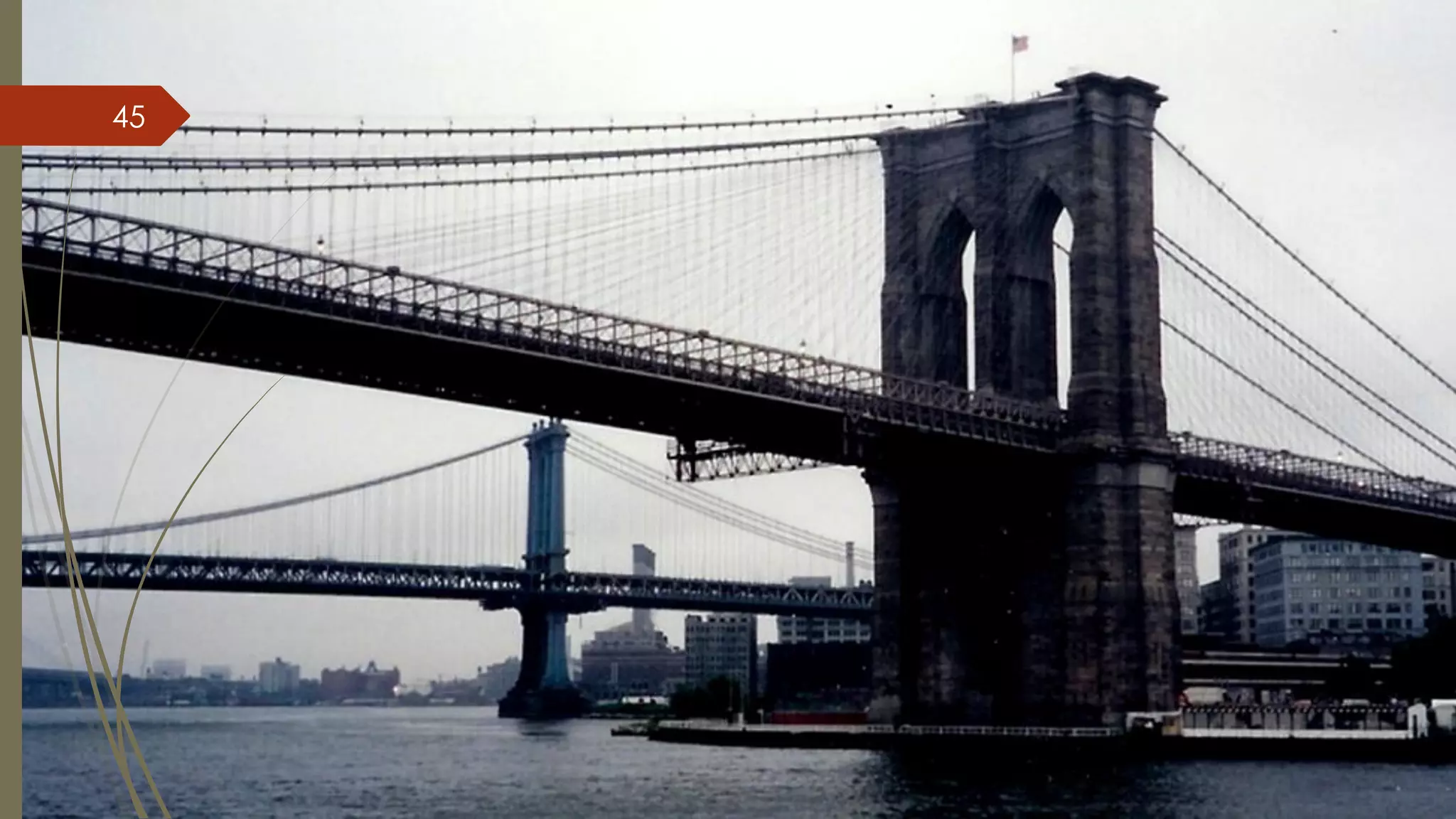
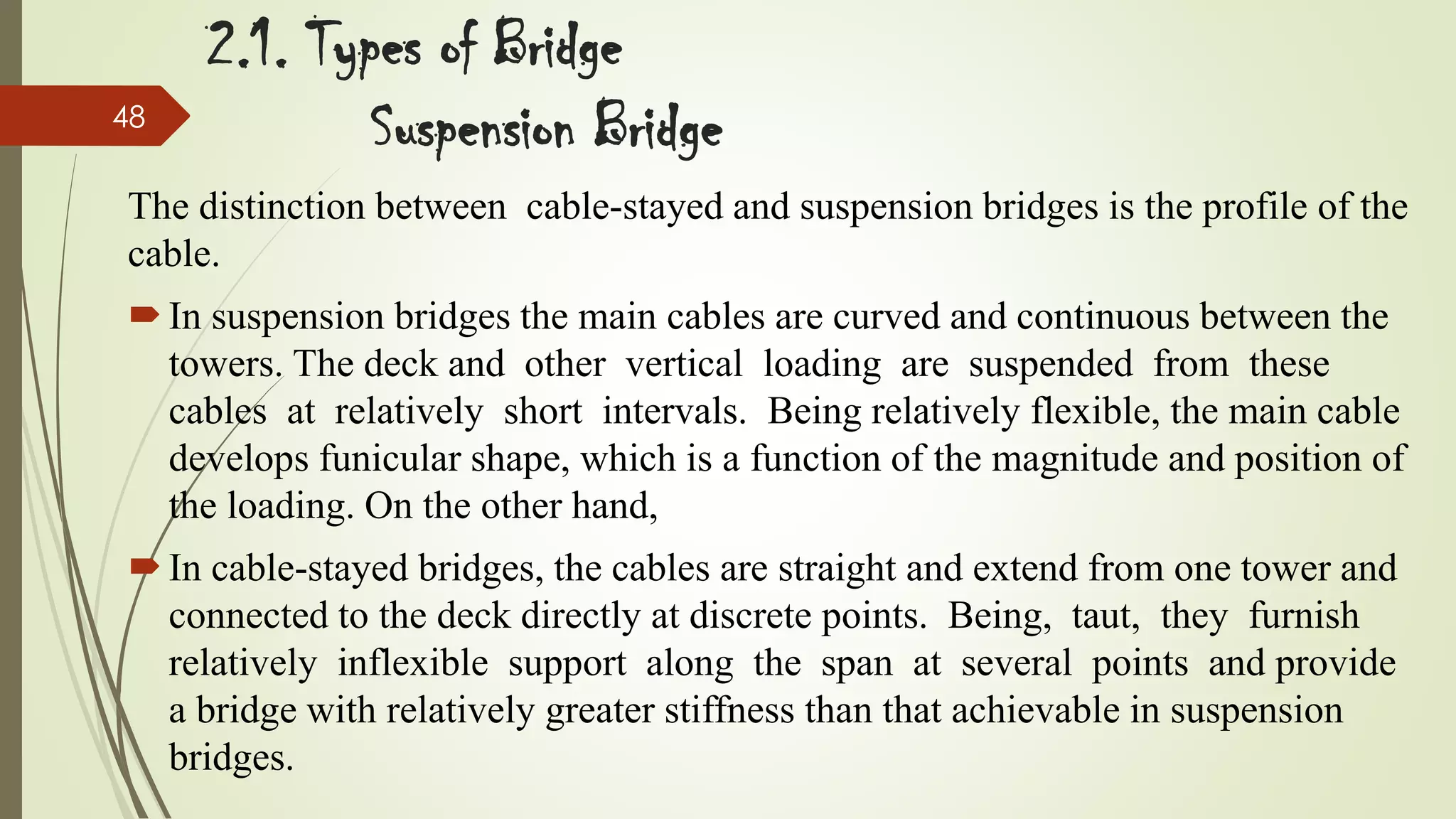
The distinction between cable-stayed and suspension bridges is the profile of the
cable.
 In suspension bridges the main cables are curved and continuous between the
towers. The deck and other vertical loading are suspended from these
cables at relatively short intervals. Being relatively flexible, the main cable
develops funicular shape, which is a function of the magnitude and position of
the loading. On the other hand,

 In cable-stayed bridges, the cables are straight and extend from one tower and
connected to the deck directly at discrete points. Being, taut, they furnish
relatively inflexible support along the span at several points and provide
a bridge with relatively greater stiffness than that achievable in suspension
bridges.
49

2.1. Types of Bridge
Suspension Bridge

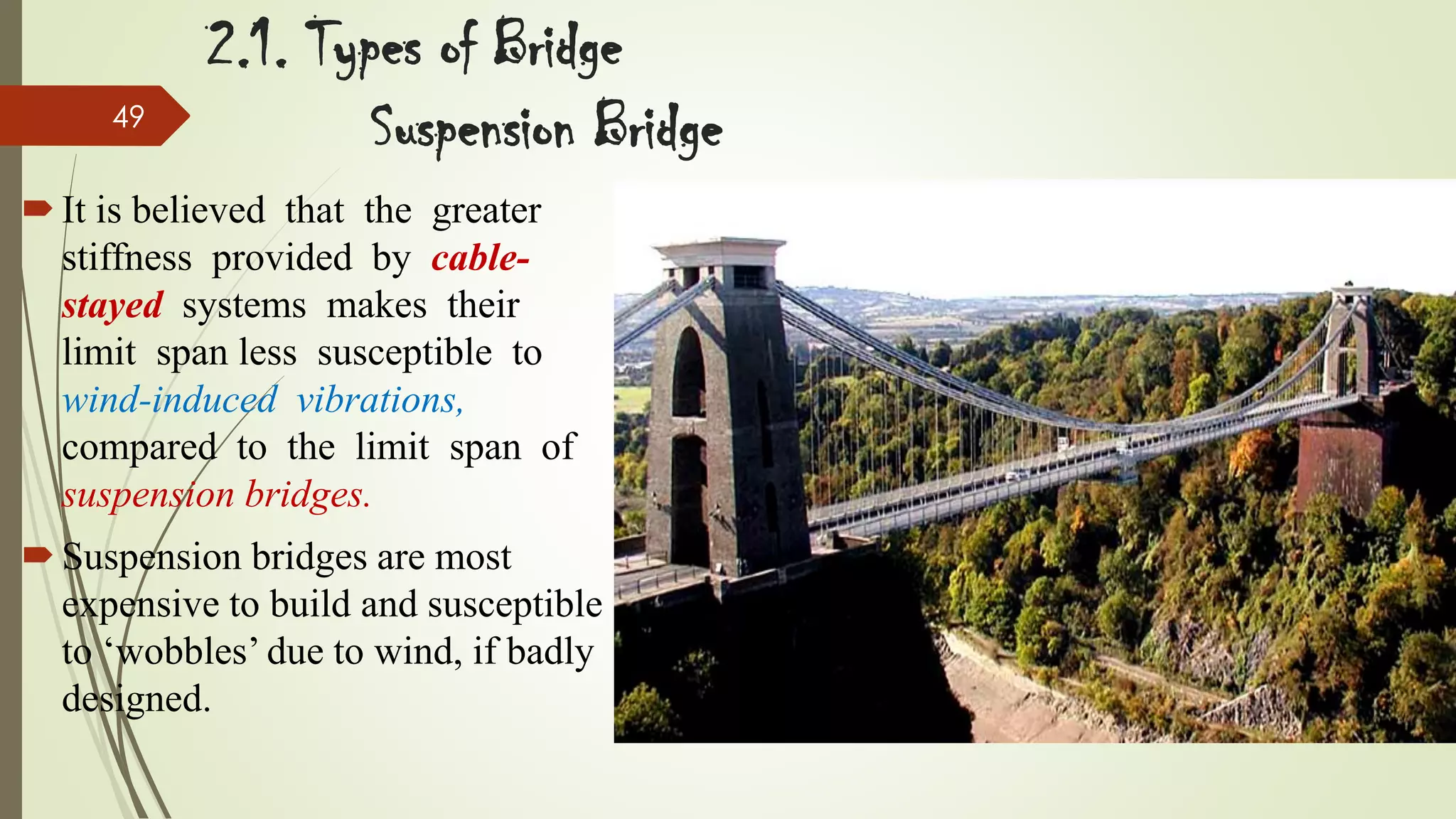
 It is believed that the greater
stiffness provided by cablestayed systems makes their
limit span less susceptible to
wind-induced vibrations,
compared to the limit span of
suspension bridges.
 Suspension bridges are most
expensive to build and susceptible
to ‘wobbles’ due to wind, if badly
designed.
50

2.2. Selection of Bridge Types
a. Geometric condition of the site (Road Alignment, Design flood and highest water
mark)
b. Aesthetics,
c. Traffic capacity,
d. Need for future widening,
e. Structural stability,
f. Foundation (sub-surface) conditions, and strength of abutments.
g. Erection procedures,
h. Available Material
i. Knowledge(skill) and Equipment(capacity) of the contractor
j. Clearance requirement above and below the road way
k. General civic requirements with respect to location, financing and community
values.
51

2.2. Selection of Bridge Types

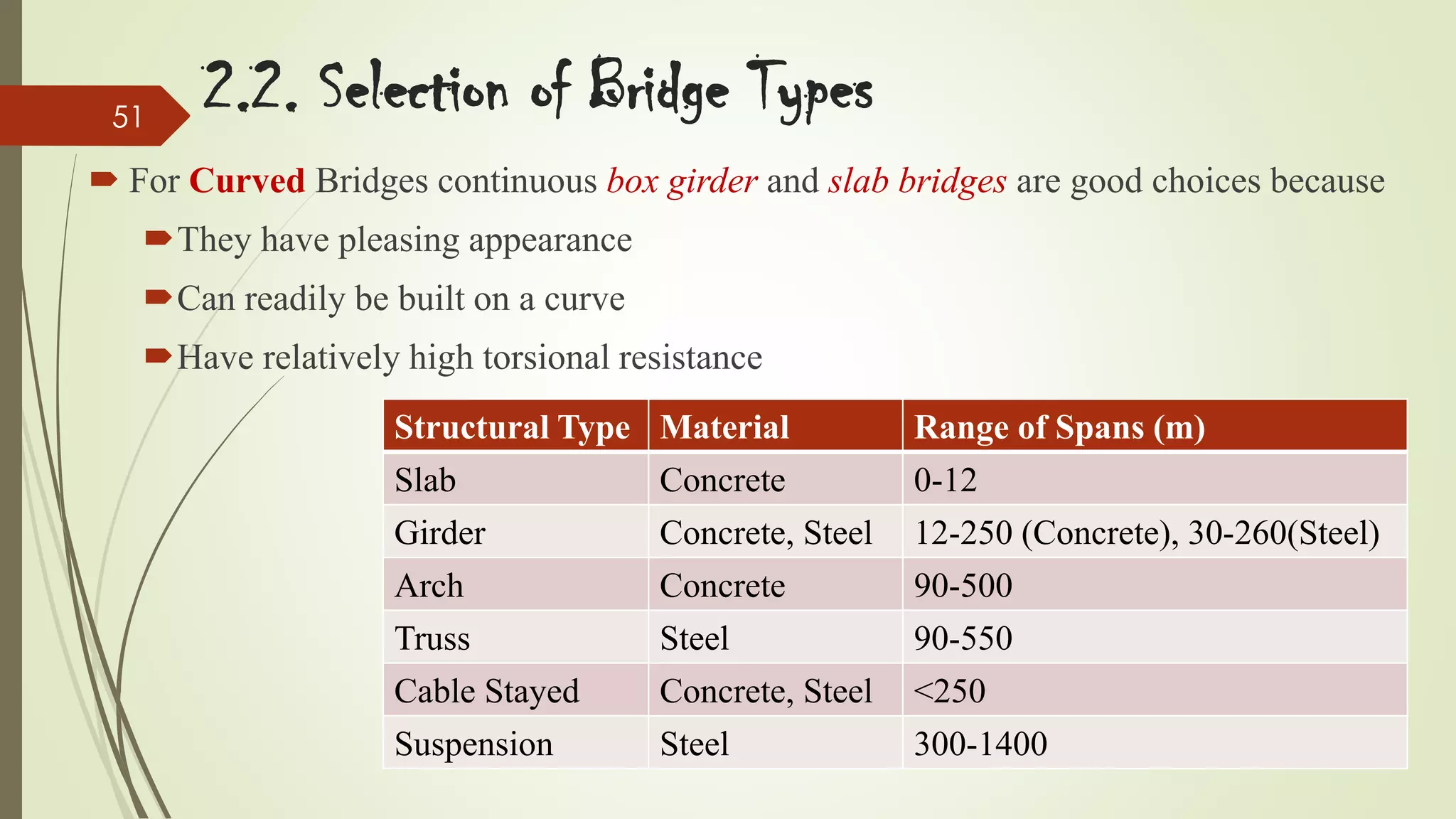
 For Curved Bridges continuous box girder and slab bridges are good choices because
They have pleasing appearance
Can readily be built on a curve
Have relatively high torsional resistance
Structural Type Material

Range of Spans (m)

Slab

Concrete

0-12

Girder

Concrete, Steel

12-250 (Concrete), 30-260(Steel)

Arch

Concrete

90-500

Truss

Steel

90-550

Cable Stayed

Concrete, Steel

<250

Suspension

Steel

300-1400
52

2.2. Selection of Bridge Types
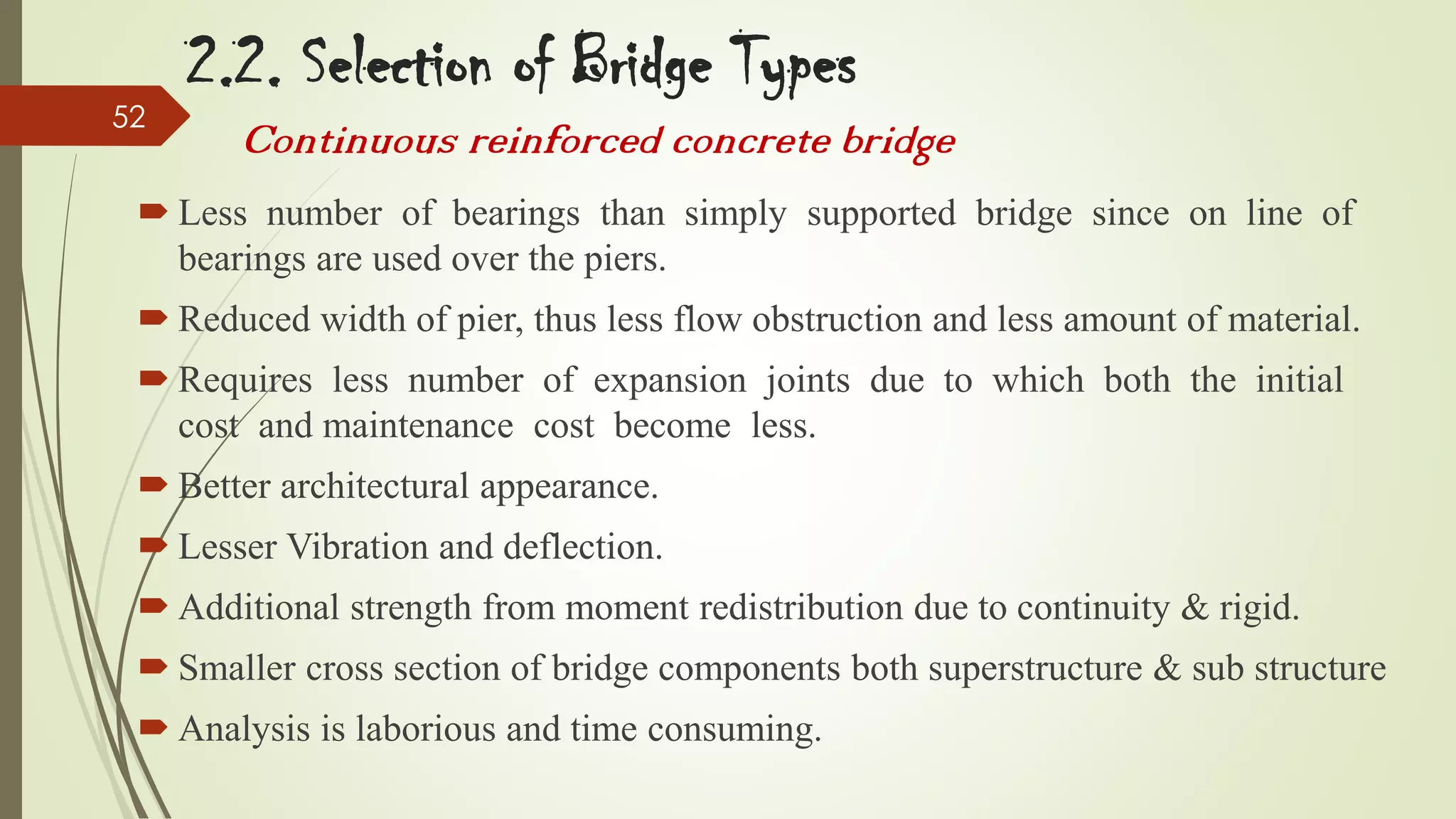
Continuous reinforced concrete bridge

 Less number of bearings than simply supported bridge since on line of
bearings are used over the piers.

 Reduced width of pier, thus less flow obstruction and less amount of material.
 Requires less number of expansion joints due to which both the initial
cost and maintenance cost become less.
 Better architectural appearance.
 Lesser Vibration and deflection.

 Additional strength from moment redistribution due to continuity & rigid.
 Smaller cross section of bridge components both superstructure & sub structure
 Analysis is laborious and time consuming.
53

2.2. Selection of Bridge Types
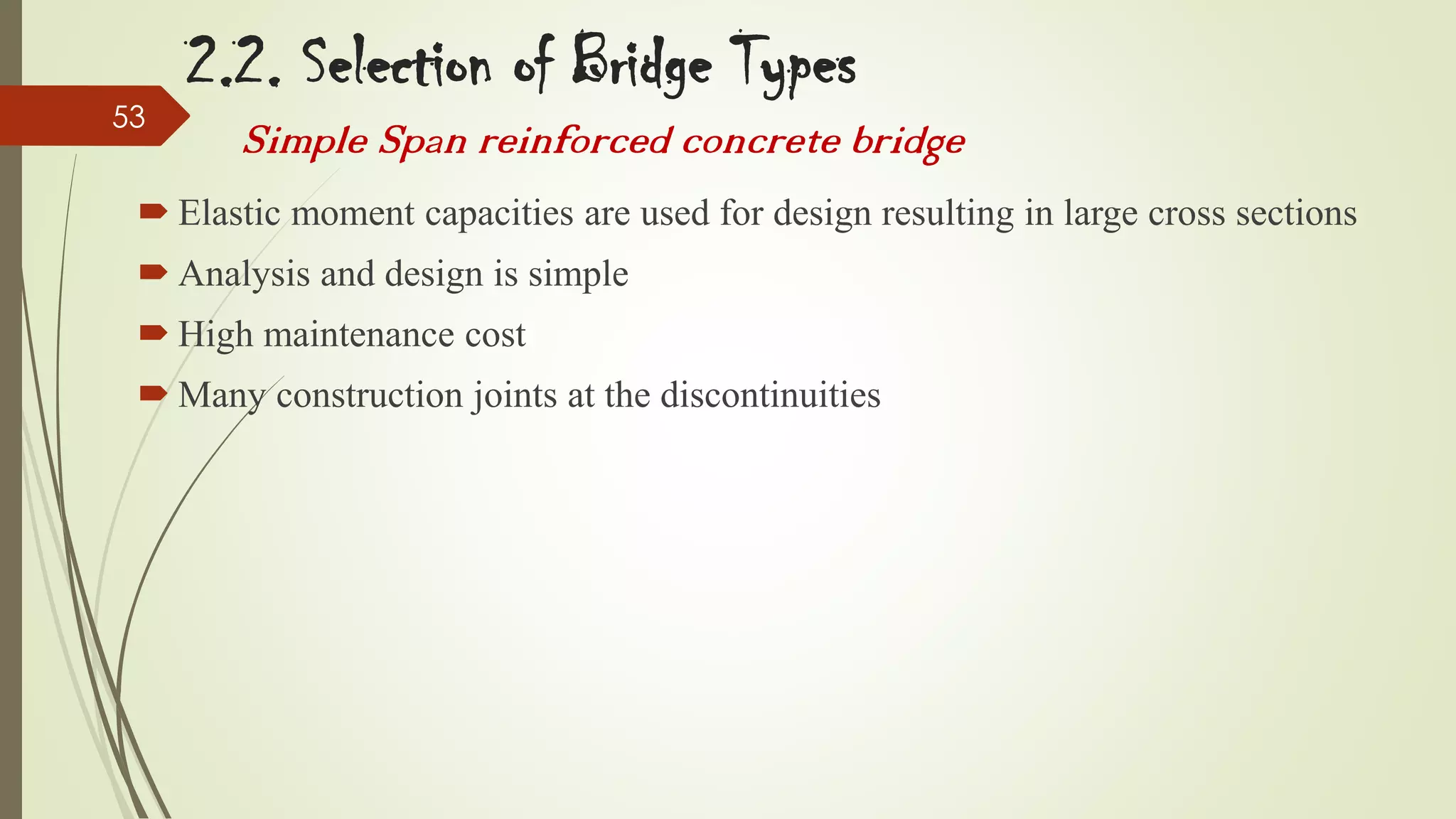
Simple Span reinforced concrete bridge

 Elastic moment capacities are used for design resulting in large cross sections
 Analysis and design is simple
 High maintenance cost
 Many construction joints at the discontinuities
2.2. Selection of Bridge Types
54

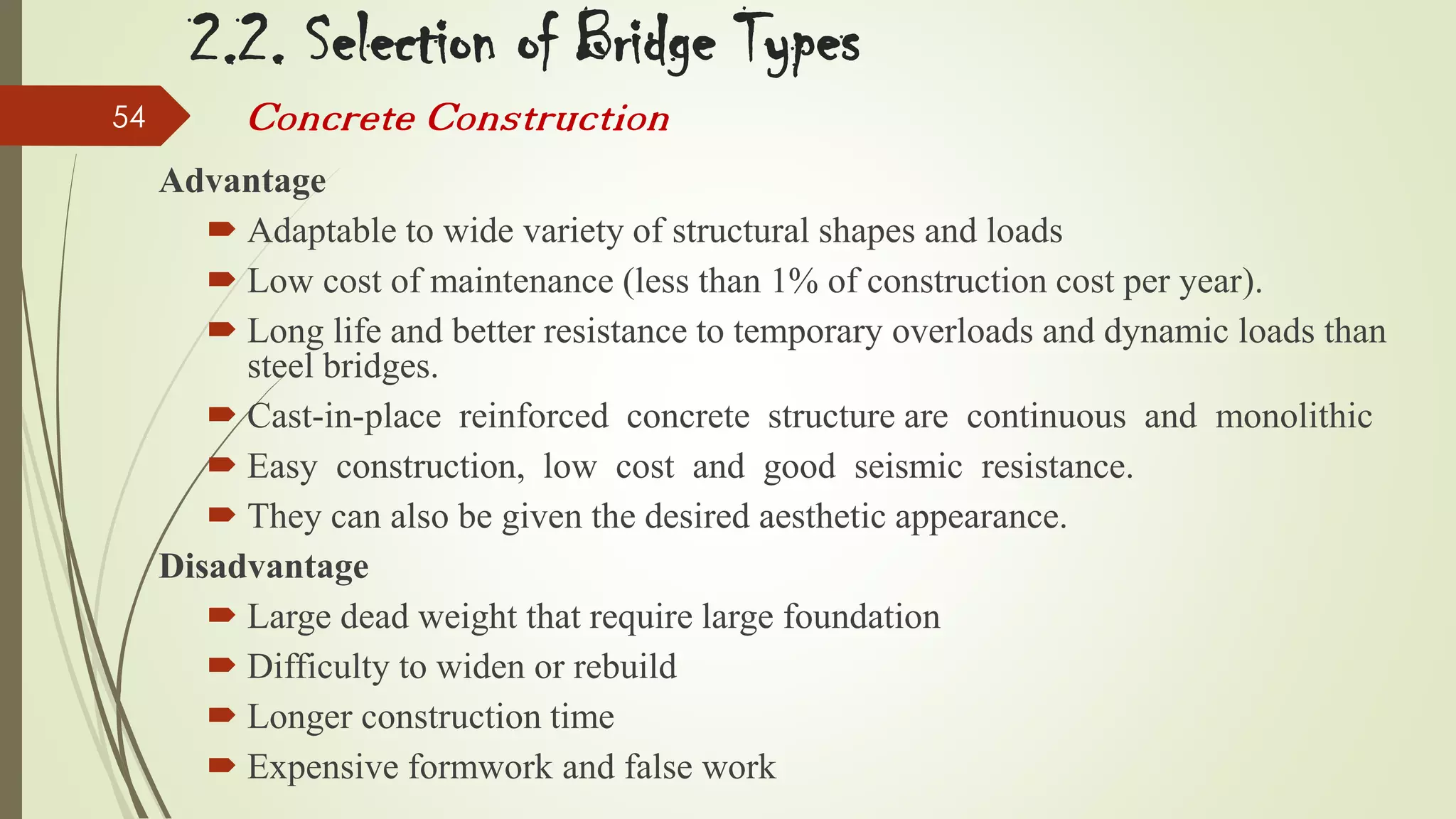
Concrete Construction
Advantage
 Adaptable to wide variety of structural shapes and loads
 Low cost of maintenance (less than 1% of construction cost per year).
 Long life and better resistance to temporary overloads and dynamic loads than
steel bridges.
 Cast-in-place reinforced concrete structure are continuous and monolithic
 Easy construction, low cost and good seismic resistance.
 They can also be given the desired aesthetic appearance.
Disadvantage
 Large dead weight that require large foundation
 Difficulty to widen or rebuild
 Longer construction time
 Expensive formwork and false work
2.2. Selection of Bridge Types
55

Steel Construction

Advantage
 Steel bridges can be built faster than reinforced concrete or pre stressed concrete bridge.
 They can be erected with ease and this minimizing construction costs.
 Steel superstructures are usually lighter than concrete superstructures which translate
into reduced substructures costs, which can be significant when soil conditions are poor.
 Steel superstructures can be designed with shallower depth than RC, which is an
important consideration when overhead clearance is required.
 Steel bridges are easy and faster to repair than RC.
Disadvantage
 Corrosion of steel is the major drawback which requires prohibitively high maintenance
cost. Corrosion can reduce cross section of structural members and weaken the
superstructure.
 The second disadvantage is that steel fatigues under repeated loading (its strength
decreases under repeated loading at high number of cycles of loading)
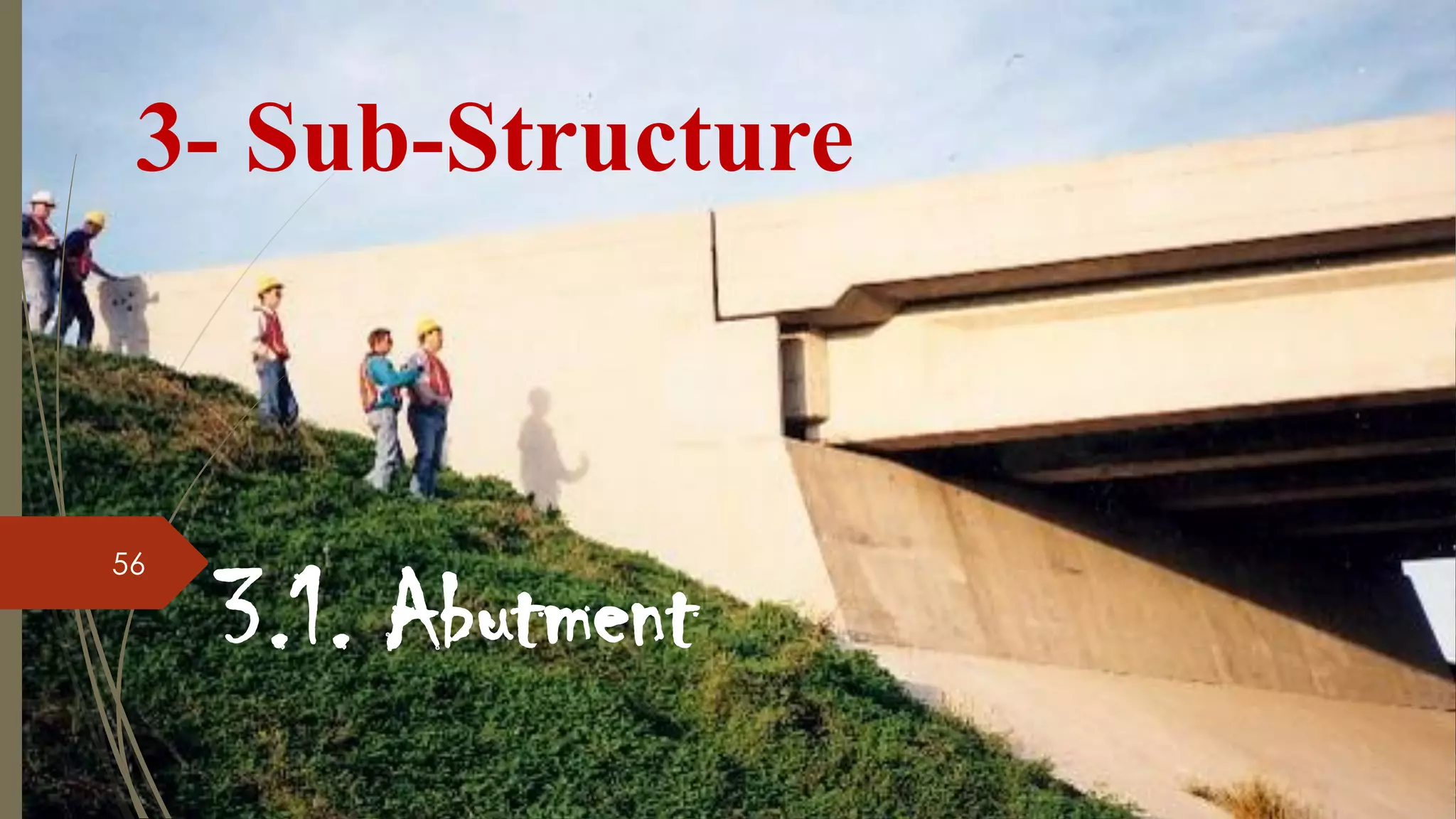
3- Sub-Structure

56

3.1. Abutment
57

3.1. Abutment

Bridge Lecture Slide by Micotol

  • 1.
    Part 2- BridgeConstruction 1 1- Introduction & Investigation
  • 2.
    2 1.1. Introduction Bridge isa structure providing passage (highway, railway, pedestrian, canal, Pipeline) over obstacle (river, valley, road, railway) “Build bridges and you will have a friend” Bridge engineering is one of the fascinating fields in civil engineering calling for expertise in many areas: structural analysis and design, geotechnique, traffic projection, surveying, runoff calculation and methods of construction. A bridge engineer has to have an appreciation of economics and aesthetics besides ability in analysis and design.
  • 3.
    3 1.2. Investigation forBridge 1.2.1. Preliminary Survey for site selection Preliminary data for site selection is collected from site visit for different alternative bridge sites. The proposed road alignment The local terrain and site conditions The required design life of the bridge The likely traffic volumes The resources available for the project

  • 4.
    4 1.2. Investigation forBridge 1.2.2. Site Selection Ideal site for bridge crossings On straight reach of the river or nodal point for meandering rivers Where the flow is steady and uniform Beyond the disturbing influence of large tributaries Has well defined & stable high banks above flood level Has reasonable straight approach & permits square crossings Has good foundation conditions Has short span Doesn’t requirement extensive river training work Doesn’t requirement extensive underwater construction
  • 5.
    5 1.2. Investigation forBridge 1.2.2. Site Selection  Initial Considerations during site selection Appropriate vertical and horizontal alignment Soil strength to ensure stability of the structure Should not have adverse impact on adjoining land or building  Location of bridge in relation to approach road alignment. a) Total Span < 60m:- The alignment of approach govern b) 60m < Total Span < 300m:- Both alignment & good bridge site selection c) Total Span > 300m:- Good bridge site governs
  • 6.
    6 1.2. Investigation forBridge 1.2.3. Site Investigation  Factors that most often need to be confirmed by field inspection are  High-water marks or profiles and related frequencies.  Selection of roughness coefficients,  Evaluation of apparent flow direction and diversions,  Flow concentration (main stream),  Observation of land use and related flood hazards, and  Geomorphic relationships and soil conditions
  • 7.
    7 1.2. Investigation forBridge 1.2.3. Site Investigation Elements of Site investigation I- Catchment area and runoff data  Catchment size  Catchment grade  Catchment cover  Presence of artificial or natural storage  Change in nature of catchment (deforestation & afforestation)  Maximum recorded intensity & frequency of rain fall
  • 8.
    8 1.2. Investigation forBridge 1.2.3. Site Investigation Elements of Site investigation II- Drawings A. Index map: general topographic map (1:50000) B. Contour Map: C. Site Plan: show detail of selected site 100-200m u/s and d/s of selected site D. Cross section & longitudinal section of the river E. Catchment area map:
  • 9.
    9 1.2. Investigation forBridge 1.2.3. Site Investigation Elements of Site investigation III- River Survey A. General Information: River name, flood direction, nearest town… B. Water Level • OFL (Ordinary flood level) • LWL (Lowest water level) • HFL (Highest Flood Level) • DFL (Design Flood Level) C. Design Discharge is flood occurring no more than once every 10yrs (returning period)
  • 10.
    10 1.2. Investigation forBridge 1.2.3. Site Investigation Elements of Site investigation  Design Discharge is maximum flow that can pass through the bridge without • Causing unacceptable disruption to traffic • Endangering the piers & abutment foundation with scours • Damaging approach embankments • Causing flood damage on upstream of embankments.  Calculation of Design Discharge a) Rational Formula b) Area – Velocity Method c) Unit Hydrograph
  • 11.
    11 1.2. Investigation forBridge 1.2.3. Site Investigation Elements of Site investigation IV. Soil Investigation  It is required to get  Soil profile  Engineering property of the foundation material  Foundation level for abutments & piers for design of foundation  The above information is obtained by analyzing samples taken from boreholes, test pit or geophysical survey.
  • 12.
    12 1.2. Investigation forBridge 1.2.4. Span Determination A. Economic Span: Min span length where cost of superstructure = Cost of substructure. B. Hydraulic Requirement: bridges are designed to accommodate design discharge at design flood. C. Location of Piers: Piers should be located to cause minimum obstruction to flow D. Free Board: water way below superstructure should be designed to pass design flood & floating debris with back water effect.
  • 13.
    13 2- Bridge typeand Selection 2.1. Bridge Types
  • 14.
    14 2.1. Types ofBridge Classification is mainly based on Superstructure a) Material b) Span Length c) Span Arrangement d) Functionality e) Structural form f) Span Length g) Movement
  • 15.
    15 2.1. Types ofBridge  Construction Materials  Traffic type/functionality  Timber Bridges  Road bridge  Masonry Bridges  Railway bridge  Reinforced Concrete Bridges  Pedestrian bridge  Pre-stressed Concrete Bridges  Span length  Steel Bridges  L ≤ 6m (Culvert)  Composite Bridges  7m < L ≤ 15m (Small span bridges)  Span Arrangement  16 ≤ L ≤ 50m (Medium span Bridges)  Simply Supported  50 ≤ L≤ 150m (Large Span Bridges)  Continuous  L≥150m (Extra Large Span Bridges)  Cantilever
  • 16.
    16 2.1. Types ofBridge Structural Arrangement or Form Slab Bridges Movements T - Girder (Deck girder Bridges) Movable Bridges (Bascule, Lift, Swing) Box Girder Fixed Bridges Arch Bridges Truss Bridges Cable Stayed Bridges Suspension Bridges
  • 17.
  • 18.
    18 2.1. Types ofBridge Slab Bridges are the simplest and least expensive structures that can be built for small spans up to 12m. They normally requires more concrete and reinforced steel than Girder Bridge of the same span but the formwork is simpler and less expressive, hence they are economical when these cast factor balance favorably.
  • 19.
    19 2.1. Types ofBridge These bridges can be built on ground supported false work or constructed of precast elements. The load carrying mechanism is by plate action, i.e., by bending and twisting due to continuity in all directions. Application of a load on the portion make the slab deflect into a dish shape locally, causing a two-dimensional system of bending and twisting moments.
  • 20.
  • 21.
    21 Pre- Stressed GirderBridges Steel girders with open intermediate bent diaphragms Pre-stressed I-girder intermediate bent
  • 22.
  • 23.
  • 24.
    24 Pre- Stressed GirderBridges Pre- Stressed I-Girder Pre- Stressed Slab deck
  • 25.
    25 Pre- Stressed GirderBridges Steel Plate Girder Bridge Pre-stressed Double Tee Girders
  • 26.
    26 2.1. Types ofBridge T-Girder Bridge
  • 27.
    27 2.1. Types ofBridge T-Girder Bridges  They are used for bridges spanning from about 10 meters-25 meters.  These usually consist of equal1y spaced beams or girders or stringers (generally with spacing of 1.8-3.6m) spanning longitudinally between supports.  The slab is structural1y continuous across the top.  The slab serves dual purpose of supporting the live load on the bridge and acting as the top flange of the longitudinal beams.  Diaphragms are provided transversely between the beams over the supports and depending on the span, at mid span and other intermediate locations.  The purpose of providing diaphragms is to ensure lateral distribution of live loads to various adjacent stringers, the magnitude of the share of each stringer depends on the stiffness of the diaphragms relative to the stringers and on the method of connectivity.  Design of T- girder bridges consists of deck slab analysis and design, and the T-girder analysis and design.
  • 28.
  • 29.
    29 2.1. Types ofBridge Box-Girder Bridge
  • 30.
    30 2.1. Types ofBridge Box-Girder Bridges Concrete box girder bridges are economical for spans of above 25 to 45m. They can be reinforced concrete or pre-stressed concrete. Longer span than 45m will have to be pre-stressed. They are similar to T-beams in configuration except the webs of T-beams are all interconnected by a common flange resulting in a cellular superstructure. The top slab, webs and bottom slab are built monolithically to act as a unit, which means that full shear transfer must be provided between all parts of the section. The interior webs resist shear and often only a small portion of girder moments. Consequently they are usually thinner than the webs of T-beams. In the case of continuous T-beams, the webs must resist the negative girder moments as well as all the shear, and contain all the reinforcement for positive moments.
  • 31.
    31 2.1. Types ofBridge Box-Girder Bridges The bottom slab (soffit) contains reinforcement for the positive moment and also acts as a compression flange in the negative moment regions of continuous spans. The bottom slab also affords a superstructure considerably thinner than a T- beam bridge of the same span and permits even longer spans to be built. Exterior Girder/web Interior Girder/web
  • 32.
    32 2.1. Types ofBridge Box-Girder Bridges Concrete box girder bridges have several advantages over other types; 1. The relatively shallow depth of box girders is all advantage where headroom is limited like in urban overpasses. 2. Monolithic construction of the superstructure and substructure offers structural as well as aesthetic advantage. The pier caps for continuous box girders can be placed with in the box, facilitating rigid connection to the pier. 3. They provide space for utilities such as water and gas lines, power, telephone and cable ducts, storm drains and sewers, which can be placed in the hollow cellular section. 4. Reinforced concrete box girders have high torsional resistance due to their closed shape and are particularly suitable for structures with significant curvature. This construction also lends itself to aesthetic treatment.
  • 33.
  • 34.
    34 2.1. Types ofBridge Truss Bridge  It creates a very rigid structure & one that transfers the load from a single point to a much wider area  Loads members in tension and compression.  Members are pinned at joints (Moment = 0).  Triangles provide stability and strength.  Ways to strengthen members in bending. Decrease overall length (deflections). Cross section design (moment of inertia) Use stronger materials (elastic modulus).
  • 35.
    35 2.1. Types ofBridge Truss Bridge Truss bridges are used for larger spans for which the depth of girder bridges is not practical due to fabrication, erection and transportation limitation or due to economy in the case of concrete girders.  The larger the height is compared to the span, the greater its strength  Every bar in this bridge experiences either a pushing or pulling force, The bars rarely bend.  Ability to support weight relies on the strength of the joints  Reasons for its un popularity • Lack of aesthetics • High life time cost
  • 36.
    36 2.1. Types ofBridge Truss Bridge
  • 37.
  • 38.
  • 39.
    39 2.1. Types ofBridge Arch Bridge A true arch transfers loads to its foundation by pure compression, however, the variable position of the live load always causes super imposed bending. Arch bridges are Very Strong if well designed Can be very beautiful Tend to be heavy Need strong abutment Economical for medium & long span bridges Reduce bending on members
  • 40.
    40 2.1. Types ofBridge Classification of Arch Bridges 1. Position of deck a. Deck Arch b. Half through Arch c. Through Arch 2. Based on nature of ribs a. Truss Arch b. Solid Rib Arch
  • 41.
  • 42.
    42 2.1. Types ofBridge Cantilever Bridge Cantilever bridge consists of two simple spans (anchor spans) with cantilever on each side of either shore supporting a short suspended span in the middle of the stream or river. This arrangement results in substantial reduction of moments or forces, in the suspended span.  Cantilever span can be erected without a false work, river navigation is not impeded during construction.  They reduce moment & force in the suspended span, decreasing mid span deflection so they have strength, rigidity & sturdiness required to carry heavy rail road traffic.
  • 43.
  • 44.
    44 2.1. Types ofBridge Cable Stayed Bridge Cable-stayed bridges are unique in that the superstructure is supported (or hung) at several intermediate points by inclined cables, or stays, radiating from and continuous over the towers, instead of being supported from underneath by conventional piers or bents.  The girder can be steel or pre-stressed concrete  Aesthetically pleasing  Easier and faster to build  Economically competitive for medium and large spans  Need strong towers
  • 45.
  • 46.
  • 47.
    2.1. Types ofBridge 47 Suspension Bridge  Can span distance for longer than any other kind of bridge  Aesthetic, light, and strong  Consists four essential parts (Tower, Anchorage, Cable, Deck)  The main cables are curved & continuous b/n towers. The deck usually supported on stiffening trusses is hung from suspension cables. It consists of a central main span flanked on each side by a side span that is separated from the main span by towers. The ends of the suspension cables are secured at the anchorage, which are usually built of massive masonry or concrete.
  • 48.
    48 2.1. Types ofBridge Suspension Bridge The distinction between cable-stayed and suspension bridges is the profile of the cable.  In suspension bridges the main cables are curved and continuous between the towers. The deck and other vertical loading are suspended from these cables at relatively short intervals. Being relatively flexible, the main cable develops funicular shape, which is a function of the magnitude and position of the loading. On the other hand,  In cable-stayed bridges, the cables are straight and extend from one tower and connected to the deck directly at discrete points. Being, taut, they furnish relatively inflexible support along the span at several points and provide a bridge with relatively greater stiffness than that achievable in suspension bridges.
  • 49.
    49 2.1. Types ofBridge Suspension Bridge  It is believed that the greater stiffness provided by cablestayed systems makes their limit span less susceptible to wind-induced vibrations, compared to the limit span of suspension bridges.  Suspension bridges are most expensive to build and susceptible to ‘wobbles’ due to wind, if badly designed.
  • 50.
    50 2.2. Selection ofBridge Types a. Geometric condition of the site (Road Alignment, Design flood and highest water mark) b. Aesthetics, c. Traffic capacity, d. Need for future widening, e. Structural stability, f. Foundation (sub-surface) conditions, and strength of abutments. g. Erection procedures, h. Available Material i. Knowledge(skill) and Equipment(capacity) of the contractor j. Clearance requirement above and below the road way k. General civic requirements with respect to location, financing and community values.
  • 51.
    51 2.2. Selection ofBridge Types  For Curved Bridges continuous box girder and slab bridges are good choices because They have pleasing appearance Can readily be built on a curve Have relatively high torsional resistance Structural Type Material Range of Spans (m) Slab Concrete 0-12 Girder Concrete, Steel 12-250 (Concrete), 30-260(Steel) Arch Concrete 90-500 Truss Steel 90-550 Cable Stayed Concrete, Steel <250 Suspension Steel 300-1400
  • 52.
    52 2.2. Selection ofBridge Types Continuous reinforced concrete bridge  Less number of bearings than simply supported bridge since on line of bearings are used over the piers.  Reduced width of pier, thus less flow obstruction and less amount of material.  Requires less number of expansion joints due to which both the initial cost and maintenance cost become less.  Better architectural appearance.  Lesser Vibration and deflection.  Additional strength from moment redistribution due to continuity & rigid.  Smaller cross section of bridge components both superstructure & sub structure  Analysis is laborious and time consuming.
  • 53.
    53 2.2. Selection ofBridge Types Simple Span reinforced concrete bridge  Elastic moment capacities are used for design resulting in large cross sections  Analysis and design is simple  High maintenance cost  Many construction joints at the discontinuities
  • 54.
    2.2. Selection ofBridge Types 54 Concrete Construction Advantage  Adaptable to wide variety of structural shapes and loads  Low cost of maintenance (less than 1% of construction cost per year).  Long life and better resistance to temporary overloads and dynamic loads than steel bridges.  Cast-in-place reinforced concrete structure are continuous and monolithic  Easy construction, low cost and good seismic resistance.  They can also be given the desired aesthetic appearance. Disadvantage  Large dead weight that require large foundation  Difficulty to widen or rebuild  Longer construction time  Expensive formwork and false work
  • 55.
    2.2. Selection ofBridge Types 55 Steel Construction Advantage  Steel bridges can be built faster than reinforced concrete or pre stressed concrete bridge.  They can be erected with ease and this minimizing construction costs.  Steel superstructures are usually lighter than concrete superstructures which translate into reduced substructures costs, which can be significant when soil conditions are poor.  Steel superstructures can be designed with shallower depth than RC, which is an important consideration when overhead clearance is required.  Steel bridges are easy and faster to repair than RC. Disadvantage  Corrosion of steel is the major drawback which requires prohibitively high maintenance cost. Corrosion can reduce cross section of structural members and weaken the superstructure.  The second disadvantage is that steel fatigues under repeated loading (its strength decreases under repeated loading at high number of cycles of loading)
  • 56.
  • 57.