BIA1021
Materials & Construction 1
for
Bachelor of Science of Architecture
Session 2024/25, Semester 1
Get-to-know questions
• How many of you are local students?
• How many are international students?
• How many of you come from urban areas?
• And how many from rural areas?
• How many of you hold a diploma in architecture?
• Or a qualification from a polytechnic or foundation related to architecture?
• How many of you live in wooden houses, masonry houses, concrete houses,
bamboo houses, or steel houses?
• How many of you have experience working in the construction field, either
directly or indirectly?
Introduction
General Info
• Faculty: Built Environment
• Department: Architecture
• Name of Academic Programme: Bachelor of
Science in Architecture
• Course Code: BIA1021
• Course Title: (Bahan dan Binaan I) Materials and
Constructions I
• Credit: 3
• Student Learning Time (SLT): 120
• Course Pre-requisite(s)/Minimum Requirement(s):
None
Introduction
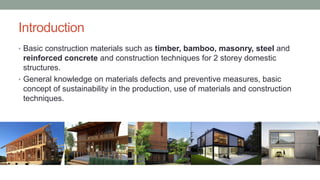
• Basic construction materials such as timber, bamboo, masonry, steel and
reinforced concrete and construction techniques for 2 storey domestic
structures.
• General knowledge on materials defects and preventive measures, basic
concept of sustainability in the production, use of materials and construction
techniques.
Course Learning Outcome (CLO)
At the end of the course, students are able to:
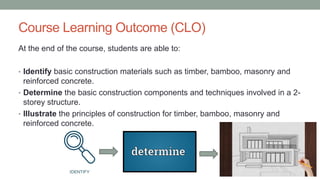
• Identify basic construction materials such as timber, bamboo, masonry and
reinforced concrete.
• Determine the basic construction components and techniques involved in a 2-
storey structure.
• Illustrate the principles of construction for timber, bamboo, masonry and
reinforced concrete.
Assessment Methods:
• Continuous Assessment: 50%
• Assignment 1 (Group) – 25%
• Assignment 2 (Individual) – 25%
• Final Examination: 50%
Assignment 1 (25%) - Group Work
The main objective is for the students to understand and able to the process of
building construction and the manner of construction. Choose any 2 storey
buidling which has good design and indicate its construction processes from
site possession to completion. Students will be divided into several groups with
a construction theme such as timber, bamboo, steel, masonry and concrete.
Produce a presentation report that consists of:
• Foundation and Structure,
• Floor, Wall and Roof Structure,
• Doors and Windows,
• External and Internal Finishing,
• Roofing and Finishing.
Peer Assessment
Assignment 2 (25%) – Individual Work
The main objective is for the students to SHOW the understanding of basic
material and construction of their final project. The presentation must consist
the drawings (any 2D drawing, sectional and other 3D illustration) which explain
the type / method of construction for the final project. Presentation of not more
than an A2 sheet safe as PDF and in a reasonable scale.
Using your final studio project, produce an A2 poster that consists of these
information:
• Identify basic construction materials of your project.
• Determine the basic construction components and
techniques involved in your project.
• Illustrate the principles of construction for your project.
Weekly
Schedule Week Date Topic
1 8/10/2023 Introductory Session, Type of Building Materials & Construction Stages
2 15/10/2023 Timber Construction
3 22/10/2023 Bamboo Construction
4 29/10/2023 Masonry Construction
5 5/11/2023 Steel Construction
6 12/11/2023 Reinforced Concrete Construction
7 19/11/2023 Expert Talk 1: Bamboo & Masonry Construction by Dr. Runda Aduldejcharas, Chulalongkorn
University, Bangkok, Thailand
- 26/11/2023 (Semester Break)
8 3/12/2022 Presentation Group 1: Timber House
9 10/12/2022 Presentation Group 2: Bamboo House
10 17/12/2022 Presentation Group 3: Masonry House
11 24/12/2023 Presentation Group 4: Steel House
12 31/12/2024 Presentation Group 5: Concrete House
13 7/1/2024 Expert Talk 2: Steel Construction by Swissma Building Technologies Sdn. Bhd.
14 14/1/2024 Factory Visit to Swissma Building Technologies S/B @ Shah Alam
15 21/1/2024 Revision Week
16 28/1/2024 Examination (tbc)
References
• Chudley and Greeno's Building Construction Handbook (12th Updated), Routledge. 2020.
• D K Chin, Building Construction (6th), Wiley (US) 2020.
• Alen Edward, Fundamentals of Building Construction: Materials and Methods (7th), Wiley(US) 2019.
• Metha Madan, Scarboughrh H. Building Construction: Principles, Materials, and Systems (What's New
in Trades & Technology). Pearson, 2016.
• Brannigan L, Colbert G. Brannigan's Building Construction. Navigate 2021
• Hill M, Carpentry & Building Construction, Student Edition, Mac Graw Hill. 2016
• Balast D K, PPI Interior Construction & Detailing for Designers & Architects, 6th Edition, PPI, A Kaplan
Company, 201 9
• Malaysian Timber Council 20018; Architectural Use of Timber Building in Malaysia. MTC. 2018.
• Architectural Use of Timber in Malaysia, MTC. 2020
• Simmons H L, Olin's Construction: Principles, Materials Construction Materials, Methods 9th Edition,
Wiley 2021.
• Spence W, Kultermann E, Construction Materials, Methods and Techniques 4th Edition. Cengage
Learning; 4th edition, 2016.
Grouping Exercise
https://pickerwheel.com/tools/random-team-generator/
Division into 5 groups
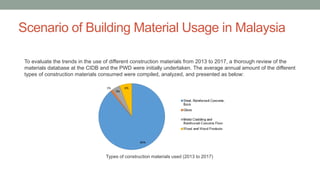
Scenario of Building Material Usage in Malaysia
Types of construction materials used (2013 to 2017)
To evaluate the trends in the use of different construction materials from 2013 to 2017, a thorough review of the
materials database at the CIDB and the PWD were initially undertaken. The average annual amount of the different
types of construction materials consumed were compiled, analyzed, and presented as below:
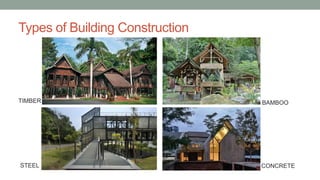
Types of Building Construction
TIMBER BAMBOO
STEEL CONCRETE
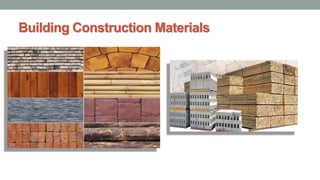
Building Construction Materials
• Stone
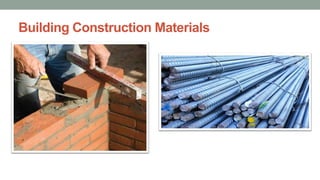
• Brick
• Cement
• Metal
• Timber
• Sand
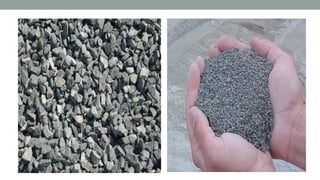
• Aggregates
• Mortar
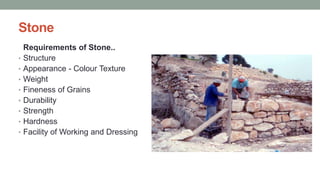
Stone
Requirements of Stone..
• Structure
• Appearance - Colour Texture
• Weight
• Fineness of Grains
• Durability
• Strength
• Hardness
• Facility of Working and Dressing
Stone
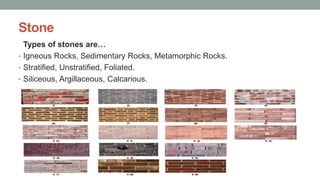
Types of stones are…
• Igneous Rocks, Sedimentary Rocks, Metamorphic Rocks.
• Stratified, Unstratified, Foliated.
• Siliceous, Argillaceous, Calcarious.
Stone
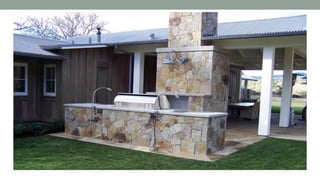
• They are used in hydraulic structures like dams and bridges.
• They are used in retaining wall masonry to retain soil.
• They are used as road metal in road construction.
• They are used as ballast for permanent way in railways.
• They are used to make concrete in the form of coarse aggregate.
Brick
Requirements of Bricks…
• The color of the brick should be red or copper and uniform.
• It should be well burnt in kilns.
• The surface should be even and free from cracks.
• The edges should be sharp.
Standard Sizes of bricks…
• Conventional / Traditional bricks : Size 23 cm x 11.4 cm x 7.6 cm
• Standard / Modular : Size : 19 cm x 9 cm x 9 cm
Brick
• Bricks are used in wall masonry construction of building
• Used in brick lintel construction
• Bats of brick are used in concrete in foundation work.
• They are durable.
• They are low cost material.
• They possess good strength.
• They are easily available.
• Brick are light in compared to stones.
Cement
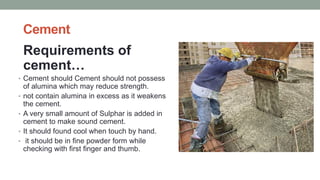
Requirements of
cement…
• Cement should Cement should not possess
of alumina which may reduce strength.
• not contain alumina in excess as it weakens
the cement.
• A very small amount of Sulphar is added in
cement to make sound cement.
• It should found cool when touch by hand.
• it should be in fine powder form while
checking with first finger and thumb.
Cement
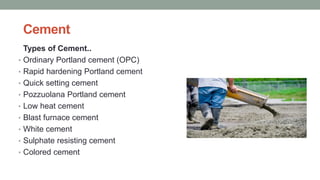
Types of Cement..
• Ordinary Portland cement (OPC)
• Rapid hardening Portland cement
• Quick setting cement
• Pozzuolana Portland cement
• Low heat cement
• Blast furnace cement
• White cement
• Sulphate resisting cement
• Colored cement
Cement
• It is used in making joints for drains & pipes.
• It is used to prepare RCC structures of building by using reinforcement with
cement concrete.
• It is used in construction of buildings, bridges, tanks, domes, flyovers,
dockyard etc.
• It is used to prepare cement mortar for building construction works like
masonry, plaster, painting, flooring etc.
• It is used to prepare cement concrete for various construction works.
Metal
Requirements of metal…
• They should provide sufficient strength to bear the loads coming on them
• They should provide resistance to corrosion and weather actions
• They should provided resistance to heat and fire.
• They should have good adhesion with cement concrete.
Metal
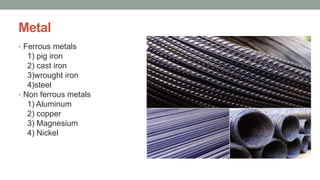
• Ferrous metals
1) pig iron
2) cast iron
3)wrought iron
4)steel
• Non ferrous metals
1) Aluminum
2) copper
3) Magnesium
4) Nickel
Timber
Requirements of timber…
• It should be dense.
• It should have uniform texture.
• It should have dark uniform color.
• It should be workable, good machinability.
• The medullary rays should be compact.
Types of Timber…
• Natural Timber - babul, oak, pine, mango, sal, teak, neem, palms, chir.
• Industrial Timber - veneers, plywoods, fiberboards, impreg timber, compreg
timber.
Timber
Uses…
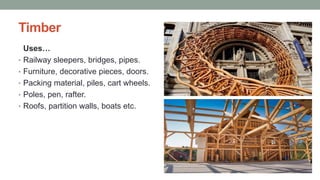
• Railway sleepers, bridges, pipes.
• Furniture, decorative pieces, doors.
• Packing material, piles, cart wheels.
• Poles, pen, rafter.
• Roofs, partition walls, boats etc.
Sand
• It should be clean.
• It should be well graded.
• Maximum permissible clay content is 3 to 4% in sand.
• It should contain sharp, angular grains.
• It should not contain salts which attract moisture from the atmosphere.
• Sand is useful in various construction activities like masonry work, plaster
work, flooring and concrete work.
• Sand is used in cement mortar, plan cement concrete , reinforced cement
concrete and prestressed concrete as key ingredient in building construction
Sand
• It is naturally available material
• It is durable
• It mix with binding material easily
• It has shiny luster
• It is of whitish brown colour.
Types of sands…
• Natural - natural sand is obtained from pits, river beds and sea beds.
• Artificial - artificial sand is formed by decomposition of sandstone due to
various weathering effects.
Aggregate
Requirements of Aggregates…
• Aggregates should be sufficiently strong.
• Aggregate surface should be rough and free form cracks.
• Aggregate should have good soundness.
• Aggregate should have good adhering with binding material.
• Fine aggregates are used to prepare cement mortar, lime mortar and cement
concrete.
• Course aggregates are used to prepare cement concrete bituminous
pavement, rigid pavement etc.
• They are used in construction of beams, columns, slab, lintel etc.
Aggregate
• Fine aggregates - size of aggregate is 4.75 mm or less is termed as fine
aggregates.
• Coarse aggregates - size of aggregates 80mm to 4.75 mm is known as
course.
• They are insoluble in water.
• They are of moderate weight.
• They are strong and durable.
• They have resistance to scratches.
• They have resistance to corrosion and decay.
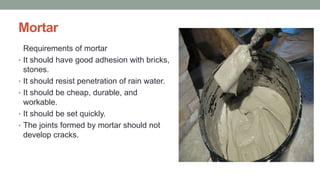
Mortar
Requirements of mortar
• It should have good adhesion with bricks,
stones.
• It should resist penetration of rain water.
• It should be cheap, durable, and
workable.
• It should be set quickly.
• The joints formed by mortar should not
develop cracks.
Mortar
 To bind the bricks or stones firmly in wall construction work.
 They are used in plaster work as finishing material to provide weather
resistance joints of masonry work are covered by plaster work. White wash
and color are applied on plastered surface easily.
Properties of mortar
 Mobility.
 Place ability.
 Water retention
Concrete
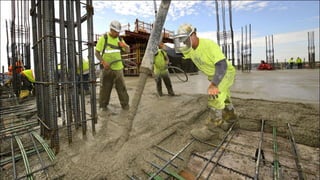
• Concrete is a mixture of cement/lime, sand, crushed rock, water.
• Preparation of concrete
• Ingredient of concrete
• Methods of mixing of concrete
TYPES OF CONCRETE
• Plain cement concrete
• Reinforced cement concrete
• Precast concrete
• Prestressed concrete
Concrete
Requirements of concrete…
• Workability
• Strength
• Durability
• Dimensional stability
Uses…
• Foundation to slab in building
• Coating material for water proofing
Which One is Artificial or Industrial Materials?
• Cement
• Bricks
• Steel
• Tiles
• Ceramic
• Paints and Varnishes
• Glass
• Plastic
• Stone
Building Construction Materials
• Building materials have an important role to play in this modern age of
technology.
• Although their most important use is in construction activities, no field of
engineering is conceivable without their use.
• Also, the building materials industry is an important contributor in our
national economy as its output governs both the rate and the quality of
construction work.
Building Construction Materials
• There are certain general factors which affect the choice of materials for a
particular scheme.
• Perhaps the most important of these is the climatic background.
• Obviously, different materials and forms of construction have developed
in different parts of the world as a result of climatic differences.
• Another factor is the economic aspect of the choice of materials.
• The rapid advance of constructional methods, the increasing introduction
of mechanical tools and plants, and changes in the organisation of the
building industry may appreciably influence the choice of materials
Building Construction Materials
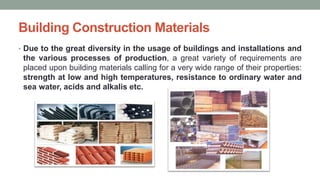
• Due to the great diversity in the usage of buildings and installations and
the various processes of production, a great variety of requirements are
placed upon building materials calling for a very wide range of their properties:
strength at low and high temperatures, resistance to ordinary water and
sea water, acids and alkalis etc.
Building Construction Materials
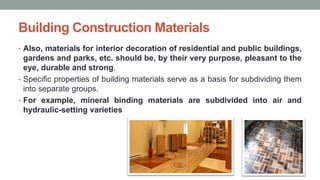
• Also, materials for interior decoration of residential and public buildings,
gardens and parks, etc. should be, by their very purpose, pleasant to the
eye, durable and strong.
• Specific properties of building materials serve as a basis for subdividing them
into separate groups.
• For example, mineral binding materials are subdivided into air and
hydraulic-setting varieties
Building Construction Materials
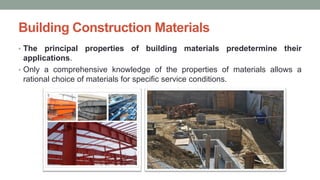
• The principal properties of building materials predetermine their
applications.
• Only a comprehensive knowledge of the properties of materials allows a
rational choice of materials for specific service conditions.
Building Construction Materials
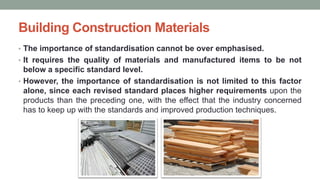
• The importance of standardisation cannot be over emphasised.
• It requires the quality of materials and manufactured items to be not
below a specific standard level.
• However, the importance of standardisation is not limited to this factor
alone, since each revised standard places higher requirements upon the
products than the preceding one, with the effect that the industry concerned
has to keep up with the standards and improved production techniques.
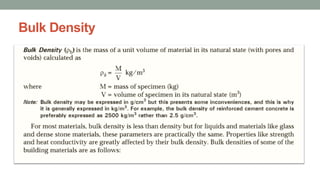
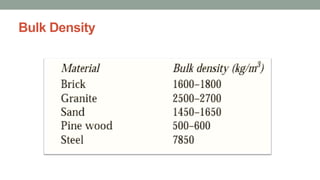
Bulk Density
Bulk Density
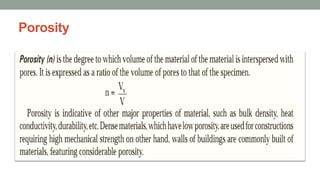
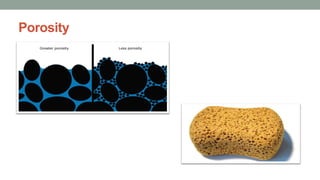
Porosity
Porosity
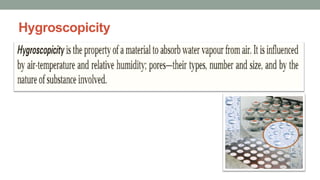
Hygroscopicity
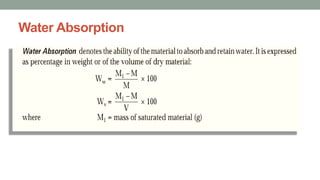
Water Absorption
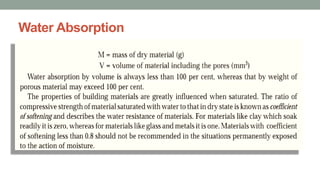
Water Absorption
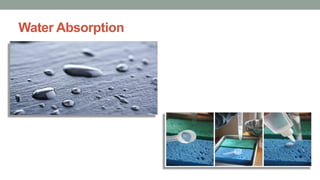
Water Absorption
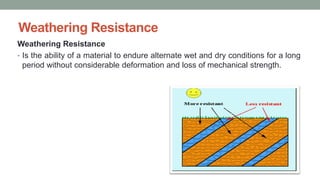
Weathering Resistance
• Is the ability of a material to endure alternate wet and dry conditions for a long
period without considerable deformation and loss of mechanical strength.
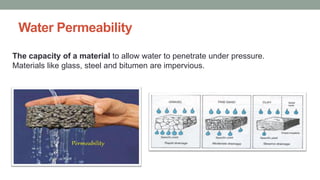
Water Permeability
The capacity of a material to allow water to penetrate under pressure.
Materials like glass, steel and bitumen are impervious.
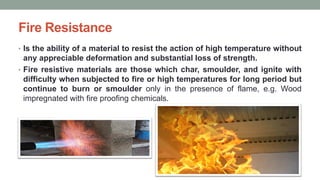
Fire Resistance
• Is the ability of a material to resist the action of high temperature without
any appreciable deformation and substantial loss of strength.
• Fire resistive materials are those which char, smoulder, and ignite with
difficulty when subjected to fire or high temperatures for long period but
continue to burn or smoulder only in the presence of flame, e.g. Wood
impregnated with fire proofing chemicals.
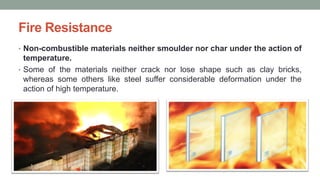
Fire Resistance
• Non-combustible materials neither smoulder nor char under the action of
temperature.
• Some of the materials neither crack nor lose shape such as clay bricks,
whereas some others like steel suffer considerable deformation under the
action of high temperature.
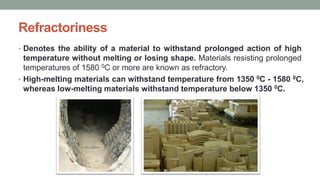
Refractoriness
• Denotes the ability of a material to withstand prolonged action of high
temperature without melting or losing shape. Materials resisting prolonged
temperatures of 1580 0C or more are known as refractory.
• High-melting materials can withstand temperature from 1350 0C - 1580 0C,
whereas low-melting materials withstand temperature below 1350 0C.
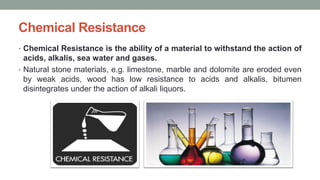
Chemical Resistance
• Chemical Resistance is the ability of a material to withstand the action of
acids, alkalis, sea water and gases.
• Natural stone materials, e.g. limestone, marble and dolomite are eroded even
by weak acids, wood has low resistance to acids and alkalis, bitumen
disintegrates under the action of alkali liquors.
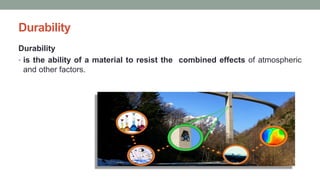
Durability
Durability
• is the ability of a material to resist the combined effects of atmospheric
and other factors.
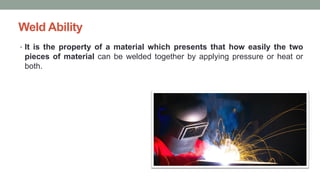
Weld Ability
• It is the property of a material which presents that how easily the two
pieces of material can be welded together by applying pressure or heat or
both.
Mechanical Properties
The mechanical properties of a material are those which effect the mechanical
strength and ability of material to be molded in suitable shape. Some of the typical
mechanical properties of a material are listed below:
• Strength
• Toughness
• Hardness
• Elasticity
• Plasticity
• Brittleness
• Malleability
• Ductility
• Creep and Slip
• Resilience
• Fatigue
Strength
• It is the property of material which opposes the deformation or breakdown of
material in presence of external forces or load. Material which we finalize for
our engineering product, must have suitable mechanical strength to be
capable to work under different mechanical forces or loads.
Strength
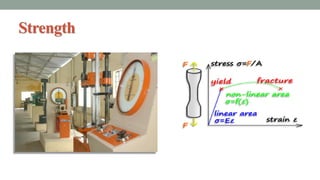
• Strength is the ability of the material to resist failure under the action of stresses
caused by loads, the most common being compression, tension, bending and
impact. The importance of studying the various strengths will be highlighted from the
fact that materials such as stones and concrete have high compressive strength but a
low tensile, bending and impact strengths.
Strength
Strength
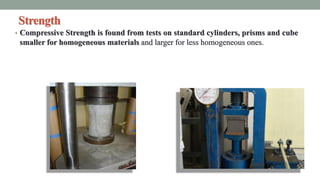
• Compressive Strength is found from tests on standard cylinders, prisms and cube
smaller for homogeneous materials and larger for less homogeneous ones.
Strength
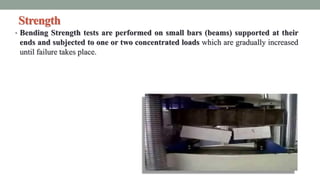
• Bending Strength tests are performed on small bars (beams) supported at their
ends and subjected to one or two concentrated loads which are gradually increased
until failure takes place.
Toughness
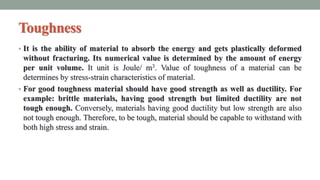
• It is the ability of material to absorb the energy and gets plastically deformed
without fracturing. Its numerical value is determined by the amount of energy
per unit volume. It unit is Joule/ m3. Value of toughness of a material can be
determines by stress-strain characteristics of material.
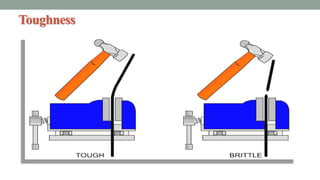
• For good toughness material should have good strength as well as ductility. For
example: brittle materials, having good strength but limited ductility are not
tough enough. Conversely, materials having good ductility but low strength are also
not tough enough. Therefore, to be tough, material should be capable to withstand with
both high stress and strain.
Toughness
Hardness
Hardness
• It is the ability of material to resist to permanent shape change due
to external stress.
• There are various measure of hardness – Scratch Hardness,
Indentation Hardness and Rebound Hardness.
• Scratch Hardness
Scratch Hardness is the ability of material to oppose the scratch to
outer surface layer due to external force.
Hardness
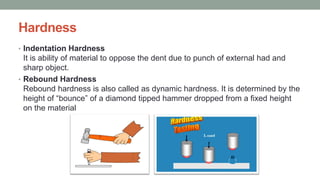
• Indentation Hardness
It is ability of material to oppose the dent due to punch of external had and
sharp object.
• Rebound Hardness
Rebound hardness is also called as dynamic hardness. It is determined by the
height of “bounce” of a diamond tipped hammer dropped from a fixed height
on the material
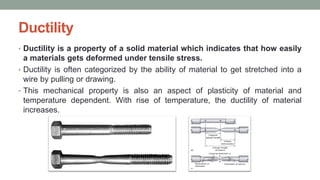
Ductility
• Ductility is a property of a solid material which indicates that how easily
a materials gets deformed under tensile stress.
• Ductility is often categorized by the ability of material to get stretched into a
wire by pulling or drawing.
• This mechanical property is also an aspect of plasticity of material and
temperature dependent. With rise of temperature, the ductility of material
increases.
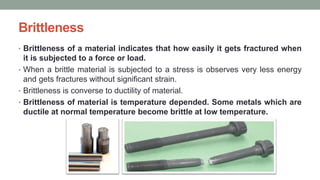
Brittleness
• Brittleness of a material indicates that how easily it gets fractured when
it is subjected to a force or load.
• When a brittle material is subjected to a stress is observes very less energy
and gets fractures without significant strain.
• Brittleness is converse to ductility of material.
• Brittleness of material is temperature depended. Some metals which are
ductile at normal temperature become brittle at low temperature.
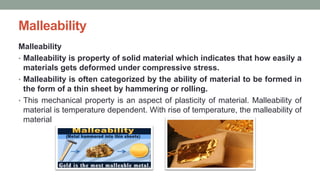
Malleability
Malleability
• Malleability is property of solid material which indicates that how easily a
materials gets deformed under compressive stress.
• Malleability is often categorized by the ability of material to be formed in
the form of a thin sheet by hammering or rolling.
• This mechanical property is an aspect of plasticity of material. Malleability of
material is temperature dependent. With rise of temperature, the malleability of
material
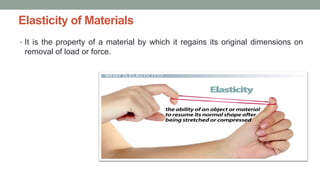
Elasticity of Materials
• It is the property of a material by which it regains its original dimensions on
removal of load or force.
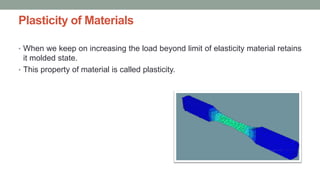
Plasticity of Materials
• When we keep on increasing the load beyond limit of elasticity material retains
it molded state.
• This property of material is called plasticity.
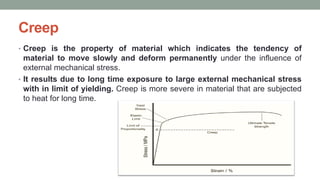
Creep
• Creep is the property of material which indicates the tendency of
material to move slowly and deform permanently under the influence of
external mechanical stress.
• It results due to long time exposure to large external mechanical stress
with in limit of yielding. Creep is more severe in material that are subjected
to heat for long time.
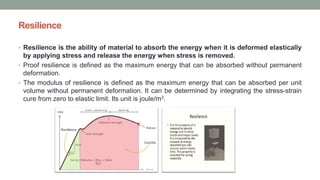
Resilience
• Resilience is the ability of material to absorb the energy when it is deformed elastically
by applying stress and release the energy when stress is removed.
• Proof resilience is defined as the maximum energy that can be absorbed without permanent
deformation.
• The modulus of resilience is defined as the maximum energy that can be absorbed per unit
volume without permanent deformation. It can be determined by integrating the stress-strain
cure from zero to elastic limit. Its unit is joule/m3.
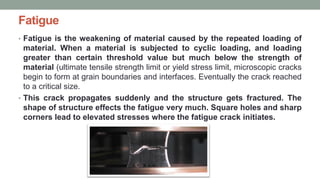
Fatigue
• Fatigue is the weakening of material caused by the repeated loading of
material. When a material is subjected to cyclic loading, and loading
greater than certain threshold value but much below the strength of
material (ultimate tensile strength limit or yield stress limit, microscopic cracks
begin to form at grain boundaries and interfaces. Eventually the crack reached
to a critical size.
• This crack propagates suddenly and the structure gets fractured. The
shape of structure effects the fatigue very much. Square holes and sharp
corners lead to elevated stresses where the fatigue crack initiates.

Modern Construction Methods & Applications in Buildings

  • 1.
    BIA1021 Materials & Construction1 for Bachelor of Science of Architecture Session 2024/25, Semester 1
  • 2.
    Get-to-know questions • Howmany of you are local students? • How many are international students? • How many of you come from urban areas? • And how many from rural areas? • How many of you hold a diploma in architecture? • Or a qualification from a polytechnic or foundation related to architecture? • How many of you live in wooden houses, masonry houses, concrete houses, bamboo houses, or steel houses? • How many of you have experience working in the construction field, either directly or indirectly?
  • 3.
    Introduction General Info • Faculty:Built Environment • Department: Architecture • Name of Academic Programme: Bachelor of Science in Architecture • Course Code: BIA1021 • Course Title: (Bahan dan Binaan I) Materials and Constructions I • Credit: 3 • Student Learning Time (SLT): 120 • Course Pre-requisite(s)/Minimum Requirement(s): None
  • 4.
    Introduction • Basic constructionmaterials such as timber, bamboo, masonry, steel and reinforced concrete and construction techniques for 2 storey domestic structures. • General knowledge on materials defects and preventive measures, basic concept of sustainability in the production, use of materials and construction techniques.
  • 5.
    Course Learning Outcome(CLO) At the end of the course, students are able to: • Identify basic construction materials such as timber, bamboo, masonry and reinforced concrete. • Determine the basic construction components and techniques involved in a 2- storey structure. • Illustrate the principles of construction for timber, bamboo, masonry and reinforced concrete.
  • 6.
    Assessment Methods: • ContinuousAssessment: 50% • Assignment 1 (Group) – 25% • Assignment 2 (Individual) – 25% • Final Examination: 50%
  • 7.
    Assignment 1 (25%)- Group Work The main objective is for the students to understand and able to the process of building construction and the manner of construction. Choose any 2 storey buidling which has good design and indicate its construction processes from site possession to completion. Students will be divided into several groups with a construction theme such as timber, bamboo, steel, masonry and concrete. Produce a presentation report that consists of: • Foundation and Structure, • Floor, Wall and Roof Structure, • Doors and Windows, • External and Internal Finishing, • Roofing and Finishing. Peer Assessment
  • 8.
    Assignment 2 (25%)– Individual Work The main objective is for the students to SHOW the understanding of basic material and construction of their final project. The presentation must consist the drawings (any 2D drawing, sectional and other 3D illustration) which explain the type / method of construction for the final project. Presentation of not more than an A2 sheet safe as PDF and in a reasonable scale. Using your final studio project, produce an A2 poster that consists of these information: • Identify basic construction materials of your project. • Determine the basic construction components and techniques involved in your project. • Illustrate the principles of construction for your project.
  • 9.
    Weekly Schedule Week DateTopic 1 8/10/2023 Introductory Session, Type of Building Materials & Construction Stages 2 15/10/2023 Timber Construction 3 22/10/2023 Bamboo Construction 4 29/10/2023 Masonry Construction 5 5/11/2023 Steel Construction 6 12/11/2023 Reinforced Concrete Construction 7 19/11/2023 Expert Talk 1: Bamboo & Masonry Construction by Dr. Runda Aduldejcharas, Chulalongkorn University, Bangkok, Thailand - 26/11/2023 (Semester Break) 8 3/12/2022 Presentation Group 1: Timber House 9 10/12/2022 Presentation Group 2: Bamboo House 10 17/12/2022 Presentation Group 3: Masonry House 11 24/12/2023 Presentation Group 4: Steel House 12 31/12/2024 Presentation Group 5: Concrete House 13 7/1/2024 Expert Talk 2: Steel Construction by Swissma Building Technologies Sdn. Bhd. 14 14/1/2024 Factory Visit to Swissma Building Technologies S/B @ Shah Alam 15 21/1/2024 Revision Week 16 28/1/2024 Examination (tbc)
  • 10.
    References • Chudley andGreeno's Building Construction Handbook (12th Updated), Routledge. 2020. • D K Chin, Building Construction (6th), Wiley (US) 2020. • Alen Edward, Fundamentals of Building Construction: Materials and Methods (7th), Wiley(US) 2019. • Metha Madan, Scarboughrh H. Building Construction: Principles, Materials, and Systems (What's New in Trades & Technology). Pearson, 2016. • Brannigan L, Colbert G. Brannigan's Building Construction. Navigate 2021 • Hill M, Carpentry & Building Construction, Student Edition, Mac Graw Hill. 2016 • Balast D K, PPI Interior Construction & Detailing for Designers & Architects, 6th Edition, PPI, A Kaplan Company, 201 9 • Malaysian Timber Council 20018; Architectural Use of Timber Building in Malaysia. MTC. 2018. • Architectural Use of Timber in Malaysia, MTC. 2020 • Simmons H L, Olin's Construction: Principles, Materials Construction Materials, Methods 9th Edition, Wiley 2021. • Spence W, Kultermann E, Construction Materials, Methods and Techniques 4th Edition. Cengage Learning; 4th edition, 2016.
  • 11.
  • 12.
    Scenario of BuildingMaterial Usage in Malaysia Types of construction materials used (2013 to 2017) To evaluate the trends in the use of different construction materials from 2013 to 2017, a thorough review of the materials database at the CIDB and the PWD were initially undertaken. The average annual amount of the different types of construction materials consumed were compiled, analyzed, and presented as below:
  • 13.
    Types of BuildingConstruction TIMBER BAMBOO STEEL CONCRETE
  • 14.
    Building Construction Materials •Stone • Brick • Cement • Metal • Timber • Sand • Aggregates • Mortar
  • 15.
    Stone Requirements of Stone.. •Structure • Appearance - Colour Texture • Weight • Fineness of Grains • Durability • Strength • Hardness • Facility of Working and Dressing
  • 16.
    Stone Types of stonesare… • Igneous Rocks, Sedimentary Rocks, Metamorphic Rocks. • Stratified, Unstratified, Foliated. • Siliceous, Argillaceous, Calcarious.
  • 18.
    Stone • They areused in hydraulic structures like dams and bridges. • They are used in retaining wall masonry to retain soil. • They are used as road metal in road construction. • They are used as ballast for permanent way in railways. • They are used to make concrete in the form of coarse aggregate.
  • 19.
    Brick Requirements of Bricks… •The color of the brick should be red or copper and uniform. • It should be well burnt in kilns. • The surface should be even and free from cracks. • The edges should be sharp. Standard Sizes of bricks… • Conventional / Traditional bricks : Size 23 cm x 11.4 cm x 7.6 cm • Standard / Modular : Size : 19 cm x 9 cm x 9 cm
  • 20.
    Brick • Bricks areused in wall masonry construction of building • Used in brick lintel construction • Bats of brick are used in concrete in foundation work. • They are durable. • They are low cost material. • They possess good strength. • They are easily available. • Brick are light in compared to stones.
  • 21.
    Cement Requirements of cement… • Cementshould Cement should not possess of alumina which may reduce strength. • not contain alumina in excess as it weakens the cement. • A very small amount of Sulphar is added in cement to make sound cement. • It should found cool when touch by hand. • it should be in fine powder form while checking with first finger and thumb.
  • 22.
    Cement Types of Cement.. •Ordinary Portland cement (OPC) • Rapid hardening Portland cement • Quick setting cement • Pozzuolana Portland cement • Low heat cement • Blast furnace cement • White cement • Sulphate resisting cement • Colored cement
  • 23.
    Cement • It isused in making joints for drains & pipes. • It is used to prepare RCC structures of building by using reinforcement with cement concrete. • It is used in construction of buildings, bridges, tanks, domes, flyovers, dockyard etc. • It is used to prepare cement mortar for building construction works like masonry, plaster, painting, flooring etc. • It is used to prepare cement concrete for various construction works.
  • 24.
    Metal Requirements of metal… •They should provide sufficient strength to bear the loads coming on them • They should provide resistance to corrosion and weather actions • They should provided resistance to heat and fire. • They should have good adhesion with cement concrete.
  • 25.
    Metal • Ferrous metals 1)pig iron 2) cast iron 3)wrought iron 4)steel • Non ferrous metals 1) Aluminum 2) copper 3) Magnesium 4) Nickel
  • 26.
    Timber Requirements of timber… •It should be dense. • It should have uniform texture. • It should have dark uniform color. • It should be workable, good machinability. • The medullary rays should be compact. Types of Timber… • Natural Timber - babul, oak, pine, mango, sal, teak, neem, palms, chir. • Industrial Timber - veneers, plywoods, fiberboards, impreg timber, compreg timber.
  • 27.
    Timber Uses… • Railway sleepers,bridges, pipes. • Furniture, decorative pieces, doors. • Packing material, piles, cart wheels. • Poles, pen, rafter. • Roofs, partition walls, boats etc.
  • 28.
    Sand • It shouldbe clean. • It should be well graded. • Maximum permissible clay content is 3 to 4% in sand. • It should contain sharp, angular grains. • It should not contain salts which attract moisture from the atmosphere. • Sand is useful in various construction activities like masonry work, plaster work, flooring and concrete work. • Sand is used in cement mortar, plan cement concrete , reinforced cement concrete and prestressed concrete as key ingredient in building construction
  • 29.
    Sand • It isnaturally available material • It is durable • It mix with binding material easily • It has shiny luster • It is of whitish brown colour. Types of sands… • Natural - natural sand is obtained from pits, river beds and sea beds. • Artificial - artificial sand is formed by decomposition of sandstone due to various weathering effects.
  • 30.
    Aggregate Requirements of Aggregates… •Aggregates should be sufficiently strong. • Aggregate surface should be rough and free form cracks. • Aggregate should have good soundness. • Aggregate should have good adhering with binding material. • Fine aggregates are used to prepare cement mortar, lime mortar and cement concrete. • Course aggregates are used to prepare cement concrete bituminous pavement, rigid pavement etc. • They are used in construction of beams, columns, slab, lintel etc.
  • 31.
    Aggregate • Fine aggregates- size of aggregate is 4.75 mm or less is termed as fine aggregates. • Coarse aggregates - size of aggregates 80mm to 4.75 mm is known as course. • They are insoluble in water. • They are of moderate weight. • They are strong and durable. • They have resistance to scratches. • They have resistance to corrosion and decay.
  • 33.
    Mortar Requirements of mortar •It should have good adhesion with bricks, stones. • It should resist penetration of rain water. • It should be cheap, durable, and workable. • It should be set quickly. • The joints formed by mortar should not develop cracks.
  • 34.
    Mortar  To bindthe bricks or stones firmly in wall construction work.  They are used in plaster work as finishing material to provide weather resistance joints of masonry work are covered by plaster work. White wash and color are applied on plastered surface easily. Properties of mortar  Mobility.  Place ability.  Water retention
  • 35.
    Concrete • Concrete isa mixture of cement/lime, sand, crushed rock, water. • Preparation of concrete • Ingredient of concrete • Methods of mixing of concrete TYPES OF CONCRETE • Plain cement concrete • Reinforced cement concrete • Precast concrete • Prestressed concrete
  • 37.
    Concrete Requirements of concrete… •Workability • Strength • Durability • Dimensional stability Uses… • Foundation to slab in building • Coating material for water proofing
  • 38.
    Which One isArtificial or Industrial Materials? • Cement • Bricks • Steel • Tiles • Ceramic • Paints and Varnishes • Glass • Plastic • Stone
  • 39.
    Building Construction Materials •Building materials have an important role to play in this modern age of technology. • Although their most important use is in construction activities, no field of engineering is conceivable without their use. • Also, the building materials industry is an important contributor in our national economy as its output governs both the rate and the quality of construction work.
  • 40.
  • 41.
    Building Construction Materials •There are certain general factors which affect the choice of materials for a particular scheme. • Perhaps the most important of these is the climatic background. • Obviously, different materials and forms of construction have developed in different parts of the world as a result of climatic differences. • Another factor is the economic aspect of the choice of materials. • The rapid advance of constructional methods, the increasing introduction of mechanical tools and plants, and changes in the organisation of the building industry may appreciably influence the choice of materials
  • 42.
  • 43.
    Building Construction Materials •Due to the great diversity in the usage of buildings and installations and the various processes of production, a great variety of requirements are placed upon building materials calling for a very wide range of their properties: strength at low and high temperatures, resistance to ordinary water and sea water, acids and alkalis etc.
  • 44.
    Building Construction Materials •Also, materials for interior decoration of residential and public buildings, gardens and parks, etc. should be, by their very purpose, pleasant to the eye, durable and strong. • Specific properties of building materials serve as a basis for subdividing them into separate groups. • For example, mineral binding materials are subdivided into air and hydraulic-setting varieties
  • 45.
    Building Construction Materials •The principal properties of building materials predetermine their applications. • Only a comprehensive knowledge of the properties of materials allows a rational choice of materials for specific service conditions.
  • 46.
    Building Construction Materials •The importance of standardisation cannot be over emphasised. • It requires the quality of materials and manufactured items to be not below a specific standard level. • However, the importance of standardisation is not limited to this factor alone, since each revised standard places higher requirements upon the products than the preceding one, with the effect that the industry concerned has to keep up with the standards and improved production techniques.
  • 47.
  • 48.
  • 49.
  • 50.
  • 51.
  • 52.
  • 53.
  • 54.
  • 55.
    Weathering Resistance Weathering Resistance •Is the ability of a material to endure alternate wet and dry conditions for a long period without considerable deformation and loss of mechanical strength.
  • 56.
    Water Permeability The capacityof a material to allow water to penetrate under pressure. Materials like glass, steel and bitumen are impervious.
  • 57.
    Fire Resistance • Isthe ability of a material to resist the action of high temperature without any appreciable deformation and substantial loss of strength. • Fire resistive materials are those which char, smoulder, and ignite with difficulty when subjected to fire or high temperatures for long period but continue to burn or smoulder only in the presence of flame, e.g. Wood impregnated with fire proofing chemicals.
  • 58.
    Fire Resistance • Non-combustiblematerials neither smoulder nor char under the action of temperature. • Some of the materials neither crack nor lose shape such as clay bricks, whereas some others like steel suffer considerable deformation under the action of high temperature.
  • 59.
    Refractoriness • Denotes theability of a material to withstand prolonged action of high temperature without melting or losing shape. Materials resisting prolonged temperatures of 1580 0C or more are known as refractory. • High-melting materials can withstand temperature from 1350 0C - 1580 0C, whereas low-melting materials withstand temperature below 1350 0C.
  • 60.
    Chemical Resistance • ChemicalResistance is the ability of a material to withstand the action of acids, alkalis, sea water and gases. • Natural stone materials, e.g. limestone, marble and dolomite are eroded even by weak acids, wood has low resistance to acids and alkalis, bitumen disintegrates under the action of alkali liquors.
  • 61.
    Durability Durability • is theability of a material to resist the combined effects of atmospheric and other factors.
  • 62.
    Weld Ability • Itis the property of a material which presents that how easily the two pieces of material can be welded together by applying pressure or heat or both.
  • 63.
    Mechanical Properties The mechanicalproperties of a material are those which effect the mechanical strength and ability of material to be molded in suitable shape. Some of the typical mechanical properties of a material are listed below: • Strength • Toughness • Hardness • Elasticity • Plasticity • Brittleness • Malleability • Ductility • Creep and Slip • Resilience • Fatigue
  • 64.
    Strength • It isthe property of material which opposes the deformation or breakdown of material in presence of external forces or load. Material which we finalize for our engineering product, must have suitable mechanical strength to be capable to work under different mechanical forces or loads.
  • 65.
    Strength • Strength isthe ability of the material to resist failure under the action of stresses caused by loads, the most common being compression, tension, bending and impact. The importance of studying the various strengths will be highlighted from the fact that materials such as stones and concrete have high compressive strength but a low tensile, bending and impact strengths.
  • 66.
  • 67.
    Strength • Compressive Strengthis found from tests on standard cylinders, prisms and cube smaller for homogeneous materials and larger for less homogeneous ones.
  • 68.
    Strength • Bending Strengthtests are performed on small bars (beams) supported at their ends and subjected to one or two concentrated loads which are gradually increased until failure takes place.
  • 69.
    Toughness • It isthe ability of material to absorb the energy and gets plastically deformed without fracturing. Its numerical value is determined by the amount of energy per unit volume. It unit is Joule/ m3. Value of toughness of a material can be determines by stress-strain characteristics of material. • For good toughness material should have good strength as well as ductility. For example: brittle materials, having good strength but limited ductility are not tough enough. Conversely, materials having good ductility but low strength are also not tough enough. Therefore, to be tough, material should be capable to withstand with both high stress and strain.
  • 70.
  • 71.
    Hardness Hardness • It isthe ability of material to resist to permanent shape change due to external stress. • There are various measure of hardness – Scratch Hardness, Indentation Hardness and Rebound Hardness. • Scratch Hardness Scratch Hardness is the ability of material to oppose the scratch to outer surface layer due to external force.
  • 72.
    Hardness • Indentation Hardness Itis ability of material to oppose the dent due to punch of external had and sharp object. • Rebound Hardness Rebound hardness is also called as dynamic hardness. It is determined by the height of “bounce” of a diamond tipped hammer dropped from a fixed height on the material
  • 73.
    Ductility • Ductility isa property of a solid material which indicates that how easily a materials gets deformed under tensile stress. • Ductility is often categorized by the ability of material to get stretched into a wire by pulling or drawing. • This mechanical property is also an aspect of plasticity of material and temperature dependent. With rise of temperature, the ductility of material increases.
  • 74.
    Brittleness • Brittleness ofa material indicates that how easily it gets fractured when it is subjected to a force or load. • When a brittle material is subjected to a stress is observes very less energy and gets fractures without significant strain. • Brittleness is converse to ductility of material. • Brittleness of material is temperature depended. Some metals which are ductile at normal temperature become brittle at low temperature.
  • 75.
    Malleability Malleability • Malleability isproperty of solid material which indicates that how easily a materials gets deformed under compressive stress. • Malleability is often categorized by the ability of material to be formed in the form of a thin sheet by hammering or rolling. • This mechanical property is an aspect of plasticity of material. Malleability of material is temperature dependent. With rise of temperature, the malleability of material
  • 76.
    Elasticity of Materials •It is the property of a material by which it regains its original dimensions on removal of load or force.
  • 77.
    Plasticity of Materials •When we keep on increasing the load beyond limit of elasticity material retains it molded state. • This property of material is called plasticity.
  • 78.
    Creep • Creep isthe property of material which indicates the tendency of material to move slowly and deform permanently under the influence of external mechanical stress. • It results due to long time exposure to large external mechanical stress with in limit of yielding. Creep is more severe in material that are subjected to heat for long time.
  • 79.
    Resilience • Resilience isthe ability of material to absorb the energy when it is deformed elastically by applying stress and release the energy when stress is removed. • Proof resilience is defined as the maximum energy that can be absorbed without permanent deformation. • The modulus of resilience is defined as the maximum energy that can be absorbed per unit volume without permanent deformation. It can be determined by integrating the stress-strain cure from zero to elastic limit. Its unit is joule/m3.
  • 80.
    Fatigue • Fatigue isthe weakening of material caused by the repeated loading of material. When a material is subjected to cyclic loading, and loading greater than certain threshold value but much below the strength of material (ultimate tensile strength limit or yield stress limit, microscopic cracks begin to form at grain boundaries and interfaces. Eventually the crack reached to a critical size. • This crack propagates suddenly and the structure gets fractured. The shape of structure effects the fatigue very much. Square holes and sharp corners lead to elevated stresses where the fatigue crack initiates.