Draft DRAFT
Lecture Notes in:
STRUCTURAL ENGINEERING
Analysis and Design
Victor E. Saouma
Dept. of Civil Environmental and Architectural Engineering
University of Colorado, Boulder, CO 80309-0428
Draft 3
PREFACE
Whereas there are numerous excellent textbooks covering Structural Analysis, or Structural
Design, I felt that there was a need for a single reference which
• Provides a succinct, yet rigorous, coverage of Structural Engineering.
• Combines, as much as possible, Analysis with Design.
• Presents numerous, carefully selected, example problems.
in a properly type set document.
As such, and given the reluctance of undergraduate students to go through extensive verbage
in order to capture a key concept, I have opted for an unusual format, one in which each key
idea is clearly distinguishable. In addition, such a format will hopefully foster group learning
among students who can easily reference misunderstood points.
Finally, whereas all problems have been taken from a variety of references, I have been
very careful in not only properly selecting them, but also in enhancing their solution through
appropriate figures and LATEX typesetting macros.
Victor Saouma Structural Engineering
Draft
Contents
I ANALYSIS 29
1 A BRIEF HISTORY OF STRUCTURAL ARCHITECTURE 31
1.1 Before the Greeks . . . . . . . . . . . . . . . . . . . . . . . . . . . . . . . . . . . . 31
1.2 Greeks . . . . . . . . . . . . . . . . . . . . . . . . . . . . . . . . . . . . . . . . . . 31
1.3 Romans . . . . . . . . . . . . . . . . . . . . . . . . . . . . . . . . . . . . . . . . . 33
1.4 The Medieval Period (477-1492) . . . . . . . . . . . . . . . . . . . . . . . . . . . . 34
1.5 The Renaissance . . . . . . . . . . . . . . . . . . . . . . . . . . . . . . . . . . . . 36
1.5.1 Leonardo da Vinci 1452-1519 . . . . . . . . . . . . . . . . . . . . . . . . . 36
1.5.2 Brunelleschi 1377-1446 . . . . . . . . . . . . . . . . . . . . . . . . . . . . . 37
1.5.3 Alberti 1404-1472 . . . . . . . . . . . . . . . . . . . . . . . . . . . . . . . 38
1.5.4 Palladio 1508-1580 . . . . . . . . . . . . . . . . . . . . . . . . . . . . . . . 38
1.5.5 Stevin . . . . . . . . . . . . . . . . . . . . . . . . . . . . . . . . . . . . . . 40
1.5.6 Galileo 1564-1642 . . . . . . . . . . . . . . . . . . . . . . . . . . . . . . . . 40
1.6 Pre Modern Period, Seventeenth Century . . . . . . . . . . . . . . . . . . . . . . 42
1.6.1 Hooke, 1635-1703 . . . . . . . . . . . . . . . . . . . . . . . . . . . . . . . . 42
1.6.2 Newton, 1642-1727 . . . . . . . . . . . . . . . . . . . . . . . . . . . . . . . 43
1.6.3 Bernoulli Family 1654-1782 . . . . . . . . . . . . . . . . . . . . . . . . . . 45
1.6.4 Euler 1707-1783 . . . . . . . . . . . . . . . . . . . . . . . . . . . . . . . . 45
1.7 The pre-Modern Period; Coulomb and Navier . . . . . . . . . . . . . . . . . . . . 47
1.8 The Modern Period (1857-Present) . . . . . . . . . . . . . . . . . . . . . . . . . . 48
1.8.1 Structures/Mechanics . . . . . . . . . . . . . . . . . . . . . . . . . . . . . 48
1.8.2 Eiffel Tower . . . . . . . . . . . . . . . . . . . . . . . . . . . . . . . . . . . 48
1.8.3 Sullivan 1856-1924 . . . . . . . . . . . . . . . . . . . . . . . . . . . . . . . 48
1.8.4 Roebling, 1806-1869 . . . . . . . . . . . . . . . . . . . . . . . . . . . . . . 49
1.8.5 Maillart . . . . . . . . . . . . . . . . . . . . . . . . . . . . . . . . . . . . . 49
1.8.6 Nervi, 1891-1979 . . . . . . . . . . . . . . . . . . . . . . . . . . . . . . . . 50
1.8.7 Khan . . . . . . . . . . . . . . . . . . . . . . . . . . . . . . . . . . . . . . 50
1.8.8 et al. . . . . . . . . . . . . . . . . . . . . . . . . . . . . . . . . . . . . . . . 51
2 INTRODUCTION 55
2.1 Structural Engineering . . . . . . . . . . . . . . . . . . . . . . . . . . . . . . . . . 55
2.2 Structures and their Surroundings . . . . . . . . . . . . . . . . . . . . . . . . . . 55
2.3 Architecture & Engineering . . . . . . . . . . . . . . . . . . . . . . . . . . . . . . 56
2.4 Architectural Design Process . . . . . . . . . . . . . . . . . . . . . . . . . . . . . 56
2.5 Architectural Design . . . . . . . . . . . . . . . . . . . . . . . . . . . . . . . . . . 56
2.6 Structural Analysis . . . . . . . . . . . . . . . . . . . . . . . . . . . . . . . . . . . 57
2.7 Structural Design . . . . . . . . . . . . . . . . . . . . . . . . . . . . . . . . . . . . 57
DraftCONTENTS 7
6 INTERNAL FORCES IN STRUCTURES 113
6.1 Design Sign Conventions . . . . . . . . . . . . . . . . . . . . . . . . . . . . . . . . 113
6.2 Load, Shear, Moment Relations . . . . . . . . . . . . . . . . . . . . . . . . . . . . 115
6.3 Moment Envelope . . . . . . . . . . . . . . . . . . . . . . . . . . . . . . . . . . . 116
6.4 Examples . . . . . . . . . . . . . . . . . . . . . . . . . . . . . . . . . . . . . . . . 117
6.4.1 Beams . . . . . . . . . . . . . . . . . . . . . . . . . . . . . . . . . . . . . . 117
E 6-1 Simple Shear and Moment Diagram . . . . . . . . . . . . . . . . . . . . . 117
E 6-2 Sketches of Shear and Moment Diagrams . . . . . . . . . . . . . . . . . . 119
6.4.2 Frames . . . . . . . . . . . . . . . . . . . . . . . . . . . . . . . . . . . . . 120
E 6-3 Frame Shear and Moment Diagram . . . . . . . . . . . . . . . . . . . . . . 120
E 6-4 Frame Shear and Moment Diagram; Hydrostatic Load . . . . . . . . . . . 123
E 6-5 Shear Moment Diagrams for Frame . . . . . . . . . . . . . . . . . . . . . . 125
E 6-6 Shear Moment Diagrams for Inclined Frame . . . . . . . . . . . . . . . . . 127
6.4.3 3D Frame . . . . . . . . . . . . . . . . . . . . . . . . . . . . . . . . . . . . 127
E 6-7 3D Frame . . . . . . . . . . . . . . . . . . . . . . . . . . . . . . . . . . . . 127
6.5 Arches . . . . . . . . . . . . . . . . . . . . . . . . . . . . . . . . . . . . . . . . . . 130
7 ARCHES and CURVED STRUCTURES 131
7.1 Arches . . . . . . . . . . . . . . . . . . . . . . . . . . . . . . . . . . . . . . . . . . 131
7.1.1 Statically Determinate . . . . . . . . . . . . . . . . . . . . . . . . . . . . . 134
E 7-1 Three Hinged Arch, Point Loads. (Gerstle 1974) . . . . . . . . . . . . . . 134
E 7-2 Semi-Circular Arch, (Gerstle 1974) . . . . . . . . . . . . . . . . . . . . . . 135
7.1.2 Statically Indeterminate . . . . . . . . . . . . . . . . . . . . . . . . . . . . 137
E 7-3 Statically Indeterminate Arch, (Kinney 1957) . . . . . . . . . . . . . . . . 137
7.2 Curved Space Structures . . . . . . . . . . . . . . . . . . . . . . . . . . . . . . . . 140
E 7-4 Semi-Circular Box Girder, (Gerstle 1974) . . . . . . . . . . . . . . . . . . 140
7.2.1 Theory . . . . . . . . . . . . . . . . . . . . . . . . . . . . . . . . . . . . . 142
7.2.1.1 Geometry . . . . . . . . . . . . . . . . . . . . . . . . . . . . . . . 142
7.2.1.2 Equilibrium . . . . . . . . . . . . . . . . . . . . . . . . . . . . . . 143
E 7-5 Internal Forces in an Helicoidal Cantilevered Girder, (Gerstle 1974) . . . 144
8 DEFLECTION of STRUCTRES; Geometric Methods 149
8.1 Flexural Deformation . . . . . . . . . . . . . . . . . . . . . . . . . . . . . . . . . 149
8.1.1 Curvature Equation . . . . . . . . . . . . . . . . . . . . . . . . . . . . . . 149
8.1.2 Differential Equation of the Elastic Curve . . . . . . . . . . . . . . . . . . 151
8.1.3 Moment Temperature Curvature Relation . . . . . . . . . . . . . . . . . . 152
8.2 Flexural Deformations . . . . . . . . . . . . . . . . . . . . . . . . . . . . . . . . . 152
8.2.1 Direct Integration Method . . . . . . . . . . . . . . . . . . . . . . . . . . . 152
E 8-1 Double Integration . . . . . . . . . . . . . . . . . . . . . . . . . . . . . . . 152
8.2.2 Curvature Area Method (Moment Area) . . . . . . . . . . . . . . . . . . . 154
8.2.2.1 First Moment Area Theorem . . . . . . . . . . . . . . . . . . . . 154
8.2.2.2 Second Moment Area Theorem . . . . . . . . . . . . . . . . . . . 154
E 8-2 Moment Area, Cantilevered Beam . . . . . . . . . . . . . . . . . . . . . . 157
E 8-3 Moment Area, Simply Supported Beam . . . . . . . . . . . . . . . . . . . 157
8.2.2.3 Maximum Deflection . . . . . . . . . . . . . . . . . . . . . . . . 159
E 8-4 Maximum Deflection . . . . . . . . . . . . . . . . . . . . . . . . . . . . . . 159
E 8-5 Frame Deflection . . . . . . . . . . . . . . . . . . . . . . . . . . . . . . . . 161
E 8-6 Frame Subjected to Temperature Loading . . . . . . . . . . . . . . . . . . 162
Victor Saouma Structural Engineering
DraftCONTENTS 9
11 APPROXIMATE FRAME ANALYSIS 227
11.1 Vertical Loads . . . . . . . . . . . . . . . . . . . . . . . . . . . . . . . . . . . . . . 227
11.2 Horizontal Loads . . . . . . . . . . . . . . . . . . . . . . . . . . . . . . . . . . . . 233
11.2.1 Portal Method . . . . . . . . . . . . . . . . . . . . . . . . . . . . . . . . . 234
E 11-1 Approximate Analysis of a Frame subjected to Vertical and Horizontal Loads236
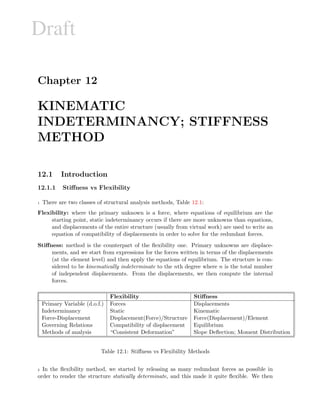
12 KINEMATIC INDETERMINANCY; STIFFNESS METHOD 253
12.1 Introduction . . . . . . . . . . . . . . . . . . . . . . . . . . . . . . . . . . . . . . . 253
12.1.1 Stiffness vs Flexibility . . . . . . . . . . . . . . . . . . . . . . . . . . . . . 253
12.1.2 Sign Convention . . . . . . . . . . . . . . . . . . . . . . . . . . . . . . . . 254
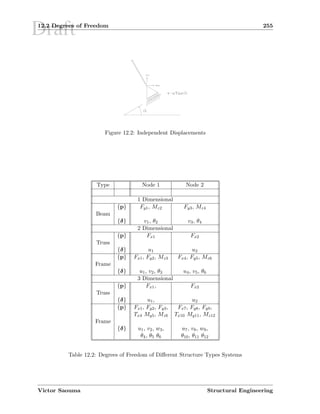
12.2 Degrees of Freedom . . . . . . . . . . . . . . . . . . . . . . . . . . . . . . . . . . . 254
12.2.1 Methods of Analysis . . . . . . . . . . . . . . . . . . . . . . . . . . . . . . 257
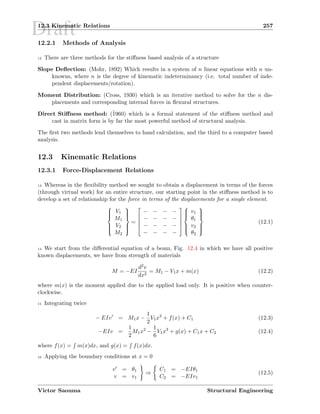
12.3 Kinematic Relations . . . . . . . . . . . . . . . . . . . . . . . . . . . . . . . . . . 257
12.3.1 Force-Displacement Relations . . . . . . . . . . . . . . . . . . . . . . . . . 257
12.3.2 Fixed End Actions . . . . . . . . . . . . . . . . . . . . . . . . . . . . . . . 259
12.3.2.1 Uniformly Distributed Loads . . . . . . . . . . . . . . . . . . . . 260
12.3.2.2 Concentrated Loads . . . . . . . . . . . . . . . . . . . . . . . . . 260
12.4 Slope Deflection; Direct Solution . . . . . . . . . . . . . . . . . . . . . . . . . . . 261
12.4.1 Slope Deflection Equations . . . . . . . . . . . . . . . . . . . . . . . . . . 261
12.4.2 Procedure . . . . . . . . . . . . . . . . . . . . . . . . . . . . . . . . . . . . 261
12.4.3 Algorithm . . . . . . . . . . . . . . . . . . . . . . . . . . . . . . . . . . . . 262
12.4.4 Examples . . . . . . . . . . . . . . . . . . . . . . . . . . . . . . . . . . . . 263
E 12-1 Propped Cantilever Beam, (Arbabi 1991) . . . . . . . . . . . . . . . . . . 263
E 12-2 Two-Span Beam, Slope Deflection, (Arbabi 1991) . . . . . . . . . . . . . . 264
E 12-3 Two-Span Beam, Slope Deflection, Initial Deflection, (Arbabi 1991) . . . 265
E 12-4 dagger Frames, Slope Deflection, (Arbabi 1991) . . . . . . . . . . . . . . . 267
12.5 Moment Distribution; Indirect Solution . . . . . . . . . . . . . . . . . . . . . . . 269
12.5.1 Background . . . . . . . . . . . . . . . . . . . . . . . . . . . . . . . . . . . 269
12.5.1.1 Sign Convention . . . . . . . . . . . . . . . . . . . . . . . . . . . 269
12.5.1.2 Fixed-End Moments . . . . . . . . . . . . . . . . . . . . . . . . . 269
12.5.1.3 Stiffness Factor . . . . . . . . . . . . . . . . . . . . . . . . . . . . 270
12.5.1.4 Distribution Factor (DF) . . . . . . . . . . . . . . . . . . . . . . 270
12.5.1.5 Carry-Over Factor . . . . . . . . . . . . . . . . . . . . . . . . . . 271
12.5.2 Procedure . . . . . . . . . . . . . . . . . . . . . . . . . . . . . . . . . . . . 271
12.5.3 Algorithm . . . . . . . . . . . . . . . . . . . . . . . . . . . . . . . . . . . . 272
12.5.4 Examples . . . . . . . . . . . . . . . . . . . . . . . . . . . . . . . . . . . . 272
E 12-5 Continuous Beam, (Kinney 1957) . . . . . . . . . . . . . . . . . . . . . . . 272
E 12-6 Continuous Beam, Simplified Method, (Kinney 1957) . . . . . . . . . . . . 275
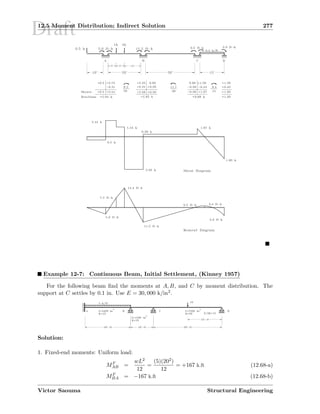
E 12-7 Continuous Beam, Initial Settlement, (Kinney 1957) . . . . . . . . . . . . 277
E 12-8 Frame, (Kinney 1957) . . . . . . . . . . . . . . . . . . . . . . . . . . . . . 278
E 12-9 Frame with Side Load, (Kinney 1957) . . . . . . . . . . . . . . . . . . . . 283
E 12-10Moment Distribution on a Spread-Sheet . . . . . . . . . . . . . . . . . . . 285
13 DIRECT STIFFNESS METHOD 287
13.1 Introduction . . . . . . . . . . . . . . . . . . . . . . . . . . . . . . . . . . . . . . . 287
13.1.1 Structural Idealization . . . . . . . . . . . . . . . . . . . . . . . . . . . . . 287
13.1.2 Structural Discretization . . . . . . . . . . . . . . . . . . . . . . . . . . . . 288
13.1.3 Coordinate Systems . . . . . . . . . . . . . . . . . . . . . . . . . . . . . . 289
Victor Saouma Structural Engineering
DraftCONTENTS 11
II DESGIN 347
14 DESIGN PHILOSOPHIES of ACI and AISC CODES 349
14.1 Safety Provisions . . . . . . . . . . . . . . . . . . . . . . . . . . . . . . . . . . . . 349
14.2 Working Stress Method . . . . . . . . . . . . . . . . . . . . . . . . . . . . . . . . 350
14.3 Ultimate Strength Method . . . . . . . . . . . . . . . . . . . . . . . . . . . . . . . 351
14.3.1 The Normal Distribution . . . . . . . . . . . . . . . . . . . . . . . . . . . 351
14.3.2 Reliability Index . . . . . . . . . . . . . . . . . . . . . . . . . . . . . . . . 352
14.3.3 Discussion . . . . . . . . . . . . . . . . . . . . . . . . . . . . . . . . . . . . 354
14.4 Example . . . . . . . . . . . . . . . . . . . . . . . . . . . . . . . . . . . . . . . . . 357
E 14-1 LRFD vs ASD . . . . . . . . . . . . . . . . . . . . . . . . . . . . . . . . . 357
15 LOADS 359
15.1 Introduction . . . . . . . . . . . . . . . . . . . . . . . . . . . . . . . . . . . . . . . 359
15.2 Vertical Loads . . . . . . . . . . . . . . . . . . . . . . . . . . . . . . . . . . . . . . 359
15.2.1 Dead Load . . . . . . . . . . . . . . . . . . . . . . . . . . . . . . . . . . . 360
15.2.2 Live Loads . . . . . . . . . . . . . . . . . . . . . . . . . . . . . . . . . . . 360
E 15-1 Live Load Reduction . . . . . . . . . . . . . . . . . . . . . . . . . . . . . . 362
15.2.3 Snow . . . . . . . . . . . . . . . . . . . . . . . . . . . . . . . . . . . . . . . 363
15.3 Lateral Loads . . . . . . . . . . . . . . . . . . . . . . . . . . . . . . . . . . . . . . 363
15.3.1 Wind . . . . . . . . . . . . . . . . . . . . . . . . . . . . . . . . . . . . . . 363
E 15-2 Wind Load . . . . . . . . . . . . . . . . . . . . . . . . . . . . . . . . . . . 369
15.3.2 Earthquakes . . . . . . . . . . . . . . . . . . . . . . . . . . . . . . . . . . . 370
E 15-3 Earthquake Load on a Frame . . . . . . . . . . . . . . . . . . . . . . . . . 374
E 15-4 Earthquake Load on a Tall Building, (Schueller 1996) . . . . . . . . . . . 375
15.4 Other Loads . . . . . . . . . . . . . . . . . . . . . . . . . . . . . . . . . . . . . . . 377
15.4.1 Hydrostatic and Earth . . . . . . . . . . . . . . . . . . . . . . . . . . . . . 377
E 15-5 Hydrostatic Load . . . . . . . . . . . . . . . . . . . . . . . . . . . . . . . . 377
15.4.2 Thermal . . . . . . . . . . . . . . . . . . . . . . . . . . . . . . . . . . . . . 378
E 15-6 Thermal Expansion/Stress (Schueller 1996) . . . . . . . . . . . . . . . . . 378
15.4.3 Bridge Loads . . . . . . . . . . . . . . . . . . . . . . . . . . . . . . . . . . 379
15.4.4 Impact Load . . . . . . . . . . . . . . . . . . . . . . . . . . . . . . . . . . 379
15.5 Other Important Considerations . . . . . . . . . . . . . . . . . . . . . . . . . . . 379
15.5.1 Load Combinations . . . . . . . . . . . . . . . . . . . . . . . . . . . . . . . 379
15.5.2 Load Placement . . . . . . . . . . . . . . . . . . . . . . . . . . . . . . . . 380
15.5.3 Structural Response . . . . . . . . . . . . . . . . . . . . . . . . . . . . . . 380
15.5.4 Tributary Areas . . . . . . . . . . . . . . . . . . . . . . . . . . . . . . . . 380
16 STRUCTURAL MATERIALS 387
16.1 Steel . . . . . . . . . . . . . . . . . . . . . . . . . . . . . . . . . . . . . . . . . . . 387
16.1.1 Structural Steel . . . . . . . . . . . . . . . . . . . . . . . . . . . . . . . . . 387
16.1.2 Reinforcing Steel . . . . . . . . . . . . . . . . . . . . . . . . . . . . . . . . 389
16.2 Aluminum . . . . . . . . . . . . . . . . . . . . . . . . . . . . . . . . . . . . . . . . 392
16.3 Concrete . . . . . . . . . . . . . . . . . . . . . . . . . . . . . . . . . . . . . . . . . 392
16.4 Masonry . . . . . . . . . . . . . . . . . . . . . . . . . . . . . . . . . . . . . . . . . 394
16.5 Timber . . . . . . . . . . . . . . . . . . . . . . . . . . . . . . . . . . . . . . . . . 394
16.6 Steel Section Properties . . . . . . . . . . . . . . . . . . . . . . . . . . . . . . . . 394
16.6.1 ASCII File with Steel Section Properties . . . . . . . . . . . . . . . . . . . 404
Victor Saouma Structural Engineering
DraftCONTENTS 13
E 19-6 Design of a Column, (?) . . . . . . . . . . . . . . . . . . . . . . . . . . . . 464
E 19-7 Column Design Using AISC Charts, (?) . . . . . . . . . . . . . . . . . . . 465
20 BRACED ROLLED STEEL BEAMS 467
20.1 Review from Strength of Materials . . . . . . . . . . . . . . . . . . . . . . . . . . 467
20.1.1 Flexure . . . . . . . . . . . . . . . . . . . . . . . . . . . . . . . . . . . . . 467
20.1.2 Shear . . . . . . . . . . . . . . . . . . . . . . . . . . . . . . . . . . . . . . 470
20.2 Nominal Strength . . . . . . . . . . . . . . . . . . . . . . . . . . . . . . . . . . . . 471
20.3 Flexural Design . . . . . . . . . . . . . . . . . . . . . . . . . . . . . . . . . . . . . 471
20.3.1 Failure Modes and Classification of Steel Beams . . . . . . . . . . . . . . 471
20.3.1.1 Compact Sections . . . . . . . . . . . . . . . . . . . . . . . . . . 472
20.3.1.2 Partially Compact Section . . . . . . . . . . . . . . . . . . . . . 473
20.3.1.3 Slender Section . . . . . . . . . . . . . . . . . . . . . . . . . . . . 474
20.3.2 Examples . . . . . . . . . . . . . . . . . . . . . . . . . . . . . . . . . . . . 475
E 20-1 Shape Factors, Rectangular Section . . . . . . . . . . . . . . . . . . . . . 475
E 20-2 Shape Factors, T Section . . . . . . . . . . . . . . . . . . . . . . . . . . . 475
E 20-3 Beam Design . . . . . . . . . . . . . . . . . . . . . . . . . . . . . . . . . . 477
20.4 Shear Design . . . . . . . . . . . . . . . . . . . . . . . . . . . . . . . . . . . . . . 479
20.5 Deflections . . . . . . . . . . . . . . . . . . . . . . . . . . . . . . . . . . . . . . . 480
20.6 Complete Design Example . . . . . . . . . . . . . . . . . . . . . . . . . . . . . . . 480
21 UNBRACED ROLLED STEEL BEAMS 483
21.1 Introduction . . . . . . . . . . . . . . . . . . . . . . . . . . . . . . . . . . . . . . . 483
21.2 Background . . . . . . . . . . . . . . . . . . . . . . . . . . . . . . . . . . . . . . . 483
21.3 AISC Equations . . . . . . . . . . . . . . . . . . . . . . . . . . . . . . . . . . . . 484
21.3.1 Dividing values . . . . . . . . . . . . . . . . . . . . . . . . . . . . . . . . . 484
21.3.2 Governing Moments . . . . . . . . . . . . . . . . . . . . . . . . . . . . . . 485
21.4 Examples . . . . . . . . . . . . . . . . . . . . . . . . . . . . . . . . . . . . . . . . 486
21.4.1 Verification . . . . . . . . . . . . . . . . . . . . . . . . . . . . . . . . . . . 486
E 21-1 Adequacy of an unbraced beam, (?) . . . . . . . . . . . . . . . . . . . . . 486
E 21-2 Adequacy of an unbraced beam, II (?) . . . . . . . . . . . . . . . . . . . . 488
21.4.2 Design . . . . . . . . . . . . . . . . . . . . . . . . . . . . . . . . . . . . . . 489
E 21-3 Design of Laterally Unsupported Beam, (?) . . . . . . . . . . . . . . . . . 490
21.5 Summary of AISC Governing Equations . . . . . . . . . . . . . . . . . . . . . . . 495
22 Beam Columns, (Unedited) 497
22.1 Potential Modes of Failures . . . . . . . . . . . . . . . . . . . . . . . . . . . . . . 497
22.2 AISC Specifications . . . . . . . . . . . . . . . . . . . . . . . . . . . . . . . . . . 497
22.3 Examples . . . . . . . . . . . . . . . . . . . . . . . . . . . . . . . . . . . . . . . . 497
22.3.1 Verification . . . . . . . . . . . . . . . . . . . . . . . . . . . . . . . . . . . 497
E 22-1 Verification, (?) . . . . . . . . . . . . . . . . . . . . . . . . . . . . . . . . . 497
E 22-2 8.2, (?) . . . . . . . . . . . . . . . . . . . . . . . . . . . . . . . . . . . . . 500
22.3.2 Design . . . . . . . . . . . . . . . . . . . . . . . . . . . . . . . . . . . . . . 503
E 22-3 Design of Steel Beam-Column, (?) . . . . . . . . . . . . . . . . . . . . . . 505
Victor Saouma Structural Engineering
DraftCONTENTS 15
26.1.4 Tendon Configuration . . . . . . . . . . . . . . . . . . . . . . . . . . . . . 546
26.1.5 Equivalent Load . . . . . . . . . . . . . . . . . . . . . . . . . . . . . . . . 546
26.1.6 Load Deformation . . . . . . . . . . . . . . . . . . . . . . . . . . . . . . . 548
26.2 Flexural Stresses . . . . . . . . . . . . . . . . . . . . . . . . . . . . . . . . . . . . 548
E 26-1 Prestressed Concrete I Beam . . . . . . . . . . . . . . . . . . . . . . . . . 550
26.3 Case Study: Walnut Lane Bridge . . . . . . . . . . . . . . . . . . . . . . . . . . . 552
26.3.1 Cross-Section Properties . . . . . . . . . . . . . . . . . . . . . . . . . . . . 552
26.3.2 Prestressing . . . . . . . . . . . . . . . . . . . . . . . . . . . . . . . . . . . 554
26.3.3 Loads . . . . . . . . . . . . . . . . . . . . . . . . . . . . . . . . . . . . . . 555
26.3.4 Flexural Stresses . . . . . . . . . . . . . . . . . . . . . . . . . . . . . . . . 555
27 COLUMNS 557
27.1 Introduction . . . . . . . . . . . . . . . . . . . . . . . . . . . . . . . . . . . . . . . 557
27.1.1 Types of Columns . . . . . . . . . . . . . . . . . . . . . . . . . . . . . . . 557
27.1.2 Possible Arrangement of Bars . . . . . . . . . . . . . . . . . . . . . . . . . 558
27.2 Short Columns . . . . . . . . . . . . . . . . . . . . . . . . . . . . . . . . . . . . . 558
27.2.1 Concentric Loading . . . . . . . . . . . . . . . . . . . . . . . . . . . . . . . 558
27.2.2 Eccentric Columns . . . . . . . . . . . . . . . . . . . . . . . . . . . . . . . 559
27.2.2.1 Balanced Condition . . . . . . . . . . . . . . . . . . . . . . . . . 559
27.2.2.2 Tension Failure . . . . . . . . . . . . . . . . . . . . . . . . . . . . 562
27.2.2.3 Compression Failure . . . . . . . . . . . . . . . . . . . . . . . . . 563
27.2.3 ACI Provisions . . . . . . . . . . . . . . . . . . . . . . . . . . . . . . . . . 563
27.2.4 Interaction Diagrams . . . . . . . . . . . . . . . . . . . . . . . . . . . . . . 564
27.2.5 Design Charts . . . . . . . . . . . . . . . . . . . . . . . . . . . . . . . . . 564
E 27-1 R/C Column, c known . . . . . . . . . . . . . . . . . . . . . . . . . . . . . 564
E 27-2 R/C Column, e known . . . . . . . . . . . . . . . . . . . . . . . . . . . . . 566
E 27-3 R/C Column, Using Design Charts . . . . . . . . . . . . . . . . . . . . . . 571
28 ELEMENTS of STRUCTURAL RELIABILITY 573
28.1 Introduction . . . . . . . . . . . . . . . . . . . . . . . . . . . . . . . . . . . . . . . 573
28.2 Elements of Statistics . . . . . . . . . . . . . . . . . . . . . . . . . . . . . . . . . 573
28.3 Distributions of Random Variables . . . . . . . . . . . . . . . . . . . . . . . . . . 575
28.3.1 Uniform Distribution . . . . . . . . . . . . . . . . . . . . . . . . . . . . . . 575
28.3.2 Normal Distribution . . . . . . . . . . . . . . . . . . . . . . . . . . . . . . 575
28.3.3 Lognormal Distribution . . . . . . . . . . . . . . . . . . . . . . . . . . . . 577
28.3.4 Beta Distribution . . . . . . . . . . . . . . . . . . . . . . . . . . . . . . . . 577
28.3.5 BiNormal distribution . . . . . . . . . . . . . . . . . . . . . . . . . . . . . 577
28.4 Reliability Index . . . . . . . . . . . . . . . . . . . . . . . . . . . . . . . . . . . . 577
28.4.1 Performance Function Identification . . . . . . . . . . . . . . . . . . . . . 577
28.4.2 Definitions . . . . . . . . . . . . . . . . . . . . . . . . . . . . . . . . . . . 577
28.4.3 Mean and Standard Deviation of a Performance Function . . . . . . . . . 578
28.4.3.1 Direct Integration . . . . . . . . . . . . . . . . . . . . . . . . . . 579
28.4.3.2 Monte Carlo Simulation . . . . . . . . . . . . . . . . . . . . . . . 579
28.4.3.3 Point Estimate Method . . . . . . . . . . . . . . . . . . . . . . . 582
28.4.3.4 Taylor’s Series-Finite Difference Estimation . . . . . . . . . . . . 583
28.4.4 Overall System Reliability . . . . . . . . . . . . . . . . . . . . . . . . . . . 584
28.4.5 Target Reliability Factors . . . . . . . . . . . . . . . . . . . . . . . . . . . 584
28.5 Reliability Analysis . . . . . . . . . . . . . . . . . . . . . . . . . . . . . . . . . . . 584
Victor Saouma Structural Engineering
DraftCONTENTS 17
33.3.2.1 Portal Method . . . . . . . . . . . . . . . . . . . . . . . . . . . . 639
E 33-1 Approximate Analysis of a Frame subjected to Vertical and Horizontal Loads641
33.4 Lateral Deflections . . . . . . . . . . . . . . . . . . . . . . . . . . . . . . . . . . . 651
33.4.1 Short Wall . . . . . . . . . . . . . . . . . . . . . . . . . . . . . . . . . . . 653
33.4.2 Tall Wall . . . . . . . . . . . . . . . . . . . . . . . . . . . . . . . . . . . . 654
33.4.3 Walls and Lintel . . . . . . . . . . . . . . . . . . . . . . . . . . . . . . . . 654
33.4.4 Frames . . . . . . . . . . . . . . . . . . . . . . . . . . . . . . . . . . . . . 655
33.4.5 Trussed Frame . . . . . . . . . . . . . . . . . . . . . . . . . . . . . . . . . 656
33.4.6 Example of Transverse Deflection . . . . . . . . . . . . . . . . . . . . . . . 657
33.4.7 Effect of Bracing Trusses . . . . . . . . . . . . . . . . . . . . . . . . . . . 661
Victor Saouma Structural Engineering
Draft
List of Figures
1.1 Hamurrabi’s Code . . . . . . . . . . . . . . . . . . . . . . . . . . . . . . . . . . . 32
1.2 Archimed . . . . . . . . . . . . . . . . . . . . . . . . . . . . . . . . . . . . . . . . 33
1.3 Pantheon . . . . . . . . . . . . . . . . . . . . . . . . . . . . . . . . . . . . . . . . 33
1.4 From Vitruvius Ten Books on Architecture, (Vitruvius 1960) . . . . . . . . . . . 34
1.5 Hagia Sophia . . . . . . . . . . . . . . . . . . . . . . . . . . . . . . . . . . . . . . 35
1.6 Florence’s Cathedral Dome . . . . . . . . . . . . . . . . . . . . . . . . . . . . . . 37
1.7 Palladio’s Villa Rotunda . . . . . . . . . . . . . . . . . . . . . . . . . . . . . . . . 39
1.8 Stevin . . . . . . . . . . . . . . . . . . . . . . . . . . . . . . . . . . . . . . . . . . 40
1.9 Galileo . . . . . . . . . . . . . . . . . . . . . . . . . . . . . . . . . . . . . . . . . . 41
1.10 Discourses Concerning Two New Sciences, Cover Page . . . . . . . . . . . . . . . 41
1.11 “Galileo’s Beam” . . . . . . . . . . . . . . . . . . . . . . . . . . . . . . . . . . . . 42
1.12 Experimental Set Up Used by Hooke . . . . . . . . . . . . . . . . . . . . . . . . . 43
1.13 Isaac Newton . . . . . . . . . . . . . . . . . . . . . . . . . . . . . . . . . . . . . . 44
1.14 Philosophiae Naturalis Principia Mathematica, Cover Page . . . . . . . . . . . . 44
1.15 Leonhard Euler . . . . . . . . . . . . . . . . . . . . . . . . . . . . . . . . . . . . . 46
1.16 Coulomb . . . . . . . . . . . . . . . . . . . . . . . . . . . . . . . . . . . . . . . . . 47
1.17 Nervi’s Palazetto Dello Sport . . . . . . . . . . . . . . . . . . . . . . . . . . . . . 51
2.1 Types of Forces in Structural Elements (1D) . . . . . . . . . . . . . . . . . . . . . 58
2.2 Basic Aspects of Cable Systems . . . . . . . . . . . . . . . . . . . . . . . . . . . . 59
2.3 Basic Aspects of Arches . . . . . . . . . . . . . . . . . . . . . . . . . . . . . . . . 60
2.4 Types of Trusses . . . . . . . . . . . . . . . . . . . . . . . . . . . . . . . . . . . . 61
2.5 Variations in Post and Beams Configurations . . . . . . . . . . . . . . . . . . . . 62
2.6 Different Beam Types . . . . . . . . . . . . . . . . . . . . . . . . . . . . . . . . . 63
2.7 Basic Forms of Frames . . . . . . . . . . . . . . . . . . . . . . . . . . . . . . . . . 64
2.8 Examples of Air Supported Structures . . . . . . . . . . . . . . . . . . . . . . . . 65
2.9 Basic Forms of Shells . . . . . . . . . . . . . . . . . . . . . . . . . . . . . . . . . . 66
2.10 Sequence of Structural Engineering Courses . . . . . . . . . . . . . . . . . . . . . 67
3.1 Types of Supports . . . . . . . . . . . . . . . . . . . . . . . . . . . . . . . . . . . 70
3.2 Inclined Roller Support . . . . . . . . . . . . . . . . . . . . . . . . . . . . . . . . 72
3.3 Examples of Static Determinate and Indeterminate Structures . . . . . . . . . . . 72
3.4 Geometric Instability Caused by Concurrent Reactions . . . . . . . . . . . . . . . 74
4.1 Types of Trusses . . . . . . . . . . . . . . . . . . . . . . . . . . . . . . . . . . . . 82
4.2 Bridge Truss . . . . . . . . . . . . . . . . . . . . . . . . . . . . . . . . . . . . . . 82
4.3 A Statically Indeterminate Truss . . . . . . . . . . . . . . . . . . . . . . . . . . . 84
4.4 X and Y Components of Truss Forces . . . . . . . . . . . . . . . . . . . . . . . . 85
DraftLIST OF FIGURES 21
9.2 Strain Energy Definition . . . . . . . . . . . . . . . . . . . . . . . . . . . . . . . . 173
9.3 Deflection of Cantilever Beam . . . . . . . . . . . . . . . . . . . . . . . . . . . . . 174
9.4 Real and Virtual Forces . . . . . . . . . . . . . . . . . . . . . . . . . . . . . . . . 176
9.5 Torsion Rotation Relations . . . . . . . . . . . . . . . . . . . . . . . . . . . . . . 178
9.6 . . . . . . . . . . . . . . . . . . . . . . . . . . . . . . . . . . . . . . . . . . . . . 181
9.7 . . . . . . . . . . . . . . . . . . . . . . . . . . . . . . . . . . . . . . . . . . . . . 181
9.8 . . . . . . . . . . . . . . . . . . . . . . . . . . . . . . . . . . . . . . . . . . . . . 182
9.9 . . . . . . . . . . . . . . . . . . . . . . . . . . . . . . . . . . . . . . . . . . . . . 183
9.10 . . . . . . . . . . . . . . . . . . . . . . . . . . . . . . . . . . . . . . . . . . . . . 184
9.11 . . . . . . . . . . . . . . . . . . . . . . . . . . . . . . . . . . . . . . . . . . . . . 185
9.12 . . . . . . . . . . . . . . . . . . . . . . . . . . . . . . . . . . . . . . . . . . . . . 186
9.13 . . . . . . . . . . . . . . . . . . . . . . . . . . . . . . . . . . . . . . . . . . . . . 190
9.14 . . . . . . . . . . . . . . . . . . . . . . . . . . . . . . . . . . . . . . . . . . . . . 191
9.15 *(correct 42.7 to 47.2) . . . . . . . . . . . . . . . . . . . . . . . . . . . . . . . . . 194
10.1 Statically Indeterminate 3 Cable Structure . . . . . . . . . . . . . . . . . . . . . . 200
10.2 Propped Cantilever Beam . . . . . . . . . . . . . . . . . . . . . . . . . . . . . . . 201
10.3 . . . . . . . . . . . . . . . . . . . . . . . . . . . . . . . . . . . . . . . . . . . . . 204
10.4 . . . . . . . . . . . . . . . . . . . . . . . . . . . . . . . . . . . . . . . . . . . . . 205
10.5 . . . . . . . . . . . . . . . . . . . . . . . . . . . . . . . . . . . . . . . . . . . . . 206
10.6 . . . . . . . . . . . . . . . . . . . . . . . . . . . . . . . . . . . . . . . . . . . . . 207
10.7 . . . . . . . . . . . . . . . . . . . . . . . . . . . . . . . . . . . . . . . . . . . . . 208
10.8 . . . . . . . . . . . . . . . . . . . . . . . . . . . . . . . . . . . . . . . . . . . . . 209
10.9 . . . . . . . . . . . . . . . . . . . . . . . . . . . . . . . . . . . . . . . . . . . . . 211
10.10 . . . . . . . . . . . . . . . . . . . . . . . . . . . . . . . . . . . . . . . . . . . . . 213
10.11 . . . . . . . . . . . . . . . . . . . . . . . . . . . . . . . . . . . . . . . . . . . . . 214
10.12 . . . . . . . . . . . . . . . . . . . . . . . . . . . . . . . . . . . . . . . . . . . . . 215
10.13 . . . . . . . . . . . . . . . . . . . . . . . . . . . . . . . . . . . . . . . . . . . . . 216
10.14 . . . . . . . . . . . . . . . . . . . . . . . . . . . . . . . . . . . . . . . . . . . . . 218
10.15Definition of Flexibility Terms for a Rigid Frame . . . . . . . . . . . . . . . . . . 220
10.16 . . . . . . . . . . . . . . . . . . . . . . . . . . . . . . . . . . . . . . . . . . . . . 221
10.17 . . . . . . . . . . . . . . . . . . . . . . . . . . . . . . . . . . . . . . . . . . . . . 223
11.1 Uniformly Loaded Beam and Frame with Free or Fixed Beam Restraint . . . . . 228
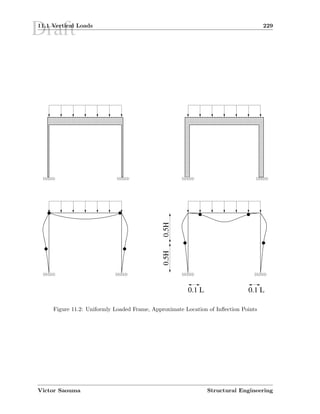
11.2 Uniformly Loaded Frame, Approximate Location of Inflection Points . . . . . . . 229
11.3 Approximate Analysis of Frames Subjected to Vertical Loads; Girder Moments . 230
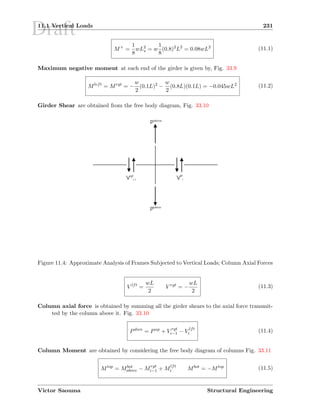
11.4 Approximate Analysis of Frames Subjected to Vertical Loads; Column Axial Forces231
11.5 Approximate Analysis of Frames Subjected to Vertical Loads; Column Moments 232
11.6 Horizontal Force Acting on a Frame, Approximate Location of Inflection Points . 233
11.7 Approximate Analysis of Frames Subjected to Lateral Loads; Column Shear . . . 235
11.8 ***Approximate Analysis of Frames Subjected to Lateral Loads; Girder Moment 235
11.9 Approximate Analysis of Frames Subjected to Lateral Loads; Column Axial Force236
11.10Example; Approximate Analysis of a Building . . . . . . . . . . . . . . . . . . . . 237
11.11Free Body Diagram for the Approximate Analysis of a Frame Subjected to Vertical Loads237
11.12Approximate Analysis of a Building; Moments Due to Vertical Loads . . . . . . . 239
11.13Approximate Analysis of a Building; Shears Due to Vertical Loads . . . . . . . . 241
11.14Approximate Analysis for Vertical Loads; Spread-Sheet Format . . . . . . . . . . 242
11.15Approximate Analysis for Vertical Loads; Equations in Spread-Sheet . . . . . . . 243
Victor Saouma Structural Engineering
DraftLIST OF FIGURES 23
15.13Load Life of a Structure, (Lin and Stotesbury 1981) . . . . . . . . . . . . . . . . 381
15.14Concept of Tributary Areas for Structural Member Loading . . . . . . . . . . . . 382
15.15One or Two Way actions in Slabs . . . . . . . . . . . . . . . . . . . . . . . . . . . 382
15.16Load Transfer in R/C Buildings . . . . . . . . . . . . . . . . . . . . . . . . . . . . 384
15.17Two Way Actions . . . . . . . . . . . . . . . . . . . . . . . . . . . . . . . . . . . . 385
15.18Example of Load Transfer . . . . . . . . . . . . . . . . . . . . . . . . . . . . . . . 386
16.1 Stress Strain Curves of Concrete and Steel . . . . . . . . . . . . . . . . . . . . . . 388
16.2 Standard Rolled Sections . . . . . . . . . . . . . . . . . . . . . . . . . . . . . . . 388
16.3 Residual Stresses in Rolled Sections . . . . . . . . . . . . . . . . . . . . . . . . . 390
16.4 Residual Stresses in Welded Sections . . . . . . . . . . . . . . . . . . . . . . . . . 390
16.5 Influence of Residual Stress on Average Stress-Strain Curve of a Rolled Section . 391
16.6 Concrete Stress-Strain curve . . . . . . . . . . . . . . . . . . . . . . . . . . . . . . 393
16.7 Concrete microcracking . . . . . . . . . . . . . . . . . . . . . . . . . . . . . . . . 393
16.8 W and C sections . . . . . . . . . . . . . . . . . . . . . . . . . . . . . . . . . . . . 395
16.9 prefabricated Steel Joists . . . . . . . . . . . . . . . . . . . . . . . . . . . . . . . 407
17.1 Stress Concentration Around Circular Hole . . . . . . . . . . . . . . . . . . . . . 410
17.2 Hole Sizes . . . . . . . . . . . . . . . . . . . . . . . . . . . . . . . . . . . . . . . . 411
17.3 Effect of Staggered Holes on Net Area . . . . . . . . . . . . . . . . . . . . . . . . 411
17.4 Gage Distances for an Angle . . . . . . . . . . . . . . . . . . . . . . . . . . . . . . 412
17.5 Net and Gross Areas . . . . . . . . . . . . . . . . . . . . . . . . . . . . . . . . . . 417
17.6 Tearing Failure Limit State . . . . . . . . . . . . . . . . . . . . . . . . . . . . . . 418
18.1 Stability of a Rigid Bar . . . . . . . . . . . . . . . . . . . . . . . . . . . . . . . . 437
18.2 Stability of a Rigid Bar with Initial Imperfection . . . . . . . . . . . . . . . . . . 439
18.3 Stability of a Two Rigid Bars System . . . . . . . . . . . . . . . . . . . . . . . . 439
18.4 Two DOF Dynamic System . . . . . . . . . . . . . . . . . . . . . . . . . . . . . . 441
18.5 Euler Column . . . . . . . . . . . . . . . . . . . . . . . . . . . . . . . . . . . . . . 442
18.6 Simply Supported Beam Column; Differential Segment; Effect of Axial Force P . 444
18.7 Solution of the Tanscendental Equation for the Buckling Load of a Fixed-Hinged Column448
18.8 Column Effective Lengths . . . . . . . . . . . . . . . . . . . . . . . . . . . . . . . 449
18.9 Frame Effective Lengths . . . . . . . . . . . . . . . . . . . . . . . . . . . . . . . . 449
18.10Column Effective Length in a Frame . . . . . . . . . . . . . . . . . . . . . . . . . 450
18.11Standard Alignment Chart (AISC) . . . . . . . . . . . . . . . . . . . . . . . . . . 451
18.12Inelastic Buckling . . . . . . . . . . . . . . . . . . . . . . . . . . . . . . . . . . . . 452
18.13Euler Buckling, and SSRC Column Curve . . . . . . . . . . . . . . . . . . . . . . 453
19.1 SSRC Column Curve and AISC Critical Stresses . . . . . . . . . . . . . . . . . . 456
19.2 Fcr versus KL/r According to LRFD, for Various Fy . . . . . . . . . . . . . . . . 459
20.1 Bending of a Beam . . . . . . . . . . . . . . . . . . . . . . . . . . . . . . . . . . . 468
20.2 Stress distribution at different stages of loading . . . . . . . . . . . . . . . . . . . 469
20.3 Stress-strain diagram for most structural steels . . . . . . . . . . . . . . . . . . . 469
20.4 Flexural and Shear Stress Distribution in a Rectangular Beam . . . . . . . . . . 470
20.5 Local (flange) Buckling; Flexural and Torsional Buckling Modes in a Rolled Section, (Lulea University)4
20.6 W Section . . . . . . . . . . . . . . . . . . . . . . . . . . . . . . . . . . . . . . . . 473
20.7 Nominal Moments for Compact and Partially Compact Sections . . . . . . . . . . 474
20.8 AISC Requirements for Shear Design . . . . . . . . . . . . . . . . . . . . . . . . . 479
Victor Saouma Structural Engineering
DraftLIST OF FIGURES 25
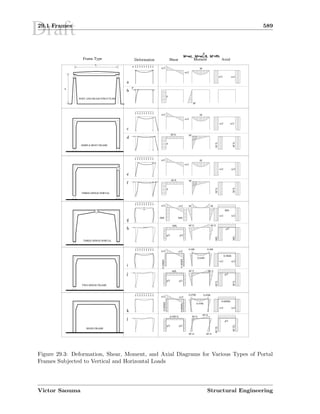
29.3 Deformation, Shear, Moment, and Axial Diagrams for Various Types of Portal Frames Subjected to Vert
29.4 Axial and Flexural Stresses . . . . . . . . . . . . . . . . . . . . . . . . . . . . . . 590
29.5 Design of a Statically Indeterminate Arch . . . . . . . . . . . . . . . . . . . . . . 591
29.6 Normal and Shear Forces . . . . . . . . . . . . . . . . . . . . . . . . . . . . . . . 594
30.1 Eiffel Tower (Billington and Mark 1983) . . . . . . . . . . . . . . . . . . . . . . . 603
30.2 Eiffel Tower Idealization, (Billington and Mark 1983) . . . . . . . . . . . . . . . . 605
30.3 Eiffel Tower, Dead Load Idealization; (Billington and Mark 1983) . . . . . . . . . 605
30.4 Eiffel Tower, Wind Load Idealization; (Billington and Mark 1983) . . . . . . . . . 606
30.5 Eiffel Tower, Wind Loads, (Billington and Mark 1983) . . . . . . . . . . . . . . . 607
30.6 Eiffel Tower, Reactions; (Billington and Mark 1983) . . . . . . . . . . . . . . . . 607
30.7 Eiffel Tower, Internal Gravity Forces; (Billington and Mark 1983) . . . . . . . . . 609
30.8 Eiffel Tower, Horizontal Reactions; (Billington and Mark 1983) . . . . . . . . . . 609
30.9 Eiffel Tower, Internal Wind Forces; (Billington and Mark 1983) . . . . . . . . . . 610
31.1 Cable Structure Subjected to p(x) . . . . . . . . . . . . . . . . . . . . . . . . . . 612
31.2 Longitudinal and Plan Elevation of the George Washington Bridge . . . . . . . . 614
31.3 Truck Load . . . . . . . . . . . . . . . . . . . . . . . . . . . . . . . . . . . . . . . 615
31.4 Dead and Live Loads . . . . . . . . . . . . . . . . . . . . . . . . . . . . . . . . . . 616
31.5 Location of Cable Reactions . . . . . . . . . . . . . . . . . . . . . . . . . . . . . . 617
31.6 Vertical Reactions in Columns Due to Central Span Load . . . . . . . . . . . . . 617
31.7 Cable Reactions in Side Span . . . . . . . . . . . . . . . . . . . . . . . . . . . . . 618
31.8 Cable Stresses . . . . . . . . . . . . . . . . . . . . . . . . . . . . . . . . . . . . . . 619
31.9 Deck Idealization, Shear and Moment Diagrams . . . . . . . . . . . . . . . . . . . 620
32.1 Magazzini Generali; Overall Dimensions, (Billington and Mark 1983) . . . . . . . 622
32.2 Magazzini Generali; Support System, (Billington and Mark 1983) . . . . . . . . . 622
32.3 Magazzini Generali; Loads (Billington and Mark 1983) . . . . . . . . . . . . . . . 623
32.4 Magazzini Generali; Beam Reactions, (Billington and Mark 1983) . . . . . . . . . 623
32.5 Magazzini Generali; Shear and Moment Diagrams (Billington and Mark 1983) . . 624
32.6 Magazzini Generali; Internal Moment, (Billington and Mark 1983) . . . . . . . . 624
32.7 Magazzini Generali; Similarities Between The Frame Shape and its Moment Diagram, (Billington and M
32.8 Magazzini Generali; Equilibrium of Forces at the Beam Support, (Billington and Mark 1983)625
32.9 Magazzini Generali; Effect of Lateral Supports, (Billington and Mark 1983) . . . 626
33.1 Flexible, Rigid, and Semi-Flexible Joints . . . . . . . . . . . . . . . . . . . . . . . 627
33.2 Deformation of Flexible and Rigid Frames Subjected to Vertical and Horizontal Loads, (Lin and Stotesb
33.3 Deformation, Shear, Moment, and Axial Diagrams for Various Types of Portal Frames Subjected to Vert
33.4 Axial and Flexural Stresses . . . . . . . . . . . . . . . . . . . . . . . . . . . . . . 630
33.5 Design of a Shear Wall Subsystem, (Lin and Stotesbury 1981) . . . . . . . . . . . 632
33.6 Trussed Shear Wall . . . . . . . . . . . . . . . . . . . . . . . . . . . . . . . . . . . 634
33.7 Design Example of a Tubular Structure, (Lin and Stotesbury 1981) . . . . . . . . 635
33.8 A Basic Portal Frame, (Lin and Stotesbury 1981) . . . . . . . . . . . . . . . . . . 636
33.9 Approximate Analysis of Frames Subjected to Vertical Loads; Girder Moments . 637
33.10Approximate Analysis of Frames Subjected to Vertical Loads; Column Axial Forces638
33.11Approximate Analysis of Frames Subjected to Vertical Loads; Column Moments 638
33.12Approximate Analysis of Frames Subjected to Lateral Loads; Column Shear . . . 640
33.13***Approximate Analysis of Frames Subjected to Lateral Loads; Girder Moment 640
33.14Approximate Analysis of Frames Subjected to Lateral Loads; Column Axial Force641
Victor Saouma Structural Engineering
Draft
List of Tables
3.1 Equations of Equilibrium . . . . . . . . . . . . . . . . . . . . . . . . . . . . . . . 71
4.1 Static Determinacy and Stability of Trusses . . . . . . . . . . . . . . . . . . . . . 83
8.1 Conjugate Beam Boundary Conditions . . . . . . . . . . . . . . . . . . . . . . . . 165
9.1 Possible Combinations of Real and Hypothetical Formulations . . . . . . . . . . . 175
9.2 k Factors for Torsion . . . . . . . . . . . . . . . . . . . . . . . . . . . . . . . . . . 180
9.3 Summary of Expressions for the Internal Strain Energy and External Work . . . 198
10.1 Table of
L
0
g1(x)g2(x)dx . . . . . . . . . . . . . . . . . . . . . . . . . . . . . . . 203
10.2 . . . . . . . . . . . . . . . . . . . . . . . . . . . . . . . . . . . . . . . . . . . . . 215
10.3 Displacement Computations for a Rectangular Frame . . . . . . . . . . . . . . . 219
11.1 Columns Combined Approximate Vertical and Horizontal Loads . . . . . . . . . 250
11.2 Girders Combined Approximate Vertical and Horizontal Loads . . . . . . . . . . 251
12.1 Stiffness vs Flexibility Methods . . . . . . . . . . . . . . . . . . . . . . . . . . . . 253
12.2 Degrees of Freedom of Different Structure Types Systems . . . . . . . . . . . . . 255
13.1 Example of Nodal Definition . . . . . . . . . . . . . . . . . . . . . . . . . . . . . 288
13.2 Example of Element Definition . . . . . . . . . . . . . . . . . . . . . . . . . . . . 288
13.3 Example of Group Number . . . . . . . . . . . . . . . . . . . . . . . . . . . . . . 289
13.4 Degrees of Freedom of Different Structure Types Systems . . . . . . . . . . . . . 293
14.1 Allowable Stresses for Steel and Concrete . . . . . . . . . . . . . . . . . . . . . . 351
14.2 Selected β values for Steel and Concrete Structures . . . . . . . . . . . . . . . . . 355
14.3 Strength Reduction Factors, Φ . . . . . . . . . . . . . . . . . . . . . . . . . . . . 355
15.1 Unit Weight of Materials . . . . . . . . . . . . . . . . . . . . . . . . . . . . . . . . 360
15.2 Weights of Building Materials . . . . . . . . . . . . . . . . . . . . . . . . . . . . . 361
15.3 Average Gross Dead Load in Buildings . . . . . . . . . . . . . . . . . . . . . . . . 361
15.4 Minimum Uniformly Distributed Live Loads, (UBC 1995) . . . . . . . . . . . . . 362
15.5 Wind Velocity Variation above Ground . . . . . . . . . . . . . . . . . . . . . . . . 366
15.6 Ce Coefficients for Wind Load, (UBC 1995) . . . . . . . . . . . . . . . . . . . . . 367
15.7 Wind Pressure Coefficients Cq, (UBC 1995) . . . . . . . . . . . . . . . . . . . . . 367
15.8 Importance Factors for Wind and Earthquake Load, (UBC 1995) . . . . . . . . . 368
15.9 Approximate Design Wind Pressure p for Ordinary Wind Force Resisting Building Structures368
15.10Z Factors for Different Seismic Zones, ubc . . . . . . . . . . . . . . . . . . . . . . 372
Draft
Part I
ANALYSIS
Draft
Chapter 1
A BRIEF HISTORY OF
STRUCTURAL ARCHITECTURE
If I have been able to see a little farther than some others,
it was because I stood on the shoulders of giants.
Sir Isaac Newton
1 More than any other engineering discipline, Architecture/Mechanics/Structures is the proud
outcome of a of a long and distinguished history. Our profession, second oldest, would be better
appreciated if we were to develop a sense of our evolution.
1.1 Before the Greeks
2 Throughout antiquity, structural engineering existing as an art rather than a science. No
record exists of any rational consideration, either as to the strength of structural members or
as to the behavior of structural materials. The builders were guided by rules of thumbs and
experience, which were passed from generation to generation, guarded by secrets of the guild,
and seldom supplemented by new knowledge. Despite this, structures erected before Galileo are
by modern standards quite phenomenal (pyramids, Via Appia, aqueducs, Colisseums, Gothic
cathedrals to name a few).
3 The first structural engineer in history seems to have been Imhotep, one of only two com-
moners to be deified. He was the builder of the step pyramid of Sakkara about 3,000 B.C., and
yielded great influence over ancient Egypt.
4 Hamurrabi’s code in Babylonia (1750 BC) included among its 282 laws penalties for those
“architects” whose houses collapsed, Fig. 1.1.
1.2 Greeks
5 The greek philosopher Pythagoras (born around 582 B.C.) founded his famous school, which
was primarily a secret religious society, at Crotona in southern Italy. At his school he allowed
Draft1.3 Romans 33
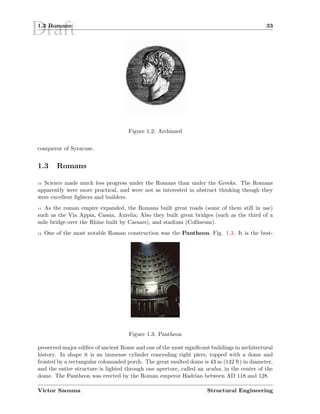
Figure 1.2: Archimed
conqueror of Syracuse.
1.3 Romans
10 Science made much less progress under the Romans than under the Greeks. The Romans
apparently were more practical, and were not as interested in abstract thinking though they
were excellent fighters and builders.
11 As the roman empire expanded, the Romans built great roads (some of them still in use)
such as the Via Appia, Cassia, Aurelia; Also they built great bridges (such as the third of a
mile bridge over the Rhine built by Caesars), and stadium (Colliseum).
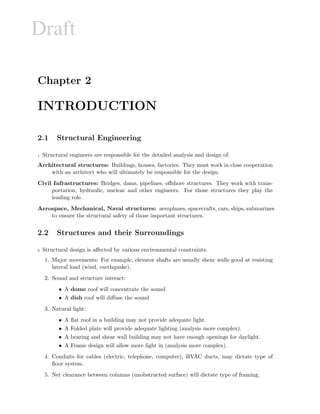
12 One of the most notable Roman construction was the Pantheon, Fig. 1.3. It is the best-
Figure 1.3: Pantheon
preserved major edifice of ancient Rome and one of the most significant buildings in architectural
history. In shape it is an immense cylinder concealing eight piers, topped with a dome and
fronted by a rectangular colonnaded porch. The great vaulted dome is 43 m (142 ft) in diameter,
and the entire structure is lighted through one aperture, called an oculus, in the center of the
dome. The Pantheon was erected by the Roman emperor Hadrian between AD 118 and 128.
Victor Saouma Structural Engineering
Draft
Chapter 2
INTRODUCTION
2.1 Structural Engineering
1 Structural engineers are responsible for the detailed analysis and design of:
Architectural structures: Buildings, houses, factories. They must work in close cooperation
with an architect who will ultimately be responsible for the design.
Civil Infrastructures: Bridges, dams, pipelines, offshore structures. They work with trans-
portation, hydraulic, nuclear and other engineers. For those structures they play the
leading role.
Aerospace, Mechanical, Naval structures: aeroplanes, spacecrafts, cars, ships, submarines
to ensure the structural safety of those important structures.
2.2 Structures and their Surroundings
2 Structural design is affected by various environmental constraints:
1. Major movements: For example, elevator shafts are usually shear walls good at resisting
lateral load (wind, earthquake).
2. Sound and structure interact:
• A dome roof will concentrate the sound
• A dish roof will diffuse the sound
3. Natural light:
• A flat roof in a building may not provide adequate light.
• A Folded plate will provide adequate lighting (analysis more complex).
• A bearing and shear wall building may not have enough openings for daylight.
• A Frame design will allow more light in (analysis more complex).
4. Conduits for cables (electric, telephone, computer), HVAC ducts, may dictate type of
floor system.
5. Net clearance between columns (unobstructed surface) will dictate type of framing.
Draft2.6 Structural Analysis 57
2.6 Structural Analysis
12 Given an existing structure subjected to a certain load determine internal forces (axial,
shear, flexural, torsional; or stresses), deflections, and verify that no unstable failure can occur.
13 Thus the basic structural requirements are:
Strength: stresses should not exceed critical values: σ < σf
Stiffness: deflections should be controlled: ∆ < ∆max
Stability: buckling or cracking should also be prevented
2.7 Structural Design
14 Given a set of forces, dimension the structural element.
Steel/wood Structures Select appropriate section.
Reinforced Concrete: Determine dimensions of the element and internal reinforcement (num-
ber and sizes of reinforcing bars).
15 For new structures, iterative process between analysis and design. A preliminary design is
made using rules of thumbs (best known to Engineers with design experience) and analyzed.
Following design, we check for
Serviceability: deflections, crack widths under the applied load. Compare with acceptable
values specified in the design code.
Failure: and compare the failure load with the applied load times the appropriate factors of
safety.
If the design is found not to be acceptable, then it must be modified and reanalyzed.
16 For existing structures rehabilitation, or verification of an old infrastructure, analysis is
the most important component.
17 In summary, analysis is always required.
2.8 Load Transfer Elements
18 From Strength of Materials, Fig. 2.1
Axial: cables, truss elements, arches, membrane, shells
Flexural: Beams, frames, grids, plates
Torsional: Grids, 3D frames
Shear: Frames, grids, shear walls.
Victor Saouma Structural Engineering
Draft
Chapter 3
EQUILIBRIUM & REACTIONS
To every action there is an equal and opposite reaction.
Newton’s third law of motion
3.1 Introduction
1 In the analysis of structures (hand calculations), it is often easier (but not always necessary)
to start by determining the reactions.
2 Once the reactions are determined, internal forces are determined next; finally, deformations
(deflections and rotations) are determined last1.
3 Reactions are necessary to determine foundation load.
4 Depending on the type of structures, there can be different types of support conditions, Fig.
3.1.
Roller: provides a restraint in only one direction in a 2D structure, in 3D structures a roller
may provide restraint in one or two directions. A roller will allow rotation.
Hinge: allows rotation but no displacements.
Fixed Support: will prevent rotation and displacements in all directions.
3.2 Equilibrium
5 Reactions are determined from the appropriate equations of static equilibrium.
6 Summation of forces and moments, in a static system must be equal to zero2.
1
This is the sequence of operations in the flexibility method which lends itself to hand calculation. In the
stiffness method, we determine displacements firsts, then internal forces and reactions. This method is most
suitable to computer implementation.
2
In a dynamic system ΣF = ma where m is the mass and a is the acceleration.
Draft3.3 Equations of Conditions 71
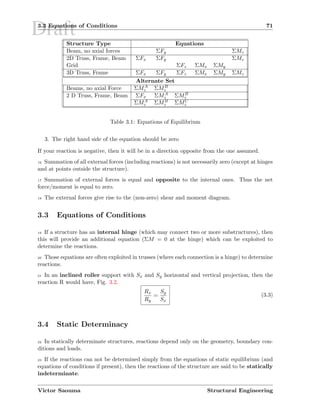
Structure Type Equations
Beam, no axial forces ΣFy ΣMz
2D Truss, Frame, Beam ΣFx ΣFy ΣMz
Grid ΣFz ΣMx ΣMy
3D Truss, Frame ΣFx ΣFy ΣFz ΣMx ΣMy ΣMz
Alternate Set
Beams, no axial Force ΣMA
z ΣMB
z
2 D Truss, Frame, Beam ΣFx ΣMA
z ΣMB
z
ΣMA
z ΣMB
z ΣMC
z
Table 3.1: Equations of Equilibrium
3. The right hand side of the equation should be zero
If your reaction is negative, then it will be in a direction opposite from the one assumed.
16 Summation of all external forces (including reactions) is not necessarily zero (except at hinges
and at points outside the structure).
17 Summation of external forces is equal and opposite to the internal ones. Thus the net
force/moment is equal to zero.
18 The external forces give rise to the (non-zero) shear and moment diagram.
3.3 Equations of Conditions
19 If a structure has an internal hinge (which may connect two or more substructures), then
this will provide an additional equation (ΣM = 0 at the hinge) which can be exploited to
determine the reactions.
20 Those equations are often exploited in trusses (where each connection is a hinge) to determine
reactions.
21 In an inclined roller support with Sx and Sy horizontal and vertical projection, then the
reaction R would have, Fig. 3.2.
Rx
Ry
=
Sy
Sx
(3.3)
3.4 Static Determinacy
22 In statically determinate structures, reactions depend only on the geometry, boundary con-
ditions and loads.
23 If the reactions can not be determined simply from the equations of static equilibrium (and
equations of conditions if present), then the reactions of the structure are said to be statically
indeterminate.
Victor Saouma Structural Engineering
Draft3.4 Static Determinacy 73
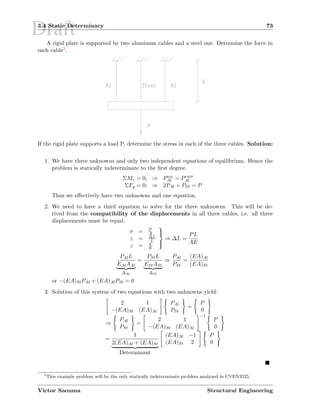
A rigid plate is supported by two aluminum cables and a steel one. Determine the force in
each cable5.
If the rigid plate supports a load P, determine the stress in each of the three cables. Solution:
1. We have three unknowns and only two independent equations of equilibrium. Hence the
problem is statically indeterminate to the first degree.
ΣMz = 0; ⇒ Pleft
Al = Pright
Al
ΣFy = 0; ⇒ 2PAl + PSt = P
Thus we effectively have two unknowns and one equation.
2. We need to have a third equation to solve for the three unknowns. This will be de-
rived from the compatibility of the displacements in all three cables, i.e. all three
displacements must be equal:
σ = P
A
ε = ∆L
L
ε = σ
E



⇒ ∆L =
PL
AE
PAlL
EAlAAl
∆Al
=
PStL
EStASt
∆St
⇒
PAl
PSt
=
(EA)Al
(EA)St
or −(EA)StPAl + (EA)AlPSt = 0
3. Solution of this system of two equations with two unknowns yield:
2 1
−(EA)St (EA)Al
PAl
PSt
=
P
0
⇒
PAl
PSt
=
2 1
−(EA)St (EA)Al
−1
P
0
=
1
2(EA)Al + (EA)St
Determinant
(EA)Al −1
(EA)St 2
P
0
5
This example problem will be the only statically indeterminate problem analyzed in CVEN3525.
Victor Saouma Structural Engineering
Draft
Chapter 4
TRUSSES
4.1 Introduction
4.1.1 Assumptions
1 Cables and trusses are 2D or 3D structures composed of an assemblage of simple one dimen-
sional components which transfer only axial forces along their axis.
2 Cables can carry only tensile forces, trusses can carry tensile and compressive forces.
3 Cables tend to be flexible, and hence, they tend to oscillate and therefore must be stiffened.
4 Trusses are extensively used for bridges, long span roofs, electric tower, space structures.
5 For trusses, it is assumed that
1. Bars are pin-connected
2. Joints are frictionless hinges1.
3. Loads are applied at the joints only.
6 A truss would typically be composed of triangular elements with the bars on the upper
chord under compression and those along the lower chord under tension. Depending on the
orientation of the diagonals, they can be under either tension or compression.
7 Fig. 4.1 illustrates some of the most common types of trusses.
8 It can be easily determined that in a Pratt truss, the diagonal members are under tension,
while in a Howe truss, they are in compression. Thus, the Pratt design is an excellent choice
for steel whose members are slender and long diagonal member being in tension are not prone
to buckling. The vertical members are less likely to buckle because they are shorter. On the
other hand the Howe truss is often preferred for for heavy timber trusses.
9 In a truss analysis or design, we seek to determine the internal force along each member, Fig.
4.2
1
In practice the bars are riveted, bolted, or welded directly to each other or to gusset plates, thus the bars
are not free to rotate and so-called secondary bending moments are developed at the bars. Another source
of secondary moments is the dead weight of the element.
Draft4.2 Trusses 83
4.1.2 Basic Relations
Sign Convention: Tension positive, compression negative. On a truss the axial forces are
indicated as forces acting on the joints.
Stress-Force: σ = P
A
Stress-Strain: σ = Eε
Force-Displacement: ε = ∆L
L
Equilibrium: ΣF = 0
4.2 Trusses
4.2.1 Determinacy and Stability
10 Trusses are statically determinate when all the bar forces can be determined from the
equations of statics alone. Otherwise the truss is statically indeterminate.
11 A truss may be statically/externally determinate or indeterminate with respect to the reac-
tions (more than 3 or 6 reactions in 2D or 3D problems respectively).
12 A truss may be internally determinate or indeterminate, Table 4.1.
13 If we refer to j as the number of joints, R the number of reactions and m the number of
members, then we would have a total of m + R unknowns and 2j (or 3j) equations of statics
(2D or 3D at each joint). If we do not have enough equations of statics then the problem is
indeterminate, if we have too many equations then the truss is unstable, Table 4.1.
2D 3D
Static Indeterminacy
External R > 3 R > 6
Internal m + R > 2j m + R > 3j
Unstable m + R < 2j m + R < 3j
Table 4.1: Static Determinacy and Stability of Trusses
14 If m < 2j − 3 (in 2D) the truss is not internally stable, and it will not remain a rigid body
when it is detached from its supports. However, when attached to the supports, the truss will
be rigid.
15 Since each joint is pin-connected, we can apply ΣM = 0 at each one of them. Furthermore,
summation of forces applied on a joint must be equal to zero.
16 For 2D trusses the external equations of equilibrium which can be used to determine the
reactions are ΣFX = 0, ΣFY = 0 and ΣMZ = 0. For 3D trusses the available equations are
ΣFX = 0, ΣFY = 0, ΣFZ = 0 and ΣMX = 0, ΣMY = 0, ΣMZ = 0.
17 For a 2D truss we have 2 equations of equilibrium ΣFX = 0 and ΣFY = 0 which can be
applied at each joint. For 3D trusses we would have three equations: ΣFX = 0, ΣFY = 0 and
ΣFZ = 0.
Victor Saouma Structural Engineering
Draft4.2 Trusses 85
Figure 4.4: X and Y Components of Truss Forces
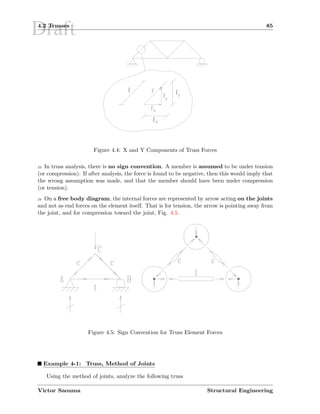
23 In truss analysis, there is no sign convention. A member is assumed to be under tension
(or compression). If after analysis, the force is found to be negative, then this would imply that
the wrong assumption was made, and that the member should have been under compression
(or tension).
24 On a free body diagram, the internal forces are represented by arrow acting on the joints
and not as end forces on the element itself. That is for tension, the arrow is pointing away from
the joint, and for compression toward the joint, Fig. 4.5.
Figure 4.5: Sign Convention for Truss Element Forces
Example 4-1: Truss, Method of Joints
Using the method of joints, analyze the following truss
Victor Saouma Structural Engineering
Draft4.2 Trusses 87
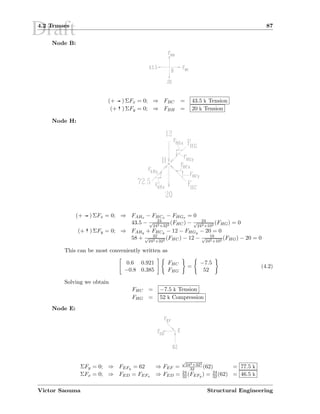
Node B:
(+ E ) ΣFx = 0; ⇒ FBC = 43.5 k Tension
(+ T) ΣFy = 0; ⇒ FBH = 20 k Tension
Node H:
(+ E ) ΣFx = 0; ⇒ FAHx − FHCx − FHGx = 0
43.5 − 24√
242+322
(FHC) − 24√
242+102
(FHG) = 0
(+ T) ΣFy = 0; ⇒ FAHy + FHCy − 12 − FHGy − 20 = 0
58 + 32√
242+322
(FHC) − 12 − 10√
242+102
(FHG) − 20 = 0
This can be most conveniently written as
0.6 0.921
−0.8 0.385
FHC
FHG
=
−7.5
52
(4.2)
Solving we obtain
FHC = −7.5 k Tension
FHG = 52 k Compression
Node E:
ΣFy = 0; ⇒ FEFy = 62 ⇒ FEF =
√
242+322
32 (62) = 77.5 k
ΣFx = 0; ⇒ FED = FEFx ⇒ FED = 24
32 (FEFy ) = 24
32 (62) = 46.5 k
Victor Saouma Structural Engineering
Draft
Chapter 5
CABLES
5.1 Funicular Polygons
1 A cable is a slender flexible member with zero or negligible flexural stiffness, thus it can only
transmit tensile forces1.
2 The tensile force at any point acts in the direction of the tangent to the cable (as any other
component will cause bending).
3 Its strength stems from its ability to undergo extensive changes in slope at the point of load
application.
4 Cables resist vertical forces by undergoing sag (h) and thus developing tensile forces. The
horizontal component of this force (H) is called thrust.
5 The distance between the cable supports is called the chord.
6 The sag to span ratio is denoted by
r =
h
l
(5.1)
7 When a set of concentrated loads is applied to a cable of negligible weight, then the cable
deflects into a series of linear segments and the resulting shape is called the funicular polygon.
8 If a cable supports vertical forces only, then the horizontal component H of the cable tension
T remains constant.
Example 5-1: Funicular Cable Structure
Determine the reactions and the tensions for the cable structure shown below.
1
Due to the zero flexural rigidity it will buckle under axial compressive forces.
Draft5.2 Uniform Load 99
=
H
cos θB
=
51
0.999
= 51.03 k (5.6-d)
TCD; tan θC =
4.6
30
= 0.153 ⇒ θC = 8.7 deg (5.6-e)
=
H
cos θC
=
51
0.988
= 51.62 k (5.6-f)
5.2 Uniform Load
5.2.1 qdx; Parabola
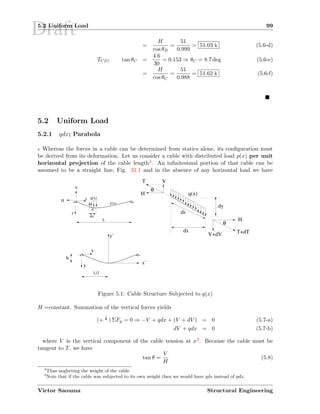
9 Whereas the forces in a cable can be determined from statics alone, its configuration must
be derived from its deformation. Let us consider a cable with distributed load p(x) per unit
horizontal projection of the cable length2. An infinitesimal portion of that cable can be
assumed to be a straight line, Fig. 31.1 and in the absence of any horizontal load we have
H
T+dT
T
H
V
V+dV
H
θ
θ
q(x)
dx
dy
ds
ds
L
x
V
q(x)
y
y(x)
dx
h
y’
x’
x
y
L/2
Figure 5.1: Cable Structure Subjected to q(x)
H =constant. Summation of the vertical forces yields
(+ c) ΣFy = 0 ⇒ −V + qdx + (V + dV ) = 0 (5.7-a)
dV + qdx = 0 (5.7-b)
where V is the vertical component of the cable tension at x3. Because the cable must be
tangent to T, we have
tan θ =
V
H
(5.8)
2
Thus neglecting the weight of the cable
3
Note that if the cable was subjected to its own weight then we would have qds instead of pdx.
Victor Saouma Structural Engineering
Draft5.2 Uniform Load 101
15 Combining Eq. 31.7 and 31.8 we obtain
y =
4hx
L2
(L − x) (5.18)
16 If we shift the origin to midspan, and reverse y, then
y =
4h
L2
x2 (5.19)
Thus the cable assumes a parabolic shape (as the moment diagram of the applied load).
17 The maximum tension occurs at the support where the vertical component is equal to V = qL
2
and the horizontal one to H, thus
Tmax = V 2 + H2 =
qL
2
2
+ H2 = H 1 +
qL/2
H
2
(5.20)
Combining this with Eq. 31.8 we obtain5.
Tmax = H 1 + 16r2 ≈ H(1 + 8r2
) (5.21)
5.2.2 † qds; Catenary
18 Let us consider now the case where the cable is subjected to its own weight (plus ice and
wind if any). We would have to replace qdx by qds in Eq. 31.1-b
dV + qds = 0 (5.22)
The differential equation for this new case will be derived exactly as before, but we substitute
qdx by qds, thus Eq. 31.5 becomes
d2y
dx2
= −
q
H
ds
dx
(5.23)
19 But ds2 = dx2 + dy2, hence:
d2y
dx2
= −
q
H
1 +
dy
dx
2
(5.24)
solution of this differential equation is considerably more complicated than for a parabola.
20 We let dy/dx = p, then
dp
dx
= −
q
H
1 + p2 (5.25)
5
Recalling that (a+b)n
= an
+nan−1
b+ n(n−1)
2!
an−2
b2
+· or (1+b)n
= 1+nb+ n(n−1)b2
2!
+ n(n−1)(n−2)b3
3!
+· · ·;
Thus for b2
<< 1,
√
1 + b = (1 + b)
1
2 ≈ 1 + b
2
Victor Saouma Structural Engineering
Draft
Chapter 6
INTERNAL FORCES IN
STRUCTURES
1 This chapter will start as a review of shear and moment diagrams which you have studied
in both Statics and Strength of Materials, and will proceed with the analysis of statically
determinate frames, arches and grids.
2 By the end of this lecture, you should be able to draw the shear, moment and torsion (when
applicable) diagrams for each member of a structure.
3 Those diagrams will subsequently be used for member design. For instance, for flexural
design, we will consider the section subjected to the highest moment, and make sure that the
internal moment is equal and opposite to the external one. For the ASD method, the basic
beam equation (derived in Strength of Materials) σ = MC
I , (where M would be the design
moment obtained from the moment diagram) would have to be satisfied.
4 Some of the examples first analyzed in chapter 3 (Reactions), will be revisited here. Later
on, we will determine the deflections of those same problems.
6.1 Design Sign Conventions
5 Before we (re)derive the Shear-Moment relations, let us arbitrarily define a sign convention.
6 The sign convention adopted here, is the one commonly used for design purposes1.
7 With reference to Fig. 6.1
2D:
Load Positive along the beam’s local y axis (assuming a right hand side convention),
that is positive upward.
Axial: tension positive.
Flexure A positive moment is one which causes tension in the lower fibers, and com-
pression in the upper ones. Alternatively, moments are drawn on the compression
side (useful to keep in mind for frames).
1
Later on, in more advanced analysis courses we will use a different one.
Draft6.2 Load, Shear, Moment Relations 115
6.2 Load, Shear, Moment Relations
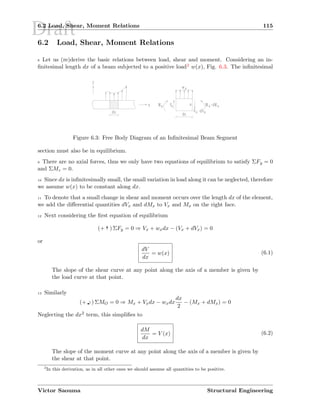
8 Let us (re)derive the basic relations between load, shear and moment. Considering an in-
finitesimal length dx of a beam subjected to a positive load2 w(x), Fig. 6.3. The infinitesimal
Figure 6.3: Free Body Diagram of an Infinitesimal Beam Segment
section must also be in equilibrium.
9 There are no axial forces, thus we only have two equations of equilibrium to satisfy ΣFy = 0
and ΣMz = 0.
10 Since dx is infinitesimally small, the small variation in load along it can be neglected, therefore
we assume w(x) to be constant along dx.
11 To denote that a small change in shear and moment occurs over the length dx of the element,
we add the differential quantities dVx and dMx to Vx and Mx on the right face.
12 Next considering the first equation of equilibrium
(+ T) ΣFy = 0 ⇒ Vx + wxdx − (Vx + dVx) = 0
or
dV
dx
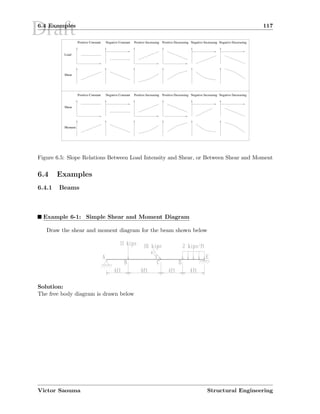
= w(x) (6.1)
The slope of the shear curve at any point along the axis of a member is given by
the load curve at that point.
13 Similarly
(+  
¡') ΣMO = 0 ⇒ Mx + Vxdx − wxdx
dx
2
− (Mx + dMx) = 0
Neglecting the dx2 term, this simplifies to
dM
dx
= V (x) (6.2)
The slope of the moment curve at any point along the axis of a member is given by
the shear at that point.
2
In this derivation, as in all other ones we should assume all quantities to be positive.
Victor Saouma Structural Engineering
Draft6.4 Examples 117
Shear
Moment
Load
Shear
Positive Constant Negative Constant
Positive Constant Negative Constant Negative Increasing Negative Decreasing
Negative Increasing Negative Decreasing
Positive Increasing Positive Decreasing
Figure 6.5: Slope Relations Between Load Intensity and Shear, or Between Shear and Moment
6.4 Examples
6.4.1 Beams
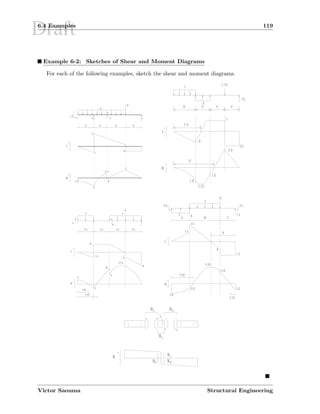
Example 6-1: Simple Shear and Moment Diagram
Draw the shear and moment diagram for the beam shown below
Solution:
The free body diagram is drawn below
Victor Saouma Structural Engineering
Draft6.4 Examples 119
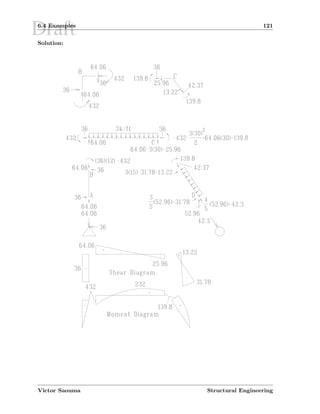
Example 6-2: Sketches of Shear and Moment Diagrams
For each of the following examples, sketch the shear and moment diagrams.
Victor Saouma Structural Engineering
Draft6.4 Examples 121
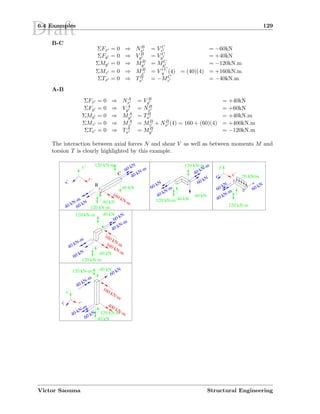
Solution:
Victor Saouma Structural Engineering
Draft6.4 Examples 129
B-C
ΣFx = 0 ⇒ NB
x = V C
z = −60kN
ΣFy = 0 ⇒ V B
y = V C
y = +40kN
ΣMy = 0 ⇒ MB
y = MC
y = −120kN.m
ΣMz = 0 ⇒ MB
z = V y
C
(4) = (40)(4) = +160kN.m
ΣTx = 0 ⇒ TB
x = −MC
z = −40kN.m
A-B
ΣFx = 0 ⇒ NA
x = V B
y = +40kN
ΣFy = 0 ⇒ V A
y = NB
x = +60kN
ΣMy = 0 ⇒ MA
y = TB
x = +40kN.m
ΣMz = 0 ⇒ MA
z = MB
z + NB
x (4) = 160 + (60)(4) = +400kN.m
ΣTx = 0 ⇒ TA
x = MB
y = −120kN.m
The interaction between axial forces N and shear V as well as between moments M and
torsion T is clearly highlighted by this example.
120 kN-m
20 kN/m
120 kN-m
40 kN
40 kN
120 kN-m
40 kN
40 kN120 kN-m
40 kN
40 kN
C
B
120 kN-m
120 kN-m 40 kN
120 kN-m
40 kN
x’
y’
z’ x’
y’120 kN-m
120 kN-m
x’
y’
60 kN
40 kN-m
40 kN-m60 kN
160 kN-m
40 kN-m
60 kN
60 kN
60 kN
40 kN-m
60 kN
40 kN-m
40 kN-m
60 kN
40 kN-m
60 kN
160 kN-m
160 kN-m
40 kN-m
60 kN
60 kN
160 kN-m
400 kN-m
40 kN-m
z’y’
Victor Saouma Structural Engineering
Draft
Chapter 7
ARCHES and CURVED
STRUCTURES
1 This chapter will concentrate on the analysis of arches.
2 The concepts used are identical to the ones previously seen, however the major (and only)
difference is that equations will be written in polar coordinates.
3 Like cables, arches can be used to reduce the bending moment in long span structures. Es-
sentially, an arch can be considered as an inverted cable, and is transmits the load primarily
through axial compression, but can also resist flexure through its flexural rigidity.
4 A parabolic arch uniformly loaded will be loaded in compression only.
5 A semi-circular arch unifirmly loaded will have some flexural stresses in addition to the
compressive ones.
7.1 Arches
6 In order to optimize dead-load efficiency, long span structures should have their shapes ap-
proximate the coresponding moment diagram, hence an arch, suspended cable, or tendon con-
figuration in a prestressed concrete beam all are nearly parabolic, Fig. 7.1.
7 Long span structures can be built using flat construction such as girders or trusses. However,
for spans in excess of 100 ft, it is often more economical to build a curved structure such as an
arch, suspended cable or thin shells.
8 Since the dawn of history, mankind has tried to span distances using arch construction.
Essentially this was because an arch required materials to resist compression only (such as
stone, masonary, bricks), and labour was not an issue.
9 The basic issues of static in arch design are illustrated in Fig. 7.2 where the vertical load is per
unit horizontal projection (such as an external load but not a self-weight). Due to symmetry,
the vertical reaction is simply V = wL
2 , and there is no shear across the midspan of the arch
(nor a moment). Taking moment about the crown,
M = Hh −
wL
2
L
2
−
L
4
= 0 (7.1)
Draft7.1 Arches 133
Solving for H
H =
wL2
8h
(7.2)
We recall that a similar equation was derived for arches., and H is analogous to the C − T
forces in a beam, and h is the overall height of the arch, Since h is much larger than d, H will
be much smaller than C − T in a beam.
10 Since equilibrium requires H to remain constant across thee arch, a parabolic curve would
theoretically result in no moment on the arch section.
11 Three-hinged arches are statically determinate structures which shape can acomodate sup-
port settlements and thermal expansion without secondary internal stresses. They are also easy
to analyse through statics.
12 An arch carries the vertical load across the span through a combination of axial forces and
flexural ones. A well dimensioned arch will have a small to negligible moment, and relatively
high normal compressive stresses.
13 An arch is far more efficient than a beam, and possibly more economical and aesthetic than
a truss in carrying loads over long spans.
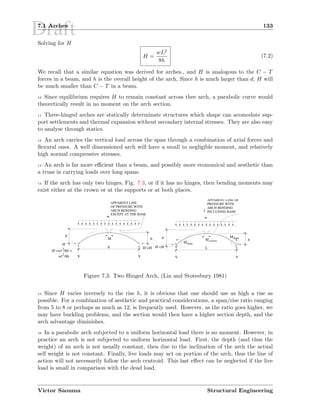
14 If the arch has only two hinges, Fig. 7.3, or if it has no hinges, then bending moments may
exist either at the crown or at the supports or at both places.
APPARENT LINE
OF PRESSURE WITH
ARCH BENDING
EXCEPT AT THE BASE
h
h’
V V
M
w
h
H’=wl /8h’<
2
wl /8h
2
H’
H’<H
APPARENT LINE OF
PRESSURE WITH
ARCH BENDING
INCLUDING BASE
V V
H’<H
M
w
h
L
crown
M
M
base
baseh’
H’<H
Figure 7.3: Two Hinged Arch, (Lin and Stotesbury 1981)
15 Since H varies inversely to the rise h, it is obvious that one should use as high a rise as
possible. For a combination of aesthetic and practical considerations, a span/rise ratio ranging
from 5 to 8 or perhaps as much as 12, is frequently used. However, as the ratio goes higher, we
may have buckling problems, and the section would then have a higher section depth, and the
arch advantage diminishes.
16 In a parabolic arch subjected to a uniform horizontal load there is no moment. However, in
practice an arch is not subjected to uniform horizontal load. First, the depth (and thus the
weight) of an arch is not usually constant, then due to the inclination of the arch the actual
self weight is not constant. Finally, live loads may act on portion of the arch, thus the line of
action will not necessarily follow the arch centroid. This last effect can be neglected if the live
load is small in comparison with the dead load.
Victor Saouma Structural Engineering
Draft7.1 Arches 135
Solving those four equations simultaneously we have:





140 26.25 0 0
0 1 0 1
1 0 1 0
80 60 0 0








RAy
RAx
RCy
RCx



=



2, 900
80
50
3, 000



⇒



RAy
RAx
RCy
RCx



=



15.1 k
29.8 k
34.9 k
50.2 k



(7.4)
We can check our results by considering the summation with respect to b from the right:
(+  ¡
'
) ΣMB
z = 0; −(20)(20) − (50.2)(33.75) + (34.9)(60) = 0
√
(7.5)
Example 7-2: Semi-Circular Arch, (Gerstle 1974)
Determine the reactions of the three hinged statically determined semi-circular arch under
its own dead weight w (per unit arc length s, where ds = rdθ). 7.6
R cosθ
R
A
B
C
R
A
B
θ
dP=wRdθ
θ
rθ
Figure 7.6: Semi-Circular three hinged arch
Solution:
I Reactions The reactions can be determined by integrating the load over the entire struc-
ture
1. Vertical Reaction is determined first:
(+  ¡') ΣMA = 0; −(Cy)(2R) +
θ=π
θ=0
wRdθ
dP
R(1 + cos θ)
moment arm
= 0 (7.6-a)
⇒ Cy =
wR
2
θ=π
θ=0
(1 + cos θ)dθ =
wR
2
[θ − sin θ] |θ=π
θ=0
=
wR
2
[(π − sin π) − (0 − sin 0)]
= π
2 wR (7.6-b)
2. Horizontal Reactions are determined next
(+  
¡
') ΣMB = 0; −(Cx)(R) + (Cy)(R) −
θ= π
2
θ=0
wRdθ
dP
R cos θ
moment arm
= 0 (7.7-a)
Victor Saouma Structural Engineering
Draft
Chapter 8
DEFLECTION of STRUCTRES;
Geometric Methods
1 Deflections of structures must be determined in order to satisfy serviceability requirements
i.e. limit deflections under service loads to acceptable values (such as ∆
L ≤ 360).
2 Later on, we will see that deflection calculations play an important role in the analysis of
statically indeterminate structures.
3 We shall focus on flexural deformation, however the end of this chapter will review axial and
torsional deformations as well.
4 Most of this chapter will be a review of subjects covered in Strength of Materials.
5 This chapter will examine deflections of structures based on geometric considerations. Later
on, we will present a more pwerful method based on energy considerations.
8.1 Flexural Deformation
8.1.1 Curvature Equation
6 Let us consider a segment (between point 1 and point 2), Fig. 8.1 of a beam subjected to
flexural loading.
7 The slope is denoted by θ, the change in slope per unit length is the curvature κ, the radius
of curvature is ρ.
8 From Strength of Materials we have the following relations
ds = ρdθ ⇒
dθ
ds
=
1
ρ
(8.1)
9 We also note by extension that ∆s = ρ∆θ
10 As a first order approximation, and with ds ≈ dx and dy
dx = θ Eq. 8.1 becomes
κ =
1
ρ
=
dθ
dx
=
d2y
dx2
(8.2)
Draft8.1 Flexural Deformation 151
14 Thus the slope θ, curvature κ, radius of curvature ρ are related to the y displacement at a
point x along a flexural member by
κ =
d2y
dx2
1 + dy
dx
2
3
2
(8.9)
15 If the displacements are very small, we will have dy
dx << 1, thus Eq. 8.9 reduces to
κ =
d2y
dx2
=
1
ρ
(8.10)
8.1.2 Differential Equation of the Elastic Curve
16 Again with reference to Figure 8.1 a positive dθ at a positive y (upper fibers) will cause a
shortening of the upper fibers
∆u = −y∆θ (8.11)
17 This equation can be rewritten as
lim
∆s→0
∆u
∆s
= −y lim
∆s→0
∆θ
∆s
(8.12)
and since ∆s ≈ ∆x
du
dx
ε
= −y
dθ
dx
(8.13)
Combining this with Eq. 8.10
1
ρ
= κ = −
ε
y
(8.14)
This is the fundamental relationship between curvature (κ), elastic curve (y), and linear strain
(ε).
18 Note that so far we made no assumptions about material properties, i.e. it can be elastic or
inelastic.
19 For the elastic case:
εx = σ
E
σ = −My
I
ε = −
My
EI
(8.15)
Combining this last equation with Eq. 8.14 yields
1
ρ
=
dθ
dx
=
d2y
dx2
=
M
EI
(8.16)
This fundamental equation relates moment to curvature.
Victor Saouma Structural Engineering
Draft8.2 Flexural Deformations 153
Solution:
At: 0 ≤ x ≤ 2L
3
1. Moment Equation
EI
d2y
dx2
= Mx =
wL
3
x −
5
18
wL2
(8.22)
2. Integrate once
EI
dy
dx
=
wL
6
x2
−
5
18
wL2
x + C1 (8.23)
However we have at x = 0, dy
dx = 0, ⇒ C1 = 0
3. Integrate twice
EIy =
wL
18
x3
−
5wL2
36
x2
+ C2 (8.24)
Again we have at x = 0, y = 0, ⇒ C2 = 0
At: 2L
3 ≤ x ≤ L
1. Moment equation
EI
d2y
dx2
= Mx =
wL
3
x −
5
18
wL2
− w(x −
2L
3
)(
x − 2L
3
2
) (8.25)
2. Integrate once
EI
dy
dx
=
wL
6
x2
−
5
18
wL2
x −
w
6
(x −
2L
3
)3
+ C3 (8.26)
Applying the boundary condition at x = 2L
3 , we must have dy
dx equal to the value
coming from the left, ⇒ C3 = 0
Victor Saouma Structural Engineering
Draft8.2 Flexural Deformations 155
Figure 8.2: Moment Area Theorems
Victor Saouma Structural Engineering
Draft
Chapter 9
ENERGY METHODS; Part I
9.1 Introduction
1 Energy methods are powerful techniques for both formulation (of the stiffness matrix of an
element1) and for the analysis (i.e. deflection) of structural problems.
2 We shall explore two techniques:
1. Real Work
2. Virtual Work (Virtual force)
9.2 Real Work
3 We start by revisiting the first law of thermodynamics:
The time-rate of change of the total energy (i.e., sum of the kinetic energy and the
internal energy) is equal to the sum of the rate of work done by the external forces
and the change of heat content per unit time.
d
dt (K + U) = We + H (9.1)
where K is the kinetic energy, U the internal strain energy, We the external work, and H the
heat input to the system.
4 For an adiabatic system (no heat exchange) and if loads are applied in a quasi static manner
(no kinetic energy), the above relation simplifies to:
We = U (9.2)
5 Simply stated, the first law stipulates that the external work must be equal to the internal
strain energy due to the external load.
1
More about this in Matrix Structural Analysis.
Draft9.2 Real Work 173
Figure 9.2: Strain Energy Definition
9.2.2 Internal Work
9 Considering an infinitesimal element from an arbitrary structure subjected to uniaxial state
of stress, the strain energy can be determined with reference to Fig. 9.2. The net force acting
on the element while deformation is taking place is P = σxdydz. The element will undergo a
displacement u = εxdx. Thus, for a linear elastic system, the strain energy density is dU = 1
2 σε.
And the total strain energy will thus be
U =
1
2 Vol
ε Eε
σ
dVol (9.7)
10 When this relation is applied to various structural members it would yield:
Axial Members:
U =
Vol
εσ
2
dVol
σ = P
A
ε = P
AE
dV = Adx



U =
L
0
P2
2AE
dx (9.8)
Torsional Members:
U = 1
2
Vol
ε Eε
σ
dVol
U = 1
2
Vol
γxy Gγxy
τxy
dVol
τxy = Tr
J
γxy =
τxy
G
dVol = rdθdrdx
J =
r
o
2π
0
r2
dθ dr



U =
L
0
T2
2GJ
dx (9.9)
Victor Saouma Structural Engineering
Draft9.3 Virtual Work 175
9.3 Virtual Work
11 A severe limitation of the method of real work is that only deflection along the externally
applied load can be determined.
12 A more powerful method is the virtual work method.
13 The principle of Virtual Force (VF) relates force systems which satisfy the requirements of
equilibrium, and deformation systems which satisfy the requirement of compatibility
14 In any application the force system could either be the actual set of external loads dp or
some virtual force system which happens to satisfy the condition of equilibrium δp. This set
of external forces will induce internal actual forces dσ or internal virtual forces δσ compatible
with the externally applied load.
15 Similarly the deformation could consist of either the actual joint deflections du and compati-
ble internal deformations dε of the structure, or some virtual external and internal deformation
δu and δε which satisfy the conditions of compatibility.
16 It is often simplest to assume that the virtual load is a unit load.
17 Thus we may have 4 possible combinations, Table 9.1: where: d corresponds to the actual,
Force Deformation IVW Formulation
External Internal External Internal
1 dp dσ du dε
2 δp δσ du dε δU
∗
Flexibility
3 dp dσ δu δε δU Stiffness
4 δp δσ δu δε
Table 9.1: Possible Combinations of Real and Hypothetical Formulations
and δ (with an overbar) to the hypothetical values.
This table calls for the following observations
1. The second approach is the same one on which the method of virtual or unit load is based.
It is simpler to use than the third as a internal force distribution compatible with the
assumed virtual force can be easily obtained for statically determinate structures. This
approach will yield exact solutions for statically determinate structures.
2. The third approach is favored for statically indeterminate problems or in conjunction with
approximate solution. It requires a proper “guess” of a displacement shape and is the
basis of the stiffness method.
18 Let us consider an arbitrary structure and load it with both real and virtual loads in the
following sequence, Fig. 9.4. For the sake of simplicity, let us assume (or consider) that this
structure develops only axial stresses.
1. If we apply the virtual load, then
1
2
δPδ∆ =
1
2 dVol
δσδεdVol (9.12)
Victor Saouma Structural Engineering
Draft
Chapter 10
STATIC INDETERMINANCY;
FLEXIBILITY METHOD
All the examples in this chapter are taken verbatim from White, Gergely and Sexmith
10.1 Introduction
1 A statically indeterminate structure has more unknowns than equations of equilibrium (and
equations of conditions if applicable).
2 The advantages of a statically indeterminate structures are:
1. Lower internal forces
2. Safety in redundancy, i.e. if a support or members fails, the structure can redistribute its
internal forces to accomodate the changing B.C. without resulting in a sudden failure.
3 Only disadvantage is that it is more complicated to analyse.
4 Analysis mehtods of statically indeterminate structures must satisfy three requirements
Equilibrium
Force-displacement (or stress-strain) relations (linear elastic in this course).
Compatibility of displacements (i.e. no discontinuity)
5 This can be achieved through two classes of solution
Force or Flexibility method;
Displacement or Stiffness method
6 The flexibility method is first illustrated by the following problem of a statically indeterminate
cable structure in which a rigid plate is supported by two aluminum cables and a steel one. We
seek to determine the force in each cable, Fig. 10.1
1. We have three unknowns and only two independent equations of equilibrium. Hence the
problem is statically indeterminate to the first degree.
Draft10.1 Introduction 201
6. We observe that the solution of this sproblem, contrarily to statically determinate ones,
depends on the elastic properties.
7 Another example is the propped cantiliver beam of length L, Fig. 10.2
x x
f BB
P
B AC L/2 L/2
P
D
1
QL/2
PL/4
-
+
-
-
-PL
PL/2
-(1)L/2
Primary Structure Under Actual Load
Primary Structure Under Redundant Loading
Bending Moment Diagram
Figure 10.2: Propped Cantilever Beam
1. First we remove the roller support, and are left with the cantilever as a primary structure.
2. We then determine the deflection at point B due to the applied load P using the virtual
force method
1.D = δM
M
EI
dx (10.6-a)
=
L/2
0
0
−px
EI
dx +
L/2
0
−
PL
2
+ Px (−x)dx (10.6-b)
=
1
EI
L/2
0
PL
2
x + Px2
dx (10.6-c)
=
1
EI
PLx2
4
+
Px3
3
L/2
0
(10.6-d)
=
5
48
PL3
EI
(10.6-e)
Victor Saouma Structural Engineering
Draft10.3 Short-Cut for Displacement Evaluation 203
Note that D0
i is the vector of initial displacements, which is usually zero unless we have
an initial displacement of the support (such as support settlement).
7. The reactions are then obtained by simply inverting the flexibility matrix.
9 Note that from Maxwell-Betti’s reciprocal theorem, the flexibility matrix [f] is always sym-
metric.
10.3 Short-Cut for Displacement Evaluation
10 Since deflections due to flexural effects must be determined numerous times in the flexibility
method, Table 10.1 may simplify some of the evaluation of the internal strain energy. You are
strongly discouraged to use this table while still at school!.
g2(x)
g1(x) L
a
r
rr
L
a
222
L
a b
L
c
Lac Lac
2
Lc(a+b)
2
rrr
L
c
Lac
2
Lac
3
Lc(2a+b)
6
¨¨¨
L
c
Lac
2
Lac
6
Lc(a+2b)
6
222
L
c d
La(c+d)
2
La(2c+d)
6
La(2c+d)+Lb(c+2d)
6
L
c d e
La(c+4d+e)
6
La(c+2d)
6
La(c+2d)+Lb(2d+e)
6
Table 10.1: Table of
L
0
g1(x)g2(x)dx
10.4 Examples
Example 10-1: Steel Building Frame Analysis, (White et al. 1976)
A small, mass-produced industrial building, Fig. 10.3, is to be framed in structural steel
with a typical cross section as shown below. The engineer is considering three different designs
for the frame: (a) for poor or unknown soil conditions, the foundations for the frame may not
be able to develop any dependable horizontal forces at its bases. In this case the idealized
base conditions are a hinge at one of the bases and a roller at the other; (b) for excellent
Victor Saouma Structural Engineering
Draft10.4Examples219
D δM M δMMdx δM M
EI dx
AB BC CD Total
f11 ¡¡ ee ¡¡ ee +h3
3 +Lh2 +h3
3 + 2h3
3EIc
+ Lh2
EIb
f12 ¡¡ ee
222
+h2L
2 +L2h
2 0 + h2L
2EIc
+ L2h
2EIb
f13 ¡¡ ee −h2
2 −Lh −h2
2 − h2
EIc
− Lh
EIb
f21
222
¡¡ ee +h2L
2 +L2h
2 0 + h2L
2EIc
+ L2h
2EIb
f22
222 222
+L2h +L3
3 0 +L2h
EIc
+ L3
3EIb
f23
222
−hL −L2
2 0 − hL
EIc
− L2
2EIb
f31 ¡¡ ee −h2
2 −Lh −h2
2 − h2
EIc
− Lh
EIb
f32
222
−hL −L2
2 0 − hL
EIc
− L2
2EIb
f33 +h +L +h + 2h
EIc
+ L
EIb
D1Q ¡¡ ee ££
———
−h2(2h+15L−30)
6 +Lh(20−5L)
2 0 −h2(2h+15L−30)
6EIc
+ Lh(20−5L)
2EIb
D2Q
222
££
———
−Lh(2h+10L−20)
2 +L2(30−10L)
6 0 −Lh(2h+10L−20)
2EIc
+ L2(30−10L)
6EIb
D3Q ££
———
+h(2h+10L−20)
2 −L(20−5L)
2 0 −h(2h+10L−20)
2EIc
− L(20−5L)
2EIb
Table 10.3: Displacement Computations for a Rectangular Frame
VictorSaoumaStructuralEngineering
Draft10.4 Examples 221
3. In the following discussion the contributions to displacements due to axial strain are denoted
with a single prime ( ) and those due to curvature by a double prime ( ).
4. Consider the axial strain first. A unit length of frame member shortens as a result of the
temperature decrease from 85◦F to 45◦F at the middepth of the member. The strain is therefore
α∆T = (0.0000055)(40) = 0.00022 (10.56)
5. The effect of axial strain on the relative displacements needs little analysis. The horizontal
member shortens by an amount (0.00022)(20) = 0.0044 ft. The shortening of the vertical
members results in no relative displacement in the vertical direction 2. No rotation occurs.
6. We therefore have D1∆ = −0.0044 ft, D2∆ = 0, and D3∆ = 0.
Figure 10.16:
7. The effect of curvature must also be considered. A frame element of length dx undergoes an
angular strain as a result of the temperature gradient as indicated in Figure 10.16. The change
in length at an extreme fiber is
= α∆Tdx = 0.0000055(25)dx = 0.000138dx (10.57)
8. with the resulting real rotation of the cross section
dφ = /0.5 = 0.000138dx/0.5 = 0.000276dx radians (10.58)
9. The relative displacements of the primary structure at D are found by the virtual force
method.
10. A virtual force δQ is applied in the direction of the desired displacement and the resulting
moment diagram δM determined.
11. The virtual work equation
δQD = δMdφ (10.59)
is used to obtain each of the desired displacements D.
12. The results, which you should verify, are
D1∆ = 0.0828 ft (10.60-a)
D2∆ = 0.1104 ft (10.60-b)
D3∆ = −0.01104 radians (10.60-c)
Victor Saouma Structural Engineering
Draft10.4 Examples 223
with units in kips and feet.
21. A moment diagram may now be constructed, and other internal force quantities computed
from the now known values of the redundants. The redundants have been valuated separately
for effects of temperature and foundation settlement. These effects may be combined with those
due to loading using the principle of superposition.
Example 10-9: Braced Bent with Loads and Temperature Change, (White et al. 1976)
The truss shown in Figure 10.17 reperesents an internal braced bent in an enclosed shed,
with lateral loads of 20 kN at the panel points. A temperature drop of 30◦C may occur on
the outer members (members 1-2, 2-3, 3-4, 4-5, and 5-6). We wish to analyze the truss for the
loading and for the temperature effect.
Solution:
1. The first step in the analysis is the definition of the two redundants. The choice of forces
in diagonals 2-4 and 1-5 as redundants facilitates the computations because some of the load
effects are easy to analyze. Figure ??-b shows the definition of R1 and R2.
2. The computations are organized in tabular form in Table 10.4. The first column gives the
bar forces P in the primary structure caused by the actual loads. Forces are in kN. Column
2 gives the force in each bar caused by a unit load (1 kN) corresponding to release 1. These
are denoted p1 and also represent the bar force ¯q1/δQ1 caused by a virtual force δQ1 applied
Figure 10.17:
at the same location. Column 3 lists the same quantity for a unit load and for a virtual force
δQ2 applied at release 2. These three columns constitute a record of the truss analysis needed
for this problem.
Victor Saouma Structural Engineering
Draft10.4Examples225
D1Q D2Q f11 f21 f12 f22 D1∆ D2∆
P p1 p2 L/EA ¯q1PL/EA ¯q2PL/EA ¯q1p1L/EA ¯q2p2L/EA ¯qp2L/EA ¯q2p2L/EA ∆/temp ¯q1∆/ ¯q2∆/
multiply by Lc/EAc Lc/EAc Lc/EAc Lc/EAc Lc/EAc Lc/EAc Lc/EAc Lc 10−4Lc 10−4Lc
1-2 60.0 0 −0.707 1 0 −42.42 0 0 0 0.50 −0.0003 0 2.12
2-3 20.00 −0.707 0 1 −14.14 0 0.50 0 0 0 −0.0003 2.12 0
3-4 0 −0.707 0 2 0 0 1.00 0 0 0 −0.0003 2.12 0
4-5 0 −0.707 0 1 0 0 0.50 0 0 0 −0.0003 2.12 0
5-6 −20.00 0 −0.707 1 0 14.14 0 0 0 0.50 −0.0003 0 2.12
6-1 40.00 0 −0.707 2 0 −56.56 0 0 0 1.00 0 0 0
2-5 20.00 −0.707 −0.707 2 −28.28 −28.28 1.00 1.00 1.00 1.00 0 0 0
1-5 0 0 1.00 2.828 0 0 0 0 0 2.83 0 0 0
2-6 −56.56 0 1.00 2.828 0 −160.00 0 0 0 2.83 0 0 0
2-4 0 1.00 0 2.828 0 0 2.83 0 0 0 0 0 0
3-5 −28.28 1.00 0 2.838 −80.00 0 2.83 0 0 0 0 0 0
−122.42 −273.12 8.66 1.00 1.00 8.66 6.36 4.24
VictorSaoumaStructuralEngineering
Draft
Chapter 11
APPROXIMATE FRAME
ANALYSIS
1 Despite the widespread availability of computers, approximate methods of analysis are justi-
fied by
1. Inherent assumption made regarding the validity of a linear elastic analysis vis a vis of
an ultimate failure design.
2. Ability of structures to redistribute internal forces.
3. Uncertainties in load and material properties
2 Vertical loads are treated separately from the horizontal ones.
3 We use the design sign convention for moments (+ve tension below), and for shear (ccw +ve).
4 Assume girders to be numbered from left to right.
5 In all free body diagrams assume positivee forces/moments, and take algeebraic sums.
6 The key to the approximate analysis method is our ability to sketch the deflected shape of a
structure and identify inflection points.
7 We begin by considering a uniformly loaded beam and frame. In each case we consider an
extreme end of the restraint: a) free or b) restrained. For the frame a relativly flexible or stiff
column would be analogous to a free or fixed restrain on the beam, Fig. 11.1.
11.1 Vertical Loads
8 With reference to Fig. 11.1, we now consider an intermediary case as shown in Fig. 11.2.
9 With the location of the inflection points identified, we may now determine all the reactions
and internal forces from statics.
10 If we now consider a multi-bay/multi-storey frame, the girders at each floor are assumed to
be continuous beams, and columns are assumed to resist the resulting unbalanced moments
from the girders, we may make the following assumptions
Draft11.1 Vertical Loads 229
 ¡ ¡ ¡  ¡ ¡ ¡ ¢¡¢¡¢¢¡¢¡¢£¡£¡££¡£¡£¤¡¤¡¤¤¡¤¡¤¥¡¥¡¥¡¥¡¥¡¥¡¥¡¥¡¥¡¥¡¥¡¥¡¥¡¥¡¥¡¥¥¡¥¡¥¡¥¡¥¡¥¡¥¡¥¡¥¡¥¡¥¡¥¡¥¡¥¡¥¡¥¥¡¥¡¥¡¥¡¥¡¥¡¥¡¥¡¥¡¥¡¥¡¥¡¥¡¥¡¥¡¥¥¡¥¡¥¡¥¡¥¡¥¡¥¡¥¡¥¡¥¡¥¡¥¡¥¡¥¡¥¡¥¥¡¥¡¥¡¥¡¥¡¥¡¥¡¥¡¥¡¥¡¥¡¥¡¥¡¥¡¥¡¥¥¡¥¡¥¡¥¡¥¡¥¡¥¡¥¡¥¡¥¡¥¡¥¡¥¡¥¡¥¡¥¥¡¥¡¥¡¥¡¥¡¥¡¥¡¥¡¥¡¥¡¥¡¥¡¥¡¥¡¥¡¥¥¡¥¡¥¡¥¡¥¡¥¡¥¡¥¡¥¡¥¡¥¡¥¡¥¡¥¡¥¡¥¥¡¥¡¥¡¥¡¥¡¥¡¥¡¥¡¥¡¥¡¥¡¥¡¥¡¥¡¥¡¥¥¡¥¡¥¡¥¡¥¡¥¡¥¡¥¡¥¡¥¡¥¡¥¡¥¡¥¡¥¡¥¥¡¥¡¥¡¥¡¥¡¥¡¥¡¥¡¥¡¥¡¥¡¥¡¥¡¥¡¥¡¥¥¡¥¡¥¡¥¡¥¡¥¡¥¡¥¡¥¡¥¡¥¡¥¡¥¡¥¡¥¡¥¥¡¥¡¥¡¥¡¥¡¥¡¥¡¥¡¥¡¥¡¥¡¥¡¥¡¥¡¥¡¥¥¡¥¡¥¡¥¡¥¡¥¡¥¡¥¡¥¡¥¡¥¡¥¡¥¡¥¡¥¡¥¥¡¥¡¥¡¥¡¥¡¥¡¥¡¥¡¥¡¥¡¥¡¥¡¥¡¥¡¥¡¥¥¡¥¡¥¡¥¡¥¡¥¡¥¡¥¡¥¡¥¡¥¡¥¡¥¡¥¡¥¡¥¥¡¥¡¥¡¥¡¥¡¥¡¥¡¥¡¥¡¥¡¥¡¥¡¥¡¥¡¥¡¥¥¡¥¡¥¡¥¡¥¡¥¡¥¡¥¡¥¡¥¡¥¡¥¡¥¡¥¡¥¡¥¥¡¥¡¥¡¥¡¥¡¥¡¥¡¥¡¥¡¥¡¥¡¥¡¥¡¥¡¥¡¥¥¡¥¡¥¡¥¡¥¡¥¡¥¡¥¡¥¡¥¡¥¡¥¡¥¡¥¡¥¡¥¥¡¥¡¥¡¥¡¥¡¥¡¥¡¥¡¥¡¥¡¥¡¥¡¥¡¥¡¥¡¥¥¡¥¡¥¡¥¡¥¡¥¡¥¡¥¡¥¡¥¡¥¡¥¡¥¡¥¡¥¡¥¥¡¥¡¥¡¥¡¥¡¥¡¥¡¥¡¥¡¥¡¥¡¥¡¥¡¥¡¥¡¥¥¡¥¡¥¡¥¡¥¡¥¡¥¡¥¡¥¡¥¡¥¡¥¡¥¡¥¡¥¡¥¥¡¥¡¥¡¥¡¥¡¥¡¥¡¥¡¥¡¥¡¥¡¥¡¥¡¥¡¥¡¥¥¡¥¡¥¡¥¡¥¡¥¡¥¡¥¡¥¡¥¡¥¡¥¡¥¡¥¡¥¡¥
¦¡¦¡¦¡¦¡¦¡¦¡¦¡¦¡¦¡¦¡¦¡¦¡¦¡¦¡¦¡¦¦¡¦¡¦¡¦¡¦¡¦¡¦¡¦¡¦¡¦¡¦¡¦¡¦¡¦¡¦¡¦¦¡¦¡¦¡¦¡¦¡¦¡¦¡¦¡¦¡¦¡¦¡¦¡¦¡¦¡¦¡¦¦¡¦¡¦¡¦¡¦¡¦¡¦¡¦¡¦¡¦¡¦¡¦¡¦¡¦¡¦¡¦¦¡¦¡¦¡¦¡¦¡¦¡¦¡¦¡¦¡¦¡¦¡¦¡¦¡¦¡¦¡¦¦¡¦¡¦¡¦¡¦¡¦¡¦¡¦¡¦¡¦¡¦¡¦¡¦¡¦¡¦¡¦¦¡¦¡¦¡¦¡¦¡¦¡¦¡¦¡¦¡¦¡¦¡¦¡¦¡¦¡¦¡¦¦¡¦¡¦¡¦¡¦¡¦¡¦¡¦¡¦¡¦¡¦¡¦¡¦¡¦¡¦¡¦¦¡¦¡¦¡¦¡¦¡¦¡¦¡¦¡¦¡¦¡¦¡¦¡¦¡¦¡¦¡¦¦¡¦¡¦¡¦¡¦¡¦¡¦¡¦¡¦¡¦¡¦¡¦¡¦¡¦¡¦¡¦¦¡¦¡¦¡¦¡¦¡¦¡¦¡¦¡¦¡¦¡¦¡¦¡¦¡¦¡¦¡¦¦¡¦¡¦¡¦¡¦¡¦¡¦¡¦¡¦¡¦¡¦¡¦¡¦¡¦¡¦¡¦¦¡¦¡¦¡¦¡¦¡¦¡¦¡¦¡¦¡¦¡¦¡¦¡¦¡¦¡¦¡¦¦¡¦¡¦¡¦¡¦¡¦¡¦¡¦¡¦¡¦¡¦¡¦¡¦¡¦¡¦¡¦¦¡¦¡¦¡¦¡¦¡¦¡¦¡¦¡¦¡¦¡¦¡¦¡¦¡¦¡¦¡¦¦¡¦¡¦¡¦¡¦¡¦¡¦¡¦¡¦¡¦¡¦¡¦¡¦¡¦¡¦¡¦¦¡¦¡¦¡¦¡¦¡¦¡¦¡¦¡¦¡¦¡¦¡¦¡¦¡¦¡¦¡¦¦¡¦¡¦¡¦¡¦¡¦¡¦¡¦¡¦¡¦¡¦¡¦¡¦¡¦¡¦¡¦¦¡¦¡¦¡¦¡¦¡¦¡¦¡¦¡¦¡¦¡¦¡¦¡¦¡¦¡¦¡¦¦¡¦¡¦¡¦¡¦¡¦¡¦¡¦¡¦¡¦¡¦¡¦¡¦¡¦¡¦¡¦¦¡¦¡¦¡¦¡¦¡¦¡¦¡¦¡¦¡¦¡¦¡¦¡¦¡¦¡¦¡¦¦¡¦¡¦¡¦¡¦¡¦¡¦¡¦¡¦¡¦¡¦¡¦¡¦¡¦¡¦¡¦¦¡¦¡¦¡¦¡¦¡¦¡¦¡¦¡¦¡¦¡¦¡¦¡¦¡¦¡¦¡¦¦¡¦¡¦¡¦¡¦¡¦¡¦¡¦¡¦¡¦¡¦¡¦¡¦¡¦¡¦¡¦¦¡¦¡¦¡¦¡¦¡¦¡¦¡¦¡¦¡¦¡¦¡¦¡¦¡¦¡¦¡¦¦¡¦¡¦¡¦¡¦¡¦¡¦¡¦¡¦¡¦¡¦¡¦¡¦¡¦¡¦¡¦
§¡§¡§§¡§¡§¨¡¨¡¨¨¡¨¡¨ ©¡©¡©©¡©¡©¡¡¡¡
¡¡¡¡¡¡¡¡
¡¡¡¡¡¡¡¡¡¡ ¡¡¡¡¡¡¡¡
¡¡¡¡¡¡¡¡¡¡¡¡¡¡¡¡¡¡¡¡¡¡¡¡¡¡¡¡¡¡¡¡¡¡¡¡¡¡¡¡¡¡¡¡¡¡¡¡¡¡¡¡¡¡¡¡¡¡¡¡¡¡¡¡¡¡¡¡¡¡¡¡¡¡¡¡¡¡¡¡¡¡¡¡¡¡¡¡¡¡¡¡¡¡¡¡¡¡¡¡¡¡¡¡¡¡¡¡¡¡¡¡¡¡¡¡¡¡¡¡¡¡¡¡¡¡¡¡¡¡¡¡¡¡¡¡¡¡¡¡¡¡¡¡¡¡¡¡¡¡¡¡¡¡¡¡¡¡¡¡¡¡¡¡¡¡¡¡¡¡¡¡¡¡¡¡¡¡¡¡¡¡¡¡¡¡¡¡¡¡¡¡¡¡¡¡¡¡¡¡¡¡¡¡¡¡¡¡¡¡¡¡¡¡¡¡¡¡¡¡¡¡¡¡¡¡¡¡¡¡¡¡¡¡¡¡¡¡¡¡¡¡¡¡¡¡¡¡¡¡¡¡¡¡¡¡¡¡¡¡¡¡¡¡¡¡¡¡¡¡¡¡¡¡¡¡¡¡¡¡¡¡¡¡¡¡¡¡¡¡¡¡¡¡¡¡¡¡¡¡¡¡¡¡¡¡¡¡¡¡¡¡¡¡¡¡¡¡¡¡¡¡¡¡¡¡¡¡¡¡¡¡¡¡¡¡¡¡¡¡¡¡¡¡¡¡¡¡¡¡¡¡¡¡¡¡¡¡¡¡¡¡¡¡¡¡¡¡¡¡¡¡¡¡¡¡¡¡¡¡¡¡¡¡¡¡¡¡¡¡¡¡¡¡¡¡¡¡¡¡¡¡¡¡¡¡¡¡¡¡¡¡¡¡¡¡¡¡¡¡¡¡¡¡¡¡¡¡¡¡¡¡¡¡¡¡¡¡¡¡¡¡
¡¡¡¡¡¡¡¡¡¡¡¡¡¡¡¡¡¡¡¡¡¡¡¡¡¡¡¡¡¡¡¡¡¡¡¡¡¡¡¡¡¡¡¡¡¡¡¡¡¡¡¡¡¡¡¡¡¡¡¡¡¡¡¡¡¡¡¡¡¡¡¡¡¡¡¡¡¡¡¡¡¡¡¡¡¡¡¡¡¡¡¡¡¡¡¡¡¡¡¡¡¡¡¡¡¡¡¡¡¡¡¡¡¡¡¡¡¡¡¡¡¡¡¡¡¡¡¡¡¡¡¡¡¡¡¡¡¡¡¡¡¡¡¡¡¡¡¡¡¡¡¡¡¡¡¡¡¡¡¡¡¡¡¡¡¡¡¡¡¡¡¡¡¡¡¡¡¡¡¡¡¡¡¡¡¡¡¡¡¡¡¡¡¡¡¡¡¡¡¡¡¡¡¡¡¡¡¡¡¡¡¡¡¡¡¡¡¡¡¡¡¡¡¡¡¡¡¡¡¡¡¡¡¡¡¡¡¡¡¡¡¡¡¡¡¡¡¡¡¡¡¡¡¡¡¡¡¡¡¡¡¡¡¡¡¡¡¡¡¡¡¡¡¡¡¡¡¡¡¡¡¡¡¡¡¡¡¡¡¡¡¡¡¡¡¡¡¡¡¡¡¡¡¡¡¡¡¡¡¡¡¡¡¡¡¡¡¡¡¡¡¡¡¡¡¡¡¡¡¡¡¡¡¡¡¡¡¡¡¡¡¡¡¡¡¡¡¡¡¡¡¡¡¡¡¡¡¡¡¡¡¡¡¡¡¡¡¡¡¡¡¡¡¡¡¡¡¡¡¡¡¡¡¡¡¡¡¡¡¡¡¡¡¡¡¡¡¡¡¡¡¡¡¡¡¡¡¡¡¡¡¡¡¡¡¡
¡¡¡¡¡¡¡¡¡¡
0.5H0.5H
0.1 L 0.1 L
Figure 11.2: Uniformly Loaded Frame, Approximate Location of Inflection Points
Victor Saouma Structural Engineering
Draft11.1 Vertical Loads 231
M+
=
1
8
wL2
s = w
1
8
(0.8)2
L2
= 0.08wL2 (11.1)
Maximum negative moment at each end of the girder is given by, Fig. 33.9
Mleft
= Mrgt
= −
w
2
(0.1L)2
−
w
2
(0.8L)(0.1L) = −0.045wL2 (11.2)
Girder Shear are obtained from the free body diagram, Fig. 33.10
Vrgt
i-1 Vlft
i
Pabove
Pbelow
Figure 11.4: Approximate Analysis of Frames Subjected to Vertical Loads; Column Axial Forces
V lft
=
wL
2
V rgt
= −
wL
2
(11.3)
Column axial force is obtained by summing all the girder shears to the axial force transmit-
ted by the column above it. Fig. 33.10
Pdwn
= Pup
+ V rgt
i−1 − V lft
i (11.4)
Column Moment are obtained by considering the free body diagram of columns Fig. 33.11
Mtop
= Mbot
above − Mrgt
i−1 + Mlft
i Mbot
= −Mtop (11.5)
Victor Saouma Structural Engineering
Draft11.2 Horizontal Loads 245
Horizontal Loads, Portal Method
1. Column Shears
V5 = 15
(2)(3) = 2.5 k
V6 = 2(V5) = (2)(2.5) = 5 k
V7 = 2(V5) = (2)(2.5) = 5 k
V8 = V5 = 2.5 k
V1 = 15+30
(2)(3) = 7.5 k
V2 = 2(V1) = (2)(7.5) = 15 k
V3 = 2(V1) = (2)(2.5) = 15 k
V4 = V1 = 7.5 k
2. Top Column Moments
Mtop
5 = V1H5
2 = (2.5)(14)
2 = 17.5 k.ft
Mbot
5 = −Mtop
5 = − 17.5 k.ft
Mtop
6 = V6H6
2 = (5)(14)
2 = 35.0 k.ft
Mbot
6 = −Mtop
6 = − 35.0 k.ft
Mtop
7 =
V up
7 H7
2 = (5)(14)
2 = 35.0 k.ft
Mbot
7 = −Mtop
7 = − 35.0 k.ft
Mtop
8 =
V up
8 H8
2 = (2.5)(14)
2 = 17.5 k.ft
Mbot
8 = −Mtop
8 = − 17.5 k.ft
3. Bottom Column Moments
Mtop
1 =
V dwn
1 H1
2 = (7.5)(16)
2 = 60 k.ft
Mbot
1 = −Mtop
1 = − 60 k.ft
Mtop
2 =
V dwn
2 H2
2 = (15)(16)
2 = 120 k.ft
Mbot
2 = −Mtop
2 = − 120 k.ft
Mtop
3 =
V dwn
3 H3
2 = (15)(16)
2 = 120 k.ft
Mbot
3 = −Mtop
3 = − 120 k.ft
Mtop
4 =
V dwn
4 H4
2 = (7.5)(16)
2 = 60 k.ft
Mbot
4 = −Mtop
4 = − 60 k.ft
4. Top Girder Moments
Mlft
12 = Mtop
5 = 17.5 k.ft
Mrgt
12 = −Mlft
12 = − 17.5 k.ft
Mlft
13 = Mrgt
12 + Mtop
6 = −17.5 + 35 = 17.5 k.ft
Mrgt
13 = −Mlft
13 = − 17.5 k.ft
Mlft
14 = Mrgt
13 + Mtop
7 = −17.5 + 35 = 17.5 k.ft
Mrgt
14 = −Mlft
14 = − 17.5 k.ft
Victor Saouma Structural Engineering
Draft11.2 Horizontal Loads 247
6. Top Girder Shear
V lft
12 = −
2Mlft
12
L12
= −(2)(17.5)
20 = −1.75 k
V rgt
12 = +V lft
12 = −1.75 k
V lft
13 = −
2Mlft
13
L13
= −(2)(17.5)
30 = −1.17 k
V rgt
13 = +V lft
13 = −1.17 k
V lft
14 = −
2Mlft
14
L14
= −(2)(17.5)
24 = −1.46 k
V rgt
14 = +V lft
14 = −1.46 k
7. Bottom Girder Shear
V lft
9 = −
2Mlft
12
L9
= −(2)(77.5)
20 = −7.75 k
V rgt
9 = +V lft
9 = −7.75 k
V lft
10 = −
2Mlft
10
L10
= −(2)(77.5)
30 = −5.17 k
V rgt
10 = +V lft
10 = −5.17 k
V lft
11 = −
2Mlft
11
L11
= −(2)(77.5)
24 = −6.46 k
V rgt
11 = +V lft
11 = −6.46 k
8. Top Column Axial Forces (+ve tension, -ve compression)
P5 = −V lft
12 = −(−1.75) k
P6 = +V rgt
12 − V lft
13 = −1.75 − (−1.17) = −0.58 k
P7 = +V rgt
13 − V lft
14 = −1.17 − (−1.46) = 0.29 k
P8 = V rgt
14 = −1.46 k
9. Bottom Column Axial Forces (+ve tension, -ve compression)
P1 = P5 + V lft
9 = 1.75 − (−7.75) = 9.5 k
P2 = P6 + V rgt
10 + V lft
9 = −0.58 − 7.75 − (−5.17) = −3.16 k
P3 = P7 + V rgt
11 + V lft
10 = 0.29 − 5.17 − (−6.46) = 1.58 k
P4 = P8 + V rgt
11 = −1.46 − 6.46 = −7.66 k
Design Parameters On the basis of the two approximate analyses, vertical and lateral load,
we now seek the design parameters for the frame, Table 33.2.
Victor Saouma Structural Engineering
Draft11.2 Horizontal Loads 249Portal Method PORTAL.XLS Victor E. Saouma
ˆˆˆˆˆˆˆˆˆˆˆˆˆˆˆˆˆˆˆˆˆˆˆˆˆˆˆˆˆˆˆˆˆˆˆˆˆˆˆˆˆˆˆˆˆˆˆˆˆˆˆˆˆˆˆˆˆˆˆˆˆˆˆˆˆˆˆˆˆˆˆˆˆˆˆˆˆˆˆˆˆˆˆˆˆˆˆˆˆˆˆˆˆˆˆˆˆˆˆˆ ‰‰‰‰‰‰‰‰‰‰‰‰‰‰‰‰‰‰‰‰‰‰‰‰‰‰‰‰‰‰‰‰‰‰‰‰‰‰‰‰‰‰‰‰‰‰‰‰‰‰‰‰‰‰‰‰‰‰‰‰‰‰‰‰‰‰‰‰‰‰‰‰‰‰‰‰‰‰‰‰‰‰‰‰‰‰‰‰‰‰‰‰‰‰‰‰‰‰‰‰‰‰‰‰‰‰‰‰‰‰‰‰‰‰‰‰‰‰‰‰‰‰‰‰‰‰‰‰‰‰‰‰‰‰‰  ‘‘‘‘‘‘‘‘‘‘‘‘‘‘‘‘‘‘‘‘‘‘‘‘‘‘‘‘‘‘‘‘‘‘‘‘‘‘‘‘‘‘‘‘‘‘‘‘‘‘‘‘‘‘‘‘‘‘‘‘‘‘‘‘‘‘‘‘‘‘
’’’’’’’’’’’’’’’’’’’’’’’’’’’’’’’’’’’’’’’’’’’’’’’’’’’’’’’’’’’’’’’’’’’’’’’’’’’’’’’’ ““““““““““““““““““““““““““““““““““““““““““““““““““““““““““““““““““““““““““““““““““““““““““““““““““““
””””””””””””””””””””””””””””””””””””””””””””””””””””””””””””””””””””””””””””””””””””””””””””””””””””””””
•••••••••••••••••••••••••••••••••••••••••••••••••••••••••••••••••••••••••••••••••••••••••••••••••••• ––––––––––––––––––––––––––––––––––––––––––––––––––––––––––––––––––––––––––––––––––––––––––––––––––––––––––––––––––––––––––––– ——————————————————————————————————————————————————————————————————————————————————————————————————————————————————————————————————
˜˜˜˜˜˜˜˜˜˜˜˜˜˜˜˜˜˜˜˜˜˜˜˜˜˜˜˜˜˜˜˜˜˜˜˜˜˜˜˜˜˜˜˜˜˜˜˜˜˜˜˜˜˜˜˜˜˜˜˜˜˜˜˜˜˜˜˜˜˜˜˜˜˜˜˜˜˜˜˜˜˜˜˜˜˜˜˜˜˜˜˜˜˜˜˜˜˜˜˜ ™™™™™™™™™™™™™™™™™™™™™™™™™™™™™™™™™™™™™™™™™™™™™™™™™™™™™™™™™™™™™™™™™™™™™™™™™™™™™™™™™™™™™™™™™™™™™™™™™™™™™™™™™™™™™™™™™™™™™™™™™™™™™™™™™™™™™™™ ddddddddddddddddddddddddddddddddddddddddddddddddddddddddddddddddddddddddddddddddddddddddddddddddddddddddddddddddddddddddddddddddddddddd eeeeeeeeeeeeeeeeeeeeeeeeeeeeeeeeeeeeeeeeeeeeeeeeeeeeeeeeeeeeeeeeeeeeee
ffffffffffffffffffffffffffffffffffffffffffffffffffffffffffffffffffffffffffffffff gggggggggggggggggggggggggggggggggggggggggggggggggggggggggggggggggggggggggggggggggggggggggggggggggggg
hhhhhhhhhhhhhhhhhhhhhhhhhhhhhhhhhhhhhhhhhhhhhhhhhhhhhhhhhhhhhhhhhhhhhhhhhhhhhhhhhhhhhhhhhhhhhhhhhhhhhhhh
iiiiiiiiiiiiiiiiiiiiiiiiiiiiiiiiiiiiiiiiiiiiiiiiiiiiiiiiiiiiiiiiiiiiiiiiiiiiiiiiiiiiiiiiiiiiiiiiiiii jjjjjjjjjjjjjjjjjjjjjjjjjjjjjjjjjjjjjjjjjjjjjjjjjjjjjjjjjjjjjjjjjjjjjjjjjjjjjjjjjjjjjjjjjjjjjjjjjjjjjjjjjjjjjjjjjjjjjjjjjjjjj kkkkkkkkkkkkkkkkkkkkkkkkkkkkkkkkkkkkkkkkkkkkkkkkkkkkkkkkkkkkkkkkkkkkkkkkkkkkkkkkkkkkkkkkkkkkkkkkkkkkkkkkkkkkkkkkkkkkkkkkkkkkkkkkkk
llllllllllllllllllllllllllllllllllllllllllllllllllllllllllllllllllllllllllllllll mmmmmmmmmmmmmmmmmmmmmmmmmmmmmmmmmmmmmmmmmmmmmmmmmmmmmmmmmmmmmmmmmmmmmmmmmmmmmmmmmmmmmmmmmmmmmmmmmmmmmmmmmmmm
nnnnnnnnnnnnnnnnnnnnnnnnnnnnnnnnnnnnnnnnnnnnnnnnnnnnnnnnnnnnnnnnnnnnnnnnnnnnnnnnnnnnnnnnnnnnnnnnnnnnnnnnnnnn oooooooooooooooooooooooooooooooooooooooooooooooooooooooo
pppppppppppppppppppppppppppppppppppppppppppppppppppppppppppppppppppppppppppppppppppppppppppppppppppp qqqqqqqqqqqqqqqqqqqqqqqqqqqqqqqqqqqqqqqqqqqqqqqqqqqqqqqqqqqqqqqqqqqqqqqqqqqqqqqqqqqqqqqqqqqqqqqqqqqqqqqqqqqqqqqqqqqqqqqqqqqqq rrrrrrrrrrrrrrrrrrrrrrrrrrrrrrrrrrrrrrrrrrrrrrrrrrrrrrrrrrrrrrrrrrrrrrrrrrrrrrrrrrrrrrrrrrrrrrrrrrrrrrrrrrrrrrrrrrrrrrrrrrrrrrrrrr
ssssssssssssssssssssssssssssssssssssssssssssssssssssssssssssssssssssssssssssssss tttttttttttttttttttttttttttttttttttttttttttttttttttttttttttttttttttttttttttttttttttttttttttttttttttt
uuuuuuuuuuuuuuuuuuuuuuuuuuuuuuuuuuuuuuuuuuuuuuuuuuuuuuuuuuuuuuuuuuuuuuuuuuuuuuuuuuuuuuuuuuuuuuuuuuuuuuuu
vvvvvvvvvvvvvvvvvvvvvvvvvvvvvvvvvvvvvvvvvvvvvvvvvvvvvvvvvvvvvvvvvvvvvvvvvvvvvvvvvvvvvvvvvvvvvvvvvvvv wwwwwwwwwwwwwwwwwwwwwwwwwwwwwwwwwwwwwwwwwwwwwwwwwwwwwwwwwwwwwwwwwwwwwwwwwwwwwwwwwwwwwwwwwwwwwwwwwwwwwwwwwwwwwwwwwwwwwwwwwwwwwwwwwwwwwww xxxxxxxxxxxxxxxxxxxxxxxxxxxxxxxxxxxxxxxxxxxxxxxxxxxxxxxxxxxxxxxxxxxxxxxxxxxxxxxxxxxxxxxxxxxxxxxxxxxxxxxxxxxxxxxxxxxxxxxxxxxxxxxxxxxxxxx yyyyyyyyyyyyyyyyyyyyyyyyyyyyyyyyyyyyyyyyyyyyyyyyyyyyyyyyyyyyyyyyyyyyyy
zzzzzzzzzzzzzzzzzzzzzzzzzzzzzzzzzzzzzzzzzzzzzzzzzzzzzzzzzzzzzzzzzzzzzzzzzzzzzzzzzzzzzzzzzzzzzzzzzzzz {{{{{{{{{{{{{{{{{{{{{{{{{{{{{{{{{{{{{{{{{{{{{{{{{{{{{{{{{{{{{{{{{{{{{{{{{{{{{{{{{{{{{{{{{{{{{{{{{{{{{{{{{{{{{{{{{{{{{{{{{{{{{ ||||||||||||||||||||||||||||||||||||||||||||||||||||||||||||||||||||||||||||||||||||||||||||||||||||||||||||||||||||||||||||||||||
}}}}}}}}}}}}}}}}}}}}}}}}}}}}}}}}}}}}}}}}}}}}}}}}}}}}}}}}}}}}}}}}}}}}}}}}}}}}}}}} ~~~~~~~~~~~~~~~~~~~~~~~~~~~~~~~~~~~~~~~~~~~~~~~~~~~~~~~~~~~~~~~~~~~~~~~~~~~~~~~~~~~~~~~~~~~~~~~~~~~~

€€€€€€€€€€€€€€€€€€€€€€€€€€€€€€€€€€€€€€€€€€€€€€€€€€€€€€€€€€€€€€€€€€€€€€€€€€€€€€€€€€€€€€€€€€€€€€€€€€€€  ‚‚‚‚‚‚‚‚‚‚‚‚‚‚‚‚‚‚‚‚‚‚‚‚‚‚‚‚‚‚‚‚‚‚‚‚‚‚‚‚‚‚‚‚‚‚‚‚‚‚‚‚‚‚‚‚‚‚‚‚‚‚‚‚‚‚‚‚‚‚‚‚‚‚‚‚‚‚‚‚‚‚‚‚‚‚‚‚‚‚‚‚‚‚‚‚‚‚‚‚‚‚‚‚‚‚‚‚‚‚‚‚‚‚‚‚‚‚‚‚‚‚‚‚‚‚‚‚‚‚‚‚‚‚‚ ƒƒƒƒƒƒƒƒƒƒƒƒƒƒƒƒƒƒƒƒƒƒƒƒƒƒƒƒƒƒƒƒƒƒƒƒƒƒƒƒƒƒƒƒƒƒƒƒƒƒƒƒƒƒƒƒƒƒƒƒƒƒƒƒƒƒƒƒƒƒ
„„„„„„„„„„„„„„„„„„„„„„„„„„„„„„„„„„„„„„„„„„„„„„„„„„„„„„„„„„„„„„„„„„„„„„„„„„„„„„„„ …………………………………………………………………………………………………………………………………………………………………………………………………………………………………………………………………………
††††††††††††††††††††††††††††††††††††††††††††††††††††††††††††††††††††††††††††††††††††††††††††††††††††††††
‡‡‡‡‡‡‡‡‡‡‡‡‡‡‡‡‡‡‡‡‡‡‡‡‡‡‡‡‡‡‡‡‡‡‡‡‡‡‡‡‡‡‡‡‡‡‡‡‡‡‡‡‡‡‡‡‡‡‡‡‡‡‡‡‡‡‡‡‡‡‡‡‡‡‡‡‡‡‡‡‡‡‡‡‡‡‡‡‡‡‡‡‡‡‡‡‡‡‡‡ ˆˆˆˆˆˆˆˆˆˆˆˆˆˆˆˆˆˆˆˆˆˆˆˆˆˆˆˆˆˆˆˆˆˆˆˆˆˆˆˆˆˆˆˆˆˆˆˆˆˆˆˆˆˆˆˆˆˆˆˆˆˆˆˆˆˆˆˆˆˆˆˆˆˆˆˆˆˆˆˆˆˆˆˆˆˆˆˆˆˆˆˆˆˆˆˆˆˆˆˆˆˆˆˆˆˆˆˆˆˆˆˆˆˆˆˆˆˆˆˆˆˆˆˆˆˆˆˆˆˆˆˆˆˆˆ ‰‰‰‰‰‰‰‰‰‰‰‰‰‰‰‰‰‰‰‰‰‰‰‰‰‰‰‰‰‰‰‰‰‰‰‰‰‰‰‰‰‰‰‰‰‰‰‰‰‰‰‰‰‰‰‰‰‰‰‰‰‰‰‰‰‰‰‰‰‰‰‰‰‰‰‰‰‰‰‰‰‰‰‰‰‰‰‰‰‰‰‰‰‰‰‰‰‰‰‰‰‰‰‰‰‰‰‰‰‰‰‰‰‰‰‰‰‰‰‰‰‰‰‰‰‰‰‰‰‰‰‰‰‰‰ ŠŠŠŠŠŠŠŠŠŠŠŠŠŠŠŠŠŠŠŠŠŠŠŠŠŠŠŠŠŠŠŠŠŠŠŠŠŠŠŠŠŠŠŠŠŠŠŠŠŠŠŠŠŠŠŠŠŠŠŠŠŠŠŠŠŠŠŠŠŠ
‹‹‹‹‹‹‹‹‹‹‹‹‹‹‹‹‹‹‹‹‹‹‹‹‹‹‹‹‹‹‹‹‹‹‹‹‹‹‹‹‹‹‹‹‹‹‹‹‹‹‹‹‹‹‹‹‹‹‹‹‹‹‹‹‹‹‹‹‹‹‹‹‹‹‹‹‹‹‹‹‹‹‹‹‹‹‹‹‹‹‹‹‹‹‹‹‹‹‹‹ ŒŒŒŒŒŒŒŒŒŒŒŒŒŒŒŒŒŒŒŒŒŒŒŒŒŒŒŒŒŒŒŒŒŒŒŒŒŒŒŒŒŒŒŒŒŒŒŒŒŒŒŒŒŒŒŒŒŒŒŒŒŒŒŒŒŒŒŒŒŒŒŒŒŒŒŒŒŒŒŒŒŒŒŒŒŒŒŒŒŒŒŒŒŒŒŒŒŒŒŒŒŒŒŒŒŒŒŒŒŒŒŒŒŒŒŒŒŒŒŒŒŒŒŒŒ 
ŽŽŽŽŽŽŽŽŽŽŽŽŽŽŽŽŽŽŽŽŽŽŽŽŽŽŽŽŽŽŽŽŽŽŽŽŽŽŽŽŽŽŽŽŽŽŽŽŽŽŽŽŽŽŽŽŽŽŽŽŽŽŽŽŽŽŽŽŽŽŽŽŽŽŽŽŽŽŽŽŽŽŽŽ‘‘‘‘‘‘‘‘‘‘‘‘‘‘‘‘‘‘‘‘‘‘‘‘‘‘‘‘‘‘‘‘‘‘‘‘‘‘‘‘‘‘‘‘‘‘‘‘‘‘‘’’’’’’’’’’’’’’’’’’’’’’’’’’
“““““““““““”””””””””””••••••••••••••••••••••••••••–––––———————————————————————————˜˜˜˜˜˜˜˜˜˜˜˜˜˜˜˜˜˜˜˜˜˜˜˜˜˜™™™™™™™™™™™ššššššššššššššššššš››››››››››››››››››››œœœœœœœœœœœœœœœœœœžžžžžžžžžžžžžžžžžžžžžžžžžŸŸŸŸŸŸŸŸŸŸŸŸŸŸŸŸŸŸŸ        ¡¡¡¡¡¡¡¡¡¡¡¡¡¡¡¡¡¡¡¡¡¡¡¡¡¡¢¢¢¢¢¢¢¢¢¢¢££££££££££££££££££££££££££££¤¤¤¤¤¥¥¥¥¥¥¥¥¥¥¥¥¥¥¥¥¥¥¥¥¥¥¥¥¥¥¥¦¦¦¦¦¦¦¦¦¦¦¦¦¦¦¦¦¦¦¦¦¦¦¦¦¦§§§§§§§§§§§¨¨¨¨¨¨¨¨¨¨¨¨¨¨¨¨¨¨¨¨¨¨¨¨¨¨¨¨©©©©©ªªªªªªªªªªªªªªªªªªªªªªªªªªª««««««««««««««««««««««««««¬¬¬¬¬¬¬¬¬¬¬­­­­­­­­­­­®®®®®®®®®®®®®®®®®®®®®®®®®®®®¯¯¯¯¯°°°°°°°°°°°°°°°°°°°°°°°°°°°±±±±±±±±±±±±±±±±±±±±±±±±±±²²²²²²²²²²²³³³³³³³³³³³³³³³³³³³³³³³³³³³³´´´´´µµµµµµµµµµµµµµµµµµµµµµµµµµµ¶¶¶¶¶¶¶¶¶¶¶¶¶¶¶¶¶¶¶¶¶¶¶¶¶¶···········¸¸¸¸¸¸¸¸¸¸¸¹¹¹¹¹¹¹¹¹¹¹¹¹¹¹¹¹¹¹¹¹¹¹¹¹¹¹¹¹¹¹¹¹¹¹¹¹¹¹¹¹¹¹¹¹¹¹¹¹¹¹¹¹¹¹¹¹¹¹¹¹¹¹¹¹¹¹¹¹¹¹¹¹¹¹¹¹¹¹¹¹¹¹¹¹¹¹¹¹¹¹¹¹¹¹ººººººººººººººººººººººººººººººººººººººººººººººººººººººººººººººººººººººººººººººººººººººººººººººº»»»»»»»»»»»»»»»»»»»»»»»»»»»»»»»»»»»»»»»»»»»»»»»»»»»»»»»»»»»»»»»»»»»»»»»»»»»»»»»»»»»»»»»»»»»»»»»¼¼¼¼¼¼¼¼¼¼¼¼¼¼¼¼¼¼¼¼¼¼¼¼¼¼¼¼¼¼¼¼¼¼¼¼¼¼¼¼¼¼¼¼¼¼¼¼¼¼¼¼¼¼¼¼¼¼¼¼¼¼¼¼¼¼¼¼¼¼¼¼¼¼¼¼¼¼¼¼¼¼¼¼¼¼¼¼¼¼¼¼¼¼¼½½½½½½½½½½½½½½½½½½½½½½½½½½½½½½½½½½½½½½½½½½½½½½½½½½½½½½½½½½½½½½½½½½½½½½½½½½½½½½½½½½½½½½½½½½½½½½½¾¾¾¾¾¾¾¾¾¾¾¾¾¾¾¾¾¾¾¾¾¾¾¾¾¾¾¾¾¾¾¾¾¾¾¾¾¾¾¾¾¾¾¾¾¾¾¾¾¾¾¾¾¾¾¾¾¾¾¾¾¾¾¾¾¾¾¾¾¾¾¾¾¾¾¾¾¾¾¾¾¾¾¾¾¾¾¾¾¾¾¾¾¾¾¿¿¿¿¿¿¿¿¿¿¿¿¿¿¿¿¿¿¿¿¿¿¿¿¿¿¿¿¿¿¿¿¿¿¿¿¿¿¿¿¿¿¿¿¿¿¿¿¿¿¿¿¿¿¿¿¿¿¿¿¿¿¿¿¿¿¿¿¿¿¿¿¿¿¿¿¿¿¿¿¿¿¿¿¿¿¿¿¿¿¿¿¿¿¿ÀÀÀÀÀÀÀÀÀÀÀÀÀÀÀÀÀÀÀÀÀÀÀÀÀÀÀÀÀÀÀÀÀÀÀÀÀÀÀÀÀÀÀÀÀÀÀÀÀÀÀÀÀÀÀÀÀÀÀÀÀÀÀÀÀÀÀÀÀÀÀÀÀÀÀÀÀÀÀÀÀÀÀÀÀÀÀÀÀÀÀÀÀÀÀÁÁÁÁÁÁÁÁÁÁÁÁÁÁÁÁÁÁÁÁÁÁÁÁÁÁÁÁÁÁÁÁÁÁÁÁÁÁÁÁÁÁÁÁÁÁÁÁÁÁÁÁÁÁÁÁÁÁÁÁÁÁÁÁÁÁÁÁÁÁÁÁÁÁÁÁÁÁÁÁÁÁÁÁÁÁÁÁÁÁÁÁÁÁÁÂÂÂÂÂÂÂÂÂÂÂÂÂÂÂÂÂÂÂÂÂÂÂÂÂÂÂÂÂÂÂÂÂÂÂÂÂÂÂÂÂÂÂÂÂÂÂÂÂÂÂÂÂÂÂÂÂÂÂÂÂÂÂÂÂÂÂÂÂÂÂÂÂÂÂÂÂÂÂÂÂÂÂÂÂÂÂÂÂÂÂÂÂÂÂÃÃÃÃÃÃÃÃÃÃÃÃÃÃÃÃÃÃÃÃÃÃÃÃÃÃÃÃÃÃÃÃÃÃÃÃÃÃÃÃÃÃÃÃÃÃÃÃÃÃÃÃÃÃÃÃÃÃÃÃÃÃÃÃÃÃÃÃÃÃÃÃÃÃÃÃÃÃÃÃÃÃÃÃÃÃÃÃÃÃÃÃÃÃÃÄÄÄÄÄÄÄÄÄÄÄÄÄÄÄÄÄÄÄÄÄÄÄÄÄÄÄÄÄÄÄÄÄÄÄÄÄÄÄÄÄÄÄÄÄÄÄÄÄÄÄÄÄÄÄÄÄÄÄÄÄÄÄÄÄÄÄÄÄÄÄÄÄÄÄÄÄÄÄÄÄÄÄÄÄÄÄÄÄÄÄÄÄÄÄÅÅÅÅÅÅÅÅÅÅÅÅÅÅÅÅÅÅÅÅÅÅÅÅÅÅÅÅÅÅÅÅÅÅÅÅÅÅÅÅÅÅÅÅÅÅÅÅÅÅÅÅÅÅÅÅÅÅÅÅÅÅÅÅÅÅÅÅÅÅÅÅÅÅÅÅÅÅÅÅÅÅÅÅÅÅÅÅÅÅÅÅÅÅÅÆÆÆÆÆÆÆÆÆÆÆÆÆÆÆÆÆÆÆÆÆÆÆÆÆÆÆÆÆÆÆÆÆÆÆÆÆÆÆÆÆÆÆÆÆÆÆÆÆÆÆÆÆÆÆÆÆÆÆÆÆÆÆÆÆÆÆÆÆÆÆÆÆÆÆÆÆÆÆÆÆÆÆÆÆÆÆÆÆÆÆÆÆÆÆÇÇÇÇÇÇÇÇÇÇÇÇÇÇÇÇÇÇÇÇÇÇÇÇÇÇÇÇÇÇÇÇÇÇÇÇÇÇÇÇÇÇÇÇÇÇÇÇÇÇÇÇÇÇÇÇÇÇÇÇÇÇÇÇÇÇÇÇÇÇÇÇÇÇÇÇÇÇÇÇÇÇÇÇÇÇÇÇÇÇÇÇÇÇÇÇÇÇÇÇÇÇÇÇÇÇÇÇÇÇÇÇÇÇÇÇÇÇÇÇÇÇÇÇÇÇÇÇÇÇÇÇÇÇÇÇÇÇÇÇÇÇÇÇÇÇÇÇÇÇÇÇÇÇÇÇÇÇÇÇÇÇÇÇÇÇÇÇÇÇÇÇÇÇÇÇÇÇÇÇÇÇÇÇÇÇÇÇÇÇÈÈÈÈÈÈÈÈÈÈÈÈÈÈÈÈÈÈÈÈÈÈÈÈÈÈÈÈÈÈÈÈÈÈÈÈÈÈÈÈÈÈÈÈÈÈÈÈÈÈÈÈÈÈÈÈÈÈÈÈÈÈÈÈÈÈÈÈÈÈÈÈÈÈÈÈÈÈÈÈÈÈÈÈÈÈÈÈÈÈÈÈÈÈÈ
ÉÉÉÉÉÉÉÉÉÉÉÉÉÉÉÉÉÉÉÉÉ
ÊÊÊÊÊÊÊÊÊÊÊÊÊÊ
1
2
3
4
5
6
7
8
9
10
11
12
13
14
15
16
17
18
19
20
21
22
23
24
25
26
27
28
29
30
A B C D E F G H I J K L M N O P Q R S
PORTAL METHOD
# of Bays 3 L1 L2 L3
ËËËËË ÌÌÌÌÌ ÍÍÍÍÍ ÎÎÎÎÎ ÏÏÏÏÏ ÐÐÐÐÐ ÑÑÑÑÑ ÒÒÒÒÒ ÓÓÓÓÓ ÔÔÔÔÔ ÕÕÕÕÕ ÖÖÖÖÖ ××××× ØØØØØ ÙÙÙÙÙ ÚÚÚÚÚ ÛÛÛÛÛ ÜÜÜÜÜ
20 30 24
MOMENTS
ÝÝÝÝÝÝÝÝ
ÞÞÞÞÞÞÞÞ
ßßßßßßßß
àààààààà
áááááááá
ââââââââ
ãããããããã
ääääääää
åååååååå
ææææææææ
çççççççç
èèèèèèèè
éééééééé
# of Storeys 2 Bay 1 Bay 2 Bay 3
êêêê ëëëë
ìììì íííí
îîîî ïïïï
ðððð ññññ
òòòò óóóó
ôôôô õõõõ
öööö ÷÷÷÷
øøøø ùùùù
úúúú ûûûû
Force Shear Col Beam Column Beam Column Beam Col
üüüü ýýýý
þþþþ ÿÿÿÿ
     ¡¡¡¡ ¢¢¢¢ ££££ ¤¤¤¤ ¥¥¥¥ ¦¦¦¦ §§§§ ¨¨¨¨ ©©©©
H Lat. Tot Ext Int Lft Rgt Lft Rgt Lft Rgt
=+H9 =-I8 =+J8+K9 =-M8 =+N8+O9 =-Q8


H1 14 15 =+C9 =+D9/(2*$F$2) =2*E9 =+E9*B9/2 =+F9*B9/2 =+K9 =+H9
=-H9 =-K9 =+K10 =+H10
=+H12-H10 =-I11 =+K12-K10+J11 =-M11 =+O12-O10+N11 =-Q11


H2 16 30 =SUM($C$9:C12) =+D12/(2*$F$2) =2*E12 =+E12*B12/2 =+F12*B12/2 =+K12 =+H12
=-H12 =-K12 =+K13 =+H13
SHEAR


Bay 1 Bay 2 Bay 3
 !!!!!  ##### $$$$$ %%%%%  ''''' ((((( ))))) 00000
Col Beam Column Beam Column Beam Col
1111 2222 3333 4444 5555
Lft Rgt Lft Rgt Lft Rgt
=-2*I8/I$3 =+I18 =-2*M8/M$3 =+M18 =-2*Q8/Q$3 =+Q18
6666
=+E9 =+F9 =+F9 =+E9
=+H19 =+K19 =+O19 =+S19
=-2*I11/I$3 =+I21 =-2*M11/M$3 =+M21 =-2*Q11/Q$3 =+Q21
=+E12 =+F12 =+F12 =+E12
=+H22 =+K22 =+O22 =+S22
AXIAL FORCE
Bay 1 Bay 2 Bay 3
7777 8888 9999 @@@@ AAAA BBBB CCCC DDDD EEEE FFFF GGGG HHHH
Col Beam Column Beam Column Beam Col
IIII PPPP QQQQ RRRR SSSS
0 0 0
=-I18 =+J18-M18 =+N18-Q18 =+R18
0 0 0
=+H28-I21 =+K28+J21-M21 =+O28+N21-Q21 =+S28+R21TTTTTTTTTTTTTTTTTTTTTTTTTTTTTTTTTTTTTTTTTTTTTTTTTTTTTTTTTTTTTTT
UUUUUUUUUUUUUUUUUUUUUUUUUUUUUUUUUUUUUUUUUUUUUUUUUUUUUUUUUUUUUUU
VVVVVVVVVVVVVVVVVVVVVVVVVVVVVVVVVVVVVVVVVVVVVVVVVVVVVVVVVVVVVVV
WWWWWWWWWWWWWWWWWWWWWWWWWWWWWWWWWWWWWWWWWWWWWWWWWWWWWWWWWWWWWWW
XXXXXXXXXXXXXXXXXXXXXXXXXXXXXXXXXXXXXXXXXXXXXXXXXXXXXXXXXXXXXXX
YYYYYYYYYYYYYYYYYYYYYYYYYYYYYYYYYYYYYYYYYYYYYYYYYYYYYYYYYYYYYYY
Figure 11.19: Portal Method; Equations in Spread-Sheet
Victor Saouma Structural Engineering
Draft11.2 Horizontal Loads 251
Mem. Vert. Hor. Design
Values
-ve Moment 9.00 77.50 86.50
9 +ve Moment 16.00 0.00 16.00
Shear 5.00 7.75 12.75
-ve Moment 20.20 77.50 97.70
10 +ve Moment 36.00 0.00 36.00
Shear 7.50 5.17 12.67
-ve Moment 13.0 77.50 90.50
11 +ve Moment 23.00 0.00 23.00
Shear 6.00 6.46 12.46
-ve Moment 4.50 17.50 22.00
12 +ve Moment 8.00 0.00 8.00
Shear 2.50 1.75 4.25
-ve Moment 10.10 17.50 27.60
13 +ve Moment 18.00 0.00 18.00
Shear 3.75 1.17 4.92
-ve Moment 6.50 17.50 24.00
14 +ve Moment 11.50 0.00 11.50
Shear 3.00 1.46 4.46
Table 11.2: Girders Combined Approximate Vertical and Horizontal Loads
Victor Saouma Structural Engineering
Draft
Chapter 12
KINEMATIC
INDETERMINANCY; STIFFNESS
METHOD
12.1 Introduction
12.1.1 Stiffness vs Flexibility
1 There are two classes of structural analysis methods, Table 12.1:
Flexibility: where the primary unknown is a force, where equations of equilibrium are the
starting point, static indeterminancy occurs if there are more unknowns than equations,
and displacements of the entire structure (usually from virtual work) are used to write an
equation of compatibility of displacements in order to solve for the redundant forces.
Stiffness: method is the counterpart of the flexibility one. Primary unknowns are displace-
ments, and we start from expressions for the forces written in terms of the displacements
(at the element level) and then apply the equations of equilibrium. The structure is con-
sidered to be kinematically indeterminate to the nth degree where n is the total number
of independent displacements. From the displacements, we then compute the internal
forces.
Flexibility Stiffness
Primary Variable (d.o.f.) Forces Displacements
Indeterminancy Static Kinematic
Force-Displacement Displacement(Force)/Structure Force(Displacement)/Element
Governing Relations Compatibility of displacement Equilibrium
Methods of analysis “Consistent Deformation” Slope Deflection; Moment Distribution
Table 12.1: Stiffness vs Flexibility Methods
2 In the flexibility method, we started by releasing as many redundant forces as possible in
order to render the structure statically determinate, and this made it quite flexible. We then
Draft12.2 Degrees of Freedom 255
Figure 12.2: Independent Displacements
Type Node 1 Node 2
1 Dimensional
{p} Fy1, Mz2 Fy3, Mz4
Beam
{δ} v1, θ2 v3, θ4
2 Dimensional
{p} Fx1 Fx2
Truss
{δ} u1 u2
{p} Fx1, Fy2, Mz3 Fx4, Fy5, Mz6
Frame
{δ} u1, v2, θ3 u4, v5, θ6
3 Dimensional
{p} Fx1, Fx2
Truss
{δ} u1, u2
{p} Fx1, Fy2, Fy3, Fx7, Fy8, Fy9,
Tx4 My5, Mz6 Tx10 My11, Mz12
Frame
{δ} u1, v2, w3, u7, v8, w9,
θ4, θ5 θ6 θ10, θ11 θ12
Table 12.2: Degrees of Freedom of Different Structure Types Systems
Victor Saouma Structural Engineering
Draft12.3 Kinematic Relations 257
12.2.1 Methods of Analysis
12 There are three methods for the stiffness based analysis of a structure
Slope Deflection: (Mohr, 1892) Which results in a system of n linear equations with n un-
knowns, where n is the degree of kinematic indeterminancy (i.e. total number of inde-
pendent displacements/rotation).
Moment Distribution: (Cross, 1930) which is an iterative method to solve for the n dis-
placements and corresponding internal forces in flexural structures.
Direct Stiffness method: (˜1960) which is a formal statement of the stiffness method and
cast in matrix form is by far the most powerful method of structural analysis.
The first two methods lend themselves to hand calculation, and the third to a computer based
analysis.
12.3 Kinematic Relations
12.3.1 Force-Displacement Relations
13 Whereas in the flexibility method we sought to obtain a displacement in terms of the forces
(through virtual work) for an entire structure, our starting point in the stiffness method is to
develop a set of relationship for the force in terms of the displacements for a single element.



V1
M1
V2
M2



=





− − − −
− − − −
− − − −
− − − −








v1
θ1
v2
θ2



(12.1)
14 We start from the differential equation of a beam, Fig. 12.4 in which we have all positive
known displacements, we have from strength of materials
M = −EI
d2v
dx2
= M1 − V1x + m(x) (12.2)
where m(x) is the moment applied due to the applied load only. It is positive when counter-
clockwise.
15 Integrating twice
− EIv = M1x −
1
2
V1x2
+ f(x) + C1 (12.3)
−EIv =
1
2
M1x2
−
1
6
V1x3
+ g(x) + C1x + C2 (12.4)
where f(x) = m(x)dx, and g(x) = f(x)dx.
16 Applying the boundary conditions at x = 0
v = θ1
v = v1
⇒
C1 = −EIθ1
C2 = −EIv1
(12.5)
Victor Saouma Structural Engineering
Draft12.5 Moment Distribution; Indirect Solution 277
Example 12-7: Continuous Beam, Initial Settlement, (Kinney 1957)
For the following beam find the moments at A, B, and C by moment distribution. The
support at C settles by 0.1 in. Use E = 30, 000 k/in2.
Solution:
1. Fixed-end moments: Uniform load:
MF
AB =
wL2
12
=
(5)(202)
12
= +167 k.ft (12.68-a)
MF
BA = −167 k.ft (12.68-b)
Victor Saouma Structural Engineering
Draft12.5 Moment Distribution; Indirect Solution 279
Solution:
1. The first step is to perform the usual moment distribution. The reader should fully under-
stand that this balancing operation adjusts the internal moments at the ends of the members
by a series of corrections as the joints are considered to rotate, until ΣM = 0 at each joint.
The reader should also realize that during this balancing operation no translation of any joint
is permitted.
2. The fixed-end moments are
MF
BC =
(18)(12)(62)
182
= +24 k.ft (12.71-a)
MF
CB =
(18)(6)(122)
182
= −48 k.ft (12.71-b)
3. Moment distribution
Joint A B C D Balance CO
Member AB BA BC CB CD DC
K 10 10 20 20 15 15
DF 0 0.333 0.667 0.571 0.429 0
FEM +24.0 -48.0 FEM

C
+13.7
c
' +27.4 +20.6 E+10.3 C DC; BC
-6.3'
-12.6 -25.1 E
c
-12.5
s
B AB; CB

C
+3.6
c
' +7.1 +5.4 E +2.7 C BC; DC
-0.6 '
-1.2 -2.4 E
c
-1.2
s
B AB; CB

C
+0.3
c
' +0.7 +0.5 E +0.02 C BC; DC
-0.1 -0.2 B
Total -6.9 -13.9 +13.9 -26.5 +26.5 +13.2
4. The final moments listed in the table are correct only if there is no translation of any joint.
It is therefore necessary to determine whether or not, with the above moments existing, there
is any tendency for side lurch of the top of the frame.
5. If the frame is divided into three free bodies, the result will be as shown below.
Victor Saouma Structural Engineering
Draft12.5 Moment Distribution; Indirect Solution 281
62 Recalling that the fixed end moment is MF = 6EI ∆
L2 = 6EKm∆, where Km = I
L2 = K
L we
can write
∆ =
MF
AB
6EKm
=
MF
DC
6EKm
(12.72-a)
⇒
MF
AB
MF
DC
=
KAB
m
KDC
m
=
10
15
(12.72-b)
63 These fixed-end moments could, for example, have the values of −10 and −15 k.ft or −20 and
−30, or −30 and −45, or any other combination so long as the above ratio is maintained. The
proper procedure is to choose values for these fixed-end moments of approximately the same
order of magnitude as the original fixed-end moments due to the real loads. This will result in
the same accuracy for the results of the balance for the side-sway correction that was realized
in the first balance for the real loads. Accordingly, it will be assumed that P, and the resulting
∆, are of such magnitudes as to result in the fixed-end moments shown below
8. Obviously, ΣM = 0 is not satisfied for joints B and C in this deflected frame. Therefore
these joints must rotate until equilibrium is reached. The effect of this rotation is determined
in the distribution below
Joint A B C D Balance CO
Member AB BA BC CB CD DC
K 10 10 20 20 15 15
DF 0 0.333 0.667 0.571 0.429 0
FEM -30.0 -30.0 
C
-45.0
c
-45.0

C
+12.9
c
' +25.8 +19.2 E+9.6 C BC; DC
+2.8' +5.7 +11.4 E
c
+5.7
s
B AB; CB

C
-1.6
c
'
-3.3 -2.4 E
-1.2 C BC; DC
+0.2' +0.5 +1.1 E
c
+0.5
s
B AB; CB
-0.3 -0.2 E
-0.1 C
Total -27.0 -23.8 +23.8 +28.4 -28.4 -36.7
9. During the rotation of joints B and C, as represented by the above distribution, the value
of ∆ has remained constant, with P varying in magnitude as required to maintain ∆.
10. It is now possible to determine the final value of P simply by adding the shears in the
columns. The shear in any member, without external loads applied along its length, is obtained
by adding the end moments algebraically and dividing by the length of the member. The final
Victor Saouma Structural Engineering
Draft
Chapter 13
DIRECT STIFFNESS METHOD
13.1 Introduction
13.1.1 Structural Idealization
1 Prior to analysis, a structure must be idealized for a suitable mathematical representation.
Since it is practically impossible (and most often unnecessary) to model every single detail,
assumptions must be made. Hence, structural idealization is as much an art as a science. Some
of the questions confronting the analyst include:
1. Two dimensional versus three dimensional; Should we model a single bay of a building,
or the entire structure?
2. Frame or truss, can we neglect flexural stiffness?
3. Rigid or semi-rigid connections (most important in steel structures)
4. Rigid supports or elastic foundations (are the foundations over solid rock, or over clay
which may consolidate over time)
5. Include or not secondary members (such as diagonal braces in a three dimensional anal-
ysis).
6. Include or not axial deformation (can we neglect the axial stiffness of a beam in a build-
ing?)
7. Cross sectional properties (what is the moment of inertia of a reinforced concrete beam?)
8. Neglect or not haunches (those are usually present in zones of high negative moments)
9. Linear or nonlinear analysis (linear analysis can not predict the peak or failure load, and
will underestimate the deformations).
10. Small or large deformations (In the analysis of a high rise building subjected to wind
load, the moments should be amplified by the product of the axial load times the lateral
deformation, P − ∆ effects).
11. Time dependent effects (such as creep, which is extremely important in prestressed con-
crete, or cable stayed concrete bridges).
Draft13.1 Introduction 289
(such as beam element), while element 2 has a code 2 (such as a truss element). Material group
1 would have different elastic/geometric properties than material group 2.
Group Element Material
No. Type Group
1 1 1
2 2 1
3 1 2
Table 13.3: Example of Group Number
6 From the analysis, we first obtain the nodal displacements, and then the element internal
forces. Those internal forces vary according to the element type. For a two dimensional frame,
those are the axial and shear forces, and moment at each node.
7 Hence, the need to define two coordinate systems (one for the entire structure, and one for
each element), and a sign convention become apparent.
13.1.3 Coordinate Systems
8 We should differentiate between 2 coordinate systems:
Global: to describe the structure nodal coordinates. This system can be arbitrarily selected
provided it is a Right Hand Side (RHS) one, and we will associate with it upper case axis
labels, X, Y, Z, Fig. 13.1 or 1,2,3 (running indeces within a computer program).
Local: system is associated with each element and is used to describe the element internal
forces. We will associate with it lower case axis labels, x, y, z (or 1,2,3), Fig. 13.2.
9 The x-axis is assumed to be along the member, and the direction is chosen such that it points
from the 1st node to the 2nd node, Fig. 13.2.
10 Two dimensional structures will be defined in the X-Y plane.
13.1.4 Sign Convention
11 The sign convention in structural analysis is completely different than the one previously
adopted in structural analysis/design, Fig. 13.3 (where we focused mostly on flexure and defined
a positive moment as one causing “tension below”. This would be awkward to program!).
12 In matrix structural analysis the sign convention adopted is consistent with the prevailing
coordinate system. Hence, we define a positive moment as one which is counter-clockwise, Fig.
13.3
13 Fig. 13.4 illustrates the sign convention associated with each type of element.
14 Fig. 13.4 also shows the geometric (upper left) and elastic material (upper right) properties
associated with each type of element.
Victor Saouma Structural Engineering
Draft13.1 Introduction 291
Figure 13.3: Sign Convention, Design and Analysis
Figure 13.4: Total Degrees of Freedom for various Type of Elements
Victor Saouma Structural Engineering
Draft13.1 Introduction 293
Type Node 1 Node 2 [k] [K]
(Local) (Global)
1 Dimensional
{p} Fy1, Mz2 Fy3, Mz4
Beam 4 × 4 4 × 4
{δ} v1, θ2 v3, θ4
2 Dimensional
{p} Fx1 Fx2
Truss 2 × 2 4 × 4
{δ} u1 u2
{p} Fx1, Fy2, Mz3 Fx4, Fy5, Mz6
Frame 6 × 6 6 × 6
{δ} u1, v2, θ3 u4, v5, θ6
{p} Tx1, Fy2, Mz3 Tx4, Fy5, Mz6
Grid 6 × 6 6 × 6
{δ} θ1, v2, θ3 θ4, v5, θ6
3 Dimensional
{p} Fx1, Fx2
Truss 2 × 2 6 × 6
{δ} u1, u2
{p} Fx1, Fy2, Fy3, Fx7, Fy8, Fy9,
Tx4 My5, Mz6 Tx10 My11, Mz12
Frame 12 × 12 12 × 12
{δ} u1, v2, w3, u7, v8, w9,
θ4, θ5 θ6 θ10, θ11 θ12
Table 13.4: Degrees of Freedom of Different Structure Types Systems
Victor Saouma Structural Engineering
Draft13.2 Stiffness Matrices 295
13.2 Stiffness Matrices
13.2.1 Truss Element
22 From strength of materials, the force/displacement relation in axial members is
σ = E
Aσ
P
=
AE
L
∆
1
(13.1)
Hence, for a unit displacement, the applied force should be equal to AE
L . From statics, the force
at the other end must be equal and opposite.
23 The truss element (whether in 2D or 3D) has only one degree of freedom associated with
each node. Hence, from Eq. 13.1, we have
[kt
] =
AE
L


u1 u2
p1 1 −1
p2 −1 1


(13.2)
13.2.2 Beam Element
24 Using Equations 12.10, 12.10, 12.12 and 12.12 we can determine the forces associated with
each unit displacement.
[kb
] =





v1 θ1 v2 θ2
V1 Eq. 12.12(v1 = 1) Eq. 12.12(θ1 = 1) Eq. 12.12(v2 = 1) Eq. 12.12(θ2 = 1)
M1 Eq. 12.10(v1 = 1) Eq. 12.10(θ1 = 1) Eq. 12.10(v2 = 1) Eq. 12.10(θ2 = 1)
V2 Eq. 12.12(v1 = 1) Eq. 12.12(θ1 = 1) Eq. 12.12(v2 = 1) Eq. 12.12(θ2 = 1)
M2 Eq. 12.10(v1 = 1) Eq. 12.10(θ1 = 1) Eq. 12.10(v2 = 1) Eq. 12.10(θ2 = 1)





(13.3)
25 The stiffness matrix of the beam element (neglecting shear and axial deformation) will thus
be
[kb
] =









v1 θ1 v2 θ2
V1
12EIz
L3
6EIz
L2 −12EIz
L3
6EIz
L2
M1
6EIz
L2
4EIz
L −6EIz
L2
2EIz
L
V2 −12EIz
L3 −6EIz
L2
12EIz
L3 −6EIz
L2
M2
6EIz
L2
2EIz
L −6EIz
L2
4EIz
L









(13.4)
26 We note that this is identical to Eq.12.14



V1
M1
V2
M2



=





v1 θ1 v2 θ2
V1
12EIz
L3
6EIz
L2 −12EIz
L3
6EIz
L2
M1
6EIz
L2
4EIz
L −6EIz
L2
2EIz
L
V2 −12EIz
L3 −6EIz
L2
12EIz
L3 −6EIz
L2
M2
6EIz
L2
2EIz
L −6EIz
L2
4EIz
L





k(e)



v1
θ1
v2
θ2



(13.5)
Victor Saouma Structural Engineering
Draft13.3 Direct Stiffness Method 297
Figure 13.7: Problem with 2 Global d.o.f. θ1 and θ2
Victor Saouma Structural Engineering
Draft13.3 Direct Stiffness Method 315
% Solve for the Displacements in meters and radians
Displacements=inv(Ktt)*P’
% Extract Kut
Kut=Kaug(4:9,1:3);
% Compute the Reactions and do not forget to add fixed end actions
Reactions=Kut*Displacements+FEA_Rest’
% Solve for the internal forces and do not forget to include the fixed end actions
dis_global(:,:,1)=[0,0,0,Displacements(1:3)’];
dis_global(:,:,2)=[Displacements(1:3)’,0,0,0];
for elem=1:2
dis_local=Gamma(:,:,elem)*dis_global(:,:,elem)’;
int_forces=k(:,:,elem)*dis_local+fea(1:6,elem)
end
function [k,K,Gamma]=stiff(EE,II,A,i,j)
% Determine the length
L=sqrt((j(2)-i(2))^2+(j(1)-i(1))^2);
% Compute the angle theta (carefull with vertical members!)
if(j(1)-i(1))~=0
alpha=atan((j(2)-i(2))/(j(1)-i(1)));
else
alpha=-pi/2;
end
% form rotation matrix Gamma
Gamma=[
cos(alpha) sin(alpha) 0 0 0 0;
-sin(alpha) cos(alpha) 0 0 0 0;
0 0 1 0 0 0;
0 0 0 cos(alpha) sin(alpha) 0;
0 0 0 -sin(alpha) cos(alpha) 0;
0 0 0 0 0 1];
% form element stiffness matrix in local coordinate system
EI=EE*II;
EA=EE*A;
k=[EA/L, 0, 0, -EA/L, 0, 0;
0, 12*EI/L^3, 6*EI/L^2, 0, -12*EI/L^3, 6*EI/L^2;
0, 6*EI/L^2, 4*EI/L, 0, -6*EI/L^2, 2*EI/L;
-EA/L, 0, 0, EA/L, 0, 0;
0, -12*EI/L^3, -6*EI/L^2, 0, 12*EI/L^3, -6*EI/L^2;
0, 6*EI/L^2, 2*EI/L, 0, -6*EI/L^2, 4*EI/L];
% Element stiffness matrix in global coordinate system
K=Gamma’*k*Gamma;
This simple proigram will produce the following results:
Displacements =
0.0010
-0.0050
Victor Saouma Structural Engineering
Draft13.3 Direct Stiffness Method 317
Figure 13.14: ID Values for Simple Beam
2. The structure stiffness matrix is assembled
K =



1 2 −3 −4
1 12EI/L2
−6EI/L2
−12EI/L3
−6EI/L2
2 −6EI/L2
4EI/L 6EI/L2
2EI/L
−3 −12EI/L3
6EI/L2
12EI/L3
6EI/L2
−4 −6EI/L2
2EI/L 6EI/L2
4EI/L



3. The global matrix can be rewritten as



−P
√
0
√
R3?
R4?



=



12EI/L2
−6EI/L2
−12EI/L3
−6EI/L2
−6EI/L2
4EI/L 6EI/L2
2EI/L
−12EI/L3
6EI/L2
12EI/L3
6EI/L2
−6EI/L2
2EI/L 6EI/L2
4EI/L






∆1?
θ2?
∆3
√
θ4
√



4. Ktt is inverted (or actually decomposed) and stored in the same global matrix





L3
/3EI L2
/2EI −12EI/L3
−6EI/L2
L2
/2EI L/EI 6EI/L2
2EI/L
−12EI/L3
6EI/L2
12EI/L3
6EI/L2
−6EI/L2
2EI/L 6EI/L2
4EI/L





5. Next we compute the equivalent load, Pt = Pt − Ktu∆u, and overwrite Pt by Pt
Pt − Ktu∆u =



−P
0
0
0



−





L3
/3EI L2
/2EI −12EI/L3
−6EI/L2
L2
/2EI L/EI 6EI/L2
2EI/L
−12EI/L3
6EI/L2
12EI/L3
6EI/L2
−6EI/L2
2EI/L 6EI/L2
4EI/L








−P
0
0
0



=



−P
0
0
0



Victor Saouma Structural Engineering
Draft13.3 Direct Stiffness Method 319
5. We compute the equivalent load, Pt = Pt − Ktu∆u, and overwrite Pt by Pt
Pt − Ktu∆u =



0
M
0
0



−





L3
/3EI −L/6EI 6EI/L2
−6EI/L2
−L/6EI L/3EI 6EI/L2
−6EI/L2
6EI/L2
6EI/L2
12EI/L3
−12EI/L3
−6EI/L2
−6EI/L2
−12EI/L3
12EI/L3








0
M
0
0



=



0
M
0
0



6. Solve for the displacements, ∆t = K−1
tt Pt, and overwrite Pt by ∆t



θ1
θ2
0
0



=





L3
/3EI −L/6EI 6EI/L2
−6EI/L2
−L/6EI L/3EI 6EI/L2
−6EI/L2
6EI/L2
6EI/L2
12EI/L3
−12EI/L3
−6EI/L2
−6EI/L2
−12EI/L3
12EI/L3








0
M
0
0



=



−ML/6EI
ML/3EI
0
0



7. Solve for the reactions, Rt = Kut∆tt + Kuu∆u, and overwrite ∆u by Ru



−ML/6EI
ML/3EI
R1
R2



=





L3
/3EI −L/6EI 6EI/L2
−6EI/L2
−L/6EI L/3EI 6EI/L2
−6EI/L2
6EI/L2
6EI/L2
12EI/L3
−12EI/L3
−6EI/L2
−6EI/L2
−12EI/L3
12EI/L3








−ML/6EI
ML/3EI
0
0



=



−ML/6EI
ML/3EI
M/L
−M/L



Cantilivered Beam/Initial Displacement and Concentrated Moment
1. The element stiffness matrix is
k =



−2 −3 −4 1
−2 12EI/L3
6EI/L2
−12EI/L3
6EI/L2
−3 6EI/L2
4EI/L −6EI/L2
2EI/L
−4 −12EI/L3
−6EI/L2
12EI/L3
−6EI/L2
1 6EI/L2
2EI/L −6EI/L2
4EI/L



2. The structure stiffness matrix is assembled
K =



1 −2 −3 −4
1 4EI/L 6EI/L2
2EI/L −6EI/L2
−2 6EI/L2
12EI/L3
6EI/L2
−12EI/L3
−3 2EI/L 6EI/L2
4EI/L −6EI/L2
−4 −6EI/L2
−12EI/L3
−6EI/L2
12EI/L3



3. The global matrix can be rewritten as



M
√
R2?
R3?
R4?



=



4EI/L 6EI/L2
2EI/L −6EI/L2
6EI/L2
12EI/L3
6EI/L2
−12EI/L3
2EI/L 6EI/L2
4EI/L −6EI/L2
−6EI/L2
−12EI/L3
−6EI/L2
12EI/L3






θ1?
∆2
√
θ3
√
∆4
√



Victor Saouma Structural Engineering
Draft
Chapter 14
DESIGN PHILOSOPHIES of ACI
and AISC CODES
14.1 Safety Provisions
1 Structures and structural members must always be designed to carry some reserve load above
what is expected under normal use. This is to account for
Variability in Resistance: The actual strengths (resistance) of structural elements will dif-
fer from those assumed by the designer due to:
1. Variability in the strength of the material (greater variability in concrete strength
than in steel strength).
2. Differences between the actual dimensions and those specified (mostly in placement
of steel rebars in R/C).
3. Effect of simplifying assumptions made in the derivation of certain formulas.
Variability in Loadings: All loadings are variable. There is a greater variation in the live
loads than in the dead loads. Some types of loadings are very difficult to quantify (wind,
earthquakes).
Consequences of Failure: The consequence of a structural component failure must be care-
fully assessed. The collapse of a beam is likely to cause a localized failure. Alternatively
the failure of a column is likely to trigger the failure of the whole structure. Alternatively,
the failure of certain components can be preceded by warnings (such as excessive defor-
mation), whereas other are sudden and catastrophic. Finally, if no redistribution of load
is possible (as would be the case in a statically determinate structure), a higher safety
factor must be adopted.
2 The purpose of safety provisions is to limit the probability of failure and yet permit
economical structures.
3 The following items must be considered in determining safety provisions:
1. Seriousness of a failure, either to humans or goods.
Draft14.3 Ultimate Strength Method 351
σ  σall =
σyld
F.S.
(14.1)
where F.S. is the factor of safety.
10 Major limitations of this method
1. An elastic analysis can not easily account for creep and shrinkage of concrete.
2. For concrete structures, stresses are not linearly proportional to strain beyond 0.45fc.
3. Safety factors are not rigorously determined from a probabilistic approach, but are the
result of experience and judgment.
11 Allowable strengths are given in Table 14.1.
Steel, AISC/ASD
Tension, Gross Area Ft = 0.6Fy
Tension, Effective Net Area∗ Ft = 0.5Fu
Bending Fb = 0.66Fy
Shear Fv = 0.40Fy
Concrete, ACI/WSD
Tension 0
Compression 0.45fc
∗ Effective net area will be defined in section 17.2.1.2.
Table 14.1: Allowable Stresses for Steel and Concrete
14.3 Ultimate Strength Method
14.3.1 The Normal Distribution
12 The normal distribution has been found to be an excellent approximation to a large class of
distributions, and has some very desirable mathematical properties:
1. f(x) is symmetric with respect to the mean µ.
2. f(x) is a “bell curve” with inflection points at x = µ ± σ.
3. f(x) is a valid probability distribution function as:
∞
−∞
f(x) = 1 (14.2)
4. The probability that xmin  x  xmax is given by:
P(xmin  x  xmax) =
xmax
xmin
f(x)dx (14.3)
Victor Saouma Structural Engineering
Draft14.3 Ultimate Strength Method 353
Figure 14.3: Frequency Distributions of Load Q and Resistance R
Failure would occur for negative values of X
19 The probability of failure Pf is equal to the ratio of the shaded area to the total area
under the curve in Fig. 14.4.
Figure 14.4: Definition of Reliability Index
20 If X is assumed to follow a Normal Distribution than it has a mean value X = ln R
Q m
and a standard deviation σ.
21 We define the safety index (or reliability index) as β = X
σ
22 For standard distributions and for β = 3.5, it can be shown that the probability of failure is
Pf = 1
9,091 or 1.1 × 10⁻⁴. That is 1 in every 10,000 structural members designed with β = 3.5
will fail because of either excessive load or understrength sometime in its lifetime.
23 Reliability indices are a relative measure of the current condition and provide a qualitative
estimate of the structural performance.
24 Structures with relatively high reliable indices will be expected to perform well. If the value
is too low, then the structure may be classified as a hazard.
25 Target values for β are shown in Table 28.2, and in Fig. 28.3
Victor Saouma Structural Engineering
Draft
Chapter 15
LOADS
15.1 Introduction
1 The main purpose of a structure is to transfer load from one point to another: bridge deck to
pier; slab to beam; beam to girder; girder to column; column to foundation; foundation to soil.
2 There can also be secondary loads such as thermal (in restrained structures), differential
settlement of foundations, P-Delta effects (additional moment caused by the product of the
vertical force and the lateral displacement caused by lateral load in a high rise building).
3 Loads are generally subdivided into two categories
Vertical Loads or gravity load
1. dead load (DL)
2. live load (LL)
also included are snow loads.
Lateral Loads which act horizontally on the structure
1. Wind load (WL)
2. Earthquake load (EL)
this also includes hydrostatic and earth loads.
4 This distinction is helpful not only to compute a structure’s load, but also to assign different
factor of safety to each one.
5 For a detailed coverage of loads, refer to the Universal Building Code (UBC), (UBC 1995).
15.2 Vertical Loads
6 For closely spaced identical loads (such as joist loads), it is customary to treat them as a
uniformly distributed load rather than as discrete loads, Fig. 15.1
Draft15.2 Vertical Loads 361
Material lb/ft2
Ceilings
Channel suspended system 1
Acoustical fiber tile 1
Floors
Steel deck 2-10
Concrete-plain 1 in. 12
Linoleum 1/4 in. 1
Hardwood 4
Roofs
Copper or tin 1-5
5 ply felt and gravel 6
Shingles asphalt 3
Clay tiles 9-14
Sheathing wood 3
Insulation 1 in. poured in place 2
Partitions
Clay tile 3 in. 17
Clay tile 10 in. 40
Gypsum Block 5 in. 14
Wood studs 2x4 (12-16 in. o.c.) 2
Plaster 1 in. cement 10
Plaster 1 in. gypsum 5
Walls
Bricks 4 in. 40
Bricks 12 in. 120
Hollow concrete block (heavy aggregate)
4 in. 30
8 in. 55
12 in. 80
Hollow concrete block (light aggregate)
4 in. 21
8 in. 38
12 in. 55
Table 15.2: Weights of Building Materials
Material lb/ft2
Timber 40-50
Steel 50-80
Reinforced concrete 100-150
Table 15.3: Average Gross Dead Load in Buildings
Victor Saouma Structural Engineering
Draft15.3 Lateral Loads 363
Floor Roof 10 9 8 7 6 5 4 3 2 Total
Cumulative R (%) 8.48 16.96 25.44 33.92 42.4 51.32 59.8 60 60 60
Cumulative LL 20 80 80 80 80 80 80 80 80 80 740
Cumulative R× LL 18.3 66.4 59.6 52.9 46.08 38.9 32.2 32 32 32 410
The resulting design live load for the bottom column has been reduced from 740 Kips to
410 Kips .
5. The total dead load is DL = (10)(60) = 600 Kips, thus the total reduction in load is
740−410
740+600 × 100= 25% .
15.2.3 Snow
19 Roof snow load vary greatly depending on geographic location and elevation. They
range from 20 to 45 psf, Fig. 15.2.
Figure 15.2: Snow Map of the United States, ubc
20 Snow loads are always given on the projected length or area on a slope, Fig. 15.3.
21 The steeper the roof, the lower the snow retention. For snow loads greater than 20 psf and
roof pitches α more than 20◦ the snow load p may be reduced by
R = (α − 20)
p
40
− 0.5 (psf) (15.2)
22 Other examples of loads acting on inclined surfaces are shown in Fig. 15.4.
15.3 Lateral Loads
15.3.1 Wind
23 Wind load depend on: velocity of the wind, shape of the building, height, geograph-
ical location, texture of the building surface and stiffness of the structure.
Victor Saouma Structural Engineering
Draft
Chapter 16
STRUCTURAL MATERIALS
1 Proper understanding of structural materials is essential to both structural analysis and to
structural design.
2 Characteristics of the most commonly used structural materials will be highlighted.
16.1 Steel
16.1.1 Structural Steel
3 Steel is an alloy of iron and carbon. Its properties can be greatly varied by altering the
carbon content (always less than 0.5%) or by adding other elements such as silicon, nickel,
manganese and copper.
4 Practically all grades of steel have a Young Modulus equal to 29,000 ksi, density of 490
lb/cu ft, and a coefficient of thermal expansion equal to 0.65 × 10⁻⁵ /deg F.
5 The yield stress of steel can vary from 40 ksi to 250 ksi. Most commonly used structural steel
are A36 (σyld = 36 ksi) and A572 (σyld = 50 ksi), Fig. 16.6
6 Structural steel can be rolled into a wide variety of shapes and sizes. Usually the most
desirable members are those which have a large section moduli (S) in proportion to their area
(A), Fig. 16.2.
7 Steel can be bolted, riveted or welded.
8 Sections are designated by the shape of their cross section, their depth and their weight. For
example W 27× 114 is a W section, 27 in. deep weighing 114 lb/ft.
9 Common sections are:
S sections were the first ones rolled in America and have a slope on their inside flange surfaces
of 1 to 6.
W or wide flange sections have a much smaller inner slope which facilitates connections and
rivetting. W sections constitute about 50% of the tonnage of rolled structural steel.
C are channel sections
MC Miscellaneous channel which can not be classified as a C shape by dimensions.
Draft16.1 Steel 389
HP is a bearing pile section.
M is a miscellaneous section.
L are angle sections which may have equal or unequal sides.
WT is a T section cut from a W section in two.
Properties of structural steel are tabulated in Table 16.1.
ASTM
Desig.
Shapes Available Use σy (ksi) σu (ksi)
A36 Shapes and bars Riveted, bolted,
welded; Buildings and
bridges
36 up through 8 in. (32
above 8.)
A500 Cold formed welded and
seamless sections;
General structural
purpose Riveted,
welded or bolted;
Grade A: 33; Grade B: 42;
Grade C: 46
A501 Hot formed welded and
seamless sections;
Bolted and welded 36
A529 Plates and bars 1
2
in and
less thick;
Building frames and
trusses; Bolted and
welded
42
A606 Hot and cold rolled sheets; Atmospheric corrosion
resistant
45-50
A611 Cold rolled sheet in cut
lengths
Cold formed sections Grade C 33; Grade D 40;
Grade E 80
A 709 Structural shapes, plates
and bars
Bridges Grade 36: 36 (to 4 in.);
Grade 50: 50; Grade 100:
100 (to 2.5in.) and 90 (over
2.5 to 4 in.)
Table 16.1: Properties of Major Structural Steels
10 Rolled sections, Fig. 16.3 and welded ones, Fig 16.4 have residual stresses. Those originate
during the rolling or fabrication of a member. The member is hot just after rolling or welding,
it cools unevenly because of varying exposure. The area that cool first become stiffer, resist
contraction, and develop compressive stresses. The remaining regions continue to cool and
contract in the plastic condition and develop tensile stresses.
11 Due to those residual stresses, the stress-strain curve of a rolled section exhibits a non-linear
segment prior to the theoretical yielding, Fig. 16.5. This would have important implications
on the flexural and axial strength of beams and columns.
16.1.2 Reinforcing Steel
12 Steel is also used as reinforcing bars in concrete, Table 16.2. Those bars have a deformation
on their surface to increase the bond with concrete, and usually have a yield stress of 60 ksi1.
1
Stirrups which are used as vertical reinforcement to resist shear usually have a yield stress of only 40 ksi.
Victor Saouma Structural Engineering
Draft16.1 Steel 391
.
.
.
Maximum
residual
compressive
stress
no residual stress
Ideal coupon containing
Members with
residual stress
F
F
y
p
2
1
3
1
2 3
Average copressive strain
AveragestressP/A
Shaded portion indicates area
which has achieved a stress Fy
Figure 16.5: Influence of Residual Stress on Average Stress-Strain Curve of a Rolled Section
Bar Designation Diameter Area Perimeter Weight
(in.) ( in2) in lb/ft
No. 2 2/8=0.250 0.05 0.79 0.167
No. 3 3/8=0.375 0.11 1.18 0.376
No. 4 4/8=0.500 0.20 1.57 0.668
No. 5 5/8=0.625 0.31 1.96 1.043
No. 6 6/8=0.750 0.44 2.36 1.5202
No. 7 7/8=0.875 0.60 2.75 2.044
No. 8 8/8=1.000 0.79 3.14 2.670
No. 9 9/8=1.128 1.00 3.54 3.400
No. 10 10/8=1.270 1.27 3.99 4.303
No. 11 11/8=1.410 1.56 4.43 5.313
No. 14 14/8=1.693 2.25 5.32 7.650
No. 18 18/8=2.257 4.00 7.09 13.60
Table 16.2: Properties of Reinforcing Bars
Victor Saouma Structural Engineering
Draft16.3 Concrete 393
or
E = 33γ1.5
fc (16.2)
where both fc and E are in psi and γ is in lbs/ft3.
24 Typical concrete (compressive) strengths range from 3,000 to 6,000 psi; However high
strength concrete can go up to 14,000 psi.
25 All concrete fail at an ultimate strain of 0.003, Fig. 16.6.
Figure 16.6: Concrete Stress-Strain curve
26 Pre-peak nonlinearity is caused by micro-cracking Fig. 16.7.
εu
f’c
.5f’c
linear
non-linear
Figure 16.7: Concrete microcracking
27 The tensile strength of concrete ft is about 10% of the compressive strength.
28 Density of normal weight concrete is 145 lbs/ft3 and 100 lbs/ft3 for lightweight concrete.
Victor Saouma Structural Engineering
Draft16.6 Steel Section Properties 401
Designation A d tw bf tf
bf
2tf
hc
tw
Ix Sx rx Iy Sy ry Zx Zy J
in2
in in in in in4
in3
in in4
in3
in in3
in3
in4
WT 8.x 50. 14.7 8.48 0.585 10.425 0.985 0 12.1 76.8 11.4 2.28 93.10 17.90 2.51 20.70 27.40 3.85
WT 8.x 45. 13.1 8.38 0.525 10.365 0.875 0 13.5 67.2 10.1 2.27 81.30 15.70 2.49 18.10 24.00 2.72
WT 8.x 39. 11.3 8.26 0.455 10.295 0.760 0 15.6 56.9 8.6 2.24 69.20 13.40 2.47 15.30 20.50 1.78
WT 8.x 34. 9.8 8.16 0.395 10.235 0.665 0 18.0 48.6 7.4 2.22 59.50 11.60 2.46 13.00 17.70 1.19
WT 8.x 29. 8.4 8.22 0.430 7.120 0.715 0 16.5 48.7 7.8 2.41 21.60 6.06 1.60 13.80 9.43 1.10
WT 8.x 25. 7.4 8.13 0.380 7.070 0.630 0 18.7 42.3 6.8 2.40 18.60 5.26 1.59 12.00 8.16 0.76
WT 8.x 23. 6.6 8.06 0.345 7.035 0.565 0 20.6 37.8 6.1 2.39 16.40 4.67 1.57 10.80 7.23 0.65
WT 8.x 20. 5.9 8.01 0.305 6.995 0.505 0 23.3 33.1 5.3 2.37 14.40 4.12 1.57 9.43 6.37 0.40
WT 8.x 18. 5.3 7.93 0.295 6.985 0.430 0 24.1 30.6 5.1 2.41 12.20 3.50 1.52 8.93 5.42 0.27
WT 8.x 16. 4.6 7.94 0.275 5.525 0.440 0 25.8 27.4 4.6 2.45 6.20 2.24 1.17 8.27 3.52 0.23
WT 8.x 13. 3.8 7.84 0.250 5.500 0.345 0 28.4 23.5 4.1 2.47 4.80 1.74 1.12 8.12 2.74 0.13
WT 7.x365. 107.0 11.21 3.070 17.890 4.910 0 1.9 739.0 95.4 2.62 2360.00 264.00 4.69 211.00 408.00 714.00
WT 7.x333. 97.8 10.82 2.830 17.650 4.520 0 2.0 622.0 82.1 2.52 2080.00 236.00 4.62 182.00 365.00 555.00
WT 7.x303. 88.9 10.46 2.595 17.415 4.160 0 2.2 524.0 70.6 2.43 1840.00 211.00 4.55 157.00 326.00 430.00
WT 7.x275. 80.9 10.12 2.380 17.200 3.820 0 2.4 442.0 60.9 2.34 1630.00 189.00 4.49 136.00 292.00 331.00
WT 7.x250. 73.5 9.80 2.190 17.010 3.500 0 2.6 375.0 52.7 2.26 1440.00 169.00 4.43 117.00 261.00 255.00
WT 7.x228. 66.9 9.51 2.015 16.835 3.210 0 2.8 321.0 45.9 2.19 1280.00 152.00 4.38 102.00 234.00 196.00
WT 7.x213. 62.6 9.34 1.875 16.695 3.035 0 3.0 287.0 41.4 2.14 1180.00 141.00 4.34 91.70 217.00 164.00
WT 7.x199. 58.5 9.15 1.770 16.590 2.845 0 3.2 257.0 37.6 2.10 1090.00 131.00 4.31 82.90 201.00 135.00
WT 7.x185. 54.4 8.96 1.655 16.475 2.660 0 3.4 229.0 33.9 2.05 994.00 121.00 4.27 74.40 185.00 110.00
WT 7.x171. 50.3 8.77 1.540 16.360 2.470 0 3.7 203.0 30.4 2.01 903.00 110.00 4.24 66.20 169.00 88.30
WT 7.x156. 45.7 8.56 1.410 16.230 2.260 0 4.0 176.0 26.7 1.96 807.00 99.40 4.20 57.70 152.00 67.50
WT 7.x142. 41.6 8.37 1.290 16.110 2.070 0 4.4 153.0 23.5 1.92 722.00 89.70 4.17 50.40 137.00 51.80
WT 7.x129. 37.8 8.19 1.175 15.995 1.890 0 4.9 133.0 20.7 1.88 645.00 80.70 4.13 43.90 123.00 39.30
WT 7.x117. 34.2 8.02 1.070 15.890 1.720 0 5.3 116.0 18.2 1.84 576.00 72.50 4.10 38.20 110.00 29.60
WT 7.x106. 31.0 7.86 0.980 15.800 1.560 0 5.8 102.0 16.2 1.81 513.00 65.00 4.07 33.40 99.00 22.20
WT 7.x 97. 28.4 7.74 0.890 15.710 1.440 0 6.4 89.8 14.4 1.78 466.00 59.30 4.05 29.40 90.20 17.30
WT 7.x 88. 25.9 7.61 0.830 15.650 1.310 0 6.9 80.5 13.0 1.76 419.00 53.50 4.02 26.30 81.40 13.20
WT 7.x 80. 23.4 7.49 0.745 15.565 1.190 0 7.7 70.2 11.4 1.73 374.00 48.10 4.00 22.80 73.00 9.84
WT 7.x 73. 21.3 7.39 0.680 15.500 1.090 0 8.4 62.5 10.2 1.71 338.00 43.70 3.98 20.20 66.30 7.56
WT 7.x 66. 19.4 7.33 0.645 14.725 1.030 0 8.8 57.8 9.6 1.73 274.00 37.20 3.76 18.60 56.60 6.13
WT 7.x 60. 17.7 7.24 0.590 14.670 0.940 0 9.7 51.7 8.6 1.71 247.00 33.70 3.74 16.50 51.20 4.67
WT 7.x 55. 16.0 7.16 0.525 14.605 0.860 0 10.9 45.3 7.6 1.68 223.00 30.60 3.73 14.40 46.40 3.55
WT 7.x 50. 14.6 7.08 0.485 14.565 0.780 0 11.8 40.9 6.9 1.67 201.00 27.60 3.71 12.90 41.80 2.68
WT 7.x 45. 13.2 7.01 0.440 14.520 0.710 0 13.0 36.4 6.2 1.66 181.00 25.00 3.70 11.50 37.80 2.03
WT 7.x 41. 12.0 7.16 0.510 10.130 0.855 0 11.2 41.2 7.1 1.85 74.20 14.60 2.48 13.20 22.40 2.53
WT 7.x 37. 10.9 7.09 0.450 10.070 0.785 0 12.7 36.0 6.3 1.82 66.90 13.30 2.48 11.50 20.30 1.94
WT 7.x 34. 10.0 7.02 0.415 10.035 0.720 0 13.7 32.6 5.7 1.81 60.70 12.10 2.46 10.40 18.50 1.51
WT 7.x 31. 9.0 6.95 0.375 9.995 0.645 0 15.2 28.9 5.1 1.80 53.70 10.70 2.45 9.16 16.40 1.10
WT 7.x 27. 7.8 6.96 0.370 8.060 0.660 0 15.4 27.6 4.9 1.88 28.80 7.16 1.92 8.87 11.00 0.97
WT 7.x 24. 7.1 6.89 0.340 8.030 0.595 0 16.8 24.9 4.5 1.87 25.70 6.40 1.91 8.00 9.82 0.73
WT 7.x 22. 6.3 6.83 0.305 7.995 0.530 0 18.7 21.9 4.0 1.86 22.60 5.65 1.89 7.05 8.66 0.52
WT 7.x 19. 5.6 7.05 0.310 6.770 0.515 0 19.8 23.3 4.2 2.04 13.30 3.94 1.55 7.45 6.07 0.40
WT 7.x 17. 5.0 6.99 0.285 6.745 0.455 0 21.5 20.9 3.8 2.04 11.70 3.45 1.53 6.74 5.32 0.28
WT 7.x 15. 4.4 6.92 0.270 6.730 0.385 0 22.7 19.0 3.5 2.07 9.79 2.91 1.49 6.25 4.49 0.19
WT 7.x 13. 3.8 6.95 0.255 5.025 0.420 0 24.1 17.3 3.3 2.12 4.45 1.77 1.08 5.89 2.77 0.18
WT 7.x 11. 3.3 6.87 0.230 5.000 0.335 0 26.7 14.8 2.9 2.14 3.50 1.40 1.04 5.20 2.19 0.10
WT 6.x168. 49.4 8.41 1.775 13.385 2.955 0 2.7 190.0 31.2 1.96 593.00 88.60 3.47 68.40 137.00 120.00
WT 6.x153. 44.8 8.16 1.625 13.235 2.705 0 3.0 162.0 27.0 1.90 525.00 79.30 3.42 59.10 122.00 92.00
WT 6.x140. 41.0 7.93 1.530 13.140 2.470 0 3.2 141.0 24.1 1.86 469.00 71.30 3.38 51.90 110.00 70.90
WT 6.x126. 37.0 7.70 1.395 13.005 2.250 0 3.5 121.0 20.9 1.81 414.00 63.60 3.34 44.80 97.90 53.50
WT 6.x115. 33.9 7.53 1.285 12.895 2.070 0 3.8 106.0 18.5 1.77 371.00 57.50 3.31 39.40 88.40 41.60
WT 6.x105. 30.9 7.36 1.180 12.790 1.900 0 4.1 92.1 16.4 1.73 332.00 51.90 3.28 34.50 79.70 32.20
WT 6.x 95. 27.9 7.19 1.060 12.670 1.735 0 4.6 79.0 14.2 1.68 295.00 46.50 3.25 29.80 71.30 24.40
WT 6.x 85. 25.0 7.01 0.960 12.570 1.560 0 5.1 67.8 12.3 1.65 259.00 41.20 3.22 25.60 63.00 17.70
WT 6.x 76. 22.4 6.86 0.870 12.480 1.400 0 5.6 58.5 10.8 1.62 227.00 36.40 3.19 22.00 55.60 12.80
WT 6.x 68. 20.0 6.70 0.790 12.400 1.250 0 6.1 50.6 9.5 1.59 199.00 32.10 3.16 19.00 49.00 9.22
WT 6.x 60. 17.6 6.56 0.710 12.320 1.105 0 6.8 43.4 8.2 1.57 172.00 28.00 3.13 16.20 42.70 6.43
WT 6.x 53. 15.6 6.45 0.610 12.220 0.990 0 8.0 36.3 6.9 1.53 151.00 24.70 3.11 13.60 37.50 4.55
WT 6.x 48. 14.1 6.36 0.550 12.160 0.900 0 8.8 32.0 6.1 1.51 135.00 22.20 3.09 11.90 33.70 3.42
WT 6.x 44. 12.8 6.26 0.515 12.125 0.810 0 9.4 28.9 5.6 1.50 120.00 19.90 3.07 10.70 30.20 2.54
WT 6.x 40. 11.6 6.19 0.470 12.080 0.735 0 10.3 25.8 5.0 1.49 108.00 17.90 3.05 9.49 27.20 1.92
WT 6.x 36. 10.6 6.13 0.430 12.040 0.670 0 11.3 23.2 4.5 1.48 97.50 16.20 3.04 8.48 24.60 1.46
WT 6.x 33. 9.5 6.06 0.390 12.000 0.605 0 12.4 20.6 4.1 1.47 87.20 14.50 3.02 7.50 22.00 1.09
WT 6.x 29. 8.5 6.09 0.360 10.010 0.640 0 13.5 19.1 3.8 1.50 53.50 10.70 2.51 6.97 16.30 1.05
WT 6.x 27. 7.8 6.03 0.345 9.995 0.575 0 14.1 17.7 3.5 1.51 47.90 9.58 2.48 6.46 14.60 0.79
WT 6.x 25. 7.3 6.09 0.370 8.080 0.640 0 13.1 18.7 3.8 1.60 28.20 6.97 1.96 6.90 10.70 0.89
WT 6.x 23. 6.6 6.03 0.335 8.045 0.575 0 14.5 16.6 3.4 1.58 25.00 6.21 1.94 6.12 9.50 0.66
WT 6.x 20. 5.9 5.97 0.295 8.005 0.515 0 16.5 14.4 3.0 1.57 22.00 5.51 1.93 5.30 8.41 0.48
WT 6.x 18. 5.2 6.25 0.300 6.560 0.520 0 18.1 16.0 3.2 1.76 12.20 3.73 1.54 5.71 5.73 0.37
WT 6.x 15. 4.4 6.17 0.260 6.520 0.440 0 20.9 13.5 2.8 1.75 10.20 3.12 1.52 4.83 4.78 0.23
WT 6.x 13. 3.8 6.11 0.230 6.490 0.380 0 23.6 11.7 2.4 1.75 8.66 2.67 1.51 4.20 4.08 0.15
WT 6.x 11. 3.2 6.16 0.260 4.030 0.425 0 20.9 11.7 2.6 1.90 2.33 1.16 0.85 4.63 1.83 0.15
WT 6.x 10. 2.8 6.08 0.235 4.005 0.350 0 23.1 10.1 2.3 1.90 1.88 0.94 0.82 4.11 1.49 0.09
WT 6.x 8. 2.4 5.99 0.220 3.990 0.265 0 24.7 8.7 2.0 1.92 1.41 0.71 0.77 3.72 1.13 0.05
WT 6.x 7. 2.1 5.95 0.200 3.970 0.225 0 27.2 7.7 1.8 1.92 1.18 0.59 0.75 3.32 0.95 0.04
WT 5.x 56. 16.5 5.68 0.755 10.415 1.250 0 5.2 28.6 6.4 1.32 118.00 22.60 2.68 13.40 34.60 7.50
WT 5.x 50. 14.7 5.55 0.680 10.340 1.120 0 5.8 24.5 5.6 1.29 103.00 20.00 2.65 11.40 30.50 5.41
WT 5.x 44. 12.9 5.42 0.605 10.265 0.990 0 6.5 20.8 4.8 1.27 89.30 17.40 2.63 9.65 26.50 3.75
WT 5.x 39. 11.3 5.30 0.530 10.190 0.870 0 7.4 17.4 4.0 1.24 76.80 15.10 2.60 8.06 22.90 2.55
WT 5.x 34. 10.0 5.20 0.470 10.130 0.770 0 8.4 14.9 3.5 1.22 66.80 13.20 2.59 6.85 20.00 1.78
WT 5.x 30. 8.8 5.11 0.420 10.080 0.680 0 9.4 12.9 3.0 1.21 58.10 11.50 2.57 5.87 17.50 1.23
WT 5.x 27. 7.9 5.05 0.370 10.030 0.615 0 10.6 11.1 2.6 1.19 51.70 10.30 2.56 5.05 15.70 0.91
WT 5.x 25. 7.2 4.99 0.340 10.000 0.560 0 11.6 10.0 2.4 1.18 46.70 9.34 2.54 4.52 14.20 0.69
WT 5.x 23. 6.6 5.05 0.350 8.020 0.620 0 11.2 10.2 2.5 1.24 26.70 6.65 2.01 4.65 10.10 0.75
WT 5.x 20. 5.7 4.96 0.315 7.985 0.530 0 12.5 8.8 2.2 1.24 22.50 5.64 1.98 3.99 8.59 0.49
WT 5.x 17. 4.8 4.86 0.290 7.960 0.435 0 13.6 7.7 1.9 1.26 18.30 4.60 1.94 3.48 7.01 0.29
WT 5.x 15. 4.4 5.24 0.300 5.810 0.510 0 14.8 9.3 2.2 1.45 8.35 2.87 1.37 4.01 4.42 0.31
WT 5.x 13. 3.8 5.16 0.260 5.770 0.440 0 17.0 7.9 1.9 1.44 7.05 2.44 1.36 3.39 3.75 0.20
WT 5.x 11. 3.2 5.09 0.240 5.750 0.360 0 18.4 6.9 1.7 1.46 5.71 1.99 1.33 3.02 3.05 0.12
WT 5.x 10. 2.8 5.12 0.250 4.020 0.395 0 17.7 6.7 1.7 1.54 2.15 1.07 0.87 3.10 1.68 0.12
WT 5.x 9. 2.5 5.05 0.240 4.010 0.330 0 18.4 6.1 1.6 1.56 1.78 0.89 0.84 2.90 1.40 0.08
WT 5.x 8. 2.2 4.99 0.230 4.000 0.270 0 19.2 5.4 1.5 1.57 1.45 0.72 0.81 3.03 1.15 0.05
WT 5.x 6. 1.8 4.93 0.190 3.960 0.210 0 23.3 4.3 1.2 1.57 1.09 0.55 0.79 2.50 0.87 0.03Victor Saouma Structural Engineering
Draft17.2 Geometric Considerations 411
rsrsrsrsrsrsrsrsrsrsrsrsrsrsrsrsrsrsrsrsrsrsrsrsrrsrsrsrsrsrsrsrsrsrsrsrsrsrsrsrsrsrsrsrsrsrsrsrsrrsrsrsrsrsrsrsrsrsrsrsrsrsrsrsrsrsrsrsrsrsrsrsrsrrsrsrsrsrsrsrsrsrsrsrsrsrsrsrsrsrsrsrsrsrsrsrsrsrrsrsrsrsrsrsrsrsrsrsrsrsrsrsrsrsrsrsrsrsrsrsrsrsrrsrsrsrsrsrsrsrsrsrsrsrsrsrsrsrsrsrsrsrsrsrsrsrsrrsrsrsrsrsrsrsrsrsrsrsrsrsrsrsrsrsrsrsrsrsrsrsrsrrsrsrsrsrsrsrsrsrsrsrsrsrsrsrsrsrsrsrsrsrsrsrsrsrrsrsrsrsrsrsrsrsrsrsrsrsrsrsrsrsrsrsrsrsrsrsrsrsrrsrsrsrsrsrsrsrsrsrsrsrsrsrsrsrsrsrsrsrsrsrsrsrsrrsrsrsrsrsrsrsrsrsrsrsrsrsrsrsrsrsrsrsrsrsrsrsrsrrsrsrsrsrsrsrsrsrsrsrsrsrsrsrsrsrsrsrsrsrsrsrsrsrrsrsrsrsrsrsrsrsrsrsrsrsrsrsrsrsrsrsrsrsrsrsrsrsrrsrsrsrsrsrsrsrsrsrsrsrsrsrsrsrsrsrsrsrsrsrsrsrsrrsrsrsrsrsrsrsrsrsrsrsrsrsrsrsrsrsrsrsrsrsrsrsrsrrsrsrsrsrsrsrsrsrsrsrsrsrsrsrsrsrsrsrsrsrsrsrsrsrrsrsrsrsrsrsrsrsrsrsrsrsrsrsrsrsrsrsrsrsrsrsrsrsrrsrsrsrsrsrsrsrsrsrsrsrsrsrsrsrsrsrsrsrsrsrsrsrsrrsrsrsrsrsrsrsrsrsrsrsrsrsrsrsrsrsrsrsrsrsrsrsrsrrsrsrsrsrsrsrsrsrsrsrsrsrsrsrsrsrsrsrsrsrsrsrsrsrrsrsrsrsrsrsrsrsrsrsrsrsrsrsrsrsrsrsrsrsrsrsrsrsrrsrsrsrsrsrsrsrsrsrsrsrsrsrsrsrsrsrsrsrsrsrsrsrsrrsrsrsrsrsrsrsrsrsrsrsrsrsrsrsrsrsrsrsrsrsrsrsrsrrsrsrsrsrsrsrsrsrsrsrsrsrsrsrsrsrsrsrsrsrsrsrsrsrrsrsrsrsrsrsrsrsrsrsrsrsrsrsrsrsrsrsrsrsrsrsrsrsr
tststststststststststststststststststststststststtststststststststststststststststststststststststtststststststststststststststststststststststststtststststststststststststststststststststststststtststststststststststststststststststststststststtststststststststststststststststststststststststtststststststststststststststststststststststststtststststststststststststststststststststststststtststststststststststststststststststststststststtststststststststststststststststststststststststtststststststststststststststststststststststststtststststststststststststststststststststststststtststststststststststststststststststststststststtststststststststststststststststststststststststtststststststststststststststststststststststststtststststststststststststststststststststststststtststststststststststststststststststststststststtststststststststststststststststststststststststtststststststststststststststststststststststststtststststststststststststststststststststststststtststststststststststststststststststststststststtststststststststststststststststststststststststtststststststststststststststststststststststststtststststststststststststststststststststststststtstststststststststststststststststststststststst
ususususususususususususususususususususususuususususususususususususususususususususususuususususususususususususususususususususususuususususususususususususususususususususususuususususususususususususususususususususususuususususususususususususususususususususususuususususususususususususususususususususususuususususususususususususususususususususususuususususususususususususususususususususususuususususususususususususususususususususususuususususususususususususususususususususususuususususususususususususususususususususususuususususususususususususususususususususususuususususususususususususususususususususususuususususususususususususususususususususususuususususususususususususususususususususususuususususususususususususususususususususususuususususususususususususususususususususususuususususususususususususususususususususususuususususususususususususususususususususususuususususususususususususususususususususususuususususususususususususususususususususususuususususususususususususususususususususususu
vsvsvsvsvsvsvsvsvsvsvsvsvsvsvsvsvsvsvsvsvsvsvvsvsvsvsvsvsvsvsvsvsvsvsvsvsvsvsvsvsvsvsvsvsvvsvsvsvsvsvsvsvsvsvsvsvsvsvsvsvsvsvsvsvsvsvsvvsvsvsvsvsvsvsvsvsvsvsvsvsvsvsvsvsvsvsvsvsvsvvsvsvsvsvsvsvsvsvsvsvsvsvsvsvsvsvsvsvsvsvsvsvvsvsvsvsvsvsvsvsvsvsvsvsvsvsvsvsvsvsvsvsvsvsvvsvsvsvsvsvsvsvsvsvsvsvsvsvsvsvsvsvsvsvsvsvsvvsvsvsvsvsvsvsvsvsvsvsvsvsvsvsvsvsvsvsvsvsvsvvsvsvsvsvsvsvsvsvsvsvsvsvsvsvsvsvsvsvsvsvsvsvvsvsvsvsvsvsvsvsvsvsvsvsvsvsvsvsvsvsvsvsvsvsvvsvsvsvsvsvsvsvsvsvsvsvsvsvsvsvsvsvsvsvsvsvsvvsvsvsvsvsvsvsvsvsvsvsvsvsvsvsvsvsvsvsvsvsvsvvsvsvsvsvsvsvsvsvsvsvsvsvsvsvsvsvsvsvsvsvsvsvvsvsvsvsvsvsvsvsvsvsvsvsvsvsvsvsvsvsvsvsvsvsvvsvsvsvsvsvsvsvsvsvsvsvsvsvsvsvsvsvsvsvsvsvsvvsvsvsvsvsvsvsvsvsvsvsvsvsvsvsvsvsvsvsvsvsvsvvsvsvsvsvsvsvsvsvsvsvsvsvsvsvsvsvsvsvsvsvsvsvvsvsvsvsvsvsvsvsvsvsvsvsvsvsvsvsvsvsvsvsvsvsvvsvsvsvsvsvsvsvsvsvsvsvsvsvsvsvsvsvsvsvsvsvsvvsvsvsvsvsvsvsvsvsvsvsvsvsvsvsvsvsvsvsvsvsvsvvsvsvsvsvsvsvsvsvsvsvsvsvsvsvsvsvsvsvsvsvsvsvvsvsvsvsvsvsvsvsvsvsvsvsvsvsvsvsvsvsvsvsvsvsvvsvsvsvsvsvsvsvsvsvsvsvsvsvsvsvsvsvsvsvsvsvsv
Effective hole size
Bolt size
Hole sizeD
D +
D +
16
1
8
1
Figure 17.2: Hole Sizes
17 Accordingly, for a plate of width w and thickness t, and with a single hole which accomodates
a bolt of diameter D, the net area would be
An = wt − D +
1
8
t (17.2)
18 Whenever there is a need for more than two rivets or bolts, the holes are not aligned but
rather staggered. Thus there is more than one potential failure line which can be used to
determine the net area.
19 For staggered holes, we define the net are in terms of, Fig. 17.3,
Figure 17.3: Effect of Staggered Holes on Net Area
pitch s, longitudinal center to center spacing between two consecutive holes.
gage g, transverse center to center spacing between two adjacent holes.
Victor Saouma Structural Engineering
Draft17.2 Geometric Considerations 413
Leg 8 7 6 5 4 3
1
2 3 2
1
2 2 1
3
4 1
1
2 1
3
8 1
1
4 1
g 4
1
2 4 3
1
2 3 2
1
2 2 1
3
4 1
3
8 1
1
8 1 7
8
7
8
3
4
5
8
g1 3 2
1
2 2
1
4 2
g2 3 3 2
1
2 1
3
4
Table 17.1: Usual Gage Lengths g, g1, g2
Solution:
We consider various paths:
A − D : 12 − 2 15
16 + 1
16 (0.25) = 2.50 in2
(17.5-a)
A − B − D : 12 − 3 15
16 + 1
16 + (2.125)2
4(2.5) + (2.125)2
4(4) (0.25) = 2.43 in2
(17.5-b)
A − B − C : 12 − 3 15
16 + 1
16 + (2.125)2
4(2.5) + (1.875)2
4(4) (0.25) = 2.4 in2 (17.5-c)
Thus path A-B-C controls.
Example 17-2: Net Area, Angle
Determine the net area An for the angle shown below if 15
16 in. diameter holes are used.
Victor Saouma Structural Engineering
Draft17.2 Geometric Considerations 415
Type of members Minimum Number Special Ae
of Fasteners/line Requirements
Fastened Rolled Sections
Members having all cross sectional elements
connected to transmit tensile force
1 (or welds) An
W, M, or S shapes with flange widths not less
than 2/3 the depth, and structural tees cut
from these shapes, provided the connection is
to the flanges. Bolted or riveted connections
shall have no fewer than three fasteners per
line in the direction of stress
3 (or welds) b
d ≥ 0.67 0.9An
W, M, or S not meeting above conditions,
structural tees cut from these shapes and
all other shapes, including built-up cross-
sections. Bolted or riveted connections shall
have no fewer than three fasteners per line in
the direction of stress
3 (or welds) 0.85An
Structural tees cut from W, M, or S con-
nected at flanges only
3 (or welds) b
d ≥ 0.67 0.9An
All members with bolted or riveted connec-
tions having only two fasteners per line in the
direction of stress
2 0.75An
Welded Plates
Welds l  2w Ag
Welds 2w  l  1.5w 0.87Ag
Welds l/w.1 0.75Ag
b Flange width; d section depth; l Weld length; w Plate width;
Table 17.2: Effective Net Area Ae for Bolted and Welded Connections
Victor Saouma Structural Engineering
Draft17.3 LRFD Design of Tension Members 417
where Φt = resistance factor relating to tensile strength
Tn = nominal strength of a tension member
Tu = factored load on a tension member
30 From Table 14.3, Φt is 0.75 and 0.9 for fracture and yielding failure respectively.
17.3.1 Tension Failure
31 The design strength ΦtTn is the smaller of that based on, Fig. 17.5
1. Yielding in the gross section: We can not allow yielding of the gross section, because
this will result in unacceptable elongation of the entire member.
ΦtTn = ΦtFyAg = 0.90FyAg (17.12)
or
2. Fracture in the net section: Yielding is locally allowed, because Ae is applicable only
on a small portion of the element. Local excessive elongation is allowed, however fracture
must be prevented. This mode of failure usually occurs if there is insufficient distance
behind the pin.
ΦtTn = ΦtFuAe = 0.75FuAe (17.13)
o
o
o
o
o
oo
o
o
o
o
o
o
o
oo
oo
o
oo o
o o
o
0.75F A 0.9F A 0.75F Au e u ey g
Figure 17.5: Net and Gross Areas
17.3.2 Block Shear Failure
32 For bolted connections, tearing failure may occur and control the strength of the tension
member.
33 For instance, with reference to Fig. 17.6 the angle tension member attached to the gusset
Victor Saouma Structural Engineering
Draft
Chapter 18
COLUMN STABILITY
18.1 Introduction; Discrete Rigid Bars
18.1.1 Single Bar System
1 Let us begin by considering a rigid bar connected to the support by a spring and axially
loaded at the other end, Fig. 18.1. Taking moments about point A:
wwwwwwwww
xxxxxxxxx
yyyyyyyyyyyyyyyyyyyyyyyyyyyyyyyyy
€€€€€€€€€€€€€€€€€€€€€€€€€€€€€€€€€
‚‚‚‚‚‚‚‚‚‚‚‚‚‚‚‚‚‚‚‚
ƒ‚ƒ‚ƒ‚ƒ‚ƒ‚ƒƒ‚ƒ‚ƒ‚ƒ‚ƒ‚ƒƒ‚ƒ‚ƒ‚ƒ‚ƒ‚ƒƒ‚ƒ‚ƒ‚ƒ‚ƒ‚ƒ
„‚„‚„‚„‚„„‚„‚„‚„‚„„‚„‚„‚„‚„„‚„‚„‚„‚„„‚„‚„‚„‚„„‚„‚„‚„‚„„‚„‚„‚„‚„„‚„‚„‚„‚„„‚„‚„‚„‚„„‚„‚„‚„‚„„‚„‚„‚„‚„„‚„‚„‚„‚„„‚„‚„‚„‚„„‚„‚„‚„‚„„‚„‚„‚„‚„„‚„‚„‚„‚„„‚„‚„‚„‚„„‚„‚„‚„‚„„‚„‚„‚„‚„„‚„‚„‚„‚„„‚„‚„‚„‚„„‚„‚„‚„‚„„‚„‚„‚„‚„„‚„‚„‚„‚„„‚„‚„‚„‚„„‚„‚„‚„‚„„‚„‚„‚„‚„„‚„‚„‚„‚„„‚„‚„‚„‚„„‚„‚„‚„‚„„‚„‚„‚„‚„„‚„‚„‚„‚„„‚„‚„‚„‚„„‚„‚„‚„‚„„‚„‚„‚„‚„
…‚…‚…‚…‚……‚…‚…‚…‚……‚…‚…‚…‚……‚…‚…‚…‚……‚…‚…‚…‚……‚…‚…‚…‚……‚…‚…‚…‚……‚…‚…‚…‚……‚…‚…‚…‚……‚…‚…‚…‚……‚…‚…‚…‚……‚…‚…‚…‚……‚…‚…‚…‚……‚…‚…‚…‚……‚…‚…‚…‚……‚…‚…‚…‚……‚…‚…‚…‚……‚…‚…‚…‚……‚…‚…‚…‚……‚…‚…‚…‚……‚…‚…‚…‚……‚…‚…‚…‚……‚…‚…‚…‚……‚…‚…‚…‚……‚…‚…‚…‚……‚…‚…‚…‚……‚…‚…‚…‚……‚…‚…‚…‚……‚…‚…‚…‚……‚…‚…‚…‚……‚…‚…‚…‚……‚…‚…‚…‚……‚…‚…‚…‚……‚…‚…‚…‚……‚…‚…‚…‚…
†‚†‚†‚†‚††‚†‚†‚†‚††‚†‚†‚†‚††‚†‚†‚†‚†
‡‚‡‚‡‚‡‚‡‡‚‡‚‡‚‡‚‡‡‚‡‚‡‚‡‚‡‡‚‡‚‡‚‡‚‡
P
B
k A
B
P
∆
θ
A
θ
P
Stable Equilibrium
Neutral Equilibrium
Unstable Equilibrium
(stable)
L
L
k
sin θ
θ
L
k
ˆ‰ˆ‰ˆˆ‰ˆ‰ˆˆ‰ˆ‰ˆ
‰‰‰‰‰‰
‘‰‘‰‘‘‰‘‰‘‘‰‘‰‘
’‰’‰’’‰’‰’’‰’‰’
“‰“‰““‰“‰““‰“‰“
”‰”‰””‰”‰””‰”‰”
Stable Neutral Unstable
Figure 18.1: Stability of a Rigid Bar
ΣMA = P∆ − kθ = 0 (18.1-a)
∆ = Lθ for small rotation (18.1-b)
PθL − kθ = 0 (18.1-c)
(P −
k
L
) = 0 (18.1-d)
Draft18.1 Introduction; Discrete Rigid Bars 439
θ0
θ0
θ0
•–•–•–•–•–••–•–•–•–•–••–•–•–•–•–••–•–•–•–•–••–•–•–•–•–••–•–•–•–•–••–•–•–•–•–••–•–•–•–•–••–•–•–•–•–••–•–•–•–•–••–•–•–•–•–••–•–•–•–•–••–•–•–•–•–••–•–•–•–•–••–•–•–•–•–••–•–•–•–•–••–•–•–•–•–••–•–•–•–•–••–•–•–•–•–••–•–•–•–•–••–•–•–•–•–••–•–•–•–•–••–•–•–•–•–••–•–•–•–•–••–•–•–•–•–••–•–•–•–•–••–•–•–•–•–••–•–•–•–•–••–•–•–•–•–••–•–•–•–•–••–•–•–•–•–••–•–•–•–•–••–•–•–•–•–••–•–•–•–•–••–•–•–•–•–•
—–—–—–—–——–—–—–—–——–—–—–—–——–—–—–—–——–—–—–—–——–—–—–—–——–—–—–—–——–—–—–—–——–—–—–—–——–—–—–—–——–—–—–—–——–—–—–—–——–—–—–—–——–—–—–—–——–—–—–—–——–—–—–—–——–—–—–—–——–—–—–—–——–—–—–—–——–—–—–—–——–—–—–—–——–—–—–—–——–—–—–—–——–—–—–—–——–—–—–—–——–—–—–—–——–—–—–—–——–—–—–—–——–—–—–—–——–—–—–—–——–—–—–—–——–—–—–—–——–—–—–—–——–—–—–—–——–—–—–—–—
˜–˜–˜–˜–˜˜–˜–˜–˜–˜˜–˜–˜–˜–˜
™–™–™–™–™™–™–™–™–™™–™–™–™–™
ddddddddddddddddddddddddddddddddddd
L
B
P
∆
θ
A
θ
P
Perfect System
L
(1-
θ
)
L
k k
k
Figure 18.2: Stability of a Rigid Bar with Initial Imperfection
θ
2
θ
1
k( - ) θ
2
θ
1
k( - )
θ1
θ2
θ
1
efefefeefefefeefefefeefefefeefefefeefefefeefefefeefefefeefefefeefefefeefefefeefefefeefefefeefefefeefefefeefefefeefefefeefefefeefefefeefefefeefefefeefefefe
gfgfgfggfgfgfggfgfgfggfgfgfggfgfgfggfgfgfggfgfgfggfgfgfggfgfgfggfgfgfggfgfgfggfgfgfggfgfgfggfgfgfggfgfgfggfgfgfggfgfgfggfgfgfggfgfgfggfgfgfggfgfgfggfgfgfghfhfhfhfhfhfhfhhfhfhfhfhfhfhfhhfhfhfhfhfhfhfhhfhfhfhfhfhfhfhhfhfhfhfhfhfhfhhfhfhfhfhfhfhfhhfhfhfhfhfhfhfhhfhfhfhfhfhfhfhhfhfhfhfhfhfhfhhfhfhfhfhfhfhfhhfhfhfhfhfhfhfhhfhfhfhfhfhfhfhhfhfhfhfhfhfhfhhfhfhfhfhfhfhfhhfhfhfhfhfhfhfhhfhfhfhfhfhfhfhhfhfhfhfhfhfhfhhfhfhfhfhfhfhfhhfhfhfhfhfhfhfhhfhfhfhfhfhfhfhhfhfhfhfhfhfhfhhfhfhfhfhfhfhfhhfhfhfhfhfhfhfh
ififififififiififififififiififififififiififififififiififififififiififififififiififififififiififififififiififififififiififififififiififififififiififififififiififififififiififififififiififififififiififififififiififififififiififififififiififififififiififififififiififififififiififififififiififififififi
1
1.618
jfjfjfjjfjfjfjjfjfjfjjfjfjfjjfjfjfjjfjfjfjjfjfjfjjfjfjfjjfjfjfjjfjfjfjjfjfjfjjfjfjfjjfjfjfjjfjfjfjjfjfjfjjfjfjfjjfjfjfjjfjfjfjjfjfjfjjfjfjfjjfjfjfjjfjfjfj
kfkfkfkkfkfkfkkfkfkfkkfkfkfkkfkfkfkkfkfkfkkfkfkfkkfkfkfkkfkfkfkkfkfkfkkfkfkfkkfkfkfkkfkfkfkkfkfkfkkfkfkfkkfkfkfkkfkfkfkkfkfkfkkfkfkfkkfkfkfkkfkfkfkkfkfkfk
lllllllll
mmmmmmmmmmmmmmmmmmmmmmm
nfnfnfnfnfnfnnfnfnfnfnfnfnnfnfnfnfnfnfnnfnfnfnfnfnfnnfnfnfnfnfnfnnfnfnfnfnfnfnnfnfnfnfnfnfnnfnfnfnfnfnfnnfnfnfnfnfnfnnfnfnfnfnfnfnnfnfnfnfnfnfnnfnfnfnfnfnfnnfnfnfnfnfnfnnfnfnfnfnfnfnnfnfnfnfnfnfnnfnfnfnfnfnfnnfnfnfnfnfnfnnfnfnfnfnfnfnnfnfnfnfnfnfnnfnfnfnfnfnfnnfnfnfnfnfnfnnfnfnfnfnfnfn
ofofofofofofoofofofofofofoofofofofofofoofofofofofofoofofofofofofoofofofofofofoofofofofofofoofofofofofofoofofofofofofoofofofofofofoofofofofofofoofofofofofofoofofofofofofoofofofofofofoofofofofofofoofofofofofofoofofofofofofoofofofofofofoofofofofofofoofofofofofofoofofofofofofoofofofofofofoppppppppp
qfqfqfqqfqfqfqqfqfqfqqfqfqfqqfqfqfqqfqfqfqqfqfqfqqfqfqfqqfqfqfqqfqfqfqqfqfqfqqfqfqfqqfqfqfqqfqfqfqqfqfqfqqfqfqfqqfqfqfqqfqfqfqqfqfqfqqfqfqfqqfqfqfqqfqfqfq
rfrfrfrrfrfrfrrfrfrfrrfrfrfrrfrfrfrrfrfrfrrfrfrfrrfrfrfrrfrfrfrrfrfrfrrfrfrfrrfrfrfrrfrfrfrrfrfrfrrfrfrfrrfrfrfrrfrfrfrrfrfrfrrfrfrfrrfrfrfrrfrfrfrrfrfrfrsfsfsfssfsfsfssfsfsfssfsfsfssfsfsfssfsfsfssfsfsfssfsfsfssfsfsfssfsfsfssfsfsfssfsfsfssfsfsfssfsfsfssfsfsfssfsfsfssfsfsfssfsfsfssfsfsfssfsfsfssfsfsfssfsfsfssfsfsfs
tftftfttftftfttftftfttftftfttftftfttftftfttftftfttftftfttftftfttftftfttftftfttftftfttftftfttftftfttftftfttftftfttftftfttftftfttftftfttftftfttftftfttftftfttftftft
ufufufufufufuufufufufufufuufufufufufufuufufufufufufuufufufufufufuufufufufufufuufufufufufufuufufufufufufuufufufufufufuufufufufufufuufufufufufufuufufufufufufuufufufufufufuufufufufufufuufufufufufufuufufufufufufuufufufufufufuufufufufufufuufufufufufufuufufufufufufuufufufufufufuufufufufufufuufufufufufufu
vfvfvfvfvfvfvvfvfvfvfvfvfvvfvfvfvfvfvfvvfvfvfvfvfvfvvfvfvfvfvfvfvvfvfvfvfvfvfvvfvfvfvfvfvfvvfvfvfvfvfvfvvfvfvfvfvfvfvvfvfvfvfvfvfvvfvfvfvfvfvfvvfvfvfvfvfvfvvfvfvfvfvfvfvvfvfvfvfvfvfvvfvfvfvfvfvfvvfvfvfvfvfvfvvfvfvfvfvfvfvvfvfvfvfvfvfvvfvfvfvfvfvfvvfvfvfvfvfvfvvfvfvfvfvfvfvvfvfvfvfvfvfvvfvfvfvfvfvfv
wfwfwfwwfwfwfwwfwfwfwwfwfwfwwfwfwfwwfwfwfwwfwfwfwwfwfwfwwfwfwfwwfwfwfwwfwfwfwwfwfwfwwfwfwfwwfwfwfwwfwfwfwwfwfwfwwfwfwfwwfwfwfwwfwfwfwwfwfwfwwfwfwfwwfwfwfw
xfxfxfxxfxfxfxxfxfxfxxfxfxfxxfxfxfxxfxfxfxxfxfxfxxfxfxfxxfxfxfxxfxfxfxxfxfxfxxfxfxfxxfxfxfxxfxfxfxxfxfxfxxfxfxfxxfxfxfxxfxfxfxxfxfxfxxfxfxfxxfxfxfxxfxfxfxyfyyfyyfyyfyyfyyfyyfyyfyyfyyfyyfyyfyyfyyfyyfyyfyyfyyfyyfyyfyyfyyfyyfy
zfzzfzzfzzfzzfzzfzzfzzfzzfzzfzzfzzfzzfzzfzzfzzfzzfzzfzzfzzfzzfzzfzzfz
L
k
L
k
A
B
C
P
C
A
B
P
P
θ
2
B
k
θ
1
LB
C
1
.618
P
L
P
P
P P
Figure 18.3: Stability of a Two Rigid Bars System
Victor Saouma Structural Engineering
Draft18.1 Introduction; Discrete Rigid Bars 441
1−
√
5
2 −1
−1 1 − −1−
√
5
2
θ1
θ2
=
0
0
(18.12-c)
−0.618 −1
−1 −1.618
θ1
θ2
=
0
0
(18.12-d)
we now arbitrarily set θ1 = 1, then θ2 = −1/1.618 = −0.618, thus the second eigenmode is
θ1
θ2
=
1
−0.618
(18.13)
18.1.3 ‡Analogy with Free Vibration
12 The problem just considered bears great ressemblence with the vibration of a two degree of
freedom mass spring system, Fig. 18.4.
m = m1
2
m=2m
1
k = k
u 2
1
u
1
u
u 2
u
2
k u
2
k(u -u )
2 1
2m u
2
..
mu1
..
ku1
{|{{|{{|{{|{{|{{|{{|{{|{{|{{|{{|{{|{{|{{|{{|{{|{{|{{|{
}|}}|}}|}}|}}|}}|}}|}}|}}|}}|}}|}}|}}|}}|}}|}}|}}|}}|}
~|~~|~~|~~|~~|~~|~~|~~|~~|~~|~~|~~|~~|~~|~~|~~|~~|~~|~
|||||||||||||||||| k = k2
k = k3
Figure 18.4: Two DOF Dynamic System
13 Each mass is subjected to an inertial force equals to the mass times the acceleration, and
the spring force:
2m¨u2 + ku2 + k(u2 − u1) = 0 (18.14-a)
m¨u1 + ku1 + k9u2 − u10 = 0 (18.14-b)
or in matrix form
m 0
0 2m
M
¨u1
¨u2
¨U
+
2k −k
−k 2k
K
u1
u2
U
(18.15)
14 The characteristic equation is |K − λM| where λ = ω2, and ω is the natural frequency.
2h − λ −h
−h 2h − 2λ
= 0 (18.16)
Victor Saouma Structural Engineering
Draft
Chapter 19
STEEL COMPRESSION
MEMBERS
1 This chapter will cover the elementary analysis and design of steel column according to the
LRFD provisions.
19.1 AISC Equations
2 By introducing a slenderness parameter λc (not to be confused with the slenderness ratio)
defined as
λ2
c =
Fy
FEuler
cr
=
Fy
π2E
KL
rmin
2
(19.1-a)
λc =
KL
rmin
Fy
π2E
(19.1-b)
Hence, this parameter accounts for both the slenderness ratio as well as steel material prop-
erties. This new parameter is a more suitable one than the slenderness ratio (which was a
delimeter for elastic buckling) for the inelastic buckling.
3 Equation 18.53 becomes
Fcr
Fy
= 1 −
λ2
c
4
for λc ≤
√
2 (19.2)
4 When λc 
√
2, then Euler equation applies
Fcr
Fy
=
1
λ2
c
for λc ≥
√
2 (19.3)
Hence the first equation is based on inelastic buckling (with gross yielding as a limiting case),
and the second one on elastic buckling. The two curves are tangent to each other.
5 The above equations are valid for concentrically straight members.
Draft19.1 AISC Equations 457
Kl
rmin
λc φcFcr
Kl
rmin
λc φcFcr
Kl
rmin
λc φcFcr
Kl
rmin
λc φcFcr
Kl
rmin
λc φcFcr
1 0.01 30.60 41 0.46 28.01 81 0.91 21.66 121 1.36 14.16 161 1.81 8.23
2 0.02 30.59 42 0.47 27.89 82 0.92 21.48 122 1.37 13.98 162 1.82 8.13
3 0.03 30.59 43 0.48 27.76 83 0.93 21.29 123 1.38 13.80 163 1.83 8.03
4 0.04 30.57 44 0.49 27.63 84 0.94 21.11 124 1.39 13.62 164 1.84 7.93
5 0.06 30.56 45 0.50 27.51 85 0.95 20.92 125 1.40 13.44 165 1.85 7.84
6 0.07 30.54 46 0.52 27.37 86 0.96 20.73 126 1.41 13.27 166 1.86 7.74
7 0.08 30.52 47 0.53 27.24 87 0.98 20.54 127 1.42 13.09 167 1.87 7.65
8 0.09 30.50 48 0.54 27.10 88 0.99 20.35 128 1.44 12.92 168 1.88 7.56
9 0.10 30.47 49 0.55 26.97 89 1.00 20.17 129 1.45 12.74 169 1.90 7.47
10 0.11 30.44 50 0.56 26.83 90 1.01 19.98 130 1.46 12.57 170 1.91 7.38
11 0.12 30.41 51 0.57 26.68 91 1.02 19.79 131 1.47 12.40 171 1.92 7.30
12 0.13 30.37 52 0.58 26.54 92 1.03 19.60 132 1.48 12.23 172 1.93 7.21
13 0.15 30.33 53 0.59 26.39 93 1.04 19.41 133 1.49 12.06 173 1.94 7.13
14 0.16 30.29 54 0.61 26.25 94 1.05 19.22 134 1.50 11.88 174 1.95 7.05
15 0.17 30.24 55 0.62 26.10 95 1.07 19.03 135 1.51 11.71 175 1.96 6.97
16 0.18 30.19 56 0.63 25.94 96 1.08 18.84 136 1.53 11.54 176 1.97 6.89
17 0.19 30.14 57 0.64 25.79 97 1.09 18.65 137 1.54 11.37 177 1.99 6.81
18 0.20 30.08 58 0.65 25.63 98 1.10 18.46 138 1.55 11.20 178 2.00 6.73
19 0.21 30.02 59 0.66 25.48 99 1.11 18.27 139 1.56 11.04 179 2.01 6.66
20 0.22 29.96 60 0.67 25.32 100 1.12 18.08 140 1.57 10.89 180 2.02 6.59
21 0.24 29.90 61 0.68 25.16 101 1.13 17.89 141 1.58 10.73 181 2.03 6.51
22 0.25 29.83 62 0.70 24.99 102 1.14 17.70 142 1.59 10.58 182 2.04 6.44
23 0.26 29.76 63 0.71 24.83 103 1.16 17.51 143 1.60 10.43 183 2.05 6.37
24 0.27 29.69 64 0.72 24.66 104 1.17 17.32 144 1.61 10.29 184 2.06 6.30
25 0.28 29.61 65 0.73 24.50 105 1.18 17.13 145 1.63 10.15 185 2.07 6.23
26 0.29 29.53 66 0.74 24.33 106 1.19 16.94 146 1.64 10.01 186 2.09 6.17
27 0.30 29.45 67 0.75 24.16 107 1.20 16.75 147 1.65 9.87 187 2.10 6.10
28 0.31 29.36 68 0.76 23.99 108 1.21 16.56 148 1.66 9.74 188 2.11 6.04
29 0.33 29.27 69 0.77 23.82 109 1.22 16.37 149 1.67 9.61 189 2.12 5.97
30 0.34 29.18 70 0.79 23.64 110 1.23 16.18 150 1.68 9.48 190 2.13 5.91
31 0.35 29.09 71 0.80 23.47 111 1.24 16.00 151 1.69 9.36 191 2.14 5.85
32 0.36 28.99 72 0.81 23.29 112 1.26 15.81 152 1.70 9.23 192 2.15 5.79
33 0.37 28.90 73 0.82 23.11 113 1.27 15.62 153 1.72 9.11 193 2.16 5.73
34 0.38 28.79 74 0.83 22.94 114 1.28 15.44 154 1.73 9.00 194 2.18 5.67
35 0.39 28.69 75 0.84 22.76 115 1.29 15.25 155 1.74 8.88 195 2.19 5.61
36 0.40 28.58 76 0.85 22.58 116 1.30 15.07 156 1.75 8.77 196 2.20 5.55
37 0.41 28.47 77 0.86 22.40 117 1.31 14.88 157 1.76 8.66 197 2.21 5.50
38 0.43 28.36 78 0.87 22.21 118 1.32 14.70 158 1.77 8.55 198 2.22 5.44
39 0.44 28.25 79 0.89 22.03 119 1.33 14.52 159 1.78 8.44 199 2.23 5.39
40 0.45 28.13 80 0.90 21.85 120 1.35 14.34 160 1.79 8.33 200 2.24 5.33
Table 19.1: Design Stress φFcr for Fy=36 ksi in Terms of KL
rmin
Victor Saouma Structural Engineering
Draft
Chapter 20
BRACED ROLLED STEEL BEAMS
1 This chapter deals with the behavior and design of laterally supported steel beams accord-
ing to the LRFD provisions.
2 If a beam is not laterally supported, we will have a failure mode governed by lateral torsional
buckling.
3 By the end of this lecture you should be able to select the most efficient section (light weight
with adequate strength) for a given bending moment and also be able to determine the flexural
strength of a given beam.
20.1 Review from Strength of Materials
20.1.1 Flexure
4 Fig.20.1 shows portion of an originally straight beam which has been bent to the radius ρ
by end couples M, thus the segment is subjected to pure bending. It is assumed that plane
cross-sections normal to the length of the unbent beam remain plane after the beam is bent.
Therefore, considering the cross-sections AB and CD a unit distance apart, the similar sectors
Oab and bcd give
ε =
y
ρ
(20.1)
where y is measured from the axis of rotation (neutral axis). Thus strains are proportional to
the distance from the neutral axis.
5 The corresponding variation in stress over the cross-section is given by the stress-strain dia-
gram of the material rotated 90o from the conventional orientation, provided the strain axis ε
is scaled with the distance y (Fig.20.1). The bending moment M is given by
M = yσdA (20.2)
where dA is an differential area a distance y (Fig.20.1) from the neutral axis. Thus the moment
M can be determined if the stress-strain relation is known.
Draft20.1 Review from Strength of Materials 469
Figure 20.2: Stress distribution at different stages of loading
Elastic Region Plastic Region
Stress
Strain ε
F
Fy
Figure 20.3: Stress-strain diagram for most structural steels
Victor Saouma Structural Engineering
Draft20.2 Nominal Strength 471
F2 =
A
(M + dM)y
I
dA (20.8-c)
τbdx = F2 − F1 (20.8-d)
=
A
dMy
I
dA (20.8-e)
τ =
dM
dx
1
Ib A
ydA (20.8-f)
(20.8-g)
substituting V = dM/dx we now obtain
τ = V Q
Ib
Q = A ydA
(20.9)
this is the shear formula, and Q is the first moment of the area.
12 For a rectangular beam, we will have a parabolic shear stress distribution.
13 For a W section, it can be easily shown that about 95% of the shear force is carried by the
web, and that the average shear stress is within 10% of the actual maximum shear stress.
20.2 Nominal Strength
The strength requirement for beams in load and resistance factor design is stated as
φbMn ≥ Mu (20.10)
where:
φb strength reduction factor; for flexure 0.90
Mn nominal moment strength
Mu factored service load moment.
14 The equations given in this chapter are valid for flexural members with the following kinds
of cross section and loading:
1. Doubly symmetric (such as W sections) and loaded in Plane of symmetry
2. Singly symmetric (channels and angles) loaded in plane of symmetry or through the shear
center parallel to the web1.
20.3 Flexural Design
20.3.1 Failure Modes and Classification of Steel Beams
15 The strength of flexural members is limited by:
Plastic Hinge: at a particular cross section.
1
More about shear centers in Mechanics of Materials II.
Victor Saouma Structural Engineering
Draft20.3 Flexural Design 473
19 The nominal strength Mn for laterally stable compact sections according to LRFD is
Mn = Mp (20.12)
where:
Mp plastic moment strength = ZFy
Z plastic section modulus
Fy specified minimum yield strength
20 Note that section properties, including Z values are tabulated in Section 16.6.
20.3.1.2 Partially Compact Section
21 If the width to thickness ratios of the compression elements exceed the λp values mentioned
in Eq. 20.11 but do not exceed the following λr, the section is partially compact and we can
have local buckling.
Flange: λp 
bf
2tf
≤ λr λp = 65√
Fy
λr = 141√
Fy−Fr
Web: λp  hc
tw
≤ λr λp = 640√
Fy
λr = 970√
Fy
(20.13)
where, Fig. 20.6:
Fy specified minimum yield stress in ksi
bf width of the flange
tf thickness of the flange
hc unsupported height of the web which is twice the distance from the neutral axis
to the inside face of the compression flange less the fillet or corner radius.
tw thickness of the web.
Fr residual stress = 10.0 ksi for rolled sections and 16.5 ksi for welded sections.
Figure 20.6: W Section
22 The nominal strength of partially compact sections according to LRFD is, Fig. 20.7
Victor Saouma Structural Engineering
Draft
Chapter 21
UNBRACED ROLLED STEEL
BEAMS
21.1 Introduction
1 In a previous chapter we have examined the behavior of laterally supported beams. Under
those conditions, the potential modes of failures were either the formation of a plastic hinge (if
the section is compact), or local buckling of the flange or the web (partially compact section).
2 Rarely are the compression flange of beams entirely free of all restraint, and in general there
are two types of lateral supports:
1. Continuous lateral support by embedment of the compression flange in a concrete slab.
2. Lateral support at intervals through cross beams, cross frames, ties, or struts.
3 Now that the beam is not laterally supported, we ought to consider a third potential mode
of failure, lateral torsional buckling.
21.2 Background
4 Whereas it is beyond the scope of this course to derive the governing differential equation
for flexural torsional buckling (which is covered in either Mechanics of Materials II or in Steel
Structures), we shall review some related topics in order to understand the AISC equations
later on
5 There are two types of torsion:
Saint-Venant’s torsion: or pure torsion (torsion is constant throughout the length) where it
is assumed that the cross-sectional plane prior to the application of torsion remains plane,
and only rotation occurs.
Warping torsion: out of plane effects arise when the flanges are laterally displaced during
twisting. Compression flange will bend in one direction laterally while its tension flange
will bend in another. In this case part of the torque is resisted by bending and the rest
by Saint-Venant’s torsion.
Draft21.3 AISC Equations 485
X1 =
π
Sx
EGJA
2
(21.4-a)
X2 = 4
Cw
Iy
Sx
GJ
2
(21.4-b)
are not really physical properties but a combination of cross-sectional ones which simplifies
the writing of Eq. 21.3. Those values are tabulated in the AISC manual.
9 The flexural efficiency of the member increases when X1 decreases and/or X2 increases.
21.3.2 Governing Moments
1. Lb  Lp: “very short” Plastic hinge
Mn = Mp = ZxFy (21.5)
2. Lp  Lb  Lr: “short” inelastic lateral torsional buckling
Mn = Cb Mp − (Mp − Mr)
Lb − Lp
Lr − Lp
≤ Mp (21.6)
and
Cb = 1.75 + 1.05
M1
M2
+ 0.3
M1
M2
2
≤ 2.3 (21.7)
where M1 is the smaller and M2 is the larger end moment in the unbraced segment M1
M2
is negative when the moments cause single curvature (i.e. one of them is clockwise,
the other counterclockwise), hence the most severe loading case with constant M gives
Cb = 1.75 − 1.05 + 0.3 = 1.0.
Mr is the moment strength available for service load when extreme fiber reach the yield
stress Fy;
Mr = (Fy − Fr)Sx (21.8)
3. Lr  Lb “long” elastic lateral torsional buckling, and the critical moment is the same as
in Eq.21.2
Mcr = Cb
π
Lb
πE
Lb
2
CwIy + EIyGJ ≤ CbMr and Mp (21.9)
or if expressed in terms of X1 and X2
Mcr =
CbSxX1
√
2
Lb
ry
1 +
X2
1 X2
2 Lb
ry
2 ≤ CbMr (21.10)
10 Fig. 21.2 summarizes the governing equations.
Victor Saouma Structural Engineering
Draft
Chapter 22
Beam Columns, (Unedited)
UNEDITED
Examples taken from Structural Steel Design; LRFD, by T. Burns, Delmar Publishers,
1995
22.1 Potential Modes of Failures
22.2 AISC Specifications
Pu
φcPn
+
8
9
Mux
φbMnx
+
Muy
φbMny
≤ 1.0 if Pu
φcPn
≥ .20
Pu
2φcPn
+
Mux
φbMnx
≤ 1.0 if Pu
φcPn
≤ .20
(22.1)
22.3 Examples
22.3.1 Verification
Example 22-1: Verification, (?)
A W 12 × 120 is used to support the loads and moments as shown below, and is not subjected
to sidesway. Determine if the member is adequate and if the factored bending moment occurs
about the weak axis. The column is assumed to be perfectly pinned (K = 1.0) in both the
strong and weak directions and no bracing is supplied. Steel is A36 and assumed Cb = 1.0.
Draft22.3 Examples 499
be developed or whether buckling behavior controls the bending behavior. The values for
Lp and Lr can be calculated using Eq. 6-1 and 6-2 respectively or they can be found in
the beam section of the LRFD manual. In either case these values for a W 12 × 120 are:
Lp = 13 ft
Lr = 75.5 ft
5. Since our unbraced length falls between these two values, the beam will be controlled
by inelastic buckling, and the nominal moment capacity Mn can be calculated from Eq.
6-5. Using this equation we must first calculate the plastic and elastic moment capacity
values, Mp and Mr.
Mp = FyZx = (36) ksi(186) in3 ft
(12) in = 558 k.ft
Mr = (Fyw − 10) ksiSx
(36 − 10) ksi(163) in3 = 353.2 k.ft
6. Using Eq. 6-5 (assuming Cb is equal to 1.0) we find:
Mn = Cb[Mp − (Mp − Mr)]
lb−Lp
Lr−Lp
Mn = 1.0[558 − (558 − 453.2)] k.ft
(15−13) ft
(75.5−15) ft
= 551.4 k.ft
7. Therefore the design moment capacity is as follows:
φbMn = 0.90(551.4) k.ft = 496.3 k.ft
8. Now consider the effects of moment magnification on this section. Based on the alternative
method and since the member is not subjected to sidesway (Mlt = 0)
Mu = B1Mnt
B1 = Cm
1− Pu
Pe
Cm = .60 − .4M1
M2
Cm = .60 − .4−50
50 = 1.0
Pu = 400 k
Pe =
π2EAg
Kl
r
2 (Euler’s Buckling Load Equation)
Pe = π2(29,000 ksi)(35.3 in2
)
32.672 = 9, 456 k
9. Therefore, calculating the B1 magnifier we find:
B1 =
1
1 − (400) k
(9,456) k
= 1.044
Calculating the amplified moment as follows:
Mu = B1Mnt
Mu = 1.044(50) k.ft = 52.2 k.ft
Therefore the adequacy of the section is calculated from Eq. as follows:
Pu
φcPn
+ 8
9
Mux
φbMnx ≤ 1.0
94000 k
(907.6) k + 8
9
(52.2) k.ft
(496.3) k.ft = .53  1.0
√
Victor Saouma Structural Engineering
Draft
Chapter 23
STEEL CONNECTIONS
23.1 Bolted Connections
1 Bolted connections, Fig. 23.1 are increasingly used instead of rivets (too labor intensive) and
more often than welds (may cause secondary cracks if not properly performed).
23.1.1 Types of Bolts
2 Most common high strength bolts are the A325 and A490.
3 A325 is made from heat-treated medium carbon steel, min. F b
y ≈ 81 − 92 ksi, Fb
u = 120 ksi
4 A490 is a higher strength manufactured from an alloy of steel, min. F b
y ≈ 115 − 130 ksi, and
Fb
u = 150 ksi
5 Most common diameters are 3/4”, 7/8” for building constructions; 7/8” and 1” for bridges,
Table 23.1.
Bolt Diameter (in.) Nominal Area (in2)
5/8 0.3068
3/4 0.4418
7/8 0.6013
1 0.7854
1 1/8 0.9940
1 1/4 1.2272
Table 23.1: Nominal Areas of Standard Bolts
23.1.2 Types of Bolted Connections
6 There are two types of bolted connections:
Bearing type which transmits the load by a combination of shear and bearing on the bolt,
Fig. 23.2.
Draft23.1 Bolted Connections 509
Slip-critical transmits load by friction, Fig. 23.3. In addition of providing adequate at ulti-
mate load, it must not slip during service loads.
€‚€€‚€€‚€€‚€€‚€€‚€
‚‚‚‚‚‚
P
‚‚‚‚‚‚‚‚‚
ƒ‚ƒƒ‚ƒƒ‚ƒ
P
P
P
P „‚„„‚„„‚„
…‚……‚……‚…
†‚††‚††‚††‚††‚†
‡‚‡‡‚‡‡‚‡‡‚‡‡‚‡ P
P
P
P
P
Figure 23.2: Stress Transfer by Shear and Bearing in a Bolted Connection
µT
µT
µT
P
P
T
T
T
T
P=
High-strength bolt
P
P
Figure 23.3: Stress Transfer in a Friction Type Bolted Connection
7 Possible failure modes (or “limit states”) which may control the strength of a bolted connec-
tion are shown in Fig. 23.4.
23.1.3 Nominal Strength of Individual Bolts
Tensile Strength The nominal strength Rn of one fastener in tension is
Rn = Fb
uAn (23.1)
where Fb
u is the tensile strength of the bolt, and An the area through the threaded portion,
also known as “tensile stress area”. The ratio of the tensile stress area to the gross area
Ag ranges from 0.75 to 0.79.
Victor Saouma Structural Engineering
Draft
Chapter 24
REINFORCED CONCRETE
BEAMS; Part I
24.1 Introduction
1 Recalling that concrete has a tensile strength (ft) about one tenth its compressive strength
(fc), concrete by itself is a very poor material for flexural members.
2 To provide tensile resistance to concrete beams, a reinforcement must be added. Steel is
almost universally used as reinforcement (longitudinal or as fibers), but in poorer countries
other indigenous materials have been used (such as bamboos).
3 The following lectures will focus exclusively on the flexural design and analysis of reinforced
concrete rectangular sections. Other concerns, such as shear, torsion, cracking, and deflections
are left for subsequent ones.
4 Design of reinforced concrete structures is governed in most cases by the Building Code
Requirements for Reinforced Concrete, of the American Concrete Institute (ACI-318). Some of
the most relevant provisions of this code are enclosed in this set of notes.
5 We will focus on determining the amount of flexural (that is longitudinal) reinforcement
required at a given section. For that section, the moment which should be considered for
design is the one obtained from the moment envelope at that particular point.
24.1.1 Notation
6 In R/C design, it is customary to use the following notation
Draft24.2 Cracked Section, Ultimate Strength Design Method 519
24.1.4 Basic Relations and Assumptions
13 In developing a design/analysis method for reinforced concrete, the following basic relations
will be used:
1. Equilibrium: of forces and moment at the cross section. 1) ΣFx = 0 or Tension in the
reinforcement = Compression in concrete; and 2) ΣM = 0 or external moment (that is the
one obtained from the moment envelope) equal and opposite to the internal one (tension
in steel and compression of the concrete).
2. Material Stress Strain: We recall that all normal strength concrete have a failure strain
u = .003 in compression irrespective of fc.
14 Basic assumptions used:
Compatibility of Displacements: Perfect bond between steel and concrete (no slip). Note
that those two materials do also have very close coefficients of thermal expansion under
normal temperature.
Plane section remain plane ⇒ strain is proportional to distance from neutral axis.
24.1.5 ACI Code
15 The ACI code is based on limit strength, or ΦMn ≥ Mu thus a similar design philosophy
is used as the one adopted by the LRFD method of the AISC code, ACI-318: 8.1.1; 9.3.1;
9.3.2
16 The required strength is based on (ACI-318: 9.2)
U = 1.4D + 1.7L
= 0.75(1.4D + 1.7L + 1.7W)
(24.1)
17 We should consider the behaviors of a reinforced concrete section under increasing load:
1. Section uncracked
2. Section cracked, elastic
3. Section cracked, limit state
The second analysis gives rise to the Working Stress Design (WSD) method (to be covered in
Structural Engineering II), and the third one to the Ultimate Strength Design (USD) method.
24.2 Cracked Section, Ultimate Strength Design Method
24.2.1 Equivalent Stress Block
18 In determining the limit state moment of a cross section, we consider Fig. 24.1. Whereas
the strain distribution is linear (ACI-318 10.2.2), the stress distribution is non-linear because
the stress-strain curve of concrete is itself non-linear beyond 0.5fc.
19 Thus we have two alternatives to investigate the moment carrying capacity of the section,
ACI-318: 10.2.6
Victor Saouma Structural Engineering
Draft24.2 Cracked Section, Ultimate Strength Design Method 521
24 We have two equations and three unknowns (α, β1, and β). Thus we need to use test data
to solve this problem1. From experimental tests, the following relations are obtained
fc (ppsi)  4,000 5,000 6,000 7,000 8,000
α .72 .68 .64 .60 .56
β .425 .400 .375 .350 .325
β1 .85 .80 .75 .70 .65
Thus we have a general equation for β1 (ACI-318 10.2.7.3):
β1 = .85 if fc ≤ 4, 000
= .85 − (.05)(fc − 4, 000) 1
1,000 if 4, 000  fc  8, 000
(24.2)
Figure 24.2: Whitney Stress Block
24.2.2 Balanced Steel Ratio
25 Next we seek to determine the balanced steel ratio ρb such that failure occurs by simulta-
neous yielding of the steel fs = fy and crushing of the concrete εc = 0.003, ACI-318: 10.3.2
We will separately consider the two failure possibilities:
Tension Failure: we stipulate that the steel stress is equal to fy:
ρ = As
bd
Asfy = .85fcab = .85fcbβ1c
⇒ c =
ρfy
0.85fcβ1
d (24.3)
Compression Failure: where the concrete strain is equal to the ultimate strain; From the
strain diagram
εc = 0.003
c
d = .003
.003+εs
⇒ c =
.003
fs
Es
+ .003
d (24.4)
1
This approach is often used in Structural Engineering. Perform an analytical derivation, if the number of
unknowns then exceeds the number of equations, use experimental data.
Victor Saouma Structural Engineering
Draft25.1 T Beams, (ACI 8.10) 531
d
hf
b
c
εs
As fy
a=β1c
.85f’cεu
Figure 25.3: T Beam Strain and Stress Diagram
= +
As Asf As-Asf
Figure 25.4: Decomposition of Steel Reinforcement for T Beams
Victor Saouma Structural Engineering
Draft25.1 T Beams, (ACI 8.10) 533
Solution:
1. Check requirements for isolated T sections
(a) be = 30 in should not exceed 4bw = 4(14) = 56 in
√
(b) hf ≥ bu
2 ⇒ 7 ≥ 14
2
√
2. Assume Rectangular section
a =
(12.48)(50)
(0.85)(3)(30)
= 8.16 in  hf
3. For a T section
Asf =
.85fchf (b−bw)
fy
= (.85)(3)(7)(30−14)
50 = 5.71 in2
ρf = 5.71
(14)(36) = .0113
Asw = 12.48 − 5.71 = 6.77 in2
ρw = 12.48
(14)(36) = .025
ρb = .85β1
fc
fy
87
87+fy
= (.85)(.85) 3
50
87
87+50 = .0275
4. Maximum permissible ratio
ρmax = .75(ρb + ρf )
= .75(.0275 + .0113) = .029  ρw
√
5. The design moment is then obtained from
Mn1 = (5.71)(50)(36 − 7
2 ) = 9, 280 k.in
a = (6.77)(50)
(.85)(3)(14) = 9.48 in
Mn2 = (6.77)(50)(36 − 9.48
2 ) = 10, 580 k.in
Md = (.9)(9, 280 + 10, 580) = 17, 890 k.in → 17, 900 k.in
Example 25-2: T Beam; Moment Capacity II
Determine the moment capacity of the following section, assume flange dimensions to satisfy
ACI requirements; As = 6#10 = 7.59 in2; fc = 3 ksi; fy=60 ksi.
Victor Saouma Structural Engineering
Draft25.1 T Beams, (ACI 8.10) 535
20
3
11
47
Solution:
1. Determine effective flange width:
1
2 (b − bw) ≤ 8hf
16hf + bw = (16)(3) + 11 = 59 in
L
4 = 24
4 12 = 72 in
Center Line spacing = 47 in



b = 47 in
2. Assume a = 3 in
As = Md
φfy(d− a
2
) = 6,400
0.9)(60)(20− 3
2
)
= 6.40 in2
a =
Asfy
(.85)fcb = (6.4)(60)
(.85)(3)(47) = 3.20 in  hf
3. Thus a T beam analysis is required.
Asf =
.85fc(b−bw)hf
fy
= (.85)(3)(47−11)(3)
60 = 4.58 in2
Md1 = φAsf fy(d −
hf
2 ) = (.90)(4.58)(60)(20 − 3
2 ) = 4, 570 k.in
Md2 = Md − Md1 = 6, 400 − 4, 570 = 1, 830 k.in
4. Now, this is similar to the design of a rectangular section. Assume a = d
5 = 20
5 = 4. in
As − Asf =
1, 830
(.90)(60) 20 − 4
2
= 1.88 in2
5. check
a = 1.88)(60)
(.85)(3)(11) = 4.02 in ≈ 4.00
As = 4.58 + 1.88 = 6.46 in2
ρw = 6.46
(11)(20) = .0294
ρf = 4.58
(11)(20) = .0208
ρb = (.85)(.85) 3
60
87
87+60 = .0214
ρmax = .75(.0214 + .0208) = .0316  ρw
√
6. Note that 6.46 in2 (T beam) is close to As = 6.40 in2 if rectangular section was assumed.
Victor Saouma Structural Engineering
Draft
Chapter 26
PRESTRESSED CONCRETE
26.1 Introduction
1 Beams with longer spans are architecturally more appealing than those with short ones.
However, for a reinforced concrete beam to span long distances, it would have to have to be
relatively deep (and at some point the self weight may become too large relative to the live
load), or higher grade steel and concrete must be used.
2 However, if we were to use a steel with fy much higher than ≈ 60 ksi in reinforced concrete
(R/C), then to take full advantage of this higher yield stress while maintaining full bond between
concrete and steel, will result in unacceptably wide crack widths. Large crack widths will in
turn result in corrosion of the rebars and poor protection against fire.
3 One way to control the concrete cracking and reduce the tensile stresses in a beam is to
prestress the beam by applying an initial state of stress which is opposite to the one which will
be induced by the load.
4 For a simply supported beam, we would then seek to apply an initial tensile stress at the
top and compressive stress at the bottom. In prestressed concrete (P/C) this can be achieved
through prestressing of a tendon placed below the elastic neutral axis.
5 Main advantages of P/C: Economy, deflection  crack control, durability, fatigue strength,
longer spans.
6 There two type of Prestressed Concrete beams:
Pretensioning: Steel is first stressed, concrete is then poured around the stressed bars. When
enough concrete strength has been reached the steel restraints are released, Fig. 26.1.
Postensioning: Concrete is first poured, then when enough strength has been reached a steel
cable is passed thru a hollow core inside and stressed, Fig. 26.2.
26.1.1 Materials
7 P/C beams usually have higher compressive strength than R/C. Prestressed beams can have
fc as high as 8,000 psi.
8 The importance of high yield stress for the steel is illustrated by the following simple example.
Draft26.1 Introduction 545
If we consider the following:
1. An unstressed steel cable of length ls
2. A concrete beam of length lc
3. Prestress the beam with the cable, resulting in a stressed length of concrete and steel
equal to ls = lc.
4. Due to shrinkage and creep, there will be a change in length
∆lc = (εsh + εcr)lc (26.1)
we want to make sure that this amout of deformation is substantially smaller than the
stretch of the steel (for prestressing to be effective).
5. Assuming ordinary steel: fs = 30 ksi, Es = 29, 000 ksi, εs = 30
29,000 = 1.03 × 10⁻³ in/ in
6. The total steel elongation is εsls = 1.03 × 10⁻³ls
7. The creep and shrinkage strains are about εcr + εsh .9 × 10−3
8. The residual stres which is left in the steel after creep and shrinkage took place is thus
(1.03 − .90) × 10−3
(29 × 103
) = 4 ksi (26.2)
Thus the total loss is 30−4
30 = 87% which is unacceptably too high.
9. Alternatively if initial stress was 150 ksi after losses we would be left with 124 ksi or a
17% loss.
10. Note that the actual loss is (.90 × 10−3)(29 × 103) = 26 ksiin each case
9 Having shown that losses would be too high for low strength steel, we will use
Strands usually composed of 7 wires. Grade 250 or 270 ksi, Fig. 26.3.
          
‘‘‘‘‘ ‘‘‘‘‘ ‘‘‘‘‘ ‘‘‘‘‘ ‘‘‘‘‘ ‘‘‘‘‘ ‘‘‘‘‘ ‘‘‘‘‘ ‘‘‘‘‘ ‘‘‘‘‘ ’’’’’’ ’’’’’’ ’’’’’’ ’’’’’’ ’’’’’’ ’’’’’’ ’’’’’’ ’’’’’’ ’’’’’’ ’’’’’’ ’’’’’’ ’’’’’’
““““““ ““““““ ““““““ ““““““ ““““““ ““““““ ““““““ ““““““ ““““““ ““““““ ““““““ ””””” ””””” ””””” ””””” ””””” ””””” ””””” ””””” ””””” ”””””
••••• ••••• ••••• ••••• ••••• ••••• ••••• ••••• ••••• •••••
––––– ––––– ––––– ––––– ––––– ––––– ––––– ––––– ––––– –––––
————— ————— ————— ————— ————— ————— ————— ————— ————— —————
˜˜˜˜˜ ˜˜˜˜˜ ˜˜˜˜˜ ˜˜˜˜˜ ˜˜˜˜˜ ˜˜˜˜˜ ˜˜˜˜˜ ˜˜˜˜˜ ˜˜˜˜˜ ˜˜˜˜˜
™™™™™ ™™™™™ ™™™™™ ™™™™™ ™™™™™ ™™™™™ ™™™™™ ™™™™™ ™™™™™ ™™™™™
šššššš šššššš šššššš šššššš šššššš šššššš šššššš šššššš šššššš šššššš šššššš
›››››› ›››››› ›››››› ›››››› ›››››› ›››››› ›››››› ›››››› ›››››› ››››››
œœœœœœ œœœœœœ œœœœœœ œœœœœœ œœœœœœ œœœœœœ œœœœœœ œœœœœœ œœœœœœ œœœœœœ œœœœœœ
         
Figure 26.3: 7 Wire Prestressing Tendon
Tendon have diameters ranging from 1/2 to 1 3/8 of an inch. Grade 145 or 160 ksi.
Wires come in bundles of 8 to 52.
Note that yield stress is not well defined for steel used in prestressed concrete, usually we take
1% strain as effective yield.
10 Steel relaxation is the reduction in stress at constant strain (as opposed to creep which
is reduction of strain at constant stress) occrs. Relaxation occurs indefinitely and produces
Victor Saouma Structural Engineering
Draft26.1 Introduction 547
Q
P P
h/2
h/3
2Q
P P
h/2
h/3
2Q
P P 2h/3
P P h/2
ž|ž|žž|ž|žž|ž|žž|ž|žž|ž|ž
Ÿ|Ÿ|ŸŸ|Ÿ|ŸŸ|Ÿ|ŸŸ|Ÿ|ŸŸ|Ÿ|Ÿ
 |  |  |  |  | 
¡|¡¡|¡¡|¡¡|¡¡|¡
¢|¢¢|¢¢|¢¢|¢¢|¢
£|££|££|££|££|£
¤|¤|¤¤|¤|¤¤|¤|¤¤|¤|¤¤|¤|¤
¥|¥|¥¥|¥|¥¥|¥|¥¥|¥|¥¥|¥|¥
¦|¦¦|¦¦|¦¦|¦¦|¦
§|§§|§§|§§|§§|§
¨|¨¨|¨¨|¨¨|¨¨|¨¨|¨
©|©©|©©|©©|©©|©©|©
ª|ªª|ªª|ªª|ªª|ª
«|««|««|««|««|«
¬|¬|¬¬|¬|¬¬|¬|¬¬|¬|¬¬|¬|¬
­|­­|­­|­­|­­|­
®|®|®®|®|®®|®|®®|®|®®|®|®
¯|¯¯|¯¯|¯¯|¯¯|¯
°|°|°°|°|°°|°|°°|°|°°|°|°
±|±±|±±|±±|±±|±
²|²|²²|²|²²|²|²²|²|²²|²|²
³|³³|³³|³³|³³|³
´|´|´´|´|´´|´|´´|´|´´|´|´´|´|´
µ|µµ|µµ|µµ|µµ|µµ|µ
¶|¶|¶¶|¶|¶¶|¶|¶¶|¶|¶¶|¶|¶
·|··|··|··|··|·
¸|¸|¸¸|¸|¸¸|¸|¸¸|¸|¸¸|¸|¸¸|¸|¸
¹|¹|¹¹|¹|¹¹|¹|¹¹|¹|¹¹|¹|¹¹|¹|¹
º|º|º|º|º|º|ºº|º|º|º|º|º|ºº|º|º|º|º|º|ºº|º|º|º|º|º|ºº|º|º|º|º|º|º
»|»|»|»|»|»|»»|»|»|»|»|»|»»|»|»|»|»|»|»»|»|»|»|»|»|»»|»|»|»|»|»|»
¼|¼|¼|¼|¼|¼|¼¼|¼|¼|¼|¼|¼|¼¼|¼|¼|¼|¼|¼|¼¼|¼|¼|¼|¼|¼|¼¼|¼|¼|¼|¼|¼|¼
½|½|½|½|½|½|½½|½|½|½|½|½|½½|½|½|½|½|½|½½|½|½|½|½|½|½½|½|½|½|½|½|½
¾|¾¾|¾¾|¾¾|¾¾|¾
¿|¿¿|¿¿|¿¿|¿¿|¿
W
h
f’
f
f
y
fc
c
c
f =fc t
2fc
2f 2fc
02f =2f
t c
c
2fc
0
0 2fc
2f =2ft c
2fc
02fc
f
fc
c
c
c
f
f
0
2fc f =f
c
t c
f
fc
c
fcc
c cf f
f
+
+
+
+
+
+ =
=
=
=
=
=0
0
Midspan
Ends
Midspan
Q
Ends
f
Figure 26.4: Alternative Schemes for Prestressing a Rectangular Concrete Beam, (Nilson 1978)
P sin θP sin θ
P cos θ P cos θ
P
P cos θ
P cos θ
P sin θP sin θ
P cos θ
P sin θ
P
2
P sin θP sin θ
P cos θ
M
P cos θ
P sin θP sin θ
P cos θ
P sin θ
P
θ
θ
P
P
e
P
P P
P e P e
e
P
θ M
P P
None
P
P
P
2
None
P P
(a)
(b)
(d)
(f)
(g)
(e)
P
(c)
Equivalent load on concrete from tendon Moment from prestressingMember
Figure 26.5: Determination of Equivalent Loads
Victor Saouma Structural Engineering
Draft26.2 Flexural Stresses 549
4. Pe and M0 + MDL + MLL
f1 = −Pe
Ac
1 − ec1
r2 − M0+MDL+MLL
S1
f2 = −Pe
Ac
1 + ec2
r2 + M0+MDL+MLL
S2
(26.7)
The internal stress distribution at each one of those four stages is illustrated by Fig. 26.7.
S2
Mo
+
S2
ÀÁÀÁÀÁÀÁÀÁÀÀÁÀÁÀÁÀÁÀÁÀÀÁÀÁÀÁÀÁÀÁÀÀÁÀÁÀÁÀÁÀÁÀÀÁÀÁÀÁÀÁÀÁÀÀÁÀÁÀÁÀÁÀÁÀÀÁÀÁÀÁÀÁÀÁÀÀÁÀÁÀÁÀÁÀÁÀÀÁÀÁÀÁÀÁÀÁÀÀÁÀÁÀÁÀÁÀÁÀÀÁÀÁÀÁÀÁÀÁÀÀÁÀÁÀÁÀÁÀÁÀÀÁÀÁÀÁÀÁÀÁÀÀÁÀÁÀÁÀÁÀÁÀÀÁÀÁÀÁÀÁÀÁÀÀÁÀÁÀÁÀÁÀÁÀ
ÂÁÂÁÂÁÂÁÂÁÂÂÁÂÁÂÁÂÁÂÁÂÂÁÂÁÂÁÂÁÂÁÂÂÁÂÁÂÁÂÁÂÁÂÂÁÂÁÂÁÂÁÂÁÂÂÁÂÁÂÁÂÁÂÁÂÂÁÂÁÂÁÂÁÂÁÂÂÁÂÁÂÁÂÁÂÁÂÂÁÂÁÂÁÂÁÂÁÂÂÁÂÁÂÁÂÁÂÁÂÂÁÂÁÂÁÂÁÂÁÂÂÁÂÁÂÁÂÁÂÁÂÂÁÂÁÂÁÂÁÂÁÂÂÁÂÁÂÁÂÁÂÁÂÂÁÂÁÂÁÂÁÂÁÂ
ÃÁÃÁÃÁÃÁÃÁÃÁÃÁÃÁÃÁÃÁÃÃÁÃÁÃÁÃÁÃÁÃÁÃÁÃÁÃÁÃÁÃÃÁÃÁÃÁÃÁÃÁÃÁÃÁÃÁÃÁÃÁÃÃÁÃÁÃÁÃÁÃÁÃÁÃÁÃÁÃÁÃÁÃÃÁÃÁÃÁÃÁÃÁÃÁÃÁÃÁÃÁÃÁÃÃÁÃÁÃÁÃÁÃÁÃÁÃÁÃÁÃÁÃÁÃÃÁÃÁÃÁÃÁÃÁÃÁÃÁÃÁÃÁÃÁÃÃÁÃÁÃÁÃÁÃÁÃÁÃÁÃÁÃÁÃÁÃÃÁÃÁÃÁÃÁÃÁÃÁÃÁÃÁÃÁÃÁÃÃÁÃÁÃÁÃÁÃÁÃÁÃÁÃÁÃÁÃÁÃÃÁÃÁÃÁÃÁÃÁÃÁÃÁÃÁÃÁÃÁÃÃÁÃÁÃÁÃÁÃÁÃÁÃÁÃÁÃÁÃÁÃÃÁÃÁÃÁÃÁÃÁÃÁÃÁÃÁÃÁÃÁÃÃÁÃÁÃÁÃÁÃÁÃÁÃÁÃÁÃÁÃÁÃÃÁÃÁÃÁÃÁÃÁÃÁÃÁÃÁÃÁÃÁÃÃÁÃÁÃÁÃÁÃÁÃÁÃÁÃÁÃÁÃÁÃ
ÄÁÄÁÄÁÄÁÄÁÄÁÄÁÄÁÄÁÄÁÄÄÁÄÁÄÁÄÁÄÁÄÁÄÁÄÁÄÁÄÁÄÄÁÄÁÄÁÄÁÄÁÄÁÄÁÄÁÄÁÄÁÄÄÁÄÁÄÁÄÁÄÁÄÁÄÁÄÁÄÁÄÁÄÄÁÄÁÄÁÄÁÄÁÄÁÄÁÄÁÄÁÄÁÄÄÁÄÁÄÁÄÁÄÁÄÁÄÁÄÁÄÁÄÁÄÄÁÄÁÄÁÄÁÄÁÄÁÄÁÄÁÄÁÄÁÄÄÁÄÁÄÁÄÁÄÁÄÁÄÁÄÁÄÁÄÁÄÄÁÄÁÄÁÄÁÄÁÄÁÄÁÄÁÄÁÄÁÄÄÁÄÁÄÁÄÁÄÁÄÁÄÁÄÁÄÁÄÁÄÄÁÄÁÄÁÄÁÄÁÄÁÄÁÄÁÄÁÄÁÄÄÁÄÁÄÁÄÁÄÁÄÁÄÁÄÁÄÁÄÁÄÄÁÄÁÄÁÄÁÄÁÄÁÄÁÄÁÄÁÄÁÄÄÁÄÁÄÁÄÁÄÁÄÁÄÁÄÁÄÁÄÁÄÄÁÄÁÄÁÄÁÄÁÄÁÄÁÄÁÄÁÄÁÄ
ÅÁÅÁÅÁÅÁÅÁÅÅÁÅÁÅÁÅÁÅÁÅÅÁÅÁÅÁÅÁÅÁÅÅÁÅÁÅÁÅÁÅÁÅÅÁÅÁÅÁÅÁÅÁÅÅÁÅÁÅÁÅÁÅÁÅÅÁÅÁÅÁÅÁÅÁÅÅÁÅÁÅÁÅÁÅÁÅÅÁÅÁÅÁÅÁÅÁÅÅÁÅÁÅÁÅÁÅÁÅÅÁÅÁÅÁÅÁÅÁÅÅÁÅÁÅÁÅÁÅÁÅÅÁÅÁÅÁÅÁÅÁÅÅÁÅÁÅÁÅÁÅÁÅÅÁÅÁÅÁÅÁÅÁÅÅÁÅÁÅÁÅÁÅÁÅ
ÆÁÆÁÆÁÆÁÆÁÆÆÁÆÁÆÁÆÁÆÁÆÆÁÆÁÆÁÆÁÆÁÆÆÁÆÁÆÁÆÁÆÁÆÆÁÆÁÆÁÆÁÆÁÆÆÁÆÁÆÁÆÁÆÁÆÆÁÆÁÆÁÆÁÆÁÆÆÁÆÁÆÁÆÁÆÁÆÆÁÆÁÆÁÆÁÆÁÆÆÁÆÁÆÁÆÁÆÁÆÆÁÆÁÆÁÆÁÆÁÆÆÁÆÁÆÁÆÁÆÁÆÆÁÆÁÆÁÆÁÆÁÆÆÁÆÁÆÁÆÁÆÁÆÆÁÆÁÆÁÆÁÆÁÆ
ÇÁÇÁÇÁÇÁÇÁÇÁÇÁÇÁÇÇÁÇÁÇÁÇÁÇÁÇÁÇÁÇÁÇÇÁÇÁÇÁÇÁÇÁÇÁÇÁÇÁÇÇÁÇÁÇÁÇÁÇÁÇÁÇÁÇÁÇÇÁÇÁÇÁÇÁÇÁÇÁÇÁÇÁÇÇÁÇÁÇÁÇÁÇÁÇÁÇÁÇÁÇÇÁÇÁÇÁÇÁÇÁÇÁÇÁÇÁÇÇÁÇÁÇÁÇÁÇÁÇÁÇÁÇÁÇÇÁÇÁÇÁÇÁÇÁÇÁÇÁÇÁÇÇÁÇÁÇÁÇÁÇÁÇÁÇÁÇÁÇÇÁÇÁÇÁÇÁÇÁÇÁÇÁÇÁÇÇÁÇÁÇÁÇÁÇÁÇÁÇÁÇÁÇÇÁÇÁÇÁÇÁÇÁÇÁÇÁÇÁÇÇÁÇÁÇÁÇÁÇÁÇÁÇÁÇÁÇÇÁÇÁÇÁÇÁÇÁÇÁÇÁÇÁÇÇÁÇÁÇÁÇÁÇÁÇÁÇÁÇÁÇ
ÈÁÈÁÈÁÈÁÈÁÈÁÈÁÈÁÈÈÁÈÁÈÁÈÁÈÁÈÁÈÁÈÁÈÈÁÈÁÈÁÈÁÈÁÈÁÈÁÈÁÈÈÁÈÁÈÁÈÁÈÁÈÁÈÁÈÁÈÈÁÈÁÈÁÈÁÈÁÈÁÈÁÈÁÈÈÁÈÁÈÁÈÁÈÁÈÁÈÁÈÁÈÈÁÈÁÈÁÈÁÈÁÈÁÈÁÈÁÈÈÁÈÁÈÁÈÁÈÁÈÁÈÁÈÁÈÈÁÈÁÈÁÈÁÈÁÈÁÈÁÈÁÈÈÁÈÁÈÁÈÁÈÁÈÁÈÁÈÁÈÈÁÈÁÈÁÈÁÈÁÈÁÈÁÈÁÈÈÁÈÁÈÁÈÁÈÁÈÁÈÁÈÁÈÈÁÈÁÈÁÈÁÈÁÈÁÈÁÈÁÈÈÁÈÁÈÁÈÁÈÁÈÁÈÁÈÁÈÈÁÈÁÈÁÈÁÈÁÈÁÈÁÈÁÈ
ÉÁÉÁÉÉÁÉÁÉÉÁÉÁÉÉÁÉÁÉÉÁÉÁÉÉÁÉÁÉÉÁÉÁÉÉÁÉÁÉÉÁÉÁÉÉÁÉÁÉÉÁÉÁÉÉÁÉÁÉÉÁÉÁÉÉÁÉÁÉÉÁÉÁÉ
ÊÁÊÁÊÊÁÊÁÊÊÁÊÁÊÊÁÊÁÊÊÁÊÁÊÊÁÊÁÊÊÁÊÁÊÊÁÊÁÊÊÁÊÁÊÊÁÊÁÊÊÁÊÁÊÊÁÊÁÊÊÁÊÁÊÊÁÊÁÊÊÁÊÁÊ
ËÁËÁËÁËÁËÁËËÁËÁËÁËÁËÁËËÁËÁËÁËÁËÁËËÁËÁËÁËÁËÁËËÁËÁËÁËÁËÁËËÁËÁËÁËÁËÁËËÁËÁËÁËÁËÁËËÁËÁËÁËÁËÁËËÁËÁËÁËÁËÁËËÁËÁËÁËÁËÁËËÁËÁËÁËÁËÁËËÁËÁËÁËÁËÁËËÁËÁËÁËÁËÁËËÁËÁËÁËÁËÁËËÁËÁËÁËÁËÁË
ÌÁÌÁÌÁÌÁÌÁÌÌÁÌÁÌÁÌÁÌÁÌÌÁÌÁÌÁÌÁÌÁÌÌÁÌÁÌÁÌÁÌÁÌÌÁÌÁÌÁÌÁÌÁÌÌÁÌÁÌÁÌÁÌÁÌÌÁÌÁÌÁÌÁÌÁÌÌÁÌÁÌÁÌÁÌÁÌÌÁÌÁÌÁÌÁÌÁÌÌÁÌÁÌÁÌÁÌÁÌÌÁÌÁÌÁÌÁÌÁÌÌÁÌÁÌÁÌÁÌÁÌÌÁÌÁÌÁÌÁÌÁÌÌÁÌÁÌÁÌÁÌÁÌÌÁÌÁÌÁÌÁÌÁÌ
ÍÁÍÍÁÍÍÁÍÍÁÍÍÁÍÍÁÍÍÁÍÍÁÍÍÁÍÍÁÍÍÁÍÍÁÍÍÁÍÍÁÍÍÁÍ
ÎÁÎÎÁÎÎÁÎÎÁÎÎÁÎÎÁÎÎÁÎÎÁÎÎÁÎÎÁÎÎÁÎÎÁÎÎÁÎÎÁÎÎÁÎ
ÏÁÏÁÏÁÏÁÏÁÏÏÁÏÁÏÁÏÁÏÁÏÏÁÏÁÏÁÏÁÏÁÏÏÁÏÁÏÁÏÁÏÁÏÏÁÏÁÏÁÏÁÏÁÏÏÁÏÁÏÁÏÁÏÁÏÏÁÏÁÏÁÏÁÏÁÏÏÁÏÁÏÁÏÁÏÁÏÏÁÏÁÏÁÏÁÏÁÏ
ÐÁÐÁÐÁÐÁÐÁÐÐÁÐÁÐÁÐÁÐÁÐÐÁÐÁÐÁÐÁÐÁÐÐÁÐÁÐÁÐÁÐÁÐÐÁÐÁÐÁÐÁÐÁÐÐÁÐÁÐÁÐÁÐÁÐÐÁÐÁÐÁÐÁÐÁÐÐÁÐÁÐÁÐÁÐÁÐÐÁÐÁÐÁÐÁÐÁÐÑÁÑÁÑÁÑÁÑÑÁÑÁÑÁÑÁÑÑÁÑÁÑÁÑÁÑÑÁÑÁÑÁÑÁÑÑÁÑÁÑÁÑÁÑÑÁÑÁÑÁÑÁÑÑÁÑÁÑÁÑÁÑÑÁÑÁÑÁÑÁÑ
ÒÁÒÁÒÁÒÒÁÒÁÒÁÒÒÁÒÁÒÁÒÒÁÒÁÒÁÒÒÁÒÁÒÁÒÒÁÒÁÒÁÒÒÁÒÁÒÁÒ
ÓÁÓÁÓÁÓÁÓÁÓÁÓÁÓÁÓÓÁÓÁÓÁÓÁÓÁÓÁÓÁÓÁÓÓÁÓÁÓÁÓÁÓÁÓÁÓÁÓÁÓÓÁÓÁÓÁÓÁÓÁÓÁÓÁÓÁÓÓÁÓÁÓÁÓÁÓÁÓÁÓÁÓÁÓÓÁÓÁÓÁÓÁÓÁÓÁÓÁÓÁÓÓÁÓÁÓÁÓÁÓÁÓÁÓÁÓÁÓÓÁÓÁÓÁÓÁÓÁÓÁÓÁÓÁÓÓÁÓÁÓÁÓÁÓÁÓÁÓÁÓÁÓÓÁÓÁÓÁÓÁÓÁÓÁÓÁÓÁÓÓÁÓÁÓÁÓÁÓÁÓÁÓÁÓÁÓÓÁÓÁÓÁÓÁÓÁÓÁÓÁÓÁÓÓÁÓÁÓÁÓÁÓÁÓÁÓÁÓÁÓÓÁÓÁÓÁÓÁÓÁÓÁÓÁÓÁÓÓÁÓÁÓÁÓÁÓÁÓÁÓÁÓÁÓ
ÔÁÔÁÔÁÔÁÔÁÔÁÔÁÔÁÔÔÁÔÁÔÁÔÁÔÁÔÁÔÁÔÁÔÔÁÔÁÔÁÔÁÔÁÔÁÔÁÔÁÔÔÁÔÁÔÁÔÁÔÁÔÁÔÁÔÁÔÔÁÔÁÔÁÔÁÔÁÔÁÔÁÔÁÔÔÁÔÁÔÁÔÁÔÁÔÁÔÁÔÁÔÔÁÔÁÔÁÔÁÔÁÔÁÔÁÔÁÔÔÁÔÁÔÁÔÁÔÁÔÁÔÁÔÁÔÔÁÔÁÔÁÔÁÔÁÔÁÔÁÔÁÔÔÁÔÁÔÁÔÁÔÁÔÁÔÁÔÁÔÔÁÔÁÔÁÔÁÔÁÔÁÔÁÔÁÔÔÁÔÁÔÁÔÁÔÁÔÁÔÁÔÁÔÔÁÔÁÔÁÔÁÔÁÔÁÔÁÔÁÔÔÁÔÁÔÁÔÁÔÁÔÁÔÁÔÁÔÔÁÔÁÔÁÔÁÔÁÔÁÔÁÔÁÔ
e c2
c1
Pi e c
Ic
2
Stage 1
Stage 2
Stage 4
r
e c
2 )2( 1 +
P i
Ac
Mo
+
S2 r
e c
2 )2( 1 +
P i
Ac
P i
Ac
P i
Ac
Pi e c1
Ic
P i
Ac
( 1 -
r
e c
2
1 )
r
e c
2 )2( 1 +
P i
Ac
P i
Ac
( 1 -
r
e c
2
1 ) -
Mo
S1
-
Mo
S1
( 1 -
r
e c
2
1 )
P i
Ac
Ac
P e
-
Mo
S
( 1 -
r
e c
2
1 ) -
Md + Ml
S
-
S1
Mt
Ac
P e
( 1 -
r
e c
2
1 )
Md + Ml
S
+ +
Mt
r
e c
2 )2( 1 +
Ac
P e
r
e c
2 )2( 1 +
Ac
P e Mo
+
S2 2
1 1
Figure 26.7: Flexural Stress Distribution for a Beam with Variable Eccentricity; Maximum
Moment Section and Support Section, (Nilson 1978)
17 Those (service) flexural stresses must be below those specified by the ACI code (where the
subscripts c, t, i and s refer to compression, tension, initial and service respectively):
fci permitted concrete compression stress at initial stage .60fci
fti permitted concrete tensile stress at initial stage  3 fci
fcs permitted concrete compressive stress at service stage .45fc
fts permitted concrete tensile stress at initial stage 6 fc or 12 fc
Note that fts can reach 12 fc only if appropriate deflection analysis is done, because section
would be cracked.
18 Based on the above, we identify two types of prestressing:
Victor Saouma Structural Engineering
Draft26.2 Flexural Stresses 551
M0 =
(.183)(40)2
8
= 36.6 k.ft (26.9-b)
The flexural stresses will thus be equal to:
fw0
1,2 =
M0
S1,2
=
(36.6)(12, 000)
1, 000
= 439 psi (26.10)
f1 = −
Pi
Ac
1 −
ec1
r2
−
M0
S1
(26.11-a)
= −83 − 439 = −522 psi (26.11-b)
fti = 3 fc = +190
√
(26.11-c)
f2 = −
Pi
Ac
1 +
ec2
r2
+
M0
S2
(26.11-d)
= −1, 837 + 439 = −1, 398 psi (26.11-e)
fci = .6fc = −2, 400
√
(26.11-f)
3. Pe and M0. If we have 15% losses, then the effective force Pe is equal to (1 − 0.15)169 =
144 k
f1 = −
Pe
Ac
1 −
ec1
r2
−
M0
S1
(26.12-a)
= −
144, 000
176
1 −
(5.19)(12)
68.2
− 439 (26.12-b)
= −71 − 439 = −510 psi (26.12-c)
f2 = −
Pe
Ac
1 +
ec2
r2
+
M0
S2
(26.12-d)
= −
144, 000
176
1 +
(5.19)(12)
68.2
+ 439 (26.12-e)
= −1, 561 + 439 = −1, 122 psi (26.12-f)
note that −71 and −1, 561 are respectively equal to (0.85)(−83) and (0.85)(−1, 837)
respectively.
4. Pe and M0 + MDL + MLL
MDL + MLL =
(0.55)(40)2
8
= 110 k.ft (26.13)
and corresponding stresses
f1,2 =
(110)(12, 000)
1, 000
= 1, 320 psi (26.14)
Thus,
f1 = −
Pe
Ac
1 −
ec1
r2
−
M0 + MDL + MLL
S1
(26.15-a)
Victor Saouma Structural Engineering
Draft26.3 Case Study: Walnut Lane Bridge 553
80 ft
CENTER
LINE
ELEVATION OF BEAM HALF
9.25’44 ’9.25’
BEAM CROSS SECTIONS TRANSVERSE DIAPHRAGMS
ROAD
SIDEWALK
CROSS - SECTION OF BRIDGE
CROSS - SECTION OF BEAM
6’-73’-3
7
10
3
6 
3 
7
1/2
1/2
30
52
10
7
TRANSVERSE DIAPHRAGM
SLOTS FOR CABLES
Figure 26.8: Walnut Lane Bridge, Plan View
Victor Saouma Structural Engineering
Draft
Chapter 27
COLUMNS
27.1 Introduction
1 Columns resist a combination of axial P and flexural load M, (or M = Pe for eccentrically
applied load).
27.1.1 Types of Columns
Types of columns, Fig. 27.1
Tied column
Spiral column
Composite column
Pipe column
tie steel
main longitudinal steel reinforcement
Figure 27.1: Types of columns
2 Lateral reinforcement, Fig. 27.2
1. Restrains longitudinal steel from outward buckling
2. Restrains Poisson’s expansion of concrete
3. Acts as shear reinforcement for horizontal (wind  earthquake) load
4. Provide ductility
very important to resist earthquake load.
Draft27.2 Short Columns 559
5 note:
1. 0.85 is obtained also from test data
2. Matches with beam theory using rect. stress block
3. Provides an adequate factor of safety
27.2.2 Eccentric Columns
5 Sources of flexure, Fig. 27.4
ML MR
Pe
Figure 27.4: Sources of Bending
1. Unsymmetric moments ML = MR
2. uncertainty of loads (must assume a minimum eccentricity)
3. unsymmetrical reinforcement
6 Types of Failure, Fig. 27.5
1. large eccentricity of load ⇒ failure by yielding of steel
2. small eccentricity of load ⇒ failure by crushing of concrete
3. balanced condition
7 Assumptions As = As; ρ = As
bd = As
bd = fs = fy
27.2.2.1 Balanced Condition
8 There is one specific eccentricity eb = M
P such that failure will be triggered by simultaneous
1. steel yielding
2. concrete crushing
Victor Saouma Structural Engineering
Draft27.2 Short Columns 561
A fs s
εs
A fs
’ s
d
d’
h/2
A’A
ss
b
ε’
s
a
e
e’
0.85f’c
Pn
c
A fs s
c
εs
c
A fs
A fs
’
y
y
Figure 27.6: Strain and Stress Diagram of a R/C Column
Victor Saouma Structural Engineering
Draft27.2 Short Columns 571
error=0.1805
a= 20.7445
iter= 2
c=24.4053
epsi_sc=0.0015
f_sc=44.2224
f_sc=40
M_n=1.6860e+04
P_n=1.4789e+03
epsi_s=-4.1859e-04
f_s=12.1392
Failure by Tension
e=24
error=1
a=10
iter=0
iter=1
c=11.7647
epsi_sc=-6.0000e-
f_sc=-1.7400
P_n_1=504.5712
P_n_2=381.9376
a_new=7.5954
error=-0.3166
a=7.5954
iter=2
c=8.9358
epsi_sc=-0.0010
f_sc=-29.8336
P_n_1=294.2857
P_n_2=312.6867
a_new=7.9562
error=0.0453
a=7.9562
iter=2
P_n_1=294.2857
Example 27-3: R/C Column, Using Design Charts
Design the reinforcement for a column with h = 20 in, b = 12 in, d = 2.5 in, fc = 4, 000 psi,
fy = 60, 000 psi, to support PDL = 56 k, PLL = 72 k, MDL = 88 k.ft, MLL = 75 k.ft,
Solution:
1. Ultimate loads
Pu = (1.4)(56) + (1.7)(72) = 201 k ⇒ Pn = 201
0.7 = 287 k
Mu = (1.4)(88) + (1.7)(75) = 251 k.ft ⇒ Mn = 251
0.7 = 358 k.ft
(27.26)
Victor Saouma Structural Engineering
Draft
Chapter 28
ELEMENTS of STRUCTURAL
RELIABILITY
28.1 Introduction
1 Traditionally, evaluations of structural adequacy have been expressed by safety factors SF =
C
D , where C is the capacity (i.e. strength) and D is the demand (i.e. load). Whereas this
evaluation is quite simple to understand, it suffers from many limitations: it 1) treats all loads
equally; 2) does not differentiate between capacity and demands respective uncertainties; 3) is
restricted to service loads; and last but not least 4) does not allow comparison of relative reli-
abilities among different structures for different performance modes. Another major deficiency
is that all parameters are assigned a single value in an analysis which is then deterministic.
2 Another approach, a probabilistic one, extends the factor of safety concept to explicitly in-
corporate uncertainties in the parameters. The uncertainties are quantified through statistical
analysis of existing data or judgmentally assigned.
3 This chapter will thus develop a procedure which will enable the Engineer to perform a
reliability based analysis of a structure, which will ultimately yield a reliability index. This is
turn is a “universal” indicator on the adequacy of a structure, and can be used as a metric to
1) assess the health of a structure, and 2) compare different structures targeted for possible
remediation.
28.2 Elements of Statistics
4 Elementary statistics formulaes will be reviewed, as they are needed to properly understand
structural reliability.
5 When a set of N values xi is clustered around a particular one, then it may be useful to
characterize the set by a few numbers that are related to its moments (the sums of integer
powers of the values):
Mean: estimates the value around which the data clusters.
µ =
1
N
N
i=1
xi (28.1)
Draft28.3 Distributions of Random Variables 575
Skewness: characterizes the degree of asymmetry of a distribution around its mean. It is
defined in a non-dimensional value. A positive one signifies a distribution with an asym-
metric tail extending out toward more positive x
Skew =
1
N
ΣN
i=1
xi − µ
σ
3
(28.8)
Kurtosis: is a nondimensional quantity which measures the “flatness” or “peakedness” of a
distribution. It is normalized with respect to the curvature of a normal distribution.
Hence a negative value would result from a distribution resembling a loaf of bread, while
a positive one would be induced by a sharp peak:
Kurt =
1
N
ΣN
i=1
xi − µ
σ
4
− 3 (28.9)
the −3 term makes the value zero for a normal distribution.
6 The expected value (or mean), standard deviation and coefficient of variation are interdepen-
dent: knowing any two, we can determine the third.
28.3 Distributions of Random Variables
7 Distribution of variables can be mathematically represented.
28.3.1 Uniform Distribution
8 Uniform distribution implies that any value between xmin and xmax is equaly likely to occur.
28.3.2 Normal Distribution
9 The general normal (or Gauss) distribution is given by, Fig. 28.1:
φ(x) =
1
√
2πσ
e− 1
2 [x−µ
σ ]
2
(28.10)
10 A normal distribution N(µ, σ2) can be normalized by defining
y =
x − µ
σ
(28.11)
and y would have a distribution N(0, 1):
φ(y) =
1
√
2π
e− y2
2 (28.12)
11 The normal distribution has been found to be an excellent approximation to a large class of
distributions, and has some very desirable mathematical properties:
Victor Saouma Structural Engineering
Draft28.4 Reliability Index 577
28.3.3 Lognormal Distribution
12 A random variable is lognormally distributed if the natural logarithm of the variable is
normally distributed.
13 It provides a reasonable shape when the coefficient of variation is large.
28.3.4 Beta Distribution
14 Beta distributions are very flexible and can assume a variety of shapes including the normal
and uniform distributions as special cases.
15 On the other hand, the beta distribution requires four parameters.
16 Beta distributions are selected when a particular shape for the probability density function
is desired.
28.3.5 BiNormal distribution
28.4 Reliability Index
28.4.1 Performance Function Identification
17 Designating F the capacity to demand ratio C/D (or performance function), in general F
is a function of one or more variables xi which describe the geometry, material, loads, and
boundary conditions
F = F(xi) (28.17)
and thus F is in turn a random variable with its own probability distribution function, Fig.
28.2.
18 A performance function evaluation typically require a structural analysis, this may range
from a simple calculation to a detailled finite element study.
28.4.2 Definitions
19 Reliability indices, β are used as a relative measure of the reliability or confidence in the
ability of a structure to perform its function in a satisfactory manner. In other words they are
a measure of the performance function.
20 Probabilistic methods are used to systematically evaluate uncertainties in parameters that
affect structural performance, and there is a relation between the reliability index and risk.
21 Reliability index is defined in terms of the performance function capacity C, and the applied
load or demand D. It is assumed that both C and D are random variables.
22 The safety margin is defined as Y = C − D. Failure would occur if Y  0 Next, C and D
can be combined and the result expressed logarithmically, Fig. 28.2.
X = ln
C
D
(28.18)
Victor Saouma Structural Engineering
Draft28.4 Reliability Index 579
30 The objective is to determine the mean and standard deviation of the performance function
defined in terms of C/D.
31 Those two parameters, in turn, will later be required to compute the reliability index.
28.4.3.1 Direct Integration
32 Given a function random variable x, the mean value of the function is obtained by integrating
the function over the probability distribution function of the random variable
µ[F(x)] =
∞
−∞
g(x)f(x)dx (28.21)
33 For more than one variable,
µ[F(x)] =
∞
−∞
∞
−∞
· · ·
∞
−∞
F(x1, x2, · · · , xn)F(x1, x2, · · · , xn)dx1dx2 · · · dxn (28.22)
34 Note that in practice, the function F(x) is very rarely available for practical problems, and
hence this method is seldom used.
28.4.3.2 Monte Carlo Simulation
35 The performance function is evaluated for many possible values of the random variables.
36 Assuming that all variables have a normal distribution, then this is done through the following
algorithm
1. initialize random number generators
2. Perform n analysis, for each one:
(a) For each variable, determine a random number for the given distribution
(b) Transform the random number
(c) Analyse
(d) Determine the performance function, and store the results
3. From all the analyses, determine the mean and the standard deviation, compute the
reliability index.
4. Count the number of analyses, nf which performance function indicate failure, the likeli-
hood of structural failure will be p(f) = nf /n.
37 A sample program (all subroutines are taken from (Press, Flannery, Teukolvsky and Vetterling
1988) which generates n normally distributed data points, and then analyze the results, deter-
mines mean and standard deviation, and sort them (for histogram plotting), is shown below:
program nice
parameter(ns=100000)
real x(ns), mean, sd
write(*,*)’enter mean, standard-deviation and n ’
read(*,*)mean,sd,n
Victor Saouma Structural Engineering
Draft28.4 Reliability Index 581
ix3=mod(ia3*ix3+ic3,m3)
j=1+(97*ix3)/m3
if(j.gt.97.or.j.lt.1)pause
ran1=r(j)
r(j)=(float(ix1)+float(ix2)*rm2)*rm1
return
end
c-----------------------------------------------------------------------------
subroutine moment(data,n,ave,adev,sdev,var,skew,curt)
c given array of data of length N, returns the mean AVE, average
c deviation ADEV, standard deviation SDEV, variance VAR, skewness SKEW,
c and kurtosis CURT
dimension data(n)
if(n.le.1)pause ’n must be at least 2’
s=0.
do 11 j=1,n
s=s+data(j)
11 continue
ave=s/n
adev=0.
var=0.
skew=0.
curt=0.
do 12 j=1,n
s=data(j)-ave
adev=adev+abs(s)
p=s*s
var=var+p
p=p*s
skew=skew+p
p=p*s
curt=curt+p
12 continue
adev=adev/n
var=var/(n-1)
sdev=sqrt(var)
if(var.ne.0.)then
skew=skew/(n*sdev**3)
curt=curt/(n*var**2)-3.
else
pause ’no skew or kurtosis when zero variance’
endif
return
end
c------------------------------------------------------------------------------
subroutine sort(n,ra)
dimension ra(n)
l=n/2+1
ir=n
10 continue
if(l.gt.1)then
l=l-1
rra=ra(l)
else
rra=ra(ir)
ra(ir)=ra(1)
ir=ir-1
if(ir.eq.1)then
ra(1)=rra
Victor Saouma Structural Engineering
Draft28.4 Reliability Index 583
42 This is accomplished by limiting ourselves to all possible combinations of µi ± σi.
43 For each analysis we determine SFF, as well as its logarithm.
44 Mean and standard deviation of the logarithmic values are then determined from the 2n
analyses, and then β is the ratio of the mean to the standard deviation.
28.4.3.4 Taylor’s Series-Finite Difference Estimation
45 In the previous method, we have cut down the number of deterministic analyses to 2n, in the
following method, we reduce it even further to 2n + 1, (US Army Corps of Engineers 1992, US
Army Corps of Engineers 1993, Bryant, Brokaw and Mlakar 1993).
46 This simplified approach starts with the first order Taylor series expansion of Eq. 28.17
about the mean and limited to linear terms, (Benjamin and Cornell 1970).
µF = F(µi) (28.23)
where µi is the mean for all random variables.
47 For independent random variables, the variance can be approximated by
V ar(F) = σ2
F =
∂F
∂xi
σi
2
(28.24-a)
∂F
∂xi
≈
F+
i − F−
i
2σi
(28.24-b)
F+
i = F(µ1, · · · , µi + σi, · · · , µn) (28.24-c)
F−
i = F(µ1, · · · , µi − σi, · · · , µn) (28.24-d)
where σi are the standard deviations of the variables. Hence,
σF =
F+
i − F−
i
2
(28.25)
Finally, the reliability index is given by
β =
ln µF
σF
(28.26)
48 The procedure can be summarized as follows:
1. Perform an initial analysis in which all variables are set equal to their mean value. This
analysis provides the mean µ.
2. Perform 2n analysis, in which all variables are set equal to their mean values, except
variable i, which assumes a value equal to µi + σi, and then µi − σi.
3. For each pair of analysis in which variable xi is modified, determine
Victor Saouma Structural Engineering
Draft28.5 Reliability Analysis 585
0.0 0.5 1.0 1.5 2.0 2.5 3.0 3.5 4.0 4.5
β
10
0
10
1
10
2
10
3
10
4
10
5
10
6
10
7
1/(ProbabilityofFailure)
Probability of Failure in terms of β
Good
Hazardous
Unsatisfactory
Poor
BelowAverage
AboveAverage
Figure 28.3: Probability of Failure in terms of β
Victor Saouma Structural Engineering
Draft
Chapter 29
DESIGN II
29.1 Frames
29.1.1 Beam Column Connections
1 The connection between the beam and the column can be, Fig. 33.1:
θ b
θc
θ b θc
θ b θc=θ b θc=
θ b θc=
θ
θ
θ
θ
b b
c
c
M=K( - )s s
Flexible Rigid Semi-Flexible
Figure 29.1: Flexible, Rigid, and Semi-Flexible Joints
Flexible that is a hinge which can transfer forces only. In this case we really have cantiliver
action only. In a flexible connection the column and beam end moments are both equal
to zero, Mcol = Mbeam = 0. The end rotation are not equal, θcol = θbeam.
Rigid: The connection is such that θbeam = θcol and moment can be transmitted through the
connection. In a rigid connection, the end moments and rotations are equal (unless there
is an externally applied moment at the node), Mcol = Mbeam = 0, θcol = θbeam.
Semi-Rigid: The end moments are equal and not equal to zero, but the rotation are different.
θbeam = θcol, Mcol = Mbeam = 0. Furthermore, the difference in rotation is resisted by
the spring Mspring = Kspring(θcol − θbeam).
29.1.2 Behavior of Simple Frames
2 For vertical load across the beam rigid connection will reduce the maximum moment in the
beam (at the expense of a negative moment at the ends which will in turn be transferred to
Draft29.1 Frames 589
w
P
w/2
-w/2
w/2
-w/2
w/2
-w/2
w/2
M’
M’
M’/L
-M’/L
M’/L
-M’/L
a
b
h
L
c
d
e
f
g
h
i
j
k
l
p
M
w/2 w/2
M’
-M’/L
p
-M’/L
p
w/2 -w/2
M/h-M/h
p/2p/2
-M/L
w/2 -w/2
0.36M/h
-0.36M/h
-M/L
p/2p/2
-w/2
0.68M/h
-0.5M’/L
p/2 p/2
M
M
w/2 w/2
w/2 w/2
M M
M/h
w/2 w/2
M’/2 M’/2
p/2
M/L
-M/L
0.4M 0.4M
0.64M
0.4M/h
w/2 w/2
M’/2
p/2
-M’/L
M’/L
0.55M
0.45M
M’/4M’/4
M’/4
0.68M/h
p/2
w/2w/2
M’/2L
-M’/2L
POST AND BEAM STRUCTURE
SIMPLE BENT FRAME
THREE-HINGE PORTAL
THREE-HINGE PORTAL
TWO-HINGE FRAME
RIGID FRAME
-0.68M/h
M’/4
0.45M
M’/2
Deformation Shear Moment AxialFrame Type
W=wL, M=wL/8, M’=Ph
2
Figure 29.3: Deformation, Shear, Moment, and Axial Diagrams for Various Types of Portal
Frames Subjected to Vertical and Horizontal Loads
Victor Saouma Structural Engineering
Draft29.1 Frames 591
29.1.4 Design of a Statically Indeterminate Arch
Adapted from (Kinney 1957)
Design a two-hinged, solid welded-steel arch rib for a hangar. The moment of inertia of the
rib is to vary as necessary. The span, center to center of hinges, is to be 200 ft. Ribs are to be
placed 35 ft center to center, with a rise of 35 ft. Roof deck, purlins and rib will be assumed to
weight 25 lb/ft2 on roof surface, and snow will be assumed at 40 lb/ft2 of this surface. Twenty
purlins will be equally spaced around the rib.
Figure 29.5: Design of a Statically Indeterminate Arch
1. The center line of the rib will be taken as the segment of a circle. By computation the
radius of this circle is found to be 160.357 ft, and the length of the arc AB to be 107.984
ft.
2. For the analysis the arc AB will be considered to be divided into ten segments, each with
a length of 10.798 ft. Thus a concentrated load is applied to the rib by the purlins framing
at the center of each segment. (The numbered segments are indicated in Fig. ??.
3. Since the total dead and snow load is 65 lb/ft2 of roof surface, the value of each concen-
trated force will be
P = 10.798 × 35 × 65 = 24.565 k (29.8)
4. The computations necessary to evaluate the coodinates of the centers of the various seg-
ments, referred to the hinge at A, are shown in Table 29.1. Also shown are the values of
∆x, the horizontal projection of the distance between the centers of the several segments.
5. If experience is lacking and the designing engineer is therefore at a loss as to the initial
assumptions regarding the sectional variation along the rib, it is recommended that the
Victor Saouma Structural Engineering
Draft29.1 Frames 593
(2) (3) (4) (5) (6) (7) (8) (9)
Shear M
to M simple
Segment x y = δM right ∆x increment beam MδM δMM
(ft) (ft · k) (k) (ft) (ft · k) (ft· k)
A 0.0 0.0 245.650
1 4.275 3.29 221.085 4.275 1,050 1,050 3,500 10.9
2 13.149 9.44 196.520 8.874 1,962 3,010 28,400 89.2
3 22.416 14.98 171.955 9.267 1,821 4,830 72,400 224.4
4 32.034 19.88 147.390 9.618 1,654 6,490 129,100 395.4
5 41.960 24.13 122.825 9.926 1,463 7,950 191,800 582.2
6 52.149 27.69 98.260 10.189 1,251 9,200 254,800 767.0
7 62.557 30.57 73.695 10.408 1,023 10,220 312,400 934.4
8 73.134 32.73 49.130 10.577 779 11,000 360,000 1,071.4
9 83.831 34.18 24.565 10.697 526 11,530 394,100 1,168.4
10 94.601 34.91 0.000 10.770 265 11,790 411,600 1,218.6
Crown 100.00 35.00 5.399 0 11,790
2,158,100 6,461.9
Table 29.2: Calculation of Horizontal Force
M
simple Total M
Segment y beam HAy at segment
(ft) (ft · k) (ft · k) (ft · k)
A 0
1 3.29 1,050 –1,100 –50
2 9.44 3,010 –3,150 –140
3 14.98 4,830 –5,000 –170
4 19.88 6,490 –6,640 –150
5 24.13 7,950 –8,060 –110
6 27.69 9,200 –9,250 –50
7 30.57 10,220 –10,210 +10
8 32.73 11,000 –10,930 +70
9 34.18 11,530 –11,420 +110
10 34.19 11,790 –11,660 +130
Crown 35.00 11,790 –11,690 +100
Table 29.3: Moment at the Centers of the Ribs
Victor Saouma Structural Engineering
Draft29.1 Frames 595
Segment V (k) V cos α − H sin α = S (k) V sin α +H cos α = N (k)
A 245.6 192 -208 = -16 153 + 261 = 414
1 221.1 177 -199 = -22 132 +268 = 400
2 196.5 165 -181 = -16 106 +281 = 387
3 172.0 150 -162 = -12 83 +292 = 375
4 147.4 133 -142 = -9 62 +303 = 365
5 122.8 114 -121 = -7 44 +311 = 355
6 98.3 94 -100 = -6 29 +319 = 348
7 73.7 72 -78 = -6 17 +325 = 342
8 49.1 48 -56 = -8 8 +329 = 337
9 24.6 244 -34 = -10 2 +332 = 334
10 0.0 0 -11 = -11 0 +334 = 334
Crown +334 = 334
Table 29.4: Values of Normal and Shear Forces
3 to the crown is made to vary linerarly. The adequacies of the sections thus determined
for the centers of the several segments are checked in Table 29.5.
17. It is necessary to recompute the value of HA because the rib now has a varying moment
of inertia. Equation 29.11 must be altered to include the I of each segment and is now
written as
HA = −
MδM/I
δMM/I
(29.14)
18. The revised value for HA is easily determined as shown in Table 29.6. Note that the
values in column (2) are found by dividing the values of MδM for the corresponding
segments in column (8) of Table 29.2 by the total I for each segment as shown in Table
29.5. The values in column (3) of Table 29.6 are found in a similar manner from the
values in column (9) of Table 29.2. The simple beam moments in column (5) of Table
29.6 are taken directly from column (7) of Table 29.2.
19. Thus the revised HA is
HA = −
2 MδM/I
2 δMM/I
= −frac2 × 1, 010.852 × 3.0192 = −334.81k (29.15)
20. The revised values for the axial thrust N at the centers of the various segments are
computed in Table 29.7.
21. The sections previously designed at the centers of the segments are checked for adequacy
in Table 29.8. From this table it appears that all sections of the rib are satisfactory.
This cannot be definitely concluded, however, until the secondary stresses caused by the
deflection of the rib are investigated.
29.1.5 Temperature Changes in an Arch
Adapted from (Kinney 1957)
Determine the effects of rib shortening and temperature changes in the arch rib of Fig. 29.5.
Consider a temperature drop of 100◦F.
Victor Saouma Structural Engineering
Draft
Chapter 30
Case Study I: EIFFEL TOWER
Adapted from (Billington and Mark 1983)
30.1 Materials,  Geometry
1 The tower was built out of wrought iron, less expensive than steel,and Eiffel had more ex-
pereince with this material, Fig. 30.1
Figure 30.1: Eiffel Tower (Billington and Mark 1983)
Draft30.2 Loads 605
Width
Location Height Width/2 Estimated Actual dy
dx β
Support 0 164 328 .333 18.4o
First platform 186 108 216 240 .270 15.1o
second platform 380 62 123 110 .205 11.6o
Intermediate platform 644 20 40 .115 6.6o
Top platform 906 1 2 .0264 1.5o
Top 984 0 0 0.000 0o
4 The tower is supported by four inclined supports, each with a cross section of 800 in2. An
idealization of the tower is shown in Fig. 30.2.
ACTUAL
CONTINUOUS
CONNECTION
ACTUAL
POINTS OF
CONNECTION
CONTINUOUS
CONNECTION
IDEALIZED
Figure 30.2: Eiffel Tower Idealization, (Billington and Mark 1983)
30.2 Loads
5 The total weight of the tower is 18, 800 k.
6 The dead load is not uniformly distributed, and is approximated as follows, Fig. 30.3:
Figure 30.3: Eiffel Tower, Dead Load Idealization; (Billington and Mark 1983)
Victor Saouma Structural Engineering
Draft
Chapter 31
Case Study II: GEORGE
WASHINGTON BRIDGE
31.1 Theory
1 Whereas the forces in a cable can be determined from statics alone, its configuration must
be derived from its deformation. Let us consider a cable with distributed load p(x) per unit
horizontal projection of the cable length (thus neglecting the weight of the cable). An
infinitesimal portion of that cable can be assumed to be a straight line, Fig. 31.1 and in the
absence of any horizontal load we have H =constant. Summation of the vertical forces yields
(+ c) ΣFy = 0 ⇒ −V + wdx + (V + dV ) = 0 (31.1-a)
dV + wdx = 0 (31.1-b)
where V is the vertical component of the cable tension at x (Note that if the cable was
subjected to its own weight then we would have wds instead of wdx). Because the cable must
be tangent to T, we have
tan θ =
V
H
(31.2)
Substituting into Eq. 31.1-b yields
d(H tan θ) + wdx = 0 ⇒ −
d
dx
(H tan θ) = w (31.3)
2 But H is constant (no horizontal load is applied), thus, this last equation can be rewritten as
− H
d
dx
(tan θ) = w (31.4)
3 Written in terms of the vertical displacement v, tan θ = dv
dx which when substituted in Eq.
31.4 yields the governing equation for cables
− Hv = w (31.5)
4 For a cable subjected to a uniform load w, we can determine its shape by double integration
of Eq. 31.5
− Hv = wx + C1 (31.6-a)
Draft31.1 Theory 613
−Hv =
wx2
2
+ C1x + C2 (31.6-b)
and the constants of integrations C1 and C2 can be obtained from the boundary conditions:
v = 0 at x = 0 and at x = L ⇒ C2 = 0 and C1 = −wL
2 . Thus
v =
w
2H
x(L − x) (31.7)
This equation gives the shape v(x) in terms of the horizontal force H,
5 Since the maximum sag h occurs at midspan (x = L
2 ) we can solve for the horizontal force
H =
wL2
8h
(31.8)
we note the analogy with the maximum moment in a simply supported uniformly loaded beam
M = Hh = wL2
8 . Furthermore, this relation clearly shows that the horizontal force is inversely
proportional to the sag h, as h H . Finally, we can rewrite this equation as
r
def
=
h
L
(31.9-a)
wL
H
= 8r (31.9-b)
6 Eliminating H from Eq. 31.7 and 31.8 we obtain
v = 4h −
x2
L2
+
x
L
(31.10)
Thus the cable assumes a parabolic shape (as the moment diagram of the applied load).
7 Whereas the horizontal force H is constant throughout the cable, the tension T is not. The
maximum tension occurs at the support where the vertical component is equal to V = wL
2 and
the horizontal one to H, thus
Tmax = V 2 + H2 =
wL
2
2
+ H2 = H 1 +
wL/2
H
2
(31.11)
Combining this with Eq. 31.8 we obtain1.
Tmax = H 1 + 16r2 ≈ H(1 + 8r2
) (31.12)
8 Had we assumed a uniform load w per length of cable (rather than horizontal projection),
the equation would have been one of a catenary2.
v =
H
w
cosh
w
H
L
2
− x + h (31.13)
The cable between transmission towers is a good example of a catenary.
1
Recalling that (a+b)n
= an
+nan−1
b+ n(n−1)
2!
an−2
b2
+· or (1+b)n
= 1+nb+ n(n−1)b2
2!
+ n(n−1)(n−2)b3
3!
+· · ·;
Thus for b2
 1,
√
1 + b = (1 + b)
1
2 ≈ 1 + b
2
2
Derivation of this equation is beyond the scope of this course.
Victor Saouma Structural Engineering
Draft
Chapter 32
Case Study III: MAGAZINI
GENERALI
Adapted from (Billington and Mark 1983)
32.1 Geometry
1 This sotrage house, built by Maillart in Chiasso in 1924, provides a good example of the
mariage between aesthetic and engineering.
2 The most strking feature of the Magazini Generali is not the structure itself, but rather the
shape of its internal supporting frames, Fig. 32.1.
3 The frame can be idealized as a simply supported beam hung from two cantilever column
supports. Whereas the beam itself is a simple structural idealization, the overhang is designed
in such a way as to minimize the net moment to be transmitted to the supports (foundations),
Fig. 32.2.
32.2 Loads
4 The load applied on the frame is from the weights of the roof slab, and the frame itself. Given
the space between adjacent frames is 14.7 ft, and that the roof load is 98 psf, and that the
total frame weight is 13.6 kips, the total uniform load becomes, Fig. 32.3:
qroof = (98) psf(14.7) ft = 1.4 k/ft (32.1-a)
qframe =
(13.6) k
(63.6) ft
= 0.2 k/ft (32.1-b)
qtotal = 1.4 + 0.2 = 1.6 k/ft (32.1-c)
Draft32.3 Reactions 623
ROOFq = 1.4 k/ft
FRAME
+ q = 0.2 k/ft
ROOFq = 1.4 k/ft FRAME
q = 1.6 k/ftTOTAL
+ q = 0.2 k/ft
Figure 32.3: Magazzini Generali; Loads (Billington and Mark 1983)
32.3 Reactions
5 Reactions for the beam are determined first taking advantage of symmetry, Fig. 32.4:
W = (1.6) k/ft(63.6) ft = 102 k (32.2-a)
R =
W
2
=
102
2
= 51 k (32.2-b)
We note that these reactions are provided by the internal shear forces.
63.6 ft
51 k 51 k
TOTAL
q = 1.6 k/ft
Figure 32.4: Magazzini Generali; Beam Reactions, (Billington and Mark 1983)
32.4 Forces
6 The internal forces are pimarily the shear and moments. Those can be easily determined for
a simply supported uniformly loaded beam. The shear varies linearly from 51 kip to -51 kip
with zero at the center, and the moment diagram is parabolic with the maximum moment at
the center, Fig. 32.5, equal to:
Mmax =
qL2
8
=
(1.6) k/ft(63.6) ft2
8
= 808 k.ft (32.3)
7 The externally induced moment at midspan must be resisted by an equal and opposite internal
moment. This can be achieved through a combination of compressive force on the upper fibers,
and tensile ones on the lower. Thus the net axial force is zero, however there is a net internal
couple, Fig. 32.6.
Victor Saouma Structural Engineering
Draft
Chapter 33
BUILDING STRUCTURES
33.1 Introduction
33.1.1 Beam Column Connections
1 The connection between the beam and the column can be, Fig. 33.1:
θ b
θc
θ b θc
θ b θc=θ b θc=
θ b θc=
θ
θ
θ
θ
b b
c
c
M=K( - )s s
Flexible Rigid Semi-Flexible
Figure 33.1: Flexible, Rigid, and Semi-Flexible Joints
Flexible that is a hinge which can transfer forces only. In this case we really have cantiliver
action only. In a flexible connection the column and beam end moments are both equal
to zero, Mcol = Mbeam = 0. The end rotation are not equal, θcol = θbeam.
Rigid: The connection is such that θbeam = θcol and moment can be transmitted through the
connection. In a rigid connection, the end moments and rotations are equal (unless there
is an externally applied moment at the node), Mcol = Mbeam = 0, θcol = θbeam.
Semi-Rigid: The end moments are equal and not equal to zero, but the rotation are different.
θbeam = θcol, Mcol = Mbeam = 0. Furthermore, the difference in rotation is resisted by
the spring Mspring = Kspring(θcol − θbeam).
33.1.2 Behavior of Simple Frames
2 For vertical load across the beam rigid connection will reduce the maximum moment in the
beam (at the expense of a negative moment at the ends which will in turn be transferred to
Draft33.1 Introduction 629
w
P
w/2
-w/2
w/2
-w/2
w/2
-w/2
w/2
M’
M’
M’/L
-M’/L
M’/L
-M’/L
a
b
h
L
c
d
e
f
g
h
i
j
k
l
p
M
w/2 w/2
M’
-M’/L
p
-M’/L
p
w/2 -w/2
M/h-M/h
p/2p/2
-M/L
w/2 -w/2
0.36M/h
-0.36M/h
-M/L
p/2p/2
-w/2
0.68M/h
-0.5M’/L
p/2 p/2
M
M
w/2 w/2
w/2 w/2
M M
M/h
w/2 w/2
M’/2 M’/2
p/2
M/L
-M/L
0.4M 0.4M
0.64M
0.4M/h
w/2 w/2
M’/2
p/2
-M’/L
M’/L
0.55M
0.45M
M’/4M’/4
M’/4
0.68M/h
p/2
w/2w/2
M’/2L
-M’/2L
POST AND BEAM STRUCTURE
SIMPLE BENT FRAME
THREE-HINGE PORTAL
THREE-HINGE PORTAL
TWO-HINGE FRAME
RIGID FRAME
-0.68M/h
M’/4
0.45M
M’/2
Deformation Shear Moment AxialFrame Type
W=wL, M=wL/8, M’=Ph
2
Figure 33.3: Deformation, Shear, Moment, and Axial Diagrams for Various Types of Portal
Frames Subjected to Vertical and Horizontal Loads
Victor Saouma Structural Engineering
Draft33.2 Buildings Structures 631
33.2 Buildings Structures
11 There are three primary types of building systems:
Wall Subsytem: in which very rigid walls made up of solid masonry, paneled or braced timber,
or steel trusses constitute a rigid subsystem. This is only adequate for small rise buildings.
Vertical Shafts: made up of four solid or trussed walls forming a tubular space structure. The
tubular structure may be interior (housing elevators, staircases) and/or exterior. Most
efficient for very high rise buildings.
Rigid Frame: which consists of linear vertical components (columns) rigidly connected to stiff
horizontal ones (beams and girders). This is not a very efficient structural form to resist
lateral (wind/earthquake) loads.
33.2.1 Wall Subsystems
12 Whereas exterior wall provide enclosure and interior ones separation, both of them can also
have a structural role in trnsfering vertical and horizontal loads.
13 Walls are constructed out of masonry, timber concrete or steel.
14 If the wall is braced by floors, then it can provide an excellent resitance to horizontal load
in the plane of the wall (but not orthogonal to it).
15 When shear-walls subsytems are used, it is best if the center of orthogonal shear resistance
is close to the centroid of lateral loads as applied. If this is not the case, then there will be
torsional design problems.
33.2.1.1 Example: Concrete Shear Wall
From (Lin and Stotesbury 1981)
16 We consider a reinforced concrete wall 20 ft wide, 1 ft thick, and 120 ft high with a vertical
load of 400 k acting on it at the base. As a result of wind, we assume a uniform horizontal
force of 0.8 kip/ft of vertical height acting on the wall. It is required to compute the flexural
stresses and the shearing stresses in the wall to resist the wind load, Fig. 33.5.
1. Maximum shear force and bending moment at the base
Vmax = wL = (0.8) k.ft(120) ft = 96 k (33.8-a)
Mmax =
wL2
2
=
(0.8) k.ft(120)2 ft2
2
= 5, 760 k.ft (33.8-b)
2. The resulting eccentricity is
eActual =
M
P
=
(5, 760) k.ft
(400) k
= 14.4 ft (33.9)
3. The critical eccentricity is
ecr =
L
6
=
(20) ft
6
= 3.3 ft  eActualN.G. (33.10)
thus there will be tension at the base.
Victor Saouma Structural Engineering
Draft33.2 Buildings Structures 633
9. The compressive stress of 740 psi can easily be sustained by concrete, as to the tensile
stress of 460 psi, it would have to be resisted by some steel reinforcement.
10. Given that those stresses are service stresses and not factored ones, we adopt the WSD
approach, and use an allowable stress of 20 ksi, which in turn will be increased by 4/3 for
seismic and wind load,
σall =
4
3
(20) = 26.7 ksi (33.16)
11. The stress distribution is linear, compression at one end, and tension at the other. The
length of the tension area is given by (similar triangles)
x
460
=
20
460 + 740
⇒ x =
460
460 + 740
(20) = 7.7 ft (33.17)
12. The total tensile force inside this triangular stress block is
T =
1
2
(460) ksi(7.7 × 12) in (12) in
width
= 250 k (33.18)
13. The total amount of steel reinforcement needed is
As =
(250) k
(26.7) ksi
= 9.4 in2 (33.19)
This amount of reinforcement should be provided at both ends of the wall since the wind
or eartquake can act in any direction. In addition, the foundations should be designed to
resist tensile uplift forces (possibly using piles).
33.2.1.2 Example: Trussed Shear Wall
From (Lin and Stotesbury 1981)
17 We consider the same problem previously analysed, but use a trussed shear wall instead of
a concrete one, Fig. 33.6.
1. Using the maximum moment of 5, 760 kip-ft (Eq. 33.8-b), we can compute the compression
and tension in the columns for a lever arm of 20 ft.
F = ±
(5, 760) k.ft
(20) ft
= ±288 k (33.20)
2. If we now add the effect of the 400 kip vertical load, the forces would be
C = −
(400) k
2
− 288 = −488 k (33.21-a)
T = −
(400) k
2
+ 288 = 88 k (33.21-b)
3. The force in the diagonal which must resist a base shear of 96 kip is (similar triangles)
F
96
=
(20)2 + (24)2
20
⇒ F =
(20)2 + (24)2
20
(96) = 154 k (33.22)
4. The design could be modified to have no tensile forces in the columns by increasing the
width of the base (currently at 20 ft).
Victor Saouma Structural Engineering

Lecture notes-in-structural-engineering-analysis-design

  • 1.
    Draft DRAFT Lecture Notesin: STRUCTURAL ENGINEERING Analysis and Design Victor E. Saouma Dept. of Civil Environmental and Architectural Engineering University of Colorado, Boulder, CO 80309-0428
  • 2.
    Draft 3 PREFACE Whereas thereare numerous excellent textbooks covering Structural Analysis, or Structural Design, I felt that there was a need for a single reference which • Provides a succinct, yet rigorous, coverage of Structural Engineering. • Combines, as much as possible, Analysis with Design. • Presents numerous, carefully selected, example problems. in a properly type set document. As such, and given the reluctance of undergraduate students to go through extensive verbage in order to capture a key concept, I have opted for an unusual format, one in which each key idea is clearly distinguishable. In addition, such a format will hopefully foster group learning among students who can easily reference misunderstood points. Finally, whereas all problems have been taken from a variety of references, I have been very careful in not only properly selecting them, but also in enhancing their solution through appropriate figures and LATEX typesetting macros. Victor Saouma Structural Engineering
  • 3.
    Draft Contents I ANALYSIS 29 1A BRIEF HISTORY OF STRUCTURAL ARCHITECTURE 31 1.1 Before the Greeks . . . . . . . . . . . . . . . . . . . . . . . . . . . . . . . . . . . . 31 1.2 Greeks . . . . . . . . . . . . . . . . . . . . . . . . . . . . . . . . . . . . . . . . . . 31 1.3 Romans . . . . . . . . . . . . . . . . . . . . . . . . . . . . . . . . . . . . . . . . . 33 1.4 The Medieval Period (477-1492) . . . . . . . . . . . . . . . . . . . . . . . . . . . . 34 1.5 The Renaissance . . . . . . . . . . . . . . . . . . . . . . . . . . . . . . . . . . . . 36 1.5.1 Leonardo da Vinci 1452-1519 . . . . . . . . . . . . . . . . . . . . . . . . . 36 1.5.2 Brunelleschi 1377-1446 . . . . . . . . . . . . . . . . . . . . . . . . . . . . . 37 1.5.3 Alberti 1404-1472 . . . . . . . . . . . . . . . . . . . . . . . . . . . . . . . 38 1.5.4 Palladio 1508-1580 . . . . . . . . . . . . . . . . . . . . . . . . . . . . . . . 38 1.5.5 Stevin . . . . . . . . . . . . . . . . . . . . . . . . . . . . . . . . . . . . . . 40 1.5.6 Galileo 1564-1642 . . . . . . . . . . . . . . . . . . . . . . . . . . . . . . . . 40 1.6 Pre Modern Period, Seventeenth Century . . . . . . . . . . . . . . . . . . . . . . 42 1.6.1 Hooke, 1635-1703 . . . . . . . . . . . . . . . . . . . . . . . . . . . . . . . . 42 1.6.2 Newton, 1642-1727 . . . . . . . . . . . . . . . . . . . . . . . . . . . . . . . 43 1.6.3 Bernoulli Family 1654-1782 . . . . . . . . . . . . . . . . . . . . . . . . . . 45 1.6.4 Euler 1707-1783 . . . . . . . . . . . . . . . . . . . . . . . . . . . . . . . . 45 1.7 The pre-Modern Period; Coulomb and Navier . . . . . . . . . . . . . . . . . . . . 47 1.8 The Modern Period (1857-Present) . . . . . . . . . . . . . . . . . . . . . . . . . . 48 1.8.1 Structures/Mechanics . . . . . . . . . . . . . . . . . . . . . . . . . . . . . 48 1.8.2 Eiffel Tower . . . . . . . . . . . . . . . . . . . . . . . . . . . . . . . . . . . 48 1.8.3 Sullivan 1856-1924 . . . . . . . . . . . . . . . . . . . . . . . . . . . . . . . 48 1.8.4 Roebling, 1806-1869 . . . . . . . . . . . . . . . . . . . . . . . . . . . . . . 49 1.8.5 Maillart . . . . . . . . . . . . . . . . . . . . . . . . . . . . . . . . . . . . . 49 1.8.6 Nervi, 1891-1979 . . . . . . . . . . . . . . . . . . . . . . . . . . . . . . . . 50 1.8.7 Khan . . . . . . . . . . . . . . . . . . . . . . . . . . . . . . . . . . . . . . 50 1.8.8 et al. . . . . . . . . . . . . . . . . . . . . . . . . . . . . . . . . . . . . . . . 51 2 INTRODUCTION 55 2.1 Structural Engineering . . . . . . . . . . . . . . . . . . . . . . . . . . . . . . . . . 55 2.2 Structures and their Surroundings . . . . . . . . . . . . . . . . . . . . . . . . . . 55 2.3 Architecture & Engineering . . . . . . . . . . . . . . . . . . . . . . . . . . . . . . 56 2.4 Architectural Design Process . . . . . . . . . . . . . . . . . . . . . . . . . . . . . 56 2.5 Architectural Design . . . . . . . . . . . . . . . . . . . . . . . . . . . . . . . . . . 56 2.6 Structural Analysis . . . . . . . . . . . . . . . . . . . . . . . . . . . . . . . . . . . 57 2.7 Structural Design . . . . . . . . . . . . . . . . . . . . . . . . . . . . . . . . . . . . 57
  • 4.
    DraftCONTENTS 7 6 INTERNALFORCES IN STRUCTURES 113 6.1 Design Sign Conventions . . . . . . . . . . . . . . . . . . . . . . . . . . . . . . . . 113 6.2 Load, Shear, Moment Relations . . . . . . . . . . . . . . . . . . . . . . . . . . . . 115 6.3 Moment Envelope . . . . . . . . . . . . . . . . . . . . . . . . . . . . . . . . . . . 116 6.4 Examples . . . . . . . . . . . . . . . . . . . . . . . . . . . . . . . . . . . . . . . . 117 6.4.1 Beams . . . . . . . . . . . . . . . . . . . . . . . . . . . . . . . . . . . . . . 117 E 6-1 Simple Shear and Moment Diagram . . . . . . . . . . . . . . . . . . . . . 117 E 6-2 Sketches of Shear and Moment Diagrams . . . . . . . . . . . . . . . . . . 119 6.4.2 Frames . . . . . . . . . . . . . . . . . . . . . . . . . . . . . . . . . . . . . 120 E 6-3 Frame Shear and Moment Diagram . . . . . . . . . . . . . . . . . . . . . . 120 E 6-4 Frame Shear and Moment Diagram; Hydrostatic Load . . . . . . . . . . . 123 E 6-5 Shear Moment Diagrams for Frame . . . . . . . . . . . . . . . . . . . . . . 125 E 6-6 Shear Moment Diagrams for Inclined Frame . . . . . . . . . . . . . . . . . 127 6.4.3 3D Frame . . . . . . . . . . . . . . . . . . . . . . . . . . . . . . . . . . . . 127 E 6-7 3D Frame . . . . . . . . . . . . . . . . . . . . . . . . . . . . . . . . . . . . 127 6.5 Arches . . . . . . . . . . . . . . . . . . . . . . . . . . . . . . . . . . . . . . . . . . 130 7 ARCHES and CURVED STRUCTURES 131 7.1 Arches . . . . . . . . . . . . . . . . . . . . . . . . . . . . . . . . . . . . . . . . . . 131 7.1.1 Statically Determinate . . . . . . . . . . . . . . . . . . . . . . . . . . . . . 134 E 7-1 Three Hinged Arch, Point Loads. (Gerstle 1974) . . . . . . . . . . . . . . 134 E 7-2 Semi-Circular Arch, (Gerstle 1974) . . . . . . . . . . . . . . . . . . . . . . 135 7.1.2 Statically Indeterminate . . . . . . . . . . . . . . . . . . . . . . . . . . . . 137 E 7-3 Statically Indeterminate Arch, (Kinney 1957) . . . . . . . . . . . . . . . . 137 7.2 Curved Space Structures . . . . . . . . . . . . . . . . . . . . . . . . . . . . . . . . 140 E 7-4 Semi-Circular Box Girder, (Gerstle 1974) . . . . . . . . . . . . . . . . . . 140 7.2.1 Theory . . . . . . . . . . . . . . . . . . . . . . . . . . . . . . . . . . . . . 142 7.2.1.1 Geometry . . . . . . . . . . . . . . . . . . . . . . . . . . . . . . . 142 7.2.1.2 Equilibrium . . . . . . . . . . . . . . . . . . . . . . . . . . . . . . 143 E 7-5 Internal Forces in an Helicoidal Cantilevered Girder, (Gerstle 1974) . . . 144 8 DEFLECTION of STRUCTRES; Geometric Methods 149 8.1 Flexural Deformation . . . . . . . . . . . . . . . . . . . . . . . . . . . . . . . . . 149 8.1.1 Curvature Equation . . . . . . . . . . . . . . . . . . . . . . . . . . . . . . 149 8.1.2 Differential Equation of the Elastic Curve . . . . . . . . . . . . . . . . . . 151 8.1.3 Moment Temperature Curvature Relation . . . . . . . . . . . . . . . . . . 152 8.2 Flexural Deformations . . . . . . . . . . . . . . . . . . . . . . . . . . . . . . . . . 152 8.2.1 Direct Integration Method . . . . . . . . . . . . . . . . . . . . . . . . . . . 152 E 8-1 Double Integration . . . . . . . . . . . . . . . . . . . . . . . . . . . . . . . 152 8.2.2 Curvature Area Method (Moment Area) . . . . . . . . . . . . . . . . . . . 154 8.2.2.1 First Moment Area Theorem . . . . . . . . . . . . . . . . . . . . 154 8.2.2.2 Second Moment Area Theorem . . . . . . . . . . . . . . . . . . . 154 E 8-2 Moment Area, Cantilevered Beam . . . . . . . . . . . . . . . . . . . . . . 157 E 8-3 Moment Area, Simply Supported Beam . . . . . . . . . . . . . . . . . . . 157 8.2.2.3 Maximum Deflection . . . . . . . . . . . . . . . . . . . . . . . . 159 E 8-4 Maximum Deflection . . . . . . . . . . . . . . . . . . . . . . . . . . . . . . 159 E 8-5 Frame Deflection . . . . . . . . . . . . . . . . . . . . . . . . . . . . . . . . 161 E 8-6 Frame Subjected to Temperature Loading . . . . . . . . . . . . . . . . . . 162 Victor Saouma Structural Engineering
  • 5.
    DraftCONTENTS 9 11 APPROXIMATEFRAME ANALYSIS 227 11.1 Vertical Loads . . . . . . . . . . . . . . . . . . . . . . . . . . . . . . . . . . . . . . 227 11.2 Horizontal Loads . . . . . . . . . . . . . . . . . . . . . . . . . . . . . . . . . . . . 233 11.2.1 Portal Method . . . . . . . . . . . . . . . . . . . . . . . . . . . . . . . . . 234 E 11-1 Approximate Analysis of a Frame subjected to Vertical and Horizontal Loads236 12 KINEMATIC INDETERMINANCY; STIFFNESS METHOD 253 12.1 Introduction . . . . . . . . . . . . . . . . . . . . . . . . . . . . . . . . . . . . . . . 253 12.1.1 Stiffness vs Flexibility . . . . . . . . . . . . . . . . . . . . . . . . . . . . . 253 12.1.2 Sign Convention . . . . . . . . . . . . . . . . . . . . . . . . . . . . . . . . 254 12.2 Degrees of Freedom . . . . . . . . . . . . . . . . . . . . . . . . . . . . . . . . . . . 254 12.2.1 Methods of Analysis . . . . . . . . . . . . . . . . . . . . . . . . . . . . . . 257 12.3 Kinematic Relations . . . . . . . . . . . . . . . . . . . . . . . . . . . . . . . . . . 257 12.3.1 Force-Displacement Relations . . . . . . . . . . . . . . . . . . . . . . . . . 257 12.3.2 Fixed End Actions . . . . . . . . . . . . . . . . . . . . . . . . . . . . . . . 259 12.3.2.1 Uniformly Distributed Loads . . . . . . . . . . . . . . . . . . . . 260 12.3.2.2 Concentrated Loads . . . . . . . . . . . . . . . . . . . . . . . . . 260 12.4 Slope Deflection; Direct Solution . . . . . . . . . . . . . . . . . . . . . . . . . . . 261 12.4.1 Slope Deflection Equations . . . . . . . . . . . . . . . . . . . . . . . . . . 261 12.4.2 Procedure . . . . . . . . . . . . . . . . . . . . . . . . . . . . . . . . . . . . 261 12.4.3 Algorithm . . . . . . . . . . . . . . . . . . . . . . . . . . . . . . . . . . . . 262 12.4.4 Examples . . . . . . . . . . . . . . . . . . . . . . . . . . . . . . . . . . . . 263 E 12-1 Propped Cantilever Beam, (Arbabi 1991) . . . . . . . . . . . . . . . . . . 263 E 12-2 Two-Span Beam, Slope Deflection, (Arbabi 1991) . . . . . . . . . . . . . . 264 E 12-3 Two-Span Beam, Slope Deflection, Initial Deflection, (Arbabi 1991) . . . 265 E 12-4 dagger Frames, Slope Deflection, (Arbabi 1991) . . . . . . . . . . . . . . . 267 12.5 Moment Distribution; Indirect Solution . . . . . . . . . . . . . . . . . . . . . . . 269 12.5.1 Background . . . . . . . . . . . . . . . . . . . . . . . . . . . . . . . . . . . 269 12.5.1.1 Sign Convention . . . . . . . . . . . . . . . . . . . . . . . . . . . 269 12.5.1.2 Fixed-End Moments . . . . . . . . . . . . . . . . . . . . . . . . . 269 12.5.1.3 Stiffness Factor . . . . . . . . . . . . . . . . . . . . . . . . . . . . 270 12.5.1.4 Distribution Factor (DF) . . . . . . . . . . . . . . . . . . . . . . 270 12.5.1.5 Carry-Over Factor . . . . . . . . . . . . . . . . . . . . . . . . . . 271 12.5.2 Procedure . . . . . . . . . . . . . . . . . . . . . . . . . . . . . . . . . . . . 271 12.5.3 Algorithm . . . . . . . . . . . . . . . . . . . . . . . . . . . . . . . . . . . . 272 12.5.4 Examples . . . . . . . . . . . . . . . . . . . . . . . . . . . . . . . . . . . . 272 E 12-5 Continuous Beam, (Kinney 1957) . . . . . . . . . . . . . . . . . . . . . . . 272 E 12-6 Continuous Beam, Simplified Method, (Kinney 1957) . . . . . . . . . . . . 275 E 12-7 Continuous Beam, Initial Settlement, (Kinney 1957) . . . . . . . . . . . . 277 E 12-8 Frame, (Kinney 1957) . . . . . . . . . . . . . . . . . . . . . . . . . . . . . 278 E 12-9 Frame with Side Load, (Kinney 1957) . . . . . . . . . . . . . . . . . . . . 283 E 12-10Moment Distribution on a Spread-Sheet . . . . . . . . . . . . . . . . . . . 285 13 DIRECT STIFFNESS METHOD 287 13.1 Introduction . . . . . . . . . . . . . . . . . . . . . . . . . . . . . . . . . . . . . . . 287 13.1.1 Structural Idealization . . . . . . . . . . . . . . . . . . . . . . . . . . . . . 287 13.1.2 Structural Discretization . . . . . . . . . . . . . . . . . . . . . . . . . . . . 288 13.1.3 Coordinate Systems . . . . . . . . . . . . . . . . . . . . . . . . . . . . . . 289 Victor Saouma Structural Engineering
  • 6.
    DraftCONTENTS 11 II DESGIN347 14 DESIGN PHILOSOPHIES of ACI and AISC CODES 349 14.1 Safety Provisions . . . . . . . . . . . . . . . . . . . . . . . . . . . . . . . . . . . . 349 14.2 Working Stress Method . . . . . . . . . . . . . . . . . . . . . . . . . . . . . . . . 350 14.3 Ultimate Strength Method . . . . . . . . . . . . . . . . . . . . . . . . . . . . . . . 351 14.3.1 The Normal Distribution . . . . . . . . . . . . . . . . . . . . . . . . . . . 351 14.3.2 Reliability Index . . . . . . . . . . . . . . . . . . . . . . . . . . . . . . . . 352 14.3.3 Discussion . . . . . . . . . . . . . . . . . . . . . . . . . . . . . . . . . . . . 354 14.4 Example . . . . . . . . . . . . . . . . . . . . . . . . . . . . . . . . . . . . . . . . . 357 E 14-1 LRFD vs ASD . . . . . . . . . . . . . . . . . . . . . . . . . . . . . . . . . 357 15 LOADS 359 15.1 Introduction . . . . . . . . . . . . . . . . . . . . . . . . . . . . . . . . . . . . . . . 359 15.2 Vertical Loads . . . . . . . . . . . . . . . . . . . . . . . . . . . . . . . . . . . . . . 359 15.2.1 Dead Load . . . . . . . . . . . . . . . . . . . . . . . . . . . . . . . . . . . 360 15.2.2 Live Loads . . . . . . . . . . . . . . . . . . . . . . . . . . . . . . . . . . . 360 E 15-1 Live Load Reduction . . . . . . . . . . . . . . . . . . . . . . . . . . . . . . 362 15.2.3 Snow . . . . . . . . . . . . . . . . . . . . . . . . . . . . . . . . . . . . . . . 363 15.3 Lateral Loads . . . . . . . . . . . . . . . . . . . . . . . . . . . . . . . . . . . . . . 363 15.3.1 Wind . . . . . . . . . . . . . . . . . . . . . . . . . . . . . . . . . . . . . . 363 E 15-2 Wind Load . . . . . . . . . . . . . . . . . . . . . . . . . . . . . . . . . . . 369 15.3.2 Earthquakes . . . . . . . . . . . . . . . . . . . . . . . . . . . . . . . . . . . 370 E 15-3 Earthquake Load on a Frame . . . . . . . . . . . . . . . . . . . . . . . . . 374 E 15-4 Earthquake Load on a Tall Building, (Schueller 1996) . . . . . . . . . . . 375 15.4 Other Loads . . . . . . . . . . . . . . . . . . . . . . . . . . . . . . . . . . . . . . . 377 15.4.1 Hydrostatic and Earth . . . . . . . . . . . . . . . . . . . . . . . . . . . . . 377 E 15-5 Hydrostatic Load . . . . . . . . . . . . . . . . . . . . . . . . . . . . . . . . 377 15.4.2 Thermal . . . . . . . . . . . . . . . . . . . . . . . . . . . . . . . . . . . . . 378 E 15-6 Thermal Expansion/Stress (Schueller 1996) . . . . . . . . . . . . . . . . . 378 15.4.3 Bridge Loads . . . . . . . . . . . . . . . . . . . . . . . . . . . . . . . . . . 379 15.4.4 Impact Load . . . . . . . . . . . . . . . . . . . . . . . . . . . . . . . . . . 379 15.5 Other Important Considerations . . . . . . . . . . . . . . . . . . . . . . . . . . . 379 15.5.1 Load Combinations . . . . . . . . . . . . . . . . . . . . . . . . . . . . . . . 379 15.5.2 Load Placement . . . . . . . . . . . . . . . . . . . . . . . . . . . . . . . . 380 15.5.3 Structural Response . . . . . . . . . . . . . . . . . . . . . . . . . . . . . . 380 15.5.4 Tributary Areas . . . . . . . . . . . . . . . . . . . . . . . . . . . . . . . . 380 16 STRUCTURAL MATERIALS 387 16.1 Steel . . . . . . . . . . . . . . . . . . . . . . . . . . . . . . . . . . . . . . . . . . . 387 16.1.1 Structural Steel . . . . . . . . . . . . . . . . . . . . . . . . . . . . . . . . . 387 16.1.2 Reinforcing Steel . . . . . . . . . . . . . . . . . . . . . . . . . . . . . . . . 389 16.2 Aluminum . . . . . . . . . . . . . . . . . . . . . . . . . . . . . . . . . . . . . . . . 392 16.3 Concrete . . . . . . . . . . . . . . . . . . . . . . . . . . . . . . . . . . . . . . . . . 392 16.4 Masonry . . . . . . . . . . . . . . . . . . . . . . . . . . . . . . . . . . . . . . . . . 394 16.5 Timber . . . . . . . . . . . . . . . . . . . . . . . . . . . . . . . . . . . . . . . . . 394 16.6 Steel Section Properties . . . . . . . . . . . . . . . . . . . . . . . . . . . . . . . . 394 16.6.1 ASCII File with Steel Section Properties . . . . . . . . . . . . . . . . . . . 404 Victor Saouma Structural Engineering
  • 7.
    DraftCONTENTS 13 E 19-6Design of a Column, (?) . . . . . . . . . . . . . . . . . . . . . . . . . . . . 464 E 19-7 Column Design Using AISC Charts, (?) . . . . . . . . . . . . . . . . . . . 465 20 BRACED ROLLED STEEL BEAMS 467 20.1 Review from Strength of Materials . . . . . . . . . . . . . . . . . . . . . . . . . . 467 20.1.1 Flexure . . . . . . . . . . . . . . . . . . . . . . . . . . . . . . . . . . . . . 467 20.1.2 Shear . . . . . . . . . . . . . . . . . . . . . . . . . . . . . . . . . . . . . . 470 20.2 Nominal Strength . . . . . . . . . . . . . . . . . . . . . . . . . . . . . . . . . . . . 471 20.3 Flexural Design . . . . . . . . . . . . . . . . . . . . . . . . . . . . . . . . . . . . . 471 20.3.1 Failure Modes and Classification of Steel Beams . . . . . . . . . . . . . . 471 20.3.1.1 Compact Sections . . . . . . . . . . . . . . . . . . . . . . . . . . 472 20.3.1.2 Partially Compact Section . . . . . . . . . . . . . . . . . . . . . 473 20.3.1.3 Slender Section . . . . . . . . . . . . . . . . . . . . . . . . . . . . 474 20.3.2 Examples . . . . . . . . . . . . . . . . . . . . . . . . . . . . . . . . . . . . 475 E 20-1 Shape Factors, Rectangular Section . . . . . . . . . . . . . . . . . . . . . 475 E 20-2 Shape Factors, T Section . . . . . . . . . . . . . . . . . . . . . . . . . . . 475 E 20-3 Beam Design . . . . . . . . . . . . . . . . . . . . . . . . . . . . . . . . . . 477 20.4 Shear Design . . . . . . . . . . . . . . . . . . . . . . . . . . . . . . . . . . . . . . 479 20.5 Deflections . . . . . . . . . . . . . . . . . . . . . . . . . . . . . . . . . . . . . . . 480 20.6 Complete Design Example . . . . . . . . . . . . . . . . . . . . . . . . . . . . . . . 480 21 UNBRACED ROLLED STEEL BEAMS 483 21.1 Introduction . . . . . . . . . . . . . . . . . . . . . . . . . . . . . . . . . . . . . . . 483 21.2 Background . . . . . . . . . . . . . . . . . . . . . . . . . . . . . . . . . . . . . . . 483 21.3 AISC Equations . . . . . . . . . . . . . . . . . . . . . . . . . . . . . . . . . . . . 484 21.3.1 Dividing values . . . . . . . . . . . . . . . . . . . . . . . . . . . . . . . . . 484 21.3.2 Governing Moments . . . . . . . . . . . . . . . . . . . . . . . . . . . . . . 485 21.4 Examples . . . . . . . . . . . . . . . . . . . . . . . . . . . . . . . . . . . . . . . . 486 21.4.1 Verification . . . . . . . . . . . . . . . . . . . . . . . . . . . . . . . . . . . 486 E 21-1 Adequacy of an unbraced beam, (?) . . . . . . . . . . . . . . . . . . . . . 486 E 21-2 Adequacy of an unbraced beam, II (?) . . . . . . . . . . . . . . . . . . . . 488 21.4.2 Design . . . . . . . . . . . . . . . . . . . . . . . . . . . . . . . . . . . . . . 489 E 21-3 Design of Laterally Unsupported Beam, (?) . . . . . . . . . . . . . . . . . 490 21.5 Summary of AISC Governing Equations . . . . . . . . . . . . . . . . . . . . . . . 495 22 Beam Columns, (Unedited) 497 22.1 Potential Modes of Failures . . . . . . . . . . . . . . . . . . . . . . . . . . . . . . 497 22.2 AISC Specifications . . . . . . . . . . . . . . . . . . . . . . . . . . . . . . . . . . 497 22.3 Examples . . . . . . . . . . . . . . . . . . . . . . . . . . . . . . . . . . . . . . . . 497 22.3.1 Verification . . . . . . . . . . . . . . . . . . . . . . . . . . . . . . . . . . . 497 E 22-1 Verification, (?) . . . . . . . . . . . . . . . . . . . . . . . . . . . . . . . . . 497 E 22-2 8.2, (?) . . . . . . . . . . . . . . . . . . . . . . . . . . . . . . . . . . . . . 500 22.3.2 Design . . . . . . . . . . . . . . . . . . . . . . . . . . . . . . . . . . . . . . 503 E 22-3 Design of Steel Beam-Column, (?) . . . . . . . . . . . . . . . . . . . . . . 505 Victor Saouma Structural Engineering
  • 8.
    DraftCONTENTS 15 26.1.4 TendonConfiguration . . . . . . . . . . . . . . . . . . . . . . . . . . . . . 546 26.1.5 Equivalent Load . . . . . . . . . . . . . . . . . . . . . . . . . . . . . . . . 546 26.1.6 Load Deformation . . . . . . . . . . . . . . . . . . . . . . . . . . . . . . . 548 26.2 Flexural Stresses . . . . . . . . . . . . . . . . . . . . . . . . . . . . . . . . . . . . 548 E 26-1 Prestressed Concrete I Beam . . . . . . . . . . . . . . . . . . . . . . . . . 550 26.3 Case Study: Walnut Lane Bridge . . . . . . . . . . . . . . . . . . . . . . . . . . . 552 26.3.1 Cross-Section Properties . . . . . . . . . . . . . . . . . . . . . . . . . . . . 552 26.3.2 Prestressing . . . . . . . . . . . . . . . . . . . . . . . . . . . . . . . . . . . 554 26.3.3 Loads . . . . . . . . . . . . . . . . . . . . . . . . . . . . . . . . . . . . . . 555 26.3.4 Flexural Stresses . . . . . . . . . . . . . . . . . . . . . . . . . . . . . . . . 555 27 COLUMNS 557 27.1 Introduction . . . . . . . . . . . . . . . . . . . . . . . . . . . . . . . . . . . . . . . 557 27.1.1 Types of Columns . . . . . . . . . . . . . . . . . . . . . . . . . . . . . . . 557 27.1.2 Possible Arrangement of Bars . . . . . . . . . . . . . . . . . . . . . . . . . 558 27.2 Short Columns . . . . . . . . . . . . . . . . . . . . . . . . . . . . . . . . . . . . . 558 27.2.1 Concentric Loading . . . . . . . . . . . . . . . . . . . . . . . . . . . . . . . 558 27.2.2 Eccentric Columns . . . . . . . . . . . . . . . . . . . . . . . . . . . . . . . 559 27.2.2.1 Balanced Condition . . . . . . . . . . . . . . . . . . . . . . . . . 559 27.2.2.2 Tension Failure . . . . . . . . . . . . . . . . . . . . . . . . . . . . 562 27.2.2.3 Compression Failure . . . . . . . . . . . . . . . . . . . . . . . . . 563 27.2.3 ACI Provisions . . . . . . . . . . . . . . . . . . . . . . . . . . . . . . . . . 563 27.2.4 Interaction Diagrams . . . . . . . . . . . . . . . . . . . . . . . . . . . . . . 564 27.2.5 Design Charts . . . . . . . . . . . . . . . . . . . . . . . . . . . . . . . . . 564 E 27-1 R/C Column, c known . . . . . . . . . . . . . . . . . . . . . . . . . . . . . 564 E 27-2 R/C Column, e known . . . . . . . . . . . . . . . . . . . . . . . . . . . . . 566 E 27-3 R/C Column, Using Design Charts . . . . . . . . . . . . . . . . . . . . . . 571 28 ELEMENTS of STRUCTURAL RELIABILITY 573 28.1 Introduction . . . . . . . . . . . . . . . . . . . . . . . . . . . . . . . . . . . . . . . 573 28.2 Elements of Statistics . . . . . . . . . . . . . . . . . . . . . . . . . . . . . . . . . 573 28.3 Distributions of Random Variables . . . . . . . . . . . . . . . . . . . . . . . . . . 575 28.3.1 Uniform Distribution . . . . . . . . . . . . . . . . . . . . . . . . . . . . . . 575 28.3.2 Normal Distribution . . . . . . . . . . . . . . . . . . . . . . . . . . . . . . 575 28.3.3 Lognormal Distribution . . . . . . . . . . . . . . . . . . . . . . . . . . . . 577 28.3.4 Beta Distribution . . . . . . . . . . . . . . . . . . . . . . . . . . . . . . . . 577 28.3.5 BiNormal distribution . . . . . . . . . . . . . . . . . . . . . . . . . . . . . 577 28.4 Reliability Index . . . . . . . . . . . . . . . . . . . . . . . . . . . . . . . . . . . . 577 28.4.1 Performance Function Identification . . . . . . . . . . . . . . . . . . . . . 577 28.4.2 Definitions . . . . . . . . . . . . . . . . . . . . . . . . . . . . . . . . . . . 577 28.4.3 Mean and Standard Deviation of a Performance Function . . . . . . . . . 578 28.4.3.1 Direct Integration . . . . . . . . . . . . . . . . . . . . . . . . . . 579 28.4.3.2 Monte Carlo Simulation . . . . . . . . . . . . . . . . . . . . . . . 579 28.4.3.3 Point Estimate Method . . . . . . . . . . . . . . . . . . . . . . . 582 28.4.3.4 Taylor’s Series-Finite Difference Estimation . . . . . . . . . . . . 583 28.4.4 Overall System Reliability . . . . . . . . . . . . . . . . . . . . . . . . . . . 584 28.4.5 Target Reliability Factors . . . . . . . . . . . . . . . . . . . . . . . . . . . 584 28.5 Reliability Analysis . . . . . . . . . . . . . . . . . . . . . . . . . . . . . . . . . . . 584 Victor Saouma Structural Engineering
  • 9.
    DraftCONTENTS 17 33.3.2.1 PortalMethod . . . . . . . . . . . . . . . . . . . . . . . . . . . . 639 E 33-1 Approximate Analysis of a Frame subjected to Vertical and Horizontal Loads641 33.4 Lateral Deflections . . . . . . . . . . . . . . . . . . . . . . . . . . . . . . . . . . . 651 33.4.1 Short Wall . . . . . . . . . . . . . . . . . . . . . . . . . . . . . . . . . . . 653 33.4.2 Tall Wall . . . . . . . . . . . . . . . . . . . . . . . . . . . . . . . . . . . . 654 33.4.3 Walls and Lintel . . . . . . . . . . . . . . . . . . . . . . . . . . . . . . . . 654 33.4.4 Frames . . . . . . . . . . . . . . . . . . . . . . . . . . . . . . . . . . . . . 655 33.4.5 Trussed Frame . . . . . . . . . . . . . . . . . . . . . . . . . . . . . . . . . 656 33.4.6 Example of Transverse Deflection . . . . . . . . . . . . . . . . . . . . . . . 657 33.4.7 Effect of Bracing Trusses . . . . . . . . . . . . . . . . . . . . . . . . . . . 661 Victor Saouma Structural Engineering
  • 10.
    Draft List of Figures 1.1Hamurrabi’s Code . . . . . . . . . . . . . . . . . . . . . . . . . . . . . . . . . . . 32 1.2 Archimed . . . . . . . . . . . . . . . . . . . . . . . . . . . . . . . . . . . . . . . . 33 1.3 Pantheon . . . . . . . . . . . . . . . . . . . . . . . . . . . . . . . . . . . . . . . . 33 1.4 From Vitruvius Ten Books on Architecture, (Vitruvius 1960) . . . . . . . . . . . 34 1.5 Hagia Sophia . . . . . . . . . . . . . . . . . . . . . . . . . . . . . . . . . . . . . . 35 1.6 Florence’s Cathedral Dome . . . . . . . . . . . . . . . . . . . . . . . . . . . . . . 37 1.7 Palladio’s Villa Rotunda . . . . . . . . . . . . . . . . . . . . . . . . . . . . . . . . 39 1.8 Stevin . . . . . . . . . . . . . . . . . . . . . . . . . . . . . . . . . . . . . . . . . . 40 1.9 Galileo . . . . . . . . . . . . . . . . . . . . . . . . . . . . . . . . . . . . . . . . . . 41 1.10 Discourses Concerning Two New Sciences, Cover Page . . . . . . . . . . . . . . . 41 1.11 “Galileo’s Beam” . . . . . . . . . . . . . . . . . . . . . . . . . . . . . . . . . . . . 42 1.12 Experimental Set Up Used by Hooke . . . . . . . . . . . . . . . . . . . . . . . . . 43 1.13 Isaac Newton . . . . . . . . . . . . . . . . . . . . . . . . . . . . . . . . . . . . . . 44 1.14 Philosophiae Naturalis Principia Mathematica, Cover Page . . . . . . . . . . . . 44 1.15 Leonhard Euler . . . . . . . . . . . . . . . . . . . . . . . . . . . . . . . . . . . . . 46 1.16 Coulomb . . . . . . . . . . . . . . . . . . . . . . . . . . . . . . . . . . . . . . . . . 47 1.17 Nervi’s Palazetto Dello Sport . . . . . . . . . . . . . . . . . . . . . . . . . . . . . 51 2.1 Types of Forces in Structural Elements (1D) . . . . . . . . . . . . . . . . . . . . . 58 2.2 Basic Aspects of Cable Systems . . . . . . . . . . . . . . . . . . . . . . . . . . . . 59 2.3 Basic Aspects of Arches . . . . . . . . . . . . . . . . . . . . . . . . . . . . . . . . 60 2.4 Types of Trusses . . . . . . . . . . . . . . . . . . . . . . . . . . . . . . . . . . . . 61 2.5 Variations in Post and Beams Configurations . . . . . . . . . . . . . . . . . . . . 62 2.6 Different Beam Types . . . . . . . . . . . . . . . . . . . . . . . . . . . . . . . . . 63 2.7 Basic Forms of Frames . . . . . . . . . . . . . . . . . . . . . . . . . . . . . . . . . 64 2.8 Examples of Air Supported Structures . . . . . . . . . . . . . . . . . . . . . . . . 65 2.9 Basic Forms of Shells . . . . . . . . . . . . . . . . . . . . . . . . . . . . . . . . . . 66 2.10 Sequence of Structural Engineering Courses . . . . . . . . . . . . . . . . . . . . . 67 3.1 Types of Supports . . . . . . . . . . . . . . . . . . . . . . . . . . . . . . . . . . . 70 3.2 Inclined Roller Support . . . . . . . . . . . . . . . . . . . . . . . . . . . . . . . . 72 3.3 Examples of Static Determinate and Indeterminate Structures . . . . . . . . . . . 72 3.4 Geometric Instability Caused by Concurrent Reactions . . . . . . . . . . . . . . . 74 4.1 Types of Trusses . . . . . . . . . . . . . . . . . . . . . . . . . . . . . . . . . . . . 82 4.2 Bridge Truss . . . . . . . . . . . . . . . . . . . . . . . . . . . . . . . . . . . . . . 82 4.3 A Statically Indeterminate Truss . . . . . . . . . . . . . . . . . . . . . . . . . . . 84 4.4 X and Y Components of Truss Forces . . . . . . . . . . . . . . . . . . . . . . . . 85
  • 11.
    DraftLIST OF FIGURES21 9.2 Strain Energy Definition . . . . . . . . . . . . . . . . . . . . . . . . . . . . . . . . 173 9.3 Deflection of Cantilever Beam . . . . . . . . . . . . . . . . . . . . . . . . . . . . . 174 9.4 Real and Virtual Forces . . . . . . . . . . . . . . . . . . . . . . . . . . . . . . . . 176 9.5 Torsion Rotation Relations . . . . . . . . . . . . . . . . . . . . . . . . . . . . . . 178 9.6 . . . . . . . . . . . . . . . . . . . . . . . . . . . . . . . . . . . . . . . . . . . . . 181 9.7 . . . . . . . . . . . . . . . . . . . . . . . . . . . . . . . . . . . . . . . . . . . . . 181 9.8 . . . . . . . . . . . . . . . . . . . . . . . . . . . . . . . . . . . . . . . . . . . . . 182 9.9 . . . . . . . . . . . . . . . . . . . . . . . . . . . . . . . . . . . . . . . . . . . . . 183 9.10 . . . . . . . . . . . . . . . . . . . . . . . . . . . . . . . . . . . . . . . . . . . . . 184 9.11 . . . . . . . . . . . . . . . . . . . . . . . . . . . . . . . . . . . . . . . . . . . . . 185 9.12 . . . . . . . . . . . . . . . . . . . . . . . . . . . . . . . . . . . . . . . . . . . . . 186 9.13 . . . . . . . . . . . . . . . . . . . . . . . . . . . . . . . . . . . . . . . . . . . . . 190 9.14 . . . . . . . . . . . . . . . . . . . . . . . . . . . . . . . . . . . . . . . . . . . . . 191 9.15 *(correct 42.7 to 47.2) . . . . . . . . . . . . . . . . . . . . . . . . . . . . . . . . . 194 10.1 Statically Indeterminate 3 Cable Structure . . . . . . . . . . . . . . . . . . . . . . 200 10.2 Propped Cantilever Beam . . . . . . . . . . . . . . . . . . . . . . . . . . . . . . . 201 10.3 . . . . . . . . . . . . . . . . . . . . . . . . . . . . . . . . . . . . . . . . . . . . . 204 10.4 . . . . . . . . . . . . . . . . . . . . . . . . . . . . . . . . . . . . . . . . . . . . . 205 10.5 . . . . . . . . . . . . . . . . . . . . . . . . . . . . . . . . . . . . . . . . . . . . . 206 10.6 . . . . . . . . . . . . . . . . . . . . . . . . . . . . . . . . . . . . . . . . . . . . . 207 10.7 . . . . . . . . . . . . . . . . . . . . . . . . . . . . . . . . . . . . . . . . . . . . . 208 10.8 . . . . . . . . . . . . . . . . . . . . . . . . . . . . . . . . . . . . . . . . . . . . . 209 10.9 . . . . . . . . . . . . . . . . . . . . . . . . . . . . . . . . . . . . . . . . . . . . . 211 10.10 . . . . . . . . . . . . . . . . . . . . . . . . . . . . . . . . . . . . . . . . . . . . . 213 10.11 . . . . . . . . . . . . . . . . . . . . . . . . . . . . . . . . . . . . . . . . . . . . . 214 10.12 . . . . . . . . . . . . . . . . . . . . . . . . . . . . . . . . . . . . . . . . . . . . . 215 10.13 . . . . . . . . . . . . . . . . . . . . . . . . . . . . . . . . . . . . . . . . . . . . . 216 10.14 . . . . . . . . . . . . . . . . . . . . . . . . . . . . . . . . . . . . . . . . . . . . . 218 10.15Definition of Flexibility Terms for a Rigid Frame . . . . . . . . . . . . . . . . . . 220 10.16 . . . . . . . . . . . . . . . . . . . . . . . . . . . . . . . . . . . . . . . . . . . . . 221 10.17 . . . . . . . . . . . . . . . . . . . . . . . . . . . . . . . . . . . . . . . . . . . . . 223 11.1 Uniformly Loaded Beam and Frame with Free or Fixed Beam Restraint . . . . . 228 11.2 Uniformly Loaded Frame, Approximate Location of Inflection Points . . . . . . . 229 11.3 Approximate Analysis of Frames Subjected to Vertical Loads; Girder Moments . 230 11.4 Approximate Analysis of Frames Subjected to Vertical Loads; Column Axial Forces231 11.5 Approximate Analysis of Frames Subjected to Vertical Loads; Column Moments 232 11.6 Horizontal Force Acting on a Frame, Approximate Location of Inflection Points . 233 11.7 Approximate Analysis of Frames Subjected to Lateral Loads; Column Shear . . . 235 11.8 ***Approximate Analysis of Frames Subjected to Lateral Loads; Girder Moment 235 11.9 Approximate Analysis of Frames Subjected to Lateral Loads; Column Axial Force236 11.10Example; Approximate Analysis of a Building . . . . . . . . . . . . . . . . . . . . 237 11.11Free Body Diagram for the Approximate Analysis of a Frame Subjected to Vertical Loads237 11.12Approximate Analysis of a Building; Moments Due to Vertical Loads . . . . . . . 239 11.13Approximate Analysis of a Building; Shears Due to Vertical Loads . . . . . . . . 241 11.14Approximate Analysis for Vertical Loads; Spread-Sheet Format . . . . . . . . . . 242 11.15Approximate Analysis for Vertical Loads; Equations in Spread-Sheet . . . . . . . 243 Victor Saouma Structural Engineering
  • 12.
    DraftLIST OF FIGURES23 15.13Load Life of a Structure, (Lin and Stotesbury 1981) . . . . . . . . . . . . . . . . 381 15.14Concept of Tributary Areas for Structural Member Loading . . . . . . . . . . . . 382 15.15One or Two Way actions in Slabs . . . . . . . . . . . . . . . . . . . . . . . . . . . 382 15.16Load Transfer in R/C Buildings . . . . . . . . . . . . . . . . . . . . . . . . . . . . 384 15.17Two Way Actions . . . . . . . . . . . . . . . . . . . . . . . . . . . . . . . . . . . . 385 15.18Example of Load Transfer . . . . . . . . . . . . . . . . . . . . . . . . . . . . . . . 386 16.1 Stress Strain Curves of Concrete and Steel . . . . . . . . . . . . . . . . . . . . . . 388 16.2 Standard Rolled Sections . . . . . . . . . . . . . . . . . . . . . . . . . . . . . . . 388 16.3 Residual Stresses in Rolled Sections . . . . . . . . . . . . . . . . . . . . . . . . . 390 16.4 Residual Stresses in Welded Sections . . . . . . . . . . . . . . . . . . . . . . . . . 390 16.5 Influence of Residual Stress on Average Stress-Strain Curve of a Rolled Section . 391 16.6 Concrete Stress-Strain curve . . . . . . . . . . . . . . . . . . . . . . . . . . . . . . 393 16.7 Concrete microcracking . . . . . . . . . . . . . . . . . . . . . . . . . . . . . . . . 393 16.8 W and C sections . . . . . . . . . . . . . . . . . . . . . . . . . . . . . . . . . . . . 395 16.9 prefabricated Steel Joists . . . . . . . . . . . . . . . . . . . . . . . . . . . . . . . 407 17.1 Stress Concentration Around Circular Hole . . . . . . . . . . . . . . . . . . . . . 410 17.2 Hole Sizes . . . . . . . . . . . . . . . . . . . . . . . . . . . . . . . . . . . . . . . . 411 17.3 Effect of Staggered Holes on Net Area . . . . . . . . . . . . . . . . . . . . . . . . 411 17.4 Gage Distances for an Angle . . . . . . . . . . . . . . . . . . . . . . . . . . . . . . 412 17.5 Net and Gross Areas . . . . . . . . . . . . . . . . . . . . . . . . . . . . . . . . . . 417 17.6 Tearing Failure Limit State . . . . . . . . . . . . . . . . . . . . . . . . . . . . . . 418 18.1 Stability of a Rigid Bar . . . . . . . . . . . . . . . . . . . . . . . . . . . . . . . . 437 18.2 Stability of a Rigid Bar with Initial Imperfection . . . . . . . . . . . . . . . . . . 439 18.3 Stability of a Two Rigid Bars System . . . . . . . . . . . . . . . . . . . . . . . . 439 18.4 Two DOF Dynamic System . . . . . . . . . . . . . . . . . . . . . . . . . . . . . . 441 18.5 Euler Column . . . . . . . . . . . . . . . . . . . . . . . . . . . . . . . . . . . . . . 442 18.6 Simply Supported Beam Column; Differential Segment; Effect of Axial Force P . 444 18.7 Solution of the Tanscendental Equation for the Buckling Load of a Fixed-Hinged Column448 18.8 Column Effective Lengths . . . . . . . . . . . . . . . . . . . . . . . . . . . . . . . 449 18.9 Frame Effective Lengths . . . . . . . . . . . . . . . . . . . . . . . . . . . . . . . . 449 18.10Column Effective Length in a Frame . . . . . . . . . . . . . . . . . . . . . . . . . 450 18.11Standard Alignment Chart (AISC) . . . . . . . . . . . . . . . . . . . . . . . . . . 451 18.12Inelastic Buckling . . . . . . . . . . . . . . . . . . . . . . . . . . . . . . . . . . . . 452 18.13Euler Buckling, and SSRC Column Curve . . . . . . . . . . . . . . . . . . . . . . 453 19.1 SSRC Column Curve and AISC Critical Stresses . . . . . . . . . . . . . . . . . . 456 19.2 Fcr versus KL/r According to LRFD, for Various Fy . . . . . . . . . . . . . . . . 459 20.1 Bending of a Beam . . . . . . . . . . . . . . . . . . . . . . . . . . . . . . . . . . . 468 20.2 Stress distribution at different stages of loading . . . . . . . . . . . . . . . . . . . 469 20.3 Stress-strain diagram for most structural steels . . . . . . . . . . . . . . . . . . . 469 20.4 Flexural and Shear Stress Distribution in a Rectangular Beam . . . . . . . . . . 470 20.5 Local (flange) Buckling; Flexural and Torsional Buckling Modes in a Rolled Section, (Lulea University)4 20.6 W Section . . . . . . . . . . . . . . . . . . . . . . . . . . . . . . . . . . . . . . . . 473 20.7 Nominal Moments for Compact and Partially Compact Sections . . . . . . . . . . 474 20.8 AISC Requirements for Shear Design . . . . . . . . . . . . . . . . . . . . . . . . . 479 Victor Saouma Structural Engineering
  • 13.
    DraftLIST OF FIGURES25 29.3 Deformation, Shear, Moment, and Axial Diagrams for Various Types of Portal Frames Subjected to Vert 29.4 Axial and Flexural Stresses . . . . . . . . . . . . . . . . . . . . . . . . . . . . . . 590 29.5 Design of a Statically Indeterminate Arch . . . . . . . . . . . . . . . . . . . . . . 591 29.6 Normal and Shear Forces . . . . . . . . . . . . . . . . . . . . . . . . . . . . . . . 594 30.1 Eiffel Tower (Billington and Mark 1983) . . . . . . . . . . . . . . . . . . . . . . . 603 30.2 Eiffel Tower Idealization, (Billington and Mark 1983) . . . . . . . . . . . . . . . . 605 30.3 Eiffel Tower, Dead Load Idealization; (Billington and Mark 1983) . . . . . . . . . 605 30.4 Eiffel Tower, Wind Load Idealization; (Billington and Mark 1983) . . . . . . . . . 606 30.5 Eiffel Tower, Wind Loads, (Billington and Mark 1983) . . . . . . . . . . . . . . . 607 30.6 Eiffel Tower, Reactions; (Billington and Mark 1983) . . . . . . . . . . . . . . . . 607 30.7 Eiffel Tower, Internal Gravity Forces; (Billington and Mark 1983) . . . . . . . . . 609 30.8 Eiffel Tower, Horizontal Reactions; (Billington and Mark 1983) . . . . . . . . . . 609 30.9 Eiffel Tower, Internal Wind Forces; (Billington and Mark 1983) . . . . . . . . . . 610 31.1 Cable Structure Subjected to p(x) . . . . . . . . . . . . . . . . . . . . . . . . . . 612 31.2 Longitudinal and Plan Elevation of the George Washington Bridge . . . . . . . . 614 31.3 Truck Load . . . . . . . . . . . . . . . . . . . . . . . . . . . . . . . . . . . . . . . 615 31.4 Dead and Live Loads . . . . . . . . . . . . . . . . . . . . . . . . . . . . . . . . . . 616 31.5 Location of Cable Reactions . . . . . . . . . . . . . . . . . . . . . . . . . . . . . . 617 31.6 Vertical Reactions in Columns Due to Central Span Load . . . . . . . . . . . . . 617 31.7 Cable Reactions in Side Span . . . . . . . . . . . . . . . . . . . . . . . . . . . . . 618 31.8 Cable Stresses . . . . . . . . . . . . . . . . . . . . . . . . . . . . . . . . . . . . . . 619 31.9 Deck Idealization, Shear and Moment Diagrams . . . . . . . . . . . . . . . . . . . 620 32.1 Magazzini Generali; Overall Dimensions, (Billington and Mark 1983) . . . . . . . 622 32.2 Magazzini Generali; Support System, (Billington and Mark 1983) . . . . . . . . . 622 32.3 Magazzini Generali; Loads (Billington and Mark 1983) . . . . . . . . . . . . . . . 623 32.4 Magazzini Generali; Beam Reactions, (Billington and Mark 1983) . . . . . . . . . 623 32.5 Magazzini Generali; Shear and Moment Diagrams (Billington and Mark 1983) . . 624 32.6 Magazzini Generali; Internal Moment, (Billington and Mark 1983) . . . . . . . . 624 32.7 Magazzini Generali; Similarities Between The Frame Shape and its Moment Diagram, (Billington and M 32.8 Magazzini Generali; Equilibrium of Forces at the Beam Support, (Billington and Mark 1983)625 32.9 Magazzini Generali; Effect of Lateral Supports, (Billington and Mark 1983) . . . 626 33.1 Flexible, Rigid, and Semi-Flexible Joints . . . . . . . . . . . . . . . . . . . . . . . 627 33.2 Deformation of Flexible and Rigid Frames Subjected to Vertical and Horizontal Loads, (Lin and Stotesb 33.3 Deformation, Shear, Moment, and Axial Diagrams for Various Types of Portal Frames Subjected to Vert 33.4 Axial and Flexural Stresses . . . . . . . . . . . . . . . . . . . . . . . . . . . . . . 630 33.5 Design of a Shear Wall Subsystem, (Lin and Stotesbury 1981) . . . . . . . . . . . 632 33.6 Trussed Shear Wall . . . . . . . . . . . . . . . . . . . . . . . . . . . . . . . . . . . 634 33.7 Design Example of a Tubular Structure, (Lin and Stotesbury 1981) . . . . . . . . 635 33.8 A Basic Portal Frame, (Lin and Stotesbury 1981) . . . . . . . . . . . . . . . . . . 636 33.9 Approximate Analysis of Frames Subjected to Vertical Loads; Girder Moments . 637 33.10Approximate Analysis of Frames Subjected to Vertical Loads; Column Axial Forces638 33.11Approximate Analysis of Frames Subjected to Vertical Loads; Column Moments 638 33.12Approximate Analysis of Frames Subjected to Lateral Loads; Column Shear . . . 640 33.13***Approximate Analysis of Frames Subjected to Lateral Loads; Girder Moment 640 33.14Approximate Analysis of Frames Subjected to Lateral Loads; Column Axial Force641 Victor Saouma Structural Engineering
  • 14.
    Draft List of Tables 3.1Equations of Equilibrium . . . . . . . . . . . . . . . . . . . . . . . . . . . . . . . 71 4.1 Static Determinacy and Stability of Trusses . . . . . . . . . . . . . . . . . . . . . 83 8.1 Conjugate Beam Boundary Conditions . . . . . . . . . . . . . . . . . . . . . . . . 165 9.1 Possible Combinations of Real and Hypothetical Formulations . . . . . . . . . . . 175 9.2 k Factors for Torsion . . . . . . . . . . . . . . . . . . . . . . . . . . . . . . . . . . 180 9.3 Summary of Expressions for the Internal Strain Energy and External Work . . . 198 10.1 Table of L 0 g1(x)g2(x)dx . . . . . . . . . . . . . . . . . . . . . . . . . . . . . . . 203 10.2 . . . . . . . . . . . . . . . . . . . . . . . . . . . . . . . . . . . . . . . . . . . . . 215 10.3 Displacement Computations for a Rectangular Frame . . . . . . . . . . . . . . . 219 11.1 Columns Combined Approximate Vertical and Horizontal Loads . . . . . . . . . 250 11.2 Girders Combined Approximate Vertical and Horizontal Loads . . . . . . . . . . 251 12.1 Stiffness vs Flexibility Methods . . . . . . . . . . . . . . . . . . . . . . . . . . . . 253 12.2 Degrees of Freedom of Different Structure Types Systems . . . . . . . . . . . . . 255 13.1 Example of Nodal Definition . . . . . . . . . . . . . . . . . . . . . . . . . . . . . 288 13.2 Example of Element Definition . . . . . . . . . . . . . . . . . . . . . . . . . . . . 288 13.3 Example of Group Number . . . . . . . . . . . . . . . . . . . . . . . . . . . . . . 289 13.4 Degrees of Freedom of Different Structure Types Systems . . . . . . . . . . . . . 293 14.1 Allowable Stresses for Steel and Concrete . . . . . . . . . . . . . . . . . . . . . . 351 14.2 Selected β values for Steel and Concrete Structures . . . . . . . . . . . . . . . . . 355 14.3 Strength Reduction Factors, Φ . . . . . . . . . . . . . . . . . . . . . . . . . . . . 355 15.1 Unit Weight of Materials . . . . . . . . . . . . . . . . . . . . . . . . . . . . . . . . 360 15.2 Weights of Building Materials . . . . . . . . . . . . . . . . . . . . . . . . . . . . . 361 15.3 Average Gross Dead Load in Buildings . . . . . . . . . . . . . . . . . . . . . . . . 361 15.4 Minimum Uniformly Distributed Live Loads, (UBC 1995) . . . . . . . . . . . . . 362 15.5 Wind Velocity Variation above Ground . . . . . . . . . . . . . . . . . . . . . . . . 366 15.6 Ce Coefficients for Wind Load, (UBC 1995) . . . . . . . . . . . . . . . . . . . . . 367 15.7 Wind Pressure Coefficients Cq, (UBC 1995) . . . . . . . . . . . . . . . . . . . . . 367 15.8 Importance Factors for Wind and Earthquake Load, (UBC 1995) . . . . . . . . . 368 15.9 Approximate Design Wind Pressure p for Ordinary Wind Force Resisting Building Structures368 15.10Z Factors for Different Seismic Zones, ubc . . . . . . . . . . . . . . . . . . . . . . 372
  • 15.
  • 16.
    Draft Chapter 1 A BRIEFHISTORY OF STRUCTURAL ARCHITECTURE If I have been able to see a little farther than some others, it was because I stood on the shoulders of giants. Sir Isaac Newton 1 More than any other engineering discipline, Architecture/Mechanics/Structures is the proud outcome of a of a long and distinguished history. Our profession, second oldest, would be better appreciated if we were to develop a sense of our evolution. 1.1 Before the Greeks 2 Throughout antiquity, structural engineering existing as an art rather than a science. No record exists of any rational consideration, either as to the strength of structural members or as to the behavior of structural materials. The builders were guided by rules of thumbs and experience, which were passed from generation to generation, guarded by secrets of the guild, and seldom supplemented by new knowledge. Despite this, structures erected before Galileo are by modern standards quite phenomenal (pyramids, Via Appia, aqueducs, Colisseums, Gothic cathedrals to name a few). 3 The first structural engineer in history seems to have been Imhotep, one of only two com- moners to be deified. He was the builder of the step pyramid of Sakkara about 3,000 B.C., and yielded great influence over ancient Egypt. 4 Hamurrabi’s code in Babylonia (1750 BC) included among its 282 laws penalties for those “architects” whose houses collapsed, Fig. 1.1. 1.2 Greeks 5 The greek philosopher Pythagoras (born around 582 B.C.) founded his famous school, which was primarily a secret religious society, at Crotona in southern Italy. At his school he allowed
  • 17.
    Draft1.3 Romans 33 Figure1.2: Archimed conqueror of Syracuse. 1.3 Romans 10 Science made much less progress under the Romans than under the Greeks. The Romans apparently were more practical, and were not as interested in abstract thinking though they were excellent fighters and builders. 11 As the roman empire expanded, the Romans built great roads (some of them still in use) such as the Via Appia, Cassia, Aurelia; Also they built great bridges (such as the third of a mile bridge over the Rhine built by Caesars), and stadium (Colliseum). 12 One of the most notable Roman construction was the Pantheon, Fig. 1.3. It is the best- Figure 1.3: Pantheon preserved major edifice of ancient Rome and one of the most significant buildings in architectural history. In shape it is an immense cylinder concealing eight piers, topped with a dome and fronted by a rectangular colonnaded porch. The great vaulted dome is 43 m (142 ft) in diameter, and the entire structure is lighted through one aperture, called an oculus, in the center of the dome. The Pantheon was erected by the Roman emperor Hadrian between AD 118 and 128. Victor Saouma Structural Engineering
  • 18.
    Draft Chapter 2 INTRODUCTION 2.1 StructuralEngineering 1 Structural engineers are responsible for the detailed analysis and design of: Architectural structures: Buildings, houses, factories. They must work in close cooperation with an architect who will ultimately be responsible for the design. Civil Infrastructures: Bridges, dams, pipelines, offshore structures. They work with trans- portation, hydraulic, nuclear and other engineers. For those structures they play the leading role. Aerospace, Mechanical, Naval structures: aeroplanes, spacecrafts, cars, ships, submarines to ensure the structural safety of those important structures. 2.2 Structures and their Surroundings 2 Structural design is affected by various environmental constraints: 1. Major movements: For example, elevator shafts are usually shear walls good at resisting lateral load (wind, earthquake). 2. Sound and structure interact: • A dome roof will concentrate the sound • A dish roof will diffuse the sound 3. Natural light: • A flat roof in a building may not provide adequate light. • A Folded plate will provide adequate lighting (analysis more complex). • A bearing and shear wall building may not have enough openings for daylight. • A Frame design will allow more light in (analysis more complex). 4. Conduits for cables (electric, telephone, computer), HVAC ducts, may dictate type of floor system. 5. Net clearance between columns (unobstructed surface) will dictate type of framing.
  • 19.
    Draft2.6 Structural Analysis57 2.6 Structural Analysis 12 Given an existing structure subjected to a certain load determine internal forces (axial, shear, flexural, torsional; or stresses), deflections, and verify that no unstable failure can occur. 13 Thus the basic structural requirements are: Strength: stresses should not exceed critical values: σ < σf Stiffness: deflections should be controlled: ∆ < ∆max Stability: buckling or cracking should also be prevented 2.7 Structural Design 14 Given a set of forces, dimension the structural element. Steel/wood Structures Select appropriate section. Reinforced Concrete: Determine dimensions of the element and internal reinforcement (num- ber and sizes of reinforcing bars). 15 For new structures, iterative process between analysis and design. A preliminary design is made using rules of thumbs (best known to Engineers with design experience) and analyzed. Following design, we check for Serviceability: deflections, crack widths under the applied load. Compare with acceptable values specified in the design code. Failure: and compare the failure load with the applied load times the appropriate factors of safety. If the design is found not to be acceptable, then it must be modified and reanalyzed. 16 For existing structures rehabilitation, or verification of an old infrastructure, analysis is the most important component. 17 In summary, analysis is always required. 2.8 Load Transfer Elements 18 From Strength of Materials, Fig. 2.1 Axial: cables, truss elements, arches, membrane, shells Flexural: Beams, frames, grids, plates Torsional: Grids, 3D frames Shear: Frames, grids, shear walls. Victor Saouma Structural Engineering
  • 20.
    Draft Chapter 3 EQUILIBRIUM &REACTIONS To every action there is an equal and opposite reaction. Newton’s third law of motion 3.1 Introduction 1 In the analysis of structures (hand calculations), it is often easier (but not always necessary) to start by determining the reactions. 2 Once the reactions are determined, internal forces are determined next; finally, deformations (deflections and rotations) are determined last1. 3 Reactions are necessary to determine foundation load. 4 Depending on the type of structures, there can be different types of support conditions, Fig. 3.1. Roller: provides a restraint in only one direction in a 2D structure, in 3D structures a roller may provide restraint in one or two directions. A roller will allow rotation. Hinge: allows rotation but no displacements. Fixed Support: will prevent rotation and displacements in all directions. 3.2 Equilibrium 5 Reactions are determined from the appropriate equations of static equilibrium. 6 Summation of forces and moments, in a static system must be equal to zero2. 1 This is the sequence of operations in the flexibility method which lends itself to hand calculation. In the stiffness method, we determine displacements firsts, then internal forces and reactions. This method is most suitable to computer implementation. 2 In a dynamic system ΣF = ma where m is the mass and a is the acceleration.
  • 21.
    Draft3.3 Equations ofConditions 71 Structure Type Equations Beam, no axial forces ΣFy ΣMz 2D Truss, Frame, Beam ΣFx ΣFy ΣMz Grid ΣFz ΣMx ΣMy 3D Truss, Frame ΣFx ΣFy ΣFz ΣMx ΣMy ΣMz Alternate Set Beams, no axial Force ΣMA z ΣMB z 2 D Truss, Frame, Beam ΣFx ΣMA z ΣMB z ΣMA z ΣMB z ΣMC z Table 3.1: Equations of Equilibrium 3. The right hand side of the equation should be zero If your reaction is negative, then it will be in a direction opposite from the one assumed. 16 Summation of all external forces (including reactions) is not necessarily zero (except at hinges and at points outside the structure). 17 Summation of external forces is equal and opposite to the internal ones. Thus the net force/moment is equal to zero. 18 The external forces give rise to the (non-zero) shear and moment diagram. 3.3 Equations of Conditions 19 If a structure has an internal hinge (which may connect two or more substructures), then this will provide an additional equation (ΣM = 0 at the hinge) which can be exploited to determine the reactions. 20 Those equations are often exploited in trusses (where each connection is a hinge) to determine reactions. 21 In an inclined roller support with Sx and Sy horizontal and vertical projection, then the reaction R would have, Fig. 3.2. Rx Ry = Sy Sx (3.3) 3.4 Static Determinacy 22 In statically determinate structures, reactions depend only on the geometry, boundary con- ditions and loads. 23 If the reactions can not be determined simply from the equations of static equilibrium (and equations of conditions if present), then the reactions of the structure are said to be statically indeterminate. Victor Saouma Structural Engineering
  • 22.
    Draft3.4 Static Determinacy73 A rigid plate is supported by two aluminum cables and a steel one. Determine the force in each cable5. If the rigid plate supports a load P, determine the stress in each of the three cables. Solution: 1. We have three unknowns and only two independent equations of equilibrium. Hence the problem is statically indeterminate to the first degree. ΣMz = 0; ⇒ Pleft Al = Pright Al ΣFy = 0; ⇒ 2PAl + PSt = P Thus we effectively have two unknowns and one equation. 2. We need to have a third equation to solve for the three unknowns. This will be de- rived from the compatibility of the displacements in all three cables, i.e. all three displacements must be equal: σ = P A ε = ∆L L ε = σ E    ⇒ ∆L = PL AE PAlL EAlAAl ∆Al = PStL EStASt ∆St ⇒ PAl PSt = (EA)Al (EA)St or −(EA)StPAl + (EA)AlPSt = 0 3. Solution of this system of two equations with two unknowns yield: 2 1 −(EA)St (EA)Al PAl PSt = P 0 ⇒ PAl PSt = 2 1 −(EA)St (EA)Al −1 P 0 = 1 2(EA)Al + (EA)St Determinant (EA)Al −1 (EA)St 2 P 0 5 This example problem will be the only statically indeterminate problem analyzed in CVEN3525. Victor Saouma Structural Engineering
  • 23.
    Draft Chapter 4 TRUSSES 4.1 Introduction 4.1.1Assumptions 1 Cables and trusses are 2D or 3D structures composed of an assemblage of simple one dimen- sional components which transfer only axial forces along their axis. 2 Cables can carry only tensile forces, trusses can carry tensile and compressive forces. 3 Cables tend to be flexible, and hence, they tend to oscillate and therefore must be stiffened. 4 Trusses are extensively used for bridges, long span roofs, electric tower, space structures. 5 For trusses, it is assumed that 1. Bars are pin-connected 2. Joints are frictionless hinges1. 3. Loads are applied at the joints only. 6 A truss would typically be composed of triangular elements with the bars on the upper chord under compression and those along the lower chord under tension. Depending on the orientation of the diagonals, they can be under either tension or compression. 7 Fig. 4.1 illustrates some of the most common types of trusses. 8 It can be easily determined that in a Pratt truss, the diagonal members are under tension, while in a Howe truss, they are in compression. Thus, the Pratt design is an excellent choice for steel whose members are slender and long diagonal member being in tension are not prone to buckling. The vertical members are less likely to buckle because they are shorter. On the other hand the Howe truss is often preferred for for heavy timber trusses. 9 In a truss analysis or design, we seek to determine the internal force along each member, Fig. 4.2 1 In practice the bars are riveted, bolted, or welded directly to each other or to gusset plates, thus the bars are not free to rotate and so-called secondary bending moments are developed at the bars. Another source of secondary moments is the dead weight of the element.
  • 24.
    Draft4.2 Trusses 83 4.1.2Basic Relations Sign Convention: Tension positive, compression negative. On a truss the axial forces are indicated as forces acting on the joints. Stress-Force: σ = P A Stress-Strain: σ = Eε Force-Displacement: ε = ∆L L Equilibrium: ΣF = 0 4.2 Trusses 4.2.1 Determinacy and Stability 10 Trusses are statically determinate when all the bar forces can be determined from the equations of statics alone. Otherwise the truss is statically indeterminate. 11 A truss may be statically/externally determinate or indeterminate with respect to the reac- tions (more than 3 or 6 reactions in 2D or 3D problems respectively). 12 A truss may be internally determinate or indeterminate, Table 4.1. 13 If we refer to j as the number of joints, R the number of reactions and m the number of members, then we would have a total of m + R unknowns and 2j (or 3j) equations of statics (2D or 3D at each joint). If we do not have enough equations of statics then the problem is indeterminate, if we have too many equations then the truss is unstable, Table 4.1. 2D 3D Static Indeterminacy External R > 3 R > 6 Internal m + R > 2j m + R > 3j Unstable m + R < 2j m + R < 3j Table 4.1: Static Determinacy and Stability of Trusses 14 If m < 2j − 3 (in 2D) the truss is not internally stable, and it will not remain a rigid body when it is detached from its supports. However, when attached to the supports, the truss will be rigid. 15 Since each joint is pin-connected, we can apply ΣM = 0 at each one of them. Furthermore, summation of forces applied on a joint must be equal to zero. 16 For 2D trusses the external equations of equilibrium which can be used to determine the reactions are ΣFX = 0, ΣFY = 0 and ΣMZ = 0. For 3D trusses the available equations are ΣFX = 0, ΣFY = 0, ΣFZ = 0 and ΣMX = 0, ΣMY = 0, ΣMZ = 0. 17 For a 2D truss we have 2 equations of equilibrium ΣFX = 0 and ΣFY = 0 which can be applied at each joint. For 3D trusses we would have three equations: ΣFX = 0, ΣFY = 0 and ΣFZ = 0. Victor Saouma Structural Engineering
  • 25.
    Draft4.2 Trusses 85 Figure4.4: X and Y Components of Truss Forces 23 In truss analysis, there is no sign convention. A member is assumed to be under tension (or compression). If after analysis, the force is found to be negative, then this would imply that the wrong assumption was made, and that the member should have been under compression (or tension). 24 On a free body diagram, the internal forces are represented by arrow acting on the joints and not as end forces on the element itself. That is for tension, the arrow is pointing away from the joint, and for compression toward the joint, Fig. 4.5. Figure 4.5: Sign Convention for Truss Element Forces Example 4-1: Truss, Method of Joints Using the method of joints, analyze the following truss Victor Saouma Structural Engineering
  • 26.
    Draft4.2 Trusses 87 NodeB: (+ E ) ΣFx = 0; ⇒ FBC = 43.5 k Tension (+ T) ΣFy = 0; ⇒ FBH = 20 k Tension Node H: (+ E ) ΣFx = 0; ⇒ FAHx − FHCx − FHGx = 0 43.5 − 24√ 242+322 (FHC) − 24√ 242+102 (FHG) = 0 (+ T) ΣFy = 0; ⇒ FAHy + FHCy − 12 − FHGy − 20 = 0 58 + 32√ 242+322 (FHC) − 12 − 10√ 242+102 (FHG) − 20 = 0 This can be most conveniently written as 0.6 0.921 −0.8 0.385 FHC FHG = −7.5 52 (4.2) Solving we obtain FHC = −7.5 k Tension FHG = 52 k Compression Node E: ΣFy = 0; ⇒ FEFy = 62 ⇒ FEF = √ 242+322 32 (62) = 77.5 k ΣFx = 0; ⇒ FED = FEFx ⇒ FED = 24 32 (FEFy ) = 24 32 (62) = 46.5 k Victor Saouma Structural Engineering
  • 27.
    Draft Chapter 5 CABLES 5.1 FunicularPolygons 1 A cable is a slender flexible member with zero or negligible flexural stiffness, thus it can only transmit tensile forces1. 2 The tensile force at any point acts in the direction of the tangent to the cable (as any other component will cause bending). 3 Its strength stems from its ability to undergo extensive changes in slope at the point of load application. 4 Cables resist vertical forces by undergoing sag (h) and thus developing tensile forces. The horizontal component of this force (H) is called thrust. 5 The distance between the cable supports is called the chord. 6 The sag to span ratio is denoted by r = h l (5.1) 7 When a set of concentrated loads is applied to a cable of negligible weight, then the cable deflects into a series of linear segments and the resulting shape is called the funicular polygon. 8 If a cable supports vertical forces only, then the horizontal component H of the cable tension T remains constant. Example 5-1: Funicular Cable Structure Determine the reactions and the tensions for the cable structure shown below. 1 Due to the zero flexural rigidity it will buckle under axial compressive forces.
  • 28.
    Draft5.2 Uniform Load99 = H cos θB = 51 0.999 = 51.03 k (5.6-d) TCD; tan θC = 4.6 30 = 0.153 ⇒ θC = 8.7 deg (5.6-e) = H cos θC = 51 0.988 = 51.62 k (5.6-f) 5.2 Uniform Load 5.2.1 qdx; Parabola 9 Whereas the forces in a cable can be determined from statics alone, its configuration must be derived from its deformation. Let us consider a cable with distributed load p(x) per unit horizontal projection of the cable length2. An infinitesimal portion of that cable can be assumed to be a straight line, Fig. 31.1 and in the absence of any horizontal load we have H T+dT T H V V+dV H θ θ q(x) dx dy ds ds L x V q(x) y y(x) dx h y’ x’ x y L/2 Figure 5.1: Cable Structure Subjected to q(x) H =constant. Summation of the vertical forces yields (+ c) ΣFy = 0 ⇒ −V + qdx + (V + dV ) = 0 (5.7-a) dV + qdx = 0 (5.7-b) where V is the vertical component of the cable tension at x3. Because the cable must be tangent to T, we have tan θ = V H (5.8) 2 Thus neglecting the weight of the cable 3 Note that if the cable was subjected to its own weight then we would have qds instead of pdx. Victor Saouma Structural Engineering
  • 29.
    Draft5.2 Uniform Load101 15 Combining Eq. 31.7 and 31.8 we obtain y = 4hx L2 (L − x) (5.18) 16 If we shift the origin to midspan, and reverse y, then y = 4h L2 x2 (5.19) Thus the cable assumes a parabolic shape (as the moment diagram of the applied load). 17 The maximum tension occurs at the support where the vertical component is equal to V = qL 2 and the horizontal one to H, thus Tmax = V 2 + H2 = qL 2 2 + H2 = H 1 + qL/2 H 2 (5.20) Combining this with Eq. 31.8 we obtain5. Tmax = H 1 + 16r2 ≈ H(1 + 8r2 ) (5.21) 5.2.2 † qds; Catenary 18 Let us consider now the case where the cable is subjected to its own weight (plus ice and wind if any). We would have to replace qdx by qds in Eq. 31.1-b dV + qds = 0 (5.22) The differential equation for this new case will be derived exactly as before, but we substitute qdx by qds, thus Eq. 31.5 becomes d2y dx2 = − q H ds dx (5.23) 19 But ds2 = dx2 + dy2, hence: d2y dx2 = − q H 1 + dy dx 2 (5.24) solution of this differential equation is considerably more complicated than for a parabola. 20 We let dy/dx = p, then dp dx = − q H 1 + p2 (5.25) 5 Recalling that (a+b)n = an +nan−1 b+ n(n−1) 2! an−2 b2 +· or (1+b)n = 1+nb+ n(n−1)b2 2! + n(n−1)(n−2)b3 3! +· · ·; Thus for b2 << 1, √ 1 + b = (1 + b) 1 2 ≈ 1 + b 2 Victor Saouma Structural Engineering
  • 30.
    Draft Chapter 6 INTERNAL FORCESIN STRUCTURES 1 This chapter will start as a review of shear and moment diagrams which you have studied in both Statics and Strength of Materials, and will proceed with the analysis of statically determinate frames, arches and grids. 2 By the end of this lecture, you should be able to draw the shear, moment and torsion (when applicable) diagrams for each member of a structure. 3 Those diagrams will subsequently be used for member design. For instance, for flexural design, we will consider the section subjected to the highest moment, and make sure that the internal moment is equal and opposite to the external one. For the ASD method, the basic beam equation (derived in Strength of Materials) σ = MC I , (where M would be the design moment obtained from the moment diagram) would have to be satisfied. 4 Some of the examples first analyzed in chapter 3 (Reactions), will be revisited here. Later on, we will determine the deflections of those same problems. 6.1 Design Sign Conventions 5 Before we (re)derive the Shear-Moment relations, let us arbitrarily define a sign convention. 6 The sign convention adopted here, is the one commonly used for design purposes1. 7 With reference to Fig. 6.1 2D: Load Positive along the beam’s local y axis (assuming a right hand side convention), that is positive upward. Axial: tension positive. Flexure A positive moment is one which causes tension in the lower fibers, and com- pression in the upper ones. Alternatively, moments are drawn on the compression side (useful to keep in mind for frames). 1 Later on, in more advanced analysis courses we will use a different one.
  • 31.
    Draft6.2 Load, Shear,Moment Relations 115 6.2 Load, Shear, Moment Relations 8 Let us (re)derive the basic relations between load, shear and moment. Considering an in- finitesimal length dx of a beam subjected to a positive load2 w(x), Fig. 6.3. The infinitesimal Figure 6.3: Free Body Diagram of an Infinitesimal Beam Segment section must also be in equilibrium. 9 There are no axial forces, thus we only have two equations of equilibrium to satisfy ΣFy = 0 and ΣMz = 0. 10 Since dx is infinitesimally small, the small variation in load along it can be neglected, therefore we assume w(x) to be constant along dx. 11 To denote that a small change in shear and moment occurs over the length dx of the element, we add the differential quantities dVx and dMx to Vx and Mx on the right face. 12 Next considering the first equation of equilibrium (+ T) ΣFy = 0 ⇒ Vx + wxdx − (Vx + dVx) = 0 or dV dx = w(x) (6.1) The slope of the shear curve at any point along the axis of a member is given by the load curve at that point. 13 Similarly (+   ¡') ΣMO = 0 ⇒ Mx + Vxdx − wxdx dx 2 − (Mx + dMx) = 0 Neglecting the dx2 term, this simplifies to dM dx = V (x) (6.2) The slope of the moment curve at any point along the axis of a member is given by the shear at that point. 2 In this derivation, as in all other ones we should assume all quantities to be positive. Victor Saouma Structural Engineering
  • 32.
    Draft6.4 Examples 117 Shear Moment Load Shear PositiveConstant Negative Constant Positive Constant Negative Constant Negative Increasing Negative Decreasing Negative Increasing Negative Decreasing Positive Increasing Positive Decreasing Positive Increasing Positive Decreasing Figure 6.5: Slope Relations Between Load Intensity and Shear, or Between Shear and Moment 6.4 Examples 6.4.1 Beams Example 6-1: Simple Shear and Moment Diagram Draw the shear and moment diagram for the beam shown below Solution: The free body diagram is drawn below Victor Saouma Structural Engineering
  • 33.
    Draft6.4 Examples 119 Example6-2: Sketches of Shear and Moment Diagrams For each of the following examples, sketch the shear and moment diagrams. Victor Saouma Structural Engineering
  • 34.
    Draft6.4 Examples 121 Solution: VictorSaouma Structural Engineering
  • 35.
    Draft6.4 Examples 129 B-C ΣFx= 0 ⇒ NB x = V C z = −60kN ΣFy = 0 ⇒ V B y = V C y = +40kN ΣMy = 0 ⇒ MB y = MC y = −120kN.m ΣMz = 0 ⇒ MB z = V y C (4) = (40)(4) = +160kN.m ΣTx = 0 ⇒ TB x = −MC z = −40kN.m A-B ΣFx = 0 ⇒ NA x = V B y = +40kN ΣFy = 0 ⇒ V A y = NB x = +60kN ΣMy = 0 ⇒ MA y = TB x = +40kN.m ΣMz = 0 ⇒ MA z = MB z + NB x (4) = 160 + (60)(4) = +400kN.m ΣTx = 0 ⇒ TA x = MB y = −120kN.m The interaction between axial forces N and shear V as well as between moments M and torsion T is clearly highlighted by this example. 120 kN-m 20 kN/m 120 kN-m 40 kN 40 kN 120 kN-m 40 kN 40 kN120 kN-m 40 kN 40 kN C B 120 kN-m 120 kN-m 40 kN 120 kN-m 40 kN x’ y’ z’ x’ y’120 kN-m 120 kN-m x’ y’ 60 kN 40 kN-m 40 kN-m60 kN 160 kN-m 40 kN-m 60 kN 60 kN 60 kN 40 kN-m 60 kN 40 kN-m 40 kN-m 60 kN 40 kN-m 60 kN 160 kN-m 160 kN-m 40 kN-m 60 kN 60 kN 160 kN-m 400 kN-m 40 kN-m z’y’ Victor Saouma Structural Engineering
  • 36.
    Draft Chapter 7 ARCHES andCURVED STRUCTURES 1 This chapter will concentrate on the analysis of arches. 2 The concepts used are identical to the ones previously seen, however the major (and only) difference is that equations will be written in polar coordinates. 3 Like cables, arches can be used to reduce the bending moment in long span structures. Es- sentially, an arch can be considered as an inverted cable, and is transmits the load primarily through axial compression, but can also resist flexure through its flexural rigidity. 4 A parabolic arch uniformly loaded will be loaded in compression only. 5 A semi-circular arch unifirmly loaded will have some flexural stresses in addition to the compressive ones. 7.1 Arches 6 In order to optimize dead-load efficiency, long span structures should have their shapes ap- proximate the coresponding moment diagram, hence an arch, suspended cable, or tendon con- figuration in a prestressed concrete beam all are nearly parabolic, Fig. 7.1. 7 Long span structures can be built using flat construction such as girders or trusses. However, for spans in excess of 100 ft, it is often more economical to build a curved structure such as an arch, suspended cable or thin shells. 8 Since the dawn of history, mankind has tried to span distances using arch construction. Essentially this was because an arch required materials to resist compression only (such as stone, masonary, bricks), and labour was not an issue. 9 The basic issues of static in arch design are illustrated in Fig. 7.2 where the vertical load is per unit horizontal projection (such as an external load but not a self-weight). Due to symmetry, the vertical reaction is simply V = wL 2 , and there is no shear across the midspan of the arch (nor a moment). Taking moment about the crown, M = Hh − wL 2 L 2 − L 4 = 0 (7.1)
  • 37.
    Draft7.1 Arches 133 Solvingfor H H = wL2 8h (7.2) We recall that a similar equation was derived for arches., and H is analogous to the C − T forces in a beam, and h is the overall height of the arch, Since h is much larger than d, H will be much smaller than C − T in a beam. 10 Since equilibrium requires H to remain constant across thee arch, a parabolic curve would theoretically result in no moment on the arch section. 11 Three-hinged arches are statically determinate structures which shape can acomodate sup- port settlements and thermal expansion without secondary internal stresses. They are also easy to analyse through statics. 12 An arch carries the vertical load across the span through a combination of axial forces and flexural ones. A well dimensioned arch will have a small to negligible moment, and relatively high normal compressive stresses. 13 An arch is far more efficient than a beam, and possibly more economical and aesthetic than a truss in carrying loads over long spans. 14 If the arch has only two hinges, Fig. 7.3, or if it has no hinges, then bending moments may exist either at the crown or at the supports or at both places. APPARENT LINE OF PRESSURE WITH ARCH BENDING EXCEPT AT THE BASE h h’ V V M w h H’=wl /8h’< 2 wl /8h 2 H’ H’<H APPARENT LINE OF PRESSURE WITH ARCH BENDING INCLUDING BASE V V H’<H M w h L crown M M base baseh’ H’<H Figure 7.3: Two Hinged Arch, (Lin and Stotesbury 1981) 15 Since H varies inversely to the rise h, it is obvious that one should use as high a rise as possible. For a combination of aesthetic and practical considerations, a span/rise ratio ranging from 5 to 8 or perhaps as much as 12, is frequently used. However, as the ratio goes higher, we may have buckling problems, and the section would then have a higher section depth, and the arch advantage diminishes. 16 In a parabolic arch subjected to a uniform horizontal load there is no moment. However, in practice an arch is not subjected to uniform horizontal load. First, the depth (and thus the weight) of an arch is not usually constant, then due to the inclination of the arch the actual self weight is not constant. Finally, live loads may act on portion of the arch, thus the line of action will not necessarily follow the arch centroid. This last effect can be neglected if the live load is small in comparison with the dead load. Victor Saouma Structural Engineering
  • 38.
    Draft7.1 Arches 135 Solvingthose four equations simultaneously we have:      140 26.25 0 0 0 1 0 1 1 0 1 0 80 60 0 0         RAy RAx RCy RCx    =    2, 900 80 50 3, 000    ⇒    RAy RAx RCy RCx    =    15.1 k 29.8 k 34.9 k 50.2 k    (7.4) We can check our results by considering the summation with respect to b from the right: (+  ¡ ' ) ΣMB z = 0; −(20)(20) − (50.2)(33.75) + (34.9)(60) = 0 √ (7.5) Example 7-2: Semi-Circular Arch, (Gerstle 1974) Determine the reactions of the three hinged statically determined semi-circular arch under its own dead weight w (per unit arc length s, where ds = rdθ). 7.6 R cosθ R A B C R A B θ dP=wRdθ θ rθ Figure 7.6: Semi-Circular three hinged arch Solution: I Reactions The reactions can be determined by integrating the load over the entire struc- ture 1. Vertical Reaction is determined first: (+  ¡') ΣMA = 0; −(Cy)(2R) + θ=π θ=0 wRdθ dP R(1 + cos θ) moment arm = 0 (7.6-a) ⇒ Cy = wR 2 θ=π θ=0 (1 + cos θ)dθ = wR 2 [θ − sin θ] |θ=π θ=0 = wR 2 [(π − sin π) − (0 − sin 0)] = π 2 wR (7.6-b) 2. Horizontal Reactions are determined next (+   ¡ ') ΣMB = 0; −(Cx)(R) + (Cy)(R) − θ= π 2 θ=0 wRdθ dP R cos θ moment arm = 0 (7.7-a) Victor Saouma Structural Engineering
  • 39.
    Draft Chapter 8 DEFLECTION ofSTRUCTRES; Geometric Methods 1 Deflections of structures must be determined in order to satisfy serviceability requirements i.e. limit deflections under service loads to acceptable values (such as ∆ L ≤ 360). 2 Later on, we will see that deflection calculations play an important role in the analysis of statically indeterminate structures. 3 We shall focus on flexural deformation, however the end of this chapter will review axial and torsional deformations as well. 4 Most of this chapter will be a review of subjects covered in Strength of Materials. 5 This chapter will examine deflections of structures based on geometric considerations. Later on, we will present a more pwerful method based on energy considerations. 8.1 Flexural Deformation 8.1.1 Curvature Equation 6 Let us consider a segment (between point 1 and point 2), Fig. 8.1 of a beam subjected to flexural loading. 7 The slope is denoted by θ, the change in slope per unit length is the curvature κ, the radius of curvature is ρ. 8 From Strength of Materials we have the following relations ds = ρdθ ⇒ dθ ds = 1 ρ (8.1) 9 We also note by extension that ∆s = ρ∆θ 10 As a first order approximation, and with ds ≈ dx and dy dx = θ Eq. 8.1 becomes κ = 1 ρ = dθ dx = d2y dx2 (8.2)
  • 40.
    Draft8.1 Flexural Deformation151 14 Thus the slope θ, curvature κ, radius of curvature ρ are related to the y displacement at a point x along a flexural member by κ = d2y dx2 1 + dy dx 2 3 2 (8.9) 15 If the displacements are very small, we will have dy dx << 1, thus Eq. 8.9 reduces to κ = d2y dx2 = 1 ρ (8.10) 8.1.2 Differential Equation of the Elastic Curve 16 Again with reference to Figure 8.1 a positive dθ at a positive y (upper fibers) will cause a shortening of the upper fibers ∆u = −y∆θ (8.11) 17 This equation can be rewritten as lim ∆s→0 ∆u ∆s = −y lim ∆s→0 ∆θ ∆s (8.12) and since ∆s ≈ ∆x du dx ε = −y dθ dx (8.13) Combining this with Eq. 8.10 1 ρ = κ = − ε y (8.14) This is the fundamental relationship between curvature (κ), elastic curve (y), and linear strain (ε). 18 Note that so far we made no assumptions about material properties, i.e. it can be elastic or inelastic. 19 For the elastic case: εx = σ E σ = −My I ε = − My EI (8.15) Combining this last equation with Eq. 8.14 yields 1 ρ = dθ dx = d2y dx2 = M EI (8.16) This fundamental equation relates moment to curvature. Victor Saouma Structural Engineering
  • 41.
    Draft8.2 Flexural Deformations153 Solution: At: 0 ≤ x ≤ 2L 3 1. Moment Equation EI d2y dx2 = Mx = wL 3 x − 5 18 wL2 (8.22) 2. Integrate once EI dy dx = wL 6 x2 − 5 18 wL2 x + C1 (8.23) However we have at x = 0, dy dx = 0, ⇒ C1 = 0 3. Integrate twice EIy = wL 18 x3 − 5wL2 36 x2 + C2 (8.24) Again we have at x = 0, y = 0, ⇒ C2 = 0 At: 2L 3 ≤ x ≤ L 1. Moment equation EI d2y dx2 = Mx = wL 3 x − 5 18 wL2 − w(x − 2L 3 )( x − 2L 3 2 ) (8.25) 2. Integrate once EI dy dx = wL 6 x2 − 5 18 wL2 x − w 6 (x − 2L 3 )3 + C3 (8.26) Applying the boundary condition at x = 2L 3 , we must have dy dx equal to the value coming from the left, ⇒ C3 = 0 Victor Saouma Structural Engineering
  • 42.
    Draft8.2 Flexural Deformations155 Figure 8.2: Moment Area Theorems Victor Saouma Structural Engineering
  • 43.
    Draft Chapter 9 ENERGY METHODS;Part I 9.1 Introduction 1 Energy methods are powerful techniques for both formulation (of the stiffness matrix of an element1) and for the analysis (i.e. deflection) of structural problems. 2 We shall explore two techniques: 1. Real Work 2. Virtual Work (Virtual force) 9.2 Real Work 3 We start by revisiting the first law of thermodynamics: The time-rate of change of the total energy (i.e., sum of the kinetic energy and the internal energy) is equal to the sum of the rate of work done by the external forces and the change of heat content per unit time. d dt (K + U) = We + H (9.1) where K is the kinetic energy, U the internal strain energy, We the external work, and H the heat input to the system. 4 For an adiabatic system (no heat exchange) and if loads are applied in a quasi static manner (no kinetic energy), the above relation simplifies to: We = U (9.2) 5 Simply stated, the first law stipulates that the external work must be equal to the internal strain energy due to the external load. 1 More about this in Matrix Structural Analysis.
  • 44.
    Draft9.2 Real Work173 Figure 9.2: Strain Energy Definition 9.2.2 Internal Work 9 Considering an infinitesimal element from an arbitrary structure subjected to uniaxial state of stress, the strain energy can be determined with reference to Fig. 9.2. The net force acting on the element while deformation is taking place is P = σxdydz. The element will undergo a displacement u = εxdx. Thus, for a linear elastic system, the strain energy density is dU = 1 2 σε. And the total strain energy will thus be U = 1 2 Vol ε Eε σ dVol (9.7) 10 When this relation is applied to various structural members it would yield: Axial Members: U = Vol εσ 2 dVol σ = P A ε = P AE dV = Adx    U = L 0 P2 2AE dx (9.8) Torsional Members: U = 1 2 Vol ε Eε σ dVol U = 1 2 Vol γxy Gγxy τxy dVol τxy = Tr J γxy = τxy G dVol = rdθdrdx J = r o 2π 0 r2 dθ dr    U = L 0 T2 2GJ dx (9.9) Victor Saouma Structural Engineering
  • 45.
    Draft9.3 Virtual Work175 9.3 Virtual Work 11 A severe limitation of the method of real work is that only deflection along the externally applied load can be determined. 12 A more powerful method is the virtual work method. 13 The principle of Virtual Force (VF) relates force systems which satisfy the requirements of equilibrium, and deformation systems which satisfy the requirement of compatibility 14 In any application the force system could either be the actual set of external loads dp or some virtual force system which happens to satisfy the condition of equilibrium δp. This set of external forces will induce internal actual forces dσ or internal virtual forces δσ compatible with the externally applied load. 15 Similarly the deformation could consist of either the actual joint deflections du and compati- ble internal deformations dε of the structure, or some virtual external and internal deformation δu and δε which satisfy the conditions of compatibility. 16 It is often simplest to assume that the virtual load is a unit load. 17 Thus we may have 4 possible combinations, Table 9.1: where: d corresponds to the actual, Force Deformation IVW Formulation External Internal External Internal 1 dp dσ du dε 2 δp δσ du dε δU ∗ Flexibility 3 dp dσ δu δε δU Stiffness 4 δp δσ δu δε Table 9.1: Possible Combinations of Real and Hypothetical Formulations and δ (with an overbar) to the hypothetical values. This table calls for the following observations 1. The second approach is the same one on which the method of virtual or unit load is based. It is simpler to use than the third as a internal force distribution compatible with the assumed virtual force can be easily obtained for statically determinate structures. This approach will yield exact solutions for statically determinate structures. 2. The third approach is favored for statically indeterminate problems or in conjunction with approximate solution. It requires a proper “guess” of a displacement shape and is the basis of the stiffness method. 18 Let us consider an arbitrary structure and load it with both real and virtual loads in the following sequence, Fig. 9.4. For the sake of simplicity, let us assume (or consider) that this structure develops only axial stresses. 1. If we apply the virtual load, then 1 2 δPδ∆ = 1 2 dVol δσδεdVol (9.12) Victor Saouma Structural Engineering
  • 46.
    Draft Chapter 10 STATIC INDETERMINANCY; FLEXIBILITYMETHOD All the examples in this chapter are taken verbatim from White, Gergely and Sexmith 10.1 Introduction 1 A statically indeterminate structure has more unknowns than equations of equilibrium (and equations of conditions if applicable). 2 The advantages of a statically indeterminate structures are: 1. Lower internal forces 2. Safety in redundancy, i.e. if a support or members fails, the structure can redistribute its internal forces to accomodate the changing B.C. without resulting in a sudden failure. 3 Only disadvantage is that it is more complicated to analyse. 4 Analysis mehtods of statically indeterminate structures must satisfy three requirements Equilibrium Force-displacement (or stress-strain) relations (linear elastic in this course). Compatibility of displacements (i.e. no discontinuity) 5 This can be achieved through two classes of solution Force or Flexibility method; Displacement or Stiffness method 6 The flexibility method is first illustrated by the following problem of a statically indeterminate cable structure in which a rigid plate is supported by two aluminum cables and a steel one. We seek to determine the force in each cable, Fig. 10.1 1. We have three unknowns and only two independent equations of equilibrium. Hence the problem is statically indeterminate to the first degree.
  • 47.
    Draft10.1 Introduction 201 6.We observe that the solution of this sproblem, contrarily to statically determinate ones, depends on the elastic properties. 7 Another example is the propped cantiliver beam of length L, Fig. 10.2 x x f BB P B AC L/2 L/2 P D 1 QL/2 PL/4 - + - - -PL PL/2 -(1)L/2 Primary Structure Under Actual Load Primary Structure Under Redundant Loading Bending Moment Diagram Figure 10.2: Propped Cantilever Beam 1. First we remove the roller support, and are left with the cantilever as a primary structure. 2. We then determine the deflection at point B due to the applied load P using the virtual force method 1.D = δM M EI dx (10.6-a) = L/2 0 0 −px EI dx + L/2 0 − PL 2 + Px (−x)dx (10.6-b) = 1 EI L/2 0 PL 2 x + Px2 dx (10.6-c) = 1 EI PLx2 4 + Px3 3 L/2 0 (10.6-d) = 5 48 PL3 EI (10.6-e) Victor Saouma Structural Engineering
  • 48.
    Draft10.3 Short-Cut forDisplacement Evaluation 203 Note that D0 i is the vector of initial displacements, which is usually zero unless we have an initial displacement of the support (such as support settlement). 7. The reactions are then obtained by simply inverting the flexibility matrix. 9 Note that from Maxwell-Betti’s reciprocal theorem, the flexibility matrix [f] is always sym- metric. 10.3 Short-Cut for Displacement Evaluation 10 Since deflections due to flexural effects must be determined numerous times in the flexibility method, Table 10.1 may simplify some of the evaluation of the internal strain energy. You are strongly discouraged to use this table while still at school!. g2(x) g1(x) L a r rr L a 222 L a b L c Lac Lac 2 Lc(a+b) 2 rrr L c Lac 2 Lac 3 Lc(2a+b) 6 ¨¨¨ L c Lac 2 Lac 6 Lc(a+2b) 6 222 L c d La(c+d) 2 La(2c+d) 6 La(2c+d)+Lb(c+2d) 6 L c d e La(c+4d+e) 6 La(c+2d) 6 La(c+2d)+Lb(2d+e) 6 Table 10.1: Table of L 0 g1(x)g2(x)dx 10.4 Examples Example 10-1: Steel Building Frame Analysis, (White et al. 1976) A small, mass-produced industrial building, Fig. 10.3, is to be framed in structural steel with a typical cross section as shown below. The engineer is considering three different designs for the frame: (a) for poor or unknown soil conditions, the foundations for the frame may not be able to develop any dependable horizontal forces at its bases. In this case the idealized base conditions are a hinge at one of the bases and a roller at the other; (b) for excellent Victor Saouma Structural Engineering
  • 49.
    Draft10.4Examples219 D δM MδMMdx δM M EI dx AB BC CD Total f11 ¡¡ ee ¡¡ ee +h3 3 +Lh2 +h3 3 + 2h3 3EIc + Lh2 EIb f12 ¡¡ ee 222 +h2L 2 +L2h 2 0 + h2L 2EIc + L2h 2EIb f13 ¡¡ ee −h2 2 −Lh −h2 2 − h2 EIc − Lh EIb f21 222 ¡¡ ee +h2L 2 +L2h 2 0 + h2L 2EIc + L2h 2EIb f22 222 222 +L2h +L3 3 0 +L2h EIc + L3 3EIb f23 222 −hL −L2 2 0 − hL EIc − L2 2EIb f31 ¡¡ ee −h2 2 −Lh −h2 2 − h2 EIc − Lh EIb f32 222 −hL −L2 2 0 − hL EIc − L2 2EIb f33 +h +L +h + 2h EIc + L EIb D1Q ¡¡ ee ££ ——— −h2(2h+15L−30) 6 +Lh(20−5L) 2 0 −h2(2h+15L−30) 6EIc + Lh(20−5L) 2EIb D2Q 222 ££ ——— −Lh(2h+10L−20) 2 +L2(30−10L) 6 0 −Lh(2h+10L−20) 2EIc + L2(30−10L) 6EIb D3Q ££ ——— +h(2h+10L−20) 2 −L(20−5L) 2 0 −h(2h+10L−20) 2EIc − L(20−5L) 2EIb Table 10.3: Displacement Computations for a Rectangular Frame VictorSaoumaStructuralEngineering
  • 50.
    Draft10.4 Examples 221 3.In the following discussion the contributions to displacements due to axial strain are denoted with a single prime ( ) and those due to curvature by a double prime ( ). 4. Consider the axial strain first. A unit length of frame member shortens as a result of the temperature decrease from 85◦F to 45◦F at the middepth of the member. The strain is therefore α∆T = (0.0000055)(40) = 0.00022 (10.56) 5. The effect of axial strain on the relative displacements needs little analysis. The horizontal member shortens by an amount (0.00022)(20) = 0.0044 ft. The shortening of the vertical members results in no relative displacement in the vertical direction 2. No rotation occurs. 6. We therefore have D1∆ = −0.0044 ft, D2∆ = 0, and D3∆ = 0. Figure 10.16: 7. The effect of curvature must also be considered. A frame element of length dx undergoes an angular strain as a result of the temperature gradient as indicated in Figure 10.16. The change in length at an extreme fiber is = α∆Tdx = 0.0000055(25)dx = 0.000138dx (10.57) 8. with the resulting real rotation of the cross section dφ = /0.5 = 0.000138dx/0.5 = 0.000276dx radians (10.58) 9. The relative displacements of the primary structure at D are found by the virtual force method. 10. A virtual force δQ is applied in the direction of the desired displacement and the resulting moment diagram δM determined. 11. The virtual work equation δQD = δMdφ (10.59) is used to obtain each of the desired displacements D. 12. The results, which you should verify, are D1∆ = 0.0828 ft (10.60-a) D2∆ = 0.1104 ft (10.60-b) D3∆ = −0.01104 radians (10.60-c) Victor Saouma Structural Engineering
  • 51.
    Draft10.4 Examples 223 withunits in kips and feet. 21. A moment diagram may now be constructed, and other internal force quantities computed from the now known values of the redundants. The redundants have been valuated separately for effects of temperature and foundation settlement. These effects may be combined with those due to loading using the principle of superposition. Example 10-9: Braced Bent with Loads and Temperature Change, (White et al. 1976) The truss shown in Figure 10.17 reperesents an internal braced bent in an enclosed shed, with lateral loads of 20 kN at the panel points. A temperature drop of 30◦C may occur on the outer members (members 1-2, 2-3, 3-4, 4-5, and 5-6). We wish to analyze the truss for the loading and for the temperature effect. Solution: 1. The first step in the analysis is the definition of the two redundants. The choice of forces in diagonals 2-4 and 1-5 as redundants facilitates the computations because some of the load effects are easy to analyze. Figure ??-b shows the definition of R1 and R2. 2. The computations are organized in tabular form in Table 10.4. The first column gives the bar forces P in the primary structure caused by the actual loads. Forces are in kN. Column 2 gives the force in each bar caused by a unit load (1 kN) corresponding to release 1. These are denoted p1 and also represent the bar force ¯q1/δQ1 caused by a virtual force δQ1 applied Figure 10.17: at the same location. Column 3 lists the same quantity for a unit load and for a virtual force δQ2 applied at release 2. These three columns constitute a record of the truss analysis needed for this problem. Victor Saouma Structural Engineering
  • 52.
    Draft10.4Examples225 D1Q D2Q f11f21 f12 f22 D1∆ D2∆ P p1 p2 L/EA ¯q1PL/EA ¯q2PL/EA ¯q1p1L/EA ¯q2p2L/EA ¯qp2L/EA ¯q2p2L/EA ∆/temp ¯q1∆/ ¯q2∆/ multiply by Lc/EAc Lc/EAc Lc/EAc Lc/EAc Lc/EAc Lc/EAc Lc/EAc Lc 10−4Lc 10−4Lc 1-2 60.0 0 −0.707 1 0 −42.42 0 0 0 0.50 −0.0003 0 2.12 2-3 20.00 −0.707 0 1 −14.14 0 0.50 0 0 0 −0.0003 2.12 0 3-4 0 −0.707 0 2 0 0 1.00 0 0 0 −0.0003 2.12 0 4-5 0 −0.707 0 1 0 0 0.50 0 0 0 −0.0003 2.12 0 5-6 −20.00 0 −0.707 1 0 14.14 0 0 0 0.50 −0.0003 0 2.12 6-1 40.00 0 −0.707 2 0 −56.56 0 0 0 1.00 0 0 0 2-5 20.00 −0.707 −0.707 2 −28.28 −28.28 1.00 1.00 1.00 1.00 0 0 0 1-5 0 0 1.00 2.828 0 0 0 0 0 2.83 0 0 0 2-6 −56.56 0 1.00 2.828 0 −160.00 0 0 0 2.83 0 0 0 2-4 0 1.00 0 2.828 0 0 2.83 0 0 0 0 0 0 3-5 −28.28 1.00 0 2.838 −80.00 0 2.83 0 0 0 0 0 0 −122.42 −273.12 8.66 1.00 1.00 8.66 6.36 4.24 VictorSaoumaStructuralEngineering
  • 53.
    Draft Chapter 11 APPROXIMATE FRAME ANALYSIS 1Despite the widespread availability of computers, approximate methods of analysis are justi- fied by 1. Inherent assumption made regarding the validity of a linear elastic analysis vis a vis of an ultimate failure design. 2. Ability of structures to redistribute internal forces. 3. Uncertainties in load and material properties 2 Vertical loads are treated separately from the horizontal ones. 3 We use the design sign convention for moments (+ve tension below), and for shear (ccw +ve). 4 Assume girders to be numbered from left to right. 5 In all free body diagrams assume positivee forces/moments, and take algeebraic sums. 6 The key to the approximate analysis method is our ability to sketch the deflected shape of a structure and identify inflection points. 7 We begin by considering a uniformly loaded beam and frame. In each case we consider an extreme end of the restraint: a) free or b) restrained. For the frame a relativly flexible or stiff column would be analogous to a free or fixed restrain on the beam, Fig. 11.1. 11.1 Vertical Loads 8 With reference to Fig. 11.1, we now consider an intermediary case as shown in Fig. 11.2. 9 With the location of the inflection points identified, we may now determine all the reactions and internal forces from statics. 10 If we now consider a multi-bay/multi-storey frame, the girders at each floor are assumed to be continuous beams, and columns are assumed to resist the resulting unbalanced moments from the girders, we may make the following assumptions
  • 54.
    Draft11.1 Vertical Loads229  ¡ ¡ ¡  ¡ ¡ ¡ ¢¡¢¡¢¢¡¢¡¢£¡£¡££¡£¡£¤¡¤¡¤¤¡¤¡¤¥¡¥¡¥¡¥¡¥¡¥¡¥¡¥¡¥¡¥¡¥¡¥¡¥¡¥¡¥¡¥¥¡¥¡¥¡¥¡¥¡¥¡¥¡¥¡¥¡¥¡¥¡¥¡¥¡¥¡¥¡¥¥¡¥¡¥¡¥¡¥¡¥¡¥¡¥¡¥¡¥¡¥¡¥¡¥¡¥¡¥¡¥¥¡¥¡¥¡¥¡¥¡¥¡¥¡¥¡¥¡¥¡¥¡¥¡¥¡¥¡¥¡¥¥¡¥¡¥¡¥¡¥¡¥¡¥¡¥¡¥¡¥¡¥¡¥¡¥¡¥¡¥¡¥¥¡¥¡¥¡¥¡¥¡¥¡¥¡¥¡¥¡¥¡¥¡¥¡¥¡¥¡¥¡¥¥¡¥¡¥¡¥¡¥¡¥¡¥¡¥¡¥¡¥¡¥¡¥¡¥¡¥¡¥¡¥¥¡¥¡¥¡¥¡¥¡¥¡¥¡¥¡¥¡¥¡¥¡¥¡¥¡¥¡¥¡¥¥¡¥¡¥¡¥¡¥¡¥¡¥¡¥¡¥¡¥¡¥¡¥¡¥¡¥¡¥¡¥¥¡¥¡¥¡¥¡¥¡¥¡¥¡¥¡¥¡¥¡¥¡¥¡¥¡¥¡¥¡¥¥¡¥¡¥¡¥¡¥¡¥¡¥¡¥¡¥¡¥¡¥¡¥¡¥¡¥¡¥¡¥¥¡¥¡¥¡¥¡¥¡¥¡¥¡¥¡¥¡¥¡¥¡¥¡¥¡¥¡¥¡¥¥¡¥¡¥¡¥¡¥¡¥¡¥¡¥¡¥¡¥¡¥¡¥¡¥¡¥¡¥¡¥¥¡¥¡¥¡¥¡¥¡¥¡¥¡¥¡¥¡¥¡¥¡¥¡¥¡¥¡¥¡¥¥¡¥¡¥¡¥¡¥¡¥¡¥¡¥¡¥¡¥¡¥¡¥¡¥¡¥¡¥¡¥¥¡¥¡¥¡¥¡¥¡¥¡¥¡¥¡¥¡¥¡¥¡¥¡¥¡¥¡¥¡¥¥¡¥¡¥¡¥¡¥¡¥¡¥¡¥¡¥¡¥¡¥¡¥¡¥¡¥¡¥¡¥¥¡¥¡¥¡¥¡¥¡¥¡¥¡¥¡¥¡¥¡¥¡¥¡¥¡¥¡¥¡¥¥¡¥¡¥¡¥¡¥¡¥¡¥¡¥¡¥¡¥¡¥¡¥¡¥¡¥¡¥¡¥¥¡¥¡¥¡¥¡¥¡¥¡¥¡¥¡¥¡¥¡¥¡¥¡¥¡¥¡¥¡¥¥¡¥¡¥¡¥¡¥¡¥¡¥¡¥¡¥¡¥¡¥¡¥¡¥¡¥¡¥¡¥¥¡¥¡¥¡¥¡¥¡¥¡¥¡¥¡¥¡¥¡¥¡¥¡¥¡¥¡¥¡¥¥¡¥¡¥¡¥¡¥¡¥¡¥¡¥¡¥¡¥¡¥¡¥¡¥¡¥¡¥¡¥¥¡¥¡¥¡¥¡¥¡¥¡¥¡¥¡¥¡¥¡¥¡¥¡¥¡¥¡¥¡¥¥¡¥¡¥¡¥¡¥¡¥¡¥¡¥¡¥¡¥¡¥¡¥¡¥¡¥¡¥¡¥¥¡¥¡¥¡¥¡¥¡¥¡¥¡¥¡¥¡¥¡¥¡¥¡¥¡¥¡¥¡¥ ¦¡¦¡¦¡¦¡¦¡¦¡¦¡¦¡¦¡¦¡¦¡¦¡¦¡¦¡¦¡¦¦¡¦¡¦¡¦¡¦¡¦¡¦¡¦¡¦¡¦¡¦¡¦¡¦¡¦¡¦¡¦¦¡¦¡¦¡¦¡¦¡¦¡¦¡¦¡¦¡¦¡¦¡¦¡¦¡¦¡¦¡¦¦¡¦¡¦¡¦¡¦¡¦¡¦¡¦¡¦¡¦¡¦¡¦¡¦¡¦¡¦¡¦¦¡¦¡¦¡¦¡¦¡¦¡¦¡¦¡¦¡¦¡¦¡¦¡¦¡¦¡¦¡¦¦¡¦¡¦¡¦¡¦¡¦¡¦¡¦¡¦¡¦¡¦¡¦¡¦¡¦¡¦¡¦¦¡¦¡¦¡¦¡¦¡¦¡¦¡¦¡¦¡¦¡¦¡¦¡¦¡¦¡¦¡¦¦¡¦¡¦¡¦¡¦¡¦¡¦¡¦¡¦¡¦¡¦¡¦¡¦¡¦¡¦¡¦¦¡¦¡¦¡¦¡¦¡¦¡¦¡¦¡¦¡¦¡¦¡¦¡¦¡¦¡¦¡¦¦¡¦¡¦¡¦¡¦¡¦¡¦¡¦¡¦¡¦¡¦¡¦¡¦¡¦¡¦¡¦¦¡¦¡¦¡¦¡¦¡¦¡¦¡¦¡¦¡¦¡¦¡¦¡¦¡¦¡¦¡¦¦¡¦¡¦¡¦¡¦¡¦¡¦¡¦¡¦¡¦¡¦¡¦¡¦¡¦¡¦¡¦¦¡¦¡¦¡¦¡¦¡¦¡¦¡¦¡¦¡¦¡¦¡¦¡¦¡¦¡¦¡¦¦¡¦¡¦¡¦¡¦¡¦¡¦¡¦¡¦¡¦¡¦¡¦¡¦¡¦¡¦¡¦¦¡¦¡¦¡¦¡¦¡¦¡¦¡¦¡¦¡¦¡¦¡¦¡¦¡¦¡¦¡¦¦¡¦¡¦¡¦¡¦¡¦¡¦¡¦¡¦¡¦¡¦¡¦¡¦¡¦¡¦¡¦¦¡¦¡¦¡¦¡¦¡¦¡¦¡¦¡¦¡¦¡¦¡¦¡¦¡¦¡¦¡¦¦¡¦¡¦¡¦¡¦¡¦¡¦¡¦¡¦¡¦¡¦¡¦¡¦¡¦¡¦¡¦¦¡¦¡¦¡¦¡¦¡¦¡¦¡¦¡¦¡¦¡¦¡¦¡¦¡¦¡¦¡¦¦¡¦¡¦¡¦¡¦¡¦¡¦¡¦¡¦¡¦¡¦¡¦¡¦¡¦¡¦¡¦¦¡¦¡¦¡¦¡¦¡¦¡¦¡¦¡¦¡¦¡¦¡¦¡¦¡¦¡¦¡¦¦¡¦¡¦¡¦¡¦¡¦¡¦¡¦¡¦¡¦¡¦¡¦¡¦¡¦¡¦¡¦¦¡¦¡¦¡¦¡¦¡¦¡¦¡¦¡¦¡¦¡¦¡¦¡¦¡¦¡¦¡¦¦¡¦¡¦¡¦¡¦¡¦¡¦¡¦¡¦¡¦¡¦¡¦¡¦¡¦¡¦¡¦¦¡¦¡¦¡¦¡¦¡¦¡¦¡¦¡¦¡¦¡¦¡¦¡¦¡¦¡¦¡¦¦¡¦¡¦¡¦¡¦¡¦¡¦¡¦¡¦¡¦¡¦¡¦¡¦¡¦¡¦¡¦ §¡§¡§§¡§¡§¨¡¨¡¨¨¡¨¡¨ ©¡©¡©©¡©¡©¡¡¡¡ ¡¡¡¡¡¡¡¡ ¡¡¡¡¡¡¡¡¡¡ ¡¡¡¡¡¡¡¡ ¡¡¡¡¡¡¡¡¡¡¡¡¡¡¡¡¡¡¡¡¡¡¡¡¡¡¡¡¡¡¡¡¡¡¡¡¡¡¡¡¡¡¡¡¡¡¡¡¡¡¡¡¡¡¡¡¡¡¡¡¡¡¡¡¡¡¡¡¡¡¡¡¡¡¡¡¡¡¡¡¡¡¡¡¡¡¡¡¡¡¡¡¡¡¡¡¡¡¡¡¡¡¡¡¡¡¡¡¡¡¡¡¡¡¡¡¡¡¡¡¡¡¡¡¡¡¡¡¡¡¡¡¡¡¡¡¡¡¡¡¡¡¡¡¡¡¡¡¡¡¡¡¡¡¡¡¡¡¡¡¡¡¡¡¡¡¡¡¡¡¡¡¡¡¡¡¡¡¡¡¡¡¡¡¡¡¡¡¡¡¡¡¡¡¡¡¡¡¡¡¡¡¡¡¡¡¡¡¡¡¡¡¡¡¡¡¡¡¡¡¡¡¡¡¡¡¡¡¡¡¡¡¡¡¡¡¡¡¡¡¡¡¡¡¡¡¡¡¡¡¡¡¡¡¡¡¡¡¡¡¡¡¡¡¡¡¡¡¡¡¡¡¡¡¡¡¡¡¡¡¡¡¡¡¡¡¡¡¡¡¡¡¡¡¡¡¡¡¡¡¡¡¡¡¡¡¡¡¡¡¡¡¡¡¡¡¡¡¡¡¡¡¡¡¡¡¡¡¡¡¡¡¡¡¡¡¡¡¡¡¡¡¡¡¡¡¡¡¡¡¡¡¡¡¡¡¡¡¡¡¡¡¡¡¡¡¡¡¡¡¡¡¡¡¡¡¡¡¡¡¡¡¡¡¡¡¡¡¡¡¡¡¡¡¡¡¡¡¡¡¡¡¡¡¡¡¡¡¡¡¡¡¡¡¡¡¡¡¡¡¡¡¡¡¡¡¡¡¡¡¡¡¡¡¡¡¡¡¡¡¡¡ ¡¡¡¡¡¡¡¡¡¡¡¡¡¡¡¡¡¡¡¡¡¡¡¡¡¡¡¡¡¡¡¡¡¡¡¡¡¡¡¡¡¡¡¡¡¡¡¡¡¡¡¡¡¡¡¡¡¡¡¡¡¡¡¡¡¡¡¡¡¡¡¡¡¡¡¡¡¡¡¡¡¡¡¡¡¡¡¡¡¡¡¡¡¡¡¡¡¡¡¡¡¡¡¡¡¡¡¡¡¡¡¡¡¡¡¡¡¡¡¡¡¡¡¡¡¡¡¡¡¡¡¡¡¡¡¡¡¡¡¡¡¡¡¡¡¡¡¡¡¡¡¡¡¡¡¡¡¡¡¡¡¡¡¡¡¡¡¡¡¡¡¡¡¡¡¡¡¡¡¡¡¡¡¡¡¡¡¡¡¡¡¡¡¡¡¡¡¡¡¡¡¡¡¡¡¡¡¡¡¡¡¡¡¡¡¡¡¡¡¡¡¡¡¡¡¡¡¡¡¡¡¡¡¡¡¡¡¡¡¡¡¡¡¡¡¡¡¡¡¡¡¡¡¡¡¡¡¡¡¡¡¡¡¡¡¡¡¡¡¡¡¡¡¡¡¡¡¡¡¡¡¡¡¡¡¡¡¡¡¡¡¡¡¡¡¡¡¡¡¡¡¡¡¡¡¡¡¡¡¡¡¡¡¡¡¡¡¡¡¡¡¡¡¡¡¡¡¡¡¡¡¡¡¡¡¡¡¡¡¡¡¡¡¡¡¡¡¡¡¡¡¡¡¡¡¡¡¡¡¡¡¡¡¡¡¡¡¡¡¡¡¡¡¡¡¡¡¡¡¡¡¡¡¡¡¡¡¡¡¡¡¡¡¡¡¡¡¡¡¡¡¡¡¡¡¡¡¡¡¡¡¡¡¡¡¡ ¡¡¡¡¡¡¡¡¡¡ 0.5H0.5H 0.1 L 0.1 L Figure 11.2: Uniformly Loaded Frame, Approximate Location of Inflection Points Victor Saouma Structural Engineering
  • 55.
    Draft11.1 Vertical Loads231 M+ = 1 8 wL2 s = w 1 8 (0.8)2 L2 = 0.08wL2 (11.1) Maximum negative moment at each end of the girder is given by, Fig. 33.9 Mleft = Mrgt = − w 2 (0.1L)2 − w 2 (0.8L)(0.1L) = −0.045wL2 (11.2) Girder Shear are obtained from the free body diagram, Fig. 33.10 Vrgt i-1 Vlft i Pabove Pbelow Figure 11.4: Approximate Analysis of Frames Subjected to Vertical Loads; Column Axial Forces V lft = wL 2 V rgt = − wL 2 (11.3) Column axial force is obtained by summing all the girder shears to the axial force transmit- ted by the column above it. Fig. 33.10 Pdwn = Pup + V rgt i−1 − V lft i (11.4) Column Moment are obtained by considering the free body diagram of columns Fig. 33.11 Mtop = Mbot above − Mrgt i−1 + Mlft i Mbot = −Mtop (11.5) Victor Saouma Structural Engineering
  • 56.
    Draft11.2 Horizontal Loads245 Horizontal Loads, Portal Method 1. Column Shears V5 = 15 (2)(3) = 2.5 k V6 = 2(V5) = (2)(2.5) = 5 k V7 = 2(V5) = (2)(2.5) = 5 k V8 = V5 = 2.5 k V1 = 15+30 (2)(3) = 7.5 k V2 = 2(V1) = (2)(7.5) = 15 k V3 = 2(V1) = (2)(2.5) = 15 k V4 = V1 = 7.5 k 2. Top Column Moments Mtop 5 = V1H5 2 = (2.5)(14) 2 = 17.5 k.ft Mbot 5 = −Mtop 5 = − 17.5 k.ft Mtop 6 = V6H6 2 = (5)(14) 2 = 35.0 k.ft Mbot 6 = −Mtop 6 = − 35.0 k.ft Mtop 7 = V up 7 H7 2 = (5)(14) 2 = 35.0 k.ft Mbot 7 = −Mtop 7 = − 35.0 k.ft Mtop 8 = V up 8 H8 2 = (2.5)(14) 2 = 17.5 k.ft Mbot 8 = −Mtop 8 = − 17.5 k.ft 3. Bottom Column Moments Mtop 1 = V dwn 1 H1 2 = (7.5)(16) 2 = 60 k.ft Mbot 1 = −Mtop 1 = − 60 k.ft Mtop 2 = V dwn 2 H2 2 = (15)(16) 2 = 120 k.ft Mbot 2 = −Mtop 2 = − 120 k.ft Mtop 3 = V dwn 3 H3 2 = (15)(16) 2 = 120 k.ft Mbot 3 = −Mtop 3 = − 120 k.ft Mtop 4 = V dwn 4 H4 2 = (7.5)(16) 2 = 60 k.ft Mbot 4 = −Mtop 4 = − 60 k.ft 4. Top Girder Moments Mlft 12 = Mtop 5 = 17.5 k.ft Mrgt 12 = −Mlft 12 = − 17.5 k.ft Mlft 13 = Mrgt 12 + Mtop 6 = −17.5 + 35 = 17.5 k.ft Mrgt 13 = −Mlft 13 = − 17.5 k.ft Mlft 14 = Mrgt 13 + Mtop 7 = −17.5 + 35 = 17.5 k.ft Mrgt 14 = −Mlft 14 = − 17.5 k.ft Victor Saouma Structural Engineering
  • 57.
    Draft11.2 Horizontal Loads247 6. Top Girder Shear V lft 12 = − 2Mlft 12 L12 = −(2)(17.5) 20 = −1.75 k V rgt 12 = +V lft 12 = −1.75 k V lft 13 = − 2Mlft 13 L13 = −(2)(17.5) 30 = −1.17 k V rgt 13 = +V lft 13 = −1.17 k V lft 14 = − 2Mlft 14 L14 = −(2)(17.5) 24 = −1.46 k V rgt 14 = +V lft 14 = −1.46 k 7. Bottom Girder Shear V lft 9 = − 2Mlft 12 L9 = −(2)(77.5) 20 = −7.75 k V rgt 9 = +V lft 9 = −7.75 k V lft 10 = − 2Mlft 10 L10 = −(2)(77.5) 30 = −5.17 k V rgt 10 = +V lft 10 = −5.17 k V lft 11 = − 2Mlft 11 L11 = −(2)(77.5) 24 = −6.46 k V rgt 11 = +V lft 11 = −6.46 k 8. Top Column Axial Forces (+ve tension, -ve compression) P5 = −V lft 12 = −(−1.75) k P6 = +V rgt 12 − V lft 13 = −1.75 − (−1.17) = −0.58 k P7 = +V rgt 13 − V lft 14 = −1.17 − (−1.46) = 0.29 k P8 = V rgt 14 = −1.46 k 9. Bottom Column Axial Forces (+ve tension, -ve compression) P1 = P5 + V lft 9 = 1.75 − (−7.75) = 9.5 k P2 = P6 + V rgt 10 + V lft 9 = −0.58 − 7.75 − (−5.17) = −3.16 k P3 = P7 + V rgt 11 + V lft 10 = 0.29 − 5.17 − (−6.46) = 1.58 k P4 = P8 + V rgt 11 = −1.46 − 6.46 = −7.66 k Design Parameters On the basis of the two approximate analyses, vertical and lateral load, we now seek the design parameters for the frame, Table 33.2. Victor Saouma Structural Engineering
  • 58.
    Draft11.2 Horizontal Loads249Portal Method PORTAL.XLS Victor E. Saouma ˆˆˆˆˆˆˆˆˆˆˆˆˆˆˆˆˆˆˆˆˆˆˆˆˆˆˆˆˆˆˆˆˆˆˆˆˆˆˆˆˆˆˆˆˆˆˆˆˆˆˆˆˆˆˆˆˆˆˆˆˆˆˆˆˆˆˆˆˆˆˆˆˆˆˆˆˆˆˆˆˆˆˆˆˆˆˆˆˆˆˆˆˆˆˆˆˆˆˆˆ ‰‰‰‰‰‰‰‰‰‰‰‰‰‰‰‰‰‰‰‰‰‰‰‰‰‰‰‰‰‰‰‰‰‰‰‰‰‰‰‰‰‰‰‰‰‰‰‰‰‰‰‰‰‰‰‰‰‰‰‰‰‰‰‰‰‰‰‰‰‰‰‰‰‰‰‰‰‰‰‰‰‰‰‰‰‰‰‰‰‰‰‰‰‰‰‰‰‰‰‰‰‰‰‰‰‰‰‰‰‰‰‰‰‰‰‰‰‰‰‰‰‰‰‰‰‰‰‰‰‰‰‰‰‰‰  ‘‘‘‘‘‘‘‘‘‘‘‘‘‘‘‘‘‘‘‘‘‘‘‘‘‘‘‘‘‘‘‘‘‘‘‘‘‘‘‘‘‘‘‘‘‘‘‘‘‘‘‘‘‘‘‘‘‘‘‘‘‘‘‘‘‘‘‘‘‘ ’’’’’’’’’’’’’’’’’’’’’’’’’’’’’’’’’’’’’’’’’’’’’’’’’’’’’’’’’’’’’’’’’’’’’’’’’’’’’’’’ ““““““““““““““““““““““““““““““““““““““““““““““““““““““““““““““““““““““““““““““““““““““““““““““““““““ ”””””””””””””””””””””””””””””””””””””””””””””””””””””””””””””””””””””””””””””””””””””””””””””””””””””””” •••••••••••••••••••••••••••••••••••••••••••••••••••••••••••••••••••••••••••••••••••••••••••••••••••• ––––––––––––––––––––––––––––––––––––––––––––––––––––––––––––––––––––––––––––––––––––––––––––––––––––––––––––––––––––––––––––– —————————————————————————————————————————————————————————————————————————————————————————————————————————————————————————————————— ˜˜˜˜˜˜˜˜˜˜˜˜˜˜˜˜˜˜˜˜˜˜˜˜˜˜˜˜˜˜˜˜˜˜˜˜˜˜˜˜˜˜˜˜˜˜˜˜˜˜˜˜˜˜˜˜˜˜˜˜˜˜˜˜˜˜˜˜˜˜˜˜˜˜˜˜˜˜˜˜˜˜˜˜˜˜˜˜˜˜˜˜˜˜˜˜˜˜˜˜ ™™™™™™™™™™™™™™™™™™™™™™™™™™™™™™™™™™™™™™™™™™™™™™™™™™™™™™™™™™™™™™™™™™™™™™™™™™™™™™™™™™™™™™™™™™™™™™™™™™™™™™™™™™™™™™™™™™™™™™™™™™™™™™™™™™™™™™™ ddddddddddddddddddddddddddddddddddddddddddddddddddddddddddddddddddddddddddddddddddddddddddddddddddddddddddddddddddddddddddddddddddddddd eeeeeeeeeeeeeeeeeeeeeeeeeeeeeeeeeeeeeeeeeeeeeeeeeeeeeeeeeeeeeeeeeeeeee ffffffffffffffffffffffffffffffffffffffffffffffffffffffffffffffffffffffffffffffff gggggggggggggggggggggggggggggggggggggggggggggggggggggggggggggggggggggggggggggggggggggggggggggggggggg hhhhhhhhhhhhhhhhhhhhhhhhhhhhhhhhhhhhhhhhhhhhhhhhhhhhhhhhhhhhhhhhhhhhhhhhhhhhhhhhhhhhhhhhhhhhhhhhhhhhhhhh iiiiiiiiiiiiiiiiiiiiiiiiiiiiiiiiiiiiiiiiiiiiiiiiiiiiiiiiiiiiiiiiiiiiiiiiiiiiiiiiiiiiiiiiiiiiiiiiiiii jjjjjjjjjjjjjjjjjjjjjjjjjjjjjjjjjjjjjjjjjjjjjjjjjjjjjjjjjjjjjjjjjjjjjjjjjjjjjjjjjjjjjjjjjjjjjjjjjjjjjjjjjjjjjjjjjjjjjjjjjjjjj kkkkkkkkkkkkkkkkkkkkkkkkkkkkkkkkkkkkkkkkkkkkkkkkkkkkkkkkkkkkkkkkkkkkkkkkkkkkkkkkkkkkkkkkkkkkkkkkkkkkkkkkkkkkkkkkkkkkkkkkkkkkkkkkkk llllllllllllllllllllllllllllllllllllllllllllllllllllllllllllllllllllllllllllllll mmmmmmmmmmmmmmmmmmmmmmmmmmmmmmmmmmmmmmmmmmmmmmmmmmmmmmmmmmmmmmmmmmmmmmmmmmmmmmmmmmmmmmmmmmmmmmmmmmmmmmmmmmmm nnnnnnnnnnnnnnnnnnnnnnnnnnnnnnnnnnnnnnnnnnnnnnnnnnnnnnnnnnnnnnnnnnnnnnnnnnnnnnnnnnnnnnnnnnnnnnnnnnnnnnnnnnnn oooooooooooooooooooooooooooooooooooooooooooooooooooooooo pppppppppppppppppppppppppppppppppppppppppppppppppppppppppppppppppppppppppppppppppppppppppppppppppppp qqqqqqqqqqqqqqqqqqqqqqqqqqqqqqqqqqqqqqqqqqqqqqqqqqqqqqqqqqqqqqqqqqqqqqqqqqqqqqqqqqqqqqqqqqqqqqqqqqqqqqqqqqqqqqqqqqqqqqqqqqqqq rrrrrrrrrrrrrrrrrrrrrrrrrrrrrrrrrrrrrrrrrrrrrrrrrrrrrrrrrrrrrrrrrrrrrrrrrrrrrrrrrrrrrrrrrrrrrrrrrrrrrrrrrrrrrrrrrrrrrrrrrrrrrrrrrr ssssssssssssssssssssssssssssssssssssssssssssssssssssssssssssssssssssssssssssssss tttttttttttttttttttttttttttttttttttttttttttttttttttttttttttttttttttttttttttttttttttttttttttttttttttt uuuuuuuuuuuuuuuuuuuuuuuuuuuuuuuuuuuuuuuuuuuuuuuuuuuuuuuuuuuuuuuuuuuuuuuuuuuuuuuuuuuuuuuuuuuuuuuuuuuuuuuu vvvvvvvvvvvvvvvvvvvvvvvvvvvvvvvvvvvvvvvvvvvvvvvvvvvvvvvvvvvvvvvvvvvvvvvvvvvvvvvvvvvvvvvvvvvvvvvvvvvv wwwwwwwwwwwwwwwwwwwwwwwwwwwwwwwwwwwwwwwwwwwwwwwwwwwwwwwwwwwwwwwwwwwwwwwwwwwwwwwwwwwwwwwwwwwwwwwwwwwwwwwwwwwwwwwwwwwwwwwwwwwwwwwwwwwwwww xxxxxxxxxxxxxxxxxxxxxxxxxxxxxxxxxxxxxxxxxxxxxxxxxxxxxxxxxxxxxxxxxxxxxxxxxxxxxxxxxxxxxxxxxxxxxxxxxxxxxxxxxxxxxxxxxxxxxxxxxxxxxxxxxxxxxxx yyyyyyyyyyyyyyyyyyyyyyyyyyyyyyyyyyyyyyyyyyyyyyyyyyyyyyyyyyyyyyyyyyyyyy zzzzzzzzzzzzzzzzzzzzzzzzzzzzzzzzzzzzzzzzzzzzzzzzzzzzzzzzzzzzzzzzzzzzzzzzzzzzzzzzzzzzzzzzzzzzzzzzzzzz {{{{{{{{{{{{{{{{{{{{{{{{{{{{{{{{{{{{{{{{{{{{{{{{{{{{{{{{{{{{{{{{{{{{{{{{{{{{{{{{{{{{{{{{{{{{{{{{{{{{{{{{{{{{{{{{{{{{{{{{{{{{{ |||||||||||||||||||||||||||||||||||||||||||||||||||||||||||||||||||||||||||||||||||||||||||||||||||||||||||||||||||||||||||||||||| }}}}}}}}}}}}}}}}}}}}}}}}}}}}}}}}}}}}}}}}}}}}}}}}}}}}}}}}}}}}}}}}}}}}}}}}}}}}}}}} ~~~~~~~~~~~~~~~~~~~~~~~~~~~~~~~~~~~~~~~~~~~~~~~~~~~~~~~~~~~~~~~~~~~~~~~~~~~~~~~~~~~~~~~~~~~~~~~~~~~~  €€€€€€€€€€€€€€€€€€€€€€€€€€€€€€€€€€€€€€€€€€€€€€€€€€€€€€€€€€€€€€€€€€€€€€€€€€€€€€€€€€€€€€€€€€€€€€€€€€€€  ‚‚‚‚‚‚‚‚‚‚‚‚‚‚‚‚‚‚‚‚‚‚‚‚‚‚‚‚‚‚‚‚‚‚‚‚‚‚‚‚‚‚‚‚‚‚‚‚‚‚‚‚‚‚‚‚‚‚‚‚‚‚‚‚‚‚‚‚‚‚‚‚‚‚‚‚‚‚‚‚‚‚‚‚‚‚‚‚‚‚‚‚‚‚‚‚‚‚‚‚‚‚‚‚‚‚‚‚‚‚‚‚‚‚‚‚‚‚‚‚‚‚‚‚‚‚‚‚‚‚‚‚‚‚‚ ƒƒƒƒƒƒƒƒƒƒƒƒƒƒƒƒƒƒƒƒƒƒƒƒƒƒƒƒƒƒƒƒƒƒƒƒƒƒƒƒƒƒƒƒƒƒƒƒƒƒƒƒƒƒƒƒƒƒƒƒƒƒƒƒƒƒƒƒƒƒ „„„„„„„„„„„„„„„„„„„„„„„„„„„„„„„„„„„„„„„„„„„„„„„„„„„„„„„„„„„„„„„„„„„„„„„„„„„„„„„„ ………………………………………………………………………………………………………………………………………………………………………………………………………………………………………………………………………… †††††††††††††††††††††††††††††††††††††††††††††††††††††††††††††††††††††††††††††††††††††††††††††††††††††††† ‡‡‡‡‡‡‡‡‡‡‡‡‡‡‡‡‡‡‡‡‡‡‡‡‡‡‡‡‡‡‡‡‡‡‡‡‡‡‡‡‡‡‡‡‡‡‡‡‡‡‡‡‡‡‡‡‡‡‡‡‡‡‡‡‡‡‡‡‡‡‡‡‡‡‡‡‡‡‡‡‡‡‡‡‡‡‡‡‡‡‡‡‡‡‡‡‡‡‡‡ ˆˆˆˆˆˆˆˆˆˆˆˆˆˆˆˆˆˆˆˆˆˆˆˆˆˆˆˆˆˆˆˆˆˆˆˆˆˆˆˆˆˆˆˆˆˆˆˆˆˆˆˆˆˆˆˆˆˆˆˆˆˆˆˆˆˆˆˆˆˆˆˆˆˆˆˆˆˆˆˆˆˆˆˆˆˆˆˆˆˆˆˆˆˆˆˆˆˆˆˆˆˆˆˆˆˆˆˆˆˆˆˆˆˆˆˆˆˆˆˆˆˆˆˆˆˆˆˆˆˆˆˆˆˆˆ ‰‰‰‰‰‰‰‰‰‰‰‰‰‰‰‰‰‰‰‰‰‰‰‰‰‰‰‰‰‰‰‰‰‰‰‰‰‰‰‰‰‰‰‰‰‰‰‰‰‰‰‰‰‰‰‰‰‰‰‰‰‰‰‰‰‰‰‰‰‰‰‰‰‰‰‰‰‰‰‰‰‰‰‰‰‰‰‰‰‰‰‰‰‰‰‰‰‰‰‰‰‰‰‰‰‰‰‰‰‰‰‰‰‰‰‰‰‰‰‰‰‰‰‰‰‰‰‰‰‰‰‰‰‰‰ ŠŠŠŠŠŠŠŠŠŠŠŠŠŠŠŠŠŠŠŠŠŠŠŠŠŠŠŠŠŠŠŠŠŠŠŠŠŠŠŠŠŠŠŠŠŠŠŠŠŠŠŠŠŠŠŠŠŠŠŠŠŠŠŠŠŠŠŠŠŠ ‹‹‹‹‹‹‹‹‹‹‹‹‹‹‹‹‹‹‹‹‹‹‹‹‹‹‹‹‹‹‹‹‹‹‹‹‹‹‹‹‹‹‹‹‹‹‹‹‹‹‹‹‹‹‹‹‹‹‹‹‹‹‹‹‹‹‹‹‹‹‹‹‹‹‹‹‹‹‹‹‹‹‹‹‹‹‹‹‹‹‹‹‹‹‹‹‹‹‹‹ ŒŒŒŒŒŒŒŒŒŒŒŒŒŒŒŒŒŒŒŒŒŒŒŒŒŒŒŒŒŒŒŒŒŒŒŒŒŒŒŒŒŒŒŒŒŒŒŒŒŒŒŒŒŒŒŒŒŒŒŒŒŒŒŒŒŒŒŒŒŒŒŒŒŒŒŒŒŒŒŒŒŒŒŒŒŒŒŒŒŒŒŒŒŒŒŒŒŒŒŒŒŒŒŒŒŒŒŒŒŒŒŒŒŒŒŒŒŒŒŒŒŒŒŒŒ  ŽŽŽŽŽŽŽŽŽŽŽŽŽŽŽŽŽŽŽŽŽŽŽŽŽŽŽŽŽŽŽŽŽŽŽŽŽŽŽŽŽŽŽŽŽŽŽŽŽŽŽŽŽŽŽŽŽŽŽŽŽŽŽŽŽŽŽŽŽŽŽŽŽŽŽŽŽŽŽŽŽŽŽŽ‘‘‘‘‘‘‘‘‘‘‘‘‘‘‘‘‘‘‘‘‘‘‘‘‘‘‘‘‘‘‘‘‘‘‘‘‘‘‘‘‘‘‘‘‘‘‘‘‘‘‘’’’’’’’’’’’’’’’’’’’’’’’’’’ “““““““““““”””””””””””••••••••••••••••••••••••••••–––––———————————————————————————˜˜˜˜˜˜˜˜˜˜˜˜˜˜˜˜˜˜˜˜˜˜˜˜˜˜™™™™™™™™™™™ššššššššššššššššššš››››››››››››››››››››œœœœœœœœœœœœœœœœœœžžžžžžžžžžžžžžžžžžžžžžžžžŸŸŸŸŸŸŸŸŸŸŸŸŸŸŸŸŸŸŸ        ¡¡¡¡¡¡¡¡¡¡¡¡¡¡¡¡¡¡¡¡¡¡¡¡¡¡¢¢¢¢¢¢¢¢¢¢¢££££££££££££££££££££££££££££¤¤¤¤¤¥¥¥¥¥¥¥¥¥¥¥¥¥¥¥¥¥¥¥¥¥¥¥¥¥¥¥¦¦¦¦¦¦¦¦¦¦¦¦¦¦¦¦¦¦¦¦¦¦¦¦¦¦§§§§§§§§§§§¨¨¨¨¨¨¨¨¨¨¨¨¨¨¨¨¨¨¨¨¨¨¨¨¨¨¨¨©©©©©ªªªªªªªªªªªªªªªªªªªªªªªªªªª««««««««««««««««««««««««««¬¬¬¬¬¬¬¬¬¬¬­­­­­­­­­­­®®®®®®®®®®®®®®®®®®®®®®®®®®®®¯¯¯¯¯°°°°°°°°°°°°°°°°°°°°°°°°°°°±±±±±±±±±±±±±±±±±±±±±±±±±±²²²²²²²²²²²³³³³³³³³³³³³³³³³³³³³³³³³³³³³´´´´´µµµµµµµµµµµµµµµµµµµµµµµµµµµ¶¶¶¶¶¶¶¶¶¶¶¶¶¶¶¶¶¶¶¶¶¶¶¶¶¶···········¸¸¸¸¸¸¸¸¸¸¸¹¹¹¹¹¹¹¹¹¹¹¹¹¹¹¹¹¹¹¹¹¹¹¹¹¹¹¹¹¹¹¹¹¹¹¹¹¹¹¹¹¹¹¹¹¹¹¹¹¹¹¹¹¹¹¹¹¹¹¹¹¹¹¹¹¹¹¹¹¹¹¹¹¹¹¹¹¹¹¹¹¹¹¹¹¹¹¹¹¹¹¹¹¹¹ººººººººººººººººººººººººººººººººººººººººººººººººººººººººººººººººººººººººººººººººººººººººººººººº»»»»»»»»»»»»»»»»»»»»»»»»»»»»»»»»»»»»»»»»»»»»»»»»»»»»»»»»»»»»»»»»»»»»»»»»»»»»»»»»»»»»»»»»»»»»»»»¼¼¼¼¼¼¼¼¼¼¼¼¼¼¼¼¼¼¼¼¼¼¼¼¼¼¼¼¼¼¼¼¼¼¼¼¼¼¼¼¼¼¼¼¼¼¼¼¼¼¼¼¼¼¼¼¼¼¼¼¼¼¼¼¼¼¼¼¼¼¼¼¼¼¼¼¼¼¼¼¼¼¼¼¼¼¼¼¼¼¼¼¼¼¼½½½½½½½½½½½½½½½½½½½½½½½½½½½½½½½½½½½½½½½½½½½½½½½½½½½½½½½½½½½½½½½½½½½½½½½½½½½½½½½½½½½½½½½½½½½½½½½¾¾¾¾¾¾¾¾¾¾¾¾¾¾¾¾¾¾¾¾¾¾¾¾¾¾¾¾¾¾¾¾¾¾¾¾¾¾¾¾¾¾¾¾¾¾¾¾¾¾¾¾¾¾¾¾¾¾¾¾¾¾¾¾¾¾¾¾¾¾¾¾¾¾¾¾¾¾¾¾¾¾¾¾¾¾¾¾¾¾¾¾¾¾¾¿¿¿¿¿¿¿¿¿¿¿¿¿¿¿¿¿¿¿¿¿¿¿¿¿¿¿¿¿¿¿¿¿¿¿¿¿¿¿¿¿¿¿¿¿¿¿¿¿¿¿¿¿¿¿¿¿¿¿¿¿¿¿¿¿¿¿¿¿¿¿¿¿¿¿¿¿¿¿¿¿¿¿¿¿¿¿¿¿¿¿¿¿¿¿ÀÀÀÀÀÀÀÀÀÀÀÀÀÀÀÀÀÀÀÀÀÀÀÀÀÀÀÀÀÀÀÀÀÀÀÀÀÀÀÀÀÀÀÀÀÀÀÀÀÀÀÀÀÀÀÀÀÀÀÀÀÀÀÀÀÀÀÀÀÀÀÀÀÀÀÀÀÀÀÀÀÀÀÀÀÀÀÀÀÀÀÀÀÀÀÁÁÁÁÁÁÁÁÁÁÁÁÁÁÁÁÁÁÁÁÁÁÁÁÁÁÁÁÁÁÁÁÁÁÁÁÁÁÁÁÁÁÁÁÁÁÁÁÁÁÁÁÁÁÁÁÁÁÁÁÁÁÁÁÁÁÁÁÁÁÁÁÁÁÁÁÁÁÁÁÁÁÁÁÁÁÁÁÁÁÁÁÁÁÁÂÂÂÂÂÂÂÂÂÂÂÂÂÂÂÂÂÂÂÂÂÂÂÂÂÂÂÂÂÂÂÂÂÂÂÂÂÂÂÂÂÂÂÂÂÂÂÂÂÂÂÂÂÂÂÂÂÂÂÂÂÂÂÂÂÂÂÂÂÂÂÂÂÂÂÂÂÂÂÂÂÂÂÂÂÂÂÂÂÂÂÂÂÂÂÃÃÃÃÃÃÃÃÃÃÃÃÃÃÃÃÃÃÃÃÃÃÃÃÃÃÃÃÃÃÃÃÃÃÃÃÃÃÃÃÃÃÃÃÃÃÃÃÃÃÃÃÃÃÃÃÃÃÃÃÃÃÃÃÃÃÃÃÃÃÃÃÃÃÃÃÃÃÃÃÃÃÃÃÃÃÃÃÃÃÃÃÃÃÃÄÄÄÄÄÄÄÄÄÄÄÄÄÄÄÄÄÄÄÄÄÄÄÄÄÄÄÄÄÄÄÄÄÄÄÄÄÄÄÄÄÄÄÄÄÄÄÄÄÄÄÄÄÄÄÄÄÄÄÄÄÄÄÄÄÄÄÄÄÄÄÄÄÄÄÄÄÄÄÄÄÄÄÄÄÄÄÄÄÄÄÄÄÄÄÅÅÅÅÅÅÅÅÅÅÅÅÅÅÅÅÅÅÅÅÅÅÅÅÅÅÅÅÅÅÅÅÅÅÅÅÅÅÅÅÅÅÅÅÅÅÅÅÅÅÅÅÅÅÅÅÅÅÅÅÅÅÅÅÅÅÅÅÅÅÅÅÅÅÅÅÅÅÅÅÅÅÅÅÅÅÅÅÅÅÅÅÅÅÅÆÆÆÆÆÆÆÆÆÆÆÆÆÆÆÆÆÆÆÆÆÆÆÆÆÆÆÆÆÆÆÆÆÆÆÆÆÆÆÆÆÆÆÆÆÆÆÆÆÆÆÆÆÆÆÆÆÆÆÆÆÆÆÆÆÆÆÆÆÆÆÆÆÆÆÆÆÆÆÆÆÆÆÆÆÆÆÆÆÆÆÆÆÆÆÇÇÇÇÇÇÇÇÇÇÇÇÇÇÇÇÇÇÇÇÇÇÇÇÇÇÇÇÇÇÇÇÇÇÇÇÇÇÇÇÇÇÇÇÇÇÇÇÇÇÇÇÇÇÇÇÇÇÇÇÇÇÇÇÇÇÇÇÇÇÇÇÇÇÇÇÇÇÇÇÇÇÇÇÇÇÇÇÇÇÇÇÇÇÇÇÇÇÇÇÇÇÇÇÇÇÇÇÇÇÇÇÇÇÇÇÇÇÇÇÇÇÇÇÇÇÇÇÇÇÇÇÇÇÇÇÇÇÇÇÇÇÇÇÇÇÇÇÇÇÇÇÇÇÇÇÇÇÇÇÇÇÇÇÇÇÇÇÇÇÇÇÇÇÇÇÇÇÇÇÇÇÇÇÇÇÇÇÇÇÈÈÈÈÈÈÈÈÈÈÈÈÈÈÈÈÈÈÈÈÈÈÈÈÈÈÈÈÈÈÈÈÈÈÈÈÈÈÈÈÈÈÈÈÈÈÈÈÈÈÈÈÈÈÈÈÈÈÈÈÈÈÈÈÈÈÈÈÈÈÈÈÈÈÈÈÈÈÈÈÈÈÈÈÈÈÈÈÈÈÈÈÈÈÈ ÉÉÉÉÉÉÉÉÉÉÉÉÉÉÉÉÉÉÉÉÉ ÊÊÊÊÊÊÊÊÊÊÊÊÊÊ 1 2 3 4 5 6 7 8 9 10 11 12 13 14 15 16 17 18 19 20 21 22 23 24 25 26 27 28 29 30 A B C D E F G H I J K L M N O P Q R S PORTAL METHOD # of Bays 3 L1 L2 L3 ËËËËË ÌÌÌÌÌ ÍÍÍÍÍ ÎÎÎÎÎ ÏÏÏÏÏ ÐÐÐÐÐ ÑÑÑÑÑ ÒÒÒÒÒ ÓÓÓÓÓ ÔÔÔÔÔ ÕÕÕÕÕ ÖÖÖÖÖ ××××× ØØØØØ ÙÙÙÙÙ ÚÚÚÚÚ ÛÛÛÛÛ ÜÜÜÜÜ 20 30 24 MOMENTS ÝÝÝÝÝÝÝÝ ÞÞÞÞÞÞÞÞ ßßßßßßßß àààààààà áááááááá ââââââââ ãããããããã ääääääää åååååååå ææææææææ çççççççç èèèèèèèè éééééééé # of Storeys 2 Bay 1 Bay 2 Bay 3 êêêê ëëëë ìììì íííí îîîî ïïïï ðððð ññññ òòòò óóóó ôôôô õõõõ öööö ÷÷÷÷ øøøø ùùùù úúúú ûûûû Force Shear Col Beam Column Beam Column Beam Col üüüü ýýýý þþþþ ÿÿÿÿ      ¡¡¡¡ ¢¢¢¢ ££££ ¤¤¤¤ ¥¥¥¥ ¦¦¦¦ §§§§ ¨¨¨¨ ©©©© H Lat. Tot Ext Int Lft Rgt Lft Rgt Lft Rgt =+H9 =-I8 =+J8+K9 =-M8 =+N8+O9 =-Q8 H1 14 15 =+C9 =+D9/(2*$F$2) =2*E9 =+E9*B9/2 =+F9*B9/2 =+K9 =+H9 =-H9 =-K9 =+K10 =+H10 =+H12-H10 =-I11 =+K12-K10+J11 =-M11 =+O12-O10+N11 =-Q11 H2 16 30 =SUM($C$9:C12) =+D12/(2*$F$2) =2*E12 =+E12*B12/2 =+F12*B12/2 =+K12 =+H12 =-H12 =-K12 =+K13 =+H13 SHEAR Bay 1 Bay 2 Bay 3 !!!!! ##### $$$$$ %%%%% ''''' ((((( ))))) 00000 Col Beam Column Beam Column Beam Col 1111 2222 3333 4444 5555 Lft Rgt Lft Rgt Lft Rgt =-2*I8/I$3 =+I18 =-2*M8/M$3 =+M18 =-2*Q8/Q$3 =+Q18 6666 =+E9 =+F9 =+F9 =+E9 =+H19 =+K19 =+O19 =+S19 =-2*I11/I$3 =+I21 =-2*M11/M$3 =+M21 =-2*Q11/Q$3 =+Q21 =+E12 =+F12 =+F12 =+E12 =+H22 =+K22 =+O22 =+S22 AXIAL FORCE Bay 1 Bay 2 Bay 3 7777 8888 9999 @@@@ AAAA BBBB CCCC DDDD EEEE FFFF GGGG HHHH Col Beam Column Beam Column Beam Col IIII PPPP QQQQ RRRR SSSS 0 0 0 =-I18 =+J18-M18 =+N18-Q18 =+R18 0 0 0 =+H28-I21 =+K28+J21-M21 =+O28+N21-Q21 =+S28+R21TTTTTTTTTTTTTTTTTTTTTTTTTTTTTTTTTTTTTTTTTTTTTTTTTTTTTTTTTTTTTTT UUUUUUUUUUUUUUUUUUUUUUUUUUUUUUUUUUUUUUUUUUUUUUUUUUUUUUUUUUUUUUU VVVVVVVVVVVVVVVVVVVVVVVVVVVVVVVVVVVVVVVVVVVVVVVVVVVVVVVVVVVVVVV WWWWWWWWWWWWWWWWWWWWWWWWWWWWWWWWWWWWWWWWWWWWWWWWWWWWWWWWWWWWWWW XXXXXXXXXXXXXXXXXXXXXXXXXXXXXXXXXXXXXXXXXXXXXXXXXXXXXXXXXXXXXXX YYYYYYYYYYYYYYYYYYYYYYYYYYYYYYYYYYYYYYYYYYYYYYYYYYYYYYYYYYYYYYY Figure 11.19: Portal Method; Equations in Spread-Sheet Victor Saouma Structural Engineering
  • 59.
    Draft11.2 Horizontal Loads251 Mem. Vert. Hor. Design Values -ve Moment 9.00 77.50 86.50 9 +ve Moment 16.00 0.00 16.00 Shear 5.00 7.75 12.75 -ve Moment 20.20 77.50 97.70 10 +ve Moment 36.00 0.00 36.00 Shear 7.50 5.17 12.67 -ve Moment 13.0 77.50 90.50 11 +ve Moment 23.00 0.00 23.00 Shear 6.00 6.46 12.46 -ve Moment 4.50 17.50 22.00 12 +ve Moment 8.00 0.00 8.00 Shear 2.50 1.75 4.25 -ve Moment 10.10 17.50 27.60 13 +ve Moment 18.00 0.00 18.00 Shear 3.75 1.17 4.92 -ve Moment 6.50 17.50 24.00 14 +ve Moment 11.50 0.00 11.50 Shear 3.00 1.46 4.46 Table 11.2: Girders Combined Approximate Vertical and Horizontal Loads Victor Saouma Structural Engineering
  • 60.
    Draft Chapter 12 KINEMATIC INDETERMINANCY; STIFFNESS METHOD 12.1Introduction 12.1.1 Stiffness vs Flexibility 1 There are two classes of structural analysis methods, Table 12.1: Flexibility: where the primary unknown is a force, where equations of equilibrium are the starting point, static indeterminancy occurs if there are more unknowns than equations, and displacements of the entire structure (usually from virtual work) are used to write an equation of compatibility of displacements in order to solve for the redundant forces. Stiffness: method is the counterpart of the flexibility one. Primary unknowns are displace- ments, and we start from expressions for the forces written in terms of the displacements (at the element level) and then apply the equations of equilibrium. The structure is con- sidered to be kinematically indeterminate to the nth degree where n is the total number of independent displacements. From the displacements, we then compute the internal forces. Flexibility Stiffness Primary Variable (d.o.f.) Forces Displacements Indeterminancy Static Kinematic Force-Displacement Displacement(Force)/Structure Force(Displacement)/Element Governing Relations Compatibility of displacement Equilibrium Methods of analysis “Consistent Deformation” Slope Deflection; Moment Distribution Table 12.1: Stiffness vs Flexibility Methods 2 In the flexibility method, we started by releasing as many redundant forces as possible in order to render the structure statically determinate, and this made it quite flexible. We then
  • 61.
    Draft12.2 Degrees ofFreedom 255 Figure 12.2: Independent Displacements Type Node 1 Node 2 1 Dimensional {p} Fy1, Mz2 Fy3, Mz4 Beam {δ} v1, θ2 v3, θ4 2 Dimensional {p} Fx1 Fx2 Truss {δ} u1 u2 {p} Fx1, Fy2, Mz3 Fx4, Fy5, Mz6 Frame {δ} u1, v2, θ3 u4, v5, θ6 3 Dimensional {p} Fx1, Fx2 Truss {δ} u1, u2 {p} Fx1, Fy2, Fy3, Fx7, Fy8, Fy9, Tx4 My5, Mz6 Tx10 My11, Mz12 Frame {δ} u1, v2, w3, u7, v8, w9, θ4, θ5 θ6 θ10, θ11 θ12 Table 12.2: Degrees of Freedom of Different Structure Types Systems Victor Saouma Structural Engineering
  • 62.
    Draft12.3 Kinematic Relations257 12.2.1 Methods of Analysis 12 There are three methods for the stiffness based analysis of a structure Slope Deflection: (Mohr, 1892) Which results in a system of n linear equations with n un- knowns, where n is the degree of kinematic indeterminancy (i.e. total number of inde- pendent displacements/rotation). Moment Distribution: (Cross, 1930) which is an iterative method to solve for the n dis- placements and corresponding internal forces in flexural structures. Direct Stiffness method: (˜1960) which is a formal statement of the stiffness method and cast in matrix form is by far the most powerful method of structural analysis. The first two methods lend themselves to hand calculation, and the third to a computer based analysis. 12.3 Kinematic Relations 12.3.1 Force-Displacement Relations 13 Whereas in the flexibility method we sought to obtain a displacement in terms of the forces (through virtual work) for an entire structure, our starting point in the stiffness method is to develop a set of relationship for the force in terms of the displacements for a single element.    V1 M1 V2 M2    =      − − − − − − − − − − − − − − − −         v1 θ1 v2 θ2    (12.1) 14 We start from the differential equation of a beam, Fig. 12.4 in which we have all positive known displacements, we have from strength of materials M = −EI d2v dx2 = M1 − V1x + m(x) (12.2) where m(x) is the moment applied due to the applied load only. It is positive when counter- clockwise. 15 Integrating twice − EIv = M1x − 1 2 V1x2 + f(x) + C1 (12.3) −EIv = 1 2 M1x2 − 1 6 V1x3 + g(x) + C1x + C2 (12.4) where f(x) = m(x)dx, and g(x) = f(x)dx. 16 Applying the boundary conditions at x = 0 v = θ1 v = v1 ⇒ C1 = −EIθ1 C2 = −EIv1 (12.5) Victor Saouma Structural Engineering
  • 63.
    Draft12.5 Moment Distribution;Indirect Solution 277 Example 12-7: Continuous Beam, Initial Settlement, (Kinney 1957) For the following beam find the moments at A, B, and C by moment distribution. The support at C settles by 0.1 in. Use E = 30, 000 k/in2. Solution: 1. Fixed-end moments: Uniform load: MF AB = wL2 12 = (5)(202) 12 = +167 k.ft (12.68-a) MF BA = −167 k.ft (12.68-b) Victor Saouma Structural Engineering
  • 64.
    Draft12.5 Moment Distribution;Indirect Solution 279 Solution: 1. The first step is to perform the usual moment distribution. The reader should fully under- stand that this balancing operation adjusts the internal moments at the ends of the members by a series of corrections as the joints are considered to rotate, until ΣM = 0 at each joint. The reader should also realize that during this balancing operation no translation of any joint is permitted. 2. The fixed-end moments are MF BC = (18)(12)(62) 182 = +24 k.ft (12.71-a) MF CB = (18)(6)(122) 182 = −48 k.ft (12.71-b) 3. Moment distribution Joint A B C D Balance CO Member AB BA BC CB CD DC K 10 10 20 20 15 15 DF 0 0.333 0.667 0.571 0.429 0 FEM +24.0 -48.0 FEM C +13.7 c ' +27.4 +20.6 E+10.3 C DC; BC -6.3' -12.6 -25.1 E c -12.5 s B AB; CB C +3.6 c ' +7.1 +5.4 E +2.7 C BC; DC -0.6 ' -1.2 -2.4 E c -1.2 s B AB; CB C +0.3 c ' +0.7 +0.5 E +0.02 C BC; DC -0.1 -0.2 B Total -6.9 -13.9 +13.9 -26.5 +26.5 +13.2 4. The final moments listed in the table are correct only if there is no translation of any joint. It is therefore necessary to determine whether or not, with the above moments existing, there is any tendency for side lurch of the top of the frame. 5. If the frame is divided into three free bodies, the result will be as shown below. Victor Saouma Structural Engineering
  • 65.
    Draft12.5 Moment Distribution;Indirect Solution 281 62 Recalling that the fixed end moment is MF = 6EI ∆ L2 = 6EKm∆, where Km = I L2 = K L we can write ∆ = MF AB 6EKm = MF DC 6EKm (12.72-a) ⇒ MF AB MF DC = KAB m KDC m = 10 15 (12.72-b) 63 These fixed-end moments could, for example, have the values of −10 and −15 k.ft or −20 and −30, or −30 and −45, or any other combination so long as the above ratio is maintained. The proper procedure is to choose values for these fixed-end moments of approximately the same order of magnitude as the original fixed-end moments due to the real loads. This will result in the same accuracy for the results of the balance for the side-sway correction that was realized in the first balance for the real loads. Accordingly, it will be assumed that P, and the resulting ∆, are of such magnitudes as to result in the fixed-end moments shown below 8. Obviously, ΣM = 0 is not satisfied for joints B and C in this deflected frame. Therefore these joints must rotate until equilibrium is reached. The effect of this rotation is determined in the distribution below Joint A B C D Balance CO Member AB BA BC CB CD DC K 10 10 20 20 15 15 DF 0 0.333 0.667 0.571 0.429 0 FEM -30.0 -30.0 C -45.0 c -45.0 C +12.9 c ' +25.8 +19.2 E+9.6 C BC; DC +2.8' +5.7 +11.4 E c +5.7 s B AB; CB C -1.6 c ' -3.3 -2.4 E -1.2 C BC; DC +0.2' +0.5 +1.1 E c +0.5 s B AB; CB -0.3 -0.2 E -0.1 C Total -27.0 -23.8 +23.8 +28.4 -28.4 -36.7 9. During the rotation of joints B and C, as represented by the above distribution, the value of ∆ has remained constant, with P varying in magnitude as required to maintain ∆. 10. It is now possible to determine the final value of P simply by adding the shears in the columns. The shear in any member, without external loads applied along its length, is obtained by adding the end moments algebraically and dividing by the length of the member. The final Victor Saouma Structural Engineering
  • 66.
    Draft Chapter 13 DIRECT STIFFNESSMETHOD 13.1 Introduction 13.1.1 Structural Idealization 1 Prior to analysis, a structure must be idealized for a suitable mathematical representation. Since it is practically impossible (and most often unnecessary) to model every single detail, assumptions must be made. Hence, structural idealization is as much an art as a science. Some of the questions confronting the analyst include: 1. Two dimensional versus three dimensional; Should we model a single bay of a building, or the entire structure? 2. Frame or truss, can we neglect flexural stiffness? 3. Rigid or semi-rigid connections (most important in steel structures) 4. Rigid supports or elastic foundations (are the foundations over solid rock, or over clay which may consolidate over time) 5. Include or not secondary members (such as diagonal braces in a three dimensional anal- ysis). 6. Include or not axial deformation (can we neglect the axial stiffness of a beam in a build- ing?) 7. Cross sectional properties (what is the moment of inertia of a reinforced concrete beam?) 8. Neglect or not haunches (those are usually present in zones of high negative moments) 9. Linear or nonlinear analysis (linear analysis can not predict the peak or failure load, and will underestimate the deformations). 10. Small or large deformations (In the analysis of a high rise building subjected to wind load, the moments should be amplified by the product of the axial load times the lateral deformation, P − ∆ effects). 11. Time dependent effects (such as creep, which is extremely important in prestressed con- crete, or cable stayed concrete bridges).
  • 67.
    Draft13.1 Introduction 289 (suchas beam element), while element 2 has a code 2 (such as a truss element). Material group 1 would have different elastic/geometric properties than material group 2. Group Element Material No. Type Group 1 1 1 2 2 1 3 1 2 Table 13.3: Example of Group Number 6 From the analysis, we first obtain the nodal displacements, and then the element internal forces. Those internal forces vary according to the element type. For a two dimensional frame, those are the axial and shear forces, and moment at each node. 7 Hence, the need to define two coordinate systems (one for the entire structure, and one for each element), and a sign convention become apparent. 13.1.3 Coordinate Systems 8 We should differentiate between 2 coordinate systems: Global: to describe the structure nodal coordinates. This system can be arbitrarily selected provided it is a Right Hand Side (RHS) one, and we will associate with it upper case axis labels, X, Y, Z, Fig. 13.1 or 1,2,3 (running indeces within a computer program). Local: system is associated with each element and is used to describe the element internal forces. We will associate with it lower case axis labels, x, y, z (or 1,2,3), Fig. 13.2. 9 The x-axis is assumed to be along the member, and the direction is chosen such that it points from the 1st node to the 2nd node, Fig. 13.2. 10 Two dimensional structures will be defined in the X-Y plane. 13.1.4 Sign Convention 11 The sign convention in structural analysis is completely different than the one previously adopted in structural analysis/design, Fig. 13.3 (where we focused mostly on flexure and defined a positive moment as one causing “tension below”. This would be awkward to program!). 12 In matrix structural analysis the sign convention adopted is consistent with the prevailing coordinate system. Hence, we define a positive moment as one which is counter-clockwise, Fig. 13.3 13 Fig. 13.4 illustrates the sign convention associated with each type of element. 14 Fig. 13.4 also shows the geometric (upper left) and elastic material (upper right) properties associated with each type of element. Victor Saouma Structural Engineering
  • 68.
    Draft13.1 Introduction 291 Figure13.3: Sign Convention, Design and Analysis Figure 13.4: Total Degrees of Freedom for various Type of Elements Victor Saouma Structural Engineering
  • 69.
    Draft13.1 Introduction 293 TypeNode 1 Node 2 [k] [K] (Local) (Global) 1 Dimensional {p} Fy1, Mz2 Fy3, Mz4 Beam 4 × 4 4 × 4 {δ} v1, θ2 v3, θ4 2 Dimensional {p} Fx1 Fx2 Truss 2 × 2 4 × 4 {δ} u1 u2 {p} Fx1, Fy2, Mz3 Fx4, Fy5, Mz6 Frame 6 × 6 6 × 6 {δ} u1, v2, θ3 u4, v5, θ6 {p} Tx1, Fy2, Mz3 Tx4, Fy5, Mz6 Grid 6 × 6 6 × 6 {δ} θ1, v2, θ3 θ4, v5, θ6 3 Dimensional {p} Fx1, Fx2 Truss 2 × 2 6 × 6 {δ} u1, u2 {p} Fx1, Fy2, Fy3, Fx7, Fy8, Fy9, Tx4 My5, Mz6 Tx10 My11, Mz12 Frame 12 × 12 12 × 12 {δ} u1, v2, w3, u7, v8, w9, θ4, θ5 θ6 θ10, θ11 θ12 Table 13.4: Degrees of Freedom of Different Structure Types Systems Victor Saouma Structural Engineering
  • 70.
    Draft13.2 Stiffness Matrices295 13.2 Stiffness Matrices 13.2.1 Truss Element 22 From strength of materials, the force/displacement relation in axial members is σ = E Aσ P = AE L ∆ 1 (13.1) Hence, for a unit displacement, the applied force should be equal to AE L . From statics, the force at the other end must be equal and opposite. 23 The truss element (whether in 2D or 3D) has only one degree of freedom associated with each node. Hence, from Eq. 13.1, we have [kt ] = AE L   u1 u2 p1 1 −1 p2 −1 1   (13.2) 13.2.2 Beam Element 24 Using Equations 12.10, 12.10, 12.12 and 12.12 we can determine the forces associated with each unit displacement. [kb ] =      v1 θ1 v2 θ2 V1 Eq. 12.12(v1 = 1) Eq. 12.12(θ1 = 1) Eq. 12.12(v2 = 1) Eq. 12.12(θ2 = 1) M1 Eq. 12.10(v1 = 1) Eq. 12.10(θ1 = 1) Eq. 12.10(v2 = 1) Eq. 12.10(θ2 = 1) V2 Eq. 12.12(v1 = 1) Eq. 12.12(θ1 = 1) Eq. 12.12(v2 = 1) Eq. 12.12(θ2 = 1) M2 Eq. 12.10(v1 = 1) Eq. 12.10(θ1 = 1) Eq. 12.10(v2 = 1) Eq. 12.10(θ2 = 1)      (13.3) 25 The stiffness matrix of the beam element (neglecting shear and axial deformation) will thus be [kb ] =          v1 θ1 v2 θ2 V1 12EIz L3 6EIz L2 −12EIz L3 6EIz L2 M1 6EIz L2 4EIz L −6EIz L2 2EIz L V2 −12EIz L3 −6EIz L2 12EIz L3 −6EIz L2 M2 6EIz L2 2EIz L −6EIz L2 4EIz L          (13.4) 26 We note that this is identical to Eq.12.14    V1 M1 V2 M2    =      v1 θ1 v2 θ2 V1 12EIz L3 6EIz L2 −12EIz L3 6EIz L2 M1 6EIz L2 4EIz L −6EIz L2 2EIz L V2 −12EIz L3 −6EIz L2 12EIz L3 −6EIz L2 M2 6EIz L2 2EIz L −6EIz L2 4EIz L      k(e)    v1 θ1 v2 θ2    (13.5) Victor Saouma Structural Engineering
  • 71.
    Draft13.3 Direct StiffnessMethod 297 Figure 13.7: Problem with 2 Global d.o.f. θ1 and θ2 Victor Saouma Structural Engineering
  • 72.
    Draft13.3 Direct StiffnessMethod 315 % Solve for the Displacements in meters and radians Displacements=inv(Ktt)*P’ % Extract Kut Kut=Kaug(4:9,1:3); % Compute the Reactions and do not forget to add fixed end actions Reactions=Kut*Displacements+FEA_Rest’ % Solve for the internal forces and do not forget to include the fixed end actions dis_global(:,:,1)=[0,0,0,Displacements(1:3)’]; dis_global(:,:,2)=[Displacements(1:3)’,0,0,0]; for elem=1:2 dis_local=Gamma(:,:,elem)*dis_global(:,:,elem)’; int_forces=k(:,:,elem)*dis_local+fea(1:6,elem) end function [k,K,Gamma]=stiff(EE,II,A,i,j) % Determine the length L=sqrt((j(2)-i(2))^2+(j(1)-i(1))^2); % Compute the angle theta (carefull with vertical members!) if(j(1)-i(1))~=0 alpha=atan((j(2)-i(2))/(j(1)-i(1))); else alpha=-pi/2; end % form rotation matrix Gamma Gamma=[ cos(alpha) sin(alpha) 0 0 0 0; -sin(alpha) cos(alpha) 0 0 0 0; 0 0 1 0 0 0; 0 0 0 cos(alpha) sin(alpha) 0; 0 0 0 -sin(alpha) cos(alpha) 0; 0 0 0 0 0 1]; % form element stiffness matrix in local coordinate system EI=EE*II; EA=EE*A; k=[EA/L, 0, 0, -EA/L, 0, 0; 0, 12*EI/L^3, 6*EI/L^2, 0, -12*EI/L^3, 6*EI/L^2; 0, 6*EI/L^2, 4*EI/L, 0, -6*EI/L^2, 2*EI/L; -EA/L, 0, 0, EA/L, 0, 0; 0, -12*EI/L^3, -6*EI/L^2, 0, 12*EI/L^3, -6*EI/L^2; 0, 6*EI/L^2, 2*EI/L, 0, -6*EI/L^2, 4*EI/L]; % Element stiffness matrix in global coordinate system K=Gamma’*k*Gamma; This simple proigram will produce the following results: Displacements = 0.0010 -0.0050 Victor Saouma Structural Engineering
  • 73.
    Draft13.3 Direct StiffnessMethod 317 Figure 13.14: ID Values for Simple Beam 2. The structure stiffness matrix is assembled K =    1 2 −3 −4 1 12EI/L2 −6EI/L2 −12EI/L3 −6EI/L2 2 −6EI/L2 4EI/L 6EI/L2 2EI/L −3 −12EI/L3 6EI/L2 12EI/L3 6EI/L2 −4 −6EI/L2 2EI/L 6EI/L2 4EI/L    3. The global matrix can be rewritten as    −P √ 0 √ R3? R4?    =    12EI/L2 −6EI/L2 −12EI/L3 −6EI/L2 −6EI/L2 4EI/L 6EI/L2 2EI/L −12EI/L3 6EI/L2 12EI/L3 6EI/L2 −6EI/L2 2EI/L 6EI/L2 4EI/L       ∆1? θ2? ∆3 √ θ4 √    4. Ktt is inverted (or actually decomposed) and stored in the same global matrix      L3 /3EI L2 /2EI −12EI/L3 −6EI/L2 L2 /2EI L/EI 6EI/L2 2EI/L −12EI/L3 6EI/L2 12EI/L3 6EI/L2 −6EI/L2 2EI/L 6EI/L2 4EI/L      5. Next we compute the equivalent load, Pt = Pt − Ktu∆u, and overwrite Pt by Pt Pt − Ktu∆u =    −P 0 0 0    −      L3 /3EI L2 /2EI −12EI/L3 −6EI/L2 L2 /2EI L/EI 6EI/L2 2EI/L −12EI/L3 6EI/L2 12EI/L3 6EI/L2 −6EI/L2 2EI/L 6EI/L2 4EI/L         −P 0 0 0    =    −P 0 0 0    Victor Saouma Structural Engineering
  • 74.
    Draft13.3 Direct StiffnessMethod 319 5. We compute the equivalent load, Pt = Pt − Ktu∆u, and overwrite Pt by Pt Pt − Ktu∆u =    0 M 0 0    −      L3 /3EI −L/6EI 6EI/L2 −6EI/L2 −L/6EI L/3EI 6EI/L2 −6EI/L2 6EI/L2 6EI/L2 12EI/L3 −12EI/L3 −6EI/L2 −6EI/L2 −12EI/L3 12EI/L3         0 M 0 0    =    0 M 0 0    6. Solve for the displacements, ∆t = K−1 tt Pt, and overwrite Pt by ∆t    θ1 θ2 0 0    =      L3 /3EI −L/6EI 6EI/L2 −6EI/L2 −L/6EI L/3EI 6EI/L2 −6EI/L2 6EI/L2 6EI/L2 12EI/L3 −12EI/L3 −6EI/L2 −6EI/L2 −12EI/L3 12EI/L3         0 M 0 0    =    −ML/6EI ML/3EI 0 0    7. Solve for the reactions, Rt = Kut∆tt + Kuu∆u, and overwrite ∆u by Ru    −ML/6EI ML/3EI R1 R2    =      L3 /3EI −L/6EI 6EI/L2 −6EI/L2 −L/6EI L/3EI 6EI/L2 −6EI/L2 6EI/L2 6EI/L2 12EI/L3 −12EI/L3 −6EI/L2 −6EI/L2 −12EI/L3 12EI/L3         −ML/6EI ML/3EI 0 0    =    −ML/6EI ML/3EI M/L −M/L    Cantilivered Beam/Initial Displacement and Concentrated Moment 1. The element stiffness matrix is k =    −2 −3 −4 1 −2 12EI/L3 6EI/L2 −12EI/L3 6EI/L2 −3 6EI/L2 4EI/L −6EI/L2 2EI/L −4 −12EI/L3 −6EI/L2 12EI/L3 −6EI/L2 1 6EI/L2 2EI/L −6EI/L2 4EI/L    2. The structure stiffness matrix is assembled K =    1 −2 −3 −4 1 4EI/L 6EI/L2 2EI/L −6EI/L2 −2 6EI/L2 12EI/L3 6EI/L2 −12EI/L3 −3 2EI/L 6EI/L2 4EI/L −6EI/L2 −4 −6EI/L2 −12EI/L3 −6EI/L2 12EI/L3    3. The global matrix can be rewritten as    M √ R2? R3? R4?    =    4EI/L 6EI/L2 2EI/L −6EI/L2 6EI/L2 12EI/L3 6EI/L2 −12EI/L3 2EI/L 6EI/L2 4EI/L −6EI/L2 −6EI/L2 −12EI/L3 −6EI/L2 12EI/L3       θ1? ∆2 √ θ3 √ ∆4 √    Victor Saouma Structural Engineering
  • 75.
    Draft Chapter 14 DESIGN PHILOSOPHIESof ACI and AISC CODES 14.1 Safety Provisions 1 Structures and structural members must always be designed to carry some reserve load above what is expected under normal use. This is to account for Variability in Resistance: The actual strengths (resistance) of structural elements will dif- fer from those assumed by the designer due to: 1. Variability in the strength of the material (greater variability in concrete strength than in steel strength). 2. Differences between the actual dimensions and those specified (mostly in placement of steel rebars in R/C). 3. Effect of simplifying assumptions made in the derivation of certain formulas. Variability in Loadings: All loadings are variable. There is a greater variation in the live loads than in the dead loads. Some types of loadings are very difficult to quantify (wind, earthquakes). Consequences of Failure: The consequence of a structural component failure must be care- fully assessed. The collapse of a beam is likely to cause a localized failure. Alternatively the failure of a column is likely to trigger the failure of the whole structure. Alternatively, the failure of certain components can be preceded by warnings (such as excessive defor- mation), whereas other are sudden and catastrophic. Finally, if no redistribution of load is possible (as would be the case in a statically determinate structure), a higher safety factor must be adopted. 2 The purpose of safety provisions is to limit the probability of failure and yet permit economical structures. 3 The following items must be considered in determining safety provisions: 1. Seriousness of a failure, either to humans or goods.
  • 76.
    Draft14.3 Ultimate StrengthMethod 351 σ σall = σyld F.S. (14.1) where F.S. is the factor of safety. 10 Major limitations of this method 1. An elastic analysis can not easily account for creep and shrinkage of concrete. 2. For concrete structures, stresses are not linearly proportional to strain beyond 0.45fc. 3. Safety factors are not rigorously determined from a probabilistic approach, but are the result of experience and judgment. 11 Allowable strengths are given in Table 14.1. Steel, AISC/ASD Tension, Gross Area Ft = 0.6Fy Tension, Effective Net Area∗ Ft = 0.5Fu Bending Fb = 0.66Fy Shear Fv = 0.40Fy Concrete, ACI/WSD Tension 0 Compression 0.45fc ∗ Effective net area will be defined in section 17.2.1.2. Table 14.1: Allowable Stresses for Steel and Concrete 14.3 Ultimate Strength Method 14.3.1 The Normal Distribution 12 The normal distribution has been found to be an excellent approximation to a large class of distributions, and has some very desirable mathematical properties: 1. f(x) is symmetric with respect to the mean µ. 2. f(x) is a “bell curve” with inflection points at x = µ ± σ. 3. f(x) is a valid probability distribution function as: ∞ −∞ f(x) = 1 (14.2) 4. The probability that xmin x xmax is given by: P(xmin x xmax) = xmax xmin f(x)dx (14.3) Victor Saouma Structural Engineering
  • 77.
    Draft14.3 Ultimate StrengthMethod 353 Figure 14.3: Frequency Distributions of Load Q and Resistance R Failure would occur for negative values of X 19 The probability of failure Pf is equal to the ratio of the shaded area to the total area under the curve in Fig. 14.4. Figure 14.4: Definition of Reliability Index 20 If X is assumed to follow a Normal Distribution than it has a mean value X = ln R Q m and a standard deviation σ. 21 We define the safety index (or reliability index) as β = X σ 22 For standard distributions and for β = 3.5, it can be shown that the probability of failure is Pf = 1 9,091 or 1.1 × 10⁻⁴. That is 1 in every 10,000 structural members designed with β = 3.5 will fail because of either excessive load or understrength sometime in its lifetime. 23 Reliability indices are a relative measure of the current condition and provide a qualitative estimate of the structural performance. 24 Structures with relatively high reliable indices will be expected to perform well. If the value is too low, then the structure may be classified as a hazard. 25 Target values for β are shown in Table 28.2, and in Fig. 28.3 Victor Saouma Structural Engineering
  • 78.
    Draft Chapter 15 LOADS 15.1 Introduction 1The main purpose of a structure is to transfer load from one point to another: bridge deck to pier; slab to beam; beam to girder; girder to column; column to foundation; foundation to soil. 2 There can also be secondary loads such as thermal (in restrained structures), differential settlement of foundations, P-Delta effects (additional moment caused by the product of the vertical force and the lateral displacement caused by lateral load in a high rise building). 3 Loads are generally subdivided into two categories Vertical Loads or gravity load 1. dead load (DL) 2. live load (LL) also included are snow loads. Lateral Loads which act horizontally on the structure 1. Wind load (WL) 2. Earthquake load (EL) this also includes hydrostatic and earth loads. 4 This distinction is helpful not only to compute a structure’s load, but also to assign different factor of safety to each one. 5 For a detailed coverage of loads, refer to the Universal Building Code (UBC), (UBC 1995). 15.2 Vertical Loads 6 For closely spaced identical loads (such as joist loads), it is customary to treat them as a uniformly distributed load rather than as discrete loads, Fig. 15.1
  • 79.
    Draft15.2 Vertical Loads361 Material lb/ft2 Ceilings Channel suspended system 1 Acoustical fiber tile 1 Floors Steel deck 2-10 Concrete-plain 1 in. 12 Linoleum 1/4 in. 1 Hardwood 4 Roofs Copper or tin 1-5 5 ply felt and gravel 6 Shingles asphalt 3 Clay tiles 9-14 Sheathing wood 3 Insulation 1 in. poured in place 2 Partitions Clay tile 3 in. 17 Clay tile 10 in. 40 Gypsum Block 5 in. 14 Wood studs 2x4 (12-16 in. o.c.) 2 Plaster 1 in. cement 10 Plaster 1 in. gypsum 5 Walls Bricks 4 in. 40 Bricks 12 in. 120 Hollow concrete block (heavy aggregate) 4 in. 30 8 in. 55 12 in. 80 Hollow concrete block (light aggregate) 4 in. 21 8 in. 38 12 in. 55 Table 15.2: Weights of Building Materials Material lb/ft2 Timber 40-50 Steel 50-80 Reinforced concrete 100-150 Table 15.3: Average Gross Dead Load in Buildings Victor Saouma Structural Engineering
  • 80.
    Draft15.3 Lateral Loads363 Floor Roof 10 9 8 7 6 5 4 3 2 Total Cumulative R (%) 8.48 16.96 25.44 33.92 42.4 51.32 59.8 60 60 60 Cumulative LL 20 80 80 80 80 80 80 80 80 80 740 Cumulative R× LL 18.3 66.4 59.6 52.9 46.08 38.9 32.2 32 32 32 410 The resulting design live load for the bottom column has been reduced from 740 Kips to 410 Kips . 5. The total dead load is DL = (10)(60) = 600 Kips, thus the total reduction in load is 740−410 740+600 × 100= 25% . 15.2.3 Snow 19 Roof snow load vary greatly depending on geographic location and elevation. They range from 20 to 45 psf, Fig. 15.2. Figure 15.2: Snow Map of the United States, ubc 20 Snow loads are always given on the projected length or area on a slope, Fig. 15.3. 21 The steeper the roof, the lower the snow retention. For snow loads greater than 20 psf and roof pitches α more than 20◦ the snow load p may be reduced by R = (α − 20) p 40 − 0.5 (psf) (15.2) 22 Other examples of loads acting on inclined surfaces are shown in Fig. 15.4. 15.3 Lateral Loads 15.3.1 Wind 23 Wind load depend on: velocity of the wind, shape of the building, height, geograph- ical location, texture of the building surface and stiffness of the structure. Victor Saouma Structural Engineering
  • 81.
    Draft Chapter 16 STRUCTURAL MATERIALS 1Proper understanding of structural materials is essential to both structural analysis and to structural design. 2 Characteristics of the most commonly used structural materials will be highlighted. 16.1 Steel 16.1.1 Structural Steel 3 Steel is an alloy of iron and carbon. Its properties can be greatly varied by altering the carbon content (always less than 0.5%) or by adding other elements such as silicon, nickel, manganese and copper. 4 Practically all grades of steel have a Young Modulus equal to 29,000 ksi, density of 490 lb/cu ft, and a coefficient of thermal expansion equal to 0.65 × 10⁻⁵ /deg F. 5 The yield stress of steel can vary from 40 ksi to 250 ksi. Most commonly used structural steel are A36 (σyld = 36 ksi) and A572 (σyld = 50 ksi), Fig. 16.6 6 Structural steel can be rolled into a wide variety of shapes and sizes. Usually the most desirable members are those which have a large section moduli (S) in proportion to their area (A), Fig. 16.2. 7 Steel can be bolted, riveted or welded. 8 Sections are designated by the shape of their cross section, their depth and their weight. For example W 27× 114 is a W section, 27 in. deep weighing 114 lb/ft. 9 Common sections are: S sections were the first ones rolled in America and have a slope on their inside flange surfaces of 1 to 6. W or wide flange sections have a much smaller inner slope which facilitates connections and rivetting. W sections constitute about 50% of the tonnage of rolled structural steel. C are channel sections MC Miscellaneous channel which can not be classified as a C shape by dimensions.
  • 82.
    Draft16.1 Steel 389 HPis a bearing pile section. M is a miscellaneous section. L are angle sections which may have equal or unequal sides. WT is a T section cut from a W section in two. Properties of structural steel are tabulated in Table 16.1. ASTM Desig. Shapes Available Use σy (ksi) σu (ksi) A36 Shapes and bars Riveted, bolted, welded; Buildings and bridges 36 up through 8 in. (32 above 8.) A500 Cold formed welded and seamless sections; General structural purpose Riveted, welded or bolted; Grade A: 33; Grade B: 42; Grade C: 46 A501 Hot formed welded and seamless sections; Bolted and welded 36 A529 Plates and bars 1 2 in and less thick; Building frames and trusses; Bolted and welded 42 A606 Hot and cold rolled sheets; Atmospheric corrosion resistant 45-50 A611 Cold rolled sheet in cut lengths Cold formed sections Grade C 33; Grade D 40; Grade E 80 A 709 Structural shapes, plates and bars Bridges Grade 36: 36 (to 4 in.); Grade 50: 50; Grade 100: 100 (to 2.5in.) and 90 (over 2.5 to 4 in.) Table 16.1: Properties of Major Structural Steels 10 Rolled sections, Fig. 16.3 and welded ones, Fig 16.4 have residual stresses. Those originate during the rolling or fabrication of a member. The member is hot just after rolling or welding, it cools unevenly because of varying exposure. The area that cool first become stiffer, resist contraction, and develop compressive stresses. The remaining regions continue to cool and contract in the plastic condition and develop tensile stresses. 11 Due to those residual stresses, the stress-strain curve of a rolled section exhibits a non-linear segment prior to the theoretical yielding, Fig. 16.5. This would have important implications on the flexural and axial strength of beams and columns. 16.1.2 Reinforcing Steel 12 Steel is also used as reinforcing bars in concrete, Table 16.2. Those bars have a deformation on their surface to increase the bond with concrete, and usually have a yield stress of 60 ksi1. 1 Stirrups which are used as vertical reinforcement to resist shear usually have a yield stress of only 40 ksi. Victor Saouma Structural Engineering
  • 83.
    Draft16.1 Steel 391 . . . Maximum residual compressive stress noresidual stress Ideal coupon containing Members with residual stress F F y p 2 1 3 1 2 3 Average copressive strain AveragestressP/A Shaded portion indicates area which has achieved a stress Fy Figure 16.5: Influence of Residual Stress on Average Stress-Strain Curve of a Rolled Section Bar Designation Diameter Area Perimeter Weight (in.) ( in2) in lb/ft No. 2 2/8=0.250 0.05 0.79 0.167 No. 3 3/8=0.375 0.11 1.18 0.376 No. 4 4/8=0.500 0.20 1.57 0.668 No. 5 5/8=0.625 0.31 1.96 1.043 No. 6 6/8=0.750 0.44 2.36 1.5202 No. 7 7/8=0.875 0.60 2.75 2.044 No. 8 8/8=1.000 0.79 3.14 2.670 No. 9 9/8=1.128 1.00 3.54 3.400 No. 10 10/8=1.270 1.27 3.99 4.303 No. 11 11/8=1.410 1.56 4.43 5.313 No. 14 14/8=1.693 2.25 5.32 7.650 No. 18 18/8=2.257 4.00 7.09 13.60 Table 16.2: Properties of Reinforcing Bars Victor Saouma Structural Engineering
  • 84.
    Draft16.3 Concrete 393 or E= 33γ1.5 fc (16.2) where both fc and E are in psi and γ is in lbs/ft3. 24 Typical concrete (compressive) strengths range from 3,000 to 6,000 psi; However high strength concrete can go up to 14,000 psi. 25 All concrete fail at an ultimate strain of 0.003, Fig. 16.6. Figure 16.6: Concrete Stress-Strain curve 26 Pre-peak nonlinearity is caused by micro-cracking Fig. 16.7. εu f’c .5f’c linear non-linear Figure 16.7: Concrete microcracking 27 The tensile strength of concrete ft is about 10% of the compressive strength. 28 Density of normal weight concrete is 145 lbs/ft3 and 100 lbs/ft3 for lightweight concrete. Victor Saouma Structural Engineering
  • 85.
    Draft16.6 Steel SectionProperties 401 Designation A d tw bf tf bf 2tf hc tw Ix Sx rx Iy Sy ry Zx Zy J in2 in in in in in4 in3 in in4 in3 in in3 in3 in4 WT 8.x 50. 14.7 8.48 0.585 10.425 0.985 0 12.1 76.8 11.4 2.28 93.10 17.90 2.51 20.70 27.40 3.85 WT 8.x 45. 13.1 8.38 0.525 10.365 0.875 0 13.5 67.2 10.1 2.27 81.30 15.70 2.49 18.10 24.00 2.72 WT 8.x 39. 11.3 8.26 0.455 10.295 0.760 0 15.6 56.9 8.6 2.24 69.20 13.40 2.47 15.30 20.50 1.78 WT 8.x 34. 9.8 8.16 0.395 10.235 0.665 0 18.0 48.6 7.4 2.22 59.50 11.60 2.46 13.00 17.70 1.19 WT 8.x 29. 8.4 8.22 0.430 7.120 0.715 0 16.5 48.7 7.8 2.41 21.60 6.06 1.60 13.80 9.43 1.10 WT 8.x 25. 7.4 8.13 0.380 7.070 0.630 0 18.7 42.3 6.8 2.40 18.60 5.26 1.59 12.00 8.16 0.76 WT 8.x 23. 6.6 8.06 0.345 7.035 0.565 0 20.6 37.8 6.1 2.39 16.40 4.67 1.57 10.80 7.23 0.65 WT 8.x 20. 5.9 8.01 0.305 6.995 0.505 0 23.3 33.1 5.3 2.37 14.40 4.12 1.57 9.43 6.37 0.40 WT 8.x 18. 5.3 7.93 0.295 6.985 0.430 0 24.1 30.6 5.1 2.41 12.20 3.50 1.52 8.93 5.42 0.27 WT 8.x 16. 4.6 7.94 0.275 5.525 0.440 0 25.8 27.4 4.6 2.45 6.20 2.24 1.17 8.27 3.52 0.23 WT 8.x 13. 3.8 7.84 0.250 5.500 0.345 0 28.4 23.5 4.1 2.47 4.80 1.74 1.12 8.12 2.74 0.13 WT 7.x365. 107.0 11.21 3.070 17.890 4.910 0 1.9 739.0 95.4 2.62 2360.00 264.00 4.69 211.00 408.00 714.00 WT 7.x333. 97.8 10.82 2.830 17.650 4.520 0 2.0 622.0 82.1 2.52 2080.00 236.00 4.62 182.00 365.00 555.00 WT 7.x303. 88.9 10.46 2.595 17.415 4.160 0 2.2 524.0 70.6 2.43 1840.00 211.00 4.55 157.00 326.00 430.00 WT 7.x275. 80.9 10.12 2.380 17.200 3.820 0 2.4 442.0 60.9 2.34 1630.00 189.00 4.49 136.00 292.00 331.00 WT 7.x250. 73.5 9.80 2.190 17.010 3.500 0 2.6 375.0 52.7 2.26 1440.00 169.00 4.43 117.00 261.00 255.00 WT 7.x228. 66.9 9.51 2.015 16.835 3.210 0 2.8 321.0 45.9 2.19 1280.00 152.00 4.38 102.00 234.00 196.00 WT 7.x213. 62.6 9.34 1.875 16.695 3.035 0 3.0 287.0 41.4 2.14 1180.00 141.00 4.34 91.70 217.00 164.00 WT 7.x199. 58.5 9.15 1.770 16.590 2.845 0 3.2 257.0 37.6 2.10 1090.00 131.00 4.31 82.90 201.00 135.00 WT 7.x185. 54.4 8.96 1.655 16.475 2.660 0 3.4 229.0 33.9 2.05 994.00 121.00 4.27 74.40 185.00 110.00 WT 7.x171. 50.3 8.77 1.540 16.360 2.470 0 3.7 203.0 30.4 2.01 903.00 110.00 4.24 66.20 169.00 88.30 WT 7.x156. 45.7 8.56 1.410 16.230 2.260 0 4.0 176.0 26.7 1.96 807.00 99.40 4.20 57.70 152.00 67.50 WT 7.x142. 41.6 8.37 1.290 16.110 2.070 0 4.4 153.0 23.5 1.92 722.00 89.70 4.17 50.40 137.00 51.80 WT 7.x129. 37.8 8.19 1.175 15.995 1.890 0 4.9 133.0 20.7 1.88 645.00 80.70 4.13 43.90 123.00 39.30 WT 7.x117. 34.2 8.02 1.070 15.890 1.720 0 5.3 116.0 18.2 1.84 576.00 72.50 4.10 38.20 110.00 29.60 WT 7.x106. 31.0 7.86 0.980 15.800 1.560 0 5.8 102.0 16.2 1.81 513.00 65.00 4.07 33.40 99.00 22.20 WT 7.x 97. 28.4 7.74 0.890 15.710 1.440 0 6.4 89.8 14.4 1.78 466.00 59.30 4.05 29.40 90.20 17.30 WT 7.x 88. 25.9 7.61 0.830 15.650 1.310 0 6.9 80.5 13.0 1.76 419.00 53.50 4.02 26.30 81.40 13.20 WT 7.x 80. 23.4 7.49 0.745 15.565 1.190 0 7.7 70.2 11.4 1.73 374.00 48.10 4.00 22.80 73.00 9.84 WT 7.x 73. 21.3 7.39 0.680 15.500 1.090 0 8.4 62.5 10.2 1.71 338.00 43.70 3.98 20.20 66.30 7.56 WT 7.x 66. 19.4 7.33 0.645 14.725 1.030 0 8.8 57.8 9.6 1.73 274.00 37.20 3.76 18.60 56.60 6.13 WT 7.x 60. 17.7 7.24 0.590 14.670 0.940 0 9.7 51.7 8.6 1.71 247.00 33.70 3.74 16.50 51.20 4.67 WT 7.x 55. 16.0 7.16 0.525 14.605 0.860 0 10.9 45.3 7.6 1.68 223.00 30.60 3.73 14.40 46.40 3.55 WT 7.x 50. 14.6 7.08 0.485 14.565 0.780 0 11.8 40.9 6.9 1.67 201.00 27.60 3.71 12.90 41.80 2.68 WT 7.x 45. 13.2 7.01 0.440 14.520 0.710 0 13.0 36.4 6.2 1.66 181.00 25.00 3.70 11.50 37.80 2.03 WT 7.x 41. 12.0 7.16 0.510 10.130 0.855 0 11.2 41.2 7.1 1.85 74.20 14.60 2.48 13.20 22.40 2.53 WT 7.x 37. 10.9 7.09 0.450 10.070 0.785 0 12.7 36.0 6.3 1.82 66.90 13.30 2.48 11.50 20.30 1.94 WT 7.x 34. 10.0 7.02 0.415 10.035 0.720 0 13.7 32.6 5.7 1.81 60.70 12.10 2.46 10.40 18.50 1.51 WT 7.x 31. 9.0 6.95 0.375 9.995 0.645 0 15.2 28.9 5.1 1.80 53.70 10.70 2.45 9.16 16.40 1.10 WT 7.x 27. 7.8 6.96 0.370 8.060 0.660 0 15.4 27.6 4.9 1.88 28.80 7.16 1.92 8.87 11.00 0.97 WT 7.x 24. 7.1 6.89 0.340 8.030 0.595 0 16.8 24.9 4.5 1.87 25.70 6.40 1.91 8.00 9.82 0.73 WT 7.x 22. 6.3 6.83 0.305 7.995 0.530 0 18.7 21.9 4.0 1.86 22.60 5.65 1.89 7.05 8.66 0.52 WT 7.x 19. 5.6 7.05 0.310 6.770 0.515 0 19.8 23.3 4.2 2.04 13.30 3.94 1.55 7.45 6.07 0.40 WT 7.x 17. 5.0 6.99 0.285 6.745 0.455 0 21.5 20.9 3.8 2.04 11.70 3.45 1.53 6.74 5.32 0.28 WT 7.x 15. 4.4 6.92 0.270 6.730 0.385 0 22.7 19.0 3.5 2.07 9.79 2.91 1.49 6.25 4.49 0.19 WT 7.x 13. 3.8 6.95 0.255 5.025 0.420 0 24.1 17.3 3.3 2.12 4.45 1.77 1.08 5.89 2.77 0.18 WT 7.x 11. 3.3 6.87 0.230 5.000 0.335 0 26.7 14.8 2.9 2.14 3.50 1.40 1.04 5.20 2.19 0.10 WT 6.x168. 49.4 8.41 1.775 13.385 2.955 0 2.7 190.0 31.2 1.96 593.00 88.60 3.47 68.40 137.00 120.00 WT 6.x153. 44.8 8.16 1.625 13.235 2.705 0 3.0 162.0 27.0 1.90 525.00 79.30 3.42 59.10 122.00 92.00 WT 6.x140. 41.0 7.93 1.530 13.140 2.470 0 3.2 141.0 24.1 1.86 469.00 71.30 3.38 51.90 110.00 70.90 WT 6.x126. 37.0 7.70 1.395 13.005 2.250 0 3.5 121.0 20.9 1.81 414.00 63.60 3.34 44.80 97.90 53.50 WT 6.x115. 33.9 7.53 1.285 12.895 2.070 0 3.8 106.0 18.5 1.77 371.00 57.50 3.31 39.40 88.40 41.60 WT 6.x105. 30.9 7.36 1.180 12.790 1.900 0 4.1 92.1 16.4 1.73 332.00 51.90 3.28 34.50 79.70 32.20 WT 6.x 95. 27.9 7.19 1.060 12.670 1.735 0 4.6 79.0 14.2 1.68 295.00 46.50 3.25 29.80 71.30 24.40 WT 6.x 85. 25.0 7.01 0.960 12.570 1.560 0 5.1 67.8 12.3 1.65 259.00 41.20 3.22 25.60 63.00 17.70 WT 6.x 76. 22.4 6.86 0.870 12.480 1.400 0 5.6 58.5 10.8 1.62 227.00 36.40 3.19 22.00 55.60 12.80 WT 6.x 68. 20.0 6.70 0.790 12.400 1.250 0 6.1 50.6 9.5 1.59 199.00 32.10 3.16 19.00 49.00 9.22 WT 6.x 60. 17.6 6.56 0.710 12.320 1.105 0 6.8 43.4 8.2 1.57 172.00 28.00 3.13 16.20 42.70 6.43 WT 6.x 53. 15.6 6.45 0.610 12.220 0.990 0 8.0 36.3 6.9 1.53 151.00 24.70 3.11 13.60 37.50 4.55 WT 6.x 48. 14.1 6.36 0.550 12.160 0.900 0 8.8 32.0 6.1 1.51 135.00 22.20 3.09 11.90 33.70 3.42 WT 6.x 44. 12.8 6.26 0.515 12.125 0.810 0 9.4 28.9 5.6 1.50 120.00 19.90 3.07 10.70 30.20 2.54 WT 6.x 40. 11.6 6.19 0.470 12.080 0.735 0 10.3 25.8 5.0 1.49 108.00 17.90 3.05 9.49 27.20 1.92 WT 6.x 36. 10.6 6.13 0.430 12.040 0.670 0 11.3 23.2 4.5 1.48 97.50 16.20 3.04 8.48 24.60 1.46 WT 6.x 33. 9.5 6.06 0.390 12.000 0.605 0 12.4 20.6 4.1 1.47 87.20 14.50 3.02 7.50 22.00 1.09 WT 6.x 29. 8.5 6.09 0.360 10.010 0.640 0 13.5 19.1 3.8 1.50 53.50 10.70 2.51 6.97 16.30 1.05 WT 6.x 27. 7.8 6.03 0.345 9.995 0.575 0 14.1 17.7 3.5 1.51 47.90 9.58 2.48 6.46 14.60 0.79 WT 6.x 25. 7.3 6.09 0.370 8.080 0.640 0 13.1 18.7 3.8 1.60 28.20 6.97 1.96 6.90 10.70 0.89 WT 6.x 23. 6.6 6.03 0.335 8.045 0.575 0 14.5 16.6 3.4 1.58 25.00 6.21 1.94 6.12 9.50 0.66 WT 6.x 20. 5.9 5.97 0.295 8.005 0.515 0 16.5 14.4 3.0 1.57 22.00 5.51 1.93 5.30 8.41 0.48 WT 6.x 18. 5.2 6.25 0.300 6.560 0.520 0 18.1 16.0 3.2 1.76 12.20 3.73 1.54 5.71 5.73 0.37 WT 6.x 15. 4.4 6.17 0.260 6.520 0.440 0 20.9 13.5 2.8 1.75 10.20 3.12 1.52 4.83 4.78 0.23 WT 6.x 13. 3.8 6.11 0.230 6.490 0.380 0 23.6 11.7 2.4 1.75 8.66 2.67 1.51 4.20 4.08 0.15 WT 6.x 11. 3.2 6.16 0.260 4.030 0.425 0 20.9 11.7 2.6 1.90 2.33 1.16 0.85 4.63 1.83 0.15 WT 6.x 10. 2.8 6.08 0.235 4.005 0.350 0 23.1 10.1 2.3 1.90 1.88 0.94 0.82 4.11 1.49 0.09 WT 6.x 8. 2.4 5.99 0.220 3.990 0.265 0 24.7 8.7 2.0 1.92 1.41 0.71 0.77 3.72 1.13 0.05 WT 6.x 7. 2.1 5.95 0.200 3.970 0.225 0 27.2 7.7 1.8 1.92 1.18 0.59 0.75 3.32 0.95 0.04 WT 5.x 56. 16.5 5.68 0.755 10.415 1.250 0 5.2 28.6 6.4 1.32 118.00 22.60 2.68 13.40 34.60 7.50 WT 5.x 50. 14.7 5.55 0.680 10.340 1.120 0 5.8 24.5 5.6 1.29 103.00 20.00 2.65 11.40 30.50 5.41 WT 5.x 44. 12.9 5.42 0.605 10.265 0.990 0 6.5 20.8 4.8 1.27 89.30 17.40 2.63 9.65 26.50 3.75 WT 5.x 39. 11.3 5.30 0.530 10.190 0.870 0 7.4 17.4 4.0 1.24 76.80 15.10 2.60 8.06 22.90 2.55 WT 5.x 34. 10.0 5.20 0.470 10.130 0.770 0 8.4 14.9 3.5 1.22 66.80 13.20 2.59 6.85 20.00 1.78 WT 5.x 30. 8.8 5.11 0.420 10.080 0.680 0 9.4 12.9 3.0 1.21 58.10 11.50 2.57 5.87 17.50 1.23 WT 5.x 27. 7.9 5.05 0.370 10.030 0.615 0 10.6 11.1 2.6 1.19 51.70 10.30 2.56 5.05 15.70 0.91 WT 5.x 25. 7.2 4.99 0.340 10.000 0.560 0 11.6 10.0 2.4 1.18 46.70 9.34 2.54 4.52 14.20 0.69 WT 5.x 23. 6.6 5.05 0.350 8.020 0.620 0 11.2 10.2 2.5 1.24 26.70 6.65 2.01 4.65 10.10 0.75 WT 5.x 20. 5.7 4.96 0.315 7.985 0.530 0 12.5 8.8 2.2 1.24 22.50 5.64 1.98 3.99 8.59 0.49 WT 5.x 17. 4.8 4.86 0.290 7.960 0.435 0 13.6 7.7 1.9 1.26 18.30 4.60 1.94 3.48 7.01 0.29 WT 5.x 15. 4.4 5.24 0.300 5.810 0.510 0 14.8 9.3 2.2 1.45 8.35 2.87 1.37 4.01 4.42 0.31 WT 5.x 13. 3.8 5.16 0.260 5.770 0.440 0 17.0 7.9 1.9 1.44 7.05 2.44 1.36 3.39 3.75 0.20 WT 5.x 11. 3.2 5.09 0.240 5.750 0.360 0 18.4 6.9 1.7 1.46 5.71 1.99 1.33 3.02 3.05 0.12 WT 5.x 10. 2.8 5.12 0.250 4.020 0.395 0 17.7 6.7 1.7 1.54 2.15 1.07 0.87 3.10 1.68 0.12 WT 5.x 9. 2.5 5.05 0.240 4.010 0.330 0 18.4 6.1 1.6 1.56 1.78 0.89 0.84 2.90 1.40 0.08 WT 5.x 8. 2.2 4.99 0.230 4.000 0.270 0 19.2 5.4 1.5 1.57 1.45 0.72 0.81 3.03 1.15 0.05 WT 5.x 6. 1.8 4.93 0.190 3.960 0.210 0 23.3 4.3 1.2 1.57 1.09 0.55 0.79 2.50 0.87 0.03Victor Saouma Structural Engineering
  • 86.
    Draft17.2 Geometric Considerations411 rsrsrsrsrsrsrsrsrsrsrsrsrsrsrsrsrsrsrsrsrsrsrsrsrrsrsrsrsrsrsrsrsrsrsrsrsrsrsrsrsrsrsrsrsrsrsrsrsrrsrsrsrsrsrsrsrsrsrsrsrsrsrsrsrsrsrsrsrsrsrsrsrsrrsrsrsrsrsrsrsrsrsrsrsrsrsrsrsrsrsrsrsrsrsrsrsrsrrsrsrsrsrsrsrsrsrsrsrsrsrsrsrsrsrsrsrsrsrsrsrsrsrrsrsrsrsrsrsrsrsrsrsrsrsrsrsrsrsrsrsrsrsrsrsrsrsrrsrsrsrsrsrsrsrsrsrsrsrsrsrsrsrsrsrsrsrsrsrsrsrsrrsrsrsrsrsrsrsrsrsrsrsrsrsrsrsrsrsrsrsrsrsrsrsrsrrsrsrsrsrsrsrsrsrsrsrsrsrsrsrsrsrsrsrsrsrsrsrsrsrrsrsrsrsrsrsrsrsrsrsrsrsrsrsrsrsrsrsrsrsrsrsrsrsrrsrsrsrsrsrsrsrsrsrsrsrsrsrsrsrsrsrsrsrsrsrsrsrsrrsrsrsrsrsrsrsrsrsrsrsrsrsrsrsrsrsrsrsrsrsrsrsrsrrsrsrsrsrsrsrsrsrsrsrsrsrsrsrsrsrsrsrsrsrsrsrsrsrrsrsrsrsrsrsrsrsrsrsrsrsrsrsrsrsrsrsrsrsrsrsrsrsrrsrsrsrsrsrsrsrsrsrsrsrsrsrsrsrsrsrsrsrsrsrsrsrsrrsrsrsrsrsrsrsrsrsrsrsrsrsrsrsrsrsrsrsrsrsrsrsrsrrsrsrsrsrsrsrsrsrsrsrsrsrsrsrsrsrsrsrsrsrsrsrsrsrrsrsrsrsrsrsrsrsrsrsrsrsrsrsrsrsrsrsrsrsrsrsrsrsrrsrsrsrsrsrsrsrsrsrsrsrsrsrsrsrsrsrsrsrsrsrsrsrsrrsrsrsrsrsrsrsrsrsrsrsrsrsrsrsrsrsrsrsrsrsrsrsrsrrsrsrsrsrsrsrsrsrsrsrsrsrsrsrsrsrsrsrsrsrsrsrsrsrrsrsrsrsrsrsrsrsrsrsrsrsrsrsrsrsrsrsrsrsrsrsrsrsrrsrsrsrsrsrsrsrsrsrsrsrsrsrsrsrsrsrsrsrsrsrsrsrsrrsrsrsrsrsrsrsrsrsrsrsrsrsrsrsrsrsrsrsrsrsrsrsrsrrsrsrsrsrsrsrsrsrsrsrsrsrsrsrsrsrsrsrsrsrsrsrsrsr tststststststststststststststststststststststststtststststststststststststststststststststststststtststststststststststststststststststststststststtststststststststststststststststststststststststtststststststststststststststststststststststststtststststststststststststststststststststststststtststststststststststststststststststststststststtststststststststststststststststststststststststtststststststststststststststststststststststststtststststststststststststststststststststststststtststststststststststststststststststststststststtststststststststststststststststststststststststtststststststststststststststststststststststststtststststststststststststststststststststststststtststststststststststststststststststststststststtststststststststststststststststststststststststtststststststststststststststststststststststststtststststststststststststststststststststststststtststststststststststststststststststststststststtststststststststststststststststststststststststtststststststststststststststststststststststststtststststststststststststststststststststststststtststststststststststststststststststststststststtststststststststststststststststststststststststtstststststststststststststststststststststststst ususususususususususususususususususususususuususususususususususususususususususususususuususususususususususususususususususususususuususususususususususususususususususususususuususususususususususususususususususususususuususususususususususususususususususususususuususususususususususususususususususususususuususususususususususususususususususususususuususususususususususususususususususususususuususususususususususususususususususususususuususususususususususususususususususususususuususususususususususususususususususususususuususususususususususususususususususususususuususususususususususususususususususususususuususususususususususususususususususususususuususususususususususususususususususususususuususususususususususususususususususususususuususususususususususususususususususususususuususususususususususususususususususususususuususususususususususususususususususususususuususususususususususususususususususususususuususususususususususususususususususususususuususususususususususususususususususususususu vsvsvsvsvsvsvsvsvsvsvsvsvsvsvsvsvsvsvsvsvsvsvvsvsvsvsvsvsvsvsvsvsvsvsvsvsvsvsvsvsvsvsvsvsvvsvsvsvsvsvsvsvsvsvsvsvsvsvsvsvsvsvsvsvsvsvsvvsvsvsvsvsvsvsvsvsvsvsvsvsvsvsvsvsvsvsvsvsvsvvsvsvsvsvsvsvsvsvsvsvsvsvsvsvsvsvsvsvsvsvsvsvvsvsvsvsvsvsvsvsvsvsvsvsvsvsvsvsvsvsvsvsvsvsvvsvsvsvsvsvsvsvsvsvsvsvsvsvsvsvsvsvsvsvsvsvsvvsvsvsvsvsvsvsvsvsvsvsvsvsvsvsvsvsvsvsvsvsvsvvsvsvsvsvsvsvsvsvsvsvsvsvsvsvsvsvsvsvsvsvsvsvvsvsvsvsvsvsvsvsvsvsvsvsvsvsvsvsvsvsvsvsvsvsvvsvsvsvsvsvsvsvsvsvsvsvsvsvsvsvsvsvsvsvsvsvsvvsvsvsvsvsvsvsvsvsvsvsvsvsvsvsvsvsvsvsvsvsvsvvsvsvsvsvsvsvsvsvsvsvsvsvsvsvsvsvsvsvsvsvsvsvvsvsvsvsvsvsvsvsvsvsvsvsvsvsvsvsvsvsvsvsvsvsvvsvsvsvsvsvsvsvsvsvsvsvsvsvsvsvsvsvsvsvsvsvsvvsvsvsvsvsvsvsvsvsvsvsvsvsvsvsvsvsvsvsvsvsvsvvsvsvsvsvsvsvsvsvsvsvsvsvsvsvsvsvsvsvsvsvsvsvvsvsvsvsvsvsvsvsvsvsvsvsvsvsvsvsvsvsvsvsvsvsvvsvsvsvsvsvsvsvsvsvsvsvsvsvsvsvsvsvsvsvsvsvsvvsvsvsvsvsvsvsvsvsvsvsvsvsvsvsvsvsvsvsvsvsvsvvsvsvsvsvsvsvsvsvsvsvsvsvsvsvsvsvsvsvsvsvsvsvvsvsvsvsvsvsvsvsvsvsvsvsvsvsvsvsvsvsvsvsvsvsvvsvsvsvsvsvsvsvsvsvsvsvsvsvsvsvsvsvsvsvsvsvsv Effective hole size Bolt size Hole sizeD D + D + 16 1 8 1 Figure 17.2: Hole Sizes 17 Accordingly, for a plate of width w and thickness t, and with a single hole which accomodates a bolt of diameter D, the net area would be An = wt − D + 1 8 t (17.2) 18 Whenever there is a need for more than two rivets or bolts, the holes are not aligned but rather staggered. Thus there is more than one potential failure line which can be used to determine the net area. 19 For staggered holes, we define the net are in terms of, Fig. 17.3, Figure 17.3: Effect of Staggered Holes on Net Area pitch s, longitudinal center to center spacing between two consecutive holes. gage g, transverse center to center spacing between two adjacent holes. Victor Saouma Structural Engineering
  • 87.
    Draft17.2 Geometric Considerations413 Leg 8 7 6 5 4 3 1 2 3 2 1 2 2 1 3 4 1 1 2 1 3 8 1 1 4 1 g 4 1 2 4 3 1 2 3 2 1 2 2 1 3 4 1 3 8 1 1 8 1 7 8 7 8 3 4 5 8 g1 3 2 1 2 2 1 4 2 g2 3 3 2 1 2 1 3 4 Table 17.1: Usual Gage Lengths g, g1, g2 Solution: We consider various paths: A − D : 12 − 2 15 16 + 1 16 (0.25) = 2.50 in2 (17.5-a) A − B − D : 12 − 3 15 16 + 1 16 + (2.125)2 4(2.5) + (2.125)2 4(4) (0.25) = 2.43 in2 (17.5-b) A − B − C : 12 − 3 15 16 + 1 16 + (2.125)2 4(2.5) + (1.875)2 4(4) (0.25) = 2.4 in2 (17.5-c) Thus path A-B-C controls. Example 17-2: Net Area, Angle Determine the net area An for the angle shown below if 15 16 in. diameter holes are used. Victor Saouma Structural Engineering
  • 88.
    Draft17.2 Geometric Considerations415 Type of members Minimum Number Special Ae of Fasteners/line Requirements Fastened Rolled Sections Members having all cross sectional elements connected to transmit tensile force 1 (or welds) An W, M, or S shapes with flange widths not less than 2/3 the depth, and structural tees cut from these shapes, provided the connection is to the flanges. Bolted or riveted connections shall have no fewer than three fasteners per line in the direction of stress 3 (or welds) b d ≥ 0.67 0.9An W, M, or S not meeting above conditions, structural tees cut from these shapes and all other shapes, including built-up cross- sections. Bolted or riveted connections shall have no fewer than three fasteners per line in the direction of stress 3 (or welds) 0.85An Structural tees cut from W, M, or S con- nected at flanges only 3 (or welds) b d ≥ 0.67 0.9An All members with bolted or riveted connec- tions having only two fasteners per line in the direction of stress 2 0.75An Welded Plates Welds l 2w Ag Welds 2w l 1.5w 0.87Ag Welds l/w.1 0.75Ag b Flange width; d section depth; l Weld length; w Plate width; Table 17.2: Effective Net Area Ae for Bolted and Welded Connections Victor Saouma Structural Engineering
  • 89.
    Draft17.3 LRFD Designof Tension Members 417 where Φt = resistance factor relating to tensile strength Tn = nominal strength of a tension member Tu = factored load on a tension member 30 From Table 14.3, Φt is 0.75 and 0.9 for fracture and yielding failure respectively. 17.3.1 Tension Failure 31 The design strength ΦtTn is the smaller of that based on, Fig. 17.5 1. Yielding in the gross section: We can not allow yielding of the gross section, because this will result in unacceptable elongation of the entire member. ΦtTn = ΦtFyAg = 0.90FyAg (17.12) or 2. Fracture in the net section: Yielding is locally allowed, because Ae is applicable only on a small portion of the element. Local excessive elongation is allowed, however fracture must be prevented. This mode of failure usually occurs if there is insufficient distance behind the pin. ΦtTn = ΦtFuAe = 0.75FuAe (17.13) o o o o o oo o o o o o o o oo oo o oo o o o o 0.75F A 0.9F A 0.75F Au e u ey g Figure 17.5: Net and Gross Areas 17.3.2 Block Shear Failure 32 For bolted connections, tearing failure may occur and control the strength of the tension member. 33 For instance, with reference to Fig. 17.6 the angle tension member attached to the gusset Victor Saouma Structural Engineering
  • 90.
    Draft Chapter 18 COLUMN STABILITY 18.1Introduction; Discrete Rigid Bars 18.1.1 Single Bar System 1 Let us begin by considering a rigid bar connected to the support by a spring and axially loaded at the other end, Fig. 18.1. Taking moments about point A: wwwwwwwww xxxxxxxxx yyyyyyyyyyyyyyyyyyyyyyyyyyyyyyyyy €€€€€€€€€€€€€€€€€€€€€€€€€€€€€€€€€ ‚‚‚‚‚‚‚‚‚‚‚‚‚‚‚‚‚‚‚‚ ƒ‚ƒ‚ƒ‚ƒ‚ƒ‚ƒƒ‚ƒ‚ƒ‚ƒ‚ƒ‚ƒƒ‚ƒ‚ƒ‚ƒ‚ƒ‚ƒƒ‚ƒ‚ƒ‚ƒ‚ƒ‚ƒ „‚„‚„‚„‚„„‚„‚„‚„‚„„‚„‚„‚„‚„„‚„‚„‚„‚„„‚„‚„‚„‚„„‚„‚„‚„‚„„‚„‚„‚„‚„„‚„‚„‚„‚„„‚„‚„‚„‚„„‚„‚„‚„‚„„‚„‚„‚„‚„„‚„‚„‚„‚„„‚„‚„‚„‚„„‚„‚„‚„‚„„‚„‚„‚„‚„„‚„‚„‚„‚„„‚„‚„‚„‚„„‚„‚„‚„‚„„‚„‚„‚„‚„„‚„‚„‚„‚„„‚„‚„‚„‚„„‚„‚„‚„‚„„‚„‚„‚„‚„„‚„‚„‚„‚„„‚„‚„‚„‚„„‚„‚„‚„‚„„‚„‚„‚„‚„„‚„‚„‚„‚„„‚„‚„‚„‚„„‚„‚„‚„‚„„‚„‚„‚„‚„„‚„‚„‚„‚„„‚„‚„‚„‚„„‚„‚„‚„‚„„‚„‚„‚„‚„ …‚…‚…‚…‚……‚…‚…‚…‚……‚…‚…‚…‚……‚…‚…‚…‚……‚…‚…‚…‚……‚…‚…‚…‚……‚…‚…‚…‚……‚…‚…‚…‚……‚…‚…‚…‚……‚…‚…‚…‚……‚…‚…‚…‚……‚…‚…‚…‚……‚…‚…‚…‚……‚…‚…‚…‚……‚…‚…‚…‚……‚…‚…‚…‚……‚…‚…‚…‚……‚…‚…‚…‚……‚…‚…‚…‚……‚…‚…‚…‚……‚…‚…‚…‚……‚…‚…‚…‚……‚…‚…‚…‚……‚…‚…‚…‚……‚…‚…‚…‚……‚…‚…‚…‚……‚…‚…‚…‚……‚…‚…‚…‚……‚…‚…‚…‚……‚…‚…‚…‚……‚…‚…‚…‚……‚…‚…‚…‚……‚…‚…‚…‚……‚…‚…‚…‚……‚…‚…‚…‚… †‚†‚†‚†‚††‚†‚†‚†‚††‚†‚†‚†‚††‚†‚†‚†‚† ‡‚‡‚‡‚‡‚‡‡‚‡‚‡‚‡‚‡‡‚‡‚‡‚‡‚‡‡‚‡‚‡‚‡‚‡ P B k A B P ∆ θ A θ P Stable Equilibrium Neutral Equilibrium Unstable Equilibrium (stable) L L k sin θ θ L k ˆ‰ˆ‰ˆˆ‰ˆ‰ˆˆ‰ˆ‰ˆ ‰‰‰‰‰‰ ‘‰‘‰‘‘‰‘‰‘‘‰‘‰‘ ’‰’‰’’‰’‰’’‰’‰’ “‰“‰““‰“‰““‰“‰“ ”‰”‰””‰”‰””‰”‰” Stable Neutral Unstable Figure 18.1: Stability of a Rigid Bar ΣMA = P∆ − kθ = 0 (18.1-a) ∆ = Lθ for small rotation (18.1-b) PθL − kθ = 0 (18.1-c) (P − k L ) = 0 (18.1-d)
  • 91.
    Draft18.1 Introduction; DiscreteRigid Bars 439 θ0 θ0 θ0 •–•–•–•–•–••–•–•–•–•–••–•–•–•–•–••–•–•–•–•–••–•–•–•–•–••–•–•–•–•–••–•–•–•–•–••–•–•–•–•–••–•–•–•–•–••–•–•–•–•–••–•–•–•–•–••–•–•–•–•–••–•–•–•–•–••–•–•–•–•–••–•–•–•–•–••–•–•–•–•–••–•–•–•–•–••–•–•–•–•–••–•–•–•–•–••–•–•–•–•–••–•–•–•–•–••–•–•–•–•–••–•–•–•–•–••–•–•–•–•–••–•–•–•–•–••–•–•–•–•–••–•–•–•–•–••–•–•–•–•–••–•–•–•–•–••–•–•–•–•–••–•–•–•–•–••–•–•–•–•–••–•–•–•–•–••–•–•–•–•–••–•–•–•–•–• —–—–—–—–——–—–—–—–——–—–—–—–——–—–—–—–——–—–—–—–——–—–—–—–——–—–—–—–——–—–—–—–——–—–—–—–——–—–—–—–——–—–—–—–——–—–—–—–——–—–—–—–——–—–—–—–——–—–—–—–——–—–—–—–——–—–—–—–——–—–—–—–——–—–—–—–——–—–—–—–——–—–—–—–——–—–—–—–——–—–—–—–——–—–—–—–——–—–—–—–——–—–—–—–——–—–—–—–——–—–—–—–——–—–—–—–——–—–—–—–——–—–—–—–——–—–—–—–——–—–—–—–——–—–—–—–——–—–—–—–— ˜–˜–˜–˜–˜˜–˜–˜–˜–˜˜–˜–˜–˜–˜ ™–™–™–™–™™–™–™–™–™™–™–™–™–™ ddddddddddddddddddddddddddddddddddd L B P ∆ θ A θ P Perfect System L (1- θ ) L k k k Figure 18.2: Stability of a Rigid Bar with Initial Imperfection θ 2 θ 1 k( - ) θ 2 θ 1 k( - ) θ1 θ2 θ 1 efefefeefefefeefefefeefefefeefefefeefefefeefefefeefefefeefefefeefefefeefefefeefefefeefefefeefefefeefefefeefefefeefefefeefefefeefefefeefefefeefefefeefefefe gfgfgfggfgfgfggfgfgfggfgfgfggfgfgfggfgfgfggfgfgfggfgfgfggfgfgfggfgfgfggfgfgfggfgfgfggfgfgfggfgfgfggfgfgfggfgfgfggfgfgfggfgfgfggfgfgfggfgfgfggfgfgfggfgfgfghfhfhfhfhfhfhfhhfhfhfhfhfhfhfhhfhfhfhfhfhfhfhhfhfhfhfhfhfhfhhfhfhfhfhfhfhfhhfhfhfhfhfhfhfhhfhfhfhfhfhfhfhhfhfhfhfhfhfhfhhfhfhfhfhfhfhfhhfhfhfhfhfhfhfhhfhfhfhfhfhfhfhhfhfhfhfhfhfhfhhfhfhfhfhfhfhfhhfhfhfhfhfhfhfhhfhfhfhfhfhfhfhhfhfhfhfhfhfhfhhfhfhfhfhfhfhfhhfhfhfhfhfhfhfhhfhfhfhfhfhfhfhhfhfhfhfhfhfhfhhfhfhfhfhfhfhfhhfhfhfhfhfhfhfhhfhfhfhfhfhfhfh ififififififiififififififiififififififiififififififiififififififiififififififiififififififiififififififiififififififiififififififiififififififiififififififiififififififiififififififiififififififiififififififiififififififiififififififiififififififiififififififiififififififiififififififiififififififi 1 1.618 jfjfjfjjfjfjfjjfjfjfjjfjfjfjjfjfjfjjfjfjfjjfjfjfjjfjfjfjjfjfjfjjfjfjfjjfjfjfjjfjfjfjjfjfjfjjfjfjfjjfjfjfjjfjfjfjjfjfjfjjfjfjfjjfjfjfjjfjfjfjjfjfjfjjfjfjfj kfkfkfkkfkfkfkkfkfkfkkfkfkfkkfkfkfkkfkfkfkkfkfkfkkfkfkfkkfkfkfkkfkfkfkkfkfkfkkfkfkfkkfkfkfkkfkfkfkkfkfkfkkfkfkfkkfkfkfkkfkfkfkkfkfkfkkfkfkfkkfkfkfkkfkfkfk lllllllll mmmmmmmmmmmmmmmmmmmmmmm nfnfnfnfnfnfnnfnfnfnfnfnfnnfnfnfnfnfnfnnfnfnfnfnfnfnnfnfnfnfnfnfnnfnfnfnfnfnfnnfnfnfnfnfnfnnfnfnfnfnfnfnnfnfnfnfnfnfnnfnfnfnfnfnfnnfnfnfnfnfnfnnfnfnfnfnfnfnnfnfnfnfnfnfnnfnfnfnfnfnfnnfnfnfnfnfnfnnfnfnfnfnfnfnnfnfnfnfnfnfnnfnfnfnfnfnfnnfnfnfnfnfnfnnfnfnfnfnfnfnnfnfnfnfnfnfnnfnfnfnfnfnfn ofofofofofofoofofofofofofoofofofofofofoofofofofofofoofofofofofofoofofofofofofoofofofofofofoofofofofofofoofofofofofofoofofofofofofoofofofofofofoofofofofofofoofofofofofofoofofofofofofoofofofofofofoofofofofofofoofofofofofofoofofofofofofoofofofofofofoofofofofofofoofofofofofofoofofofofofofoppppppppp qfqfqfqqfqfqfqqfqfqfqqfqfqfqqfqfqfqqfqfqfqqfqfqfqqfqfqfqqfqfqfqqfqfqfqqfqfqfqqfqfqfqqfqfqfqqfqfqfqqfqfqfqqfqfqfqqfqfqfqqfqfqfqqfqfqfqqfqfqfqqfqfqfqqfqfqfq rfrfrfrrfrfrfrrfrfrfrrfrfrfrrfrfrfrrfrfrfrrfrfrfrrfrfrfrrfrfrfrrfrfrfrrfrfrfrrfrfrfrrfrfrfrrfrfrfrrfrfrfrrfrfrfrrfrfrfrrfrfrfrrfrfrfrrfrfrfrrfrfrfrrfrfrfrsfsfsfssfsfsfssfsfsfssfsfsfssfsfsfssfsfsfssfsfsfssfsfsfssfsfsfssfsfsfssfsfsfssfsfsfssfsfsfssfsfsfssfsfsfssfsfsfssfsfsfssfsfsfssfsfsfssfsfsfssfsfsfssfsfsfssfsfsfs tftftfttftftfttftftfttftftfttftftfttftftfttftftfttftftfttftftfttftftfttftftfttftftfttftftfttftftfttftftfttftftfttftftfttftftfttftftfttftftfttftftfttftftfttftftft ufufufufufufuufufufufufufuufufufufufufuufufufufufufuufufufufufufuufufufufufufuufufufufufufuufufufufufufuufufufufufufuufufufufufufuufufufufufufuufufufufufufuufufufufufufuufufufufufufuufufufufufufuufufufufufufuufufufufufufuufufufufufufuufufufufufufuufufufufufufuufufufufufufuufufufufufufuufufufufufufu vfvfvfvfvfvfvvfvfvfvfvfvfvvfvfvfvfvfvfvvfvfvfvfvfvfvvfvfvfvfvfvfvvfvfvfvfvfvfvvfvfvfvfvfvfvvfvfvfvfvfvfvvfvfvfvfvfvfvvfvfvfvfvfvfvvfvfvfvfvfvfvvfvfvfvfvfvfvvfvfvfvfvfvfvvfvfvfvfvfvfvvfvfvfvfvfvfvvfvfvfvfvfvfvvfvfvfvfvfvfvvfvfvfvfvfvfvvfvfvfvfvfvfvvfvfvfvfvfvfvvfvfvfvfvfvfvvfvfvfvfvfvfvvfvfvfvfvfvfv wfwfwfwwfwfwfwwfwfwfwwfwfwfwwfwfwfwwfwfwfwwfwfwfwwfwfwfwwfwfwfwwfwfwfwwfwfwfwwfwfwfwwfwfwfwwfwfwfwwfwfwfwwfwfwfwwfwfwfwwfwfwfwwfwfwfwwfwfwfwwfwfwfwwfwfwfw xfxfxfxxfxfxfxxfxfxfxxfxfxfxxfxfxfxxfxfxfxxfxfxfxxfxfxfxxfxfxfxxfxfxfxxfxfxfxxfxfxfxxfxfxfxxfxfxfxxfxfxfxxfxfxfxxfxfxfxxfxfxfxxfxfxfxxfxfxfxxfxfxfxxfxfxfxyfyyfyyfyyfyyfyyfyyfyyfyyfyyfyyfyyfyyfyyfyyfyyfyyfyyfyyfyyfyyfyyfyyfy zfzzfzzfzzfzzfzzfzzfzzfzzfzzfzzfzzfzzfzzfzzfzzfzzfzzfzzfzzfzzfzzfzzfz L k L k A B C P C A B P P θ 2 B k θ 1 LB C 1 .618 P L P P P P Figure 18.3: Stability of a Two Rigid Bars System Victor Saouma Structural Engineering
  • 92.
    Draft18.1 Introduction; DiscreteRigid Bars 441 1− √ 5 2 −1 −1 1 − −1− √ 5 2 θ1 θ2 = 0 0 (18.12-c) −0.618 −1 −1 −1.618 θ1 θ2 = 0 0 (18.12-d) we now arbitrarily set θ1 = 1, then θ2 = −1/1.618 = −0.618, thus the second eigenmode is θ1 θ2 = 1 −0.618 (18.13) 18.1.3 ‡Analogy with Free Vibration 12 The problem just considered bears great ressemblence with the vibration of a two degree of freedom mass spring system, Fig. 18.4. m = m1 2 m=2m 1 k = k u 2 1 u 1 u u 2 u 2 k u 2 k(u -u ) 2 1 2m u 2 .. mu1 .. ku1 {|{{|{{|{{|{{|{{|{{|{{|{{|{{|{{|{{|{{|{{|{{|{{|{{|{{|{ }|}}|}}|}}|}}|}}|}}|}}|}}|}}|}}|}}|}}|}}|}}|}}|}}|}}|} ~|~~|~~|~~|~~|~~|~~|~~|~~|~~|~~|~~|~~|~~|~~|~~|~~|~~|~ |||||||||||||||||| k = k2 k = k3 Figure 18.4: Two DOF Dynamic System 13 Each mass is subjected to an inertial force equals to the mass times the acceleration, and the spring force: 2m¨u2 + ku2 + k(u2 − u1) = 0 (18.14-a) m¨u1 + ku1 + k9u2 − u10 = 0 (18.14-b) or in matrix form m 0 0 2m M ¨u1 ¨u2 ¨U + 2k −k −k 2k K u1 u2 U (18.15) 14 The characteristic equation is |K − λM| where λ = ω2, and ω is the natural frequency. 2h − λ −h −h 2h − 2λ = 0 (18.16) Victor Saouma Structural Engineering
  • 93.
    Draft Chapter 19 STEEL COMPRESSION MEMBERS 1This chapter will cover the elementary analysis and design of steel column according to the LRFD provisions. 19.1 AISC Equations 2 By introducing a slenderness parameter λc (not to be confused with the slenderness ratio) defined as λ2 c = Fy FEuler cr = Fy π2E KL rmin 2 (19.1-a) λc = KL rmin Fy π2E (19.1-b) Hence, this parameter accounts for both the slenderness ratio as well as steel material prop- erties. This new parameter is a more suitable one than the slenderness ratio (which was a delimeter for elastic buckling) for the inelastic buckling. 3 Equation 18.53 becomes Fcr Fy = 1 − λ2 c 4 for λc ≤ √ 2 (19.2) 4 When λc √ 2, then Euler equation applies Fcr Fy = 1 λ2 c for λc ≥ √ 2 (19.3) Hence the first equation is based on inelastic buckling (with gross yielding as a limiting case), and the second one on elastic buckling. The two curves are tangent to each other. 5 The above equations are valid for concentrically straight members.
  • 94.
    Draft19.1 AISC Equations457 Kl rmin λc φcFcr Kl rmin λc φcFcr Kl rmin λc φcFcr Kl rmin λc φcFcr Kl rmin λc φcFcr 1 0.01 30.60 41 0.46 28.01 81 0.91 21.66 121 1.36 14.16 161 1.81 8.23 2 0.02 30.59 42 0.47 27.89 82 0.92 21.48 122 1.37 13.98 162 1.82 8.13 3 0.03 30.59 43 0.48 27.76 83 0.93 21.29 123 1.38 13.80 163 1.83 8.03 4 0.04 30.57 44 0.49 27.63 84 0.94 21.11 124 1.39 13.62 164 1.84 7.93 5 0.06 30.56 45 0.50 27.51 85 0.95 20.92 125 1.40 13.44 165 1.85 7.84 6 0.07 30.54 46 0.52 27.37 86 0.96 20.73 126 1.41 13.27 166 1.86 7.74 7 0.08 30.52 47 0.53 27.24 87 0.98 20.54 127 1.42 13.09 167 1.87 7.65 8 0.09 30.50 48 0.54 27.10 88 0.99 20.35 128 1.44 12.92 168 1.88 7.56 9 0.10 30.47 49 0.55 26.97 89 1.00 20.17 129 1.45 12.74 169 1.90 7.47 10 0.11 30.44 50 0.56 26.83 90 1.01 19.98 130 1.46 12.57 170 1.91 7.38 11 0.12 30.41 51 0.57 26.68 91 1.02 19.79 131 1.47 12.40 171 1.92 7.30 12 0.13 30.37 52 0.58 26.54 92 1.03 19.60 132 1.48 12.23 172 1.93 7.21 13 0.15 30.33 53 0.59 26.39 93 1.04 19.41 133 1.49 12.06 173 1.94 7.13 14 0.16 30.29 54 0.61 26.25 94 1.05 19.22 134 1.50 11.88 174 1.95 7.05 15 0.17 30.24 55 0.62 26.10 95 1.07 19.03 135 1.51 11.71 175 1.96 6.97 16 0.18 30.19 56 0.63 25.94 96 1.08 18.84 136 1.53 11.54 176 1.97 6.89 17 0.19 30.14 57 0.64 25.79 97 1.09 18.65 137 1.54 11.37 177 1.99 6.81 18 0.20 30.08 58 0.65 25.63 98 1.10 18.46 138 1.55 11.20 178 2.00 6.73 19 0.21 30.02 59 0.66 25.48 99 1.11 18.27 139 1.56 11.04 179 2.01 6.66 20 0.22 29.96 60 0.67 25.32 100 1.12 18.08 140 1.57 10.89 180 2.02 6.59 21 0.24 29.90 61 0.68 25.16 101 1.13 17.89 141 1.58 10.73 181 2.03 6.51 22 0.25 29.83 62 0.70 24.99 102 1.14 17.70 142 1.59 10.58 182 2.04 6.44 23 0.26 29.76 63 0.71 24.83 103 1.16 17.51 143 1.60 10.43 183 2.05 6.37 24 0.27 29.69 64 0.72 24.66 104 1.17 17.32 144 1.61 10.29 184 2.06 6.30 25 0.28 29.61 65 0.73 24.50 105 1.18 17.13 145 1.63 10.15 185 2.07 6.23 26 0.29 29.53 66 0.74 24.33 106 1.19 16.94 146 1.64 10.01 186 2.09 6.17 27 0.30 29.45 67 0.75 24.16 107 1.20 16.75 147 1.65 9.87 187 2.10 6.10 28 0.31 29.36 68 0.76 23.99 108 1.21 16.56 148 1.66 9.74 188 2.11 6.04 29 0.33 29.27 69 0.77 23.82 109 1.22 16.37 149 1.67 9.61 189 2.12 5.97 30 0.34 29.18 70 0.79 23.64 110 1.23 16.18 150 1.68 9.48 190 2.13 5.91 31 0.35 29.09 71 0.80 23.47 111 1.24 16.00 151 1.69 9.36 191 2.14 5.85 32 0.36 28.99 72 0.81 23.29 112 1.26 15.81 152 1.70 9.23 192 2.15 5.79 33 0.37 28.90 73 0.82 23.11 113 1.27 15.62 153 1.72 9.11 193 2.16 5.73 34 0.38 28.79 74 0.83 22.94 114 1.28 15.44 154 1.73 9.00 194 2.18 5.67 35 0.39 28.69 75 0.84 22.76 115 1.29 15.25 155 1.74 8.88 195 2.19 5.61 36 0.40 28.58 76 0.85 22.58 116 1.30 15.07 156 1.75 8.77 196 2.20 5.55 37 0.41 28.47 77 0.86 22.40 117 1.31 14.88 157 1.76 8.66 197 2.21 5.50 38 0.43 28.36 78 0.87 22.21 118 1.32 14.70 158 1.77 8.55 198 2.22 5.44 39 0.44 28.25 79 0.89 22.03 119 1.33 14.52 159 1.78 8.44 199 2.23 5.39 40 0.45 28.13 80 0.90 21.85 120 1.35 14.34 160 1.79 8.33 200 2.24 5.33 Table 19.1: Design Stress φFcr for Fy=36 ksi in Terms of KL rmin Victor Saouma Structural Engineering
  • 95.
    Draft Chapter 20 BRACED ROLLEDSTEEL BEAMS 1 This chapter deals with the behavior and design of laterally supported steel beams accord- ing to the LRFD provisions. 2 If a beam is not laterally supported, we will have a failure mode governed by lateral torsional buckling. 3 By the end of this lecture you should be able to select the most efficient section (light weight with adequate strength) for a given bending moment and also be able to determine the flexural strength of a given beam. 20.1 Review from Strength of Materials 20.1.1 Flexure 4 Fig.20.1 shows portion of an originally straight beam which has been bent to the radius ρ by end couples M, thus the segment is subjected to pure bending. It is assumed that plane cross-sections normal to the length of the unbent beam remain plane after the beam is bent. Therefore, considering the cross-sections AB and CD a unit distance apart, the similar sectors Oab and bcd give ε = y ρ (20.1) where y is measured from the axis of rotation (neutral axis). Thus strains are proportional to the distance from the neutral axis. 5 The corresponding variation in stress over the cross-section is given by the stress-strain dia- gram of the material rotated 90o from the conventional orientation, provided the strain axis ε is scaled with the distance y (Fig.20.1). The bending moment M is given by M = yσdA (20.2) where dA is an differential area a distance y (Fig.20.1) from the neutral axis. Thus the moment M can be determined if the stress-strain relation is known.
  • 96.
    Draft20.1 Review fromStrength of Materials 469 Figure 20.2: Stress distribution at different stages of loading Elastic Region Plastic Region Stress Strain ε F Fy Figure 20.3: Stress-strain diagram for most structural steels Victor Saouma Structural Engineering
  • 97.
    Draft20.2 Nominal Strength471 F2 = A (M + dM)y I dA (20.8-c) τbdx = F2 − F1 (20.8-d) = A dMy I dA (20.8-e) τ = dM dx 1 Ib A ydA (20.8-f) (20.8-g) substituting V = dM/dx we now obtain τ = V Q Ib Q = A ydA (20.9) this is the shear formula, and Q is the first moment of the area. 12 For a rectangular beam, we will have a parabolic shear stress distribution. 13 For a W section, it can be easily shown that about 95% of the shear force is carried by the web, and that the average shear stress is within 10% of the actual maximum shear stress. 20.2 Nominal Strength The strength requirement for beams in load and resistance factor design is stated as φbMn ≥ Mu (20.10) where: φb strength reduction factor; for flexure 0.90 Mn nominal moment strength Mu factored service load moment. 14 The equations given in this chapter are valid for flexural members with the following kinds of cross section and loading: 1. Doubly symmetric (such as W sections) and loaded in Plane of symmetry 2. Singly symmetric (channels and angles) loaded in plane of symmetry or through the shear center parallel to the web1. 20.3 Flexural Design 20.3.1 Failure Modes and Classification of Steel Beams 15 The strength of flexural members is limited by: Plastic Hinge: at a particular cross section. 1 More about shear centers in Mechanics of Materials II. Victor Saouma Structural Engineering
  • 98.
    Draft20.3 Flexural Design473 19 The nominal strength Mn for laterally stable compact sections according to LRFD is Mn = Mp (20.12) where: Mp plastic moment strength = ZFy Z plastic section modulus Fy specified minimum yield strength 20 Note that section properties, including Z values are tabulated in Section 16.6. 20.3.1.2 Partially Compact Section 21 If the width to thickness ratios of the compression elements exceed the λp values mentioned in Eq. 20.11 but do not exceed the following λr, the section is partially compact and we can have local buckling. Flange: λp bf 2tf ≤ λr λp = 65√ Fy λr = 141√ Fy−Fr Web: λp hc tw ≤ λr λp = 640√ Fy λr = 970√ Fy (20.13) where, Fig. 20.6: Fy specified minimum yield stress in ksi bf width of the flange tf thickness of the flange hc unsupported height of the web which is twice the distance from the neutral axis to the inside face of the compression flange less the fillet or corner radius. tw thickness of the web. Fr residual stress = 10.0 ksi for rolled sections and 16.5 ksi for welded sections. Figure 20.6: W Section 22 The nominal strength of partially compact sections according to LRFD is, Fig. 20.7 Victor Saouma Structural Engineering
  • 99.
    Draft Chapter 21 UNBRACED ROLLEDSTEEL BEAMS 21.1 Introduction 1 In a previous chapter we have examined the behavior of laterally supported beams. Under those conditions, the potential modes of failures were either the formation of a plastic hinge (if the section is compact), or local buckling of the flange or the web (partially compact section). 2 Rarely are the compression flange of beams entirely free of all restraint, and in general there are two types of lateral supports: 1. Continuous lateral support by embedment of the compression flange in a concrete slab. 2. Lateral support at intervals through cross beams, cross frames, ties, or struts. 3 Now that the beam is not laterally supported, we ought to consider a third potential mode of failure, lateral torsional buckling. 21.2 Background 4 Whereas it is beyond the scope of this course to derive the governing differential equation for flexural torsional buckling (which is covered in either Mechanics of Materials II or in Steel Structures), we shall review some related topics in order to understand the AISC equations later on 5 There are two types of torsion: Saint-Venant’s torsion: or pure torsion (torsion is constant throughout the length) where it is assumed that the cross-sectional plane prior to the application of torsion remains plane, and only rotation occurs. Warping torsion: out of plane effects arise when the flanges are laterally displaced during twisting. Compression flange will bend in one direction laterally while its tension flange will bend in another. In this case part of the torque is resisted by bending and the rest by Saint-Venant’s torsion.
  • 100.
    Draft21.3 AISC Equations485 X1 = π Sx EGJA 2 (21.4-a) X2 = 4 Cw Iy Sx GJ 2 (21.4-b) are not really physical properties but a combination of cross-sectional ones which simplifies the writing of Eq. 21.3. Those values are tabulated in the AISC manual. 9 The flexural efficiency of the member increases when X1 decreases and/or X2 increases. 21.3.2 Governing Moments 1. Lb Lp: “very short” Plastic hinge Mn = Mp = ZxFy (21.5) 2. Lp Lb Lr: “short” inelastic lateral torsional buckling Mn = Cb Mp − (Mp − Mr) Lb − Lp Lr − Lp ≤ Mp (21.6) and Cb = 1.75 + 1.05 M1 M2 + 0.3 M1 M2 2 ≤ 2.3 (21.7) where M1 is the smaller and M2 is the larger end moment in the unbraced segment M1 M2 is negative when the moments cause single curvature (i.e. one of them is clockwise, the other counterclockwise), hence the most severe loading case with constant M gives Cb = 1.75 − 1.05 + 0.3 = 1.0. Mr is the moment strength available for service load when extreme fiber reach the yield stress Fy; Mr = (Fy − Fr)Sx (21.8) 3. Lr Lb “long” elastic lateral torsional buckling, and the critical moment is the same as in Eq.21.2 Mcr = Cb π Lb πE Lb 2 CwIy + EIyGJ ≤ CbMr and Mp (21.9) or if expressed in terms of X1 and X2 Mcr = CbSxX1 √ 2 Lb ry 1 + X2 1 X2 2 Lb ry 2 ≤ CbMr (21.10) 10 Fig. 21.2 summarizes the governing equations. Victor Saouma Structural Engineering
  • 101.
    Draft Chapter 22 Beam Columns,(Unedited) UNEDITED Examples taken from Structural Steel Design; LRFD, by T. Burns, Delmar Publishers, 1995 22.1 Potential Modes of Failures 22.2 AISC Specifications Pu φcPn + 8 9 Mux φbMnx + Muy φbMny ≤ 1.0 if Pu φcPn ≥ .20 Pu 2φcPn + Mux φbMnx ≤ 1.0 if Pu φcPn ≤ .20 (22.1) 22.3 Examples 22.3.1 Verification Example 22-1: Verification, (?) A W 12 × 120 is used to support the loads and moments as shown below, and is not subjected to sidesway. Determine if the member is adequate and if the factored bending moment occurs about the weak axis. The column is assumed to be perfectly pinned (K = 1.0) in both the strong and weak directions and no bracing is supplied. Steel is A36 and assumed Cb = 1.0.
  • 102.
    Draft22.3 Examples 499 bedeveloped or whether buckling behavior controls the bending behavior. The values for Lp and Lr can be calculated using Eq. 6-1 and 6-2 respectively or they can be found in the beam section of the LRFD manual. In either case these values for a W 12 × 120 are: Lp = 13 ft Lr = 75.5 ft 5. Since our unbraced length falls between these two values, the beam will be controlled by inelastic buckling, and the nominal moment capacity Mn can be calculated from Eq. 6-5. Using this equation we must first calculate the plastic and elastic moment capacity values, Mp and Mr. Mp = FyZx = (36) ksi(186) in3 ft (12) in = 558 k.ft Mr = (Fyw − 10) ksiSx (36 − 10) ksi(163) in3 = 353.2 k.ft 6. Using Eq. 6-5 (assuming Cb is equal to 1.0) we find: Mn = Cb[Mp − (Mp − Mr)] lb−Lp Lr−Lp Mn = 1.0[558 − (558 − 453.2)] k.ft (15−13) ft (75.5−15) ft = 551.4 k.ft 7. Therefore the design moment capacity is as follows: φbMn = 0.90(551.4) k.ft = 496.3 k.ft 8. Now consider the effects of moment magnification on this section. Based on the alternative method and since the member is not subjected to sidesway (Mlt = 0) Mu = B1Mnt B1 = Cm 1− Pu Pe Cm = .60 − .4M1 M2 Cm = .60 − .4−50 50 = 1.0 Pu = 400 k Pe = π2EAg Kl r 2 (Euler’s Buckling Load Equation) Pe = π2(29,000 ksi)(35.3 in2 ) 32.672 = 9, 456 k 9. Therefore, calculating the B1 magnifier we find: B1 = 1 1 − (400) k (9,456) k = 1.044 Calculating the amplified moment as follows: Mu = B1Mnt Mu = 1.044(50) k.ft = 52.2 k.ft Therefore the adequacy of the section is calculated from Eq. as follows: Pu φcPn + 8 9 Mux φbMnx ≤ 1.0 94000 k (907.6) k + 8 9 (52.2) k.ft (496.3) k.ft = .53 1.0 √ Victor Saouma Structural Engineering
  • 103.
    Draft Chapter 23 STEEL CONNECTIONS 23.1Bolted Connections 1 Bolted connections, Fig. 23.1 are increasingly used instead of rivets (too labor intensive) and more often than welds (may cause secondary cracks if not properly performed). 23.1.1 Types of Bolts 2 Most common high strength bolts are the A325 and A490. 3 A325 is made from heat-treated medium carbon steel, min. F b y ≈ 81 − 92 ksi, Fb u = 120 ksi 4 A490 is a higher strength manufactured from an alloy of steel, min. F b y ≈ 115 − 130 ksi, and Fb u = 150 ksi 5 Most common diameters are 3/4”, 7/8” for building constructions; 7/8” and 1” for bridges, Table 23.1. Bolt Diameter (in.) Nominal Area (in2) 5/8 0.3068 3/4 0.4418 7/8 0.6013 1 0.7854 1 1/8 0.9940 1 1/4 1.2272 Table 23.1: Nominal Areas of Standard Bolts 23.1.2 Types of Bolted Connections 6 There are two types of bolted connections: Bearing type which transmits the load by a combination of shear and bearing on the bolt, Fig. 23.2.
  • 104.
    Draft23.1 Bolted Connections509 Slip-critical transmits load by friction, Fig. 23.3. In addition of providing adequate at ulti- mate load, it must not slip during service loads. €‚€€‚€€‚€€‚€€‚€€‚€ ‚‚‚‚‚‚ P ‚‚‚‚‚‚‚‚‚ ƒ‚ƒƒ‚ƒƒ‚ƒ P P P P „‚„„‚„„‚„ …‚……‚……‚… †‚††‚††‚††‚††‚† ‡‚‡‡‚‡‡‚‡‡‚‡‡‚‡ P P P P P Figure 23.2: Stress Transfer by Shear and Bearing in a Bolted Connection µT µT µT P P T T T T P= High-strength bolt P P Figure 23.3: Stress Transfer in a Friction Type Bolted Connection 7 Possible failure modes (or “limit states”) which may control the strength of a bolted connec- tion are shown in Fig. 23.4. 23.1.3 Nominal Strength of Individual Bolts Tensile Strength The nominal strength Rn of one fastener in tension is Rn = Fb uAn (23.1) where Fb u is the tensile strength of the bolt, and An the area through the threaded portion, also known as “tensile stress area”. The ratio of the tensile stress area to the gross area Ag ranges from 0.75 to 0.79. Victor Saouma Structural Engineering
  • 105.
    Draft Chapter 24 REINFORCED CONCRETE BEAMS;Part I 24.1 Introduction 1 Recalling that concrete has a tensile strength (ft) about one tenth its compressive strength (fc), concrete by itself is a very poor material for flexural members. 2 To provide tensile resistance to concrete beams, a reinforcement must be added. Steel is almost universally used as reinforcement (longitudinal or as fibers), but in poorer countries other indigenous materials have been used (such as bamboos). 3 The following lectures will focus exclusively on the flexural design and analysis of reinforced concrete rectangular sections. Other concerns, such as shear, torsion, cracking, and deflections are left for subsequent ones. 4 Design of reinforced concrete structures is governed in most cases by the Building Code Requirements for Reinforced Concrete, of the American Concrete Institute (ACI-318). Some of the most relevant provisions of this code are enclosed in this set of notes. 5 We will focus on determining the amount of flexural (that is longitudinal) reinforcement required at a given section. For that section, the moment which should be considered for design is the one obtained from the moment envelope at that particular point. 24.1.1 Notation 6 In R/C design, it is customary to use the following notation
  • 106.
    Draft24.2 Cracked Section,Ultimate Strength Design Method 519 24.1.4 Basic Relations and Assumptions 13 In developing a design/analysis method for reinforced concrete, the following basic relations will be used: 1. Equilibrium: of forces and moment at the cross section. 1) ΣFx = 0 or Tension in the reinforcement = Compression in concrete; and 2) ΣM = 0 or external moment (that is the one obtained from the moment envelope) equal and opposite to the internal one (tension in steel and compression of the concrete). 2. Material Stress Strain: We recall that all normal strength concrete have a failure strain u = .003 in compression irrespective of fc. 14 Basic assumptions used: Compatibility of Displacements: Perfect bond between steel and concrete (no slip). Note that those two materials do also have very close coefficients of thermal expansion under normal temperature. Plane section remain plane ⇒ strain is proportional to distance from neutral axis. 24.1.5 ACI Code 15 The ACI code is based on limit strength, or ΦMn ≥ Mu thus a similar design philosophy is used as the one adopted by the LRFD method of the AISC code, ACI-318: 8.1.1; 9.3.1; 9.3.2 16 The required strength is based on (ACI-318: 9.2) U = 1.4D + 1.7L = 0.75(1.4D + 1.7L + 1.7W) (24.1) 17 We should consider the behaviors of a reinforced concrete section under increasing load: 1. Section uncracked 2. Section cracked, elastic 3. Section cracked, limit state The second analysis gives rise to the Working Stress Design (WSD) method (to be covered in Structural Engineering II), and the third one to the Ultimate Strength Design (USD) method. 24.2 Cracked Section, Ultimate Strength Design Method 24.2.1 Equivalent Stress Block 18 In determining the limit state moment of a cross section, we consider Fig. 24.1. Whereas the strain distribution is linear (ACI-318 10.2.2), the stress distribution is non-linear because the stress-strain curve of concrete is itself non-linear beyond 0.5fc. 19 Thus we have two alternatives to investigate the moment carrying capacity of the section, ACI-318: 10.2.6 Victor Saouma Structural Engineering
  • 107.
    Draft24.2 Cracked Section,Ultimate Strength Design Method 521 24 We have two equations and three unknowns (α, β1, and β). Thus we need to use test data to solve this problem1. From experimental tests, the following relations are obtained fc (ppsi) 4,000 5,000 6,000 7,000 8,000 α .72 .68 .64 .60 .56 β .425 .400 .375 .350 .325 β1 .85 .80 .75 .70 .65 Thus we have a general equation for β1 (ACI-318 10.2.7.3): β1 = .85 if fc ≤ 4, 000 = .85 − (.05)(fc − 4, 000) 1 1,000 if 4, 000 fc 8, 000 (24.2) Figure 24.2: Whitney Stress Block 24.2.2 Balanced Steel Ratio 25 Next we seek to determine the balanced steel ratio ρb such that failure occurs by simulta- neous yielding of the steel fs = fy and crushing of the concrete εc = 0.003, ACI-318: 10.3.2 We will separately consider the two failure possibilities: Tension Failure: we stipulate that the steel stress is equal to fy: ρ = As bd Asfy = .85fcab = .85fcbβ1c ⇒ c = ρfy 0.85fcβ1 d (24.3) Compression Failure: where the concrete strain is equal to the ultimate strain; From the strain diagram εc = 0.003 c d = .003 .003+εs ⇒ c = .003 fs Es + .003 d (24.4) 1 This approach is often used in Structural Engineering. Perform an analytical derivation, if the number of unknowns then exceeds the number of equations, use experimental data. Victor Saouma Structural Engineering
  • 108.
    Draft25.1 T Beams,(ACI 8.10) 531 d hf b c εs As fy a=β1c .85f’cεu Figure 25.3: T Beam Strain and Stress Diagram = + As Asf As-Asf Figure 25.4: Decomposition of Steel Reinforcement for T Beams Victor Saouma Structural Engineering
  • 109.
    Draft25.1 T Beams,(ACI 8.10) 533 Solution: 1. Check requirements for isolated T sections (a) be = 30 in should not exceed 4bw = 4(14) = 56 in √ (b) hf ≥ bu 2 ⇒ 7 ≥ 14 2 √ 2. Assume Rectangular section a = (12.48)(50) (0.85)(3)(30) = 8.16 in hf 3. For a T section Asf = .85fchf (b−bw) fy = (.85)(3)(7)(30−14) 50 = 5.71 in2 ρf = 5.71 (14)(36) = .0113 Asw = 12.48 − 5.71 = 6.77 in2 ρw = 12.48 (14)(36) = .025 ρb = .85β1 fc fy 87 87+fy = (.85)(.85) 3 50 87 87+50 = .0275 4. Maximum permissible ratio ρmax = .75(ρb + ρf ) = .75(.0275 + .0113) = .029 ρw √ 5. The design moment is then obtained from Mn1 = (5.71)(50)(36 − 7 2 ) = 9, 280 k.in a = (6.77)(50) (.85)(3)(14) = 9.48 in Mn2 = (6.77)(50)(36 − 9.48 2 ) = 10, 580 k.in Md = (.9)(9, 280 + 10, 580) = 17, 890 k.in → 17, 900 k.in Example 25-2: T Beam; Moment Capacity II Determine the moment capacity of the following section, assume flange dimensions to satisfy ACI requirements; As = 6#10 = 7.59 in2; fc = 3 ksi; fy=60 ksi. Victor Saouma Structural Engineering
  • 110.
    Draft25.1 T Beams,(ACI 8.10) 535 20 3 11 47 Solution: 1. Determine effective flange width: 1 2 (b − bw) ≤ 8hf 16hf + bw = (16)(3) + 11 = 59 in L 4 = 24 4 12 = 72 in Center Line spacing = 47 in    b = 47 in 2. Assume a = 3 in As = Md φfy(d− a 2 ) = 6,400 0.9)(60)(20− 3 2 ) = 6.40 in2 a = Asfy (.85)fcb = (6.4)(60) (.85)(3)(47) = 3.20 in hf 3. Thus a T beam analysis is required. Asf = .85fc(b−bw)hf fy = (.85)(3)(47−11)(3) 60 = 4.58 in2 Md1 = φAsf fy(d − hf 2 ) = (.90)(4.58)(60)(20 − 3 2 ) = 4, 570 k.in Md2 = Md − Md1 = 6, 400 − 4, 570 = 1, 830 k.in 4. Now, this is similar to the design of a rectangular section. Assume a = d 5 = 20 5 = 4. in As − Asf = 1, 830 (.90)(60) 20 − 4 2 = 1.88 in2 5. check a = 1.88)(60) (.85)(3)(11) = 4.02 in ≈ 4.00 As = 4.58 + 1.88 = 6.46 in2 ρw = 6.46 (11)(20) = .0294 ρf = 4.58 (11)(20) = .0208 ρb = (.85)(.85) 3 60 87 87+60 = .0214 ρmax = .75(.0214 + .0208) = .0316 ρw √ 6. Note that 6.46 in2 (T beam) is close to As = 6.40 in2 if rectangular section was assumed. Victor Saouma Structural Engineering
  • 111.
    Draft Chapter 26 PRESTRESSED CONCRETE 26.1Introduction 1 Beams with longer spans are architecturally more appealing than those with short ones. However, for a reinforced concrete beam to span long distances, it would have to have to be relatively deep (and at some point the self weight may become too large relative to the live load), or higher grade steel and concrete must be used. 2 However, if we were to use a steel with fy much higher than ≈ 60 ksi in reinforced concrete (R/C), then to take full advantage of this higher yield stress while maintaining full bond between concrete and steel, will result in unacceptably wide crack widths. Large crack widths will in turn result in corrosion of the rebars and poor protection against fire. 3 One way to control the concrete cracking and reduce the tensile stresses in a beam is to prestress the beam by applying an initial state of stress which is opposite to the one which will be induced by the load. 4 For a simply supported beam, we would then seek to apply an initial tensile stress at the top and compressive stress at the bottom. In prestressed concrete (P/C) this can be achieved through prestressing of a tendon placed below the elastic neutral axis. 5 Main advantages of P/C: Economy, deflection crack control, durability, fatigue strength, longer spans. 6 There two type of Prestressed Concrete beams: Pretensioning: Steel is first stressed, concrete is then poured around the stressed bars. When enough concrete strength has been reached the steel restraints are released, Fig. 26.1. Postensioning: Concrete is first poured, then when enough strength has been reached a steel cable is passed thru a hollow core inside and stressed, Fig. 26.2. 26.1.1 Materials 7 P/C beams usually have higher compressive strength than R/C. Prestressed beams can have fc as high as 8,000 psi. 8 The importance of high yield stress for the steel is illustrated by the following simple example.
  • 112.
    Draft26.1 Introduction 545 Ifwe consider the following: 1. An unstressed steel cable of length ls 2. A concrete beam of length lc 3. Prestress the beam with the cable, resulting in a stressed length of concrete and steel equal to ls = lc. 4. Due to shrinkage and creep, there will be a change in length ∆lc = (εsh + εcr)lc (26.1) we want to make sure that this amout of deformation is substantially smaller than the stretch of the steel (for prestressing to be effective). 5. Assuming ordinary steel: fs = 30 ksi, Es = 29, 000 ksi, εs = 30 29,000 = 1.03 × 10⁻³ in/ in 6. The total steel elongation is εsls = 1.03 × 10⁻³ls 7. The creep and shrinkage strains are about εcr + εsh .9 × 10−3 8. The residual stres which is left in the steel after creep and shrinkage took place is thus (1.03 − .90) × 10−3 (29 × 103 ) = 4 ksi (26.2) Thus the total loss is 30−4 30 = 87% which is unacceptably too high. 9. Alternatively if initial stress was 150 ksi after losses we would be left with 124 ksi or a 17% loss. 10. Note that the actual loss is (.90 × 10−3)(29 × 103) = 26 ksiin each case 9 Having shown that losses would be too high for low strength steel, we will use Strands usually composed of 7 wires. Grade 250 or 270 ksi, Fig. 26.3.            ‘‘‘‘‘ ‘‘‘‘‘ ‘‘‘‘‘ ‘‘‘‘‘ ‘‘‘‘‘ ‘‘‘‘‘ ‘‘‘‘‘ ‘‘‘‘‘ ‘‘‘‘‘ ‘‘‘‘‘ ’’’’’’ ’’’’’’ ’’’’’’ ’’’’’’ ’’’’’’ ’’’’’’ ’’’’’’ ’’’’’’ ’’’’’’ ’’’’’’ ’’’’’’ ’’’’’’ ““““““ ““““““ ““““““ ““““““ ““““““ ““““““ ““““““ ““““““ ““““““ ““““““ ““““““ ””””” ””””” ””””” ””””” ””””” ””””” ””””” ””””” ””””” ””””” ••••• ••••• ••••• ••••• ••••• ••••• ••••• ••••• ••••• ••••• ––––– ––––– ––––– ––––– ––––– ––––– ––––– ––––– ––––– ––––– ————— ————— ————— ————— ————— ————— ————— ————— ————— ————— ˜˜˜˜˜ ˜˜˜˜˜ ˜˜˜˜˜ ˜˜˜˜˜ ˜˜˜˜˜ ˜˜˜˜˜ ˜˜˜˜˜ ˜˜˜˜˜ ˜˜˜˜˜ ˜˜˜˜˜ ™™™™™ ™™™™™ ™™™™™ ™™™™™ ™™™™™ ™™™™™ ™™™™™ ™™™™™ ™™™™™ ™™™™™ šššššš šššššš šššššš šššššš šššššš šššššš šššššš šššššš šššššš šššššš šššššš ›››››› ›››››› ›››››› ›››››› ›››››› ›››››› ›››››› ›››››› ›››››› ›››››› œœœœœœ œœœœœœ œœœœœœ œœœœœœ œœœœœœ œœœœœœ œœœœœœ œœœœœœ œœœœœœ œœœœœœ œœœœœœ           Figure 26.3: 7 Wire Prestressing Tendon Tendon have diameters ranging from 1/2 to 1 3/8 of an inch. Grade 145 or 160 ksi. Wires come in bundles of 8 to 52. Note that yield stress is not well defined for steel used in prestressed concrete, usually we take 1% strain as effective yield. 10 Steel relaxation is the reduction in stress at constant strain (as opposed to creep which is reduction of strain at constant stress) occrs. Relaxation occurs indefinitely and produces Victor Saouma Structural Engineering
  • 113.
    Draft26.1 Introduction 547 Q PP h/2 h/3 2Q P P h/2 h/3 2Q P P 2h/3 P P h/2 ž|ž|žž|ž|žž|ž|žž|ž|žž|ž|ž Ÿ|Ÿ|ŸŸ|Ÿ|ŸŸ|Ÿ|ŸŸ|Ÿ|ŸŸ|Ÿ|Ÿ  |  |  |  |  |  ¡|¡¡|¡¡|¡¡|¡¡|¡ ¢|¢¢|¢¢|¢¢|¢¢|¢ £|££|££|££|££|£ ¤|¤|¤¤|¤|¤¤|¤|¤¤|¤|¤¤|¤|¤ ¥|¥|¥¥|¥|¥¥|¥|¥¥|¥|¥¥|¥|¥ ¦|¦¦|¦¦|¦¦|¦¦|¦ §|§§|§§|§§|§§|§ ¨|¨¨|¨¨|¨¨|¨¨|¨¨|¨ ©|©©|©©|©©|©©|©©|© ª|ªª|ªª|ªª|ªª|ª «|««|««|««|««|« ¬|¬|¬¬|¬|¬¬|¬|¬¬|¬|¬¬|¬|¬ ­|­­|­­|­­|­­|­ ®|®|®®|®|®®|®|®®|®|®®|®|® ¯|¯¯|¯¯|¯¯|¯¯|¯ °|°|°°|°|°°|°|°°|°|°°|°|° ±|±±|±±|±±|±±|± ²|²|²²|²|²²|²|²²|²|²²|²|² ³|³³|³³|³³|³³|³ ´|´|´´|´|´´|´|´´|´|´´|´|´´|´|´ µ|µµ|µµ|µµ|µµ|µµ|µ ¶|¶|¶¶|¶|¶¶|¶|¶¶|¶|¶¶|¶|¶ ·|··|··|··|··|· ¸|¸|¸¸|¸|¸¸|¸|¸¸|¸|¸¸|¸|¸¸|¸|¸ ¹|¹|¹¹|¹|¹¹|¹|¹¹|¹|¹¹|¹|¹¹|¹|¹ º|º|º|º|º|º|ºº|º|º|º|º|º|ºº|º|º|º|º|º|ºº|º|º|º|º|º|ºº|º|º|º|º|º|º »|»|»|»|»|»|»»|»|»|»|»|»|»»|»|»|»|»|»|»»|»|»|»|»|»|»»|»|»|»|»|»|» ¼|¼|¼|¼|¼|¼|¼¼|¼|¼|¼|¼|¼|¼¼|¼|¼|¼|¼|¼|¼¼|¼|¼|¼|¼|¼|¼¼|¼|¼|¼|¼|¼|¼ ½|½|½|½|½|½|½½|½|½|½|½|½|½½|½|½|½|½|½|½½|½|½|½|½|½|½½|½|½|½|½|½|½ ¾|¾¾|¾¾|¾¾|¾¾|¾ ¿|¿¿|¿¿|¿¿|¿¿|¿ W h f’ f f y fc c c f =fc t 2fc 2f 2fc 02f =2f t c c 2fc 0 0 2fc 2f =2ft c 2fc 02fc f fc c c c f f 0 2fc f =f c t c f fc c fcc c cf f f + + + + + + = = = = = =0 0 Midspan Ends Midspan Q Ends f Figure 26.4: Alternative Schemes for Prestressing a Rectangular Concrete Beam, (Nilson 1978) P sin θP sin θ P cos θ P cos θ P P cos θ P cos θ P sin θP sin θ P cos θ P sin θ P 2 P sin θP sin θ P cos θ M P cos θ P sin θP sin θ P cos θ P sin θ P θ θ P P e P P P P e P e e P θ M P P None P P P 2 None P P (a) (b) (d) (f) (g) (e) P (c) Equivalent load on concrete from tendon Moment from prestressingMember Figure 26.5: Determination of Equivalent Loads Victor Saouma Structural Engineering
  • 114.
    Draft26.2 Flexural Stresses549 4. Pe and M0 + MDL + MLL f1 = −Pe Ac 1 − ec1 r2 − M0+MDL+MLL S1 f2 = −Pe Ac 1 + ec2 r2 + M0+MDL+MLL S2 (26.7) The internal stress distribution at each one of those four stages is illustrated by Fig. 26.7. S2 Mo + S2 ÀÁÀÁÀÁÀÁÀÁÀÀÁÀÁÀÁÀÁÀÁÀÀÁÀÁÀÁÀÁÀÁÀÀÁÀÁÀÁÀÁÀÁÀÀÁÀÁÀÁÀÁÀÁÀÀÁÀÁÀÁÀÁÀÁÀÀÁÀÁÀÁÀÁÀÁÀÀÁÀÁÀÁÀÁÀÁÀÀÁÀÁÀÁÀÁÀÁÀÀÁÀÁÀÁÀÁÀÁÀÀÁÀÁÀÁÀÁÀÁÀÀÁÀÁÀÁÀÁÀÁÀÀÁÀÁÀÁÀÁÀÁÀÀÁÀÁÀÁÀÁÀÁÀÀÁÀÁÀÁÀÁÀÁÀÀÁÀÁÀÁÀÁÀÁÀ ÂÁÂÁÂÁÂÁÂÁÂÂÁÂÁÂÁÂÁÂÁÂÂÁÂÁÂÁÂÁÂÁÂÂÁÂÁÂÁÂÁÂÁÂÂÁÂÁÂÁÂÁÂÁÂÂÁÂÁÂÁÂÁÂÁÂÂÁÂÁÂÁÂÁÂÁÂÂÁÂÁÂÁÂÁÂÁÂÂÁÂÁÂÁÂÁÂÁÂÂÁÂÁÂÁÂÁÂÁÂÂÁÂÁÂÁÂÁÂÁÂÂÁÂÁÂÁÂÁÂÁÂÂÁÂÁÂÁÂÁÂÁÂÂÁÂÁÂÁÂÁÂÁÂÂÁÂÁÂÁÂÁÂÁÂ ÃÁÃÁÃÁÃÁÃÁÃÁÃÁÃÁÃÁÃÁÃÃÁÃÁÃÁÃÁÃÁÃÁÃÁÃÁÃÁÃÁÃÃÁÃÁÃÁÃÁÃÁÃÁÃÁÃÁÃÁÃÁÃÃÁÃÁÃÁÃÁÃÁÃÁÃÁÃÁÃÁÃÁÃÃÁÃÁÃÁÃÁÃÁÃÁÃÁÃÁÃÁÃÁÃÃÁÃÁÃÁÃÁÃÁÃÁÃÁÃÁÃÁÃÁÃÃÁÃÁÃÁÃÁÃÁÃÁÃÁÃÁÃÁÃÁÃÃÁÃÁÃÁÃÁÃÁÃÁÃÁÃÁÃÁÃÁÃÃÁÃÁÃÁÃÁÃÁÃÁÃÁÃÁÃÁÃÁÃÃÁÃÁÃÁÃÁÃÁÃÁÃÁÃÁÃÁÃÁÃÃÁÃÁÃÁÃÁÃÁÃÁÃÁÃÁÃÁÃÁÃÃÁÃÁÃÁÃÁÃÁÃÁÃÁÃÁÃÁÃÁÃÃÁÃÁÃÁÃÁÃÁÃÁÃÁÃÁÃÁÃÁÃÃÁÃÁÃÁÃÁÃÁÃÁÃÁÃÁÃÁÃÁÃÃÁÃÁÃÁÃÁÃÁÃÁÃÁÃÁÃÁÃÁÃÃÁÃÁÃÁÃÁÃÁÃÁÃÁÃÁÃÁÃÁÃ ÄÁÄÁÄÁÄÁÄÁÄÁÄÁÄÁÄÁÄÁÄÄÁÄÁÄÁÄÁÄÁÄÁÄÁÄÁÄÁÄÁÄÄÁÄÁÄÁÄÁÄÁÄÁÄÁÄÁÄÁÄÁÄÄÁÄÁÄÁÄÁÄÁÄÁÄÁÄÁÄÁÄÁÄÄÁÄÁÄÁÄÁÄÁÄÁÄÁÄÁÄÁÄÁÄÄÁÄÁÄÁÄÁÄÁÄÁÄÁÄÁÄÁÄÁÄÄÁÄÁÄÁÄÁÄÁÄÁÄÁÄÁÄÁÄÁÄÄÁÄÁÄÁÄÁÄÁÄÁÄÁÄÁÄÁÄÁÄÄÁÄÁÄÁÄÁÄÁÄÁÄÁÄÁÄÁÄÁÄÄÁÄÁÄÁÄÁÄÁÄÁÄÁÄÁÄÁÄÁÄÄÁÄÁÄÁÄÁÄÁÄÁÄÁÄÁÄÁÄÁÄÄÁÄÁÄÁÄÁÄÁÄÁÄÁÄÁÄÁÄÁÄÄÁÄÁÄÁÄÁÄÁÄÁÄÁÄÁÄÁÄÁÄÄÁÄÁÄÁÄÁÄÁÄÁÄÁÄÁÄÁÄÁÄÄÁÄÁÄÁÄÁÄÁÄÁÄÁÄÁÄÁÄÁÄ ÅÁÅÁÅÁÅÁÅÁÅÅÁÅÁÅÁÅÁÅÁÅÅÁÅÁÅÁÅÁÅÁÅÅÁÅÁÅÁÅÁÅÁÅÅÁÅÁÅÁÅÁÅÁÅÅÁÅÁÅÁÅÁÅÁÅÅÁÅÁÅÁÅÁÅÁÅÅÁÅÁÅÁÅÁÅÁÅÅÁÅÁÅÁÅÁÅÁÅÅÁÅÁÅÁÅÁÅÁÅÅÁÅÁÅÁÅÁÅÁÅÅÁÅÁÅÁÅÁÅÁÅÅÁÅÁÅÁÅÁÅÁÅÅÁÅÁÅÁÅÁÅÁÅÅÁÅÁÅÁÅÁÅÁÅÅÁÅÁÅÁÅÁÅÁÅ ÆÁÆÁÆÁÆÁÆÁÆÆÁÆÁÆÁÆÁÆÁÆÆÁÆÁÆÁÆÁÆÁÆÆÁÆÁÆÁÆÁÆÁÆÆÁÆÁÆÁÆÁÆÁÆÆÁÆÁÆÁÆÁÆÁÆÆÁÆÁÆÁÆÁÆÁÆÆÁÆÁÆÁÆÁÆÁÆÆÁÆÁÆÁÆÁÆÁÆÆÁÆÁÆÁÆÁÆÁÆÆÁÆÁÆÁÆÁÆÁÆÆÁÆÁÆÁÆÁÆÁÆÆÁÆÁÆÁÆÁÆÁÆÆÁÆÁÆÁÆÁÆÁÆÆÁÆÁÆÁÆÁÆÁÆ ÇÁÇÁÇÁÇÁÇÁÇÁÇÁÇÁÇÇÁÇÁÇÁÇÁÇÁÇÁÇÁÇÁÇÇÁÇÁÇÁÇÁÇÁÇÁÇÁÇÁÇÇÁÇÁÇÁÇÁÇÁÇÁÇÁÇÁÇÇÁÇÁÇÁÇÁÇÁÇÁÇÁÇÁÇÇÁÇÁÇÁÇÁÇÁÇÁÇÁÇÁÇÇÁÇÁÇÁÇÁÇÁÇÁÇÁÇÁÇÇÁÇÁÇÁÇÁÇÁÇÁÇÁÇÁÇÇÁÇÁÇÁÇÁÇÁÇÁÇÁÇÁÇÇÁÇÁÇÁÇÁÇÁÇÁÇÁÇÁÇÇÁÇÁÇÁÇÁÇÁÇÁÇÁÇÁÇÇÁÇÁÇÁÇÁÇÁÇÁÇÁÇÁÇÇÁÇÁÇÁÇÁÇÁÇÁÇÁÇÁÇÇÁÇÁÇÁÇÁÇÁÇÁÇÁÇÁÇÇÁÇÁÇÁÇÁÇÁÇÁÇÁÇÁÇÇÁÇÁÇÁÇÁÇÁÇÁÇÁÇÁÇ ÈÁÈÁÈÁÈÁÈÁÈÁÈÁÈÁÈÈÁÈÁÈÁÈÁÈÁÈÁÈÁÈÁÈÈÁÈÁÈÁÈÁÈÁÈÁÈÁÈÁÈÈÁÈÁÈÁÈÁÈÁÈÁÈÁÈÁÈÈÁÈÁÈÁÈÁÈÁÈÁÈÁÈÁÈÈÁÈÁÈÁÈÁÈÁÈÁÈÁÈÁÈÈÁÈÁÈÁÈÁÈÁÈÁÈÁÈÁÈÈÁÈÁÈÁÈÁÈÁÈÁÈÁÈÁÈÈÁÈÁÈÁÈÁÈÁÈÁÈÁÈÁÈÈÁÈÁÈÁÈÁÈÁÈÁÈÁÈÁÈÈÁÈÁÈÁÈÁÈÁÈÁÈÁÈÁÈÈÁÈÁÈÁÈÁÈÁÈÁÈÁÈÁÈÈÁÈÁÈÁÈÁÈÁÈÁÈÁÈÁÈÈÁÈÁÈÁÈÁÈÁÈÁÈÁÈÁÈÈÁÈÁÈÁÈÁÈÁÈÁÈÁÈÁÈ ÉÁÉÁÉÉÁÉÁÉÉÁÉÁÉÉÁÉÁÉÉÁÉÁÉÉÁÉÁÉÉÁÉÁÉÉÁÉÁÉÉÁÉÁÉÉÁÉÁÉÉÁÉÁÉÉÁÉÁÉÉÁÉÁÉÉÁÉÁÉÉÁÉÁÉ ÊÁÊÁÊÊÁÊÁÊÊÁÊÁÊÊÁÊÁÊÊÁÊÁÊÊÁÊÁÊÊÁÊÁÊÊÁÊÁÊÊÁÊÁÊÊÁÊÁÊÊÁÊÁÊÊÁÊÁÊÊÁÊÁÊÊÁÊÁÊÊÁÊÁÊ ËÁËÁËÁËÁËÁËËÁËÁËÁËÁËÁËËÁËÁËÁËÁËÁËËÁËÁËÁËÁËÁËËÁËÁËÁËÁËÁËËÁËÁËÁËÁËÁËËÁËÁËÁËÁËÁËËÁËÁËÁËÁËÁËËÁËÁËÁËÁËÁËËÁËÁËÁËÁËÁËËÁËÁËÁËÁËÁËËÁËÁËÁËÁËÁËËÁËÁËÁËÁËÁËËÁËÁËÁËÁËÁËËÁËÁËÁËÁËÁË ÌÁÌÁÌÁÌÁÌÁÌÌÁÌÁÌÁÌÁÌÁÌÌÁÌÁÌÁÌÁÌÁÌÌÁÌÁÌÁÌÁÌÁÌÌÁÌÁÌÁÌÁÌÁÌÌÁÌÁÌÁÌÁÌÁÌÌÁÌÁÌÁÌÁÌÁÌÌÁÌÁÌÁÌÁÌÁÌÌÁÌÁÌÁÌÁÌÁÌÌÁÌÁÌÁÌÁÌÁÌÌÁÌÁÌÁÌÁÌÁÌÌÁÌÁÌÁÌÁÌÁÌÌÁÌÁÌÁÌÁÌÁÌÌÁÌÁÌÁÌÁÌÁÌÌÁÌÁÌÁÌÁÌÁÌ ÍÁÍÍÁÍÍÁÍÍÁÍÍÁÍÍÁÍÍÁÍÍÁÍÍÁÍÍÁÍÍÁÍÍÁÍÍÁÍÍÁÍÍÁÍ ÎÁÎÎÁÎÎÁÎÎÁÎÎÁÎÎÁÎÎÁÎÎÁÎÎÁÎÎÁÎÎÁÎÎÁÎÎÁÎÎÁÎÎÁÎ ÏÁÏÁÏÁÏÁÏÁÏÏÁÏÁÏÁÏÁÏÁÏÏÁÏÁÏÁÏÁÏÁÏÏÁÏÁÏÁÏÁÏÁÏÏÁÏÁÏÁÏÁÏÁÏÏÁÏÁÏÁÏÁÏÁÏÏÁÏÁÏÁÏÁÏÁÏÏÁÏÁÏÁÏÁÏÁÏÏÁÏÁÏÁÏÁÏÁÏ ÐÁÐÁÐÁÐÁÐÁÐÐÁÐÁÐÁÐÁÐÁÐÐÁÐÁÐÁÐÁÐÁÐÐÁÐÁÐÁÐÁÐÁÐÐÁÐÁÐÁÐÁÐÁÐÐÁÐÁÐÁÐÁÐÁÐÐÁÐÁÐÁÐÁÐÁÐÐÁÐÁÐÁÐÁÐÁÐÐÁÐÁÐÁÐÁÐÁÐÑÁÑÁÑÁÑÁÑÑÁÑÁÑÁÑÁÑÑÁÑÁÑÁÑÁÑÑÁÑÁÑÁÑÁÑÑÁÑÁÑÁÑÁÑÑÁÑÁÑÁÑÁÑÑÁÑÁÑÁÑÁÑÑÁÑÁÑÁÑÁÑ ÒÁÒÁÒÁÒÒÁÒÁÒÁÒÒÁÒÁÒÁÒÒÁÒÁÒÁÒÒÁÒÁÒÁÒÒÁÒÁÒÁÒÒÁÒÁÒÁÒ ÓÁÓÁÓÁÓÁÓÁÓÁÓÁÓÁÓÓÁÓÁÓÁÓÁÓÁÓÁÓÁÓÁÓÓÁÓÁÓÁÓÁÓÁÓÁÓÁÓÁÓÓÁÓÁÓÁÓÁÓÁÓÁÓÁÓÁÓÓÁÓÁÓÁÓÁÓÁÓÁÓÁÓÁÓÓÁÓÁÓÁÓÁÓÁÓÁÓÁÓÁÓÓÁÓÁÓÁÓÁÓÁÓÁÓÁÓÁÓÓÁÓÁÓÁÓÁÓÁÓÁÓÁÓÁÓÓÁÓÁÓÁÓÁÓÁÓÁÓÁÓÁÓÓÁÓÁÓÁÓÁÓÁÓÁÓÁÓÁÓÓÁÓÁÓÁÓÁÓÁÓÁÓÁÓÁÓÓÁÓÁÓÁÓÁÓÁÓÁÓÁÓÁÓÓÁÓÁÓÁÓÁÓÁÓÁÓÁÓÁÓÓÁÓÁÓÁÓÁÓÁÓÁÓÁÓÁÓÓÁÓÁÓÁÓÁÓÁÓÁÓÁÓÁÓ ÔÁÔÁÔÁÔÁÔÁÔÁÔÁÔÁÔÔÁÔÁÔÁÔÁÔÁÔÁÔÁÔÁÔÔÁÔÁÔÁÔÁÔÁÔÁÔÁÔÁÔÔÁÔÁÔÁÔÁÔÁÔÁÔÁÔÁÔÔÁÔÁÔÁÔÁÔÁÔÁÔÁÔÁÔÔÁÔÁÔÁÔÁÔÁÔÁÔÁÔÁÔÔÁÔÁÔÁÔÁÔÁÔÁÔÁÔÁÔÔÁÔÁÔÁÔÁÔÁÔÁÔÁÔÁÔÔÁÔÁÔÁÔÁÔÁÔÁÔÁÔÁÔÔÁÔÁÔÁÔÁÔÁÔÁÔÁÔÁÔÔÁÔÁÔÁÔÁÔÁÔÁÔÁÔÁÔÔÁÔÁÔÁÔÁÔÁÔÁÔÁÔÁÔÔÁÔÁÔÁÔÁÔÁÔÁÔÁÔÁÔÔÁÔÁÔÁÔÁÔÁÔÁÔÁÔÁÔÔÁÔÁÔÁÔÁÔÁÔÁÔÁÔÁÔ e c2 c1 Pi e c Ic 2 Stage 1 Stage 2 Stage 4 r e c 2 )2( 1 + P i Ac Mo + S2 r e c 2 )2( 1 + P i Ac P i Ac P i Ac Pi e c1 Ic P i Ac ( 1 - r e c 2 1 ) r e c 2 )2( 1 + P i Ac P i Ac ( 1 - r e c 2 1 ) - Mo S1 - Mo S1 ( 1 - r e c 2 1 ) P i Ac Ac P e - Mo S ( 1 - r e c 2 1 ) - Md + Ml S - S1 Mt Ac P e ( 1 - r e c 2 1 ) Md + Ml S + + Mt r e c 2 )2( 1 + Ac P e r e c 2 )2( 1 + Ac P e Mo + S2 2 1 1 Figure 26.7: Flexural Stress Distribution for a Beam with Variable Eccentricity; Maximum Moment Section and Support Section, (Nilson 1978) 17 Those (service) flexural stresses must be below those specified by the ACI code (where the subscripts c, t, i and s refer to compression, tension, initial and service respectively): fci permitted concrete compression stress at initial stage .60fci fti permitted concrete tensile stress at initial stage 3 fci fcs permitted concrete compressive stress at service stage .45fc fts permitted concrete tensile stress at initial stage 6 fc or 12 fc Note that fts can reach 12 fc only if appropriate deflection analysis is done, because section would be cracked. 18 Based on the above, we identify two types of prestressing: Victor Saouma Structural Engineering
  • 115.
    Draft26.2 Flexural Stresses551 M0 = (.183)(40)2 8 = 36.6 k.ft (26.9-b) The flexural stresses will thus be equal to: fw0 1,2 = M0 S1,2 = (36.6)(12, 000) 1, 000 = 439 psi (26.10) f1 = − Pi Ac 1 − ec1 r2 − M0 S1 (26.11-a) = −83 − 439 = −522 psi (26.11-b) fti = 3 fc = +190 √ (26.11-c) f2 = − Pi Ac 1 + ec2 r2 + M0 S2 (26.11-d) = −1, 837 + 439 = −1, 398 psi (26.11-e) fci = .6fc = −2, 400 √ (26.11-f) 3. Pe and M0. If we have 15% losses, then the effective force Pe is equal to (1 − 0.15)169 = 144 k f1 = − Pe Ac 1 − ec1 r2 − M0 S1 (26.12-a) = − 144, 000 176 1 − (5.19)(12) 68.2 − 439 (26.12-b) = −71 − 439 = −510 psi (26.12-c) f2 = − Pe Ac 1 + ec2 r2 + M0 S2 (26.12-d) = − 144, 000 176 1 + (5.19)(12) 68.2 + 439 (26.12-e) = −1, 561 + 439 = −1, 122 psi (26.12-f) note that −71 and −1, 561 are respectively equal to (0.85)(−83) and (0.85)(−1, 837) respectively. 4. Pe and M0 + MDL + MLL MDL + MLL = (0.55)(40)2 8 = 110 k.ft (26.13) and corresponding stresses f1,2 = (110)(12, 000) 1, 000 = 1, 320 psi (26.14) Thus, f1 = − Pe Ac 1 − ec1 r2 − M0 + MDL + MLL S1 (26.15-a) Victor Saouma Structural Engineering
  • 116.
    Draft26.3 Case Study:Walnut Lane Bridge 553 80 ft CENTER LINE ELEVATION OF BEAM HALF 9.25’44 ’9.25’ BEAM CROSS SECTIONS TRANSVERSE DIAPHRAGMS ROAD SIDEWALK CROSS - SECTION OF BRIDGE CROSS - SECTION OF BEAM 6’-73’-3 7 10 3 6 3 7 1/2 1/2 30 52 10 7 TRANSVERSE DIAPHRAGM SLOTS FOR CABLES Figure 26.8: Walnut Lane Bridge, Plan View Victor Saouma Structural Engineering
  • 117.
    Draft Chapter 27 COLUMNS 27.1 Introduction 1Columns resist a combination of axial P and flexural load M, (or M = Pe for eccentrically applied load). 27.1.1 Types of Columns Types of columns, Fig. 27.1 Tied column Spiral column Composite column Pipe column tie steel main longitudinal steel reinforcement Figure 27.1: Types of columns 2 Lateral reinforcement, Fig. 27.2 1. Restrains longitudinal steel from outward buckling 2. Restrains Poisson’s expansion of concrete 3. Acts as shear reinforcement for horizontal (wind earthquake) load 4. Provide ductility very important to resist earthquake load.
  • 118.
    Draft27.2 Short Columns559 5 note: 1. 0.85 is obtained also from test data 2. Matches with beam theory using rect. stress block 3. Provides an adequate factor of safety 27.2.2 Eccentric Columns 5 Sources of flexure, Fig. 27.4 ML MR Pe Figure 27.4: Sources of Bending 1. Unsymmetric moments ML = MR 2. uncertainty of loads (must assume a minimum eccentricity) 3. unsymmetrical reinforcement 6 Types of Failure, Fig. 27.5 1. large eccentricity of load ⇒ failure by yielding of steel 2. small eccentricity of load ⇒ failure by crushing of concrete 3. balanced condition 7 Assumptions As = As; ρ = As bd = As bd = fs = fy 27.2.2.1 Balanced Condition 8 There is one specific eccentricity eb = M P such that failure will be triggered by simultaneous 1. steel yielding 2. concrete crushing Victor Saouma Structural Engineering
  • 119.
    Draft27.2 Short Columns561 A fs s εs A fs ’ s d d’ h/2 A’A ss b ε’ s a e e’ 0.85f’c Pn c A fs s c εs c A fs A fs ’ y y Figure 27.6: Strain and Stress Diagram of a R/C Column Victor Saouma Structural Engineering
  • 120.
    Draft27.2 Short Columns571 error=0.1805 a= 20.7445 iter= 2 c=24.4053 epsi_sc=0.0015 f_sc=44.2224 f_sc=40 M_n=1.6860e+04 P_n=1.4789e+03 epsi_s=-4.1859e-04 f_s=12.1392 Failure by Tension e=24 error=1 a=10 iter=0 iter=1 c=11.7647 epsi_sc=-6.0000e- f_sc=-1.7400 P_n_1=504.5712 P_n_2=381.9376 a_new=7.5954 error=-0.3166 a=7.5954 iter=2 c=8.9358 epsi_sc=-0.0010 f_sc=-29.8336 P_n_1=294.2857 P_n_2=312.6867 a_new=7.9562 error=0.0453 a=7.9562 iter=2 P_n_1=294.2857 Example 27-3: R/C Column, Using Design Charts Design the reinforcement for a column with h = 20 in, b = 12 in, d = 2.5 in, fc = 4, 000 psi, fy = 60, 000 psi, to support PDL = 56 k, PLL = 72 k, MDL = 88 k.ft, MLL = 75 k.ft, Solution: 1. Ultimate loads Pu = (1.4)(56) + (1.7)(72) = 201 k ⇒ Pn = 201 0.7 = 287 k Mu = (1.4)(88) + (1.7)(75) = 251 k.ft ⇒ Mn = 251 0.7 = 358 k.ft (27.26) Victor Saouma Structural Engineering
  • 121.
    Draft Chapter 28 ELEMENTS ofSTRUCTURAL RELIABILITY 28.1 Introduction 1 Traditionally, evaluations of structural adequacy have been expressed by safety factors SF = C D , where C is the capacity (i.e. strength) and D is the demand (i.e. load). Whereas this evaluation is quite simple to understand, it suffers from many limitations: it 1) treats all loads equally; 2) does not differentiate between capacity and demands respective uncertainties; 3) is restricted to service loads; and last but not least 4) does not allow comparison of relative reli- abilities among different structures for different performance modes. Another major deficiency is that all parameters are assigned a single value in an analysis which is then deterministic. 2 Another approach, a probabilistic one, extends the factor of safety concept to explicitly in- corporate uncertainties in the parameters. The uncertainties are quantified through statistical analysis of existing data or judgmentally assigned. 3 This chapter will thus develop a procedure which will enable the Engineer to perform a reliability based analysis of a structure, which will ultimately yield a reliability index. This is turn is a “universal” indicator on the adequacy of a structure, and can be used as a metric to 1) assess the health of a structure, and 2) compare different structures targeted for possible remediation. 28.2 Elements of Statistics 4 Elementary statistics formulaes will be reviewed, as they are needed to properly understand structural reliability. 5 When a set of N values xi is clustered around a particular one, then it may be useful to characterize the set by a few numbers that are related to its moments (the sums of integer powers of the values): Mean: estimates the value around which the data clusters. µ = 1 N N i=1 xi (28.1)
  • 122.
    Draft28.3 Distributions ofRandom Variables 575 Skewness: characterizes the degree of asymmetry of a distribution around its mean. It is defined in a non-dimensional value. A positive one signifies a distribution with an asym- metric tail extending out toward more positive x Skew = 1 N ΣN i=1 xi − µ σ 3 (28.8) Kurtosis: is a nondimensional quantity which measures the “flatness” or “peakedness” of a distribution. It is normalized with respect to the curvature of a normal distribution. Hence a negative value would result from a distribution resembling a loaf of bread, while a positive one would be induced by a sharp peak: Kurt = 1 N ΣN i=1 xi − µ σ 4 − 3 (28.9) the −3 term makes the value zero for a normal distribution. 6 The expected value (or mean), standard deviation and coefficient of variation are interdepen- dent: knowing any two, we can determine the third. 28.3 Distributions of Random Variables 7 Distribution of variables can be mathematically represented. 28.3.1 Uniform Distribution 8 Uniform distribution implies that any value between xmin and xmax is equaly likely to occur. 28.3.2 Normal Distribution 9 The general normal (or Gauss) distribution is given by, Fig. 28.1: φ(x) = 1 √ 2πσ e− 1 2 [x−µ σ ] 2 (28.10) 10 A normal distribution N(µ, σ2) can be normalized by defining y = x − µ σ (28.11) and y would have a distribution N(0, 1): φ(y) = 1 √ 2π e− y2 2 (28.12) 11 The normal distribution has been found to be an excellent approximation to a large class of distributions, and has some very desirable mathematical properties: Victor Saouma Structural Engineering
  • 123.
    Draft28.4 Reliability Index577 28.3.3 Lognormal Distribution 12 A random variable is lognormally distributed if the natural logarithm of the variable is normally distributed. 13 It provides a reasonable shape when the coefficient of variation is large. 28.3.4 Beta Distribution 14 Beta distributions are very flexible and can assume a variety of shapes including the normal and uniform distributions as special cases. 15 On the other hand, the beta distribution requires four parameters. 16 Beta distributions are selected when a particular shape for the probability density function is desired. 28.3.5 BiNormal distribution 28.4 Reliability Index 28.4.1 Performance Function Identification 17 Designating F the capacity to demand ratio C/D (or performance function), in general F is a function of one or more variables xi which describe the geometry, material, loads, and boundary conditions F = F(xi) (28.17) and thus F is in turn a random variable with its own probability distribution function, Fig. 28.2. 18 A performance function evaluation typically require a structural analysis, this may range from a simple calculation to a detailled finite element study. 28.4.2 Definitions 19 Reliability indices, β are used as a relative measure of the reliability or confidence in the ability of a structure to perform its function in a satisfactory manner. In other words they are a measure of the performance function. 20 Probabilistic methods are used to systematically evaluate uncertainties in parameters that affect structural performance, and there is a relation between the reliability index and risk. 21 Reliability index is defined in terms of the performance function capacity C, and the applied load or demand D. It is assumed that both C and D are random variables. 22 The safety margin is defined as Y = C − D. Failure would occur if Y 0 Next, C and D can be combined and the result expressed logarithmically, Fig. 28.2. X = ln C D (28.18) Victor Saouma Structural Engineering
  • 124.
    Draft28.4 Reliability Index579 30 The objective is to determine the mean and standard deviation of the performance function defined in terms of C/D. 31 Those two parameters, in turn, will later be required to compute the reliability index. 28.4.3.1 Direct Integration 32 Given a function random variable x, the mean value of the function is obtained by integrating the function over the probability distribution function of the random variable µ[F(x)] = ∞ −∞ g(x)f(x)dx (28.21) 33 For more than one variable, µ[F(x)] = ∞ −∞ ∞ −∞ · · · ∞ −∞ F(x1, x2, · · · , xn)F(x1, x2, · · · , xn)dx1dx2 · · · dxn (28.22) 34 Note that in practice, the function F(x) is very rarely available for practical problems, and hence this method is seldom used. 28.4.3.2 Monte Carlo Simulation 35 The performance function is evaluated for many possible values of the random variables. 36 Assuming that all variables have a normal distribution, then this is done through the following algorithm 1. initialize random number generators 2. Perform n analysis, for each one: (a) For each variable, determine a random number for the given distribution (b) Transform the random number (c) Analyse (d) Determine the performance function, and store the results 3. From all the analyses, determine the mean and the standard deviation, compute the reliability index. 4. Count the number of analyses, nf which performance function indicate failure, the likeli- hood of structural failure will be p(f) = nf /n. 37 A sample program (all subroutines are taken from (Press, Flannery, Teukolvsky and Vetterling 1988) which generates n normally distributed data points, and then analyze the results, deter- mines mean and standard deviation, and sort them (for histogram plotting), is shown below: program nice parameter(ns=100000) real x(ns), mean, sd write(*,*)’enter mean, standard-deviation and n ’ read(*,*)mean,sd,n Victor Saouma Structural Engineering
  • 125.
    Draft28.4 Reliability Index581 ix3=mod(ia3*ix3+ic3,m3) j=1+(97*ix3)/m3 if(j.gt.97.or.j.lt.1)pause ran1=r(j) r(j)=(float(ix1)+float(ix2)*rm2)*rm1 return end c----------------------------------------------------------------------------- subroutine moment(data,n,ave,adev,sdev,var,skew,curt) c given array of data of length N, returns the mean AVE, average c deviation ADEV, standard deviation SDEV, variance VAR, skewness SKEW, c and kurtosis CURT dimension data(n) if(n.le.1)pause ’n must be at least 2’ s=0. do 11 j=1,n s=s+data(j) 11 continue ave=s/n adev=0. var=0. skew=0. curt=0. do 12 j=1,n s=data(j)-ave adev=adev+abs(s) p=s*s var=var+p p=p*s skew=skew+p p=p*s curt=curt+p 12 continue adev=adev/n var=var/(n-1) sdev=sqrt(var) if(var.ne.0.)then skew=skew/(n*sdev**3) curt=curt/(n*var**2)-3. else pause ’no skew or kurtosis when zero variance’ endif return end c------------------------------------------------------------------------------ subroutine sort(n,ra) dimension ra(n) l=n/2+1 ir=n 10 continue if(l.gt.1)then l=l-1 rra=ra(l) else rra=ra(ir) ra(ir)=ra(1) ir=ir-1 if(ir.eq.1)then ra(1)=rra Victor Saouma Structural Engineering
  • 126.
    Draft28.4 Reliability Index583 42 This is accomplished by limiting ourselves to all possible combinations of µi ± σi. 43 For each analysis we determine SFF, as well as its logarithm. 44 Mean and standard deviation of the logarithmic values are then determined from the 2n analyses, and then β is the ratio of the mean to the standard deviation. 28.4.3.4 Taylor’s Series-Finite Difference Estimation 45 In the previous method, we have cut down the number of deterministic analyses to 2n, in the following method, we reduce it even further to 2n + 1, (US Army Corps of Engineers 1992, US Army Corps of Engineers 1993, Bryant, Brokaw and Mlakar 1993). 46 This simplified approach starts with the first order Taylor series expansion of Eq. 28.17 about the mean and limited to linear terms, (Benjamin and Cornell 1970). µF = F(µi) (28.23) where µi is the mean for all random variables. 47 For independent random variables, the variance can be approximated by V ar(F) = σ2 F = ∂F ∂xi σi 2 (28.24-a) ∂F ∂xi ≈ F+ i − F− i 2σi (28.24-b) F+ i = F(µ1, · · · , µi + σi, · · · , µn) (28.24-c) F− i = F(µ1, · · · , µi − σi, · · · , µn) (28.24-d) where σi are the standard deviations of the variables. Hence, σF = F+ i − F− i 2 (28.25) Finally, the reliability index is given by β = ln µF σF (28.26) 48 The procedure can be summarized as follows: 1. Perform an initial analysis in which all variables are set equal to their mean value. This analysis provides the mean µ. 2. Perform 2n analysis, in which all variables are set equal to their mean values, except variable i, which assumes a value equal to µi + σi, and then µi − σi. 3. For each pair of analysis in which variable xi is modified, determine Victor Saouma Structural Engineering
  • 127.
    Draft28.5 Reliability Analysis585 0.0 0.5 1.0 1.5 2.0 2.5 3.0 3.5 4.0 4.5 β 10 0 10 1 10 2 10 3 10 4 10 5 10 6 10 7 1/(ProbabilityofFailure) Probability of Failure in terms of β Good Hazardous Unsatisfactory Poor BelowAverage AboveAverage Figure 28.3: Probability of Failure in terms of β Victor Saouma Structural Engineering
  • 128.
    Draft Chapter 29 DESIGN II 29.1Frames 29.1.1 Beam Column Connections 1 The connection between the beam and the column can be, Fig. 33.1: θ b θc θ b θc θ b θc=θ b θc= θ b θc= θ θ θ θ b b c c M=K( - )s s Flexible Rigid Semi-Flexible Figure 29.1: Flexible, Rigid, and Semi-Flexible Joints Flexible that is a hinge which can transfer forces only. In this case we really have cantiliver action only. In a flexible connection the column and beam end moments are both equal to zero, Mcol = Mbeam = 0. The end rotation are not equal, θcol = θbeam. Rigid: The connection is such that θbeam = θcol and moment can be transmitted through the connection. In a rigid connection, the end moments and rotations are equal (unless there is an externally applied moment at the node), Mcol = Mbeam = 0, θcol = θbeam. Semi-Rigid: The end moments are equal and not equal to zero, but the rotation are different. θbeam = θcol, Mcol = Mbeam = 0. Furthermore, the difference in rotation is resisted by the spring Mspring = Kspring(θcol − θbeam). 29.1.2 Behavior of Simple Frames 2 For vertical load across the beam rigid connection will reduce the maximum moment in the beam (at the expense of a negative moment at the ends which will in turn be transferred to
  • 129.
    Draft29.1 Frames 589 w P w/2 -w/2 w/2 -w/2 w/2 -w/2 w/2 M’ M’ M’/L -M’/L M’/L -M’/L a b h L c d e f g h i j k l p M w/2w/2 M’ -M’/L p -M’/L p w/2 -w/2 M/h-M/h p/2p/2 -M/L w/2 -w/2 0.36M/h -0.36M/h -M/L p/2p/2 -w/2 0.68M/h -0.5M’/L p/2 p/2 M M w/2 w/2 w/2 w/2 M M M/h w/2 w/2 M’/2 M’/2 p/2 M/L -M/L 0.4M 0.4M 0.64M 0.4M/h w/2 w/2 M’/2 p/2 -M’/L M’/L 0.55M 0.45M M’/4M’/4 M’/4 0.68M/h p/2 w/2w/2 M’/2L -M’/2L POST AND BEAM STRUCTURE SIMPLE BENT FRAME THREE-HINGE PORTAL THREE-HINGE PORTAL TWO-HINGE FRAME RIGID FRAME -0.68M/h M’/4 0.45M M’/2 Deformation Shear Moment AxialFrame Type W=wL, M=wL/8, M’=Ph 2 Figure 29.3: Deformation, Shear, Moment, and Axial Diagrams for Various Types of Portal Frames Subjected to Vertical and Horizontal Loads Victor Saouma Structural Engineering
  • 130.
    Draft29.1 Frames 591 29.1.4Design of a Statically Indeterminate Arch Adapted from (Kinney 1957) Design a two-hinged, solid welded-steel arch rib for a hangar. The moment of inertia of the rib is to vary as necessary. The span, center to center of hinges, is to be 200 ft. Ribs are to be placed 35 ft center to center, with a rise of 35 ft. Roof deck, purlins and rib will be assumed to weight 25 lb/ft2 on roof surface, and snow will be assumed at 40 lb/ft2 of this surface. Twenty purlins will be equally spaced around the rib. Figure 29.5: Design of a Statically Indeterminate Arch 1. The center line of the rib will be taken as the segment of a circle. By computation the radius of this circle is found to be 160.357 ft, and the length of the arc AB to be 107.984 ft. 2. For the analysis the arc AB will be considered to be divided into ten segments, each with a length of 10.798 ft. Thus a concentrated load is applied to the rib by the purlins framing at the center of each segment. (The numbered segments are indicated in Fig. ??. 3. Since the total dead and snow load is 65 lb/ft2 of roof surface, the value of each concen- trated force will be P = 10.798 × 35 × 65 = 24.565 k (29.8) 4. The computations necessary to evaluate the coodinates of the centers of the various seg- ments, referred to the hinge at A, are shown in Table 29.1. Also shown are the values of ∆x, the horizontal projection of the distance between the centers of the several segments. 5. If experience is lacking and the designing engineer is therefore at a loss as to the initial assumptions regarding the sectional variation along the rib, it is recommended that the Victor Saouma Structural Engineering
  • 131.
    Draft29.1 Frames 593 (2)(3) (4) (5) (6) (7) (8) (9) Shear M to M simple Segment x y = δM right ∆x increment beam MδM δMM (ft) (ft · k) (k) (ft) (ft · k) (ft· k) A 0.0 0.0 245.650 1 4.275 3.29 221.085 4.275 1,050 1,050 3,500 10.9 2 13.149 9.44 196.520 8.874 1,962 3,010 28,400 89.2 3 22.416 14.98 171.955 9.267 1,821 4,830 72,400 224.4 4 32.034 19.88 147.390 9.618 1,654 6,490 129,100 395.4 5 41.960 24.13 122.825 9.926 1,463 7,950 191,800 582.2 6 52.149 27.69 98.260 10.189 1,251 9,200 254,800 767.0 7 62.557 30.57 73.695 10.408 1,023 10,220 312,400 934.4 8 73.134 32.73 49.130 10.577 779 11,000 360,000 1,071.4 9 83.831 34.18 24.565 10.697 526 11,530 394,100 1,168.4 10 94.601 34.91 0.000 10.770 265 11,790 411,600 1,218.6 Crown 100.00 35.00 5.399 0 11,790 2,158,100 6,461.9 Table 29.2: Calculation of Horizontal Force M simple Total M Segment y beam HAy at segment (ft) (ft · k) (ft · k) (ft · k) A 0 1 3.29 1,050 –1,100 –50 2 9.44 3,010 –3,150 –140 3 14.98 4,830 –5,000 –170 4 19.88 6,490 –6,640 –150 5 24.13 7,950 –8,060 –110 6 27.69 9,200 –9,250 –50 7 30.57 10,220 –10,210 +10 8 32.73 11,000 –10,930 +70 9 34.18 11,530 –11,420 +110 10 34.19 11,790 –11,660 +130 Crown 35.00 11,790 –11,690 +100 Table 29.3: Moment at the Centers of the Ribs Victor Saouma Structural Engineering
  • 132.
    Draft29.1 Frames 595 SegmentV (k) V cos α − H sin α = S (k) V sin α +H cos α = N (k) A 245.6 192 -208 = -16 153 + 261 = 414 1 221.1 177 -199 = -22 132 +268 = 400 2 196.5 165 -181 = -16 106 +281 = 387 3 172.0 150 -162 = -12 83 +292 = 375 4 147.4 133 -142 = -9 62 +303 = 365 5 122.8 114 -121 = -7 44 +311 = 355 6 98.3 94 -100 = -6 29 +319 = 348 7 73.7 72 -78 = -6 17 +325 = 342 8 49.1 48 -56 = -8 8 +329 = 337 9 24.6 244 -34 = -10 2 +332 = 334 10 0.0 0 -11 = -11 0 +334 = 334 Crown +334 = 334 Table 29.4: Values of Normal and Shear Forces 3 to the crown is made to vary linerarly. The adequacies of the sections thus determined for the centers of the several segments are checked in Table 29.5. 17. It is necessary to recompute the value of HA because the rib now has a varying moment of inertia. Equation 29.11 must be altered to include the I of each segment and is now written as HA = − MδM/I δMM/I (29.14) 18. The revised value for HA is easily determined as shown in Table 29.6. Note that the values in column (2) are found by dividing the values of MδM for the corresponding segments in column (8) of Table 29.2 by the total I for each segment as shown in Table 29.5. The values in column (3) of Table 29.6 are found in a similar manner from the values in column (9) of Table 29.2. The simple beam moments in column (5) of Table 29.6 are taken directly from column (7) of Table 29.2. 19. Thus the revised HA is HA = − 2 MδM/I 2 δMM/I = −frac2 × 1, 010.852 × 3.0192 = −334.81k (29.15) 20. The revised values for the axial thrust N at the centers of the various segments are computed in Table 29.7. 21. The sections previously designed at the centers of the segments are checked for adequacy in Table 29.8. From this table it appears that all sections of the rib are satisfactory. This cannot be definitely concluded, however, until the secondary stresses caused by the deflection of the rib are investigated. 29.1.5 Temperature Changes in an Arch Adapted from (Kinney 1957) Determine the effects of rib shortening and temperature changes in the arch rib of Fig. 29.5. Consider a temperature drop of 100◦F. Victor Saouma Structural Engineering
  • 133.
    Draft Chapter 30 Case StudyI: EIFFEL TOWER Adapted from (Billington and Mark 1983) 30.1 Materials, Geometry 1 The tower was built out of wrought iron, less expensive than steel,and Eiffel had more ex- pereince with this material, Fig. 30.1 Figure 30.1: Eiffel Tower (Billington and Mark 1983)
  • 134.
    Draft30.2 Loads 605 Width LocationHeight Width/2 Estimated Actual dy dx β Support 0 164 328 .333 18.4o First platform 186 108 216 240 .270 15.1o second platform 380 62 123 110 .205 11.6o Intermediate platform 644 20 40 .115 6.6o Top platform 906 1 2 .0264 1.5o Top 984 0 0 0.000 0o 4 The tower is supported by four inclined supports, each with a cross section of 800 in2. An idealization of the tower is shown in Fig. 30.2. ACTUAL CONTINUOUS CONNECTION ACTUAL POINTS OF CONNECTION CONTINUOUS CONNECTION IDEALIZED Figure 30.2: Eiffel Tower Idealization, (Billington and Mark 1983) 30.2 Loads 5 The total weight of the tower is 18, 800 k. 6 The dead load is not uniformly distributed, and is approximated as follows, Fig. 30.3: Figure 30.3: Eiffel Tower, Dead Load Idealization; (Billington and Mark 1983) Victor Saouma Structural Engineering
  • 135.
    Draft Chapter 31 Case StudyII: GEORGE WASHINGTON BRIDGE 31.1 Theory 1 Whereas the forces in a cable can be determined from statics alone, its configuration must be derived from its deformation. Let us consider a cable with distributed load p(x) per unit horizontal projection of the cable length (thus neglecting the weight of the cable). An infinitesimal portion of that cable can be assumed to be a straight line, Fig. 31.1 and in the absence of any horizontal load we have H =constant. Summation of the vertical forces yields (+ c) ΣFy = 0 ⇒ −V + wdx + (V + dV ) = 0 (31.1-a) dV + wdx = 0 (31.1-b) where V is the vertical component of the cable tension at x (Note that if the cable was subjected to its own weight then we would have wds instead of wdx). Because the cable must be tangent to T, we have tan θ = V H (31.2) Substituting into Eq. 31.1-b yields d(H tan θ) + wdx = 0 ⇒ − d dx (H tan θ) = w (31.3) 2 But H is constant (no horizontal load is applied), thus, this last equation can be rewritten as − H d dx (tan θ) = w (31.4) 3 Written in terms of the vertical displacement v, tan θ = dv dx which when substituted in Eq. 31.4 yields the governing equation for cables − Hv = w (31.5) 4 For a cable subjected to a uniform load w, we can determine its shape by double integration of Eq. 31.5 − Hv = wx + C1 (31.6-a)
  • 136.
    Draft31.1 Theory 613 −Hv= wx2 2 + C1x + C2 (31.6-b) and the constants of integrations C1 and C2 can be obtained from the boundary conditions: v = 0 at x = 0 and at x = L ⇒ C2 = 0 and C1 = −wL 2 . Thus v = w 2H x(L − x) (31.7) This equation gives the shape v(x) in terms of the horizontal force H, 5 Since the maximum sag h occurs at midspan (x = L 2 ) we can solve for the horizontal force H = wL2 8h (31.8) we note the analogy with the maximum moment in a simply supported uniformly loaded beam M = Hh = wL2 8 . Furthermore, this relation clearly shows that the horizontal force is inversely proportional to the sag h, as h H . Finally, we can rewrite this equation as r def = h L (31.9-a) wL H = 8r (31.9-b) 6 Eliminating H from Eq. 31.7 and 31.8 we obtain v = 4h − x2 L2 + x L (31.10) Thus the cable assumes a parabolic shape (as the moment diagram of the applied load). 7 Whereas the horizontal force H is constant throughout the cable, the tension T is not. The maximum tension occurs at the support where the vertical component is equal to V = wL 2 and the horizontal one to H, thus Tmax = V 2 + H2 = wL 2 2 + H2 = H 1 + wL/2 H 2 (31.11) Combining this with Eq. 31.8 we obtain1. Tmax = H 1 + 16r2 ≈ H(1 + 8r2 ) (31.12) 8 Had we assumed a uniform load w per length of cable (rather than horizontal projection), the equation would have been one of a catenary2. v = H w cosh w H L 2 − x + h (31.13) The cable between transmission towers is a good example of a catenary. 1 Recalling that (a+b)n = an +nan−1 b+ n(n−1) 2! an−2 b2 +· or (1+b)n = 1+nb+ n(n−1)b2 2! + n(n−1)(n−2)b3 3! +· · ·; Thus for b2 1, √ 1 + b = (1 + b) 1 2 ≈ 1 + b 2 2 Derivation of this equation is beyond the scope of this course. Victor Saouma Structural Engineering
  • 137.
    Draft Chapter 32 Case StudyIII: MAGAZINI GENERALI Adapted from (Billington and Mark 1983) 32.1 Geometry 1 This sotrage house, built by Maillart in Chiasso in 1924, provides a good example of the mariage between aesthetic and engineering. 2 The most strking feature of the Magazini Generali is not the structure itself, but rather the shape of its internal supporting frames, Fig. 32.1. 3 The frame can be idealized as a simply supported beam hung from two cantilever column supports. Whereas the beam itself is a simple structural idealization, the overhang is designed in such a way as to minimize the net moment to be transmitted to the supports (foundations), Fig. 32.2. 32.2 Loads 4 The load applied on the frame is from the weights of the roof slab, and the frame itself. Given the space between adjacent frames is 14.7 ft, and that the roof load is 98 psf, and that the total frame weight is 13.6 kips, the total uniform load becomes, Fig. 32.3: qroof = (98) psf(14.7) ft = 1.4 k/ft (32.1-a) qframe = (13.6) k (63.6) ft = 0.2 k/ft (32.1-b) qtotal = 1.4 + 0.2 = 1.6 k/ft (32.1-c)
  • 138.
    Draft32.3 Reactions 623 ROOFq= 1.4 k/ft FRAME + q = 0.2 k/ft ROOFq = 1.4 k/ft FRAME q = 1.6 k/ftTOTAL + q = 0.2 k/ft Figure 32.3: Magazzini Generali; Loads (Billington and Mark 1983) 32.3 Reactions 5 Reactions for the beam are determined first taking advantage of symmetry, Fig. 32.4: W = (1.6) k/ft(63.6) ft = 102 k (32.2-a) R = W 2 = 102 2 = 51 k (32.2-b) We note that these reactions are provided by the internal shear forces. 63.6 ft 51 k 51 k TOTAL q = 1.6 k/ft Figure 32.4: Magazzini Generali; Beam Reactions, (Billington and Mark 1983) 32.4 Forces 6 The internal forces are pimarily the shear and moments. Those can be easily determined for a simply supported uniformly loaded beam. The shear varies linearly from 51 kip to -51 kip with zero at the center, and the moment diagram is parabolic with the maximum moment at the center, Fig. 32.5, equal to: Mmax = qL2 8 = (1.6) k/ft(63.6) ft2 8 = 808 k.ft (32.3) 7 The externally induced moment at midspan must be resisted by an equal and opposite internal moment. This can be achieved through a combination of compressive force on the upper fibers, and tensile ones on the lower. Thus the net axial force is zero, however there is a net internal couple, Fig. 32.6. Victor Saouma Structural Engineering
  • 139.
    Draft Chapter 33 BUILDING STRUCTURES 33.1Introduction 33.1.1 Beam Column Connections 1 The connection between the beam and the column can be, Fig. 33.1: θ b θc θ b θc θ b θc=θ b θc= θ b θc= θ θ θ θ b b c c M=K( - )s s Flexible Rigid Semi-Flexible Figure 33.1: Flexible, Rigid, and Semi-Flexible Joints Flexible that is a hinge which can transfer forces only. In this case we really have cantiliver action only. In a flexible connection the column and beam end moments are both equal to zero, Mcol = Mbeam = 0. The end rotation are not equal, θcol = θbeam. Rigid: The connection is such that θbeam = θcol and moment can be transmitted through the connection. In a rigid connection, the end moments and rotations are equal (unless there is an externally applied moment at the node), Mcol = Mbeam = 0, θcol = θbeam. Semi-Rigid: The end moments are equal and not equal to zero, but the rotation are different. θbeam = θcol, Mcol = Mbeam = 0. Furthermore, the difference in rotation is resisted by the spring Mspring = Kspring(θcol − θbeam). 33.1.2 Behavior of Simple Frames 2 For vertical load across the beam rigid connection will reduce the maximum moment in the beam (at the expense of a negative moment at the ends which will in turn be transferred to
  • 140.
    Draft33.1 Introduction 629 w P w/2 -w/2 w/2 -w/2 w/2 -w/2 w/2 M’ M’ M’/L -M’/L M’/L -M’/L a b h L c d e f g h i j k l p M w/2w/2 M’ -M’/L p -M’/L p w/2 -w/2 M/h-M/h p/2p/2 -M/L w/2 -w/2 0.36M/h -0.36M/h -M/L p/2p/2 -w/2 0.68M/h -0.5M’/L p/2 p/2 M M w/2 w/2 w/2 w/2 M M M/h w/2 w/2 M’/2 M’/2 p/2 M/L -M/L 0.4M 0.4M 0.64M 0.4M/h w/2 w/2 M’/2 p/2 -M’/L M’/L 0.55M 0.45M M’/4M’/4 M’/4 0.68M/h p/2 w/2w/2 M’/2L -M’/2L POST AND BEAM STRUCTURE SIMPLE BENT FRAME THREE-HINGE PORTAL THREE-HINGE PORTAL TWO-HINGE FRAME RIGID FRAME -0.68M/h M’/4 0.45M M’/2 Deformation Shear Moment AxialFrame Type W=wL, M=wL/8, M’=Ph 2 Figure 33.3: Deformation, Shear, Moment, and Axial Diagrams for Various Types of Portal Frames Subjected to Vertical and Horizontal Loads Victor Saouma Structural Engineering
  • 141.
    Draft33.2 Buildings Structures631 33.2 Buildings Structures 11 There are three primary types of building systems: Wall Subsytem: in which very rigid walls made up of solid masonry, paneled or braced timber, or steel trusses constitute a rigid subsystem. This is only adequate for small rise buildings. Vertical Shafts: made up of four solid or trussed walls forming a tubular space structure. The tubular structure may be interior (housing elevators, staircases) and/or exterior. Most efficient for very high rise buildings. Rigid Frame: which consists of linear vertical components (columns) rigidly connected to stiff horizontal ones (beams and girders). This is not a very efficient structural form to resist lateral (wind/earthquake) loads. 33.2.1 Wall Subsystems 12 Whereas exterior wall provide enclosure and interior ones separation, both of them can also have a structural role in trnsfering vertical and horizontal loads. 13 Walls are constructed out of masonry, timber concrete or steel. 14 If the wall is braced by floors, then it can provide an excellent resitance to horizontal load in the plane of the wall (but not orthogonal to it). 15 When shear-walls subsytems are used, it is best if the center of orthogonal shear resistance is close to the centroid of lateral loads as applied. If this is not the case, then there will be torsional design problems. 33.2.1.1 Example: Concrete Shear Wall From (Lin and Stotesbury 1981) 16 We consider a reinforced concrete wall 20 ft wide, 1 ft thick, and 120 ft high with a vertical load of 400 k acting on it at the base. As a result of wind, we assume a uniform horizontal force of 0.8 kip/ft of vertical height acting on the wall. It is required to compute the flexural stresses and the shearing stresses in the wall to resist the wind load, Fig. 33.5. 1. Maximum shear force and bending moment at the base Vmax = wL = (0.8) k.ft(120) ft = 96 k (33.8-a) Mmax = wL2 2 = (0.8) k.ft(120)2 ft2 2 = 5, 760 k.ft (33.8-b) 2. The resulting eccentricity is eActual = M P = (5, 760) k.ft (400) k = 14.4 ft (33.9) 3. The critical eccentricity is ecr = L 6 = (20) ft 6 = 3.3 ft eActualN.G. (33.10) thus there will be tension at the base. Victor Saouma Structural Engineering
  • 142.
    Draft33.2 Buildings Structures633 9. The compressive stress of 740 psi can easily be sustained by concrete, as to the tensile stress of 460 psi, it would have to be resisted by some steel reinforcement. 10. Given that those stresses are service stresses and not factored ones, we adopt the WSD approach, and use an allowable stress of 20 ksi, which in turn will be increased by 4/3 for seismic and wind load, σall = 4 3 (20) = 26.7 ksi (33.16) 11. The stress distribution is linear, compression at one end, and tension at the other. The length of the tension area is given by (similar triangles) x 460 = 20 460 + 740 ⇒ x = 460 460 + 740 (20) = 7.7 ft (33.17) 12. The total tensile force inside this triangular stress block is T = 1 2 (460) ksi(7.7 × 12) in (12) in width = 250 k (33.18) 13. The total amount of steel reinforcement needed is As = (250) k (26.7) ksi = 9.4 in2 (33.19) This amount of reinforcement should be provided at both ends of the wall since the wind or eartquake can act in any direction. In addition, the foundations should be designed to resist tensile uplift forces (possibly using piles). 33.2.1.2 Example: Trussed Shear Wall From (Lin and Stotesbury 1981) 17 We consider the same problem previously analysed, but use a trussed shear wall instead of a concrete one, Fig. 33.6. 1. Using the maximum moment of 5, 760 kip-ft (Eq. 33.8-b), we can compute the compression and tension in the columns for a lever arm of 20 ft. F = ± (5, 760) k.ft (20) ft = ±288 k (33.20) 2. If we now add the effect of the 400 kip vertical load, the forces would be C = − (400) k 2 − 288 = −488 k (33.21-a) T = − (400) k 2 + 288 = 88 k (33.21-b) 3. The force in the diagonal which must resist a base shear of 96 kip is (similar triangles) F 96 = (20)2 + (24)2 20 ⇒ F = (20)2 + (24)2 20 (96) = 154 k (33.22) 4. The design could be modified to have no tensile forces in the columns by increasing the width of the base (currently at 20 ft). Victor Saouma Structural Engineering