1.Prajapati Narendrakumar
ME-D-237
Selection of right material is an important problem
which an engineer has to face. The basic concern of a
civil engineer is design, construction ,supervision and
maintenance of different types of structures such as
buildings bridges canals road etc. hence he/she most
have thorough knowledge of nature and behavior of
material. A key element field practice is to deal with
type of material. Selection of material depends upon
their properties in relation to intend use. Also overall
economy of material should be considered. a study of
these aspects of material and their application in
construction is very important for an civil engineer.
Types of building materials:-
Stone
brick
Lime
Cement
Timber
Sand
Aggregates
Mortar
Concrete
Bitumen
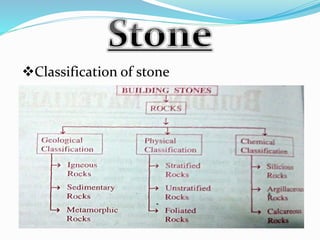
Classification of stone
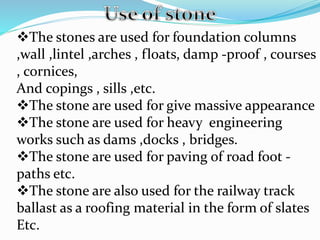
The stones are used for foundation columns
,wall ,lintel ,arches , floats, damp -proof , courses
, cornices,
And copings , sills ,etc.
The stone are used for give massive appearance
The stone are used for heavy engineering
works such as dams ,docks , bridges.
The stone are used for paving of road foot -
paths etc.
The stone are also used for the railway track
ballast as a roofing material in the form of slates
Etc.
Introduction
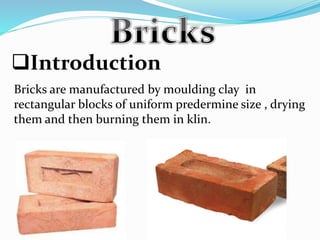
Bricks are manufactured by moulding clay in
rectangular blocks of uniform predermine size , drying
them and then burning them in klin.
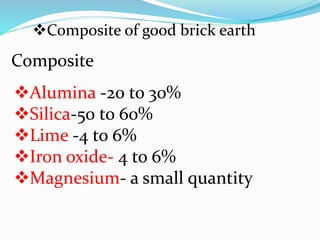
Composite of good brick earth
Composite
Alumina -20 to 30%
Silica-50 to 60%
Lime -4 to 6%
Iron oxide- 4 to 6%
Magnesium- a small quantity
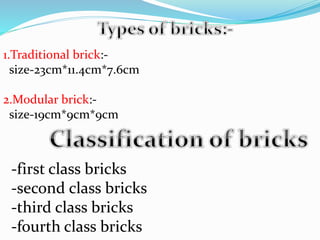
1.Traditional brick:-
size-23cm*11.4cm*7.6cm
2.Modular brick:-
size-19cm*9cm*9cm
-first class bricks
-second class bricks
-third class bricks
-fourth class bricks
Introduction
Lime is an important cementing material use in
engineer construction. A cement material may be
defined as that material which has the capacity of
holding structural unit together with sufficient
strength. When it is mixed sand and water, the
mixture is called lime mortar and is used to bind
bricks and stones in wall of building and plaster of
walls. when it is mixed with sand ,coarse aggregartes
and water the mixture is called lime concreate and is
used as filler material of foundation and base coarse
for flooring etc.
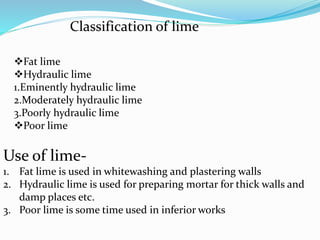
Classification of lime
Fat lime
Hydraulic lime
1.Eminently hydraulic lime
2.Moderately hydraulic lime
3.Poorly hydraulic lime
Poor lime
Use of lime-
1. Fat lime is used in whitewashing and plastering walls
2. Hydraulic lime is used for preparing mortar for thick walls and
damp places etc.
3. Poor lime is some time used in inferior works
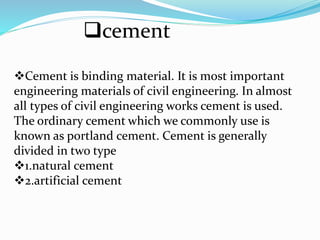
cement
Cement is binding material. It is most important
engineering materials of civil engineering. In almost
all types of civil engineering works cement is used.
The ordinary cement which we commonly use is
known as portland cement. Cement is generally
divided in two type
1.natural cement
2.artificial cement
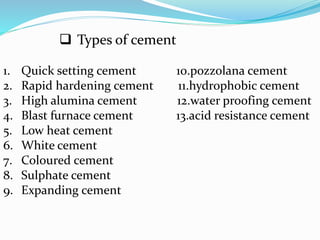
 Types of cement
1. Quick setting cement 10.pozzolana cement
2. Rapid hardening cement 11.hydrophobic cement
3. High alumina cement 12.water proofing cement
4. Blast furnace cement 13.acid resistance cement
5. Low heat cement
6. White cement
7. Coloured cement
8. Sulphate cement
9. Expanding cement
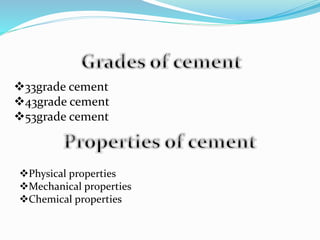
33grade cement
43grade cement
53grade cement
Physical properties
Mechanical properties
Chemical properties
Timber is one of the oldest structural
material used by men. Timber has been
used in a variety
Of ways in building construction, bridge
construction , In tunnel ,and many other
engineering activities. It has been extensively
use as beams ,columns ,and plates in
construction in variety of situations ,such as
, foundation ,flooring , stairs and roofing.
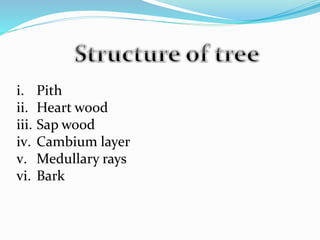
i. Pith
ii. Heart wood
iii. Sap wood
iv. Cambium layer
v. Medullary rays
vi. Bark
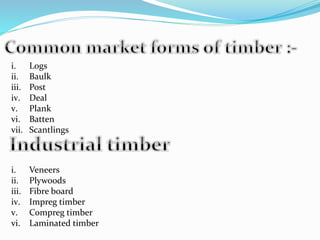
i. Logs
ii. Baulk
iii. Post
iv. Deal
v. Plank
vi. Batten
vii. Scantlings
i. Veneers
ii. Plywoods
iii. Fibre board
iv. Impreg timber
v. Compreg timber
vi. Laminated timber
Sand is an important material material.
It consists of small rounded or angular
grains of silica sio2 and is formed by the
decomposition or disintegration of
sand stone under the action of weather
such as wind ,rain frost etc. it forms a
major ingredient in concreate ,lime
mortar ,cement mortar etc.
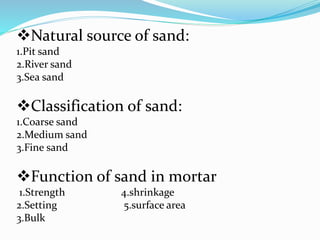
Natural source of sand:
1.Pit sand
2.River sand
3.Sea sand
Classification of sand:
1.Coarse sand
2.Medium sand
3.Fine sand
Function of sand in mortar
1.Strength 4.shrinkage
2.Setting 5.surface area
3.Bulk
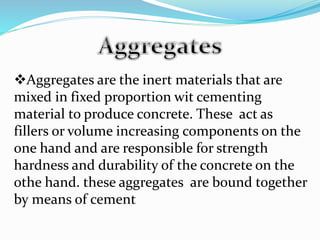
Aggregates are the inert materials that are
mixed in fixed proportion wit cementing
material to produce concrete. These act as
fillers or volume increasing components on the
one hand and are responsible for strength
hardness and durability of the concrete on the
othe hand. these aggregates are bound together
by means of cement
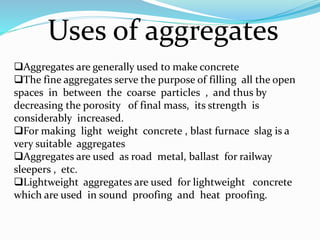
Uses of aggregates
Aggregates are generally used to make concrete
The fine aggregates serve the purpose of filling all the open
spaces in between the coarse particles , and thus by
decreasing the porosity of final mass, its strength is
considerably increased.
For making light weight concrete , blast furnace slag is a
very suitable aggregates
Aggregates are used as road metal, ballast for railway
sleepers , etc.
Lightweight aggregates are used for lightweight concrete
which are used in sound proofing and heat proofing.
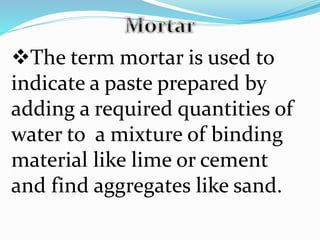
The term mortar is used to
indicate a paste prepared by
adding a required quantities of
water to a mixture of binding
material like lime or cement
and find aggregates like sand.
The mortar mix should be easily workable.
It should set and harden quickly so that
construction could be done with speed
It should not develop any cracks on drying.
It should be durable.
It should be capable of retaining sufficient water
during its application.
It should be cheap and economical.
It should be capable of resisting penetration of rain
water
 Fresh concrete may be defined as a
plastic mixture of binding materials
with sand and aggregates in the
presence of water. The mixture in a
plastic condition when allowed to set
become as hard as stone certain other
material called admixtures are also
added sometimes to obtain specific
effect
Bituminous binder used in pavement
construction works include both bitumen
and tar. The bitumen is the binding
material which is present in asphalt . It is
also sometimes called the mineral tar.
Bitumen is a petroleum product obtained
by the distillation of petroleum crude
where's road tar is obtained by the
destructure distillation of coal or wood. It
is chemically hydro-carbon.
building materials civil 1st sem

building materials civil 1st sem

  • 2.
  • 3.
    Selection of rightmaterial is an important problem which an engineer has to face. The basic concern of a civil engineer is design, construction ,supervision and maintenance of different types of structures such as buildings bridges canals road etc. hence he/she most have thorough knowledge of nature and behavior of material. A key element field practice is to deal with type of material. Selection of material depends upon their properties in relation to intend use. Also overall economy of material should be considered. a study of these aspects of material and their application in construction is very important for an civil engineer.
  • 4.
    Types of buildingmaterials:- Stone brick Lime Cement Timber Sand Aggregates Mortar Concrete Bitumen
  • 5.
  • 6.
    The stones areused for foundation columns ,wall ,lintel ,arches , floats, damp -proof , courses , cornices, And copings , sills ,etc. The stone are used for give massive appearance The stone are used for heavy engineering works such as dams ,docks , bridges. The stone are used for paving of road foot - paths etc. The stone are also used for the railway track ballast as a roofing material in the form of slates Etc.
  • 7.
    Introduction Bricks are manufacturedby moulding clay in rectangular blocks of uniform predermine size , drying them and then burning them in klin.
  • 8.
    Composite of goodbrick earth Composite Alumina -20 to 30% Silica-50 to 60% Lime -4 to 6% Iron oxide- 4 to 6% Magnesium- a small quantity
  • 9.
    1.Traditional brick:- size-23cm*11.4cm*7.6cm 2.Modular brick:- size-19cm*9cm*9cm -firstclass bricks -second class bricks -third class bricks -fourth class bricks
  • 10.
    Introduction Lime is animportant cementing material use in engineer construction. A cement material may be defined as that material which has the capacity of holding structural unit together with sufficient strength. When it is mixed sand and water, the mixture is called lime mortar and is used to bind bricks and stones in wall of building and plaster of walls. when it is mixed with sand ,coarse aggregartes and water the mixture is called lime concreate and is used as filler material of foundation and base coarse for flooring etc.
  • 11.
    Classification of lime Fatlime Hydraulic lime 1.Eminently hydraulic lime 2.Moderately hydraulic lime 3.Poorly hydraulic lime Poor lime Use of lime- 1. Fat lime is used in whitewashing and plastering walls 2. Hydraulic lime is used for preparing mortar for thick walls and damp places etc. 3. Poor lime is some time used in inferior works
  • 12.
    cement Cement is bindingmaterial. It is most important engineering materials of civil engineering. In almost all types of civil engineering works cement is used. The ordinary cement which we commonly use is known as portland cement. Cement is generally divided in two type 1.natural cement 2.artificial cement
  • 13.
     Types ofcement 1. Quick setting cement 10.pozzolana cement 2. Rapid hardening cement 11.hydrophobic cement 3. High alumina cement 12.water proofing cement 4. Blast furnace cement 13.acid resistance cement 5. Low heat cement 6. White cement 7. Coloured cement 8. Sulphate cement 9. Expanding cement
  • 14.
    33grade cement 43grade cement 53gradecement Physical properties Mechanical properties Chemical properties
  • 15.
    Timber is oneof the oldest structural material used by men. Timber has been used in a variety Of ways in building construction, bridge construction , In tunnel ,and many other engineering activities. It has been extensively use as beams ,columns ,and plates in construction in variety of situations ,such as , foundation ,flooring , stairs and roofing.
  • 16.
    i. Pith ii. Heartwood iii. Sap wood iv. Cambium layer v. Medullary rays vi. Bark
  • 17.
    i. Logs ii. Baulk iii.Post iv. Deal v. Plank vi. Batten vii. Scantlings i. Veneers ii. Plywoods iii. Fibre board iv. Impreg timber v. Compreg timber vi. Laminated timber
  • 18.
    Sand is animportant material material. It consists of small rounded or angular grains of silica sio2 and is formed by the decomposition or disintegration of sand stone under the action of weather such as wind ,rain frost etc. it forms a major ingredient in concreate ,lime mortar ,cement mortar etc.
  • 19.
    Natural source ofsand: 1.Pit sand 2.River sand 3.Sea sand Classification of sand: 1.Coarse sand 2.Medium sand 3.Fine sand Function of sand in mortar 1.Strength 4.shrinkage 2.Setting 5.surface area 3.Bulk
  • 20.
    Aggregates are theinert materials that are mixed in fixed proportion wit cementing material to produce concrete. These act as fillers or volume increasing components on the one hand and are responsible for strength hardness and durability of the concrete on the othe hand. these aggregates are bound together by means of cement
  • 21.
    Uses of aggregates Aggregatesare generally used to make concrete The fine aggregates serve the purpose of filling all the open spaces in between the coarse particles , and thus by decreasing the porosity of final mass, its strength is considerably increased. For making light weight concrete , blast furnace slag is a very suitable aggregates Aggregates are used as road metal, ballast for railway sleepers , etc. Lightweight aggregates are used for lightweight concrete which are used in sound proofing and heat proofing.
  • 22.
    The term mortaris used to indicate a paste prepared by adding a required quantities of water to a mixture of binding material like lime or cement and find aggregates like sand.
  • 23.
    The mortar mixshould be easily workable. It should set and harden quickly so that construction could be done with speed It should not develop any cracks on drying. It should be durable. It should be capable of retaining sufficient water during its application. It should be cheap and economical. It should be capable of resisting penetration of rain water
  • 24.
     Fresh concretemay be defined as a plastic mixture of binding materials with sand and aggregates in the presence of water. The mixture in a plastic condition when allowed to set become as hard as stone certain other material called admixtures are also added sometimes to obtain specific effect
  • 25.
    Bituminous binder usedin pavement construction works include both bitumen and tar. The bitumen is the binding material which is present in asphalt . It is also sometimes called the mineral tar. Bitumen is a petroleum product obtained by the distillation of petroleum crude where's road tar is obtained by the destructure distillation of coal or wood. It is chemically hydro-carbon.