 Complex Number: A number 𝑧 = 𝑎 + 𝑖𝑏 where 𝑖 = −1 , a
and b are any two real numbers, is called complex number.
 Complex Variable: A variable 𝑧 = 𝑥 + 𝑖𝑦 where 𝑖 = −1 ,
x and y are any two real variables, is called complex
number.
 Complex conjugate: Conjugate of 𝑧 = 𝑥 + 𝑖𝑦 is 𝑧 = 𝑥 −
𝑖𝑦
 Modulus (or) absolute value of a complex: The modulus of
a complex number 𝑧 = 𝑥 + 𝑖𝑦 is given by 𝑧 = 𝑥2 + 𝑦2
 Argument (or) amplitude
 The argument of z is the angle 𝜃 between the positive real axis and the
line joining the point to the origin
 Polar form of a complex variable: The polar form of a complexvariable
𝑧 = 𝑥 + 𝑖𝑦 is given by
 𝑧 = 𝑟 𝑐𝑜𝑠𝜃 + 𝑖 𝑟𝑠𝑖𝑛𝜃 , 𝑤ℎ𝑒𝑟𝑒 𝑥 = 𝑟 𝑐𝑜𝑠𝜃, 𝑦 = 𝑟𝑠𝑖𝑛𝜃 , 𝜃 is the angle
between the positive real axis and the line joining the point to the origin
and r is the distance of he point from the origin.
Euler’s formula: 𝒆𝒊𝜽
= 𝒄𝒐𝒔𝜽 + 𝒊 𝒔𝒊𝒏𝜽
Modules and amplitude: Modulus 𝑧 =
𝑥2 + 𝑦2 = 𝑟2(cos2 𝜃 + sin2 𝜃) = 𝑟
Amplitude
𝑦
𝑥
=
𝑟𝑠𝑖𝑛𝜃
𝑟𝑐𝑜𝑠𝜃
= 𝑡𝑎𝑛𝜃 ⇒ 𝜃 =
tan−1 𝑦
𝑥
 Argand Plane
 The Plane which is convenient way to represent any
imaginary number graphically is known as the Argand
Plane. Let z = x + iy. Then Re (z) = x and Im (z) = y
 Note: 𝑟𝑐𝑖𝑠𝜃 = 𝑟(𝑐𝑜𝑠𝜃 + 𝑖𝑠𝑖𝑛𝜃)
 Note
 1. 𝑟2
= 𝑧 2
= 𝑥2
+ 𝑦2
= (𝑥 + 𝑖𝑦)(𝑥 − 𝑖𝑦) = 𝑧 𝑧
 2. 𝑧1 + 𝑧2 ≤ 𝑧1 + |𝑧2|
 3. 𝑧1 − 𝑧2 ≥ 𝑧1 − |𝑧2|
 4. 𝑧1 𝑧2 = 𝑧1 𝑧2
 5.
𝑧1
𝑧2
=
𝑧1
𝑧2
 6.(𝑧1 ± 𝑧2) = 𝑧1 ± 𝑧2
 7. 𝑧1 𝑧2 = 𝑧1 𝑧2
 8. 𝑧 𝑛 = 𝑧 𝑛
 9. 𝑧−1
=
𝑧
𝑧 2 , 𝑧 ≠ 0
 Function of complex variable
 If for each value of the complex variable 𝑧 =
𝑥 + 𝑖𝑦 in a region R defined on complex plane
there exist corresponding one or more values of
𝑤 = 𝑓(𝑧) = 𝑢(𝑥, 𝑦) + 𝑖𝑣(𝑥, 𝑦), then 𝑤 = 𝑓(𝑧) is
called the function of the complex variable z.
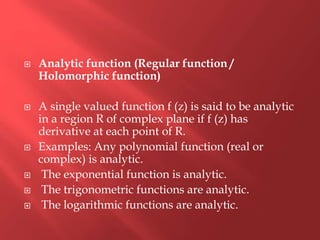
 Analytic function (Regular function /
Holomorphic function)
 A single valued function f (z) is said to be analytic
in a region R of complex plane if f (z) has
derivative at each point of R.
 Examples: Any polynomial function (real or
complex) is analytic.
 The exponential function is analytic.
 The trigonometric functions are analytic.
 The logarithmic functions are analytic.
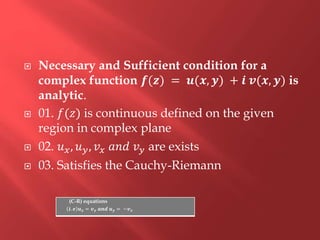
 Necessary and Sufficient condition for a
complex function 𝒇(𝒛) = 𝒖(𝒙, 𝒚) + 𝒊 𝒗(𝒙, 𝒚) is
analytic.
 01. 𝑓(𝑧) is continuous defined on the given
region in complex plane
 02. 𝑢 𝑥, 𝑢 𝑦, 𝑣 𝑥 𝑎𝑛𝑑 𝑣 𝑦 are exists
 03. Satisfies the Cauchy-Riemann
(C-R) equations
𝒊. 𝒆 𝒖 𝒙 = 𝒗 𝒚 𝒂𝒏𝒅 𝒖 𝒚 = −𝒗 𝒙
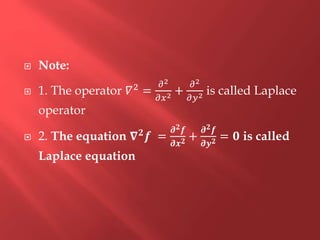
 Note:
 1. The operator 𝛻2
=
𝜕2
𝜕𝑥2 +
𝜕2
𝜕𝑦2 is called Laplace
operator
 2. The equation 𝛁 𝟐 𝒇 =
𝝏 𝟐 𝒇
𝝏𝒙 𝟐 +
𝝏 𝟐 𝒇
𝝏𝒚 𝟐 = 𝟎 is called
Laplace equation
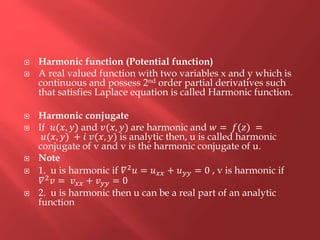
 Harmonic function (Potential function)
 A real valued function with two variables x and y which is
continuous and possess 2nd order partial derivatives such
that satisfies Laplace equation is called Harmonic function.
 Harmonic conjugate
 If 𝑢(𝑥, 𝑦) and 𝑣(𝑥, 𝑦) are harmonic and 𝑤 = 𝑓(𝑧) =
𝑢(𝑥, 𝑦) + 𝑖 𝑣(𝑥, 𝑦) is analytic then, u is called harmonic
conjugate of v and v is the harmonic conjugate of u.
 Note
 1. u is harmonic if 𝛻2
𝑢 = 𝑢 𝑥𝑥 + 𝑢 𝑦𝑦 = 0 , v is harmonic if
𝛻2
𝑣 = 𝑣 𝑥𝑥 + 𝑣 𝑦𝑦 = 0
 2. u is harmonic then u can be a real part of an analytic
function
 Milne-Thomas method
 Case(i). If the real part u of the analytic function f(z) is known
 Step (1) find 𝑢 𝑥 𝑎𝑛𝑑 𝑢 𝑦
 Step (2) find 𝑢 𝑥 𝑎𝑛𝑑 𝑢 𝑦 at (𝑧, 0)
 Step (3) 𝑓(𝑧) = 𝑢 𝑥 𝑑𝑧 − 𝑖 𝑢 𝑦 𝑑𝑧

 Case(ii). If the imaginary part v of the analytic function f(z) is known
 Steps (1) find 𝑣 𝑥 𝑎𝑛𝑑 𝑣 𝑦
 Step (2) find 𝑣 𝑥 𝑎𝑛𝑑 𝑣 𝑦 at (𝑧, 0)
 Step (3) 𝑓(𝑧) = 𝑣 𝑦 𝑑𝑧 + 𝑖 𝑣 𝑥 𝑑𝑧
 Note : Supposed to find the analytic function whose combined value of u and v is given
 [(i.e) the values like 3𝑢 + 2𝑣 , 𝑢 − 𝑣, 𝑢 + 𝑣 etc]
 Step (1) find partial differentiation of given combined value with respect to x
 Step (2) find partial differentiation of given combined value with respect to y
 Step (3) Using C-R equation 𝑢 𝑥 = 𝑣 𝑦 & 𝑢 𝑦 = −𝑣 𝑥 & convert 𝑢 𝑦 𝑎𝑛𝑑 𝑣 𝑦 𝑏𝑦 𝑣 𝑥 𝑎𝑛𝑑 𝑢 𝑥 in the equation received from step (2)
 Step (4) Solve for 𝑢 𝑥 𝑎𝑛𝑑 𝑣 𝑥
 Step (5) 𝑤. 𝑘. 𝑡, 𝑓′
𝑧 = 𝑢 𝑥 + 𝑖𝑣 𝑥 and find 𝑓′
𝑧 = 𝑢 𝑥 + 𝑖𝑣 𝑥 at (𝑧, 0) and integrate
 We will get f(z)
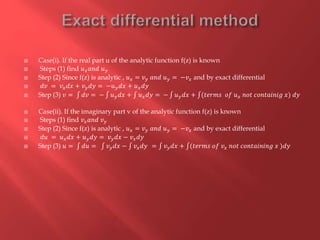
 Case(i). If the real part u of the analytic function f(z) is known
 Steps (1) find 𝑢 𝑥 𝑎𝑛𝑑 𝑢 𝑦
 Step (2) Since f(z) is analytic , 𝑢 𝑥 = 𝑣 𝑦 𝑎𝑛𝑑 𝑢 𝑦 = −𝑣 𝑥 and by exact differential
 𝑑𝑣 = 𝑣 𝑥 𝑑𝑥 + 𝑣 𝑦 𝑑𝑦 = −𝑢 𝑦 𝑑𝑥 + 𝑢 𝑥 𝑑𝑦
 Step (3) 𝑣 = 𝑑𝑣 = − 𝑢 𝑦 𝑑𝑥 + 𝑢 𝑥 𝑑𝑦 = − 𝑢 𝑦 𝑑𝑥 + (𝑡𝑒𝑟𝑚𝑠 𝑜𝑓 𝑢 𝑥 𝑛𝑜𝑡 𝑐𝑜𝑛𝑡𝑎𝑖𝑛𝑖𝑔 𝑥) 𝑑𝑦
 Case(ii). If the imaginary part v of the analytic function f(z) is known
 Steps (1) find 𝑣 𝑥 𝑎𝑛𝑑 𝑣 𝑦
 Step (2) Since f(z) is analytic , 𝑢 𝑥 = 𝑣 𝑦 𝑎𝑛𝑑 𝑢 𝑦 = −𝑣 𝑥 and by exact differential
 𝑑𝑢 = 𝑢 𝑥 𝑑𝑥 + 𝑢 𝑦 𝑑𝑦 = 𝑣 𝑦 𝑑𝑥 − 𝑣 𝑥 𝑑𝑦
 Step (3) 𝑢 = 𝑑𝑢 = 𝑣 𝑦 𝑑𝑥 − 𝑣 𝑥 𝑑𝑦 = 𝑣 𝑦 𝑑𝑥 + (𝑡𝑒𝑟𝑚𝑠 𝑜𝑓 𝑣 𝑥 𝑛𝑜𝑡 𝑐𝑜𝑛𝑡𝑎𝑖𝑛𝑖𝑛𝑔 𝑥 )𝑑𝑦
 Shortcut method
 Case(i). If the real part u of the analytic function
f(z) is known
 Then 𝑓 𝑧 = 2𝑢
𝑧
2
,
𝑧
2𝑖
− 𝑢 0,0 +
𝑖𝑐 , 𝑤ℎ𝑒𝑟𝑒 𝑐 𝑖𝑠 𝑎 𝑐𝑜𝑛𝑠𝑡𝑎𝑛𝑡
 Case(ii). If the imaginary part v of the analytic
function f(z) is known
 Then 𝑓 𝑧 = 2𝑖𝑣
𝑧
2
,
𝑧
2𝑖
− 𝑖𝑣 0,0 +
𝑐 , 𝑤ℎ𝑒𝑟𝑒 𝑐 𝑖𝑠 𝑎 𝑐𝑜𝑛𝑠𝑡𝑎𝑛𝑡
 Mapping
 Mapping is a mathematical technique used to convert (or map) one mathematical
problem and its solution into another. It involves the study of complex variables.
 Let a complex variable function z = x +iy define in z- plane have to convert (or map) in
another complex variable function f(z) =w = u +iv define in w- plane. This process is
called as Mapping.
 Conformal Mapping
 Conformal Mapping is a mathematical technique used to convert (or map) one
mathematical problem and its solution into another preserving both angles and shape of
infinitesimal small figures but not necessarily their size.
 The process of Mapping in which a complex variable function z = x + iy define in z-
plane
 mapped to another complex variable function f(z) = w = u +iv define in w- plane
preserving the angles between the curves both in magnitude and sense is called as
conformal mapping.
 The necessary condition for conformal mapping— if w = f(z) represents a conformal
mapping of a domain D in the z −plane into a domain D of the w −plane then f(z) is an
analytic function in domain D.
 A mapping 𝒘 = 𝒇(𝒛) is said to be conformal
at 𝒛 = 𝒛 𝟎 if 𝒇’(𝒛 𝟎) ≠ 𝟎
 𝒊. 𝒆
𝒅𝒘
𝒅𝒛
≠ 𝟎 𝒂𝒕 𝒛 = 𝒛 𝟎
 The point at which the mapping is not conformal, is called
critical point
 𝑖. 𝑒 𝑖𝑓 𝑓′
𝑧0 = 0 , 𝑧 = 𝑧0 is called critical point.
 𝑖. 𝑒
𝑑𝑤
𝑑𝑧 𝑎𝑡 𝑧=𝑧0
= 0 , then z0 is the critical point of the
transformation 𝑤 = 𝑓 𝑧 .
 If the transformation 𝑤 = 𝑓(𝑧) is conformal at a point
𝑧 = 𝑧0 then the inverse transformation
 𝑍 = 𝑓−1(𝑤) is conformal at the same point 𝑧 = 𝑧0
 So the critical points of the transformation w = f(z) is
given by
𝒅𝒘
𝒅𝒛
= 𝟎 𝒂𝒏𝒅
𝒅𝒛
𝒅𝒘
= 𝟎
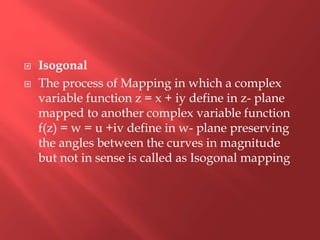
 Isogonal
 The process of Mapping in which a complex
variable function z = x + iy define in z- plane
mapped to another complex variable function
f(z) = w = u +iv define in w- plane preserving
the angles between the curves in magnitude
but not in sense is called as Isogonal mapping
 Consider =
𝑎𝑧+𝑏
𝑐𝑧+𝑑
,𝑎𝑑 − 𝑏𝑐 ≠ 0, where z = x + iy
is a complex variable in z-plane and w = u + iv
is a complex variable in the w-plane, also a, b,
c, d are complex numbers and c and d cannot
both zero simultaneously . This transformation
is called bilinear transformation
 Note:
 1. The necessary condition for bilinear
transformation is 𝑎𝑑 − 𝑏𝑐 ≠ 0
 2. The inverse transformation 𝑧 =
𝑑𝑤−𝑏
𝑎−𝑤𝑐
is also
bilinear
 3. 𝑎𝑑 − 𝑏𝑐 is called the determinant of the bilinear
transformation 𝑤 =
𝑎𝑧+𝑏
𝑐𝑧+𝑑
 If 𝑎𝑑 − 𝑏𝑐 = 1 then the transformation is said to
be normalized.
 4. Bilinear transformation is 1-1 and onto (bijective)
 5. Every bilinear transformation maps circle or
straight line onto a circle or straight line
 The fixed point of the transformation 𝑤 =
𝑎𝑧+𝑏
𝑐𝑧+𝑑
is obtained from solving
 𝑧 =
𝑎𝑧+𝑏
𝑐𝑧+𝑑
𝑜𝑟 𝑐𝑧2 + 𝑑 − 𝑎 𝑧 − 𝑏 = 0
Cross ratio
 The cross ratio of four points 𝑧1, 𝑧2, 𝑧3, 𝑧4 is 𝑧1, 𝑧2, 𝑧3, 𝑧4 =
𝑧1−𝑧2 𝑧3−𝑧4
𝑧2−𝑧3 𝑧4−𝑧1
Note
 1. Bilinear transformation preserves cross ratio.
 If 𝑧1, 𝑧2, 𝑧3, 𝑧4 are points in z-plane and 𝑤1, 𝑤2, 𝑤3, 𝑤4 are
their corresponding images on w-plane under a bilinear
transformation their cross ratios are equal
 𝑖. 𝑒 𝑧1, 𝑧2, 𝑧3, 𝑧4 = (𝑤1, 𝑤2, 𝑤3, 𝑤4)
 2. When three points 𝑧1, 𝑧2, 𝑧3 of z-plane and their
corresponding images 𝑤1, 𝑤2, 𝑤3 on w-plane are given then
the associated bilinear transformation can be found by using
𝑧 −𝑧1 𝑧2−𝑧3
𝑧1−𝑧2 𝑧3−𝑧
=
𝑤−𝑤1 𝑤2−𝑤3
𝑤1−𝑤2 𝑤3−𝑤

Analytic function

  • 2.
     Complex Number:A number 𝑧 = 𝑎 + 𝑖𝑏 where 𝑖 = −1 , a and b are any two real numbers, is called complex number.  Complex Variable: A variable 𝑧 = 𝑥 + 𝑖𝑦 where 𝑖 = −1 , x and y are any two real variables, is called complex number.  Complex conjugate: Conjugate of 𝑧 = 𝑥 + 𝑖𝑦 is 𝑧 = 𝑥 − 𝑖𝑦  Modulus (or) absolute value of a complex: The modulus of a complex number 𝑧 = 𝑥 + 𝑖𝑦 is given by 𝑧 = 𝑥2 + 𝑦2
  • 3.
     Argument (or)amplitude  The argument of z is the angle 𝜃 between the positive real axis and the line joining the point to the origin  Polar form of a complex variable: The polar form of a complexvariable 𝑧 = 𝑥 + 𝑖𝑦 is given by  𝑧 = 𝑟 𝑐𝑜𝑠𝜃 + 𝑖 𝑟𝑠𝑖𝑛𝜃 , 𝑤ℎ𝑒𝑟𝑒 𝑥 = 𝑟 𝑐𝑜𝑠𝜃, 𝑦 = 𝑟𝑠𝑖𝑛𝜃 , 𝜃 is the angle between the positive real axis and the line joining the point to the origin and r is the distance of he point from the origin.
  • 4.
    Euler’s formula: 𝒆𝒊𝜽 =𝒄𝒐𝒔𝜽 + 𝒊 𝒔𝒊𝒏𝜽 Modules and amplitude: Modulus 𝑧 = 𝑥2 + 𝑦2 = 𝑟2(cos2 𝜃 + sin2 𝜃) = 𝑟 Amplitude 𝑦 𝑥 = 𝑟𝑠𝑖𝑛𝜃 𝑟𝑐𝑜𝑠𝜃 = 𝑡𝑎𝑛𝜃 ⇒ 𝜃 = tan−1 𝑦 𝑥
  • 5.
     Argand Plane The Plane which is convenient way to represent any imaginary number graphically is known as the Argand Plane. Let z = x + iy. Then Re (z) = x and Im (z) = y
  • 6.
     Note: 𝑟𝑐𝑖𝑠𝜃= 𝑟(𝑐𝑜𝑠𝜃 + 𝑖𝑠𝑖𝑛𝜃)  Note  1. 𝑟2 = 𝑧 2 = 𝑥2 + 𝑦2 = (𝑥 + 𝑖𝑦)(𝑥 − 𝑖𝑦) = 𝑧 𝑧  2. 𝑧1 + 𝑧2 ≤ 𝑧1 + |𝑧2|  3. 𝑧1 − 𝑧2 ≥ 𝑧1 − |𝑧2|  4. 𝑧1 𝑧2 = 𝑧1 𝑧2  5. 𝑧1 𝑧2 = 𝑧1 𝑧2  6.(𝑧1 ± 𝑧2) = 𝑧1 ± 𝑧2  7. 𝑧1 𝑧2 = 𝑧1 𝑧2  8. 𝑧 𝑛 = 𝑧 𝑛  9. 𝑧−1 = 𝑧 𝑧 2 , 𝑧 ≠ 0
  • 7.
     Function ofcomplex variable  If for each value of the complex variable 𝑧 = 𝑥 + 𝑖𝑦 in a region R defined on complex plane there exist corresponding one or more values of 𝑤 = 𝑓(𝑧) = 𝑢(𝑥, 𝑦) + 𝑖𝑣(𝑥, 𝑦), then 𝑤 = 𝑓(𝑧) is called the function of the complex variable z.
  • 8.
     Analytic function(Regular function / Holomorphic function)  A single valued function f (z) is said to be analytic in a region R of complex plane if f (z) has derivative at each point of R.  Examples: Any polynomial function (real or complex) is analytic.  The exponential function is analytic.  The trigonometric functions are analytic.  The logarithmic functions are analytic.
  • 9.
     Necessary andSufficient condition for a complex function 𝒇(𝒛) = 𝒖(𝒙, 𝒚) + 𝒊 𝒗(𝒙, 𝒚) is analytic.  01. 𝑓(𝑧) is continuous defined on the given region in complex plane  02. 𝑢 𝑥, 𝑢 𝑦, 𝑣 𝑥 𝑎𝑛𝑑 𝑣 𝑦 are exists  03. Satisfies the Cauchy-Riemann (C-R) equations 𝒊. 𝒆 𝒖 𝒙 = 𝒗 𝒚 𝒂𝒏𝒅 𝒖 𝒚 = −𝒗 𝒙
  • 10.
     Note:  1.The operator 𝛻2 = 𝜕2 𝜕𝑥2 + 𝜕2 𝜕𝑦2 is called Laplace operator  2. The equation 𝛁 𝟐 𝒇 = 𝝏 𝟐 𝒇 𝝏𝒙 𝟐 + 𝝏 𝟐 𝒇 𝝏𝒚 𝟐 = 𝟎 is called Laplace equation
  • 11.
     Harmonic function(Potential function)  A real valued function with two variables x and y which is continuous and possess 2nd order partial derivatives such that satisfies Laplace equation is called Harmonic function.  Harmonic conjugate  If 𝑢(𝑥, 𝑦) and 𝑣(𝑥, 𝑦) are harmonic and 𝑤 = 𝑓(𝑧) = 𝑢(𝑥, 𝑦) + 𝑖 𝑣(𝑥, 𝑦) is analytic then, u is called harmonic conjugate of v and v is the harmonic conjugate of u.  Note  1. u is harmonic if 𝛻2 𝑢 = 𝑢 𝑥𝑥 + 𝑢 𝑦𝑦 = 0 , v is harmonic if 𝛻2 𝑣 = 𝑣 𝑥𝑥 + 𝑣 𝑦𝑦 = 0  2. u is harmonic then u can be a real part of an analytic function
  • 12.
     Milne-Thomas method Case(i). If the real part u of the analytic function f(z) is known  Step (1) find 𝑢 𝑥 𝑎𝑛𝑑 𝑢 𝑦  Step (2) find 𝑢 𝑥 𝑎𝑛𝑑 𝑢 𝑦 at (𝑧, 0)  Step (3) 𝑓(𝑧) = 𝑢 𝑥 𝑑𝑧 − 𝑖 𝑢 𝑦 𝑑𝑧   Case(ii). If the imaginary part v of the analytic function f(z) is known  Steps (1) find 𝑣 𝑥 𝑎𝑛𝑑 𝑣 𝑦  Step (2) find 𝑣 𝑥 𝑎𝑛𝑑 𝑣 𝑦 at (𝑧, 0)  Step (3) 𝑓(𝑧) = 𝑣 𝑦 𝑑𝑧 + 𝑖 𝑣 𝑥 𝑑𝑧  Note : Supposed to find the analytic function whose combined value of u and v is given  [(i.e) the values like 3𝑢 + 2𝑣 , 𝑢 − 𝑣, 𝑢 + 𝑣 etc]  Step (1) find partial differentiation of given combined value with respect to x  Step (2) find partial differentiation of given combined value with respect to y  Step (3) Using C-R equation 𝑢 𝑥 = 𝑣 𝑦 & 𝑢 𝑦 = −𝑣 𝑥 & convert 𝑢 𝑦 𝑎𝑛𝑑 𝑣 𝑦 𝑏𝑦 𝑣 𝑥 𝑎𝑛𝑑 𝑢 𝑥 in the equation received from step (2)  Step (4) Solve for 𝑢 𝑥 𝑎𝑛𝑑 𝑣 𝑥  Step (5) 𝑤. 𝑘. 𝑡, 𝑓′ 𝑧 = 𝑢 𝑥 + 𝑖𝑣 𝑥 and find 𝑓′ 𝑧 = 𝑢 𝑥 + 𝑖𝑣 𝑥 at (𝑧, 0) and integrate  We will get f(z)
  • 13.
     Case(i). Ifthe real part u of the analytic function f(z) is known  Steps (1) find 𝑢 𝑥 𝑎𝑛𝑑 𝑢 𝑦  Step (2) Since f(z) is analytic , 𝑢 𝑥 = 𝑣 𝑦 𝑎𝑛𝑑 𝑢 𝑦 = −𝑣 𝑥 and by exact differential  𝑑𝑣 = 𝑣 𝑥 𝑑𝑥 + 𝑣 𝑦 𝑑𝑦 = −𝑢 𝑦 𝑑𝑥 + 𝑢 𝑥 𝑑𝑦  Step (3) 𝑣 = 𝑑𝑣 = − 𝑢 𝑦 𝑑𝑥 + 𝑢 𝑥 𝑑𝑦 = − 𝑢 𝑦 𝑑𝑥 + (𝑡𝑒𝑟𝑚𝑠 𝑜𝑓 𝑢 𝑥 𝑛𝑜𝑡 𝑐𝑜𝑛𝑡𝑎𝑖𝑛𝑖𝑔 𝑥) 𝑑𝑦  Case(ii). If the imaginary part v of the analytic function f(z) is known  Steps (1) find 𝑣 𝑥 𝑎𝑛𝑑 𝑣 𝑦  Step (2) Since f(z) is analytic , 𝑢 𝑥 = 𝑣 𝑦 𝑎𝑛𝑑 𝑢 𝑦 = −𝑣 𝑥 and by exact differential  𝑑𝑢 = 𝑢 𝑥 𝑑𝑥 + 𝑢 𝑦 𝑑𝑦 = 𝑣 𝑦 𝑑𝑥 − 𝑣 𝑥 𝑑𝑦  Step (3) 𝑢 = 𝑑𝑢 = 𝑣 𝑦 𝑑𝑥 − 𝑣 𝑥 𝑑𝑦 = 𝑣 𝑦 𝑑𝑥 + (𝑡𝑒𝑟𝑚𝑠 𝑜𝑓 𝑣 𝑥 𝑛𝑜𝑡 𝑐𝑜𝑛𝑡𝑎𝑖𝑛𝑖𝑛𝑔 𝑥 )𝑑𝑦
  • 14.
     Shortcut method Case(i). If the real part u of the analytic function f(z) is known  Then 𝑓 𝑧 = 2𝑢 𝑧 2 , 𝑧 2𝑖 − 𝑢 0,0 + 𝑖𝑐 , 𝑤ℎ𝑒𝑟𝑒 𝑐 𝑖𝑠 𝑎 𝑐𝑜𝑛𝑠𝑡𝑎𝑛𝑡  Case(ii). If the imaginary part v of the analytic function f(z) is known  Then 𝑓 𝑧 = 2𝑖𝑣 𝑧 2 , 𝑧 2𝑖 − 𝑖𝑣 0,0 + 𝑐 , 𝑤ℎ𝑒𝑟𝑒 𝑐 𝑖𝑠 𝑎 𝑐𝑜𝑛𝑠𝑡𝑎𝑛𝑡
  • 15.
     Mapping  Mappingis a mathematical technique used to convert (or map) one mathematical problem and its solution into another. It involves the study of complex variables.  Let a complex variable function z = x +iy define in z- plane have to convert (or map) in another complex variable function f(z) =w = u +iv define in w- plane. This process is called as Mapping.  Conformal Mapping  Conformal Mapping is a mathematical technique used to convert (or map) one mathematical problem and its solution into another preserving both angles and shape of infinitesimal small figures but not necessarily their size.  The process of Mapping in which a complex variable function z = x + iy define in z- plane  mapped to another complex variable function f(z) = w = u +iv define in w- plane preserving the angles between the curves both in magnitude and sense is called as conformal mapping.  The necessary condition for conformal mapping— if w = f(z) represents a conformal mapping of a domain D in the z −plane into a domain D of the w −plane then f(z) is an analytic function in domain D.
  • 16.
     A mapping𝒘 = 𝒇(𝒛) is said to be conformal at 𝒛 = 𝒛 𝟎 if 𝒇’(𝒛 𝟎) ≠ 𝟎  𝒊. 𝒆 𝒅𝒘 𝒅𝒛 ≠ 𝟎 𝒂𝒕 𝒛 = 𝒛 𝟎
  • 17.
     The pointat which the mapping is not conformal, is called critical point  𝑖. 𝑒 𝑖𝑓 𝑓′ 𝑧0 = 0 , 𝑧 = 𝑧0 is called critical point.  𝑖. 𝑒 𝑑𝑤 𝑑𝑧 𝑎𝑡 𝑧=𝑧0 = 0 , then z0 is the critical point of the transformation 𝑤 = 𝑓 𝑧 .  If the transformation 𝑤 = 𝑓(𝑧) is conformal at a point 𝑧 = 𝑧0 then the inverse transformation  𝑍 = 𝑓−1(𝑤) is conformal at the same point 𝑧 = 𝑧0  So the critical points of the transformation w = f(z) is given by 𝒅𝒘 𝒅𝒛 = 𝟎 𝒂𝒏𝒅 𝒅𝒛 𝒅𝒘 = 𝟎
  • 18.
     Isogonal  Theprocess of Mapping in which a complex variable function z = x + iy define in z- plane mapped to another complex variable function f(z) = w = u +iv define in w- plane preserving the angles between the curves in magnitude but not in sense is called as Isogonal mapping
  • 19.
     Consider = 𝑎𝑧+𝑏 𝑐𝑧+𝑑 ,𝑎𝑑− 𝑏𝑐 ≠ 0, where z = x + iy is a complex variable in z-plane and w = u + iv is a complex variable in the w-plane, also a, b, c, d are complex numbers and c and d cannot both zero simultaneously . This transformation is called bilinear transformation
  • 20.
     Note:  1.The necessary condition for bilinear transformation is 𝑎𝑑 − 𝑏𝑐 ≠ 0  2. The inverse transformation 𝑧 = 𝑑𝑤−𝑏 𝑎−𝑤𝑐 is also bilinear  3. 𝑎𝑑 − 𝑏𝑐 is called the determinant of the bilinear transformation 𝑤 = 𝑎𝑧+𝑏 𝑐𝑧+𝑑  If 𝑎𝑑 − 𝑏𝑐 = 1 then the transformation is said to be normalized.  4. Bilinear transformation is 1-1 and onto (bijective)  5. Every bilinear transformation maps circle or straight line onto a circle or straight line
  • 21.
     The fixedpoint of the transformation 𝑤 = 𝑎𝑧+𝑏 𝑐𝑧+𝑑 is obtained from solving  𝑧 = 𝑎𝑧+𝑏 𝑐𝑧+𝑑 𝑜𝑟 𝑐𝑧2 + 𝑑 − 𝑎 𝑧 − 𝑏 = 0
  • 22.
    Cross ratio  Thecross ratio of four points 𝑧1, 𝑧2, 𝑧3, 𝑧4 is 𝑧1, 𝑧2, 𝑧3, 𝑧4 = 𝑧1−𝑧2 𝑧3−𝑧4 𝑧2−𝑧3 𝑧4−𝑧1 Note  1. Bilinear transformation preserves cross ratio.  If 𝑧1, 𝑧2, 𝑧3, 𝑧4 are points in z-plane and 𝑤1, 𝑤2, 𝑤3, 𝑤4 are their corresponding images on w-plane under a bilinear transformation their cross ratios are equal  𝑖. 𝑒 𝑧1, 𝑧2, 𝑧3, 𝑧4 = (𝑤1, 𝑤2, 𝑤3, 𝑤4)  2. When three points 𝑧1, 𝑧2, 𝑧3 of z-plane and their corresponding images 𝑤1, 𝑤2, 𝑤3 on w-plane are given then the associated bilinear transformation can be found by using 𝑧 −𝑧1 𝑧2−𝑧3 𝑧1−𝑧2 𝑧3−𝑧 = 𝑤−𝑤1 𝑤2−𝑤3 𝑤1−𝑤2 𝑤3−𝑤