INTRODUCTION TO
VECTOR INTEGRALS
SlideMake.com
M.VISHWANI
227R1A1235
IT-A
1
INTRODUCTION TO VECTOR INTEGRALS
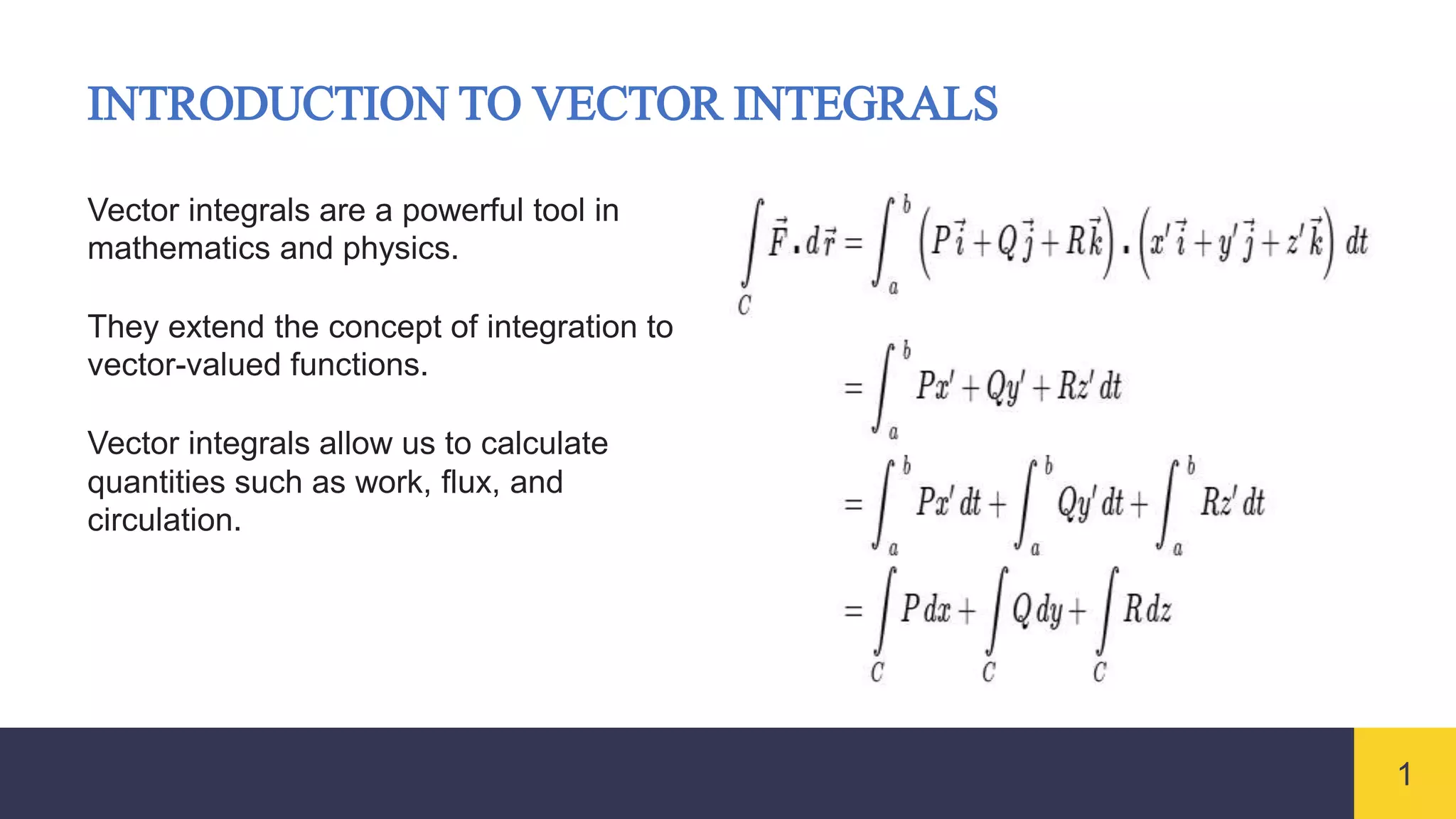
Vector integrals are a powerful tool in
mathematics and physics.
They extend the concept of integration to
vector-valued functions.
Vector integrals allow us to calculate
quantities such as work, flux, and
circulation.
2
NOTATION AND DEFINITIONS
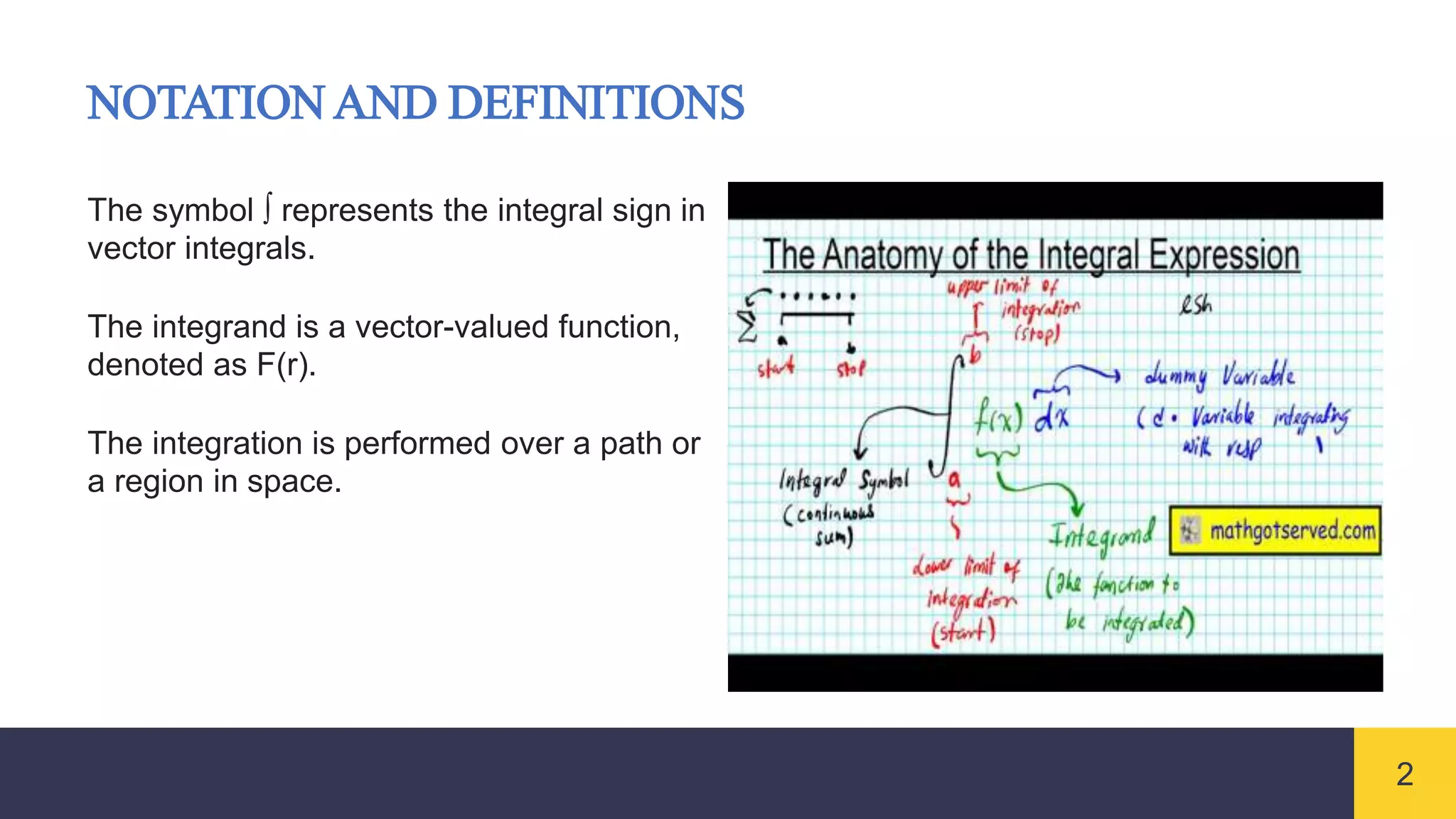
The symbol ∫ represents the integral sign in
vector integrals.
The integrand is a vector-valued function,
denoted as F(r).
The integration is performed over a path or
a region in space.
3
LINE INTEGRALS
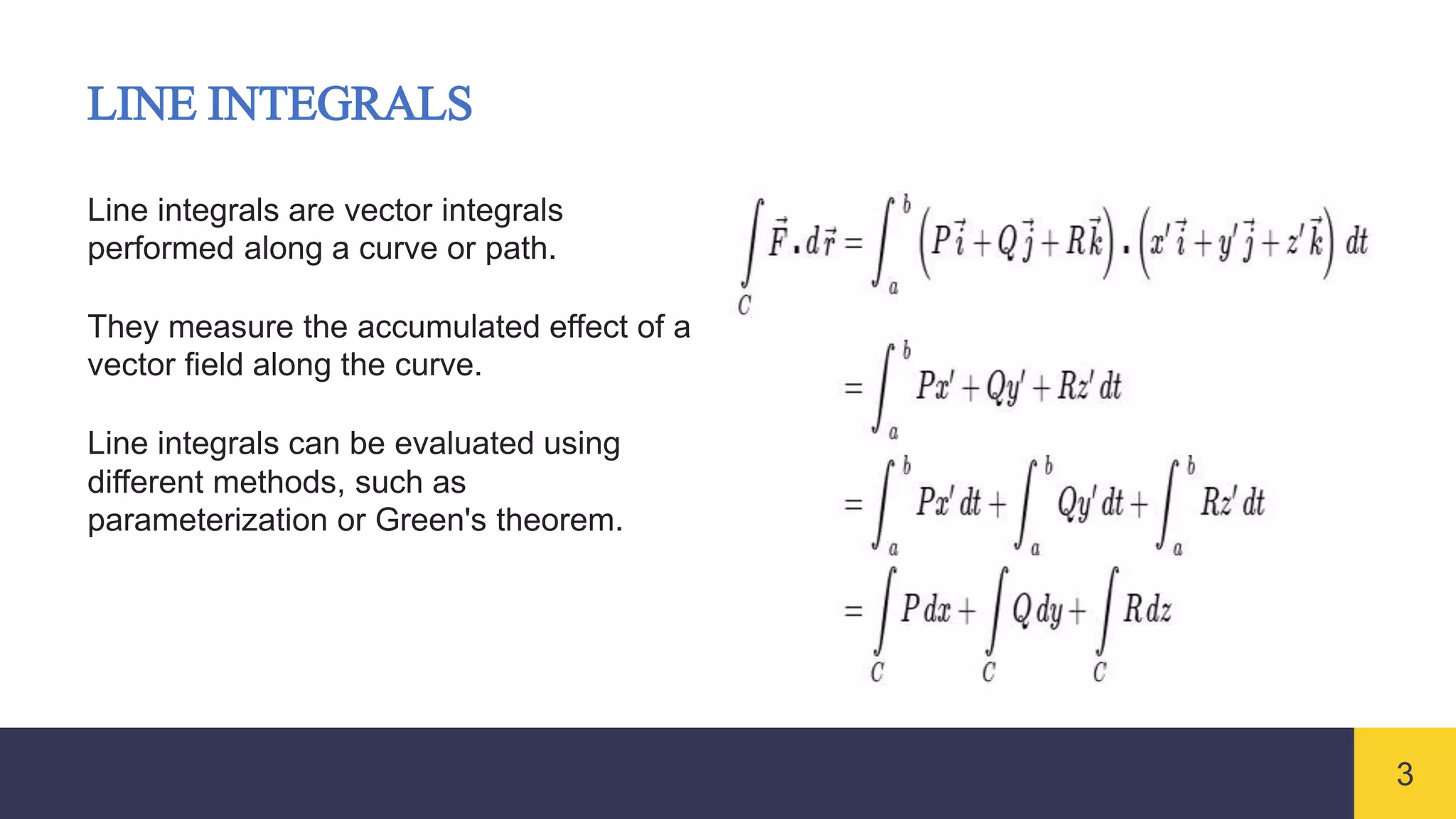
Line integrals are vector integrals
performed along a curve or path.
They measure the accumulated effect of a
vector field along the curve.
Line integrals can be evaluated using
different methods, such as
parameterization or Green's theorem.
4
SURFACE INTEGRALS
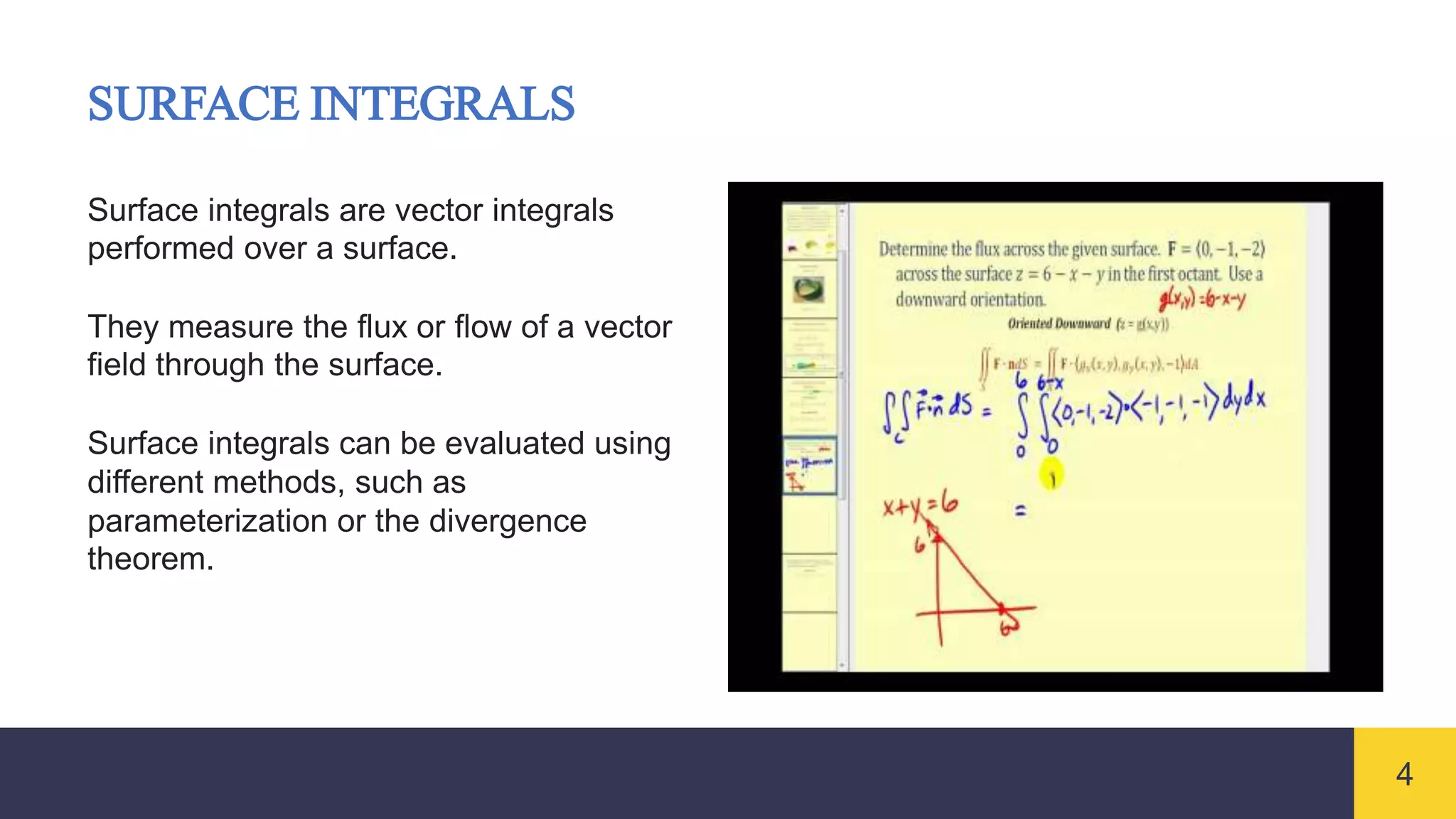
Surface integrals are vector integrals
performed over a surface.
They measure the flux or flow of a vector
field through the surface.
Surface integrals can be evaluated using
different methods, such as
parameterization or the divergence
theorem.
5
VOLUME INTEGRALS
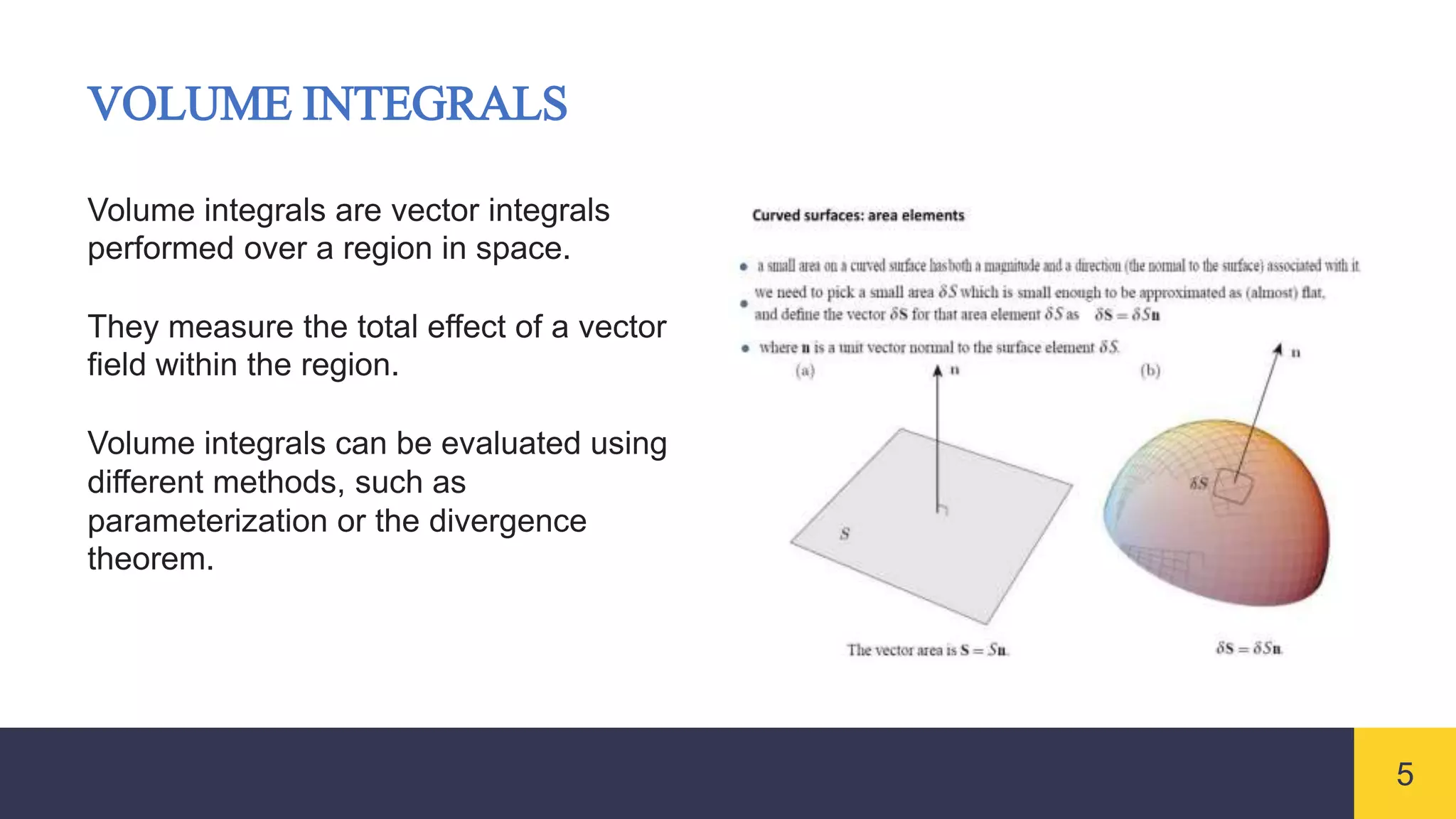
Volume integrals are vector integrals
performed over a region in space.
They measure the total effect of a vector
field within the region.
Volume integrals can be evaluated using
different methods, such as
parameterization or the divergence
theorem.
6
APPLICATIONS OF VECTOR INTEGRALS
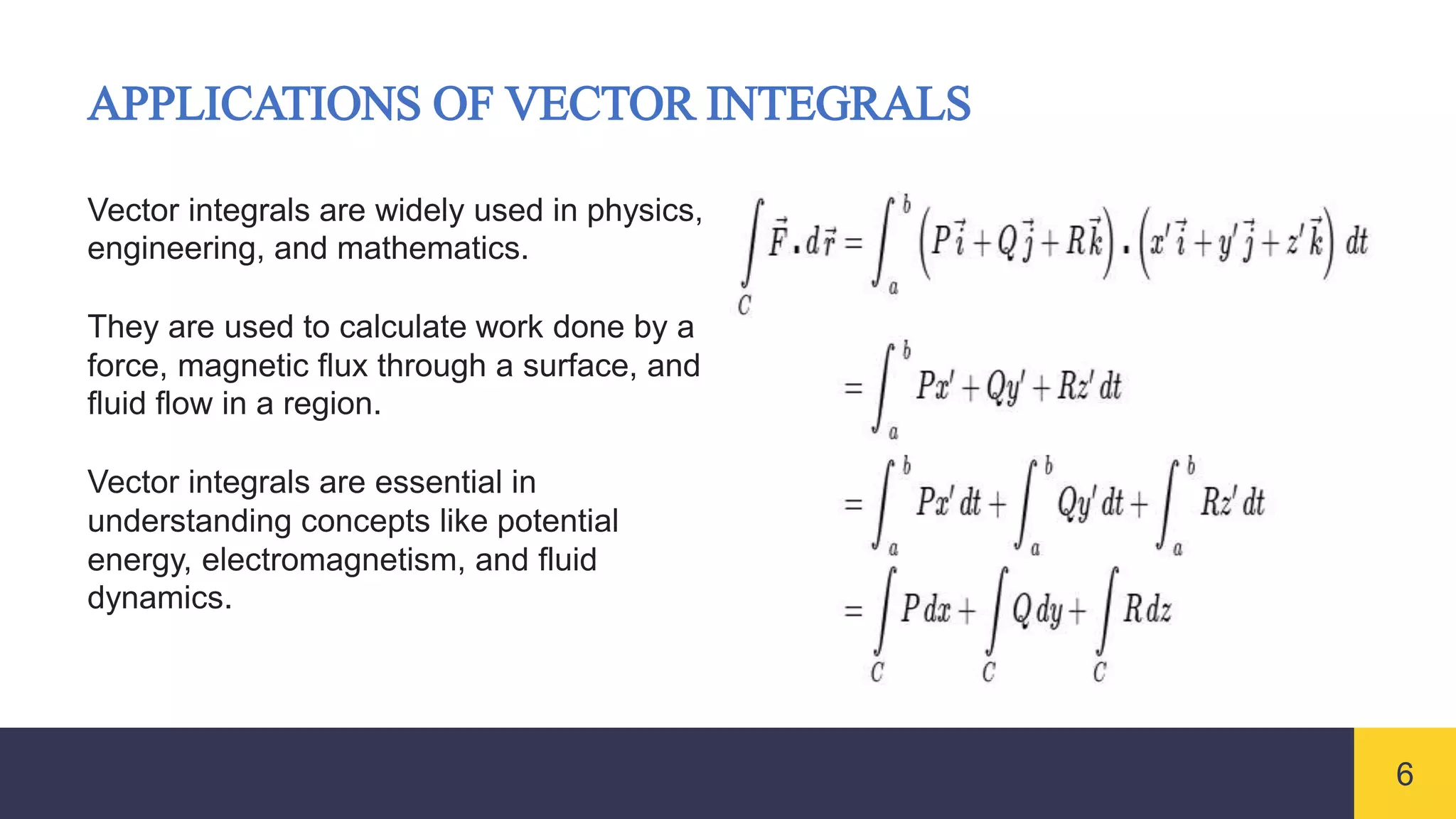
Vector integrals are widely used in physics,
engineering, and mathematics.
They are used to calculate work done by a
force, magnetic flux through a surface, and
fluid flow in a region.
Vector integrals are essential in
understanding concepts like potential
energy, electromagnetism, and fluid
dynamics.
7
VECTOR INTEGRATION TECHNIQUES
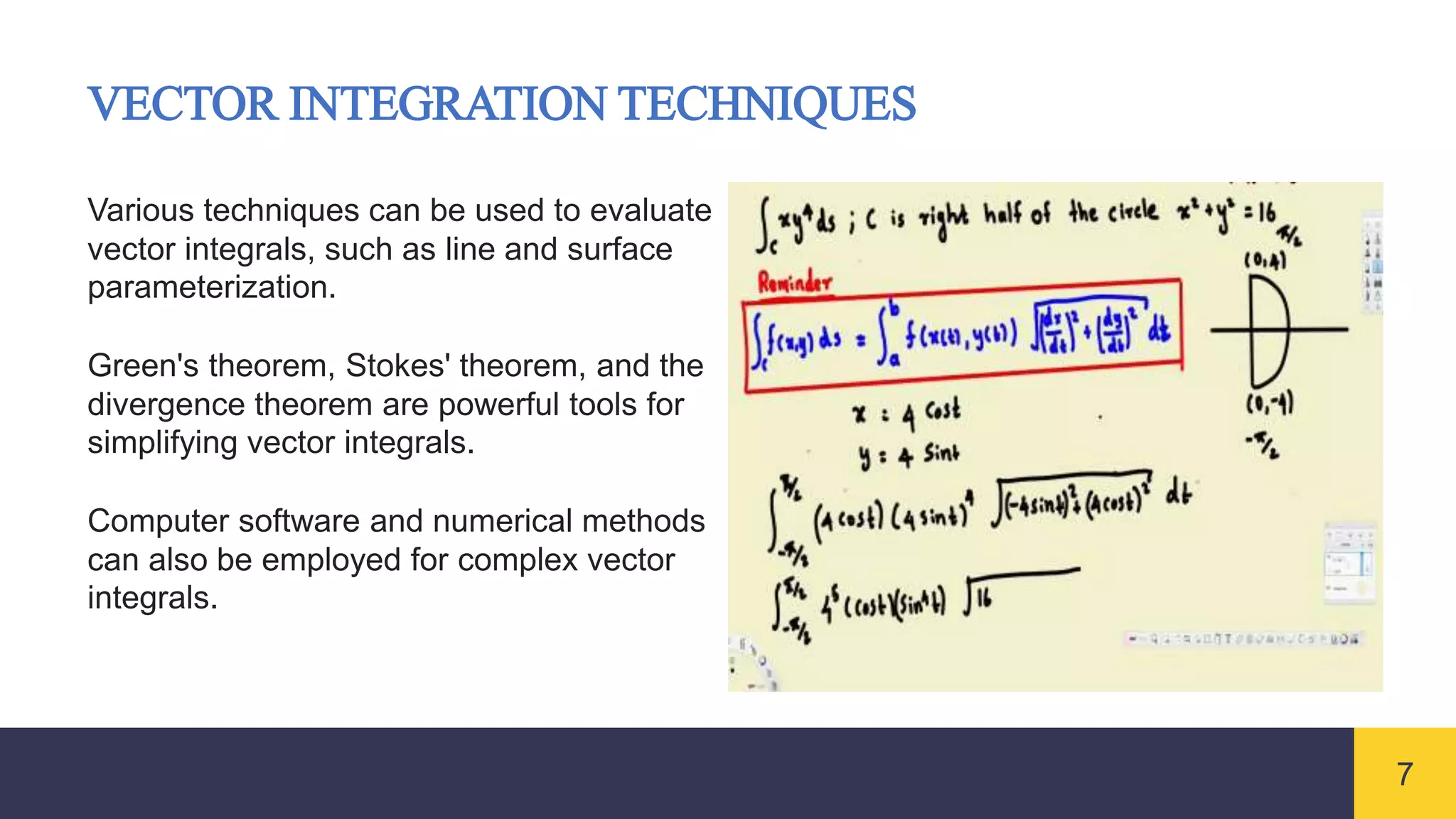
Various techniques can be used to evaluate
vector integrals, such as line and surface
parameterization.
Green's theorem, Stokes' theorem, and the
divergence theorem are powerful tools for
simplifying vector integrals.
Computer software and numerical methods
can also be employed for complex vector
integrals.
8
SUMMARY
Vector integrals extend integration to
vector-valued functions, allowing us to
calculate quantities like work, flux, and
circulation.
Line integrals measure the effect of a
vector field along a curve, while surface
integrals measure flux through a surface.
Volume integrals measure the total effect of
a vector field within a region.
THANKYOU

Introduction To Vector Integrals.pptx

  • 1.
  • 2.
    1 INTRODUCTION TO VECTORINTEGRALS Vector integrals are a powerful tool in mathematics and physics. They extend the concept of integration to vector-valued functions. Vector integrals allow us to calculate quantities such as work, flux, and circulation.
  • 3.
    2 NOTATION AND DEFINITIONS Thesymbol ∫ represents the integral sign in vector integrals. The integrand is a vector-valued function, denoted as F(r). The integration is performed over a path or a region in space.
  • 4.
    3 LINE INTEGRALS Line integralsare vector integrals performed along a curve or path. They measure the accumulated effect of a vector field along the curve. Line integrals can be evaluated using different methods, such as parameterization or Green's theorem.
  • 5.
    4 SURFACE INTEGRALS Surface integralsare vector integrals performed over a surface. They measure the flux or flow of a vector field through the surface. Surface integrals can be evaluated using different methods, such as parameterization or the divergence theorem.
  • 6.
    5 VOLUME INTEGRALS Volume integralsare vector integrals performed over a region in space. They measure the total effect of a vector field within the region. Volume integrals can be evaluated using different methods, such as parameterization or the divergence theorem.
  • 7.
    6 APPLICATIONS OF VECTORINTEGRALS Vector integrals are widely used in physics, engineering, and mathematics. They are used to calculate work done by a force, magnetic flux through a surface, and fluid flow in a region. Vector integrals are essential in understanding concepts like potential energy, electromagnetism, and fluid dynamics.
  • 8.
    7 VECTOR INTEGRATION TECHNIQUES Varioustechniques can be used to evaluate vector integrals, such as line and surface parameterization. Green's theorem, Stokes' theorem, and the divergence theorem are powerful tools for simplifying vector integrals. Computer software and numerical methods can also be employed for complex vector integrals.
  • 9.
    8 SUMMARY Vector integrals extendintegration to vector-valued functions, allowing us to calculate quantities like work, flux, and circulation. Line integrals measure the effect of a vector field along a curve, while surface integrals measure flux through a surface. Volume integrals measure the total effect of a vector field within a region.
  • 10.