DOUBLE INTEGRALSPrepared ByShemalValandS.Y.B.Sc.-2010
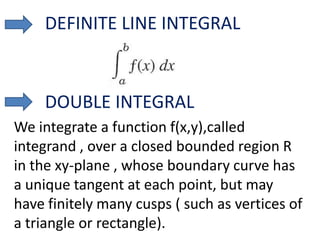
DEFINITE LINE INTEGRALDOUBLE INTEGRALWe integrate a function f(x,y),called    integrand , over a closed bounded region R in the xy-plane , whose boundary curve has a unique tangent at each point, but may have finitely many cusps ( such as vertices of a triangle or rectangle).
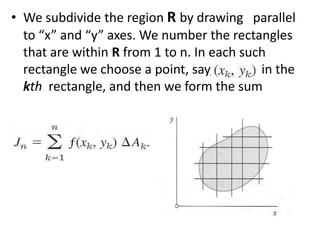
We subdivide the region Rby drawing   parallel to “x” and “y” axes. We number the rectangles that are within R from 1 to n. In each such rectangle we choose a point, say,               in the kth  rectangle, and then we form the sum
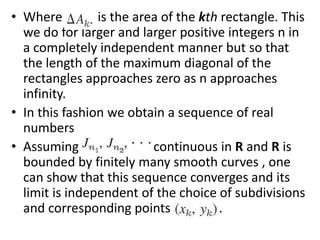
Where           is the area of the kth rectangle. This we do for larger and larger positive integers n in a completely independent manner but so that the length of the maximum diagonal of the rectangles approaches zero as n approaches infinity. In this fashion we obtain a sequence of real numbers                         Assuming that f(x,y) is continuous in R and R is bounded by finitely many smooth curves , one can show that this sequence converges and its limit is independent of the choice of subdivisions and corresponding points               .
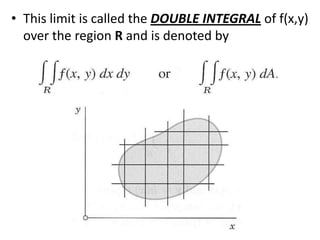
This limit is called the DOUBLE INTEGRAL of f(x,y) over the region R and is denoted by
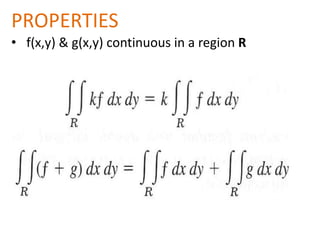
PROPERTIES f(x,y) & g(x,y) continuous in a region R
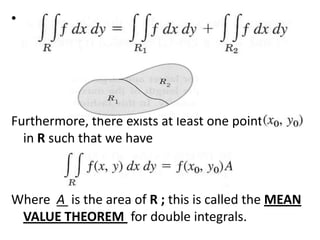
Furthermore, there exists at least one point             in R such that we have         Where  A  is the area of R ; this is called the MEAN VALUE THEOREM  for double integrals.
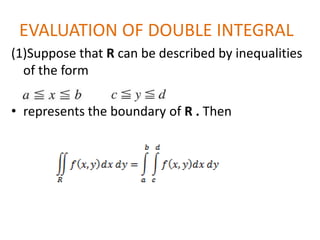
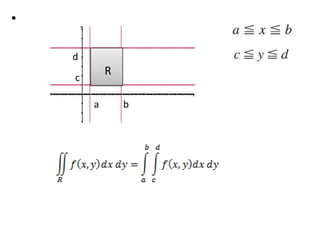
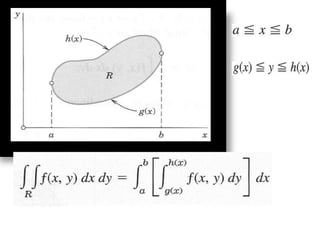
EVALUATION OF DOUBLE INTEGRAL(1)Suppose that R can be described by inequalities of the formrepresents the boundary of R . Then
dRcab
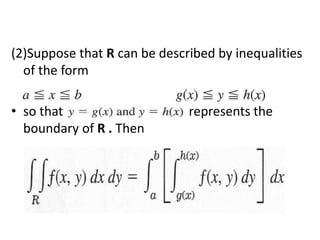
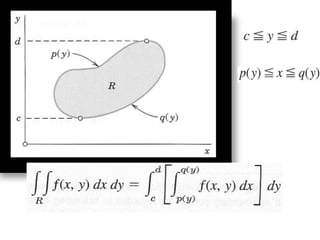
(2)Suppose that R can be described by inequalities of the formso that                                       represents the boundary of R . Then
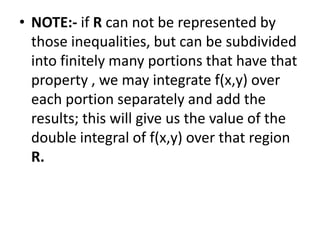
NOTE:- if R can not be represented by those inequalities, but can be subdivided into finitely many portions that have that property , we may integrate f(x,y) over each portion separately and add the results; this will give us the value of the double integral of f(x,y) over that region  R.
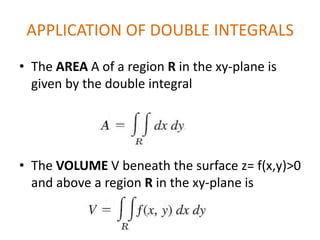
APPLICATION OF DOUBLE INTEGRALSThe AREA A of a region R in the xy-plane is given by the double integralThe VOLUME V beneath the surface z= f(x,y)>0 and above a region R in the xy-plane is
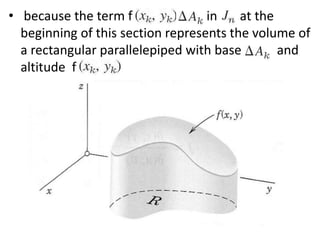
 because the term f                       in       at the beginning of this section represents the volume of a rectangular parallelepiped with base           and altitude  f
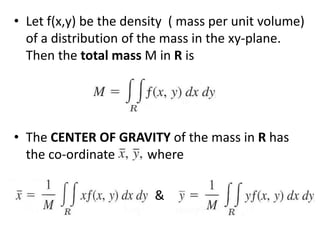
Let f(x,y) be the density  ( mass per unit volume) of a distribution of the mass in the xy-plane. Then the total mass M in R is The CENTER OF GRAVITY of the mass in R has the co-ordinate          where                                         &
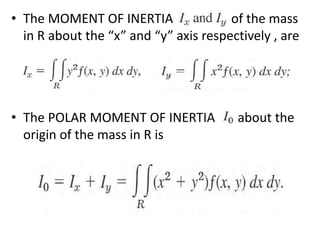
The MOMENT OF INERTIA                  of the mass in R about the “x” and “y” axis respectively , areThe POLAR MOMENT OF INERTIA       about the origin of the mass in R is
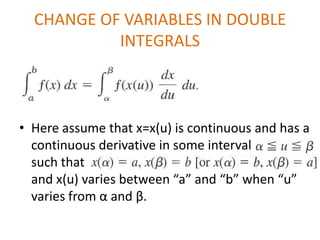
CHANGE OF VARIABLES IN DOUBLE INTEGRALSHere assume that x=x(u) is continuous and has a continuous derivative in some interval                      such that                                                                        and x(u) varies between “a” and “b” when “u” varies from α and β.
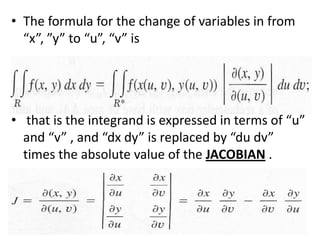
The formula for the change of variables in from “x”, ”y” to “u”, “v” is that is the integrand is expressed in terms of “u” and “v” , and “dxdy” is replaced by “du dv” times the absolute value of the JACOBIAN .
Here we assume the following. The functions                 x=x(u,v)   y=y(u,v) effecting the change are continuous and have continuous partial derivatives in some region R* in the uv-plane such that the point (x,y) corresponding to any (u,v) in R* lies in r and, conversely , to every (x,y) in R there corresponds one and only one (u,v) in R*; furthermore the JACOBIAN J is either positive throughout R* or  negative throughout R*.
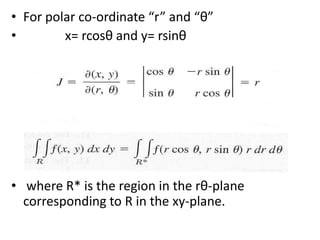
For polar co-ordinate “r” and “θ”              x= rcosθ and y= rsinθ where R* is the region in the rθ-plane corresponding to R in the xy-plane.

Double Integrals

  • 1.
  • 2.
    DEFINITE LINE INTEGRALDOUBLEINTEGRALWe integrate a function f(x,y),called integrand , over a closed bounded region R in the xy-plane , whose boundary curve has a unique tangent at each point, but may have finitely many cusps ( such as vertices of a triangle or rectangle).
  • 3.
    We subdivide theregion Rby drawing parallel to “x” and “y” axes. We number the rectangles that are within R from 1 to n. In each such rectangle we choose a point, say, in the kth rectangle, and then we form the sum
  • 4.
    Where is the area of the kth rectangle. This we do for larger and larger positive integers n in a completely independent manner but so that the length of the maximum diagonal of the rectangles approaches zero as n approaches infinity. In this fashion we obtain a sequence of real numbers Assuming that f(x,y) is continuous in R and R is bounded by finitely many smooth curves , one can show that this sequence converges and its limit is independent of the choice of subdivisions and corresponding points .
  • 5.
    This limit iscalled the DOUBLE INTEGRAL of f(x,y) over the region R and is denoted by
  • 6.
    PROPERTIES f(x,y) &g(x,y) continuous in a region R
  • 7.
    Furthermore, there existsat least one point in R such that we have Where A is the area of R ; this is called the MEAN VALUE THEOREM for double integrals.
  • 8.
    EVALUATION OF DOUBLEINTEGRAL(1)Suppose that R can be described by inequalities of the formrepresents the boundary of R . Then
  • 9.
  • 10.
    (2)Suppose that Rcan be described by inequalities of the formso that represents the boundary of R . Then
  • 13.
    NOTE:- if Rcan not be represented by those inequalities, but can be subdivided into finitely many portions that have that property , we may integrate f(x,y) over each portion separately and add the results; this will give us the value of the double integral of f(x,y) over that region R.
  • 14.
    APPLICATION OF DOUBLEINTEGRALSThe AREA A of a region R in the xy-plane is given by the double integralThe VOLUME V beneath the surface z= f(x,y)>0 and above a region R in the xy-plane is
  • 15.
    because theterm f in at the beginning of this section represents the volume of a rectangular parallelepiped with base and altitude f
  • 16.
    Let f(x,y) bethe density ( mass per unit volume) of a distribution of the mass in the xy-plane. Then the total mass M in R is The CENTER OF GRAVITY of the mass in R has the co-ordinate where &
  • 17.
    The MOMENT OFINERTIA of the mass in R about the “x” and “y” axis respectively , areThe POLAR MOMENT OF INERTIA about the origin of the mass in R is
  • 18.
    CHANGE OF VARIABLESIN DOUBLE INTEGRALSHere assume that x=x(u) is continuous and has a continuous derivative in some interval such that and x(u) varies between “a” and “b” when “u” varies from α and β.
  • 19.
    The formula forthe change of variables in from “x”, ”y” to “u”, “v” is that is the integrand is expressed in terms of “u” and “v” , and “dxdy” is replaced by “du dv” times the absolute value of the JACOBIAN .
  • 20.
    Here we assumethe following. The functions x=x(u,v) y=y(u,v) effecting the change are continuous and have continuous partial derivatives in some region R* in the uv-plane such that the point (x,y) corresponding to any (u,v) in R* lies in r and, conversely , to every (x,y) in R there corresponds one and only one (u,v) in R*; furthermore the JACOBIAN J is either positive throughout R* or negative throughout R*.
  • 21.
    For polar co-ordinate“r” and “θ” x= rcosθ and y= rsinθ where R* is the region in the rθ-plane corresponding to R in the xy-plane.